Nuclear lobby gets its tentacles into education in India

By India Education Diary Bureau Admin -November 11, 2020, Noida: Shiv Nadar School, Noida, (a not-for-profit initiative of the Shiv Nadar Foundation in K12 education) organized the first-of-its-kind Energy Boot Camp as part of its STEAM (Science, Technology, Engineering, Art, and Math) program to bring awareness about clean energy, climate change and sustainability.The Boot Camp was organized virtually in association with the Indian Youth Nuclear Society (IYNS), from November 6 to 8, 2020 and witnessed participation from around 2000 students (Grade 6 to 12)…….. https://indiaeducationdiary.in/shiv-nadar-school-hosts-virtual-boot-camp-on-nuclear-energy-climate-change-and-sustainability/
Despite propaganda from nuclear front group ”Third Way”, research shows that nuclear power as carbon reducer is counter-productive
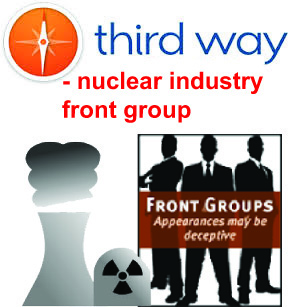 For many scientists — and Bill Gates — nuclear energy is part of the answer to the world’s climate-change problem. The market for nuclear power could triple by 2050 across the world, according to a recent study by Third Way, a U.S.-based think tank. There are more than 60 advanced reactor designs in development in the U.S., the Atlantic Council, a U.S. think tank, said in a paper.
data from 123 countries over a 25-year period, examining how the introduction of either nuclear-power or renewable-energy sources affects each country’s levels of carbon emissions.
Very dubious claims made by proponents of NuScam’s small nuclear reactor plans
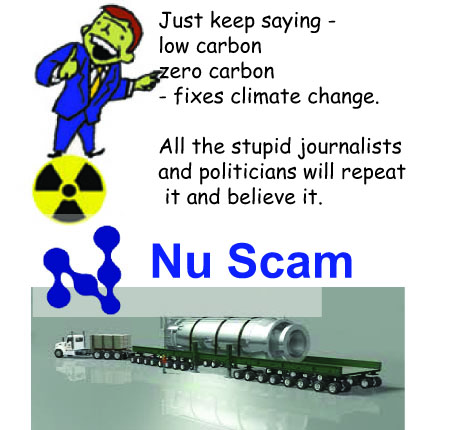 Small Nuclear Reactors Would Provide [a dubious claim] Carbon-Free Energy, but Would They Be Safe? Inside Climate News, Jonathan Moens, -21 Oct 20 Regulators have approved designs for 12 small reactors to be built in Idaho, but opponents say the project is dangerous and too late to fight climate change. “……… Last month, U.S. officials approved NuScale Power’s designs for 12 small nuclear reactors to be built in Boise, Idaho. The reactors could make use of the water, transmission lines and general infrastructure of former coal-powered plants in the West to produce clean energy, said Jose Reyes, co-founder of the company.
NuScale said the energy produced by its reactors would generate enough electricity to power about 50,000 homes across six Western states. The Utah Associated Municipal Power Systems, an energy cooperative, would be the first to build the reactors on a federal site at the Idaho National Laboratory.
The NuScale Power initiative has met with opposition from local environmental groups, who say that nuclear power is a dangerous and unsustainable energy source.
In addition, the highly radioactive waste from nuclear reactors must be securely stored indefinitely to prevent accidents, and contains plutonium and uranium that can be reprocessed into nuclear weapons. “We see this project as a way to create a whole new generation of high level radioactive waste,” said Scott Williams, executive director of Healthy Environment Alliance of Utah, a nuclear watchdog. ……
The designs underwent a public health and safety review by the Nuclear Regulatory Commission. But some scientists think they still aren’t safe enough. In a public statement, Edwin Lyman, director of nuclear power safety with the Union of Concerned Scientists, cited a report by a senior engineer at the Nuclear Regulatory Commission expressing concern that the cooling process might inadvertently cause “catastrophic” core damage to the reactors.
Other scientists worry that NuScale may be getting ahead of itself by not having a planning protocol for a radioactive emergency that affects areas around the site.
“In the event of an accident, the people around there will not have rehearsed how to do an evacuation,” said M.V. Ramana, a professor in the School of Public Policy and Global Affairs at the University of British Columbia. …….
Too Late in a Climate Crisis?
The municipal power systems cooperative still needs to obtain a license to build and begin operating the reactors. To do so, the project will undergo an additional site-specific review to consider the potential ecological, geographic and residential impact the technology may have on the area, said George Griffith, lead technician at the Idaho National Laboratory.
The delay means that while NuScale will be ready to manufacture modular reactors by around 2024, it will take an additional five to six years for them to be operational at the Idaho site, said Reyes.
Some experts, however, question whether 2029 is too late for the technology to be relevant in a time of climate crisis…….
Ramana, of the University of British Columbia, said, “While the overall capital cost [for small modular reactors] might be smaller, they also generate smaller amounts of electricity.” He outlined his concerns in a report released in September urging the Utah energy cooperative to “end their pursuit of small modular reactors.”
Ramana made clear that while devastating incidents associated with nuclear power plants might seem unlikely, we need to remain cautious.
“The lesson we should learn from all the many nuclear and other accidents that have happened with hazardous technologies, is a little bit of humility,” he said. https://insideclimatenews.org/news/20102020/small-nuclear-reactors-carbon-free-energy
Anti-science in America – climate denial to coronavirus denial
 America re-discovers anti-science in its midst, Environmental Health News,16 Oct 20
Fauci, Birx, Redfield & Co. are in the middle of a political food fight. They could learn a lot from environmental scientists.
Let’s start with the story of a scientist who beat back a powerful global denial movement without any help from social media or modern, sophisticated organizing campaigns.
It took Galileo 359 years to wrangle an apology out of the Vatican for his heretical belief that the Earth revolved around the sun.
I’m glad he didn’t take it personally. Science denial is neither new nor purely American—but we sure are finding ways to make it lethal and lasting.
Climate scientists have been dealing with anti-science, largely unnoticed by the general public, for 20 years. Doctors face a growing wave of anti-vaccination zealots. Now a pandemic with a seven-figure global death toll and a stranglehold on the world’s economy has opened the doors wide for some multi-front anti-science blowback.
Americans, many refusing to wear masks and ignoring social distancing guidelines, appear to be gathering at frat parties, raves, political rallies, nightclubs and more in defiance of what credentialed experts say are the most vital ways to restrict the spread of COVID-19.
Major sporting events, notably college football, are backing down from previously self-imposed restrictions.
And, lo and behold, positive test rates are going back up in a big way.
Past is deadly prologue
Here are a couple recent, high profile examples of anti-science fervor in the U.S.:………
But nothing in science can quite match the decades-long assault on climate science and climate scientists. On the high end, there are PR campaigns backed by fossil fuel money, well-heeled litigation, and unhinged attacks from national pols and pundits. Then, there are the confounding, face-palming antics of the Coal Rollers—pickup truck owners who modify their rides with “Prius Repellent”—thick sooty black smoke intended to make a bizarre anti-science, pro-climate denial statement. Yes, people do this.
Penn State’s Michael Mann is arguably the highest-profile climate scientist in the U.S. Let’s make a minor leap of faith and say Mann’s climate stature is the closest equivalent to Dr. Anthony Fauci’s standing on coronavirus.
Right now, Dr. Fauci’s main public tormentor is President Trump. Their conflicts are tame compared to the deniers’ gang-up on Mann, which has lasted more than a decade and may offer Fauci a few tips on being a scientist in the middle of a political peeing match…….
Make no mistake, Fauci’s a heroic public servant in an awful bind who, as far as I know, may not even be interested in the killer tell-all book that now resides in his head.
But after COVID-19 is finally conquered, Mike Mann and a thousand others will still be getting bashed, and the worst impacts of climate change will still be ahead of us.
Peter Dykstra is our weekend editor and columnist and can be reached at pdykstra@ehn.org or @pdykstra.
Hypocrisy prize to U.S. International Development Finance Corporation (DFC), for pretending that NuScam’s Small Nuclear Reactors are ”foreign aid”

|
DFC Convenes U.S., African Leaders for Investment Conference, U.S. International Development Finance Corporation (DFC), October 16, 2020 Announces new efforts aimed at bolstering agency’s reach across continent. WASHINGTON – Today, U.S. International Development Finance Corporation (DFC) and the Atlantic Council hosted the virtual Investing in Africa’s Future conference to bring together African heads of state, senior U.S. government officials, African development finance institutions and others to announce new efforts to promote and strengthen U.S. trade and investment in Africa, in support of the Administration’s Prosper Africa Initiative…….. DFC made the following announcements during the summit: …………
LOI for Nuclear in South Africa: In July 2020, DFC updated and modernized its nuclear energy policy—ending its prohibition on supporting nuclear power in order to help meet the energy needs in the developing world. DFC signed a Letter of Intent to support NuScale, a U.S. nuclear energy technology firm, to develop 2,500 MW of nuclear energy in South Africa. If successful, NuScale would be the first U.S. nuclear energy IPP on the continent and would help support energy resilience and security in one of Africa’s leading economies and a key partner on the continent for the United States Government……….. https://www.dfc.gov/media/press-releases/dfc-convenes-us-african-leaders-investment-conference
|
|
Promises, promises — the media keeps buying the tired old nuclear spin marketing small reactors

Promises, promises — Beyond Nuclear International– Sometimes it’s “Promises promises”. On other days it’s “Another one bites the dust”.
Nuclear power is failing. So why does news coverage suggest the opposite?
By Linda Pentz Gunter 5 Oct 20, Sometimes it’s “Promises promises”. On other days it’s “Another one bites the dust”………
the unavoidable story, no matter what myths the pro-nuclear propagandists try to spin. Reality has an annoying habit of grabbing the headlines. And right now, those read:
“Fresh delays at EDF’s Flamanville 3”
“Scottish nuclear power station to shut down early after reactor problems”
“Hitachi ‘withdraws’ from £20bn Wylfa project”
“Olkiluoto-3 nuclear power plant 11 months behind latest schedule”
“Nuclear reactor in France shut down over drought”
“Exelon vows to shut down Byron, Dresden nuclear plants”
And so on.
However, despite this breaking news, you have to sort through a lot of aspirational chaff to find these headlines. The majority of articles about nuclear power are still centered around a rosy future as a climate-busting, jobs-providing cornerstone of any energy policy.
And the majority of politicians in countries where nuclear power still holds sway continue to support it. Why do we let them? Because they think we want them to. As linguistic and messaging guru, George Lakoff, so often repeats: “Voters don’t vote their self-interest. They vote their values.”
So when a nuclear company, or a politician, trumpets instant, well-paying jobs, voters line up to support it too. No matter that nuclear jobs are not likely to be instant, safe or long-lasting, will destroy the environment and do nothing for climate change — and even, in the case of promised new nuclear plants like Summer in South Carolina or Wylfa-B in Wales, may never materialize at all. A boost to the local economy is a good soundbite. Why look behind the arras, only to find nothing there?
But when the media looks behind the nuclear arras they find small modular reactors, micro reactors, “new generation” reactors, and the perpetual promise of fusion. And they interpret this as news, even though none of these reactor designs are new and fusion has been decades away for, well, decades.
These “new” nuclear developments are also often reported on as if they are actually happening. Such overstatements are routinely exposed in the annual World Industry Status Report, (a veritable Bible of empirical data, with the 2020 edition just released last week), which looks into the substance of such breaking news and finds it is almost always aspirational. Take a closer look and it is all about plans, not reality.
The same with alleged turncoats. The media love them.
So we get Zion Lights, a refugee from Extinction Rebellion UK, who is getting plenty of ink and headlines for her new found pro-nuclear delusions. She has positioned herself as an ex-co-leader of XR, a false claim the movement has corrected in a thorough takedown of Lights and her boss, Michael Shellenberger, which we published last week………. https://wordpress.com/read/feeds/72759838/posts/2949326488more https://wordpress.com/read/feeds/72759838/posts/2949326488
It’s important to bust the pro-nuclear spin
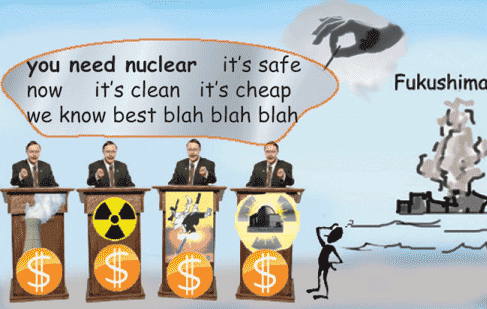
It’s important to bust the pro-nuclear spin, Millennium Alliance for Humanity and the Biosphere (MAHB), Noel Wauchope | October 1, 2020 ”……………. cutting through the spin, where do we start? The reason that I start with the nuclear industry is that it is utterly symbolic of the lies, the deceptions, that prop up the polluting industries that are ruining the natural world on which we depend.
It is the most dangerous arena of industry lying because its proponents have very successfully put across the idea that only the ”experts” those with technical knowledge of nuclear physics, can have a valid opinion. I think that’s why journalists world-wide are content to simply regurgitate industry handouts as ”news” – often as an excited recitation of a sequence of technical procedures, with detailed technical illustrations. The only bit that is easily understood is the bit where they’ll say that nuclear power is “zero-carbon” “essential to combat climate change”. But is that bit true?
Any doubt about nuclear power fixing climate change is not explored, because, after all, the society at large, including the journalists, do not understand nuclear physics. They might know a bit about history, ecology, biology, radiation effects, sociology, economics, indigenous rights, conflict resolution, – but hey, that’s all soft stuff and doesn’t matter.
The lying began with the very conception of the nuclear monster. First, the idea that it’s OK for war attacks to focus on massacring civilians – this reached its greatest acceptance with the atomic bombing of Hiroshima and Nagasaki. Then came that first big factual lie, that this bombing was necessary to end the war. This comfortable belief has been refuted by many recent studies that indicate that the real motive was to intimidate the Russians and that Japan was already set to surrender, anyway. The persecution of Wilfred Burchett, and the suppression of his reporting, set off the deception that the effects of ionizing radiation are not all that bad, really.
The next lie, again a very comforting belief, is that this new horror could be turned into something really good – nuclear reactors, safe, cheap, electricity – a peaceful purpose.
It was never safe. You just ignore the cancers among the uranium mining communities, and nuclear workers. You ignore the many radiological and nuclear accidents and messes, even the big ones – Chalk River, Rocky Flats, Windscale, Soviet ice-breaker Lenin, Mayak, Three Mile Island, Chernobyl, Tomsk, Hanford, Fukushima. The risk of terrorism, using nuclear materials, is ever-present.
It was never cheap. You just ignore the costs of the health and environmental damage due to uranium mining, and to the many accidents. The insurance industry understands this, which is why laws like the Price Anderson Act are there, to make sure that the tax-payer cops the costs of nuclear accidents. You just don’t count the costs of disposing of the virtually eternal radioactive wastes, including dead reactors, and the necessary security involved.
It was never peaceful. The prime purpose of nuclear reactors was to produce that novel element – plutonium, for nuclear weapons. Every country that now has nuclear weapons began that process by getting “peaceful” nuclear power. We must wonder why Gulf states like Saudi Arabia, with abundant oil and sunshine resources, are so keen to get nuclear power. Today, the nuclear industry no longer makes the pretense that there is no connection between commercial and military reactors. and indeed, calls for government subsidy because of its role in national security. It is particularly worrying that the media enthuses over space research, while the USA and other nuclear nations are planning for nuclear-powered weapons in space.
When it comes to global heating, it’s a terrible shame that the media keeps on buying the nuclear deception about this. Even if nuclear power were ”zero-carbon” – there would have to be thousands of reactors, (millions of small ones) operating very quickly, to have any effect. But global heating is happening too fast for that. “Zero carbon” is also nonsense when you consider the whole nuclear fuel chain – those many operations that go on from uranium mining through to the building and operation of nuclear waste dumps.
Nuclear medicine is becoming somewhat of a fig leaf on the industry. It still has its role. But, non-nuclear technologies – cyclotrons are coming into operation, and produce the medical radioisotopes far more conveniently, and near hospitals, close to the point of use.
The nuclear lobby’s most questionable deception, which was shown in its glossy propaganda film “Pandora’s Promise”, is that the world needs endless energy use, for the world’s expanding human population. Indeed, we learn that nuclear is needed to set up colonies on Mars when we’ve mucked up this planet.
Not that the nuclear lobby is the only one advocating endless energy use. Some renewable energy advocates have this same idea. It’s an idea tied to our mistaken culture of growth.
During this period of pandemic economic paralysis, and despite all the suffering, many people have the chance to reflect on the world’s rather perilous situation. Many citizen scientists, citizen journalists, are asking the necessary questions. We need to be aware, to bust through, the vested interests, the jargon, the lies, that keep us hooked to the growth paradigm. There is no better spin bubble to bust than the nuclear one. https://mahb.stanford.edu/blog/its-important-to-bust-the-pro-nuclear-spin/
From 38 million English-language articles, study shows Trump as world’s biggest driver of coronavirus misinformation
 Donald Trump has been the world’s biggest driver of coronavirus misinformation, study finds, SBS News 1 Oct 20, The study from Cornell University looked some 38 million English language articles in traditional media outlets around the world in the first half of this year.
US President Donald Trump has been the world’s biggest driver of COVID-19 misinformation during the pandemic, a study from Cornell University said Thursday.
A team from the Cornell Alliance for Science evaluated 38 million articles published by English-language, traditional media worldwide between 1 January and 26 May of this year.
The database they used aggregates coverage from countries such as the United States, Britain, India, Ireland, Australia, New Zealand and other African and Asian nations.
The authors found that comments by Mr Trump drove major spikes in the “miracle cures” topic, led by his 24 April press briefing where he mused on the possibility of using disinfectants inside the body to cure the coronavirus.
Similar spikes were seen when he promoted unproven treatments like hydroxychloroquine.
“We conclude therefore that the president of the United States was likely the largest driver of the COVID-19 misinformation ‘infodemic’,” the team wrote.
Sarah Evanega, who led the study and is director of the Cornell Alliance for Science, said: “If people are misled by unscientific and unsubstantiated claims about the disease, they may be less likely to observe official guidance and thus risk spreading the virus…….. They identified 522,472 news articles that reproduced or amplified misinformation related to the coronavirus pandemic, or what the World Health Organization has called the “infodemic.”….. https://www.sbs.com.au/news/donald-trump-has-been-the-world-s-biggest-driver-of-coronavirus-misinformation-study-finds
Refuting the nuclear lobby’s nonsense on risks of ionising radiation
Clean Technica 28th Sept 2020, Recently, a report appeared on BBC News, titled “Nuclear power: Are we too anxious about the risks of radiation?” It has been re-posted or restated at a number of news sites since. It says that 28 people died as a direct result of the Fukushima explosion and exposure to the immediateradiation. It goes on to say that there were 15 deaths in the region from thyroid cancer. And the conclusion that it bases on these figures is specifically stated: “[A]ccording to the UN in 2005, just 43 deaths could be directly attributed to the worst nuclear disaster the world has ever seen.”
Really? Just 43 deaths? And this is according to the UN? There is a lot of well documented material on the Chernobyl Disaster available. One article at Wikipedia is, “Deaths due to the Chernobyl disaster.” It states, “[T]here is considerable debate concerning the accurate number of projected deaths due to the disaster’s long-term health effects; long-term death estimates range from up to 4,000 (per the 2005 and 2006 conclusions of a joint consortium of the United Nations) for the most exposed people of Ukraine, Belarus, and Russia, to 16,000 in total for all those exposed on the entire continent of Europe, with figures as high as 60,000 when including the relatively minor effects around the globe.”
https://cleantechnica.com/2020/09/28/is-nuclear-power-as-safe-as-the-bbc-claims/
Indonesia: strong objections to nuclear and “new” fossil fuel technologies being called ”green” energy
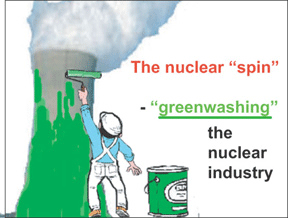 Tug of war: Stakeholders clash over nuclear, fossil fuel addition to green energy bill Norman Harsono, The Jakarta Post Jakarta / Fri, September 25, 2020 Green energy businesses and watchdogs are up in arms over the House of Representatives’ decision to add nuclear and “new” fossil fuel technologies into a landmark green energy bill. Industry players have issued statements and held public hearings with lawmakers over the past two weeks to protest such an addition in the long-awaited New and Renewables Energy (EBT) bill, which promises legal certainty and incentives for listed industries. Nuclear energy, liquefied coal and coal gas – the latter product being pioneered by state-owned coal miner PT Bukit Asam – are all categorized as “new” but not “renewable” in the draft bill, a copy of which was obtained by The Jakarta Post.
Small Nuclear Reactors look good – on paper!
 Lockdown alternatives look good on paper: So do nuclear reactors, Independent Australia, By John Quiggin | 22 September 2020, Amid mounting pressure for a “hands-off” approach to pandemic controls, Professor John Quiggin explains the real costs of the “let her rip” strategy.
BACK IN 1953, the founder of the U.S. naval nuclear program, Admiral Hyman Rickover, drew a striking contrast between “paper reactors” and “real reactors”:
An academic [paper] reactor or reactor plant almost always has the following basic characteristics: (1) It is simple. (2) It is small. (3) It is cheap. (4) It is light. (5) It can be built very quickly. (6) It is very flexible in purpose (“omnibus reactor”). (7) Very little development is required. It will use mostly “off-the-shelf” components. (8) The reactor is in the study phases. It is not being built now.
On the other hand, a practical [real] reactor plant can be distinguished by the following characteristics: (1) It is being built now. (2) It is behind schedule. (3) It is requiring an immense amount of development on apparently trivial items. Corrosion, in particular, is a problem. (4) It is very expensive. (5) It takes a long time to build because of the engineering development problems. (6) It is large. (7) It is heavy. (8) It is complicated.
The tools of the academic-reactor designer are a piece of paper and a pencil with an eraser. If a mistake is made, it can always be erased and changed. If the practical-reactor designer errs, he wears the mistake around his neck; it cannot be erased. Everyone can see it.
Rickover’s insight has been borne out many times, as a long series of new reactor designs, promising power “too cheap to meter”, have come in over time and over budget. The latest such paper reactor, the Small Modular Reactor being developed by NuScale Power recently received design approval from the U.S. Nuclear Regulatory Commission. Quietly tucked away in the announcement was the prediction that the first 12-module plant being developed for Utah Associated Municipal Power Systems would be operational by 2030. Until last week, the announced target was 2027. And when the project was first funded, commercial operation was projected for 2023.
The contrast drawn by Rickover applies equally well to the policies proposed by critics of the elimination and suppression policies adopted around the world in response to the COVID-19 pandemic………..
Unlike Rickover’s paper reactors, these theoretical policies are typically not spelt out in much detail. Rather, the adverse effects of real policies, such as the hardship associated with travel restrictions and the economic cost of lockdowns are pointed out, and it is claimed that it would have been far better to accept a few deaths, mostly of old people who were going to die soon anyway. ….
Broadly speaking, the earlier and more comprehensive the control policy, the better the outcomes in terms of both (market) economic activity and health outcomes. (With a proper understanding of economics, health outcomes are economic outcomes, whether or not they affect market activity). ……..
Ohio’s House Bill 60 – bailing out nuclear power, will not save consumers money.
Groups pushing for repeal of the bailout of Ohio’s two nuclear plants are challenging proponents of House Bill 6 who say the law will save consumers money. Instead, consumer and environmental groups say the legislation will add about $7 to a monthly bill.
Ohio environmentalists and consumer groups dispute the math that’s been used to justify the bailout of Ohio’s two nuclear power plants. They say House Bill 6, passed last summer, actually will increase the cost of the average monthly electric bill a family pays by about $7, not decrease it, as backers of the law say.
Efforts to repeal HB 6 have gained momentum since the indictment this summer of former House Speaker Larry Householder, who has been charged with four others in a $61 million federal bribery and racketeering scandal tied to the legislation.
“Supporters of House Bill 6 and those that are now arguing for no repeal or partial repeal are presenting similar cost savings information that is inaccurate and incomplete,” said Trish Demeter, chief of staff of the Ohio Environmental Council Action Fund……..
environmentalists and consumer groups said Wednesday that those numbers don’t tell the whole story.
Take energy efficiency, for example.
Those programs carried an average monthly fee of $3.36. The programs provide homeowners and small businesses with rebates and incentives to switch out aging appliances and upgrade old equipment that wastes energy.
When you account for the lost efficiency savings, consumers are much worse off,″ said Chris Neme, principal of Energy Futures Group, which has worked on energy efficiency programs.
Demeter said the $1.50-per-month fee to shore up the two coal plants is supposed to end in 2030, but utilities are allowed to defer costs to operate the plants, which can be recovered later from consumers.
“Millions upon millions more (will be) coming out of Ohioans’ pockets and going to into the coffers of Ohio utilities,” she said.
The groups are calling on the legislature to consider the true costs of the bill and then repeal it.
Demeter also said repeal of the bill is necessary to begin to restore the public trust in the legislative process that’s been hurt by the scandal.
“Not repealing the bill as soon as humanly possible is sending a message the legislature is not interested in restoring that trust,” she said. https://www.dispatch.com/business/20200909/savings-from-hb-6-nuclear-bailout-donrsquot-add-up-advocacy-groups-say
EDF made exaggerated and unrealistic claims about local jobs to be provided by Sizewell nuclear power project
Ipswich Star 7th Sept 2020, Independent consultants have challenged the jobs and economic benefits that building a new twin reactor nuclear power station on the Suffolk coast will bring – labelling the claims as “exaggerated” and “unrealistic”.
EDF Energy has said that Sizewell C will give the county’s economy a £125million a year boost and create 25,000 job opportunities during the 10-year construction period and 900 skilled jobs when the power plant is operational. But an independent review of EDF’s Economic Statement, assessing the impacts of Sizewell C on Suffolk’s economy, by research and analysis consultancy Development Economics – commissioned by the Stop Sizewell C campaign – has criticised key aspects of the research and evidence submitted to the Planning Inspectorate.
EDF though insists its project will deliver investment, jobs, skills, education and training for decades to come. And it says its Economic Statement in its planning application is fully compliant with relevant national policy. Development Economics though claimed some aspects were “exaggerated” and “unrealistic”. It questioned EDF’s claim of up to “2,410 jobs for Suffolk residents”, saying this included people travelling from up to 90 minutes away, which covers large population centres in Norfolk and Essex.
It said these local workers will be the overwhelming source of lower skilled roles, expected to fill 90% of jobs in ‘Site Support’ –
cleaners, bus drivers and security guards – compared with only 8% ofroles in professional and management. At peak construction 76% of the workforce will come from further away still and will have to be accommodated in the area.
https://www.ipswichstar.co.uk/news/sizewell-c-independent-economy-report-1-6824930
How to educate American children about nuclear weapons?
|
What’s missing from American schools’ curricula? Nuclear weapons. Bulletin of the Atomic Scientists, By Sara Z. Kutchesfahani, September 3, 2020 This week, students across the United States are heading back to school. While many high schools and universities are still deciding whether classes this semester will happen online, in-person, or in some hybrid combination, one thing is certain: Nuclear weapons are not a standard part of their class curricula.
The answer is fairly simple. Nuclear weapons issues are not a standard part of secondary school education, nor are they widely covered in undergraduate and graduate programs. A 2018 survey of 1,100 high school students in Washington State found that less than 1 percent even knew which countries possessed nuclear weapons. The finding was all the more startling because the students live in a nuclear-armed country themselves, and in an area with a nuclear legacy dating back to the Manhattan Project. While the situation is not as bad at the university level, the number of undergraduate courses that cover nuclear weapons issues is still low. A 2019 study on undergraduate nonproliferation education found that, among 75 of the top-ranked public, private, and military institutions in the country, on average, each institution offered seven such courses over a two-year academic period, or less than two courses per semester. A good way to contextualize that is to compare it to course offerings on climate change—the other most pressing threat to humanity’s survival. The same study found that on that topic, the nation’s three leading public, private, and liberal arts institutions each offered between 19 and 30 courses during just a single academic year (2017–2018). Why does this matter? It matters because the nuclear weapons threat isn’t going away—if anything, it is growing—but the number of people working in the field is shrinking. …. The field is going to need many more bright minds to solve current and future nuclear challenges. Attracting those bright minds starts with building awareness of the issue. And awareness of any issue can be linked to issue exposure. So, if school boards, curriculum writers, and teachers and professors continue to ignore the topic of nuclear weapons and do not include it in class curricula, the public will continue to be unaware of the existential threat these devastating weapons pose to humanity, and the professional field will have difficulty sustaining itself. Nuclear weapons policy is confusing, highly technical, intimidating, shrouded in secrecy, and largely dominated by an awfully small group of men. So those who want to begin exploring the subject may find it exclusive, inaccessible, and hierarchical. But the simple and easy-to-understand fact remains that nuclear war remains a significant global threat……… Here are three relatively easy and practical solutions that teachers and professors can implement this school year—without having to go through too many bureaucratic hurdles. First, check out a new platform that offers a diverse volunteer network of professionals ready to speak with students and teachers about topics, lessons, classes, college, internships, and career advice on nuclear issues. The platform is called NRICHED, and its creators want to empower students with agency to tackle the world’s biggest problems through experiential learning……. Second, consider offering a nuclear security undergraduate class at your institution, and press administrators to recognize its importance. For those whose administrators are hesitant, the Stanton Foundation provides grant support for the development of new nuclear-related courses for undergraduates each academic year…….. Third, enlist the outstanding work of Girl Security, an organization that provides specialized programming for (female) high school students on national security subjects, including nuclear weapons. The Girl Security team helps empower young women with practical training through simulation exercises developed by women national security practitioners. Moreover, they provide girls with placement in a phased mentorship network, pairing them with women national security professionals who are one step ahead of them in their academic and professional advancement……….. https://thebulletin.org/2020/09/whats-missing-from-american-schools-curricula-nuclear-weapons/ |
|
Students unaware of nuclear weapons and the existential threat that they pose
Students Aren’t Learning About Nuclear Weapons. That’s a Major Problem. AT TOP https://www.popularmechanics.com/military/weapons/a33917558/nuclear-weapons-education-in-schools/ Popular Mechanics, BY CAROLINE DELBERT, SEP 4, 2020
- Not enough young people have access to even the option of studying nuclear weapons dynamics, an industry report says.
- Nuclear weapons development continues around the world.
- The current nuclear risk workforce is aging out, with few interested in replacing them.
- At the Bulletin of the Atomic Scientists, innovation advocate Sara Z. Kutchesfahani says the vast majority of U.S. students don’t learn about nuclear weapons in high school, or even in most relevant college coursework. Kutchesfahani says that low level of knowledge, combined with industry factors, means the nuclear workforce itself is about to hit a critical state.
- Kutchesfahani is writing on behalf of an industry thinktank, N Square, a “funders collaborative” that advocates for nuclear threat reduction. She says the lack of flow of new, younger workers into the nuclear sector will create a dangerously unbalanced workforce demographic in an industry that will still need a lot of support for the foreseeable future. Even if nuclear weapons are never used, they must be maintained carefully. If they’re “disarmed” in the future, trained people must handle and dispose of or recycle them.
- In the essay, Kutchesfahani likens nuclear weapons awareness and literacy to the idea of climate change awareness and curricula, because, she says, both are existential threats:
“[I]f school boards, curriculum writers, and teachers and professors continue to ignore the topic of nuclear weapons and do not include it in class curricula, the public will continue to be unaware of the existential threat these devastating weapons pose to humanity, and the professional field will have difficulty sustaining itself.”
Much of nuclear investment in 2020 is in energy—for better or worse, world powers are treating next-generation nuclear power like the next big thing and even using that as a way to underfund investment in wind, solar, hydro, and other sustainable forms of energy.But there has also been a new kind of nuclear warhead developed and now tested in 2020, a low-yield warhead launched from a submarine that, again, is publicly billed as a “deterrent” to other nations’ nuclear aggressions, particularly Russia.
This content is imported from {embed-name}. You may be able to find the same content in another format, or you may be able to find more information, at their web site. - The fact remains that as long as there are nuclear weapons in play on the world stage, the world must realistically discuss them. That’s separate from politics, or even whether advocates are for or against nuclear weapons at all. If someone walked into your home while juggling flaming batons, you’d suddenly wish you had a flaming batons expert to help you decide what to do next.
1 This Month
Chernobyl: The Lost Tapes – A good documentary on Chernobyl on SBS available On Demand for the next 3 weeks– https://www.sbs.com.au/ondemand/tv-program/chernobyl-the-lost-tapes/2352741955560

of the week–London Campaign for Nuclear Disarmament

Tell the Ukrainian Government to Drop Prosecution of Peace Activist Yurii Sheliazhenko
To see nuclear-related stories in greater depth and intensity – go to https://nuclearinformation.wordpress.com
-
Archives
- April 2026 (139)
- March 2026 (251)
- February 2026 (268)
- January 2026 (308)
- December 2025 (358)
- November 2025 (359)
- October 2025 (376)
- September 2025 (257)
- August 2025 (319)
- July 2025 (230)
- June 2025 (348)
- May 2025 (261)
-
Categories
- 1
- 1 NUCLEAR ISSUES
- business and costs
- climate change
- culture and arts
- ENERGY
- environment
- health
- history
- indigenous issues
- Legal
- marketing of nuclear
- media
- opposition to nuclear
- PERSONAL STORIES
- politics
- politics international
- Religion and ethics
- safety
- secrets,lies and civil liberties
- spinbuster
- technology
- Uranium
- wastes
- weapons and war
- Women
- 2 WORLD
- ACTION
- AFRICA
- Atrocities
- AUSTRALIA
- Christina's notes
- Christina's themes
- culture and arts
- Events
- Fuk 2022
- Fuk 2023
- Fukushima 2017
- Fukushima 2018
- fukushima 2019
- Fukushima 2020
- Fukushima 2021
- general
- global warming
- Humour (God we need it)
- Nuclear
- RARE EARTHS
- Reference
- resources – print
- Resources -audiovicual
- Weekly Newsletter
- World
- World Nuclear
- YouTube
-
RSS
Entries RSS
Comments RSS
 nuclear-news