Protesters call on Hopkins University to drop nuclear weapons research
 Protesters call on Hopkins to drop nuclear weapons research The Johns Hopkins Newsletter, By CHRIS H. PARK and MIN-SEO KIM | January 27, 2021 Members of Prevent Nuclear War Maryland, a Baltimore-based anti-war, anti-nuclear weapons organization, protested the University’s involvement in nuclear weapons research with the U.S. government on Friday, Jan. 22. Protesters call on Hopkins to drop nuclear weapons research The Johns Hopkins Newsletter, By CHRIS H. PARK and MIN-SEO KIM | January 27, 2021 Members of Prevent Nuclear War Maryland, a Baltimore-based anti-war, anti-nuclear weapons organization, protested the University’s involvement in nuclear weapons research with the U.S. government on Friday, Jan. 22.The group also celebrated the ratification of the Treaty on the Prohibition of Nuclear Weapons (TPNW) — a legally binding international treaty prohibiting the development, ownership and deployment of nuclear weapons by nation……….. On Friday, around a dozen protesters held bright yellow banners reading “nuclear weapons are illegal” on the Charles Street median and in front of the marble Hopkins sign on the Merrick Gateway, conversing with passers-by. Protesters criticized the University’s engagement with nuclear weapons research at the Applied Physics Lab (APL). Hopkins is the top recipient of federal research and development funds, receiving $2.351 billion in a contract from the U.S. Department of Defense (DOD) in 2019. The International Campaign to Abolish Nuclear Weapons identified Hopkins to be one of the universities involved in developing and maintaining the U.S. nuclear arsenal in its 2019 report. Max Obuszewski, one of the co-founders of Prevent Nuclear War Maryland, said he has been protesting nuclear weapons for over 30 years. He believes that continued development and possession of nuclear weapons poses an existential threat to the world. “Our government is going to spend trillions of dollars to refurbish the nuclear arsenal. We have to make the legislators give us security, like health care and education. We don’t have any of that,” he said. “What we’re doing now is to shame the United States and the nuclear weapons contractors into joining the treaty.” Prevent Nuclear War, the parent organization of the group Obuszewski founded, has worked to mobilize support for the “back from the brink” resolution in local and state governments. The resolution calls on the federal government to renounce its nuclear first-use policy, limit presidential authority to launch a nuclear attack, reduce spending on nuclear weapons research and work with other states to eliminate nuclear weapons. Baltimore was the first major city to endorse its version of the resolution, introduced by then-City Councilman Bill Henry. Because APL research is classified — unlike work in other University divisions — it is unclear how many of its contracts with the DOD are related to nuclear weapons. In an email to The News-Letter, Karen Lancaster, the assistant vice president of external relations for the Office of Communications, noted that the APL was a research division of the University, not an academic one, thus is exempt from the University-wide rule on not allowing classified work……. Lancaster did not comment specifically on APL’s nuclear weapons research program. Dr. Gwen DuBois, a co-founder of Prevent Nuclear War Maryland, stated that the University should turn its efforts to research that would have immediate positive effects on people’s lives. She is an alum of the Bloomberg School of Public Health and teaches part-time at the School of Medicine. “Johns Hopkins University of Medicine has played a great role in the COVID-19 pandemic. That is what we expect of this great institution, but not profiting off immoral and illegal weapons,“ she said. “What we want to see from Hopkins is to pull out from contracts with nuclear weapons. Hopkins is knee-deep in this stuff and isn’t transparent.” Obuszewski also stated that nuclear weapons research is a reckless avenue to allocate University resources. “We think it’s abominable,“ he said. “Especially in this pandemic, let’s not waste all this money on nuclear weapons.” DuBois expressed hope that Hopkins students and faculty would pressure the University leaders to stop engaging in this research, citing the impact made by students who protested the now-suspended plans to create a private police force. “[TPNW] is an opportunity for universities and corporations to reassess what they do. For corporations, it’s going to come from the shareholders. For universities, the pressure’s going to come from the students or professors,“ she said. “There’s nothing that gives us more hope than seeing students help us. If nothing else, if this opens up a dialogue with the University, that would be tremendous: Bring it out into the open and let the University debate this.” https://www.jhunewsletter.com/article/2021/01/protesters-call-on-hopkins-to-drop-nuclear-weapons-research |
|
Universities in collusion with nuclear industry
U.S. universities have continued to build connections to the U.S. nuclear weapons complex. Although students and faculty have opposed university participation in nuclear weapons research and development at various points in the last 70 years, such participation continues.
November 15, 2020 by beyondnuclearinternational https://wordpress.com/read/feeds/2663585/posts/3150281214 An ICAN report
Universities across the United States are identified in this report for activities ranging from directly managing laboratories that design nuclear weapons to recruiting and training the next generation of nuclear weapons scientists. Much of universities’ nuclear weapons work is kept secret from students and faculty by classified research policies and undisclosed contracts with the Defense Department and the Energy Department. The following is the executive summary from ICAN’s report: Schools of Mass Destruction, with some changes made for timeliness.
Over the next ten years, the Congressional Budget Office estimates U.S. taxpayers will pay nearly $500 billion to maintain and modernize their country’s nuclear weapons arsenal, or almost $100,000 per minute. A separate estimate brings the total over the next 30 years to an estimated $1.7 trillion. In a July 2019 report, National Nuclear Security Administrator Lisa Gordon-Haggerty wrote, “The nuclear security enterprise is at its busiest since the demands of the Cold War era.”
In addition to large amounts of funding, enacting these upgrades requires significant amounts of scientific, technical and human capital. To a large extent, the U.S. government and its contractors have turned to the nation’s universities to provide this capital.
Over the next ten years, the Congressional Budget Office estimates U.S. taxpayers will pay nearly $500 billion to maintain and modernize their country’s nuclear weapons arsenal, or almost $100,000 per minute. A separate estimate brings the total over the next 30 years to an estimated $1.7 trillion. In a July 2019 report, National Nuclear Security Administrator Lisa Gordon-Haggerty wrote, “The nuclear security enterprise is at its busiest since the demands of the Cold War era.”
Despite these debates, U.S. universities have continued to build connections to the U.S. nuclear weapons complex. Although students and faculty have opposed university participation in nuclear weapons research and development at various points in the last 70 years, such participation continues.
Universities involve themselves in the nuclear weapons complex through the four channels listed below. In return for this engagement, universities receive funding, access to research facilities, and specific career opportunities for students.
1) Direct Management
A handful of universities directly manage nuclear weapons related activities on behalf of the federal government, retaining contracts worth billions of dollars per year collectively. These include the University of California, Texas A&M University, Johns Hopkins University, the Massachusetts Institute of Technology, and the University of Rochester.
2) Institutional Partnerships
Many of the National Nuclear Security Administration’s (NNSA) sites advertise collaborative agreements with local and national universities. These formal agreements allow the institutions to cooperate on research and share personnel and expertise. They can also provide university researchers access to funding and advanced facilities in the NNSA laboratories. The report highlights more than 30 such agreements with schools in 18 states.
3) Research Programs and Partnerships
In addition to formal institutional partnerships, numerous connections exist between universities and the nuclear weapons complex at the research project level. In a report delivered to Congress in July 2019, the NNSA highlights that more than $65 million in grants were delivered to academic institutions in the last year to support stockpile stewardship. When including grants and subcontracts from the NNSA labs as well, the total amount of funding to universities for research may be higher than $150 million per year.
4) Workforce Development Programs
Former Department of Energy Secretary Rick Perry has written that finding “the next generation workforce of world-class scientists, engineers and technicians is a major priority.” Through university partnerships, vocational training programs and research fellowships, the NNSA creates employment pipelines for the development of its future workforce.
A primary goal of this report is to facilitate a shared understanding of university connections to nuclear weapons research and development. A common factual basis will help communities of university faculty, students and administrations engage in robust internal debates and take action. Universities would not willingly participate today in the production of chemical and biological weapons; for the same humanitarian reasons, no university should seek an association with the other category of weapons of mass destruction: nuclear weapons.
While American universities have played a key role in the development and continuation of nuclear weapons, they can now join U.S. cities and states that have rejected U.S. nuclear weapons and called on the federal government to support nuclear reductions and the Treaty on the Prohibition of Nuclear Weapons. In light of the research presented, this report offers the following recommendations to universities:
Recommendations
• Provide greater transparency into connections with the nuclear weapons complex;
• Stop directly managing nuclear weapons production sites and dissolve research contracts solely related to nuclear weapons production;
• For contracts with dual-purpose research applications, demand greater transparency and create specific processes for ethical review of this research;
• Advocate for reinvestment of weapons activities funding to non-proliferation and environmental remediation efforts; and
• Join cities and state legislatures in urging the federal government to support the 2017 Treaty on the Prohibition of Nuclear Weapons and reverse course on nuclear arms control backsliding.
See the full list of universities.
The above is the Executive Summary of ICAN’s report on US Universities. Read the full report. Beyond Nuclear is a member of ICAN.
In addition to large amounts of funding, enacting these upgrades requires significant amounts of scientific, technical and human capital. To a large extent, the U.S. government and its contractors have turned to the nation’s universities to provide this capital.
At the same time, the United States is shirking its previous commitments to nuclear arms control and reducing nuclear risks despite its obligation under Article VI of the Nuclear Non-Proliferation Treaty to pursue good-faith measures towards nuclear disarmament.
In August 2019, the United States officially withdrew from the landmark 1987 Intermediate-Range Nuclear Forces Treaty, testing a treaty-prohibited missile shortly thereafter. The Trump Administration’s 2018 Nuclear Posture Review expanded the circumstances under which the United States would consider the first use of nuclear weapons and called for the development of two new sea-based low-yield nuclear weapon systems.
Internationally, many member states of the United Nations have recognized the devastating humanitarian and environmental impacts of nuclear weapons: debating, adopting, signing and now ratifying the 2017 Treaty on the Prohibition of Nuclear Weapons.

Rupert Murdoch gets phoney Australia Day Award, thanks to fossil fuel and finance industries
Murdoch’s Australia Day award — brought to you by miners and bankers
Those who promote and profit from fossil fuels have appropriated the phoney awards handed out by the obscure Australia Day Foundation. https://www.crikey.com.au/2021/01/27/rupert-murdoch-australia-day-foundation/– DAVID HARDAKER, JAN 27, 2021
On the face of it it looks to be an extraordinary decision: a prestigious honour bestowed on the media mogul whose recent hits in the United States include helping fan an insurrection against democracy via Fox News and in Australia leading the way on climate change denialism in cahoots with the Morrison government it supports.
The foundation and its awards are backed by a group of international conglomerates including mining giants BHP, Rio Tinto, Woodside and Anglo-American. Australia’s big banks, the National Australia Bank and Westpac, are also in on the act. Another leading name is CQS, the wealthy London hedge fund founded by Australian business figure Sir Michael Hintze.
Hintze is not well known in Australia, but he is at the centre of a powerful network of business and conservative UK and Australian politicians. As we reported last year he has been a force behind the climate-sceptic Global Warming Policy Foundation which has given voice to the views of Tony Abbott and Cardinal George Pell.
Nominally a business outfit, the foundation also blurs the lines with government. It is sponsored by Austrade and uses Australia House, home to the Australian High Commission, in London to hand out its “Australia Day” awards to UK and Australian figures of its choosing.
This year it gave its honorary Australian of the Year in the UK award to Conservative British MP Liz Truss who promoted the cause of Abbott as a trade adviser to the UK government. Past recipients have included Prime Minister Boris Johnson.
Hintze is not well known in Australia, but he is at the centre of a powerful network of business and conservative UK and Australian politicians. As we reported last year he has been a force behind the climate-sceptic Global Warming Policy Foundation which has given voice to the views of Tony Abbott and Cardinal George Pell.
Nominally a business outfit, the foundation also blurs the lines with government. It is sponsored by Austrade and uses Australia House, home to the Australian High Commission, in London to hand out its “Australia Day” awards to UK and Australian figures of its choosing.
This year it gave its honorary Australian of the Year in the UK award to Conservative British MP Liz Truss who promoted the cause of Abbott as a trade adviser to the UK government. Past recipients have included Prime Minister Boris Johnson.
Hintze is not well known in Australia, but he is at the centre of a powerful network of business and conservative UK and Australian politicians. As we reported last year he has been a force behind the climate-sceptic Global Warming Policy Foundation which has given voice to the views of Tony Abbott and Cardinal George Pell.
Nominally a business outfit, the foundation also blurs the lines with government. It is sponsored by Austrade and uses Australia House, home to the Australian High Commission, in London to hand out its “Australia Day” awards to UK and Australian figures of its choosing.
This year it gave its honorary Australian of the Year in the UK award to Conservative British MP Liz Truss who promoted the cause of Abbott as a trade adviser to the UK government. Past recipients have included Prime Minister Boris Johnson.
Quietly, under the brouhaha of the pandemic, the global nuclear lobby prepares a propaganda onslaught

”If you tell a lie big enough and keep repeating it, people will eventually come to believe it. A lie told once remains a lie but a lie told a thousand times becomes the truth ” – Joseph Goebbels
This month, I’ve concentrated my efforts on the ground-breaking and historic  UN Treaty for the Prohibition of Nuclear Weapons coming into force. Of course, the nuclear weapons states will try to destroy that Treaty. Failing destruction, they will aim for pooh poohing and rubbishing that Treaty. Finally they’ll go for a favourite strategy – ignoring it, and hoping that the world will just forget about it.
I don’t think that the world will forget about it. The challenge will be to help those workers and communities that depend on nuclear-weapons-making to be helped out of that toxic situation, and into life-sustaining work and activities.
MEANWHILE, as media and science correctly focus on the global coronavirus pandemic, the issue of nuclear power has pretty much disappeared from view. Nothing is happening?
Not so. Things are happening, and the nuclear lobby is busy planning a big propaganda push – a Goebbels-worthy spinfest, for 2021.
Today, the nuclear weapons industry is pretty much the only reason for”peaceful” nuclear power. ”Peaceful nukes” provide the trained experts, the technology development necessary for the weapons industry. If governments and universities can be persuaded to back commercial nuclear energy, this solves a lot of probems. Especially, it helps to blur the picture on the astronomic costs of nuclear weapons, as quite a lot of costs are covered by ”peaceful” nuclear development.
There’s another pressing reason to keep nuclear power going. It’s the horrible and never-ending cost of shutting down reactors and dealing with their toxic wastes. How much cheaper to just relicense them for 100 years? That way, the present responsible officials will all be gone, and they don’t have to worry about that problem. Heck – they’ve handed it over to our great-grandchildre, What a fine idea! NOT!!
Against this background, the nuclear lobby is girding its loins for the public perception battle.
Armed with lies – that nuclear fixes climate – that it’s cheap, is clean, works great with renewables, essential for society – blah blah, the nuclear lobby is preparing its onslaught. They generally try pretty hard to ignore matters like comparative costs, and wastes problems. But they can just lie again, if put on the spot about such problems.
Just a few quotatios from World Nuclear News :-
The barrier to nuclear is perception“
”addressing perceptions of its alleged drawbacks”
Bilbao y León – “the nuclear industry has responsibly managed all its used nuclear fuel and waste “from day one”.
“We know where every ounce of used nuclear fuel and nuclear waste is because we have been managing it throughout the history of the nuclear industry. …….
“The real challenges to nuclear are external” – ”small modular reactors ..cheaper, safer, better, and going to provide more discreet financial solutions” [the discreet bit is true?]
The government nuclear regulatory authorities are, unfortunately, usually well onside with the industry – in what is known as “regulatory capture”. Again, from World Nuclear News –
”The hurdles advanced nuclear developers face‘ – ””We, as the regulator, are working on building public trust, confidence and social acceptance in these new technologies.’‘
Joseph Goebbels would be proud of the skills of Sama Bilbao y Leon, Director General of the World Nuclear Association. She’s great with language (as the global nuclear lobby has realised, in appointing her, and several other women, to top promotional positions.)
Protest rally against University of Arkansas’ involvement with nuclear weapons corporation
Group protests UA involvement with nuclear corporation, https://www.nwahomepage.com/news/group-protests-ua-involvement-with-nuclear-corporation/ by: Megan Wilson, Jan 22, 2021, FAYETTEVILLE, Ark. (KNWA/KFTA) – Northwest Arkansans join peace groups around the world celebrating an international treaty on prohibiting nuclear weapons.
A group gathered at the University of Arkansas to protest its contract with the nuclear weapons corporation Honeywell International.
Abel Tomlinson is the founder of Arkansas Non-Violence Alliance.
He said the University contradicts its mission statement by building non-nuclear components for the bombs.
“Its mission statement says that they’re ‘determined to build a better world.’ and we belive that building nuclear bombs is the complete opposite of that. Nobody should be having them. They’re endangering everyone, it’s unacceptable,” Tomlinson said.
The University of Arkansas was aware of today’s protest, but did not wish to comment.
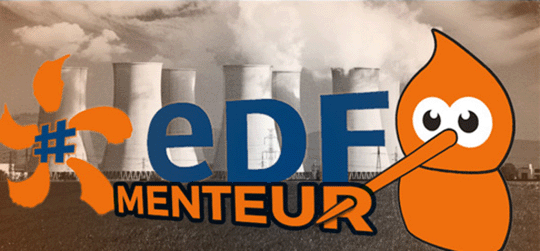
UK’s Centre for Policy Studies about to change its name to Centre for the Promotion of Nuclear Sizewell C?
|
Times 21st Jan 2021. Apparently the Centre for Policy Studies is “Britain’s leading centre-right think tank”. But who knew it was changing its name to the Centre for the Promotion of Sizewell C? Its latest missive comes with a press release headed: “Net zero target at risk without investment in new nuclear”.
And given the report’s general drift, you’d think all 58 pages had been penned by France’s EDF: the cost-overrun and late-delivery specialists behind the consumer-fleecing £22.5 billion Hinkley Point C.
Actually, you’d be wrong. EDF merely “supported” the report. Ask the CPS what that means and it admits it paid for it — or at least “contributed funding”.
True, Britain needs an energy mix…. But Sizewell C? That also brings flood risk and money from the Hong Kong crackdown experts of Beijing.
And the National Infrastructure Commission reckons a “highly renewable power system” plus “flexible technologies”, including hydrogen, “could besubstantially cheaper” than relying on a “fleet of nuclear power plants”. A fake independent report from the CPS hardly improves their
case. https://www.thetimes.co.uk/article/an-airline-takeover-that-might-fly-8t8qbjl07 |
|
Pro nuclear publicist James Conca made a very big gaffe about Fukushima disaster
 Gaffe of the Week: “Nuclear is No Problem At All.” Seattle Met By Erica C. Barnett 3/17/2011 Talk about bad timing: At a little-noticed public hearing in the state house energy, technology, and communications committee last week, representatives from the US nuclear energy industry touted nuclear power as the most important “industry in the history of humanity.” And when pressed about the news coming out of Japan, reassured committee members that there was absolutely no risk of nuclear meltdown from reactors hit by last week’s earthquake…..As Japanese authorities continued today to use ever-more-desperate measures (including water cannons and fire-truck hoses) to cool the melting fuel rods at several of the reactors, the head of the Nuclear Regulatory Administration said at least one reactor was bleeding radiation directly into the atmosphere and said “extremely high” radiation levels near the plant could make it impossible to continue trying to cool the reactors. Gaffe of the Week: “Nuclear is No Problem At All.” Seattle Met By Erica C. Barnett 3/17/2011 Talk about bad timing: At a little-noticed public hearing in the state house energy, technology, and communications committee last week, representatives from the US nuclear energy industry touted nuclear power as the most important “industry in the history of humanity.” And when pressed about the news coming out of Japan, reassured committee members that there was absolutely no risk of nuclear meltdown from reactors hit by last week’s earthquake…..As Japanese authorities continued today to use ever-more-desperate measures (including water cannons and fire-truck hoses) to cool the melting fuel rods at several of the reactors, the head of the Nuclear Regulatory Administration said at least one reactor was bleeding radiation directly into the atmosphere and said “extremely high” radiation levels near the plant could make it impossible to continue trying to cool the reactors.
All of which makes the rosy picture painted by the nuclear industry Friday look even more dubious. After representatives of the nuke industry touted the industry’s safety record—working at a nuclear plant is “safer than working at Toys ‘R’ Us,” Hanford lab director Jim Conca told the committee—committee members asked the industry reps whether they were confident that all the safety systems they’d just praised would hold up in Japan. Asked specifically about the nuclear situation in Japan, Nuclear Energy Institute public affairs director Jim Colgary reassured Rep. Deb Eddy (D-48) that the safety systems in place at the nuclear reactors “absolutely” would come through. “It’s a conservative safety system,” Colgary said…. Conca added: “I’m very happy that Japan has 26 percent nuclear because those will not be the problems. When you see the pictures things burning [in Japan], it won’t be nuclear, it’ll be the gas-fired power plants and things like that. Nuclear is no problem at all.” |
|
|
”Small Modular Reactors”’- governments are being sucked in by the ”billionaires’ nuclear club”

SNC-Lavalin Scandal-ridden SNC-Lavalin is playing a major role in the push for SMRs.
Terrestrial Energy….. Terrestrial Energy’s advisory board includes Dr. Ernest Moniz, the former US Secretary of the Dept. of Energy (2013-2017) who provided more than $12 billion in loan guarantees to the nuclear industry. Moniz has been a key advisor to the Biden-Harris transition team, which has come out in favour of SMRs.
The “billionaires’ nuclear club” …“As long as Bill Gates is wasting his own money or that of other billionaires, it is not so much of an issue. The problem is that he is lobbying hard for government investment.”
Going after the public purse
Bill Gates was apparently very busy during the 2015 Paris climate talks. He also went on stage during the talks to announce a collaboration among 24 countries and the EU on something called Mission Innovation – an attempt to “accelerate global clean energy innovation” and “increase government support” for the technologies.
Gates’ PR tactic is effective: provide a bit of capital to create an SMR “bandwagon,” with governments fearing their economies would be left behind unless they massively fund such innovations.
governments “are being suckers. Because if Wall Street and the banks will not finance this, why should it be the role of the government to engage in venture capitalism of this kind?”
It will take a Herculean effort from the public to defeat this NICE Future, but along with the Assembly of First Nations, three political parties – the NDP, the Bloc Quebecois, and the Green Party – have now come out against SMRs.
|
Mini-Nukes, Big Bucks: The Interests Behind the SMR Push https://watershedsentinel.ca/articles/mini-nukes-big-bucks-the-money-behind-small-modular-reactors/
It’s remarkable that only five years ago, the National Energy Board predicted: “No new nuclear units are anticipated to be built in any province” by 2040.So what happened? The answer involves looking at some of the key influencers at work behind the scenes, lobbying for government funding for SMRs. |

Deceitful nuclear propaganda exposed in ”The Wretched Atom”
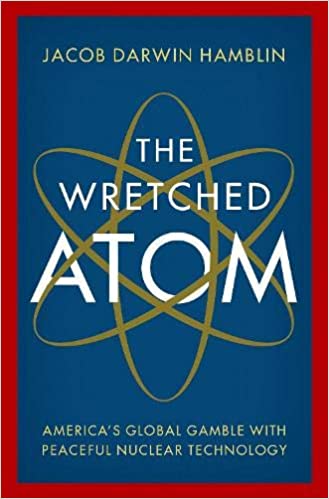
The Wretched Atom https://jacobdarwinhamblin.com/books/the-wretched-atom/
Coming in June 2021 from Oxford University Press
A groundbreaking narrative of how the United States offered the promise of nuclear technology to the developing world and its gamble that other nations would use it for peaceful purposes.
After the Second World War, the United States offered a new kind of atom that differed from the bombs that destroyed Hiroshima and Nagasaki. This atom would cure diseases, produce new foods, make deserts bloom, and provide abundant energy for all. It was an atom destined for the formerly colonized, recently occupied, and mostly non-white parts of the world that were dubbed the “wretched of the earth” by Frantz Fanon.
The “peaceful atom” had so much propaganda potential that President Dwight Eisenhower used it to distract the world from his plan to test even bigger thermonuclear weapons. His scientists said the peaceful atom would quicken the pulse of nature, speeding nations along the path of economic development and helping them to escape the clutches of disease, famine, and energy shortfalls. That promise became one of the most misunderstood political weapons of the twentieth century. It was adopted by every subsequent US president to exert leverage over other nations’ weapons programs, to corner world markets of uranium and thorium, and to secure petroleum supplies. Other countries embraced it, building reactors and training experts. Atomic promises were embedded in Japan’s postwar recovery, Ghana’s pan-Africanism, Israel’s quest for survival, Pakistan’s brinksmanship with India, and Iran’s pursuit of nuclear independence.
As The Wretched Atom shows, promoting civilian atomic energy was an immense gamble, and it was never truly peaceful. American promises ended up exporting violence and peace in equal measure. While the United States promised peace and plenty, it planted the seeds of dependency and set in motion the creation of today’s expanded nuclear club.
In 2021 be aware of the deceitful ”environmental” nuclear front groups
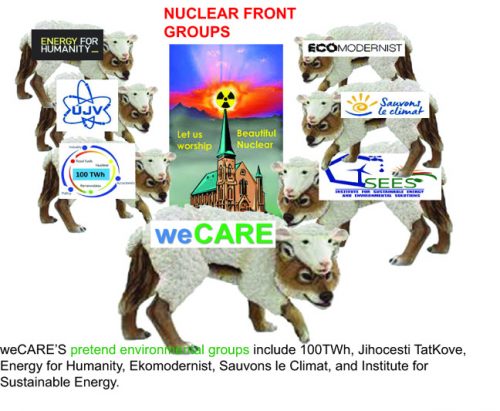
In 2021, The desperate nuclear lobby will be revving up their propaganda.
Their favourite medium for pro nuclear spin is to set up, or take over, an environmental group. These fake environmental groups abound, especially in the USA.
However, Europe has its fair share. They have recently banded to gether to pressure the European Union to include nuclear power in “new green deals”. They’ll peddle the same old lies:
- that dirty nuclear power is “clean”
- that nuclear power (useless against climate change, and very vulnerable to climate change) will “fix climate change”.
- that nuclear power (prohibitively expensive) is ”economical”
- that radioactive trash (a massive unsolved problem)” is ”not a problem”
- that new nuclear power (essential for the nuclear weapons industry) has ”nothing to do with nuclear weapons”
They’ve just sent a letter, a load of absolute codswallop to the European Commission, aserting that nuclear power is essential, and demanding government funding to develop the (non-existent) Next Generation new nuclear gimmicks.
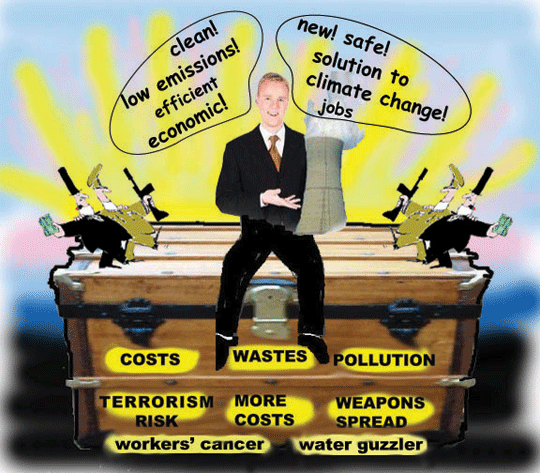
Get ready for a 2021 barrage of pro nuclear spin, from a desperate industry
”Utilities Middle East” and Russia’s Rosatom held a webinar extolling the “benefits” of nuclear power. The panellists went on at length  on how nuclear power is “clean” ”safe” ”economic” – and of course the ”waste problem is solved”, and nuclear is the ”cure for climate change.”
At the end of this hymn of praise, however, there’s a cautionary note.
There’s a question mark over “public acceptance”which means that it is “make or break” time for the industry’s future.
Clearly the world, especially “developing countries”, is in for a barrage of glossy, expensively produced, pro nuclear spin.
|
The barrier to nuclear is perception, says panel, World Nuclear News, 31 December 2020 ” the benefits of nuclear power are clearer than ever, but the industry still has some way to go in addressing perceptions of its alleged drawbacks with cost, safety and radioactive waste. This was the overriding message of the three panellists in a webinar held last week by Utilities Middle East in partnership with Russian state nuclear corporation Rosatom. …….
Public acceptance
Alexander Voronkov, regional vice-president and director of Rosatom’s Middle East and North Africa divisionsaid public acceptance of nuclear energy is vital to the successful implementation of any nuclear power plant project. “It’s make or break. That’s why it’s important to put in place an effective communication programme at the very early stage of an NPP project with the public and the other key stakeholders, to address their concerns. We have learned that if you work with the public constantly and comprehensively it is possible to reach a high level of public acceptance of nuclear power.” In Russia as a whole, that level is as high as 75%, he said………… A low level of public acceptance of nuclear power is usually due to a lack of knowledge, he said, so it is important to create diversified communication programmes to explain, in simple terms, what nuclear energy is and its benefits. “We have developed different tools in line with international best practice, with the Press and NGOs, through the establishment of nuclear energy information centres near construction sites,” he said…… the climate emergency and the post-COVID recovery are spurring policymakers and the financial community, Sama Bilbao y León, director general of World Nuclear Association. said, to increasingly recognise the role that nuclear power can play at a global level. |
|
Untrue: claims that the nuclear bombing of Hiroshima and Nagasaki ended World War 2
 Did the Atomic Bomb End the Pacific War?
The use of the atomic weapon must be seen as a continuation and a start: the  nuclear continuation of the conventional terror bombing of Japanese civilians, and the start of a new “cold war.” Portside, August 2, 2020 Paul Ham
Many historians and most lay people still
believe the atomic destruction of Hiroshima and Nagasaki ended the Pacific War.
They claim with varying intensity that the Japanese regime surrendered unconditionally in response to the nuclear attack; that the bomb saved a million or more Amercian servicemen; that Hiroshima and Nagasaki were chosen chiefly for their value as military targets; and that the use of the weapon was, according to a post-war propaganda campaign aimed at soothing American consciences, ‘our least abhorrent choice’.
The trouble is, not one of these claims is true.
That such denial of the facts has been allowed to persist for 75 years, that so many people believe this ‘revisionist’ line – revisionist because it was concocted after the war as a post-facto justification for the bomb – demonstrates the power of a government-sponsored rewrite of history over the minds of academics, journalists, citizens and presidents.
The uranium bomb dropped on Hiroshima, code-named ‘Little Boy’, landed on the city center, exploding above the main hospital and wiping out dozens of schools, killing 75,000 people, including tens of thousands of school children.
‘Fat Man’, the plutonium bomb used on Nagasaki, incinerated the largest Catholic community in Japan, obliterating the country’s biggest cathedral along with a residential district packed with schools and hospitals. Its missed its original target, the city center.
Zealous apologists for the bomb will have started picking holes: Hiroshima held troops? Yes, a few enfeebled battalions. Hiroshima had military factories? Most were on the outskirts of town, well clear of the bomb. Continue reading
Biden flirts with the fantasy of small nuclear reactors as the cure for climate change
if the nuclear revolution doesn’t happen in the next four years, it’s probably not going to happen
The Green Fantasy and Messy Reality of Nuclear Power. TNR, 23 Dec 20, Biden is flirting with the idea of rejuvenating the industry to help decarbonize the economy—and there are skeptics in spades. Joe Biden will have to do more about climate change than any president before him. He has no choice. Already, close U.S. allies are openly expressing their relief about the end of the ecologically disastrous Trump era while a coalition of left-wing politicians and organizations are demanding sweeping emissions reductions.
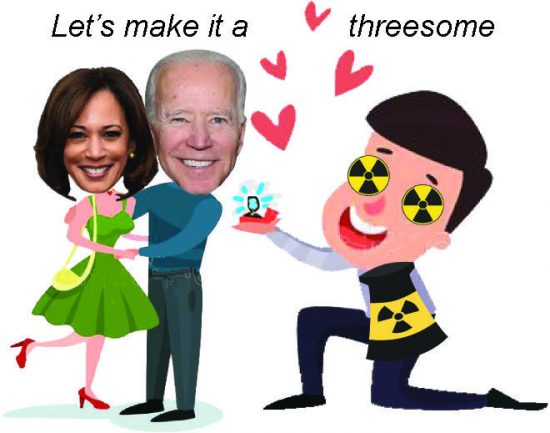 Biden’s campaign climate promises were extensive. But one of the more interesting promises in the plan—and one of the ones key to determining how he approaches emissions reduction—was his promise to “identify the future of nuclear energy.” That means reopening discussion of a technology many environmentalists once thought would be rotting in the dustbin of history by now.
Part of the reason nuclear energy construction remains difficult and expensive in the U.S. is that in polls Americans are split down the middle on their approval of nuclear energy, and opponents make a big stink when construction of a nuclear plant is being discussed. These are rational worries, according to Mark Delucchi, a research scientist affiliated with UC Berkeley and Lawrence Berkeley National Laboratory, which operates on behalf of the U.S. Department of Energy. In addition to the risk of meltdowns—which are, admittedly, rare—we have to also consider the disposal of caches of spent nuclear fuel, the risks of which “are potentially much more abroad in time and space,” Delucchi said. “They affect people. They affect other ecosystems. They affect different generations. And they’re unknown.”
“It kinda boggles my mind how anyone who has any clue about solving problems related to climate or energy still considers nuclear power,” said Mark Jacobson, professor of civil and environmental engineering at Stanford University and a frequent collaborator with Delucchi. As Jacobson pointed out, there’s next to no active construction of nuclear power plants currently going on in the U.S. All of the U.S. nuclear energy construction happening right now consists of two reactors in Georgia that Jacobson says “may never even be finished.”
A project in Utah set to break ground soon was set in motion by politicians accused of conflicts of interest, and construction of that plant has faced opposition from activists since its inception. In 2017, two U.S. nuclear reactor projects were canceled after construction had begun, leaving investors on the hook for billions of dollars. “So people are trying to say that we should build lots of these things that you can’t even build one of?” Jacobson said.
Despite the near impossibility of constructing one of these plants, greater federal investment in nuclear energy appears to be on the table. Biden’s transition team includes Rachel Slaybaugh, a Berkeley nuclear engineer. The Senate Committee on Energy and Public Works earlier this month approved a bipartisan bill aimed at protecting existing nuclear infrastructure, developing new nuclear technology, and supporting uranium mining.
 America’s pro-nuclear voices tend to hail from the aggressively moderate part of the political spectrum. The centrist think tank Third Way says on its website that “advanced nuclear is shaping up to be a key component in our race to zero emissions.” House Minority Leader Kevin McCarthy conceded in February that climate change is real—a step not all Republicans have taken—but claimed that the Democrats are going about trying to fix it all wrong. We should be, McCarthy wrote on his website, “investing in clean energy technology that will lead to less emissions, lower costs, and produce as much or more power. Chief among them is advanced nuclear technology.”
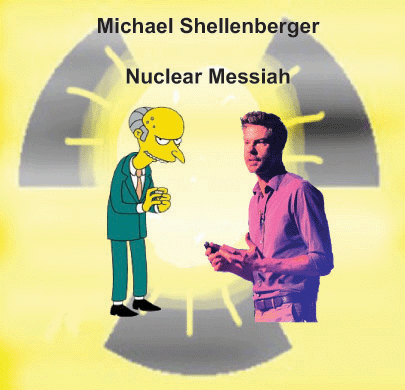
Rather predictably for anyone who follows this issue, McCarthy’s statement about clean energy (which doesn’t mention wind or solar) includes several citations of rockstar nuclear activist Michael Shellenberger, a guy who doesn’t think climate change is that bad and who has given not one, but two blockbuster TED talks attempting to bodyslam wind and solar, one of which is bluntly named “Why renewables can’t save the planet.” Over 2 million people have watched it on YouTube alone.
The notion that nuclear power is necessary and inevitable is far from a fringe viewpoint. Last year, The New York Times ran an op-ed called “Nuclear Power Can Save the World,” written by three Ph.D.-holders, including cognitive neuroscientist and radical optimist Steven Pinker.
According to this brand of eco-contrarianism, nuclear is not just viable, but the only pragmatic plan for decarbonizing the U.S. energy grid. Built into this message is invariably the idea that plans outlined by environmentalists, activists, and alternative energy proponents are actually doing more harm than good. It’s not that these folks want nuclear to have a seat at the table as humanity negotiates its energy future; they want to nuke-pill the whole climate movement.
But inevitably, this rhetoric has to address the chief problem of nuclear power, which is that it is extremely time-consuming and expensive to build new reactors. The solution, nuclear supporters argue, is to take a modular approach to our nuclear construction. Modularity means minimal  variation at each new site, a streamlined design process, and less of the sort of worksite entropy that slows things down. In other words, cookie-cutter them into the energy landscape as quickly as possible.
There’s reason to be skeptical of this approach. “Claims about the technical and economic attractiveness of modular or small scale nuclear reactors, I think, are potentially especially problematic on the political side of things,” Delucchi said. “A lot of the costs associated with nuclear power are based on technologies that are not commercialized, or even particularly close.”
Plans based on 100 percent renewable energy are routinely criticized for relying on technology not yet available or cost-effective. Clearly, though, that’s also true for nuclear power. Nuclear fans, then, are asking the country to bet on a successful nuclear expansion at a time when we have less than ten years—roughly the time it takes to carry out the relatively smooth construction of a single nuclear power plant—to cut our greenhouse gas emissions by 40–50 percent from 2010, or else we’ll blow past the ugly 1.5 degree warming threshold, according to the Intergovernmental Panel on Climate Change (IPCC), and plunge ourselves into climate chaos. That’s quite a bet.
In practical terms, all Biden has promised to do with regard to nuclear energy is form a research agency, dubbed ARPA-C, and churn out some government reports about it and other energy possibilities. And it won’t be at all surprising if, like Trump, Biden also gives a little boost to uranium mining companies that are desperate to expand their operations.
If ARPA-C’s research into modular reactors produces breakthroughs, more uranium gets mined, regulations fall away, public outcry dies down, and nuclear really turns out to be the answer to climate change, that should become clear by the end of Biden’s first term. If the U.S. is going to come anywhere close to meeting the IPCC’s recommendations for avoiding catastrophic warming through nuclear power, modular nuclear plants will be going up all over the place by January of 2025. We should see ribbons being cut, foundations being poured, and uranium ore well on its way to being enriched. “Small-scale modular” will have to become one of those eye-rollingly overused cliches, like “OK Boomer” or “social distancing.”
None of this seems particularly likely. And if the nuclear revolution doesn’t happen in the next four years, it’s probably not going to happen, given the slow pace of nuclear power construction. All those pragmatic arguments for nuclear energy will probably end up looking as fantastical as a three-eyed fish. https://newrepublic.com/article/160712/green-fantasy-messy-reality-nuclear-power
Nuclear powered electric vehicles? not existing, and not likely
|
One promising option, according to scientists at Argonne National Laboratory, is small nuclear reactors. Engineer Derek Kultgen is leading efforts at Argonne to develop a microreactor — about the size of two home water heaters — that is specifically designed to charge electric trucks at rest stops across the country lacking EV charging stations………… One promising, carbon-free charging option, according to scientists at Argonne National Laboratory, is small nuclear reactors………. Small nuclear reactors could be ideal for e-truck charging, he said……. In August, the Nuclear Regulatory Commission issued a final safety evaluation report endorsing NuScale Power’s small modular nuclear reactor design (Greenwire, Aug. 31). ……. Critics, however, say there’s insufficient evidence that small reactors are safer than nuclear power plants. It could also take years before they’re ready to be deployed, whereas new solar and wind resources could be built much more quickly. The microreactor being designed at Argonne, for example, is not being planned for construction at this point. NuScale’s design is the first to gain approval by the NRC, and even that project is still more than one year away from coming online, said Edwin Lyman, director of nuclear power safety at the Union of Concerned Scientists. Many proposed microreactor applications — including this one from Argonne — are inappropriate uses of nuclear energy, according to Lyman. “The Department of Energy is desperately trying to think of applications for all sorts of nuclear reactors, no matter how improbable or impractical they are, and I think this is a good example,” he said…….. Cost, security questionsWhile the concept is worth considering as a potential charging tool, some issues would need to be addressed before truck stop microreactors could become a reality, said Rick Mihelic, director of emerging technologies at the North American Council for Freight Efficiency. Opposition to nuclear power could delay the distribution of the microreactors, he said. A network of microreactors would also add to the country’s nuclear waste problem, for which there is no permanent disposal solution. It could be difficult to make the microreactors economical as well. To overcome that barrier, the researchers would need to find a way to mass-produce them, Buongiorno said. “If they are deployed each a little differently, each built at a different location with a different workforce, then achieving good economics may prove hopeless,” he said. Opposition to nuclear power could delay the distribution of the microreactors, he said. A network of microreactors would also add to the country’s nuclear waste problem, for which there is no permanent disposal solution. It could be difficult to make the microreactors economical as well. To overcome that barrier, the researchers would need to find a way to mass-produce them, Buongiorno said. “If they are deployed each a little differently, each built at a different location with a different workforce, then achieving good economics may prove hopeless,” he said……. https://www.eenews.net/stories/1063719531 |
|
American universities in the US nuclear weapons complex

US universities should reject, not invest in, nuclear weapons Schools of mass destruction https://beyondnuclearinternational.org/2020/11/15/schools-of-mass-destruction/
American universities in the US nuclear weapons complex
An ICAN report
Universities across the United States are identified in this report for activities ranging from directly managing laboratories that design nuclear weapons to recruiting and training the next generation of nuclear weapons scientists. Much of universities’ nuclear weapons work is kept secret from students and faculty by classified research policies and undisclosed contracts with the Defense Department and the Energy Department. The following is the executive summary from ICAN’s report: Schools of Mass Destruction, with some changes made for timeliness. Posted on November 15, 2020 by beyondnuclearinternational
Over the next ten years, the Congressional Budget Office estimates U.S. taxpayers will pay nearly $500 billion to maintain and modernize their country’s nuclear weapons arsenal, or almost $100,000 per minute. A separate estimate brings the total over the next 30 years to an estimated $1.7 trillion. In a July 2019 report, National Nuclear Security Administrator Lisa Gordon-Haggerty wrote, “The nuclear security enterprise is at its busiest since the demands of the Cold War era.”
In addition to large amounts of funding, enacting these upgrades requires significant amounts of scientific, technical and human capital. To a large extent, the U.S. government and its contractors have turned to the nation’s universities to provide this capital.
At the same time, the United States is shirking its previous commitments to nuclear arms control and reducing nuclear risks despite its obligation under Article VI of the Nuclear Non-Proliferation Treaty to pursue good-faith measures towards nuclear disarmament.
In August 2019, the United States officially withdrew from the landmark 1987 Intermediate-Range Nuclear Forces Treaty, testing a treaty-prohibited missile shortly thereafter. The Trump Administration’s 2018 Nuclear Posture Review expanded the circumstances under which the United States would consider the first use of nuclear weapons and called for the development of two new sea-based low-yield nuclear weapon systems.
Internationally, many member states of the United Nations have recognized the devastating humanitarian and environmental impacts of nuclear weapons: debating, adopting, signing and now ratifying the 2017 Treaty on the Prohibition of Nuclear Weapons.
Despite these debates, U.S. universities have continued to build connections to the U.S. nuclear weapons complex. Although students and faculty have opposed university participation in nuclear weapons research and development at various points in the last 70 years, such participation continues.
Universities involve themselves in the nuclear weapons complex through the four channels listed below. In return for this engagement, universities receive funding, access to research facilities, and specific career opportunities for students.
1) Direct Management
A handful of universities directly manage nuclear weapons related activities on behalf of the federal government, retaining contracts worth billions of dollars per year collectively. These include the University of California, Texas A&M University, Johns Hopkins University, the Massachusetts Institute of Technology, and the University of Rochester.
2) Institutional Partnerships
Many of the National Nuclear Security Administration’s (NNSA) sites advertise collaborative agreements with local and national universities. These formal agreements allow the institutions to cooperate on research and share personnel and expertise. They can also provide university researchers access to funding and advanced facilities in the NNSA laboratories. The report highlights more than 30 such agreements with schools in 18 states.
3) Research Programs and Partnerships
In addition to formal institutional partnerships, numerous connections exist between universities and the nuclear weapons complex at the research project level. In a report delivered to Congress in July 2019, the NNSA highlights that more than $65 million in grants were delivered to academic institutions in the last year to support stockpile stewardship. When including grants and subcontracts from the NNSA labs as well, the total amount of funding to universities for research may be higher than $150 million per year.
4) Workforce Development Programs
Former Department of Energy Secretary Rick Perry has written that finding “the next generation workforce of world-class scientists, engineers and technicians is a major priority.” Through university partnerships, vocational training programs and research fellowships, the NNSA creates employment pipelines for the development of its future workforce.
A primary goal of this report is to facilitate a shared understanding of university connections to nuclear weapons research and development. A common factual basis will help communities of university faculty, students and administrations engage in robust internal debates and take action. Universities would not willingly participate today in the production of chemical and biological weapons; for the same humanitarian reasons, no university should seek an association with the other category of weapons of mass destruction: nuclear weapons.
While American universities have played a key role in the development and continuation of nuclear weapons, they can now join U.S. cities and states that have rejected U.S. nuclear weapons and called on the federal government to support nuclear reductions and the Treaty on the Prohibition of Nuclear Weapons. In light of the research presented, this report offers the following recommendations to universities:
Recommendations
• Provide greater transparency into connections with the nuclear weapons complex;
• Stop directly managing nuclear weapons production sites and dissolve research contracts solely related to nuclear weapons production;
• For contracts with dual-purpose research applications, demand greater transparency and create specific processes for ethical review of this research;
• Advocate for reinvestment of weapons activities funding to non-proliferation and environmental remediation efforts; and
• Join cities and state legislatures in urging the federal government to support the 2017 Treaty on the Prohibition of Nuclear Weapons and reverse course on nuclear arms control backsliding.
See the full list of universities.
The above is the Executive Summary of ICAN’s report on US Universities. Read the full report. Beyond Nuclear is a member of ICAN.

1 This Month
Chernobyl: The Lost Tapes – A good documentary on Chernobyl on SBS available On Demand for the next 3 weeks– https://www.sbs.com.au/ondemand/tv-program/chernobyl-the-lost-tapes/2352741955560

of the week–London Campaign for Nuclear Disarmament

Tell the Ukrainian Government to Drop Prosecution of Peace Activist Yurii Sheliazhenko
To see nuclear-related stories in greater depth and intensity – go to https://nuclearinformation.wordpress.com
-
Archives
- April 2026 (139)
- March 2026 (251)
- February 2026 (268)
- January 2026 (308)
- December 2025 (358)
- November 2025 (359)
- October 2025 (376)
- September 2025 (257)
- August 2025 (319)
- July 2025 (230)
- June 2025 (348)
- May 2025 (261)
-
Categories
- 1
- 1 NUCLEAR ISSUES
- business and costs
- climate change
- culture and arts
- ENERGY
- environment
- health
- history
- indigenous issues
- Legal
- marketing of nuclear
- media
- opposition to nuclear
- PERSONAL STORIES
- politics
- politics international
- Religion and ethics
- safety
- secrets,lies and civil liberties
- spinbuster
- technology
- Uranium
- wastes
- weapons and war
- Women
- 2 WORLD
- ACTION
- AFRICA
- Atrocities
- AUSTRALIA
- Christina's notes
- Christina's themes
- culture and arts
- Events
- Fuk 2022
- Fuk 2023
- Fukushima 2017
- Fukushima 2018
- fukushima 2019
- Fukushima 2020
- Fukushima 2021
- general
- global warming
- Humour (God we need it)
- Nuclear
- RARE EARTHS
- Reference
- resources – print
- Resources -audiovicual
- Weekly Newsletter
- World
- World Nuclear
- YouTube
-
RSS
Entries RSS
Comments RSS
 nuclear-news