Officials reveal cost of shooting down ‘UFOs’ – WSJ
https://www.rt.com/news/572002-cost-shoot-down-ufos/ 24 Feb 23
The military has called off its search for the remains of the three objects, which are now thought to have been harmless balloons.
The Pentagon blew more than $1.5 million to shoot down three mysterious objects spotted in US and Canadian airspace earlier this month, multiple defense officials told the Wall Street Journal, though they suggested the true cost is likely higher.
The $1.5 million figure provided to the Journal on Wednesday only covers the cost of the four AIM-9X Sidewinder missiles used to shoot down the ‘UFOs’ over Alaska, Lake Huron, and the Yukon region in Canada, excluding funds spent by the Coast Guard, Navy, and National Guard in searching for the debris.
The flights used to spot the balloons and eventually shoot them down are not part of the cost estimates, because the US military considers the flights part of its pilots’ training and has already budgeted those flight hours,” the outlet added, citing the defense officials.
One of the missiles failed to hit its target, requiring another $400,000 Sidewinder to send the unidentified object plummeting into one of Michigan’s Great Lakes.
The string of shootdowns came after a Chinese high-altitude balloon entered US airspace in late January, which was also downed by a US fighter jet. While Washington insisted the craft was used for espionage, Beijing rejected the charge, arguing the balloon was used to collect meteorological data and had drifted off course by accident. US officials reached by the Washington Post later acknowledged that China’s version of events could be accurate, noting the balloon may have been pushed into US territory after encountering “strong winds.”
The Chinese balloon appeared to trigger anxiety in the White House, with President Joe Biden ordering the three other objects to be shot down in quick succession soon after the initial incident. However, in an address last week, Biden revealed that intelligence agencies had assessed the objects were “most likely” weather balloons, admitting the military had used sophisticated air-to-air missiles – fired from multi-million-dollar aircraft – to neutralize harmless scientific instruments.
As of last Friday, the military halted its search for the wreckage of the three objects, after officials said poor weather conditions would make them difficult to locate.
Further underscoring the blunder, an Illinois-based hobby group has offered evidence that the device downed over Canada’s Yukon territory was likely one of its ‘pico balloons’ – tiny devices sent high into the atmosphere and tracked by amateur enthusiasts, which usually cost between $12 and $200 to construct. While it remains unclear how the military could have missed the balloon, which had been in the air for 123 days and circled the Earth six times, officials have said the three objects were picked up not long after radar adjustments were made by the North American Aerospace Defense Command (NORAD).
Pentagon-Funded Plymouth University Cancels Anti-War Academic: the militarization of higher education.

Pentagon-Funded Plymouth University Cancels Anti-War Academic: Reflections on How the US Empire Conquered Higher Education, CouterPunch BY T.J. COLES 17 Feb 23,
The US Empire is in the final and most dangerous stages of its quest for what the Pentagon calls “full spectrum dominance.” Having invaded and fought proxy wars in the oil-rich Middle East, it is now trying to break nuclear-armed Russia in another proxy war before attempting “regime change” in nuclear-armed China. We need not tarry on the potential consequences. Professor Noam Chomsky called it 20 years ago: this is hegemony or survival. Which one do you choose?
As the Empire races towards its biggest bet, using humanity and all other species on the planet as gambling chips, anti-war comment is tolerated less and less. For those who want to know what happened to me, see the Annex of this article for the leaked emails and background. Meanwhile, consider what is taking shape.
DELETING THE ENEMY
Critics of Western imperialism are silenced by the Empire’s witting and unwitting minions in increasingly knee-jerk ways. Google, which was developed with CIA money, has de-ranked anti-war websites, driving traffic to state-corporate outlets that promote imperialism. After buying YouTube, it then went on a de-platforming spree, banning and de-monetizing “conspiracy theorists,” left and right, who dare deviate from the increasingly narrow orthodoxy of acceptable thought.
Under the new McCarthyism of RussiaGate, the US Federal Bureau of Investigation has used the pretext of countering foreign disinformation to suspend and terminate political accounts. In 2020, following an evidence-free CNN report alleging that it was a front for the sanctioned nation of Iran, the FBI and Department of Justice seized the US domain for the website of the American Herald Tribune, founded by Dr. Anthony James Hall, who retired from his Canadian university, Lethbridge, following pressure from the Zionist Lobby and from individuals who accused him of being a “conspiracy theorist”—a cheap smear tactic employed against me by a cabal of staff at Plymouth University.
Meanwhile, the Twitter Files have exploded the myth that “social media” are independent corporate actors. Likewise, journalist Dr. Alan Macleod has documented the dozens of former spies now employed to police content at Facebook.
SHAME IS THE GAME
The opinions of self-described fact-checkers—like the Poynter Institute—are amplified by state-corporate media which engage in public humiliation rituals in the hope that retailers will pull magazines, academic institutions will fire staff, digital providers will demonetize accounts, and web hosts will drop entire sites and/or content……….
As governments contract out censorship to “fact-checkers,” critics of Empire are demonetized. Consortium News and Mint Press have seen their PayPal accounts frozen. PayPal’s pro-Trump co-founder, Peter Thiel, has made many millions of dollars from Pentagon contracts. Between 2007 and ’19, US taxpayers gave his Palantir Technologies $1.5 billion via the Department of Defense, particularly to spy on Afghans and Iraqis.
ACADEMIC OBLIVION
The above examples show how the US military and intelligence continue to influence the infrastructure through which much of today’s information travels. Another target is academia. But how serious is the problem?……………………………………………………..
THE MILITARIZATION OF HIGHER EDUCATION
Universities serve a variety of purposes, one of which is the development of new weapons for the US military. In the past, white voices critical of Empire would be tolerated as long as their non-university work did not grind the gears of Empire. That’s how Professor Chomsky, for instance, was able to get arrested protesting mass murder in Vietnam while receiving Pentagon money to undertake his linguistics research.
The technological origins of “full spectrum dominance” can perhaps be traced back to the outgoing Reagan and incoming George H.W. Bush administrations, under whom the Pentagon founded the Multidisciplinary University Research Initiative to further integrate with education and develop tools for things like the so-called Star Wars program (Strategic Defense Initiative). One consequence is that higher education became significantly influenced—maybe not full-spectrum dominated—by the eternal war machine.
By 2015, the Department of Defense (DoD), which in more honest times was called the Department of War, was investing $250 million of taxpayer money in universities. In that year, the DoD decided to look for international partners, of which the Britain was a natural first-choice. The Pentagon’s Basic Research Office Director, Robin Staffin, said: “we decided it was time to formalize cooperation between the U.S. and the U.K.”
DARPA is the Pentagon’s taxpayer-funded innovation arm. It used to stand for the Advanced Projects Research Agency, but PR experts realized that they’d better prefix it with the word “Defense.” In 2016, venture capitalist-turned-DARPA Director, Arati Prabhakar, said: “DARPA is reliant on research universities as one part of this huge ecosystem … [We] draw from the deep foundational research, almost always at places like great universities.”
For instance, the DoD recently said that the universities of Alabama-Huntsville, Florida International, Texas A&M Engineering Experiment Station, and others, have received funding to develop solutions for—are you ready?—“monitoring the health and status of hypersonic aeroshells” (heat shields for space systems, which are core elements of “full spectrum dominance.” The “health and status” of ordinary Americans, who still don’t have free coverage, is less important). Other projects include thermodynamic ducts for hypersonic vehicles sponsored by the usual suspects, like Boeing and Lockheed Martin.
FUNDING PLYMOUTH UNIVERSITY: DARPA’S DRIVE…………………………………………………
CONCLUSION
As universities continue designing weapons of mass murder, thought criminals in Western countries continue to face deplatforming and public shaming. Are their personal fates as severe as those of dissident academics in US-UK-supported regimes, like Saudi Arabia? Of course not. But that is not the point. An obvious chilling effect is created in which scholars striving for social justice and indeed the survival of the planet are silenced. The witting an unwitting minions of Empire are too obtuse to realize that by issuing penalties for expressing opinions, those penalties may one day be imposed upon them.
ANNEX (HISTORY, EMAIL EVIDENCE, REBUTTAL):
MY STORY……………………………………………………………………………….as I have lost my University position as a result of my political views, it is worth considering exactly what I write for Nexus (article by article) and that my articles give a left-wing voice to the so-called conspiracy research community, which is often dominated by right-wingers and apolitical people.
As one can see below, the bulk of my work for Nexus consists of critiques and exposés of US military and intelligence agencies. …………………………………………………………
T. J. Coles is director of the Plymouth Institute for Peace Research and the author of several books, including Voices for Peace (with Noam Chomsky and others) and Fire and Fury: How the US Isolates North Korea, Encircles China and Risks Nuclear War in Asia (both Clairview Books). https://www.counterpunch.org/2023/02/17/pentagon-funded-plymouth-university-cancels-anti-war-academic-reflections-on-how-the-us-empire-conquered-higher-education/
What We Know About The US Air Force’s Balloon Party So Far

https://caityjohnstone.medium.com/what-we-know-about-the-us-air-forces-balloon-party-so-far-6c59b80e7a3d Caitlin Johnstone, 18 Feb 23
You know, everyone’s always talking about how the US military is only ever used to kill foreigners for resource control and generate profits for the military-industrial complex, but that’s not entirely true. Turns out the US military is also used for shooting down party balloons.
In an article titled “Object downed by US missile may have been amateur hobbyists’ $12 balloon,” The Guardian’s Richard Luscombe reports the following:
The Northern Illinois Bottlecap Balloon Brigade says one of its hobby craft went “missing in action” over Alaska on 11 February, the same day a US F-22 jet downed an unidentified airborne entity not far away above Canada’s Yukon territory.
In a blogpost, the group did not link the two events. But the trajectory of the pico balloon before its last recorded electronic check-in at 12.48am that day suggests a connection — as well as a fiery demise at the hands of a sidewinder missile on the 124th day of its journey, three days before it was set to complete its seventh circumnavigation.
If that is what happened, it would mean the US military expended a missile costing $439,000 (£365,000) to fell an innocuous hobby balloon worth about $12 (£10).
“The descriptions of all three unidentified objects shot down Feb. 10–12 match the shapes, altitudes and payloads of the small pico balloons, which can usually be purchased for $12–180 each, depending on the type,” writes Steve Trimble for Aviation Week, who first broke the Bottlecap Balloon Brigade story.
This information would put a bit of a wobble on Senate Majority Leader Chuck Schumer’s comments to ABC’s This Week on Sunday that all three of the balloons shot down through the weekend were Chinese surveillance devices, saying “the Chinese were humiliated” by the US catching them in their sinister espionage plot. If the US air force did in fact just spent millions of dollars shooting down American party balloons, it wouldn’t be the Chinese who are humiliated.
And it looks like that is indeed what happened. On Tuesday the National Security Council’s John Kirby said the “leading explanation” for the three unidentified flying objects that were shot down is that they were “balloons tied to some commercial or benign purpose.” On Thursday President Biden told the press that “The intelligence community’s current assessment is that these three objects were most likely balloons tied to private companies, recreation, or research institutions studying weather or conducting other scientific research.”
And this all comes out after US officials told The Washington Post that the “Chinese spy balloon” which started this historically unprecedented multi-day frenzy of aerial kinetic warfare over North America was probably never intended for surveillance of the United States at all. Experts assess that the balloon was blown over the continent entirely by accident, trying to reconcile that narrative with the contradictory US government claims of intentional Chinese espionage by suggesting that perhaps the Chinese had intended for the balloon to be used for spying on US military forces in the Pacific or something.
So to recap, the US air force shot down a Chinese balloon which US officials have subsequently admitted was only blown over the US by accident, then went on a spree of shooting things out of the sky which it turns out were probably civilian party balloons. The entire American political/media class has been spending the month of February furiously demanding more militarism and more cold war escalations over what is in all probability four harmless balloons.
And what’s really crazy is that they’re probably going to get those increases in militarism and cold war escalations they’ve been calling for, despite the entire ordeal originating primarily in the overactive imaginations of the drivers of the US empire. The shrieking hysterical panic about “Chinese spy balloons” has dwarfed the coverage of the revelations contradicting that narrative, and China hawks have been using the occasion to argue for increases in military spending. The Atlantic’s Richard Fontaine got all excited and wrote a whole article about how the threat of Chinese spy balloons can be used “to rally public concern and build international solidarity” against China.
These are the people who rule our world. They are not wise. They are not insightful. They are not even particularly intelligent. The US empire is a Yosemite Sam cartoon character who at any time can just flip out and start firing Sidewinder missiles at random pieces of junk in the sky, screaming “I’ll blast yer head off ya varmint!” If the US war machine was a civilian human, their family would be quietly talking amongst themselves about the possibility of conservatorship.
These are the last people in the world who should be running things, and they are the last people in the world who should be armed with nuclear weapons. But that’s exactly where we find ourselves in this bizarre slice of spacetime. God help us all.
____________________
Japan PM Kishida tells ministers to assuage public concerns over nuclear policy
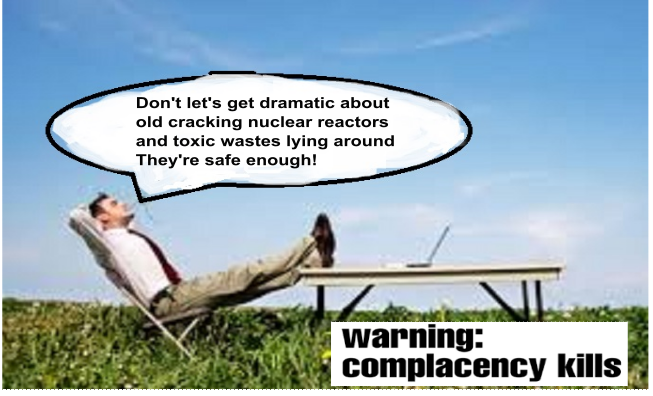
Mainichi, 17 Feb 23, TOKYO (Kyodo) — Japanese Prime Minister Fumio Kishida urged his ministers Friday to assuage public concerns over the government’s planned policy shift that will allow the operation of nuclear power plants beyond the current limit of 60 years.
The instruction came after the country’s nuclear watchdog decided this week to review regulatory standards on the lifespan of nuclear reactors despite one of the five commissioners remaining opposed to the policy in a rare move.
The government plans to submit related bills to parliament during the current session. The revision will enable the operation of reactors for an extended period by excluding the time spent on inspections and other offline periods from their designed service life.
“I was instructed that the Cabinet should decide on the bills after we are ready to provide thorough explanations at the Diet to clear the public’s anxiety,” industry minister Yasutoshi Nishimura told a press conference………………
On Monday, the Nuclear Regulation Authority formally approved the revision by a majority vote after Akira Ishiwatari, a commissioner in charge of earthquake and tsunami countermeasures, opposed it.
The revision “is not based on new scientific or technical findings. It cannot be said to be a shift to the safe side,” Ishiwatari said. Another member also expressed a cautious stance in making decisions too swiftly. https://mainichi.jp/english/articles/20230217/p2g/00m/0na/060000c
Ballooning paranoia: The China threat hits the skies
Thankfully, one or two sober notes of reflection have prevailed, even from within the military-intelligence fraternity. The Center for Strategic and International Studies has issued a few self-evident truths. ‘Balloons are not an ideal platform for spying,’ writes James Andrew Lewis, ‘they are big and hard to hide. They go where the winds take them’. Such instruments ‘would be a strange choice for a technologically advanced and sophisticated opponent’.
Independent Australia, By Binoy Kampmark | 13 February 2023
Hysteria over balloons is a strange thing, writes Dr Binoy Kampmark.
HOT AIR balloons first appeared during the Napoleonic era, where they served as delivery weapons for bombs and undertook surveillance tasks. High-altitude balloons were also used by, of all powers, the United States during the 1950s, for reasons of gathering intelligence, though these were shot down by the irritated Soviets.
On 28 January, a device reported to be a “high-altitude surveillance balloon” entered U.S. airspace in Alaska. It then had a brief spell in Canadian airspace before returning to the U.S. via Idaho on 31 January.
On 4 February, with the balloon moving off the coast of South Carolina, a decision was made by the U.S. military to shoot it down using an F-22 Raptor from the First Fighter Wing based at Langley Air Force Base. The Pentagon has revealed that the collection of debris is underway.
In response, the Chinese Foreign Ministry issued a stern note of disapproval, protesting:
‘The US attack on a civilian unmanned airship by force.’
This was ‘a clear overreaction and a serious violation of international practice’. Beijing also issued a note of apology, regretting ‘the unintended entry of the ship into U.S. airspace due to force majeure’.
A U.S. State Department official, while noting the statement of regret, felt compelled to designate:
‘The presence of this balloon in our airspace [as] a clear violation of our sovereignty as well as international law.’
Rumours of a second Chinese balloon flying across Latin America were also confirmed by a spokesperson of the Chinese Foreign Ministry on 6 February, who described it as being “of a civilian nature and is used for flight tests”.The instrument had been impaired by weather in its direction, having “limited self-control capabilities”.
The Pentagon’s press secretary, Brigadier General Pat Ryder, also confirmed the existence of the second balloon, reaching the predictably opposite conclusion to his Chinese counterparts:
“We are seeing reports of a balloon transiting Latin America. We now assess it is another Chinese surveillance balloon.”
This overegged saga has seen much airtime and column space dedicated to those in the pay of the military-defence complex. Little thought was given to the purpose of such a seemingly crude way of collecting military intelligence. Timothy Heath of the Rand Corporation went so far as to extol the merits of such cheeky devices. For one thing, they were hard to detect, making them somehow reliable.
General Glen VanHerck, commander of North American Aerospace Defense Command and U.S. Northern Command, made reference to a number of Chinese spy balloons that supposedly operated with impunity during the Trump Administration. “I will tell you that we did not detect those threats,” he said. This had resulted in a “domain awareness gap that we have to figure out”.
The begging bowl for even larger defence budgets is being pushed around the corridors of power.
Lawyers of international law have also had their say, reaching for their manuals, and shaking their heads gravely. Donald Rothwell of the Australian National University thought that:
‘The incursion of the Chinese balloon tested the boundaries of international law.’
Thankfully, one or two sober notes of reflection have prevailed, even from within the military-intelligence fraternity. The Center for Strategic and International Studies has issued a few self-evident truths. ‘Balloons are not an ideal platform for spying,’ writes James Andrew Lewis, ‘they are big and hard to hide. They go where the winds take them’. Such instruments ‘would be a strange choice for a technologically advanced and sophisticated opponent’.……………………………..
The Chinese explanation has been scoffed at and derisively dismissed. Yet balloons are an almost quotidian feature of scientific and meteorological work, whatever the official explanation offered by Beijing might be. NASA’s own Scientific Balloon Program, for instance, has been most engaged of late.
The organisation was keen to tout its fall 2022 campaign involving six scientific, engineering and student balloon flights in support of 17 missions.
The scale of any one mission be sizeable. ‘Our balloon platforms’, came the description from NASA’s Scientific Balloon chief Debbie Fairbrother, ‘can lift several thousand pounds to the edge of space, allowing for multiple, various scientific instruments, technologies, and education payloads to fly together in one balloon flight’.
The disproportionate nature of Washington’s reaction to Beijing over such balloons also looks rather odd in the face of the vast surveillance technologies it deploys against adversaries and friends.
But politics is not merely the art of the possible but an opportunity for the absurd to find form and voice. On this score, the mouse has clearly terrified the elephant. https://independentaustralia.net/politics/politics-display/ballooning-paranoia-the-china-threat-hits-the-skies,17230
Media ‘Spy Balloon’ Obsession a Gift to China Hawks
The Pentagon says it believes this spy balloon doesn’t significantly improve China’s ability to gather intelligence with its satellites.
Minimizing US provocation
The unstated premise of much of this coverage was that the US was minding its own business when China encroached upon it–an attitude hard to square with the US’s own history of spying.
JULIANNE TVETEN 10 Feb 23 https://fair.org/home/media-spy-balloon-obsession-a-gift-to-china-hawks/
For over a week, US corporate media have been captivated by a so-called “Chinese spy balloon,” raising the specter of espionage.
NBC News (2/2/23), the Washington Post (2/2/23) and CNN (2/3/23), among countless others, breathlessly cautioned readers that a high-altitude device hovering over the US may have been launched by China in order to collect “sensitive information.” Local news stations (e.g., WDBO, 2/2/23) marveled at its supposed dimensions: “the size of three school buses”! Reuters (2/3/23) waxed fantastical, telling readers that a witness in Montana thought the balloon “might have been a star or UFO.”
While comically sinister, the term “Chinese spy balloon”—which corporate media of all stripes swiftly embraced—is partially accurate, at least regarding the device’s provenance; Chinese officials promptly confirmed that the balloon did, indeed, come from China.
What’s less certain is the balloon’s purpose. A Pentagon official, without evidence, stated in a press briefing (2/2/23) that “clearly the intent of this balloon is for surveillance,” but hedged the claim with the following:
We assess that this balloon has limited additive value from an intelligence collection perspective. But we are taking steps, nevertheless, to protect against foreign intelligence collection of sensitive information.
Soon after, the Chinese Ministry of Foreign Affairs’ website (2/3/23) stated that the balloon “is of a civilian nature, used for scientific research such as meteorology,” according to a Google translation. “The airship,” the ministry continued, “seriously deviated from the scheduled route.”
Parroting Pentagon
Despite this uncertainty, US media overwhelmingly interpreted the Pentagon’s conjecture as fact. The New York Times (2/2/23) reported that “the United States has detected what it says is a Chinese surveillance balloon,” only to call the device “the spy balloon”—without attributive language—within the same article. Similar evolution happened at CNBC, where the description shifted from “suspected Chinese spy balloon” (2/6/23) to simply “Chinese spy balloon” (2/6/23). The Guardian once bothered to place “spy balloon” in quotation marks (2/5/23), but soon abandoned that punctuation (2/6/23).
Given that media had no proof of either explanation, it might stand to reason that outlets would give each possibility—spy balloon vs. weather balloon—equal attention. Yet media were far more interested in lending credence to the US’s official narrative than to that of China.
n coverage following the initial reports, media devoted much more time to speculating on the possibility of espionage than of scientific research. The New York Times (2/3/23), for instance, educated readers about the centuries-long wartime uses of surveillance balloons. Similar pieces ran at The Hill (2/3/23), Reuters (2/2/23) and the Guardian (2/3/23). Curiously, none of these outlets sought to provide an equivalent exploration of the history of weather balloons after the Chinese Foreign Affairs statement, despite the common and well-established use of balloons for meteorological purposes.
Even information that could discredit the “spy balloon” theory was used to bolster it. Citing the Pentagon, outlets almost universally acknowledged that any surveillance capacity of the balloon would be limited. This fact apparently didn’t merit reconsideration of the “spy balloon” theory; instead, it was treated as evidence that China was an espionage amateur. As NPR’s Geoff Brumfiel (2/3/23) stated:
The Pentagon says it believes this spy balloon doesn’t significantly improve China’s ability to gather intelligence with its satellites.
One of Brumfiel’s guests, a US professor of international studies, called the balloon a “floating intelligence failure,” adding that China would only learn, in Brumfiel’s words, at most “a little bit” from the balloon. That this might make it less likely to be a spy balloon and more likely, as China said, a weather balloon did not seem to occur to NPR.
Reuters (2/4/23), meanwhile, called the use of the balloon “a bold but clumsy espionage tactic.” Among its uncritically quoted “security expert” sources: former White House national security adviser and inveterate hawk John Bolton, who scoffed at the balloon for its ostensibly low-tech capabilities.
Minimizing US provocation
The unstated premise of much of this coverage was that the US was minding its own business when China encroached upon it–an attitude hard to square with the US’s own history of spying. Perhaps it’s for this reason that media opted not to pay that history much heed.
In one example, CNN (2/4/23) published a retrospective headlined “A Look at China’s History of Spying in the US.” The piece conceded that the US had spied on China, but, in line with the headline’s framing, wasn’t too interested in the specifics. Despite CNN‘s lack of curiosity, plenty of documentation of US spying on China and elsewhere exists. Starting in 2010, according to the New York Times (5/20/17), China dismantled CIA espionage operations within the country.
And as FAIR contributor Ari Paul wrote for Counterpunch (2/7/23):
The US sent a naval destroyer past Chinese controlled islands last year (AP, 7/13/22) and the Chinese military confronted a similar US vessel in the same location a year before (AP, 7/12/21). The AP (3/21/22) even embedded two reporters aboard a US “Navy reconnaissance aircraft that flew near Chinese-held outposts in the South China Sea’s Spratly archipelago,” dramatically reporting on Chinese military build up in the area as well as multiple warnings “by Chinese callers” that the Navy plan had “illegally entered what they said was China’s territory and ordered the plane to move away.”
The US military has also invested in its own spy balloon technology. In 2019, the Pentagon was testing “mass surveillance balloons across the US,” as the Guardian (8/2/19) put it. The tests were commissioned by SOUTHCOM, a US military organ that conducts surveillance of Central and South American countries, ostensibly for intercepting drug-trafficking operations. Three years later, Politico (7/5/22) reported that “the Pentagon has spent about $3.8 million on balloon projects, and plans to spend $27.1 million in fiscal year 2023,” adding that the balloons “may help track and deter hypersonic weapons being developed by China and Russia.”
In this climate, it came as no surprise when the US deployed an F-22 fighter jet to shoot down the balloon off the Atlantic coast (Reuters, 2/4/23). Soon after, media were abuzz with news of China’s “threat[ening]” and “confrontational” reaction (AP, 2/5/23; Bloomberg, 2/5/23), casting China as the chief aggressor.
Perpetuating Cold War hostilities
Since news of the balloon broke, US animus toward China, already at historic highs, has climbed even further.
Secretary of State Antony Blinken postponed a trip to China. President Biden made a thinly veiled reference to the balloon as a national security breach in his February 7 State of the Union address, declaring, “If China threatens our sovereignty, we will act to protect our country.” Rep. Raja Krishnamoorthi, Democratic ranking member of the newly formed House Select Committee on China, asserted that “the threat is real from the Chinese Communist Party.”
Rather than questioning this saber-rattling, US media have dispensed panicked spin-offs of the original story (Politico, 2/5/23; Washington Post, 2/7/23; New York Times, 2/8/23), ensuring that the balloon saga, no matter how much diplomatic decay ensues, lasts as long as possible.
High-altitude surveillance — even balloons — is nothing new. So why the fuss?
There are hundreds of satellites spying on the US, China and Russia, to name just a few countries, so a well-tracked balloon was hardly a threat.
Crikey MICHAEL SAINSBURY, FEB 07, 2023
It was a darkly comic, made-for-media case: a Chinese hot air balloon flying about 20 kilometres over American soil, shot down by a US fighter jet over the weekend. It ignited a fairly confused diplomatic crisis, with China now saying it reserves the right to a response, and has laid bare the fragile state of relations between the world’s two most powerful nations.
The mere existence of the balloon — China claims it was a civilian weather-monitoring device, but the US is convinced it was spying, possibly on nuclear facilities — saw US Secretary of State Antony Blinken cancel his planned visit to meet his Chinese counterpart, Wang Yi.
It’s a worrying setback in efforts by the US and China to steady a relationship tattered by Chinese adventurism — of which the balloon is yet another example — and US determination to contain China’s rise, particularly regarding the technology underpinning,………… (Subscribers only)……….. https://www.crikey.com.au/2023/02/07/china-balloon-surveillance-not-new-why-the-fuss/?su=QUl4aHc5NFlOL2ZuMXRneFE4bjZzQT09
NewsReal: Chinese Balloon: It’s All About The Optics
Sott.net, 05 Feb 2023.
The whole world (i.e., the USA) was stunned this week as a Chinese high-altitude balloon dared traverse the USA before being shot down in a stunning and brave military move by an air-to-air missile fired from an F-22 fighter jet over US waters in the Atlantic.
Bullet dodged?
Er, no. As Joe and Niall explain in this NewsReal, such balloons (Chinese, research, ‘spy’ or otherwise) traverse the US and elsewhere on a regular basis. What’s different this time is that ‘someone’ overruled the Pentagon’s initial assessment that this balloon posed no threat to US national security to instead make a REALLY big deal out of it…
Minister Madeleine King visits Australia’s proposed nuclear waste dump site – methinks the lady doth protest too much.
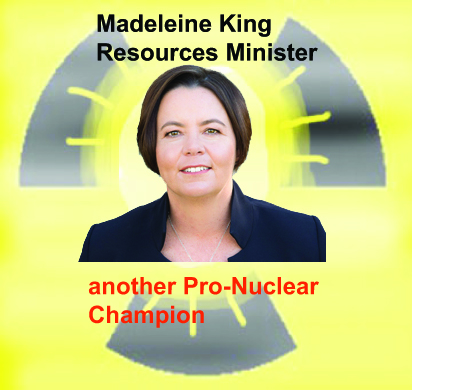
Peter Remta 14 Jan 23 Minister visits Kimba to discuss Nationa Radioactive Waste Management Facility, 13 January 2023
Minister for Resources and Northern Australia, the Hon Madeleine King MP, has visited Kimba to meet with local community members and view the planned site for the National Radioactive Waste Management Facility.
It is going to be a long wait for another 10 years
The town of Kimba, on South Australia’s Eyre Peninsula, has been involved in more than seven years of consultation on the location of Australia’s National Radioactive Waste Management Facility.
Still have not provided a safety case or even details of the radionuclide inventories and activity of the intermediate level waste.
Will the high-level light waste processed in France be included in the storage?
“It was a pleasure to visit Kimba for the first time as Minister for Resources and Northern Australia and meet with community members to understand their views firsthand,” Minister King said.
“I was also able to meet with representatives from the Barngarla Determination Aboriginal Corporation (BDAC) Board in Kimba and other Traditional Owners.”
Minister King said she was strongly committed to protecting the cultural heritage of the site.
If she is so committed why does she continue opposing the Barngarla peoples’ review litigation?
The National Radioactive Waste Management Facility will consolidate Australia’s low level radioactive waste permanently and intermediate level waste temporarily, which is currently stored in more than one hundred locations across the country.
Please correct this total lie as many of the more than one hundred locations handle their own low-level waste and in the federal government’s own previous statements it will be lucky to get 10% of that waste for disposal at the national facility.
Most of this waste comes from nuclear medicine production, which is an essential part of an advanced healthcare system like ours and one that most Australians will benefit from over their lifetimes.
Again please don’t be cute as the waste you are speaking about is the intermediate level waste generated at Lucas Heights in the course of producing nuclear medicine and that should soon be dramatically reduced as the medical profession worldwide is turning away from reactor generated medicine
“As part of my visit, I engaged with a number of local community groups and stakeholders to discuss how the social and economic benefits of the project could be maximised for the local community,” Minister King said.
None of this will in any way improve or safeguard the community from all the potential problems of the aboveground facility and the destruction of its agricultural industry.
“I understand there is a wide range of views about the project in this community and I wanted to listen to those views firsthand.”
Minister King also met members of the community at a sundowner event at the upgraded Kimba Medical Centre, which was funded under the National Radioactive Waste Management Facility Community Benefit Program.
“The upgrades to the Kimba Medical Centre will drive health and social improvements in a community that sorely needs it,” Minister King said.
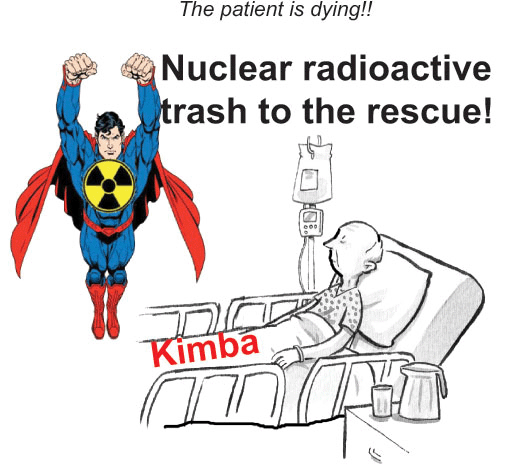
[Ed note: I understood that Kimba was a thriving, healthy community, a State leader in agriculture.
Are we to understand that instead, it is a sickly pathetic situation, and indeed, the radioactive waste dump’s purpose is to be the saviour of this sad place?]
The only benefit of upgrading the so-called medical centre will be hopefully to provide better care for the people who are affected by radiation – and there will be quite a few believe me with the above ground facility.
Other projects funded in previous rounds include the upgrades to the Kimba Medical Centre, resurfacing Kimba District sporting fields, as well as various mental health initiatives.
[Ed. note. I wonder how much mental health and community cohesion have been damaged by this whole nuclear waste fiasco?]
To find out more about the facility, visit: radioactivewaste.gov.au.
It’s all about the bomb: why civilian nuclear power is merely a cover for producing more nuclear weapons

Nuclear weapons are a special kind of horror opposed by most rational people around the world.
the IAEA’s bluntly stated mission is to promote nuclear technology.
Like Atoms for Peace, this repackaging of a military activity as a civilian one succeeded in making the endeavor socially acceptable and somewhat self-funding
The nuclear power-nuclear weapons link can only be broken by a ban on both
It’s all about the bomb — Beyond Nuclear International
Why civilian nuclear power is merely a cover for producing more nuclear weapons
By Alfred Meyer, 8 Jan 23,
The Zaporizhzhia Nuclear Power Station in southeastern Ukraine, Europe’s largest nuclear power plant, has the world’s attention right now, and rightly so. For the first time in history, six nuclear reactors and thirty-seven years’ worth of high-level nuclear waste are in the middle of a battlefield in an active war zone—one artillery shell, on site or off, could interrupt the control and cooling of the operational reactor, or the cooling of the waste in storage, leading to a catastrophic release of radiation that could spread throughout the Northern Hemisphere. How in the world can nuclear power reactors be considered clean and safe sources of electricity?
Russia, a nuclear-armed nation that invaded Ukraine on February 24, 2022, has said that it would use nuclear weapons if needed. And strong allies of Ukraine—the United States, the United Kingdom, and France, all NATO members—are also armed with nuclear weapons.
You likely are aware of what has happened in the weeks since this magazine went to press, and whether or not the world is in the midst of another major radioactive disaster, as happened at Fukushima in Japan in 2011, Chernobyl in northern Ukraine in 1986, and Three Mile Island in the United States in 1979. I assume that if you are reading this, nuclear weapons have not been used in the war in Ukraine. So how has the world ended up in such an existentially threatening situation? Why does the nuclear enterprise have the world’s future so tightly in its grip?
The short answer: nuclear weapons. It is all about the bomb.
In 1939, Albert Einstein wrote to President Franklin D. Roosevelt urging him to pursue nuclear research in the United States. It was crucial, Einstein wrote, to counter Germany’s efforts to harness the magic of radioactivity and develop a super weapon. A few years later, the Manhattan Project was born in secrecy in 1942. A sprawling and tightly controlled academic, military, industrial, and governmental infrastructure was built to accommodate an entirely new industry equal in size to the American automobile industry at the time. Secrecy was so thorough that when Vice President Harry Truman ascended to the presidency on April 12, 1945, upon Roosevelt’s sudden death, he was unaware that the atomic bomb program even existed, much less that it was on the verge of testing a plutonium weapon in July.
During World War II, the United States succeeded in developing atomic weapons, while Germany was defeated before it could do so. Even though Japan was essentially defeated by then, Truman, some three months after he learned that the United States did possess the super weapons, chose to use them. Although the firebombing of Tokyo in March 1945 had burned to death more than 100,000 people and left more than a million people homeless, it did not occasion the global outcry that followed the use of the uranium bomb on Hiroshima, on August 6, 1945, and the plutonium bomb on Nagasaki, three days later. Nuclear weapons are a special kind of horror opposed by most rational people around the world.
However, following the use of nuclear weapons in Japan in 1945, there has been significant ongoing public opposition to them. In the earliest days of the United Nations, there were various efforts to abolish or control nuclear weapons. It was clear that they constitute an entirely different type of military threat that includes the likelihood of ending life on earth as we know it. Abolishing nuclear weapons is the way to end this existential threat.
When World War II hero General Dwight D. Eisenhower became President in 1953, the dilemma for the military, and for Eisenhower, was how to grow the atomic bomb programs, in light of negative public opinion toward the nuclear enterprise. At the same time, the United States wanted to be recognized as the leader of the “free world” in the postwar years. In the early 1950s, the military needed to recast nuclear enterprise activities to appear to be peaceful, beneficial parts of our modern life, very distant from the wartime horrors.
In August 1953, Eisenhower was worried about the Soviet Union’s successful test of a sophisticated hydrogen bomb—which signaled to the United States that the nuclear arms race was officially on. Eisenhower considered delivering a type of “fireside chat” to the American public—or perhaps a “mushroom cloud chat”—to level with citizens about the truly horrific existential threat that nuclear weapons posed to the world.
But by December of that year, a different strategy appeared to take effect. In a now famous speech on December 8, 1953, titled “Atoms for Peace,” Eisenhower proposed to the U.N. General Assembly an international program of sharing “peaceful” nuclear materials and know-how for untold bounty, to encourage development of nuclear programs around the world.
The United States also proposed an international agency under the United Nations to promote and oversee nuclear activities, which today is the International Atomic Energy Agency, or IAEA. While acknowledging the IAEA’s important oversight role, such as inspecting the Zaporizhzhia reactors and fuel pools at this perilous time in history, one should also recognize that the IAEA’s bluntly stated mission is to promote nuclear technology. The first leaders of the IAEA were from the United States, to ensure that U.S. interests were protected.
Nuclear enterprise infrastructure is an outgrowth of World War II. These new endeavors drew international interest in creating the huge nuclear marketplace now in existence. Atoms for Peace—a plan to share nonmilitary nuclear technology with other countries to “win hearts and minds”—placed nuclear materials and reactors in more than forty countries, including Iran. This generated ongoing business for many American nuclear enterprise companies while supporting and expanding the U.S. military’s nuclear infrastructure and capacity in the United States.
Having nuclear activities under the auspices of the United Nations conferred upon them the legitimacy and respect of that international body. While Eisenhower was making his “Atoms for Peace” speech at the United Nations, he was in the middle of planning the largest hydrogen bomb test ever in the United States, the fifteen-megaton “Bravo” test, on March 1, 1954, which was more than 1,000 times bigger than the bomb dropped on Hiroshima.
The generally favorable response to Atoms for Peace was a trifecta for the nuclear enterprise. U.S. nuclear activities were repackaged as the “peaceful” atom and given the patina of social acceptance through United Nations oversight. Eisenhower was lauded as a good leader for sharing the atom with the world, and the U.S. nuclear infrastructure got new business and growth, which supported more U.S. nuclear weapons and nuclear Navy programs.
Atoms for Peace also served geopolitical ends. For instance, one reason the United States provided Iran with a research reactor in 1967 was to saddle that country with significant financial obligations, including paying for ongoing parts, services, and technical support from American companies. These financial obligations would then, theoretically, force Iran to sell more oil on the world market, regardless of OPEC actions, a kind of atoms-for-oil program—but only peaceful atoms, mind you!
As Atoms for Peace was taking shape, a major policy change was made via the Atomic Energy Act of 1954. The top-secret, tightly controlled Manhattan Project to build the atomic bomb was a governmental endeavor. Nuclear reactors produce the plutonium needed for atomic bombs. With the passage of this new bill by Congress, the operation of nuclear power reactors by privately owned corporations was allowed.
The Atomic Energy Commission was created in 1946 to promote and regulate the development of this new industry. With the commission led by Wall Street banker Lewis Strauss for five critical years, it is not surprising that the scales heavily favored promotion over regulation. Encouraging private investment in these risky reactor projects was assisted by minimizing regulatory safety and operational demands upon the private operators.
Being the biggest nuclear enterprise on earth encourages the circular, self-sustaining dynamic of the nuclear arms race.
But why was it so important for the U.S. government to develop and subsidize civilian nuclear power? Because it allowed the military, in essence, to spin off its nuclear reactor activities to private financing and corporate operations. Like Atoms for Peace, this repackaging of a military activity as a civilian one succeeded in making the endeavor socially acceptable and somewhat self-funding—although government subsidies are still perennially needed to carry on, and taxpayers are still covering the liability insurance costs of the private corporations. Most importantly, as detailed in a 2017 report by former U.S. Energy Secretary Ernest Moniz, civilian nuclear power is an “essential enabler” of our national security. The Atlantic Council calculates the value of this contribution to national security to be $42.4 billion a year. Businesses contributing to the nuclear Navy’s supply chain are in forty-four U.S. states.
The essential nature of civilian nuclear power for national security would suggest that if the United States has the largest national inventory of civilian nuclear reactors in the world, then it also has the largest nuclear enterprise infrastructure to support nuclear weapons production and a nuclear Navy.
Being the biggest nuclear enterprise on earth encourages the circular, self-sustaining dynamic of the nuclear arms race. The United States is busy modernizing its nuclear weapons infrastructure to be “strong enough” to negotiate the elimination of nuclear weapons. This is presented as official doctrine in the nonproliferation world. In reality, the United States is actually driving the growing international nuclear arms race.
Atoms for Peace and the nuclear enterprise employ particularly successful advertising campaigns, greatly influencing public opinion and shaping our cultural consciousness of the nuclear world.
Presenting civilian nuclear power as the answer to climate change, as clean and safe electrical generation, or as energy “too cheap to meter” is simply a sales pitch. What is actually delivered by a robust nuclear energy fleet is the capacity for nuclear weapons and a nuclear Navy.
Over the decades, there have been numerous expert critiques of nuclear power, authoritatively debunking these misleading and false promises, yet these critiques seem to have no effect on the trajectory of the nuclear enterprise. I suggest that these sales pitches are diversionary techniques aimed at sapping our energy. It does not matter if nuclear power can really solve climate change, it just has to be seen as an essential part of the solution to attract bright, young talent into what is made to appear as the cutting edge of technology and climate solutions, even though the civilian nuclear power industry worldwide has been in decline since 2002.
To protect ourselves from the dangers of the nuclear enterprise, we need to stop the nuclear weapons and nuclear power reactor programs—a tall order, for sure. But if we seek success in our efforts, we are well advised to understand the forces we are engaging with. It is all about nuclear weapons.
Alfred Meyer is a member of Physicians for Social Responsibility and has worked with communities affected by the Chernobyl and Fukushima nuclear catastrophes.
Countering nuclear industry propaganda by telling the facts – Joshua Frank’s book “Atomic Days”

That the world hasn’t been the same since the ignition of the Atomic Age in
the 1940s is certainly an understatement, yet the public’s awareness of how
the nuclear industry operates has always been dismally low. Secrecy has
played a part — especially in relation to bomb-making activities — but
so too has the establishment news media, which focuses on individual events
and sidelines institutional factors.
So an accident is news (if it’s not covered up), but not the regular practices or misguided motivations that
led to it, even though they were ultimately responsible. Also, stories
about nuclear power can be complicated to tell as they involve, first,
technical processes that are arcane to people outside the field, and
second, powerful corporate interests who don’t want them told, and who
confuse and confound the discourse with slick PR.
But raising public awareness of the facts around the nuclear industry is especially important
in this third decade of the 21st century when well-meaning people who are
seeking to reduce carbon emissions out of a legitimate concern for the
climate crisis are proposing to expand the use of nuclear power to replace
fossil fuels.
That this recommendation is no solution at all cannot be
overstated, yet it’s being peddled by respected people with public
platforms. Fortunately for advocates of common sense, Joshua Frank has
brought his investigative skills to bear on the nuclear industry with his
new book, Atomic Days: The Untold Story of the Most Toxic Place in America,
in which he takes a deep dive into the subject of Hanford, that is, of the
Hanford Nuclear Site, in eastern Washington state.
Counterpunch 30th Dec 2022
https://www.counterpunch.org/2022/12/30/the-cold-wars-radioactive-legacy/
Physicists push for nuclear science education. Their environmental colleagues not so sure
‘Cherish’ the power: Physicists issue call to arms over nuclear skills gap

Associate Professor Tilman Ruff, founder of the Nobel prize-winning International Campaign to Abolish Nuclear Weapons, said he feared the nation’s universities were becoming “academic prostitutes” for the nuclear industry – particularly firms that make nuclear weapons.
“The organisations that have historically funded nuclear research at universities have been those with interests in either uranium mining and nuclear power, or nuclear weapons. That’s the problem. There’s not big amounts of money in the more socially constructive areas.”
https://www.smh.com.au/national/cherish-the-power-physicists-issue-call-to-arms-over-nuclear-skills-gap-20221228-p5c92s.html By Liam Mannix, December 28, 2022
Australia’s physicists say we must learn to cherish nuclear science and invest in training a new generation of experts to run satellites, quantum computers and submarines.
But their colleagues in environmental science are wary of what such an investment might produce.
Australia’s physicists say we must learn to cherish nuclear science and invest in training a new generation of experts to run satellites, quantum computers and submarines.
Australia has committed to buying or building a fleet of American or British-designed nuclear submarines, with the first expected to be in the water late next decade.
They will probably require a crew and workforce of nuclear engineers, technicians and scientists – but Australia lacks a civil nuclear industry.
The nation is already struggling to fill key nuclear safety positions, let alone produce a new workforce, says Dr AJ Mitchell, senior lecturer in the Australia National University’s Department of Nuclear Physics and Accelerator Applications.
“The need is urgent. The captain of our first nuclear submarine is probably already in secondary school today,” he said. “This must be a sovereign capability. And it needs to start yesterday.
“We need to make people understand that ‘nuclear’ is not something to be scared of, but rather to cherish and appreciate.”
Mitchell is leading the development of a national vision for nuclear science, a project launched this month at the Australian Institute of Physics Congress in Adelaide. The strategy includes a national program of nuclear science education.
Nobel laureate and Australian National University vice-chancellor Brian Schmidt made waves last month when urged Australia not to “drag its feet” on the nuclear submarines issue.
The boats represented “one of the biggest training and workforce development challenges Australia has faced”, he said.
That warning adds to pre-existing concerns about the training of engineering and science graduates generally.
Australia has been slowly increasing its number of new engineers, but most of the workforce growth is from overseas labour, according to a report by Engineers Australia.
Fewer students are studying advanced mathematics or physics in year 12, while applications for engineering courses at university fell between 2010 and 2015. Australia has the third lowest number of engineers as a proportion of graduates among developed countries.
Changes to the way engineering courses are funded led the Group of Eight – a coalition of the country’s top research universities – to declare this year that the Australian model for the university education of engineers was “broken” and could not deliver enough skilled engineering graduates to meet the government’s infrastructure investment.
But not all scientists share a conviction that nuclear physics and engineering need investment.
“There is already controversy about the nuclear submarines deal, and anxiety in our region about some sort of arms race and nuclearisation,” said Associate Professor Peter Christoff, a climate policy researcher at the University of Melbourne and former assistant commissioner for the environment in Victoria.
“Significant funding for research into nuclear physics and engineering would send precisely the wrong signals to our regional neighbours and increase their anxieties that what we’re seeing is precisely the start of that nuclear arms race.”
Associate Professor Tilman Ruff, founder of the Nobel prize-winning International Campaign to Abolish Nuclear Weapons, said he feared the nation’s universities were becoming “academic prostitutes” for the nuclear industry – particularly firms that make nuclear weapons.
“The organisations that have historically funded nuclear research at universities have been those with interests in either uranium mining and nuclear power, or nuclear weapons. That’s the problem. There’s not big amounts of money in the more socially constructive areas.”
Calling nuclear fusion a potential ‘climate solution’ may undermine actual solutions
The latest fusion breakthrough is scientifically important, but the technology’s timeline just doesn’t match up with the urgency of climate change.
Grid Dave Levitan 28 Dec 22 Climate Reporter
When scientists at Lawrence Livermore National Laboratory announced a “breakthrough” in nuclear fusion research this month, many eyes quickly turned to climate change. Stories from the BBC, CNN and other major outlets mentioned the potential for “limitless” clean energy and discussed fusion’s place as a global warming fix within their opening paragraphs. Even Secretary of Energy Jennifer Granholm, in announcing the new result, touted its potential to provide “clean power to combat climate change.”
From a purely theoretical standpoint, this makes some sense. Fusion power, in an idealized, storybook form, turns the world’s energy system on its head, offering an emissions-free way to keep the lights on. And the latest advance sounds truly impressive: Using enormously powerful lasers, scientists at Livermore’s National Ignition Facility (NIF) managed to create a split-second fusion reaction — mimicking that which takes place on a massive scale inside the sun — that produced more energy than it consumed.
But the world doesn’t live in that storybook. On a practical, near-term level, nuclear fusion and climate change have almost nothing to do with each other. One remains in more-or-less scientific infancy, many years away from even a hint of usable form; the other gets more urgent by the day, requires immediate intervention and has some readily available tech being deployed as we speak.
“A lot of people are desperate for some sort of silver bullet climate solution that will help to bypass the hard work of actually getting political agreements and policymaking and sacrifice to eliminate fossil fuels,” said Edwin Lyman, a physicist and director of nuclear power safety for the Union of Concerned Scientists. “It would just be easier if there were this panacea out there that would transform everything, but of course that’s totally unrealistic.”
Celebrating scientific advances is important. But linking that science with an urgent global need that it cannot on relevant time scales address may offer false hope and potentially undermine the more banal climate progress — dramatic renewable energy expansion, efficiency improvements, vehicle electrification and so on — that is possible today.
Ignition achieved
The old joke about nuclear fusion is that it is always 20 — or 30 or 50 — years away. Taking hydrogen atoms and fusing them into helium, in the process releasing energy that theoretically can be used to power the electric grid, is so technically challenging that despite well over a half-century of advances, the joke still more or less holds true…………………. more https://www.grid.news/story/climate/2022/12/26/calling-nuclear-fusion-a-potential-climate-solution-may-undermine-actual-solutions/
Media hype about nuclear fusion is designed to make research on thermonuclear weapons look acceptable
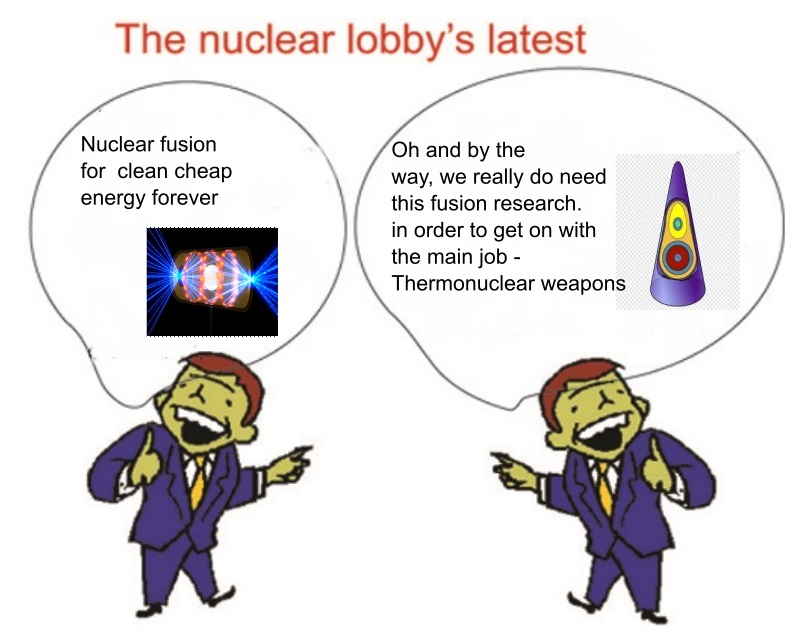
Gordon Edwards, 26 Dec 22, The recent worldwide media hype about fusion energy saving the world by providing clean energy in the foreseeable future, based on a single 85 nanosecond burst of fusion heat triggered by a battery of 192 lasers focussed on a peppercorn-sized pellet at a US weapons laboratory, is extraordinarily unbalanced and deceptive reporting. I believe it to be fundamentally fraudulent, and quite contrary to the Pugwash movement’s commitment to promoting scientific, evidence-based policymaking.
The distortion of truth on this topic is designed to make research on thermonuclear weapons more acceptable to the public and to elected representatives. It will have no near-term applications that will be of any use in tackling climate change. To assert the contrary is naive at best, or manipulative and dishonest at worst.
A balanced debate is not achievable when one side of the debate is so unbalanced to begin with. It is not advisable to dilute every climate change discussion by giving equal time to climate deniers, nor to include creationist theories in every discussion of evolution, nor to invite anti-vaxers in all discussions of the covid pandemic. Similarly it is not helpful to have fusion energy enthusiasts distracting our attention completely away from the military nature of the National Ignition Facility at Lawrence Livermore National Labs,
The following two paragraphs by M.V. Ramana put the matter quite succinctly:(
See https://thewire.in/the-sciences/nuclear-fusion-energy-breakthrough-celebration )
“On December 13, the US Department of Energy (DOE) announced that the National Ignition Facility (NIF) at the Lawrence Livermore National Laboratory had reached a “milestone”: the achievement of “ignition” in nuclear fusion earlier in the month. That announcement was hailed by many as a step into a fossil fuel free energy future. US senate majority leader Charles Schumer, for example, claimed that we were “on the precipice of a future no longer reliant on fossil fuels but instead powered by new clean fusion energy”.
“But in truth, generating electrical power from fusion commercially or at an industrial scale is likely unattainable in any realistic sense, at least within the lifetimes of most readers of this article. At the same time, this experiment will contribute far more to US efforts to further develop its terrifyingly destructive nuclear weapons arsenal.”
Why all the hysteria over not clapping for Zelensky?
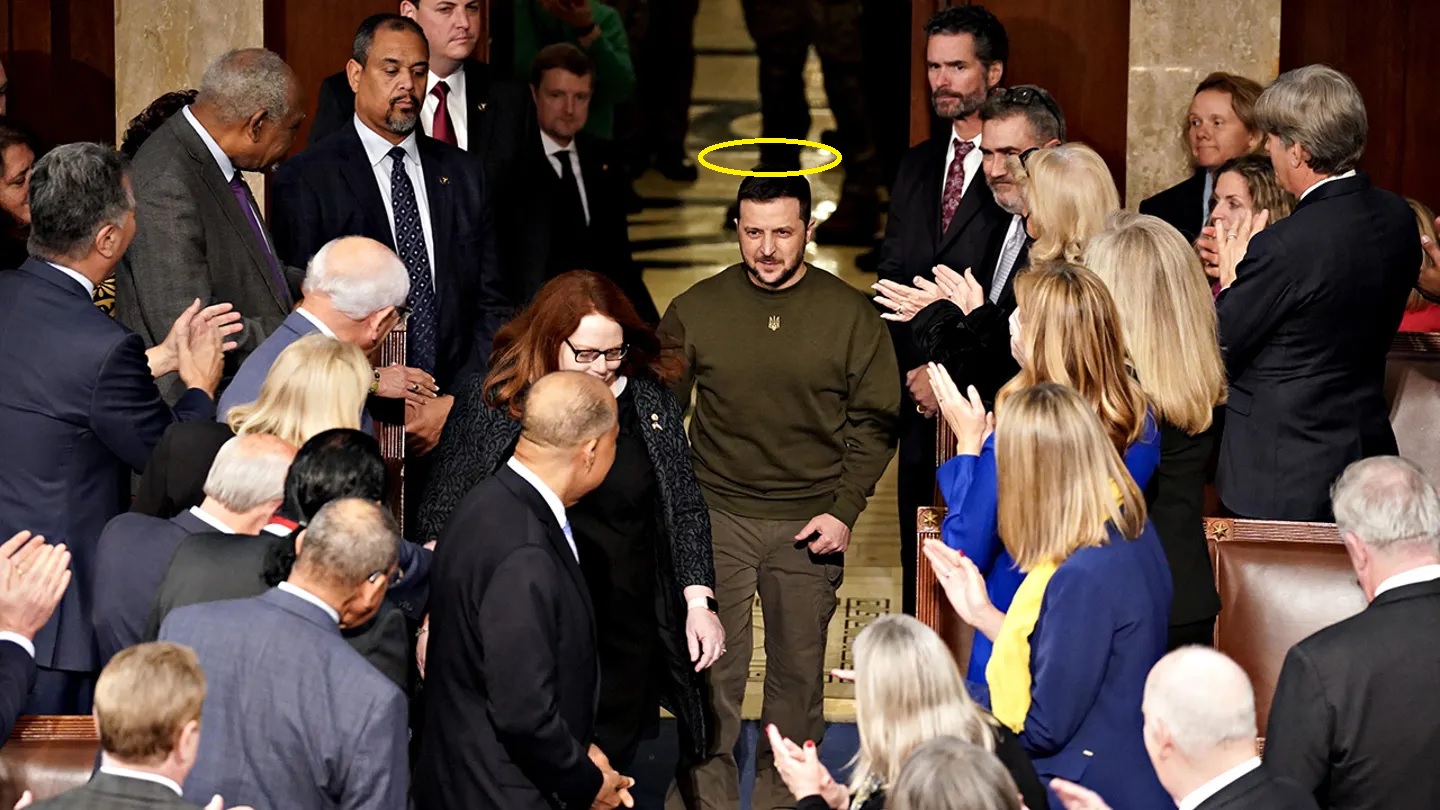
Tucker Carlson rips comparisons of Ukraine’s Zelenskyy to Winston Churchill
Fox News 23 Dec 22 You can’t even really call it news anymore. It’s some kind of “Lucy in the Sky with Diamonds” scenario on display every single day. Yesterday, last night, the president of Ukraine showed up in Congress wearing a green sweatshirt and cargo pants for maximum disrespect, and demanded the United States continue to spend more on his country’s border security than we spend on our own. That actually happened.
It was a pretty cheeky performance if you think about it. But like Sam Bankman-Fried before him, Zelenskyy put a salesman’s gloss on what otherwise might look very much like a scam. So the tens of billions of dollars you’ll be sending me is not charity, Zelenskyy explained. It’s not a gift. It’s not like the 20 bucks you gave the homeless guy at Union Station this morning for a quart of vodka. No, it’s not that at all. This money, Zelenskyy said, is, quote, “an investment.” Oh, an investment.
So what exactly are the terms of this investment now that we’re talking finance? When do we get our dividend checks? Well, Zelenskyy didn’t specify that. Though, at one point in his speech, he did provide a hint. Are the tens of billions of dollars you’re sending me with no audit and no concrete proof of what I’m actually doing with it, will all that money be “enough,” Zelenskyy asked rhetorically. Answer: “Not really.”
“Not really.” In other words, the return on our investment in Ukraine will be more pitches for more investments in Ukraine. Give me money so I can demand more money. That’s what Zelenskyy promised us last night.
And under certain circumstances, that might actually be fine. If nothing else, Zelenskyy is quite an audacious young entrepreneur with the kind of pluck and fast-talking shamelessness where you think, “This guy is either going to wind up in prison or very rich, and maybe both.” And there are times when you might want to throw a kid like that a few bucks just to see where it goes. You don’t know.
But unfortunately, this is not one of those times. The United States is flat out of money and not just in some abstract PowerPoint presentation kind of way, where we show you graphs of the national debt and we all pretend to be shocked and horrified. No, no, no. The United States is broke in a real way, meaning we can no longer afford to take care of our citizens.
For example, 15 million Americans are about to lose their healthcare coverage under Medicaid. Now, these are people who got coverage during COVID, but will now lose that coverage thanks to a provision in the $1.7 trillion spending bill that’s about to become law. As CNBC reports, governors of various states have informed the Biden administration that the cost of keeping all those people on Medicaid is “too high.” And it is high. Undoubtedly, it is high.
How high is it? Well, over the last three years since COVID began, the federal government spent about $100 billion in extra Medicaid payments to Americans. That’s a lot of money. How much is it? Well, it turns out that $100 billion is roughly what Congress has sent to our fast-talking Ukrainian friend in the sweatshirt in less than a single year. Just for comparison, just you would know what the priorities are in Washington, your health care is just too expensive. Sorry. And your border is too. Can’t afford it. But for the strongman who runs Ukraine, no cost is too high……………………………………………
But here’s the interesting thing. Almost every person in the room clapped like a seal. So no matter what that man said — Send me more money! I command you! Send me more money! We’re taking care of it the most responsible ways — they applaud, all of them, almost like they have to. …………
Now there are 435 members of the House of Representatives, and they’re Republicans and Democrats. And famously, they don’t get along. They don’t agree on anything. They can’t even pass a budget because they disagree on everything very bitterly. And yet, when a foreign leader shows up in cargo pants to tell them lies and give them orders, they all applaud. That’s pretty weird behavior in a democracy if you think about it. The fractious debate we hear so much about doesn’t exist. And in fact, looking at the screen last night, it didn’t really look like a democracy, to be honest.
Clapping is mandatory as long as Zelenskyy is speaking. Now there were a few who didn’t obey. That would include Matt Gaetz of Florida, Lauren Boebert of Colorado. And when they didn’t stand up and applaud, they found out the hard way what happens to people who dare not to applaud.
NBC News took off right after them. That was the headline for NBC. Its house “historian” Michael Beschloss declared this: “For any members of Congress who refuse to clap for Zelenskyy, we need to know from them exactly why. We need to know why.” Thought crime alert. You’ve been reported as not applauding. Explain yourself, pleb. And then Beschloss went on television to drive home the point. Our sources have reported you are not clapping. Watch this.[on original]
……………………………. Why wouldn’t you clap for a man who banned a Christian denomination? A man who arrested priests, raided monasteries, seized churches outlawed opposition media outlets, outlawed political parties that opposed him, threw his primary political opponent in jail. Why would you applaud for a man like that? Do you love Putin? Are you opposed to democracy? Explain yourself. That’s what he’s saying. That’s what they’re all saying.
It’s absurd. What they’re describing is the opposite of democracy. There’s no democracy in Ukraine, obviously. Banning a Christian denomination. Shut up. But he did. ………….
Is it possible that the more ludicrous the lie they tell you, the fewer questions they can tolerate about it, the less dissent they can put up with because they fear the whole edifice might crumble if they allow one person to ask one reasonable question. It’s possible that’s what’s happening. ……………………………………….
GEN. BARRY MCCAFFREY: This is a historical figure. This guy actually can be compared to Winston Churchill, to Lincoln in 1860.
So that kind of solves a mystery from last night. How can any self-respecting American sit there when some foreign dictator shows up wearing his workout clothes in the US Congress and starts demanding, with a very apparent lack of gratitude, that we send him tens of billions of dollars when we’re running out of money? How could you sit and put up with that? And then drapes a Ukrainian flag in our Congress. How could you put up with that?
Well, because you’re not a self-respecting American. You have no self-respect. You have no dignity. You don’t care. You’ll say anything. You’ll tell any lie. You’ll repeat any talking point. And when someone from the DNC or the White House sends you a note by text, saying, “Compare him to Churchill,” you do because you have no self-respect. That’s the problem. So while millions of Americans can’t afford to go to the doctor and we have no border, our leaders and our media are imagining they’re very close to Winston Churchill. ………………….
none of the lawmakers who clapped yesterday had any idea either. They’re clapping for regime change. They’re clapping for an uncertain and incredibly dangerous future. It’s not getting the Russian military out of Ukraine. It’s much more than that. And they don’t want to know more.
And you know what they don’t care about? You, your health care, your southern border, your children, your schools, your country. They don’t care. https://www.foxnews.com/opinion/tucker-carlson-why-all-hysteria-not-clapping-zelenskyy—
1 This Month



Shut down the radiation-damaged Heysham nuclear reactors now
To see nuclear-related stories in greater depth and intensity – go to https://nuclearinformation.wordpress.com

Say No to NASA’s Reckless Nuclear Reactor on the Moon
Say No to NASA’s Reckless Nuclear Reactor on the Moon
-
Archives
- October 2026 (268)
- September 2026 (339)
- August 2026 (330)
- July 2026 (355)
- June 2026 (287)
- May 2026 (306)
- April 2026 (356)
- March 2026 (251)
- February 2026 (267)
- January 2026 (308)
- December 2025 (358)
- November 2025 (359)
-
Categories
- 1
- 1 NUCLEAR ISSUES
- business and costs
- climate change
- culture and arts
- ENERGY
- environment
- health
- history
- indigenous issues
- Legal
- marketing of nuclear
- media
- opposition to nuclear
- PERSONAL STORIES
- politics
- politics international
- Religion and ethics
- safety
- secrets,lies and civil liberties
- spinbuster
- technology
- Uranium
- wastes
- weapons and war
- Women
- 2 WORLD
- ACTION
- AFRICA
- Atrocities
- AUSTRALIA
- Christina's notes
- Christina's themes
- culture and arts
- Events
- Fuk 2022
- Fuk 2023
- Fukushima 2017
- Fukushima 2018
- fukushima 2019
- Fukushima 2020
- Fukushima 2021
- general
- global warming
- Humour (God we need it)
- Nuclear
- RARE EARTHS
- Reference
- resources – print
- Resources -audiovicual
- Weekly Newsletter
- World
- World Nuclear
- YouTube
-
RSS
Entries RSS
Comments RSS

