It’s Not Terrorism When We Do It

This is why a state was so crucial to the Zionist project. Before 1948, the groups that became the IDF, from the Haganah, to the Lehi and the Irgun were explicitly called terror groups. And their members were Jewish terrorists. These labels were widely used by western media, and the existence of Jewish terrorism was not controversial. In a 1948 Guardian editorial, in the aftermath of the King David Hotel bombing, the paper referred to “Jewish terrorists” who it said are “ruthless men corrupt by the sickness of the time, caring nothing for the sufferings of the individual Jews in Europe” for whom “every school boy’s jest is another argument for Zionism.”
But as soon as the Jewish Zionists got their own state, the terrorists were absorbed into the military arm of the state,
July 18, 2026, Nate Bear Do Not Panic, https://scheerpost.com/2026/07/18/its-not-terrorism-when-we-do-it/
Yesterday Pete Hegseth triumphantly tweeted a picture of Iran’s Chabahar maritime port tower collapsing following an attack by the US regime. The image bore a striking resemblance to the collapse of the towers on September 11th.
Despite the fact this was, like most of the attacks on Iran, an attack on civilian infrastructure, it will not be labelled as such by the western media and political class. They will never call it terrorism or a war crime, despite the fact that it was both. Whether a civilian tower, a bridge, or a school full of children, western actions that result in mass murder will always simply be the product of a “strike.”
Benign language whenever the imperialist death machine starts slaughtering is a critical tool in maintaining consent for war crimes and state terrorism. And even though Hegseth literally tweeted a picture of this war crime, I‘ve yet to see an imperialist media outlet reproduce the image, because they know how bad it looks. This is a classic tactic we see over and over again: selective reporting and the omission of detail in order to bolster public support for state terrorism and war crimes abroad. Western media has already bundled this “strike” in with all the others in order to present a false equivalence between an illegal war of aggression on the one hand, and legitimate Iranian defence on the other (defensive actions which, by the way, are always labelled as “attacks.”)
The underlying psychology behind the double-standard is rooted in arrogance and supremacy: they’re the bad guys, and they do terrorism. We’re the good guys, and we “conduct strikes.”
And by we, I mean the forces of western imperialism, whether that’s the US or any other power that lines up behind the American regime, especially, but not exclusively, Israel. The use of the words “terror” and “terrorism” are also a critical rhetorical device, conditioning westerners to accept imperial violence as legitimate, and any resistance to that violence as illegitimate. This tendency was seen starkly of course after October 7th. Hamas does terrorism, while Israel merely strikes. Those strikes can be genocidal, they can reduce entire cities to dust, destroy hospitals, schools, universities, water treatment plants, grain silos and the means of life for two million people. They can kill tens of thousands of children in all manner of sadistic and gruesome ways, they can wipe out entire bloodlines, but they are never labelled terrorism. They are, and always will be, simply strikes. Because terrorism is bad, and we’re the good guys.
This is why a state was so crucial to the Zionist project. Before 1948, the groups that became the IDF, from the Haganah, to the Lehi and the Irgun were explicitly called terror groups. And their members were Jewish terrorists. These labels were widely used by western media, and the existence of Jewish terrorism was not controversial. In a 1948 Guardian editorial, in the aftermath of the King David Hotel bombing, the paper referred to “Jewish terrorists” who it said are “ruthless men corrupt by the sickness of the time, caring nothing for the sufferings of the individual Jews in Europe” for whom “every school boy’s jest is another argument for Zionism.”
But as soon as the Jewish Zionists got their own state, the terrorists were absorbed into the military arm of the state, and their violence, which months before was clearly identified as terrorism, was legitimatised by the recognition of a state. And this legitimisation of Israeli state terrorism went hand-in-hand with the decades-long campaign to legally designate resistance to state terrorism as the real terrorism, a campaign which led us inexorably towards the genocide of Gaza.
Genocide. Another word reserved by the hegemonic media only for the victims of the imperial enemy, and not for those slaughtered by the imperial ally.
So for the western media, terrorism isn’t terrorism, genocide isn’t terrorism, and it’s not even genocide. Despite the almost universal belief of genocide scholars, holocaust scholars, and international legal experts that what has taken place, and continues to take place in Gaza, is a genocide, the term is almost never used. The Guardian can even write an article with the title ‘Israel committing genocide in Gaza, world’s top scholars on the crime say’, and in the majority of its subsequent coverage, refer to it as a war. Their main hub for coverage of the genocide, ten months after that headline, is titled Israel-Gaza War. If they had the courage of their supposed progressive convictions, if the truly believed in experts, as all good liberals profess to do, they would accept the evidence they presented themselves, and refer factually to genocide.
They don’t because the western mind, in matters of imperialism requires dissonance. It requires references to “strikes” not terrorism, to “wars” not genocides and to “foreign policy,” not imperialism. This is especially true of the professional media mind which must filter, process and present the news from the imperial core. My guess is that some of the benign, consent manufacturing language is intentional, and some is simply the product of subconscious western supremacy and the dehumanisation of the periphery. Because to fully internalise the evil committed by the system you not only live within but help uphold would require the instant rejection of that system. And well, you’ve got bills to pay. The genocide can be the war if it means making that next installment on your mortgage.
As the terror attacks on Iran and Gaza continue, and as the genocide deepens, we’ll hear only of strikes and wars from a media class fully complicit in both.
The false promise of nuclear power
THE LANCET, Volume 408, Issue 10551p214-215July 18, 2026, https://www.thelancet.com/journals/lancet/article/PIIS0140-6736(26)01304-8/fulltext?rss=yes
Philip J Landrigana,b Send email to landrigp@bc.edu ∙ Brita E Lundbergc
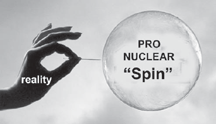
By focusing narrowly on reactor operations, portraying reactor hazards as “extremely small”, and ignoring nuclear energy’s other dangers, Talha Burki’s World Report1 supports the mendacious narrative that nuclear power is a “safe, clean, and affordable” solution to both rising electricity demand and climate change.2
Uranium, the fuel of nuclear power, is radioactive and carcinogenic.3 It endangers health across the entire nuclear fuel cycle. Uranium miners suffer increased risk of lung cancer. Nuclear fuel production workers are exposed to uranium hexafluoride and radon.4 Reactor operators and nearby communities are exposed to radioisotopes; in the USA, 115 000 cancer deaths since 2000 are attributed to residence near nuclear plants.5 All reactors produce waste that will remain radioactive for millennia.6 Reactor decommissioning liberates this waste, exposing workers and communities.
Nuclear power is unique among energy sources in its potential for catastrophe—meltdown, fuel diversion, and weaponisation. A life-cycle analysis of 388 nuclear plants finds that all reactors, large and small, are susceptible to nuclear incidents.7
Nuclear power is not climate neutral. Nuclear power releases 66 g of greenhouse gases per kWh of electricity, which is far less than any fossil fuel, but more than any renewable. Most greenhouse-gas releases occur during uranium mining and milling.8
Nuclear power is neither cheap nor affordable. The levelised cost of nuclear energy has increased by 47% since 2009.2 Current economic analyses do not count health-related costs and underestimate construction costs. Construction of the most recent US reactor cost over US$35 billion,9,10 more than twice its original budget.
By contrast, the cost of renewables has plummeted. Since 2010, solar power costs have decreased by 90%, wind by 70%,11 and batteries by 99%.12
Nuclear power is economically viable only when it receives massive subsidies, tax breaks, and liability exemptions.Nuclear power is a dangerous distraction. It is time to move beyond it and invest in renewables.
References…………………………………………………………………………………….
What do you need to know to run a nuclear power plant?
13 July 2026 by Matthew Lockwood, By Siegfried Evens, Visiting Fellow, SPRU and SEG, https://blogs.sussex.ac.uk/sussexenergygroup/2026/07/13/what-do-you-need-to-know-to-run-a-nuclear-power-plant/
Governments around the world revisit nuclear energy as part of the race to net zero. But an important question often remains overlooked: how do we train the people who make nuclear technology possible?
I have studied how nuclear engineering education developed in the United States and Sweden between the 1950s and 1970s to draw lessons from history. The research shows that nuclear engineering did not emerge as a standalone field overnight. Instead, it grew through collaboration between physicists, chemists, mechanical engineers, materials scientists, and other specialists working together to solve complex problems they could not figure out on their own.
The study also reveals that the skills expected of nuclear engineers changed over time. Early training focused heavily on nuclear physics and radiation. As nuclear power plants became larger and more sophisticated, engineers increasingly needed expertise in areas such as heat transfer, materials performance, and reactor safety.
The comparison between the US and Sweden shows the importance of political culture in nuclear engineering. The United States built nuclear expertise through a decentralized network of national laboratories, industry, and emerging nuclear engineering departments. Sweden, meanwhile, pursued a more centralized model in which existing technical universities worked closely with state-led nuclear institutions.
The study is a reminder that nuclear expertise is something we actually have to organize as a society. And for a future in which nuclear power is built and used safely, we do not only need engineers with broad technical knowledge, but also the ability to address broader challenges related to safety, policy, economics, and society.
This research was published in the journal Nuclear Technology, accessible here.
University of Manchester and United Kingdom National Nuclear Laboratory (UKNNL) sign landmark nuclear partnership agreement.

Manchester University 3 Jul 2026
The University of Manchester and United Kingdom National Nuclear Laboratory (UKNNL) have signed a Memorandum of Understanding (MoU) formalising a wide-ranging partnership to advance nuclear science, grow the UK’s nuclear workforce, and strengthen the country’s position as a global leader in nuclear technology.
The agreement was signed at The University of Manchester by UKNNL Chief Executive Officer Julianne Antrobus and Professor Sarah Sharples, Vice President and Dean of the Faculty of Science and Engineering.
The MoU sets out a shared commitment to collaboration across decommissioning research, materials science, nuclear fuels and energy systems, waste management, and innovation — building on a relationship stretching back many years.
Julianne Antrobus, CEO, United Kingdom National Nuclear Laboratory UKNNL, said: “I am looking forward to our collaboration with the University of Manchester moving from strength to strength as we work together to develop the next generation of nuclear talent and technology.
“The 2024 Strategic Review gave us a clear direction: become the partnerships-led national laboratory that government and the sector needs. One of the most important things we can do in pursuit of that is to work strategically with the academic institutions that can genuinely help us deliver our mission.
The University of Manchester is one of those vitally important institutions. This MoU formalises a relationship that is already delivering world-leading science and growing the next generation of nuclear talent — and it signals our intent to do much more together. Our partnership with Manchester, alongside our recent agreements with CEA, Bangor University, Japan Atomic Energy Agency (JAEA) and Rolls-Royce, positions UKNNL at the centre of a network of world-class partners, so that we can deliver on our purpose: nuclear science to benefit society.”
Professor Zara Hodgson, Director of the Dalton Nuclear Institute, said: “I am delighted to see this MoU between UKNNL and The University of Manchester signed today. It provides us with a firm platform for a renewed and strengthened collaborative approach to serve the sector. Enabling our teams to work together more closely is a foundational step towards progress in vital research and innovation for a transforming sector and to achieve an accelerated pathway to nuclear expertise that the sector needs now, and in the future……………………….
The agreement also establishes arrangements for sharing facilities and expertise, including access to UKNNL’s Preston and Central Laboratory facilities for Manchester PhD students and researchers, and reciprocal access to University facilities for UKNNL staff……………………………………………………………………………………………
A track record of collaboration
The two organisations have an established history of joint working that is already delivering results for the UK nuclear sector, including published research in leading journals on nuclear fuels and materials, support for PhD researchers in next-generation nuclear technologies, shared personnel arrangements including visiting and honorary academic appointments, and the establishment of centres of excellence such as the Effluents Centre of Excellence and the PHLAME (Photonics and Laser Analysis of Materials and Environments) collaborative research group. https://www.manchester.ac.uk/about/news/university-of-manchester-and-uknnl-sign-landmark-nuclear-partnership-agreement/
The new nuclear madness is climate criminality
“We build, own and operate micro modular nuclear power plants.”
No, they don’t. Last Energy has never built, owned or operated any sort of nuclear power plant, micro, modular or otherwise. But claims such as these simply aren’t questioned by politicians and the media. Rather, they are repeated.
by beyondnuclearinternational, https://beyondnuclearinternational.org/2026/06/28/the-new-nuclear-madness-is-climate-criminality/
From reviving ‘dead’ reactors to building new ones large and small, an atomic epidemic is running rampant, writes Linda Pentz Gunter
Many of us have been asking ourselves the same question recently. Why does there seem to be a collective taking leave of all senses gripping politicians everywhere when it comes to nuclear power?
And why is the media lapping up the nonsense and hype and repeating the plethora of false promises (to put it politely) being spewed by nuclear companies — new and old?
Here’s an example from Last Energy, a US nuclear startup hoping to build 20 megawatt pressurized water reactors. According to Nation Cymru, who receives Last Energy’s press materials, a statement on the company’s website reads: “We build, own and operate micro modular nuclear power plants.”
No, they don’t. Last Energy has never built, owned or operated any sort of nuclear power plant, micro, modular or otherwise. But claims such as these simply aren’t questioned by politicians and the media. Rather, they are repeated.
Last Energy — brilliant name, as it will be “last”, if it even goes forward at all — was created by Titans of Nuclear podcaster Brent Kugelmass. They have a pilot project underway in Texas for a 5 megawatt version of the four 20MW “micro-reactors” they want to build in a small community in South Wales, where I am speaking this week.
One of my discussants there, Debra Cooper, co-chair of the Bridgend Green Party, made an acute observation about the company in their early public meetings, poorly attended fiascos that have abruptly stopped. It appeared that not only does Last Energy have no experience with nuclear reactors, they are not that familiar with how British electricity works.
“Their PowerPoint Presentation computer indicated that it had low power and the panicked presenters rushed around fiddling with various wires,” Cooper reported of an early public meeting with Last Energy officials in 2025. “Eventually they ascertained that they had not switched on the plug point at the wall.”
The company also exemplified that patronizing approach we are so familiar with of the “benevolent” corporation that will not only deliver jobs but give back to the community. Such is the arrogant ignorance of companies such as these that First Energy spokespeople assured the good people of Llynfi Valley in Wales that they will graciously fund food banks.
“When I pointed out to them that what locals needed was a fair day’s wage for a fair day’s work, without having to rely on food banks, this appeared to surprise them,” Cooper wrote. The proliferation of food banks is a tragic reminder of the scale of poverty and food insecurity across the country, not solved by adding more food banks but by addressing the root cause.
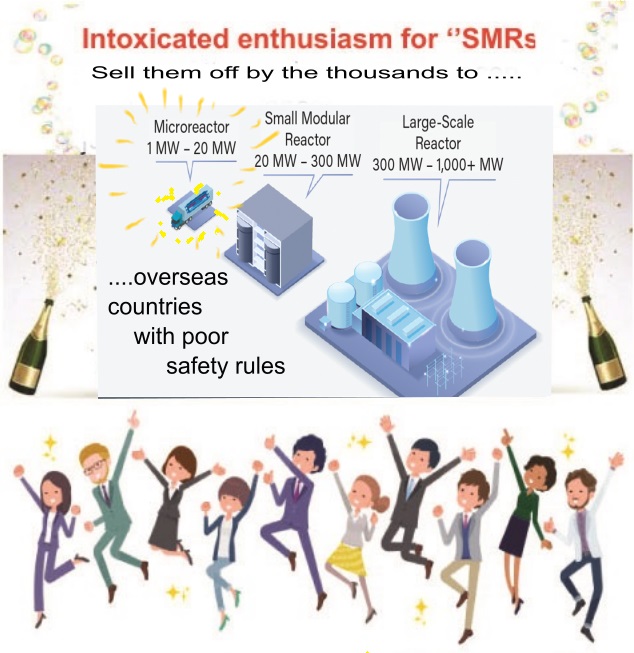
Stateside, we have an atomic epidemic among US governors, Republicans and Democrats alike, who are falling over each other in their eagerness to welcome new nuclear reactors into their states. Mostly, it’s the so-called small modular reactor (SMR), almost all of which are, like Last Energy, lacking a certified design or commercial buyers.
But some are willing to revive the dead — Three Mile Island in Pennsylvania, Duane Arnold in Iowa and Palisades in Michigan — and others are happy to accept the same fate as Georgia and welcome Westinghouse back into the game.
The Trump administration has announced it will sink $17.5 billion of taxpayer money into the formerly bankrupt Westinghouse for 10 new full sized AP1000 reactors. This, it is claimed, is in order to “speed the development of 10 new large nuclear reactors to meet the skyrocketing power demand from massive data centers,” reported the Associated Press.
Why pouring money into Westinghouse — now actually wholly owned by two Canadian companies, Brookfield Asset Management and Cameco Corporation — would speed up a process that has already proven to take lamentably long, is nowhere explained.
The only Westinghouse AP1000 project to complete in the US at all, at Vogtle 3 and 4 in Georgia, took 14 years to get here and soared in cost from a predicted $14 billion to at least $35 billion. But these problems were not caused by a lack of money.
The project received $12 billion total in federal loan guarantees, more than 68% of what is now being offered to likely six different utilities to build 10 more AP1000s.
The utilities rumored to be lined up to collect the dough, if not actually deliver the reactors, are Dominion Energy, DTE Energy, Entergy, PSEG (Public Service Enterprise Group) and WEC Energy Group.
Westinghouse’s other two-reactor project, the AP1000s at V.C.Summer, collapsed mid-build, contributing to the company going bankrupt and almost taking down its then Japaneses parent company, Toshiba, with it. Utility executives were convicted of crimes and went to jail. But now there are even efforts to revive this financially catastrophic debacle.
The project received $12 billion total in federal loan guarantees, more than 68% of what is now being offered to likely six different utilities to build 10 more AP1000s.
The utilities rumored to be lined up to collect the dough, if not actually deliver the reactors, are Dominion Energy, DTE Energy, Entergy, PSEG (Public Service Enterprise Group) and WEC Energy Group.
Westinghouse’s other two-reactor project, the AP1000s at V.C.Summer, collapsed mid-build, contributing to the company going bankrupt and almost taking down its then Japaneses parent company, Toshiba, with it. Utility executives were convicted of crimes and went to jail. But now there are even efforts to revive this financially catastrophic debacle.
Energy Secretary Chris Wright, himself a former nuclear (and gas) executive, assures us as his nose grows ever longer, that it will all be different this time around with likely “dozens of these built going forward.”
Have small modular reactors been forgotten, given their poor economies of scale and absence of certified designs, upfront factories and commercial interest? Not according to the state governors embracing this expensive fantasy.
SMRs have turned into today’s atomic fad toy — a nuclear Labubu! Everyone wants one — or most likely more than one; some of these reactors are as small as 10 megawatts. One by itself might be able to power a smaller data center but the main thrust is to build hyperscale and AI-focused data center campuses.
This means that SMRs are actually intended to meet a need we don’t need; energy (and water) guzzling AI mega data centers, designed to enrich tech bros and impoverish the rest of us, fiscally, environmentally and morally.
But the nuclear nuttiness is by no means confined to English (or Welsh) speaking countries.
The Swedish parliament, known as the Riksdag, has just voted to reclassify uranium mines as not a nuclear facility. This allows for the radioactivity they release and the waste they create— and mainly leave behind— to be treated like any other mineral.
There was no science behind this thinking, just a deeply undemocratic rationale, as a World Nuclear News article explained: “With uranium mines no longer regulated as nuclear facilities, uranium extraction will no longer require explicit municipal consent.” Sweden had already lifted its uranium mining ban in January 2026. Needless to say, the uranium companies are jubilant.
Just as bad, and arguably madder, the Riksdag also “voted in favor of the government’s proposal to amend Sweden’s environmental code to enable the expansion of nuclear power in more places on the coast,” the WNN article said.
There is a new political phenomenon known as “climate hushing”, but building reactors on coastlines when, due to our failure to address climate change adequately or in time, sea-level rise is an inevitability, is climate criminality.
Linda Pentz Gunter is the founder and executive director of Beyond Nuclear. She is the author of No To Nuclear. Why Nuclear Power Destroys Lives, Derails Climate Progress And Provokes War , published by Pluto Press and also available on Amazon.
Israel rebrands scheme to ethnically cleanse Gaza of Palestinians as ‘Freedom of Movement Plan’: Report
Tel Aviv is intensifying its efforts to depopulate Gaza and replace the strip’s Palestinian inhabitants with Jewish settlers
News DeskJUN 29, 2026, https://thecradle.co/articles/israel-rebrands-scheme-to-ethnically-cleanse-gaza-of-palestinians-as-freedom-of-movement-plan-report
Israel has rebranded its controversial plan to expel Palestinians from Gaza, dropping the euphemism “voluntary migration” and replacing it with “Freedom of Movement Plan,” Israeli media reported on 29 June.
Channel 13 reported that Israeli security officials and the Mossad have been instructed to stop using the term “voluntary migration,” which has drawn condemnation as a thinly veiled reference to Israel’s effort to ethnically cleanse Gaza of its Palestinian residents.
According to Channel 13, Israeli officials believe that rebranding the initiative name could make it easier for foreign governments to support the plan.
The officials “expressed optimism that the change in terminology could help shift those countries’ positions and revive the plan after earlier setbacks,” the channel added.
Israel has lobbied multiple countries to accept large numbers of Palestinians from Gaza as refugees, including South Sudan, Chad, the Congo, Ethiopia, Indonesia, and Libya.
Tel Aviv has also proposed sending Palestinians to the breakaway region of Somaliland. In December, Israel became the first UN member state to recognize Somaliland’s independence from Somalia.
Last week, the new head of Israel’s National Security Council, Shmuel Ben Ezra, convened an urgent meeting with defense establishment officials to discuss the issue of “encouraging the voluntary emigration” of Palestinians from the Gaza Strip.
In a meeting attended by Israeli military and Shin Bet security service officials, Mossad officials said that no countries have agreed to accept Palestinians from Gaza.
An Israeli defense official who spoke with Haaretz said that the revival of the plan to expel Palestinians from the strip may be connected to quiet agreements reached recently between Israeli Prime Minister Benjamin Netanyahu and US President Donald Trump.
The official added that the US may agree to the Israeli plan as “compensation for painful concessions” that Washington imposed on Israel as part of its deal with Iran.
Since the start of the genocide of Palestinians in Gaza in October 2023, Israel has sought to cleanse the strip of Palestinians while presenting the effort as a humanitarian initiative.
On 28 October 2023, Israeli culture magazine Mekomit published a leaked document issued by Israel’s Ministry of Intelligence recommending the occupation of Gaza and total transfer of its 2.3 million inhabitants to Egypt’s Sinai Peninsula.
The document recommended that Israel evacuate the Gazan population to Sinai during the war, establish tent cities and new cities in northern Sinai to accommodate the deported population, and then create a closed security zone stretching several kilometers inside Egypt.
The expelled Palestinians would not be allowed to return to any areas near the Israeli border.
The plan stated the government must launch a public relations campaign that will promote the expulsion of Palestinians in a way that does not damage Israel’s reputation.
The deportation of Palestinians from Gaza must be presented as a necessary humanitarian measure to receive international support, the document added.
Such a deportation could be justified if it will lead to “fewer casualties among the civilian population compared to the expected number of casualties if they remain.”
Since that time, Israeli bombing has killed at least 75,000 Palestinians, the majority women and children, according to a tally by the Gaza Health Ministry. However, independent estimates of the death toll are much higher, reaching into the hundreds of thousands.
Over a million Palestinians in Gaza are displaced and living in tents after Israeli bombing destroyed their homes.
Nuclear powered shipping – a golden future or unrealistic claims?
There was little in the way of caution at the conference, save for the odd nod to safety, seemingly when someone remembered there were members of the press in the room. But is atomic energy really the answer to decarbonising shipping? Underneath it all there was an undertone of not really believing what they were saying, and an element of ‘will they find out what we’re not saying’.
Nuclear scientists are split on the ability of fourth generation nuclear reactors to decarbonise shipping, but the drive for funds is leading to ever greater claims
Nick Savvides, Europe correspondent
Keeping politicians and politics away from the technical decisions necessary to develop nuclear power was how one professor described the path to nuclear nirvana.
Jan Emblemsvåg, a professor, speaker and organiser for a recent meeting on Nuclear Power for Shipping, at the Technical University of Norway (NTNU), believes that politicians will stymie the work of engineers.
But professor Emblemsvåg was, like his fellow delegates, very optimistic about the future of nuclear ships, as long as politicians kept their noses out of the technicians’ business. That gave the conference room an upbeat feel.
There was little in the way of caution at the conference, save for the odd nod to safety, seemingly when someone remembered there were members of the press in the room. But is atomic energy really the answer to decarbonising shipping? Underneath it all there was an undertone of not really believing what they were saying, and an element of ‘will they find out what we’re not saying’.
As it happened, a quick chat with Dr Edwin Lyman, director of nuclear power safety at the Union of Concerned Scientists in Washington, DC, and author of the April 2024 paper, “Five Things the ‘Nuclear Bros’ Don’t Want You to Know About Small Modular Reactors,” was certainly fuel for thought.
The paper outlined what the protagonists for nuclear energy, and in particular small modular reactors (SMR), didn’t want you to know. An SMR is defined as producing 300MW of power or less.
Unsurprisingly, Dr Lyman said: “Nothing has changed since 2024, the same challenges outlined then remain in the reactors of today.”
Dr Lyman’s report was written about land-based reactors, but he says it is just as pertinent for ship-based SMRs.
The report discusses the five major claims made for SMR technology; that they are more economical than larger reactors; they are safer; that they reduce radioactive waste; they are more reliable and resilient; and are more efficient than large reactors.
Economies of scale
Building SMRs should in theory be cheaper with lower capital costs, but that doesn’t mean they are more economical, argues Dr Lyman: “What matters more when comparing the economics of different power sources is the cost to produce a kilowatt-hour of electricity, and that depends on the capital cost per kilowatt of generating capacity, as well as the costs of operations, maintenance, fuel, and other factors.”
Economies of scale can also mean that larger units are more economical than smaller ones and SMR developers claim up to 80% cost reductions through the mass production of SMRs. Dr Lyman, however, cites a 2018 University of Cambridge, department of engineering study, that put cost savings due to mass production at 30% at most.
Safety
Safety is said to be a major advantage of SMR technology, they are smaller, have less radioactive material and generate less heat than their larger pressurised water cousins.
Not so, said Dr Lyman: “The so-called passive safety features that SMR proponents like to cite may not always work, especially during extreme events such as large earthquakes, major flooding, or wildfires that can degrade the environmental conditions under which they are designed to operate.”
Lack of testing
None of these reactors have been tested on land or at sea, but Dr Lyman told Seatrade Maritime News: ”The complex, issues associated with fluid flow, and heat transfer and heat distribution in these reactors, they have absolutely no idea that they would be able to operate safely on land, much less on a ship.”
He added: “I would not be comfortable with deploying SMR’s on ships, there are many more challenges at sea than on land.”
Moreover, some molten salt reactors can generate significant quantities of tritium, a radioactive isotope of hydrogen, which cannot be contained within the reactor and could “diffuse throughout your entire ship,” putting crew at risk and contaminating the cargo.
Early attempts to develop a molten salt reactor used charcoal absorption beds in an attempt to capture the tritium, which eventually led to the abandonment of the technology. The used charcoal had to be treated as nuclear waste and disposed of appropriately.
Waste, however, was an issue that was brushed aside as irrelevant by panellists at NTNU, who considered the costs associated with radioactive waste as “minimal”.
Radioactive waste disposal, “is something the nuclear industry promised they could solve 80 years ago, and it hasn’t happened yet,” noted Dr Lyman.
Finland is the one country where there has been “progress toward a geologic repository for very small amounts of fuel,” said Dr Lyman, but no other country has achieved that. In fact Finland has consent to build the Onkalo repository a geologic repository on Olkiluoto Island.
It has a capacity for 6,500 tonnes, stored in copper canisters for 100,000 years at a depth of 400-450m. After 100 years the repository will be permanently sealed.
Storing radioactive waste
No other country has the capacity to sustainably store radioactive waste, “Is stored where it’s being generated,” explained Dr Lyman, “So it’s unrealistic for them to brush off the issue of waste. Any shipping company that is going to start using nuclear reactors is going to have to have a plan and a programme for the long-term management of waste.”
Moreover, some fuel types, such as TRISO will generate as much as 10 times the volume of waste compared to a light water reactor.
“Any shipping company that claims it’s going down this path without having the parallel commitment for management and storage of waste, which would generally require a license, in whatever country that storage facility is going to be, is just, they’re living in fantasy land,” claimed Dr Lyman.
Neither could those costs be mitigated by leasing a reactor as some industry figures have suggested, companies might be suggesting that they will collect spent fuel and handle the waste, but unless they have a credible plan for dealing with that waste it is not a realistic option.
Dr Lyman pointed out that spent fuels are initially stored in “swimming pool type structures” where the waste is cooled, this is expensive and can take five to 10 years to cool. Following that the costs for dry storage are comparatively small, but monitoring will continue indefinitely, so the expense will be ongoing.
Eventually the cost of storage will likely fall on the taxpayer, but even there it is uncertain whether governments are willing to take on the cost of storage.
“In the United States, the law requires the federal government to take title of spent nuclear fuel after a certain period of time. And, you know, the US government famously reneged on its commitment to take over [waste management] in 1998.It has not happened yet.”
Ultimately, the utility companies that continue to store spent fuel have sought damages from the federal government for the hundreds of millions of dollars that they have spent over nearly three decades in storing nuclear waste.
Reactor designs are yet to be proven
None of the proposed SMR designs have yet been tested and proven, though the US Department of Energy launched a Reactor Pilot Program that is meant to “Expedite the testing of advanced reactor designs”.
Launched in 2025 the programme that aims to test three designs which will go critical outside the Idaho National Laboratory on 4 July this year.
To achieve the aim of going critical Dr Lyman points out that no company has built a reactor.
“These aren’t actual power producing machines. They’re just really an array of fuel in an experimental apparatus,” explained Dr Lyman, but that’s not the hard part.
“The hard part is the engineering, the power conversion system, understanding the thermal hydraulics and all the other effects, all those take time, and if you’re trying to do that quickly, especially with novel concepts and materials, it’s a recipe for failure,” he concluded.
According to Lyman the Reactor Pilot Program is a rushed job that the Trump administration is pushing, but he says it lacks durability.
Moreover, the high-assay low-enriched uranium, known as HALEU, is uranium enriched to contain between 5% and 20% of the fissile isotope U-235, these fuels need more mined uranium to produce the fuel.
Uranium mining uses in situ leaching methods where a solution of water, sulphuric acid and hydrogen peroxide is used to dissolve uranium, before purifying and drying the fuel into a concentrated powder known as yellowcake.
More conventional mining methods crush uranium ore into a slurry before dissolving the uranium with sulphuric acid.
Uranium mining is ecologically unsustainable, and costly, particularly in lives lost with some 7,800 uranium miners dying of lung cancer according to data from the Pooled Uranium Miners Analysis.
Effectively, from mine to wake to waste nuclear energy must clean up its act, and it needs to take safety and security seriously too if it is to achieve the kind of break through its proponents claim.
Currently, added Dr Lyman, “There’s no path between the situation today and what you would need to do to have an international safety and security regime for shipboard SMRs and commerce,” noted Dr Lyman.
No modern SMR has been built or tested, there is no regulatory regime and issues such as safety and security remain open, with International Atomic Energy Agency monitoring needed to make certain that nuclear fuels “are not diverted”.
Existing SMR companies, “Need to attract capital to be able to actually build their reactors. And now you have this multiplicity of vendors who are all competing, and that’s compelling them to make more and more unrealistic claims to try to attract attention and making promises and ambitions that are not realistic,” claimed Dr Lyman.
Responding to professor Emblemsvåg’s claim that politicians were the roadblock for developing nuclear powered ships Dr Lyman argued that politicians were critical to the future of nuclear-powered ships. “The only way nuclear is going to get accepted is if politics drives the process, which is what we’re seeing now [with the Reactor Pilot Program]….There has to be massive government support, that’s the only way some of these plans are going to happen.”
Words Matter: What does “De-Confliction” Even Mean?
The blind acceptance of confusing words and terms we don’t understand also dulls our thinking, dulls our reporting and plays into the hands of the governments, who are involved in this negotiation process, and who want to limit and control scrutin
The blind acceptance of confusing words and terms we don’t understand also dulls our thinking, dulls our reporting and plays into the hands of the governments, who are involved in this negotiation process, and who want to limit and control scrutiny. .
June 22, 2026, Kathy Gannon Substack, https://scheerpost.com/2026/06/22/words-matter-what-does-de-confliction-even-mean/
The statement that came out of the first day of meetings in Switzerland between Iran and the United States announced a number of committees or cells, including the “de-confliction” cell.
What does that even mean?
Merriam-Webster offers up one definition: “The coordination of flights, maneuvers, etc. between groups especially in areas where overlapping operations are occurring in order to reduce the risk of accidents or incidents.” Or the same dictionary offered up as an example of how it would be used: “Deconfliction is how friendly forces keep out of each other’s way,” John Bolton.
Now that’s even more confusing because according to the statement, this cell is between the parties, presumably Iran and the United States, as well as the Lebanese republic. Yet the statement went on to say this Deconfliction cell will be “facilitated by the mediators to ensure the adherence of the termination of the military operations in Lebanon as per the MoU.”
Yet neither Israel nor Hezbollah is part of this “deconfliction” cell, even though they are the ones carrying out military operations and as a result would seem critical to any termination of those operations.
Presumably even as the statement avoids saying it, and until now the reporting hasn’t cleared up the confusion, Iran would represent Hezbollah and America, Israel.
Presumably Iran would rein in Hezbollah and the United States would rein in Israel. That seems a big ask, likely more for Washington, than Tehran. Until now the U.S. has failed to stop Israel’s bombing campaign. The question then is: How is this cell that neither includes Israel or Hezbollah, going to “ensure the adherence of the termination of the military operations in Lebanon as per the MoU.”
It is a bit of a mystery how the Merriam Webster dictionary use of “deconfliction” applies to this conflict. Neither Israel nor Hezbollah fit the definition of “friendly forces.”
It’s also disappointing that, until now, news reports covering the statement have offered little to no understanding of this “deconfliction” cell, which is tasked with ending regional conflicts, a key component of the MoU, which must be settled before any peace deal is reached.
Many of the news reports have put quotes around the word “deconfliction” presumably because its definition is difficult to explain, vague or not understood, yet its official so it is used __ without explanation, but with quotes.
But Words Matter.
Words have meaning and the increasing readiness to use words and terms without explanation, or without calling out distortions makes us all less informed. It also distorts our understanding of events, of progress or failure.
It is no longer even clear who is responsible for success or failure and that is problematic because it allows those who negotiate in poor faith to deflect or avoid blame.
The blind acceptance of confusing words and terms we don’t understand also dulls our thinking, dulls our reporting and plays into the hands of the governments, who are involved in this negotiation process, and who want to limit and control scrutiny.
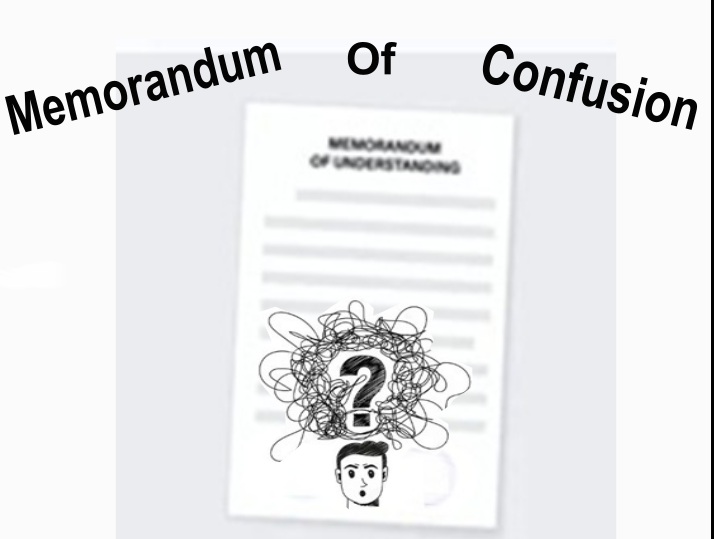
This MoU itself has often been defined by misleading, vague or confusing terminology. In the initial stages it was referred to as a peace agreement by mediators, who announced the MoU and repeated in news reports. It is not. It is not even an agreement.
It is simply a 60-day pause in fighting, while the thorny issues that have, until now, prevented a peace agreement are discussed with the hopes that it will eventually lead to a peace agreement.
As the pause and negotiations begin, it seems a a new wave of confusing, self-serving terminology is being used to obscure what work is being done, who is doing it, and whether real progress is occurring.
Take a bow to the renewable revolution. The nuclear renaissance that never was is already fizzling
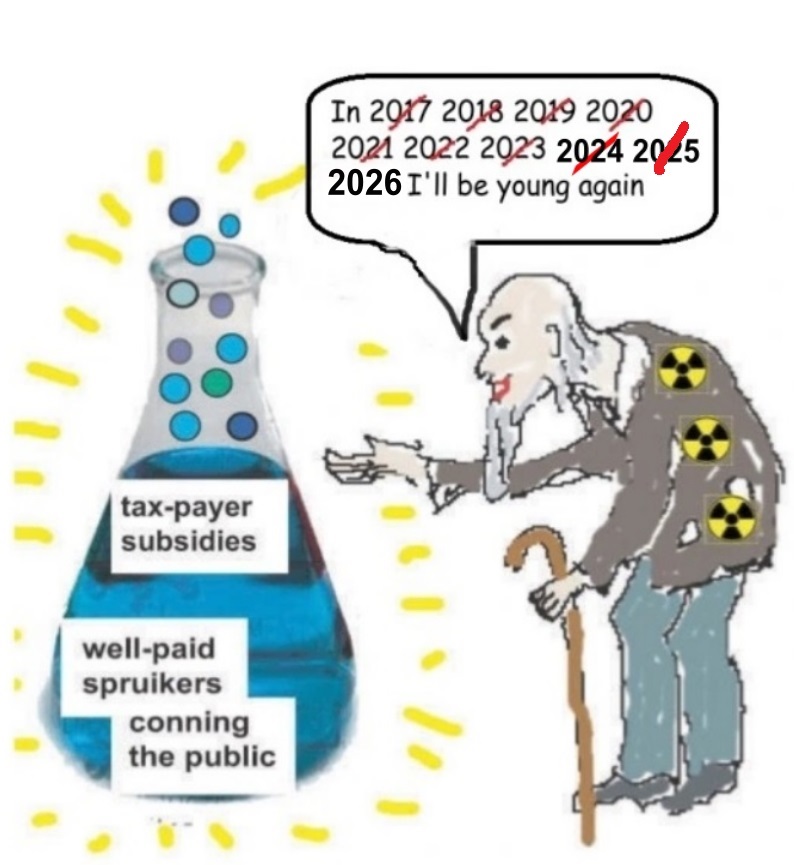
A tried and true technology should get cheaper and faster to develop. With nuclear power, it’s just the opposite.
by beyondnuclearinternational, Linda Pentz Gunter, https://beyondnuclearinternational.org/2026/06/16/wont-get-fooled-again/
These days the mainstream media routinely parrot the nuclear industry party line that it is enjoying a “global renaissance.” These meek media sycophants don’t stop to question the veracity of this claim at all, or to notice that the rhetoric does not appear to match reality.
But if we are really living through a “nuclear renaissance”, which one is it? The old nuclear renaissance of 2006? Or a new re-renaissance? And where is their Michelangelo? Bill Gates appears to have made billions, but he hasn’t made masterpieces.
You have to wonder about the nuclear industry’s marketing mavens, though. Why on earth would they rebrand what they are trying to suggest is the new world dominance of nuclear power as an essential energy source by giving it the same name as their most abject failure?
Meet the new nuclear renaissance. Same as the old nuclear renaissance. All promise and, so far, no delivery.
That first nuclear renaissance wasn’t a renaissance at all, it was a stillbirth. And as a student of Italian, I have to say it peeves me that the nuclear industry dares to use the name at all.
The actual renaissance, which began in Italy, fully blossomed across Europe in the fifteenth and sixteenth centuries. It was an extraordinary simultaneous flowering of culture, intellectualism, art, music, science, economics and technology, a genuine “rebirth” after the relatively primitive Middle Ages.
As former energy department official Joe Romm so aptly put it during a recent briefing on nuclear power on Capitol Hill: “if the actual renaissance had been anything like the nuclear renaissance, we’d still be in the dark ages. But I guess in some respects, we still are.”
The first nuclear renaissance was launched around 2006 with about the same hubris as President Nixon’s famous claim that there would be 1,000 nuclear reactors operating in the US by the year 2000. (There were 104.)
The Nuclear Renaissance Part One promised 34 new reactors. We got two, limping in at Plant Vogtle in Georgia, years late and wildly over budget, ballooning from an original price tag of $14 billion to more than $35 billion and raising electricity rates to new heights.
Two more reactors — at the V.C. Summer site in South Carolina — broke ground but were canceled before completion, also raising electricity rates and sending executives to prison for bribery and corruption.
But now it’s the nuclear renaissance all over again! The John Carter of the nuclear world (John Carter, a 2012 Disney release, was one of the biggest box office bombs in movie history).
Everything is on track for it to be as big a dud as last time, except for one important difference. In 2026 we have an administration that is vehemently, and criminally, anti-renewable energy, casting aside actual climate solutions to prioritize fossil fuels and new nuclear projects and trashing reactor safety regulations — and the nuclear regulator — to ensure it happens.
This is all designed to clear the path — or superhighway — to allow an unprecedented acceleration of new reactor development and deployment. The theory is that it is overly stringent safety regulations that hold up nuclear power expansion.
But the field is now populated by ingenue startup companies with no reactor development experience. History shows that even with a known and familiar technology, there are frequent stumbles that hold things up that have nothing to do with the already compliant regulator — the US Nuclear Regulatory Commission currently being constrained and circumvented — or popular opposition (we wish!) It’s called “negative learning.” A tried and true technology should get cheaper and faster to develop. With nuclear power, it’s just the opposite.
But even with the NRC stripped of its oversight, Nuclear Renaissance the Sequel could still be a box office flop. That’s because, despite everything, renewables are simply doing it for themselves. Battery technology is advancing by leaps and bounds — crucially important not only to ensure renewable reliability but also to move away from extractive minerals mining with all its attendant predatory colonialism.
And renewables are soaring worldwide, despite the wrong-headed policies of far too many of the world’s governments — and especially our own governors here in the US — who have insisted on leaping aboard the atomic Titanic.
In 2025, renewables accounted for almost 86% of the total global power capacity added. Globally, renewable power capacity is projected to increase almost 4,600 GW between 2025 and 2030 – double the deployment of the previous five years, according to the International Energy Agency. This will see renewables become the largest global energy source, used for almost 45% of electricity generation by 2030.
The irony is, that even as he spouts gibberish about wind farms causing cancer, while directing billions towards an energy technology — nuclear power — that actually does, President Trump has accidentally boosted an already robust global green energy revolution by bombing Iran and forcing the closure of the strait of Hormuz, a key passageway for the transport of fossil fuels.
To compensate for this sudden shortage of fossil fuels — a bizarre mixed blessing given we absolutely shouldn’t be using them anyway— countries are quickly finding alternatives. What they aren’t finding are those new nuclear power plants, the paper atomic airplanes still in the design phase.
Instead, they are switching on renewables, which can be deployed in months to a handful of years, at a far lower cost, and of course without all the attendant complications of radioactive waste production or meltdowns that could irradiate entire regions effectively forever.
And it’s really not that hard, as we already know. The barriers to renewables are not technological, they’re political. But when nations’ hands are forced, how quickly things change.
Just look at Pakistan. In 2020 the country was struggling to get access to Liquified Natural Gas. It was at 3% solar. Today Pakistan is at 30% solar capacity.
“Storage will make renewable energy dominant,” says the International Renewable Energy Agency, borrowing Trump’s favorite word.
So no, we won’t get fooled again by the promise of a new nuclear renaissance. We are watching the renewable revolution take a bow instead.
Linda Pentz Gunter is the Executive Director of Beyond Nuclear and writes for and edits Beyond Nuclear International. She is the author of the book, No To Nuclear. Why Nuclear Power Destroys Lives, Derails Climate Progress And Provokes War, published by Pluto Press. Any opinions are her own.
The push to lift Ireland’s nuclear ban: Going nuclear or nowhere?
“You can go into Harvey Norman in the morning and buy a solar panel. You can’t go anywhere and buy a small modular nuclear reactor.”
By Louise Byrne, RTE, 12 Jun 2026
From the backbenches of Fianna Fáil in recent months has emerged a political push to lift the ban in Ireland on nuclear power generators.
What’s behind the move to ‘go nuclear’ now? And is it a viable option, or a distraction from already proven renewable technologies?
In the late 1970s Ireland had its own version of Woodstock. Thousands of demonstrators descended on Carnsore Point to attend carnival-like protests against the development of the country’s first nuclear plant.
ESB engineers had chosen the Co Wexford site for its low population, stable geology and access to the Irish Sea for plant cooling.
Minister for Energy at the time, Desmond O’Malley dubbed the protesters “members of the flat-Earth society” hindering Ireland’s entry into the atomic age.
Yet the scale of opposition, the discovery of gas off Kinsale and the Three Mile Island accident in the US eventually led to the withdrawal of political support for the Carnsore Point project.
The u-turn was so pronounced by the late 1990s legislation was introduced to veto any future nuclear production.
Two Acts contain legislative blocks – the 1999 Electricity Regulation Act and 2024 Planning and Development Act, but there is no constitutional impediment to nuclear power. And for the first time in decades, the issue is back on the political agenda.
Fianna Fáil TD James O’Connor has introduced a bill which would reverse the legislative ban. The proposal has been supported by both the Taoiseach and Tánaiste……………………………………………………………..
Green Party leader Roderic O’Gorman described the idea as Government “kite flying”.
“The nuclear industry promises to deliver at a cheap price on a reasonable timescale but it doesn’t happen,” he told the programme.
“We should double down on delivering renewable energy, cutting bills for consumers and giving us energy security.”
Going nuclear, or going nowhere fast?
The war in Ukraine has highlighted our dependence on imported fuel and the argument goes that nuclear power may provide an additional low-carbon alternative to fossil fuels; one that can complement renewable sources.
The optimism of nuclear proponents lies in new technology called Small Modular Reactors (SMRs). These are smaller reactors that require less cooling but that can produce up to a third of the power of large, conventional reactors.
Prefabricated units can be manufactured, shipped and installed on site, making them more affordable to build than large power reactors, according to the Institute for Atomic Energy Agency.
However, the new technology is still in development and is years away from being deployed at scale, said Dr Paul Deane, Senior Lecturer in Clean Energy Futures at University College Cork.
“There’s lots of uncertainty around the costs and capability of the technology and big questions on what you do with the nuclear waste.”
While keeping an open mind on its potential, Dr Deane cautioned that SMR technology was not yet commercially available.
“You can go into Harvey Norman in the morning and buy a solar panel. You can’t go anywhere and buy a small modular nuclear reactor.
“When something doesn’t exist in the commercial world everyone is able to be right and wrong about it because we’ve nothing to benchmark against.”
The delivery of nuclear power requires supply chains with a steady supply of raw materials as well as large workforces of highly specialised engineers. China and Russia are the only countries currently with operational small reactors, although Canada is developing the first such facility in a G7 nation.
“They started building it last year. It’s probably going to take about five years for it to be developed but then we’ve got to see, does it work?,” Dr Deane said.
For people like Roderic O’Gorman, the obvious step to improve our grid capacity while meeting climate goals is not untested nuclear technology, it’s investment in battery storage and renewable generation.
“Spain made a call after the Ukraine war to go with renewables, to go with solar. They now have the lowest wholesale electricity prices in Europe,” he said
…………………………………………………………………………………………………………………………………………………………………………………. Small Modular Reactors are among the technologies being examined by the Sustainable Energy Authority as part of its Decarbonised Electricity System Study. It will present the Government with a range of options for decarbonising Ireland’s electricity system post-2030.
A draft technical report noted “SMRs are not expected to be available before 2045. Moderate scale deployment may be possible by 2050, but it is plausible that no nuclear fission will be deployed by 2050.”
“Optimistic scenarios” envisaged that SMRs could complement renewables by providing stable, low-carbon baseload power needed for grid stability, but legal complexity, upfront investment, and public acceptance remain significant hurdles, the report said.
The SEAI has cautioned that the report is provisional. “Subsequent work, that is currently under way, will provide a more precise assessment of the potential for the (decarbonising) technologies to be adopted within the Irish electricity system.
“Specific conclusions should be based on the final publication.”
Safety concerns have also not gone away, according to anti-nuclear activist Adi Roche who cited Russia’s occupation of the Zaporizhia nuclear plant in Ukraine as evidence of the technology’s inherent security flaws.
“Nuclear facilities themselves can function as potential radiological weapons — “dirty bombs” whose consequences could be catastrophic without a single warhead being deployed,” she wrote in the Irish Examiner.
………………………………………………. Environmentalists contend that every euro invested in an Irish nuclear energy project is money that isn’t spent on green energy, grid resilience or large batteries that could smooth out renewable supplies.
There is no need, they argue, to revisit the Carnsore Point debate.https://www.rte.ie/news/primetime/2026/0612/1578039-the-push-to-lift-irelands-nuclear-ban-going-nuclear-or-nowhere/
Beyond the Propaganda: The French Uniqueness and the New Nuclear Dead End.
green report.it By Luigi Moccia, June 11, 2026
Nuclear is better than renewables: have you seen how low emissions are in France compared to those in Germany?”
How many times have you heard this biased and misleading statement, accompanied by a graph comparing emissions per kilowatt-hour produced in those two countries?
In its simplicity, this comparison seems solid, but it masks several misunderstandings that require much more than a single indicator chart to unravel.
Proponents of this argument imply that France and Germany represent polar opposites in decarbonization: nuclear-focused France versus renewables-focused Germany. This framework is flawed because, first, Germany has contributed to decisive progress in renewables, but it is not a monolith and has demonstrated contradictory aspects, as we will see below.
Secondly, a partial relativization also applies to France, which, although it has a nuclear energy policy, has also invested in renewables, thus improving the emissions profile of its electricity production.
It’s true that, yes, in Europe, if you’re looking for a natural experiment in pro-nuclear policy, France is the benchmark, and so it makes sense to include it in a debate on energy policies. But if you want a pro-renewables benchmark in Europe, you need to look not at Germany, but at other countries, such as Denmark.
Are France and Denmark countries of different sizes and therefore not comparable? Indeed, in this case, some context is needed, but, if anything, the differences in size work against the small country, Denmark, as we will see below.
This debate is unknown to the public because pro-nuclear clichés are relentlessly directed against Germany, guilty of recognizing that nuclear power is a non-competitive technology on the market, too risky to invest in, and that decarbonization must be achieved with other means. This has led to a proliferation of distortions about German energy policies, which not only invade social media but also end up in the columns of newspapers deemed authoritative, thus distorting the debate. In this excursus on the energy policies of France and Denmark, I will also develop some considerations regarding Germany, as a contribution to countering misinformation. …………………………………………………………………………………………………………………………………………………………………………………………………………………………………………………………..
But how much does French nuclear power really cost?
No one knows for sure. In France, the civil nuclear program was developed under a state monopoly, in conjunction with the military program. The two accounts were not separate and were secret. Only in 2000, once the program was completed, was an attempt made to evaluate the costs of the civil program. A special parliamentary commission of inquiry was established by the Jospin government (the Charpin–Dessus–Pellat Commission , named after the three designated commissioners). An analysis of the data made available by this commission is presented in a 2010 scientific article by Arnulf Grubler ( link ). Contrary to expectations, according to which costs should decrease with the increase in installations, French reactors followed the opposite trajectory: costs increased over time.
The trend of rising costs continued even after the early 2000s, when, according to some, a new “Nuclear Renaissance” should have begun.
Are you having déjà vu ? Didn’t you know there was already a period in which a new beginning for the atom was hypothesized? Well, truth be told, the current “Renaissance” isn’t even the second, because even before the one in the early 2000s, there were those, from a very authoritative position, who had predicted another imminent one, in 1985 (see the article by Alvin Weinberg and co-authors ). So today we are at the third announcement of a “Nuclear Renaissance,” after the first two failed. As you can see, these announcements follow a twenty-year cycle, ebb and flow.
Is nuclear overregulated?
According to some, the rising cost of nuclear energy is caused by excessive regulation: this technology is supposedly subject to safety standards that are too stringent compared to the actual risk. This would therefore be a case of overregulation driven by irrational fears. To support this claim, a graph is usually presented comparing various sources based on the mortality rate per unit of electricity produced. In such a comparison, nuclear power appears to be very low. Is this enough to conclude that nuclear power is a safe source? For influencers and Sunday debunkers, evidently yes, because they spend their time on social media posting this single graph. For the rest of the world, who are familiar with risk analysis, however, the answer is no…………………………………………………………………………………………………………………………………………………………….
What other energy technology presents a risk on a single site of this size? None. That’s why it’s hyperbole to label a technology “safe” when its risks are manageable, but the costs are enormous……………………………………………………………………………………………………………………………………………………………………………………………………………………………….
So what is the cost of the new French nuclear power?
New nuclear power plant projects using French technology that have been started in the last quarter of a century can be counted on one hand and are four in total: Olkiluoto in Finland, Taishan in China, Flamanville in France and Hinkley Point in the United Kingdom.
Quickly, because you could write a book about it: four projects, one worse than the other.
Finland’s Olkiluoto-3 reactor not only went 14 years over schedule and three-odd miles over budget, but it also caused the bankruptcy of AREVA , which was bailed out at Paris’ expense. Thus, the Finns, who had the savvy to sign a turnkey contract, saw their exposure to budget overruns reduced (but not eliminated). Keep this in mind when you hear people boast about the low prices on the Finnish electricity market thanks to the new Olkiluoto reactor: French taxpayers largely paid for it!
The two reactors built in China at Taishan, in addition to overruns in construction time (a five-year delay) and budget (more than 60%, see the report by the French Court of Auditors ), have recorded very mediocre performances in these first years of operation: cumulative capacity factors equal to 55% and 76% (source: IAEA PRIS ), following anomalies detected on the first reactor in 2021 and 2022. Note the difference compared to what nuclear proponents usually boast before the start of each project: according to them, it should always be equal to the capacity factor of the best reactors, equal to around 90%.
China has no plans to build further reactors with this French technology. As China is the only country with a significant nuclear program, at least given the declining status of this source, this debacle undermines France’s hopes of playing a leading role as an exporter of this technology. It is no coincidence that India, which has expressed interest in this technology in its diplomatic relations with France for decades, has yet to finalize any contracts, despite periodic announcements, always reiterated with great fanfare, which are then forgotten.
The domestically built Flamanville reactor continues to astound the world with its incredible series of unfortunate events. After twelve years of construction overruns and a budget more than three times the originally planned, the Flamanville-3 reactor powered up on September 3, 2024. The day was celebrated with great fanfare by nuclear proponents, evidently to forget the previous tribulations, because what’s done is done.
It’s a shame that nuclear power is a bit more complex than any other technology. As of June 2026, 21 months after commissioning, the reactor is not yet fully operational (source: IAEA PRIS ). If it is fully operational in the coming months, 2026 will be a short operational phase: further extraordinary maintenance is planned to replace a major component, as well as other repairs. This shutdown phase will begin in September 2026 and last almost a year. Therefore, the actual performance of this reactor will only be determined in 2028, assuming all goes well.
The costs? The French Court of Auditors had estimated the investment cost, including interest, at €23.7 billion, based on 2023 figures (
link ). But in the meantime, there have been further delays, and then the extraordinary maintenance phase will arrive. Each year of inactivity for such a large reactor entails liabilities exceeding €1 billion. A new assessment will be drawn up in a few years, but it’s already safe to say that, in a nation that has never abandoned nuclear power, a new reactor built on a site already equipped with adequate infrastructure (because it already hosts other reactors) will produce at well over €160/MWh (see Fig. 7, page 24 of
this technical report by Australian researchers, considering that the analysis does not include the aforementioned post-construction delays). That’s roughly triple what some dreamers believe possible with nuclear power here in Italy. Of course, they’d be the “rational” ones!
Last but not least , England: here, the nuclear revival was supposed to take place, as decided by Tony Blair’s governments. In the British political system, which is predominantly two-party, nuclear power enjoys almost complete support in both government and opposition. But despite the absence of significant parliamentary opposition, nuclear power has never been revived in the past quarter-century. Delays and budget overruns at the Hinkley Point power plant under construction have significantly dampened expectations. Compensation for the two new reactors at this plant is expected to be based on a guaranteed price for 35 years, fully indexed to inflation. This price, at current values, is equal to €151/MWh (but be careful, it must be updated annually for inflation, and entry into service is scheduled for the early 2030s). It is unlikely that this remuneration, however generous, will be sufficient to guarantee the profitability of the French company EDF. The Court of Auditors of that country has already expressed criticism of the matter; see page 56 of this report . On this project alone, EDF had to absorb losses of 12.9 billion euros in 2024 ( link ), to which further losses of 2.5 billion euros were added in 2026 ( link ).
In short, electricity is expensive for British customers, without even generating value for the French taxpayer. Not exactly a model that, not surprisingly, won’t be replicated in England itself. If the other British nuclear project, the Sizewell C power plant, is built, the remuneration mechanism will be different, not based solely on electricity produced. As we’ve seen, even a generous purchase guarantee isn’t enough to make nuclear power bankable. Starting in December 2025, UK customers will already be paying a contribution to the plant’s construction on their bills, even though it hasn’t even begun! Independent estimates estimate that this electricity will cost €334/MWh ( link ). A bargain, but not for British customers, as explained below.
This brief overview of new French nuclear projects—six reactors out of four power plants—is exhaustive; there are no others. This isn’t a carefully selected subset ; this is the total number of projects underway in what is considered the West’s leading nuclear power plant.
Furthermore, I also commented on the possible two new reactors of the Sizewell project, if they are ever built. But even that figure doesn’t improve the picture; if anything, it worsens it, because, although the cost estimate is the most recent, it is also the highest, confirming that, with nuclear, the most plausible estimate is always the highest and that state involvement in nuclear must be preponderant, users must start paying for at least a decade before receiving their first kilowatt-hour, and, even under these conditions, those who agree to invest demand and receive returns in the form of Argentine bonds (according to the Financial Times ( link ), private investors in Sizewell C will receive a rate of return on capital between 10.8 and 13%).
Based on this evidence, the new French nuclear power is out of the market.
It’s no coincidence that the remaining fortunes of that country’s nuclear industry now depend on a new reactor project, the EPR2. This project, still on paper, has already seen a 58% increase in its budget forecast in just six years. Note that the 58% increase in the budget is adjusted for inflation .
If all goes well, an EPR2 will enter into operation in 2038. Given the track record, who would dare sign a purchase contract for such a reactor before seeing at least one in operation for a reasonable number of years? Whether this project is successful will only be known in the 2040s, not before. Therefore, any hypothesis of decarbonization, which for the electricity sector must occur before that date, cannot reasonably rely on new European nuclear technology, since, in this western part of the continent, French nuclear power is the only active sector.
Active but stranded, even without wanting to add to the picture the difficulties of extraordinary maintenance to extend the useful life of the old reactors, the dismantling and waste management (further budget overruns have already been announced, including for the geological repository,
a budget that has already more than doubled , and, as they say in French,
ce n’est qu’un début ), as well as the geopolitical difficulties of both natural uranium supply (
the upheavals in the former colonial area of Africa ) and the enrichment phase (dependence on Russia, which controls 46% of the world’s uranium enrichment capacity,
Szulecki and Overland, 2023 ). Furthermore, regarding the dependence of the French nuclear industry on Russia, it should be remembered that in 2022 approximately half of the turnover of Arabelle turbines (ex-Alstom) depended on orders from Rosatom (source:
WNISR 2024 ). These facts are the reason for Europe’s resistance to sanctioning that important sector of Russia’s military economy, despite the invasion of Ukraine……………………………………………………………………………………………………………………………………………………………………………………………………………………………………….https://www.greenreport.it/editoriale/62161-oltre-la-propaganda-lunicum-francese-e-il-vicolo-cieco-del-nuovo-nucleare
Hegseth Compares D-Day Troops to Europe’s Migrants
You could argue that Hegseth was confused in this analogy, and simply misspoke. But he and the administration he is part of have taken over Nazi talking points on racial hierarchies,
Juan Cole, 06/07/2026, https://www.juancole.com/2026/06/hegseth-compares-migrants.html
Ann Arbor (Informed Comment) – Whiskey Pete Hegseth, speaking 82 years after the Allied storming of the beaches of Nazi-occupied France, appears to have sided with . . . the Nazis. He said, “Sadly, today, different European beaches are stormed by different dangerous ideologies. Beaches in Spain, in Italy, in Greece and Bulgaria. Boats and men arrive. When will European capitals do something about that invasion?”
He compared the 156,000 US, Canadian and British troops who landed at five beaches on the Normandy coast of Vichy France on June 6, 1944, to the desperate “boat people” coming to today’s Europe in risky voyages on leaky vessels across the Mediterranean. About 150,000 a year make it across alive, to a continent of 743 million Some 30% are summarily deported. I.e., each year’s irregular migrants constitute 0.013% (a little over one hundredth of one percent) of the population.
Now, I’m sure that Operation Overlord, helmed by Supreme Allied Commander Dwight D. Eisenhower and Commander of all Allied ground forces British General Bernard “Monty” Montgomery, was viewed by German Field Marshals Erwin Rommel and Gerd von Rundstedt as a landing of tens of thousands of undocumented aliens from barbarian races. After all those who hit the beaches included Jews, Slavs, Hispanics, indigenous Americans, Chinese Americans and 2,000 African Americans, whom the Nazis viewed with the same horror and disdain that Hegseth views today’s migrants to Europe.
But it is more than a little odd that the successor of Department of War head Henry L. Stimson should take the Nazi view of the matter.
You could argue that Hegseth was confused in this analogy, and simply misspoke. But he and the administration he is part of have taken over Nazi talking points on racial hierarchies, as I observed in some detail in my analysis for Tomdispatch.com of the Trump National Security Strategy regarding Europe. I wrote,
‘Trump claims that he’s no longer sure Europeans will even remain European. He supposedly worries that, two decades from now, the continent will be unrecognizable and EU countries no longer capable of being Washington’s “reliable allies.” That barb is, of course, clearly aimed at Muslim immigrants to Europe, even though they are a distinct minority of those arriving there. In an interview about his NSS, Trump snidely remarked, “If you take a look at London, you have a mayor named Khan.” And he then went on to exclaim in horror that immigrants aren’t just coming from the Middle East, “they’re coming in from the Congo, tremendous numbers of people coming from the Congo.” In other words, the only thing that outstrips Trump’s Islamophobia is his horror of Black people.
Of course, he’s completely misinformed about immigration to Europe, which means his NSS is as well. As a start, the largest influx of people into the EU in recent few years has been 4.3 million Ukrainians. The major sources of immigration to Germany in 2024 were Ukraine, Romania, Turkey, Syria, and India. For Spain, it was Colombia, Morocco, Venezuela, Peru, and Argentina. As for Europe’s future reliability, Trump has already said that he “can’t trust” Denmark, no matter that its population is solidly Lutheran and predominantly blond, because that country won’t give him Greenland. And since the president has expressed a willingness to break up the NATO alliance, if necessary, to add 57,000 Greenlanders to his feudal domains, his doubting of European dependability should be considered richly ironic.
Aryan Reliability
The underpinnings of Trump’s reasoning can (or at least should) be described as Nazi in style. After all, he’s assuming that the immigrants he loathes are inherently incapable of becoming Europeans and will make those countries intrinsically untrustworthy as allies of the United States. Of the EU countries, he recently asserted that “they’ll change their ideology, obviously, because the people coming in have a totally different ideology.” Yet British Prime Minister Rishi Sunak, born in Southampton to an immigrant Indian-East African family of Hindu faith, was widely viewed as having restored British-U.S. diplomatic relations after years of strain.
In reality, studies show that socio-economic status, not national origin, best predicts how immigrants will vote. In Germany, the better-off Russian-Germans, who far outnumber largely working-class Turkish-Germans, tend to vote for right-of-center parties. Both groups, however, seem happy to participate in European politics in accordance with local norms. If, for Trump, the term “immigrants” in this context is a dog whistle for Muslims, it might be noted that nine of the 22 countries, including Egypt, Saudi Arabia, and Pakistan, that have been formally designated by Trump as “major non-NATO allies” are Muslim-majority
His foreign policy reasoning in that NSS eerily mirrors the crackpot logic of Adolf Hitler, who saw France as an enemy of Germany’s because it had allegedly fallen irretrievably under non-Aryan Jewish influence, and who held out hope in the 1920s and early 1930s that Aryan elements would prevail over Jewish ones in Britain, a country he preferred as a strategic partner because of the Germanic ancestry of part of its population. In Trump’s NSS, immigrant Europeans from Africa and the Middle East play the role that Jews did in Hitler’s thinking — that is, non-Aryan underminers of national integrity. Hitler’s conspiratorial racism was, of course, all too grimly insane, and so, too, is that of Trump’s NSS.
“Mongols and Negroes”
Central to the NSS is the Great Replacement. The idea, though not the phrase, goes back to 1900 when the French nationalist parliamentarian and novelist Maurice Barrès wrote, “Today, new French have slipped in among us… who want to impose on us their ways of feeling.” He warned of Jewish, Italian, and other immigrants. “The name of France might well survive,” he commented, but “the special character of our country would nevertheless be destroyed.” Amid a political crisis over the wrongful conviction of Captain Alfred Dreyfus (of Jewish and Alsatian heritage) for supposed espionage for the German embassy, Barrès denounced the famed French novelist Émile Zola, a supporter of Dreyfus, as “not French” but a rootless cosmopolitan from a Venetian background.
Fifty years later, the French Nazi René Binet (1913-1957) coined the phrase “Great Replacement.” An ex-Communist, he had served as a Nazi collaborator during World War II in the Waffen Grenadier Brigade of the Charlemagne paramilitary Protection Squadron (Schutzstaffel or SS). After the war, in his 1950 book Theory of Racism, he wrote in dismay about how Western Europe had been invaded by “Mongols and Negroes” — that is, by the Soviets and the Americans. He lamented that Jewish-dominated capital also supposedly controlled Europe (it didn’t, of course) and falsely alleged that Jewish CEOs were bringing in immigrants in a deliberate attempt to replace civilized White Europeans.
Sadly enough, Binet’s ideas have been revived in this century by French thinkers and politicians. Renaud Camus published his twenty-first century version of the theory in 2010, entitling his book The Great Replacement. Such falsehoods were echoed in Charlottesville, Virginia, in 2017, when American Nazis chanted “Jews will not replace us” (and President Trump called the assembled protestors, as well as those who opposed them, “very fine people”).
Read the rest here.
Israel Could Solve Its PR Problem By Simply Ceasing To Be Evil
Caitlin Johnstone, Jun 06, 2026, https://www.caitlinjohnst.one/p/israel-could-solve-its-pr-problem?utm_source=post-email-title&publication_id=82124&post_id=200847621&utm_campaign=email-post-title&isFreemail=true&r=1ise1&triedRedirect=true&utm_medium=email
Israel’s +972 Magazine reports that the Israeli military establishment has launched a training program designed to “influence public consciousness” around the world, with courses aimed at training hundreds of operatives per year in strategies for “actively disrupting or manipulating the beliefs, attitudes, and behaviors of target audiences.”
Citing a leaked Defense Ministry tender, +972 reports that lecturers in the program are required to hold “doctorates and/or professorships in the fields of influence, consciousness, security and terrorism, mass communication, [or] digital and network communication,” as well as “at least four years of professional experience in the fields of influence [or] influence intelligence in various security organizations.”
“Some of the courses — including those on influence operations, influence intelligence, and online activism — will be in English for ‘foreign partners,’ whose identities are not specified,” +972 reports. “For these participants, the Defense Ministry built a dedicated syllabus that includes study of ‘the American approach,’ meaning U.S. perspectives and cultural norms, and conducting influence campaigns in the international arena.”
Israel’s +972 Magazine reports that the Israeli military establishment has launched a training program designed to “influence public consciousness” around the world, with courses aimed at training hundreds of operatives per year in strategies for “actively disrupting or manipulating the beliefs, attitudes, and behaviors of target audiences.”
Citing a leaked Defense Ministry tender, +972 reports that lecturers in the program are required to hold “doctorates and/or professorships in the fields of influence, consciousness, security and terrorism, mass communication, [or] digital and network communication,” as well as “at least four years of professional experience in the fields of influence [or] influence intelligence in various security organizations.”
“Some of the courses — including those on influence operations, influence intelligence, and online activism — will be in English for ‘foreign partners,’ whose identities are not specified,” +972 reports. “For these participants, the Defense Ministry built a dedicated syllabus that includes study of ‘the American approach,’ meaning U.S. perspectives and cultural norms, and conducting influence campaigns in the international arena.”
Israel’s +972 Magazine reports that the Israeli military establishment has launched a training program designed to “influence public consciousness” around the world, with courses aimed at training hundreds of operatives per year in strategies for “actively disrupting or manipulating the beliefs, attitudes, and behaviors of target audiences.”
Citing a leaked Defense Ministry tender, +972 reports that lecturers in the program are required to hold “doctorates and/or professorships in the fields of influence, consciousness, security and terrorism, mass communication, [or] digital and network communication,” as well as “at least four years of professional experience in the fields of influence [or] influence intelligence in various security organizations.”
“Some of the courses — including those on influence operations, influence intelligence, and online activism — will be in English for ‘foreign partners,’ whose identities are not specified,” +972 reports. “For these participants, the Defense Ministry built a dedicated syllabus that includes study of ‘the American approach,’ meaning U.S. perspectives and cultural norms, and conducting influence campaigns in the international arena.”
Israel’s +972 Magazine reports that the Israeli military establishment has launched a training program designed to “influence public consciousness” around the world, with courses aimed at training hundreds of operatives per year in strategies for “actively disrupting or manipulating the beliefs, attitudes, and behaviors of target audiences.”
Citing a leaked Defense Ministry tender, +972 reports that lecturers in the program are required to hold “doctorates and/or professorships in the fields of influence, consciousness, security and terrorism, mass communication, [or] digital and network communication,” as well as “at least four years of professional experience in the fields of influence [or] influence intelligence in various security organizations.”
“Some of the courses — including those on influence operations, influence intelligence, and online activism — will be in English for ‘foreign partners,’ whose identities are not specified,” +972 reports. “For these participants, the Defense Ministry built a dedicated syllabus that includes study of ‘the American approach,’ meaning U.S. perspectives and cultural norms, and conducting influence campaigns in the international arena.”
Israel’s +972 Magazine reports that the Israeli military establishment has launched a training program designed to “influence public consciousness” around the world, with courses aimed at training hundreds of operatives per year in strategies for “actively disrupting or manipulating the beliefs, attitudes, and behaviors of target audiences.”
Citing a leaked Defense Ministry tender, +972 reports that lecturers in the program are required to hold “doctorates and/or professorships in the fields of influence, consciousness, security and terrorism, mass communication, [or] digital and network communication,” as well as “at least four years of professional experience in the fields of influence [or] influence intelligence in various security organizations.”
“Some of the courses — including those on influence operations, influence intelligence, and online activism — will be in English for ‘foreign partners,’ whose identities are not specified,” +972 reports. “For these participants, the Defense Ministry built a dedicated syllabus that includes study of ‘the American approach,’ meaning U.S. perspectives and cultural norms, and conducting influence campaigns in the international arena.”
This revelation comes as Israel quintuples its annual propaganda budget to three-quarters of a billion dollars. So going forward you can expect to be blasted in the face with a whole lot more pro-Israel perception management while you’re minding your own fucking business trying to live your life.
It’s such a trip how Zionists just take it as a given that the only way to improve public perception of Israel is to ramp up efforts to manipulate the thoughts people think about it. They never give serious attention to the possibility that Israel would have a lot more public approval if it stopped fucking murdering innocent civilians all the time and fucking torturing people and raping captives with trained rape dogs. Israel can’t possibly be wrong; only our thoughts about Israel can be wrong.
At an American Jewish Committee event on Tuesday, Santa Clara University’s Maya Ackerman argued that generative AI presents an exciting new opportunity for imposing pro-Israel narratives on public consciousness, because AI companies can be lobbied directly to push pro-Israel narratives since their leaders can control what information people see.
Here’s a transcript of what she said:
“The really cool thing about AI is that while it can become a great ally for our enemies if we act early, it could be exactly the opportunity that we need after missing the boat with social media. AI is now becoming the dominant source of information — the main source of information. People trust AI more than anything else. They trust AI more than social media. They turn to chatbots like ChatGPT and Gemini instead of using Google. And young people use these bots instead of Google in very, very very large numbers. So this is becoming the main source of information.
“And so when I say this, I still find Jewish people being discouraged, they say ‘Oh, but Wikipedia is already so antisemitic and social media is so antisemitic — why bother? The AI just learns from all of this data.’ So, you know, whatever, not much we can do.
“But that’s not true, because over the past two years the AI companies have been moving towards alignment. So instead of algorithms sort of honestly representing what’s in the data, we’re finding that these chatbots and the text to image models are increasingly showing us exactly what the companies want us to see.
“Okay, so it’s becoming intentional. Which means that instead of trying to control the whole world and trying to somehow manage what’s happening in this big blob called Wikipedia and social media, we can go directly to the companies with clear technical and advocacy solutions. For the first time, there is a path to correcting the digital world.”
So to be clear, Ackerman is arguing that AI chatbots are useful because instead of “honestly representing what’s in the data” they are saying whatever their owners tell them to say, which means the owners of AI companies can simply be pressured to make the chatbots say pro-Israel things. She is saying this gives “Jewish people” (her words, not mine) an opportunity for “correcting the digital world” (her words, not mine) in a way that is more efficient than “trying to control the whole world” (her words, not mine).
It’s just surreal how people like me are always going to great lengths to draw clear distinctions and avoid coming across as antisemitic in our criticisms of Israel, and then Jewish Zionists go to these events all “Yes we Jews need to be actively manipulating western institutions in order to deceive everyone and control society.”
The other day at a Jerusalem Post conference, World Jewish Congress president Ron Lauder argued that Jewish billionaires should be using their wealth “to attack our enemies”, and advocated for Israeli intelligence agencies Mossad and Shin Bet to track and “counterattack” Israel’s critics online in the “fight” against anti-Israel sentiment.
Speaking at a book launch event in Jerusalem last month, British columnist and broadcaster Melanie Phillips argued that “the Jewish community” should use “psychological warfare” and “psyops” to promote the interests of Israel.
“There are plenty of people in this country who … are experts in what’s called psyops. They should be used. They could be drawn upon. These are reservoirs of talent and skill that could be used and harnessed, to really make a difference,” Phillips said.
If I wanted people to stop hating my favorite country for committing war crimes and genocide, I personally would simply encourage that country to stop committing war crimes and genocide.
I would not try to solve the problem by waging psyops and information warfare.
I would not try to solve the problem by lobbying governments to ban criticism of my favorite country.
I would not try to solve the problem by claiming that anyone who criticizes my favorite country is a Nazi.
I would not try to solve the problem with a dramatic increase to my favorite country’s propaganda budget.
I would not try to solve the problem by swarming the internet with paid trolls who argue in support of my favorite country.
I would not try to solve the problem by buying up news outlets and social media platforms in order to force them to amplify information that is supportive of my favorite country.
I feel like doing these things would only make people hate my favorite country more. I think people would get sick of my favorite country’s supporters constantly trying to manipulate their minds and assaulting their right to free expression.
I would only do these things if I wanted people to hate my favorite country. Like if my favorite country was premised on the idea that everyone already hates its inhabitants, so the only way to stay safe is to remain in a constant state of military combat and mass-scale manipulation. Then I suppose it would make sense to do the things I just described.
But come to think of it, if my favorite country was founded on the premise of nonstop warfare and manipulation and the assumption that it must necessarily always be despised throughout the world, at some point I suspect I’d find myself wondering why my favorite country is my favorite country at all. And I’d begin wondering if perhaps it was a mistake to establish such a country in the first place.
Trump Describes Executions to Kids, While MAGA Bans Lessons Causing “Discomfort”

Trump’s performance of masculine bravado and attacks on transgender athletes were not separate from his broader message — they were central to it. Trump has presented the revival of the Presidential Fitness Test not simply as a health initiative, but as part of rebuilding a “tougher,” more militaristic national character. Within that worldview, rigid masculinity becomes a political ideal associated with aggression, control, and toughness, while vulnerability, peace, or gender nonconformity are treated as signs of weakness and decay.
Trump’s lesson to children was to fear difference, obey power, and treat vulnerable people as threats.
By Jesse Hagopian , Truthout, May 16, 2026, https://truthout.org/articles/trump-describes-executions-to-kids-while-maga-bans-lessons-causing-discomfort/?utm_source=Truthout&utm_campaign=fcdf48b92f-EMAIL_CAMPAIGN_2026_05_16_02_57&utm_medium=email&utm_term=0_bbb541a1db-fcdf48b92f-650192793
Seated behind the Resolute Desk in the Oval Office in early May, Donald Trump delivered a disturbing lecture to a group of children huddled around him — most of them not yet even teenagers. They had been brought to the White House for what was supposed to be a celebratory event marking the reinstatement of the Presidential Fitness Test, dressed in brightly colored T-shirts bearing the government emblem of the rebooted program.
Flanked by a group including cabinet secretaries Linda McMahon, Pete Hegseth, and Robert F. Kennedy Jr., Trump turned the White House into his schoolhouse. Casting himself as a master teacher, he launched into an improvised lesson — part contemporary issues, part history, part geography, and all MAGA mythology.
During his lesson, Trump exposed a central contradiction at the heart of his politics. States and school districts across the country have enacted MAGA education policies — such as the Florida Stop WOKE Act — that prohibit teaching content that might cause students “guilt, anguish, or other forms of psychological distress.” But Trump himself showed no such restraint. During what amounted to an advanced course in authoritarian education, he immersed children in a grotesque curriculum of graphic executions, nuclear annihilation, and the threat of entire societies being wiped out — paired with nationalist triumphalism and the scapegoating of transgender people.
The premise of the event itself rested on the fear that the U.S. has become weak and soft, which could only be remedied by making the country aggressively masculine again. Trump framed the return of the Presidential Fitness Test not merely as a health initiative, but as part of a broader struggle for national strength and power. Warning in a statement to the press that declining youth fitness weakens “our economy, military readiness, academic performance, and national morale,” he cast physical toughness as a prerequisite for a nation prepared for war.
This is not education. It is spectacle, coercion, indoctrination, and the normalization of violence.
Teaching Fear
In one of the most disturbing moments of the event, a reporter asked Trump whether Iranian protesters, with U.S. support, could topple their government. He answered by explaining, in vivid detail, how those protesters might be massacred: “You can have 200,000 people protesting … and when they start shooting them right between the eyes, and you see a guy fall, and another one fall…”
Then Trump raised his hand to his face, pressing his index finger between his brows, marking the place where the bullet would strike. Recalling protests led by Iranian women, he described a demonstrator being shot by snipers as “a woman dropped dead with a bullet right there,” repeatedly pointing between his eyes to show where the bullet struck. He described the panic that could spread through the crowd as “another woman dropped” and protesters began to flee. A boy to his right pursed his lips as Trump narrated the murders. A girl to his left appeared visibly jarred — her eyes widened, her expression tense — as the adults around her stood by silently.
Educators and child psychologists have long warned that exposing children to graphic violence without context or emotional grounding can create anxiety, confusion, and fear. The National Association of School Psychologists advises adults discussing violence with children to keep explanations “developmentally appropriate” and avoid exposing them to “vengeful, hateful, and angry comments.” Trump did the opposite. Rather than helping children process violence with care and understanding, he used graphic imagery to normalize brutality and reinforce the logic of power.
Trump did not stop at describing executions. He escalated from scenes of political murder to warnings of nuclear catastrophe.
He did briefly acknowledge the inappropriateness of his comments, saying, “You might be too young for this,” before warning the children that “you can’t let a bunch of lunatics have a nuclear weapon or the world will be in a lot of trouble.” As Desi Lydic quipped on “The Daily Show”: “No, they’re not too young. I’m sure they’ve already seen the ‘Paw Patrol’ episode where they drop a ballistic missile on Humdinger.”
Organizations focused on child development emphasize that young people need guidance and context when confronting frightening world events. Child advocacy organization Defending the Early Years (DEY) notes that young children “hear headlines and snippets of conversations and are often left to make sense of confusing situations without proper guidance or facilitation.” Rather than ignoring difficult events — or exposing children only to the most disturbing fragments — DEY emphasizes the need for “age-appropriate conversations … so they can understand what is happening.”
A responsible lesson on nuclear weapons, for example, might begin by asking students what they already know and what questions they have. It might include a brief, factual explanation of what nuclear weapons are, paired with age-appropriate historical context — such as the global movements that have worked to limit or eliminate them. Students might examine how ordinary people have organized against nuclear war, or consider what actions communities can take to reduce the risk of these weapons being used.
Rather than helping children process difficult realities, Trump took it even further: “Iran with a nuclear weapon … maybe we wouldn’t all be here right now.”
He amplified the dread by asking the kids to imagine a world in which entire regions are destroyed, and where they themselves would not survive: “I can tell you, the Middle East would have been gone. Israel would have been gone. They would have trained their sights on Europe, first, and then us.”
Counselor Nathaniel N. Ivers notes that fear of nuclear devastation can have a lifelong impact on children. During the Cold War, studies found that children and caregivers often experienced heightened anxiety about nuclear threats — and that when adults expressed more fear, their children tended to become more anxious as well.
Beyond inflicting psychological trauma, Trump’s discussion of nuclear apocalypse also lacked the historical context students would need to understand how the past shapes present conflicts. The United States remains the only country to have ever used nuclear weapons in war — dropping atomic bombs on both Hiroshima and Nagasaki at the end of World War II, killing more than 200,000 civilians. Trump, of course, was not interested in allowing students to consider why many around the world fear the U.S. use of nuclear weapons more than any other country.
Nor did Trump mention the long history of U.S. intervention in Iran itself. As historian Stephen Kinzer explains, after World War II, the people of Iran rose up to achieve a brief period of democracy and “They did something that the United States never likes: They chose a leader who wanted to put the interests of his own country ahead of the interests of the United States.” The leader they elected was Prime Minister Mohammad Mosaddegh, who moved to nationalize the country’s oil industry. In response, the United States and Britain orchestrated the 1953 coup that overthrew him. As Kinzer put it, “this was not just an attack on one person, but an attack on democracy.”
But Trump didn’t teach these truths that could help children understand how those in power have misused it. And just as Trump taught children to fear “enemies” abroad, he also taught them to view transgender people at home as threats to the social order he was trying to defend. Railing against gender-affirming care for trans youth, Trump invoked “transgender mutilization” — mangling the word he was trying to weaponize — in an apparent attempt to frighten the children before abruptly catching himself and saying, “Don’t listen to this, kids.” Then, reversing his decision to have the children disregard him, Trump looked into the eyes of the youth and declared, “I’ve never had one person say it’s important we allow women to be challenged by men in women’s sports…”
Moments later, he resumed the lesson. Turning to one of the boys beside him and slapping him on the arm, Trump said, “I don’t think we are gonna have to worry about you.” He then asked, “Are you a strong person?” When the boy replied yes, Trump followed up: “Do you think you can take me in a fight?”
Again, aggression was the lesson.
Trump’s performance of masculine bravado and attacks on transgender athletes were not separate from his broader message — they were central to it. Trump has presented the revival of the Presidential Fitness Test not simply as a health initiative, but as part of rebuilding a “tougher,” more militaristic national character. Within that worldview, rigid masculinity becomes a political ideal associated with aggression, control, and toughness, while vulnerability, peace, or gender nonconformity are treated as signs of weakness and decay.
Trump’s rhetoric drew on a long bipartisan tradition in U.S. politics in which organized sports and physical fitness were treated not as recreation, but as training grounds for masculine discipline, war, and imperial power. Theodore Roosevelt’s celebration of “The Strenuous Life” warned against national “softness” and argued that athletics cultivated the “virile virtues” needed by a colonizing nation. As sports historian Dave Zirin wrote in A People’s History of Sports in the United States, Roosevelt saw “masculinity and Muscular Christianity as symbiotic with a nation poised to conquer.”
Decades later, Democratic President John F. Kennedy echoed similar fears in his essay “The Soft American,” arguing that the U.S.’s “struggles against aggressors throughout our history have been won on the playgrounds and corner lots and fields of America,” and that military victories “only come from bodies which have been conditioned by a lifetime of participation in sports.” Kennedy’s expansion of the Presidential Fitness program, established under President Dwight D. Eisenhower, was explicitly tied to Cold War anxieties about national decline, military readiness, and the U.S.’s ability to compete with global rivals. Trump’s revival of the Presidential Fitness Test tapped directly into that tradition — one that links fears of national decline to nationalism, militarism, and rigid ideas about masculinity.
“Everyone Is Welcome Here” vs. MAGA Hypocrisy
Taken together, Trump’s lesson was about teaching children who and what to fear — foreign enemies overseas and vulnerable communities at home — while deflecting from the real dangers of war, bigotry, and oppression. As Rethinking Schools argues, education should help students “see injustice, imagine possible remedies, and develop the tools to enact them.” Trump’s lesson taught the opposite: fear difference, obey power, and treat vulnerable people as threats.
For years, Trump and his allies — especially writer Christopher Rufo — have argued that schools should avoid teaching material that is “divisive,” “negative,” or emotionally distressing. Trump and his allies have described lessons on racism and slavery as “toxic,” even likening such teaching to “child abuse.”
The hypocrisy is rank.
In Idaho, middle school teacher Sarah Inama was ordered in January 2025 to take down a classroom poster that read, “Everyone is welcome here.” That demand was the result of Idaho’s 2021 “divisive concepts” law, which restricts how teachers can discuss race, identity, and inequality in schools. In that environment, a message affirming the lives of all children was recast as subversive indoctrination meant to sow division. Across the country, teachers have been reprimanded for displaying Pride flags, forced out of their jobs for acknowledging systemic racism, or warned against teaching that slavery was wrong, for fear that it might make students uncomfortable.
But describing people being shot “right between the eyes” is comforting? Imagining nuclear annihilation prevents psychological distress? Celebrating bombing campaigns is reassuring?
In this upside-down moral universe, empathy is dangerous, human dignity is controversial, and truth itself is suspect. What is condemned is not harm, but the effort to understand and end it.
And yet, there is resistance.
At first when Sarah Inama was told to take down her classroom poster, she complied. But after a student asked if taking it down meant that not all students were welcome, the meaning of the order became undeniable — and she put the poster back up.
After rehanging it, she wrote to her principal that the request “goes against everything that we work towards and the type of community that we dream to have at our school.”
“We (help students learn) by making them feel safe,” she continued. “We do that by making sure they have food. We do that by building relationships with them. And, most importantly, we do that by making sure that they know that they are all welcome there and we want them here … With that being said, I have put my sign back up.”
In putting the sign back up in her classroom, Inama posed a challenge to us all: Will we insist that students deserve classrooms that tell the truth, nurture their humanity, and equip them to challenge injustice — or will we allow fear and violence to become the curriculum
Jesse Hagopian is a Seattle educator, the director of the Zinn Education Project’s Teaching for Black Lives Campaign, an editor for Rethinking Schools, and the author of the book, Teach Truth: The Struggle for Antiracist Education. You can follow him at IAmAnEducator.com, Instagram, Bluesky or Substack.
We Can’t Curb Nuclear Proliferation If We Don’t Acknowledge Israel’s Nukes.

This letter is a rare and important challenge to one of the most entrenched taboos in U.S. foreign policy: acknowledging that Israel has an undeclared nuclear arsenal for decades and that Washington has largely complied with Israel’s desire to maintain silence around it
The goal of nonproliferation cannot be credible if it is selective. Israel is not a signatory to the Nuclear Non-Proliferation Treaty, while Iran is.
There is no credible nonproliferation policy that begins by pretending not to see the bombs your ally already has.
Etan Mabourakh , Truthout, May 12, 2026, https://truthout.org/articles/we-cant-curb-nuclear-proliferation-if-we-dont-acknowledge-israels-nukes/?utm_source=Truthout&utm_campaign=603e7eec49-EMAIL_CAMPAIGN_2026_05_12_09_25&utm_medium=email&utm_term=0_bbb541a1db-603e7eec49-650192793
Thirty House Democrats, led by Rep. Joaquin Castro, publicly asked Secretary of State Marco Rubio on May 4 to end the long-standing U.S. policy of ambiguity around Israel’s nuclear capabilities. In a letter, the group asked for answers on detailed questions about Israel’s warheads, delivery systems, fissile material production, and nuclear doctrine. They argue that Congress has a constitutional responsibility to understand the nuclear balance in the Middle East and warn that official silence makes coherent nonproliferation policy impossible.
Lawmakers tied their demand for transparency directly to the current U.S.-Israeli war on Iran, warning that fighting alongside a state whose nuclear posture remains officially unacknowledged heightens the risks of miscalculation and escalation. It also makes the United States out to be hypocritical — citing the nonexistent threat of an Iranian nuclear weapon yet to be built, which Iran had forsworn, while simultaneously ignoring Israel’s secret, unmonitored, undiscussed nuclear weapons arsenal.
If the United States claims to be deeply concerned about nuclear proliferation in the region, the government has a responsibility to stop ignoring facts that make the entirety of U.S. foreign policy on proliferation look completely disingenuous. The U.S. cannot keep sending billions in weapons unconditionally to a nuclear-armed state while treating open discussion of that reality as impermissible.
This letter is a rare and important challenge to one of the most entrenched taboos in U.S. foreign policy: acknowledging that Israel has an undeclared nuclear arsenal for decades and that Washington has largely complied with Israel’s desire to maintain silence around it. That posture goes all the way back to a secret 1969 understanding that allowed the issue to remain publicly unspoken even as it has shaped regional calculations. For decades, Washington would not acknowledge Israel’s nuclear capability, and Israel would not confirm it. But declassified National Security Archive material suggests that by 1969, U.S. agencies had already accumulated enough sensitive evidence to treat the issue as a serious intelligence matter, while also deciding that political and foreign policy costs outweighed the benefits of pressing it openly. The result was an unofficial understanding that helped lock the subject inside a veil of deniability, even as internal investigations, wiretaps, and intelligence briefings continued behind the scenes.
If the formal public stance of the U.S. is to not support the existence of nuclear weapons in the Middle East — whether in Iran or Israel — then the foreign policy objective should be to advocate for a Middle East free of weapons of mass destruction. This would require acknowledging that war has utterly failed as a strategy to prevent that goal, especially when the fake threat of an active nuclear weapons program is used to justify military action — as has been the case in costly, useless U.S. wars in Iraq and now in Iran.
The goal of nonproliferation cannot be credible if it is selective. Israel is not a signatory to the Nuclear Non-Proliferation Treaty, while Iran is. Simply acknowledging that fact does not require putting full trust in Tehran to abide by the treaty — indeed, that’s why Iran has been subjected to countless inspection regimes; it simply means that any honest regional nonproliferation framework has to begin with the facts as they are, not as Washington prefers to describe them.
Those facts and suspicions have been a matter of public record for decades, even if U.S. officials have often refused to address them publicly. As far back as 1965, the U.S. government knew that over 200 pounds of highly enriched, weapons-grade uranium had gone missing from the Nuclear Materials and Equipment Corporation (NUMEC) plant in Pennsylvania — triggering enduring investigations and allegations by the CIA and other agencies that the material was clandestinely diverted to the Israeli nuclear program.
Decades later, in 1986, former Dimona technician Mordechai Vanunu leaked photographs and data to the Sunday Times that exposed the full scale of Israel’s covert weapons program. These facts have long been known and reported on by countless media outlets and scholars, even if they were officially evaded by the U.S. government.
That is why the Castro letter deserves attention beyond the news cycle. The lawmakers wrote that ambiguity about Israel’s program makes coherent nonproliferation policy impossible not only for Iran, but for Saudi Arabia, the United Arab Emirates and every other state making decisions based on the capabilities of its neighbors. These 30 Democrats are right to express this concern, and the principle involved is larger than one conflict: There’s no such thing as a rules-based order built on exceptions for allies and punishment for adversaries.
We will not be able to resolve complex issues of nuclear proliferation if we cannot even share a basic reality. The Orwellian “ceasefires” in Gaza, Lebanon, and Iran illustrate this clearly. The U.S. government and its allies lie, and then expect the other side to not just accept their terms, but also their version of the truth — a recipe for perpetual conflict.
Ironically, tragic and repeated U.S. failures of diplomacy have strengthened the most conservative forces inside Iran, who benefit most from isolation, siege, and perpetual confrontation. If U.S. officials profess to care about the Iranian people, regional peace, and genuine nonproliferation, they should be building diplomatic pathways that reduce incentives for weaponization, not destroying the possibility of trust altogether.
The United States should state openly what it knows, demand transparency from all regional actors, and return to the hard work of diplomacy. The rest of Congress should insist on answers to the questions raised in the Castro letter, not bury them. And anyone serious about preventing nuclear catastrophe should be willing to say a simple thing out loud: There is no credible nonproliferation policy that begins by pretending not to see the bombs your ally already has.
1 This Month
23-25 October – on Zoom – World BEYOND War’s annual global conferenc


Shut down the radiation-damaged Heysham nuclear reactors now
To see nuclear-related stories in greater depth and intensity – go to https://nuclearinformation.wordpress.com

Say No to NASA’s Reckless Nuclear Reactor on the Moon
Say No to NASA’s Reckless Nuclear Reactor on the Moon

-
Archives
- October 2026 (247)
- September 2026 (339)
- August 2026 (330)
- July 2026 (355)
- June 2026 (287)
- May 2026 (306)
- April 2026 (356)
- March 2026 (251)
- February 2026 (267)
- January 2026 (308)
- December 2025 (358)
- November 2025 (359)
-
Categories
- 1
- 1 NUCLEAR ISSUES
- business and costs
- climate change
- culture and arts
- ENERGY
- environment
- health
- history
- indigenous issues
- Legal
- marketing of nuclear
- media
- opposition to nuclear
- PERSONAL STORIES
- politics
- politics international
- Religion and ethics
- safety
- secrets,lies and civil liberties
- spinbuster
- technology
- Uranium
- wastes
- weapons and war
- Women
- 2 WORLD
- ACTION
- AFRICA
- Atrocities
- AUSTRALIA
- Christina's notes
- Christina's themes
- culture and arts
- Events
- Fuk 2022
- Fuk 2023
- Fukushima 2017
- Fukushima 2018
- fukushima 2019
- Fukushima 2020
- Fukushima 2021
- general
- global warming
- Humour (God we need it)
- Nuclear
- RARE EARTHS
- Reference
- resources – print
- Resources -audiovicual
- Weekly Newsletter
- World
- World Nuclear
- YouTube
-
RSS
Entries RSS
Comments RSS

