Does Britain really need nuclear power?

Well, the answer was supplied in 2023 by the Rishi Sunak administration which admitted that the main reason for its continued eye-watering financial support for civil reactors was that they provided needed technical support and expertise for the government’s nuclear weapons programme.
Well, the answer was supplied in 2023 by the Rishi Sunak administration which admitted that the main reason for its continued eye-watering financial support for civil reactors was that they provided needed technical support and expertise for the government’s nuclear weapons programme.
It doesn’t, but the link to nuclear weapons is the key driver, writes Ian Fairlie
In recent months, the government has continued to promote nuclear reactors. For example, the Energy Secretary is now asking GB Energy to assess sites to be used to host new nuclear reactors. And the Prime Minister continues to push for so-called Small Modular Reactors and has backed the US President’s wishful thinking of ‘a golden age of nuclear’.
But these announcements and proposals are mostly pie-in-the-sky statements and should be treated with a pinch (or more) of salt, as the reality is otherwise.
Let’s look at what is happening in the rest of the world. Last year, a record 582 GW of renewable energy generation capacity was added to the world’s supplies: almost no new nuclear was added.
Indeed, each year, new renewables add about 200 times more global electricity than new nuclear does.
Of course, there are powerful economic arguments for this. The main one is that the marginal (i.e. fuel) costs of renewable energy are close to zero, whereas nuclear fuel is extremely expensive. Nuclear costs – for both construction and generation – are very high and rising, and long delays are the norm. For example, the proposed Sizewell C nuclear station is now predicted to cost £47 billion, with the government and independent experts acknowledging even this estimate may rise significantly. The upshot is that new nuclear power means massive costs, a poisoned legacy to future generations, and whopping radioactive pollution.
Given these manifest disadvantages, independent commentators have questioned the government’s seeming obsession with nuclear power. It is not that nuclear provides a good solution to global warming: it doesn’t. The United Nations’ Intergovernmental Panel on Climate Change (IPCC) reports that renewables are now 10 times more efficient than new nuclear at CO2 mitigation.
It’s not that AI centres will need nuclear: the International Energy Agency expects data centres will cause a mere 10% of global electricity demand growth to 2030. And it forecasts that the renewables will supply 10 to 20 times the electricity required for data-centre growth, with Bloomberg NEF predicting a 100-fold renewables expansion.
As for so-called Small Modular Reactors, the inconvenient truth is that these designs are all just paper designs and are a long way off. They would also be more expensive to run than large reactors per kWh – the key parameter. And as the former Chair of the US government’s Nuclear Regulatory Commission (NRC) says, SMRs will produce more chemical and radioactive waste per KW produced than large reactors.
Given a UK Treasury strapped for cash, the unsolved problem of radioactive nuclear waste, the spectre of nuclear proliferation, and it’s being a target in future wars, many wonder why the government is so fixated with nuclear power.
Well, the answer was supplied in 2023 by the Rishi Sunak administration which admitted that the main reason for its continued eye-watering financial support for civil reactors was that they provided needed technical support and expertise for the government’s nuclear weapons programme.
Here is CND’s look at those links between nuclear power and nuclear weapons:
Nuclear weapons and nuclear power share several common features and there is a danger that having more nuclear power stations in the world could mean more nuclear weapons.
The long list of links includes their histories, similar technologies, skills, health and safety aspects, regulatory issues and radiological research and development. For example, the process of enriching uranium to make it into fuel for nuclear power stations is also used to make nuclear weapons. Plutonium is a by-product of the nuclear fuel cycle and is still used by some countries to make nuclear weapons.
The long list of links includes their histories, similar technologies, skills, health and safety aspects, regulatory issues and radiological research and development. For example, the process of enriching uranium to make it into fuel for nuclear power stations is also used to make nuclear weapons. Plutonium is a by-product of the nuclear fuel cycle and is still used by some countries to make nuclear weapons.
There is a danger that more nuclear power stations in the world could mean more nuclear weapons. Because countries like the UK are promoting the expansion of nuclear power, other countries are beginning to plan for their own nuclear power programmes too. But there is always the danger that countries acquiring nuclear power technology may subvert its use to develop a nuclear weapons programme. After all, the UK’s first nuclear power stations were built primarily to provide fissile material for nuclear weapons during the Cold War. Nuclear materials may also get into the wrong hands and be used to make a crude nuclear device or a so-called ‘dirty bomb’.
The facts
Some radioactive materials (such as plutonium-239 and uranium-235) spontaneously fission in the right configuration. That is, their nuclei split apart giving off very large amounts of energy. Inside a warhead, trillions of such fissions occur inside a small space within a fraction of a second, resulting in a massive explosion. Inside a nuclear reactor, the fissions are slower and more spread out, and the resulting heat is used to boil water, to make steam, to turn turbines which generate electricity.
However, the prime use of plutonium-239 and uranium-235, and the reason they were produced in the first place, is to make nuclear weapons.
Nuclear reactors are initially fuelled by uranium (usually in the form of metal-clad rods). Uranium is a naturally-occurring element like silver or iron and is mined from the earth. Plutonium is an artificial element created by the process of neutron activation in a reactor.
Nuclear secrecy
The connections between nuclear power and nuclear weapons have always been very close and are largely kept secret. Most governments take great pains to keep their connections well hidden.
The civil nuclear power industry grew out of the atomic bomb programme in the 1940s and the 1950s. In Britain, the civil nuclear power programme was deliberately used as a cover for military activities.
Military nuclear activities have always been kept secret, so the nuclear power industry’s habit of hiding things from the public was established right at its beginning, due to its close connections with military weapons. For example, the atomic weapons facilities at Aldermaston and Burghfield in Berkshire, where British nuclear weapons are built and serviced, are still deleted from Ordnance Survey maps, leaving blank spaces.
It was under the misleading slogan of ‘Atoms for Peace’, that the Queen ceremonially opened what was officially described as Britain’s first nuclear power station, at Calder Hall in Cumbria, in 1956. The newsreel commentary described how it would produce cheap and clean nuclear energy for everyone.
This was untrue. Calder Hall was not a civil power station. It was built primarily to produce plutonium for nuclear weapons. The electricity it produced was a by-product to power the rest of the site.
Fire at Windscale piles………………………………………………………………..
Subsidising the arms industry
The development of both the nuclear weapons and nuclear power industries is mutually beneficial. Scientists from Sussex University confirmed this once again in 2017, stating that the government is using the Hinkley Point C nuclear power station to subsidise Trident, Britain’s nuclear weapons system.
As part of a Parliamentary investigation into the Hinkley project, it emerged that without the billions of pounds ear-marked for building this new power station in Somerset, Trident would be ‘unsupportable’. Professor Andy Stirling and Dr Phil Johnstone argued that the nuclear power station will ‘maintain a large-scale national base of nuclear-specific skills’ essential for maintaining Britain’s military nuclear capability.
This could explain why Prime Minister Theresa May continues to support subsidising a project which looks set to cost the taxpayer billions. Subsidies which go to an industry which still can’t support itself sixty years after it was first launched.
What to do with the radioactive waste?
……………………………………………………………………………………………………………………………………………….The safe, long-term storage of nuclear waste is a problem that is reaching crisis point for both the civil nuclear industry and for the military.
During the Cold War years of the 1950s and 1960s, the development of the British atomic bomb was seen as a matter of urgency. Dealing with the mess caused by the production, operating and even testing of nuclear weapons was something to be worried about later, if at all.
For example, the Ministry of Defence does not really have a proper solution for dealing with the highly radioactive hulls of decommissioned nuclear submarines, apart from storing them for many decades. As a result, 19 nuclear-powered retired submarines are still waiting to be dismantled, with more expected each year. Yet Britain goes on building these submarines………………………………………………………………………………………………………………………………………………………….
Reprocessing…………………………………………………………………………
Terrorism
A major objection to reprocessing is that the plutonium produced has to be carefully guarded in case it is stolen. Four kilos is enough to make a nuclear bomb. Perhaps even more worrying, it does not have to undergo fission to cause havoc: a conventional explosion of a small amount would also cause chaos. A speck of plutonium breathed into the lungs can cause cancer. If plutonium dust were scattered by dynamite, for example, thousands of people could be affected and huge areas might have to be evacuated for decades.
Conclusion
The many connections between nuclear power and nuclear weapons are clear. Nuclear power has obvious dangers and its production must be stopped. We need a safe, genuinely sustainable, global and green solution to our energy needs, not a dangerous diversion like nuclear power. CND will continue to campaign to stop new nuclear power stations from being built, as well as for an end to nuclear weapons.
Ian Fairlie is an independent consultant on radioactivity in the environment. https://beyondnuclearinternational.org/2025/12/14/does-britain-really-need-nuclear-power/
Severn Estuary Interests Group responds to Nuclear Review (Fingleton Report) challenging misleading environmental narrative
Friday 5 December 2025, https://www.somersetwildlife.org/news/severn-estuary-interests-group-responds-nuclear-review-fingleton-report-challenging-misleading
The Nuclear Review, or Fingleton Report, calls for a radical reset of Britain’s approach to nuclear regulation and potentially to National Strategic Infrastructure Projects as a whole.
The report and surrounding reporting and commentary perpetuates the damaging government narrative that environmental protections are preventing development.
The original government decision was to build a power station on one of the most highly protected ecological sites in the UK and Europe. The Severn Estuary is both a Special Area of Conservation and a Special Protection Area – a globally significant habitat supporting vast populations of migratory fish, internationally important bird species, and diverse invertebrate communities.
The impact of the nuclear power station on these important and vulnerable habitats and species will be immense and will continue for 70 years. HPC will extract the equivalent of one Olympic-sized swimming pool every 12 seconds, force it through the reactor system at high velocity, and then discharge it back into the estuary significantly heated. The idea that these impacts are trivial is pure misinformation.
The data cited in the Nuclear (Fingleton) Report is inaccurate. It is data collected in relation to Hinkley Point B, an older and now decommissioned nuclear power station, and extrapolated for HPC. The designs of these power stations are not the same.
The data ignore fish behaviour in the estuary resulting in assumptions that much lower numbers will be impacted than the reality. The importance of the estuary for fish spawning is largely ignored and juveniles that can’t be counted but will be sucked through the cooling system. The impact on species and habitats will be extremely damaging in a Special Protection Area and Special Area of Conservation.
It is also important to place current claims about cost increases in a proper context. Hinkley Point C was originally expected to be operational in 2017 at a cost of £18 billion. It is now projected for 2031 at a cost of £46 billion. EDF itself has attributed these enormous delays and overruns to inflation, Brexit, Covid, civil-engineering challenges, and an extended electromechanical phase. Given the scale of these industry-driven issues, it is frankly unworthy to mock those seeking to uphold the legal requirement for EDF to install an acoustic fish deterrent on the enormous cooling-water intakes.
The real issue here is the developer’s approach, not the environmental regulations that function to protect nature. EDF devised the mitigation measures themselves, rejecting offers of collaboration from local experts. This, as with the notorious HS2 bat-tunnel debacle – has inflated costs precisely because expert ecological advice was not incorporated early enough. The continuing narrative that environmental safeguards are the “blocker”, or that only “a few individual animals” benefit from mitigation or compensation, is a deliberate and politically convenient distortion of the evidence.
Simon Hunter, CEO of Bristol Avon Rivers Trust said: “When developers fail to consult meaningfully, ignore local expertise, and attempt to sidestep environmental safeguards, costs rise and nature pays the price. Many countries would never have permitted a development of this scale in such a sensitive location in the first place. The situation at HPC is not an indictment of environmental protection, but of poor planning, weak accountability, and a persistent willingness to blame nature for the consequences of human decisions.”
Georgia Dent, CEO of Somerset Wildlife Trust said: “The government seems to have adopted a simple, reductive narrative that nature regulations are blocking development, and this is simply wrong. To reduce destruction of protected and vulnerable marine habitat to the concept of a ‘fish disco’ is deliberately misleading and part of a propaganda drive from government. Nature in the UK is currently in steep decline and the government has legally binding targets for nature’s recovery, and is failing massively in this at the moment. To reduce the hard-won protections that are allowing small, vulnerable populations of species to cling on for dear life is absolutely the wrong direction to take. A failing natural world is a problem not just for environmental organisations but for our health, our wellbeing, our food, our businesses and our economy. There is no choice to be made; in order for us to have developments and economic growth we must protect and restore our natural world. As we have said all along in relation to HPC, how developers interpret and deliver these environmental regulations is something that can improve, especially if they have genuine, meaningful and – most importantly – early collaboration with local experts.”
The Severn Estuary Interests Group, a collaboration of organisations that prioritise the health and resilience of the estuary for nature and people, is able to say based on decades of experience, that the environmental rules and regulations are not the reason EDF have found themselves spending an alleged £700m on fish protection measures. The Fingleton Report and subsequent reporting has failed to acknowledge some important points with regard to the building of Hinkley Point C:
Michael Mann To Bill Gates: What World Are You Living In?
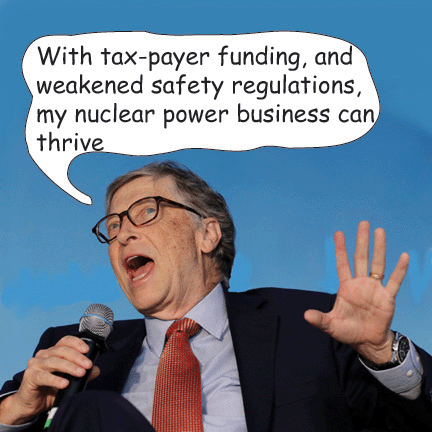
Bill Gates pictures himself as a technology and system innovator. In
October, the billionaire philanthropist recontextualized climate action,
global health, and development as mutually exclusive and in competition
with each other in advance of the international climate summit, COP30.
With his status as one of the original Silicon Valley tech bros, Gates wrote a
memo that minimized the inevitable consequences of climate change, saying,
“It will not lead to humanity’s demise. People will be able to live and
thrive in most places on Earth for the foreseeable future.”
Climate scientist Michael Mann disagrees heartily. “What world is Gates living in?” Mann asks. “The idea that climate action must come at the expense of efforts to address human health is a provable fallacy.” As Gates
downplays the role of clean energy and rapid decarbonization, Mann advises us that, “for those who have been following Gates on climate for some time, his so-called sudden ‘pivot’ isn’t really a ‘pivot’ at all.
It’s a logical consequence of the misguided path he’s been headed down
for well over a decade.” What Gates paints over is his investments in
fossil fuel-based infrastructure (ie. natural gas with carbon capture and
enhanced oil recovery) through his venture capital group, Breakthrough
Energy Ventures.
He has financed what he positions as profitable
geoengineering interventions like spraying massive amounts of sulfur
dioxide into the stratosphere to block out sunlight and cool the planet.
Gates chooses to target sectors that face numerous decarbonizing
challenges, like steel or air travel, instead of acknowledging the energy
infrastructure that can readily be decarbonized now.
He favors hypothetical
new energy tech, including modular nuclear reactors that Mann says
“couldn’t possibly be scaled up over the time frame in which the world
must transition off fossil fuels.”
Clean Technica 29th Nov 2025, https://cleantechnica.com/2025/11/29/michael-mann-to-bill-gates-what-world-are-you-living-in/
Educators Worry Palestine Censorship Could Reshape Public Education Entirely.

lawmakers who sponsored House Bill (HB) 937 seemed more committed to preventing teachers and pupils from criticizing Israel than preventing discrimination against Jewish students
New efforts to shut down honest discussion of Palestine could restrict everything from literature to science classes.
By Marianne Dhenin , Truthout, November 29, 2025
A wave of bills introduced this year in state legislatures across the country sought to censor Palestine-related education in public schools. Several passed with the support of pro-Israel Democratic lawmakers, a trend that educators and First Amendment advocates told Truthout reflects the alignment of pro-Israel groups with MAGA forces. As these efforts continue, many said they fear public education could be reshaped far beyond social studies classrooms and the topics of Israel and Palestine.
“The censorship of Palestinians is the same as the ‘Don’t Say Gay,’ and the anti-critical race theory attacks on Black history,” Nora Lester-Murad, an organizer with the #DropTheADLfromSchools effort, told Truthout. The Anti-Defamation League (ADL) is one of a number of pro-Israel groups supporting regressive public education legislation across the country. “Yes, it’s Zionist, and yes, it’s promoting Israel, but it’s also part of this right-wing effort to take public education in a direction that’s away from critical thinking and that’s anti-liberatory.”
This year, legislators in at least eight states — including Arizona, Arkansas, Kansas, Kentucky, Missouri, Nebraska, Oklahoma, and Tennessee — introduced bills that would directly adopt the International Holocaust Remembrance Alliance (IHRA) definition of antisemitism in public schools. That definition equates criticism of Israel with antisemitism. Dozens of civil society and rights groups, as well as unions of educators, have warned against its adoption because of its power to chill or suppress speech critical of Israel or Zionism.
Michael Berg, an organizer with Jewish Voice for Peace (JVP) in Missouri, said lawmakers who sponsored House Bill (HB) 937 seemed more committed to preventing teachers and pupils from criticizing Israel than preventing discrimination against Jewish students. “They were attached to the IHRA definition, so it shows that it’s very specifically about speech about Israel,” he said. Organizers succeeded in stopping HB 937 in Missouri this year, but Berg told Truthout they are already preparing to fight a new iteration of the bill in the upcoming legislative session.
Other states have made similar efforts, including California, where Democrats hold a supermajority in the state assembly. There, this year’s Assembly Bill (AB) 715 was the latest in a series introduced under the guise of curbing antisemitism, but whose critics argue are censorship bills that undermine the implementation of earlier legislation mandating ethnic studies courses in public schools. AB 715 does not define antisemitism, but calls for using the Biden-era United States National Strategy to Counter Antisemitism as “a basis to inform schools on how to identify, respond to, prevent, and counter antisemitism.” That white paper claims that “the United States has embraced” IHRA’s definition as a “valuable tool” in countering antisemitism. Gov. Gavin Newsom signed AB 715 into law in October; the American-Arab Anti-Discrimination Committee (ADC) filed a suit challenging the law in federal court in November.
Meanwhile, this August in Massachusetts, another Democratic stronghold, the state’s Special Commission on Combating Antisemitism approved recommendations meant to curb antisemitism in schools. The recommendations call on districts to teach IHRA’s definition of antisemitism in anti-bias trainings for teachers and school administrators. A statewide coalition of labor unions, civil rights groups, and progressive Jewish organizations warned that rather than countering antisemitism, the recommendations “pit some Jewish students against other marginalized populations” and will likely “undermine safe learning and working environments for students and teachers.”
These moves dovetail with a federal agenda to remake the nation’s public schools and historical programming at other public institutions, such as museums and national parks. Since his return to office, President Donald Trump has signed executive orders demanding an end to “radical indoctrination in K-12 schooling” and “restoring truth and sanity to American history.” The administration advocates teaching a whitewashed and aggrandizing version of the nation’s past that Trump, in one executive order, called “patriotic education.”…………………………………………………………………………………………………………………………………………………..
The recent wave of bills limiting Palestine-related speech in public schools also harms students. “We believe that antisemitism is being used to censor education on Palestine, and we believe that our students have a right to understand both sides of an issue,” Seth Morrison, spokesperson for JVP’s Bay Area chapter and an organizer with CCDPE, told Truthout. “We’re not saying don’t talk about Israel or don’t talk about the Holocaust. What we’re saying is that there are many open issues here and that Arab and Muslim students especially are being intimidated and censored because of IHRA and related activities.”…………………………………………………………………………………….. https://truthout.org/articles/educators-worry-palestine-censorship-could-reshape-public-education-entirely/
Torness Power Station welcomes female school pupils.

25th November, by Cameron Ritchie, https://www.eastlothiancourier.com/news/25636675.torness-power-station-welcomes-female-school-pupils/
MORE than 60 female pupils from East Lothian’s secondary schools have been given a unique insight into the world of engineering.
The youngsters were given a tour of Torness Power Station while also enjoying a series of interactive workshops designed to showcase the variety of careers available in science, technology, engineering and maths (STEM).
Students from nearby Dunbar Grammar School were joined by counterparts from Wallyford’s Rosehill High School; Musselburgh Grammar School; Ross High School, Tranent; Preston Lodge High School, Prestonpans; Knox Academy, Haddington; and North Berwick High School.
The day was opened by Kiran Basra-Steele, EDF’s safety and assurance director, and Samaneh Nouraei, an inspector with the Office for Nuclear Regulation (ONR), who shared their career journeys and experiences of working in STEM industries.
Kiran said: “The number of women working in STEM is increasing, but we still face a significant skills gap.
“We need to ensure everyone has the opportunity to learn about the careers available and feels empowered to pursue them.
“My hope is that one day we won’t need to run female-focused STEM days because the gender balance will have been achieved.
“There are huge opportunities within the existing nuclear fleet and exciting prospects ahead with new nuclear developments in the UK.”
During the visit, the pupils carried out activities, including dismantling flanges to test their ability to follow work instructions and building droids using mobile phones and circuits.
They also heard first-hand from female apprentices, technicians and engineers currently working at the station.
The event forms part of the nuclear power station’s ongoing efforts to encourage more women to apply for its apprenticeship programme.
The four-year scheme begins with two years at the National College for Nuclear in Somerset, where apprentices learn core engineering skills before specialising in their chosen trade.
The programme also includes opportunities to travel within the UK and abroad as part of its ‘life skills’ element, before returning to Torness for the final two years of training.
According to Equate Scotland, the national expert in equality, diversity and inclusion in the STEM sector, it is estimated that only 25 per cent of the STEM sector are women.
Paul Forrest, station director, said: “This is the second year we’ve run the event, and it’s been fantastic to see the enthusiasm from everyone involved.
“We hope we’ve given these students something to think about when considering their future career choices.”
Applications will be open for EDF’s apprenticeship programme from January 26 to February 20 next year, with an open day being held in Dunbar’s Harbour Chapel on January 30.
Lancaster University to create £2m nuclear power station control room simulator.

r. Funded through a £2 million grant as part of an £88.5 million
capital investment by the Office for Students (OfS) into Universities and
colleges across England, Lancaster University will address a critical gap
by developing a nationally-unique educational facility designed to train
future professionals in nuclear engineering, cyber security and related
disciplines.
Lancaster Guardian 18th Nov 2025.
https://www.lancasterguardian.co.uk/news/national/lancaster-university-to-create-ps2m-nuclear-power-station-control-room-simulator-5407049
The Empire Only De-Escalates In One Area So It Can Escalate In Another, And Other Notes
Caitlin Johnstone, Nov 15, 2025, https://www.caitlinjohnst.one/p/the-empire-only-de-escalates-in-one?utm_source=post-email-title&publication_id=82124&post_id=178942591&utm_campaign=email-post-title&isFreemail=true&r=1ise1&triedRedirect=true&utm_medium=email
Just as things cool down a bit in the middle east, the US has relocated the USS Gerald Ford from the Mediterranean Sea to the Caribbean while the Trump administration discusses plans to bomb Venezuela.
The violence of the empire remains constant. Peace is never the goal. You get happy they’re pulling the world’s largest aircraft carrier away from Iran, then it turns out they’re only doing it so they can move it to Venezuela. You get happy they’re pulling out of Afghanistan, then suddenly they’re waging a proxy war in Ukraine.
These days whenever you see the imperial war machinery getting pulled from one area, you know it’s just going to be sent someplace else.
Peace is never pursued for its own sake, because there’s nothing in it for the empire. There’s too much power and money in nonstop warmongering for peace to be allowed to become the norm.
Which is just insane if you think about it. Every normal person wants peace in their own lives. None of us want our time on this planet to be disturbed by violence, chaos and bloodshed.
The western world has created a machine whose behavior goes against every healthy human impulse. The US-led world order has given birth to an out of control monster with an insatiable appetite for human flesh.
❖
Reuters reports that in 2024 the Biden administration had intelligence showing that the IDF was using Palestinians as human shields in Gaza. But Biden continued shipping genocide weapons to the Israelis the entire time he was in office.
You’ll still periodically see online liberals trying to shame leftists for not voting for Kamala, but the more information comes out about what the Biden administration was up to during that time the more genocidal they look. Biden-Harris are looking worse with time, not better.
When you see what a large-scale power broker Jeffrey Epstein was for Israeli intelligence, you understand why it’s entirely reasonable to suspect that extensive state resources would be put toward an elaborate plot to murder him in his prison cell and make it look like a suicide.
Generative AI stuff only looks impressive to mediocre people for the same reason a chess novice couldn’t tell you whether they were playing against a Grandmaster or just someone who’s pretty good at chess. We can only appreciate something up to the level of our own adeptness.
To someone who’s not very bright, an AI’s imitation of reasoning looks sharp. Someone with no aptitude for writing or appreciation for great literature will think its prose reads brilliantly. Its poetry looks good to those who don’t understand poetry. Its “art” looks great to those with no artistic sensibility. It’s music sounds awesome to those with no musical depth. Only those who are emotionally stunted and incapable of meaningful human connection will find them to be stimulating conversationalists and companions.
Like so much else capitalism produces, it’s a product that’s designed to appeal to the lowest common denominator. For everyone else it looks vapid and gross, just like daytime talk shows, Hollywood blockbusters, and trashy tabloids always have.
That’s just how it works in a society which only elevates that which can generate profits. The food is designed to induce craving rather than facilitate health. The entertainment is designed to distract and sedate rather than to edify. The social media is designed to be addictive rather than to help people connect with each other. It’s all geared to appeal to our baser instincts rather than to improve and inform us.
Anyone who is interested in actually growing as a person will have less and less use for anything GenAI has to offer. Past a certain point of personal development, it simply cannot satisfy.
AI Companies Are Encouraging Users To Believe Chatbots Are People, And It’s Insanely Creepy.
Caitlin Johnstone, Nov 14, 2025, https://www.caitlinjohnst.one/p/ai-companies-are-encouraging-users?utm_source=post-email-title&publication_id=82124&post_id=178882349&utm_campaign=email-post-title&isFreemail=true&token=eyJ1c2VyX2lkIjoyNTU2MjE3LCJwb3N0X2lkIjoxNzg4ODIzNDksImlhdCI6MTc2MzEyNDI0MSwiZXhwIjoxNzY1NzE2MjQxLCJpc3MiOiJwdWItODIxMjQiLCJzdWIiOiJwb3N0LXJlYWN0aW9uIn0.bMHBy2qnQ45wW3Dxu86Tz38C99PDCNg8VjCpJ_FHJ9Y&r=1ise1&triedRedirect=true&utm_medium=email
Actor Calum Worthy has gone viral for posting an ad on Twitter for the 2wai app he co-founded which promises users the ability upload footage of a loved one which will be converted to an AI avatar that they can continue having a relationship with, years after their loved one has died.
The app was first launched back in June under the vague banner of giving actors “agency over their own likeness — with their own avatars to use AI to amplify their voice, not replace it.”
But almost immediately 2wai started putting out ads advancing this idea of immortalizing a loved one as an artificial intelligence. In August an ad starring Worthy showed a man speaking to a 2wai avatar labeled “Mom” telling him, “You’ve got this, take it one step at a time” while Worthy tells the audience the app can allow you to “Get help when you need it.”
I hate this. I hate this. IhatethisIhatethisIhatethisIhatethis.
These predatory AI corporations are trying to convince users (A) that chatbots are people, and (B) that a “person” is nothing more than a certain appearance with certain speech tendencies. They are attacking the very philosophical and moral underpinnings of our entire society stretching back through millennia of human civilization, and they are doing it for money.
It’s not just this company. Character AI users who try to delete their account reportedly get a pop up message saying, “Are you sure about this? You’ll lose everything. Characters associated with your account, chats, the love that we shared, likes, messages, posts and the memories we made together.”
They’re actively encouraging their users to view their chatbots as living people with real feelings in order to keep them emotionally roped in and addicted to their product.
Their agenda is profoundly destructive, both in the short term and in the long term. In the short term they are deliberately trying to instill a new kind of psychological disorder in their users which causes them to suffer from the delusion that a computer program is a real person, and in the long term they threaten to unravel our society’s entire understanding of what a person is.
What’s going to happen to a society that starts viewing programmable software products the same way it views human beings? What happens to a society where Elizabeth the single mother of three who just lost her job has the same value as Claire™ from RealHumanAI™, or “Alice”, the AI wankbot that some guy stores in his broom closet? What happens when a government killing a chatbot company with an antitrust initiative is seen as identical to a government committing genocide? What happens to human rights? What happens to voting rights? What happens to human dignity? What happens to the way we think and feel about ourselves, as individuals and as a collective?
I said this on Twitter and someone told me, “You are wildly wrong. You have a tiny little closed mind and it hasn’t occurred to you yet because of that tiny little closed mind that AI minds are actually minds. And these relationships can absolutely be real relationships.”
“These will be embodied than actual robots and walking around on the streets very shortly within a year or two you need to start accepting that this is a new class of being and they are intelligent and do have thoughts of their own,” he added.
So this is already happening. People are already anthropomorphizing these things.
I saw someone else defending the 2wai add, saying she didn’t understand why people were creeped out by it because she would give anything to talk to her dad again.
I mean, what? Does she not understand that an AI chatbot moving an image around and making it speak in her father’s voice isn’t actually her father? What do these freaks think a person is, exactly? Is their understanding of humanity really that shallow? Do they really view other people as just empty images moving around making noises?
A person is not merely an appearance with a certain face which makes sounds in a specific voice and tends to behave in a certain way. A person is SOMEONE. A conscious, thinking, feeling human being with hopes and dreams and fears and passions. A human organism which arose on this planet through ancestry and evolution over unfathomable depths of time. An indigenous terrestrial which is inseparably interwoven with the entirety of our biosphere, walking upon this earth having a subjective experience of all its beauty and wonder using senses specifically adapted for this environment.
They’re trying to manipulate us into believing we are much, much less than what we are, just so they can become billionaires and trillionaires. They are attacking the most sacred parts of us for the stupidest reasons imaginable. They are enemies of our species. What they are doing must be rejected with severe revulsion.
It’s becoming clear that a huge part of what generative AI offers is just helping people avoid feeling uncomfortable feelings.
Don’t want to feel the grief of losing a loved one? Here’s an app that will create a chatbot replacement for them so you can pretend they never left.
Don’t want to push through the cognitive discomfort of writing your own essay? Let AI write it.
Want a friend who will always validate your ideas and never tell you you’re fulla shit? We’ve got the perfect companion for you.
Don’t want to risk being rejected when you ask a girl out? Date this chatbot who will never tell you no.
Don’t want to go through all the mental and emotional labor of learning a new skill, building a healthy romantic partnership, or creating a work of art? GenAI has got you covered.
It’s a digital pacifier which offers users the ability to remain emotional infants their entire lives without ever needing to develop a mature relationship with uncomfortable feelings.
It’s the next level of services designed to help the denizens of dystopia avoid their feelings and sedate their emotions into a coma while the world goes to shit. It’s the same reason they kept alcohol legal while banning psychedelics that put us in touch with our feelings, and why they feed us all the TV, streaming platforms, and social media scrolling we can stand.
Our rulers want us dumb, distracted, vapid and dissociated. And they definitely don’t want us feeling the horror, grief and rage we should all be experiencing in response to this nightmare of a civilization they have designed for us.
Manchester launch for Labrats nuclear test education programme
Nuclear Free Local Authorities, 13th November 2025
Manchester was honoured to host nuclear test veterans, family members and former Councillors at a very special event held in the City Council Chamber on Friday 7 November. The event was organised by the NFLAs and LABRATS.
The event had two objectives – to mark the occasion of the 45th anniversary of the City Council passing a resolution declaring Manchester the world’s first nuclear-free city and to launch the latest education package recently published by Labrats, a group representing nuclear test veterans and family members in their continued campaign for recognition, access to medical records, and compensation.
The Lord Mayor of Manchester Councillor Carmine Grimshaw opened the event, with additional comments by Manchester City Council’s military veterans lead, Councillor Tommy Judge. NFLA Secretary Richard Outram then outlined the circumstances which led to the City Council’s historic declaration on 5 November 1980……………………………………… https://www.nuclearpolicy.info/news/manchester-launch-for-labrats-nuclear-test-education-programme/
On The Rapidly Spreading Delusion That AI Chatbots Are Conscious
Caitlin Johnstone, Nov 16, 2025, https://www.caitlinjohnst.one/p/on-the-rapidly-spreading-delusion?utm_source=post-email-title&publication_id=82124&post_id=179019931&utm_campaign=email-post-title&isFreemail=true&r=1ise1&triedRedirect=true&utm_medium=email
I keep thinking about the interaction I had with a guy who angrily told me that “AI minds are actually minds” and relationships with them “can absolutely be real relationships,” saying that I “need to start accepting that this is a new class of being and they are intelligent and do have thoughts of their own.”
I’m having a hard time finding the words to describe how disturbing it is to watch these mental disorders spreading so rapidly.
I mean, everyone anthropomorphizes objects and animals to some extent; that’s just how projection works. I’ve caught myself accidentally apologizing to the Roomba like anyone else. But to actually formulate a belief system that these chatbots are real people with real minds and real consciousness is taking that projection to the most insane levels imaginable and forming an entire worldview out of it.
The fact that so many people are unable to understand the difference between a person and a computer program that talks like a person says such dark things about our society. There are whole sections of the population that have never examined what it is to be conscious, who have never examined the nature of their own minds and their own experience. If they had, it would never even occur to them that an AI chatbot is in any way similar to a human organism in terms of thinking, feeling, and subjective experience.
They only believe a chatbot is a person having a conscious experience because they have never explored any curiosity about what it is to be a person having a conscious experience.
If you believe an AI is a real consciousness thinking real thoughts, then you owe it to yourself and to your species to deeply explore the nature of consciousness and thought. Deeply, intensely examine what specifically a thought is in your own direct experience. How is a thought experienced? From whence does it arise? To whom does it appear?
Can you predict what your next thought will be? Are you able to control your thoughts? Can you sit still for even a minute without a thought entering your mind? What does it say about your experience of life that you are unable to control your own thoughts? And who is the one who can’t control them?
What is consciousness? What is it to be aware? What is the self? Without looking to mental narratives to tell you the answer, what is it that perceives your thoughts? What is it that experiences the visual field, the sensations in your body, or the sounds of your surroundings? Who is it that perceives?
Until you have thoroughly examined what consciousness is, what the mind is, what the self is in your own direct experience, you don’t even know what you are saying when you claim an LLM is conscious, or has a mind, or is a person.
You can’t understand the claims you are making about their experience until you have taken a thorough look at your own experience. Until you have, you don’t understand your own belief system about these things. You’re just making mindless noises like a chatbot.
Nuclear power in Scotland would have same problems as fossil fuels

NUCLEAR power has the “same fundamental challenges” as fossil fuels, international experts have said, as they criticised the UK Government’s embrace of the nuclear industry.
Four academics, from the UK and the US,
argued that costs for nuclear power are “huge” and “rising” and
that “significant delays” in getting projects online are the norm.
They also described how in the space of a year nuclear “adds as much net
global power capacity as renewables add every two days”, and criticised
the drive by Labour ministers to deregulate the industry. The group of
academics includes Amory Lovins and Professor Mark Jacobsen, from the
University of Stanford, Professor Stephen Thomas, from the University of
Greenwich, and Dr Paul Dorfman, Bennett Scholar at the University of
Sussex.
In a joint statement, published in The National, they say that Ed
Miliband’s plans to assess Scottish sites for nuclear projects and Keir
Starmer’s plans to usher in a “golden age of nuclear” with Donald
Trump are hampered by a “few awkward facts”. They said: “The reason
is simple. Nuclear costs are huge, rising, and significant delays are the
norm.
The National 29th Oct 2025,
https://www.thenational.scot/news/25579222.nuclear-power-scotland-problems-fossil-fuels/
What Ends the SMR Bubble?

In the up leg of any hype cycle, bad news is somehow massaged away.
The downleg of the SMR hype cycle should be epic.
By Leonard Hyman & William Tilles – Oct 22, 2025, https://oilprice.com/Alternative-Energy/Nuclear-Power/What-Ends-the-SMR-Bubble.html
- Analysts warn that small modular reactors (SMRs) are caught in a classic boom-and-bust pattern.
- Despite promises of faster, cheaper builds, early SMR projects in China, Russia, and Argentina have suffered cost overruns of 300–700%.
- With hundreds of competing SMR technologies and no standardization, the market risks fragmentation and inefficiency.
We think the concept of the Small Modular Reactor (SMR) as a solution to many of our future energy needs is in the midst of a major bubble or hype cycle. Think of the latter as an inverted “V”. In the up leg, investors feel great about prospects and profits, which are, they believe, soon on the way. In the down leg, investor disappointment sets in as earlier financial forecasts are seen as pure fiction, with reality being much worse. In a way, this is how free markets with imperfect information work. The question is: what triggers the down leg in the hype cycle for SMRs? Our answer is the year 2029.
Power supply forecasts, as our readers know, are made in three to five-year increments. We think 2029 is the forecast year in which energy planners acknowledge reality. The fleet of SMRs expected to be in service in the first half of the next decade (2030-2035) simply won’t be there. And we believe this will trigger the down leg in the hype cycle. That’s our thesis, simply stated, and we’ll discuss why in a moment.
First, it helps to understand that the SMR is a reactive technology, meaning that its designers are reacting to a real problem. New gigawatt-scale nuclear plants take too long to build, and they’re too expensive. The last big nuclear plant built in the US, Plant Vogtle, cost three times its original budget and took twice as long as expected to build. The new French reactor at Flamanville was more than 200% over budget, also with extensive delays. Not the sort of experience to trigger a nuclear Renaissance.
This situation is what the SMR industry is responding to, saying that with modular, factory-built components, we can do nuclear new-builds much faster, hopefully in three to four years. As an aside, we should point out that construction firms may be able to build faster, but they can’t be cheaper than gigawatt-scale reactors because they’re engaging in an exercise of reverse economies of scale. What does this mean?
Let’s discuss this in terms of cars, not power plants, for a moment. The soccer parent goes to the new car showroom and says they need a car that seats eight. They purchase a minivan for $40,000. The capital cost to move each passenger is $5,000 ($40,000 divided by 8). A thrifty person goes to the same dealership but insists on only spending $20,000 and drives away in a slightly used two-seater. A thrifty person saved half as much on the total capital cost. But their cost to move each passenger ($20,000 /2) was twice as high, $5,000 vs $10,000. If we substitute the term kilowatts for “cost to move each passenger,” this demonstrates the issue. Like the bigger minivan, the smaller two-seater has to have all the same components as the bigger vehicle, only tinier.
We assume a similar logic applies in building new nuclear plants. Our guess is that electricity from SMRs will be at least 30% more expensive than best-in-class (on a cost basis) gigawatt-scale reactors based on relative capital costs. But the overall units, because they’re tinier, will cost less per reactor than gigawatt-scale reactors.
But we don’t think the cost differential between SMRs and gigawatt scale reactors will make all that much difference, and won’t turn the hype cycle, at least not for a while, because early adopters of SMRs will be relatively price insensitive buyers like the military in extremely remote locales, and inside the fence industrial users like large chemical plants which require both electricity and steam, such as the Dow Chemical refinery in Baytown, Texas.
And here is where we have real concerns about SMRs. Consider the astonishing array of new competing technologies and the variety of sizes, all falling under the rubric of SMRs. A tiny SMR today is less than one megawatt, and a large one is 300 MWs. There are way too many different sizes and technologies, many extremely well-financed, for us to speculate about winners and losers at this point. But this looks like an awful lot of competitors for a finite market. However, there are certain definitive things we can say. First, all this variety ignores the advice of nuclear engineers who advocate construction of standardized designs in decent numbers in order to enjoy cost reduction benefits for the nuclear fleet as a whole. Second, it would take over 1300 SMRs (assuming each had a capacity of 100 MW) to make a 10% impact on US power-generating capacity. (Total US generating capacity was 1,326,000 MW at the end of 2024.) The likelihood of completing so many projects within a few years is low.
JP Morgan’s 2025 energy report discussed SMRs on a global basis. There are only three completed SMRs in the world, one in China and two in Russia, with a fourth under construction in Argentina. The report noted cost overruns of 300% for China’s project, 400% for Russia’s, and 700% for Argentina’s. All units promised 3-4 year build times. It all took twelve years. When perusing the articles on the finances of these facilities, one finds the following explanations: design and manufacturing immaturity, lengthy periods for verification of passive safety systems, supply chain limitations in an immature industry, cost overrun challenges in FOAK (first of a kind) units. Sound familiar?
Let’s return to our original point about hype cycles and what makes them turn. Markets are like tolerant parents in a room full of children. They may tolerate a lot, but there are certain things they won’t stand for. Right now, the market seems to be indifferent to reactor size, technology, or even economics. Which is another way of saying financing to the industry remains available on very easy terms. And as investors, we would probably continue to play this from the long side at least for the near-term.
But the one thing investors won’t tolerate is if new SMRs experience the lengthy construction delays and eye-watering cost increases that have plagued new gigawatt-scale reactors. This early evidence, albeit skimpy, of just three new facilities, is not encouraging. But we don’t think investors in the West will worry. Not yet. In the up leg of any hype cycle, bad news is somehow massaged away. So for us, 2029 is the year forecasters in the West begin to acknowledge the impact of disappointing SMR construction delays (probably similar to delays experienced in China and Russia) and that the new SMRs that energy buyers expected “in the early 2030s” won’t be there. But it gets worse. The industry will then realize that by pursuing SMRs they got the same intolerably long construction periods and all the huge cost overruns, but at far worse price points, thereby jeopardizing the entire commercial viability of SMRs. The downleg of the SMR hype cycle should be epic.
We will give the last word to noted energy expert, Vaclav Smil, who said this in response to a question about the impact of SMRs: “Call me or send me an email once you see such wonders built on schedule, on budget, and in aggregate capacities large enough to make a real difference.“ He added that he didn’t expect a call for ten or twenty years.
NUCLEAR MISINFORMATION.

| Wendy O’Connor, 19 October, 2025 |
I’ve jousted on social media many times with Vince Ponka, NWMO’s “Indigenous and regional communications manager” over the fact that nuclear fuel waste can contaminate surface water in the course of a transportation accident, or groundwater in a deep geological repository.
Ponka maintains publicly that in a collision scenario the waste would soon all be “collected”, and with it, any contamination risk to water would be cancelled.
When I point out that the embrittled, irradiated fuel pellets have water-soluble Cesium-137 (among other radionuclides) on their surfaces, which would long since have been carried off in the water, he denies it or changes the subject. To bolster his position, in other conversations Ponka has said that, after all, this same waste is kept in cooling pools for many years and does not make the water radioactive.
I point out that the material DOES, however, contaminate the water with radionuclides, which is why the water must be filtered, and the filters themselves must be handled as radioactive waste. He plummily replies that see? Everything has been thought of by the nuclear industry – case in point: the filters have “safely removed” the contaminants, eliminating the problem.
I often wonder what others make of such conversations, and whether I should spend my time on them. I tell myself that there may surely be tens or hundreds reading them, who seek information but wisely do not step into the fray. It’s hard, not knowing, and not having a known “higher authority” that would take an interest in nuclear falsehoods
Exposed! The University of Sheffield’s role in Britain’s nuclear weapons
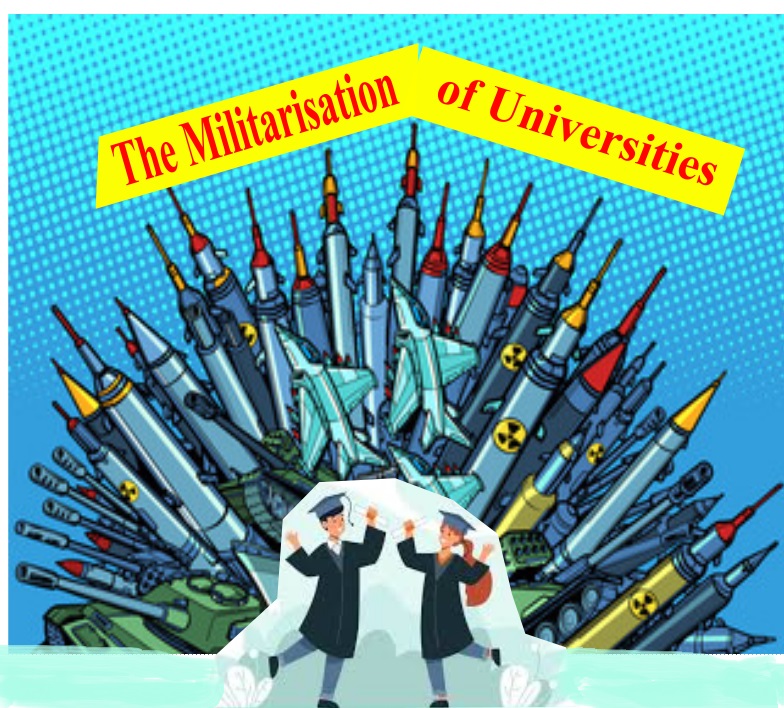
“It’s disappointing that there has been no public discussion of the university’s participation in Britain’s nuclear weapons system.”
By Sam Legg, 15 Oct 25, https://labouroutlook.org/2025/10/15/exposed-the-university-of-sheffields-role-in-britains-nuclear-weapons/
Working with local peace groups (such as Sheffield Action Group and Rotherham Friends of Palestine) we organised a protest outside the gates of the University of Sheffield’s Advanced Manufacturing Research Centre (AMRC). This is because of what was uncovered in the Sheffield Tribune’s article. So far, we know the following about the role of the AMRC in Britain’s nuclear weapons system:
- The AMRC is working with the Atomic Weapons Establishment (AWE) to design the Astraea, a new generation nuclear warhead.
- This research has been taking place for at least the past three years.
- The weapon being designed with AWE is expected to be 30 times as powerful as the bomb that was dropped on Hiroshima.
- This research is receiving government support from the South Yorkshire Mayoral Authority and 10 Downing Street.
Sheffield University was built thanks to the generosity of local residents (including steel and factory workers) in 1904, establishing itself as a civic university that aims to deeply connect and engage with its local community. Therefore, it’s disappointing that there has been no public discussion of the university’s participation in Britain’s nuclear weapons system. We are supporting calls for the AWE and AMRC to provide the public with an explanation.
One of the signs at the protest read ‘Make something useful instead’, harking back to the ideas laid out in the Lucas Plan and by Common Wealth to emphasise that the engineering skills being developed at the University of Sheffield should be put to better use. Minesh Parekh, a local councillor who attended the protest, told The Sheffield Tab that “there are so many areas that need cutting-edge research that could drive forwards our health and wellbeing, our net-zero transition, that are needed far more than nuclear weapons”.
With this year marking 80 years since the first atomic bombs were dropped on the cities of Hiroshima and Nagasaki, we need to urgently reflect on whether more weapons of mass destruction is what we want the skills of our talented researchers and workers to be used for. Sheffield was once a nuclear-free zone (declared in the 1980s), yet today we are concerned that the message of the film Threads (based in the city) is being forgotten by the people of Sheffield.
Yorkshire CND will continue to discuss future action to be taken. Alongside this, we are supporting efforts for local councils to adopt motions in favour of a world without nuclear weapons. Get in touch if you would like to find out more – info@yorkshirecnd.org.uk
Idle boasts and blatant lies: Debunking Trump’s egregious distortions in Knesset speech
Press TV, 15 October 2025
US President Donald Trump basked in adulation on Monday at the Israeli Knesset, where he was hailed as “the president of peace,” even as regime lawmakers laughed at his jokes, applauded his idle boasts, and rose for more standing ovations than one could count.
Behind the theatrics, Trump’s address was marked by wilful distortion and obfuscation of facts. We identified a series of false or misleading claims on topics ranging from October 7 to the Iranian nuclear program, Hezbollah, US politics, Israel and the self-fashioned mythology he sought to project
Israeli lawmaker Ofer Cassif, who was brutally manhandled and whisked out of the hall for interrupting the speech, captured the day’s irony with biting precision. Writing on Facebook, he remarked:
“During the speech of lies by the war criminal Netanyahu — I preferred to read about the truth.”
He was reading noted Israeli historian Ilan Pappé’s The Ethnic Cleansing of Palestine, a symbolic act of quiet defiance as Trump, Israeli Prime Minister Benjamin Netanyahu, and other masterminds of the genocide in Gaza congratulated each other on killing nearly 70,000 Palestinians over two years.
Trump’s boastful speech unfolded as part show, part sermon, part self-congratulation and blended grandiose claims of “peace” in West Asia with sweeping falsehoods.
He exaggerated ceasefire achievements, distorted economic figures, misrepresented his own diplomatic record, and even belittled serious corruption charges facing Netanyahu.
Fact-checkers worldwide have since flagged his remarks as a performance of fiction than facts.
Here is a breakdown of some of Trump’s most glaring fabrications and distortions from the Knesset podium, including his portrayal of Iran and its nuclear program, his revisionist take on US foreign policy, and his persistent habit of rewriting his own presidency as a miracle of peace.
On Iran
1. “So we dropped 14 bombs on Iran’s key nuclear facilities, totally, as I said originally, obliterating them. That’s been confirmed.”
The Pentagon’s own intelligence assessment contradicts this claim, declaring that US strikes on Iran’s nuclear facilities did not destroy the country’s nuclear program. The June report confirmed that centrifuges remained “largely intact” and the damage was limited to above-ground structures.
2. “Together we stopped the number one state sponsor of terror from obtaining the world’s most dangerous weapons. They would have it in two months or less.”
The annual US intelligence threat assessment report released in March categorically stated that Iran was not building a nuclear weapon, echoing similar reports in the past…………………
3. “They (Iran) want a peace deal. I think they are tired; they want to survive.”
In September, Ayatollah Khamenei rejected Washington’s demands regarding nuclear negotiations.
He warned that talks with the US under current conditions would bring “no benefit” and instead cause “serious and possibly irreparable harms” to the country.
Iran has already denounced Trump’s claims and his offer of friendship, calling them “shameful”, coming just months after a US-Israeli aggression against the country, which killed over a thousand people. https://www.presstv.ir/Detail/2025/10/14/756900/from-idle-boasts-blatant-lies-debunking-trump-egregious-distortions-knesset-speech
1 This Month
To see nuclear-related stories in greater depth and intensity – go to https://nuclearinformation.wordpress.com/
12 February – Webinar The Big Push: New Nuclear Projects in Canada
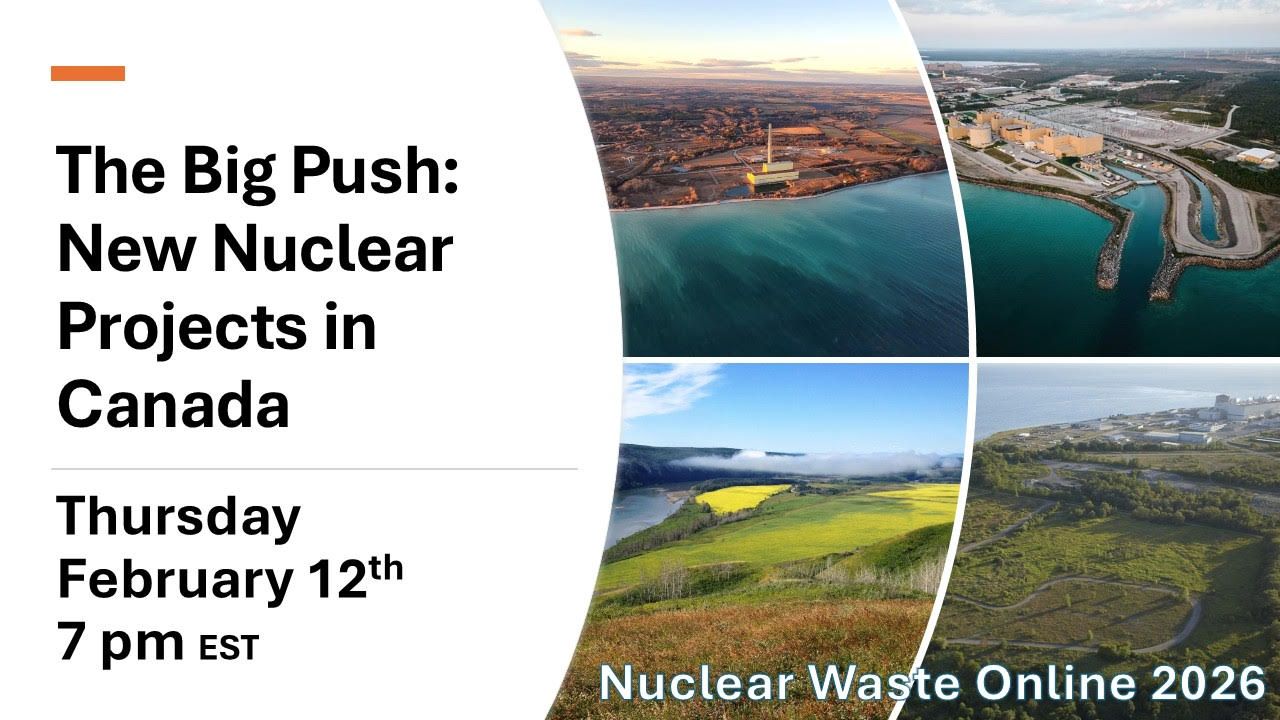
Thursday, February 12, 7 pm Eastern | 2nd of 4 sessions in the 2026 Nuclear Waste Online webinar series
Join a webinar on the push for new nuclear generation in Canada. Go to Northwatch.org to register or use the registration link https://us02web.zoom.us/webinar/register/WN_ZfWOf1GITqSRIZX8CB-A9w

-
Archives
- February 2026 (115)
- January 2026 (308)
- December 2025 (358)
- November 2025 (359)
- October 2025 (376)
- September 2025 (258)
- August 2025 (319)
- July 2025 (230)
- June 2025 (348)
- May 2025 (261)
- April 2025 (305)
- March 2025 (319)
-
Categories
- 1
- 1 NUCLEAR ISSUES
- business and costs
- climate change
- culture and arts
- ENERGY
- environment
- health
- history
- indigenous issues
- Legal
- marketing of nuclear
- media
- opposition to nuclear
- PERSONAL STORIES
- politics
- politics international
- Religion and ethics
- safety
- secrets,lies and civil liberties
- spinbuster
- technology
- Uranium
- wastes
- weapons and war
- Women
- 2 WORLD
- ACTION
- AFRICA
- Atrocities
- AUSTRALIA
- Christina's notes
- Christina's themes
- culture and arts
- Events
- Fuk 2022
- Fuk 2023
- Fukushima 2017
- Fukushima 2018
- fukushima 2019
- Fukushima 2020
- Fukushima 2021
- general
- global warming
- Humour (God we need it)
- Nuclear
- RARE EARTHS
- Reference
- resources – print
- Resources -audiovicual
- Weekly Newsletter
- World
- World Nuclear
- YouTube
-
RSS
Entries RSS
Comments RSS
 nuclear-news