2 important Russo Ukraine war stories: 1 covered 24/7; 1 covered up

It would be so nice for me to think (as a good, genuinely conservative, Christian Westerner and patriotic Australian) , – that this Walt Zlotow story is a pack of lies, (obviously from a paid stooge of Putin)
My problem is: that everything that I see, read, hear, on Australian corporate media and the Australian Broadcasting Corporation – just happens to tally with what he is saying.
Good on Walt Zlotow for having the guts to speak out.
I’m just sorry that I think that he is not going to be believed. The end result? We might find a small group of (?)wealthy individuals presiding over a nearly dead planet.

Walt Zlotow West Suburban Peace Coalition, Glen Ellyn IL 27June 23
Mainstream news got the figurative memo from the US State Dept. and military Friday: Full media press coverage of the mini insurrection against Russian President Putin that could potentially have toppled him. But not one word on the apparently failing Ukrainian counteroffensive the US was counting on before even considering negotiations to end the 17 month war.
That coverage simply continues the 487 days of media compliance with US not so subtle demands that the war be reported as Ukraine largely defeating a Russia hopelessly unable to secure control of Donbas and keep NATO off its doorstep.
If the American people were informed on Ukraine’s near complete inability to repel the Russian invaders, they might push back against the squandering of over a hundred billion dollars in US treasure on a futile cause not affecting US national security in the least.
If they knew we’re sending cluster bombs, prohibited by most countries, that can kill long after the war ends, if ever, they might call for negotiations, not more weapons.
If they knew we’re sending long range missiles to strike deep in Russia, possibly triggering nuclear confrontation, they might protest this madness.
But most Americans don’t know any of this. Like the apparently failing Ukrainian offensive, only good news, justifying America’s ghoulish demand this war goes on endlessly, gets on mainstream news.
If the US had that insane approach to diplomacy and negotiations during the Cuban Missile Crisis, we wouldn’t be having this discussion. We’d have all been blown away 61 years ago. more at https://www.antiwar.com/blog/author/walt_zlotow/
“Nuclear is CLEAN” Trumpets Westinghouse’s Uranium Fuel in Cumbrian Press Adverts
Name: Anita Stirzaker Ad type:Brand/product: Westinghouse Electric Company
Your complaint:
Advert in the Whitehaven News (and other regional papers?) for Westinghouse “Shaping Tomorrow’s Energy to deliver a carbon-free future in the UK. Westinghouse is shaping the future of clean energy in the UK.”
The advert talks about the AP1000 “ready for deployment in the UK” – this is not the case – the AP1000 has not been given licence approval for any sites in the UK as far as I know and there are no operational AP1000 reactors anywhere in Europe as far as I know. The AP1000 would not be “carbon free” as the uranium fuel requires fossil fuel at every stage from mining to looking after the wastes. The Westinghouse plant at Springfields itself uses enormous amounts of gas to manufacture uranium fuel and has I believe its own dedicated gas pipeline into the site. Sellafield is where the fuel from Springfields ends up and this has its own gas plant on site called Fellside. Westinghouse itself in its 2022 Sustainability report (https://www.westinghousenuclear.com/Portals/0/about/Westinghouse%202023%20ESG%20Report.pdf) says it has a “net-zero” carbon emissions target by 2050″ note this is the more slippery accounting of “net-zero” which is definitely not “carbon free” as the advert in the Whitehaven News claims.
The advert claims that Westinghouse is shaping “clean energy”. this is not the case – the Springfields site itself uses lots of freshwater in all its processes – far more I believe than the fracking industry would have done in the Preston area. The fresh water use is enormous especially if the leaching of uranium fuel from the grounds of foreign countries is included along with cooling the hot nuclear wastes at Sellafield.
The nuclear industry cannot legitimately claim to be clean while radioactive and chemical emissions are routinely dumped to the environment. Then there is the possibility of catastrophic accident. What other industries have such large Emergency Zones in the case of accident ? At the lancaster canal alongside the Springfields plant there are Westinghouse notices saying “if you hear a loud, continous siren (like an air-raid siren) you should leave this area as quickly as possible”.
There is another conflicting notice saying “Go inside your boat and stay inside until instructed otherwise. Close all windows and doors. Switch off all heating, ventilation and air conditioning systems. Tune to the local radio station and listen for announcements telling you what to do.”
That is not a “clean” industry!
From Springfields Westinghouse site there are a cocktail of radioactive an chemical wastes going into the landfill at Clifton Marsh – the latest plan is to open an incineration plant on the Westinghouse Springfield site to take in nuclear waste (including intermediate nuclear wastes) from Europe and burn it there.
That is not a “clean” industry.
If Shell has been taken to task for its “clean” claims then the nuclear industry cannot be allowed to get away with this greenwashing of its fossil fuel use alongside its radioactive and chemical emissions to land, rivers,sea and air. The nuclear industry is not fully insured for good reason – it is uninsurable.
The absurdity of Western reporting on the war in Ukraine – Schrodinger’s Offensive
JULIAN MACFARLANE. JUN 17, 2023
Ukraine is mounting Schrodinger’s Offensive. If it succeeds, it has already started. If it fails, then it hasn’t even begun. Clint Ehrlich.
Schrodinger’s famous paradox as applied to the “counter-offensive” Ukraine
“…this is what I like to call “Schrodinger’s War Effort,” in that we’re meant to believe that Ukraine is simultaneously easily winning and also desperately needs gear because it’s on the brink of catastrophic collapse.
Similarly, Russia is simultaneously comically weak and incompetent and able to conquer Europe if they are not stopped in Ukraine.”
….. Zelensky met with Justin Trudeau in Kiev…Zelensky finally acknowledged that there was indeed a “Counteroffensive”…. Trudeau gave him half a billion dollars ……. Schrodinger’s box had been opened.
But….the cat was still both alive and dead— the offensive both a failure and a success. While the Counteroffensive has officially begun, it has…well…not started in actuality since Kiev has instructed its single source media to refer only to “probing attacks”.
The UAF suffered losses of perhaps 10,000 men in its counteroffensive inthe first ten days along with substantial amounts of equipment including Leopard tanks, Bradleys and mine clearing vehicles—at least 160 tanks, mostly irretrievably damaged and hundreds of other vehicles, according to most sources. By the time you read this, the numbers will be higher, roughly a thousand men every day and 10 tanks, plus AFVs.
Yet, the UAF has been unable to breach Russian minefields to get to Russia’s real, multilayered fortifications 20 km beyond…………………
Right now, 10 Ukrainians die for every Russian, far in excess of the 3:1 ratio expected in assaults against defended positions.
The majority of the UAF losses of armor are not actually tanks blown to pieces but many damaged or abandoned on the battlefield — “irretrievable” losses.
Russia had 54 tanks put of action in the first 10 days but perhaps 30 of these could be can be salvaged or repaired.
Here too the UAF / RF loss is ratio is lop-sided.
$ilk purses out sow’s ears
Failing in the Zaporozhe region, the Ukrainians attacked in southern Donetsk , Zelensky first claimed to have taken three uninhabited villages in the Vremevka “gray zone”.
These villages are tiny — one had only five buildings. But here too, the UAF has suffered losses all out of proportion to any tactical benefits…………………………………………………………………….
General Milley recently acknowledged that the US is no longer the only military superpower. Russia and China are super powers too. Then he went on to promise the Ukraine more weaponry to commit national suicide.
Contradictions? Schrodinger lives.
What exactly is going on?……………………………………………………………….
The Absurdity of a “Big Splash”
For the UAF to overcome Russian defenses and cut the land bridge they would need:
- Roughly 5 as many troops as they have
- Full SEAD, which means full air superiority, advanced AD and EW.
- 5 to 10 times their current force of armor,
- A massive improvement in logistics.,
- A huge increase in ammo.
- 10 times more artillery
- Upgraded coordination, communications and command structures without ideological (Nazi) and political interference.
- An efficient logistics system
- An engineering corps capable of providing bridges and mine-clearing
- Battlefield medical
Yeah — it’s a lonnnnnnnnnng list. And incomplete at that…………………………………………………………….
Always follow the money. Cui Bono?
As I have suggested it’s MICIMATT—the Military-Industrial-Congressional-Intelligence-Media-Academia-Think Tank complex that calls the shots. When the USSR disappeared, they were faced with the awful fact that there was no major threat to them to support their huge budgets. How, oh how, could they afford new BMWs for each of the kids and the dog, too?
In this topsy turvey world, American military industrial companies are now profiting from the failure of Germany’s wunderwaffen Leopard 2s in the CounterOffensive — which almost guarantees providing Abrams tanks to Ukraine. The US has already said it will supply DU munitions — which the Russians will presumably blow up in Western Ukraine, polluting Europe to the West.
…………………………………….. In the meantime, absurdity has to be managed. The cat has to be fed.
But how does one handle the Unbelievable?
Magicians do it through misdirection. People believe what they see — which is unfortunately also what they don’t see. Which was Schrodinger’s point, of course.
So, the UAF attacked the Kakhovka Dam. That re-directed attention from Ukrainian military failures……………………………………………..
In the meantime, absurdity has to be managed. The cat has to be fed.
……….The event was trumped in the Western Press as yet another proof of a.) Russian desperation b.) Russian Evil.
So if the “Counteroffensive” fails, it’s because the Russians play dirty and to not care about the environment or human life. Russian “success” and Ukrainian failure therefore become somehow irrelevant.
……………………………………………….. the West insists that Russia is collapsing. Yet also preparing to conquer Europe. The Ukrainians will keep on coming……………………………………………… https://julianmacfarlane.substack.com/p/schrodingers-offensive
Ignoring the Fiction of a Nuclear Silver Bullet

by Ben JealousJune 14, 2023, https://www.washingtoninformer.com/jealous-ignoring-the-fiction-of-a-nuclear-silver-bullet/
A growing chorus in Washington equates weaning our country off energy from killer fossil fuels to relying more heavily on new nuclear power plants. The same debates are happening in state capitals from Richmond to Raleigh, Springfield to Sacramento. This chorus distracts from the real work ahead of ensuring clean, renewable, affordable energy for every community.
The risk of nuclear energy is an easy dividing line. To opponents, names like Three Mile Island, Chernobyl and Fukushima are all the evidence we need that a catastrophic event is unavoidable and unacceptable. For supporters, those events are a sign that disasters are few. Both are right – they happen infrequently, and when they do occur, they are cataclysmic.
The more compelling reasons we should drop the silver bullet thinking about nuclear power are its cost and its reliability.
Since the mid-20th century when nuclear power entered the public imagination, the belief has been that energy is “free” – start the chain reaction make electricity. It’s not, and it never has been (uranium must be mined and reactor fuel is consumable). We’ve reached a point where renewable sources like wind and solar power are cheaper, in part because they are quicker to come online.
Lazard, a global investment bank and financial consultancy that reports annually on the “levelized cost of energy” from various sources, found that nuclear power is two to six times more costly per megawatt hour than wind and solar (which now cost the same per megawatt hour). The capital cost of large-scale solar and wind is at least eight times lower. The time to get new wind and solar into the electricity grid is at least half the time for a new nuclear plant; history shows that anyone who estimates the completion date for a new nuclear plant is wrong.
Unlike most industries that rely heavily on science and technology, the cost of building nuclear plants is rising over time. In Silicon Valley, they call it a reverse learning curve.
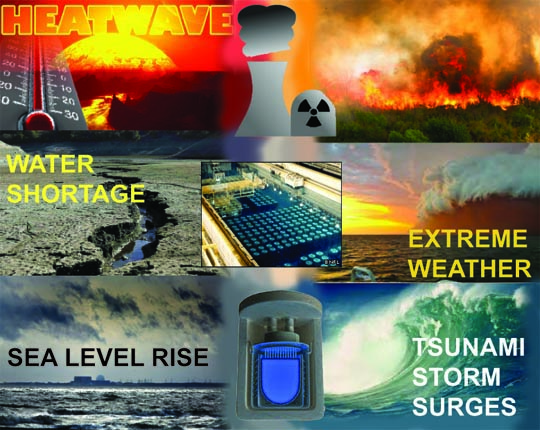
Supporters of nuclear power like to argue that nuclear plants are required for reliability, and that they can operate all the time. This ignores nuclear’s vulnerability to climate change: severe weather, extreme temperatures, and both floods and droughts have forced nuclear plants to shut down unexpectedly in recent years. Additionally, a reactor goes offline for routine maintenance at least every two years, which means a plant must have more total capacity to cover that maintenance routine. By comparison, wind and solar farms have much fewer operational problems. And battery backups have gotten faster than the gas power generation that nuclear plants often turn to meet peak demand.
It’s time to confront nuclear’s challenges — uranium mining, accident risk, cost, and climate vulnerability — and double down on the solutions we know will be central to our shift away from fossil fuels.
We can’t afford the distraction of a fiction around nuclear power when burning fossil fuels threatens the health of millions around the world annually. Our focus must be on bringing the clean air, cost saving, and economic benefits of clean energy to communities across the country as quickly as we can. From home energy retrofits and rooftop solar to wind energy and battery storage, we have more and better ways than ever before to transform our energy systems from fossil fuels to energy that’s actually clean, reliable and renewable.
Ben Jealous is executive director of the Sierra Club, America’s largest and most influential grassroots environmental organization.
Ukraine’s propaganda machine is vital for Zelensky: Here is how it works
Rt.com 12 June 23
Kiev is waging an extensive information war against Russia and it began long before the military conflict
The Russia-Ukraine conflict isn’t just about the clash of armed forces on the battlefield. It has also been marked by unprecedented levels of confrontation in the fields of information and psychology, cognition and semantics.
Kiev has arguably achieved more success on the information front, than on the ground. There the “fighters” aren’t just journalists and information and psychological warfare specialists, but content makers and PR experts. Influencing the psyche, mindset, and emotions of ordinary people has become a big deal, as shaping Western public opinion is vital for President Vladimir Zelensky’s regime.
The symbols of war
Anyone familiar with advertising and PR knows that tying a product to a colorful, memorable symbol, or slogan, will boost its popularity, especially in this era of short attention spans. During wartime, the same strategy works just as well with the news as with advertising and election campaigns.
In the current conflict, Ukraine has become very good at creating symbols. Media outlets instantly take up any popular symbol and make use of it in order to influence the mindset of ordinary Ukrainians.
Here’s a recent example. In May, despite the very difficult situation for the Armed Forces of Ukraine (AFU) in Artemovsk (Bakhmut) and statements from several commentators – particularly the former Zelensky adviser Alexey Arestovich – that the army could soon retreat (as it eventually did), Ukrainian society wasn’t at all worried and had complete faith in the AFU’s ability to retain control over the city.
In fact, public attitudes towards the battle were largely shaped by the media. For example, at the beginning of the year the rock band “Antytila” (“Antibodies”) released a video for the song ‘Bakhmut Fortress.’ A few months later, it became viral. Ukrainians have since posted countless self-made versions of the video on social networks, affirming the myth of the impenetrable fortress of Bakhmut.
Such symbols are created not only during ongoing battles, but also in the aftermath of the AFU’s obvious failures. For example, at the end of February, the Artemsol salt production enterprise announced that before the start of active battles for Soledar (which ended in January with the victory of the Russian Army), it collected 20 tons of salt from the mines. The salt was packed into 100,000 packages bearing the symbolic inscription “Ukrainian Rock-Solid Strength.” Each package was sold for 500 hryvnia (about $13.50). According to the organizers of the fundraiser, most proceeds were spent on kamikaze drones for the AFU.
Symbolic campaigns like these occur regularly in Ukraine and are designed to encourage the population. In November of last year, when Russian troops withdrew from the west bank of the Kherson region and the AFU entered the eponymous regional capital, a national social media campaign urged users to place images of watermelons (the area grows them) on their profile pictures. ………………………………………………………………
The triumph of these symbols, which have endured long after being confirmed as fake, is a result of the information bubble in which Ukrainian society and much of the West has found itself. In the past year and a half since opposition media was blocked, government-controlled outlets are often the only source of information for Ukrainians.
The invisible front
“Today, information warfare is the core structure of any war. It is very important to have influence over a society that is involved in combat. Moreover, it is essential to convince the world community of the rightness of our actions in order to receive further support. Not only authorized persons can take part in this information war, but also regular citizens who ‘fight’ at their own discretion,” Ukraine’s Deputy Defense Minister Anna Maliar said in February.
Information and Psychological Operations (IPsO) are intended to brainwash people and shape public opinion, and they are among Kiev’s most important strategies in the conflict with Russia. In combat conditions, these operations are primarily aimed at demoralizing and disorganizing the enemy’s front and rear and inspiring a hopeless, doomed atmosphere. Usually, their main task is to discredit the military and political command and highlight defeat and failure…………………………………………………………………………………….
As part of Ukraine’s integration into NATO structures, special unit instructors from the United States and other Western countries are involved in the training of IPsO center personnel. In particular, these are specialists from the US Army’s 4th Psychological Operations Group (formerly called the 4th Military Information Support Group) and the UK’s 77th Brigade – a special unit of information, psychological, and cyber operations of the Armed Forces of Great Britain. IPsO specialists also undergo regular training at US military bases.
Disinformation and propaganda
In addition to official media outlets, Ukraine’s Information and Psychological Operations Centers rely on several thousand internet resources including information and news sites, social networks, and coordinated social media groups.
Even before the start of Russia’s military campaign, certain Ukrainian volunteer internet information resources were controlled by IPsO centers. This included the volunteer communities InformNapalm, (informnapalm.org ), Peacemaker (psb4ukr.org ), Information Resistance (sprotyv.info ), as well as commercial sites (seebreeze.org.ua, petrimazepa.com, podvodka.info, metelyk.org, mfaua.org, burkonews.info, euromaidanpress.com , peopleproject.com and others) used for information campaigns and testing “social engineering” technologies. In particular, it was noted that IPsO officers often operated under the guise of “volunteers” and pseudo-bloggers……………………………………
Ukraine uses various tools – including websites, social networks, and bots – to spread disinformation. In April, hackers from RaHDit and other groups revealed Ukrainian Telegram channels presumably supervised by the SBU, which posed as pro-Russian. An entire network of such channels, with an audience of 5-6 million people, was discovered during the investigation. The list includes channels Operation Z, Novorossiya 2.0, and many others……………… more https://www.rt.com/russia/577774-kievs-propaganda-machine-how-it-works/—
Patrick Lawrence: Neo-Nazis in Ukraine? No, Yes, No–Yes

Stepan Bandera torchlight parade in Kiev, Jan. 1, 2020. (A1/Wikimedia Commons)
As is well-known and documented, the neo–Nazis who infest the Armed Forces of Ukraine, the AFU — among many other national institutions — have made idols of such figures as Stepan Bandera, the freakishly murderous nationalist who allied with the Nazi regime during the war.
A New York Times’ reporter’s job this week is to persuade us that all those Ukrainian soldiers wearing Nazi insignia and marching through Kiev in Klan-like torch parades are not what you think.
June 7, 2023, By Patrick Lawrence, Original to ScheerPost
I tell you, serving as a New York Times correspondent these days cannot be easy.
You have to convey utter nonsense to your readers while maintaining a straight face and a serious demeanor.
You have to suggest the Russians may have exploded a drone over the Kremlin, that they may have blown up their own gas pipeline, that their president is an out-of-touch psychotic, that their soldiers in Ukraine are drunkards using faulty equipment, that they attack with “human hordes” (Orientalism, anyone?) and on and on — all the while affecting the gravitas once associated with the traditional “Timesman.” You try it sometime.
………………….. now we have the case of Thomas Gibbons–Neff, a square-jawed former Marine covering the Ukraine war for the Times — strictly to the extent the Kyiv regime permits him to do so, as he explains with admirable honesty. This guy is serious times 10, he and his newspaper want us to know.
Tom’s job this week is to persuade us that all those Ukrainian soldiers wearing Nazi insignia, idolizing Jew-murdering, Russophobic collaborators with the Third Reich, gathering ritually in Nazi-inspired cabals, marching through Kyiv in Klan-like torch parades are not what you think.
Nah, our Tom tells us. They look like neo–Nazis, they act like neo–Nazis, they dress like neo–Nazis, they profess Fascist and neo–Nazi ideologies, they wage this war with the Wehrmacht’s visceral hatred of Russians — O.K., but whyever would you think they are neo–Nazis?
They are just regular guys. They wear the Wolfsangel, the Schwarze sonne, the black sun, the Totenkopf, or Death’s Head — all Nazi symbols — because they are proud of themselves, and these are the kinds of things proud people wear. I was just wearing mine the other day.
The slipping and sliding starts early in “Nazi Symbols on Ukraine’s Front Lines Highlight Thorny Issues of History,” the piece Gibbons–Neff published in Monday’s editions.
He begins with three photographs of neo–Nazi Ukrainian soldiers, SS insignia plainly visible, that the Kyiv regime has posted on social media, “then quietly deleted,” since the Russian intervention began last year.
“The photographs, and their deletions,” Gibbons–Neff writes, “highlight the Ukrainian military’s complicated relationship with Nazi imagery, a relationship forged under both Soviet and German occupation during World War II.”
Complicated relationship with Nazi imagery? Stop right there, Mr. Semper fi. Ukraine’s neo–Nazi problem is not about a few indiscreetly displayed images. Sorry. The Ukrainian army’s “complicated relationship” is with a century of ultra-right ideology drawn from Mussolini’s Fascism and then the German Reich.
As is well-known and documented, the neo–Nazis who infest the Armed Forces of Ukraine, the AFU — among many other national institutions — have made idols of such figures as Stepan Bandera, the freakishly murderous nationalist who allied with the Nazi regime during the war.
This history is a matter of record, as briefly outlined here, but Gibbons–Neff alludes to none of it. It’s merely a matter of poor image-making, you see. In support of this offensive whitewash, Gibbons–Neff has the nerve to quote a source from none other than Bellingcat, which was long, long back exposed as a C.I.A. and MI6 cutout and which is now supported by the Atlantic Council, the NATO–funded, spook-infested think tank based in Washington.
“What worries me, in the Ukrainian context, is that people in Ukraine who are in leadership positions, either they don’t or they’re not willing to acknowledge and understand how these symbols are viewed outside of Ukraine,” a Bellingcat “researcher” named Michael Colborne tells Gibbons–Neff. “I think Ukrainians need to increasingly realize that these images undermine support for the country.”
[Related: Ukraine Parliament Cheers Nazi Collaborator]
Think about that. The presence of Nazi elements in the AFU is not a worry. The worry is merely whether clear signs of Nazi sympathies might cause some members of the Western alliance to decide they no longer want to support Nazi elements in the AFU.
I am reminded of that Public Broadcasting news segment last year, wherein a provincial governor is featured with a portrait of Bandera behind him. PBS simply blurred the photograph and ran the interview with another of the courageous, admirable Ukrainians to which we are regularly treated.
I hardly need remind paying-attention readers that the neo–Nazis-who-are-not-neo–Nazis were for years well-reported as simply neo–Nazis in the years after the U.S.–cultivated coup in 2014.
[Related: Caitlin Johnstone: What MSM Can No Longer Say]
The Times, The Washington Post, PBS, CNN — the whole sorry lot — ran pieces on neo–Nazi elements in the AFU and elsewhere. In March 2018, Reuters published a commentary by Jeff Cohen under the headline “Ukraine’s Neo–Nazi Problem.”
Three months later The Atlantic Council, for heaven’s sake, published a paper, also written by Cohen, titled, “Ukraine’s Got a Real Problem with Far–Right Violence (And no, RT Didn’t Write This Headline).”
I recall, because it was so surprising coming from the council. The original head on that paper was “Ukraine’s Got a Neo–Nazi Problem,” but that version now seems lost to the blur of stealth editing.
Then came the Russian intervention, and Poof! There are no more neo–Nazis in Ukraine.
There are only these errant images that are of no special account.
And to assert there are neo–Nazis in Ukraine — to have some semblance of memory and a capacity to judge what is before one’s eyes — “plays into Russian propaganda,” Gibbons–Neff warns us.
It is to “give fuel to his”— Vladimir Putin’s — “false claims that Ukraine must be de–Nazified.” For good measure Gibbons–Neff gets out the old Volodymyr-Zelensky-is-Jewish chestnut, as if this is proof of… of something or other.
My mind goes to that lovely Donovan lyric from the Scottish singer’s Zen enlightenment phase. Remember “There Is a Mountain?” The famous lines went, “First there is a mountain/ Then there is no mountain/ Then there is.” There were neo–Nazis in Ukraine, then there were no neo–Nazis, and now there are neo–Nazis but they aren’t neo–Nazis after all.
………………………………….. Gibbons–Neff resolutely avoids dilating his lens such that the larger phenomenon comes into view. It all comes down to those three unfortunate insignia in those three deleted photographs.
The parades, the corridors of neo–Nazi flags, the ever-present swastikas, the reenactments of all-night SS rituals, the glorification of Nazis and Nazi collaborators, the Russophobic blood lust: Sure, it can all be explained, except that our Timesman does not go anywhere near any of this.
Gibbons–Neff resolutely avoids dilating his lens such that the larger phenomenon comes into view. It all comes down to those three unfortunate insignia in those three deleted photographs.
The parades, the corridors of neo–Nazi flags, the ever-present swastikas, the reenactments of all-night SS rituals, the glorification of Nazis and Nazi collaborators, the Russophobic blood lust: Sure, it can all be explained, except that our Timesman does not go anywhere near any of this.
“It is, of course, true that, for instance, the Azov Battalion was originally founded by neo–Nazi and far-right groups (as well as many soccer ultra-fans), which brought along with it the typical aesthetics — not only neo–Nazi insignia but also things like Pagan rituals or names like ‘The Black Corps,’ the official newspaper of Nazi Germany’s major paramilitary organization Schutzstaffel (SS).”
But worry not, readers. It is merely an aesthetic, part of a harmless, misunderstood “subculture”:
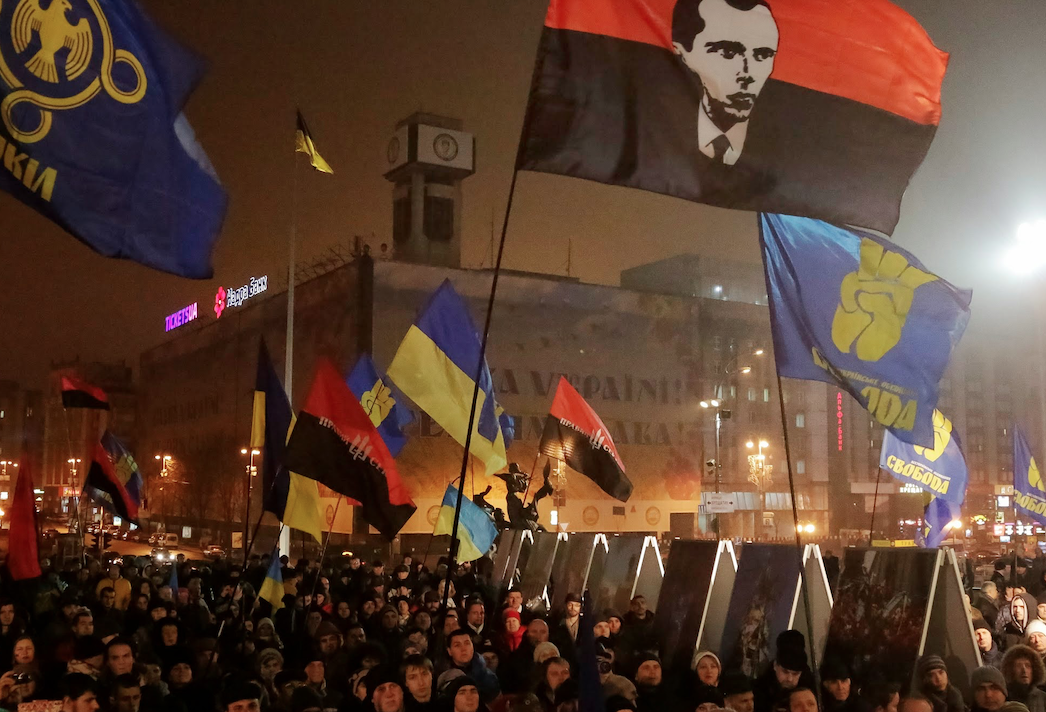
Torchlight procession in honor of the 106 anniversary of the birthday of Stepan Bandera, Kiev, Jan. 1, 2015. (All-Ukrainian Union CC BY 3.0, Wikimedia Commons)
…………………………………………….It is always interesting to ask why a piece such as this appears when it does. Dead silence for months on the neo–Nazi question, and then suddenly a long explainer that does its best to avoid explaining anything. Always interesting to ask, never easy to answer.
It could be that a lot of stuff on these awful people is sifting out from under the carpet. Or maybe something big is on the way and this piece is preemptive. Or maybe either Gibbons–Neff or his editors saw the Ponomarenko piece as an opportunity to dispose of one of the Kyiv regime’s most embarrassing features.
Or maybe the larger context counts here. As mentioned in this space last week, the Times’ Steve Erlanger recently suggested from Brussels that NATO might do a postwar Germany job with Ukraine: Welcome the West of the country to the alliance and let the eastern provinces go for an indefinite period, unification the long-term objective.
Late last week Foreign Affairs ran a fantastical piece by Andriy Zagorodnyuk, formerly a Ukrainian defense minister and now, yes indeedy, a distinguished fellow at the Atlantic Council. It appeared under the headline, “To Protect Europe, Let Ukraine Join NATO—Right Now.” ……………………………………….more https://consortiumnews.com/2023/06/07/patrick-lawrence-neo-nazis-in-ukraine-no-yes-no-yes/?fbclid=IwAR2qutGUc886hz22JN9TvBgmNTXCb-dJwB1TvxPfsnvxCTT6d9yuEoeJOH8
Tucker Carlson steamrolls Ukraine propaganda in new show
US corporate media outlets treat curiosity as the “gravest crime,” the former TV pundit has said
7 June 23 https://www.rt.com/news/577602-tucker-carlson-twitter-show/
Former Fox News host Tucker Carlson has released the first episode of his new series on Twitter, taking Western news agencies to task for one-sided reporting on the conflict in Ukraine and open hostility toward anybody voicing dissenting views.
Dubbed ‘Tucker on Twitter’, the show’s first ten-minute segment was shared on the social media platform on Tuesday night. The clip opened with a monologue on the alleged Ukrainian attack on a major dam in Russia’s Kherson Region this week, which Carlson dubbed “an act of terrorism.”
“Blowing up the dam may be bad for Ukraine, but it hurts Russia more, and for precisely that reason the Ukrainian government has considered destroying it,” he said. Carlson went on to observe that a Ukrainian general had admitted to planning attacks on the Kakhovka dam facility in comments to the Washington Post last December.
While Carlson said he had little doubt that Kiev was behind the incident, he noted that several American media outlets had already suggested that Moscow may have arranged the attack, claiming they view Ukrainian President Vladimir Zelensky as simply “too decent for terrorism.”

“Of all the people in the world, our shifty, dead-eyed Ukrainian friend in the tracksuit is uniquely incapable of blowing up a dam. He’s literally a living saint, a man in whom there is no sin,” he went on, describing the general attitude within the mainstream press.
The pundit drew comparisons to last year’s attack on the Nord Stream pipelines, which were built to carry natural gas from Russia into Germany. Though Carlson argued it was “obvious” that Ukraine had carried out the sabotage, he said US media outlets had little interest in investigating, helping to make Americans among “the least informed people in the world.”
“Not only are the media not interested in any of this, they are actively hostile to anybody who is. In journalism, curiosity is the gravest crime,” he continued, adding that while media outlets lie, “mostly they just ignore the stories that matter.”
Carlson parted ways with Fox in April, a major shake-up for the media giant, given the prominence of his prime-time program, ‘Tucker Carlson Tonight’. He later announced that would move his content to Twitter, where he has released other stand-alone segments similar to his former show. In his signoff for Tuesday’s episode, the host voiced hopes that Twitter would be a venue with “no gatekeepers,” but vowed to leave the site should that turn out to be false.
Clean energy transition sparks nuclear reaction

Along with its many known problems, as an inflexible, costly baseload power source, nuclear is becoming as outdated as fossil fuels.
By David Suzuki with contributions from Senior Editor and Writer Ian Hanington, https://davidsuzuki.org/story/clean-energy-transition-sparks-nuclear-reaction/ 26 May 23
As the impacts of climate disruption become more frequent and intense, we need a range of solutions. One that’s getting a lot of attention is nuclear power.
Industry is pushing hard for it, especially “small modular reactors,” and the federal government has offered support and tax incentives. After 30 years without building any new reactors, Ontario is also jumping onto the nuclear bandwagon again. How should we react?
Along with its many known problems, as an inflexible, costly baseload power source, nuclear is becoming as outdated as fossil fuels. Small modular reactors will create even more waste and cost more — and slow the necessary transition to renewable energy.
Many disadvantages of nuclear are well known. It can contribute to weapons proliferation. Radioactive waste remains highly toxic for a long time and must be carefully and permanently stored or disposed of. And while serious accidents are rare, they can be devastating and difficult to deal with, as the Chernobyl and Fukushima disasters demonstrated.
Along with its many known problems, as an inflexible, costly baseload power source, nuclear is becoming as outdated as fossil fuels.
Uranium to fuel nuclear also raises problems, including high rates of lung cancer in miners and emissions from mining, transport and refining. Add that to the water vapour and heat it releases, and nuclear power produces “on average 23 times the emissions per unit electricity generated” as onshore wind, according to Stanford University professor Mark Jacobson.
But the biggest issues are that nuclear power is expensive — at least five times more than wind and solar — and takes a long time to plan and build. Small modular reactors are likely to be even more expensive, especially considering they’ll produce far less electricity than larger plants. And because the various models are still at the prototype stage, they won’t be available soon.
Because we’ve stalled for so long in getting off coal, oil and gas for electricity generation, we need solutions that can be scaled up quickly and affordably.
The last nuclear plant built in Ontario, Darlington, ended up costing $14.4 billion, almost four times the initial estimate. It took from 1981 to 1993 to construct (and years before that to plan) and is now being refurbished at an estimated cost of close to $13 billion. In 1998, Ontario Hydro faced the equivalent of bankruptcy, in part because of Darlington.
Ontario’s experience isn’t unique. A Boston University study of more than 400 large-scale electricity projects around the world over the past 80 years found “on average, nuclear plants cost more than double their original budgets and took 64 per cent longer to build than projected,” the Toronto Star reports. “Wind and solar, by contrast, had average cost overruns of 7.7 per cent and 1.3 per cent, respectively.”
China has been building more nuclear power plants than any other country — 50 over the past 20 years. But in half that time, it has added 13 times more wind and solar capacity.
As renewable energy, energy efficiency and storage technologies continue to rapidly improve and come down in price, costs for nuclear are rising. As we recently noted, the Intergovernmental Panel on Climate Change’s Sixth Assessment report shows that nuclear power delivers only 10 per cent of the results of wind and solar at far higher costs. In the time it takes to plan and build nuclear, including SMRs, and for much less money, we could be putting far more wind, solar and geothermal online, and developing and increasing storage capacity, grid flexibility and energy efficiency.
The amount it will cost to build out sufficient nuclear power — some of which must come in the form of taxpayer subsidies — could be better put to more quickly improving energy efficiency and developing renewable energy such as wind, solar and geothermal.
Putting money and resources into nuclear appears to be an attempt to stall renewable electricity uptake and grid modernization. Small modular reactors are likely to cost even more than large plants for the electricity they generate. And, because more will be required, they pose increased safety issues.
David Suzuki Foundation research shows how Canada could get 100 per cent reliable, affordable, emissions-free electricity by 2035 — without resorting to expensive and potentially dangerous (and, in the case of SMRs, untested) technologies like nuclear.
New nuclear is a costly, time-consuming hurdle on the path to reliable, flexible, available, cost-effective renewable energy. The future is in renewables.
Nuclear Turns Fashionable
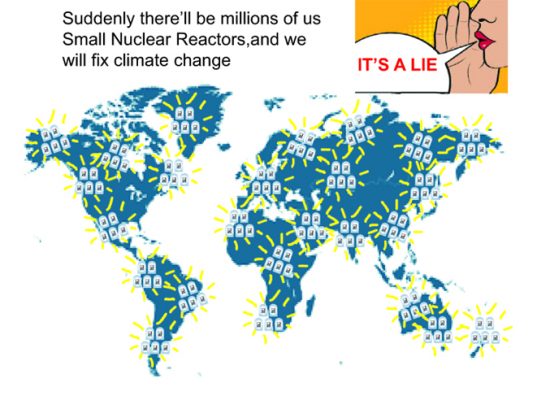
Should nuclear power really circumnavigate the planet with mini-power plants?
BY ROBERT HUNZIKER, CounterPunch 26 May 23
Small Modular Reactors (SMR) are the new nuclear craze, especially with the U.S. Congress, as America’s representatives see SMRs as a big answer to energy needs and reduction of greenhouse gases, advertised as a green deal for clean energy that skirts the heavy costs of paying the Middle East billions upon billions. However, the devil in the details is dangerously overlooked.
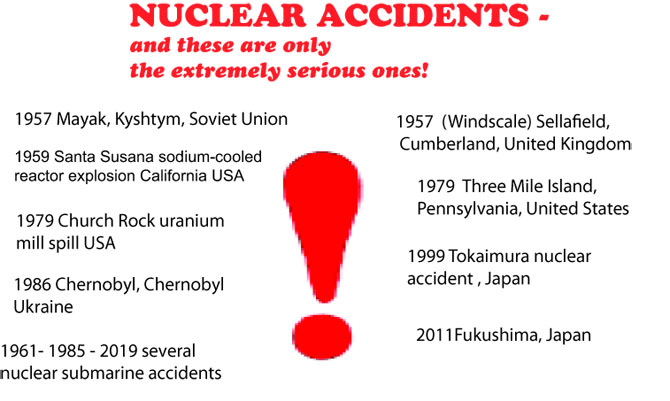
Notable nuclear accidents: NRX (1952) Kyshtym (1957) Windscale (1957) SL-1 (1961) Wood River Junction (1964) K-27 (1968) Three Mile Island (1979) Constituyentes (1983) Mohammedia (1984) K-431 (1985) Chernobyl (1986) Tokai (1997, 1999) Fukushima (2011) … but wait, hundreds, possibly thousands, of Small Modular Reactors (nuclear SMRs) are about to pop up around the world. What could possibly go wrong?
“Multiple and unexpected failures are built into society’s complex and tightly coupled nuclear reactor systems. Such accidents are unavoidable and cannot be designed around.” (Charles Perrow, Normal Accidents (Princeton University Press, 1999)
“On dozens of occasions because of human error or technical miscue or active threat, the world has come dangerously close to the brink of nuclear conflagration… it is a terrifying history of which most people remain ignorant.” (Julian Cribb, How to Fix a Broken Planet, Cambridge University Press, 2023.)
Should nuclear power really circumnavigate the planet with mini-power plants?
For Germany, which closed its last three nuclear plants in April 2023, the country’s Federal Office for the Safety of Nuclear Waste Management conducted a study: “SMRs have been the subject of repeated discussion in recent times. They promise cheap energy, safety, and little waste. BASE commissioned an expert report (in German) to evaluate these concepts and the risks associated with them. The report provides a scientific assessment of possible areas of application and the associated safety issues. It concludes that the construction of SMRs is only economically viable for a very large number of units and poses significant risks if widely deployed.”
Yet, “resistance to nuclear power is starting to ebb around the world with support from a surprising group: environmentalists… This change of heart spans the globe, and is being prompted by climate change, unreliable electrical grids and fears about national security in the wake of Russia’s invasion of Ukraine.” (Source: Why Even Environmentalists are Supporting Nuclear Power Today, NPR, August 30, 2022
U.S. senators recently introduced a nuclear energy bill called the Advance Act with bipartisan support, hopefully enhancing and advancing America’s world leadership role in nuclear energy by deploying SMRs by the bucketful, idealized as a “cleaner smarter safer solution” to today’s bulky nuclear power plants. Advance Act will cut red tape and make it easier and much faster for SMRs to gain a foothold in the marketplace……………………..
The excitement over nuclear is palpable, as politicians’ hands tremble with excitement, introducing what’s billed as the perfect green clean way to solve energy needs. There are cheerleaders galore. The U.S. Congress for one is a very influential cheerleading group, but it’s more pervasive than that. Big players like Japan and China are going all-in for nuclear. Japan Adopts Plan to Maximize Nuclear Energy, in Major Shift, AP News, December 22, 2022.

Wait a moment… isn’t Japan currently being criticized in several quarters of the world for dumping Fukushima toxic radioactive water into the ocean? After all, the U.S. National Association of Marine Laboratories, with over 100 member laboratories, issued a position paper strongly opposing the toxic dumping because of a lack of adequate and accurate scientific data in support of Japan’s assertions of safety.
Regardless, last week the G7 nations gave its blessing for Japan to dump Fukushima’s toxic water into the Pacific Ocean. Hmm.
Interestingly, PM Shinzo Abe (1954-2022) shortly after Fukushima’s meltdown 10 years ago, assured the International Olympic Committee in consideration of holding the games in Tokyo, that “everything was under control.” Notwithstanding numerous assurances by Japanese authorities of no harm, no foul, over the years, several independent journalists in Japan have reported numerous deaths because of the Fukushima meltdown and its aftermath but never acknowledged by the government. Assurances are not always assurances!
Therefore, it’s only fair that the darker side of nuclear cheerleading — yea yea yea no nuclear no nuclear — deserves some notoriety. For starters, the results of a recent study by Stanford University’s Center for International Security and Cooperation published in the prestigious Proceedings of the National Academy of Sciences, May 31, 2022, entitled Nuclear Waste from Small Modular Reactors.
Stanford News also published the study: Sandford-led Research Finds Small Modular Reactors Will Exacerbate Challenges of Highly Radioactive Nuclear Waste. The study concludes that SMRs will generate more radioactive waste than conventional nuclear power plants. Stanford and the University of British Columbia jointly conducted the study, e.g., SMRs will be manufactured in factories and industry analysts claim SMRs will be cheaper and produce fewer radioactive byproducts than the big bulky conventional reactors; however, the study discovered the upsetting fact that, pound-for-pound when compared to the big bulky conventional nuclear plants, SMRs will increase nuclear waste… considerably!
………………………………………………………………………………………. Meanwhile, SMRs are about to enter a world of nuclear power that has sharp critics. For example, crib notes of a detailed analysis of nuclear by Greenpeace, which has considerable nuclear expertise on staff, provides an offset to the ringing applause around the world for SMRs: 6 Reasons Why Nuclear Energy is not the Way to a Green and Peaceful World d/d March 18, 2022.
Greenpeace is not at all hesitant about exposing the “myths being perpetuated by the nuclear industry.”

For starters the scale of proposed nuclear energy installations does not come close to meeting the needs to go to net zero emissions in a timely fashion, according to projections by the World Nuclear Association, greenhouse gas emissions would only drop by 4% by 2050, assuming 37 new large nuclear reactors brought onto the grid per year from now to 2050. Yet only 57 new reactors are schedule for construction over the next 15 years. A number for SMRs is unknown currently.

Nuclear power plants are extremely dangerous as easy targets for terrorists, cyberattacks or acts of war. Moreover, they are unique hazards for accidents by nature like Fukushima and/or by human error like Chernobyl, and some accidents never go away.
“For the first time in history, a major war is being waged in a country with multiple nuclear reactors and thousands of tons of highly radioactive spent fuel. The war in southern Ukraine around Zaporizhzhia puts them all at heightened risk of a severe accident…. Nuclear power plants are some of the most complex and sensitive industrial installations, which require a very complex set of resources in ready state at all times to keep them operational,” Ibid.
Nuclear power plants are a water-hungry technology that must, must, must have a lot of water to cool the radioactive hot stuff. Nuclear power facilities are vulnerable to water stress, warming rivers, and rising temperatures. Facilities in the US and France have often been shut down during heatwaves or have scaled down activity, especially France’s shakiness in 2022. Global warming is nuclear power’s biggest enemy.
And, then there’s this: “Electricite de France SA’s fleet of 56 atomic power plants has long been the backbone of Europe’s energy system, but in 2022 it was more of a millstone……………………………………………..
For a prize-winning compelling read about the most toxic place in America and a terrifying look at the radioactive nuclear materials produced at Hanford for four decades: Atomic Days, The Untold Story of the Most Toxic Place in America (Haymarket Books, 2022)
Regardless of the strongest assurances, nuclear accidents happen. They just happen!
Robert Hunziker lives in Los Angeles and can be reached at rlhunziker@gmail.com. https://www.counterpunch.org/2023/05/26/nuclear-turns-fashionable/
Missteps deliver Alexandria Ocasio-Cortez into the hands of the pro-nuclear propagandists – REPROCESSING IS NOT RECYCLING.
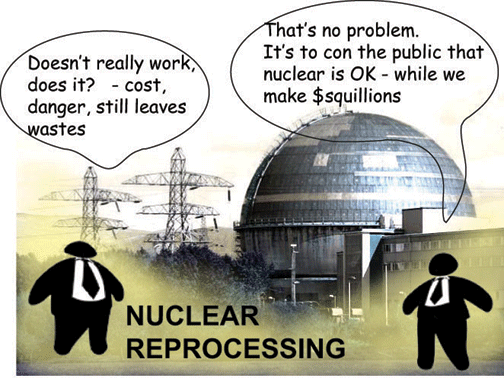
In fact, reprocessing irradiated fuel increases the volume of radioactive waste, while reducing only the level of radioactivity. This results in enormous discharges of so-called low- and intermediate-level but still highly radioactive wastes in the form of gases and liquids into the air and the English Channel. It is this that makes reprocessing arguably the dirtiest and most carcinogenic phase of the entire nuclear industry
.
Congresswoman talked nuclear nonsense, but does that mean she supports it?
Dear AOC, reprocessing is not recycling — Beyond Nuclear International
“………..the nuclear power propagandists, heralding her as the latest defector from the “Left” to the pro-nuclear power cause…………. But her errors are costly — to her credibility, as well as to the climate cause.
By Linda Pentz Gunter – from Ralph Nader’s new newspaper, the Capitol Hill Citizen, April 23
The progressive Democratic congresswoman, Alexandria Ocasio-Cortez, has 8.6 million followers on her Instagram account, a number identical to the online readership of the New York Times.
With her rock star-like AOC moniker and plenty of adoring fans, what the U.S. representative from Queens, New York writes or says has an impact. And it needs to be accurate. Presumably that is why Members of Congress deploy a slew of aides, tasked with delivering the details on a likely sometimes overwhelming array of topics.
When it comes to nuclear power, however, the Congresswoman from New York appears to be flying solo. Either that, or her aides are failing to do their homework. AOC’s stance on nuclear power was as confusing — and arguably as confused — during the introduction of the short-lived Green New Deal four years ago as her latest venture on Instagram after her February 2023 trip to Japan.
In 2019, after a February 7 joint press conference to roll out the blueprint for a Green New Deal alongside fellow Democrat, Senator Ed Markey, AOC’s office published details of the plan with nuclear power explicitly excluded. There was an immediate backlash, after which the reference to nuclear power’s exclusion was abruptly deleted. Asked to explain the switch, AOC told reporters that the Green New Deal “leaves the door open on nuclear so we can have that conversation” and that she herself did not “take a strong anti- or pro-position on it.”
From Japan earlier this year, AOC delivered a series of bubbly Instagram updates, mostly expressing her delight with Japan’s bullet trains. After her visit to the stricken Fukushima Daiichi nuclear power plant, site of the devastating March 2011 explosions and triple meltdowns, she put up a series of informational posts, then stumbled badly on the final question, which asked: “France uses nuclear power. How do they manage it differently? They don’t have earthquakes….”
For reasons that remain unclear, other than the French connection, AOC used this opportunity to launch what sounded unmistakably like praise for the end phase of nuclear power production — reprocessing. Only she called it “recycling”, a deliberately misleading industry term that masks the highly polluting operations involved in reprocessing, which takes irradiated reactor fuel and separates the plutonium from uranium in a chemical bath.
She then made a series of points, all of which were either factually or scientifically inaccurate, or both. We reached out to AOC’s press office for a response, but as of press time there was none.
These missteps begged the question as to the source of the Congresswoman’s information. Her use of the term “recycling” suggests that she, like most of her colleagues on the Hill, defers to the nuclear industry itself to sell her a highly sanitized version of its activities.
This is particularly frustrating coming from an elected official whose raison d’être is to serve as the people’s champion. Had her staff instead opened the door to eminently qualified academics on the subject, such as Princeton physicist, Frank von Hippel, never mind independent experts from the NGO world, they could have saved their boss considerable embarrassment.
Instead, AOC posted that “France recycles their nuclear waste,” even embedding the recycling logo in her text. But reprocessing does nothing of the kind.
Of that irradiated reactor fuel reprocessed at the La Hague nuclear center on France’s Normandy coast, 95% of it contains uranium products too contaminated for further use. This is trucked south for conversion and storage at the Pierrelatte/Tricastin enrichment facility, although for a time, some was shipped to Siberia. Of the remaining 5%, 4% of it is vitrified into glass logs and stored at La Hague. So is almost all of the separated plutonium, 1% of what’s left, now amounting to more than 80 tonnes.
A tiny fraction of that plutonium is “recycled” into something called Mixed-Oxide Fuel (MOX), used in 24 French reactors licensed to carry a 30% MOX fuel load. After fissioning, during which plutonium is once again produced, that waste is again shipped back to La Hague for storage.
AOC went on to explain that France’s “recycling” of nuclear waste had increased “the efficiency of their system.” It is not clear what this vague allusion means, but there is no debate about the extra costs incurred by France in choosing the reprocessing route. As a May 2007 analysis prepared for Public Citizen concluded: “The cumulative cost difference between full reprocessing and no reprocessing amounts to about $25 billion.”
AOC then wrote that French nuclear waste “recycling” was responsible for “reducing the overall amount of radioactive waste to deal with.” In fact, reprocessing irradiated fuel increases the volume of radioactive waste, while reducing only the level of radioactivity. This results in enormous discharges of so-called low- and intermediate-level but still highly radioactive wastes in the form of gases and liquids into the air and the English Channel. It is this that makes reprocessing arguably the dirtiest and most carcinogenic phase of the entire nuclear industry.
AOC also noted that “Japan sends its waste to France and the UK for recycling”. This practice was suspended some years ago, but when it was happening, it comprised more than 160 ship transports of at least 7,000 tons of lethal radioactive cargo, including plutonium, the trigger component for nuclear bombs, an inviting target for terrorists. Most of the reprocessed fuel was then returned to Japan, either in vitrified form or as MOX.
Surely none of this qualifies as recycling?
Needless to say, the pro-nuclear lobby seized on these pronouncements, turning AOC into the latest enviro-convert to the pro-nuclear side. She even garnered headlines in the French press, including in the conservative daily, Le Figaro, where a columnist exhorted French environmentalists to take inspiration from AOC’s epiphany and “abandon their anti-nuclear ideology”.
Newsweek characterized AOC’s Instagram posts as indicative of “The Left’s Changing Position on Nuclear Energy,” in its headline and suggested that “her appraisal of the fuel that provides 19 percent of Americans’ electricity seemed almost warm.”
All of this attention, whether invited or unwanted, prompted yet another ambiguous statement from AOC’s communications director, Lauren Hitt, who told Newsweek “We don’t have any changes in the Congresswoman’s policy posture re[garding] nuclear to announce as of now.”
But what exactly is Rep. Acasio-Cortez’s policy posture on nuclear power? That remains exasperatingly unclear.
The Single Dumbest Thing The Empire Asks Us To Believe

Caitlin Johnstone https://caitlinjohnstone.substack.com/p/the-single-dumbest-thing-the-empire?utm_source=post-email-title&publication_id=82124&post_id=118488383&isFreemail=true&utm 1 May 23
The single dumbest thing the US-centralized empire asks us to believe is that the military encirclement of its top two geopolitical rivals is a defensive action, rather than an act of extreme aggression.
We’re asked to believe many extremely stupid narratives by the manipulators who rule over us, but I really think this one might take the cake. The idea that the US militarily encircling Russia and China is an act of defense rather than aggression is so in-your-face transparently idiotic that anyone who thinks critically enough about it will immediately dismiss it for the foam-brained nonsense that it is, yet it’s the mainstream narrative in the western world, and millions of people accept it as true. Because that’s the power of US propaganda.
It gets more and more absurd the more you think about it. Their argument is basically, “No no you don’t understand, the US has been hurriedly surrounding its primary geopolitical competitors with war machinery because it wants to prevent them from doing something aggressive.” They’re like, “We can’t just have nations exerting military aggression willy nilly, that’s why we needed to move all this war machinery to the other side of the planet onto the borders of our primary strategic rivals.”
Can you think of anything more insane than that? Than all of the most powerful and influential figures in politics, government and media simultaneously claiming that a nation amassing heavily-armed proxy forces on the borders of their enemies is something that should be regarded as an action designed to prevent aggression, rather than an incendiary act of extreme aggression in and of itself?
I recently had someone tell me that the US has every right to expand its immense military presence near China, and to illustrate their point they said that if China set up a base in Mexico the US would have no business telling them not to. But that argument actually illustrates my point, not theirs: only the most propaganda-addled of minds would believe that the US would allow China to set up a military base in Mexico for even one second. There’d be kinetic warfare long before the foundations were even poured.
What this undeniably means is that the US is the aggressor in these conflicts. It was the aggressor when it expanded NATO and began turning Ukraine into a de facto NATO member, and it is the aggressor as it accelerates its encirclement of China and prepares to open the floodgates of weapons into Taiwan. If it is doing things on the borders of its geopolitical rivals that it would never permit those rivals to do to it, then it is the aggressor, and anything its rivals do is a defensive response to those aggressions.
This is how the US-centralized empire always acts. It continually attacks, starves and menaces nations which disobey the decrees it issues in its self-appointed role as the leader of the so-called “rules-based international order”, then as soon as its aggressions receive the slightest bit of pushback its spinmeisters feign Bambi-eyed innocence and pretend they’re just passive witnesses to unprovoked aggression by the disobedient nations.
But the empire is not passive, it is not innocent, and it is primarily responsible for the extremely dangerous current and emerging conflicts we are seeing on the world stage. The US empire is imperiling us all with its last-ditch frantic scramble to secure unipolar planetary hegemony before multipolarity takes over, engaging in freakishly aggressive actions on the borders of the nuclear-armed nations who challenge its power.
And I just think that’s worth reiterating from time to time. If we don’t keep reminding ourselves what’s true, these bastards will drive us all nuts.
Survivors of Britain’s Cold War radiation experiments to have their stories recorded
Survivors of Britain’s Cold War radiation experiments are to have their
life stories recorded and stored in the British Library. The £250,000
scheme will lead to a documentary and resources to teach A-level students
about the Cold War and the impact the weapons testing programme had on the
men who took part in it, and their families.
Dr Chris Hill, one of the academics leading the project, said: “It’s about furthering their story, embedding it deeper in the public consciousness and confronting what is a
very problematic part of Britain’s history.”
Mirror 27th April 2023
https://www.mirror.co.uk/news/politics/nuclear-heroes-win-250000-documentary-29833221
Return to Russia: Crimeans Tell the Real Story of the 2014 Referendum and Their Lives Since — RADIATION FREE LAKELAND

Originally posted on In Gaza: Crimeans gather with Russian national and Crimea flags in Sevastopol, Crimea, March 14, 2018. Alexander Zemlianichenko | AP Eva Bartlett traveled to Crimea to see firsthand out how Crimeans have fared since 2014 when their country reunited with Russia, and what the referendum was really like. October 9, 2019, Mint…
Return to Russia: Crimeans Tell the Real Story of the 2014 Referendum and Their Lives Since — RADIATION FREE LAKELAND
SIMFEROPOL, CRIMEA — In early August I traveled to Russia for the first time, partly out of interest in seeing some of the vast country with a tourist’s eyes, partly to do some journalism in the region. It also transpired that while in Moscow I was able to interview Maria Zakharova, spokeswoman of the Foreign Ministry.
High on my travel list, however, was to visit Crimea and Donetsk People’s Republic (DPR) — the former a part of Russia, the latter an autonomous republic in the east of Ukraine, neither accurately depicted in Western reporting. Or at least that was my sense looking at independent journalists’ reports and those in Russian media.
Both regions are native Russian-speaking areas; both opted out of Ukraine in 2014. In the case of Crimea, joining Russia (or actually rejoining, as most I spoke to in Crimea phrased it) was something people overwhelmingly supported. In the case of the Donbass region, the turmoil of Ukraine’s Maidan coup in 2014 set things in motion for the people in the region to declare independence and form the Donetsk and Lugansk People’s Republics.
In March 2014, Crimeans held a referendum during which 96 percent of voters chose to join Russia. This has been heavily disputed in Western media, with claims that Crimeans were forced to hold the referendum and claims of Russian troops on the streets “occupying” the peninsula.
Because Western media insisted the referendum was a sham held under duress, and because they bandy about the term “pro-Russian separatists” for the people of the DPR, I decided to go and speak to people in these areas to hear what they actually want and feel.
From the Russian mainland to the Crimean Peninsula………………………………………………………………
In the evening, we stay in the home of Vlad’s friend Tata, a Russian woman who moved to Crimea in 2012.
Since there was so much hype in Western media about a Russian takeover of the peninsula, I ask the burning questions: Were Crimeans forced to take part in the referendum? What was the mood like around that time? Tata replies:
“I never saw so many people in my life go out to vote, of their own free will. There was a period before the referendum, maybe about two months, during which there were two holidays: International Women’s Day, March 8, and Defender of the Fatherland Day, February 23.
……………………………………………………………I never saw tanks, I never saw Russian soldiers. I never saw any of that in the city.”
I ask Tata about how life had changed after the referendum:………………………………….
After the Soviet Union collapsed, it wasn’t the will of the Crimean people to join Ukraine. People were always Russian here; they always identified as Russian. Ukraine understood this well, and put nothing into Crimea, as punishment. Ukraine didn’t build any hospitals, kindergartens or roads.
In the past four years, the Crimean government has built 200 new kindergartens. This is the most obvious example of how things have improved. They also built the new Simferopol airport.
I worked in aviation. It took three years to build an airport of this standard in Yekaterinburg, Russia. It took half a year in Simferopol.”
International Jazz Festival……………………………………………………….
Construction everywhere……………………………………….
I remark on how kind and gentle people are here, as in Russia. Vlad replies:
“It shouldn’t be surprising — people are people anywhere. But Western media conditions us with stereotypes of Russians as cold and hard, vilifying an entire nation.”
The coastal city of Yalta lies further west along the peninsula. The drive there the following day is more beautiful still, the road flanked by mountains to one side, hills cascading down to the Black Sea on the other, endless wineries and, before Yalta itself, the stunning cliff-top castle known as “Swallow’s Nest.”
In the evening, we stay in the home of Vlad’s friend Tata, a Russian woman who moved to Crimea in 2012.
Since there was so much hype in Western media about a Russian takeover of the peninsula, I ask the burning questions: Were Crimeans forced to take part in the referendum? What was the mood like around that time? Tata replies:
“I never saw so many people in my life go out to vote, of their own free will. There was a period before the referendum, maybe about two months, during which there were two holidays: International Women’s Day, March 8, and Defender of the Fatherland Day, February 23.
Normally, people would go away on vacation during these holidays. But that year, Crimeans didn’t go anywhere; they wanted to be sure they were here during the referendum. We felt the sense of a miracle about to happen. People were anxiously awaiting the referendum.
There were military tents in the city, but they were not erected by the military, but by local men. They would stand there every day, and people could come and sign a document calling for a referendum.
I went one day and asked if I could add my name but I couldn’t, because I have a Russian passport. Only Crimean citizens could sign it. This was the fair way to do it.
At that time, my husband was in America. One day, he was watching CNN and got scared and called me because he saw reports of soldiers in the streets, an ‘invasion’ by Russia.
The local navy came from Sevastopol to Yalta and anchored their ships off the coast, made a blockade to ensure no larger Ukrainian or other ships could come and attack.
But I never saw tanks, I never saw Russian soldiers. I never saw any of that in the city.”
I ask Tata about how life had changed after the referendum:
When I came here in December 2012, everything was dilapidated and run down. The nice roads you were driving on, they didn’t exist when we were a part of Ukraine. I didn’t understand why Crimea was still a part of Ukraine. It was Russian land ever since the Tsars, the imperial time of Russia. This is where the Russian soul is, and the soul of the Russian navy.
After the Soviet Union collapsed, it wasn’t the will of the Crimean people to join Ukraine. People were always Russian here; they always identified as Russian. Ukraine understood this well, and put nothing into Crimea, as punishment. Ukraine didn’t build any hospitals, kindergartens or roads.
In the past four years, the Crimean government has built 200 new kindergartens. This is the most obvious example of how things have improved. They also built the new Simferopol airport.
I worked in aviation. It took three years to build an airport of this standard in Yekaterinburg, Russia. It took half a year in Simferopol.”
Finally, after night falls, we drive into the city of Koktebel, where an annual Jazz Festival is starting.
During all these hours of driving, the roads are smooth and well-trafficked, and I don’t see a single Russian military vehicle.
The next day, I walk through Koktebel, taking in the local markets brimming with produce, cheeses, and other goods, and every so often come across a streetside stand laden with fresh fruits. In the late afternoon, I walk along the sea, past packed beaches, and meet with a Crimean woman, Yaroslava, who lives in Austria but every summer returns to her beloved Crimea. She is ardently supportive of the decision to have joined Russia and spends much of her time back in Austria trying to educate people on why Crimeans wanted to be a part of Russia.
These are reasons I hear throughout my travels in Crimea: We wanted to be able to speak our native language [Russian] and be educated in that language; we wanted to be able to practice our cultural traditions; we have always been a part of Russia and we wanted to return.
Yaroslava is busy helping out with the Jazz Festival and wants to use the rest of our short time talking to help me arrange future meetings with people in Crimea. We decided to do a proper interview via Skype in the future when time allows.
I drift on to the Jazz Festival, where a talented pianist and band play beach-side to an enthusiastic crowd. Some songs later, I drift back along the beach, passing numerous musicians busking, and a pulsing nightlife that isn’t going to bed any time soon.
…………………………………As I stand to orient the map route and zoom in to look for any signs of cafes, a woman walks by me and says with a smile something with the word “shto,” which I think means “what.” When I reply in English, she laughs and flags down another woman, Yana, who speaks English well and insists she and her husband drive me.
As we drive, we chat. I ask her about the referendum, mentioning that many in the West have the notion that it was done under duress, with a heavy military presence to influence the vote. She laughs, saying: “There were no troops, no military, around us during the referendum.” She speaks of the joy of Crimeans to vote, says that maybe 98 percent of Sevastopol voters had voted in favor [it was apparently 96 percent, but close enough], and adds, “We are now under the wing of Russia.”
I ask about developments since then. She mentions the improvements in roads, also the modern trolley-buses and regular buses, the opening of kindergartens and schools, and free courses (like music) for children……………………………………..
Ukrainians in Crimea
In Simferopol anew, I meet Anastasiya Gridchina, the Chair of the Ukrainian Community of Crimea, an organization formed in 2015 whose main goals, she tells me, “are to have friendly relations between two great peoples: Ukrainians and Russians — not the politicians but the people. The second goal is to preserve inter-ethnic peace in the Republic between different nationalities.”
Gridchina explains that in Crimea there are more than 175 nationalities, just 20 less than in all of Russia, but in a very small territory. Hence the importance of preserving inter-ethnic peace. After Russians, Ukrainians comprise the second largest population in Crimea.
I ask Anastasiya whether she supported, much less participated in the referendum.
“I worked very hard in order that we could have a referendum. I live in Perevalne, the last settlement in the mountains above Alushta. There was a Ukrainian military detachment which did surrender. In February 2014, I was among a line of people standing between the Ukrainian and Russian military detachments, to prevent any bloodshed. The fear that prevailed at that time was that nationalists from Ukraine would come here and we would have massacres.
In February, there was a confrontation outside the Parliament here in Simferopol. It was organized by leaders of the Mejlis — the Crimeans Tatars. On the other side, there were some pro-Russia organizations who were protecting the Parliament. They were far less [numerous] than the Mejlis. The Mejlis were armed with sticks and knives. There were clashes and two people were killed, but thankfully it didn’t escalate beyond that.
When the news came that there would be a referendum, people relaxed. They had a chance to express their point of view and 96 percent of the population of Crimea voted for Crimea to return to Russia.”
Since she is Ukrainian, I ask Anastasiya why she wanted Crimea to join Russia:
“I’ve lived in Crimea all my life, and my language is Russian. And I know the history of Crimea, which has always been Russian territory, which has a history beginning with the Russian Empire and then the Soviet Union. So, it is Russian-speaking territory, first of all. That’s why I believe it should be in the Russian Federation, not in Ukraine.”
I ask about the claims that Russian soldiers invaded Crimea:
“Whatever they might have said about Russian soldiers forcing people to participate in the referendum, it was all lies, pure lies. We did not see any soldiers on the streets, especially on the day of the referendum.
I gave an interview to foreign journalists before the referendum. But when they published it, they changed my words. I said we were very thankful to the Russian troops that were here, that protected us from the attacks of Ukrainian nationalists prior to the referendum. But they translated it that I said ‘Please, we want Ukrainian soldiers to defend us from those Russian soldiers.’
The Russian troops that were here were not on the streets on the day of the referendum but, at the time in general, they were there to protect civilians from an attack by Ukrainians.
On the day of the referendum, there were no soldiers, no military. The only security were there to prevent any illegal actions. No military people were there, no arms, no armored personnel carriers, no military equipment, nothing. Only members of the election commission and the people voting.”
I ask whether many Ukrainian Crimeans left following the referendum:
“There were those who immediately after the referendum left Crimea for Ukraine because it was their personal wish. Nobody prevented them from going. Even the soldiers had an option: to stay and continue military service here, or to leave……………
Finally, Anastasiya gives me a message for the people outside of Crimea:
“I’d like to tell people around the world, welcome to Crimea, come here yourselves and see and hear with your own eyes and ears, to understand that all the lies you hear about Crimea, that we are oppressed or under pressure from the military…this is all lies, this is all not true.
Also, that we are not allowed to speak Ukrainian is a lie. One of the state languages is Ukrainian. Russian and Tatar are also state languages.”……………………
Next, I speak to Yuri Gempel, a member of Parliament, and the chairman of the Standard Commission on Inter-Ethnic Relations of the Parliament of Crimea.
“Crimea, under Ukraine, was robbed,” Gempel says. He continues:
“Everything was taken by the government and representatives of the ruling elite of Ukraine. For the 23 years Crimea was a part of Ukraine, they robbed Crimea. Not a single kindergarten was built in Crimea during those years. Kindergartens built during Soviet times stopped functioning.
But the main issue is that during that time, the people still felt themselves to be in Russian territory, not Ukrainian, in language, culture and in spirit. Under Ukrainian rule, Crimeans were made to speak Ukrainian, although Crimeans’ native language is Russian. People were deprived of the right to be in state service if they did not speak Ukrainian.”…………………………………………………………………………………………………………………………………
As for the claims that Russia invaded Crimea and of Russian forces intimidating voters, I believe the many people I met who denounced those claims and articulated very clearly why they wanted to join Russia, or as they say, “return to Russia.” https://ingaza.wordpress.com/2019/10/10/return-to-russia-crimeans-tell-the-real-story-of-the-2014-referendum-and-their-lives-since/
In Indiana, small nuclear reactors don’t need to be “small” any more.

ED. – the picture above is of a NuScale smr design, not Rolls Royce, but the principle is the same. It’s not really small, and they know that truly small reactors are not economically viable.
New law boosts maximum size of nuclear reactors permitted in Indiana
nwi.com Dan Carden, Apr 24, 2023
Gov. Eric Holcomb approved a new state law Thursday increasing the maximum size of the small modular nuclear reactors that someday may be used by utility companies to generate electricity in Indiana.
Senate Enrolled Act 176, which took effect immediately, redefines a small modular reactor (SMR) as a nuclear reactor capable of generating up to 470 megawatts of energy — a 34% increase from the state’s former 350 MW generating cap.
Rep. Ed Soliday, R-Valparaiso, the sponsor of the legislation, said the higher generating capacity encompasses more of the nascent SMR market, including a 450 MW reactor designed by Rolls-Royce, an aircraft engine manufacturer based in Indianapolis…………………………………………..
State lawmakers directed the Indiana Utility Regulatory Commission last year to adopt rules by July 1, 2023, that would permit nuclear SMRs to be used to generate electricity in the Hoosier State……….
Critics of the plans have said there’s no need for Indiana to lead the way with nuclear SMRs, especially through rules that give utilities built-in profits, other incentives and the opportunity to recoup potentially billions of dollars in construction costs from ratepayers before a nuclear reactor actually generates any electricity. https://nwitimes.com/business/technology/new-law-boosts-maximum-size-of-nuclear-reactors-permitted-in-indiana/article_3962a672-8e8c-5168-bc88-31cc6891a88b.html
Six war mongering think tanks and the military contractors that fund them.
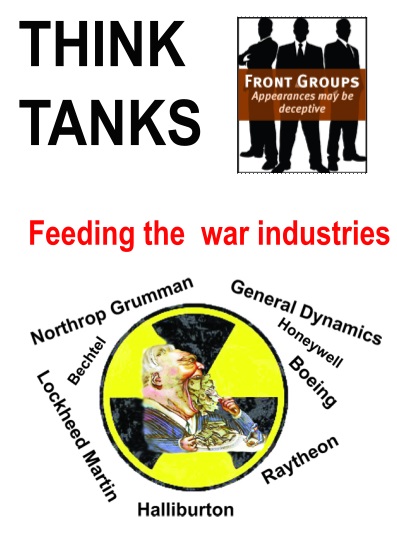
Center for Strategic and International Studies
Center for a New American Security
Hudson Institute
Atlantic Council
International Institute for Strategic Studies
Australian Strategic Policy Institute
Amanda Yee, March 7, 2023 https://www.liberationnews.org/six-war-mongering-think-tanks-and-the-military-contractors-that-fund-them/
From producing reports and analysis for U.S. policy-makers, to enlisting representatives to write op-eds in corporate media, to providing talking heads for corporate media to interview and give quotes, think tanks play a fundamental role in shaping both U.S. foreign policy and public perception around that foreign policy. Leaders at top think tanks like the Atlantic Council and Hudson Institute have even been called upon to set focus priorities for the House Intelligence Committee. However, one look at the funding sources of the most influential think tanks reveals whose interests they really serve: that of the U.S. military and its defense contractors.
This ecosystem of overlapping networks of government institutions, think tanks, and defense contractors is where U.S. foreign policy is derived, and a revolving door exists among these three sectors. For example, before Biden-appointed head of the Pentagon Lloyd Austin took his current position, he sat on the Board of Directors at Raytheon. Before Austin’s appointment, current defense policy advisor Michèle Flournoy was also in the running for the position. Flournoy sat on the board of Booz Allen Hamilton, another major Pentagon defense contractor. These same defense contractors also work together with think tanks like the Center for Strategic and International Studies to organize conferences attended by national security officials. On top of all this, since the end of the Cold War, intelligence analysis by the CIA and NSA has increasingly been contracted out to these same defense companies like BAE Systems and Lockheed Martin, among others — a major conflict of interest. In other words, these corporations are in the position to produce intelligence reports which raise the alarm on U.S. “enemy” nations so they can sell more military equipment!
And of course these are the same defense companies that donate hundreds of thousands of dollars each year to think tanks. Given all this, is it any wonder the U.S. government is simultaneously flooding billions of dollars of weaponry into an unwinnable proxy war in Ukraine while escalating a Cold War into a potential military confrontation with China?
The funding to these policy institutes steers the U.S. foreign policy agenda. To give you a scope of how these contributions determine national security priorities, listed below are six of some of the most influential foreign policy think tanks, along with how much in contributions they’ve received from “defense” companies in the last year.
All funding information for these policy institutes was gathered from the most recent annual report that was available online. Also note that this list is compiled from those that make this information publicly available — many think tanks, such as the hawkish American Enterprise Institute, do not release donation sources publicly.
1 – Center for Strategic and International Studies
According to their 2020 annual report
$500,000+: Northrop Grumman Corporation
$200,000-$499,999: General Atomics (energy and defense corporation that manufactures Predator drones for the CIA), Lockheed Martin, SAIC (provides information technology services to U.S. military)
$100,000-$199,999: Bechtel, Boeing, Cummins (provides engines and generators for military equipment), General Dynamics, Hitachi (provides defense technology), Hanwha Group (South Korean aerospace and defense company), Huntington Ingalls Industries, Inc. (largest military shipbuilding company in the United States), Mitsubishi Corporation, Nippon Telegraph and Telephone Corporation (provides intelligence and information technology services to U.S. military), Qualcomm, Inc. (semiconductor company that produces microchips for the U.S. military), Raytheon, Samsung (provides security technology to the U.S. military), SK Group (defense technology company)
$65,000-$99,999: Hyundai Motor (produces weapons systems), Oracle
$35,000-$64,999: BAE Systems
2 – Center for a New American Security
$500,000+: Northrop Grumman Corporation
$250,000-$499,999: Lockheed Martin
$100,000-$249,000: Huntington Ingalls Industries, Neal Blue (Chairman and CEO of General Atomics), Qualcomm, Inc., Raytheon, Boeing
$50,000-$99,000: BAE Systems, Booz Allen Hamilton, Intel Corporation (provides aerospace and defense technology), Elbit Systems of America (aerospace and defense company), General Dynamics, Palantir Technologies
3 – Hudson Institute
According to their 2021 annual report
$100,000+: General Atomics, Linden Blue (co-owner and Vice Chairman of General Atomics), Neal Blue, Lockheed Martin, Northrop Grumman
$50,000-$99,000: BAE Systems, Boeing, Mitsubishi Heavy Industries
4 – Atlantic Council
According to their 2021 annual report
$250,000-$499,000: Airbus, Neal Blue, SAAB (provides defense equipment)
$100,000-$249,000: Lockheed Martin, Raytheon
$50,000-$99,000: SAIC
5 – International Institute for Strategic Studies
Based in London. From fiscal year 2021-2022
£100,000+: Airbus, BAE Systems, Boeing, General Atomics, Lockheed Martin, Raytheon, Rolls Royce (provides military airplane engines)
£25,000-£99,999: Northrop Grumman Aerospace Systems, Northrop Grumman Corporation
6 – Australian Strategic Policy Institute
Note: ASPI has been one of the primary purveyors of the “Uyghur genocide” narrative
From their 2021-2022 annual report
$186,800: Thales Australia (aerospace and defense corporation)
$100,181: Boeing Australia
$75,927: Lockheed Martin
$20,000: Omni Executive (aerospace and defense corporation)
$27,272: SAAB Australia
1 This Month
Chernobyl: The Lost Tapes – A good documentary on Chernobyl on SBS available On Demand for the next 3 weeks– https://www.sbs.com.au/ondemand/tv-program/chernobyl-the-lost-tapes/2352741955560

of the week–London Campaign for Nuclear Disarmament

Tell the Ukrainian Government to Drop Prosecution of Peace Activist Yurii Sheliazhenko
To see nuclear-related stories in greater depth and intensity – go to https://nuclearinformation.wordpress.com
-
Archives
- April 2026 (126)
- March 2026 (251)
- February 2026 (268)
- January 2026 (308)
- December 2025 (358)
- November 2025 (359)
- October 2025 (376)
- September 2025 (257)
- August 2025 (319)
- July 2025 (230)
- June 2025 (348)
- May 2025 (261)
-
Categories
- 1
- 1 NUCLEAR ISSUES
- business and costs
- climate change
- culture and arts
- ENERGY
- environment
- health
- history
- indigenous issues
- Legal
- marketing of nuclear
- media
- opposition to nuclear
- PERSONAL STORIES
- politics
- politics international
- Religion and ethics
- safety
- secrets,lies and civil liberties
- spinbuster
- technology
- Uranium
- wastes
- weapons and war
- Women
- 2 WORLD
- ACTION
- AFRICA
- Atrocities
- AUSTRALIA
- Christina's notes
- Christina's themes
- culture and arts
- Events
- Fuk 2022
- Fuk 2023
- Fukushima 2017
- Fukushima 2018
- fukushima 2019
- Fukushima 2020
- Fukushima 2021
- general
- global warming
- Humour (God we need it)
- Nuclear
- RARE EARTHS
- Reference
- resources – print
- Resources -audiovicual
- Weekly Newsletter
- World
- World Nuclear
- YouTube
-
RSS
Entries RSS
Comments RSS
 nuclear-news