Missing Links in Textbook History: War


According to the Institute for National Strategic Studies: “The most highly prized attribute of private contractors is that they reduce troop requirements by replacing military personnel. This reduces the military and political resources that must be dedicated to the war.”
By Jim Mamer , ScheerPost, 28 Mar 24
In the councils of government, we must guard against the acquisition of unwarranted influence, whether sought or unsought, by the military- industrial complex. The potential for the disastrous rise of misplaced power exists and will persist.
— President Dwight D. Eisenhower’s Farewell Address (1961)
n the late 1980s I had a student in an American history class who said that the United States won the war in Vietnam. I felt dizzy. Maybe I had misunderstood. So, I asked him to explain. “My father,” he told the class, “said that we had won the war because we won most of the battles and we killed more of them than they killed of us.”
My instinct was to attempt to impose logic on the discussion. American aircraft, I said, dropped millions of tons of bombs on Vietnam – more than twice what the U.S. dropped in all of World War II. That, of course, killed a lot of people, but it did not win the war.
That student was not convinced and I quickly realized that I would not change his mind. Not long after, I discovered that he and his father were not alone.
Ignorance or Amnesia?
The late Gore Vidal famously referred to this country as the “United States of Amnesia.” He had a point. As a society, we don’t seem to learn much from past experiences and even what we think we remember is often blurry.
In a 2003 episode of “Democracy Now!” Vidal reported that George W. Bush had managed to have a number of presidential papers put beyond the reach of historians for a great length of time. Making historical records unavailable, he predicted, will worsen America’s amnesia: “There will be no functioning historical memory … we are creating a lobotomized nation wherein the connections between essential parts of our history are severed from what is taught.”…………………………………………………………..
Glenn Greenwald blames some of the misunderstanding on journalists. He began a recent edition of System Update by talking about how journalists report on war. “One of the most important parts of journalism, when it comes to war, is to scrutinize, and investigate and debunk propaganda that comes from every side in every war.” Unfortunately, he concludes, journalists often fail to scrutinize, investigate and debunk.
I have argued some of the blame should be put on state approved textbooks which often fail, in Vidal’s words, to make the vital connections, due to what I call “missing links.
The Often-Invisible Agenda of Corporate Media
In 2005, Norman Solomon wrote an article titled “The Military-Industrial-Media Complex,” where he describes the connections of the military-industrial complex to corporate media.
“Firms with military ties routinely advertise in news outlets. Often, media magnates and people on the boards of large media-related corporations enjoy close links—financial and social—with the military industry and Washington’s foreign-policy establishment. Sometimes a media-owning corporation is itself a significant weapons merchant.”
Because so much of the media is now tied to corporate sponsors or serves the agenda of one political party most Americans are never exposed to real debate. Highly paid broadcasters may be fearful of offending their corporate paymasters when they report on a war involving the United States, especially when their reports have been given a veneer of credibility from “experts” drawn from the ranks of retired military officers, retired CIA personnel and former FBI officials.
As a result, there is virtually no media coverage of weapons manufacturers and the profits they make. Just imagine the impact it would make if reports from war zones that we are deeply involved with, like Gaza or Ukraine, were followed by listings of the profits made by various weapon-making conglomerates like Lockheed Martin, Mitsubishi, Boeing, General Dynamics or Raytheon?
How much do we know about American Wars?
To understand the gravity of the situation it helps to have a sense of how many American wars have been fought and how many conflicts we are currently involved with. The numbers differ according to the source largely because wars are sometimes grouped under umbrella terms like the Caribbean wars, the Cold War or the War on Terror.
According to Wikipedia, the United States has been involved in 107 wars since its founding and 41 of these were fought against the Indigenous peoples of North America. Most of these wars are ignored by schools, textbooks and the media, but the pressure to become involved in additional conflict is ever-present and comes from a variety of sources.
When Dick Cheney was Secretary of Defense for President George Bush Sr., he contracted engineering company Kellogg, Brown & Root (then part of Halliburton) to identify traditional military jobs that could be taken over by private sector contractors. It turned out there were a lot of jobs for the private sector and ever since the use of contractors has grown in positions like conducting intelligence, training local military, handling security and assisting in drone warfare.
At times the number of private contractors has been larger than that of enlisted troops……………………………
According to the Institute for National Strategic Studies: “The most highly prized attribute of private contractors is that they reduce troop requirements by replacing military personnel. This reduces the military and political resources that must be dedicated to the war.”
Public Citizen reports that “Every year, the defense industry donates millions of dollars to the campaigns of members of Congress, creating pressure on the legislative branch to fund specific weapons systems, maintain an extremely high Pentagon budget, and add ever more military spending.”
They also report that the pressure to spend more is constant, even though “nearly 50% of the Pentagon budget” already goes to private contractors. According to the report, in 2022 the weapons/defense industry donated $10.2 million to the 84 members of the House and Senate Armed Services Committees.
Even the language employed to report on war is structured to confuse. Invented phrases resemble Orwell’s Newspeak, from the novel 1984, meant to prevent too much thought. How else to explain the birth of misleading terms like “protective reaction strike” (an attack) “enhanced interrogation techniques” (torture), “extraordinary rendition” (kidnapping), “collateral damage” (extra dead), or “targeted killings” (usually with a lot of collateral damage).
The Art of Promoting Misunderstanding
What you do in this world is a matter of no consequence. The question is,
What can you make people believe that you have done?
……………………………………………………………………………………………………………………. High school textbooks all discuss early American wars, but usually without analysis. What follows are examples of how three early wars are discussed in textbooks………………………………………………………………………………………………………………
Are we headed toward Forever Wars?
Republicans and Democrats disagree today on many issues, but they are united in their resolve that the United States must remain the world’s greatest military power. This bipartisan commitment to maintaining American supremacy has become a political signature of our times.
— Andrew J. Bacevich, American Imperium 2016
……………………………..describing our history as one damn war after another.
How else to respond to the Wikipedia list of 107 wars involving the United States since 1787. And the wars continue. In his book “The United States of War,” David Vine reports that, “In the nearly two decades since U.S. forces invaded Afghanistan and Iraq, the U.S. military has fought in at least 22 countries.”
In his analysis of American wars Andrew Bacevich writes that “the constructed image of the past to which most Americans habitually subscribe prevents them from seeing other possibilities.” This “constructed image” is basically one of the United States as largely innocent of aggression, but forced by circumstance to defend itself.
In order to identify the missing links in the textbook treatments of American wars, it is important to look beyond the minutiae of single events and the unique characteristics of each conflict and look for common threads in the motivations towards engaging in war.
We have a government financed and influenced by Eisenhower’s military-industrial complex idea, and a population which seems either uninformed or uninterested.
The combination invites a future of permanent war.
Common threads include the ever-present assertion that the United States is defending itself whenever it goes to war and that includes wars engaged in while assembling a nation that would span the continent, as the song goes, “from sea to shining sea.”
How accurate were American claims of self-defense regarding American participation in the three early wars I reviewed?
…………………………………………………… If Andrew Bacevich is correct in saying we in the U.S. have a bipartisan congressional commitment to maintaining American supremacy, then more wars are inevitable. If we are to escape a future of forever wars, all justifications for war should be questioned and debated before the killing starts. https://scheerpost.com/2024/03/28/missing-links-in-textbook-history-war/
Nuclear and weapons industry propaganda to schools

NRS Dounreay and socio economic partners hosted the second FIRST® LEGO® League Challenge North Highland Tournament in March with local schools taking part.
North Highlands team headed for international robot challenge. NRS
Dounreay and socio-economic partners hosted the second FIRST® LEGO®
League Challenge North Highland Tournament in March with local schools
taking part. Each team participated in 3 short robot games and presented to
a panel of judges where they were judged on their robot design, innovation
project and core values such as team work. They are also judged throughout
the tournament and games on their ‘gracious professionalism’; their
behaviours within their own team and towards other teams.
Nuclear Restoration Services 25th March 2024
https://www.gov.uk/government/news/north-highlands-team-headed-for-international-robot-challenge
Cancer “epidemic” in the Young as Radioactive Wastes are Increasingly Dispersed to the Environment meanwhile Nuclear given “green” status in Brussels.

BY MARIANNEWILDART https://mariannewildart.wordpress.com/2024/03/24/cancer-epidemic-in-the-young-as-radioactive-wastes-are-increasingly-dispersed-to-the-environment-meanwhile-nuclear-given-green-status-in-brussels/
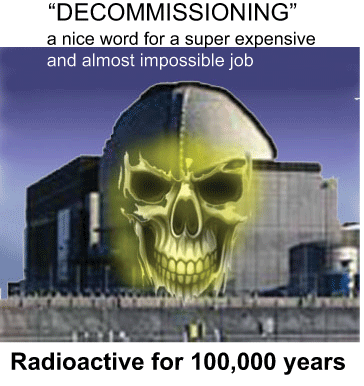
“Decommissioning” old and redundant nuclear plants sounds great and is greenwashed by the nuclear industry and Government as “Nuclear Restoration Services” . But in reality “decommissioning” means dispersal of nuclear wastes to the air, sea and land. Laws have been changed (despite opposition by Radiation Free Lakeland and others) to facilitate this by “moving waste up the heirarchy” ie what once was banned as too dangerous in landfill, incinerators and radioactive scrap metal is now routinely dispersed to the public realm. This also means that far higher level wastes are proposed for Geological Disposal than was the case in the 1990s when the NIREX inquiry stopped plans for intermediate and low level wastes in a deep nuclear dump.
In the same week the “Princess of Wales reveals diagnosis, doctors warn of mysterious cancer ‘epidemic” but the finger of suspicion never falls on the increase in radioactive wastes now being chucked into the public realm – nope the public are asked to fill in polls on whether they think processed food, lack of exercise, smoking is to blame for increase in cancers. In other words folks – “its your fault” despite the increased burden on your body from radiation and chemicals in the public realm.

Also in the same week EU ‘leaders’ in Brussels met to sign a Declaration pushing new nuclear “as part of the transition to a net-zero-emissions society”. The International Atomic Energy Agency’s Nuclear Energy Summit in Brussels on March 21 was protested by more than 40 organisations and we support that protest. But our support was tempered with the knowledge that rather than shouting about the radioactive and chemical toxic burden on the planet and people NGOs have for too long focussed on the narrative that nuclear is not a “climate solution.” NGOs “aim is to highlight that nuclear energy is a dangerous distraction from real climate solutions.” It is good to see opposition but by not pushing hard against the full consequences of nuclear (this is especially true of NGOs in the UK with few exceptions ) , the industry has been given a free ride to push its ‘climate solution’ agenda in the knowledge that it will not be overly tarnished by NGOs’ in the public ’s perception as Poison Power.
Of course it is a climate solution in the sense that the nuclear mafia agenda for the planet and its human and non-human inhabitants mean that we will not be in the least bit concerned about the climate.
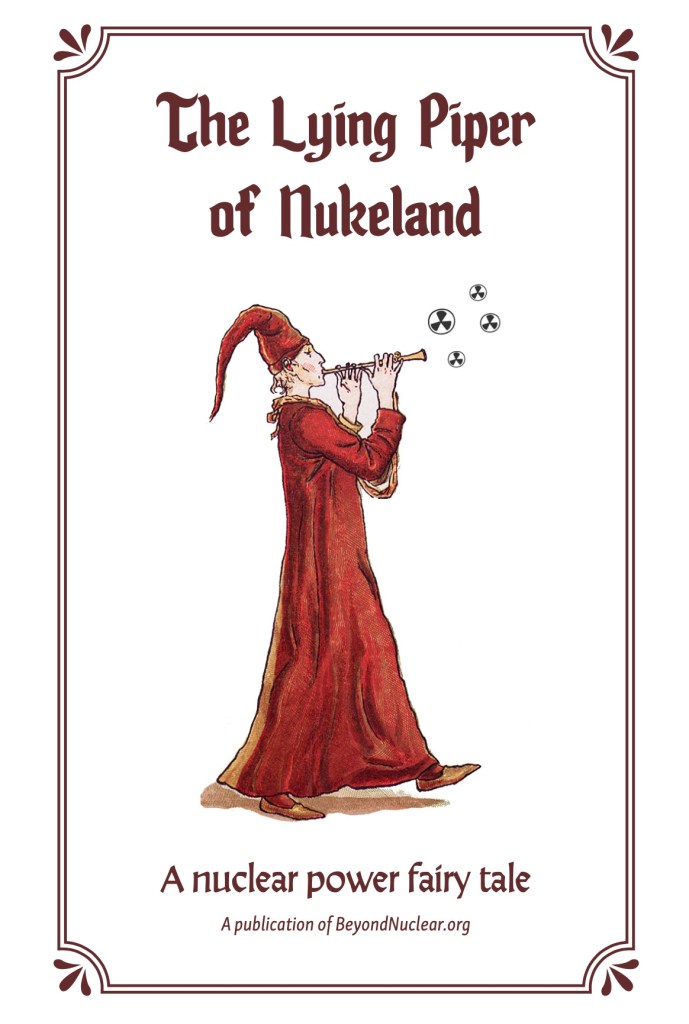
Beyond Nuclear reported from Brussels and produced an excellent leaflet “The Lying Piper of Nukeland” :
The IAEA and 30 countries that met in Brussels on March 21, spun false nuclear fairy tales, then issued a suitably “solemn pledge” to expand nuclear power, effectively announcing their own funeral. Many European groups protested in Brussels at the expo center where the summit was held .
A Barely-Disguised Genocide

CAITLIN JOHNSTONE, MAR 24, 2024, https://www.caitlinjohnst.one/p/a-barely-disguised-genocide?utm_source=post-email-title&publication_id=82124&post_id=142907577&utm_campaign=email-post-title&isFreemail=true&r=1ise1&triedRedirect=true&utm_medium=email
I just read a New York Times piece about the bodies that are trapped beneath the rubble in Gaza which said the Gaza Health Ministry estimates that there are 7,000 people listed as missing, but adds that that figure “has not been updated since November.”
November. There is no chance that any of the numbers we’re getting out of Gaza are up to date, including the death counts. Their infrastructure is shot and the scene there is just too chaotic. Nobody can keep track of anything anymore.
ISIS keeps attacking the enemies of the US and Israel for some strange and mysterious reason while funding for the main humanitarian group in Gaza gets cut due to completely unevidenced claims of Hamas affiliation. Re-fund UNRWA; de-fund ISIS.
❖
It’s funny to see the US proposing a fake UN “ceasefire” resolution which doesn’t actually demand a ceasefire when it’s public knowledge that the US could single-handedly create a ceasefire by telling Israel it will stop receiving US weapons if it doesn’t negotiate one right now.
❖
Ben Shapiro just cancel cultured Candace Owens out of a job for saying Palestinians are human beings and Alex Jones has condemned Israel’s genocidal atrocities before most Democrats on Capitol Hill have. American right wing punditry is a trip, man.
It sure is a crazy coincidence how all this stuff about difficulty with food distribution, collateral damage, human shields, the need to eliminate Hamas etc just happens to combine to create a situation that looks exactly the same as committing a genocide against an undesirable population.
They’re just doing a horrible thing they’ve wanted to do for ages and then using narrative to cover it up. Oh noes, it turns out it’s really hard to get food and medical supplies to this undesirable population! Oh noes, it turns out the bad guys are hiding in the hospitals and the civilian infrastructure! Oh noes, it turns out the bad guys are hiding behind large numbers of women and children! Oh noes, it turns out we’re going to need you all to move off of the land we’ve been coveting for generations!
It’s a sick joke that not even a child would fall for, but you see western government officials and major news outlets treating it seriously every goddamn day. It’s a barely-disguised genocide happening right out in the open, and the people responsible for telling the public what’s going on in the world are pretending it’s actually a very unfortunate series of highly convenient coincidences. There’s an elephant in the room wearing a cardboard crown as a disguise, and they’re all calling it Your Highness and telling everyone the king has come to visit.
Israel routinely massacres civilians who are waiting for food, attacks hospitals, picks off civilians with drones and snipers, and is deliberately starving the frailest and most defenseless people in Gaza to death, but the western political-media class keep calling this a “war”.
❖
People who wish to conflate Zionism with Jewishness often argue that most Jews are Zionists, but so what if they are? Most westerners are propaganda-addled imperialists, but if I didn’t believe westerners can and do snap out of that worldview I wouldn’t be doing what I do here.
In any system where people are being indoctrinated at mass scale by the powerful you’re going to see the majority of that population buying into the indoctrination, but conflating the people with the political ideology they’re indoctrinated with serves only to confuse and distort. If people had conflated “Nazism” with “Germany” that logic could have been used to justify exterminating every German after WWII, but because that distortion wasn’t made it opened up the possibility of de-indoctrinating the nation from that pernicious worldview.
Betting on the possibility of a better future means drawing a distinction between the people and the unhealthy worldviews they’ve been indoctrinated with, whether that’s Zionism, western imperialism, or anything else. We can only have a healthy world when the people snap out of their propaganda-induced coma and shake off the power-serving worldviews of this diseased civilization.
The Lying Piper of Nukeland:The IAEA’s nuclear fairy tales are leading nations — and all of us — into climate catastrophe
On March 21, more than 40 groups, mainly from Europe, protested the false promises and nuclear fairy tales being spun at the March 21 International Atomic Energy Agency’s Nuclear Energy Summit in Brussels. Prior to our fairy tale-themed rally close to the venue we issued a declaration signed by 621 organizations from across the world and issued a press release.
Our fairy tale handout parodied the story of nuclear power — see the text below. Beyond Nuclear also published a pamphlet exposing the hypocrisies and conflicts of interest of the IAEA. Feel free to download both and to distribute freely.
The IAEA’s nuclear fairy tales are leading nations — and all of us — into climate catastrophe
by By Linda Pentz Gunter beyondnuclearinternational, https://beyondnuclearinternational.org/2024/03/22/the-lying-piper-of-nukeland
At the end of the one-day summit, the IAEA and 34 countries issued a pledge “to work to fully unlock the potential of nuclear energy“, code for taking taxpayer money and going with a begging bowl to the World Bank.
Once upon a time… long ago, a Piper arrived in Carbonville. The people of Carbonville welcomed him warmly because they had heard that when he played his flute he had magical powers.
“Oh Piper!” they cried. “Here in Carbonville it is always dark and cold. It is smokey and polluted. Can you help us find a better way to create warmth and light?”
The Piper was happy to oblige. “I know just the answer,” he told them. “It’s called nuclear power! It’s safe, cheap and reliable. Very soon you will have warmth and light that is too cheap to meter!”
The people of Carbonville were so excited to get shiny new nuclear power plants that they took a vote and changed the name of their town to Nukeland.
The Piper began to play and very soon beautiful drawings of nuclear power plants started to appear for the people of Nukeland to admire. But several years passed and nothing else happened.
“What use are these drawings?” the people said. “We need warmth and light!”
“Be patient,” said the Piper. “I will bring you 15 nuclear power plants and you will have all the heat and light you need. I just need five gold coins to get them started.”
The people of Nukeland were very poor but they did without and saved up until they had five gold coins. They gave them to the Piper and once again he began to play.
The people of Nukeland watched as their fields were plowed under and their trees cut down and the land paved with concrete in readiness for the nuclear power plants. But still none appeared.
“I need more gold!” cried the Piper. “Just five more gold coins and your nuclear plants will be here”.
“You said it would only cost us five gold coins,” cried the people. “Now you’re charging us double!”
But all the same, the people paid the Piper another five gold coins. Many more years passed while the people of Nukeland froze in the dark, and then one day three nuclear power plants were finally done.
The people of Nukeland were shocked. Three nuclear power plants weren’t nearly enough to bring heat and light to everyone. “Why are there only three?” they asked the Piper. “You promised us 15. We paid for 15.”
The Piper just shrugged. “Now you will have the heat and light you wanted!” he exclaimed. “Those of you who can pay for it.”
So only the richest people who could afford the nuclear energy got light and heat even though everyone in the land had paid for the nuclear power plants.
And when the nuclear power plants opened, the Piper brought in all his friends and relatives to run them. “What about all the jobs you promised us?” demanded the people of Nukeland.
“You people are imbeciles,” snapped the Piper. “We need experts.” And even though the Piper’s friends and relatives knew as little as he did about nuclear power plants, they all got jobs at the plants, leaving the people of Nukeland to starve.
The Piper went to the newspapers to brag about his achievement. “Nuclear power is the answer to all your problems,” he cried. “Yes it is!” the editors agreed and wrote it in their newspapers.
But one reporter, the youngest of them all, wasn’t so sure. “Surely,” she said, “it would be easier, quicker and cheaper to harness the power of the sun when it is shining and capture the power of the wind when it is blowing?” she asked. “What if we turned that into heat and light?”
“Nonsense!” cried the Piper. “Nonsense!” agreed the editors, who never asked any questions. And they wrote it in their newspapers.
Soon, the Youngest Reporter began to notice that, along with the electricity for the rich people who could pay for it, the nuclear power plants also produced an evil, toxic waste. And no one knew what to do with it.
“What about all the waste?” she asked the Piper. “Not my problem,” said the Piper. “Someone else will come along later and deal with it.”
Then the Youngest Reporter discovered that the people working at the nuclear power plant and the people living nearby and especially the children, were falling sick with strange diseases never before seen in Nukeland.
”It’s the nuclear power plant that’s making you sick,” the Youngest Reporter told the people of Nukeland.
“Scaremonger!” cried the Piper. “Ignore her,” he told the people of Nukeland. “She’s too emotional. She doesn’t understand science.”
So the people ignored the Youngest Reporter even though most of them could not afford to buy the power from the nuclear plants and were still living in the cold and dark.
And then, one day, one of the nuclear power plants blew up and a great poison rained down on the land and many many more people got sick and many of them died.
And the Youngest Reporter who no one had listened to wept. “There was another way,” she said, “and it was right there in front of us all the time. The sun and the wind are free and safe and fast and cheap.”
And the people of Nukeland finally agreed. “We should never have listened to the Lying Piper,” they said. “He took our money and wasted our time. He made us sick and led us down a dead end. We made a terrible mistake.”
And they didn’t live happily ever after.
Linda Pentz Gunter is the international specialist at Beyond Nuclear and writes for and edits Beyond Nuclear International.
Zion Lights and her lying, climate-denying mentor Michael Shellenberger

The only nuclear industry that is booming is nuclear decommissioning ‒ the World Nuclear Association anticipates US$111 billion (A$145 billion) worth of decommissioning projects to 2035. [written in 2017 – but nothing’s changed]
Zion Lights was sucked into nuclear advocacy by self-confessed liar, climate denier and MAGA lunatic Michael Shellenberger.
JIM GREEN, https://jimkgreen1.substack.com/p/zion-lights-and-her-lying-climate 21 Mar 24
The latest substack missive from British nuclear power advocate Zion Lights reflects the cognitive dissonance that all nuclear advocates must be experiencing. Mixed in with anger and nuttiness. In the UK, if the two Hinkley Point C reactors are ever completed (the only two reactors under construction in the UK), the cost will be at least A$44 billion per reactor and it will be at least 25 years between the announcement that new reactors will be built and grid-connection of the reactors. If we allow for the usual pattern of overruns and delays, the figures are likely to be A$50+ billion per reactor, and 30 years between announcement and grid-connection.
Since the last reactor startup in the UK (Sizewell B in 1995), 24 reactors have been permanently shut-down. If the Hinkley Point C reactors begin operating in the early- to mid-30s, it will be 35‒40 years between reactors startups in the UK, during which time there will have been 32 permanent reactor-shutdowns. Only Sizewell B is likely to be operating.
If not for the military connections (which Lights studiously ignores), Hinkley Point C would likely be abandoned and plans for more reactors would also be abandoned.
Lights was sucked into nuclear advocacy by self-confessed liar, climate denier and MAGA lunatic Michael Shellenberger. You can read more about Lights here, Shellenberger here, and you can read Extinction Rebellion’s important statement about both of them here. The Extinction Rebellion statement concludes: “Zion Lights, Michael Shellenberger, the Breakthrough Institute and their associated deniers and delayers are intentionally spreading doubt about the severity of the [climate] crisis and the action needed to respond to it.”
Presumably Lights did at least some research beforehand but still thought it a good idea to work for self-confessed liar and climate denier Shellenberger.
I mention Shellenberger because Lights’ latest substack post is nothing more than a cut-and-paste of lies and distortions that Shellenberger has been peddling for decades. Lights might at least have the decency to come up with her own lies and distortions.
That being the case, I won’t trawl through Lights’ post here. Instead, here is an article about Shellenberger which covers the same ground. “Nuclear power will solve global warming and feed all the world’s children.”
Is there a future for ‘pro-nuclear environmentalism’?
Jim Green, 30 Oct 2017, RenewEconomy. For a longer version of this article please click here.
Michael Shellenberger is visiting Australia this week. He has been a prominent environmentalist (of sorts) since he co-authored the 2004 essay, The Death of Environmentalism. These days, as the President of the California-based ‘Environmental Progress’ lobby group, he is stridently pro-nuclear, hostile towards renewable energy and hostile towards the environment movement.
Shellenberger is visiting to speak at the International Mining and Resources Conference in Melbourne. His visit was promoted by Graham Lloyd in The Australian in September. Shellenberger is “one of the world’s leading new-generation environmental thinkers” according to The Australian, and if the newspaper is any guide he is here to promote his message that wind and solar have failed, that they are doubling the cost of electricity, and that “all existing renewable technologies do is make the electricity system chaotic and provide greenwash for fossil fuels.”
Trawling through Environmental Progress literature, one of their recurring themes is the falsehood that “every time nuclear plants close they are replaced almost entirely by fossil fuels”. South Korea, for example, plans to reduce reliance on coal and nuclear under recently-elected President Moon Jae-in, and to boost reliance on gas and renewables. But Shellenberger and Environmental Progress ignore those plans and concoct their own scare-story in which coal and gas replace nuclear power, electricity prices soar, thousands die from increased air pollution, and greenhouse emissions increase.
Fake scientists and radiation quackery
Environmental Progress’ UK director John Lindberg is described as an “expert on radiation” on the lobby group’s website. In fact, he has no scientific qualifications. Likewise, a South Korean article falsely claims that Shellenberger is a scientist and that article is reposted, without correction, on the Environmental Progress website.
Shellenberger says that at a recent talk in Berlin: “Many Germans simply could not believe how few people died and will die from the Chernobyl accident (under 200) and that nobody died or will die from the meltdowns at Fukushima. How could it be that everything we were told is not only wrong, but often the opposite of the truth?”
There’s a simple reason that Germans didn’t believe Shellenberger’s claims about Chernobyl and Fukushima ‒ they are false.
Continue readingWithout Extensive Narrative Manipulation, None Of This Would Be Consented To
CAITLIN JOHNSTONE, MAR 20, 2024,
Without extensive narrative manipulation, it would never occur to anyone that bombing Gaza into rubble is a reasonable response to a single Hamas attack.
Without extensive narrative manipulation, it would never occur to anyone that killing tens of thousands of Palestinians and starving hundreds of thousands more is a reasonable response to a thousand Israelis being killed.
Without extensive narrative manipulation, it would never occur to anyone that criticizing the actions of the state of Israel is antisemitic.
Without extensive narrative manipulation, it would never occur to anyone that saying “from the river to the sea” is a call for genocide.
Without extensive narrative manipulation, it would never occur to anyone to think about this onslaught and the discourse around it in terms of “Jews vs Jew haters”.
Without extensive narrative manipulation, it would never occur to anyone that it was fine and normal to keep an unwanted ethnic group in a walled-in area whose resources are tightly controlled by those in power.
Without extensive narrative manipulation, it would never occur to anyone that TikTok is a massive problem that needs to be eliminated.
Without extensive narrative manipulation, it would never occur to anyone that Israel should be able to inflict violence and abuse upon the Palestinian population for generations without ever receiving any violence in return.
Without extensive narrative manipulation, it would never occur to anyone that Israel using the Israeli army to murder civilians in an Israeli military campaign is something that can be blamed on Hamas.
Without extensive narrative manipulation, it would never occur to anyone that it is fine and acceptable for the IDF to be targeting healthcare workers, journalists and scholars and destroying hospitals, universities and mosques.
Without extensive narrative manipulation, it would never occur to anyone that dozens of Israeli hostages are more important than the hundreds of thousands of Palestinians who are being starved and murdered.
Without extensive narrative manipulation, it would never occur to anyone that the US war machine should be bombing people in Yemen, Iraq and Syria to stop their retaliations for the destruction of Gaza.
Without extensive narrative manipulation, it would never occur to anyone that the governments who are backing a genocide are not personally responsible for it.
Without extensive narrative manipulation, it would never occur to anyone that the unfathomable suffering that is taking place in Gaza right now should not be at the forefront of our attention.
Without extensive narrative manipulation, it would never occur to anyone that the genocide in Gaza should be allowed to continue instead of being brought to an immediate end.
And that’s why we’ve been seeing such extensive narrative manipulation — from our news media, from our government officials, and from Israel apologists on social media.
It’s because without extensive narrative manipulation, none of this would be consented to.
Exposing myths about building French nuclear power
How French nuclear construction times and costs have been getting longer and longer – for a long time
DAVID TOKE, MAR 16, 2024, https://davidtoke.substack.com/p/exposing-myths-about-building-french
It has been standard in the UK to talk about the wonders of the French nuclear programme and how if only we copied them nuclear power would get cheaper and cheaper. The story has gone ‘If only we built a series of nuclear power plant like they did’. But it turns out that the idea that the French nuclear programme was ever getting any cheaper was a myth.
In the UK Government policy documents would use their own language to describe nuclear prospects. Special terms are used that are not usually used to discuss other energy developments. These include the acronym ‘FOAK’ which stands for ‘First of a Kind’. In other words the first plant will be relatively more expensive than the plants of the same model that followed them. Another term used of course is ‘overnight’ costs – that is a wonderful piece of euphemism given that nuclear power plants are anything but built overnight. Its use obscures the fact that very large interest costs mount up during the time that the plant is being constructed, costs which are not included in the total cost estimates. That is because the plant in the spreadsheet is being built overnight (?!).
But when we examine the actual ‘overnight’ costs of French nuclear power, as reported, they have always been increasing. Look at the analysis by Arnulf Grubler published in the journal Energy Policy in 2010: [graph on original]
Grubler’s analysis did not include the length of time taken to construct the latest French nuclear power plant at Flamanville. This is an EPR (the same design as is being built at Hinkley C and planned for Sizewell C. Construction of the Flamanville EPR began in 2007 but it has still not been completed. Hence the Figure below includes the time taken to build Flamanville up until now, with the proviso that the plant still has not been completed.
It should be understood that, broadly speaking, the cost of building reactors is proportionate to the amount of construction time. So the cost has gone up, and in recent years cost has been going up at a rapid rate,.
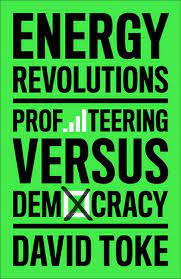
In my forthcoming book ‘Energy Revolutions – Profiteering versus Democracy’ I outliner four reasons for the increasing difficulties of building nuclear power plants:
‘First is the fact that nuclear power plant designers have incorporated safety features designed to minimise the consequences of nuclear accidents, but in doing so the plants have become much more complicated and difficult to build without great expense.
A second reason is that large construction projects of whatever type, at least in the West, tend to greatly overrun their budgets. In the West, improvements in health and safety regulations to protect construction workers have no doubt played a part in this.
A third factor is that, in the West at least, the cheap industrialised labour force that dominated the industrial economies of the past and which could be used to develop nuclear programmes (in the way that France did in the 1980s) has ceased to exist.
A fourth factor is simply that renewable energy technologies, especially wind and solar power, can be largely manufactured offsite in a modular fashion and their costs have rapidly fallen, leaving nuclear power increasingly uncompetitive.’ (page 30)
This book shows how we can move forward to an energy system powered by renewable energy rather than nuclear power or ‘carbon capture’ fossil fuels. It reveals how selective public ownership and targeted interventions, as part of an energy democracy programme will protect consumer interests better than the chaotic energy supply system that failed consumers so expensively in the recent energy crisis. We want no more of that!
Essentially, the idea of using nuclear power as a significant measure to engineer the global energy transition is at best a tremendous waste of resources. It is not just France that is seeing its nuclear power programme stall. It is a global phenomenon. Renewable energy is, by contrast, expanding at ever-incredible rates. As can be seen from the following graphs which is taken from my book ‘Energy Revolutions’. [on original]
IAEA director’s visit to Japan widely questioned, seeks to downplay nuclear water dumping
Global Times, By Xu Yelu and Xing Xiaojing Mar 15, 2024
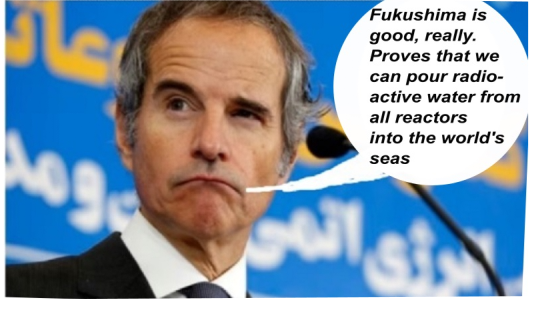
Rafael Grossi, director general of the International Atomic Energy Agency (IAEA), said during his visit to Japan that he confirmed that the “treated water” in Fukushima fully meets international standards, and experts believe such remarks supporting the discharge have become a kind of “political security” reached between the Japanese government and the IAEA.
Grossi was in Japan visiting the site of the nuclear power plant for the first time since the water dumping began. He also attended a meeting in Fukushima where representatives of the government and fishing communities discussed the current situation, according to Kyodo News.
He supported Japan’s decision once again, saying, “Our corroboration and information and also independent sampling have confirmed the very low presence of tritium … In some cases even impossible to trace, which means that the process is working as we thought it will be. So in this regard, it is correct. We are satisfied.”
According to the Japanese newspaper Mainichi Shimbun, Japanese Prime Minister Fumio Kishida and Foreign Minister Yoko Kamikawa separately met with Grossi, confirming continued cooperation on the issue of the discharge. The Japanese side announced that they will provide approximately 18.5 million euros ($20 million) in assistance to the IAEA.
The Chinese Embassy in Japan responded on Thursday that the Japanese side’s forced implementation of discharging nuclear-contaminated wastewater into the sea has no precedent since the peaceful use of nuclear energy by humans, nor are there any recognized disposal standards. How can it be said to comply with so-called “international standards?”
The nuclear-contaminated wastewater generated by the Fukushima nuclear accident contains various radioactive nuclides present in the melted core, many of which do not have effective treatment technologies. Focusing solely on tritium clearly ignores this basic fact………………………….
The IAEA should uphold the principles of objectivity, professionalism, and impartiality, and should not endorse Japan’s erroneous actions of discharging nuclear-contaminated wastewater into the sea, nor should it disseminate one-sided information that misleads international public opinion, the embassy stressed.
………………”With the internal management chaos of Tokyo Electric Power Company and inadequate government supervision in Japan, in a situation where standards are unclear, boundaries are unclear, and data is not transparent, no one or organization can guarantee that the nuclear-contaminated wastewater being discharged into the ocean by Japan is safe,” Zhang said.
…………………………….the plan to discharge Fukushima’s contaminated water into the sea will last for 30 years. However, since the first round of discharge, it has been less than seven months, and the IAEA has expressed “satisfaction” with the discharge situation. Or, it can be said that this is a kind of “political security” reached between the Japanese government and the IAEA.
https://www.globaltimes.cn/page/202403/1308918.shtml
There is no such thing as a “nuclear waste-eating” reactor
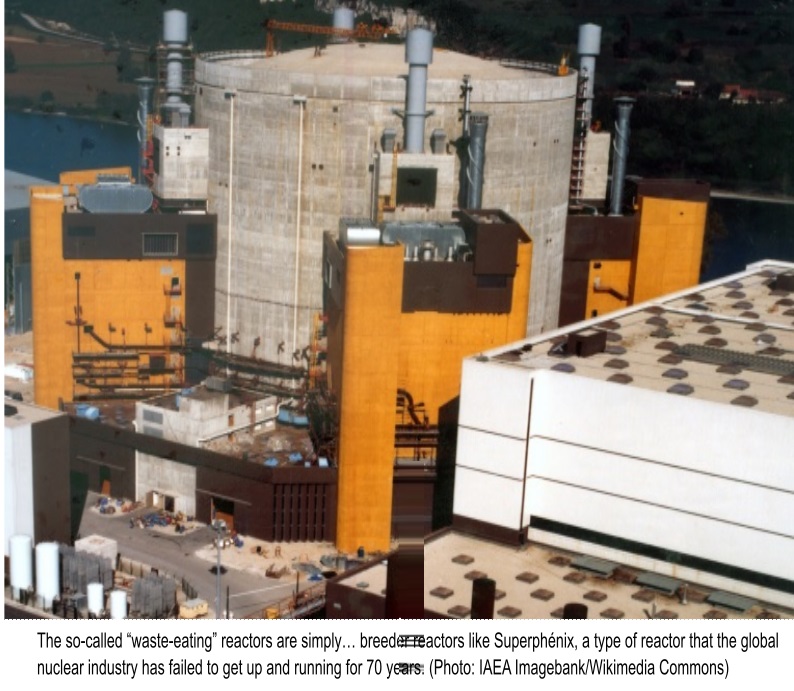
Contrary to popular belief, the French nuclear industry is by no means “triumphant”, “the best in the world” or “at the cutting edge of technology”: in fact, EDF (bankrupt), Areva (renamed Orano after filing for bankruptcy) and CEA (subsidized by public money) are constantly making fools of themselves and leaving the French with astronomical bills.
A magic reactor killed by environmentalists?
By Stéphane Lhomme by beyondnuclearinternational, https://beyondnuclearinternational.org/2024/03/17/a-magic-reactor-killed-by-environmentalists/
On the contrary, a “nuclear waste-eating reactor” does not exist
Appearing as a guest on several TV channels (BFM, Cnews, etc.), a certain Fabien Bouglé managed to fool both viewers and journalists (most of whom are totally ignorant about nuclear power) with a series of fibs, each more enormous than the last. Here are a few clarifications.
There is no such thing as a “nuclear waste-eating” reactor
The smooth-talking Bouglé left his ignorant interlocutors stunned and bewildered as he talked about “waste-eating” reactors that would have already solved the radioactive waste issue if an infamous green lobby, “betraying France to Germany” (sic!), hadn’t “prevented” the advent of such reactors.
So, like throwing a log on the fire, all you have to do is put the radioactive waste produced by today’s power plants into a “magic” reactor, and the waste will disappear.
Mr. Bouglé finally divulged his “secret”: the so-called “waste-eating” reactors are simply… breeder reactors: a type of reactor that the global nuclear industry has failed to operate for 70 years, like Superphénix in France! And, even if it did work, it would in no way eliminate radioactive waste. What’s more, less than 1% of nuclear fuel (the most radioactive waste) could theoretically have its lifespan reduced, but without disappearing and while becoming even more radioactive! In the nuclear industry, as elsewhere, miracles do not exist.
The Astrid project was not “on the way to success” and was not “taken over by Bill Gates”
Despite its pretty name, the Astrid reactor project was nothing more than a little Superphénix: a sodium-cooled breeder reactor. Look at the “progress”: 40 years after the launch of Superphénix (1240 MW), the CEA wanted to make another attempt with a reactor half as powerful (600 MW), before giving up altogether.
Japan’s Monju fast-breeder reactor was definitively shut down after countless failures, a terrible fire and sodium leaks; Germany’s Kalkar fast-breeder reactor was never commissioned; and the USA has abandoned the sector. Only Russia manages to keep its BN800 hobbling along… but it doesn’t perform any of the miracles expected of it (producing “more fissile material than it consumes”, “eating” radioactive waste and other nonsense).
As for Bill Gates, he’s one of the dummies who, in recent years, have announced various types of miraculous reactors, always claiming to be able to produce electricity “cheaply, safely and with little waste” (blah blah blah). Beginning in 2006, Bill Gates and his company Terrapower first tried to make a “travelling wave” reactor work, then a “molten salt” one, both abandoned after wasting billions. Now Gates is dreaming of developing… a sodium-cooled fast-neutron reactor: back to Superphénix and 70 years of failure for the global nuclear industry.
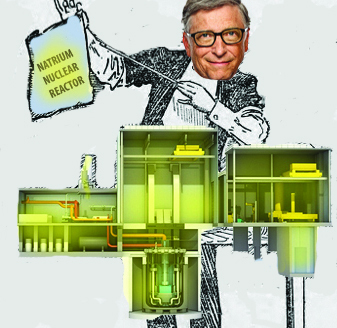
France’s nuclear woes are caused by… France’s nuclear woes!
The “evil anti-nuclear environmentalists” and the so-called “traitors in the pay of Germany” denounced by Inspector Bouglé have nothing to do with the disasters of French nuclear power: EDF, Areva (now Orano) and the CEA are doing just fine on their own! For example:
- Industrial and financial disasters at the EPR sites in Finland, Flamanville and England: 15 to 20 years (instead of four and a half) to build a reactor costing 20 billion Euros instead of 3 billion, and with serious defects.
- The unprecedented scandal of the thousands of defective parts (including the famous Flamanville EPR vessel) produced by Areva in its Le Creusot plants.
- Catastrophic and ruinous flops at the Iter (fusion) and RJH reactor sites.
- Stress corrosion (up to 32 reactors out of 56 shut down at the same time in 2022)
And so on.
Contrary to popular belief, the French nuclear industry is by no means “triumphant”, “the best in the world” or “at the cutting edge of technology”: in fact, EDF (bankrupt), Areva (renamed Orano after filing for bankruptcy) and CEA (subsidized by public money) are constantly making fools of themselves and leaving the French with astronomical bills.
The Fessenheim closure is not the cause of electricity shortages in France and imports from Germany
Mr. Bouglé claims that France was an exporter to Germany before the closure of Fessenheim and that it has suddenly become an importer because of the plant’s closure in 2020. He’s talking nonsense.
In reality, there are exchanges (in both directions) between the two countries throughout the year. When the balance sheet is drawn up on December 31, France is still an importer from Germany (*), and has been for over 25 years (**), long before Fessenheim was shut down.
This phenomenon is mainly due to the absurd choice of electric heating, developed on a massive scale in France to “justify” nuclear power: as soon as it gets cold, electricity consumption is such that it far exceeds the capacity of the French nuclear fleet, even when it’s working properly!
It’s also worth noting the ridiculous claim that life was wonderful in France with 58 reactors, and that it has suddenly gone into crisis with “only” 56 reactors, which in reality is an insane number. For the record, during the stress corrosion crisis, France was saved by importing massive amounts of electricity from neighboring countries, which have only a few reactors, if any at all.
(*) Of course, we can criticize the fact that a significant proportion of Germany’s electricity is generated by coal-fired power plants (even if the share of renewables is increasing exponentially), but the fact is that it’s this “dirty” electricity that heats France every winter, and French nuclear enthusiasts don’t go so far as to refuse this electricity and stay in the cold and dark!
(**) Except, very narrowly, in 2011: following the Fukushima disaster, Germany immediately shut down 8 reactors. But by 2012, France was once again a net importer from Germany.
The joke about waste-eating reactors
Let’s start by noting that nuclear reactors continually produce insane quantities of radioactive waste of various kinds, from nuclear fuel to the tools and clothing used in power plants, which are contaminated… and can’t be “eaten”!
But let’s concentrate on the most radioactive, the spent fuel that comes out of the reactor core after use.
Spent fuel comprises four types of element: plutonium, uranium, fission products and minor actinides. Note that the vast majority of radioactivity is contained in these last two categories.
To attempt reuse this waste fuel, separation work must already be carried out in a gigantic plant such as La Hague. These operations require huge amounts of electricity and using large quantities of terribly corrosive and dangerous chemicals: a far cry from the “clean” energy that could “save the planet”.
– Plutonium
Listening to Mr. Bouglé, the uninformed viewer (and the ignorant journalist) think that all they have to do is recover this fuel and put it in the so-called “waste-eating reactor”, which will make this waste disappear… while producing electricity! Jackpot, bravo and thanks for everything. But Santa Claus doesn’t exist, and it’s all poppycock. And here’s why.
It is used by the military for their atomic weapons. Some of this plutonium can be recovered to make fuel (known as “mox”) for use in today’s power plants, which exacerbates the consequences of an accident when it occurs. Various studies show that this option reduces only slightly the amount of uranium needed from mining. But in no case is this plutonium “eaten” or “incinerated”; it is almost entirely recovered after use.
– Uranium
The uranium resulting from these separation operations, known as “reprocessed uranium”, can theoretically be reused in place of mined uranium, but in reality, this option poses a number of technical problems. EDF has been trying to use it for years in its Cruas power plant (Ardèche), after re-enrichment… in Russia (thanks Putin!). But this remains very marginal, and in no case is this uranium “eaten” or “incinerated”; it is almost entirely recovered after use.
– Fission products
There’s nothing we can do with them, except vitrify them and store them for millennia!
– Minor actinides
These are the only elements of radioactive waste that could theoretically have their lifespan reduced in breeder reactors… while becoming even more radioactive! But even if such a “feat” were to happen (provided we finally manage to operate breeder reactors properly), minor actinides would not be “eaten”, “incinerated” or “disintegrated”. In fact, they are vitrified like fission products and have to be stored for millennia.
Conclusion
Of course, there is no technology that can “eat” nuclear waste. At most, it is theoretically possible (but not in practice) to degrade a tiny fraction of it, and even then, at the cost of new radioactive and chemical contamination and very high energy consumption.
Once and for all, let’s remember that there will never be a nuclear miracle, be it with magic reactors, or by replacing uranium with thorium (the thorium sector is also that of fast-breeder reactors!), or with fusion, or by calling old projects that have never worked “4th generation” or “SMR”.
Stéphane Lhomme is Director of the Nuclear Observatory.
Hollywood stars put their name to a good message, but it’s the messengers who are problematic.

Nuclear Threat Initiative’s CEO is, yes, Ernest Moniz, the former US Energy Secretary, who is at the forefront of promoting nuclear power to anyone and everyone who wants it
Moniz is one of the chief architects behind the pro-nuclear infiltration of the COP28 climate summit
Make (some) nukes history, Hollywood stars put their name to a good message, but it’s the messengers who are problematic
By Linda Pentz Gunter, https://beyondnuclearinternational.org/2024/03/11/make-some-nukes-history/
A handful of Hollywood celebs, some highly recognizable including Jane Fonda, Barbra Streisand, Lily Tomlin, Emma Thompson and Michael Douglas, as well as musicians such as Jackson Brown and Graham Nash, just signed their names to a letter published in the LA Times urging that we “Make Nukes History”.
Hooray, right? Well, only half hooray.
The Hollywood letter was part of a quickly launched campaign to coincide with the Oscar buzz around the successful feature film, Oppenheimer, in order to leverage attention for the need to abolish nuclear weapons. The Make Nukes History campaign aims to raise public awareness about the civilization-ending risks posed by today’s nuclear arsenals. It reminds us that while Oppenheimer is a history lesson, nuclear weapons are very much still with us, but that we can put an end to what J. Robert Oppenheimer started.
So far, all so good. Far too few of us are thinking about nuclear weapons and the threat they pose, let alone doing something about getting rid of them. It’s an important message that needs reiterating.
Meanwhile, Oppenheimer duly swept seven Academy Awards on Sunday. We waited hopefully for one of the winners to say something about the effect of Oppenheimer’s bomb down the ages. It came only from Cillian Murphy at the end of his Best Actor acceptance speech. “We made a film about the man who created the atomic bomb and for better or for worse we are all living in Oppenheimer’s world so I would really like to dedicate this to the peacemakers, everywhere,” Murphy said.
The Make Nukes History message did not make it to the Oscar stage and the LA Times letter was surprisingly skimpy, failing to get at the heart of the two key takeaways missed in the Oppenheimer film: the unwilling, unrecognized and still uncompensated victims of Oppenheimer’s original Trinity bomb; and the on-going harm down generations to all peoples whose lands were seized and used for atomic tests.
The letter includes a quote from President John F. Kennedy, then states:
“At a time of great uncertainty, even one nuclear weapon—on land, in the sea, in the air, or in space—is too many. To protect our families, our communities, and our world, we must demand that global leaders work to make nuclear weapons history—and build a brighter future.”
Demand indeed. Some of us have been doing this for decades. And we have a treaty for that. But thank you for waking up.
But what does “build a brighter future” actually mean? That, it turns out, is the slogan of the organization behind the orchestration of the Hollywood letter and Oscar campaign — the Nuclear Threat Initiative.
Let’s first take a look at who actually signed the letter. With two exceptions, all the signatories are white. There are no Native Americans on there. No US Marshall Islanders. Almost none of the Oppenheimer film cast and crew signed it. The last four signatures belong to the board of NTI.
NTI was the brainchild of Fonda’s ex, Ted Turner. NTI’s CEO is, yes, Ernest Moniz, the former US Energy Secretary, who is at the forefront of promoting nuclear power to anyone and everyone who wants it. Turner is also a firm supporter of nuclear power (I know because I tried to challenge him on it in person and was quickly deflected by a very large gentleman in possession of an impressive set of muscles.)
Moniz is one of the chief architects behind the pro-nuclear infiltration of the COP28 climate summit and its ridiculous “let’s triple global nuclear power capacity by 2050” proclamation. He will be in Brussels later this month, headlining the International Atomic Energy Agency’s propaganda-fest, billed as the First Ever Nuclear Energy Summit. So will Charles Oppenheimer, Robert Oppenheimer’s grandson and another signatory to the LA Times letter.
So here we have a slightly star-studded short-lived campaign to proclaim an end to one kind of nuke, while behind the scenes the same organization is working hard to promote the other kind of nuke, thus ensuring that the door to nuclear weapons development stays firmly open.
So sorry, no two thumbs up for this bit of Hollywood theatre.
Linda Pentz Gunter is the international specialist at Beyond Nuclear and writes for and edits Beyond Nuclear International. All opinions are her own.
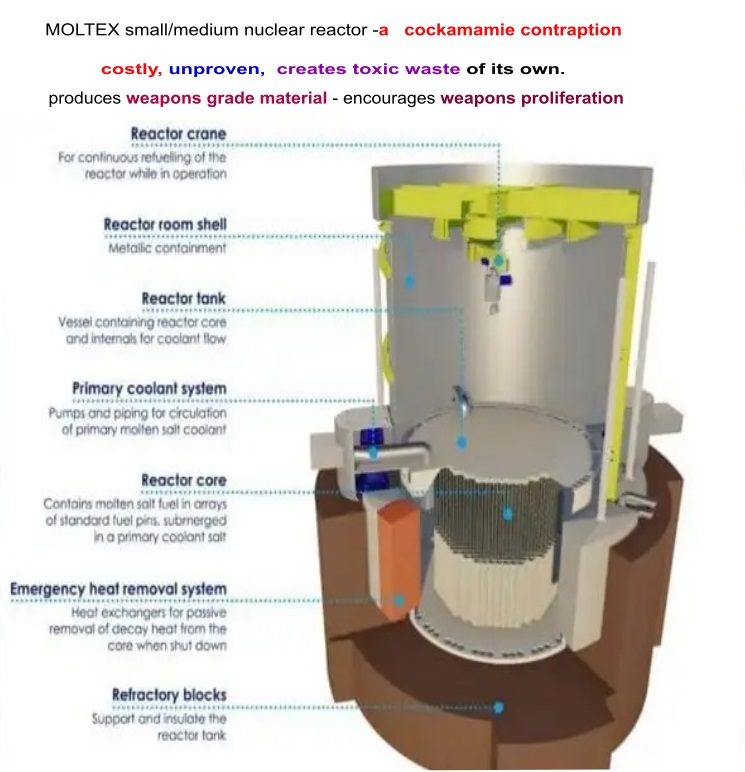
MOLTEX nuclear reactors: The whole thing is a scam, wasting tax payer money again.

14 Mar 24
Why this pyro-reprocessing? Vitrification is the proven and researched method for reprocessed nuclear fuel waste. The U.S. NUCLEAR WASTE TECHNICAL REVIEW BOARD states, ” HLW is vitrified by mixing it with a combination of silica sand and other glass-forming chemicals, heating the mixture to very high temperatures [approximately 1,150°C (2,100°F)] until it melts, and pouring the molten material into stainless steel canisters where it cools to form a glass. Vitrification is used in several countries to immobilize HLW because it has advantages over other modes of treatment. It is a well-demonstrated technology resulting from more than 40 years of industrial experience, it can be used for a wide range of HLW compositions, it is a continuous process that can be applied to large volumes of HLW, and the resulting glass product is chemically durable in many geologic disposal environments.” https://www.nwtrb.gov/docs/default-source/facts-sheets/vitrified_hlw.pdf?sfvrsn=18
A soluble corrosive salt from pyro-reprocessing is not an acceptable wasteform.
It is important to realize even with glass vitrification there will still be an off gas waste stream containing the volatiles such as Tc99, I131 and C14, the major contributors to dose in the Seaborn EIS. There needs to be extensive research done on immobilization on the volatile off gas reprocessed waste stream.
Why is it that for reprocessed waste disposal the volatile, mobile, major contributors to dose consequence are ignored?
In fact the cost and feasibility of waste disposal and decommissioning in general is never properly accounted for in the development of nuclear reactors. New reactors are not designed to make decommissioning feasible without huge cost and extensive worker radiation exposure. This is short sighted madness that the nuclear industry is allowed to get away with.
Guess what? There is no nuclear waste, no nuclear proliferation and no possible nuclear meltdown from the much cheaper solar wind and deep geothermal power options. Is this not obvious? Yet government money (our money) is poured into nuclear energy. Did the public have a say in this? No expenditure without representation? Can we dump the reactors into Boston harbour?
[Episode #219] – Nuclear Illusions
Energy Transition Show 6th March 2024 https://xenetwork.org/ets/episodes/episode-219-nuclear-illusions/—
In Episode #209, we peeled back the layers on civilian nuclear power, revealing its history as a facade for the nuclear weapons industry with a corresponding legacy of deception.
Yet, the allure of small modular reactors (SMRs) has recently been touted as the nuclear industry’s saving grace and a beacon of hope with the potential to sidestep a muddled past. Despite all the fanfare and substantial investments, the crumbling of prominent SMR initiatives exposes the continuation of the industry’s tradition of overpromising and underdelivering, a pattern all too familiar to those who’ve been watching closely.
Joining us in this episode is Jim Green from Friends of the Earth Australia, a seasoned nuclear journalist with three decades of experience in critiquing nuclear energy. Jim offers an unparalleled depth of insight into the industry’s persistent shortcomings and the realities behind the SMR hype. Together, we delve into the track record of conventional nuclear power, the latest trends in nuclear plant construction and retirements worldwide, and examine the companies at the forefront of the SMR push, offering a candid exploration of the nuclear power industry’s claims versus its actual performance.
Guest:
Jim Green is the National Nuclear-Free Campaigner with Friends of the Earth Australia, a member of the Nuclear Consulting Group (nuclearconsult.com), and former editor of the World Information Service on Energy’s ‘Nuclear Monitor’ newsletter. He has a First Class Honours degree in Public Health and a Doctorate in Science and Technology Studies for his thesis on the debates over the replacement of Australia’s nuclear research reactor.
More fusion hot air, literally!
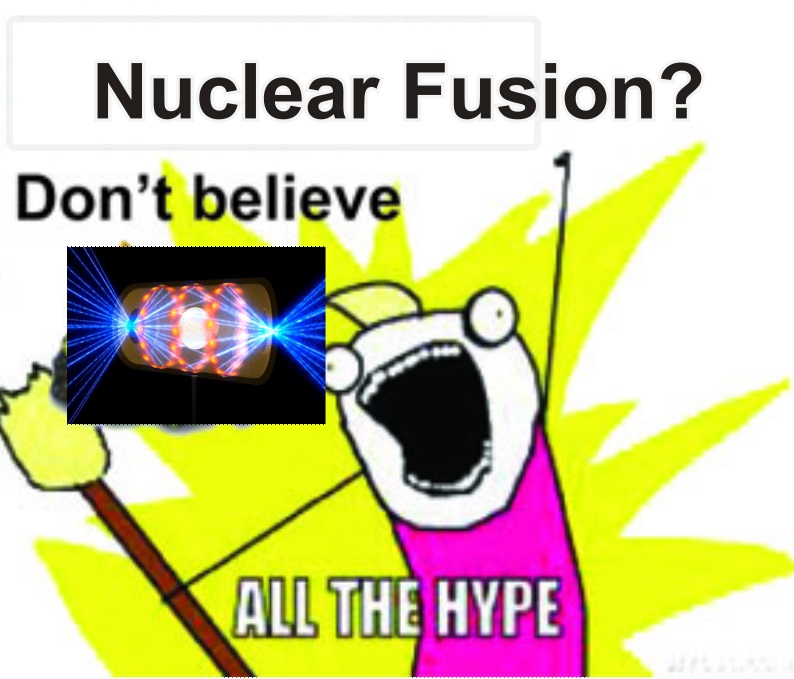
Megajoules and megaheadlines are all meganonsense
By Linda Pentz Gunter, https://beyondnuclearinternational.org/2024/03/04/more-fusion-hot-air-literally/ 4 Mar 24
Another week, more fusion news, cue another overblown headline, as the mainstream media once again paid homage to industry hype, digesting nuclear propaganda soundbites without even a hiccup.
On February 8, we learned that the Joint European Torus fusion project, also known as JET, had broken its own record in energy output during a last gasp attempt to make fusion work. The 40-year old project is now closed down for good.
The moment — and just a fleeting moment it truly was, lasting a mere 5.2 seconds — was duIy celebrated as another breakthrough for fusion.
“Nuclear fusion: new record brings dream of clean energy closer,” trumpeted the BBC who were especially smug since Torus is based in the UK.
“Nuclear Fusion World Record Smashed in Major Achievement”, said Science Alert.
“Scientists have made a record-setting fusion energy breakthrough,” blared the headline on Vice.
Below – A jolly video about JET in which the narrator’s voice perhaps generates more energy than the reactor itself.
What actually happened? JET generated 69 megajoules of energy in those 5.2 seconds, breaking its previous record of 59 megajoules over 5 seconds in 2021.
For those of us who don’t go about measuring things in megajoules, I deferred to our colleague, physicist, M.V. Ramana, for an explanation.
What are they really talking about here and is it actually a breakthrough?
“One can start with the annual average consumption of one US household,” Ramana said. “That’s about 10,500 kilowatt hours which is equivalent to 37,800 megajoules. Essentially using one hour = 3,600 seconds, and one joule = one watt-second.”
Head already spinning, I hoped he would do the rest of the math. He did.
“The 69 megajoules generated by JET”, Ramana explained, “is equivalent to roughly 0.06 percent of the electricity consumed by an average US household.”
So a minuscule contribution. But here’s the catch. “The JET machine produced 69 megajoules, but this is all heat,” explained Ramana. “Only about a third of that can be converted into electricity under ideal circumstances.”
Mostly heat, and hardly any electricity. So what the JET fusion so-called breakthrough actually delivered was all hot air. Literally!
Then came some more hot air. “First ‘private’ nuclear reactor to power 2 million British homes” ran another headline. The private sector nuclear company in question is Westinghouse. Yes, that Westinghouse! The one whose executives are in jail over a failed new nuclear power plant project in South Carolina. The Westinghouse that went bankrupt, forcing its mega-giant parent company, Toshiba, to shed not only Westinghouse but all Toshiba’s nuclear assets to avoid going down with the Westinghouse ship.
The same Westinghouse that is now $20 billion over budget at its other new nuclear project at Vogtle in Georgia.
But the British press were all “oh joy, oh rapture unforeseen” over this announcement, a project that has about as much credibility as the whimsical plot of HMS Pinafore.
And finally, we learned that Michigan governor, Gretchen Whitmer, is seeking another $150 million to restart the old and decrepit Palisades nuclear plant.
Palisades has been closed for almost two years and the company that would re-open and run it, Holtec, which specializes in decommissioning and radioactive waste management, has zero experience running a nuclear power plant.
This latest ask comes on top of $150 million already approved last year for a Palisades restart and could be augmented by a $1.5 billion loan from the federal government as well.
All of this nuclear nonsense comes on the heels of other hyperbole surrounding previous so-called advances in fusion (see our earlier coverage here and here), misrepresented almost universally as an imminent answer to our worsening climate crisis.
But, as the song goes in Pinafore, “Things are seldom what they seem.”
Linda Pentz Gunter is the international specialist at Beyond Nuclear and writes for and edits Beyond Nuclear International
The nuclear narrative.

What is a narrative? ……… In other words, it is about occupying public space to disseminate enchanting stories that give pride of place to industry, multinationals, investors, billionaires, each greener than the last.
Jean-François Nadeau, March 4, 2024, https://www.ledevoir.com/opinion/chroniques/808350/chronique-narratif
The future of the world, at least according to the head of the AtkinsRéalis firm, lies in nuclear power. This company, formerly known as SNC-Lavalin, has changed its name. The scandals that have affected her, she asserts, belong to the past.
For its campaign to promote atomic energy, AtkinsRéalis secured the services of two former prime ministers: Jean Chrétien and Mike Harris. In 2019, as revealed by Radio-Canada, Jean Chrétien had already gone so far as to propose, with astonishing lightness, storing foreign nuclear waste in Labrador. In a letter, the former prime minister wrote to a Japanese firm: “Canada has been the largest supplier of nuclear fuel for years, and I have always thought it would be appropriate for Canada to become, at the end of account, the steward and guarantor of the safe storage of nuclear waste after their first service cycle. »
No carbon neutrality without nuclear power , repeats the boss of AtkinsRéalis like an advertising slogan. We must replace fossil fuels, while doubling or tripling, thanks to nuclear power, the production of electricity, he pleads. There is no question, in this presentation, of rethinking a model of society based on an infinite expansion of consumption. Always more cars, as long as they are electric. Always more heating, regardless of the fact that our buildings are thermal sieves. In other words, what continues to matter is growth. And the increase in AtkinsRéalis’ turnover is largely due to nuclear power, as noted by Le Devoir .
Last week, Minister Pierre Fitzgibbon reiterated again that he was not closing the door to the return of nuclear power. Since the arrival of Michael Sabia at the head of Hydro-Québec , the signals pointing in the direction of this revival have multiplied. “I think that as a government, in the ministry, at home, we must stay on the lookout for what is happening in nuclear power,” the minister further affirmed in front of an audience of business people. To have such projects accepted, the minister specified that “you simply have to have a good narrative”. In Quebec, he laments, “we have not had any narrative on nuclear power” since the closure of Gentilly-2 .
What is a narrative? In 1928, Edward Bernays, the founding father of the public relations and advertising industry, called these language elements capable of manipulating public opinion propaganda . This word ended up, as we know, having unfavorable connotations. Others were therefore substituted. Here is the latest addition, used in all sauces: the narrative . In other words, it is about occupying public space to disseminate enchanting stories that give pride of place to industry, multinationals, investors, billionaires, each greener than the last.

Pierre Fitzgibbon shows interest in mini nuclear reactors. The boss AtkinsRéalis also praises this technology, which is far from wonderful. Nobody says too loudly that these types of plants produce more nuclear waste per megawatt. These mini power plants would produce up to thirty times more radioactive waste than conventional nuclear power plants.
In his “narrative”, the boss of AtkinsRéalis barely concedes that the management of radioactive materials constitutes a serious danger for humanity.
In Ontario, a large dump for radioactive waste was approved on January 9. Tons of heavy metals, dangerous radioactive elements, plutonium, uranium, etc. will pile up there for a century, not far from the Ottawa River. The whole thing promises to occupy, for eternity, an area equivalent to 70 National Hockey League ice rinks.
In France, 280 km of underground galleries are being built to store nuclear waste. To give an idea, the galleries of the Montreal metro total 71 km. This giant sarcophagus will be the largest construction site in Europe. In these galleries, the most dangerous waste will be able to spew radioactivity for 100,000 years.
So that the hydrogen and the fumes released from this collection of waste do not explode, it is necessary to continually ventilate. Which requires electricity. A power outage, if it lasts more than a week, could be catastrophic. Obviously, electrical problems, cataclysms, wars, terrorists, this will never happen in a hundred years. Not again in a thousand years, probably. Moreover, at the entrance to these sites, in what language should we warn future generations not to dig?
The speech of the boss of AtkinsRéalis is very similar to that which is also being given these days by the cereal manufacturer Kellogg’s. Gary Pilnick, its CEO, is sad to see the cost of food soaring. However, he does not recommend reviewing the profit margins on which the food giants are fattening, nor the exploitation system which governs this surge in prices. He simply suggests eating cereal at dinner, so that consumers can lower their bills and cereal manufacturers can make more money. At the bottom of the scale, this makes no difference to the misfortunes of the majority. Agricultural producers in Quebec, for example, find themselves this year with the lowest net incomes since 1938, they say.
Nuclear industries operate according to the same elastic logic which consists of making money at all costs. Our dependence on automobiles and energy-intensive lifestyles suits them. And it is enough, to hear them, to continue to rush forward, head down, to escape from a reality that is ruining the future. Their technologies promise to fix everything. As long as you are willing to swallow their narrative first, like soft cereal .
1 This Month

To see nuclear-related stories in greater depth and intensity – go to https://nuclearinformation.wordpress.com
-
Archives
- September 2026 (194)
- August 2026 (330)
- July 2026 (355)
- June 2026 (287)
- May 2026 (306)
- April 2026 (356)
- March 2026 (251)
- February 2026 (267)
- January 2026 (308)
- December 2025 (358)
- November 2025 (359)
- October 2025 (375)
-
Categories
- 1
- 1 NUCLEAR ISSUES
- business and costs
- climate change
- culture and arts
- ENERGY
- environment
- health
- history
- indigenous issues
- Legal
- marketing of nuclear
- media
- opposition to nuclear
- PERSONAL STORIES
- politics
- politics international
- Religion and ethics
- safety
- secrets,lies and civil liberties
- spinbuster
- technology
- Uranium
- wastes
- weapons and war
- Women
- 2 WORLD
- ACTION
- AFRICA
- Atrocities
- AUSTRALIA
- Christina's notes
- Christina's themes
- culture and arts
- Events
- Fuk 2022
- Fuk 2023
- Fukushima 2017
- Fukushima 2018
- fukushima 2019
- Fukushima 2020
- Fukushima 2021
- general
- global warming
- Humour (God we need it)
- Nuclear
- RARE EARTHS
- Reference
- resources – print
- Resources -audiovicual
- Weekly Newsletter
- World
- World Nuclear
- YouTube
-
RSS
Entries RSS
Comments RSS
 nuclear-news