JUSTIN TRUDEAU FACES CALLS TO RESIGN RE: SNC-LAVALIN SCANDAL
As reported by Newsweek.
Liberal Party Canadian Prime Minister Justin Trudeau now faces calls from his Conservative Party challenger in this autumn’s election to resign over a scandal involving SNC-Lavalin, a giant engineering firm based in Montreal, Quebec. SNC-Lavalin has been accused of bribery, fraud, and other corruption over its practices in Libya. If convicted of such  wrongdoing, SNC-Lavalin could be barred from Canadian federal contracts for a decade. (SNC-Lavalin has been previously barred for a decade from World Bank contracts.)
Holtec International has teamed with SNC-Lavalin to form a nuclear power plant decommissioning consortium. Already, the Holtec/SNC-Lavalin consortium has taken over ownership of the permanently shutdown Oyster Creek atomic reactor in NJ. This includes on-site irradiated nuclear fuel management.
Holtec & SNC-Lavalin are also vying for taking over the ownership of such other soon-to-be decommissioning nuclear power plants as Pilgrim in MA, and Palisades in MI.
Holtec is also the proponent for a national centralized interim storage facility for irradiated nuclear fuel in southeastern New Mexico.
Its partnership with a corrupt company like SNC-Lavalin calls into question Holtec’s own judgment.
 However, Holtec itself has engaged in bribery, at the Tennessee Valley Authority’s Browns Ferry nuclear power plant; in addition, Holtec CEO Krishna Singh has been accused by whistleblowers Oscar Shirani (Commonwealth Edison/Exelon) and Dr. Ross Landsman (NRC Region 3) of attempting to bribe them into silence, re: QA violations (see below).
And Holtec CEO Krishna Singh has also made racist remarks re: his own African American and Puerto Rican American workers in Camden, NJ.
Holtec is also infamous for QA (Quality Assurance) violations in the manufacture of its irradiated nuclear fuel canisters, brought to light by whistleblowers.
See these previous Beyond Nuclear website posts, for more info. on concerns re: SNC-Lavalin:…….. http://www.beyondnuclear.org/centralized-storage/
March 9, 2019
Posted by Christina Macpherson |
Canada, politics, secrets,lies and civil liberties |
3 Comments
 France TV Info 6th March 2019 A film about the Fukushima disaster censored in a commune that houses a
nuclear power plant. The Nuclear Exit Association planned a projection
eight years after the Fukushima accident in Japan. But the event was
canceled after the nearby nuclear plant contacted the town hall.
https://www.francetvinfo.fr/monde/japon/fukushima/nievre-un-film-sur-la-catastrophe-de-fukushima-censure-dans-une-commune-qui-heberge-une-centrale-nucleaire_3220981.html
March 9, 2019
Posted by Christina Macpherson |
civil liberties, France |
1 Comment
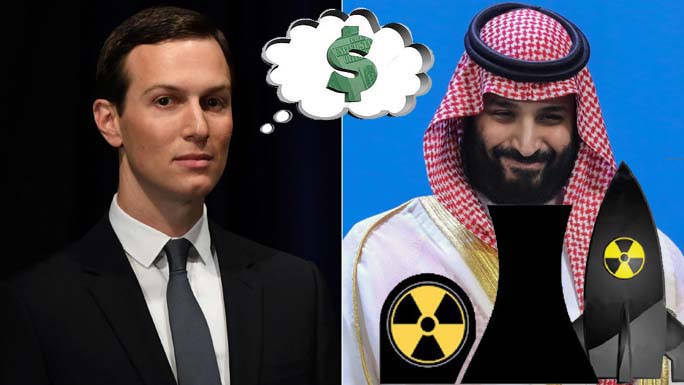
Trump’s endeavour to nuclearise Saudi Arabia is driven by family business interests and tacitly approved by Israel. Aljazeera, by Hamid Dabashi, 8 Mar 2019 Like chronic indigestion that refuses to go away, presidential son-in-law Jared Kushner is back causing much discomfort to the general public.
“Kushner meets Saudi’s MBS for the first time since Khashoggi murder,” Al Jazeera recently reported, “The meeting focused on ‘increasing cooperation’ between Washington and Riyadh, as well as the Middle East peace process.”
But there might be more on their plate than just another bogus “peace process”.
Kushner has two paramount concerns while sitting comfortably in the big pocket of Saudi Crown Prince Mohammed bin Salman (MBS): pursuing his own personal financial gains and helping Israel steal what is left of Palestine. MBS also has two objectives while playing with Kushner, like a shiny marble in his pocket: To confront Iran and to establish himself as a ruling tyrant not just in Saudi Arabia but throughout the Arab and Muslim world.
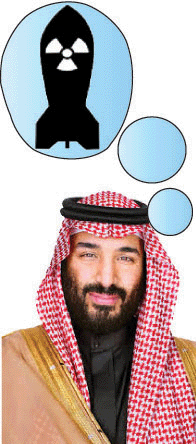
The slaughter of innocent men, women and children in Yemen and the butchery of Jamal Khashoggi are the first flowers of his dream of a Saudi Spring. But in his pursuit of power and glory through murder and destruction, MBS does not seem to be satisfied with using only conventional means. It appears that he is now harbouring a great desire to go nuclear and the Trump administration is more than willing to oblige.
As the New York Times recently revealed, the Trump administration has been pursuing a deal with Saudi Arabia to develop its nuclear energy sector. “By ramming through the sale of as much as $80 billion in nuclear power plants, the Trump administration would provide sensitive know-how and materials to a government whose de facto leader, Crown Prince Mohammed bin Salman, has suggested that he may eventually want a nuclear weapon as a hedge against Iran and has shown little concern for what the rest of the world thinks,” the newspaper claimed.
At the forefront of these efforts, of course, are Kushner and his business interests. It turns out a company that bailed out his family after an ill-conceived real estate deal in New York brought them close to bankruptcy now intends to sell nuclear reactors in Saudi Arabia.
That, along with other shenanigans, has gotten the US security establishment worried. Their attempts to cancel his security clearance, however, have been repeatedly overridden by his father-in-law.
Hence, Kushner remains undeterred in his pursuit to nuclearise Saudi Arabia.
In exposing this worrying reality, the US media, however, has made two very wrong assumptions: one, that a nuclear deal with Saudi Arabia somehow contradicts the interests of the Israeli leadership; two, that it is the result of some kind of a Gulf-money entrapment.
……. Given that President Donald Trump’s son-in-law has been the principal driving force behind a “peace plan” that aims to strip Palestinians of all their legitimate rights and legalise the Israeli occupation, it is hard to believe that he is now pursuing a policy that contradicts Israeli interests. …….
The reason why a Saudi nuclear programme is in the interest of the Israeli settler colony is very simple: It would fuel Saudi-Iranian rivalry, keeping them in a permanent state of war in the shadow of nuclear proliferation, which is good for Zionism, and of course, for the Israeli arms industry. It would keep the populations of both countries preoccupied with the imagined Sunni-Shia conflict and make them increasingly oblivious to the plight of the Palestinian people and the desecration of the holy sites in Jerusalem. …….. https://www.aljazeera.com/indepth/opinion/making-nuclear-mbs-190307135114759.html
March 9, 2019
Posted by Christina Macpherson |
Saudi Arabia, secrets,lies and civil liberties, USA |
Leave a comment
Revealed: Glencore bankrolled covert campaign to prop up coal , Guardian, Christopher Knaus@knausc, 7 Mar 2019
The mining company engaged Sir Lynton Crosby’s firm to push anti-renewables message and counter anti-coal activists The multinational mining giant Glencore spent millions bankrolling a secret, globally coordinated campaign to prop up coal demand by undermining environmental activists, influencing politicians and spreading sophisticated pro-coal messaging on social media.
March 7, 2019
Posted by Christina Macpherson |
2 WORLD, secrets,lies and civil liberties |
Leave a comment
Jared and the Saudi Crown Prince Go Nuclear? https://www.nytimes.com/2019/03/02/opinion/sunday/saudi-arabia-jared-kushner-nuclear.html
There are too many unanswered questions about the White House’s role in advancing Saudi ambitions. By Nicholas Kristof, March 2, 2019
Jared Kushner slipped quietly into Saudi Arabia this week for a meeting with Crown Prince Mohammed bin Salman, so the question I’m trying to get the White House to answer is this: Did they discuss American help for a Saudi nuclear program?
Of all the harebrained and unscrupulous dealings of the Trump administration in the last two years, one of the most shocking is a Trump plan to sell nuclear reactors to Saudi Arabia that could be used to make nuclear weapons.
Even as President Trump is trying to denuclearize North Korea and Iran, he may be helping to nuclearize Saudi Arabia. This is abominable policy tainted by a gargantuan conflict of interest involving Kushner.
Kushner’s family real estate business had been teetering because of a disastrously overpriced acquisition he made of a particular Manhattan property called 666 Fifth Avenue, but last August a company called Brookfield Asset Management rescued the Kushners by taking a 99-year lease of the troubled property — and paying the whole sum of about $1.1 billion up front.
Alarm bells should go off: Brookfield also owns Westinghouse Electric, the nuclear services business trying to sell reactors to Saudi Arabia.
Saudi swamp, meet American swamp.
It may be conflicts like these, along with even murkier ones, that led American intelligence officials to refuse a top-secret security clearance for Kushner. The Times reported Thursday that Trump overruled them to grant Kushner the clearance.
This nuclear reactor mess began around the time of Trump’s election, when a group of retired U.S. national security officials put together a plan to enrich themselves by selling nuclear power plants to Saudi Arabia. The officials included Michael Flynn, Trump’s national security adviser, and they initially developed a “plan for 40 nuclear power plants” in Saudi Arabia, according to a report from the House Oversight and Reform Committee. The plan is now to start with just a couple of plants.
As recently as Feb. 12, Trump met in the White House with backers of the project and was supportive, Reuters reported.
These are civilian nuclear power plants, and Saudi Arabia claims it wants them for electricity. But the Saudis insist on producing their own nuclear fuel, rather than buying it more cheaply abroad. Producing fuel is a standard way for rogue countries to divert fuel for secret nuclear weapons programs, and the Saudi resistance to safeguards against proliferation bolsters suspicions that the real goal is warheads.
Trump may be vigilant (destructively so) about Iran’s nuclear plants, but in the Saudi case his response seems to be: There’s money to be made! When Israeli Prime Minister Benjamin Netanyahu raised objections to the transfer last year, Axios reported, “Trump and his advisers told Netanyahu that, if the U.S. does not sell the Saudis nuclear reactors, other countries like Russia or France will.”
Trump seems to believe that the Saudis have us over a barrel: If we don’t help them with nuclear technology, someone else will. That misunderstands the U.S.-Saudi relationship. The Saudis depend on us for their security, and the blunt truth is that we hold all the cards in this relationship, not them.
Why on earth would America put Prince Mohammed on a path to acquiring nuclear weapons? He is already arguably the most destabilizing leader in an unstable region, for he has invaded Yemen, kidnapped Lebanon’s prime minister, started a feud with Qatar, and, according to American intelligence officials, ordered the murder of the Washington Post columnist Jamal Khashoggi.
The prince has also imprisoned and brutally tortured women’s rights activists, including one who I’m hoping will win the Nobel Peace Prize, Loujain al-Hathloul. As Representative Brad Sherman, a California Democrat, has noted, “A country that can’t be trusted with a bone saw shouldn’t be trusted with nuclear weapons.”
There’s another element of Trump’s Saudi policy that is simply repulsive: the fawning courtship of a foreign prince who has created in Yemen the world’s worst humanitarian crisis, murdered a journalist and tortured women’s rights activists. The White House genuflections are such that Prince Mohammed had a point when, according to The Intercept, he bragged that he had Kushner in his “pocket.”
No one knows whether Prince Muhammed will manage to succeed his father and become the next king, for there is opposition and the Saudi economic transformation he boasts of is running into difficulties. Trump and Kushner seem to be irresponsibly trying to boost the prince’s prospects, increasing the risk that an unstable hothead will mismanage the kingdom for the next 50 years. Perhaps with nuclear weapons.
March 4, 2019
Posted by Christina Macpherson |
business and costs, politics international, Saudi Arabia, secrets,lies and civil liberties, USA |
Leave a comment
 Middle East Monitor 2nd March 2019 ,
 Doubts have been raised about Saudi Arabia’s plans for its nuclear
capabilities, which it maintains are for peaceful purposes, to meet its
population’s energy needs. However a US body charged with looking in to
Saudi’s nuclear plans has warned that “many whistleblowers have warned
against conflicts of interest that could fall within the scope of the
Federal Criminal Law.” The Committee on Oversight and Reform issued the
warning after President Donald Trump announced he intended to sell
“sensitive nuclear technology” to Saudi Arabia to benefit US companies.
https://www.middleeastmonitor.com/20190302-us-officials-question-saudis-nuclear-plans/
March 4, 2019
Posted by Christina Macpherson |
Saudi Arabia, secrets,lies and civil liberties, USA |
Leave a comment
Trump Selling Nuclear Technology to Saudi Arabia Is a New Moral Low, Inderjeet Parmar, The Wire, 27 Feb 19
In doing so, he has declared the return of great power global rivalries, with China and Russia as the biggest threats to US power.
The Trump administration’s plan to sell nuclear technologies to the Saudi Arabian regime is a case study in the decay of American imperial power, the essential corruption of the Trump White House and the self-serving and reckless character of the military-industrial complex. After two years of this administration, it is shocking, if unsurprising, that President Trump shows flagrant disregard for the law, is hypocritical with regard to his claimed desire to ‘drain the swamp’ of big money lobbying and is enabling the intensified militarisation of great power geopolitical rivalries.
In so doing, Trump has accelerated longer-term trends begun under successive previous presidents since the end of Second World War. He has declared the return of great power global rivalries, with China and Russia as the biggest threats to US power.
But Trump is not alone in this drive to further destabilisation: the Saudis have also shortlisted Russia, China, France and South Korea to bid for nuclear contracts. Russia has already signed nuclear power agreements or understandings with Egypt, Jordan and Turkey. And China’s Belt and Road Initiative features plans to build nuclear plants in dozens of countries on the Silk Road; China has signed nuclear cooperation agreements with Saudi Arabia, Egypt, Armenia and the UK.
There have been reports that Russian and Chinese firms would cooperate with other states’ nuclear plans in West Asia, including Trump’s, but that Obama-era US sanctions on Russia stood in the way. If taken seriously by the numerous investigating bodies focused on the Trump White House, this may well prove to be a key driver of Trump’s relatively non-hostile rhetoric towards President Putin.
But this ramped up cooperative competition for markets and contracts, and other pending arms deals, may also explain the immediate reasons why the Republican president ignored CIA intelligence that Saudi Crown Prince Mohammed bin Salman had ordered and directed the killing and dismemberment of regime critic and Washington Post columnist Jamal Khashoggi.
The gruesome killing of the journalist – a member of Trump’s “enemy of the people” fake media, as opposed to his supporters at Fox News – could hardly be expected to hold up the brutal jockeying for advantage in the world’s most volatile – and tragic – region.
An interim report by the Democrat Elijah Cummings-chaired House Committee on Oversight and Reform, based largely on credible whistleblower accounts – including emails and other documents from within the White House itself – suggests that Trump and his trusted lieutenants, in particular, Jared Kushner, regardless of legal advice to the contrary, are finalising plans that may violate the Atomic Energy Act 1954, which provides powers to Congress to oversee the sale and use of nuclear technologies……..
Conflicts of interest abound in this matter. Trump acolytes are looking to make billions of dollars by winning fees, commissions and contracts in Saudi Arabia. What is sold as an attempt to make Saudi Arabia less reliant on fossil fuels for revenues, and more secure against regional powers like Iran and Syria, appears to be a rather unsubtle money grab. At the centre of the controversy is IP3 International, a firm whose leadership reads like the membership list of the morally and intellectually bankrupt military-industrial complex. Its name, according to its website, is an abbreviation for ‘international peace, power and prosperity’.
Before digging a little deeper into IP3 International, it’s worth looking at where within the Trump camp this scheme originated and developed. Retired General Michael Flynn’s name is all over this plan. His Flynn Intel Group consultancy is closely linked with IP3 International’s plan to build dozens of nuclear reactors in Saudi Arabia and across the Gulf states. Flynn pushed the Saudi plan before and after the 2016 election, once he was named national security adviser and even after he had been dismissed for lying about his discussions with the Russian ambassador about US sanctions; he’s currently awaiting sentencing for lying to the FBI, among other things.
Kushner, Trump’s son-in-law, troubleshooter and West Asia peace envoy, has been praising and protecting the Saudi crown prince as some sort of Kemal Ataturk-like visionary set to drag the kingdom and the region into the 21st century. Kushner has links with Westinghouse Electric Company – a nuclear services breakaway from the original Westinghouse Electric Corporation – and its current major shareholder, Brook Asset Management, which is closely linked with IP3 International.
Trump’s inauguration lead and close confidant, Tom Barrack, was reported by the New York Times as having raised investments topping $7 billion since Trump’s nomination, with a quarter of that deriving from the UAE and Saudi Arabia. Barrack justified his and the Trump administration’s business dealings with Saudi Arabia by praising the economic vision of the kingdom’s “young, brilliant new leader”. He justified the killing of Khashoggi thus: “Whatever happened in Saudi Arabia, the atrocities in America are equal or worse than the atrocities in Saudi Arabia.” Skullduggery, falsehood and self-interest justified by a self-serving admission of truth, while Trump’s brutal anti-immigrant policies and defence of police killings continue apace.
IP3 International and Flynn Intel Group are core drivers of the programme, as are ACU Strategic Partners – a nuclear power consultancy led by Alex Copson, who was advised by Michael Flynn; and Colony NorthStar, Tom Barrack’s real estate investment firm.
IP3 International’s leadership team is almost a case study of the military-industrial complex. Of its leadership team of 21, there are five retired US generals and four retired US Navy admirals. Among its three co-founders are General John ‘Jack’ Keane and Robert ‘Bud’ McFarlane. An architect of Reagan’s Star Wars nuclear programme, McFarlane is a convicted felon from the Iran-Contra scandal – found guilty of illegally selling arms to Iran during the Iran-Iraq war to illegally fund the Contras fighting the revolutionary-democratic Sandinista administration in Nicaragua. Congress had banned US aid to the Contras at the time. McFarlane spends some of his time promoting US wars via the Committee on the Present Danger. He is a non-executive director of the British military corporation Aegis Defence Services, which has ‘offices’ across West Asia.
General Keane retired from the military in 2003, became an analyst with Fox News and advised on the US occupation of Iraq. He was an architect, along with Fred Kagan, of the murderous 2007 “surge” in Iraq. Keane is a director of General Dynamics, consultant-advisor for the Erik Prince-founded private military company Blackwater, now called Academi, and executive chair of the Humvee manufacturer AM General.
Finally, ambassador Denis Ross is on IP3 International’s advisory board. Ross, a Democrat, has faithfully served American imperial power for decades – under both Republican and Democratic presidents. IP3 International opens its coffers and serves both parties. Ross is an arch-Zionist, indeed named as such in Walt and Mearsheimer’s The Israel Lobby as a key supporter of AIPAC. He advised Hillary Clinton on West Asian affairs, and considers the Saudi crown prince a true “revolutionary”……….
Kushner heads off to West Asia in the final days of this month to continue discussions on the nuclear programmes. President Trump is reported to have attended a meeting on February 12 at the White House with private nuclear corporations including Westinghouse, General Electric, and AECOM, “led by General Keane… ,” according to the congressional report.
The military-industrial complex has made the US government and geopolitical interests inseparable from their own personal and corporate interests. A remarkable March 4, 2017 email from McFarlane to the National Security Council’s Derek Harvey, titled “We’re Very Close to Losing Our Position in the Middle East” and reproduced in the House committee’s interim report, makes this all too clear……..https://thewire.in/world/trump-selling-nuclear-technology-to-saudi-arabia-is-a-new-moral-low
February 28, 2019
Posted by Christina Macpherson |
business and costs, politics, secrets,lies and civil liberties |
Leave a comment
 White House bans four journalists from covering Trump-Kim dinner, SMH, By Philip Rucker
 and Josh Dawsey
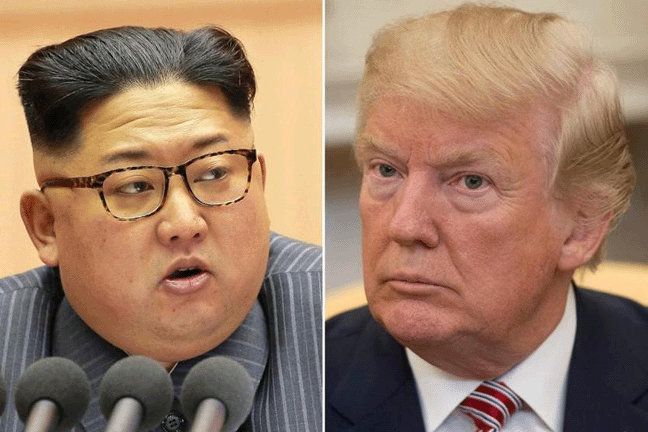
February 28, 2019 Hanoi, The White House abruptly banned four US journalists from covering President Donald Trump’s dinner on Wednesday with North Korean dictator Kim Jong-un after some of them shouted questions at the leaders during their earlier meetings.Reporters from the Associated Press, Bloomberg News, the Los Angeles Times and Reuters were excluded from covering the dinner because of what White House press secretary Sarah Huckabee Sanders said were “sensitivities over shouted questions in the previous sprays”. Among the questions asked of Trump was one about the congressional testimony of his former lawyer, Michael Cohen.
The White House’s move to restrict press access was an extraordinary act of retaliation by the US government, which historically has upheld the rights of journalists while a president travels overseas. It was especially remarkable because it came during Trump’s meeting with the leader of a totalitarian state that does not have a free press.
Trump’s exchanges with Kim were being covered by the standard 13-member travelling White House press pool, but ahead of the dinner Sanders sought to exclude all reporters from the pool and permit only the photographers and television crew, citing “sensitivities over shouted questions in the previous sprays”.
After loud pushback, including from photojournalists who protested, Sanders allowed a single reporter in the pool for the dinner: Vivian Salama of the Wall Street Journal, who was serving as the print pooler and did not ask a question at the dinner. In addition, at least two members of the North Korean media contingent, a photographer and cameraman, were seen covering the dinner.
Reporters for the three wire services, as well as a second print pooler, were excluded. They included two journalists who had asked Trump questions in the earlier appearances: Jonathan Lemire of the AP and Jeff Mason of Reuters. Also excluded were Justin Sink of Bloomberg and Eli Stokols of the Los Angeles Times………..
Lauren Easton, a spokeswoman for the AP, said in a statement: “The Associated Press decries such efforts by the White House to restrict access to the president. It is critically important that any president uphold American press freedom standards, not only at home but especially while abroad.” .
…… Trump has long complained about reporters asking him questions at photo opportunities, especially when he is in the presence of foreign leaders, which aides have said he views as disrespectful and lacking in decorum. The White House occasionally has punished reporters for their questioning, including CNN’s Jim Acosta and Kaitlan Collins……https://www.smh.com.au/world/asia/white-house-bans-four-journalists-from-covering-trump-kim-dinner-20190228-p510qg.html
February 27, 2019
Posted by Christina Macpherson |
civil liberties, USA |
Leave a comment
Risk of terrorism at radioactive waste site kept secret from residents near earmarked sites, Jade Gailberger, Federal Political Reporter, The Advertiser February 24,
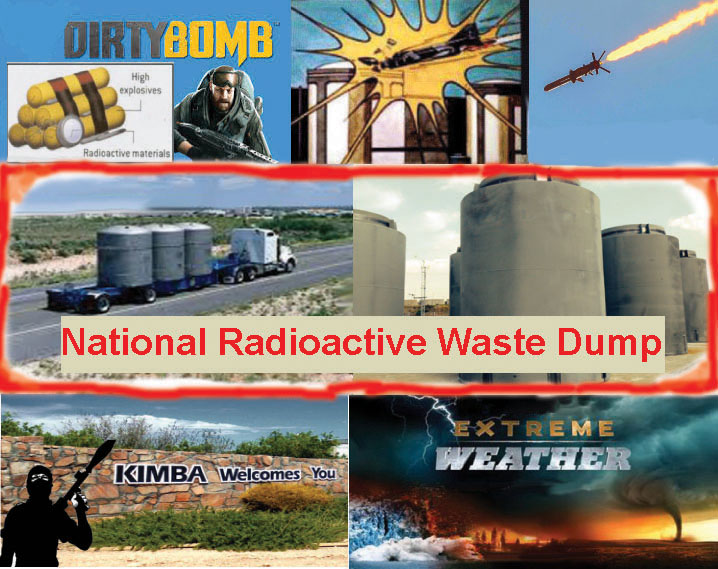
The risk of terrorist activity at a radioactive waste site, including the removal of drums for use in a “dirty bomb”, has been kept secret from residents near two sites earmarked for a new national dump.
As the communities of Hawker and Kimba remain divided on the site selection for a new waste site, documents obtained under Freedom of Information laws reveal the Defence Department identified a potential risk of terrorist activity at a dump at Woomera.
The revelation has cemented the security concerns of residents, who say they have been ignored by Government officials.
The now closed Koolymilka dump, situated on Defence land at Woomera, was licensed for temporary radioactive waste storage but has not taken new material since 2010.
An emergency response plan for the site, which still houses waste that is anticipated to be transferred to a national facility, details scenarios that may affect it including:
-
- TERRORISTS removing drums to make a “dirty bomb”.
- MISSILE and aircraft strikes, fire, flood or a storm in Woomera that could damage the building and cause contamination if drums ruptured.
- CIVILIAN protest activity.
Defence has said it has no responsibility to inform the public of the risks because the new waste dump is an Industry Department project.
Kimba farmer Peter Woolford, who is opposed to radioactive waste storage on agricultural land, said security, terrorism and fire concerns at a national site had been raised but “fobbed off” by officials who claimed it “would be safe”.
“The (Industry) Department continually says it is going to be open and transparent but you have to obtain FOI documents to get the full story,” he said. “It’s an issue that the department should be … explaining.”
Centre Alliance Senator Rex Patrick said communities had been denied information needed to make an informed decision about a dump in their region.
At a Senate estimates hearing last week, Mr Patrick asked if the Industry Department had briefed the communities about potential terrorism. Industry Minister Matt Canavan said: “I have never been provided with any advice that this is at all a risk … this has never been raised as an issue”.
The Industry Department said the new dump would pose “no security or safety risk to the community” and “significant detail” on safety and security had been made public.
The Australian Nuclear Science and Technology Organisation said 14 of 45 jobs at the new dump would be security.
February 25, 2019
Posted by Christina Macpherson |
AUSTRALIA, secrets,lies and civil liberties, wastes |
Leave a comment

 Guardian 23rd Feb 2019 The idea that the US might sell state-of-the-art nuclear technology to
Saudi Arabia, potentially enabling Crown Prince Mohammed bin Salman’s reckless regime to build nuclear weapons, sounds so far-fetched as to be almost grotesque.
After all the near-hysterical American and Israeli warnings about the risk of Iran, the Saudis’ arch-rival, acquiring the
bomb, surely even Donald Trump would balk at such breathtaking – and dangerous – hypocrisy? Apparently not.
According to a congressional inquiry, senior White House officials, retired generals and Trump’s close relatives and business cronies have been secretly pursuing a multibillion-dollar scheme to cut a nuclear deal with Riyadh.
The talks are said to be continuing, despite increased public scrutiny and legal advice that a technology transfer lacking strict conditions could contravene US law, breach international counter-proliferation safeguards, and fuel a
nuclear arms race.
https://www.theguardian.com/us-news/2019/feb/23/trump-cronies-secret-talks-nuclear-tech-saudi-arabia
February 25, 2019
Posted by Christina Macpherson |
Saudi Arabia, secrets,lies and civil liberties, USA |
Leave a comment
 Trump introduced Qatari to donor pursuing nuclear power project, report says, Al-Monitor, Laura Rozen February 21, 2019 WASHINGTON — Last spring, President Donald Trump introduced a potential Qatari investor to a friend and inauguration donor seeking a few billion dollars in investment to buy an unfinished nuclear power plant in northeastern Alabama, according to interviews the donor gave to a Tennessee media outlet published this week.
Tennessee businessman Franklin Haney, 78, told the University of Memphis’ Institute for Public Service Reporting that Trump introduced him to the Qatari at Trump’s Mar-a-Lago resort in Palm Beach, Florida, of which Haney is a longtime member. He said the introduction to the Qatari, whose name he said he did not recall, came a couple weeks after he was introduced in March to Trump’s then-personal lawyer Michael Cohen, whom Haney briefly hired as a consultant.
Cohen pleaded guilty last year to lying to Congress, financial crimes and violating federal campaign finance laws related to hush money payments made to two women who alleged affairs with Trump before the 2016 US presidential election. Cohen is slated to testify next week before three congressional committees ahead of reporting for a three-year federal prison sentence in May.
“As best as Haney recalls, he and Cohen were introduced in March,” the Institute for Public Service Reporting wrote in a detailed investigative report published by the Daily Memphian on Feb. 19. “A couple weeks later, the president introduced Haney to a Qatari official whose name Haney said he doesn’t recall.”
The institute quoted Haney as saying, “He (Trump) says, ‘I know you’re working on this nuclear plant. They (the Qataris) are going to invest $45 billion (in the U.S.) and they’ll loan money for nuclear plants.’”
The Wall Street Journal previously reported that Haney, who contributed a million dollars to Trump’s Inaugural Committee through a limited liability corporation, had hired Cohen as a consultant in an effort to get Qatari investment for the Tennessee nuclear power project.
But it had not previously been reported until now that Trump himself had been directly involved in the effort.
The White House did not respond to a query from Al-Monitor about the report.
Trump’s alleged role in linking a potential Qatari investor to a reported longtime friend and donor came amid a striking shift in Trump’s public statements about the gas-rich Gulf nation, which has been the target of a Saudi-led blockade since 2017.
Trump warmly welcomed Qatari Emir Sheikh Tamim bin Hamad Al Thani to the White House on April 10, 2018, and praised the Qataris for buying lots of US military equipment…………
The Qatari roadshow and encounters with several figures in Trump’s close orbit coincided with intensifying federal scrutiny of Cohen.
The FBI raided Cohen’s home and offices on April 9.
Haney told the Institute for Public Service Reporting in a series of interviews that he paid Cohen about $200,000 before canceling the contract to try to help secure $2 billion in Qatari investment for his plans to buy the Tennessee Valley Authority’s unfinished Bellefonte Nuclear Plant, in northeastern Alabama, and then sell power to the Memphis Light, Gas & Water Division. Haney said he ended the consulting contract with Cohen after Cohen was revealed to be under federal investigation, he told the Institute.
Haney also said Trump had no role in his decision to hire Cohen to try to pursue the Qatari investment. “I see Donald Trump every time he comes to Florida,” the Tennessee businessman told the Institute. “I don’t need him (Cohen) to introduce me to Donald Trump.’’
Cohen is scheduled to testify behind closed doors before the Senate Intelligence Committee on Tuesday, publicly before the House Oversight and Reform committee on Wednesday and behind closed doors to the House Intelligence committee Feb. 28.
The more detailed accounts of consultations between Trump associates and the Qataris on possible investment in a US nuclear power project last spring comes as a new interim staff report by the House Oversight and Reform Committee raises concerns about Trump National Security Council officials having aggressively pursued a private company’s proposal to sell sensitive US nuclear technology to the Saudis.
“Multiple whistleblowers came forward to warn about efforts inside the White House to rush the transfer of highly sensitive U.S. nuclear technology to Saudi Arabia in potential violation of the Atomic Energy Act and without review by Congress as required by law — efforts that may be ongoing to this day,” the interim staff report said. “The Trump Administration’s interactions with Saudi Arabia have been shrouded in secrecy, raising significant questions about the nature of the relationship.”
The report also warned that the efforts to lobby the Trump administration to sell US nuclear technology to Saudi Arabia may be ongoing, with reported possible internal administration interest in the plan from Energy Secretary Rick Perry, senior White House adviser Jared Kushner and Trump himself. Trump met with a consortium of US nuclear energy developers and retired US Army Gen. Jack Keane, co-founder of IP3 International and a chief proponent of the plan to sell US nuclear power plants to Saudi Arabia, at the White House on Feb. 12, Bloomberg reported.
Kushner and Trump Middle East peace envoy Jason Greenblatt are slated to travel this weekend to the Middle East, in part to brief officials in six countries about the economic components of the administration’s forthcoming peace plan. “Jared Kushner and Jason Greenblatt leave this weekend for the region to build on the momentum from the Warsaw Ministerial,” a White House official, speaking not for attribution, told Al-Monitor. “There will be stops in Oman, Bahrain, UAE, Saudi Arabia, Turkey and Qatar.” https://www.al-monitor.com/pulse/originals/2019/02/trump-introduce-qatar-donor-nuclear-power.html
February 23, 2019
Posted by Christina Macpherson |
secrets,lies and civil liberties, USA |
Leave a comment
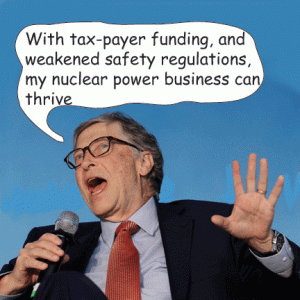
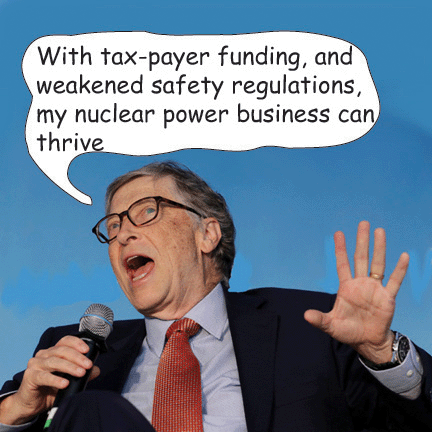
Paul Waldon Fight To Stop Nuclear Waste Dump In Flinders Ranges SA, 22 Feb 19, Stanford Energy, has touted Bill Gates as a entrepreneur while denouncing wind and solar calling it unreliable, at a recent Global Energy Form.
However the uncomfortable looking Bill Gates fails to mention his vested interest in the nuclear arena with 108,502,519 shares worth about $7 billion in the company “Republic Services” that manages radioactive waste, and has failed at satisfying the general public and residents of St Louis with the cleanup of Bill and other shareholders toxic waste. Placing money before the health of people in a estranged community can be easy when void of a conscience. https://www.facebook.com/groups/344452605899556/
February 23, 2019
Posted by Christina Macpherson |
secrets,lies and civil liberties, USA |
Leave a comment
|
Trump administration ‘pushing Saudi nuclear deal’ which could benefit company linked to Jared Kushner
Congressional report cites ‘abnormal acts’ in White House regarding proposal to build reactors in kingdom, The Independent UK Tom Embury-Dennis20 Feb 19. Senior Trump administration officials pushed a project to share nuclear power technology with Saudi Arabia over the objections of ethics officials, according to a congressional report, in a move that could have benefitted a company which has since provided financial relief to the family of Jared Kushner.
Citing whistleblowers within the US government, the report by the Democrat-led House oversight and reform committee alleges “abnormal acts” in the White House regarding the proposal to build dozens of nuclear reactors across the kingdom.
The committee on Tuesday opened an investigation into the allegations, which include concerns over whether White House officials in the early months of the Trump administration sought to work around national security procedures to push a Saudi deal that could have financially benefited close supporters of the US president.
According to the report, the nuclear effort was pushed by former national security adviser Michael Flynn, who was fired in early 2017 and is awaiting sentencing for lying to the FBI in the Russia investigation.
Derek Harvey, a National Security Council official brought in by Flynn, continued work on the proposal, which has remained under consideration by the Trump administration.
Relying on the whistleblower accounts, email communications and other documents, the committee’s report details how National Security Council and ethics officials repeatedly warned the actions of Flynn and a senior aide could run afoul of federal conflicts of interest law and statutes governing the transfer of nuclear technology to foreign powers.
The report also notes one of the power plant manufacturers that could benefit from such a deal includes Westinghouse Electric, a subsidiary of Brookfield Asset Management, a company which struck a deal in August to rescue the Kushner family’s 666 Fifth Avenue tower in Manhattan from massive debts.
Detailing the White House’s continued efforts to promote the deal, the report highlights how in May, energy secretary Rick Perry told a congressional committee he “tried to really drive home” to Saudi Arabia how “you have to use Westinghouse” for “the best reactors in the world”.
It also notes Mr Kushner, the president’s son-in-law and adviser, allegedly remains “directly involved” with those efforts, and that he would be travelling to Saudi Arabia in late February to “share elements of the economic plan” of a US peace proposal in the Middle East. …….. https://www.independent.co.uk/news/world/americas/us-politics/trump-administration-saudi-arabia-nuclear-deal-jared-kushner-666-fifth-avenue-westinghouse-a8787786.html
|
|
February 21, 2019
Posted by Christina Macpherson |
politics, Russia, secrets,lies and civil liberties |
Leave a comment
Contractor used Masters and NASCAR tickets in failed nuclear plant kickback scheme, Nick Bromberg
Yahoo Sports, Feb 21, 2019, A contractor involved with a failed nuclear power plant construction project allegedly made some nice cash in a kickback scheme that involved tickets to sporting events. And, like most alleged illegal kickback schemes, the contractor got caught.
According to a court filing in a lawsuit filed by the United States Government, Wise Services Inc. submitted nearly 500 fake invoices during construction of a Savannah River nuclear facility. The South Carolina project was ended in 2018 and won’t be finished.
The government said in the suit that the kickbacks for the submission of fake invoices to project manager CB&I AREVA MOX Services LLC included tickets to the Masters, NASCAR races and college football events. And even Yeti coolers!…..https://sports.yahoo.com/contractor-used-masters-nascar-tickets-failed-nuclear-plant-kickback-scheme-164311675.html
February 21, 2019
Posted by Christina Macpherson |
secrets,lies and civil liberties, USA |
Leave a comment
 wrongdoing, SNC-Lavalin could be barred from Canadian federal contracts for a decade. (SNC-Lavalin has been previously barred for a decade from World Bank contracts.)
 However, Holtec itself has engaged in bribery, at the Tennessee Valley Authority’s Browns Ferry nuclear power plant; in addition, Holtec CEO Krishna Singh has been accused by whistleblowers Oscar Shirani (Commonwealth Edison/Exelon) and Dr. Ross Landsman (NRC Region 3) of attempting to bribe them into silence, re: QA violations (see below).