Theft of nuclear materials from USA’s Dept of Energy
Nuclear material stolen from Energy Department car https://www.federaltimes.com/federal-oversight/2018/07/17/nuclear-material-stolen-from-energy-department-car/ WASHINGTON — Two nuclear security experts for the Department of Energy’s Idaho National Laboratory lost samples of plutonium and cesium, materials that can be used in nuclear and radioactive bombs, after their rental car was broken into in March 2017.
Secrecy about proposed interim nuclear waste storage site
Lawmaker says he can’t get info on waste plan https://www.abqjournal.com/1195897/legislator-citizens-deserve-to-have-answers-about-nuclear-facility.html, By Maddy Hayden / Journal Staff Writer July 12th Albuquerque Journal
Russia’s environmental groups demand an end to secrecy about Russia’s nuclear wastes

Russian environmentalists demand transparency from the country’s nuclear waste industry http://bellona.org/news/nuclear-issues/2018-06-russian-environmentalists-demand-transparency-from-the-countrys-nuclear-waste-industry
Environmentally significant information about radioactive waste should never be secret and concealing information about the disposition of this waste from those who live closest to it is unacceptable, said a joint statement from three Russian ecological non-profits. by Bellona
Environmentally significant information about radioactive waste should never be secret and concealing information about the disposition of this waste from those who live closest to it is unacceptable, said a joint statement from three Russian ecological non-profits.
The statement was issued last week by the group Radioactive Waste Safety, Greenpeace and Bellona.
In the 70 years since Russia began applying nuclear technology, millions of tons of radioactive waste have been accumulated. This poses a now and future threat for hundreds and thousands of years. The negligent or thoughtless handling of radioactive waste could lead to accidents and catastrophes, as well as environmental consequences that will impact future generations – all while we are still struggling with past nuclear accidents, such as the Kyshtym disaster at the Mayak Chemical Combine in 1957 to name just one
“We are convinced that information on the total quantity and condition of radioactive waste, as well as on projects and programs related to handling and disposal of radioactive waste is environmentally significant, and that it is the constitutional right of Russian citizens to have access to that information. This information affects the interests of people living near installations wirer radioactive wastes is handled and stored,” said the three groups.
“Recently, we and other environmental activists have been denied the provision of environmentally relevant information on the disposal of hazardous radioactive wastes, specifically relative to the practice of injecting liquid radioactive waste into deep geological formations in the Krasnoyarsk, Tomsk and Ulyanovsk Regions” said Alexander Kolotov, program director for Radioactive Waste Safety. “This practice is not permissible an leads to a deepening distrust between local residents and the nuclear industry.”
“As is well known, Russia’s state nuclear corporation Rosatom has a long list of information it considers commercial secrets and classified. This list compulsory across all divisions and subsidiaries of the company, said Alexander Nikitin of Bellona. “Therefore, Rosatom doesn’t permit one or another division within its ranks to disclose information when it is requested by the public.”
“We are certain that enterprises and organizations in Russia, which handle radioactive waste should maintain transparency with the public about the dangers of these activities and their possible impact on the environment and public health,” said Ivan Blokov, program director of Greenpeace.
“Ecologically significant information on radioactive waste should be included in the annual environmental reports of the relevant enterprises and organizations, and should be published on their official websites and be provided by them at the request of citizens and public organizations.”
In addition to presenting environmentally relevant information on radioactive waste, environmentalists call upon Russia’s nuclear waste disposition industries to to immediately inform the public and local residents about any significant incidents or accidents associated with hazardous radioactive waste.
Redress for nuclear industry whistleblowers in USA
 Redress for nuclear industry whistleblowers https://safety.blr.com/workplace-safety-news/safety-administration/OSHA-Occupational-Safety-and-Health-Administration/Redress-for-nuclear-industry-whistleblowers/
In a recently published fact sheet, OSHA reminds contractors, subcontractors, and licensees of the Nuclear Regulatory Commission (NRC) and contractors and subcontractors of the Department of Energy (DOE) that their employees are protected from retaliation for reporting potential violations of the Energy Reorganization Act (ERA) or the Atomic Energy Act (AEA) to their employers or to the government.
According to OSHA, retaliation comprises a wide range of actions, including firing or laying off, blacklisting, demoting, denying overtime or promotion, disciplining, denying benefits, failing to hire or rehire, intimidation, reassignment affecting promotion prospects, reducing pay or hours, and making threats.
Affected employers
Under the ERA, employees of the following employers are protected from retaliation for engaging in protected activity:
- NRC licensees and applicants for licenses, including the Tennessee Valley Authority;
- NRC contractors and subcontractors;
- Contractors and subcontractors of NRC licensees and applicants for licenses;
- Agreement state licensees and applicants for licenses from agreement states, including their contractors and subcontractors; and
- Certain DOE contractors and subcontractors.
Protected actions
Employees of the above entities may not be discharged or otherwise retaliated against because the employee:
Notified the employer of an alleged violation of the ERA or the AEA;- Refused to engage in any practice that is unlawful under the ERA or the AEA if the employee has identified the alleged illegality to the employer;
- Testified before Congress or at any federal or state proceeding regarding any provision (or proposed provision) of the ERA or the AEA;
- Commenced a proceeding, caused a proceeding to be commenced, or is about to commence or cause to be commenced a proceeding under the ERA or the AEA;
- Testified, assisted, or participated in or is about to testify, assist, or participate in a proceeding under the ERA or AEA; or
- Assisted, participated in, or is about to assist or participate in any other action to carry out the purposes of the ERA or the AEA.
Filing requirements
The major burden for an employee seeking redress for alleged illegal retaliation is that the complaint must be filed with OSHA within 180 days after the employee was notified of the action taken against her or him. Otherwise the process is relatively simple. The employee or his or her representative can file an ERA complaint with OSHA by visiting or calling his or her local OSHA office, sending a written complaint to the closest OSHA office, or filing a complaint online. No particular form is required, and complaints may be submitted in any language. Also:
- Written complaints may be filed by fax, electronic communication, hand delivery during business hours, U.S. mail (confirmation services recommended), or other third-party commercial carrier.
- The date of the postmark, fax, electronic communication, telephone call, hand delivery, delivery to a third-party commercial carrier, or in-person filing at an OSHA office is considered the date filed.
What OSHA will do
If the complaint is filed on time, OSHA will investigate it according to procedures at 29 CFR Part 24.
“If the evidence supports an employee’s complaint of retaliation, OSHA will issue an order requiring the employer to, as appropriate, put the employee back to work, pay lost wages, restore benefits, and provide other possible relief,” states OSHA. “The exact requirements will depend on the facts of the case. If the evidence does not support the employee’s complaint, OSHA will dismiss the complaint.”
After OSHA issues a decision, the employer and/or the employee may request a full hearing before an administrative law judge of the Department of Labor (DOL). The judge’s decision may be appealed to DOL’s Administrative Review Board. The employee may also file a complaint in federal court if the Department does not issue a final decision within 365 days.
DOE’s program
Also, the DOE has established regulations at 10 CFR Part 708 to protect employees of DOE contractors against reprisal by the employer for specific employee actions that largely mirror OSHA’s protected actions listed above.
Procedures for filing a complaint under Part 708 differ from OSHA’s procedures and are generally considered more difficult to navigate. For example, the complaint must be filed within 90 days of the alleged retaliation; the complaint must be filed in writing; and the complaint may not be filed if it is based on the same facts for which the employee already requested a remedy from OSHA, under Federal Acquisition whistleblower protection regulations for contract employees, or from a state government.
In July 2016, the Government Accountability Office reported on DOE’s Part 708 program and recommended improvements.
OSHA’s fact sheet is available here.

Julian Assange’s 6 years of confinement in Ecuadorian Embassy in London
2,192 Days of Confinement: Assange’s 6 Years in Ecuadorian Embassy in Numbers, https://sputniknews.com/europe/201806191065516777-assange-6-years-embassy-london/
June 19 marks six years since the founder of WikiLeaks entered the building of the Ecuadorian Embassy in London. He hasn’t stepped foot outside it since.
Julian Assange has been residing at the Ecuadorian Embassy in London since 2012, where he sought refuge while facing sexual assault allegations in Sweden.
981 days have passed since the Metropolitan police removed dedicated 24/7 guards from outside the Ecuadorian Embassy on October 12, 2015.
“Like all public services, MPS resources are finite. With so many different criminal, and other, threats to the city it protects, the current deployment of officers is no longer believed proportionate,” a statement by the Met police said.
865 days since the UN Working Group on Arbitrary Detention (WGAD) ruled in a majority decision that Assange was being detained inside the Ecuadorian Embassy in London arbitrarily and was allowed to leave.
READ MORE: UN Ruling on Assange’s Illegal Detention Explained
396 days since the allegations were dropped by Swedish prosecutors, but the Wikileaks founder would still get arrested if he left the embassy’s premises — by the UK police — for failing to surrender to the court in 2012.
158 days since Assange was granted Ecuadorian citizenship and subsequently the UK was asked to recognize the whistleblower as a diplomatic agent. Had the British agreed — it would have given Assange immunity to finally leave the embassy.
However, the UK refused the request, meaning he remains confined to the Ecuadorian Embassy, which has been found “dangerous physically and mentally” and “a clear infringement of his human right to healthcare.”
83 days since the whistleblower’s access to the Internet was cut off “in order to prevent any potential harm.”
“The government of Ecuador has suspended the systems that allows Julian Assange to communicate with the world outside of the Ecuadorian Embassy in London… The measure was adopted due to Assange not complying with a written promise which he made with the government in late 2017, whereby he was obliged not to send messages which entailed interference in relation to other states,” the government of Ecuador said in a statement.
Julian Assange fears extradition to the United States to be prosecuted for espionage after his website leaked classified US data.
After years of ignoring Julian Assange’s plight, at last the Australian govt might help him
 Australian officials spotted in mysterious Assange visit https://www.smh.com.au/world/europe/australian-officials-spotted-in-mysterious-assange-visit-20180608-p4zk7w.html, 8 June 18
London: Australian government officials have paid a mysterious visit to Julian Assange in his Ecuadorian embassy refuge in London, in a sign there may be a breakthrough in the stalemate that has lasted almost six years.
Two officials from Australia’s High Commission were spotted leaving the embassy in Knightsbridge in west London on Thursday.
It is the first time Australian consular officials have visited Assange at the embassy.
They were accompanied by Assange’s lawyer Jennifer Robinson.
Robinson confirmed the meeting to Fairfax but said she could not say what the meeting was about “given the delicate diplomatic situation”. “Julian Assange is in a very serious situation” she said. “He remains in the embassy because of the risk of extradition to the US. That risk is undeniable after numerous statements by Trump administration officials including the director of the CIA and the US attorney-general.”
Assange entered the embassy on June 19, 2012, after he had exhausted his appeals against an extradition order to go to Sweden to face rape and sexual assault allegations.
Swedish authorities have since closed their investigation, saying it couldn’t continue without Assange’s presence in their country.
However Assange still faces arrest if he steps out of the Ecuadorian embassy for breach of his bail conditions, after failing in a legal bid earlier this year to have the warrant cancelled by an English court.
His condition has recently become much worse, with his hosts repeatedly suggesting in public comments that they want the situation resolved and him out of the building. The court proceedings also revealed his worsening health, including serious tooth problems, respiratory infections, depression and a frozen shoulder.
His internet and phone connections were cut off by the Ecuadorian government six weeks ago and he was denied any visitors apart from lawyers, after Ecuador complained he had breached “a written commitment made to the government at the end of 2017 not to issue messages [on social media] that might interfere with other states”.
A spokeswoman from the High Commission said she would have to refer any questions about the meeting to the Department of Foreign Affairs and Trade in Canberra.
The Department of Foreign Affairs and Trade in Canberra confirmed it is providing consular assistance to Assange through the Australian High Commission in London.
Citing privacy obligations, however, DFAT refused to offer further comment.
Assange has complained for years that the Australian government has not offered him consular assistance, despite his being an Australian citizen.
In May last year Assange’s mother Christine Assange called on the Australian Government to give her son a new passport so that he can leave Britain.
“His passport’s been confiscated, the Australian Government should immediately issue him another one and demand safe passage for him to take up legal asylum in Ecuador,” she told the ABC.
Increased powers for security guards at Missouri’s nuclear power plants
 Nuclear power plant legislation signed into law, June 8th, 2018, JEFFERSON CITY — Last week, 77 bills were signed into law including one regarding nuclear power plant security.
Rep. Travis Fitzwater’s bill strengthens security measures at nuclear power plants in Missouri and defines specifically what armed nuclear security guards can do to provide protection at those facilities.
House Bill 1797 specifies the level of physical force nuclear security guards can use while guarding a nuclear power plant; protects certain nuclear power plant employers from civil liability in carrying out their duties; and increases the penalties associated with trespassing at a nuclear power plant………
Commonly known as the Nuclear Power Plant Security Guard Act, the legislation faced little opposition in the state House and Senate. …….. To read the bill in its entirety, visit house.mo.gov/bill.aspx?bill=HB1797&year=2018&code=R.
FirstEnergy bankrupt, but still spent hundreds of $thousands on lobbying for nuclear power

The Lobbying Bills Attached to FirstEnergy’s Coal and Nuclear Emergency Action
The bankrupt business has spent hundreds of thousands of dollars on lobbying so far this year. GTM, JUNE 05, 2018
Call to stop the persecution of whistleblower Julian Assange
US activist Kevin Zeese calls for demonstrations against the persecution of Julian Assange https://www.wsws.org/en/articles/2018/06/06/zees-j06.html 6 June 2018
Kevin Zeese, a prominent US activist and lawyer, issued the following statement this week endorsing action in defense of Julian Assange, including the June 17 rally in Sydney and vigils in London and around the world on June 19.
Zeese has spoken out against the escalating censorship of the Internet and the broader erosion of democratic rights. He is a co-director of the Popular Resistance organisation and is on the advisory board of the Courage Foundation which raises funds for the defence of persecuted journalists and whistleblowers.
Statement of Kevin Zeese endorsing protests and vigils in defense of Julian Assange
Julian Assange through his work as editor of WikiLeaks has made major strides toward democratizing the media by creating a vehicle for whistleblowers to share the truth and correct the misinformation of the mass corporate media. Assange and WikiLeaks have given people a precious tool—access to the undeniable truth about what governments and big business are doing. This is a tool we can all use to educate each other about what is really going on around us.
Assange is being persecuted because a democratized media threatens the monopoly over media control of the elites. A democratized media makes it more difficult for them to misinform, mislead and propagandize.
Through WikiLeaks, Assange with whistleblowers like Edward Snowden and Chelsea Manning have exposed war crimes, the truth about the Guantanamo Bay prison, the corporate domination of US policy and the actions of governments around the world and more. This has led to popular revolts around the world that have challenged those who abuse their power.
Freedom of speech and freedom of the press is being defined by the treatment of Julian Assange. Everyone who cares about these freedoms should speak out and take action on his behalf by joining the demonstration in Sydney, Australia on June 17 and the vigils being held in London and around the world on June 19—the anniversary of when Julian sought asylum in the Ecuadorian embassy six years ago. On June 19 at 11:00 a.m. we will be holding a protest in support of Julian Assange at the White House. Please join us to call for an end to his persecution.
Kevin Zeese, co-director of Popular Resistance, member of the advisory board of the Courage Foundation
Costly lobbying for nuclear and coal industries, by bankrupt First Energy Solutions

 The Lobbying Bills Attached to FirstEnergy’s Coal and Nuclear Emergency Action https://www.greentechmedia.com/articles/read/firstenergy-coal-and-nuclear-request-lobbying#gs.WUmycd4
The bankrupt business has spent hundreds of thousands of dollars on lobbying so far this year., JUNE 05, 2018
Groups Release Key DOE Documents on Expanded Plutonium Pit Production, DOE Nuclear Weapons Plan Not Supported by Recent Congressional Actions
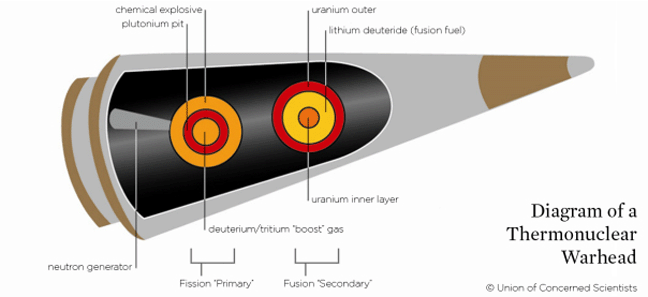
https://nukewatch.org/pressreleases/PR-Pit-Production-Docs-5-31-18.pdf May 31, 2018 Contact Tom Clements, SRS Watch, 803.240.7268, tomclements329@cs.com Jay Coghlan, Nuclear Watch NM, 505.989.7342, c. 505.470.3154, jay@nukewatch.org
Santa Fe, NM & Columbia, SC – Two key U.S. Department of Energy documents on future production of plutonium “pits” for nuclear weapons, not previously released to the public, fail to justify new and upgraded production facilities at both the Los Alamos National Laboratory (LANL) in New Mexico and the Savannah River Site (SRS) in South Carolina.
The report reveals that the initial cost estimate for these new and upgraded facilities at both sites is $10 billion by 2030, and around $46 billion in total life cycle costs. Plutonium pits are the fissile cores of nuclear weapons. Cost overruns are the rule for major projects undertaken by the National Security Administration (NNSA), the semi-autonomous nuclear weapons agency within DOE, so the costs are likely to rise yet more, according to Nuclear Watch New Mexico and Savannah River Site Watch.
NNSA’s Pu Pit Production Engineering Assessment, originally marked Unclassified Controlled Nuclear Information, was finalized on April 20, 2018. The 293-page document was obtained by Nuclear Watch and is being released so that the public may be fully informed about the agency’s misguided pursuit of new plutonium pit production facilities for future new-design nuclear weapons. The new NNSA Administrator has called future plutonium pit production her highest priority. But the Engineering Assessment fails to answer the most crucial question: why are at least 80 plutonium pits per year needed to begin with?
As background, on May 10, 2018, NNSA announced in a one-page statement:
To achieve DoD’s [Department of Defense] 80 pits per year requirement by 2030, NNSA’s recommended alternative repurposes the Mixed Oxide Fuel Fabrication Facility at the Savannah River Site in South Carolina to produce plutonium pits while also maximizing pit production activities at Los Alamos National Laboratory in New Mexico. This two-prong approach – with at least 50 pits per year produced at Savannah River and at least 30 pits per year at Los Alamos – is the best way to manage the cost, schedule, and risk of such a vital undertaking.
Nuclear Watch also obtained NNSA’s 14-page Plutonium Pit Production Engineering Assessment (EA) Results. That summary document, dated May 2018, relied on the Trump Administration’s 2018 Nuclear Posture Review for claiming the need for expanded plutonium pit production. However, that high-level review failed to state any concrete justification for the alleged pit need. Moreover, Congress is balking at funding any new pit production facilities at SRS, primarily because Sen Lindsey Graham (R-SC) vociferously opposes repurposing the MOX facility, now undergoing termination, and the New Mexico congressional delegation opposes any pit production outside of the Los Alamos Lab.
The Engineering Assessment details that NNSA analyzed four pit production options, one in the Mixed Oxide (MOX) Fuel Fabrication Facility at SRS and three options at Los Alamos. NNSA chose the most expensive combination, repurposing the MOX facility and increasing pit production at LANL to 30 pits per year. Los Alamos is currently authorized to produce 20 pits per year, but has failed to achieve even that because of ongoing nuclear criticality safety issues (moreover, LANL proposed to produce all 80 pits per year, which NNSA rejected). SRS has never produced pits, raising new nuclear risks at that site and concern about new waste streams.
The Engineering Assessment makes clear that “moderate risks” in the option of repurposing the MOX plant at SRS includes any failure to quickly terminate the MOX project, due to subsequent delays in closing out the project and terminating contracts. Likewise, the report affirms a longheld concern that there is a “very high probability for incomplete construction records/as-built drawings” for the MOX project. On May 10, DOE began congressionally sanctioned termination of the bungled MOX project, but it is being opposed in last-ditch, desperate attempts by Senator Lindsey Graham and the State of South Carolina. The Engineering Assessment makes explicitly clear that terminating the MOX program is the crucial prerequisite for plutonium pit production at SRS and that “some work [on repurposing the MOX plant] can be completed during MOX closeout,” contrary to both the wishes of Congress and requirements of the National Environmental Policy Act.
Expanded plutonium pit production is NOT needed to maintain the safety and reliability of the existing nuclear weapons stockpile, according to Nuclear Watch. In fact, no pit production for the existing nuclear weapons stockpile has been scheduled since 2011, and none is scheduled for the future. Up to 15,000 “excess” pits and another 5,000 in “strategic reserve” are already stored at DOE’s Pantex Plant near Amarillo, TX. In 2006 independent experts found that pits last a least a century1 (they currently average 40 years old). A 2012 follow-on study by the Livermore Lab found that the “graceful aging of plutonium also reduces the immediate need for a modern highcapacity manufacturing facility to replace pits in the stockpile.” 2
Future pit production is for speculative future new designs being pushed by the nuclear weapons labs, so-called Interoperable Warheads for both land- and sub-launched missiles that the Navy does not support. 3 Moreover, as the Engineering Assessment makes clear, future pits will NOT be exact replicas of existing pits. This could have serious potential consequences because heavily modified plutonium pits cannot be full-scale tested, or alternatively could prompt the U.S. to return to nuclear weapons testing, which would have severe international proliferation consequences.
The Engineering Assessment also explicitly links raising the administrative limit on plutonium at LANL’s “Rad Lab” to expanded pit production. This contradicts a recent draft environmental assessment in which NNSA claimed that re-categorizing the Rad Lab as a Hazard Category-3 nuclear facility was necessary only to maintain basic analytical chemistry capabilities, while omitting any reference whatsoever to expanded plutonium pit production.
The Engineering Assessment briefly outlines what could be a major vulnerability to NNSA’s pit production plans, that is the agency’s future compliance (or not) with the National Environmental Policy Act (NEPA). The Assessment states that if “compliance is delayed, [this] extends the schedule, increases costs, and/or delays production.” Both Nuclear Watch and SRS Watch assert that the law requires that major federal proposals be subject to public review and comment before a formal decision is made. Arguably, a formal decision to raise production to 80 pits or more per year necessitates a new or supplemental nation-wide programmatic environmental impact statement (PEIS), which the new dual-site decision strongly buttresses. Follow-on site-specific NEPA documents will then be necessary, with full public participation and hearings. All of this could introduce substantial delays to NNSA’s plutonium pit production plans.
“While it’s clear that the bungled MOX project is unworkable from technical and cost perspectives and must rapidly be terminated, there is no justification to convert the abandoned facility to a nuclear bomb production plant,” said Tom Clements, director of SRS Watch. “We agree that money must now be spent closing and securing the MOX building, but not on the new, unauthorized pit mission. Spending taxpayer funds to now begin conversion of the MOX plant to pit production, as is indicated in the pit report, is premature and can’t even be considered until Congress approves the NNSA approach for new facilities and an environmental impact review with public participation takes place,” added Clements.
Jay Coghlan, Nuclear Watch Director, commented, “NNSA has already tried four times to expand plutonium pit production, only to be defeated by citizen opposition and its own cost overruns and incompetence. We realize that this fifth attempt at a new pit plant is the most serious yet, but we remain confident it too will fall apart. The enormous financial and environmental costs of new nuclear bomb factories and the fact that expanded plutonium pit production is simply not needed for the existing nuclear weapons stockpile will doom this effort. We think the American public will reject new-design nuclear weapons, which is what this expanded pit production decision is really all about.”
British government used pilots like ‘GUINEA PIGS’ during Cold War nuclear experiments

 MoD used British pilots like ‘GUINEA PIGS’ during Cold War nuclear experiments https://www.express.co.uk/news/uk/967466/cold-war-nuclear-experiments-MoD-radiation-RAF
THE Ministry of Defence (MoD) used British nuclear test pilots like “guinea pigs” during the Cold War, deliberately exposing them to radiation, it has been claimed By ALICE SCARSI, May 31, 2018
The shocking allegation was made by the widow of a pilot who obtained secret documents suggesting her husband took part in a life-threatening experiment.
Shirley Denson, 83, said the documentation shows her husband, Flight Lieutenant Eric Denson, was ordered to fly through the cloud of a thermonuclear explosion at Christmas Island in the Pacific.
The test exposed him to so much radiation he was left with unbearable headaches which eventually brought him to kill himself to make the pain stop, she added.
And the experiment may have affected two of the couple’s four daughters, as Mrs Denson claimed they were born with abnormalities.
The widow, who was handed the papers by the MoD while conducting research about her husband’s service, described the situation “wicked” and “evil”.
“It makes me furious to think it was done on purpose, that my Eric mattered so little to them.”
The documents revealed Fl Lt Denson had flown his Canberra B6 bomber into the mushroom cloud of a 2.8 megaton nuclear explosion on April 28 1958, with X-ray badges on the seat to measure radiation, the Mirror reported.
During the flight, the pilot would have been exposed to 65 years’ worth of normal background radiation during the six-minute flight.
British Nuclear Test Veterans’ Association chairman Alan Owen said: “This is the first time in all our years of campaigning we have ever found evidence this strong.
“Our members always believed they were guinea pigs and this appears to prove some of them were, at best, collateral damage in horrifying experiments.
“We need to know everything – now.”
The MoD denied Fl Lt Denson was purposely exposed to radiation.
The allegations caused outrage among politicians, who urged the MoD to answer the claim.
Deputy Labour leader Tom Watson described the documents as “shocking”, and said the Defence Secretary should issue an unqualified apology to Mrs Denson in the Commons.
He said: “This is a shocking document the MoD cannot wriggle out of.
“We need answers about what experiments were conducted, and how many of the 22,000 nuke vets were involved in them.”
Shadow defence secretary Nia Griffiths said the papers brought to light “deeply worrying revelations” and called for them to be investigated by the MoD.
And Shadow Health Secretary Jonathan Ashworth added: “This is an absolute scandal.”
A spokesman for the MoD rejected the claims saying: “It is not true to say these men were subject to an experiment to look at the effects of radiation.
“The British nuclear testing programme contributed towards keeping our country secure during the Cold War and regular health checks were conducted throughout.
“The National Radiological Protection Board has carried out three studies of nuclear test veterans and found no valid evidence to link this programme to ill health.”
And he exclusively revealed to Express.co.uk: “According to the information available in the Operational Record Books for the squadron, Fl Lt Denson did not fly the same aircraft in the week after his sampling sortie.
“The ‘experiments’ referred to were to determine the best possible arrangement on the body of dosemeters (devices that measure radiation) so that these mens’ exposure could be measured as accurately as possible.”
Tennessee Valley Authority was overcharged nearly $4.4 million by contractor at Watts Bar Nuclear Power Plant
Contractor at Watts Bar Nuclear Power Plant overcharged TVA nearly $4.4 million http://www.wrcbtv.com/story/38316846/contractor-at-watts-bar-nuclear-power-plant-overcharged-tva-nearly-44-million
TVA spokesman Scott Brooks said the federal utility is pursuing action to collect for the overcharges by the contractor. May 31st 2018, by
The Tennessee Valley Authority was overcharged nearly $4.4 million by a contractor at the Watts Bar Nuclear Power Plant for construction of the Unit 2 reactor from 2013 to 2015, according to an audit released Wednesday.
President Trump’s Washington swamp – the nuclear lobby/politics revolving door
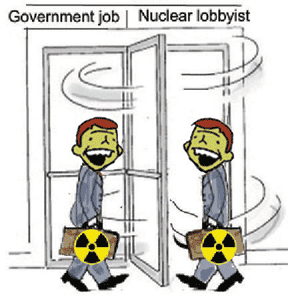 New swamp: Ex-Perry adviser lobbies for energy firm bailout AP, By MATTHEW DALY and RICHARD LARDNER, 29 May 18, WASHINGTON — At a West Virginia rally on tax cuts, President Donald Trump veered off on a subject that likely puzzled most of his audience.
“Nine of your people just came up to me outside. ’Could you talk about 202?’” he said. “We’ll be looking at that 202. You know what a 202 is? We’re trying.”
One person who undoubtedly knew what Trump was talking about last month was Jeff Miller, an energy lobbyist with whom the president had dined the night before. Miller had been hired by FirstEnergy Solutions, a bankrupt power company that relies on coal and nuclear energy to produce electricity. His assignment: push the Trump administration to use a so-called 202 order — named for a provision of the Federal Power Act — to secure a bailout worth billions of dollars.
Although Trump didn’t agree to the plan — he still hasn’t — for Miller, a president’s public declaration of interest amounted to a job well done.
How a single lobbyist helped carry a long-shot idea from obscurity to the presidential stage is a twisty journey through the new swamp of Trump’s Washington. Rather than clearing out the lobbyists and campaign donors that spend big money to sway politicians, Trump and his advisers paved the way for a new cast of powerbrokers who have quickly embraced familiar ways to wield influence.
Miller is among them. A well-connected GOP fundraiser, he has served as an adviser to California Gov. Arnold Schwarzenegger and Texas Gov. Rick Perry, also a close friend. He ran Perry’s unsuccessful presidential campaign in 2016. And when Trump tapped Perry to lead the Energy Department, Miller shepherded his friend through confirmation, sitting behind him, next to the nominee’s wife, at the Senate hearing.
When Perry came to Washington, Miller did, too. He launched his firm, Miller Strategies, early last year and began lobbying his friend and other Washington officials.
Besides Perry, Miller is close to other Trump-era power players. He is among House Majority Leader Kevin McCarthy’s best friends, their relationship dating back decades to Miller’s days in California. In more recent years, Miller developed a friendship with Vice President Mike Pence adviser Marty Obst.
“He’s very influential in Washington, a leading fundraiser,” Obst said of Miller.
Now, after 14 months in business, the 43-year-old Miller has collected more than $3.2 million from a roster of clients that includes several of the nation’s largest energy companies, among them Southern Co., a nuclear power plant operator headquartered in Atlanta, and Texas-based Valero Energy, according to federal filings.
Miller also has continued to raise money for GOP politicians. He contributed nearly $37,000 of his own over the past year to Republicans, including Sen. Ted Cruz of Texas and Greg Pence of Indiana, who’s seeking the congressional seat once held by his younger brother, the vice president, according to federal campaign records.
He is an active supporter of America First Action, a pro-Trump super PAC that raised $4.7 million in the first three months of 2018.
…….. Miller registered as a lobbyist in Washington in February 2017, just after Trump took office. He was hired by FirstEnergy in July 2017. Lobbying disclosure records show he was paid to target the highest levels of American government: the White House — including the offices of Trump and Pence — and Perry’s Energy Department. Miller has earned $330,000 from FirstEnergy since last year, making him one of the company’s highest-paid outside lobbyists……..https://apnews.com/e620b6cb527d41ebbb1c27974d771822
Julian Assange was smeared without proof. USA refused to hear his account of Wikileaks and ‘Russiagate’
US has no interest in hearing what Julian Assange can freely say about Russiagate – Max Blumenthal https://www.rt.com/news/428010-assange-russiagate-testimony-blumenthal/
Assange, who is currently incommunicado in the Ecuadorean embassy in London, reportedly offered – through an intermediary – to talk to US investigators about the release of DNC documents by WikiLeaks during the 2016 US election campaign.
US intelligence claims that WikiLeaks acted on behalf of Russia as part of a campaign to prop up the candidacy of Donald Trump and undermine that of Hillary Clinton. The offer was flatly rejected by Representative Adam Schiff, the ranking Democrat on the House Intelligence Committee, who said Assange would only be interviewed if he is in US custody.
“The US has no intention of interviewing Julian Assange except under duress, possibly after a long period of solitary confinement, the kind that Chelsea Manning endured,” journalist Max Blumenthal told RT, referring to the whistleblower, whose leak to WikiLeaks of classified US material exposing abuses in Iraq lead to her nearly seven-year confinement. Schiff is “the de facto grand inquisitor of the Russiagate investigation”, he said, so he presumably speaks for the entire US intelligence community.
No WikiLeaks people were publicly accused of having a hand in the supposed hacking of the DNC computer network and that the narrative of the hacking itself is on a very shaky foundation, Blumenthal remarked.
“They don’t want to interrupt their narrative with what could be facts very similar to the case of the hacking of the Democratic National Committee. The DNC has never handed over its servers to any US intelligence or law enforcement agency and has likely destroyed those servers,” he said. “It seems like the US does not want to know what’s in them just as the US only wants to know what Assange has to say only after he has been sufficiently held and intimidated.”
Blumenthal says Assange is rightfully afraid of leaving the Ecuador embassy because of his claim that he would then be grabbed by the UK law enforcement and extradited to the US under a classified indictment – the existence of which neither Washington nor London will confirm. If put in US custody, he is likely to become the first person prosecuted in America for what is essentially a journalist revealing classified information, he added.Read more
‘The smelly kid in class’: Former Met officer taunts Julian Assange’s mother on Twitter
“You have the whole beltway press corps howling about [US President Donald] Trump being mean to them and criticizing them. But almost no one in Washington in the press corps will stand up and defend Julian Assange as a fellow journalist,” he said. “This is a case that sets a precedent for the rest of the media in how other journalists would be treated if they reveal classified information. And it seems like there is little concern about it in the journalistic community in the West.”
The lack of support is because the US intelligence community smeared WikiLeaks and Assange personally, calling them a non-governmental intelligence agency and a Russian agent respectively, Blumenthal said, adding that the smear campaign didn’t bother to provide any proof.
“This narrative is almost impossible to challenge. It is simply the CIA’s narrative accepted hook, line and sinker by the New York Times, the Washington Post and all of the major cable media news networks,” he explained.
Assange was given political asylum under the leftist Ecuadorean President Rafael Correa. His successor, Lenín Moreno, has put the country on the path of rapprochement with the US. Moreno is apparently under pressure from Washington to have Assange kicked out of the embassy, which would essentially require him to violate the Ecuadorean law banning extradition of its citizens to foreign nations, Blumenthal said.
“Julian Assange is an Ecuadorean citizen. The Ecuadorean president Lenín Moreno has acceded to US wishes on so many points and said that Julian Assange is a problem he inherited,” he said. “It’s really up to [Moreno] to decide between the pressure that he is receiving from the US, which has just signed a joint military agreement with his country, and the rule of law, the Ecuadorean constitution, which forbids him from handing over an Ecuadorean citizen like Assange to the United States or the UK.”
1 This Month
29 Jan. Thursday 7-8 p.m. Webinar – World’s Largest Nuclear Station in Port Hope, ON?
To see nuclear-related stories in greater depth and intensity – go to https://nuclearinformation.wordpress.com/



31st January – Challenging the War Machine – a DECLASSIFIED UK SUMMIT

Website of the Week
Now until to February 10, 2026 Radioactive waste storage in France: the debate is finally open! How to participate?
-
Archives
- January 2026 (288)
- December 2025 (358)
- November 2025 (359)
- October 2025 (376)
- September 2025 (258)
- August 2025 (319)
- July 2025 (230)
- June 2025 (348)
- May 2025 (261)
- April 2025 (305)
- March 2025 (319)
- February 2025 (234)
-
Categories
- 1
- 1 NUCLEAR ISSUES
- business and costs
- climate change
- culture and arts
- ENERGY
- environment
- health
- history
- indigenous issues
- Legal
- marketing of nuclear
- media
- opposition to nuclear
- PERSONAL STORIES
- politics
- politics international
- Religion and ethics
- safety
- secrets,lies and civil liberties
- spinbuster
- technology
- Uranium
- wastes
- weapons and war
- Women
- 2 WORLD
- ACTION
- AFRICA
- Atrocities
- AUSTRALIA
- Christina's notes
- Christina's themes
- culture and arts
- Events
- Fuk 2022
- Fuk 2023
- Fukushima 2017
- Fukushima 2018
- fukushima 2019
- Fukushima 2020
- Fukushima 2021
- general
- global warming
- Humour (God we need it)
- Nuclear
- RARE EARTHS
- Reference
- resources – print
- Resources -audiovicual
- Weekly Newsletter
- World
- World Nuclear
- YouTube
-
RSS
Entries RSS
Comments RSS
 nuclear-news