Contractor used Masters and NASCAR tickets in failed nuclear plant kickback scheme, Nick Bromberg
Yahoo Sports, Feb 21, 2019, A contractor involved with a failed nuclear power plant construction project allegedly made some nice cash in a kickback scheme that involved tickets to sporting events. And, like most alleged illegal kickback schemes, the contractor got caught.
According to a court filing in a lawsuit filed by the United States Government, Wise Services Inc. submitted nearly 500 fake invoices during construction of a Savannah River nuclear facility. The South Carolina project was ended in 2018 and won’t be finished.
The Indy Explains: How a secret plutonium shipment exacerbated mistrust between Nevada and Department of Energy, The Nevada Independent ByDaniel Rothberg 18 Feb 19, The secretive Nevada plutonium shipment that has spawned angry rhetoric from Nevada politicians has a history that starts with Russia. In 2000, the United States entered into a pact with Russia to set aside excess weapons-grade plutonium for civilian use in nuclear reactors. Congress then passed a law that it would turn the excess 34 metric tons of plutonium into MOX, or mix-oxide fuel, at a newly built facility in South Carolina.
But that statute came with a firm deadline: If the MOX facility was not operational by 2014, the Department of Energy would be required to move one metric ton of plutonium stored at South Carolina’s Savannah River Site, a nuclear facility built in the 1950s, within two years.
After years of cost overruns and technical challenges, the Trump administration scrapped the facility. Meanwhile, the state of South Carolina obtained a court order in 2017 requiring the Department of Energy enforce the deadline and move the metric ton of plutonium by 2020.
Less than one year later, the agency said it moved a half-ton of that plutonium to the Nevada National Security Site. The action came after months of questioning from state officials, and its furtive nature has spurred a lawsuit, driving a deep chasm between the state and the agency.
Four months after South Carolina obtained the court order, Nevada officials heard that the federal government might be sending some of the plutonium to the state, according to court records. From August to November, state officials began asking questions about the potential shipment. But Nevada officials received few assurances from Department of Energy officials.
Beyond a general ‘expectation’ that any plutonium would be removed by approximately 2026-27, [a November 20] letter did not contain any of the requested assurances,” Pam Robinson, the policy director for then-Gov. Brian Sandoval, wrote in a December affidavit.
What Nevada officials didn’t know: the United States had already moved the plutonium.
Who knew what when
That surprising disclosure came months later — on January 30 — when a general counsel for the National Nuclear Security Administration (NNSA) disclosed that the agency had made a half-ton plutonium shipment from South Carolina to the Nevada Test Site prior to November.
Gov. Steve Sisolak responded to the revelation with a heated statement, pledging to continue existing litigation and keep the Department of Energy accountable.I am beyond outraged by this completely unacceptable deception from the U.S. Department of Energy,” he said to the media. “The department led the state of Nevada to believe that they were engaging in good-faith negotiations with us regarding a potential shipment of weapons-grade plutonium, only to reveal that those negotiations were a sham all along.”
Members of the state’s congressional delegation also released fiery responses.
State officials worry that the plutonium shipment to the testing facility, which is about 65 miles outside of Las Vegas and occupies an area the size of Rhode Island, could set a precedent for the federal government to send more nuclear materials to the state.
In court filings, lawyers for Attorney General Aaron Fordalso argued the federal government failed to fully inventory the environmental impacts of the size and type of plutonium being sent to the highly guarded site.
They also view the action as a backdoor move to open Yucca Mountain, the controversial nuclear waste repository that sits in the remote desert about 100 miles outside of Las Vegas.
The NNSA disputes all of these claims. ………
“Plutonium is nasty stuff,” said Allison Macfarlane, a George Washington University science and technology professor who chaired the U.S. Nuclear Regulatory Commission from 2012 to 2014. “But we’ve made so much of it on the weapons side in this country — and the civilian side in other countries — that we really need to manage it very carefully unless we eliminate it.”
Fuzile returned to the state capture inquiry on Monday to finalise aspects of his testimony.
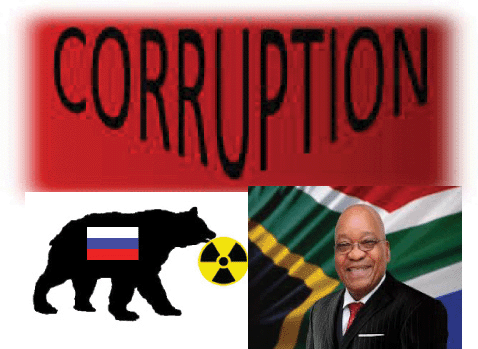
He told the commission of a meeting with former president Jacob Zuma where the nuclear deal was discussed.
He said Zuma made various comments that were concerning. And even with doubts from Treasury and Nene, there was pressure to go ahead with the deal.
Nene had testified when he appeared last year at the inquiry that the nuclear deal would have cost a lot of money and place massive risk on the country’s fiscus.
“The costs associated with it were astronomical. The envisaged 9.6 GW programme would have constituted the largest investment project in SA history. The investment required would have been estimated at R200 billion for a phased approach,” said Nene.
Fuzile said in a meeting with Zuma on the eve of Nene’s firing, officials from Treasury explained to Zuma and other officials why the project would be a risk yet Cabinet moved to approve the first phase of the deal.
“This was the biggest procurement ever in the history of the country, yet the processes were rushed and some of the stuff that was talked about was not followed. If nuclear had proceeded, this country would have been in trouble. The process that was followed was seriously flawed. There was a brushing aside of the true cost of the project,” said Fuzile.
Zuma commented that Fuzile and former minister Pravin Gordhan had stopped the PetrolSA Engen deal and said it was Treasury’s job to find the money.
Nene had testified that he suspects he was fired because of his objection to the nuclear deal.
Lungisa also touched on the PetroSA deal which did not go through, something Zuma appeared unhappy about.
He also testified about concerns from some board members at South Africa Airways (SAA) about the Airbus deal.
Lungisa also noted the resistance for the removal of former SAA board chair Dudu Myeni. He said it did not make sense why there was so much resistance especially as lenders for SAA did not enjoy working with the SAA board led by Myeni
Lungisa’s testimony was largely focused on corroborating information already provided by Nene and Gordhan when they appeared at the inquiry last year.
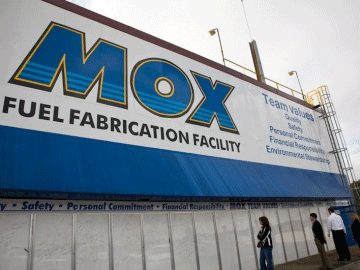
Dept. of Justice 14th Feb 2019 The Department of Justice announced today that the United States has filed suit against CB&I AREVA MOX Services LLC (MOX Services) and Wise Services Inc. under the False Claims Act and the Anti-Kickback Act in connection with a contract between MOX Services and the National Nuclear Security
Administration relating to the design and operation of the MOX Fuel
Fabrication Facility (MFFF) at the NNSA Savannah River Site in Aiken, South
Carolina.
MOX Services is a South Carolina Limited Liability Corporation with headquarters in Aiken, South Carolina. Wise Services, which subcontracted with MOX Services, is an Ohio corporation with headquarters in Dayton, Ohio. Under the MOX Contract, MOX Services agreed to design, build, operate (and ultimately decommission) the MFFF.
The MFFF is designed to transform weapons-grade plutonium into mixed oxide fuel rods that may be irradiated in commercial nuclear power plants.
In performing the MOX Contract, MOX Services entered into a series of subcontracts with Wise Services between 2008 and 2016. Each of these subcontracts provided for
Wise Services to supply labor, materials, equipment, and supervision for unplanned construction activities (e.g. general labor, plumbing, electrical, carpentry) deemed necessary to support MOX Services’ efforts at the MFFF.
The government’s complaint alleges that Wise Services falsely claimed reimbursement under its subcontracts with MOX Services for construction materials that did not exist, and that in turn MOX Services knowingly submitted $6.4 million in claims to NNSA for the fraudulent charges submitted by Wise Services. The complaint further alleges that Wise Services’ Senior Site Representative Phillip Thompson paid kickbacks to MOX Services officials with responsibility for the subcontracts to improperly obtain favorable treatment from MOX Services. On Feb. 27, 2017, Mr. Thompson entered a guilty plea on charges of conspiring to commit theft of government funds. https://www.justice.gov/opa/pr/united-states-files-false-claims-act-lawsuit-connection-mox-fuel-fabrication-facility
THE Soviet Union used its own population as “guinea pigs” to tests the effects of its secret nuclear weapons as tensions rose with the United States, a former member of the European Parliament for Scotland revealed. By CALLUM HOARE, Feb 13, 2019 The Semipalatinsk Test Site, also known as The Polygon, was home to at least 456 nuclear tests between 1949 and 1989, during the height of the Cold War. These top-secret missions were carried out with little regard for human or environmental impact in the surrounding area, just 11 miles away. Locals were told their area had been selected to help counter the threat from the US but were not aware of the full extent of the radiation damage.
“They were not told these weapons were nuclear and there would be the question of radioactive fallout that would affect all of them.
“The KGB doctors would wait until the wind was blowing towards the villages, then detonate the bombs and spend days afterwards checking the effects on the locals.
“They were being used as human guinea pigs.”
Mr Stevenson claimed the KGB manipulated locals so they could test the full potential of their nuclear weapons.
He continued: “The KGB ordered them to pack books and bedding behind the windows of their houses and actually stand outside.
“The women were there holding their babies and the KGB told them ‘you will witness the might of Soviet technology’ and they were actually celebrating this massive bomb, not knowing it would make them severely ill.
“Igor Kurchatov and Andrei Sakharov were the fathers of the Soviet nuclear weapons.
“[Joseph] Stalin gave an order that if the bomb did not explode, the professors and all their team would be executed.”
In 1989, the anti-nuclear movement was started in Kazakhstan called “Nevada Semipalatinsk”, led by poet Olzhas Suleimenov.
The site was officially closed by the President of Kazakhstan Nursultan Nazarbayev on 29 August 1991, denuclearising the country.
It has now become the best-researched atomic testing site in the world and is open to the public to visit.
The National 11th Feb 2019 ACCIDENT reports and safety reviews into nuclear weapons and atomic energy programmes in Scotland are among hundreds of documents to have been suddenly withdrawn from public view.
According to a report on the Sunday Post website, following a “security review” the files at the National Archives in Kew were removed so that they can no longer be accessed by the public.
The move has been described as “very concerning” by the Campaign for Nuclear Disarmament (CND). The documents relate to a range of topics on Britain’s nuclear weapons and atomic energy programmes, including the nuclear power plant in Dounreay, Caithness, as well as Chapelcross in
Dumfries and Galloway and the Hunterston A and Hunterston B power stations which are located in Ayrshire. https://www.thenational.scot/news/17423745.scotlands-nuclear-history-suddenly-disappears-from-public-archive/
Scotland’s nuclear history suddenly disappears from public archive, The National, 11 Feb 19, ACCIDENT reports and safety reviews into nuclear weapons and atomic energy programmes in Scotland are among hundreds of documents to have been suddenly withdrawn from public view.
According to a report on the Sunday Post website, following a “security review” the files at the National Archives in Kew were removed so that they can no longer be accessed by the public.
The move has been described as “very concerning” by the Campaign for Nuclear Disarmament (CND).
The documents relate to a range of topics on Britain’s nuclear weapons and atomic energy programmes, including the nuclear power plant in Dounreay, Caithness, as well as Chapelcross in Dumfries and Galloway and the Hunterston A and Hunterston B power stations which are located in Ayrshire.
It is not entirely clear why the files have been removed.
All that is known at this point is that Nuclear Decommissioning Authority (NDA) ordered a security review and that a decision will be made on whether or not the documents should remain public……….
“Just before Christmas all the files were withdrawn from the National Archive without any explanation or communication,” said Jon Agar, professor of science and technology studies at University College London
“It was replaced with a message that if you need to see this, you have to put in an FOI request.
“Almost everything we would want to know on the public record which allows us to trace the history of nuclear establishments across the country have been essentially withdrawn from public sight…….. Ian Chamberlain of CND described the withdrawal of the files as “very concerning”.
There are also meetings in eight areas of England as the government hunts for a single location to bury the lethal waste.
The waste, which has been accumulating from nuclear power stations over the last 60 years, is to be transferred from specially-engineered containers where it is currently building up to a subterranean Geological Disposal Facility (GDF) where it can be left forever.
The government’s official line is that no location has been chosen and that any site will only be picked if a community is willing.
Experts at the RWM (a subsidiary of the Nuclear Decommissioning Authority) have been scouring Wales for suitable regions and this is what they have to say about the area in which you live:
1. North Wales offshore including the Vale of Clwyd……….
2. North Wales Coalfield, comprising Wrexham and north to Prestatyn…….
3. From St Brides Bay to the Severn Estuary, extending north to Welshpool……
4. 20 km offshore strip along the Bristol Channel – from Carmarthen Bay to Cardiff…..
5. Most of North Wales and West Wales – from St Davids to Bangor……
Report: Trump Inaugural Committee Under Investigation for Possible Finance Crime, Slate By MOLLY OLMSTEAD, DEC 13, 2018 “………..Prosecutors also asked for documents from Tennessee developer Franklin Haney, the Journal reported. Haney made a $1 million donation to the inaugural committee and, in April, hired Cohen to help him obtain a $5 billion loan from the U.S. government, among other funding, for a pair of nuclear reactors in Alabama. Prosecutors asked him for documents related to any correspondence with members of the committee. ……
Secret Underground Nuclear City In The Arctic | A Potential Threat
WW3 FEARS: Pentagon’s secret underground tunnels of MOBILE NUCLEAR bases REVEALED THE US government built a fully-functioning mobile nuclear base below the ice ofGreenland in preparation for war, it was revealed during a documentary. https://www.express.co.uk/news/world/1084951/ww3-fears-pentagon-mobile-nuclear-base-greenland-sptIn 1960, the United States ran a highly publicised project known as Camp Century on the island to study the feasibility of working below the ice. However, declassified files show it was actually a cover-up for a top-secret Cold War programme. Project Iceworm was the code name for the United States Army’s mission to build a network of mobile nuclear missile launch sites.
The ultimate objective was to place medium-range missiles under the ice — close enough to strike targets within the Soviet Union.
YouTube series “The Real Secrets of Antarctica” revealed how the project came to light in January 1995.
The 2017 documentary detailed: “Some very interesting disclosures were declassified about US military installations in Greenland which took place in the 1960s.
“They fed the American people a highly publicised story about advances in research and building an underground city below Greenland called Camp Century.
Only later did the truth about Project Iceworm surface.
“The Pentagon was attempting to put in place mobile nuclear launching sites to utilise thousands of miles of tunnels.”
Project Iceworm was to be a system of tunnels 2,500 miles in length, used to deploy up to 600 nuclear missiles, that would be able to reach the Soviet Union in case of nuclear war.
The missile locations would be under the cover of Greenland’s ice sheet and were supposed to be periodically changed.
A total of 21 trenches were cut and covered with arched roofs within which prefabricated buildings were erected.
These tunnels also contained a hospital, a shop, a theatre, and a church and the total number of inhabitants was around 200.
From 1960 until 1963 the electricity supply was provided by means of the world’s first mobile nuclear reactor, named PM-2A.
Water was supplied by melting glaciers and tested to determine whether germs were present, including tests for the plague virus.
However, just three years after it was built, ice core samples taken by geologists demonstrated that the glacier was moving much faster than anticipated and would destroy the tunnels and planned launch stations in about two years.
The facility was evacuated in 1965, and the nuclear generator removed.
Project Iceworm was canceled, and Camp Century closed in 1966.
Feds sue Hanford contractor, claiming kickbacks and lies defrauded taxpayers out of millions, Tri City Herald , BY ANNETTE CARY, FEBRUARY 08, 2019 RICHLAND, WA
The Department of Justice filed a civil lawsuit Friday against Hanford contractor Mission Support Alliance, accusing it of defrauding the federal government out of tens of millions of taxpayer dollars.
Also named in the lawsuit are former Mission Support Alliance President Frank Armijo, Lockheed Martin Corp. and Lockheed Martin Services Inc……….
The Justice Department is accusing Mission Support Alliance of using half-truths, omissions, kickbacks and outright lies before its purchase by Leidos to get the Department of Energy to consent to a $232 million subcontract to a company with which it had ownership ties.
Lockheed Martin Corp. was a principal owner of Mission Support Alliance in 2010, when Mission Support Alliance awarded a subcontract for information technology services at Hanford to Lockheed Martin Services Inc.
The lawsuit alleges that from 2010 to 2015 the defendants misrepresented billing rates charged to DOE, the effort estimated to be needed to complete work and the anticipated additional profit for the subcontractor.
“Defendants’ fraud allowed them to obtain grossly inflated and improper additional profit on the subcontract,” the Justice Department said in a news release.
The lawsuit said that estimates of costs for payment rates were inflated in some cases by basing them on far more employees to perform work than Lockheed Martin Services Inc. included in its internal budget.
In some cases DOE was billed by both Mission Support Alliance and Lockheed Martin Services Inc. for the same labor, the lawsuit said.
‘GROSSLY INFLATED PRICING’ CLAIMS
The profit paid for Lockheed Martin Services Inc. work was in addition to money Lockheed Martin Corp. was already earning on the same work through its partial ownership of Mission Support Alliance, according to the Justice Department.
DOE repeatedly made clear that the subcontractor, Lockheed Martin Services Inc., could not earn profit on top of what its owner was already being paid through Mission Support Alliance, the lawsuit said.
Armijo, and Rich Olsen, the Mission Support Alliance chief financial officer, also worked on behalf of Lockheed Martin Corp. and misused their positions at Hanford to help Lockheed Martin Corp. obtain grossly inflated pricing, the Justice Department alleged.
In addition to serving at times as the Mission Support Alliance president, Armijo also was a vice president of Lockheed Martin Corp., the lawsuit said.
HANFORD OFFICIALS ALLEGEDLY PAID KICKBACKS
The Justice Department said some employees, including Armijo, told DOE that the subcontractor’s pricing did not contain any additional profit for the subcontract for the same work on which Lockheed Martin Corp. was already earning profit through its ownership of Mission Support Alliance.
The millions of dollars that Armijo and other employees were paid in cash and stock as part of an incentive program amounted to kickbacks for improperly using their Mission Support Alliance positions to provide favorable treatment for Lockheed Martin Corp., the Justice Department alleges. ………https://www.tri-cityherald.com/news/local/hanford/article226014785.html
https://www.rt.com/usa/451098-hanford-nuclear-lockheed-lawsuit/10 Feb, 2019 Contractors involved in a multibillion decontamination effort at the notorious Hanford nuclear site have been accused of defrauding US taxpayers, according to a lawsuit against Mission Support Alliance and Lockheed Martin.
MSA has a 10-year, $3.2 billion contract with the Department of Energy (DOE) to support the decontamination effort at the decommissioned nuclear production complex known as the Hanford Site. Allowed to pick subcontractors for the nation’s largest and most expensive environmental cleanup at its own discretion, MSA abused its authority and awarded “improper favorable treatment” for kickbacks, the Justice Department claimed this week.
The lawsuit alleges that Lockheed Martin Corporation (LMC) and Lockheed Martin Services Inc. (LMSI) paid more than $1 million to executives of MSA – which was conveniently co-owned by another Lockheed subsidiary at the time – in order to secure a $232 million subcontract to provide management and technology support at the Washington state nuclear site from 2010-2016.
The services were provided at “inflated rates” and in some cases the DOE was even billed twice, by both MSA and Lockheed, for the same work. In addition, the suit accuses Jorge Francisco Armijo, who served as both the Vice President of LMC and President of MSA, of abusing his authority for financial gain by his simultaneously held posts.
“Where Congress has allocated money for specific purposes, we will not tolerate unlawful conduct by contractors who seek to enhance their profits at the expense of taxpayers,” said Assistant Attorney General Jody Hunt of the Department of Justice’s Civil Division.
Lockheed immediately denied the allegations of being involved in the corruption scheme, rejecting any notion that the “corporation or its executives engaged in any wrongdoing.” MSA also brushed aside the accusations, claiming that the company “stands behind” their employees.
The 586-square-mile former nuclear research facility was used to produce plutonium for the nuclear bomb in the Manhattan Project. After over four decades of nuclear fuel production, the site was closed down in 1987, requiring an extensive clean-up of solid and liquid wastes left from the weapons production processes.
When Trump supporters chant “make America great again,” I have difficulty imagining that any of them are longing for the days when radiation exposure went unregulated. Nevertheless, that’s precisely the direction the EPA is headed with its latest appointment.
Brant Ulsh, a health physicist working for a consulting firm, will serve as both a scientific advisor to the EPA and as the new leader of the Radiation Advisory Committee. Ulsh is a controversial choice because he is considered the nation’s most outspoken critic of radiation levels.
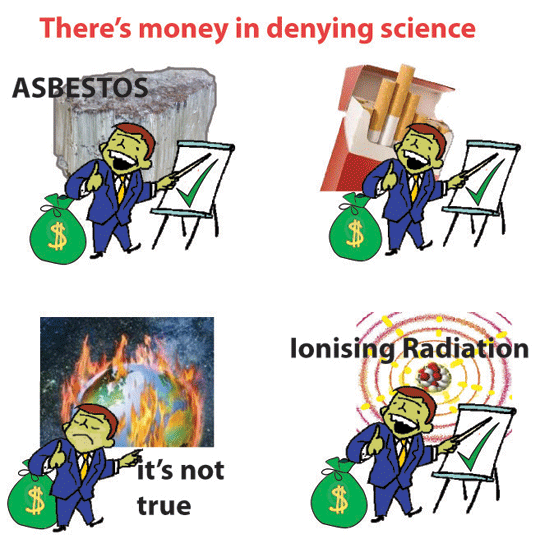
His papers and positions put him at odds with the overwhelming majority of the scientific community that believes coming into contact with even low levels of ionizing radiation poses a significant cancer risk. He claims the science is too outdated and insufficient to warrant the existing government standards.
“Once again the Trump administration is moving to the fringe for its scientific advice, choosing someone who could undercut foundational protections from radiation,” wrote the Natural Resources Defense Council in a statement regarding Ulsh’s appointment. “We need sound science to dictate health protections, not dangerous theories.”
If you’re wondering what angle Ulsh is working, he admits to it in his own papers. Evidently, he’s concerned that our radiation regulations put “unnecessary burdens” on corporations. Funny how the conservatives in power always seem more concerned with the extra money rich companies pay to keep people safe than actual public safety.
For what it’s worth – and it should be worth a lot, EPA head Andrew Wheeler – just last year the National Council on Radiation Protection and Measurements reviewed 29 studies that reconfirmed a correlation between low level radiation exposure and an increased risk of cancer.
As a scientific advisor to the EPA and the head of the Radiation Advisory Committee, Ulsh could play a pivotal role in rolling back the standards that dictate acceptable amounts of radiation. Since humans can’t detect when they’re exposed to radiation, we rely on enforcement of these limits to keep us safe.
Make no mistake – this appointment isn’t accidental. There are countless scientists who could have led the Radiation Advisory Committee that accept the existing scientific consensus on radiation levels. To choose an outlier like Ulsh is to look for someone to deliberately take the agency in a different direction.
In fact, thanks to an Associated Press story from last year, we know that the EPA was already making plans to throw out regulations on radiation, so having a scientist like Ulsh bring his own opinions could be the ideal vehicle in order to accomplish that agenda.
At the risk of being hyperbolic, at this point, I think we’ve got to ask ourselves: is the Trump administration just trying to kill us? They’re appointing fossil fuel lobbyists to oversee climate change, corporate polluters to worry about clean water, chemical bigwigs to regulate pesticides and now a pro-radiation guy to set radiation standards.
Is nothing sacred? Does the Trump administration feel no obligation to keep the American people safe? If the EPA is so confident that scientists are wrong and radiation isn’t actually harmful, maybe it should start by experimenting at the White House before unleashing it on the public at large.
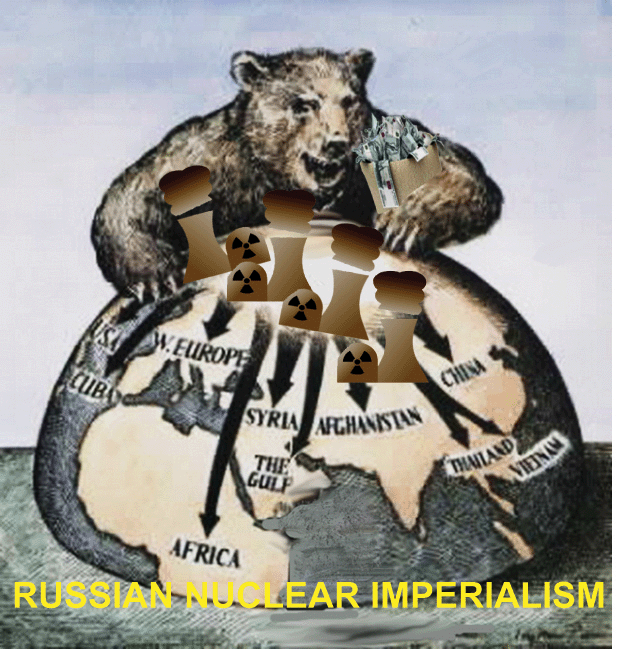
Hungary seeks to postpone loan payback to Russia for Nuclear power plant: What will the final cost be?Bellona February 1, 2019 by Charles DiggesBudapest is seeking to modify the terms of a loan it must repay to Russia for building two new VVER-1200 type reactors that will eventually replace Hungary’s Paks nuclear power plant, according to a report from Reuters.
The reactors, which will constitute a plant called Paks II, will be built by Rosatom, Russia’s state nuclear power company, at a cost of 10 billion euro ($12 billion), and will replace the older Soviet-built nuclear plant that supplies half of the country’s electricity.
Rosatom’s construction contract, which includes the loan for Paks II, was the subject of a hotly-debated probe by the EU’s Organization for Economic Co-Operation and Development, which investigated whether the Russian bid violated European competition statutes.
At the time, EU officials and commentators viewed the deal as a Trojan Horse to help cement Moscow’s influence over the right-leaning, rabidly anti-globalist government of Hungarian Prime Minister Viktor Orban.
Hungarian financial authorities plan to ask Moscow to postpone collecting on the debt until after the new reactors begin to generate electricity – but it is as yet unclear whether Rosatom will accept new terms. The plant’s construction, meanwhile, is running late. The build was supposed to begin last year………
While the terms of the Paks II loan remain in the shadows, other financing arrangements Moscow has made for building nuclear reactors in other countries suggest that the interest alone could prove to be very expensive for Budapest.
An $11.4 billion, 30-year agreement Rosatom signed with Bangladesh to build the Roopur nuclear plant will net Moscow $8 billion in interest. A $25 billion deal Rosatom is pursuing with Egypt to build that country’s Dabaa plant could, over the 35-year term of that loan, swell to $71 billion.
Terms like this could spell trouble for Hungary in light of Moscow’s tendency to be a kneecapping creditor when it comes to energy projects – especially when Russia sours on the politics of its debtors.
In 2014, at the height of East-West tensions over Russia’s annexation of Crimea, Kremlin officials threatened to cut nuclear fuel supplies to Ukraine’s Soviet built reactors – which would have interrupted their chain reactions and likely caused a catastrophic accident.
Rosatom eventually walked the threat back. But the lurid message in Moscow’s head-fake toward igniting a second Chernobyl was clear: Russian-built reactors are a useful new tool for political blackmail………..
Many in Europe – Hungary included – subsequently sought to diversify their energy supply in favor of nuclear. Yet, in a devious twist, Rosatom has emerged as the most stable and eager nuclear builder on the international market.
For now, Rosatom can afford to offer risky loans thanks to the enormous state subsidies it receives. These subsidies can be funneled into more loans, and the loans then boost the company’s profits on paper. But for the past several years, it has become clear that these subsidies to the company will likely decrease or dry up altogether in 2020.
As a result, Rosatom is amassing so-called memorandums of understanding from any country vaguely interested in nuclear power. The company says is currently has dozens of these MOUs amounting to more than $130 billion in incoming business.
But that claim should be viewed skeptically, as many of the countries for which Rosatom is promising to build reactors – countries like Jordan, Algeria, Nigeria, the Republic of Congo and Bolivia – won’t have the infrastructure to support nuclear power for decades.
SNC-Lavalin should be barred from federal contracts: Angus, Call comes after two former executives pleaded guilty to breaking laws Elizabeth Thompson · CBC NewsFeb 03, 2019 The Canadian government should suspend engineering giant SNC-Lavalin from competing for future federal government contracts after two former top executives pleaded guilty to charges in recent weeks, says NDP MP Charlie Angus.
“How is it that a company with such a horrific record of corporate malfeasance is able to obtain so many government contracts and continue to bid on government contracts?” said Angus.
On Friday, former SNC-Lavalin CEO Pierre Duhaime pleaded guilty to breach of trust in a plea deal that resulted in 20 months of house arrest, 240 hours of community service and a $200,000 donation to a fund for victims of crime. His trial had been scheduled to begin Monday……….
“I’m astounded that SNC is still given such favoured status with the Liberal government in terms of contracts.”NDP MP Charlie Angus.
SNC Lavalin is still before a court in Montreal, charged with fraud and corruption in connection with payments of nearly $48 million to public officials in Libya under Moammar Gadhafi’s government and allegations it defrauded Libyan organizations of an estimated $130 million.
Ryan said the company is contesting the case and has pleaded not guilty.












 nuclear-news