The saga of Rocky Flats Nuclear Weapons Plant AND what happened to the Grand Jury documents??

Rocky Flats Nuclear Weapons Plant Closed Long Ago, but Is Still a Hot Topic https://www.westword.com/news/rocky-flats-nuclear-plant-shut-down-thirty-years-ago-but-is-still-a-hot-topic-11437949, | AUGUST 7, 2019
Colorado almost had its own Chernobyl.
That’s what then-congressman Jared Polis told the U.S. House of Representatives on May 12, 2009, the fortieth anniversary of a fire at what was then called the Rocky Flats National Munitions Plant, sixteen miles upwind of Denver.
“I rise today to commemorate one of the most fateful days in the history of the State of Colorado, the day the Rocky Flats Nuclear Weapons Plant outside of Boulder nearly became America’s own Chernobyl, some thirty years before that terrible accident in the Ukraine,” Polis told his colleagues. “On Mother’s Day of that year, a fire broke out amid the glove boxes in Building 776, where plutonium spheres were being manufactured for use as cores for some of the most powerful weapons in human history. The fire quickly spread throughout the facility, as many of the fire alarms had been removed to make room for more production. It is estimated that between 0.14 and 0.9 grams of plutonium 239 and 240 were released before a heroic band of perhaps forty firefighters were able to control and eventually douse the fire. Those firefighters faced the immense decision of whether to battle the blaze with water, which could have set off a chain reaction, with the resulting explosion literally contaminating the entire Denver metropolitan area. Luckily for us all, they chose correctly.
“Still, plutonium was released into the environment from that accident, through the air vents in the roof of the building and via firefighters extinguishing it. Thousands of Coloradans were exposed, although how many we’ll never know. The firefighters, of course, were exposed most severely, and everyone nearby faced greatly increased risks of serious disease. Indeed, many of those involved have since contracted and died from cancers and other conditions tied to radiation exposure.”
Unlike Chernobyl, the site of a massive nuclear explosion on April 26, 1986, that exposed at least half a million Russians to radiation, decimated the land for miles around and inspired HBO’s Chernobyl that educated a new generation to collateral damages of the nuclear age, Rocky Flats was not a nuclear power plant. In fact, Colorado’s only nuclear-generating facility, Fort St. Vrain near Platteville, had its own problems from when it began generating electricity in 1976 and was shut down entirely in 1989.
By then, what became known as the Rocky Flats Nuclear Weapons Plant had been in operation for almost three decades; it was a manufacturing facility that created plutonium triggers for this country’s nuclear arsenal. But it still dealt with one of the most toxic elements on the planet, one with a half-life of 24,000 years, as well as many deadly chemicals. By the time of the 1969 Rocky Flats fire, the plant had been manufacturing those triggers for sixteen years, largely in secret.
Rocky Flats was not Chernobyl. But what happened there was bad enough — though just how bad may never be known. Documents about the plant, like some of the plutonium that was processed there, have a way of disappearing.\
PROJECT APPLE
By then, scientists had realized that they’d misread the wind patterns when siting Rocky Flats; they’d relied on measurements taken at Stapleton Airport northeast of Denver, without accounting for how winds shifted as they came over the mountains and through the canyons. Rather than being safely out of the path of any plutonium release, Denver was at ground zero, sixteen miles downwind. Even so, residents were not warned of potential dangers after the fires.
At the time, Dr. Carl Johnson, head of the Jefferson County health department, was revealing his own concerns about the evils of Rocky Flats. He released studies suggesting that Denver’s overall cancer rates were higher than expected, and the rates around Rocky Flats higher still. Property near the plant set for the development of 10,000 homes exceeded the state’s plutonium soil contamination standard by a factor of seven, he reported. As a result, federal housing officials directed realtors to warn prospective homebuyers who wanted government loans in order to purchase houses in the area that there could be potential liabilities.
In 1981, Johnson was fired by Jefferson County. The feds soon removed its directive to realtors.
SPILLED SECRETS
In the first week of August 1989, two dozen citizens from across Colorado were sworn in as members of Special Grand Jury 89-2. The grand jurors met for a week every month for over two years, and after hearing from dozens of witnesses and going through hundreds of boxes of documents, they were prepared to consider charges not just for workers at the plant, but for their federal overseers. “We didn’t care who they were or how high up the chain of command they were,” one grand juror later told Westword.
It wasn’t Chernobyl, but the story about Rocky Flats exploded just the same.
CLEANING UP
After the raid, Rocky Flats never made another nuclear trigger. The feds and Rockwell agreed to an early termination of the Rockwell management contract in September 1989, the day after the company filed a civil suit against the DOE, the EPA and the Department of Justice, arguing that the feds had failed to provide proper waste-disposal sites for radioactive materials. A week later, Rocky Flats was named a Superfund site, and EG&G signed a contract to operate the facility starting January 1, 1990. By then, the focus had been changed from nuclear-materials production to cleanup, and most of the 5,000-plus employees stayed on to do the job. Among other things, nearly 3,600 containers of pondcrete and saltcrete — 4.3 million pounds of low-level solidified waste that had been packaged like barrels, until they started to crumble and leak (the grand jurors had heard considerable testimony about that failed system) — were moved, and the solar ponds where waste had been stored were drained. Plutonium located in the ducts, which Stone had warned about, was removed.
As the story of the Rocky Flats grand jury became national news, Congress held hearings to determine whether justice had been denied. The hearings made headlines, but secured nothing more than a promise of more transparency from the DOE. Foreman McKinley even ran for Congress, in hopes that he’d be able to tell the full story from the floor of the House of Representatives. (Although that attempt failed, he ultimately served in the Colorado Legislature and co-authored a book titled The Ambushed Grand Jury…and thus far has avoided any contempt-of-court charges.)
In 1995, EG&G staff and the DOE held a Rocky Flats Summit with 150 community activists, regulators, state officials and members of citizen oversight committees to discuss cleanup plans, including reducing the risk of plutonium to site workers and the public, and deferring some environmental restoration and cleanup in order to reduce that risk. When EG&G declined to sign up for a second round, Kaiser-Hill took over the project. The draft Rocky Flats Vision and Rocky Flats Cleanup Agreement were released in March 1996, four years after the Justice Department had made its deal with Rockwell; Governor Roy Romer signed them that June. What had been predicted to be a cleanup project that would take decades and tens of billions of dollars was put on the fast track.
After nearly ten years and $7.7 billion, the remediation job was declared complete in 2005. More than 800 structures had been decontaminated and demolished, including five major plutonium facilities and two major uranium facilities. While much of the low-level radioactive waste was shipped to other disposal sites, the most contaminated rubble was buried far below the ground in the Central Operable Unit: 1,308 acres at the center of the facility, where most of the manufacturing had been done, which would be declared off-limits forever. The 5,000-plus acres around the COU, in the Peripheral Operable Unit, were turned over to the U.S. Fish and Wildlife Service in 2007 to revamp into a wildlife refuge, much as the Rocky Mountain Arsenal had been two decades earlier.
Even though the grand jurors were still silenced, the secrets of Rocky Flats seeped out in other ways. Workers who’d become sick sued the government, and public officials took up their cause. Nearby homeowners who’d suffered bad health and other losses filed a class-action suit against Rockwell and Dow; their case was finally heard in U.S. District Court Judge John Kane’s courtroom, where former FBI agent Lipsky testified as to what he’d found at the plant. Despite the testimony about problems on those properties, houses were popping up along the southern border of Rocky Flats, and some new homeowners started to wonder if they’d bought more than they bargained for. And as plans to finally complete the northwest segment of the beltway around Denver progressed, municipalities began questioning whether construction of the Jefferson Parkway, set to go along the east side of Rocky Flats, would really be safe.
As the date of the Rocky Flats National Wildlife Refuge’s opening neared, activist groups filed suit to keep the gates closed. Last September, Congressman Polis made a last-second request to Ryan Zinke, then-secretary of the Department of the Interior, which oversees Fish and Wildlife, to consider “my constituents’ request that the DOI complete further testing of air, water, and soil at the Refuge site by March 2019, and that until further testing has been completed, the Refuge site remain unopened to the public.”
Although Polis never heard from Zinke, he got his answer: The refuge opened to the public on September 15, 2018 (the suits filed to prevent its opening are still pending). But even those who have no concerns about the refuge’s safety were taken aback last November when a British company proposed fracking alongside Rocky Flats: While cleanup experts had considered the effects of water runoff, and burrowing animals, and even prairie fires, they’d never considered that drilling operations would bore down and then up into the property from the sides. The proposal was pulled, and last month Representative Joe Neguse, who took over the first congressional seat when Polis was elected governor, introduced legislation that would prohibit oil, gas and mineral drilling beneath federally owned Superfund sites, such as Rocky Flats.
Meanwhile, the debate over whether the surface is really safe continues.
In January, attorney Pat Mellen decided to try a different tack. On behalf of seven groups — the Alliance of Nuclear Workers Advocacy Groups, Rocky Flats Downwinders, Candelas Glows/Rocky Flats Glows, Environmental Information Network, Rocky Flats Neighborhood Association, Rocky Flats Right to Know and the Rocky Mountain Peace and Justice Center — she filed a motion asking that materials considered by Colorado’s first-ever special grand jury be released. “The documents gathered by the Grand Jury and now under seal are a unique resource that provides the detailed evidence of whether specific locations or hot spots of unremediated or undiscovered hazardous substances must outweigh a site-wide ‘safe’ determination made for other purposes,” she argued.
MISSING IN ACTION
And then on July 24, Mellen received an email from Kyle Brenton, assistant U.S. Attorney in the U.S. Attorney’s office where Mike Norton had negotiated the Rockwell deal thirty years before, that the grand jury documents were missing. “Can you imagine that?” says McKinley. “The Justice Department has a long history of losing stuff. They lost all kinds of stuff…plutonium, reports.”
And some things never change, he notes. When the grand jury was sent home back in 1992 and its files first sealed, the head of the Department of Justice was William Barr. Today, Barr is again the attorney general.
Lipsky, who was transferred to the FBI’s Los Angeles gang unit not long after his investigation of Rocky Flats, is now a private investigator who continues to push for the release of the real story about Rocky Flats. When he heard that the documents were missing, “the only thing I could do was laugh,” he says. Brenton’s email estimates that “60-some boxes are not physically in our office space now.” Lipsky’s agents filled many times that many boxes with documents seized during the raid at Rocky Flats.
According to Brenton, his office had custody of the requested documents until at least 2004. He’s now going through boxes of documents from linked cases, such as whistleblower Stone’s suit against Rockwell, and the Cook class-action litigation that finally found victory and a $375 million settlement in Kane’s courtroom, to see if they were misfiled.
“It is incidents like this that continue to foster uncertainty and fear within the communities that are the most impacted,” Polis’s office says of the missing grand-jury documents. “Our administration is committed to government transparency and public access to information. That’s why our Department of Public Health and Environment recently requested that these records be unsealed for the public.”
For a time, there was a stash of grand jury documents at U.S. District Court Judge Richard Matsch’s courtroom. At one point, the grand jurors had petitioned Matsch to allow them to tell their story; that request was denied, and Matsch passed away this spring. Judge Finesilver had relevant documents, too; before he died in 2006, he gave 180 boxes of records to the Denver Public Library, with the stipulation that they be kept closed until 2009.
That August, a librarian began cataloguing the contents, then ran across two boxes holding various forms of the grand jury report marked “Not for public release.” He called the clerk of the U.S. District Court to ask if the documents could be made public. Instead, the clerk picked up the boxes and demanded that anything else that surfaced involving Rocky Flats be sent to the court. The missing grand jury materials are not the only documents devoted to Rocky Flats, of course. The Colorado Department of Public Health and Environment still has voluminous files, including a giant binder detailing all the different chemicals once used at the Rocky Flats Nuclear Weapons Plant. For a time, Front Range Community College hosted a Rocky Flats Reading Room, though much of the materials are now in the University of Colorado archives, which has a “wealth of information,” according to David Abelson, executive director of the Rocky Flats Stewardship Council. “Walling off these documents from public view creates an impression that there’s a lack of information regarding management of the site.”
That impression is misguided, he thinks: His group includes representatives from most of the local governments around Rocky Flats, all but one of which supports recreation at the refuge. Still, in June the council passed a resolution against allowing fracking near the plant, and it’s keeping an eye on three studies being done of environmental conditions at the refuge, the results of which are due this fall. The current samples will be compared to historic samples…if those can be found.
For now, Mellen is drilling down into the case of the missing documents. On July 31, she filed a motion asking the judge to give the U.S. Attorney’s Office thirty days to find them. “I actually believe it’s a bigger number of boxes than that,” she says of Brenton’s estimate. “But right now, I’d be happy with that.”
Rocky Flats isn’t Chernobyl, but this could still blow up.
Significant disappearance of files about Rocky Flats former nuclear weapons plutonium site
U.S. Nuclear Arms Plant Files Reported Missing,more https://www.ecowatch.com/nuclear-arms-plant-files-missing-2639561239.html?rebelltitem=1#rebelltitem1 Jordan Davidson, Jul. 31, 2019,
The U.S. Department of Justice won’t turn over 60 boxes of files about a nuclear arms plant in Colorado because it says it can’t find the files. The missing documents were presented to a grand jury during a two-year criminal investigation that looked into environmental crimes committed at Rocky Flats, which produced plutonium triggers for the nation’s nuclear arsenal throughout the Cold War, as the Denver Post reported.
The nuclear plant, just outside of Denver, operated from 1952 to 1989 when it shut down amid the grand jury investigation. While running, it had a history of fires, leaks and spills. Files about the plant, however, have remained a state secret since the grand jury investigation concluded in 1992.
The site was cleaned and opened up last year as a national wildlife refuge. But a coalition of environmental activists, former nuclear workers, nearby residents and public health advocates filed a motion in federal court asking that the files be made public, as the Associated Press reported.
“This is not a quest for guilt,” Patricia Mellen, one of the group’s attorneys said, as the Associated Pressreported. “We need the information to protect the public. That’s the issue.”
The group will file a motion to ask a federal judge on Wednesday to demand that the U.S. Department of Justice find the missing documents within 30 days. They say the documents could show whether the government did enough to clean up the site before turning part of it into a wildlife refuge and opening it to hikers and bicyclists.
Last week the U.S. Attorney’s office wrote in an email that 62 to 65 boxes of documents were last confirmed in the Justice Department’s custody in 2004. He wrote that the boxes were not found in the Denver office or at the federal records center.
“… I have been attempting to reach out to former USAO staff and attorneys who touched the Rocky Flats matter over the years to see whether they have any memory of where the boxes might have ended up,” Kyle Brenton, an assistant U.S. Attorney in Denver, wrote in the email seen by The Denver Post. “That effort is ongoing, but has not yet yielded results.”
In 1992, the grand jury determined that eight individuals, including Department of Energy officials and employees from Rockwell International — the company contracted by the DOE to manage the plant — should be indicted for environmental crimes. The indictments never happened and the Justice Department struck a deal with Rockwell, fining the company $18.5 million. The settlement also covered Rockwell’s legal bills and protected Rockwell executives from further legal action, according to Westword.
Since then, the grand jury foreman ran for Congress on the platform that winning a seat in Congress would give him the legal protections to talk about the evidence he saw. A former FBI agent who led the raid on Rocky Flats has discussed the site since retiring from the FBI. He believes the wildlife refuge is far from safe, even after a $7 billion cleanup effort, as Westword reported.
n addition to concerns about the safety of the current wildlife refuge, the documents could reveal important information for former Rocky Flats employees who may have developed health problems from working there.
“These documents could help individual complainants prove their case,” said Terrie Barrie, from the Alliance of Nuclear Workers Advocacy Groups told The Denver Post. “I am honestly frustrated by this because they are supposed to keep this stuff.”
So far, 11,823 former Rocky Flats workers have filed claims with the U.S. Department of Labor, and 4,290 of those claims had been settled, totaling over $642 million in medical bills paid by the U.S. government, according to The Denver Post.
Russia’s coverup of 2017 nuclear accident in the Ural mountains
|
On July 26, a large group of experts led by Olivier Masson from the Institute of Radioprotection and Nuclear Safety in Durance, France, and Georg Steinhauser of the Institute of Radioecology and Radiation Protection in Hanover, Germany, published a paper definitively attributing a radiation cloud that spread over Europe in 2017 to an undeclared accident in the Southern Urals region of Russia, likely at the Mayak nuclear facility near Chelyabinsk. Two years ago, Russia promised to investigate where the cloud could have come from, but a commission formed on Russia’s initiative failedto produce a clear conclusion. At the same time, Mayak and Rosatom, the state-owned nuclear power company to which it belongs, have denied that any accident took place. In late September 2017, several Russian regions and then a number of European countries detected high concentrations of radioactive ruthenium-106 in the atmosphere. As the contamination traveled, more countries noticed it and published reports. The first Russian denials, from the authorities of the Sverdlovsk and Chelyabinsk regions in the Urals, came a week later. Even after the Russian state weather service Roshydromet reported ruthenium-106 pollution in the South Urals, a Rosatom-led commission insisted the contamination wasn’t the result of an accident and suggested that it could have been caused by a defunct satellite burning up in the atmosphere. The Masson-Steinhauser group ruled out the satellite theory: Such an incident would have caused higher concentrations of ruthenium at high altitudes, which was not the case. Instead, the researchers argued that only a nuclear reprocessing facility could have caused this particular type of contamination. A number of Western and Russian facilities had been responsible for ruthenium-106 releases in the past. By analyzing the weather patterns and ruthenium measurements, including those from Roshydromet, the international team placed the source close to the location of Mayak, the erstwhile scene of a major nuclear disaster – the 1957 “Kyshtym Accident” that forced the evacuation of 10,000 people in the area and caused long-term consequences for residents’ health. The 2017 ruthenium release, luckily, hurt no one – the radioactive gas quickly became diluted and there was no significant fallout. This made it easier for the Russian authorities to deny that an accident had taken place. But then, just like in the Soviet Union, which did its best to keep the Chernobyl disaster under wraps until it could no longer deny it or minimize its impact, denying everything is more or less the officially adopted tactic in Vladimir Putin’s Russia, even when there are casualties. The government and its propaganda apparatus have, for example, put out a progression of elaborate but untrustworthy versions of the 2014 downing of Malaysia Airways Flight 17 — which was hit with a Russian missile from territory held by pro-Russian rebels in eastern Ukraine. Even after the Masson-Steinhauser team published its findings, Leonid Bolshov, a physicist who was a key member of the Russian-led commission, claimed that the paper “ignored” measurements taken near Mayak, “where almost no ruthenium-106 was detected.” According to Bolshov, the commission’s findings weren’t affected by the new analysis. The dispatch quoting Bolshov from the Russian propaganda agency RIA Novosti bore the headline “Physicists Connected Ruthenium-106 Leak with Experiments in Italy.” Indeed, the Masson-Steinhauser paper discusses a possible link between the accident and Mayak’s work on a cerium-144 source for an Italian neutrino experiment; Mayak canceled the order soon after the ruthenium release. But the headline carefully avoids mentioning Mayak or Russia. The right thing for Mayak and Rosatom to do would be to share with international experts any data on that work, including, of course, whatever could have led to the ruthenium release. That, however, is as likely as an honest Chernobyl movie made in Putin’s Russia. Last week, the unofficial trailer of a new Russian Chernobyl series was leaked on YouTube. Its maker, NTV, a television company with close ties to Putin’s inner circle, promptly pulled it down and threatened those who post it with legal consequences for copyright infringement. But those who sawthe video flooded it with dislikes and negative comments; indeed, it looks like a tear-jerking soap opera with no attempt at authenticity. One of the plot lines appears to involve U.S. Spies. When the series runs, it’ll be another reminder to foreign, especially European, scientists that it’s up to them to watch the Russian nuclear industry for signs of serious accidents. Russia, like the Soviet Union before it, won’t be the first to tell the world about them. |
|

Murky Middle East nuclear deal involving Trump’s billionaire friend
 Trump’s friend tried to profit from Middle East nuclear deal, lawmakers say https://www.theguardian.com/us-news/2019/jul/29/tom-barrack-saudi-arabia-nuclear-deal-envoy
Congressional report finds Tom Barrack tried to buy Westinghouse as he sought a related government post

A billionaire friend of Donald Trump pursued a plan to buy Westinghouse Electric Corp – even as he lobbied Trump to become a special envoy and promote the company’s work on nuclear power in Saudi Arabia, a congressional report released on Monday.
While Tom Barrack failed in both efforts, the report provides fresh evidence of the ease with which some corporate and foreign interests have gained access to the US president and other senior members of his administration.
Documents obtained by the Democratic-led House oversight committee raise “serious questions about whether the White House is willing to place the potential profits of the President’s friends above the national security of the American people and the universal objective of preventing the spread of nuclear weapons”, the report said.
The report is the second from the panel’s investigation into the plan to construct 40 nuclear power plants in Saudi Arabia and elsewhere in the Middle East. The plan was supported by Trump’s first national security adviser, Michael Flynn; Barrack, Trump’s inaugural committee chairman; and a consortium of companies led by retired US military commanders and former White House officials called IP3.
One company was Westinghouse, the only US manufacturer of large reactors, which was bought out of bankruptcy by Brookfield Asset Management last August.
The report comes alongside a number of other investigations into the administration being conducted by the panel chaired by the US representative Elijah Cummings – including into the use of personal texts and emails for official business by Trump’s daughter, Ivanka, and her husband, Jared Kushner.
Trump attacked Cummings, an African American from Baltimore, in weekend tweets that the president’s critics denounced as racist.
Monday’s report was based largely on thousands of documents provided by unidentified private companies. The White House, the report said, provided no documents, while other federal agencies submitted some.
The committee may subpoena White House documents, it said.
Documents showed that Barrack negotiated with Trump and other White House officials to seek “powerful positions”, including special Middle East envoy, as he took steps to profit from the civil nuclear scheme he advocated.
A previous committee report, published in February, said efforts to advance the nuclear power scheme began during Trump’s 2016 presidential campaign.
Trump officials have continued meeting with IP3 even though White House lawyers in January 2017 instructed staff to cease work on the plan over concerns that Flynn was breaking conflict of interest laws, according to that report. Flynn, fired by Trump in February 2017, advised IP3 while serving on his campaign and transition team, said both reports.
White House lawyers also worried that promoters of IP3’s so-called “Middle East Marshall Plan” sought to transfer US nuclear know-how to Saudi Arabia even as they pushed back on Riyadh’s behalf against certain safeguards, the reports said. Known as the “Gold Standard”, the safeguards are designed to prevent nuclear weapons development. IP3 called the standard a “total roadblock”, Monday’s report said.
A Barrack spokesman said the billionaire had been cooperating with the oversight committee and had provided it with requested documents. Barrack’s investments and business development in the region were for a “better aligned Middle East”, he said. “This is not political, it is essential.“
The White House and IP3 did not immediately respond to requests for comment.
New research: 2017 radioactive cloud traced to an unacknowledged nuclear accident in southern Russia

Mysterious Radiation Cloud Over Europe Traced to Secret Russian Nuclear Accident https://www.livescience.com/66050-radiation-cloud-secret-russian-nuclear-accident.html By | July 29, 2019 A vast cloud of nuclear radiation that spreadover continental Europe in 2017 has been traced to an unacknowledged nuclear accident in southern Russia, according to an international team of scientists.
The experts say the cloud of radiation detected over Europe in late September 2017 could only have been caused by a nuclear fuel-reprocessing accident at the Mayak Production Association, a nuclear facility in the Chelyabinsk region of the Ural Mountains in Russia, sometime between noon on Sept. 26 and noon on Sept. 27.
Russia confirmed that a cloud of nuclear radiation was detected over the Urals at the time, but the country never acknowledged any responsibility for a radiation leak, nor has it ever admitted that a nuclear accident took place at Mayak in 2017. [Top 10 Greatest Explosions Ever]
The lead author of the new research, nuclear chemist Georg Steinhauser of Leibniz University in Hanover, Germany, said that more than 1,300 atmospheric measurements from around the world showed that between 250 and 400 terabecquerels of radioactive ruthenium-106 had been released during that time.
Ruthenium-106 is a radioactive isotope of ruthenium, meaning that it has a different number of neutrons in its nucleus than the naturally occurring element has. The isotope can be produced as a byproduct during nuclear fission of uranium-235 atoms.
Although the resulting cloud of nuclear radiation was diluted enough that it caused no harm to people beneath it, the total radioactivity was between 30 and 100 times the level of radiation released after the Fukushima accident in Japan in 2011, Steinhauser told Live Science.
The research was published today (July 29) in the journal Proceedings of the National Academy of Sciences.
Ruthenium release
The cloud of radiation in September 2017 was detected in central and eastern Europe, Asia, the Arabian Peninsula and even the Caribbean.
Only radioactive ruthenium-106 — a byproduct of nuclear fission, with a half-life of 374 days — was detected in the cloud — Steinhauser said.
During the reprocessing of nuclear fuel — when radioactive plutonium and uranium are separated from spent nuclear fuel from nuclear power reactors — ruthenium-106 is typically separated out and placed into long-term storage with other radioactive waste byproducts, he said.
That meant that any massive release of ruthenium could only come from an accident during nuclear fuel reprocessing; and the Mayak facility was one of only a few places in the world that carries out that sort of reprocessing, he said.
Advanced meteorological studies made as part of this new research showed that the radiation cloud could only have come from the Mayak facility in Russia. “They have done a very thorough analysis and they have pinned down Mayak — there is no doubt about it,” he said.
The accident came a little more than 60 years since a nuclear accident at Mayak in 1957 caused one of the largest releases of radiation in the region’s history, second only to the 1986 explosion and fire at the Chernobyl nuclear power plant, which is now in the Ukraine. [Chernobyl Nuclear Disaster 25 Years Later (Infographic)]
In the 1957 accident, known as the Kyshtym disaster after a nearby town, a tank of liquid nuclear waste at the Mayak facility exploded, spreading radioactive particles over the site and causing a radioactive plume of smoke that stretched for hundreds of miles.
Nuclear accident
The study showed that the 2017 accident at Mayak was unlikely to have been caused by a relatively simple release of radioactive gas, Steinhauser said. Rather, a fire, or even an explosion, might have exposed workers at the plant to harmful levels of radiation, he added.
Russia has not acknowledged that any accident occurred at the Mayak facility, maybe because plutonium is made there for thermonuclear weapons. However, Russia had established a commission to investigate the radioactive cloud, Steinhauser said.
The Russian commission ruled that there was not enough evidence to determine if a nuclear accident was responsible for the cloud. But Steinhauser and his team hope it may look again at this decision in the light of the new research.
“They came to the conclusion that they need more data,” he said. “And so we feel like, okay, now you can have all of our data — but we would like to see yours as well.”
Any information from Russia about an accident at the Mayak facility would help scientists refine their research, instead of having to rely only on measurements of radioactivity from around the world, Steinhauser said.
The international team of scientists involved are keenly interested in learning more about its causes. “When everybody else is concerned, we are almost cheering for joy, because we have something to measure,” he said. “But it is our responsibility to learn from this accident. This is not about blaming Russia, but it is about learning our lessons,” he said.
Australia cracks down on climate activism. French journalists arrested while filming anti-coal activities
 Adani protest: French journalists arrested while filming anti-coal activities, Guardian
Journalists charged with trespassing after filming Frontline Action on Coal activists include Hugo Clément, Ben Smee@BenSmee, Mon 22 Jul 2019 Four journalists working for the public television network France 2 have been charged with trespassing for filming a protest near the Abbot Point coal terminal, in north Queensland, targeting the operations of the Adani group.
Lies and deceptions surrounding the planned costly bailout of Ohio’s nuclear power plants
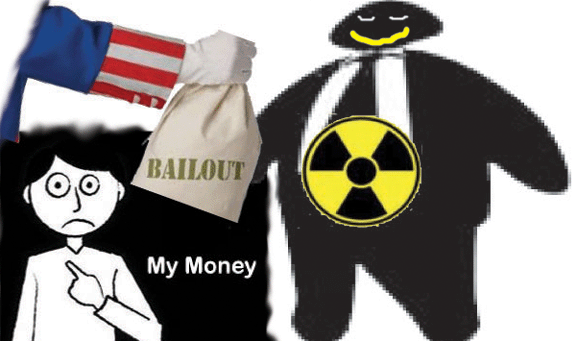
 There’s still time to say no to Ohio’s costly nuclear bailout https://www.crainscleveland.com/opinion/personal-view-theres-still-time-say-no-ohios-costly-nuclear-bailout Jeff Barge 21 July 19, There may have been a case once for Ohio to subsidize FirstEnergy Solutions’ two nuclear plants in Ohio. But the company’s deceit and dishonesty in providing false and misleading information to the state legislature and the public now make that virtually impossible. That may be why the bailout failed to pass as scheduled on July 17 by one vote and may not be brought up again until Aug. 1.
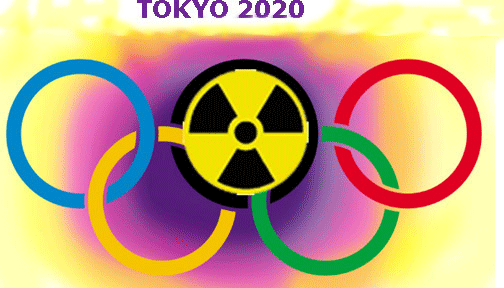
The Olympic Games and the second Tokai Nuclear Plant,
 I am revealing some meaningful facts about Fukushima.
 3.On June 25,three days before the G 20 Summit in Osaka,white smoke was
The unpleasant reality behind the Tokyo Olympics’ shimmering curtain of propaganda

Is Tokyo Ready for the Olympic Juggernaut? Tokyo says that it’s ready to host the 2020 Olympics. The early numbers—and quality of Olympic leadership—are not encouraging. The Nation, By Dave Zirin and Jules Boykoff 18 July 19
Dave ZirinTWITTERDave Zirin is the sports editor of The Nation.
Secret Locations of U.S. nuclear weapons in Europe revealed

Leaked NATO report reveals where USA is hiding SIX nuclear weapons – and they’re in EUROPE https://www.express.co.uk/news/world/1155277/us-nuclear-weapons-map-secret-locations-nukes-europe-nato-news
THE SECRET locations of US nuclear weapons in Europe were been accidentally revealed in a NATO-affiliated report. By KATE WHITFIELD, , Jul 19, 2019 The document was titled “A new era for nuclear deterrence? Modernisation, arms control and allied nuclear forces”. It was first published in April and written by a Canadian senator for the Defense and Security Committee of the NATO Parliamentary Assembly. The document, which has now been deleted, seems to confirm long-held suspicions that US nuclear weapons are being stored in Europe.
The document referred to the sites of roughly 150 American nuclear weapons.
Locations in Belgium, Germany, Italy, the Netherlands and Turkey were identified.
The report was seen by Belgian newspaper De Morgen, which said: “These bombs are stored at six US and European bases — Kleine Brogel in Belgium, Büchel in Germany, Aviano and Ghedi-Torre in Italy, Volkel in The Netherlands, and Incirlik in Turkey.”
The document did not attribute this information to any source.
In the final version of the document, published last week, the reference was removed.
The latest version of the report instead makes reference to aircraft capable of carrying nuclear weapons.
The report says: “The European Allies often cited as operating such aircraft are Belgium, Germany, Italy, The Netherlands, and Turkey.”
A NATO official told The Washington Post the report was “not an official Nato document” and pointed out that it was written by the alliance’s parliamentary assembly.
The official added: “We do not comment on the details of Nato’s nuclear posture.”
While the storage of US nuclear weapons has long been suspected, many are viewing this as confirmation.
De Morgen’s report was headlined: “Finally in black and white: There are American nuclear weapons in Belgium.”
And Dutch broadcaster RTL News said: “NATO reveals the Netherlands’ worst-kept secret.”
Kingston Reif, director for disarmament and threat-reduction policy at the Arms Control Association, said the presence of US nuclear weapons in Europe was “no surprise”.
He added: “This has long been fairly open knowledge.”
The presence of the weapons resulted from an agreement reached in the 1960s and is thought to be a relic of the Cold War era.
But in recent years, fears have grown over whether parts of the continent, such as Turkey, are the best place to store them in the wake of terrorist extremism in the region.
How many nuclear weapons does the USA have?
The US was the first country to manufacture nuclear weapons and, to date, is the only country to have used them in combat – in the Hiroshima and Nagasaki bombings in World War II.
Since 1945, the United States produced more than 70,000 nuclear warheads – more than all other nuclear states combined.
At its peak in 1967, the US military had a stockpile of 31,255 warheads.
Now, the most recent figures suggest the US has an estimated 4,018 nuclear weapons in either deployment or storage.
The first victims of the first atomic explosion might have been American children.
After a nearly half a century of denial, the US Department of Energy concluded in 2006, “the Trinity test also posed the most significant hazard of the entire Manhattan Project.
Ionizing radiation is especially damaging to dividing cells, so the developing infant, both before and after birth, is susceptible to radiation damage, as Alice Stewart, an epidemiologist who first demonstrated the link between X-rays of pregnant women and disease in their children,[12] first warned in 1956.[13]This damage may be seen years later with the development of leukemia and other cancers in children exposed in utero to ionizing radiation, as Stewart and others confirmed in subsequent studies.[14] By 1958, the United Nations Scientific Committee on the Effects of Atomic Radiation recognized that, in the short term, radiation damage can be reflected in fetal and infant deaths.[15]
Fallout protection was not a priority for the Trinity explosion.
The current body of historical evidence of harm, negligence, and deception—especially the evidence of increased infant death following the first nuclear explosion—should be more than enough for long overdue justice for the people in New Mexico who were downwind of Trinity.
Is cancer the legacy left by world’s first atomic bomb test?
Trinity: “The most significant hazard of the entire Manhattan Project” https://thebulletin.org/2019/07/trinity-the-most-significant-hazard-of-the-entire-manhattan-project/?utm_source=Newsletter&utm_medium=Email&utm_campaign=Newsletter072219&utm_content=Nuclear_Trinity_071519
By Kathleen M. Tucker, Robert Alvarez, July 15, 2019 For the past several years, the controversy over radioactive fallout from the world’s first atomic bomb explosion in Alamogordo, New Mexico on July 16, 1945—code-named Trinity—has intensified. Evidence collected by the New Mexico health department but ignored for some 70 years shows an unusually high rate of infant mortality in New Mexico counties downwind from the explosion and raises a serious question whether or not the first victims of the first atomic explosion might have been American children. Even though the first scientifically credible warnings about the hazards of radioactive fallout from a nuclear explosion had been made by 1940, historical records indicate a fallout team was not established until less than a month before the Trinity test, a hasty effort motivated primarily by concern over legal liability.
In October 1947, a local health care provider raised an alarm about infant deaths downwind of the Trinity test, bringing it to the attention of radiation safety experts working for the US nuclear weapons program. Their response misrepresented New Mexico’s then-unpublished data on health effects. Continue reading
Private Notes Show How Big Oil Spread Climate Science Denial
The ‘Historical Jigsaw of Climate Deception’: Private Notes Show How Big Oil Spread Climate Science Denial DeSmogBlog, By Mat Hope • Thursday, July 11, 2019 We’ve all heard the dodgy arguments: ‘the science is uncertain’, ‘climate change is natural, not down to humans’, ‘science has been hijacked by politics’… Now a new cache of documents sheds light on the origins of the disinformation.
In another verse of a now familiar refrain, a fossil fuel industry group in the 1990s publicly promoted arguments to undermine confidence in climate science while internally acknowledging their products were driving up temperatures.
A cache of meeting minutes, briefings, and emails uncovered by the Climate Investigations Center shows how industry group the Global Climate Coalition (GCC) used its financial clout and political connections to cast doubt on mainstream climate science until its disbandment in 2002. The GCC would for decades cast doubt on the veracity of climate science and strategically spread the message that the UN Intergovernmental Panel on Climate Change (IPCC) was a politicised body, to discourage regulatory reform that would hit coalition members’ profits.
The documents show that the group, which counted fossil fuel giants Exxon, Shell, and Peabody among its members, knowingly pushed misinformation on climate change even as the GCC internally acknowledged humans’ impact on the climate “cannot be denied”. Some of those same companies have been the recent targets of lawsuits seeking damages for climate change impacts.
“These documents are another stain on the fossil fuel industry’s track-record as a disingenuous rogue agent in climate science and politics,” Geoffrey Supran, a Postdoctoral Fellow at Harvard University researching climate science denial, told DeSmog. “They further illustrate the sophisticated combination of inside- and outside-lobbying used by the fossil fuel industry to protect their status quo business operations.”
Peddling Denial
Within the GCC, the Science and Technology Assessment Committee (STAC) took responsibility for assessing contemporary climate science and formulating strategic arguments to undermine it. The STAC was chaired by Mobil Oil’s Lenny Bernstein. Mobil, Exxon, and Texaco (now part of Chevron) all contributed five staffers to the committee.
An internal 1994 document outlining “issues and options” for the GCC to consider regarding “potential global climate change” shows the group’s outright climate science denial.
The document concludes that “the claim that serious impacts from climate change have occurred or will occur in the future has not been proven” and “consequently, there is no basis for the design of effective policy action that would eliminate the potential for climate change.”
In the same document, the GCC cites the work of infamous academics known for spreading climate science denial including Richard Linzen, Patrick Michaels, and Robert Balling. The document asserts that these academics’ arguments disputing mainstream climate science “have received far less attention than they deserve”. ……….
Politicisation
The GCC’s disinformation strategy extended beyond casting aspersions on the science to the process of gathering evidence for the major IPCC reports, the documents show.
Porter Womeldorff, an Illinois Power Company employee and co-chair of the STAC, suggested the group focus on the politicisation of the IPCC process.
And that’s exactly what the GCC did. In an internal document from 1996, the GCC boasted that its criticism of the IPCC’s processes had been picked up more widely by the mainstream media:
“Publications which have joined in questioning the IPCC approach to conforming technical reports to summaries include the NYTimes, Wall St. Journal, Energy Daily, and Nature.”
This followed a 1995 report that noted with glee a Nature editorial taking aim at the IPCC for a press-release that the erstwhile journal considered to be needlessly attention seeking.
Harvard’s Supran, who recently testified to the European Parliament about Exxon’s history of climate science denial, told DeSmog that the documents “help fill in pieces of the historical jigsaw of climate deception by the fossil fuel industry”.
“History teaches us that when it comes to the fossil fuel industry’s rhetoric on climate change and energy, we take them at face value at our peril.” https://www.desmogblog.com/2019/07/11/historical-deception-global-climate-coalition-science-denial?utm_source=desmog%20%20weekly%20newsletter
Illegal transport of thorium at Georgia’s border with Armenia
Georgia intercepts radioactive substance at border with Armenia http://www.xinhuanet.com/english/2019-07/15/c_138229300.htm Source: Xinhua Editor: yan TBILISI, July 15 – Georgia on Monday detained an Armenian citizen who was charged with illegally transporting the radioactive substance Thorium at the border with Armenia.
According to the Georgian State Security Service, the radioactive substance was intercepted at the Sadakhlo checkpoint when the suspect in a mini-bus was inspected.
The total weight of the packages carried by the suspect was 71.63 kg, and they contained radioactive isotope Thorium 232, which is a nuclear material and poses a threat to life and health.
The mini-bus was moving from Armenia to Russia through Georgia.
If convicted, the detainee will face 5 to 10 years in prison.
For 6 years, Potentially Dangerous Nuclear Waste Was Shipped to Nevada as Low Level Wastes
DOE Was Shipping Potentially Dangerous Nuclear Waste To Nevada Site For Years
Energy officials told Gov. Steve Sisolak that the Nevada National Security Site received shipments from 2013 to 2018 that could contain “reactive” material. By Sanjana Karanth, 12 July 19
The U.S. Department of Energy shipped potentially dangerous nuclear material incorrectly labeled as low-level radioactive waste into Nevada for several years, the state’s governor announced.
A statement from Nevada Gov. Steve Sisolak (D) on Wednesday said the department sent a total of 32 shipments to the Nevada National Security Site between 2013 and 2018 that were supposed to be low-level radioactive waste from a facility in Tennessee. (The DOE told the Las Vegas Review-Journal later on Wednesday that there were actually nine shipments that had 32 containers.)
But DOE Deputy Secretary Daniel Brouillette told Sisolak on July 3 that some of those shipments may have included “reactive” material, which can release large amounts of thermodynamic energy.
Sisolak’s office said DOE officials have not confirmed that the shipments definitely contained reactive materials, which he said “would trigger additional safety concerns,” but the department did confirm Wednesday to the Review-Journal that the shipments were not in compliance with the security site’s waste acceptance criteria.
On July 5, Sisolak and Sens. Catherine Cortez Masto (D) and Jacky Rosen (D) sent a letter to Energy Secretary Rick Perry citing the risks posed to Nevada’s residents and environment and demanding that the DOE immediately correct the waste disposal mistake and create new procedures to ensure it doesn’t happen again.
“These egregious acts ― whether acts of negligence or indicative of something else ― are unconscionable and have potentially put the health and safety of Nevadans and our environment at unacceptable risk,” the letter stated.
The security site has been a place to permanently dispose of what the DOE categorizes as low-level radioactive waste, which can include materials like rags, construction debris and other equipment exposed to radioactive material. The site also takes in some forms of “mixed low-level waste,” which can contain some hazardous waste such as garbage and sludge. The governor’s office said mixed low-level waste is more strictly regulated and requires treatment prior to disposal and a more protective disposal method than low-level waste.
The shipments in question were not properly labeled to indicate which materials were low-level waste and which were more dangerous.
Federal officials, including from the National Nuclear Security Administration, gave an in-person briefing to Sisolak on Tuesday regarding the department’s findings and proposed response. During the briefing, the governor referred to an incident last year in which the DOE shipped half a metric ton of weapons-grade plutonium to the same security site and didn’t give notice until months later.
Yet again, the DOE has violated its mission, broken Nevadans’ trust and failed to follow its own compliance procedures,” Cortez Masto and Rosen said in a joint statement Wednesday. “We intend to immediately determine whether the mixed waste shipped to Nevada poses a hazard to the health and safety of Nevadans and will take every action necessary to hold the DOE accountable.”
DOE officials told the Review-Journal that they are launching an internal investigation to figure out how the shipments were miscategorized for six years, and will temporarily suspend all planned future shipments from the Tennessee facility.
The nuclear industry cries poor, wants bailouts, BUT LOOK WHAT THEY PAY THEIR EXECUTIVES!

Christine Layman . Three Mile Island Survivors (Facebook) 6 July 19, The PA nuclear industry claims it needs a $500 million dollar a year bailout because they are unable to be competitive in the market place and yet, First Energy paid their top 7 executives more than $25 million combined in 2018 alone. Sounds like they are making plenty of money to me!
SAY NO TO ANY NUCLEAR BAILOUT IN PA!
7 First Energy executives were paid more than $25 million in 2018
1 This Month
Chernobyl: The Lost Tapes – A good documentary on Chernobyl on SBS available On Demand for the next 3 weeks– https://www.sbs.com.au/ondemand/tv-program/chernobyl-the-lost-tapes/2352741955560

of the week–London Campaign for Nuclear Disarmament

Tell the Ukrainian Government to Drop Prosecution of Peace Activist Yurii Sheliazhenko
To see nuclear-related stories in greater depth and intensity – go to https://nuclearinformation.wordpress.com
-
Archives
- April 2026 (152)
- March 2026 (251)
- February 2026 (268)
- January 2026 (308)
- December 2025 (358)
- November 2025 (359)
- October 2025 (376)
- September 2025 (257)
- August 2025 (319)
- July 2025 (230)
- June 2025 (348)
- May 2025 (261)
-
Categories
- 1
- 1 NUCLEAR ISSUES
- business and costs
- climate change
- culture and arts
- ENERGY
- environment
- health
- history
- indigenous issues
- Legal
- marketing of nuclear
- media
- opposition to nuclear
- PERSONAL STORIES
- politics
- politics international
- Religion and ethics
- safety
- secrets,lies and civil liberties
- spinbuster
- technology
- Uranium
- wastes
- weapons and war
- Women
- 2 WORLD
- ACTION
- AFRICA
- Atrocities
- AUSTRALIA
- Christina's notes
- Christina's themes
- culture and arts
- Events
- Fuk 2022
- Fuk 2023
- Fukushima 2017
- Fukushima 2018
- fukushima 2019
- Fukushima 2020
- Fukushima 2021
- general
- global warming
- Humour (God we need it)
- Nuclear
- RARE EARTHS
- Reference
- resources – print
- Resources -audiovicual
- Weekly Newsletter
- World
- World Nuclear
- YouTube
-
RSS
Entries RSS
Comments RSS
 nuclear-news