Notes On Bondi Beach And Free Speech
Caitlin Johnstone, Dec 22, 2025, https://www.caitlinjohnst.one/p/notes-on-bondi-beach-and-free-speech?utm_source=post-email-title&publication_id=82124&post_id=182280999&utm_campaign=email-post-title&isFreemail=true&r=1ise1&triedRedirect=true&utm_medium=email
The dumbest thing we are being asked to believe today is that pro-Palestinian protests caused the Bondi shooting. It’s self-evidently moronic. No one sincerely believes it. They’re just pretending to believe it to get protests banned and criticism of Israel outlawed.
Nobody actually believes pro-Palestine protests caused the Bondi shooting. They’re just pretending to believe that to promote the interests of a genocidal apartheid state.
Nobody actually believes “globalize the intifada” means “kill all Jews”. They’re just pretending to believe that to promote the interests of a genocidal apartheid state.
Nobody actually believes pro-Palestine demonstrations are “hate marches” or that pro-Palestine speech is “hate speech”. They’re just pretending to believe that to promote the interests of a genocidal apartheid state.
Nobody actually believes there’s a soaring epidemic of antisemitism in our society that is caused by anti-genocide demonstrations. They’re just pretending to believe that to promote the interests of a genocidal apartheid state.
Nobody actually believes opposing the state of Israel is the same as hating Jews. They’re just pretending to believe that to promote the interests of a genocidal apartheid state.
Israel supporters are liars and manipulators. They support genocide and apartheid. Of course they will lie about what they believe, and pretend to think things that they don’t actually think. They’re defending a mass atrocity that can only be defended using lies. They’re bad people. Bad people do bad things
It’s crazy how the Bondi shooters got radicalized by the anti-genocide protests from 2023 to 2025 and then invented a time machine and went back to 2019 to join ISIS.
That’s the claim that’s being made when people say the mass shooting in Sydney was caused by pro-Palestine protests, you know. In 2019 Naveed Akram was on an Australian intelligence watch list because of his ties to an Islamic State terror cell, so the claim that the Gaza protests caused or incited the shooting necessarily requires an element of time travel. Call their story “The Terrorists and the Time Machine”.
We’re being asked to believe that ISIS were a bunch of cuddly wuddly snuggle bears until Australians started protesting an active genocide.
Continue readingIf You’re Not Free To Oppose A Genocide, Your Society Is Not Free
Caitlin Johnstone, Dec 21, 2025, https://www.caitlinjohnst.one/p/if-youre-not-free-to-oppose-a-genocide?utm_source=post-email-title&publication_id=82124&post_id=182228375&utm_campaign=email-post-title&isFreemail=true&r=1ise1&triedRedirect=true&utm_medium=email
If the right to free speech does not include the right to oppose an active genocide using strong and unmitigated language, then there is no freedom of speech.
This is exactly the sort of thing that freedom of speech is intended for: times when the government is doing something wrong which needs to be ferociously opposed. That’s the primary reason it’s an enshrined value in our society. Freedom of speech is for holding the powerful to account.
If you only have freedom of speech when you’re agreeing with your government and saying nothing which inconveniences the powerful, then Saudi Arabia has free speech. Every tyrannical regime that has ever existed has had freedom of speech by those standards. You don’t measure a society’s freedom by how much its citizenry are allowed to agree with their government, you measure it by how much they’re allowed to disagree.
And right now we are being told we’re not allowed to disagree. We’re being told the protests need to stop, the anti-genocide chants need to be criminalized, and everyone needs to shut up and obey — all justified by the completely baseless narrative that the words and actions of pro-Palestinian activists were somehow responsible a terrible massacre that was committed in Sydney last week.
And these policies just so happen to serve the interests of the very same western powers whose genocide-enabling actions were being forcefully opposed these last two years. Government officials constantly being protested and questioned about their facilitation of Israel’s genocidal atrocities. Politicians who are consistently confronted by anti-genocide demonstrators during their public appearances. Wealthy arms manufacturers whose profit margins are being harmed by direct action from activist groups. Plutocratic media institutions who are becoming more and more discredited in the public eye as the Gaza holocaust exposes them all. Billionaires whose empires are built upon the political status quo that gave rise to the genocide in question.
If the powerful are shutting down speech rights to advance their own interests in your society, then your society is not meaningfully different than the dictatorships the western world tries to contrast itself with. All our stories about living in a free society have been just that: stories. Fairy tales.
That’s what they’re telling us with this mad rush to stomp out freedom of speech this past week. They are telling us that we do not live in the kind of society we were taught about in school. They are telling us that the only reason we were allowed to speak as we pleased in the years leading up to the Gaza genocide is because we were a bunch of compliant sheep who were not meaningfully challenging the interests of the powerful, and now that we are meaningfully challenging them the facade of freedom and democracy is falling away.
As Frank Zappa once said, “The illusion of freedom will continue as long as it’s profitable to continue the illusion. At the point where the illusion becomes too expensive to maintain, they will just take down the scenery, they will pull back the curtains, they will move the tables and chairs out of the way and you will see the brick wall at the back of the theater.”
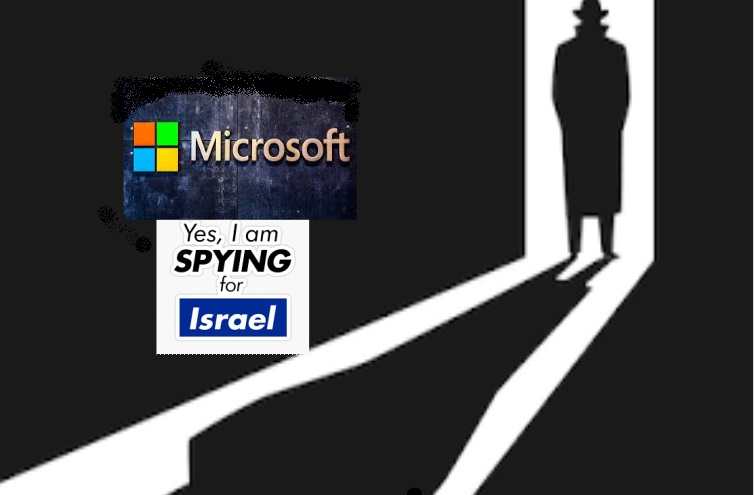
Hi-tech holocaust: How Microsoft aids the Gaza genocide
| Alan Macleod, MintPress News, 2025-10-27 |
Israel’s genocide is being powered by Microsoft.
From creating a massive digital dragnet, aiding in the production of A.I.-generated kill lists, hiring hundreds of Israeli spies to run its internal affairs, and suppressing figures opposing the slaughter, the Seattle-based tech corporation has played a key role in the violence.
MintPress has detailed the deep collaboration between the Israeli Defense Forces (IDF) and Amazon, Google, TikTok, Apple, Palantir, and Oracle, but Microsoft’s relationship with the government and armed forces of Israel is potentially the closest,leading then-CEO Steve Ballmer tostatethat “Microsoft is as much an Israeli company as an American company.” MintPress explores the decades-long partnership between Microsoft and Israel, and the employees trying to break that marriage from the inside.
Turning Code Into Carnage
“Among U.S. tech firms,” the Associated Press wrote, “Microsoft has had an especially close relationship with the Israeli military.” That relationship, it notes, massively expanded after the October 7, 2023, attacks.
In the months following October 7, the IDF’s usage of Microsoft’s Azure cloud service surged more than 200-fold. The amount of data from surveillance cameras, drones, checkpoints, biometric scanners, phone calls, and intercepted Palestinian personal data stored by the IDF on Microsoft servers doubledin the next nine months,reaching13.6 petabytes by July 2024 – equivalent to 23,000 years of audio, or seven trillion pages of text.
The point of all this was to create an enormous digital dragnet, where Palestinians’ every move, word, and keystroke was recorded in monitored in the greatest and most dystopian digital dragnet ever created. In the words of Yossi Sariel, the head of Unit 8200, the IDF’s surveillance division, the plan was to “track everyone, all of the time.”
Sariel argued that big data was the solution to Israel’s problems, envisaging a future where Israel intercepted and stored “a million calls an hour” from Palestine, and used A.I. to search for keywords and identify threats.
There was no way, however, that Israel could do this alone, as it did not possess the expertise or anything like the storage capacity needed for such a project. To this end, Sarieltravelledto Seattle in 2021 to meet with Microsoft CEO Satya Nadella, to pitch him on the surveillance partnership whereby Microsoft would build Unit 8200 a customized and segregated area within its Azure platform.
The Israeli military uses Microsoft Azure to transcribe, translate, and otherwise process intelligence garnered via mass surveillance, which is then linked to Israel’s A.I.-based weapons systems.
The largest and most controversial organization within the Israeli military, Unit 8200 has long been the centerpiece of Israel’s hi-tech spying operation. The unit is dedicated to surveillance, cyberwarfare, and online manipulation operations. Last year, it carried out the Lebanese Pager Attack, an act that wounded thousands of civilians. Unit 8200 agents were also behind many of the most infamous international spyware and hacking cases, including the Pegasus software, that was used to surveil tens of thousands of the world’s most prominent political leaders, journalists, and human rights campaigners.
Sariel’s policy of mass surveillance changed the internal attitude at Unit 8200. “Suddenly the entire public was our enemy,”said one officer. The gargantuan trove of information compiled in Microsoft Azure amounted to a vast repository on the entire Palestinian population – a giant database of kompromat that is used to extort and blackmail the region’s indigenous people. If a person was secretly gay, or cheating on their spouse, for example, that information was readily available to Unit 8200 agents, who would then use it to turn their targets into informants. One former Unit 8200 member revealed that, as part of their training, they were made to memorize different Arabic slang words for “gay”, so that they could identify them in conversations.
Palestinian man passes through a biometric gate at the Qalandia crossing near JerusalemThe cloud database is also used to provide after-the-fact justification for arrests of innocent peoples. Off-hand, out-of-context comments made years agocan be used to portray anyone as a member of Hamas, Palestinian Islamic Jihad, or another armed resistance force.
…………………………………………………………………………………………….Of course, the vast majority of the deaths have been civilians – around 70% were women and children. But Israeli officials can also go back after the fact and scour their digital dragnet to justify any killing, finding connections or any other incriminating evidence. A senior Israeli military officer described the cloud technology as “a weapon in every sense of the word.” Other officials, however, have gone so far as to raise concerns that Israel’s overreliance on Microsoft as a service is a strategic vulnerability that should be corrected.
Microsoft Sees No Evil, Only Profits
Throughout all this, Microsoft has protested its innocence – and ignorance – of Israeli crimes. A spokesperson for the company stated:
“At no time during this engagement or since that time has Microsoft been aware of the surveillance of civilians or collection of their cell phone conversations using Microsoft’s services, including through the external review it commissioned.
“Any allegations about Microsoft leadership involvement and support of this project … are false.”
But leaked documents suggest Microsoft engineers understood exactly what sort of data was being stored in Azure, and what their clients hoped to achieve……………………………………………………………………………………………………………………………………………
Corporate Zionism: Roots in Israel’s War Economy
The Azure/IDF partnership is the result of a decades-long relationship between Microsoft and the State of Israel, one which has helped both entities. Microsoft established its first branch in Israel in 1989, and two years later, opened a research and development center in the city of Herzliya near Tel Aviv. The first of its kind outside the United States, the center has continued to expand, and now directly employs an estimated 2,700 workers.
Throughout the 1990s and 2000s, Microsoft began signing deals with Israeli firms and government agencies, and, by the 2010s, was an integral part of the Israeli security state. In 2017, it inked a lucrative contract with the Israeli Prison Service, providing cloud services to the entity responsible for jailing tens of thousands of Palestinians without trial. Today, it maintains over 600 active subscriptions with the Israeli military.
The company has also moved to acquire at least 21 Israeli tech firms. Among these include cybersecurity group, Hexadite, purchased for $100 million in 2017, and Oribi, a web analytics business founded by a former Israeli intelligence agent.
sectorEvery CEO in Microsoft’s history has flown to Israel to meet with Prime Minister Benjamin Netanyahu, including Bill Gates, who, in 2016, stated that hi-tech Israeli security was “improving the world.”
In short, Microsoft is a cornerstone of Israel’s burgeoning hi-tech sector, which accounts for 20% of the country’s GDP and more than half of its total exports. Netanyahu himself has showered praise on the corporation, describing the Microsoft/Israel partnership as “a marriage made in heaven.”
Others have been less enthused by this union.In June, Iran deliberately targeted a Microsoft center in Be’ersheva, carrying out a missile strike against it. Iran’s Revolutionary Guard justified their actions, citing Microsoft’s “close cooperation with the Israeli army and its being part of the system supporting aggression, and not just a civilian entity.” “The cyber area that was attacked also includes the residences of people from the espionage and artificial intelligence fields, who operate in direct cooperation with the enemy army and its security apparatus,” it concluded.
Cracking Down on Internal Resistance
A greater threat than Iran to Microsoft, however, is its own employees, hundreds of whom have organized to oppose its role in the genocide. Under the banner of No Azure for Apartheid, workers demand that:
Microsoft terminates all Azure contracts with Israel; disclose all ties to the Israeli national security state; publicly call for a ceasefire, and stop persecuting employees who speak out about the genocide.
This fourth demand is particularly salient, as the corporation has shown little to no tolerance for dissent. In October 2024, it fired two workers for organizing a vigil for Palestinian refugees at its corporate headquarters near Seattle………………………………………………………………………
Targeting Enemies
Company employees are far from the only target of Microsoft’s wrath, however. In May, Karim Khan, chief prosecutor of the International Criminal Court,announcedthat Microsoft had locked him out of his official ICC email account, just as he was formalizing charges against Netanyahu and other top Israeli leaders. For many, the timing was not a coincidence, but rather a message.
The British lawyer joined a vast plethora of Palestinians who have complained that Microsoft has terminated their accounts without warning. A BBC investigationfounddozens of Palestinians who, after attempting to use Microsoft services to contact relatives in Gaza, were banned for life. “I’ve had this Hotmail account for 15 years. They banned me for no reason, saying I violated their terms — what terms? Tell me,” one Palestinian-American user said.
IBM’s brand has forever been tarnished by its collaboration with Nazi Germany, aiding Hitler’s slaughter of millions of people. In much the same way, No Azure for Apartheid believe that Microsoft’s name will forever be linked with the destruction in Gaza. Microsoft has enjoyed a decades-long partnership with Israel, which has seen them slowly integrate themselves into the state, becoming a fundamental part of the system of oppression. From servicing the Israeli war machine, to hiring hundreds of Israeli spies to run its affairs, to cracking down on internal and external dissent against it, Israel’s mass killing of Palestinians is aided by Microsoft, whose technological prowess has helped Israel carry out the world’s first A.I.-powered genocide. https://www.mintpressnews.com/microsoft-israel-surveillance-azure-idf-gaza-genocide/290534/
The Australian Israel Lobby Is Flat-Out Saying They Want A Ban On Criticism Of Israel
Caitlin Johnstone, Dec 19, 2025, https://www.caitlinjohnst.one/p/the-australian-israel-lobby-is-flat?utm_source=post-email-title&publication_id=82124&post_id=182048888&utm_campaign=email-post-title&isFreemail=true&r=1ise1&triedRedirect=true&utm_medium=email
Australians everywhere should be made acutely aware that the Australian Israel lobby is now explicitly advocating a ban on criticism of the state of Israel.
Not just hate speech against Jews. Criticism of a foreign state. They’re coming right out and saying it.
During a recent public video conference with the American Jewish Committee on the topic of the Bondi Beach shooting, the Executive Manager of the Australia/Israel & Jewish Affairs Council (AIJAC) explicitly says he wants pro-Palestine protests to be banned by the Australian government, and that addressing the problem of antisemitic hate speech in Australia necessarily means stopping opposition to Israel’s actions.
About 40 minutes into the American Jewish Committee’s YouTube video of the conference, AIJAC Executive Manager Joel Burnie demands that the Australian government take much stronger action to regulate freedom of expression regarding Israel and Zionism in Australia, saying the following:
“They need to act swiftly. They need to go to their own arms and their own institutions: no longer can you refuse service to a Zionist. We are going to prosecute people that spew hate speech against your people, and we’re not going to tip toe around the fact that the central problem here is Israel. I for one as Jewish leader will no long talk about antisemitism in isolation from Israel, because it’s the rhetoric and language on Israel that motivates the people to come and kill us. Those two terrorists were motivated by what was going on in Israel, and that’s what motivated them to come and kill us. So if they had Israel on their minds why are we acting as though it has nothing to do with the vitriolic binary nature of the pro-Palestinian advocacy movement?”
Burnie goes on to say that he wants a complete government ban on protests against Israel’s abuses throughout the nation:
“So overnight what we want immediately if you ask any Jew, what do you want, what do you want? No more protests! No more protests! No more no-go zones for Jews. I can’t, for two years, cannot take my kids to downtown Melbourne for two years on a Sunday, because of the pro-Palestinian marches, because of the violent nature of them. No more! Because that is an acceptance of the connection between the two. And until the prime minister is willing to do that, this is gonna happen again.”
Burnie is lying here, for the record. Anyone who has gone to the pro-Palestine demonstrations in Melbourne as I have will tell you that the protests are not even slightly violent in nature, and that there are Jews among the demonstrators who actively make their presence known. Those demonstrations have never been “no-go zones for Jews”; Joel Burnie doesn’t want to take his kids to downtown Melbourne on a Sunday because he doesn’t want to expose them to ideas and information which reveal the depravity of his Israel-supporting worldview.
Australians would probably benefit from watching the entire hour-long video of the conference, whose contents I first saw spotlighted on Twitter by Information Liberation’s Chris Menahan.
Some other highlights:
At 4:20 Burnie says that part of his role at AIJAC is “to take non-Jewish politicians and journalists and diplomats and other Australian officials to Israel.”
At 14:00 Nick Aronson, who is Chief of Staff to Australia’s so-called “antisemitism envoy” Jillian Segal, regurgitates the bogus propaganda line we’ve been hearing nonstop from Israel apologists throughout the western political/media class, “the words globalise the intifada actually mean globalise the intifada; it means kill Jews wherever they are”. Pro-Israel spinmeisters have been spouting this line with creepy uniformity ever since the Bondi shooting in order to justify government crackdowns on freedom of speech and assembly to protect Israeli information interests.
At 15:00 Burnie says “the gloves are off now” with regard to stomping out free speech in Australia, saying Jews need stop saying “not all pro-Palestinian supporters are antisemitic”, saying “The pro-Palestinian movement, or the things within the pro-Palestinian movement that we all are exposed to in the public, is too binary: you’re pro-Palestinian so you need to be viciously anti-Israel.”
At 16:20 Burnie claims the Bondi shooting “happened because of the protest movements on the streets”, citing no evidence.
At 17:30 Burnie again makes his “no more protests” demand, saying “If I could ask for one thing of the government today: no more protests. If they cannot utilise language that is not inciting violence, that does not marginalise and dehumanise Jews, they have no right to be on the streets.”
At 21:10 Burnie complains that there haven’t been any prosecutions and arrests for antisemitic speech.
At 33:30 Burnie singles out Australian Muslims, saying “there needs to be more monitoring and surveillance of Islamic hate preachers” and an auditing of their education syllabus because of an “antisemitism problem amongst the Australian Muslim community.”
At 36:25 Burnie says Jillian Segal’s notorious speech-suppressing plan for fighting antisemitism in Australia “wasn’t about quashing debate on Israel, it just happens to be that language on Israel invading all of our social spaces in Australia have made this country a very unsafe space and place for Jews.”
At 46:00 Aronson says “there’s absolutely no doubt that people need to go to jail” for antisemitic hate speech in Australia, but says that won’t be enough to fix the problem because “we can always arrest more people, make no mistake, but you can never arrest enough, to be honest.”
At 54:00 Aronson speaks of the need for regulating online speech, complaining that “a number of the online platforms pride themselves on what they call free speech — obviously we would disagree; we would call it hate speech.” At 56:00 he says “we need to continue to put pressure on these platforms to understand the role they have to play in social cohesion, and how far short they are falling of community standards.”
This comes as the Australian government announces plans to ramp up its war on free speech in the wake of the Bondi Beach attack. We can be sure to see more authoritarian measures rolled out in the weeks to come as Israel’s supporters seize on this opportunity to advance the information interests of a genocidal apartheid state.
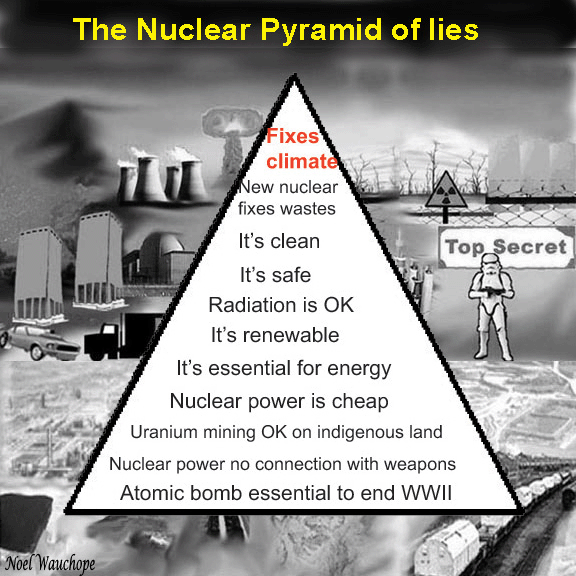
CLEAN? -WHAT A LIE! NIA welcomes first-ever nuclear appointment to Government’s Clean? Power Advisory Commission.
Sizewell C’s Julia Pyke brings expertise in delivering major infrastructure projects and effective community engagement
The Nuclear Industry Association has welcomed the appointment of Julia Pyke, Co-Managing Director of Sizewell C, as one of the UK Government’s eight new Clean Power 2030 Advisory Commissioners – marking the first time somebody with significant nuclear experience has been appointed to the Commission.
The appointment recognises the vital role nuclear power plays in delivering secure, reliable and low-carbon electricity, and ensures nuclear expertise is at the heart of advice shaping the UK’s clean power future.
Tom Greatrex, Chief Executive of the Nuclear Industry Association, said:
“Julia Pyke’s appointment is a hugely positive step and a clear recognition that nuclear must be central to delivering the UK’s clean power mission. The fact that this is the first time a nuclear leader has been appointed to the Commission ensures that decisions on the UK’s energy future are informed by the realities of building and operating clean, reliable power at scale.”
The Lobby Is Milking the Bondi Beach Attack To Silence Critics of Israel’s Genocide
Jonathon Cook. December 16, 2025
It is years of dedicated work by the Israel lobby that has ensured the mass murder of Palestinians is viewed by governments, the media and parts of the Jewish community as entirely legitimate
I, for one, am struggling to stomach the spew of hypocrisy from pro-Israel groups like the Community Security Trust and its policy director, Dave Rich, in the wake of Sunday’s Bondi Beach attack.
Establishment media, on the other hand, appear to have a bottomless appetite for efforts by Israel apologists to exploit the genuine fear and grief of the Jewish community to advance a political agenda – one designed to silence criticism of Israel over its two-year slaughter and maiming of Palestinian children in Gaza.
Predictably, the supposedly liberal Guardian once again gave Rich a prominent slot in its comment pages, this time to spin the attack in Sydney into a demand for silencing opposition to Israel’s genocide.
Here are extracts from Rich’s piece in italics, followed by my observations. His all-too-obvious double standards and his glaring misdirection ploys should have disqualified this piece from publication. But the British media simply can’t get enough of this kind of bilge.
Rich: “The mobile phone footage of two gunmen calmly taking aim at families enjoying a Hanukah party is utterly chilling. It takes a special kind of dehumanisation, an ideology of pure hatred and self-righteous conviction, to do that.”
If Rich is so troubled by issues of dehumanisation, why has he remained so steadfastly mute about the long and utterly chilling dehumanisation of Palestinians by Israel and by its lobby groups, including his own organisation? Remember, Israeli leaders called the Palestinians “human animals”. It is decades of that kind of dehumanisation that laid the ground for Israel’s genocide. It is precisely because of such dehumanisation that the live-streamed horrors of the past two years made barely any impact on the Israeli public or on opinion among Israel’s supporters.
The truth is it is Rich and his fellow pro-Israel lobbyists who are the ones in the grip of an “ideology of pure hatred” – one that chooses to excuse the mass murder of children when they are Palestinian, blown to pieces and starved for months on end by the very state he identifies with.
Rich: “The whole basis of western liberal democracy, the belief in shared values within a diverse society, is endangered by these attacks.”
No, it’s not the Bondi Beach attack that has endangered “western liberal democracy”. That was irreversibly hollowed out when western leaders chose to actively collude in Israel’s genocide and defy the rulings of the world’s most respected legal institutions, the International Court of Justice and the International Criminal Court. Western liberal democracy was hollowed out when these leaders chose to side with Israeli prime minister Benjamin Netanyahu and prioritise his exterminationist agenda over the rule of law………………………………………………………………………………………………………………………………………….
The real emergency is a rampant anti-Palestinian racism that has utterly normalised genocide and been given institutional support across the West. It is anti-Palestinian racism, not “antisemitism”, that is the consequence of “two years of turning a blind eye, taking the easy path and ignoring the warnings”. Make no mistake: alongside the grief and the defiance, people with a conscience are angry at the two-year genocide endorsed by our governments. And they have every right to be. https://www.jonathan-cook.net/blog/2025-12-16/bondi-beach-silence-critics-israel-genocide/
FBI Labels Antifa a Major Terror Threat, but Lawmakers Say Evidence Is Lacking as Trump’s Obsession Distracts From Far-Right Extremism
December 12, 2025, Joshua Scheer, https://scheerpost.com/2025/12/12/fbi-labels-antifa-a-major-terror-threat-but-lawmakers-say-evidence-is-lacking-as-trumps-obsession-distracts-from-far-right-extremism/
At a recent House Homeland Security Committee hearing, FBI official Michael Glasheen — operations director of the Bureau’s National Security Branch — described the anti-fascist movement antifa as one of the most significant domestic terrorism threats facing the United States, echoing a Trump executive order that designated antifa as a domestic terrorist organization.
But when lawmakers pressed him for specifics, Glasheen struggled to provide concrete evidence about where antifa is organized, how many members it has, or how its activities are tracked. He repeatedly described the situation as “fluid” and emphasized that investigations are ongoing. The exchange underscored deep partisan divisions in Congress over how domestic threats are identified, and raised broader questions about how law enforcement defines and responds to politically motivated violence — particularly given that antifa lacks formal leadership, structure or membership rolls.
Despite the lack of clear data, Glasheen maintained that antifa remains the agency’s “primary concern” and “the most immediate violent threat that we’re facing.”
Democratic Rep. Bennie Thompson challenged those claims directly: “Where in the United States does antifa exist? What does that mean?” he asked. “We’re trying to get information. You said antifa is a terrorist organization. Tell us, as a committee, how did you come to that? Do they exist? How many members do they have in the United States as of right now?”
“Well, that’s very fluid,” Glasheen said.
“Sir, I just want you to tell us — if you said antifa is the No. 1 domestic terrorist organization operating in the United States, I just need to know where they are … how many people have you identified with the FBI that antifa is made of,” Thompson asked.
“Sir, you wouldn’t come to this committee to say something that you can’t prove,” Thompson said to Glasheen. “I know you wouldn’t do that. But you did.
Trump’s obsession with antifa is well-known, even though the evidence has long shown that the more significant threat comes from right-wing–aligned groups rather than activists who identify as anti-fascist. It’s not hard to understand why this president fixates on antifa, but the disconnect between his rhetoric and documented threats has been clear for years. The Intercept’s reporting — based on leaked documents from 2020 — “But while the White House beat the drum for a crackdown on a leaderless movement on the left, law enforcement offices across the country were sharing detailed reports of far-right extremists seeking to attack the protesters and police during the country’s historic demonstrations, a trove of newly leaked documents reveals.”
So there is a threat, just not from the group Trump focuses on. What this designation does, however, is clearly silence critics of his administration, using the “terror” label as a tool — especially if he can find a way to tie someone to foreign support
Because U.S. law does not criminalize membership in domestic terror groups, experts warn that the Trump administration could attempt to target American citizens under existing laws that apply to foreign organizations. Shayana Kadidal, an attorney at the Center for Constitutional Rights, told The Intercept that regulations allow the government to link domestic groups to foreign entities already designated as terrorist organizations, potentially creating legal obstacles for ordinary Americans. Kadidal highlighted past cases in which U.S. citizens were branded “specially designated terrorists” for alleged ties to foreign groups, which severely restricted their ability to conduct normal financial transactions.
Civil liberties advocates also caution that Supreme Court precedent allows individuals to be charged with providing “material support” to foreign terrorist organizations based on speech acts alone — a pathway the administration could exploit. One immediate consequence of this approach is the “chilling effect,” where protesters may hesitate to participate due to legal uncertainty, effectively discouraging civic engagement and dissent.
In the larger context of extremism, the focus on hunting antifa is largely a red herring, distracting from the far more serious threat posed by right-wing and white supremacist groups. We turn to Luke Baumgartner, a research fellow with George Washington University’s Program on Extremism discussing what the we are all taking about, from an interview on PBS :
“I would classify it more as a political scapegoat, honestly. There have been incidents of political violence linked to far left extremists in the U.S. in recent years, but the overwhelming majority of the data points towards far right extremism being a much more serious threat to national security.”
He continued, noting that any protest by the left — whether it’s No Kings or Black Lives Matter — is immediately labeled “antifa.” This represents a clear abuse of Trump’s power in his broader effort to crush the left and silence groups that challenge his warped worldview.
Trump did this with Black Lives Matter back in 2020 with the violent clearing of peaceful Black Lives Matter protesters from Lafayette Square — simply so he could stage a photo op. It remains one of the clearest demonstrations of state power being used to suppress constitutional rights in modern American history.
That wasn’t an anomaly, but part of a longstanding pattern in which protests are met with force, intimidation, and the machinery of government turned against them. Now, feeling more empowered than ever, the president appears to be attempting the same tactics under the guise of combating “terrorism,” despite evidence showing that left-wing movements are far less likely to pose the threats he claims to be targeting.
Needless to say, I’m glad that Bennie Thompson is still around and holding the line, but more action is needed to challenge what amounts to a high level of evil by some and foolishness by others and the belief that there is a real threat when, in reality, there is “no there there,” and that any supposed danger is merely a smokescreen.
Tony Blair’s digital ID dream, brought to you by Keir Starmer
Why is Britain’s PM set on introducing such a wildly unpopular policy as digital ID? Parliament debated the issue last night after a petition against the policy was signed by three million people. It’s a policy that has done the improbable job of uniting Nigel Farage, Jeremy Corbyn, Boris Johnson and Zack Polanski in opposition to the idea. In today’s column, Carole Cadwalladr joins the dots between Starmer’s policy and the Tony Blair Institute – and argues that the whole thing is a “techno-authoritarian’s wet dream”.
If Keir Starmer’s digital ID is the question, Tony Blair is the answer
The government’s wildly unpopular new policy is backed by Britain’s wildly unpopular former PM. It’s also a techno-authoritarian’s wet dream, argues Carole Cadwalladr
We live in polarising times. Britain is a nation united only by the occasional sporting fixture and intermittent bursts of outrage at the BBC. Yet somehow, Keir Starmer has achieved the impossible: he has announced new legislation so wildly unpopular that it has hit a mythical political g-spot, uniting not only Nigel Farage and Jeremy Corbyn, but even more miraculously, it’s brought together Jeremy Corbyn and Zarah Sultana.
The issue at stake is digital ID. And if it has so far passed you by, it’s not because you’ve failed to pay attention, it’s because digital ID is a political ghost, a phantom that appeared from nowhere and now looks set to haunt what remains of Starmer’s credibility.
This is a policy that wasn’t in the Labour Party’s manifesto, that no party faithful campaigned for and that no voters were told about on the doorstep. Instead, after some brief ground softening by pet journalists in friendly newspapers, it appeared out of almost nowhere in late September.
Last week, the Office of Budget Responsibility calculated that it would cost £1.8bn over the next three years (a figure rejected by the government, who also couldn’t point to any savings). And yesterday evening, parliament debated the issue, not because the government had tabled it but because it had no choice: it had been forced to hold a ‘Westminster Hall’ debate, triggered by a petition signed by nearly three million people.
The obvious question is why? Why is Starmer pinning his political reputation on such a manifestly unpopular policy? When he announced it, he claimed it would stop illegal immigration by putting an end to illegal work, an argument so hopeless that even he’s abandoned it (people who employ illegal immigrants being the least obvious demographic to abide by any new rules).
Instead he’s tweeted a series of increasingly desperate reasons, all of which have been comprehensively ratioed (ie comments vastly outnumbering shares) and community noted (fact-checked by users).
I wish there was a more complicated reason behind Starmer’s kamikaze moves. But there’s a perfectly straightforward explanation behind all of this: Tony Blair.
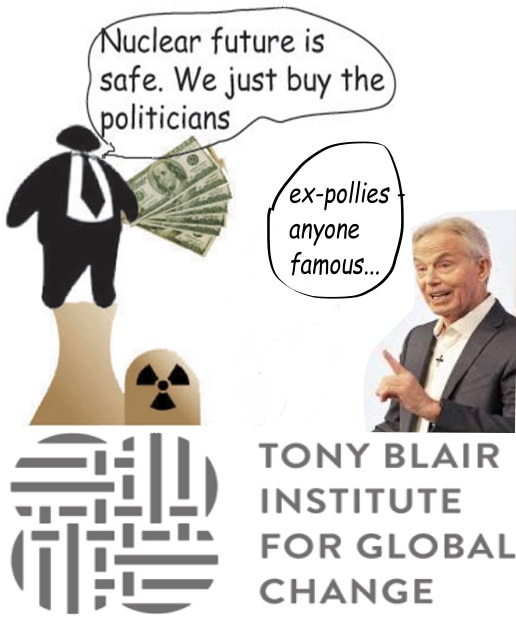
The Nerve has mapped the political landscape to illustrate who’s for digital ID and who’s against it. And what our research shows is a web of influence that radiates out from Tony Blair’s Institute for Global Change. In the ‘for’ camp is a grab bag of people who are mostly associated with Blair. And against it…is everyone else.
The pro-Digital ID list includes William Hague who authors reports, for which he’s presumably being paid, with Tony Blair for TBI, including one on Digital ID – a report forgot to mention in his tweet claiming the concept is simply ‘common sense’.
There are also historic allies like Peter Mandelson and those in Blair’s grace and favour, including various Labour proteges in key cabinet positions, Peter Kyle, Wes Streeting and publications that include the Times and the Observer.
This list of those against includes not just Farage, Corbyn and Sultana but also Zack Polanski, Ed Davey and Boris Johnson.
The fight has only just begun, but digital ID is already shaping up to resemble less a policy than a suicide vest Tony Blair has strapped to Starmer’s back.
Digital ID is Blair’s pet policy. Cut it in half and you’ll find the letters T-O-N-Y running through the middle. It’s lodged deep in Blair’s political psyche – his obsession with a national ID card goes back to the 90s – but it’s also now the basis for a technology that is a surveillance capitalist’s wet dream.
“The £260m Larry Ellison has put into Tony Blair’s institute is an extraordinary amount of money. It dwarves the budget and expenditure of other UK think tanks“
And while it may look like a 90s throwback, it cleaves closely to the 21st century business goals of Blair’s billionaire patron. That billionaire patron is Larry Ellison, the man who’s backed Blair’s ‘Institute for Global Change’ to the tune of £260m.
We chose to launch the Nerve with an investigation into Starmer, Blair and Ellison because if Larry Ellison is the eminence grise behind Blair, Blair is the eminence grise behind Starmer.
Ellison, the founder of Oracle, has emerged as one of the most powerful of the broligarchs, close to both Trump and Netanyahu. He’s poised to take over American TikTok with Rupert Murdoch, while his son has bought Paramount and installed a right-wing commentator as the head of CBS News. He’s also the most powerful man in Britain that most people have never heard of.
The £260m he’s put into Tony Blair’s institute is an extraordinary amount of money by British standards. It dwarves the budget and expenditure of other UK think tanks. Digital ID is only the latest policy that’s been incubated in the steel and glass central London offices that seemingly operate a revolving door between TBI and the Starmer government, all closely align with Ellison’s.
Nor is TBI Ellison’s only UK venture. He’s also funded the Ellison Institute of Technology, a research institute at Oxford University that includes the life sciences, and a nationwide centralised database that incorporates health and other data that could have huge research possibilities.
Data is the raw fuel of AI foundation models and our personal data, the most intimate facts about us, is the most valuable data of all. (Especially to a man like Ellison who’s obsessed with ageing and is funding health research that he hopes will extend human life, including importantly his own.) Some of the worst companies on the planet will seek to exploit that data and digital ID is an irreversible step: a genie that once out of the bottle, is never going back.
It’s the techno-authoritarian possibilities of a centralised database that’s alarmed both the libertarian wing of the Conservative and Reform parties, spearheaded by David Davis, but also tech and press freedom organisations, including the Electronic Freedom Foundation, Open Rights Group, Big Brother Watch and Article 19. It’s not hyperbole to say that creating a centralised database is what the Stasi would do because it is exactly what they did.
One doesn’t have to speculate about Ellison’s views on mass data collection and what it means for surveillance: he’s already said all the quiet parts out loud. “Every police officer is going to be supervised at all times,” he has said. “And if there’s a problem, AI will report that problem and report it to the appropriate person. Citizens will be on their best behaviour because we are constantly recording and reporting everything that’s going on.”
Tony Blair is an undeclared lobbyist. Ellison is his client. And TBI is an influencing machine whose tentacles spread across both the political and media establishments: if you read any article about digital ID that doesn’t include the Blair/Ellison connection, ask yourself why.
Carole Cadwalladr is an award-winning investigative journalist and co-founder of the Nerve, a new platform for fearless, independent journalism.
UN environment report ‘hijacked’ by US and others over fossil fuels, top scientist says.
A key UN report on the state of the global environment has been “hijacked”
by the United States and other countries who were unwilling to go along
with the scientific findings, the co-chair has told the BBC. The Global
Environment Outlook, the result of six years’ work, connects climate
change, nature loss and pollution to unsustainable consumption by people
living in wealthy and emerging economies. It warns of a “dire future” for
millions unless there’s a rapid move away from coal, oil and gas and fossil
fuel subsidies. But at a meeting with government representatives to agree
the findings, the US and allies said they could not go along with a summary
of the report’s conclusions. As the scientists were unwilling to water down
or change their findings, the report has now been published without the
summary and without the support of governments, weakening its impact.
Researchers say the objections to this new report reflect similar concerns
expressed by countries at the recent COP30 talks.
BBC 9th Dec 2025,
https://www.bbc.co.uk/news/articles/c1w9ge93w9po
Zelensky ‘systematically sabotaged’ Ukraine anti-corruption efforts: Report
Close associates of Zelensky recently fled to Israel amid allegations of a $100 million corruption scheme
News Desk, DEC 6, 2025, https://thecradle.co/articles/zelensky-systematically-sabotaged-ukraine-anti-corruption-efforts
Over the past four years, the Ukrainian government “systematically sabotaged” oversight of the country’s state-owned companies and weapons procurement processes, “allowing graft to flourish,” a New York Times (NYT) investigation published on 6 December has revealed.
The investigation details how the government of Volodymyr Zelensky sidelined outside experts from the US and EU serving on advisory boards responsible for monitoring spending, appointing executives, and preventing corruption.
“President Volodymyr Zelensky’s administration has stacked boards with loyalists, left seats empty, or stalled them from being set up at all. Leaders in Kiev even rewrote company charters to limit oversight, keeping the government in control and allowing hundreds of millions of dollars to be spent without outsiders poking around,” the NYT report says.
The investigation was published amid a corruption scandal centering on close associates of the Ukrainian president.
Anti-corruption authorities have accused members of Zelensky’s inner circle of embezzling $100 million from the state-owned nuclear power company, Energoatom.
“Mr. Zelensky’s administration has blamed Energoatom’s supervisory board for failing to stop the corruption. But it was Mr. Zelensky’s government itself that neutered Energoatom’s supervisory board,” the NYT writes.
The investigation also found that Zelensky sidelined the supervisory boards of the state-owned electricity company Ukrenergo and Ukraine’s Defense Procurement Agency.
European leaders have justified funneling billions of dollars in taxpayer funds to Ukraine despite knowledge of the systematic corruption and theft plaguing the country.
“We do care about good governance, but we have to accept that risk,” said Christian Syse, the special envoy to Ukraine from Norway.
“Because it’s war. Because it’s in our own interest to help Ukraine financially. Because Ukraine is defending Europe from Russian attacks,” he added.
Zelensky’s chief of staff, Andriy Yermak, resigned late last month amid the Energoatom corruption scandal and just hours after police raided his home.
Ukrainska Pravda reported that he had left for Israel, of which he is a citizen, just hours before the raid.
Yermak is widely considered the second-most-powerful official in the country, with influence over domestic politics, military issues, and foreign policy, Axios noted.
Businessman Timur Mindich, who co-founded the entertainment company Kvartal 95 with Zelensky, allegedly led the embezzlement scheme.
Mindich also escaped to Israel, where he enjoys citizenship, hours before a separate raid on his luxury apartment by police from the National Anti-Corruption Bureau of Ukraine (NABU).
“Timur had an apartment with golden toilets that was in the same building as Zelensky’s,” a former Ukrainian government official told Fox News.
The Story They Forgot to Tell: Ten Years of Ukraine’s Corruption and the Media’s Convenient Timeline

The original of this article shows clear examples of mainstream media coverage of corruption, and also gives telling case studies
How the NYT’s latest “exposé” framing collapses when you place Ukraine’s graft in its full post-coup 2014–2024 context — and why MSM remembers corruption only when it fits partisan politics.
Gregor Jankovič, DD Geopolitics, Dec 08, 2025
When the New York Times ran its December investigation into how Kiev “sabotaged oversight” and allowed a $100-million corruption scheme to take root in state energy firms, many readers saw it as a stinging indictment of President Volodymyr Zelensky’s government — and of the geopolitical consequences of a U.S. retreat. That was the intended reading. But placed against a fuller decade-long record, the NYT narrative looks less like an objective accounting and more like a carefully timed political frame: corruption is old and structural in Ukraine, and it has been tolerated, overlooked, and sometimes protected by Western patrons for years — through multiple U.S. administrations. For evidence of this, we need to look back. It was all reported.
The 2014 “reforms” — impressive on paper, weak in practice
After the Maidan coup (2013–14), Kyiv adopted a series of legal reforms and created new institutions, under pressure from Washington and Brussels — the National Anti-Corruption Bureau (NABU), anti-corruption prosecutors (SAP), and a push for “independent” supervisory boards at state companies. Western donors loudly backed these moves and conditioned assistance on these newly formed “watchdog structures”.
These reforms looked impressive on paper.
In reality:
The institutions were funded by the West but controlled through political appointments.- The supervisory boards were symbolic, frequently ignored, or never fully seated.
- Oligarchs shifted from Yanukovych-style control to a networked, distributed corruption model.
- The existing Ukrainian oligarchic network simply adapted to them, rather than collapsed or lose its hold over the national economy.
Even the EU Court of Auditors admitted in 2016:
“No meaningful progress. Political interference everywhere.”
The NYT now pretends these same paper-thin structures were once strong, credible, and functioning — until Trump broke them.
2017–2020: “Under Trump, Corruption Survives” — but Oversight Was Never Real
Trump’s first term did not “destroy” Ukrainian anti-corruption systems. They never worked to begin with.
Throughout these years:
- The EU repeatedly warned of massive political interference in SOEs.
- The IMF froze loan tranches over corruption concerns.
- Poroshenko used “anti-corruption bodies” as political weapons.
- Supervisory boards existed but were powerless and often ignored.
Trump didn’t weaken Ukrainian oversight.
Ukrainian elites never accepted it in the first place.
But acknowledging this would break the New York Times’ morality play — so the paper skips the entire era.
A notorious and in the Western MSM extremely suppressed story from this period was the case of the then ex-vice-president Joe Biden (tied to the Ukrainian energy company Burisma through his son Hunter Biden), related to his demanding for the removal of Prosecutor General Viktor Shokin in 2016:
Two years after leaving office, Joe Biden couldn’t resist the temptation last year to brag to an audience of foreign policy specialists about the time as vice president that he strong-armed Ukraine into firing its top prosecutor.
In his own words, with video cameras rolling, Biden described how he threatened Ukrainian President Petro Poroshenko in March 2016 that the Obama administration would pull $1 billion in U.S. loan guarantees, sending the former Soviet republic toward insolvency, if it didn’t immediately fire Prosecutor General Viktor Shokin.
“I said, ‘You’re not getting the billion.’ I’m going to be leaving here in, I think it was about six hours. I looked at them and said: ‘I’m leaving in six hours. If the prosecutor is not fired, you’re not getting the money,’” Biden recalled telling Poroshenko.
“Well, son of a bitch, he got fired. And they put in place someone who was solid at the time,” Biden told the Council on Foreign Relations event, insisting that President Obama was in on the threat.
The pattern was not unique to one administration: it was a systemic weakness of Ukrainian governance, which Western capitals tolerated because they preferred an obedient Kiev regime to the chaos of an un-governed vacuum – or even worse – an actual autonomous political leadership, acting in Ukraine’s national interest.
The practical effect: major contracts, procurement lines, and State-Owned Enterprises (SOE) budgets remained lucrative targets. (See EU/IMF concerns and internal audits.)
2021–2023: The Biden Years — Oversight Collapses Behind a Wall of Wartime Secrecy
This is the period NYT absolutely cannot afford to discuss honestly.
Under Biden:
- Western weapons deliveries lacked tracking mechanisms;
- The CBS documentary reporting that “only 30% of Western arms reach the front” was pressured into removal;
- The Ukrainian defense ministry’s food, fuel and procurement scandals exploded;
- Wartime laws classified nearly all budgetary and procurement data;
- Local and international NGOs documented the worst transparency regression since 2014;
- EU institutions quietly complained about “political capture” of state companies.
Biden’s approach was simple:
fund Ukraine massively, ask few questions, conceal accountability problems to maintain wartime unity.
The NYT now pretends this era was a model of transparency — but it was precisely the opposite.
The SMO did change incentives. Massive Western assistance flowed; governments were conveniently reluctant to publicly police Kiev for fear of weakening its war effort or Ukrainian morale. Wartime secrecy and emergency procurement rules further reduced transparency.
The most striking example was the CBS Documentary “Arming Ukraine” in 2022 suggesting that a surprisingly low share of Western weapons could be verified at frontline use — here is the original “unredacted” version:
The story raised alarms and was subsequently revised after huge diplomatic pushback – which was, of course, swept under the carpet. CBS exposed major tracking problems and distribution opacity in a wartime logistics nightmare of super-charging the Kiev junta’s military — and it was, “surprisingly”, quietly downplayed.
The bigger point: weapons tracking, procurement integrity, and transparency were problems long before any 2025 scandals surfaced.
The Editor’s note on the redacted CBS Reports story says it all:
Why military aid in Ukraine may not always get to the front lines
………………………………………………………………………………………………………………………………………………………. Conclusion — What honest coverage would look like?
A responsible investigation would do three things simultaneously:
document concrete corruption cases and who profited;
trace the long arc (2014→2024) showing systemic weaknesses and donor complicity;
and evaluate how wartime necessities reshaped incentives and motives for both Kiev and its backers.
The NYT’s piece does the first well — but the rest of the story is too often left out of concrete framing and reduced to jabs at its political “enemy”.
Readers deserve unbiased coverage that resists tidy partisan narratives and accepts complexity:
Ukraine’s corruption is real, longstanding, and enabled as much by it’s Masters foreign policy choices as by local actors’ greed. https://ddgeopolitics.substack.com/p/the-story-they-forgot-to-tell-ten?utm_source=post-email-title&publication_id=1769298&post_id=180977735&utm_campaign=email-post-title&isFreemail=true&r=1ise1&triedRedirect=true&utm_medium=email
After Canadian Police Raid Homes, Six Peace Activists Face Charges.

The event was sponsored by Israel-based defence contractor Elbit Systems, Lockheed Martin, General Dynamics, Hensoldt, Saab and Gastops. All of these firms are directly involved in supplying drones, munitions, targeting systems and surveillance technology used in the genocidal assault on the population of Gaza. Notably, Ottawa-based contractor Gastops is the sole supplier of critical engine sensors for the F-35 jets that Israel uses to drop 2,000-pound bombs.
By Pierre Lajeunesse, World Socialist Web Site, December 2, 2025, https://popularresistance.org/after-canadian-police-raid-homes-six-peace-activists-face-charges/
Activists With World Beyond War Raided Over Protest Against Arms Fair.
The World Socialist Web Site and the Socialist Equality Party (Canada) unequivocally condemn these raids and charges. They represent a serious escalation of state repression aimed at criminalizing anti-war and anti-genocide dissent.
London, Ontario police carried out coordinated pre-dawn raids on November 25 against four homes across southern Ontario, targeting members of the anti-war and Palestinian-solidarity group World Beyond War (WBW). The raids bring to six the number of peace activists charged in relation to a protest of more than 100 people against the Best Defence Conference in London at the end of October, an arms-industry gathering attended by Israeli-linked weapons manufacturers and Canadian military officials.
The sweeping operation saw officers burst into homes at 6 a.m., frighten children, seize personal electronic devices and haul activists hours away from their communities.
The World Socialist Web Site and the Socialist Equality Party (Canada) unequivocally condemn these raids and charges. They represent a serious escalation of state repression aimed at criminalizing anti-war and anti-genocide dissent under conditions where the Canadian government is deeply implicated in US-led wars around the world and Israel’s genocide in Gaza. All charges must be dropped immediately.
On the morning of October 21, WBW and other anti-war activists blockaded entrances to the RBC Place convention centre in London, attempting to prevent arms dealers and military officials from entering the weapons conference.
The event was sponsored by Israel-based defence contractor Elbit Systems, Lockheed Martin, General Dynamics, Hensoldt, Saab and Gastops. All of these firms are directly involved in supplying drones, munitions, targeting systems and surveillance technology used in the genocidal assault on the population of Gaza. Notably, Ottawa-based contractor Gastops is the sole supplier of critical engine sensors for the F-35 jets that Israel uses to drop 2,000-pound bombs.
Protesters denounced the corporations for supplying a government engaged in mass killings and demanded that the Canadian government impose an arms embargo on Israel. For this, the organizers of the protest are being treated as criminals.
Just over a month after the protest, on November 25, the London Police Service Street Crime Unit, normally deployed against drug trafficking and “organized crime,” executed search warrants at homes in London, Hamilton, Marmora and Owen Sound. The items seized reveal the political nature of the operation: computers, laptops, hard drives, phones, USB sticks, two-way radios, protest placards and even a “Free Palestine” wreath taken from one activist’s door. Police also paraded before the media the discovery of purported “plans indicating how to cause property damage” and “documents describing police Public Order Unit tactics.”
In its own account, WBW describes officers waking families before dawn, crowding into small homes, harassing parents, disturbing disabled residents and seizing every electronic device in sight. These were intimidation raids carried out to send a message that opposition to war will be punished.
Those arrested and charged include WBW Canada organizer Rachel Small, longtime London activist and Western University professor David Heap, Hamilton activist Patricia Mills and Toronto-based organizer Diana Thorpe, whom police now claim is “wanted.” Earlier in October, charges were also laid against Nicholas Vincent Amor and Pamela Reano.
The charges include mischief over $5,000, conspiracy, resisting arrest, disguise with intent and “obstructing a peace officer,” the standard prosecutorial arsenal used to intimidate protest movements.
Speaking to CBC News about the excessive charges, Heap noted, “I think the police response is overreaching, and that’s because they’re trying to intimidate people from standing against war industries … more generally, and it won’t work.” Responding to police claims about property damage, Heap explained, “I think we should be thinking about [how] these war industries are used to kill civilians in many parts of the world. Property damage pales in comparison.”
The London police statements are shot through with politically-motivated exaggerations and insinuations. A handful of activists allegedly damaged electronic locks or threw paint, acts that are insignificant next to the industrial-scale violence of the corporations and military officials being protected by the police, companies profiting from the arming of the Zionist regime in Israel as it commits genocide, and Canadian military officers providing training, intelligence and logistical support.
The London raids form part of a broader pattern of repression unfolding across Canada.
The “Peace 11” frame-up in Toronto in 2023 targeted protesters who splashed washable red paint on the front of an Indigo bookstore to highlight CEO Heather Reisman’s support for the Israel Defense Forces (IDF). The police conducted violent no-knock raids, seized electronics and handcuffed family members, while the corporate media smeared the protesters as antisemites for opposing genocide.
The increasing brazenness of the authorities was underscored in a further incident last month, when 95-year-old legal scholar Richard Falk, a former special rapporteur for the UN on human rights in the Palestinian Territories, was detained for three hours at Pearson Airport in Toronto. Falk was attending a “people’s tribunal” in Ottawa aimed at exposing Canada’s complicity in Israel’s imperialist-backed genocide of the Palestinians.
In Quebec, longtime anti-war writer and NDP leadership candidate Yves Engler stood trial last week on charges of “harassing” a Montreal hate-crimes detective after he was told he would be arrested for criticism of a Zionist provocateur on social media. Engler’s alleged crime is encouraging his supporters to join in an email writing campaign to the police demanding that the spurious charges be dropped. The fact that this escalated into a criminal prosecution underscores the drive by police and prosecutors to criminalize any protest against imperialist war.
The federal Liberal government and its provincial counterparts, Liberal, Conservative, Coalition Avenir Quebec, and NDP alike, have fuelled this climate. Prime Minister Mark Carney has continued the Trudeau government’s backing of Israel’s slaughter in Gaza with weapons, diplomatic cover and intelligence support. It was only after immense pressure that Ottawa cast a largely symbolic UN vote for a “ceasefire,” while simultaneously affirming Israel’s “right” to complete its war aims.
The Liberal government can tolerate no opposition to war under conditions in which it is enforcing a massive increase in military spending unprecedented since World War II. With the backing of the New Democrats and trade unions, Carney’s government just passed a budget containing over $80 billion in additional military spending over the coming five years aimed at equipping Canadian imperialism to secure its share of the spoils in a rapidly escalating third world war.
The Ontario NDP, meanwhile, hounded legislator Sarah Jama and kicked her from its caucus for denouncing Israel’s apartheid regime. This gave fuel to a campaign by the right-wing Ontario government of Tory Premier Doug Ford to ban her from speaking in the legislature until she recanted. Jama was subsequently blocked from standing as a candidate for the ONDP in elections earlier this year.
Under these conditions, police forces have been emboldened to treat anti-war protests as a threat to national security. The raids on WBW members follow the logic of Canadian imperialism’s warmongering, in which war abroad requires repression at home.
The lessons of the past two years of anti-genocide and anti-war protests in Canada and internationally must be drawn. Despite enormous public opposition to Israel’s genocidal assault on the Gaza Palestinians, and despite countless appeals to Liberal cabinet ministers, NDP MPs, municipal officials and international bodies, the slaughter and dispossession continue unabated. Protest alone, especially when subordinated to moral appeals to the very governments and corporate CEOs arming the Zionist state, cannot halt imperialist war and genocide.
The working class requires its own independent organizations of struggle. Rank-and-file committees must be established in workplaces, campuses and neighborhoods to unite workers against war, austerity and repression. These committees must be guided by a socialist program that links opposition to militarism with the fight against the capitalist system that breeds war.
The criminalization of anti-war activism flows from the preparations of the ruling class for a global conflict against Russia and China. The fight to defend the WBW activists and oppose war and genocide is inseparable from the struggle to build an international revolutionary political movement of the working class against capitalism’s descent into barbarism.
How Israeli-Linked Operatives and Firms Are Embedded in U.S. Cyber Systems.

December 5, 2025 , By: Joshua Scheer, https://scheerpost.com/2025/12/05/how-israeli-linked-operatives-and-firms-are-embedded-in-u-s-cyber-systems/
The Substack report, “Former Israeli Spies Now Overseeing US Government Cybersecurity” by Nate Bear (¡Do Not Panic!), is well worth reading. It uncovers that a firm with deep roots in Israeli military intelligence is now managing critical cybersecurity infrastructure for more than 70 U.S. federal agencies — including the Departments of Defense, Homeland Security, Treasury, Transportation, Energy, Agriculture and Health.
The company, Axonius, was founded by former operatives from Israel’s intelligence unit Unit 8200. Its platform centralizes data from all IT tools used by agencies — giving “visibility and control over all types and number of devices.” This means administrators in Tel Aviv can theoretically track device usage, logins, website access, and can even disable devices or accounts for millions of U.S. federal employees.
While Axonius pitches itself as a tool to unify and strengthen federal cybersecurity, the investigation argues that the massive scale of its deployment — combined with its leadership’s intelligence background — raises serious national security and privacy concerns.
Because much of the company’s engineering and software development is run out of Tel Aviv — and many of its employees are former Israeli spies — critics say the United States has, in effect, outsourced federal level cybersecurity to a foreign intelligence‑linked firm.
Whether Axonius has acted, or plans to act, maliciously remains unclear. But the story highlights how deeply embedded Israeli‑linked cyber intelligence infrastructure may now be across U.S. government systems — something many see as a troubling precedent.
While dystopian in nature, it is a must-read and a must-deal-with report, as we have been exposing what is happening in Gaza. The relentless nature of Israeli surveillance is an unbearable nightmare. You should also read Gaza journalist Mohammed R. Mhawish’s 16-month investigation — “Watched, Tracked, and Targeted in Gaza” — into what is happening in Gaza now, focusing on the surveillance state. Both are must-reads.
This is not a new development. Obviously, thanks to the work of these journalists, I was inspired and did a basic search to find out about the relationship between Israel and United States spy connections, and I found this from 12 years ago, with The Guardian reporting: “The National Security Agency (NSA) has a secret agreement with the Israeli intelligence agency Israeli Sigint National Unit (ISNU) — established in principle in March 2009 — that allows the NSA to share raw, unfiltered intercepted communications with Israel,” and “The sharing of raw, pre‑minimization intelligence contradicts previous government assurances of ‘robust safeguards’ to protect Americans’ privacy.”
So needless to say, this isn’t the first — or the last — time these countries have worked together. What’s striking is how public it seems now, and it’s clear their privacy concerns for Americans aren’t what they once were.
However, as we will see, the relationship is also riddled with a double‑dealing, spy‑vs‑spy aspect that bears remembering. This is also covered in Nate’s Substack report and in a clip below with former CIA agent John Kiriakou, both discussing the distrust Mossad has for our intelligence agencies — and the ongoing issue of stealing technology and spying on the United States.
That distrust has played out a number of times, with Israel being accused or caught spying on the United States. One time was during the Obama Iran talks, with the Wall Street Journal’s shocking report about Israel spying, quoting a senior U.S. official: “It is one thing for the U.S. and Israel to spy on each other. It is another thing for Israel to steal U.S. secrets and play them back to U.S. legislators to undermine U.S. diplomacy.”
Or being accused of planting devices by the White House in 2019 to spy on Donald Trump, or now just hanging out and having secret meetings — like U.S. Ambassador to Israel Mike Huckabee did when he met convicted spy Jonathan Pollard at the U.S. Embassy in Jerusalem in July of this year.
For those who forget Pollard, a former U.S. Navy intelligence officer, he was sentenced to life in prison for stealing classified U.S. material and sharing it with Israel. He served 30 years before being granted parole under President Obama in 2015 and moved to Israel in 2020.
But as Kiriakou says in the clip, they don’t trust that we give them the best of our technology. So they work both sides and always in their own interest. After Nate’s report, they might not need to steal it anymore. But based on their pattern already in our history, they won’t stop their spy‑vs‑spy activities.
See below the Kirakou video [on original] for another video about the Mike Huckabee story with The Grayzone’s Max Blumenthal and Aaron Mate discuss the scandalous—and still unpunished—secret meeting between U.S. Ambassador to Israel Mike Huckabee and one of the most notorious Israeli spies, Jonathan Pollard, who handed vast troves of U.S. secrets to his handlers in Tel Aviv and now proudly identifies as an “Israel Firster.”
Ukraine’s Energoatom, Holtec International, and the US retreat from fighting corruption abroad
very little about the relationship between Trump’s Washington and Zelenskyy’s Kyiv might be considered ordinary.
President Zelensky moved to dismantle the safeguards meant to protect Ukraine’s institutions from corruption,
Bulletin, By Matt Smith | December 3, 2025,
In 2012, FBI agents stationed themselves in a Trump Tower apartment to wire up a senior official of FIFA, soccer’s world governing body, to record conversations that would become evidence for anti-bribery prosecutions. In 2018, Justice Department officials seized the yacht Equanimity in an operation aimed at returning stolen assets to Malaysia. In 2023, the United States sent a veteran US prosecutor to Kyiv to strengthen Ukraine’s anti-corruption agencies, which America had earlier helped establish.
In a functioning international order, we might see this type of global collaboration in the wake of a recent investigative piece I wrote for the Bulletin about a US company, Holtec International, that has had substantial dealings with a state-owned nuclear company now under investigation in Ukraine.
In more normal times, the government of Ukrainian President Volodymyr Zelenskyy might request assistance under the US-Ukraine Treaty on Mutual Legal Assistance in Criminal Matters. The FBI established a liaison office at the headquarters of the National Anti-Corruption Bureau of Ukraine (aka NABU) in 2017, under a memorandum of understanding to cooperate on “investigations related to money laundering, international asset recovery, and Ukrainian high-level officials’ bribery and corruption.” These are word–for–word what investigators are now pursuing in Ukraine’s nuclear power agency.
A professionalized Justice Department could respond to a formal Ukrainian request by issuing subpoenas seeking information from US firms that might be relevant to the Ukrainian probe.
But we are no longer in anything like normal times.
Here’s the context: NABU—an agency the United States helped create and train—is investigating an alleged $100 million corruption scheme inside Energoatom, the governmental body that oversees nuclear energy and spent fuel storage in Ukraine. This scandal has consumed Zelenskyy’s inner circle and led to the resignation of his chief deputy and lead peace negotiator.
Holtec International, a Florida company that established an office in Kyiv in 2007, became a prime contractor and subcontractor for Energoatom on complex, multi-year spent nuclear fuel storage projects.
Holtec executives met repeatedly with Energoatom leadership. They navigated Ukraine’s procurement systems. They hired local subcontractors. They managed complex, multi-year construction projects in a business environment that Ukrainian prosecutors now say has been compromised. Holtec has files that could matter: Ukrainian invoices, compliance checks, email communications, and management logs.
In response to my inquiry about whether the company had heard from the Justice Department regarding Ukraine, Holtec issued a statement saying it witnessed no corruption: “Our operations center in Kyiv, Holtec Ukraine, has worked with our client, Energoatom, to provide safe storage systems and technology to ensure the spent fuel in Ukraine is stored safely and protected from external threats. At no time have we had any interactions that would have led us to believe in any impropriety with our work and contracts.”
As with any such company statement, this one merits checking. Holtec email communications might show whether American executives interacted with the officials now under investigation. Compliance audits might reveal whether the company flagged irregularities. Payment records might reveal inflated costs prosecutors have identified elsewhere. Internal management logs might document which Ukrainian officials controlled access to Holtec’s projects and whether those officials match the outside “shadow managers” prosecutors have identified as having gained control of Energoatom and then having demanded bribes from contractors.
The Bulletin’s investigation, published November 20, did not find evidence that Holtec was involved in Ukrainian misconduct. In fact, subpoenaing Holtec’s records would neither require nor imply allegations of corporate wrongdoing; such subpoenas require only the recognition that a US entity could possess evidence material to a foreign corruption prosecution. The legal mechanisms for seeking Holtec’s records exist. The precedents for doing so are well-established. Such a procedure has previously been seen as an ordinary step.
But very little about the relationship between Trump’s Washington and Zelenskyy’s Kyiv might be considered ordinary.
Since Trump took office in January, his administration has pursued a quiet dismantling of America’s ability to provide this kind of aid. On February 5, Attorney General Pam Bondi formally disbanded Task Force KleptoCapture, the unit established after the Russian invasion of Ukraine and dedicated to seizing assets of Russian oligarchs. Five days later, President Donald Trump signed Executive Order 14209, explicitly “pausing” enforcement of the Foreign Corrupt Practices Act—the very statute that authorizes investigations into potential bribery of foreign officials by US companies.
Deregulation even extended to tools of crime, as Russia increasingly relies on cryptocurrency to bypass sanctions. The Justice Department has turned away from prosecuting digital asset violations while the US established a “Strategic Bitcoin Reserve,” giving legitimacy to a cryptocurrency known as a key sanctions-evasion tool.
Scores of federal prosecutors have left Justice as colleagues were fired for perceived political slights. Trump’s highest-priority prosecutions—i.e., the politicized ones—are pursued by unqualified loyalists who have ended up, in many matters, embarrassing a once-storied agency.
The diminished US interest in corruption prosecution has had foreseeable consequences in Kyiv. Concurrent with the shift in Washington, President Zelensky moved to dismantle the safeguards meant to protect Ukraine’s institutions from corruption, signing legislation in July to strip NABU of independence. Ukrainians took to the streets. Most reports about international pressure to restore NABU’s status concerned European countries that sprang to the defense of the anti-corruption agency America helped build. The United States recently rotated a new FBI liaison to the NABU offices as part of the cooperation agreement. The Ukrainian press said a recent meeting concerned the Energoatom bribery case.
Typically, the next steps might seem clear. But nobody involved seems to be operating in a typical way.
The Justice Department press office did not respond to questions asking whether Holtec’s files sit in Florida, untouched. https://thebulletin.org/2025/12/ukraines-energoatom-holtec-international-and-the-us-retreat-from-fighting-corruption-abroad/?utm_source=ActiveCampaign&utm_medium=email&utm_content=Ukraine%20s%20Energoatom%2C%20Holtec%20International%2C%20and%20the%20US%20retreat%20from%20fighting%20corruption%20abroad&utm_campaign=20251201%20Monday%20Newsletter%20%28Copy%29
1 This Month

of the week – Nuclear Information and Resource Service

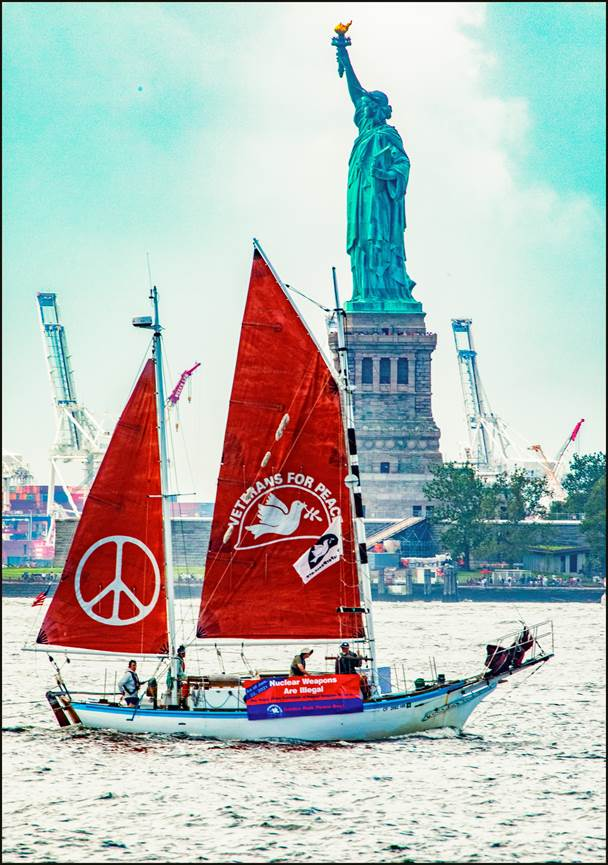
22,000+ miles voyaging for nuclear disarmament
and a radiation-free environment https://vfpgoldenruleproject.org/
To see nuclear-related stories in greater depth and intensity – go to https://nuclearinformation.wordpress.com
-
Archives
- July 2026 (241)
- June 2026 (287)
- May 2026 (306)
- April 2026 (356)
- March 2026 (251)
- February 2026 (267)
- January 2026 (308)
- December 2025 (358)
- November 2025 (359)
- October 2025 (375)
- September 2025 (257)
- August 2025 (319)
-
Categories
- 1
- 1 NUCLEAR ISSUES
- business and costs
- climate change
- culture and arts
- ENERGY
- environment
- health
- history
- indigenous issues
- Legal
- marketing of nuclear
- media
- opposition to nuclear
- PERSONAL STORIES
- politics
- politics international
- Religion and ethics
- safety
- secrets,lies and civil liberties
- spinbuster
- technology
- Uranium
- wastes
- weapons and war
- Women
- 2 WORLD
- ACTION
- AFRICA
- Atrocities
- AUSTRALIA
- Christina's notes
- Christina's themes
- culture and arts
- Events
- Fuk 2022
- Fuk 2023
- Fukushima 2017
- Fukushima 2018
- fukushima 2019
- Fukushima 2020
- Fukushima 2021
- general
- global warming
- Humour (God we need it)
- Nuclear
- RARE EARTHS
- Reference
- resources – print
- Resources -audiovicual
- Weekly Newsletter
- World
- World Nuclear
- YouTube
-
RSS
Entries RSS
Comments RSS
 nuclear-news