FAIR exposes the false claims about China and COVID-19
 Debunking Trump and Corporate Media’s WHO/China Coverup Conspiracy Theories FAIR
The Trump administration suspended funding to WHO in April—the UN’s primary infectious disease–fighting body—accusing it of “severely mismanaging and covering up the spread of the coronavirus,” and of taking China’s allegedly deceptive claims about its handling of Covid-19 at “face value.” But corporate media had already been boosting these same talking points.
The Wall Street Journal’s “The World Health Organization Draws Flak for Coronavirus Response” (2/12/20) effectively accused WHO of being “too deferential to China in its handling of the new virus,” and criticized WHO Director-General Tedros Ghebreyesus for “bending to Beijing” after lauding China’s unquestionably effective swift quarantine of 60 million people, and for declaring that “China is actually setting a new standard for outbreak response” and identifying the virus in “record time.” The Journal further expounded the conspiracy theory of a seemingly omnipotent China having WHO under its thumb:
Over its decades of battling epidemics, the WHO has rarely had to deal with an entity as politically and economically powerful as China today. It can’t afford to alienate the country’s leadership, whose clout and financial largess it aims to attract to global health causes. It needs Beijing’s cooperation in preventing a full-blown pandemic—and this may not be the last time. China is the source of many emerging pathogens, which jump from animals to humans in its teeming live markets and can cause deadly epidemics.
According to the Journal’s logic, when WHO praises China for an effective response containing Covid-19 and giving the rest of the world ample time to take health precautions, it is “compromising its own epidemic response standards, eroding its global authority, and sending the wrong message to other countries that might face future epidemics.” When Dr. Bruce Aylward—a Canadian medical expert with 30 years of experience combating polio, Ebola and other global health emergencies—concluded that he “didn’t see anything that suggested manipulation of numbers,” after leading a team of experts visiting China for WHO, that can’t be an accurate observation. For corporate journalists, it can only be because he was duped by the devious Chinese government “underreporting both total cases and deaths it’s suffered from the disease” (Bloomberg, 4/1/20).
The Journal flimsily explained that China wields such formidable control over the WHO because China is a “future source of funds and a partner with which to tackle the biggest global health problems,” and not as a “current donor.” That would be because a cursory examination of WHO’s funding would reveal that the US donated more than 10 times more money to WHO ($893 million) than China ($86 million), despite the US having almost $200 million in arrears before suspending payments (Axios, 4/15/20).
Neither does the Journal explain how or why WHO could possibly withhold information from Western nations even if it wanted to, when its leadership is stacked with Americans and Europeans, and 15 US officials were embedded with the WHO in Geneva, given that the US is the most “politically and economically powerful” nation on Earth. This makes the Trump administration’s declaration of the US terminating its membership in WHO after threats to permanently cut funding especially egregious.
Nor can the Journal explain the source of China’s fearsome influence over independent and prestigious medical journals like Nature (5/4/20), Science (3/28/20) and the Lancet (3/7/20), which also credited the effectiveness and transparency of China’s response for saving thousands of lives (CGTN, 5/1/20, 5/10/20). Does China’s mysterious and awe-inspiring influence extend over Western medical journals as well?
When Foreign Policy (5/12/20) reported on the exclusive scoop of a leaked dataset of coronavirus cases and deaths from the Chinese military’s National University of Defense Technology, it confirmed that the leaked information “matches” the publicly available numbers the Chinese government posts online—which poses an inconvenience to those spouting conspiracy theories of a Chinese government coverup. Corporate media accounts of Chinese deception and fake statistics also fail to explain how the Chinese government possesses the fantastical ability to deceive governments and independent medical experts around the world, even if it wanted to. As FAIR’s Jim Naureckas (4/2/20) pointed out earlier:
The reality is that it’s very hard to hide an epidemic. Stopping a virus requires identifying and isolating cases of infection, and if you pretend to have done so when you really haven’t, the uncaught cases will grow exponentially. Maintaining a hidden set of real statistics and another set for show would require the secret collusion of China’s 2 million doctors and 3 million nurses—the kind of improbable cooperation that gives conspiracy theories a bad name…. If China is merely pretending to have the coronavirus under control, the pathogen will rapidly surge as people resume interacting with their communities. Once international travel is restored, it will be quite obvious which countries do and don’t have effective management of Covid-19.
Countries revising their figures upon receiving new information is to be expected, and is not necessarily evidence of deceit, as plenty of nations besides China revise their data upwards. Yet only China is singled out as being exceptionally deceptive. For example, in the same week New York revised its death toll upwards by nearly 3,800, China’s adding almost 1,300 dead to its Wuhan data was presented as a possible coverup (Politico, 4/14/20; Guardian, 4/17/20). The Moon of Alabama blog (4/1/20) explained some of the complexities in reporting numbers during a pandemic in real-time:
Does one include co-morbids or not in the count? What about casualties of a car accident that also test positive for Covid-19 when they die? What about those who died with Covid-19 symptoms but could not be tested for lack of test kits? Are the tests really working reliably?… What about asymptomatic cases that test positive. Are these false positives, or do these people really have the virus? One can only know that by testing them a month later for antibodies………
this manipulation of public opinion by the US government and corporate media appears to be working. According to a recent Ipsos survey, more than 30% of Americans have witnessed someone blaming Asian people for the coronavirus pandemic (even though new research indicates that travel from New York City was the primary source of the US outbreak, with New York’s outbreak originating in Europe). Pew Research (4/21/20) found that around two-thirds of Americans have an unfavorable view of China, which is the most negative rating for the country since Pew began asking the question in 2005. This suggests that public opinion has been turned against China, despite it being the first to detect the virus, alert the world and provide a model for containing it.https://fair.org/home/debunking-trump-and-corporate-medias-who-china-coverup-conspiracy-theories/
BOLTON BOOK: Trump Endorsed Israeli Airstrike On Iranian Nuclear Reactors
BOLTON BOOK: Trump Endorsed Israeli Airstrike On Iranian Nuclear Reactors https://www.theyeshivaworld.com/news/featured/1874761/bolton-book-trump-endorsed-israeli-airstrike-on-iranian-nuclear-reactors.html
USA’s secret plan for “dominance”by exploding a nuclear bomb on the moon
REVEALED: The US wanted to detonate a nuclear bomb on the MOON in 1959 to counter the Soviet lead in the space race and show dominance
- New details of an astonishing scheme, first detailed in 1999, have been revealed
- John Greenewald, Jr writes in Secrets from the Vault about numerous plans
- He says a nuclear bomb on the moon was ‘one of the stupider things’ considered
- The US government also wanted to build a military base on the moon by 1966
By HARRIET ALEXANDER FOR DAILYMAIL.COM
PUBLISHED: 10:28 AEST, 21 June 2020 | UPDATED: 15:01 AEST, 21 June 2020
New details about a U.S. plan to blow up a nuclear bomb on the moon as a Cold War ‘show of dominance’ have been revealed in a recently-published book.
The secret mission, code-named Project A119, was conceived at the dawn of the space race by an Air Force division located at New Mexico‘s Kirtland Air Force Base.
A report authored in June 1959 entitled ‘A Study of Lunar Research Flights’ explained plans to explode the bomb on the moon’s ‘terminator’ – the area between the part of the surface that is illuminated by the sun, and the part that’s dark.
The explosion would have likely been visible with the naked eye from Earth because the military had planned to add sodium to the bomb, which would glow when it exploded
A nuclear bomb on the surface of the moon was definitely one of the stupider things the government could do,’ said John Greenewald, Jr., author of Secrets from the Vault.
The book, published in April, details some of the more surreal suggestions made in history.
Greenewald, 39, has been interested in U.S. government secrets since he was 15 and has filed more than 3,000 Freedom of Information Requests……… https://www.dailymail.co.uk/news/article-8443569/US-wanted-detonate-nuclear-bomb-moon-1959-dominance.html
Kim Jong Un’s cyberwar preparations
 Kim Jong Un has quietly built a 7,000-man cyber army that gives North Korea an edge nuclear weapons don’t, Business Insider, ELLEN IOANES, JUN 17, 2020,
- North Korea has a cyber army of about 7,000, trained to find secrets, disrupt critical infrastructure, and steal money to circumvent sanctions.
- These cyberattacks are often difficult to pin on North Korea because they originate in countries like China and Russia, and a counterattack is almost impossible because of North Korea’s rudimentary internet.
- North Korea’s likely next targets are critical US infrastructure like power plants, dams, and electrical grids.
The WannaCry virus, on the one hand, was ransomware; you could argue that it’s aimed at getting money, but it caused a huge disruption of hospitals in the UK and, potentially, in something like 100-plus other countries where they had disseminated the ransomware. This was software that brought the operation of critical facilities to a standstill.
This is not hacking; this is cyber warfare.
Because North Korea depends so heavily on China, not just for cyber, but in the case of cyber, for access to servers, its pipelines, and so on, it would be critical for the United States to develop some degree of cooperation with China to limit North Korea’s offensive cyber threat.
South Carolina Electric and Gas lawyers and executives could face gaol for fraud
 SCE&G LAWYERS MAY BE CHARGED IN NUCLEAR FRAUD, https://www.lexingtonchronicle.com/news/sceg-lawyers-may-be-charged-nuclear-fraud More utility executives may face prison time, too
By Jerry Bellune
JerryBellune@yahoo.com
Former SC Electric & Gas executive Steve Byrne may have company.
His plea agreement on fraud charges reveals that other executives and lawyers for SCANA, the owner of SCE&G, are at risk of being charged,.
Federal officials believe a conspiracy of executives and their lawyers hid a $9 billion nuclear failure from state officials, investors and the public for years.
An official federal document filed in US District Court in Columbia revealed:
• Byrne and unidentified “others” orchestrated a cover-up of costly errors at the nuclear construction site.
• They “deceived regulators and customers to maintain financing for the project and to financially benefit SCANA” and themselves.
• “As construction problems mounted, costs rose and schedules slipped,” Byrne and others hid the truth.
For the rest of what the federal documents reveal, see Thursday’s Lexington County Chronicle.
Number two executive of the defunct SCANA Corpto plead guilty to fraud conspiracy in nuclear plant failure
|
Top SCANA ex-official to plead guilty to fraud conspiracy in nuclear plant failure https://www.thestate.com/news/local/crime/article243356621.html, BY JOHN MONK
JUNE 08, 2020 The number two executive of the defunct SCANA Corp. — whose top officials engineered the biggest business failure in South Carolina history: the $10 billion V.C. Summer nuclear plant fiasco — has agreed to plead guilty to criminal conspiracy fraud charges in connection with the nuclear failure, according to a document filed Monday in U.S. District Court in Columbia.
The upcoming guilty plea of Stephen A. Byrne, 60, is a centerpiece of a Monday filing involving his alleged criminal actions. He will need to have his guilty plea formally accepted by a U.S. District Court judge before it becomes official. Byrne is charged with conspiring to commit mail fraud, the document said. The document is a motion requesting a stay in a Securities and Exchange civil fraud lawsuit against Byrne and SCANA’s former CEO, Kevin Marsh. That civil lawsuit was filed in February. One big difference between civil and criminal proceedings is that in a criminal proceeding, a defendant can be subject to a prison term. The document alleges that “through intentional and material misrepresentations and omissions, Byrne and others deceived regulators and customers to maintain financing for the (nuclear) project and to financially benefit SCANA.” The Monday filing said there is “an ongoing criminal investigation” and indicated more criminal charges against other former SCANA top officials may be in the offing. |
|
|
Huge police squadron paid by nuclear industry to monitor residents of Bure
the tens of millions of euros per year disbursed by Andra to pay for the presence of the gendarme squadron represents a significant sum. In 2018, the agency’s net profit amounted to only 11.5 million euros,
Cigeo related expenses are directly funded by the three major nuclear players: EDF and Orano, two private companies, and CEA, a public research establishment. In 2018, they poured 212 million euros into the landfill project.

Large Man Looking At Co-Worker With A Magnifying Glass — Image by © Images.com/Corbis
In Bure, the nuclear waste agency pays the police,  À Bure, l’agence des déchets nucléaires se paie des gendarmes, Reporterre, 5 juin 2020 / Marie Barbier (Reporterre) et Jade Lindgaard According to information obtained by Mediapart and Reporterre, an agreement was signed in 2018 between the national gendarmerie and Andra, the agency responsible for the burial of nuclear waste, in this village of the Meuse. Since then, the agency has paid tens of millions of euros to monitor residents through gendarmes. This partnership poses ethical and legal problems.
Around Bure, in the Meuse, where the most dangerous nuclear waste from French power plants must be buried in a gigantic mine 500 meters underground, the villages are only inhabited by a handful of people. And yet, 75 gendarmes patrol there 24 hours a day. For almost a year and a half, according to information collected by Mediapart and Reporterre, these soldiers are paid by Andra, the National Agency for Radioactive Waste Management, which has set up a laboratory at the future landfill.
In October 2018, an agreement was signed between Andra and the General Directorate of the National Gendarmerie (DGGN) “in order to guarantee the safety of personnel and facilities in the long term” the agency confirmed to us, in response to our questions. According to figures given by the agency itself, “ten million euros” are spent each year by Andra, a public industrial and commercial establishment (EPIC), to pay the soldiers engaged and cover related costs, including catering. To date, therefore, at least twenty million euros have been spent – or are in the process of being spent – in this context
The mobile gendarmes are hosted directly on Andra’s site, in a block built for this purpose. They sleep there, store their equipment and their vehicles and take their recovery days there before leaving to patrol. These soldiers, often very young, stay there for three to six weeks before leaving on another assignment. They are immediately replaced by new arrivals. The DGGN refused to communicate the exact content to us The government decision to assign a squadron of mobile gendarmes to this territory dates from the summer of 2017. In June, Le Bindeuil, a hotel-restaurant known to accommodate Andra staff and gendarmes, suffered damage during the anti-nuclear days. And in August, a demonstration ended in confrontations with the police. These facts are today the subject of judicial information, in which ten people are under investigation, and which gives rise to massive and particularly intrusive surveillance, as we detailed in our four-part investigation……..
Is it legal to pay a squadron of gendarmes to protect themselves?….
Long dormant, this system was revived by a decree, signed by Alain Juppé in 1997…..
….. In 2009, an agreement was signed with EDF for the protection of nuclear power plants. “At the national level, the overall workforce is around a thousand gendarmes,” confirms EDF, who specifies that “this specialized platoon is financed by EDF” but that the latter “does not communicate on the cost of this protection” .
This is to prevent a new Zad, like that of Notre-Dame-des-Landes, from forming But Andra’s laboratory cannot, unlike nuclear power plants, be considered a sensitive site. No radioactive waste is present there. Cigeo’s excavation work.
So what is the purpose of the gendarmerie platoon paid by Andra at the Bure site? According to many residents that we were able to contact, these gendarmes are mainly assigned to the surveillance of the territory and its inhabitants. For the police, it is a question of preventing the militants evicted from Lejuc wood – a communal forest once occupied by opponents of Cigeo – from returning. And to prevent a new Zad from forming, he example of Notre-Dame-des-Landes, in Loire-Atlantique
According to residents interviewed for this article, the patrol vehicles are reformed vehicles, old Range Rovers, or newer models from Kangoo and Transit. A villager saw them move at night with torches bearing the acronym of Andra. What exactly are their prerogatives? The Directorate General of the National Gendarmerie refused to answer our questions.
“Permanent and repeated identity checks infringe on individual freedoms” and can “only lead to incidents”.
Me Matteo Bonaglia, one of the lawyers indicted in the framework of the criminal investigation for association of criminals, says he is “surprised by such means allocated to Andra. This explains, however, the over-militarization that we observe in this territory where the fight against the project to bury nuclear waste is playing out, Andra being able to allocate the assistance of the police force in a proportion three times greater than everywhere elsewhere.
It is already difficult to oppose the Cigeo project and assert its anti-nuclear opinions. Here, the multiplication of controls and the over-representation of gendarmes constitutes a de facto obstacle to freedom of opinion and the free expression of ideas. It also explains the large number of trials that have taken place in recent years for offenses such as contempt and rebellion, not everyone is so willing to be subject to constant scrutiny. ”
This agreement with the gendarmerie is all the more problematic since Andra appears several times in the file currently being examined after the start of the fire at the Hôtel-restaurant du Bindeuil, in which ten anti-nuclear activists are put under review and to which Mediapart and Reporterre had access.
The agency did not bring a civil action, but complained three times. Thus, on February 17, 2017, its director, David Mazoyer, filed a complaint “on behalf of Andra” after “degradations” committed on the site of the eco-library, belonging to the agency. “During the night of February 16 to 17, 2017,” explains the director of gendarmes in Ligny-en-Barrois the opponents damaged, bent or tore down the fence around the site, mainly on the west facade and on a line of about 150 meters. These degradations were the subject of an additional indictment and joined the long list of crimes covered in this sprawling instruction.
A few months later, on June 21, 2017, the day of the fire at the Le Bindeuil hotel and restaurant, David Mazoyer filed a second complaint: “Other members of their movement attacked the code on the pedestrian portal giving access to the Ecothèque site. This device is damaged and out of use. I am filing a complaint on behalf of Andra for the destruction of this device. ”
Finally, on April 24, 2018, it was the head of Andra’s risk protection and prevention service who complained about receiving documents after discovering photos belonging to the Ecoteca during a search.
According to our information, the platoon of gendarmes paid by Andra is not assigned to the “Bure cell”, a cell of gendarmes with their own badge in charge of the current investigation. But what about a complainant who pays gendarmes to go and monitor the people against whom he has complained? By order of the prefecture, Andra gendarmes can also in theory be assigned to the maintenance of order at demonstrations or at the courthouse. The mix of genres would then be total: a complainant who pays the police in a demonstration against him or worse, during trials of opponents of his project …
In addition to this potential conflict of interest, the apparently legal agreement between Andra and the national gendarmerie raises legal questions. In 2018, a circular from the Minister of the Interior Gérard Colomb paved the way for a much wider billing than what had been initially planned. “The circular no longer takes the precaution of limiting it to” organizers of sporting, recreational or cultural events for profit “. We can invoice everyone, regardless of the object and the lucrative purpose or not, “said Mickaël Lavaine.
In 2018, the publication of his article in the review of legal current events in administrative law gave rise to an action brought by the Collectif des Festivals before the Council of State, the organizers denouncing the considerable sums of security which they owed. ” discharge to the State.
This mixture of genres questions the impartiality of police work
In this legal debate, the two paragraphs of article L211-11 of the code of internal security, organized by the Columbus circular, are opposed. The first specifies that these conventions concern only “organizers of sporting, recreational or cultural events for profit”, the second target much more broadly all “natural or legal persons”. “The Council of State will have to rule on this debate: is paragraph 2 linked to paragraph 1? If he decides in this sense, which I defend, that means that Andra cannot be invoiced, nor of the associations which organize the potato festival. This would return to the spirit of the text of the Tour de France, “said Mickaël Lavaine. The Council of State is expected to decide by summer.
For the researcher, this legal debate poses a much broader question: “The internal security code specifies that the police or gendarmerie forces may be charged for law enforcement services which cannot be attached to the normal obligations incumbent on the public authorities’. But what is the obligation normal state? This notion is vague enough to be able to put what you want into it. If we push the logic of the Columbus circular to its end, there is nothing to prohibit charging the organizer of an FO demonstration or the CGT for the police devices of a demonstration. However, the Declaration of Human Rights provides that the public force must be financed by taxes. ”
For Alexandre Faro, lawyer for one of the activist witnesses assisted in the investigation opened after the fire at Bindeuil, “this amounts to privatizing the police in favor of Andra. From a strict legal point of view this is very questionable because in France the police are a monopoly of the state and the Constitution provides that sovereignty is exercised by the people and for the people. ”
These debates also animated Andra employees when the agreement with the DGGN was signed. An internal source tells us that “that posed questions”: “Why is Andra paying when it is a public establishment?
Far from being anecdotal, the tens of millions of euros per year disbursed by Andra to pay for the presence of the gendarme squadron represents a significant sum. In 2018, the agency’s net profit amounted to only 11.5 million euros, mainly made up of research tax credit, as indicated in the establishment’s annual financial report. Cigeo related expenses are directly funded by the three major nuclear players: EDF and Orano, two private companies, and CEA, a public research establishment. In 2018, they poured 212 million euros into the landfill project.
The gendarmes paid by Andra who crisscross the territory are not the same as those who are investigating for justice as part of the judicial information and have listened for months to opponents of Andra. But they belong to the same institution. This mix of genres questions the impartiality of police work. Then does not public power find itself in a situation of insincerity towards the citizens whom it controls with such relentlessness? The gendarmes, Andra, justice, political leaders on one side; opponents of the other. Two tight-knit camps, one facing the other, like in a war situation.
https://reporterre.net/A-Bure-l-agence-des-dechets-nucleaires-se-paie-des-gendarmes
Uranium mining protests in Russia
“……..Uranium mining protest
In the Kurgan region, Rosatom’s subsidiary company, Dalur, has been mining uranium and the local communities fear an environmental disaster. In the summer of 2019, the state environmental appraisal revealed a discrepancy between Dalur’s documentation and the Russian legislation
Activists attribute her persecution to her work at the Public Monitoring Fund for the Environmental Condition and the Population Welfare which she led back in 2017. The Foundation has repeatedly published information on the possible environmental damage resulting from Dalur’s mining activity. (28)
9
In the fall of 2019, environmentalists revealed that radioactive and toxic waste (uranium hexafluoride, UF6)were being imported from Germany through the port of Amsterdam into Russia. This is the waste from the uranium enrichment process which will be sent to the Urals or Siberia and stored in containers above the ground. Thus, under the auspices of a commercial transaction, the German uranium–enriching enterprise, Urenco, avoids its nuclear waste problem, while Rosatom profits by taking the hazardous waste into Russia.
Assange too sick to attend the very unjust process of the UK extradition hearings
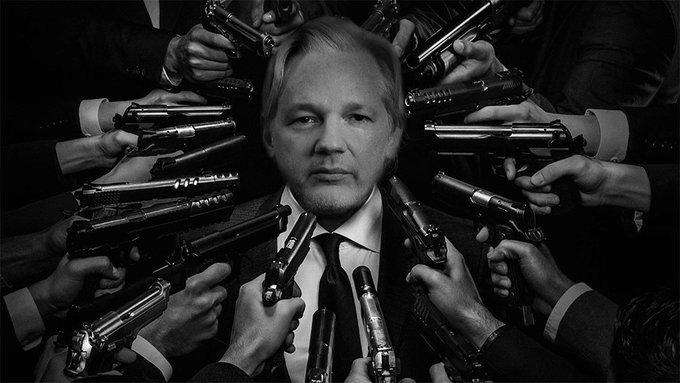 Monica Del Mestre 3 June 20
2. In addition to other ongoing health concerns, Assange faces the serious risk of exposure to Covid in Belmarsh prison, and has been advised that even going to the video room to take part in hearings is unsafe. This is another reason he should be immediately released.
3. Assange’s lawyers have long complained they have had insufficient access to him in prison. Under lockdown conditions, they have had no access to him at all. They have repeatedly flagged that this lack of access seriously impacts their ability to prepare his defence.
4. One of the next steps agreed today is that psychiatric reports on Assange from the prosecution and defence will be due to the court on 31 July. Remember that UN Special Rapporteur @NilsMelzer has expressed alarm many times that Assange shows symptoms of psychological torture.
5. It is a welcome step that the continuation of the full extradition hearing was adjourned, as lockdown conditions present clear barriers to open justice – but 7 September may not be late enough to make a meaningful difference. Also the court is still struggling to find a venue.
6. It remains extremely frustrating that the court does not adequately accommodate NGO observers. I have never experienced so much difficulty accessing a trial in any country as at Woolwich Crown Court in February, and the teleconference option we now have is far from sufficient.
7. The press are also facing severe restrictions. Only 6 journalists have been allowed to attend in person the past 2 hearings, with others limited to the awful phone line. This case is of high public interest and a better solution must be found before the full hearing resumes.
8. Assange’s next callover hearing has been scheduled for 29 June at 10 am. We urge the court to find workable solutions to enable his safe attendance and ensure the press and observers are able to properly monitor proceedings. /END
Confidential documents stolen, hacked from US nuclear missile contractor
Hackers steal secrets from US nuclear missile contractor
Cyber extortionists have stolen sensitive data from a company which supports the US Minuteman III nuclear deterrent. Sky News, Alexander MartinTechnology reporter @AlexMartin Wednesday 3 June 2020 UK Hackers have stolen confidential documents from a US military contractor which provides critical support for the country’s Minuteman III nuclear deterrent, Sky News has learnt.
After gaining access to Westech International’s computer network, the criminals encrypted the company’s machines and began to leak documents online to pressure the company to pay extortion.
It is unclear if the documents stolen by the criminals include military classified information, but files which have already been leaked online suggest the hackers had access to extremely sensitive data, including payroll and emails.
There are also concerns that Russian-speaking operators behind the attack could attempt to monetise their haul by selling information about the nuclear deterrent on to a hostile state.
Court documents in the US allege that Russian cyber criminals with a financial motivation have collaborated with the intelligence services in order to steal classified government documents.
A spokesperson for Westech confirmed to Sky News that the company had been hacked and its computers encrypted, and that investigations to identify what data the criminals had managed to steal were ongoing.
The company is involved with the nuclear deterrent as a sub-contractor for Northrup Grumman, providing engineering and maintenance support for the Minuteman III intercontinental ballistic missiles.
Minuteman III is the land-based component of the US nuclear deterrent, stored in hundreds of protected underground launch facilities operated by the US Air Force.
Each ICBM is capable of delivering multiple thermonuclear warheads further than 6,000 miles, or the distance between London and Buenos Aires.
Brett Callow, a researcher for Emsisoft which specialises in tackling ransomware incidents, told Sky News: “This is not the first incident in which a contractor has leaked data and, unless action is taken, it will not be the last.
“The information exposed in these incidents could potentially be of interest to other nation states and present a risk to both national security and to the safety of service personnel.
“Even if a company pays the ransom, there is no guarantee that the criminals will destroy the stolen data, especially if it has a high market value.
“They may still sell it to other governments or trade it with other criminal enterprises,” Mr Callow warned, adding that another criminal group operating under the same model is offering interested parties the opportunity to bid for its stolen data…….. https://news.sky.com/story/hackers-steal-secrets-from-us-nuclear-missile-contractor-11999442
RUSSIAN NUCLEAR INDUSTRY STRUGGLES WITH PANDEMIC, also threatened by climate change
 COVID Infects World Nuclear Plants, May 27, 2020, by Alex Smith, Radio Ecoshock, “……….RUSSIAN NUCLEAR INDUSTRY STRUGGLES WITH PANDEMICNow it the time to talk about the awful virus out of control in Russia, the last bastion of nuclear ambition with an infamous track record. I have to report it, because it seems no one from there feels safe to talk about it. One environment group reported safety questions about secret nuclear cities – after a government minister mentioned it. They declined an interview. I contacted reporters usually willing to do radio, including two from the English language Moscow Times, but got no reply. Radio silence as they say. These are dangerous times in Moscow, as ambulances line up outside hospitals, mortuaries go into overdrive, and the Putin government, like many governments, covers up early mistakes. COVID Infects World Nuclear Plants, May 27, 2020, by Alex Smith, Radio Ecoshock, “……….RUSSIAN NUCLEAR INDUSTRY STRUGGLES WITH PANDEMICNow it the time to talk about the awful virus out of control in Russia, the last bastion of nuclear ambition with an infamous track record. I have to report it, because it seems no one from there feels safe to talk about it. One environment group reported safety questions about secret nuclear cities – after a government minister mentioned it. They declined an interview. I contacted reporters usually willing to do radio, including two from the English language Moscow Times, but got no reply. Radio silence as they say. These are dangerous times in Moscow, as ambulances line up outside hospitals, mortuaries go into overdrive, and the Putin government, like many governments, covers up early mistakes.
o I patch together what little we can find out. The Russian nuclear story, as I said in the beginning, spreads out to governments all over the world, from the Middle East to North Korea. Really their nuclear technology is not much more dangerous than in Japan or America. It is all dangerous when built and run by flawed humans. Every nuclear country has a secret history of near-misses and hidden atomic poisons. Britain, Canada, France, you name it. There is a long list of atomic leaks, break-downs, hair-raising risks all over the world. Like the Trump Administration, the Putin government downplayed the threat of COVID-19 for precious months after it broke out in China. For a while in February, it looked like the pandemic would barely graze Russia. It was business-as-usual. Then the first wave arrived. Now Russia has the third most serious infection in the world, with way over 300,000 cases confirmed, and who knows how many really. The government is reporting low death rates, under 4,000 mortalities. As in China, these numbers are not credible. The real number of deaths has to be many times that. In late May, the Moscow Times ran an article explaining why the Russian government did not count 60% of suspected Covid-19 deaths. Only cases where autopsies showed the disease were counted. But who has time or staff to do thousands of autopsies during a wave of the pandemic? The Moscow health department attributed the obvious spike in deaths to things like “heart failure, stage four malignant diseases, leukemia … and other incurable deadly diseases”. In many ways, Russia is still a secret state. Certainly it has secret atomic cities. These are closed cities. You needed special permits to go there even before the pandemic, in fact, since the 1950’s. Nuclear bombs, missiles, and torpedoes are made there. Factories make reactors that can float in the sea, hide in the ground, or blast out into space. During Soviet times, these cities also specialized in chemical and biological weapons. Some say they still do, though the Russians publicly denounced those weapons. So if was surprising when “The head of Russia’s state nuclear corporation has expressed concerns about the spread of the novel coronavirus to three of its so-called “nuclear cities.” At the beginning of May, Charles Digges from the Russian environment group Bellona wrote about it, after the public announcement by Rosatom chief Alexei Likhachev. Likhachev said: “The situation in Sarov, Elektrostal, Desnogorsk is today particularly alarming.” People in the West do not understand why it is alarming that anything was admitted at all. When he said it, Russia was just the seventh most infected country. Less than a month later, their cases have doubled, and Russia is number two worst. The archipelago of nuclear labs and businesses controlled by Russia’s Rosatom employ around 250,000 people. The company admits they have stashed some workers permanently on nuclear sites, but like the U.S. industry, won’t say how many or where. This is what you do when you have an emergency. During the pandemic, they need to try to isolate enough workers to keep nuclear reactors operating and cool, to keep vast lakes and mountains of nuclear waste cool and secure, literally, to keep the lights on. The record shows safety at many Russian nuclear complexes has been poor at the best of times. There is a long and painful history not just of nuclear accidents – those are legendary – but of atomic neglect. Barrels of highly radioactive materials were just buried all over, or sunk at sea. Nobody is totally sure where all of it went. The Soviet Union left the world a legacy of abandoned hot spots no-go zones. Putin inherited that, and doubled down on Russian nuclear ambitions. The Russians will sell, and have sold, nuclear technology to anyone. Iran? Sure. North Korea, well that transfer of Russian nuclear technology may or may not have been authorized. Now they are building a nuclear reactor in Bangladesh. But why not? Canada gave India nuclear tech that led to their atomic bomb, and trained the Pakistani father of the bomb. Canadian engineers watched as prison slave labor built a Candu nuclear plant in Romania. The Romanians couldn’t really pay, so Canada agreed to take it out in coal and jam. It’s a dirty corrupt business no matter who does it. The on-again off-again felon Mike Flynn was busy trying to selling nuclear reactors to dictators in the Middle East. China wants to make money selling reactors. Nobody makes money selling reactors. Nuclear power is the biggest money pit in the history of money pits. And the cost never ends. Deconstruction usually falls on future taxpayers. The dangerous radioactive waste needs to be secured and guarded for tens of thousands of years. It’s never over. Thank goodness nuclear weapons are no longer a threat. Except both Russia and the United States have announced new supersonic atomic delivery missiles in just the last couple of years. Trump is pushing to build new nuclear weapons – the best anybody has ever seen! Britain is always embarking on a new nuclear plan that sinks into hundreds of billions of wasted pounds. Don’t get me started on nuclear waste dump schemes that never work or mini-reactors to save the climate. But the Russians have to be champions of nuclear secrecy. I don’t know of any other whole cities entirely closed off, so secret they did not even appear on maps. Now they say that despite official worries, everything nuclear is under control in Russia. The Rosatom chief reported 47 employees infected with COVID-19. 23 of them are in the secret city of Sarov, he said, in late April. How many are there now? MORE NUCLEAR WORRIES IN RUSSIA AS COVID-19 RUNS RAMPANTEleven hundred miles East of Moscow, the Russian nuclear power plant at Beloyarsk was the first to keep it’s staff on site. Nobody goes home. That was reported in Russian-only by the state news agency Interfax. At least one staff member was sick for days with a high fever. That was in April. The old reactors from the 1960’s are temporarily shut down, but now they run two large fast-neutron reactors there. The Russian group Bellona reports “270 workers isolated at the Rostov nuclear plant took to social media to complain they were being treated like ’cattle’.” That is in Southwest corner of Russia, along the Don River. The workers reported lack of protection against the virus and terrible working conditions. Rosatom says those concerns have since been addressed. URANIUM MINING SHUT DOWN AROUND THE WORLDRosatom also reports the large Russian uranium mining industry has been shut down due to coronavirus concerns. Many mines of all kinds have been closed around the world. We will start to feel the shortages some time in the fall, even though demand has fallen off. The Russians are also concerned about their electric utilities, because as they say “Falling incomes of both retail and corporate consumers might result in a tidal wave of unpaid electricity bills.” The American and European electric utilities fear that too. Uranium mining has been closed down for the pandemic pretty well everywhere from Canada to Kazakhstan to Namibia. Nuclear reprocessing plants are also closed. There is currently a glut of nuclear fuel, but I suppose if the pandemic is not solved in a year or so, nuclear power plants could run low on fuel. Perhaps experts can advise us on that. On April 14, a Russia language news outlet reported three employees of Kursk Nuclear Power Plant were infected by COVID-19. That is in the city of Kurchatov, in the direction of the border with Ukraine. You need a special permit to go there too. How many are infected there now? The Russian nuclear industry, both weapons and power, is not immune to this novel virus. So far they have not been overwhelmed by it. Not that we know of. Now that the pandemic is full blown and still growing in Russia, there is practically nothing coming out about the nuclear danger there. I suppose we will find out 30 years from now when the archives are released. Or maybe any day now, when radioactivity monitors in Sweden or Washington State go off. Of course, that could be coming from Japan, China, Canada, the U.S., or any of the dozens of nuclear operations run by humans with no immunity to a new disease, and economies shaking down. THERE IS ANOTHER HOT SPOT – SIBERIABefore we leave Russia, let me tell you about another hot spot there: Siberia. In last week’s Radio Ecoshock program, two top scientists told us about the coming heat as we load up the atmosphere with carbon. Dr. Radley Horton from Columbia was part of a team that discovered heat beyond human endurance is already popping up in various countries. It’s not that hot in Siberia. I’m sure the locals are enjoying the early summer warmth, although they must be nervous. Forest fires, and they have massive planet-changing forest fires, are already burning in Siberia, when it should be time for the snow to melt. For European and Canadian listeners, that’s 31 degrees C in Siberia, instead of -12 C, over a massive, massive area. Will we see a repeat of the 2010 heat wave over Russia, that killed tens of thousands of people and closed down the country’s wheat export trade? How much carbon will be released this year from forest fires in the far north? It has begun. ‘…… https://www.ecoshock.org/2020/05/covid-infects-world-nuclear-plants.html |
|
Nuclear industry brazenly exploiting Pandemic to get tax-payer funding
 The Nuclear Industry at the Feeding Trough https://www.the-american-interest.com/2020/05/15/the-nuclear-industry-at-the-feeding-trough/ VICTOR GILINSKY & HENRY SOKOLSKI, 15 May, 20
The nuclear lobby is playing the national security card in trying to justify Federal handouts. It’s a con.
We are getting used to brazen coronavirus claims for federal largess, but it’s hard to beat the claims coming from the nuclear industry. Even before the pandemic hit, it had for the most part given up competing for new power plant sales in the domestic and international energy marketplace and instead was wrapping itself in the flag and declaring itself essential to U.S. national security, and therefore deserving of generous federal support.
This approach has the full backing of the Trump Energy Department, and has been dutifully rolled out as part of the broader scramble for federal relief funds unleashed by the coronavirus crisis. As Energy Secretary Danny Ray Brouillette made clear to radio talk show host Hugh Hewitt in an April 28 interview:
We’ve lost our leadership both on the technology side and on the market side… to the Russians and the Chinese. And why does that matter? Well, obviously it matters, because we are, we were the world leader not only in the development of nuclear technology, but in the export of this technology around the world. And we lost that, and it leads to a national defense issue.
And, indeed, DOE’s web site announces: “Nuclear power is intrinsically tied to National Security.” Among the ways DOE plans to restore American nuclear energy leadership are “minimizing commercial fleet fiscal vulnerabilities [DOE-speak for subsidizing],” and “leveling the playing field against state-owned enterprises.”
The implication is that other countries are not competing fairly, as if they snuck around us to jump the line. Now, to cope with this, we have to sweeten the deals we offer to get the sales. And as a thriving nuclear sector is supposedly a necessary condition for gaining foreign sales, we have to prop up domestic nuclear plants, too.
If nothing else, there is a stunning lack of self-awareness in this view. Yes, the United States pioneered the light water reactor technology used around the world. But, as a result of U.S. business decisions, in part reflecting the unfavorable economics of nuclear power in the United States but also poor management, we effectively no longer have any reactor manufacturers.
Combustion Engineering, a company with 28,000 employees, a pressurized water reactor manufacturer, sold itself in 1989 to the European firm ABB Asea Brown Boveri Ltd. The great Westinghouse firm, once the world leader on pressurized water reactors, blundered financially into becoming a subsidiary of the CBS Corporation. In 1995, CBS sold it to British Nuclear Fuels Limited. BNFL in turn sold Westinghouse nuclear activities to Toshiba in 2006.
Westinghouse, by then a shell of its former self, performed so miserably in constructing the last large reactors to be built in the United States in South Carolina and Georgia that it went bankrupt and almost took Toshiba down, too. The South Carolina owners canceled their two plants, and the remaining two in Georgia will cost nearly $30 billion, double the original contract price. After this experience, it is hard to see any future sales of large reactors in the United States.
General Electric used to build boiling water reactors, but it only offers sales abroad as a junior partner to Japan’s Hitachi Corporation. Its reputation is anyway tarnished because it designed the plants that failed during the 2011 Fukushima accident. In short, U.S. nuclear plant manufacturing capabilities are much diminished, and the domestic market just isn’t there. And it isn’t there because nuclear economics are extremely unfavorable.
Currently, the US still has 95 power reactors online, supplying a bit less than 20 percent of America’s electrical demand. They are on average 39 years old. Only two plants, the ones in Georgia, are now under construction and they are expected to be the last large ones to be built for some time.
That hasn’t fazed the nuclear faithful both in and out of government. They still think, as their predecessors thought sixty years ago, that nuclear power is the technology of the future. They paint a picture of our putative arch-enemies, Russia and China, selling nuclear power plants and locking up nuclear relationships with numerous states, including important friendly states such as Saudi Arabia and Turkey, relationships that will last for the rest of the century. We will be frozen out and will thereby lose influence throughout the world. But it’s still not too late if we follow the advice of the Energy Department, the nuclear industry, and a gaggle of consultants looking to cash in.
What is it we have to do? The battles in Washington turn on so-called agreements for cooperation with potential customers that are prerequisites for sales of major reactors and components. The main issue concerns whether we will accept customers that also want to acquire acquires auxiliary facilities that can be used to produce plutonium and highly enriched uranium, the fuels that are also the explosives used in nuclear weapons. The only position consistent with non-proliferation, halting the spread of nuclear weapons, is “no.”
But the nuclear enthusiasts say that’s too strict, that others have more accommodating terms, and that if we sell with looser terms, we’ll have more influence. They have their eye especially on Saudi Arabia, a country that at one point said, implausibly, it was going to build 16 nuclear power plants. They don’t seem to pay attention to the other thing the Saudis said—the crown prince’s statement that if Iran was going to get a bomb, he was going to get one, too, and fast.
It’s not just the Trump crowd that opposes tightening security rules over nuclear exports (in the name, they say, of security). President Obama’s Energy Secretary, Ernest Moniz, has been arguing that subsidizing domestic nuclear power and encouraging nuclear sales without especially tight security restrictions—restrictions that go by the rubric of “gold standard”—are in the interests of U.S. nuclear security, and even support the deterrence value of our nuclear weapons.
All this is a bit much. Do we really think that Russia, with a GNP below that of Italy, is capable of freezing us out of the world? Does it have the financial capacity to offer generous terms on many projects? Will they ever be completed?
Nuclear power is just one U.S. export technology, and not exactly the most promising. For example, the U.S. exported $136 billion in aircraft last year; U.S. nuclear exports for the same period could only be measured in millions of dollars. China is building a comparatively large number of nuclear plants but nuclear power supplies less than five percent of its electrical demand and is only projected to account for seven percent by 2040. Any large accident will turn this program off.
There are many more exciting technologies to share with others. We don’t have to sell out our nonproliferation policies. If anything, we should be strengthening them, and convincing Russia and China to conform to them, as well.
As for the DOE and industry sales pitch, we should see it for what it is: a con to get at the federal trough. May 15, 2020
‘The Triumph of Doubt’ – corporations’ war on science
 Inside corporations’ war on science . A new book explains how corporations create a climate of doubt around science and expertise. Vox, By Sean Illing@seanillingsean.illing@vox.com May 26, 2020
Johnson & Johnson announced this week that it will stop putting talc, a mineral linked to asbestos, in its baby powder products. The move comes after years of lawsuits alleging that the powder causes various cancers.
It’s also a surprising turnaround. Johnson & Johnson has spent decades funding biased science and lobbying the government to avoid regulating its products or labeling them as cancer-causing. It’s a tactic deployed by many other industries that have a stake in stifling regulation and the science behind it.
The history of this practice is documented in a new book by David Michaels, the former assistant secretary of labor for the Occupational Safety and Health Administration (OSHA) under the Obama administration. It’s a close look at how powerful corporations fund junk science and misinformation campaigns in order to obscure evidence and undercut regulatory efforts.
Big Tobacco and the fossil fuels industry are obvious examples, but the problem goes well beyond that. From cancer-causing hair products and apparel to diabetes-linked food and sugary drinks, corporations have realized that you don’t have to convince the public or government officials of anything — all you have to do is create the illusion of doubt.
And they do that by piloting bogus studies, organizing partisan think tanks, supplying dubious congressional witnesses, and anything else they can think of to give regulators enough cover to plausibly look the other way. If you’ve ever heard a politician say “The science is still unclear” or “We need to keep researching the issue,” there’s a good chance that was made possible by industry-funded pseudo-science.
I spoke to Michaels about what this process looks like, why journalists and civic actors have been unable to stop it, and how the practice has become more pervasive in recent years. We also discussed the coronavirus pandemic and how the tactics he describes in this book helped lay the groundwork for the extreme skepticism of scientific expertise we’re seeing from conservatives.
“The Republican base,” Michaels told me, “has been acclimatized to be skeptical of mainstream science, and easily believe accusations that they are being manipulated by the deep state, the liberal media, and pointy-headed scientists.”
A lightly edited transcript of our conversation follows.
Sean Illing
When you say that big corporations like DuPont or Exxon manufacture doubt around their products, what do you mean?
David Michaels
I mean that they hire scientists who appear to be reputable to produce or obscure evidence about the products they make. If there are studies or even suggestions that their product is dangerous, you can hire a scientist who will say, “The evidence is in question,” or, “The study is wrong.”
Corporations make sure those scientists get their opinions into what look like credible peer-reviewed journals, then they get picked up by newspapers, then they have the sound bites that commentators repeat, and that’s enough to convince people that there’s uncertainty. Not necessarily that the product is safe, but that the scientific evidence isn’t there.
That’s basically how it works.
Sean Illing
You used the phrase “appear to be reputable.” What does that mean?
David Michaels
They are credentialed people, but they typically work for consulting firms whose business model is to provide any result their client needs……..
One of the things the Trump administration has done is essentially take the same mercenary scientists who have been working for corporations trying to influence the agencies to do the wrong thing and then given them high-level positions in these same agencies – [EPA , the FDA and other public institutions]…….
The example that I find most striking is a fellow named Tony Cox, who was appointed chairman of the Clean Air Scientific Advisory Committee by former EPA Administrator Scott Pruitt, who is himself a longtime lobbyist for the oil and coal industries……..
Sean Illing
So we’ve just made the process more efficient. Industry doesn’t even need middlemen to muddy the waters on their behalf now because they just have their own people appointed to run the agencies charged with regulating them…….
David Michaels
As the abject and enormously tragic failure of the Trump administration’s response to the Covid-19 pandemic becomes increasingly clear, the president and his supporters are taking the tobacco road, applying the same strategy used by cigarette manufacturers, fossil fuel corporations, and a host of other industries whose products and activities damage public health.
Not only is it the same strategy, it features the same cast of characters, and it is promoted in the same social media and cable TV venues, especially Fox News. Right-wing pundits, Trump administration officials, and scientists with long histories of discredited studies first declared the epidemic a hoax and then asserted the numbers of cases and deaths are wildly inflated. They have been eventually shown to be wildly wrong, but it has no impact on their credibility or their willingness to offer outrageous claims.
When the Trump administration is finally evicted from power, we will need to rebuild our system of public health protections, not simply by pouring more funding into federal agencies that were weak and flawed even before Trump, but by reimagining how they can be far more effective and inclusive, and are able to apply the best available science. And we must do this in a way that overcomes the anti-science culture fed by the current administration and the Republican party.
If we are unable to accomplish these goals, I fear that the nation’s disastrous response to Covid-19 is likely to be a preview of a very troubling future. https://www.vox.com/policy-and-politics/21137717/johnson-and-johnson-triumph-of-doubt-david-michaels
Misleading and inaccurate information provided by Australia’s authorities on National Radioactive Waste Management
 Peter Remta – submission to Senate Committee on National Radioactive Waste Management Amendment (Site Specification, Community Fund and Other Measures) Bill 2020 [Provisions] Submission 65 more https://antinuclear.net/2020/05/23/peter-remta-misleading-and-inaccurate-information-provided-by-authorities-on-national-radioactive-waste-management/
“………. EXPLANATORY MEMORANDUM The explanatory memorandum accompanying the Bill simply repeats many of the inaccurate and misleading comments and information provided by the Department of Industry Innovation and Science and ANSTO to the communities of the initially accepted sites in South Australia since the beginning of the nomination process under the existing legislation.
………I must stress that the serious and unacceptable manner in which quite inaccurate information has been disseminated on behalf of the government on such an important issue both now and during the nomination and selection process has only caused more concern and community dissension and I suggest will lead to a greater general apprehension of starting a nuclear industry in Australia
Explanatory memorandum assertions :
1. While the concept of a single and purpose-built nuclear waste facility is a desired objective as outlined at the start of the explanatory memorandum it will be difficult to achieve as is now proposed.
To begin with it is wrong to say that this facility will support nuclear science and technology since it fails to meet the safety prescriptions for a facility of that nature.
It is also wrong to link the provision of nuclear medicine to the proposed storage and disposal of waste at the facility as the various entities generating waste from medical and research activities will continue relying on their own disposal methods and will not necessarily use a government run business for that purpose.
2. Most importantly it is a totally false and misleading proposition to suggest that the failure to establish the facility as proposed by the government will somehow lead to a reduction in nuclear medical services and treatment and the government should quickly correct that serious misconception since this has been a rather distressing concern for the community at Kimba and generally. It is therefore disingenuous to give that impression that this will be a central
facility for all nuclear waste in Australia.
3. While existing waste is held in numerous locations around the country there is no legal or other requirement that this waste would be disposed of at the facility and it is therefore disingenuous to give the impression that this will
be a central facility for all waste in Australia.
4. The reference to meeting with the international obligations under the Joint Convention4 ignores the safety code requirements promulgated some 12 years later under which it would be very difficult to establish the proposed
facility.
5. The suggestion of acquiring additional land for such things as all weather road access is only another example of the intrinsically unsuitable nature of the chosen site and the lack of planning and the necessary technical knowledge for construction of the facility.
6. The process of identifying a suitable location being a 40 year effort again shows the inability of the government or simply ignores that the current process in a proper manner only began after 2012 under the existing legislation.
7. To suggest proper and successful consultations with community members is a test of normal intelligence having regard to the strong and spirited opposition to the facility from the outset by the community generally and the fact that a concerned Aboriginal group has litigated its opposition to an appeal to the Federal Court5 and may now resort to a referral to the United Nations Human Rights Council.
8. The financial aspects of the government’s proposals lack frankness and justification when it has been claimed variously that the amount so far spent in selecting the site is $55 million or $85 million over the past five years but with a constant refusal to provide any details as to how that money has been spent or applied.
Surely there should be proper public disclosure of this quantum of expenditure when compared to the usual outcry where there is only a fraction of that amount involved if there is no reasonable explanation given. Moreover this should be gauged against the persistent refusal of the government to pay for an independent assessment and scrutiny of its
proposals by the members of the Kimba community who oppose the facility.
9. The statement as to compatibility with human rights is again with respect rather nonsensical when the government was incapable of holding a proper and valid ballot (albeit through the District Council of Kimba) which totally ignored the inclusion of an opposing argument contrary to the recognised and applicable principles of human rights. That ballot and the previous one as well as some claimed community surveys failed to meet the principles of informed consent which places a high standard of compliance on both the government and the District Council.
This becomes even worse by excluding the Aboriginal peoples from the ballotIf the government were genuine then it should hold another ballot with a more appropriate and wider base for voting and with the prior provision of all pertinent
information including the arguments or case against the facility. This goes back to providing a proper assessment and scrutiny of the government’s proposals by the opposing members of the Kimba community which has never been
the case.
Regrettably the compatibility statement is more prescriptive in its content instead of actually dealing with the facts of the situation and circumstances that occurred and which have been presented in the statement in a most favourable light for the government. when under the most basic of constitutional and democratic rights they
should have been included in that process…………
Sections on NAPANDEE FINANCIAL ASPECTS INFORMATION, BALLOTS, and INFORMED CONSENT LEGAL ACTIONS MANAGEMENT of FACILITY INTERNATIONAL OBLIGATIONS TECHNICAL ASSESSMENT [these will be published here separately, later]
…. CONCLUDING COMMENTS and RECOMMENDATIONS Continue reading
More about dirty nuclear tricks in Ohio
 In disgusting turn, shareholders reap the profits from ratepayer payouts intended to keep Ohio’s nuclear plants afloat May 22, 2020 By Editorial Board, cleveland.com and The Plain Dealer
So much for the cries of doom and gloom over the future of the two Ohio nuclear plants FirstEnergy Corp. built and that an affiliated company operated.
To keep open the Perry nuclear power plant east of Cleveland and the Davis-Besse plant near Toledo, Ohio’s electricity customers are about to start paying an extra $150 million a year in subsidies. That comes courtesy of the Ohio General Assembly and Gov. Mike DeWine via House Bill 6, a bill they rushed into law last summer.
Akron-based FirstEnergy Solutions, which then owned the two plants, had argued (through an army of Statehouse lobbyists) that, without the nuclear subsidy, it would be forced to close the two plants.
In February, Solutions emerged from bankruptcy and became an independent (and solvent) firm, Energy Harbor Corp., also based in Akron.
It now appears the biggest beneficiaries of the deal will be Energy Harbor stock investors.
Energy Harbor’s board voted last week to boost stock buybacks by $300 million, from $500 million to $800 million, cleveland.com’s Andrew J. Tobias reports. When a company buys back its own stock, that cuts the number of available shares, which can boost their prices, benefiting shareholders.
And where did that extra $300 million come from? Could it be on the expectation of the impending subsidy from Ohioans on their electricity bills? It’s fair to ask whether Perry and Davis-Besse were ever in real jeopardy of closing, or was it all a shell game to shore up the company’s finances?
That’s House Bill 6: Socializing losses and privatizing profits, although the bill’s Statehouse backers said otherwise. HB 6, quarterbacked by House Speaker Larry Householder, was absolutely, positively all for a good cause, the speaker assured Ohioans — promoting clean air and, by the way, saving nuclear power plant workers’ jobs.
Nuclear plants don’t emit greenhouse gases, which stoke global warming. But HB 6 wasn’t fully a clean air act. Besides subsidizing Perry and Davis-Besse and providing $20 million annually to six solar power projects in Ohio, HB 6 also underwrote two coal-fired power plants (one in Indiana). Coal plants hardly promote clean air. And the bill zeroed out the state’s renewable energy mandates and reduced its energy-efficiency ones.
But, as Oscar Wilde said, consistency is the last refuge of the unimaginative. And when it comes to lining the pockets of electric utilities, our legislature isn’t merely imaginative; it’s shameless.
Energy Harbor now owns Perry and Davis-Besse and a share of the coal plants. And while Energy Harbor stock isn’t publicly traded, it’s available through brokers……..
Given the gravy HB 6 will sluice, no wonder pals of HB 6 threw everything they could dream up – including a ridiculous “Chinese conspiracy” – to sidetrack people trying to get HB 6 on the statewide ballot so Ohioans could vote the bill up or down. The friends of HB 6 succeeded, disgracefully, in blocking a statewide vote. The message they sent to Ohioans: Shut up – and pay up. Given the gravy HB 6 will sluice, no wonder pals of HB 6 threw everything they could dream up – including a ridiculous “Chinese conspiracy” – to sidetrack people trying to get HB 6 on the statewide ballot so Ohioans could vote the bill up or down. The friends of HB 6 succeeded, disgracefully, in blocking a statewide vote. The message they sent to Ohioans: Shut up – and pay up. https://www.cleveland.com/opinion/2020/05/in-disgusting-turn-shareholders-reap-the-profits-from-ratepayer-payouts-intended-to-keep-ohios-nuclear-plants-afloat.html
1 This Month
Chernobyl: The Lost Tapes – A good documentary on Chernobyl on SBS available On Demand for the next 3 weeks– https://www.sbs.com.au/ondemand/tv-program/chernobyl-the-lost-tapes/2352741955560

of the week–London Campaign for Nuclear Disarmament

Tell the Ukrainian Government to Drop Prosecution of Peace Activist Yurii Sheliazhenko
To see nuclear-related stories in greater depth and intensity – go to https://nuclearinformation.wordpress.com
-
Archives
- April 2026 (139)
- March 2026 (251)
- February 2026 (268)
- January 2026 (308)
- December 2025 (358)
- November 2025 (359)
- October 2025 (376)
- September 2025 (257)
- August 2025 (319)
- July 2025 (230)
- June 2025 (348)
- May 2025 (261)
-
Categories
- 1
- 1 NUCLEAR ISSUES
- business and costs
- climate change
- culture and arts
- ENERGY
- environment
- health
- history
- indigenous issues
- Legal
- marketing of nuclear
- media
- opposition to nuclear
- PERSONAL STORIES
- politics
- politics international
- Religion and ethics
- safety
- secrets,lies and civil liberties
- spinbuster
- technology
- Uranium
- wastes
- weapons and war
- Women
- 2 WORLD
- ACTION
- AFRICA
- Atrocities
- AUSTRALIA
- Christina's notes
- Christina's themes
- culture and arts
- Events
- Fuk 2022
- Fuk 2023
- Fukushima 2017
- Fukushima 2018
- fukushima 2019
- Fukushima 2020
- Fukushima 2021
- general
- global warming
- Humour (God we need it)
- Nuclear
- RARE EARTHS
- Reference
- resources – print
- Resources -audiovicual
- Weekly Newsletter
- World
- World Nuclear
- YouTube
-
RSS
Entries RSS
Comments RSS
 nuclear-news