Corruption investigation into AREVA’s sale of Nigerian uranium
Former CEO of failed V.C. Summer nuclear project pleads guilty to fraud charges
 Former SCANA CEO pleads guilty to fraud charges for failed nuclear power project, https://abcnews4.com/news/local/former-scana-ceo-pleads-guilty-to-fraud-charges-for-failed-nuclear-power-project by Tony Fortier-Bensen, Wednesday, November 25th 2020 COLUMBIA, SC (WCIV)
The former chief executive officer of SCANA pleaded guilty on Tuesday to fraud charges for the failed V.C. Summer project in Fairfield County.
Kevin Marsh pleaded guilty to one count of conspiracy and one count of obtaining false property by false pretenses, according to a plea agreement.
The agreement also said that Marsh would serve 18 to 36 months and has agreed to pay $5 million in restitution.
In June, retired SCANA chief operating officer Steve Byrne entered a guilty plea for his actions in relation to the failed nuclear power plant.
The U.S Attorney’s office alleges Byrne and Marsh conspired with other SCANA executives to deceive state and federal government overseers, stock holders and power customers in order to keep funding coming in to build two nuclear reactors at the V.C. Summer Nuclear Station.
The expansion project cost Santee-Cooper and the defunct South Carolina Electric & Gas over $9 billion before the two entities abandoned the project in July 2017.
In addition, Marsh agreed to waive indictment and arraignment and work with authorities to provide further information on the failed project.
Under the plea agreement, Marsh could be sentenced to serve 18 to 36 months in prison. Marsh has also agreed to pay $5 million in restitution.
Cybersecurity breach at Kudankulam Nuclear Power Plant (KKNPP) undetected for over 6 months

 Breach at Kudankulam nuclear plant may have gone undetected for over six months: By Nirmal John, , ET Nov 25, 2020
The cybersecurity breach at the Kudankulam Nuclear Power Plant (KKNPP) may have remained undetected for more than six months, reveals a report from Singapore-based cybersecurity firm Group-IB.
Experts from Group-IB, who discovered and analysed an archive containing dtrack, a remote-administration tool attributed to North Korean group Lazarus, says that analysis “revealed that the logs contained data from a compromised machine running Windows that belonged to an employee of the Nuclear P ..
Orano, formerly Areva, targeted by judicial investigation for corruption.
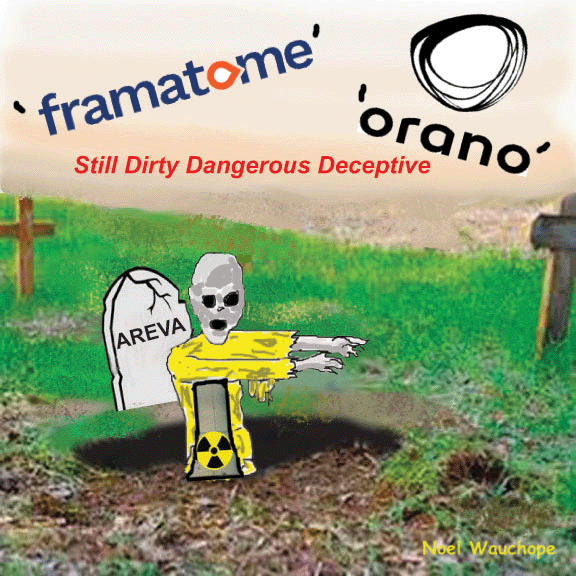
Orano, formerly Areva, targeted by judicial investigation for corruption. 25 Nov 20, A new case shakes the French nuclear group Orano, formerly known as Areva. An
investigation was opened by the Paris prosecutor’s office for facts “of
corruption of a foreign public official”, implicating in particular one of
the providers of Orano, the company Eurotradia International. “We had not
noticed anything abnormal and we are now at the disposal of justice,” said
the spokesperson for Orano, who claims to have terminated his contracts
with Eurotradia.
Julian Assange ‘targeted as a political opponent of Trump administration and threatened with the death penalty’
Julian Assange ‘targeted as a political opponent of Trump administration and threatened with the death penalty’ Evening Standard. By Tristan Kirk. @kirkkorner
Professor Paul Rogers, a lecturer in peace studies at Bradford University and specialist on the ‘War on Terror’, said Assange’s opinions put him “in the crosshairs” of Trump’s top team.
Giving evidence to Assange’s extradition hearing this morning, he said he believes the prosecution case is part of a drive in the United States to target “dissenters”.
“In my opinion Mr Assange’s expressed views, opinions and activities demonstrate very clearly ‘political opinions’”, he told the court.
Professor Rogers, in his witness statement, said Assange’s work involved exposing secrets that the US government wanted to keep hidden, he had been in conflict with the Obama administration, but there was “no question” that Assange had been targeted as a political opponent by Trump’s officials.
“The opinions and views of Mr Assange, demonstrated in his words and actions with the organisation WikiLeaks over many years, can be seen as very clearly placing him in the crosshairs of dispute with the philosophy of the Trump administration”, he said.
Assange’s legal team argue that a decision was taken under President Obama not to prosecute the Wikileaks activist, but that move was overturned under Trump. https://www.standard.co.uk/news/uk/julian-assange-donald-trump-administration-old-bailey-hearing-a4543656.html?fbclid=IwAR3Rj4n0Lzlt5GmE1lXZXoMVDsOS5BdT9sEKgj82SCmMnpNLFQ6ZfEzVUOI
UK’s ‘small nuclear reactors’ – the real agenda is the funding of nuclear weapons
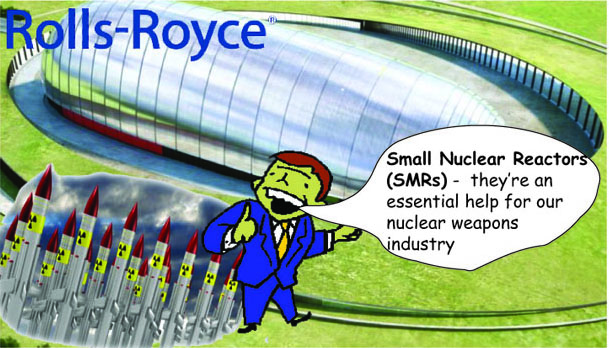
A secret military agenda. UK defence policy is driving energy policy – with the public kept in the dark, Beyond Nuclear
By David Thorpe, 8 Nov 20,The UK government has for 15 years persistently backed the need for new nuclear power. Given its many problems, most informed observers can’t understand why. The answer lies in its commitment to being a nuclear military force. Here’s how, and why, anyone opposing nuclear power also needs to oppose its military use.
“All of Britain’s household energy needs supplied by offshore wind by 2030,” proclaimed Prime Minister Boris Johnson at a recent online Conservative Party conference. This means 40 per cent of total UK electricity. Johnson did not say how, but it is likely, if it happens, to be by capacity auctions, as it has been in the recent past.
But this may have been a deliberate distraction: there were two further announcements on energy – both about nuclear power.
16 so-called “small nuclear reactors”
Downing Street told the Financial Times, which it faithfully reported, that it was “considering” £2 billion of taxpayers’ money to support “small nuclear reactors” – up to 16 of them “to help UK meet carbon emissions targets”.
It claimed the first SMR is expected to cost £2.2 billion and be online by 2029.
The government could also commission the first mini power station, giving confidence to suppliers and investors. Any final decision will be subject to the Treasury’s multiyear spending review, due later this year.
The consortium that would build it includes Rolls Royce and the National Nuclear Laboratory.
Support for this SMR technology is expected to form part of Boris Johnson’s “10-point plan for a green industrial revolution” and new Energy White Paper, which are scheduled for release later in the autumn.
Johnson will probably also frame it as his response to the English citizens assembly recommendations– a version of the one demanded by Extinction Rebellion in 2019 – which reported its conclusions last month.
While the new energy plan will also include carbon capture and storage, and using hydrogen as vehicle fuel, it’s the small modular reactors that are eye-popping.
They would be manufactured on production lines in central plants and transported to sites for assembly. Each would operate for up to 60 years, “providing 440MW of electricity per year — enough to power a city the size of Leeds”, Downing Street said, and the Financial Times copied.
The SMR design is alleged to be ready by April next year. The business and energy department has already pledged £18 million (US $23.48 million) towards the consortium’s early-stage plans.
They are not small
The first thing to know about these beasts is that they are not small. 440MW? The plant at Wylfa (Anglesey, north Wales) was 460MW (it’s closed now). 440MW is bigger than all the Magnox type reactors except Wylfa and comparable to an Advanced Gas-cooled Reactor.
Where will they be built? In the town of Derby – the home of Rolls Royce – where, as nuclear consultant Dr. David Lowry points out, the government is already using the budget of the Housing and Communities Department to finance the construction of a new advanced manufacturing centre site.
When asked why this site was not being financed by the business and energy department (BEIS), as you’d expect, a spokesperson responded that it was part of “levelling up regeneration money”.
Or perhaps BEIS did not want its budget used in such a way. Throwing money at such a “risky prospect” betrays “an irrationally cavalier attitude” according to Andrew Stirling, Professor of Science & Technology Policy at the University of Sussex Business School, because an “implausibly short time” is being allowed to produce an untested reactor design.
Only if military needs are driving this decision is it explicable, Stirling says. “Even in a worst case scenario, where this massive Rolls Royce production line and supply chain investment is badly delayed (or even a complete failure) with respect to civil reactor production, what will nonetheless have been gained is a tooled-up facility and a national skills infrastructure for producing perhaps two further generations of submarine propulsion reactors, right into the second half of the century.
“And the costs of this will have been borne not by the defence budget, but by consumers and citizens.”
Yes, military needs
UK defence policy is fully committed to military nuclear. The roots of civil nuclear power lay in the Cold War push to develop nuclear weapons. Thus has it ever been since the British public was told nuclear electricity would be “too cheap to meter”.
The legacy of empire and thrust for continued perceived world status are at the core of a post-Brexit mentality. It’s inconceivable to the English political elite that this status could exist without Great Britain being in the nuclear nations club, brandishing the totem of a nuclear deterrent.
“The civil-military link is undisputable and should be openly discussed,” agrees Dr Paul Dorfman at the Energy Institute, University College London.
Andrew Stirling talks of the “tragic relative popularity of (increasingly obsolescent) nuclear weapons”. The coincidental fact that civil nuclear installations are also crumbling provides a serendipitous opportunity for some.
The stores of plutonium in the UK are already overflowing and the military has its own dedicated uranium enrichment logistics.
Any nation’s defence budget in this day and age cannot afford a new generation of nuclear weapons. So it needs to pass the costs onto the energy sector.
“Clearly, the military need to maintain both reactor construction and operation skills and access to fissile materials will remain. I can well see the temptation for Defence Ministers to try to transfer this cost to civilian budgets,” observes Tom Burke, Chairman of think tank E3G.
The threat of nuclear proliferation
The threat of nuclear proliferation is therefore linked to the spread of civil nuclear power worldwide, says Dr David Toke, Reader in Energy Politics, Department of Politics and International Relations at the University of Aberdeen. David Lowry agrees: “India, Pakistan and above all Israel are obvious examples, each of which certainly has built nuclear weapons.”
It’s impossible to separate the tasks of challenging civil nuclear power without also challenging military nuclear interests, Stirling strongly believes. “The massive expense of increasingly ineffective military nuclear systems extend beyond the declared huge budgets. They are also propped up by large hidden subsidies from consumer and taxpayer payments for costly nuclear power.
“Huge hidden military interests will likely continue to keep the civil nuclear monster growing new arms. Until critics reach out and engage the entire thing, we’ll never prevail in either struggle.”
How new plants would be paid for still remains a question. Nuclear power is prohibitively expensive………..https://wordpress.com/read/feeds/72759838/posts/3011373103
Japanese nuclear regulator’s website hit by possible cyberattack
Japanese nuclear regulator’s website hit by possible cyberattack, Japan Times, https://www.japantimes.co.jp/news/2020/11/04/national/nuclear-regulator-website-cyberattack, KYODO, Nov 4, 2020
The Nuclear Regulation Authority said Tuesday its official website became inaccessible possibly due to cyberattacks.
The incident comes a week after the regulatory body’s intranet had an unauthorized access from outside.
According to the NRA, the government’s cybersecurity institute notified it of the website disruption on Tuesday afternoon. There was no abnormality when the NRA updated the website Monday evening, it said.
The website remained inaccessible for hours, but the problem was resolved by around 8:30 p.m., the NRA said.
In August, a fake website resembling that of the NRA was discovered by an official of the regulator.
Two politicians to plead guilty in Ohio nuclear corruption case

The five are accused of shepherding $60 million in energy company money for personal and political use. Manufacturing, Oct 29th, 2020 Andrew Welsh-Huggins COLUMBUS, Ohio (AP) — Two Ohio political operatives plan to plead guilty to charges that they conspired as part of what another defendant called an “unholy alliance” aimed at bailing out two aging Ohio nuclear power plants, court documents show.
Former Republican House Speaker Larry Householder and four others are charged with racketeering for their roles in the alleged scheme, under a law federal prosecutors typically use to charge gang members.
The five are accused of shepherding $60 million in energy company money for personal and political use in exchange for passing a legislative bailout of two aging nuclear plants and then derailing an attempt to place a rejection of the bailout on the ballot.
A federal court docket showed that “plea agreements” were filed Thursday for defendants Jeffrey Longstreth, a longtime Householder political adviser, and Juan Cespedes, a lobbyist described by investigators as a “key middleman.”
In a recorded conversation in September 2019, Borges described the relationship between Householder and the energy company as “this unholy alliance,” according to the July 21 complaint that lays out the details of the alleged scheme.
Lawmakers from both parties have pledged to repeal the bailout and to pass legislation requiring disclosure of money contributed to and spent by dark money groups. However, hearings to repeal the bailout ended this fall without resolution.
As recently as Wednesday, Republican Gov. Mike DeWine called on lawmakers to repeal the bailout during the Legislature’s lame duck session following next month’s election.
On Tuesday, two Ohio cities sued to block the bailout law from taking effect in January. https://www.manufacturing.net/energy/news/21200589/ohio-political-operatives-to-plead-guilty-in-nuclear-plant-bribery-case
Russian hacking group Energetic Bear have hacked nuclear stations, now threaten USA election
 Russians Who Pose Election Threat Have Hacked Nuclear Plants and Power Grid . The hacking group, Energetic Bear, is among Russia’s stealthiest. It appears to be casting a wide net to find useful targets ahead of the election, experts said. NYT, By Nicole Perlroth, Oct. 23, 2020
Cybersecurity officials watched with growing alarm in September as Russian state hackers started prowling around dozens of American state and local government computer systems just two months before the election.
The act itself did not worry them so much — officials anticipated that the Russians who interfered in the 2016 election would be back — but the actor did. The group, known to researchers as “Dragonfly” or “Energetic Bear” for its hackings of the energy sector, was not involved in 2016 election hacking. But it has in the past five years breached the power grid, water treatment facilities and even nuclear power plants, including one in Kansas………
Energetic Bear typically casts a wide net, then zeros in on a few high-value targets. In Germany and the United States, the group has infected websites popular in the energy sector, downloading malware onto the machines of anyone who visited the sites, then searching for employees with access to industrial systems.
In other attacks, it has hijacked the software updates for computers attached to industrial control systems. It has also blasted targets with phishing emails in search of employees, or co-workers, who might have access to critical systems at water, power and nuclear plants.
And it has done so with remarkable success. A disturbing screenshot in a 2018 Department of Homeland Security advisory showed the groups’ hackers with their fingers on the switches of the computers that controlled the industrial systems at a power plant.
The group has thus far stopped short of sabotage, but appears to be preparing for some future attack. The hackings so unnerved officials that starting in 2018, the United States Cyber Command, the arm of the Pentagon that conducts offensive cyberattacks, hit back with retaliatory strikes on the Russian grid…………… https://www.nytimes.com/2020/10/23/us/politics/energetic-bear-russian-hackers.html
It is not too late for The Guardian to redeem itself, and help Julian Assange
 The Guardian’s Silence Let UK Trample on Assange’s Rights in Effective Darkness https://consortiumnews.com/2020/10/21/the-guardians-silence-let-uk-trample-on-assanges-rights-in-effective-darkness/?fbclid=IwAR16w5kNgLGJ3jyFI6QvKZmxJ5tn_LjZcD90a7FOG-ZQ8jaGzUYKlhnRT8M
Jonathan-Cook.net WISE Up, a solidarity group for Julian Assange and whistleblower Chelsea Manning, is due to stage a demonstration outside The Guardian offices on Oct. 22 to protest the paper’s failure to support Assange as the U.S. seeks his extradition in an unprecedented assault on press freedom.
The date chosen for the protest marks the 10th anniversary of The Guardian’s publication of the Iraq war logs, leaked by Manning to Assange and which lie at the heart of the U.S. case to reclassify journalism exposing crimes against humanity as “espionage.”
Here is my full statement, part of which is due to be read out, in support of Assange and castigating The Guardian for its craven failure to speak up in solidarity with its former media partner:
Julian Assange has been hounded out of public life and public view by the U.K. and U.S. governments for the best part of a decade.
Now he languishes in a small, airless cell in Belmarsh high-security prison in London — a victim of arbitrary detention, according to a UN working group, and a victim of psychological torture, according to Nils Melzer, the UN’s expert on torture.
If Judge Vanessa Baraitser, presiding in the Central Criminal Court in London, agrees to extradition, as she gives every appearance of preparing to do, Assange will be the first journalist to face a terrifying new ordeal — a form of extraordinary rendition to the United States for “espionage” — for having the courage to publish documents that exposed U.S. war crimes and crimes against humanity.
The Guardian worked with Assange and WikiLeaks on vitally important documents – now at the heart of the U.S. case against Assange – known as the Afghanistan and Iraq war logs. The latter were published exactly a decade ago today. They were a journalistic coup of global significance, and the paper ought to be profoundly proud of its role in bringing them to public attention.
During Assange’s extradition hearing, however, The Guardian treated the logs and its past association with Assange and WikiLeaks more like a dirty secret it hoped to keep out of sight. Those scoops furnished by Assange and whistleblower Chelsea Manning enriched the paper financially, and bolstered its standing internationally. They also helped to pave its path into the lucrative U.S. market.
Unlike Assange and Manning, The Guardian has suffered no consequences for publishing the logs. Unlike Assange and Manning, the paper has faced no retribution. While it profited, Assange continues to be made an example of — to deter other journalists from contemplating following in his footsteps.
The Guardian owes Assange.
- It owes him a huge debt for allowing it to share in the journalistic glory of WikiLeaks’ revelations.
- It owes him a duty of care as its partner in publishing the logs.
- It owes him its voice loudly denouncing the abuse of a fellow journalist for doing the essence of journalism — holding the powerful to account.
- It owes him and its own staff, and the young journalists who will one day take their place, its muscle in vigorously defending the principle of a strong and free press.
- It owes him, and the rest of us, a clear profession of its outrage as the U.S. conducts an unprecedented assault on free speech, the foundation of a democratic society.
And yet The Guardian has barely raised its voice above a whisper as the noose has tightened around Assange’s — and by extension, our — neck. It has barely bothered to cover the dramatic and deeply disturbing developments of last month’s extradition hearing, or the blatant abuses of legal process overseen by Baraitser.
The Guardian has failed to raise its editorial voice in condemnation either of the patently dishonest U.S. case for extradition or of the undisguised mistreatment of Assange by Britain’s legal and judicial authorities.
The paper’s many columnists ignored the proceedings too, except for those who contributed yet more snide and personal attacks of the kind that have typified The Guardian’s coverage of Assange for many years.
It is not too late for the paper to act in defence of Assange and journalism.
Assange’s rights are being trampled under foot close by The Guardian’s offices in London because the British establishment knows that these abuses are taking place effectively in darkness. It has nothing to fear as long as the media abdicates its responsibility to scrutinize what amounts to the biggest attack on journalism in living memory.
Were The Guardian to shine a light on Assange’s case — as it is morally obligated to do — the pressure would build on other media organizations, not least the BBC, to do their job properly too. The British establishment would finally face a countervailing pressure to the one being exerted so forcefully by the U.S.
The Guardian should have stood up for Assange long ago, when the threats he and investigative journalism faced became unmistakable. It missed that opportunity. But the threats to Assange — and the causes of transparency and accountability he champions — have not gone away. They have only intensified. Assange needs the Guardian’s support more urgently, more desperately than ever before.
Jonathan Cook is a former Guardian journalist (1994-2001) and winner of the Martha Gellhorn Special Prize for Journalism. He is a freelance journalist based in Nazareth. If you appreciate his articles, please consider offering your financial support.
This article is from his blog Jonathan Cook.net.
The nuclear industry’s cunning strategy to pass its clean-up costs to the tax-payer
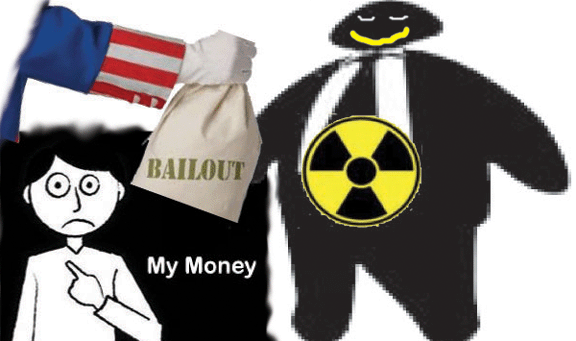
 The nuclear bailout nobody’s talking about, https://highlandcountypress.com/Content/In-The-News/In-The-News/Article/The-nuclear-bailout-nobody-s-talking-about-/2/20/60902, By Marty Schladen, Ohio Capital Journal, 19 Oct 20, https://ohiocapitaljournal.com/
Ohio state government continues to be gripped by an alleged $61 million bribery scandal involving a billion-dollar nuclear bailout.
But while the effort for that bailout was brewing as part Akron-based FirstEnergy’s strategy to prop up and spin off unprofitable nuclear power plants, another part of the strategy might have resulted in an additional — and potentially larger — bailout in a separate venue.
And, some observers warn, many more such bailouts throughout the country might be on the way.
In February, seven months after Gov. Mike Dewine signed the $1.3 billion ratepayer bailout that mostly would subsidize two Northern Ohio nuclear plants, FirstEnergy might have gotten an even bigger break in U.S. bankruptcy court. That’s when Judge Alan M. Koschik signed off on a settlement that largely excused FirstEnergy from footing part of the bill to clean up the aging nuclear plants in Ohio and another in Pennsylvania that it had bequeathed to to its successor, now known as Energy Harbor, in the event that company goes belly up.
If the new company can’t make a go of it with the nuclear and coal plants that had been owned by FirstEnergy, taxpayers could well be on the hook for whatever part of the estimated $10 billion nuclear cleanup that Energy Harbor and a trust fund it’s required to maintain can’t.
Those are cleanups that, for financial reasons, will take 60 years — decades during which the crumbling cooling tower of the company’s Davis-Besse plant, for example, will loom over the Lake Erie shoreline in view of South Bass Island, one of Ohio’s premier tourist attractions.
Energy Harbor’s “financial future doesn’t look bright and when we say (FirstEnergy) needs to set aside money for (shutting down and cleaning up the plants), their response is going to be, ‘The bankruptcy court approved the reorganization, FirstEnergy isn’t on the hook anymore,’” said Margrethe Kearney, senior staff attorney at the Environmental Law & Policy Center, which is appealing the bankruptcy ruling to the 6th U.S. Circuit Court of Appeals in Cincinnati. “This is a way that bankruptcy is increasingly being used by companies — to shed their environmental liability.”
And, Kearney said, companies across the country that own nuclear generators likely will try to use the bankruptcy to ease looming cleanup costs off of their books and onto the backs of taxpayers.
“Especially here in the Midwest we have a lot of nuclear power plants, a lot of them are coming to the end of their useful life, most of them are out of the money, so it doesn’t really make sense to invest in them because natural gas and renewable energy is less expensive and we’re going to have a real crisis when it comes to the decommissioning of power plants and the financial ability to pay for them,” she said.
A doozy of a scandal
The Ohio Capitol was rocked in July when the FBI arrested then-House Speaker Larry Householder and four associates in what U.S. Attorney David DeVillers said was “likely the largest bribery and money-laundering scheme ever in the state of Ohio.”
DeVillers alleged that $61 million flowed from FirstEnergy and related companies through 501(c)(4) dark money groups and into campaigns of House candidates who later elected Householder speaker, a perch from which he shepherded House Bill 6, the $1.3 billion bailout, to passage. (House Bill 6 was cosponsored by Hillsboro Republican State Rep. Shane Wilkin and Rep. Jamie Callender, a Lake County Republican.)
The money also funded a nasty, xenophic campaign to block a voter initiative to repeal HB 6, while Householder and his associates simultaneously lined their own pockets with some of the loot, DeVillers said.
It wasn’t the only such scandal to break in July. In Illinois, Commonwealth Edison and parent company Exelon admitted to an eight-year bribery scheme targeting people around Illinois House Speaker Michael Madigan, who hasn’t been charged. One of the things the company received from the legislature during that period was a $2.35 billion bailout of two struggling nuclear power plants in that state.
In Ohio, nobody from FirstEnergy has been charged. But DeVillers in July said his investigation was far from over.
In September, Ohio Attorney General Dave Yost named FirstEnergy and associated companies as defendants in a civil suit. Among other things, it demanded that bailout funds be blocked and that the companies that funded the HB 6 scheme either fire the officials involved or see the companies themselves dissolved.
Who was in charge?
The funds promised by HB 6 were far from the first ratepayer largesse enjoyed by companies related to FirstEnergy, whose name graces the stadium in which the Cleveland Browns play. Last year, Ohio Rep. Mark Romanchuk, R-Ontario, said the company’s Ohio nuclear plants had received $10.2 billion in state subsidies since 1999.
The attorney general’s lawsuit says that four years ago, what to do about the failing nuclear plants was at the heart of what he said was a corrupt scheme to obtain a bailout.
“In late 2016, FirstEnergy Corp. had a problem,” the suit says. “The nuclear power generation plants it owned through its subsidiary FirstEnergy Solutions Corp. had turned from assets to liabilities.”
It also said that by spinning off the plants, passing the bailout and sending its former subsidiary through bankruptcy, FirstEnergy did lasting harm to the state. That’s because, the suit said, FirstEnergy had potentially shifted some of the burden to clean up the Perry and Davis-Besse reactors in Ohio from itself and onto the taxpayers.
“Ohio’s environmental future has been damaged, because the costs for the ultimate decommissioning of the nuclear plants are now secured by Energy Harbor, a company with far smaller capitalization than FirstEnergy Corp.,” the suit said. “To the extent that decommissioning and environmental repair costs exceed Energy Harbor’s ability to pay, those costs will be borne by Ohio through its ratepayers or taxpayers — a scenario that already played out once in the FirstEnergy Solutions’ bankruptcy plan that created Energy Harbor.”
Yet, FirstEnergy maintains that after 2016 its leaders had no control over the former subsidiary that owns nuclear as well as coal plants in Ohio and Pennsylvania.
“FirstEnergy leadership has not had any decision-making power regarding the strategic direction of FES since November 2016, and FirstEnergy and Energy Harbor are now separate, unaffiliated companies,” FirstEnergy spokeswoman Jennifer Young said in September after the Ohio attorney general’s lawsuit was filed.
However, that claim seems hard to credit because FirstEnergy CEO Chuck Jones is also CEO of FirstEnergy Services.
Until June, First Energy Services provided the power plant-owning company that became Energy Harbor with many — if not all — of the services one would associate with running it. They include “administrative, management, financial, compliance, ethical, external affairs, and political and regulatory advocacy services. ”
For her part, Young said that the companies are independent because they have separate boards.
Long-term strategy
In late 2016, as FirstEnergy was spinning off the company that after bankruptcy became Energy Harbor, Jones announced a strategy of seeking a bailout for the spun-off company’s failing nuclear assets.
“We are advocating for Ohio’s support for its two nuclear plants, even though the likely outcome is that FirstEnergy won’t be the long-term owner of these assets,” Jones said.
In an affidavit supporting criminal charges against the former Ohio speaker and others, FBI Special Agent Blane Wetzel introduces the case for a criminal conspiracy by referring back to that time.
“In 2016, (FirstEnergy) Corp.’s nuclear generation future looked grim,” it said. “In its November 2016 annual report to shareholders, Ohio-based (FirstEnergy) Corp. and its affiliates reported a weak energy market, poor forecast demands, and hundreds of millions of dollars in losses, particularly from its nuclear energy affiliate…
“Given this backdrop, (FirstEnergy) announced future options for its generation portfolio as follows: ‘legislative and regulatory solutions for generation assets’; asset sales and plant deactivations; restructuring debt; and/or seeking protection under U.S. bankruptcy laws for its affiliates involved in nuclear generation.”
On March 31, 2018, Energy Harbor predecessor FirstEnergy Solutions exercised one of those options when it filed for Chapter 11 protection in the U.S. Bankruptcy Court of the Northern District of Ohio.
Broad immunity
By the time FirstEnergy Solutions emerged from bankruptcy in February, it had a new name, Energy Harbor, and it had largely released its former parent company, FirstEnergy Corp., from any responsibility to clean up the nuclear plants it used to own.
“It makes it really difficult to get into the pockets of the parent if the subsidiary runs out of money,” Kearney, of the Environmental Law and Policy Center said of the settlement.
In fact, the release worked out between FirstEnergy, a primary creditor, and its former subsidiary was so broad that Judge Koschik disallowed part of it, saying it would make the overall settlement legally unconfirmable.
“The only (nuclear cleanup) ‘mechanism’ offered by (Energy Harbor) is its own assumption of these long-term environmental obligations and a promise that as a reorganized debtor with new capital structure facilitated by (FirstEnergy Corp.), it will stalwartly stand by and satisfy these claims if and when they arise,” Koschik wrote.
FirstEnergy and its former subsidiary modified the “third-party releases” and Koschik signed off on the overall settlement.
But he did so without allowing Kearney’s group to put on testimony from an expert witness, Peter Bradford, a former commissioner with the U.S. Nuclear Regulatory Commission. Bradford planned to testify that there were expenses far in excess of what the commission — which is responsible only for the cleanup of radioactive material — requires nuclear operators to pay into a trust fund, Kearney said.
Koschik’s refusal to hear from Bradford is a big part of why the Environmental Law and Policy Center and associated groups are appealing the bankruptcy settlement, although they also have briefed the appellate court on the federal criminal and state civil actions surrounding the HB 6 bailout scandal.
“We are asking to have our expert heard on the nuclear decommissioning issues,” Kearney said. “That doesn’t mean that the entirety of the bankruptcy proceeding will be reopened.”
Cleanup of the century
Asked last week about what it would cost to clean up its former nuclear plants in Ohio and Pennsylvania, FirstEnergy’s Young said, “FirstEnergy’s liabilities related to nuclear decommissioning are hypothetical and comparable to any former owner of nuclear generating facilities. The bankruptcy did not change that. The other questions you asked about decommissioning would need to be directed to Energy Harbor since they are the current owners and operators of the plants and are primarily liable for decommissioning. As you’ll recall, Energy Harbor is a separate company now unaffiliated with FirstEnergy.”
Calls and emails to two Energy Harbor spokesmen were unanswered.
Young said that as of June, Energy Harbor’s nuclear decommissioning trust funds were worth about $2 billion.
The cleanup envisioned for Perry and Davis-Besse plants in Ohio and the two Beaver Valley units in Pennsylvania would extend for the better part of a century — from 2021 through 2083, according to 2018 studies performed for FirstEnergy as part of the bankruptcy. Kearney said the longevity of the process isn’t because the cleanup is so complex. It’s because the money in the trust fund isn’t enough to pay for it now, so it needs time to grow.
However, based on the estimates commissioned by FirstEnergy, it’s hard so see how $2 billion would be enough. They list four categories of costs associated with the cleanup:
• Decommissioning, including a 17% contingency;
• Hefty NRC license-termination fees (fees are a major source of the agency’s funding);
• Spent-fuel management; and
• Non-nuclear demolition.
Taken together, the combined estimated cost to shut down and clean up all the facilities is $9.6 billion in 2014 dollars. And not nearly all of the $2 billion in the trust fund will be allowed to grow until 2074 to meet it.
The total cost to clean up Beaver Valley Unit 2, for example, is estimated at just under $2 billion, or about 20% of the total.
The timeline in the estimate calls for about an eighth of that — $233 million — to be spent through 2026 preparing for a 48-year “dormancy” period. The estimate says that it will cost between $6 million and $7 million a year for the first 33 years and $3 million to $4 million a year for the next 15.
In other words, if Energy Harbor were to stop paying into the trust fund tomorrow, far less than $2 billion will be allowed to grow until the final cleanup starts in 2075.
The estimates were financed by an interested party, FirstEnergy. But even if they weren’t, Kearney stressed that they could be significantly off — especially since they’re drawn out over such a long period. She said, however, “That $2 billion represents about half of the (overall) estimated cleanup costs.”
The uncertainty over how much the nuclear cleanups will cost and whether Energy Harbor can pay for them makes it unjust that its bankruptcy let FirstEnergy off the hook — especially in light of the criminality alleged in Ohio’s other nuclear bailout, the state’s official consumer representative said.
“An inadequate funding of the future decommissioning costs for the Davis-Besse and Perry nuclear power plants would also be of concern to Ohioans who, one way or another, may ultimately be asked to pay the tab for any shortfall in funding of these costs,” the Office of the Ohio Consumer Counsel said in a brief filed with the 6th Circuit. “Such a result would be objectionable for consumers.”
The OCC needn’t have limited his claims to the potential burden to Ohioans. As things stand now, if Energy Harbor can’t cover the cost of the cleanup, it will fall on all U.S. taxpayers.
Read the federal complaint
https://assets.documentcloud.org/documents/6999130/Ohio-House-complaint.pdf
Marty Schladen has been a reporter for decades, working in Indiana, Texas and other places before returning to his native Ohio to work at The Columbus Dispatch in 2017. He’s won state and national journalism awards for investigations into utility regulation, public corruption, the environment, prescription drug spending and other matters.
Nuclear pollution in China – the Uighur people pay the health and environmental price
A third of the PRCs uranium for nuclear energy comes from extortion in the Yili basin of Xinjiang. This is also home to a great population of Uighurs.
Today, China has one of the world’s largest nuclear energy development programmes. During the Cold War era, there did not exist a political or economic motivator for commercialising nuclear energy as coal-fired power stations and hydroelectric energy dominated the system. However, after 2005, China has been able to reinvent this narrative. Notably, what this resurrected was a reassertion of spaces of injustice for their minorities. Their lands were first grounds for nuclear weapons’ testing and now used for energy rather than warfare purposes, thus continuing a historical subjugation to nuclear imperialism. This nuclear imperialism situates itself within an already prevalent cyclic violence against China’s far western frontier region of Xinjiang’s ethnic minorities, the predominantly Muslim Uighurs, ever since the establishment of the People’s Republic of China (PRC) in 1949.
Given the inherent differentiation between the Uighurs and the Chinese dominant ethnicity, the Hans, the former’s identity was always up for scrutiny. The government came down particularly hard on the Uighurs after the events of 9/11 initiated the Global War on Terror (GWOT), as well as the Ürümqi riots on 5 July 2009 which saw clashes between protesting Uighurs, Han people, and China’s People’s Armed Police, leaving nearly 200 people dead in Xinjiang. The Chinese government has attributed security concerns with the certain ‘terrorist’ acts committed by a handful of them. Taking what some might perceive as an opportunist stand, China was able to claim being victim to global terrorism, to justify crackdown on the minority group. What this terrorist narrative in turn ushered in was a transnational territory of uncontrolled spaces where ‘dangerous populations’ need not be afforded legal protections and therefore be made to quarantine; containing their actions that often correspond to security threats. The antagonism was not restricted to the few Uighurs rioters. Instead the entire Uighur community as a single biological group was treated as the Homo Sacer.
………….. The systematic discrimination of the Uighur feeds into a larger understanding of necro-politics of Uighur lives having become too consequential juxtaposed with a system which is ready to dispense with this minority population. The emphasis here is on China’s first nuclear weapons test in Lop Nor, and the legacy it has translated onto the present day context through states sponsored uranium mining in the Yili Basin, underscoring a new kind of imperialism.
Nuclear weapon testing began in the mid-1960s. Soon a kind of nuclear imperialism started to take root in the existing Han colonisation of Uighur spaces. The latter revolved around a combination of contestation over the sovereignty of the Uighur homeland and the resource-rich soils they inhabited. The aftermath of the Sino-Soviet split meant a collapse in PRCs nuclear relationship with China which acted as a driver for hastening and furthering their ambitious nuclear programmes. The PRC became the fifth nation to develop nuclear weapons during the Cold War. They formally established the 10,000 km sq. Lop Nor Nuclear Test base in 1956. It still stands as the largest site of its kind in the world………
Professor Jun Takada conducted a study explaining how peak levels of radioactivity from large yield tests might have had prolonged consequences in the biological makeup of the generations to come observing congenital defects and cancer incidents in some. The cancer incidents in the region were approximately 35% higher than the rest of the state. Uighur traditional medicine could not cope with these cases. In short, a biopolitical regime protected the state from liability, meanwhile for the Uighurs, contestation around state assurance and health risks posed a blurring in the causation between sickness and exposition.
The Uighurs who were affected by the Lop Nor test therefore have been given no compensation or recognition from the state. Many Hans on the other hand were given assurance from the state especially in terms of healthcare on various occasions. This only furthered the resentment and tension between the Hans and the Uighurs of Xinjiang in the years to come.
Following this, peaceful protests sprung up. In November 1985, protests led by students in Beijing against nuclear weapon tests were met with brute state coercion. In 1993, Uighurs gathered at Log Nor and demanded the ban of nuclear testing but were interrupted by PLA forces, some protestors were shot in the process. The Tigers of Lop Nor were an organisation that even managed to send tanks inside nuclear spaces and blew up planes in protest. Moreover, enveloped in this environment, the Uighur identity that already clashed with Han nationalism was simply made starker; the anti-nuclear movement began to echo separatist tendencies.
Today, a third of the PRCs uranium for nuclear energy comes from extortion in the Yili basin of Xinjiang. This is also home to a great population of Uighurs. The PRC has placed a moratorium on the manufacturing of fissile material for deterrence purposes, transforming Xinjiang into the primary hub for the nuclear energy industry. The NINT continues to partake in nuclear research, to the north of the Lop Nor test site. There is no state system in place to ensure the safety of those dwelling the Yili. What this reflects is a revival of a past narrative of nuclear imperialism as uranium energy extraction seems to have overtaken nuclear testing. There appears to be no incentive from the ends of the government; a lacking in enforceable nuclear legislations and regional systems of monitoring and regulating nuclear activity. …….
. China now possesses over 44 nuclear reactors in operation and 18 others under construction and is striving towards ensuring that 1/5th of their energy comes from their power plants by 2030. Activism from the minorities in the region is often counted by officials as acts of Islamism or cultural protests rather than a legacy of activities against the nuclear industry which is another layer of discrimination that has been recognised by the Uighurs.
More anti-nuclear activism seems to be entering the eastern provinces of Shandong, Jiangsu, and Guangdong as a result of general community concerns against an unprotected nuclear policy. Online petitions and active media are slowly entering the scene to influence and mobilise public opinion. However, it is only perhaps a matter of time before the PRC silences them too.
Censorship is often used to subdue this kind of opposition online. What is worse is that the Uighurs of Xinjiang lack the agency to voice their grievances while practitioners in the east who are often familiar with the political systems and often well-educated are able to make negotiations with the state in terms of the relocation of nuclear power plants. ……… https://www.orfonline.org/expert-speak/nuclear-imperialism-china-xinjiang/
The attack on journalism – launched with the persecution of Julian Assange

Persecuting Assange Is a Real Blow to Reporting and Human Rights Advocacy’
CounterSpin interview with Chip Gibbons on Assange extradition Fair, 15 Oct 20,
 for the October 9, 2020, episode of CounterSpin. This is a lightly edited transcript.
Janine Jackson: If it were not for a tiny handful of journalists—ShadowProof’s Kevin Gosztola preeminent among them—Americans might be utterly unaware that a London magistrate, for the last month, has been considering nothing less than whether journalists have a right to publish information the US government doesn’t want them to. Not whether outlets can leak classified information, but whether they can publish that information on, as in the case US war crimes and torture and assorted malfeasance to do with, for instance, the war on Afghanistan, which just entered its 19th year, with zero US corporateUS war crimes and torture and assorted malfeasance to do with, for instance, the war on Afghanistan, which just entered its 19th year, with zero US corporate media interest.
Assange’s case, the unprecedented use of the Espionage Act to go after a journalist, has dire implications for all reporters. But this country’s elite press corps have evidently decided they can simply whistle past it, perhaps hoping that if and when the state comes after them, they’ll make a more sympathetic victim.
Joining us now to discuss the case is Chip Gibbons. He’s policy director at Defending Rights & Dissent. He joins us now by phone from Washington, DC………..
CG: Sure. So the US has indicted Julian Assange with 17 counts under the Espionage Act, as well as a count under the Computer Fraud and Abuse Act.
Assange is not a US person; he’s an Australian national. He was inside the Ecuadorian embassy for a number of years, as Ecuador had granted him asylum, and the UK had refused to basically recognize that and let him leave the country, so he was de facto imprisoned inside the embassy. And after the indictment the US issued, the new government of Ecuador—which is much less sympathetic to Assange than the previous Correa government—let the US come in the embassy and seize him.
And the US is seeking Assange’s extradition to the US from the UK. I guess it’s, probably, technically a hearing, but Kevin’s point was that it’s more like what we would think of as a trial, in that there’s different witnesses, there’s expert testimony, there’s different legal arguments at stake.
The defense, the witness portion of it, has closed; it ended last week. And there’s going to be closing arguments submitted in writing, and then the judge will render a decision, and that decision will be appealable by either side. So regardless of the outcome, we can expect appeals. So it does very closely mirror what we would think of more like a trial than a hearing in the US court context.
It’s important to really understand what’s at stake with Assange’s extradition. He is the first person ever indicted by the US government under the Espionage Act for publishing truthful information.
The US government has considered indicting journalists before: They considered indicting Seymour Hersh, a very famous investigative reporter. They considered indicting James Bamford, because he had the audacity to try to write a book on the National Security Agency. But they’ve never done that.
And Obama’s administration looked at the idea of indicting Assange and said, “No, this would violate the First Amendment, and it would open the door to all kinds of other bad things.” But the Trump administration clearly doesn’t have those qualms……..
It is very interesting to see how this plays out in a US court in the current environment. If whoever—Trump or Biden, whoever is president, when this finally comes to the US—actually pursues this, and they actually are allowing the persecution of journalists, that’s going to be a really dark, dark assault on free expression rights.
And it’s worth remembering—and Julian Assange is clearly very reviled in the corporate media and the political establishment right now—but the information he leaked came from Chelsea Manning, it dealt with US war crimes; and he worked with the New York Times, the Guardian, Der Spiegel, Le Monde, Al Jazeera, to publish this information. So if he can go to jail for publishing this, why can’t the New York Times? And is that a door anyone wants to open? There is a big press freedom angle here.
I also want to talk about the facts, though: What did Julian Assange publish, and why did it matter? ………..
Julian Assange is accused of publishing information about war crimes, about human rights abuses and about abuses of power, that have been tremendously important, not just for the public’s right to know, but also have made a real difference in advocacy around those issues. People were able to go and get justice for victims of rendition, or able to go and get court rulings in other countries about US drone strikes, because of this information being in the public domain. So attacking Assange, persecuting Assange, disappearing him into a supermax prison, this is a real blow to reporting and human rights advocacy. ………
JJ: Right. And, finally, the journalists who are holding their nose right now on covering it aren’t offering to give back the awards that they won based on reporting relying on WikiLeaks revelations. And James Risen had an op-ed in the New York Times a while back, in which he was talking about Glenn Greenwald, but also about Julian Assange, and he said that he thought that governments—he was talking about Bolsonaro in Brazil, as well as Donald Trump—that they’re trying out these anti-press measures and, he said, they “seem to have decided to experiment with such draconian anti- press tactics by trying them out first on aggressive and disagreeable figures.”………. https://fair.org/home/persecuting-assange-is-a-real-blow-to-reporting-and-human-rights-advocacy/
Assange extradition case could esrablish a dangerous legal precedent
 Crumbling Case Against Assange Shows Weakness of “Hacking” Charges Related to Whistleblowing
The charge against Assange is about establishing legal precedent to charge publishers with conspiring with their sources, something that so far the U.S. government has failed to do because of the First Amendment.
Five years later, in 2018, the Trump Administration indicted Assange anyway. But, rather than charging him with espionage for publishing classified information, they charged him with a computer crime, later adding 17 counts of espionage in a superseding May 2019 indictment.
The computer charges claimed that, in 2010, Assange conspired with his source, Chelsea Manning, to crack an account on a Windows computer in her military base, and that the “primary purpose of the conspiracy was to facilitate Manning’s acquisition and transmission of classified information.” The account enabled internet file transfers using a protocol known as FTP.
New testimony from the third week of Assange’s extradition trial makes it increasingly clear that this hacking charge is incredibly flimsy. The alleged hacking not only didn’t happen, according to expert testimony at Manning’s court martial hearing in 2013 and again at Assange’s extradition trial last week, but it also couldn’t have happened.
The new testimony, reported earlier this week by investigative news site Shadowproof, also shows that Manning already had authorized access to, and the ability to exfiltrate, all of the documents that she was accused of leaking — without receiving any technical help from WikiLeaks. …….
the charge is not actually about hacking — it’s about establishing legal precedent to charge publishers with conspiring with their sources, something that so far the U.S. government has failed to do because of the First Amendment………
Whether or not you believe Assange is a journalist is beside the point. The New York Times just published groundbreaking revelations from two decades of Donald Trump’s taxes showing obscene tax avoidance, massive fraud, and hundreds of millions of dollars of debt.
Trump would like nothing more than to charge the New York Times itself, and individual journalists that reported that story, with felonies for conspiring with their source. This is why the precedent in Assange’s case is so important: If Assange loses, the Justice Department will have established new legal tactics with which to go after publishers for conspiring with their sources. https://portside.org/2020-10-10/crumbling-case-against-assange-shows-weakness-hacking-charges-related-whistleblowing
World press freedom endangered, if UK extradites Julian Assange to America
The
|
Assange Faces Extradition for Exposing US War Crimes, BY Marjorie Cohn, Truthout, October 11, 2020 Three weeks of testimony in Julian Assange’s extradition hearing in London underscored WikiLeaks’s extraordinary revelation of U.S. war crimes in Iraq, Afghanistan and Guantánamo Bay. But the Trump administration is seeking to extradite Assange to the United States to stand trial for charges under the Espionage Act that could cause him to spend 175 years in prison. Assange founded WikiLeaks during the Bush administration’s “war on terror,” which was used as a pretext to start two illegal wars and carry out a widespread program of torture and abuse of prisoners at Guantánamo and the CIA black sites. On October 8, 2011, Assange told a Stop the War Coalition rally in London’s Trafalgar Square, “If wars can be started by lies, peace can be started by truth.” In 2010 and 2011, WikiLeaks published classified material that Army intelligence analyst Chelsea Manning had provided to the organization. Manning was prosecuted, convicted and sentenced to 35 years in prison for leaking the documents. As he left office, Barack Obama commuted her sentence to the seven years she had already served. That commutation provoked “tremendous anger” in the Trump administration and drew Trump’s attention to Assange, Eric Lewis testified. Lewis, chairman of the board of Reprieve U.S. and lawyer for Guantánamo and Afghan detainees, called this “a politically motivated prosecution.” The files that WikiLeaks published contained 90,000 reports about the war in Afghanistan, including the Afghan War Logs, which documented a greater number of civilian casualties by coalition forces than the U.S. military had reported. In addition, WikiLeaks published nearly 400,000 field reports about the Iraq War, more than 15,000 unreported deaths of Iraqi civilians, and the systematic murder, torture and rape by the Iraqi army and authorities that were ignored by U.S. forces. WikiLeaks also published the Guantánamo Files, 779 secret reports constituting evidence of the U.S. government’s abuse of approximately 800 men and boys, ages 14 to 89. That abuse violated the Geneva Conventions and the Convention Against Torture and Other Cruel, Inhuman or Degrading Treatment or Punishment. Perhaps the most notorious release by WikiLeaks was the 2007 “Collateral Murder” video, which depicts a U.S. Army Apache helicopter target and fire on unarmed civilians in Baghdad. At least 18 civilians were killed, including two Reuters reporters and a man who came to rescue the wounded. Two children were injured. A U.S. Army tank drove over one of the bodies, cutting it in half. The video contained evidence of three separate war crimes prohibited by the Geneva Conventions and the U.S. Army Field Manual. As they are firing on the civilians, U.S. gunmen can be heard saying, “Look at those dead bastards.” In his written testimony, investigative journalist Nicky Hager drew a parallel between the Collateral Murder video and the television image of George Floyd screaming “I can’t breathe.” Assange Cannot Be Extradited for a Political OffenseThe 2003 U.S.-U.K. Extradition Treaty forbids extradition for a political offense. Although the treaty doesn’t define “political offense,” it generally includes espionage, treason, sedition and crimes against state power. Trump is asking the U.K. to extradite Assange for exposing war crimes. This is a classic political offense. Assange is charged under the Espionage Act and espionage constitutes a political offense as well……….. Assange’s Prosecution Violates Freedom of PressWhile the Obama administration declined to file criminal charges against Assange for fear of setting a dangerous precedent, Team Trump demonstrated no such forbearance. By charging Assange under the Espionage Act, Trump is making him a poster boy for its full court press against the media, which he calls “the enemy of the people.” Assange’s prosecution would send an ominous message to all journalists: report the unvarnished truth at your peril. No media outlet or journalist has ever been prosecuted under the Espionage Act for publishing truthful information, which is protected First Amendment activity. Journalists are permitted to publish material that was illegally obtained by a third person and is a matter of public concern. The U.S. government has never prosecuted a journalist or newspaper for publishing classified information, an essential tool of journalism. Information-gathering, reporting and disclosure fit the classic definition of activity protected by the First Amendment’s guarantee of freedom of the press. There is no distinction between what WikiLeaks did and what The New York Times, Der Spiegel, Le Monde, El País and The Guardian did as well. They all published articles based on documents WikiLeaks released. This is the reason Obama administration — which prosecuted an enormous number of whistleblowers — considered, but refrained from, indicting Assange. ……… WikiLeaks Didn’t Endanger Informants and Saved LivesAlthough the U.S. government claims that Assange endangered informants named in the published documents, John Goetz, an investigative reporter who worked for Germany’s Der Spiegel, testified that Assange took pains to ensure that the names of U.S. informants in Iraq and Afghanistan were redacted to protect their identities. …….. Moreover, WikiLeaks’s revelations actually saved lives. After WikiLeaks published evidence of Iraqi torture centers the U.S. had established, the Iraqi government refused Obama’s request to extend immunity to U.S. soldiers who commit criminal and civil offenses there. As a result, Obama had to withdraw U.S. troops from Iraq. WikiLeaks also revealed evidence of wrongdoing by other countries besides the United States. The organization uncovered Russian surveillance, published exposés of Bashar al-Assad in Syria, and some say WikiLeaks’s exposure of corruption in Tunisia and torture in Egypt helped catalyze the Arab Spring………… Assange’s Prosecution Will Chill JournalismOstensibly to get around allegations that it is prosecuting Assange for conducting journalism, the Trump administration is trying to paint him as a hacker by accusing him of conspiring with Manning to break into a government computer to steal government documents, in violation of the Computer Fraud and Abuse Act. But, as Patrick Eller, a digital forensic expert, testified, the attempted cracking of the password hash was not technologically possible in 2010, when the conversation between Assange and Manning occurred. Even if it were feasible, the purpose would not have been to conceal Manning’s identity and it would not have given Manning any increased access to government databases. The prosecution of Assange would set a disturbing example for journalists and media outlets that publish information critical of the government. Team Trump singled out Assange to deter journalists from publishing material that criticizes U.S. policy. If Assange is extradited to the United States and convicted of the charges against him, it would chill journalists from reporting the facts for fear they could be indicted under the Espionage Act………. When she set the November 16 date for the defense to submit closing arguments, Judge Vanessa Baraitser asked the defense how the U.S. presidential election would affect its case and declared that her decision on extradition would come after that election, stating, “That’s one of the factors going into my decision.” Kristinn Hrafnsson, editor-in-chief of WikiLeaks, said that the judge “acknowledged what has been clear since even before the first indictment against Julian Assange was unsealed — that this is a politically motivated prosecution.” Baraitser, who has granted extradition in 96 percent of the cases that have come before her, plans to issue her ruling on January 4. If she grants extradition, there will be several levels of appeals, including to the European Court of Human Rights. The stakes could not be higher. https://truthout.org/articles/assange-faces-extradition-for-exposing-us-war-crimes/?eType=EmailBlastContent&eId=614ce999-9844-4d61-a600-169db0c99052 |
1 This Month



26 September – International Day for the Total Elimination of Nuclear Weapons


PLEASE OPPOSE HR 8255 AND S.3639 – bills would accelerate satellite deployment, with no environmental review or safeguards – https://ncstd5li.quorum.us/campaign/169331/
To see nuclear-related stories in greater depth and intensity – go to https://nuclearinformation.wordpress.com
-
Archives
- September 2026 (245)
- August 2026 (330)
- July 2026 (355)
- June 2026 (287)
- May 2026 (306)
- April 2026 (356)
- March 2026 (251)
- February 2026 (267)
- January 2026 (308)
- December 2025 (358)
- November 2025 (359)
- October 2025 (375)
-
Categories
- 1
- 1 NUCLEAR ISSUES
- business and costs
- climate change
- culture and arts
- ENERGY
- environment
- health
- history
- indigenous issues
- Legal
- marketing of nuclear
- media
- opposition to nuclear
- PERSONAL STORIES
- politics
- politics international
- Religion and ethics
- safety
- secrets,lies and civil liberties
- spinbuster
- technology
- Uranium
- wastes
- weapons and war
- Women
- 2 WORLD
- ACTION
- AFRICA
- Atrocities
- AUSTRALIA
- Christina's notes
- Christina's themes
- culture and arts
- Events
- Fuk 2022
- Fuk 2023
- Fukushima 2017
- Fukushima 2018
- fukushima 2019
- Fukushima 2020
- Fukushima 2021
- general
- global warming
- Humour (God we need it)
- Nuclear
- RARE EARTHS
- Reference
- resources – print
- Resources -audiovicual
- Weekly Newsletter
- World
- World Nuclear
- YouTube
-
RSS
Entries RSS
Comments RSS
 nuclear-news