How the USA fabricated a movie, full of falsehoods about the nuclear bombing in 1945.

Over and over we’re told that bigger bombs will bring peace and end war.
We’re told and shown completely fabricated nonsense
At the time The Beginning or the End was being scripted and filmed, the U.S. government was seizing and hiding away every scrap it could find of actual photographic or filmed documentation of the bomb sites.
Hiroshima Is A Lie Endangerment By David Swanson, World BEYOND War, August 5, 2021 ”……………………… In Greg Mitchell’s 2020 book, The Beginning or the End: How Hollywood — and America — Learned to Stop Worrying and Love the Bomb, we have an account of the making of the 1947 MGM film, The Beginning or the End, which was carefully shaped by the U.S. government to promote falsehoods.[xxiii] The film bombed. It lost money. The ideal for a member of the U.S. public was clearly not to watch a really bad and boring pseudo-documentary with actors playing the scientists and warmongers who had produced a new form of mass-murder. The ideal action was to avoid any thought of the matter. But those who couldn’t avoid it were handed a glossy big-screen myth. You can watch it online for free, and as Mark Twain would have said, it’s worth every penny.[xxiv]
The film opens with what Mitchell describes as giving credit to the UK and Canada for their roles in producing the death machine — supposedly a cynical if falsified means of appealing to a larger market for the movie. But it really appears to be more blaming than crediting. This is an effort to spread the guilt. The film jumps quickly to blaming Germany for an imminent threat of nuking the world if the United States didn’t nuke it first. (You can actually have difficulty today getting young people to believe that Germany had surrendered prior to Hiroshima, or that the U.S. government knew in 1944 that Germany had abandoned atomic bomb research in 1942.[xxv]) Then an actor doing a bad Einstein impression blames a long list of scientists from all over the world. Then some other personage suggests that the good guys are losing the war and had better hurry up and invent new bombs if they want to win it.
Over and over we’re told that bigger bombs will bring peace and end war. A Franklin Roosevelt impersonator even puts on a Woodrow Wilson act, claiming the atom bomb might end all war (something a surprising number of people actually believe it did, even in the face of the past 75 years of wars, which some U.S. professors describe as the Great Peace). We’re told and shown completely fabricated nonsense, such as that the U.S. dropped leaflets on Hiroshima to warn people (and for 10 days — “That’s 10 days more warning than they gave us at Pearl Harbor,” a character pronounces) and that the Japanese fired at the plane as it approached its target. In reality, the U.S. never dropped a single leaflet on Hiroshima but did — in good SNAFU fashion — drop tons of leaflets on Nagasaki the day after Nagasaki was bombed. Also, the hero of the movie dies from an accident while fiddling with the bomb to get it ready for use — a brave sacrifice for humanity on behalf of the war’s real victims — the members of the U.S. military. The film also claims that the people bombed “will never know what hit them,” despite the film makers knowing of the agonizing suffering of those who died slowly.
One communication from the movie makers to their consultant and editor, General Leslie Groves, included these words: “Any implication tending to make the Army look foolish will be eliminated.”[xxvi]
The main reason the movie is deadly boring, I think, is not that movies have sped up their action sequences every year for 75 years, added color, and devised all kinds of shock devices, but simply that the reason anybody should think the bomb that the characters all talk about for the entire length of the film is a big deal is left out. We don’t see what it does, not from the ground, only from the sky.
Mitchell’s book is a bit like watching sausage made, but also a bit like reading the transcripts from a committee that cobbled together some section of the Bible. This is an origin myth of the Global Policeman in the making. And it’s ugly. It’s even tragic. The very idea for the film came from a scientist who wanted people to understand the danger, not glorify the destruction. This scientist wrote to Donna Reed, that nice lady who gets married to Jimmy Stewart in It’s a Wonderful Life, and she got the ball rolling. Then it rolled around an oozing wound for 15 months and voilà, a cinematic turd emerged.
There was never any question of telling the truth. It’s a movie. You make stuff up. And you make it all up in one direction. The script for this movie contained at times all sorts of nonsense that didn’t last, such as the Nazis giving the Japanese the atomic bomb — and the Japanese setting up a laboratory for Nazi scientists, exactly as back in the real world at this very time the U.S. military was setting up laboratories for Nazi scientists (not to mention making use of Japanese scientists). None of this is more ludicrous than The Man in the High Castle, to take a recent example of 75 years of this stuff, but this was early, this was seminal. Nonsense that didn’t make it into this film, everybody didn’t end up believing and teaching to students for decades, but easily could have. The movie makers gave final editing control to the U.S. military and the White House, and not to the scientists who had qualms. Many good bits as well as crazy bits were temporarily in the script, but excised for the sake of proper propaganda.
If it’s any consolation, it could have been worse. Paramount was in a nuclear arms film race with MGM and employed Ayn Rand to draft the hyper-patriotic-capitalist script. Her closing line was “Man can harness the universe — but nobody can harness man.” Fortunately for all of us, it didn’t work out. Unfortunately, despite John Hersey’s A Bell for Adano being a better movie than The Beginning or the End, his best-selling book on Hiroshima didn’t appeal to any studios as a good story for movie production. Unfortunately, Dr. Strangelove would not appear until 1964, by which point many were ready to question future use of “the bomb” but not past use, making all questioning of future use rather weak. This relationship to nuclear weapons parallels that to wars in general. The U.S. public can question all future wars, and even those wars it’s heard of from the past 75 years, but not WWII, rendering all questioning of future wars weak. In fact, recent polling finds horrific willingness to support future nuclear war by the U.S. public.
At the time The Beginning or the End was being scripted and filmed, the U.S. government was seizing and hiding away every scrap it could find of actual photographic or filmed documentation of the bomb sites. Henry Stimson was having his Colin Powell moment, being pushed forward to publicly make the case in writing for having dropped the bombs. More bombs were rapidly being built and developed, and whole populations evicted from their island homes, lied to, and used as props for newsreels in which they are depicted as happy participants in their destruction.
Mitchell writes that one reason Hollywood deferred to the military was in order to use its airplanes, etc., in the production, as well as in order to use the real names of characters in the story. I find it very hard to believe these factors were terribly important. With the unlimited budget it was dumping into this thing — including paying the people it was giving veto power to — MGM could have created its own quite unimpressive props and its own mushroom cloud. It’s fun to fantasize that someday those who oppose mass murder could take over something like the unique building of the U.S. Institute of “Peace” and require that Hollywood meet peace movement standards in order to film there. But of course the peace movement has no money, Hollywood has no interest, and any building can be simulated elsewhere. Hiroshima could have been simulated elsewhere, and in the movie wasn’t shown at all. The main problem here was ideology and habits of subservience.
There were reasons to fear the government. The FBI was spying on people involved, including wishy-washy scientists like J. Robert Oppenheimer who kept consulting on the film, lamenting its awfulness, but never daring to oppose it. A new Red Scare was just kicking in. The powerful were exercising their power through the usual variety of means.
As the production of The Beginning or the End winds toward completion, it builds the same momentum the bomb did. After so many scripts and bills and revisions, and so much work and ass-kissing, there was no way the studio wouldn’t release it. When it finally came out, the audiences were small and the reviews mixed. The New York daily PM found the film “reassuring,” which I think was the basic point. Mission accomplished.https://worldbeyondwar.org/hiroshima-is-a-lie/
British Navy secrecy over nuclear submarine crashes
– The Royal Navy has refused to say whether anyone was disciplined following
an incident in which a nuclear submarine nearly crashed into a ferry
carrying 282 people off the Scottish coast. The navy also won’t say
whether it carried out an independent review to reduce the risks of future
collisions. This was recommended by government investigators concerned
about the near-miss and two other nuclear submarine crashes. Campaigners
accuse the navy of using the excuse of national security “to cover up
dangerous incompetence”. The Scottish National Party (SNP) condemns the
secrecy as “absolutely untenable”.
The Ferret 5th Aug 2021
Britain’s secret shortlist of areas earmarked for the dumping of nuclear waste
Southend-on-Sea, Essex, is the county’s most populous area, with more people living in the borough than anywhere else, but it’s a different story when you go to one of its most easterly points. Once you pass Shoeburyness, the area becomes almost entirely uninhabited. A series of islands, including Foulness Island and Wallasea Island, are situated here. They’re mostly marshy, boggy areas, but a few people still live there. A number of these islands are or have been owned by the government’s Ministry of Defence, who use this area for a variety of purposes, including as a shooting range. One of these islands is Potton Island. This island is mostly uninhabited, separated from the mainland by a thin creek only navigable via a small bridge which leads to the village of Great Wakering. In the 1800s, it was used as farmland until a major flood left the island abandoned. It was restored in the 1940s, and fell under the control of the Ministry of Defence in the 1950s before being turned back into a space for pasture and farmland. Documents released in 2005, after decades of secrecy, outlined areas the British government had earmarked for dumping nuclear waste in the 1980s and 1990s. Whilst any dumping would have been done in managed and safe ways, it’s still concerning to know that areas across Britain were being earmarked as graves for radioactive waste. Waste could have potentially been buried on Potton Island, and pedestrian access onto it possibly restricted completely. Southend Borough Council reportedly had no idea that Potton Island was on the government’s list of potential dumping locations, and were shocked when they found out it was on the shortlist. Essex Live 31st July 2021 https://www.essexlive.news/whats-on/classified-plans-use-essex-island-5713965 |
Facebook blocks users from Scottish Campaign for Nuclear Disarmament (CND)’s website
*S
Facebook blocks users from Scottish CND’s website
Billy Briggs, 25 July 21
The Scottish Campaign for Nuclear Disarmament (CND) is considering an official complaint to Ofcom after Facebook blocked users from accessing the peace organisation’s website. Anyone trying to access the official
Scottish CND site from its Facebook page in recent weeks has been advised the URL breaches “community standards”.
Scottish CND told The Ferret that many people have complained about not being able to access its website
via Facebook. The peace group thinks it may have been a “malicious complaint” or the perhaps the word “bomb” in the URL which is proving problematic.
Ferret 24th July 2021
First Energy company to pay fine for bribing Ohio officials to bail out nuclear power stations
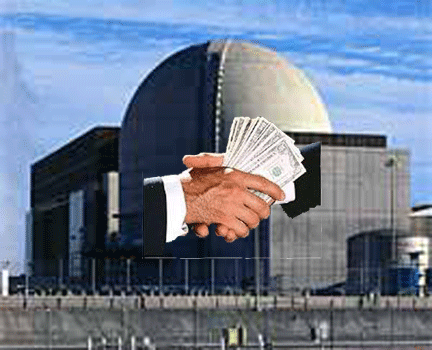
FirstEnergy agrees to pay $230M fine for bribing Ohio officials to bail out two nuclear plants, Utility Dive, Iulia Gheorghiu July 23, 2021
Dive Brief:
- FirstEnergy Corporation announced on Thursday a settlement agreement to pay a $230 million penalty for bribing Ohio officials to ensure the passage of a ratepayer-funded bailout for older generation assets, including two nuclear plants.
- The utility cooperated with federal investigators to disclose paying millions through dark money groups to state officials, including former Ohio House Speaker Larry Householder and former Public Utilities Commision of Ohio (PUCO) Chairman Sam Randazzo. The company acknowledged using 501(c)(4) organizations, which are registered lobbying entities, to conceal the nature, source and control of payments in the pursuit of the nuclear legislation……………
The details in the 49-page settlement agreement, in which FirstEnergy had to admit that company executives paid money to public officials in return for official action, has led to stakeholders raising questions about utility dark-money and political spending………….
The OEC Action Fund is also asking for a full repeal of HB 6 and has called for an investigation into every PUCO and Ohio Power Siting Board ruling made under Randazzo’s tenure.
“Each case he presided over is possibly tainted by corrupt ties to FirstEnergy,” Taylor-Miesle said……………………. https://www.utilitydive.com/news/firstenergy-agrees-to-pay-230m-fine-for-bribing-ohio-officials-to-bail-out/603836/
British court ruling heightens danger of Assange extradition to the US
British court ruling heightens danger of Assange extradition to the US, WSWS, Oscar Grenfell, 12 July 21, Last week’s ruling by the British High Court allowing prosecutors to appeal an earlier judgment blocking Julian Assange’s extradition, poses the very real danger that the WikiLeaks publisher will be dispatched to his American persecutors in the not-too-distant future.
The ruling is a microcosm of the Assange case as a whole. As they have for the past decade, the British courts have thrown aside the WikiLeaks founder’s legal and democratic rights. They have granted a US appeal that is both duplicitous and irregular under conditions in which the entire attempt by the American state to prosecute Assange has been exposed as an illegal frame-up.
The US appeal is a damning refutation of those, including among Assange’s own supporters, who have peddled dangerous illusions that the US administration of President Joe Biden may drop the prosecution if a sufficient number of moral pleas are addressed to the new occupant of the White House.
The appeal was first issued in the dying days of the Trump administration but it was continued, honed and argued for by Biden’s Justice Department. Assange remains in London’s maximum-security Belmarsh Prison and faces the prospect of lifetime incarceration in the US because Biden is determined to press ahead with the prosecution of a journalist and publisher for exposing American war crimes, human rights violations and illegal spying operations.
That is because the Assange prosecution is viewed as a crucial precedent by the imperialist powers for the suppression of dissent and anti-war opposition amid a ratcheting up of the preparations for military conflict, including the Biden administration’s threats and provocations against China, and the first signs of a resurgence of working-class struggle.
The appeal also confirms the warnings made by the World Socialist Web Site about January’s British District Court decision that barred extradition.
Judge Vanessa Baraitser accepted all the substantive arguments of the US prosecutors, including their right to try a publisher under the Espionage Act. Her ruling, prohibiting extradition, was framed in the narrowest terms. Its purpose was to defuse a groundswell of opposition to the prospect of Assange’s extradition and to provide the US with ample scope for appeal.
Baraitser ruled that extradition would be “oppressive.” Assange’s compromised health and the conditions of his imprisonment in the US would likely result in his suicide.
The deliberate consequence of that judgment was that there was only a legal sliver between Assange and extradition.
The US has exploited this with its appeal claiming that the conditions of imprisonment would not be so oppressive. It has proposed worthless assurances that Assange would not be held under Special Administrative Measures (SAM), regulations that impose almost total isolation on a prisoner, and that he could serve out his sentence in Australia.
The extradition hearing had heard harrowing testimony about the dire psychological consequences of SAMs and conditions at the supermax ADX Florence prison where they are frequently imposed.
The US arguments, accepted as a legitimate basis of appeal by the British court, were demolished by Stella Moris, Assange’s partner and an international human rights lawyer.
In a statement issued on Friday, Moris wrote: “Reports about US undertakings are grossly misleading. On any given day 80,000 prisoners in US prisons are held in solitary confinement. Only a handful are in ADX/under special administrative measures. ADX is just one of dozens of self-described supermax prisons in the United States. The US government also says it may change its mind if the head of the CIA advises it to do so once Julian Assange is held in US custody.
“With regard to the supposed concession of allowing Julian to serve jail time in Australia, it was always his right to request a prisoner transfer to Australia to finish serving his sentence because he is an Australian. It is no concession at all. There are existing agreements between the US and Australian authorities. What is crucial to understand is that prisoner transfers are eligible only after all appeals have been exhausted. For the case to reach the US Supreme Court could easily take a decade, even two.
“What the US is proposing is a formula to keep Julian in prison effectively for the rest of his life. The only assurance that would be acceptable would be for the Biden Administration to drop this shameful case altogether, once and for all. He should not be in prison for a single day, not in the UK, not in the United States, not in Australia—because journalism is not a crime.”
As Moris noted, the US appeal itself reserved the “right” to impose SAMs once Assange is on US soil. Testimony at the extradition hearing, including from a former US prison warden, established that the imposition of SAMs is essentially extra-judicial, often being introduced at the say-so of the intelligence agencies, and with no genuine means of appeal.
“What the US is proposing is a formula to keep Julian in prison effectively for the rest of his life. The only assurance that would be acceptable would be for the Biden Administration to drop this shameful case altogether, once and for all. He should not be in prison for a single day, not in the UK, not in the United States, not in Australia—because journalism is not a crime.”
As Moris noted, the US appeal itself reserved the “right” to impose SAMs once Assange is on US soil. Testimony at the extradition hearing, including from a former US prison warden, established that the imposition of SAMs is essentially extra-judicial, often being introduced at the say-so of the intelligence agencies, and with no genuine means of appeal.
The hearings, moreover, heard evidence of a case in which similar assurances were immediately thrown out the door once extradition was secured……………
Thordarson has now admitted, however, that almost all his testimony consisted of lies proffered in exchange for immunity from US prosecution. The American government thus submitted a false indictment to the British courts……….https://www.wsws.org/en/articles/2021/07/12/assa-j12.html?pk_campaign=assange-newsletter&pk_kwd=wsws
In the USA State of Ohio, pro nuclear legislation is helped along by misinformation on renewable energy

How misinformation propped up Ohio lawmakers’ latest attack on renewables
Unsupported and misleading statements were the “means to the end” for a bill to cripple new solar and wind energy in Ohio, critics say. by Kathiann M. Kowalski July 7, 2021
False and unsubstantiated claims about renewable energy have flourished for years, but critics say different forms of misinformation played a big role in Ohio lawmakers’ latest move to stifle the growth of wind and solar energy.
“Misinformation is the means to the end,” said Trish Demeter, chief of staff for the Ohio Environmental Council Action Fund. “Misinformation, bad information, misconstrued information, partial information: All of those are tactics that are supporting the goal, which is to block and kill renewable energy from being built in Ohio.”
Senate Bill 52 would let counties keep out new solar and wind farms from all or part of their territories, holding those projects to a higher standard than fossil fuel infrastructure.
Continue readingAustralian Members of Parliament from right and left parties call on US President Biden to drop charges against Julian Assange,
Australian MPs call on US President Biden to drop charges against Assange, https://www.smh.com.au/politics/federal/australian-mps-call-on-us-president-biden-to-drop-charges-against-assange-20210629-p585a1.html By Rob Harris, June 30, 2021 Former security analyst turned federal Labor MP Peter Khalil has joined a group of Australian politicians directly lobbying the United States to drop an appeal over a British court’s ruling against the extradition of the WikiLeaks co-founder Julian Assange.
In a video message to US President Joe Biden released on Wednesday evening Australian time, 11 federal MPs from across the political spectrum have also appealed to Washington to drop its espionage charges against the Australian citizen and for the British government to allow him to return home.
Before entering politics Mr Khalil, the member for the Victorian seat of Wills, was director of National Security Policy of the Coalition Provisional Authority in Iraq. As a national security adviser to former prime minister Kevin Rudd, he was personally named in diplomatic cables sent to Washington by the US Embassy, which were later released by Wikileaks.
While he has previously criticised Mr Assange’s actions in helping obtain and leak classified information on the wars in Afghanistan and Iraq, Mr Khalil said the case was “not just about one individual”.
“In an era where rising authoritarian regimes are denying and attacking freedom of the press, such as the shut down of Hong Kong’s Apple Daily by the Chinese Community Party, it is more important than ever that when it comes to condemning the denial of press freedom the rhetoric of liberal democracies is actually matched with substantive actions to protect the right of journalists and the media to do their work freely to hold governments to account,” Mr Khalil said.
He said while the Obama administration had clearly chosen not to indict Mr Assange because it would set a damming precedent against journalistic practice and behaviour, the Trump administration aggressively pursued the case.
“Therein lies the problem. These charges are so broad-based that if successful they would go well beyond this individual case – they would impact investigative journalism and open up prosecutions of countless media doing this journalism, they would have a chilling effect on all journalists reporting on national security and foreign affairs matters,” he said.
The 49-year-old Mr Assange has been in Belmarsh Prison since April 2019 trying to avoid extradition to the US to face charges on multiple counts of conspiring with and directing others, from 2009 to 2019, to illegally obtain and release US secrets.
In doing so he aided and abetted hacking, illegally exposed confidential US sources to danger and used the information to damage the US, according to the charges. If convicted on all counts he faces a prison sentence of up to 175 years.
In 2012 Mr Assange sought asylum at the Ecuadorean embassy to avoid extradition to Sweden on a rape allegation that he denied. An investigation into the 2010 rape allegation has since been dropped by Swedish prosecutors.
He was awarded a Walkley award, Australian journalism’s highest honour, in 2011 for a “most outstanding contribution to journalism” for his “brave, determined and independent stand for freedom of speech and transparency”.
In March this year Nationals MP George Christensen, Independent Andrew Wilkie and Labor’s Julian Hill personally met with the US embassy’s charge d’affaires, Michael Goldman, arguing that Mr Assange should be allowed to return home.
A 24-member parliamentary group established to support Mr Assange’s bid to return home contains members from all major parties, including now Deputy Prime Minister Barnaby Joyce.
Prime Minister Scott Morrison said in January Mr Assange would be allowed to return to Australia if all charges were dropped. He said consular support had consistently been offered to Mr Assange, but made clear the government were “not parties to those set of proceedings”.
.
U.S. proposals about extradition of Julian Assange are designed to keep him in prison for life
Assange fiancee rejects US proposals over possible extradition
Stella Moris says measures intended to keep her partner ‘in prison effectively for the rest of his life’, https://www.theguardian.com/media/2021/jul/08/julian-assange-fiancee-rejects-us-proposals-over-possible-extradition Ben Quinn@BenQuinn75, Thu 8 Jul 2021
US assurances that Julian Assange would not be held under the strictest maximum-security conditions if extradited from the UK have been rejected by his fiancee, who described them as a formula to keep him in prison for the rest of his life.
Details of the proposals made to British authorities emerged after permission was granted this week to appeal against January’s ruling that the Wikileaks co-founder cannot be extradited on mental health grounds.
They include assurances that Assange, if convicted in relation to charges of alleged espionage and hacking, would be allowed to serve any jail time in his native Australia.
The package contains a particular assurance that Assange would not be subject to “special administrative measures” (SAMs) in US custody or imprisoned at the “supermax” prison in Florence, Colorado, procedures reserved for high-security prisoners. The assurances were subject to change if he were to “do something” subsequently that met the US test for the imposition of the high-security measures.
Details were contained in excerpts of the UK court ruling granting limited permission to appeal, which were released by the Crown Prosecution Service.
In January, the district judge Vanessa Baraitser ruled Assange could not be extradited because of concerns over his mental health and risk of suicide in a US prison.
Stella Moris, Assange’s fiancee, described reports about US undertakings as “grossly misleading”, adding that 80,000 prisoners in US prisons were held in solitary confinement on any given day and only a handful were held in the conditions specifically mentioned in the proposals.
“The US government also says it may change its mind if the head of the CIA advises it to do so once Julian Assange is held in US custody,” she added.
In relation to him serving jail time in Australia, she said that it had always been his right to request a prison transfer to finish serving his sentence.
“What is crucial to understand is that prisoner transfers are eligible only after all appeals have been exhausted. For the case to reach the US supreme court could easily take a decade, even two.
“What the US is proposing is a formula to keep Julian in prison effectively for the rest of his life.”
Nick Vamos, a partner at the Peters & Peters law firm and a former head of extradition at the Crown Prosecution Service, said it was “highly unusual” for the US Department of Justice to offer broader assurances to a foreign court on prisoner treatment upfront. In fact, he said it had previously refused to do so in terrorism cases.
“It’s not unusual in extradition, but it is for the Americans to give this type of assurances because their previous approach over many years has been to say, ‘the US legal system is a fair one and our prison system is capable of dealing with people with all kinds of conditions,’” he said.
While a date has yet to be set for a high court hearing in relation to the US appeal, Vamos suggested things could move “quite quickly”.
While the ruling earlier this year had gone in Assange’s favour, he added: “The difficulty he and his legal team now have is that, if the court says we are denying extradition because we are concerned about his treatment, we are worried that a, b or c might happen, and the requesting state then provides an assurance which says, ‘under no circumstance will that ever happen’, then it defeats the objection.
“There’s also a longstanding history of our courts accepting the assurances from requesting states. The question is: ‘Does the assurance address it in fact or can it be undermined by suggesting that it is not quite as good as it appears or that they will dishonour it anyway?’”
U.S. government offers meaningless assurances on Julian Assange’s well-being, as it gets right to appeal on UK court ruling against his extradition

UK High Court grants US government right to appeal on Assange extradition, World Socialist Website, Laura Tiernan7 July 2021 Stella Moris, the partner of imprisoned WikiLeaks publisher Julian Assange, spoke outside Britain’s High Court yesterday warning he is “still at risk of extradition” after a judge decided the US government can appeal an earlier court ruling that blocked his extradition on health grounds.
The judge also ruled that Assange must remain in prison until the appeal is heard, effectively extending his incarceration for at least many more months.The ruling underscores the Biden administration’s determination to ensure Assange’s removal to the US. According to a report in the Wall Street Journal, based on excerpts of the judge’s ruling supplied by the UK Crown Prosecution Service, the US government offered “assurances” that Assange would not be imprisoned in oppressive conditions and could be permitted to serve any sentence in Australia.Such assurances are meaningless. Once Assange is in US custody, those pledges will be cast aside. The Wall Street Journal reported: “The US said it reserved the right to impose special measures on Mr. Assange, or hold him in a Supermax jail, if ‘he were to do something subsequent to the offering of these assurances’ that meets the test for applying them.”
Assange has been denied bail and remains detained in London’s Belmarsh Prison despite a January decision by District Court Judge Vanessa Baraitser denying his extradition to the US. Assange faces trumped-up charges under the Espionage Act over his exposure of war crimes, illegal mass surveillance and torture by the US and its allies. He has been held captive in the UK for a decade.
Baraitser ruled January 4 that Assange’s extradition to a US federal prison would be “oppressive” because of his compromised mental health and risk of suicide. The US Department of Justice (DoJ) under President Donald Trump immediately appealed Baraitser’s decision. Two days later, Trump mounted a fascist coup attempt in Washington D.C. The Democrats under Joseph Biden and Kamala Harris have seamlessly continued US imperialism’s political vendetta against Assange.The WikiLeaks publisher is being held in violation of his First Amendment rights to free speech and freedom of the press and in breach of international human rights law.
Britain’s High Court has reportedly granted a right of appeal to the US on three grounds. The court will decide whether Baraitser applied the Extradition Act correctly; whether sufficient advance notice was given of the court’s decision, and whether “assurances” by the US over mitigating the risk of suicide were properly considered.A date for the appeal hearing has not been announced, but it will likely take place after the courts’ summer recess. This leaves Assange imprisoned at Belmarsh indefinitely in conditions long condemned by doctors and human rights lawyers as “psychological torture.”
In a letter sent yesterday to Biden and US Attorney General Merrick Garland by Doctors for Assange, 250 doctors from 35 countries demanded the dropping of all charges against the WikiLeaks publisher. They denounced his ongoing imprisonment due to the US appeal as “amounting to cruel, inhuman and degrading treatment in the UK.”……….. https://www.wsws.org/en/articles/2021/07/08/gnkp-j08.html?pk_campaign=assange-newsletter&pk_kwd=wsws
Key witness in Julian Assange case admits to lies in indictment

A major witness in the United States’ Department of Justice case against Julian Assange has admitted to fabricating key accusations in the indictment against the Wikileaks founder. STUNDIN, Bjartmar Oddur Þeyr Alexanderssonbjartmar@stundin.is, Gunnar Hrafn Jónssonritstjorn@stundin.is 26 June 21,
The witness, who has a documented history with sociopathy and has received several convictions for sexual abuse of minors and wide-ranging financial fraud, made the admission in a newly published interview in Stundin where he also confessed to having continued his crime spree whilst working with the Department of Justice and FBI and receiving a promise of immunity from prosecution.
The man in question, Sigurdur Ingi Thordarson, was recruited by US authorities to build a case against Assange after misleading them to believe he was previously a close associate of his. In fact he had volunteered on a limited basis to raise money for Wikileaks in 2010 but was found to have used that opportunity to embezzle more than $50,000 from the organization. Julian Assange was visiting Thordarson’s home country of Iceland around this time due to his work with Icelandic media and members of parliament in preparing the Icelandic Modern Media Initiative, a press freedom project that produced a parliamentary resolution supporting whistleblowers and investigative journalism.
The United States is currently seeking Assange’s extradition from the United Kingdom in order to try him for espionage relating to the release of leaked classified documents. If convicted, he could face up to 175 years in prison. The indictment has sparked fears for press freedoms in the United States and beyond and prompted strong statements in support of Assange from Amnesty International, Reporters without borders, the editorial staff of the Washington Post and many others.
US officials presented an updated version of an indictment against him to a Magistrate court in London last summer. The veracity of the information contained therein is now directly contradicted by the main witness, whose testimony it is based on.
No instruction from Assange
The court documents refer to Mr Thordarson simply as “Teenager” (a reference to his youthful appearance rather than true age, he is 28 years old) and Iceland as “NATO Country 1” but make no real effort to hide the identity of either. They purport to show that Assange instructed Thordarson to commit computer intrusions or hacking in Iceland.
The aim of this addition to the indictment was apparently to shore up and support the conspiracy charge against Assange in relation to his interactions with Chelsea Manning. Those occurred around the same time he resided in Iceland and the authors of the indictment felt they could strengthen their case by alleging he was involved in illegal activity there as well. This activity was said to include attempts to hack into the computers of members of parliament and record their conversations.
In fact, Thordarson now admits to Stundin that Assange never asked him to hack or access phone recordings of MPs. His new claim is that he had in fact received some files from a third party who claimed to have recorded MPs and had offered to share them with Assange without having any idea what they actually contained. He claims he never checked the contents of the files or even if they contained audio recordings as his third party source suggested. He further admits the claim, that Assange had instructed or asked him to access computers in order to find any such recordings, is false.
Nonetheless, the tactics employed by US officials appear to have been successful as can be gleaned from the ruling of Magistrate Court Judge Vanessa Baraitser on January 4th of this year. Although she ruled against extradition, she did so purely on humanitarian grounds relating to Assange’s health concerns, suicide risk and the conditions he would face in confinement in US prisons. With regards to the actual accusations made in the indictment Baraitser sided with the arguments of the American legal team, including citing the specific samples from Iceland which are now seriously called into question.
Other misleading elements can be found in the indictment, and later reflected in the Magistrate’s judgement, based on Thordarson’s now admitted lies. One is a reference to Icelandic bank documents. The Magistrate court judgement reads: “It is alleged that Mr. Assange and Teenager failed a joint attempt to decrypt a file stolen from a “NATO country 1” bank”………..
On the FBI radar
Thordarson’s rogue acts were not limited to communications of that nature as he also admits to Stundin that he set up avenues of communication with journalists and had media pay for lavish trips abroad where he mispresented himself as an official representative of WikiLeaks………………………. https://stundin.is/grein/13627/key-witness-in-assange-case-admits-to-lies-in-indictment/
France refuses to hand over maps of nuclear tests in Algeria
France refuses to hand over maps of nuclear tests in Algeria, https://en.mehrnews.com/news/175726/France-refuses-to-hand-over-maps-of-nuclear-tests-in-Algeria 7 Jul 21, France conducted several nuclear tests in the Algerian desert between 1960 and 1966, four of which were conducted on the ground and 13 underground.
Tayeb Zitouni, minister of Mujahideen and Right Holders of Algeria made the remarks on the occasion of the 59th anniversary of the country’s independence from France (July 5, 1962).
According to Al-Quds Al-Arabi newspaper, Zitouni said that the French side refuses to provide a map showing the exact location of the tests and the disposal of nuclear and chemical waste.
He said France had so far taken no action to clear the area of the contaminated areas or pay compensation to the victims of the nuclear tests.
The case of the atomic explosions is one of the most important unresolved cases between Algeria and France, which has reached a stalemate in negotiations, and on any occasion, the Algerian authorities ask Paris to accept responsibility for this sensitive case.
The UK and Ireland Nuclear Free Local Authorities (NFLA) deplore the new secrecy on defence nuclear safety reports
The UK and Ireland Nuclear Free Local Authorities (NFLA) is very disappointed with the decision of a tribunal appeal related to the Information Commissioner that has decided to not allow certain defence nuclear safety reports to be published, citing ‘national security’ grounds.
As ‘The Ferret’ investigative journalism site has uncovered, annual reports by the Ministry of Defence’s (MOD) internal watchdog, the Defence Nuclear Safety Regulator (DNSR), were published for 10 years under the Freedom of Information Act, but ceased in 2017, when the MOD deemed these reports now as ‘too sensitive’ to go into the public realm.
The Ferret has noted previously that the reports for 2005 to 2015 highlighted “regulatory risks” 86 times, including 13 rated as ‘high priority’. One issue repeatedly seen as a high risk was a growing shortage of suitably qualified and experienced nuclear engineers, which is of real concern to
the NFLA.
NFLA 5th July 2021
UK’s Ministry of Defence kept ‘devastating’ nuclear accident risks under wraps
‘Devastating’ nuclear accident risks kept under wraps, The Ferret, Rob Edwards, July 4, 2021,
A ruling allowing the Ministry of Defence (MoD) to keep nuclear safety problems secret has been condemned as a threat to democracy, with “devastating” accident risks.
An information tribunal in London has rejected a bid to release reports about Trident nuclear bomb and submarine hazards on the Clyde because of fears about leaks to an increasingly “aggressive” Russia.
But the secrecy has come under fierce fire from a former nuclear submarine commander and campaigners. They criticised the MoD for hiding its nuclear blunders, putting people in danger, and edging the UK towards a “closed and dictatorial state”.
The Scottish National Party attacked the MoD’s secrecy as “absolutely untenable”. The idea that withholding information would keep the UK safe was “a very dangerous delusion”, the party argued.
The MoD, however, insisted that nuclear information had to be protected “for reasons of national security”. The defence nuclear programme was “fully accountable” to ministers, it said.
Annual reports by the MoD’s internal watchdog, the Defence Nuclear Safety Regulator (DNSR), were published for ten years under freedom of information law. But this ceased in 2017.
The Ferret revealed that the reports for 2005 to 2015 highlighted “regulatory risks” 86 times, including 13 rated as high priority. One issue repeatedly seen as a high risk was a growing shortage of suitably qualified and experienced nuclear engineers.
The DNSR report for 2014-15 warned that the lack of skilled staff was “the principal threat to the delivery of nuclear safety”. It also cautioned that “attention is required to ensure maintenance of adequate safety performance” for ageing nuclear submarines at the Faslane naval dockyard near Helensburgh.
The Ferret reported in 2019 that a belatedly released extract from the 2015-16 report showed that the Defence Nuclear Safety Regulator was itself struggling with staff shortages. It could not complete all the “essential tasks” to ensure nuclear safety.
The MoD’s decision to stop publishing DNSR reports was appealed to the First Tier Tribunal on information rights by researcher and campaigner, Peter Burt. Hearings were held in London in December 2019, but the verdict was delayed by the coronavirus pandemic.
The ruling, which has now been made available, dismissed his appeal and endorsed the MoD arguments for secrecy. Key parts of the tribunal proceedings were conducted in private, with Burt banned from taking part……………….. https://theferret.scot/nuclear-accident-risks-under-wraps/
Buried in the sand of Southern Algeria – the radioactive pollution from French nuclear tests

Algérie: sous le sable, les déchets nucléaires français, translation by
Hervé CourtoisC.A.N. Coalition Against Nukes, 2 July 21
This is one of the major issues in the reconciliation of memories between France and Algeria. A subject that has long remained buried in the sands of the Sahara: the pollution of southern Algeria by French nuclear tests.
More than fifty years after the last test in 1966, Algiers has just created an agency for the rehabilitation of former nuc;ea test sites.
The Propaganda
From 1960 to 1966, the French army conducted 17 nuclear tests in southern Algeria, on the sites of Reggane and In Ekker. At the time, Albdekrim Touhami, a native of Tamanrasset, was a teenager. In Ekker is 150 kilometers north. He remembers the installation of the French military base, seen then as a welcome source of employment.”For us, it was a godsend. Everyone came running to get a job as a laborer or simple worker on the site. We didn’t think that this bomb was going to be a disaster for the region. We were told, “Here it is, the bomb will go off at such and such a time. You may feel some shaking, like an earthquake. But don’t worry, there will be no problem.” “
Fifteen years after Hiroshima and Nagasaki, the danger of nuclear weapons is known. Southern Algeria is chosen to conduct these tests, because the area is considered quite deserted compared to the Southern Alps or Corsica, while being close to the French mainland.
France wanted to quickly demonstrate its capacity to use the bomb in the context of the Cold War and the race for nuclear deterrence.”France wanted to catch up with the other nuclear powers, the United States, Russia and the United Kingdom, to remain in what was called at the time “the big league”. This partly explains why the priority was the result, not the concern about the environmental impact or the collateral damage to the population. The priority was to explode the bomb,” recalls Patrice Bouveret, co-founder of the Observatoire de l’armement, an independent center of expertise.A highly polluted area .
In1962, Algeria became independent. The tests continued. Most of them, eleven, were carried out between 1962 and 1966 and therefore with the agreement of the new Algerian authorities. Systematically, the waste generated by these tests was buried, explains Jean-Marie Collin, spokesperson for Ican-France (International Campaign for the Abolition of Nuclear Weapons) who published a study with Patrice Bouveret, “Under the sand, the radioactivity! “.
Very clearly, France has a desire to bury,” emphasizes Jean-Marie Collin. It considers the desert as an ocean, an ocean of sand, and it buries everything that is likely to be contaminated. Algerian independence and the fact that France left Algeria under rather complicated conditions did not play in favor of depollution. On the contrary, even more waste was left behind. “Waste that goes from the simple screwdriver to the tank exposed to test the resistance of military equipment to the atomic bomb. Another pollution linked to nuclear tests, the accidental one during the Berryl underground test in 1962.
The reason for the tests was that the nuclear technology was not fully mastered and therefore there were accidents that released radioactive lava,” continues the Ican-France spokesman. The test concerned was in 1962. We were there in 2007. The scientists measured the radioactivity, which was extremely high, and they told us: “You should not stay more than twenty minutes on the spot, if you do not want to absorb radioactivity that is dangerous for your body. “
Only one victim compensated.
Contaminated rocks left in the open air, in areas of passage. Contaminated sand disseminated by the winds beyond the Algerian borders, particularly in neighboring Niger. For about fifteen years, in the area of Tamanrasset and with very few means, Abdelkrim Touhami and his association Taourirt tries to draw up a sanitary assessment.We learned that many people died of suspicious deaths,” he confides. People were dying little by little. Babies were being born with deformities. Cancers were occurring through this disaster. “
To date, no official census of the people exposed, whether French or Algerian. Only one Algerian victim has been compensated under the Morin Law (2010). The decree of May 31 creating an agency for the rehabilitation of test sites in Algeria is an important step for Jean-Marie Collin of Ican-France.
Until now,” he explains, “the Algerian state created a certain surveillance zone on these sites, but there had never been any action to protect these zones in order to avoid any real access. This decree opens up the possibility that international organizations such as States could come and help rehabilitate these nuclear test sites. What we have at the same time are discussions between France and Algeria, officially revealed in April, whereas until then, these discussions did not officially exist.
“These discussions took place within the framework of the Franco-Algerian working group on nuclear tests, created in 2008 under the presidency of Nicolas Sarkozy. This issue of rehabilitation was also included in the report by Benjamin Stora on the reconciliation of memories between France and Algeria. Algiers must ratify the Tian, the Treaty for the Prohibition of Nuclear Weapons, to which France is not a signatory, before mid-October.
.Supporters of the rehabilitation of former nuclear test sites want a joint Franco-Algerian mission to be sent to map the polluted sites in order to circumscribe them, and eventually treat them so that the inhabitants are no longer exposed to radioactivity. . https://www.rfi.fr/fr/afrique/20210629-alg%C3%A9rie-sous-le-sable-les-d%C3%A9chets-nucl%C3%A9aires-fran%C3%A7ais?fbclid=IwAR2Gn0qmn8xngwhyIaCBN1ut9lU9w_YwziHLSr9S2SkwmBGc9oaWL0f18As
1 This Month



26 September – International Day for the Total Elimination of Nuclear Weapons


PLEASE OPPOSE HR 8255 AND S.3639 – bills would accelerate satellite deployment, with no environmental review or safeguards – https://ncstd5li.quorum.us/campaign/169331/
To see nuclear-related stories in greater depth and intensity – go to https://nuclearinformation.wordpress.com
-
Archives
- September 2026 (245)
- August 2026 (330)
- July 2026 (355)
- June 2026 (287)
- May 2026 (306)
- April 2026 (356)
- March 2026 (251)
- February 2026 (267)
- January 2026 (308)
- December 2025 (358)
- November 2025 (359)
- October 2025 (375)
-
Categories
- 1
- 1 NUCLEAR ISSUES
- business and costs
- climate change
- culture and arts
- ENERGY
- environment
- health
- history
- indigenous issues
- Legal
- marketing of nuclear
- media
- opposition to nuclear
- PERSONAL STORIES
- politics
- politics international
- Religion and ethics
- safety
- secrets,lies and civil liberties
- spinbuster
- technology
- Uranium
- wastes
- weapons and war
- Women
- 2 WORLD
- ACTION
- AFRICA
- Atrocities
- AUSTRALIA
- Christina's notes
- Christina's themes
- culture and arts
- Events
- Fuk 2022
- Fuk 2023
- Fukushima 2017
- Fukushima 2018
- fukushima 2019
- Fukushima 2020
- Fukushima 2021
- general
- global warming
- Humour (God we need it)
- Nuclear
- RARE EARTHS
- Reference
- resources – print
- Resources -audiovicual
- Weekly Newsletter
- World
- World Nuclear
- YouTube
-
RSS
Entries RSS
Comments RSS
 nuclear-news