Tricastin nuclear power plant: cascading cover-ups.

Tricastin nuclear power plant: cascading cover-ups. In the case of the
whistleblower at the Tricastin power plant, which files a complaint against
EDF, new elements consulted by Mediapart reveal that the Nuclear Safety
Authority has long known about the problem. According to an internal
document, EDF lied and the safety authority also in its public
communication.
Mediapart 24th Nov 2021
“Blown to Hell: America’s Deadly Betrayal of the Marshall Islanders”
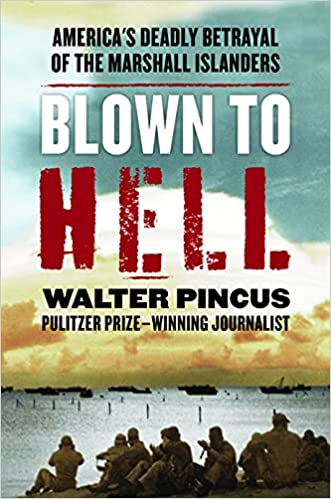
Biggest US nuclear bomb test destroyed an island—and this man’s life, https://nypost.com/2021/11/20/biggest-us-nuclear-bomb-test-destroyed-an-island-and-lives/ By Eric Spitznagel The US bomb tested near John Anjain’s (right) home in the Marshall Islands in 1954 was 1,000 times stronger than at Hiroshima, and left his wife and kids with debilitating and deadly health problems, as detailed in a new book. November 20, 2021
Just before dawn on March 1, 1954, John Anjain was enjoying coffee on the beach in the South Pacific when he heard a thunderous blast, and saw something in the sky that he said “looked like a second sun was rising in the west.”
Later that day, “something began falling upon our island,” said Anjain, who at the time was 32 and chief magistrate of the Rongelap atoll, part of the Marshall Islands. “It looked like ash from a fire. It fell on me, it fell on my wife, it fell on our infant son.”
It wasn’t a paranormal experience. Anjain and his five young sons, along with the 82 other inhabitants of Rongelap, were collateral damage from a “deadly radioactive fallout from a hydrogen bomb test… detonated by American scientists and military personnel,” writes Walter Pincus in his new book, “Blown to Hell: America’s Deadly Betrayal of the Marshall Islanders” (Diversion Books), out now.
In 1946, the US started testing atomic weapons began in Bikini Atoll, 125 miles west of Rongelap. Known as Operation Crossroads, the tests were moved to the islands from the US because officials feared “radioactive fallout could not be safely contained at
any site in the United States,” writes Pincus.
During those early tests, the Rongelapians were relocated to another island a safe distance away.
But the 1954 test was different. Not only were there no evacuations, but “Castle
Bravo,” as it was dubbed, was also the largest of the thermonuclear devices detonated during the military’s 67 tests, “a thousand times as large as the bomb that destroyed Hiroshima,” writes Pincus.
It took just hours for fallout to reach the shores of Rongelap, where it blanketed the island with radioactive material, covering houses and coconut palm trees. On some parts of the isle, the white radioactive ash was “an inch and a half deep on the ground,” writes Pincus.
The natives, who often went barefoot and shirtless, were covered in the toxic debris. It stuck to their hair and bodies and even between their toes.
“Some people put it in their mouths and tasted it,” Anjain recalled at a Washington DC hearing run by the Senate Energy and Natural Resources Committee to investigate the incident in 1977. “One man rubbed it into his eye to see if it would cure an old ailment. People walked in it, and children played with it.”
Rain followed, which dissolved the ash and carried it “down drains and into the barrels that provided water for each household,” writes Pincus.
It took three days before American officials finally evacuated the island, taking the natives to nearby Kwajalein for medical tests. Many Rongelapians were already suffering health effects, like vomiting, hair loss, and all-over body burns and blisters. Tests showed their white blood cell counts plummeting, and high levels of radioactive strontium in their systems. No one died, at least not immediately. That would come later.
After three years, the Rongelapians were allowed to return home, assured by officials that conditions were safe. But by 1957, the rate of miscarriages and stillbirths on the island doubled, and by 1963 the first residents began to develop thyroid tumors.
Though they continued to conduct annual medical tests, the US military admitted no culpability, other than awarding each islander $10,800 in 1964 as compensation for the inconvenience.
In fact, some — including the islanders — have speculated that the US government had used the Rongelapians as “convenient guinea pigs” to study the effects of high-level radiation.
For Anjain and his family, the effects were devastating. His wife and four of his children developed cancer. A sixth child, born after the fallout, developed poliomyelitis and had to use a crutch after one of his legs became paralyzed.
But the biggest tragedy befell his fifth child Lekoj, who was just one year old when Castle Bravo covered their island in nuclear dust. As a child, he was mostly healthy, other than the occasional mysterious bruise. Soon after his 18th birthday, Lekoj was flown to an American hospital, where doctors discovered he had acute myelogenous leukemia.
Anjain stayed at his son’s bedside for weeks as he underwent chemo, holding his dying son’s hand and watching him disappear.
He recounted Lekoj’s final days in a letter to the Friends of Micronesia newsletter in 1973. “Bleeding started in his ears, mouth and nose and he seemed to be losing his mind,” Anjain wrote of his son. “When I would ask him questions he gave me no
answer except ‘Bad Luck.’”
Lekoj passed away on November 15, 1972, at just 19. Newsweek called him “the first, and so far only leukemia victim of an H-bomb,” and said his death was proof that nuclear fallout “could be even more lethal to human life than the great fireball itself.”
After burying his son at a spot overlooking Rongelap Lagoon, Anjain continued to battle for financial restitution for his family and other Rongelapian survivors. In 2004, just months before his death (of undisclosed causes) at 81, he marched with 2,000 people in Japan to commemorate the 50th anniversary of the 1954 hydrogen bomb test that slowly killed his son.
In 2007, a Nuclear Claims Tribunal awarded Rongelap more than $1 billion in damages, but not a penny of it has yet been paid. And according to a 2019 Columbia University study, radiation levels on Rongelap are still higher than Chernobyl or Fukushima.
For Anjain, it was never really about the money. “I know that money cannot bring back my son,” he once said. “It cannot give me back 23 years of my life. It cannot take the poison from the coconut crabs. It cannot make us stop being afraid.”
Heritage Foundation – murky think tank funded by the nuclear weapons industry, wants weapons-makers to be exempt from climate and pandemic regulations

“Defense industrial base” is a buzzword that has picked up steam during the pandemic: It sends the message that, whatever happens with the economy and pandemic, we need to make sure we are in “fighting shape” — by keeping military contractors afloat. This concept was invoked to explain why, at the beginning of the pandemic, factories that produce bombs and tankers should be allowed to stay open, even amid the outbreak risk to workers. And it was also used to justify subsidies to contractors during the hardship of the pandemic.
Lockheed Martin is just one of numerous weapons manufacturers that has directly funded the Heritage Foundation. According to a report by the think tank Center for International Policy (CIP), the Heritage Foundation ranks ninth among the top think tanks that received funding from military contractors and the U.S. government from 2014 to 2019. Lockheed Martin and Raytheon were two of those major funders, both of which are among the largest weapons companies in the world and would be impacted by the new regulation.
This case provides a window into the murky world of think tanks, which are often viewed as academic and above-the-fray institutions but operate more as lobbying outfits.
Think Tank Funded by the Weapons Industry Pressures Biden Not to Regulate Military Contractors’ Emissions https://www.rsn.org/001/think-tank-funded-by-the-weapons-industry-pressures-biden-not-to-regulate-military-contractors-emissions.html
Sarah Lazare/In These Times 19 November 21The Heritage Foundation has received considerable donations from the arms industry. And now it’s trying to shield that industry from climate regulations targeting military contractors.
The Heritage Foundation, a prominent conservative think tank, is publicly opposing a new Biden administration regulation that would force the weapons industry to report its greenhouse gas emissions related to federal contracts. It turns out the Heritage Foundation also receives significant funding from the weapons industry, which makes the case worth examining — because it reveals how the arms industry pays supposedly respectable institutions to do its policy bidding at the expense of a planet careening toward large-scale climate disaster.
The regulation in question was first proposed in an executive order in May. It would require federal contractors to disclose their greenhouse gas emissions and their “climate-related financial risk,” and to set “science-based reduction targets.” In other words, companies like Lockheed Martin would have to disclose how much carbon pollution its F‑35 aircraft and cluster bombs actually cause.
In October, the Biden administration started the process to amend federal procurement rules to reflect these changes. “Today’s action sends a strong signal that in order to do business with the federal government, companies must protect consumers by beginning to mitigate the impact of climate change on their operations and supply chains,” Shalanda Young, acting director of the White House Office of Management and Budget, said at the time.The Department of Defense is the world’s biggest institutional consumer of fossil fuels and a bigger carbon polluter than 140 countries. Yet its emissions (and those of other armed forces) are excluded from UN climate negotiations, including the recent COP26 talks. The Biden administration itself supports a massive military budget, initially requesting $753 billion for the 2022 National Defense Authorization Act, a number that has since ballooned, with the Senate set to vote on a $778 billion plan. Organizers and researchers argue that, to curb the climate crisis, it is necessary to roll back U.S. militarism and dismantle the military budget.
But according to the Heritage Foundation, even this modest proposal is a bridge too far.
Continue readingNew files expose Australian govt’s betrayal of Julian Assange and detail his prison torment
The documents obtained by Tranter and provided to The Grayzone provide an unobstructed view of the Australian junior ally’s betrayal of one of its citizens to the imperial power that has hunted him for years. As Julian Assange’s rights were violated at every turn, Canberra appears to have been complicit.
New files expose Australian govt’s betrayal of Julian Assange and detail his prison torment https://thegrayzone.com/2021/11/17/files-australian-julian-assange-prison/ KIT KLARENBERG· NOVEMBER 17, 2021
Documents provided exclusively to The Grayzone detail Canberra’s abandonment of Julian Assange, an Australian citizen, and provide shocking details of his prison suffering
Was the government of Australia aware of the US Central Intelligence Agency plot to assassinate Julian Assange, an Australian citizen and journalist arrested and now imprisoned under unrelentingly bleak, harsh conditions in the UK?
Why have the country’s elected leaders refused to publicly advocate for one of its citizens, who has been held on dubious charges and subjected to torture by a foreign power, according to UN Special Rapporteur on Torture Nils Melzer? What does Canberra know about Julian’s fate and when did it know it?
The Grayzone has obtained documents revealing that the Australian government has since day one been well-aware of Julian’s cruel treatment inside London’s maximum security Belmarsh Prison, and has done little to nothing about it. It has, in fact, turned a cold shoulder to the jailed journalist despite hearing his testimony of conditions “so bad that his mind was shutting down.”
Not only has Canberra failed to effectively challenge the US and UK governments overseeing Assange’s imprisonment and prosecution; as these documents expose in stark detail, it appears to have colluded with them in the flagrant violation of an Australian citizen’s human rights, while doing its best to obscure the reality of his situation from the public.
Continue readingNon government organisations anxious about Tricastin nuclear station, and about historic law to protect whitleblowers
After Tricastin, we must “protect the whistleblowers and focus on the
alert and not on the messenger”. Three representatives of non-governmental
organizations recall, in a forum at “The World”, the importance of “the
historic law” that the National Assembly is about to vote on the protection
of whistleblowers. They are also calling for the opening of a parliamentary
inquiry into the facts relating to the Tricastin nuclear power plant.
Le Monde 15th Nov 2021
America’s relentless pursuit of Australian Julian Assange is a threat to any journalist who might expose a USA massacre of civilians
Julian Assange currently sits in Belmarsh Prison waiting to find out if British judges will overturn a lower court’s ruling against his extradition to the United States to be prosecuted under the Espionage Act for journalistic activity which exposed U.S. war crimes. War crimes not unlike those that were just exposed by The New York Times in its reporting on the Baghuz massacre.
The precedent the U.S. government is trying to set with its persecution of Assange will, if successful, cast a chilling effect over journalism which scrutinizes the U.S. war machine, not just in the United States but around the world.
Syria Massacre Coverup Shows Danger of Assange Precedent, https://consortiumnews.com/2021/11/15/syria-massacre-coverup-shows-danger-of-assange-precedent/ November 15, 2021 The precedent the U.S. government is trying to set with its persecution of Assange will, if successful, cast a chilling effect over journalism which scrutinizes the U.S. war machine, writes Caity Johnstone. By Caitlin Johnstone
CaitlinJohnstone.com The New York Times has published a very solid investigative report on a U.S. military coverup of a 2019 massacre in Baghuz, Syria which killed scores of civilians. This would be the second investigative report on civilian-slaughtering U.S. airstrikes by The New York Times in a matter of weeks, and if I were a more conspiracy-minded person I’d say the paper of record appears to have been infiltrated by journalists.
The report contains many significant revelations, including that the U.S. military has been grossly undercounting the numbers of civilians killed in its airstrikes and lying about it to Congress, that special ops forces in Syria have been consistently ordering airstrikes which kill noncombatants with no accountability by exploiting loopholes to get around rules meant to protect civilians, that units which call in such airstrikes are allowed to do their own assessments grading whether the strikes were justified, that the U.S. war machine attempted to obstruct scrutiny of the massacre “at nearly every step” of the way, and that the Air Force’s Office of Special Investigations only investigates such incidents when there is “potential for high media attention, concern with outcry from local community/government, concern sensitive images may get out.”
“But at nearly every step, the military made moves that concealed the catastrophic strike,” The New York Times reports. “The death toll was downplayed. Reports were delayed, sanitized and classified. United States-led coalition forces bulldozed the blast site. And top leaders were not notified.”
Journalist Aaron Maté has called the incident “one of the U.S. military’s worst massacres and cover-up scandals since My Lai in Vietnam.”
Asked by the Times for a statement, Central Command gave the laughable justification that maybe those dozens of women and children killed in repeated bomb blasts were actually armed enemy combatants:
“This week, after The New York Times sent its findings to U.S. Central Command, which oversaw the air war in Syria, the command acknowledged the strikes for the first time, saying 80 people were killed but the airstrikes were justified. It said the bombs killed 16 fighters and four civilians. As for the other 60 people killed, the statement said it was not clear that they were civilians, in part because women and children in the Islamic State sometimes took up arms.“
I mean, how do you even address a defense like that? How do you get around the “Maybe those babies were ISIS fighters” defense?
Reading the report it becomes apparent how much inertia was thrown on attempts to bring the massacre to light and how easy it would have been for those attempts to succumb to the pressure and just give up, which naturally leads one to wonder how many other such incidents never see the light of day because attempts to expose them are successfully ground to a halt.
The Times says the Baghuz massacre “would rank third on the military’s worst civilian casualty events in Syria if 64 civilian deaths were acknowledged,” but it’s clear that that “acknowledged” bit is doing a lot of heavy lifting there.
And it really makes you appreciate how much work goes into getting information like this in front of the public eye, and how important it is to do so, and how tenuous the ability to do so currently is.
Julian Assange currently sits in Belmarsh Prison waiting to find out if British judges will overturn a lower court’s ruling against his extradition to the United States to be prosecuted under the Espionage Act for journalistic activity which exposed U.S. war crimes. War crimes not unlike those that were just exposed by The New York Times in its reporting on the Baghuz massacre.
The precedent the U.S. government is trying to set with its persecution of Assange will, if successful, cast a chilling effect over journalism which scrutinizes the U.S. war machine, not just in the United States but around the world.
If it can succeed in legally establishing that it can extradite an Australian journalist for publishing information in the public interest about U.S. war crimes, it will have succeeded in legally establishing that it can do that to any journalist anywhere. And you can kiss investigative reporting like this goodbye.
This is what’s at stake in the Assange case. Our right to know what the most deadly elements of the most powerful government on our planet are doing. The fact that the drivers of empire think it is legitimate to deprive us of such information by threatening to imprison anyone who tries to show it to us makes them an enemy of all humanity.
Nuclear power company First Energy prosecuted for corruption, but still finds it worthwhile to bribe politicians

It is the largest fine ever imposed by the U.S. Attorney’s Office for the Southern District of Ohio.
But it is a pittance when compared to the earnings it brought in last year: $1.1 billion. For that reason, the company’s stock has a 52-week range of between $26 and its current high of $39 a share.
Paying Bribes Got FirstEnergy In Trouble, But It Is Still Making Political Donations , Forbes, 15 Nov 21,
Has FirstEnergy Corp. learned anything from its nuclear energy scandal and criminal probe? Prosecutors say that if the company fully cooperates then it will drop the charges against it in three years. But the utility is still giving millions to lobby lawmakers — a bit cringeworthy, given the events.
It’s legal. But the company’s chief executive since March, Steven Strah, has said that FirstEnergy FE +1.2% will play a more subtle political role. The protocol now is strict oversight of its lobbying activities — the kind of thing that would avoid, for example, bribing public officials to keep open struggling nuclear plants. For sure, FirstEnergy’s campaign spending is already at $1.5 million this year. That is in line with the contributions it has been making for the last decade.
FirstEnergy is sticking to “the way they did business 50 years ago,“ said Ashley Brown, a former Ohio public utilities commissioner, who now leads the Harvard Electricity Policy Group. “That’s part of why they’re just a lobbying firm with a utility sideline.”
Brown’s comments appeared in a story by Eye on Ohio, which joined with Energy News Network in the endeavor. Eye on Ohio is a division of the Ohio Center for Journalism.
In a deferred prosecution agreement reached over the summer between FirstEnergy and federal prosecutors, the utility admitted that it conspired with and subsequently bribed public officials: $60 million, which was used to secure a $1.3 billion bailout package for its nuclear units and to also help defeat a voter initiative that would have thrown out that law.
The company was penalized $230 million — money to be split equally between the federal and state government. In Ohio, it will be used to help low-income citizens pay their utility bills. It is the largest fine ever imposed by the U.S. Attorney’s Office for the Southern District of Ohio. But it is a pittance when compared to the earnings it brought in last year: $1.1 billion. For that reason, the company’s stock has a 52-week range of between $26 and its current high of $39 a share.
Prosecutors said that they wanted the penalty to “sting” but they did not want to disrupt the company’s business. They filed one charge: conspiracy to commit honest services and wire fraud, which will be dismissed if FirstEnergy continues to cooperate.
“Our activity in this space will be much more limited than it has been in the past, with closer alignment to our strategic goals and with additional oversight and significantly more robust disclosure,” says CEO Strah, before investors. “These efforts, together with enhanced policies and procedures, will help to bring additional clarity around appropriate behaviors at FirstEnergy.”
The bargain between prosecutors and the utility examines how FirstEnergy took monies from its regulated units and then paid off public officials. Former Ohio House Speaker Larry Householder has already been charged. Former Ohio Public Utilities Commission Chairman Sam Randazzo has resigned his position. The power company used a dark money group called Generation Now to hide its efforts. A lobbyist has pleaded guilty along with a staffer for Householder, who set up the shady organization to receive the dirty money.
A New Track
Subsequent to this criminal settlement, Ohio’s Attorney General Dave Yost added FirstEnergy’s former CEO Charles Jones to a list of defendants his office is suing. (Prosecutors would not comment on whether Jones is also in criminal trouble.) The civil complaint also includes ex-FirstEnergy senior vice president Michael Dowling and Sam Randazzo.
The “corruption was more cancerous than previously thought––necessitating adding additional defendants and giving rise to additional claims,” the lawsuit says. Ohio’s legislature, meantime, has revoked the $1.3 billion bailout. …… https://www.forbes.com/sites/kensilverstein/2021/11/15/paying-bribes-got-firstenergy-in-trouble-but-it-is-still-making-political-donations—and-amends/?sh=1e29ece1150a
French unions complicit with EDF in harrassments and other scandals
EDF, the grinding machine: “EDF holds the unions in its hands”. Number 2
in Force Ouvrière at EDF, Rémy Casabielhe has been one of the main
negotiators of the agreements in recent years within the company.
In his
interview with Blast, after the first stages of our investigation, the
union representative bluntly denounces the inaction of management, but also
of the unions, in the face of the problems of harassment, discrimination
and suicide.
And calls into question the agreements concluded for twenty
years, responsible for this phenomenon. Words that detonate and lift the
veil on a complicity that does not speak its name.
Blast 13th Nov 2021
Anniversary of the mysterious death of Karen Silkwood

Massimo Greco https://www.facebook.com/groups/361888987167863/ 13 Nov 21, Museum of the Gulf Coast
This Day In History.…..On November 13, 1974, 28-year-old Karen Silkwood, who is from Nederland, is killed in a car accident near Crescent, Oklahoma, north of Oklahoma City. Silkwood worked as a technician at a plutonium plant operated by the Kerr-McGee Corporation, and she had been critical of the plant’s health and safety procedures.
Silkwood had an appointment with a union staff representative and a New York Times investigative reporter. At this meeting, she was to provide documentation to the reporter, showing charges that Kerr-McGee had been negligent in quality control and had falsified records were justified.
Police were summoned to the scene of an accident along Oklahoma’s State Highway 74: Silkwood had somehow crashed into a concrete culvert. She was dead by the time help arrived. An autopsy revealed that she had taken a large dose of Quaaludes before she died, which would likely have made her doze off at the wheel; however, an accident investigator found skid marks and a suspicious dent in the Honda’s rear bumper, indicating that a second car had forced Silkwood off the road.
The documents she was to have turned over to the reporter were never found.Silkwood’s father sued Kerr-McGee, and the company eventually settled for $1.3 million, minus legal fees. Kerr-McGee closed its Crescent plant in 1979.
Unfair restrictions on observers at COP26 climate talks
The legitimacy of the Cop26 climate summit has been called into question
by civil society participants who say restrictions on access to
negotiations are unprecedented and unjust.
As the Glasgow summit enters its
second week, observers representing hundreds of environmental, academic,
climate justice, indigenous and women’s rights organisations warn that
excluding them from negotiating areas and speaking to negotiators could
have dire consequences for millions of people.
Observers act as informal watchdogs of the summit – the eyes and ears of the public during
negotiations to ensure proceedings are transparent and reflect the concerns
of communities and groups most likely to be affected by decisions. But
their ability to observe, interact and intervene in negotiations on carbon
markets, loss and damage and climate financing has been obstructed during
the first week, the Guardian has been told.
Guardian 8th Nov 2021
”Deep fakes”: corruption of data has worrying implications for nuclear policy
Deep fakes: The next digital weapon with worrying implications for nuclear policy Sylvia Mishra |New Tech Nuclear Officer, 3 Nov 21, The past decade has witnessed the unprecedented march of technology and the opportunities, dangers, and disruptions that accompany it. In the last 4-5 years, a synthetic media technology (that uses machine learning techniques and is created by generative adversarial networks – GANs) known as deep fakes, has revolutionised the ways that digital media can be altered. The ability of state and non-state actors to generate, forge, and manipulate media has created clickbait headlines and fake news, ‘terrorised women’ by substituting faces to create fake porn, and abetted the spread of misinformation and disinformation. An opinion piece in the Washington Post has called this worrying trend of mass-scale manipulation the “democratisation of forgery”.
One of the disquieting ramifications of this emerging and disruptive technology (EDT) is the challenge it poses to nuclear weapons decision-making, in particular its impact on decision-makers and wider society, Nuclear Command, Control, and Communications (NC3), nuclear doctrine, posturing and signalling.
Implications for nuclear weapons decision-making
In the 21st century, nuclear weapons decision-making is markedly different from that of the Cold War era. As great power competition has come back into sharper focus, countries are expanding and upgrading their nuclear arsenals and moving towards incorporating EDTs for warfighting. On the one hand, the political divide between nuclear haves and have-nots is widening and, on the other, the pursuit of EDTs by non-nuclear states is reducing the technology gap between nuclear and non-nuclear states. Simultaneously, arms control is waning. These developments are taking place at a time when trust among states and decision-makers is fast eroding, and generational divides among decision-makers are increasing. For example, senior decision-makers may find themselves lacking knowledge about new EDTs and technical know-how, while younger decision-makers might lack the understanding of nuclear policy-making compressed timelines.
The ability of deep fakes to undermine the confidence in information analysis and outputs provided by digital security platforms can erode trust among states and, in turn, complicate nuclear weapons decision-making, making it difficult for decision-makers to make distinctions between correct and spurious information. Deep fakes expert and computer science professor at Dartmouth University, Hany Farid stated, “The things that keep me up at night these days are the ability to create a fake video and audio of a world leader saying ”I’ve launched nuclear weapons”. He adds that the technology to do this exists today
As we witness rapid advancements of deep fake technology, nuclear weapons policy decision-makers are likely to be faced with questions like “will deep fakes undermine understanding about enemy intent and misdirect about an adversary capability?” Furthermore, deep fakes may cause algorithms that offer information on situational awareness to misclassify based on altered inputs. Such scenarios may cause a breakdown in automated NC3 architecture bearing serious consequences.
With the corruption and poisoning of data, can adversaries take undue advantage and engage in nuclear brinkmanship? Can non-state actors create misperception and escalation by generating fake videos of a leader suggesting that they have deployed nuclear weapons against an adversary? Even if such fake videos can be quickly detected, it is highly likely that once these videos go online they will sow the seeds of widespread uncertainty.
During crises, the general population might find it difficult to tell factual from spurious information, exacerbating the situation. …………..
In a report titled ‘Weapons of Mass Distortion’, King’s College London’s Marina Favaro classifies deep fake as a ‘weapon of mass distortion’, arguing that it is capable of reducing situational awareness of a country and could erode Nuclear Command, Control, and Communications (NC3)………………. https://www.europeanleadershipnetwork.org/commentary/deep-fakes-the-next-digital-weapon-with-worrying-implications-for-nuclear-policy/
Pandora Papers: is the world’s biggest leak the world’s biggest cover-up?
Pandora Papers: is the world’s biggest leak the world’s biggest cover-up? https://www.michaelwest.com.au/pandora-papers-is-the-worlds-biggest-leak-the-worlds-biggest-cover-up/ , By Michael West|, October 8, 2021
Where are the US billionaires, the Wall Streeters, the Big Four tax firms Deloitte, EY, KPMG, PwC? Michael West explores the mystery of the Pandora Papers in this first of a two-part series.
In the wake of the stunning Pandora Papers data leak this week, the ABC enthused, “Even by the ICIJ’s standards, this is big. If the documents were printed out and stacked up they would be four times taller than Sydney’s Centrepoint Tower”.
Probably not. If we assume Pandora is like its predecessors Panama Papers and Paradise Papers – where less than 1% of the data was made public – that would represent a stack of documents 12.2 metres high, not 1220 metres, which would get you up to Yogurt World on Level 5 of the Centrepoint food court.
Another “biggest data leak in history”, another trove mega-leaks where billionaires, celebrities, Italian mobsters, Russian oligarchs and foreign heads of state have been outed for their links to tax havens.
But where are the US politicians? Where are the Wall Streeters? Where are the Big Four, the masterminds of global tax avoidance PwC, EY, KPMG and Deloitte?
Conspicuously absent, that’s where. Again.
Beating the B Team
Make no mistake this is fabulous, explosive stuff. The Pandora Papers, like Panama Papers and Paradise papers, are a spectacular data leak but, like the leaks before them, they have blown the lid on the world’s Tax Avoidance B Team.
And, like the others, the data has not actually been made public; not much of it anyway, maybe 1%. The rest is sitting with the International Consortium of Investigative Journalists (ICIJ) in Washington. It has been leaked to the ICIJ alone which in turn leaks bits of it, presumably a very small part of it, to its “global media partners”.
n Australia, these are Nine Entertainment’s AFR, Guardian and ABC who are themselves keeping most of it a secret. This from Guardian Australia:
“Australians who appear in the data include senior figures from the finance and property industries. The Guardian has chosen not to identify them.
“About 400 Australian names are contained in the papers, a cache of 11.9m files from companies hired by wealthy clients to create offshore structures and trusts in tax havens such as Panama, Dubai, Monaco, Switzerland, the Cayman Islands and Samoa.”
Meanwhile Julian Assange
Meanwhile Julian Assange continues to rot in London’s Belmarsh Prison, facing extradition to the US, abandoned by successive Australian governments amid reports of a CIA plot to assassinate him. His crime? Wikileaks made public US war crimes; a real leak, documents actually made public.
In contrast, the Washington-based ICIJ has consistently refused to release its data to the public, preferring instead to conduct a choreographed media circus. Its director, Australian journalist Gerard Ryle, declined to respond to questions for this story, doubly ironic given we used to work together on the newsroom floors at Fairfax and the ICIJ is a self-styled beacon of journalistic integrity dedicated to “expose the truth and hold the powerful accountable, while also adhering to the highest standards of fairness and accuracy”.
One question we put to Ryle was whether ICIJ had received a subpoena from US authorities for this incredible trove of corporate information, say the Department of Justice. If not, why not?
The questions are many, not only because of the sheer magnitude of this set of leaks but also because the effect of the Pandora Papers is to, deservedly, trash a suite of non-US tax havens such as the notorious British Virgin Islands and the upshot will be to drive global wealth towards secrecy jurisdictions in the US such as Rupert Murdoch’s preferred haven of Delaware.
So, what is going on here?
The way ICIJ works is they use a panel of 150 “media partners”, mostly large corporate media organisations around the world, to disseminate the information, or at least the bits of it they deem suitable.
In the case of Panama Papers, an anonymous source dubbed John Doe hacked Panamanian law firm Mossack Fonseca and leaked the data to German journalists who got it to ICIJ for dissemination to its band of media partners.
14 Mossack Fonsecas
This time around, there are 14 Mossack Fonsecas; that is, 14 “offshore service providers” have been hacked. This is hacking on an industrial, possibly sovereign, scale. It is possible these “offshore service providers”, from Hong Kong to the Caribbean, divulged the information voluntarily, but unlikely.
Who benefits? The US and the Big Four. Just as the Panama Papers helped to demolish Panama as a tax haven, compelling clients of Mossack Fonseca to flee to other secrecy jurisdictions to hide their money, the upshot of the Pandora Papers is that, right at this moment, the super rich who secrete their money in the British Virgin Islands, the Seychelles or Cyprus will be thinking long and hard about restructuring to hide their riches via Delaware or another onshore tax haven in the US.
They will also think long and hard about getting the Big Four global tax firms – PwC, Deloitte, EY and KPMG – to manage their affairs. The A Team.
This is of course a speculative conclusion but also, as one regulatory finance source confided to Michael West Media this week, just a matter of putting two and two together. The Washington-based ICIJ never seems to be harassed by US authorities, the Big Four are rarely named, US billionaires are rarely named, blue chip tax avoiders are rarely named, the identity of the vast bulk of wealthy Australians in the data are never named.
Foreign PEPs, mobsters and oligarchs
This is not to disparage the work of Gerard Ryle and his team. The latest mega-leak of almost 12 million documents from offshore finance firms has identified the usual high profile types: crooner Julio Iglesias, cricket star Sachin Tendulkar, pop music diva Shakira, supermodel Claudia Schiffer and “an Italian mobster known as “Lell the Fat One”.
Great headlines, and every one a worthy story, although many will have bona fide reasons for being in tax havens. Rich people avoid tax, full stop. We will discuss the mechanics of secrecy jurisdictions, how it all works and who actually benefits in the sequel to this story.
Besides the crooners, mobsters and Russian oligarchs however, the Pandora Papers have outed an array of ”politically exposed persons” (PEP); former politicians and present heads of state. From King Abdullah of Jordan, Azerbaijan’s ruling Aliyev family, the prime minister of the Czech republic, Andrej Babiš and Ukraine’s president, Volodymyr Zelenskiy, to former British prime minister Tony Blair and three current Latin American heads of state, those identified publicly in Pandora Papers have sent shockwaves around the world.
The Aussie connection
A slew of tax authorities have vowed to take action, including the Australian Tax Office which, on Wednesday, froze more than $80 million in assets and companies linked to Gold Coast property developer Jim Raptis.
Westpac director Steve Harker was also identified as a client of one of the offshore service providers Singapore’s Asiaciti. As the identities of most of the Australians remain a secret, Harker is probably feeling unfairly targeted. What of the other 400 Australians?
No doubt the draconian defamation laws in this country, laws which protect the wealthy, played a part in the decision of local media to keep the names secret. Yet this also goes to the fundamental issue with ICIJ’s arbitrary arrangements and its media partners cherry-picking the data.
If ICIJ were truly fair dinkum about transparency and public interest, it would make the data from all its leaks public so that boffins from around the world, anybody for that matter, could hop in and dig around.
Who is calling the shots? One man apparently, Gerard Ryle. In the wake of the Panama Papers, when we asked Ryle on a number of occasions for an ICIJ log-in to analyse the data, we were denied.
“My path, my call,” said Ryle. We already have our media partners, he said.
Meanwhile, the 2016 Panama Papers remain under lock and key, unavailable to the public, secreted by ICIJ. The data is getting stale now. It is six years old. It is wasted, an insult to the people who risked their lives to put it in the public domain.
In Part II: who guards the guards? The second story in our investigation of the ICIJ and its Offshore Leaks examines what is really going on with international tax avoidance.
Michael West
Michael West established michaelwest.com.au to focus on journalism of high public interest, particularly the rising power of corporations over democracy. Formerly a journalist and editor at Fairfax newspapers and a columnist at News Corp, West was appointed Adjunct Associate Professor at the University of Sydney’s School of Social and Political Sciences. You can follow Michael on Twitter @MichaelWestBiz.
Chris Hedges: The Assange case is the most important battle for press freedom in our time
Chris Hedges: The Assange case is the most important battle for press freedom in our time, Rt.com29 Oct, 2021
If the WikiLeaks founder is extradited and found guilty of publishing classified material, it will set a legal precedent that will effectively end national security reporting.
For the past two days, I have been watching the extradition hearing for Julian Assange via video link from London. The United States is appealing a lower court ruling that denied the US request to extradite Assange not, unfortunately, because in the eyes of the court he is innocent of a crime, but because, as Judge Vanessa Baraitser in January concluded, Assange’s precarious psychological state would deteriorate given the “harsh conditions” of the inhumane US prison system, “causing him to commit suicide.” The United States has charged Assange with 17 counts under the Espionage Act and one count of trying to hack into a government computer, charges that could see him imprisoned for 175 years.
Assange, with long white hair, appeared on screen the first day from the video conference room in HM Prison Belmarsh. He was wearing a white shirt with an untied tie around his neck. He looked gaunt and tired. He did not appear in court, the judges explained, because he was receiving a “high dose of medication.” On the second day he was apparently not present in the prison’s video conference room.
Assange is being extradited because his organization WikiLeaks released the Iraq War Logs in October 2010, which documented numerous US war crimes – including video images of the gunning down of two Reuters journalists and 10 other unarmed civilians in the ‘Collateral Murder’ video, the routine torture of Iraqi prisoners, the covering up of thousands of civilian deaths and the killing of nearly 700 civilians that had approached too closely to US checkpoints. He is also being targeted by US authorities for other leaks, especially those that exposed the hacking tools used by the CIA known as Vault 7, which enables the spy agency to compromise cars, smart TVs, web browsers, and the operating systems of most smart phones, as well as operating systems such as Microsoft Windows, macOS, and Linux.
If Assange is extradited and found guilty of publishing classified material, it will set a legal precedent that will effectively end national security reporting, allowing the government to use the Espionage Act to charge any reporter who possesses classified documents, and any whistleblower who leaks classified information.
If the appeal by the United States is accepted, Assange will be retried in London. The ruling on the appeal is not expected until at least January.
Assange’s September 2020 trial painfully exposed how vulnerable he has become after 12 years of detention, including seven in the Ecuadorian Embassy in London. He has in the past attempted suicide by slashing his wrists. He suffers from hallucinations and depression, takes antidepressant medication and the antipsychotic quetiapine. After he was observed pacing his cell until he collapsed, punching himself in the face, and banging his head against the wall, he was transferred for several months to the medical wing of the Belmarsh prison. Prison authorities found “half of a razor blade” hidden under his socks. He has repeatedly called the suicide hotline run by the Samaritans because he thought about killing himself “hundreds of times a day.”
James Lewis, the lawyer for the United States, attempted to discredit the detailed and disturbing medical and psychological reports on Assange presented to the court in September 2020, painting him instead as a liar and malingerer. He excoriated the decision of Judge Baraitser to bar extradition, questioned her competence, and breezily dismissed the mountains of evidence that high-security prisoners in the United States, like Assange, subjected to Special Administrative Measures (SAMs), and held in virtual isolation in supermax prisons, suffer psychological distress. He charged Dr. Michael Kopelman, emeritus professor of neuropsychiatry at the Institute of Psychiatry, Psychology and Neuroscience, King’s College London, who examined Assange and testified for the defense, with deception for “concealing” that Assange fathered two children with his fiancée, Stella Moris while in refuge in the Ecuadorian Embassy in London. He said that, should the Australian government request Assange, he could serve his prison time in Australia, his home country, after his appeals had been exhausted, but stopped short of promising that Assange would not be held in isolation or subject to SAMs…………………
There is no legal basis to hold Assange in prison. There is no legal basis to try him, an Australian citizen, under the US Espionage Act. The CIA spied on Assange in the Ecuadorian Embassy through a Spanish company, UC Global, contracted to provide embassy security. This spying included recording the privileged conversations between Assange and his lawyers as they discussed his defense. This fact alone invalidated the trial. Assange is being held in a high security prison so the state can, as Nils Melzer, the UN special rapporteur on torture, has testified, continue the degrading abuse and torture it hopes will lead to his psychological if not physical disintegration. The architects of imperialism, the masters of war, the corporate-controlled legislative, judicial and executive branches of government and their obsequious courtiers in the media, are guilty of egregious crimes. Say this simple truth and you are banished, as many of us have been, to the margins of the media landscape. Prove this truth, as Assange, Chelsea Manning, Jeremy Hammond, and Edward Snowden have by allowing us to peer into the inner workings of power, and you are hunted down and persecuted.
Assange’s “crime” is that he exposed the more than 15,000 unreported deaths of Iraqi civilians. He exposed the torture and abuse of some 800 men and boys, aged between 14 and 89, at Guantánamo. He exposed that Hillary Clinton in 2009 ordered US diplomats to spy on UN Secretary General Ban Ki Moon and other UN representatives from China, France, Russia, and the UK, spying that included obtaining DNA, iris scans, fingerprints, and personal passwords, part of the long pattern of illegal surveillance that included eavesdropping on UN Secretary General Kofi Annan in the weeks before the US-led invasion of Iraq in 2003. He exposed that Barack Obama, Hillary Clinton, and the CIA orchestrated the June 2009 military coup in Honduras that overthrew the democratically-elected president, Manuel Zelaya, replacing him with a murderous and corrupt military regime. He exposed that George W. Bush, Barack Obama, and General David Petraeus prosecuted a war in Iraq that, under post-Nuremberg laws, is defined as a criminal war of aggression, a war crime, which authorized hundreds of targeted assassinations, including those of US citizens in Yemen. He exposed that the United States secretly launched missile, bomb, and drone attacks on Yemen, killing scores of civilians. He exposed that Goldman Sachs paid Hillary Clinton $657,000 to give talks, a sum so large it can only be considered a bribe, and that she privately assured corporate leaders she would do their bidding while promising the public financial regulation and reform. He exposed the internal campaign to discredit and destroy British Labour Party leader Jeremy Corbyn by members of his own party. He exposed how the hacking tools used by the CIA and the National Security Agency permit the wholesale government surveillance of our televisions, computers, smartphones, and anti-virus software, allowing the government to record and store our conversations, images, and private text messages, even from encrypted apps.
He exposed the truth. He exposed it over and over and over until there was no question of the endemic illegality, corruption, and mendacity that defines the global ruling elite. And for these truths alone he is guilty. https://www.rt.com/op-ed/538822-assange-battle-for-press-freedom/#comment-5589120643
USA and UK’s transparent persecution of Australian Julian Assange
The goal is to set a legal precedent which allows journalists who expose the crimes of the powerful to be persecuted not covertly as is normally done in ‘free democracies,’ but right out in the open. To tell journalists “We’ll just throw you in prison if you cross us.
What makes this precedent uniquely dangerous is that it is not just threatening to imprison American journalists who expose US crimes, but any journalist anywhere in the world.
Caitlin Johnstone: The Assange persecution lays out Western savagery at its most transparent https://www.rt.com/op-ed/538713-us-appeal-of-the-julian-assange/28 Oct, 2021 By Caitlin Johnstone, an independent journalist based in Melbourne, Australia. Her website is here and you can follow her on Twitter @caitozThe first day of the US appeal in the Julian Assange extradition case saw grown adults arguing in court that the US government could guarantee that it wouldn’t treat the WikiLeaks founder as cruelly as it treats other prisoners.
I wish I was kidding.
In their write-up on Wednesday’s proceedings, The Dissenter’s Kevin Gosztola and Mohamed Elmaazi report that the prosecution argued that “the High Court should accept the appeal on the basis that the U.S. government offered ‘assurances’ that Assange won’t be subjected to Special Administrative Measures (SAMs) or incarcerated in ADX Florence, a super-maximum prison in Colorado.”
What this means is that in order to overturn the January extradition ruling which judge Vanessa Baraitser denied on the basis that the notoriously draconian US prison system is too cruel to guarantee Assange’s health and safety, the prosecution has established as one of their grounds for appeal the claim that they can offer “assurances” that they would not inflict some of their most brutal measures upon him. These would include the aforementioned Special Administrative Measures, wherein prisoners are so isolated that they effectively disappear off the face of the earth, or sending him to ADX Florence, where all prisoners are kept in solitary confinement 23 hours a day.
What’s ridiculous about these “assurances,” apart from the obvious, is that within its own legal argument the US government reserves the right to reverse those assurances at any time and impose SAMs or maximum security imprisonment upon Assange if it deems them necessary. As Amnesty International explains:
They say: we guarantee that he won’t be held in a maximum security facility and he will not be subjected to Special Administrative Measures and he will get healthcare. But if he does something that we don’t like, we reserve the right to not guarantee him, we reserve the right to put him in a maximum security facility, we reserve the right to offer him Special Administrative Measures. Those are not assurances at all. It is not that difficult to look at those assurances and say: these are inherently unreliable, it promises to do something and then reserves the right to break the promise.
So the prosecution’s legal argument here is essentially “We promise we won’t treat Assange as cruelly as we treat our other prisoners, unless we decide we really want to.”
This is not just a reflection on the weakness of the extradition appeal, it’s a reflection on the savagery of all the so-called free democracies that have involved themselves in this case.
This same prosecution argued that Assange should not be denied US extradition from the UK on humanitarian grounds as in the case of activist Lauri Love, because Love suffered from both physical and psychological ailments while Assange’s ailments are only psychological. They stood before the court and made this argument even as Assange was visibly pained and unwell in his video appearance from Belmarsh Prison, which he was only able to attend intermittently due to his frail condition.
“For my newspaper, I have worked as media partner of WikiLeaks since 2009,” tweeted journalist Stefania Maurizi who attended the hearing via video link. “I have seen Julian Assange in all sorts of situations, but I have never ever seen him so unwell and so dangerously thin.”
So they’re just openly brutalizing a journalist for exposing US war crimes, while arguing that they can be trusted to treat him humanely and give him a fair trial if granted extradition. This after it has already been confirmed that the CIA plotted to kidnap and assassinate him during the Trump administration, after we learned that the prosecution relied on false testimony from a convicted child molester and diagnosed sociopath, after it was revealed that the CIA spied on Assange and his lawyers in the Ecuadorian embassy, and after intelligence asset Jeffrey Epstein famously died under highly suspicious circumstances in a US prison cell.
The worst atrocities in history have all been legal. All the worst examples of genocide, slavery, tyranny and bloodshed have been allowed or actively facilitated by the state. The persecution of Assange is geared toward entering the imprisonment of journalists into this category.
The goal is to set a legal precedent which allows journalists who expose the crimes of the powerful to be persecuted not covertly as is normally done in ‘free democracies,’ but right out in the open. To tell journalists “We’ll just throw you in prison if you cross us.”
What makes this precedent uniquely dangerous is that it is not just threatening to imprison American journalists who expose US crimes, but any journalist anywhere in the world. This is an Australian journalist in the process of being extradited from the UK for publishing facts about US war crimes in the nations it has invaded. The aim is to set up a system where anyone in the US-aligned world can be funneled into its prison system for publishing inconvenient facts.
This is the savagery of the Western world at its most transparent. It’s not the greatest evil the US-centralized empire has perpetrated; that distinction would certainly be reserved for its acts of mass military slaughter that it has been inflicting upon our species with impunity for generations. But it’s the most brazen. The most overt. It’s the most powerful part of the most depraved power structure on earth looking us all right in the eyes and telling us exactly what it is.
And if we can really look at this beast and what it is doing right now, really see it with eyes wide open, it reveals far more about those who rule over us than anything any journalist has ever exposed.
UK High Court Should Deny Extradition Because CIA Planned to Assassinate Assange

UK High Court Should Deny Extradition Because CIA Planned to Assassinate Assange, BYMarjorie Cohn, Truthout October 24, 2021
Why is Joe Biden’s Department of Justice continuing Donald Trump’s persecution of WikiLeaks founder, publisher and journalist Julian Assange?
Barack Obama, concerned about threats to the First Amendment freedom of the press, decided against indicting Assange for exposing U.S. war crimes. Trump did indict Assange, under Espionage Act charges that could garner him 175 years in prison. A district judge denied Trump’s request for Assange’s extradition from the U.K. to the United States because of the extremely high likelihood that it would lead Assange to commit suicide. Trump appealed the denial of extradition.
Instead of dropping Trump’s extradition request, Biden is vigorously pursuing his predecessor’s appeal against Assange, which the U.K. High Court will hear on October 27 and 28. At that hearing, the High Court should determine what effect the CIA’s recently revealed plan to kidnap and assassinate Assange will have on his fragile mental state in the event he is extradited to the United States.
Judge Baraitser’s Denial of Extradition
On January 6, U.K. District Judge Vanessa Baraitser issued a 132-page decision denying extradition. “Faced with conditions of near total isolation and without the protective factors which moderate his risk at HMP Belmarsh [where Assange is currently imprisoned],” she wrote, “I am satisfied that the procedures described by Dr. [Leukefeld] will not prevent Mr. Assange from finding a way to commit suicide.”…………………………..
The United States will be allowed to present “assurances” that if Assange is extradited, tried, convicted and imprisoned, he will not be subject to special administrative measures (SAMs) — onerous conditions that would keep him in virtual isolation — or be held at the ADX maximum security prison in Florence, Colorado. The U.S. intends to provide an additional assurance that it would not object to
Assange serving any custodial sentence he may receive in Australia. These so-called assurances, however, are conditional. The U.S. reserves the right to impose SAMs or hold Assange at ADX if his future behavior warrants it. Moreover, the U.S. cannot guarantee that Australia would consent to hosting Assange’s incarceration.
The High Court should give considerable weight to the way in which explosive new revelations of the Trump administration’s plot to kidnap and assassinate Assange will affect his mental health if he is extradited.
High Court Should Consider U.S. Plans to Kidnap and Assassinate Assange
The indictment against Assange stems from WikiLeaks’ 2010-2011 revelations of U.S. war crimes in Iraq, Afghanistan and Guantánamo. They included 400,000 field reports about the Iraq War, 15,000 unreported deaths of Iraqi civilians, and evidence of systematic torture, rape and murder after U.S. forces “handed over detainees to a notorious Iraqi torture squad,” the documents reveal. They included the Afghan War Logs, 90,000 reports revealing more civilian casualties by coalition forces than the U.S. military had reported. And the Guantánamo Files contained 779 secret reports revealing that 150 innocent people had been imprisoned there for years and documenting the torture and abuse of 800 men and boys, in violation of the Geneva Conventions and the Convention Against Torture and Other Cruel, Inhuman or Degrading Treatment or Punishment.
Perhaps the most notable release by WikiLeaks was the 2007 “Collateral Murder” video, in which a U.S. Army Apache helicopter gunship in Baghdad targets and fires on unarmed civilians. At least 18 civilians were killed, including two Reuters journalists and a man trying to rescue the wounded. Two children were injured. A U.S. Army tank then drives over one of the bodies, cutting it in half. The video depicts three separate war crimes prohibited by the Geneva Conventions and the U.S. Army Field Manual.
It was WikiLeaks’ publication of CIA hacking tools known as “Vault 7,” which the agency called “the largest data loss in CIA history,” that incurred the wrath of Trump’s CIA Director Mike Pompeo. Vault 7 materials revealed electronic surveillance and cyber-warfare by the CIA.
In 2017, Pompeo called WikiLeaks a “non-state hostile intelligence service” and CIA and government officials hatched “secret war plans” to abduct and kill Assange, according to a stunning Yahoo! News report. Some senior CIA and Trump administration officials requested “sketches” or “options” for ways to assassinate Assange. Trump “asked whether the CIA could assassinate Assange and provide him ‘options’ for how to do so,” according to the report.
Pompeo advocated “extraordinary rendition,” which the CIA used in the “war on terror” to illegally seize suspects and send them to its “black sites” where they were tortured. The scenario was that the CIA would break into the Ecuadorian Embassy in which Assange was staying under a grant of asylum and clandestinely fly him to the United States to stand trial. Others in the agency wanted to assassinate Assange outright by poisoning or shooting him to avoid the hassle of kidnapping him.
The CIA spied on WikiLeaks, and it aimed to sow discord among the group’s members and steal their electronic devices, according to the Yahoo! News report. The CIA also conducted illegal surveillance inside the Ecuadorian Embassy and spied on privileged attorney-client communications between Assange and his lawyers.
Concerned that the CIA might kidnap or kill Assange, which could jeopardize a potential criminal prosecution, the Department of Justice (DOJ) filed a secret indictment against him in 2018. To bolster the DOJ’s case for extradition, the FBI collaborated with informant Siggi Thordarson to paint Assange as a hacker instead of a journalist. Thordarson later admitted to the Icelandic newspaper Stundin that he lied about Assange being a hacker in return for immunity from prosecution by the FBI.
In 2019, after a new pro-U.S. president came to power in Ecuador, in order to facilitate the U.S.’s attempted extradition, London police dragged Assange from the embassy and arrested him for violating bail conditions. Assange remains in custody in London’s maximum security Belmarsh Prison pending Biden’s appeal of the extradition denial.
The High Court should give great weight to the U.S. plans to kidnap and assassinate Assange. The knowledge of those revelations will put even more mental stress on Assange, whom former UN Special Rapporteur on Torture Nils Melzer described as having suffered “prolonged exposure to psychological torture” during his confinement. The High Court should affirm the district court’s denial of extradition.
A Window Into U.S. War Crimes and Threats to Investigative Journalism
“When Assange published hundreds of thousands of classified military and diplomatic documents in 2010, the public was given an unprecedented window into the lack of justification and the futility of the wars in Afghanistan and Iraq,” Assange Defense co-chairs Daniel Ellsberg, Alice Walker and Noam Chomsky wrote at Newsweek. “The truth was hidden by a generation of governmental lies. Assange’s efforts helped show the American public what their government was doing in their name.”
Recent revelations of Pompeo’s threats against Assange that appeared in Yahoo! News have shed light on the dangers the national security state poses to investigative journalism and the public’s right to know. In light of these new disclosures, a coalition of 25 press freedom, civil liberties and international human rights organizations have intensified their call for dismissal of the DOJ’s charges against Assange.
Adam Schiff, chairman of the House Intelligence Committee, said his committee has asked the CIA for information about plans to kidnap or assassinate Assange.
The High Court will decide whether to affirm or overturn district judge Baraitser’s decision denying extradition. If they affirm Baraitser’s ruling, the Biden administration could ask the U.K. Supreme Court to review the case. If the High Court overturns Baraitser’s decision, Assange could appeal to the U.K. Supreme Court and then to the European Court of Human Rights if the Supreme Court ruling goes against him.
Biden’s appeal of the denial of extradition should be dismissed. Julian Assange should be released and celebrated for his courage. https://truthout.org/articles/uk-high-court-should-deny-extradition-because-cia-planned-to-assassinate-assange/?eType=EmailBlastContent&eId=d08c3b6b-b92d-4b47-92cb-3c964bf0bab4
1 This Month



26 September – International Day for the Total Elimination of Nuclear Weapons


PLEASE OPPOSE HR 8255 AND S.3639 – bills would accelerate satellite deployment, with no environmental review or safeguards – https://ncstd5li.quorum.us/campaign/169331/
To see nuclear-related stories in greater depth and intensity – go to https://nuclearinformation.wordpress.com
-
Archives
- September 2026 (233)
- August 2026 (330)
- July 2026 (355)
- June 2026 (287)
- May 2026 (306)
- April 2026 (356)
- March 2026 (251)
- February 2026 (267)
- January 2026 (308)
- December 2025 (358)
- November 2025 (359)
- October 2025 (375)
-
Categories
- 1
- 1 NUCLEAR ISSUES
- business and costs
- climate change
- culture and arts
- ENERGY
- environment
- health
- history
- indigenous issues
- Legal
- marketing of nuclear
- media
- opposition to nuclear
- PERSONAL STORIES
- politics
- politics international
- Religion and ethics
- safety
- secrets,lies and civil liberties
- spinbuster
- technology
- Uranium
- wastes
- weapons and war
- Women
- 2 WORLD
- ACTION
- AFRICA
- Atrocities
- AUSTRALIA
- Christina's notes
- Christina's themes
- culture and arts
- Events
- Fuk 2022
- Fuk 2023
- Fukushima 2017
- Fukushima 2018
- fukushima 2019
- Fukushima 2020
- Fukushima 2021
- general
- global warming
- Humour (God we need it)
- Nuclear
- RARE EARTHS
- Reference
- resources – print
- Resources -audiovicual
- Weekly Newsletter
- World
- World Nuclear
- YouTube
-
RSS
Entries RSS
Comments RSS
 nuclear-news