Another corrupt executive pleads guilty in South Carolina’s nuclear scandal
‘Key Westinghouse witness’ in SC nuclear scandal told lies to help SCANA fool public, The News and Observer,
BY JOHN MONKJUNE 10, 2021 COLUMBIA, SC

A former Westinghouse executive who oversaw construction on SCANA’s doomed $10 billion nuclear project in Fairfield County admitted lying about the project in an effort to fool people into thinking the doomed project would be a success, a federal prosecutor said Thursday in federal court.
The former Westinghouse official, Carl Churchman, 70, was in court in Columbia before U.S. District Judge Mary Lewis to plead guilty to one count of lying to FBI agent Aaron Hawkins.
Churchman, who now lives in Utah, was the third person so far to plead guilty in an ongoing four-year FBI investigation of criminal acts connected to the 2017 failure of SCANA’s effort to build two nuclear plants at the V.C. Summer facility in Fairfield County, about 25 miles northwest of Columbia.
It was the biggest business failure in S.C. history and threw more than 4,000 people out of work. At first, the July 2017 failure of the nuclear project was attributed to cost overruns and mismanagement, but the FBI investigation established that top SCANA officials engaged in a criminal conspiracy to hide the looming business failure from the public, regulars and investors who owned SCANA stock.
“There is more to come (in the investigation), and Mr. Churchman is a key witness for us,” assistant U.S. Attorney Winston Holliday told Judge Lewis, indicating that more people would face criminal charges.
In 2020 and this year, two former top SCANA executives — Stephen Byrne and Kevin Marsh — pleaded guilty to criminal fraud charges related to their knowing about costly delays to the project, delays they unlawfully kept secret for years from regulators and shareholders. Sentences in those cases are pending.
“There is more to come (in the investigation), and Mr. Churchman is a key witness for us,” assistant U.S. Attorney Winston Holliday told Judge Lewis, indicating that more people would face criminal charges.
In 2020 and this year, two former top SCANA executives — Stephen Byrne and Kevin Marsh — pleaded guilty to criminal fraud charges related to their knowing about costly delays to the project, delays they unlawfully kept secret for years from regulators and shareholders. Sentences in those cases are pending.
In several court hearings, prosecutors have described the lies told by SCANA executives not as crimes of greed but crimes of hubris and an abuse of public trust — an inability to tell the truth and admit publicly that such a huge project that was supposed to showcase a major commitment to nuclear energy with Westinghouse nuclear reactors had turned into such an abject failure………… https://www.newsobserver.com/news/state/south-carolina/article252009438.html
Marginalized voices are ignored in favor of nuclear development
How Nuclear Waste Impacts Marginalized Communities, Geopolitics. By Ainsley Lawrence -June 11, 2021 ‘
(Amazingly, this excerpt comes from a quite enthusiastic pro nuclear article)
‘………………..Marginalized Voices are Ignored in Favor of Nuclear Development.
All over the world, nuclear power plants are planned and developed within communities that do not want them and question their safety. Yet, corporations press on with their plans. One prominent example occurred in the aftermath of the Fukushima nuclear disaster, in which an estimated 32 million people were affected.
Marginalized Voices are Ignored in Favor of Nuclear Development
All over the world, nuclear power plants are planned and developed within communities that do not want them and question their safety. Yet, corporations press on with their plans. One prominent example occurred in the aftermath of the Fukushima nuclear disaster, in which an estimated 32 million people were affected.
As a direct consequence of their being ignored, marginalized communities like those below the poverty level or with higher populations of minority groups tend to live closer to nuclear power plants. According to Stanford University research, a larger percentage of African Americans lived within 50 miles of nuclear power plants than their white peers.
Infamously, Chernobyl represents exactly what happens to marginalized communities when a nuclear disaster occurs. The city’s many subsistence farmers found themselves suddenly without the means to make a living when the disaster occurred. As a result, they were forced to rely on government subsistence to make ends meet, and many have either returned or stayed in the region where housing is cheaper.
Because the risks associated with nuclear power lower property values, lower-income families both already live in planned sites for nuclear development or come to live there after they’re built. This means when a disaster occurs, it is the poor who face more of the devastation.
Protections Aren’t for Everyone
The leaks at the Savannah River nuclear site in the American South showcased just how racially and financially disparate the effects tend to be when dealing with dangerous nuclear waste. From the evidence that emerged that black workers were frequently sent into high-radiation areas without the proper protection to the lack of job mobility experienced by the same, historically marginalized workers and the larger black community in Savannah River took a disproportionate amount of the fallout.
There were at least 30 cases of cancer and ailments associated with the Savannah River site in its earlier days, but the leaks of nuclear containments continue to give the community health concerns, especially when it comes to the availability of safe drinking water. Poor water quality can lead to illness and even death. When polluted with radiation, the effects of contaminated drinking water can be even worse.
But Stanford research shows that ionizing radiation standards are designed more to protect adult males. For nuclear facility workers, even these standards can be waived, allowing facility owners to expose workers to as much as 50 times more radiation than is allowed for the common citizen. Often, these workers don’t even receive hazard pay.
Minority and low-income communities are at higher risk of the radiation pumped via nuclear waste into their communities because of their proximity. At the same, these communities have statistically higher levels of women and children. These risk factors, much like the reasons nuclear power plants are built in these areas in the first place, perpetuate racist and classist outcomes………
Israel’s outgoing top Mossad chief reveals that they caused recent attacks targeting Iran’s nuclear programme and murdering their scientists.
Israel spy on Iran nuclear scientists: ‘We offer them a way out’, Aljazeera
The outgoing spy agency chief reveals Israel was behind recent attacks targeting Iran’s nuclear programme and its top scientist. The outgoing chief of Israel’s Mossad intelligence service has offered the closest acknowledgement yet his country was behind recent attacks targeting Iran’s nuclear programme and a military scientist.
The comments by Yossi Cohen, speaking to Israel’s Channel 12 investigative programme Uvda in a segment aired on Thursday night, offered an extraordinary debriefing by the head of the typically secretive agency in what appears to be the final days of Prime Minister Benjamin Netanyahu’s rule.
It also gave a clear warning to other scientists in Iran’s nuclear programme that they too could become targets for assassination even as diplomats in Vienna try to negotiate terms to try to salvage the 2015 nuclear accord with world powers. United States President Joe Biden has dispatched his diplomats to revive the landmark deal from which his predecessor, Donald Trump, walked away in 2018.
“If the scientist is willing to change career and will not hurt us anymore, then yes, sometimes we offer them” a way out, Cohen said.
Among the major attacks to target Iran, none have struck deeper than two explosions over the last year at its Natanz nuclear facility. There, centrifuges enrich uranium from an underground hall designed to protect them from air strikes.
In July 2020, a mysterious explosion tore apart Natanz’s advanced centrifuge assembly, which Iran later blamed on Israel. Then in April of this year, another blast tore apart one of its underground enrichment halls.
Discussing Natanz, the interviewer asked Cohen where he would take them if they could travel there, he said “to the cellar” where “the centrifuges used to spin”.
“It doesn’t look like it used to look,” he added.
Iran nuclear programme is peaceful
Cohen did not directly claim the attacks, but his specificity offered the closest acknowledgement yet of an Israeli hand in the attacks. The interviewer, journalist Ilan Dayan, also seemingly offered a detailed description in a voiceover of how Israel snuck the explosives into Natanz’s underground halls.
“The man who was responsible for these explosions, it becomes clear, made sure to supply to the Iranians the marble foundation on which the centrifuges are placed,” Dayan said. “As they install this foundation within the Natanz facility, they have no idea that it already includes an enormous amount of explosives.”
They also discussed the November killing of Mohsen Fakhrizadeh, an Iranian scientist who began Tehran’s military nuclear programme decades ago. The US and its regional ally Israel suspect that Iran is trying to develop nuclear weapons. But Tehran has long maintained its programme is peaceful.
While Cohen on camera does not claim the killing, Dayan in the segment described Cohen as having “personally signed off on the entire campaign”. Dayan also described how a remotely operated machine gun fixed to a pick-up truck killed Fakhrizadeh and later self-destructed.
Cohen described an Israeli effort to dissuade Iranian scientists from taking part in the programme, which had seen some abandon their work after being warned, even indirectly, by Israel. Asked by the interviewer if the scientists understood the implications if they did not stop, Cohen said: “They see their friends.”
They also talked about Israel’s operation seizing archival documents from Iran’s military nuclear programme. Dayan said 20 agents – none Israelis – seized material from 32 safes, then scanned and transmitted a large portion of the documents. Cohen confirmed that the Mossad received most of the material before it was physically taken out of Iran……… https://www.aljazeera.com/news/2021/6/11/ex-mossad-chief-signals-israel-behind-iran-nuclear-attacks
France’s government criminalises anti nuclear activists
Hasty translation of part of this article – the rest available only to subscribers
par Nicolas Celnik Liberation 5th June 2021
Sezin Topçu: “The state monitors militants and plutonium with the same fears” For the sociologist of science, the trial of the Bure activists shows that nuclear power is a strategic issue for France, which explains a”criminalization of anti-nuclear action”.
Twelve months firm required for one, 10 to 18 months suspended sentence required for the other six defendants: the anti-nuclear fight could cost them dearly. The judgment of the seven opponents of the disposal project of the National Agency for the Management of Radioactive Waste (Andra), dubbed “Cigeo”, whose trial was held between Tuesday and Thursday, will be delivered on September 21. The means put in place by the justice system (which would have spent nearly a million euros for the investigation, according to Reporterre and Mediapart) have not yet made it possible to prove anything else on this “organized band” of “criminals” that the organization of an unauthorized demonstration, for “willful violence …
Secret papers reveal the British spying on Scottish anti-nuclear activists, who were labelled as ”terrorists”
The National 5th June 2021, Secret papers reveal the UK spied on anti-nuclear campaigners. SCOTTISHnanti-nuclear groups were spied upon by the British state in the 1970s and 1980s, according to documents released by police to the spycops inquiry.
Previously secret papers reveal that undercover police officers, known as spycops, claimed to have “penetrated” the Scottish Campaign to Resist the Atomic Menace (SCRAM), Friends of the Earth and the Torness Alliance during protests against the building of a nuclear power station at Torness in East Lothian.
Activists involved with the protests told The Ferret that spycop units had been a “threat to democracy” and “outrageous”. Anti-nuclear campaigners had been wrongly branded as a terror threat “second only to the IRA”, they said. The Metropolitan Police said that undercover policing is “vital” to fight terrorism and “serious crime” in order to keep the public safe. Undercover officers infiltrated campaign groups using dead children’s identities. Some had sexual
relations with women they were spying on and at least three officers fathered children.
They included an officer called Bob Lambert, who operated undercover in Scotland. Lambert’s alter ego was that of a
long-haired anarchist by the name of Bob Robinson. The ongoing inquiry is mostly focused on two disbanded undercover Metropolitan Police units – the Special Demonstration Squad (SDS), which was set up in 1968 by Special
Branch, and the National Public Order Intelligence Unit (NPOIU).
There were calls for the inquiry to be extended north of the Border after it emerged these units operated in Scotland, as reported by The Ferret. But the calls were rejected. The Scottish Government refused to have a public inquiry.
Instead ministers agreed to a review by Her Majesty’s Inspectorate of Policing in Scotland (HMICS), which victims of spycops boycotted.
Pete Roche, who worked at Friends of the Earth (Edinburgh) and SCRAM in the 1970s and 1980s, described the activities of the spycops as a “threat to democracy”.He said: “We always suspected that SCRAM had been infiltrated by the security services, but would have expected them to be a bit more organised and less London-centric than is demonstrated here. “We were always totally open and transparent about what we were planning, so they could have picked up most of this information by attending a couple of our meetings. We can only hope that the kinds of protests we were organising are now seen more as a normal part of the democratic process.”
https://www.thenational.scot/news/19352858.headline/
The Ferret 6th June 2021
Abdul Khan and the illegal and immoral world of nuclear proliferation
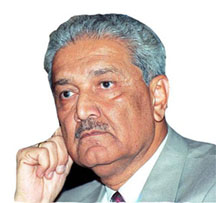
Smiling Buddha and how Khan network’s inside job made Pakistan a nuclear state, Financial Express, May 31, 2021 By Subhash Jangala
By conducting the first confirmed nuclear weapons test by a non-member of the UN Security Council, India caught the entire international intelligence community unawares.
On 26th May 2021, India celebrated Buddha Jayanti, the anniversary of the great soul obtaining enlightenment. Exactly 47 years ago, on the Buddha Jayanti of 1974, Smiling Buddha ushered India into the nuclear age. By conducting the first confirmed nuclear weapons test by a non-member of the UN Security Council, India caught the entire international intelligence community unawares. Thousands of miles away from the test site in Pokhran, Rajasthan was Almelo, a tiny municipality in eastern Netherlands. As the news of the Indian nuclear test trickled in, a silent storm started brewing in a man’s heart. 1974’s Buddha Jayanti not only heralded India’s geopolitical assent, it also flagged off Pakistan’s steep decline in international status and reputation.
Abdul Qadeer Khan, a Pakistani metallurgical engineer employed in a uranium enrichment plant in Almelo, took India’s successful nuclear test to heart. In his work, Khan got several opportunities to work with Highly Enriched Uranium (HEU) in Netherlands. Khan quickly dispatched a letter to Pakistan’s newly powerful Prime Minister, Zulfiqar Ali Bhutto explaining why HEU was the miracle cure for Pakistan’s struggle with making a plutonium bomb. After several attempts, Bhutto did give Khan a hearing and was impressed. Thus began a decades-long saga of illegal and criminal transfer of nuclear materials and technologies from across the world into Pakistan and then via Pakistan to other states like Iran and Libya.
Back in the 1970s and 80s, Anti Money Laundering regulations and investigation into Proliferation Finance weren’t as developed as they are today. This allowed Khan and the Pakistan Government to run a complex international network of benami companies and suppliers that have created and helped sustain a nuclear black economy. A deeper study of the proliferation episode makes for interesting reading……………………..
As years progressed, Khan used his contacts to obtain components from across the world, expanding Pakistan’s chances of testing their first nuclear bomb. At the same time, the West, unmindful of Khan’s dogged belief in his experiment and Pakistan’s tenacious resolve to match India kiloton-for-kiloton, took a laid-back and lackadaisical route to control the black nuclear economy that Pakistan was helping create. Eventually, his endearing nature and Pakistan’s resolute support, Khan managed to assemble all the components required to make his nuclear dream go live.
However, Khan’s dream did not end with making Pakistan a formidable opponent to India in the nuclear battlefield. Khan expanded his activities deeper into the illegal and immoral world of nuclear proliferation. He helped create a market where any budding nuclear adventurist could order from a list of raw materials which could be sourced from any of the reliable suppliers across the world. A “Flipkart for Nuclear dummies” was born. This market place operated from the following places, [shown on map on original]
Khan Research Laboratories in Pakistan and SMB Computers in Dubai (a front company) operated as the hub and the rest were all procurement or delivery centres. An investigation by the Malaysian Police into one such transaction revealed the inner workings of the network. The same is presented below in 8 steps. [diagram on original]
……….. The most important link that connected the entire network was the fact that, apart from the core individuals, no entity had a clue what was being produced and for whom.
The fraud continued for a while. On a fateful day in 2004, the US exposed the outlines of the world;s largest nuclear proliferation ring. In a dramatic television appearance Feb. 4, Abdul Qadeer Khan, the father of the Pakistani bomb, acknowledged that he had secretly provided North Korea, Libya, and Iran with crucial building blocks for making nuclear weapons. Khan, considered a national hero, apologized to the people of Pakistan for what he had done and was pardoned by the then Pakistani President Gen. Pervez Musharraf shortly afterward.
On this Buddha Jayanti, the story of AQ Khan should alert sanctions compliance organisations across the globe to the new challenges like the need to transition to a low carbon energy economy, introduction of advanced materials and growth of underground markets through the dark web. International organisations should re-dedicate themselves to technology, co-operative diplomacy, Exchange of Information and cross-cultural capacity building to ensure rogue proliferators and black markets don’t emerge in newer and more sophisticated areas of crime.
(The author is an officer of the 2011 batch of the Indian Revenue Service. He is presently posted as Joint Director (OSD) in the Directorate General of Administration and Taxpayer Services at New Delhi. Prior to this role, he worked as a Tax Diplomat in the Foreign Tax and Tax Research Division of the Central Board of Direct Taxes. The views expressed are the author’s own, and do not represent the official position or policy of the Government of India or Financial Express Online.) https://www.financialexpress.com/world-news/smiling-buddha-and-how-khan-networks-inside-job-made-pakistan-a-nuclear-state/2262259/
Targeted surveillance threatens human rights defenders
OPERATING FROM THE SHADOWS: INSIDE NSO GROUP’S CORPORATE STRUCTURE https://www.amnesty.org/en/documents/doc10/4182/2021/en/
31 May 2021, Index number: DOC 10/4182/2021, Targeted surveillance is a serious threat facing human rights defenders globally. Though often carried out by states, this practice is enabled by digital surveillance tools provided by private companies. However, the lack of transparency about the operations of the surveillance industry poses a serious obstacle for victims of unlawful surveillance to seek accountability and the right to remedy. This briefing seeks to shed light on one specific company – NSO Group – and thereby help to overcome this barrier. This briefing is jointly written by Amnesty International, Privacy International and The Centre for Research on Multinational Corporations (SOMO).
Secrecy and connivance between UK’s coal and nuclear lobbies in Cumbria
There are high-level omissions in all the reporting and I fear that our
Government are only too happy for the focus to be myopically on climate
rather than the blatant cronyism of the coal mine boss having been
appointed to ADVISE the government on nuclear dump plans.
How on earth can
the forthcoming public inquiry be impartially decided upon by a government
minister when the most powerful tier of government, the Dept of Business,
Energy and Industrial Strategy is taking advice from the coal mine boss,
Mark Kirkbride? Not only that but the Coal Authority (who are under BEIS)
are deferring to the coal boss’s wish not to place the new Coal Authority
licence applications in the public domain. Again how on earth can there be
a public inquiry in which the public don’t know what the developer has
planned?
Keep Cumbrian Coal in the Hole 28th May 2021
Mr Nuclear Waste and Mr Coal – Top Cronies..Shhh
Report on the threat of nuclear terrorism
Etidal publishes report on threat of nuclear terrorism, https://www.arabnews.com/node/1866166/saudi-arabia 28 May 21, RIYADH: In a report published on Thursday, the Riyadh-based Global Center for Combating Extremist Ideology (Etidal) warned that terrorist groups are attempting to exploit the humanitarian effects of the COVID-19 pandemic to develop their capabilities, including the aim of obtaining weapons of mass destruction.
“The Great Threat: Extremism and the Spread of Nuclear Terrorism” reviews the risks posed by terrorist organizations through their efforts to acquire nuclear weapons, which has been a goal of such groups for decades.
Etidal noted that “the signs of terrorist practices around the world following the coronavirus pandemic shed light on the extremist organizations’ attempts to extensively exploit the global humanitarian situation in order to develop their destructive capabilities.”
RIYADH: In a report published on Thursday, the Riyadh-based Global Center for Combating Extremist Ideology (Etidal) warned that terrorist groups are attempting to exploit the humanitarian effects of the COVID-19 pandemic to develop their capabilities, including the aim of obtaining weapons of mass destruction.
“The Great Threat: Extremism and the Spread of Nuclear Terrorism” reviews the risks posed by terrorist organizations through their efforts to acquire nuclear weapons, which has been a goal of such groups for decades.
Etidal noted that “the signs of terrorist practices around the world following the coronavirus pandemic shed light on the extremist organizations’ attempts to extensively exploit the global humanitarian situation in order to develop their destructive capabilities.”
The sixth high-ranking FirstEnergy executive fired, in Ohio nuclear corruption scandal

FirstEnergy fires another executive over consulting contract First Energy fires another executive over consulting contract https://spectrumnews1.com/oh/columbus/news/2021/05/28/firstenergy-fires-another-executive-over-consulting-contractCLEVELAND (AP Ohio)) — A FirstEnergy senior vice president was fired Thursday for her “inaction” regarding a 2015 amendment to a “purported” consulting contract with someone who was later appointed as Ohio’s top utility regulator, the company announced in a U.S. Securities and Exchange Commission filing.
Eileen Mikkelsen’s dismissal makes her the sixth high-ranking FirstEnergy executive fired since the U.S. Department of Justice alleged last July that the company had secretly funded a $60 million bribery scheme aimed at winning legislative approval of a bailout of two nuclear power plants operated at the time by a wholly-owned FirstEnergy subsidiary.
CEO Chuck Jones and two other vice presidents were fired in October for what FirstEnergy said were violations of company policies and its code of conduct. Two of the company’s top attorneys were fired the following month.
FirstEnergy did not specify the reason for their dismissals.
Jones was appointed CEO in 2015.
A message seeking comment was left for Mikkelsen on Thursday. A FirstEnergy spokesperson declined to comment about the firing.
While FirstEnergy has not named the regulator in question, it has not been disputed that it was Samuel Randazzo, appointed by Republican Gov. Mike DeWine in early 2019 as chair of the Public Utilities Commission of Ohio. Randazzo resigned last November after the FBI searched his Columbus townhome and FirstEnergy disclosed it had paid him $4.3 million before his appointment to end a consulting contract in place since 2013.
“FirstEnergy continues to believe that payments under the consulting agreement may have been for purposes other than those represented within the consulting agreement,” according to Thursday’s SEC filing.
FirstEnergy has been engaged in damage control over the last year as it tries to restore is corporate reputation, emphasizing efforts the company has made to strengthen its internal controls. FirstEnergy officials have said the company is cooperating with investigations by the DOJ, SEC and Federal Energy Regulatory Commission and that it has discussed a deferred prosecution agreement with DOJ attorneys.discussed a deferred prosecution agreement with DOJ attorneys.
The Legislature earlier this year repealed the $1 billion bailout in the wake of the scandal and the plants’ new owner, Energy Harbor, indicating it did not want the subsidy worth about $150 million a year. Energy Harbor took control of the plants and other assets of the FirstEnergy subsidiary in February 2020 as part of a deal struck in U.S. Bankruptcy Court.
Two sets of lawsuits seeking certification as class action complaints have been filed against FirstEnergy since July. Outside attorneys representing the company have said in recent motions to dismiss the lawsuits that FirstEnergy’s actions regarding its contributions to dark money groups controlled by former Ohio House Speaker Larry Householder were legal.
Householder and four others were indicted on racketeering charges shortly after the DOJ unveiled criminal complaints against them in July. Householder has pleaded not guilty.
US military running a massive undercover army and conducting warrantless surveillance of Americans
US military running a massive undercover army and conducting warrantless surveillance of Americans, WSW
Kevin Reed21 May 2021 Two reports over the past week have revealed that the Pentagon is carrying out secret operations within the US and internationally without congressional oversight and in violation of basic constitutional rights.
An exclusive report by Newsweek on Monday explained that the US military is operating “[T]he largest undercover force the world has ever known.” The secret army of 60,000 people works under “masked identities and in low profile” and is part of a special program called “signature reduction.”
The Newsweek report—written by journalist William M. Arkin following a two-year investigation of the program—says that the secret military force is “more than ten times the size of the clandestine elements of the CIA, carries out domestic and foreign assignments, both in military uniforms and under civilian cover, in real life and online, sometimes hiding in private businesses and consultancies, some of them household name companies.”
Arkin examined “over 600 resumes and 1,000 job postings, dozens of Freedom of Information Act requests, and scores of interviews with participants and defense decision-makers” to uncover the “completely unregulated practice” of the US military. The giant clandestine operation has never been the subject of a hearing in Congress, and Arkin says that it “challenges U.S. laws, the Geneva Conventions, the code of military conduct and basic accountability.”
The infrastructure of the Pentagon’s covert “signature reduction” program is based upon 130 private companies with the support of dozens of “little known and secret government organizations” that award “classified contracts” and “oversee publicly acknowledged operations.”
Among the functions of these private businesses are creating false documentation; paying the taxes of individuals operating under assumed identities; manufacturing disguises and other devices used to avoid identification; building invisible devices used to photograph and listen in on the conversations and activity of people around the world…………….
The fact that the Pentagon has been conducting warrantless surveillance of Americans was exposed in a May 13 letter from Senator Ron Wyden (Democrat from Oregon) to Secretary of Defense Lloyd Austin that was published by Vice’s Motherboard Tech.
Wyden asked the Department of Defense (DoD) for detailed information about its data purchasing practices after Motherboard revealed special forces were buying location data last February. The initial DoD responses—which revealed that the military or intelligence agencies were using internet browsing and other types of data—prompted Wyden to demand more answers about warrantless spying on American citizens.
Wyden wrote that his investigation had confirmed that the Internal Revenue Service, Customs and Border Protection, the Drug Enforcement Agency and the Defense Intelligence Agency were all purchasing from private companies the location data of Americans without a warrant…………..https://www.wsws.org/en/articles/2021/05/22/cong-m22.html
Another former Westinghouse executive pleads guilty to lying in South Carolina nuclear power scandal
3rd official to plead guilty in SC nuclear debacle, https://www.wistv.com/2021/05/24/rd-official-plead-guilty-sc-nuclear-debacle/ By Associated Press| May 24, 2021
COLUMBIA, S.C. (AP) – Court documents show a former official for the contractor hired to build two South Carolina nuclear reactors that were never completed will plead guilty to lying to federal authorities.
Carl Churchman was the Westinghouse Electric Co. project director for the failed plant that cost ratepayers and investors billions of dollars.
Authorities say Churchman lied about whether he communicated with utility executives on completion dates for the reactors.
Utility executives swore construction was on track to keep regulators approving rate increases and maintain support from investors, even though the project fell behind.
Two top-level executives have already pleaded guilty in the multi-year federal fraud investigation.
Renewable energy cheated in uneasy coalition with Exelon nuclear, in Illinois

How Pay-to-Play Politics and an Uneasy Coalition of Nuclear and Renewable Energy Led to a Flawed Illinois Law, Inside Climate News
State lawmakers are running out of time to fix 2016 clean energy legislation.
By Dan Gearino, Inside Climate News and Brett Chase, Chicago Sun-TimesMay 21, 2021This article is the result of a partnership between Inside Climate News and the Chicago Sun-Times.
CHICAGO—Just over five years ago, the Illinois Legislature passed a plan that aimed to build a solar power industry from scratch while saving thousands of jobs at two struggling nuclear plants.
The Future Energy Jobs Act brought together environmental groups, the owner of the nuclear plants—Exelon Corp., unions and consumer advocates. The result was a plan marrying nuclear subsidies with support for renewable energy that purported to create tens of thousands of solar power jobs as well as put the state on track to move away from fossil fuels and meet its pre-existing target of having 25 percent renewable energy by 2025.
But the law sputtered from the start and now state leaders are racing to meet a May 31 legislative deadline to fix some of its biggest problems, like the impending loss of more than $300 million in funding for renewable energy programs.
But the law sputtered from the start and now state leaders are racing to meet a May 31 legislative deadline to fix some of its biggest problems, like the impending loss of more than $300 million in funding for renewable energy programs. The 2025 target is far out of reach, the jobs expectations went unmet and the solar industry is laying off workers as promised funding dries up.
Exelon emerged as a clear winner, receiving $2.3 billion in ratepayer-funded subsidies over a decade for its two plants. It is now demanding even more money and threatening to close two other nuclear plants if it doesn’t get it.
“Exelon continues to get $235 million a year, while the solar support has been stripped away,” said Howard Learner, executive director of the Chicago-based Environmental Law and Policy Center and a critic of the state’s nuclear bailout. “Illinois could’ve been a Midwest solar energy leader.”
Making the current scramble even more complicated is a federal bribery probe of Exelon and its Chicago utility subsidiary, Commonwealth Edison. Prosecutors say ComEd gave cash, jobs and contracts to associates of former House Speaker Michael Madigan with the hope he would shape the legislation to the company’s liking.
Gov. J.B. Pritzker has said that Exelon will not dictate the terms of the current debate over how to fix the state’s energy law. But the company and its close allies in organized labor nonetheless have immense power in the Legislature.
Exelon is seeking subsidies for its four Illinois nuclear plants that didn’t get help in the 2016 law, and is saying that the Byron and Dresden nuclear plants will close without this aid.
Meanwhile, solar companies are laying off workers following the abrupt end of incentive funding tied to the 2016 law.
Supporters of the law talked about a boom in solar jobs, but the actual gains have been modest. Illinois went from 3,480 solar jobs in 2015, the 14th highest number in the country, to 5,259 jobs in 2020, which ranked 13th, according to the Solar Foundation.
While there were few new solar jobs, there has been a surge in the small-scale solar projects the law was designed to encourage, with more than 20,000 projects completed. But solar remains a blip in Illinois’ energy landscape, providing less than 1 percent of the state’s electricity generation in 2020.
Solar and wind energy have grown in Illinois, but renewable sources are only about 7.5 percent of the state’s electricity consumption, which is far short of the pace needed to reach the target of 25 percent by 2025…….
While there were few new solar jobs, there has been a surge in the small-scale solar projects the law was designed to encourage, with more than 20,000 projects completed. But solar remains a blip in Illinois’ energy landscape, providing less than 1 percent of the state’s electricity generation in 2020.
Solar and wind energy have grown in Illinois, but renewable sources are only about 7.5 percent of the state’s electricity consumption, which is far short of the pace needed to reach the target of 25 percent by 2025……..
A Nuclear Bailout Takes Shape
In 2016, Exelon was threatening to close the Clinton and Quad Cities power plants and wanted the Illinois General Assembly to pass a law that would require local utilities, including ComEd, to charge consumers for a 10-year subsidy for the plants.
The idea had the strong backing of Exelon’s allies in organized labor, but it was difficult to get lawmakers to agree to raise utility bills.
At the same time, environmental groups, clean energy business groups and environmental justice advocates had their own proposals.
Madigan, a Democrat who was the longtime speaker of the House, made clear that any clean energy proposals needed to go through Exelon and get added to their nuclear bailout, according to those closely involved with the process. Madigan, through a spokeswoman, declined to comment.
“Being able to pass clean energy legislation was conditioned by the speaker to reach agreement with ComEd and Exelon and labor,” said Jen Walling, executive director of the Illinois Environmental Council, which led the push for renewable energy provisions.
Walling, whose group represents more than 90 environmental and community groups across Illinois, said the political reality forced the environmental advocates to work with Exelon.
Pat Quinn, a Democrat who was governor from 2009 until he lost his bid for re-election in 2014, said the process was unseemly but typical for Exelon.
Exelon wanted “the renewable people to literally crawl to them,” Quinn said. “As long as they could hold up the renewables and the progressive stuff, they’d get more for themselves.”
Federal prosecutors later said that Exelon subsidiary ComEd’s actions at that time were more than just hardball politics. The company was part of a pay-to-play environment for energy legislation in the state, with ComEd giving cash, contracts and jobs to people connected to Madigan, according to a federal complaint. The investigation has led to indictments and a deferred prosecution agreement with ComEd.
ComEd’s Breymaier said the company has “substantially strengthened oversight and controls of its lobbying and hiring,” among other steps to prevent actions like those described by prosecutors………… https://insideclimatenews.org/news/21052021/how-pay-to-play-politics-and-an-uneasy-coalition-of-nuclear-and-renewable-energy-led-to-a-flawed-illinois-law/
U.S. Pentagon hypes up the ”China threat”, in its deceptive propaganda to get more $billions from Congress

we can expect to be bombarded with Pentagon and industry propaganda on China’s growing air and naval capabilities—requiring, it will be stated, hundreds of billions of dollars in added spending.
Costs for the new intercontinental missile are currently estimated at $100 billion ($10 billion more than a few years ago) and are sure to rise in the years ahead if full-scale production is approved by Congress.
The Pentagon Inflates the Chinese Nuclear Threat in a Push for New Intercontinental Missiles. Every US military service is seeking more money than before, and each one is touting the importance of their weapons in overcoming the Chinese military threat. The Nation, By Michael T. Klare , 19 May 21,
This year, as in every year, the Department of Defense will seek to extract budget increases from Congress by highlighting the severe threats to US security posed by its foreign adversaries. Usually, this entails a litany of such perils, ranging from a host of nation-state adversaries to nonstate actors like ISIS and Al Qaeda. This year, however, the Pentagon is focusing almost entirely on just one threat in its funding appeals: The People’s Republic of China. Sensing that a majority in Congress—Democrats as well as Republicans—are keen to display their determination to blunt China’s rise, senior officials are largely framing the military budget around preparation for a possible conflict with that country. “The Department will prioritize China as our number one pacing challenge and develop the right operational concepts, capabilities, and plans to bolster deterrence and maintain our competitive advantage,” Secretary of Defense Lloyd Austin declared on March 4.
From the Pentagon’s perspective, this means portraying every budgetary item—from Army tanks and Navy ships to Air Force jets and ballistic missiles—in terms of their utility in fighting the Chinese military, the People’s Liberation Army (PLA). Every US military service is seeking more money than before (as they always do), and each one is touting the importance of their weapons in overcoming the Chinese military threat. But this year, after a series of rising budgets during the Trump administration, defense appropriations are expected to remain flat (at a nonetheless colossal $715 billion), meaning that any increase in spending on any given weapons system—be it a major warship, aircraft, or missile—is likely to come at the expense of increases in others. The result, not surprisingly, is a contest among the services to magnify the vital importance of their pet projects in overpowering the PLA.
This means that we can expect to be bombarded with Pentagon and industry propaganda on China’s growing air and naval capabilities—requiring, it will be stated, hundreds of billions of dollars in added spending on new fighter jets, submarines, and surface ships. Although China’s military capabilities still lag far behind those of US forces in terms of their technical proficiency—China’s two aircraft carriers, for example, can launch only a dozen or so combat jets, compared to the 75-plus deployed on America’s 11 carriers—but the PLA has nonetheless acquired many new ships and planes, so promoters of US weaponry have some real data to cite when making their claims of growing Chinese military prowess.
“The PRC maintains the world’s largest naval force, which has tripled in size over the past two decades,” said Adm. Philip S. Richardson on March 21 (while not revealing that most of those ships are coastal frigates with little utility in a conflict with the US Navy). For the advocates of a buildup in US nuclear forces, however, it is hard to justify such claims, and so they have been forced to make wildly exaggerated claims about China’s nuclear capabilities.
This is an especially critical year for America’s nuclear weapons boosters, as plans for modernization of the US strategic “triad”—land-based intercontinental ballistic missiles (ICBMs), sea-launched ballistic missiles (SLBMs) and their submarine platforms, and long-range bombers—are all scheduled to move from the research and development phase to full-scale production. Funds have already been appropriated for a new bomber, the B-21 Raider, and for a new SLBM-carrying submarine, the Columbia class, and now the Pentagon wants to begin work on a new ICBM, which it calls, in its typically obfuscating way, the Ground-Based Strategic Deterrent, or GBSD. Costs for the new intercontinental missile are currently estimated at $100 billion ($10 billion more than a few years ago) and are sure to rise in the years ahead if full-scale production is approved by Congress.
While nuclear modernization enjoys strong support in Congress, questions have been raised about the need for the GBSD, especially given the competition for funds from other favored programs, such as the F-35 fighter and the Los Angeles–class attack submarine, and the fact that an alternative exists in terms of refurbishing the Pentagon’s existing fleet of 400 Minuteman-III ICBMs. Some in Congress have also suggested that land-based missiles would be highly vulnerable in the event of an enemy preemptive strike and that the nation enjoys more-than-adequate deterrence to such attack with its undetectable fleet of missile-carrying submarines. For example, Senator Ed Markey of Massachusetts and Representative Ro Khanna of California have introduced the Investing in Cures Before Missiles (ICBM) Act, which would divert funds from GBSD procurement to development of a universal coronavirus vaccine, while also extending the life of Minuteman missiles. “With all of the global challenges we face,” Khanna declared, “the last thing we should be doing is giving billions to defense contractors to build missiles we don’t need to keep as a strong nuclear deterrence.”
In response to these challenges, the nuclear lobby has gone all-out in touting the threat posed by China’s nuclear capabilities, even though these hardly come close to those possessed by the United States or its principal nuclear adversary, the Russian Federation. According to the latest (and most authoritative) data from the Stockholm International Peace Research Institute, China possesses 320 nuclear warheads in total—none of which is believed to be deployed at present on its ICBMs, SLBMs, or bombers. By comparison, Russia has 6,375 warheads in its stockpile, of which 1,575 are currently deployed on weapons systems, and the United States has 5,800 warheads, with 1,750 deployed. China is said to be increasing the size of its nuclear stockpile, in part because it is replacing some older, single-warhead ICBMs with newer, multiple-warhead versions, but its progress in this direction has been slow and no analyst, inside or outside of government, predicts an increase that will bring the Chinese arsenal anywhere close to those possessed by Russia and the United States………..
Congress members should avoid being swayed by unfounded claims about China’s expanding nuclear arsenal. Of course, any Chinese nuclear weapons—like any nuclear weapons anywhere—pose a threat to US and global security, but we need not embark on a new nuclear arms race simply to overcome an over-hyped increase in Chinese capabilities. https://www.thenation.com/article/politics/pentagon-china-nuclear/
Master of Space: Corporate plans for the militarization & privatization of space
Feb 2, 2021 Sun, Jan 31, 2021: 10:30 am to 12:30 pm Master of Space: Corporate plans for the militarization & privatization of space DESCRIPTION: Bruce Gagnon will reveal the deadly connections between the corporate drive to ‘control and dominate’ space as spelled out in the US Space Command’s 1997 planning document called Vision for 2020. https://thecommunity.com/wp-content/u…
The gold rush is now underway as space technologies have matured to the point where mining the sky for precious resources becomes possible. Corporate forces intend to use the newly formed ‘Space force’ to guard the front gate on and off Earth to ensure that only ‘authorized’ companies and nations would be allowed to access space.
This vision was first spelled out before Congress in the early 1950’s when former Nazi Maj. Gen. Walter Dornberger shared his vision of orbiting battle stations in space to control the pathway on and off our planet. Dornberger had been Hitler’s liaison to V-1 & V-2 rocket scientist Wernher von Braun during WW II. After the war Dornberger, Von Braun and more than 1,000 Nazi leaders were secretly brought to the US to serve in the military industrial complex. Van Braun built the US space program and Dornberger became a V-P of Bell Aerospace in New York. http://www.space4peace.org
BIO: Bruce Gagnon is the Coordinator (and Co-Founder) of the Global Network Against Weapons & Nuclear Power in Space. He is a Vietnam war-era veteran and began his organizing work with the United Farm Workers Union. He lives in Bath, Maine.
1 This Month

of the week – Shut Down Drone Warfare!


Tell the Ukrainian Government to Drop Prosecution of Peace Activist Yurii Sheliazhenko

Petition to revoke the licensing of the Near Surface Nuclear Disposal Facility (NSDF) at Chalk River. https://www.ourcommons.ca/petitions/en/Petition/Details?Petition=e-7247
To see nuclear-related stories in greater depth and intensity – go to https://nuclearinformation.wordpress.com
-
Archives
- April 2026 (58)
- March 2026 (251)
- February 2026 (268)
- January 2026 (308)
- December 2025 (358)
- November 2025 (359)
- October 2025 (376)
- September 2025 (257)
- August 2025 (319)
- July 2025 (230)
- June 2025 (348)
- May 2025 (261)
-
Categories
- 1
- 1 NUCLEAR ISSUES
- business and costs
- climate change
- culture and arts
- ENERGY
- environment
- health
- history
- indigenous issues
- Legal
- marketing of nuclear
- media
- opposition to nuclear
- PERSONAL STORIES
- politics
- politics international
- Religion and ethics
- safety
- secrets,lies and civil liberties
- spinbuster
- technology
- Uranium
- wastes
- weapons and war
- Women
- 2 WORLD
- ACTION
- AFRICA
- Atrocities
- AUSTRALIA
- Christina's notes
- Christina's themes
- culture and arts
- Events
- Fuk 2022
- Fuk 2023
- Fukushima 2017
- Fukushima 2018
- fukushima 2019
- Fukushima 2020
- Fukushima 2021
- general
- global warming
- Humour (God we need it)
- Nuclear
- RARE EARTHS
- Reference
- resources – print
- Resources -audiovicual
- Weekly Newsletter
- World
- World Nuclear
- YouTube
-
RSS
Entries RSS
Comments RSS
 nuclear-news