Secrecy and connivance between UK’s coal and nuclear lobbies in Cumbria
There are high-level omissions in all the reporting and I fear that our
Government are only too happy for the focus to be myopically on climate
rather than the blatant cronyism of the coal mine boss having been
appointed to ADVISE the government on nuclear dump plans.
How on earth can
the forthcoming public inquiry be impartially decided upon by a government
minister when the most powerful tier of government, the Dept of Business,
Energy and Industrial Strategy is taking advice from the coal mine boss,
Mark Kirkbride? Not only that but the Coal Authority (who are under BEIS)
are deferring to the coal boss’s wish not to place the new Coal Authority
licence applications in the public domain. Again how on earth can there be
a public inquiry in which the public don’t know what the developer has
planned?
Keep Cumbrian Coal in the Hole 28th May 2021
Mr Nuclear Waste and Mr Coal – Top Cronies..Shhh
Report on the threat of nuclear terrorism
Etidal publishes report on threat of nuclear terrorism, https://www.arabnews.com/node/1866166/saudi-arabia 28 May 21, RIYADH: In a report published on Thursday, the Riyadh-based Global Center for Combating Extremist Ideology (Etidal) warned that terrorist groups are attempting to exploit the humanitarian effects of the COVID-19 pandemic to develop their capabilities, including the aim of obtaining weapons of mass destruction.
“The Great Threat: Extremism and the Spread of Nuclear Terrorism” reviews the risks posed by terrorist organizations through their efforts to acquire nuclear weapons, which has been a goal of such groups for decades.
Etidal noted that “the signs of terrorist practices around the world following the coronavirus pandemic shed light on the extremist organizations’ attempts to extensively exploit the global humanitarian situation in order to develop their destructive capabilities.”
RIYADH: In a report published on Thursday, the Riyadh-based Global Center for Combating Extremist Ideology (Etidal) warned that terrorist groups are attempting to exploit the humanitarian effects of the COVID-19 pandemic to develop their capabilities, including the aim of obtaining weapons of mass destruction.
“The Great Threat: Extremism and the Spread of Nuclear Terrorism” reviews the risks posed by terrorist organizations through their efforts to acquire nuclear weapons, which has been a goal of such groups for decades.
Etidal noted that “the signs of terrorist practices around the world following the coronavirus pandemic shed light on the extremist organizations’ attempts to extensively exploit the global humanitarian situation in order to develop their destructive capabilities.”
The sixth high-ranking FirstEnergy executive fired, in Ohio nuclear corruption scandal

FirstEnergy fires another executive over consulting contract First Energy fires another executive over consulting contract https://spectrumnews1.com/oh/columbus/news/2021/05/28/firstenergy-fires-another-executive-over-consulting-contractCLEVELAND (AP Ohio)) — A FirstEnergy senior vice president was fired Thursday for her “inaction” regarding a 2015 amendment to a “purported” consulting contract with someone who was later appointed as Ohio’s top utility regulator, the company announced in a U.S. Securities and Exchange Commission filing.
Eileen Mikkelsen’s dismissal makes her the sixth high-ranking FirstEnergy executive fired since the U.S. Department of Justice alleged last July that the company had secretly funded a $60 million bribery scheme aimed at winning legislative approval of a bailout of two nuclear power plants operated at the time by a wholly-owned FirstEnergy subsidiary.
CEO Chuck Jones and two other vice presidents were fired in October for what FirstEnergy said were violations of company policies and its code of conduct. Two of the company’s top attorneys were fired the following month.
FirstEnergy did not specify the reason for their dismissals.
Jones was appointed CEO in 2015.
A message seeking comment was left for Mikkelsen on Thursday. A FirstEnergy spokesperson declined to comment about the firing.
While FirstEnergy has not named the regulator in question, it has not been disputed that it was Samuel Randazzo, appointed by Republican Gov. Mike DeWine in early 2019 as chair of the Public Utilities Commission of Ohio. Randazzo resigned last November after the FBI searched his Columbus townhome and FirstEnergy disclosed it had paid him $4.3 million before his appointment to end a consulting contract in place since 2013.
“FirstEnergy continues to believe that payments under the consulting agreement may have been for purposes other than those represented within the consulting agreement,” according to Thursday’s SEC filing.
FirstEnergy has been engaged in damage control over the last year as it tries to restore is corporate reputation, emphasizing efforts the company has made to strengthen its internal controls. FirstEnergy officials have said the company is cooperating with investigations by the DOJ, SEC and Federal Energy Regulatory Commission and that it has discussed a deferred prosecution agreement with DOJ attorneys.discussed a deferred prosecution agreement with DOJ attorneys.
The Legislature earlier this year repealed the $1 billion bailout in the wake of the scandal and the plants’ new owner, Energy Harbor, indicating it did not want the subsidy worth about $150 million a year. Energy Harbor took control of the plants and other assets of the FirstEnergy subsidiary in February 2020 as part of a deal struck in U.S. Bankruptcy Court.
Two sets of lawsuits seeking certification as class action complaints have been filed against FirstEnergy since July. Outside attorneys representing the company have said in recent motions to dismiss the lawsuits that FirstEnergy’s actions regarding its contributions to dark money groups controlled by former Ohio House Speaker Larry Householder were legal.
Householder and four others were indicted on racketeering charges shortly after the DOJ unveiled criminal complaints against them in July. Householder has pleaded not guilty.
US military running a massive undercover army and conducting warrantless surveillance of Americans
US military running a massive undercover army and conducting warrantless surveillance of Americans, WSW
Kevin Reed21 May 2021 Two reports over the past week have revealed that the Pentagon is carrying out secret operations within the US and internationally without congressional oversight and in violation of basic constitutional rights.
An exclusive report by Newsweek on Monday explained that the US military is operating “[T]he largest undercover force the world has ever known.” The secret army of 60,000 people works under “masked identities and in low profile” and is part of a special program called “signature reduction.”
The Newsweek report—written by journalist William M. Arkin following a two-year investigation of the program—says that the secret military force is “more than ten times the size of the clandestine elements of the CIA, carries out domestic and foreign assignments, both in military uniforms and under civilian cover, in real life and online, sometimes hiding in private businesses and consultancies, some of them household name companies.”
Arkin examined “over 600 resumes and 1,000 job postings, dozens of Freedom of Information Act requests, and scores of interviews with participants and defense decision-makers” to uncover the “completely unregulated practice” of the US military. The giant clandestine operation has never been the subject of a hearing in Congress, and Arkin says that it “challenges U.S. laws, the Geneva Conventions, the code of military conduct and basic accountability.”
The infrastructure of the Pentagon’s covert “signature reduction” program is based upon 130 private companies with the support of dozens of “little known and secret government organizations” that award “classified contracts” and “oversee publicly acknowledged operations.”
Among the functions of these private businesses are creating false documentation; paying the taxes of individuals operating under assumed identities; manufacturing disguises and other devices used to avoid identification; building invisible devices used to photograph and listen in on the conversations and activity of people around the world…………….
The fact that the Pentagon has been conducting warrantless surveillance of Americans was exposed in a May 13 letter from Senator Ron Wyden (Democrat from Oregon) to Secretary of Defense Lloyd Austin that was published by Vice’s Motherboard Tech.
Wyden asked the Department of Defense (DoD) for detailed information about its data purchasing practices after Motherboard revealed special forces were buying location data last February. The initial DoD responses—which revealed that the military or intelligence agencies were using internet browsing and other types of data—prompted Wyden to demand more answers about warrantless spying on American citizens.
Wyden wrote that his investigation had confirmed that the Internal Revenue Service, Customs and Border Protection, the Drug Enforcement Agency and the Defense Intelligence Agency were all purchasing from private companies the location data of Americans without a warrant…………..https://www.wsws.org/en/articles/2021/05/22/cong-m22.html
Another former Westinghouse executive pleads guilty to lying in South Carolina nuclear power scandal
3rd official to plead guilty in SC nuclear debacle, https://www.wistv.com/2021/05/24/rd-official-plead-guilty-sc-nuclear-debacle/ By Associated Press| May 24, 2021
COLUMBIA, S.C. (AP) – Court documents show a former official for the contractor hired to build two South Carolina nuclear reactors that were never completed will plead guilty to lying to federal authorities.
Carl Churchman was the Westinghouse Electric Co. project director for the failed plant that cost ratepayers and investors billions of dollars.
Authorities say Churchman lied about whether he communicated with utility executives on completion dates for the reactors.
Utility executives swore construction was on track to keep regulators approving rate increases and maintain support from investors, even though the project fell behind.
Two top-level executives have already pleaded guilty in the multi-year federal fraud investigation.
Renewable energy cheated in uneasy coalition with Exelon nuclear, in Illinois

How Pay-to-Play Politics and an Uneasy Coalition of Nuclear and Renewable Energy Led to a Flawed Illinois Law, Inside Climate News
State lawmakers are running out of time to fix 2016 clean energy legislation.
By Dan Gearino, Inside Climate News and Brett Chase, Chicago Sun-TimesMay 21, 2021This article is the result of a partnership between Inside Climate News and the Chicago Sun-Times.
CHICAGO—Just over five years ago, the Illinois Legislature passed a plan that aimed to build a solar power industry from scratch while saving thousands of jobs at two struggling nuclear plants.
The Future Energy Jobs Act brought together environmental groups, the owner of the nuclear plants—Exelon Corp., unions and consumer advocates. The result was a plan marrying nuclear subsidies with support for renewable energy that purported to create tens of thousands of solar power jobs as well as put the state on track to move away from fossil fuels and meet its pre-existing target of having 25 percent renewable energy by 2025.
But the law sputtered from the start and now state leaders are racing to meet a May 31 legislative deadline to fix some of its biggest problems, like the impending loss of more than $300 million in funding for renewable energy programs.
But the law sputtered from the start and now state leaders are racing to meet a May 31 legislative deadline to fix some of its biggest problems, like the impending loss of more than $300 million in funding for renewable energy programs. The 2025 target is far out of reach, the jobs expectations went unmet and the solar industry is laying off workers as promised funding dries up.
Exelon emerged as a clear winner, receiving $2.3 billion in ratepayer-funded subsidies over a decade for its two plants. It is now demanding even more money and threatening to close two other nuclear plants if it doesn’t get it.
“Exelon continues to get $235 million a year, while the solar support has been stripped away,” said Howard Learner, executive director of the Chicago-based Environmental Law and Policy Center and a critic of the state’s nuclear bailout. “Illinois could’ve been a Midwest solar energy leader.”
Making the current scramble even more complicated is a federal bribery probe of Exelon and its Chicago utility subsidiary, Commonwealth Edison. Prosecutors say ComEd gave cash, jobs and contracts to associates of former House Speaker Michael Madigan with the hope he would shape the legislation to the company’s liking.
Gov. J.B. Pritzker has said that Exelon will not dictate the terms of the current debate over how to fix the state’s energy law. But the company and its close allies in organized labor nonetheless have immense power in the Legislature.
Exelon is seeking subsidies for its four Illinois nuclear plants that didn’t get help in the 2016 law, and is saying that the Byron and Dresden nuclear plants will close without this aid.
Meanwhile, solar companies are laying off workers following the abrupt end of incentive funding tied to the 2016 law.
Supporters of the law talked about a boom in solar jobs, but the actual gains have been modest. Illinois went from 3,480 solar jobs in 2015, the 14th highest number in the country, to 5,259 jobs in 2020, which ranked 13th, according to the Solar Foundation.
While there were few new solar jobs, there has been a surge in the small-scale solar projects the law was designed to encourage, with more than 20,000 projects completed. But solar remains a blip in Illinois’ energy landscape, providing less than 1 percent of the state’s electricity generation in 2020.
Solar and wind energy have grown in Illinois, but renewable sources are only about 7.5 percent of the state’s electricity consumption, which is far short of the pace needed to reach the target of 25 percent by 2025…….
While there were few new solar jobs, there has been a surge in the small-scale solar projects the law was designed to encourage, with more than 20,000 projects completed. But solar remains a blip in Illinois’ energy landscape, providing less than 1 percent of the state’s electricity generation in 2020.
Solar and wind energy have grown in Illinois, but renewable sources are only about 7.5 percent of the state’s electricity consumption, which is far short of the pace needed to reach the target of 25 percent by 2025……..
A Nuclear Bailout Takes Shape
In 2016, Exelon was threatening to close the Clinton and Quad Cities power plants and wanted the Illinois General Assembly to pass a law that would require local utilities, including ComEd, to charge consumers for a 10-year subsidy for the plants.
The idea had the strong backing of Exelon’s allies in organized labor, but it was difficult to get lawmakers to agree to raise utility bills.
At the same time, environmental groups, clean energy business groups and environmental justice advocates had their own proposals.
Madigan, a Democrat who was the longtime speaker of the House, made clear that any clean energy proposals needed to go through Exelon and get added to their nuclear bailout, according to those closely involved with the process. Madigan, through a spokeswoman, declined to comment.
“Being able to pass clean energy legislation was conditioned by the speaker to reach agreement with ComEd and Exelon and labor,” said Jen Walling, executive director of the Illinois Environmental Council, which led the push for renewable energy provisions.
Walling, whose group represents more than 90 environmental and community groups across Illinois, said the political reality forced the environmental advocates to work with Exelon.
Pat Quinn, a Democrat who was governor from 2009 until he lost his bid for re-election in 2014, said the process was unseemly but typical for Exelon.
Exelon wanted “the renewable people to literally crawl to them,” Quinn said. “As long as they could hold up the renewables and the progressive stuff, they’d get more for themselves.”
Federal prosecutors later said that Exelon subsidiary ComEd’s actions at that time were more than just hardball politics. The company was part of a pay-to-play environment for energy legislation in the state, with ComEd giving cash, contracts and jobs to people connected to Madigan, according to a federal complaint. The investigation has led to indictments and a deferred prosecution agreement with ComEd.
ComEd’s Breymaier said the company has “substantially strengthened oversight and controls of its lobbying and hiring,” among other steps to prevent actions like those described by prosecutors………… https://insideclimatenews.org/news/21052021/how-pay-to-play-politics-and-an-uneasy-coalition-of-nuclear-and-renewable-energy-led-to-a-flawed-illinois-law/
U.S. Pentagon hypes up the ”China threat”, in its deceptive propaganda to get more $billions from Congress

we can expect to be bombarded with Pentagon and industry propaganda on China’s growing air and naval capabilities—requiring, it will be stated, hundreds of billions of dollars in added spending.
Costs for the new intercontinental missile are currently estimated at $100 billion ($10 billion more than a few years ago) and are sure to rise in the years ahead if full-scale production is approved by Congress.
The Pentagon Inflates the Chinese Nuclear Threat in a Push for New Intercontinental Missiles. Every US military service is seeking more money than before, and each one is touting the importance of their weapons in overcoming the Chinese military threat. The Nation, By Michael T. Klare , 19 May 21,
This year, as in every year, the Department of Defense will seek to extract budget increases from Congress by highlighting the severe threats to US security posed by its foreign adversaries. Usually, this entails a litany of such perils, ranging from a host of nation-state adversaries to nonstate actors like ISIS and Al Qaeda. This year, however, the Pentagon is focusing almost entirely on just one threat in its funding appeals: The People’s Republic of China. Sensing that a majority in Congress—Democrats as well as Republicans—are keen to display their determination to blunt China’s rise, senior officials are largely framing the military budget around preparation for a possible conflict with that country. “The Department will prioritize China as our number one pacing challenge and develop the right operational concepts, capabilities, and plans to bolster deterrence and maintain our competitive advantage,” Secretary of Defense Lloyd Austin declared on March 4.
From the Pentagon’s perspective, this means portraying every budgetary item—from Army tanks and Navy ships to Air Force jets and ballistic missiles—in terms of their utility in fighting the Chinese military, the People’s Liberation Army (PLA). Every US military service is seeking more money than before (as they always do), and each one is touting the importance of their weapons in overcoming the Chinese military threat. But this year, after a series of rising budgets during the Trump administration, defense appropriations are expected to remain flat (at a nonetheless colossal $715 billion), meaning that any increase in spending on any given weapons system—be it a major warship, aircraft, or missile—is likely to come at the expense of increases in others. The result, not surprisingly, is a contest among the services to magnify the vital importance of their pet projects in overpowering the PLA.
This means that we can expect to be bombarded with Pentagon and industry propaganda on China’s growing air and naval capabilities—requiring, it will be stated, hundreds of billions of dollars in added spending on new fighter jets, submarines, and surface ships. Although China’s military capabilities still lag far behind those of US forces in terms of their technical proficiency—China’s two aircraft carriers, for example, can launch only a dozen or so combat jets, compared to the 75-plus deployed on America’s 11 carriers—but the PLA has nonetheless acquired many new ships and planes, so promoters of US weaponry have some real data to cite when making their claims of growing Chinese military prowess.
“The PRC maintains the world’s largest naval force, which has tripled in size over the past two decades,” said Adm. Philip S. Richardson on March 21 (while not revealing that most of those ships are coastal frigates with little utility in a conflict with the US Navy). For the advocates of a buildup in US nuclear forces, however, it is hard to justify such claims, and so they have been forced to make wildly exaggerated claims about China’s nuclear capabilities.
This is an especially critical year for America’s nuclear weapons boosters, as plans for modernization of the US strategic “triad”—land-based intercontinental ballistic missiles (ICBMs), sea-launched ballistic missiles (SLBMs) and their submarine platforms, and long-range bombers—are all scheduled to move from the research and development phase to full-scale production. Funds have already been appropriated for a new bomber, the B-21 Raider, and for a new SLBM-carrying submarine, the Columbia class, and now the Pentagon wants to begin work on a new ICBM, which it calls, in its typically obfuscating way, the Ground-Based Strategic Deterrent, or GBSD. Costs for the new intercontinental missile are currently estimated at $100 billion ($10 billion more than a few years ago) and are sure to rise in the years ahead if full-scale production is approved by Congress.
While nuclear modernization enjoys strong support in Congress, questions have been raised about the need for the GBSD, especially given the competition for funds from other favored programs, such as the F-35 fighter and the Los Angeles–class attack submarine, and the fact that an alternative exists in terms of refurbishing the Pentagon’s existing fleet of 400 Minuteman-III ICBMs. Some in Congress have also suggested that land-based missiles would be highly vulnerable in the event of an enemy preemptive strike and that the nation enjoys more-than-adequate deterrence to such attack with its undetectable fleet of missile-carrying submarines. For example, Senator Ed Markey of Massachusetts and Representative Ro Khanna of California have introduced the Investing in Cures Before Missiles (ICBM) Act, which would divert funds from GBSD procurement to development of a universal coronavirus vaccine, while also extending the life of Minuteman missiles. “With all of the global challenges we face,” Khanna declared, “the last thing we should be doing is giving billions to defense contractors to build missiles we don’t need to keep as a strong nuclear deterrence.”
In response to these challenges, the nuclear lobby has gone all-out in touting the threat posed by China’s nuclear capabilities, even though these hardly come close to those possessed by the United States or its principal nuclear adversary, the Russian Federation. According to the latest (and most authoritative) data from the Stockholm International Peace Research Institute, China possesses 320 nuclear warheads in total—none of which is believed to be deployed at present on its ICBMs, SLBMs, or bombers. By comparison, Russia has 6,375 warheads in its stockpile, of which 1,575 are currently deployed on weapons systems, and the United States has 5,800 warheads, with 1,750 deployed. China is said to be increasing the size of its nuclear stockpile, in part because it is replacing some older, single-warhead ICBMs with newer, multiple-warhead versions, but its progress in this direction has been slow and no analyst, inside or outside of government, predicts an increase that will bring the Chinese arsenal anywhere close to those possessed by Russia and the United States………..
Congress members should avoid being swayed by unfounded claims about China’s expanding nuclear arsenal. Of course, any Chinese nuclear weapons—like any nuclear weapons anywhere—pose a threat to US and global security, but we need not embark on a new nuclear arms race simply to overcome an over-hyped increase in Chinese capabilities. https://www.thenation.com/article/politics/pentagon-china-nuclear/
Master of Space: Corporate plans for the militarization & privatization of space
Feb 2, 2021 Sun, Jan 31, 2021: 10:30 am to 12:30 pm Master of Space: Corporate plans for the militarization & privatization of space DESCRIPTION: Bruce Gagnon will reveal the deadly connections between the corporate drive to ‘control and dominate’ space as spelled out in the US Space Command’s 1997 planning document called Vision for 2020. https://thecommunity.com/wp-content/u…
The gold rush is now underway as space technologies have matured to the point where mining the sky for precious resources becomes possible. Corporate forces intend to use the newly formed ‘Space force’ to guard the front gate on and off Earth to ensure that only ‘authorized’ companies and nations would be allowed to access space.
This vision was first spelled out before Congress in the early 1950’s when former Nazi Maj. Gen. Walter Dornberger shared his vision of orbiting battle stations in space to control the pathway on and off our planet. Dornberger had been Hitler’s liaison to V-1 & V-2 rocket scientist Wernher von Braun during WW II. After the war Dornberger, Von Braun and more than 1,000 Nazi leaders were secretly brought to the US to serve in the military industrial complex. Van Braun built the US space program and Dornberger became a V-P of Bell Aerospace in New York. http://www.space4peace.org
BIO: Bruce Gagnon is the Coordinator (and Co-Founder) of the Global Network Against Weapons & Nuclear Power in Space. He is a Vietnam war-era veteran and began his organizing work with the United Farm Workers Union. He lives in Bath, Maine.
Restarting nuclear power in Japan. Will the old ”Nuclear Village” bribery factor trump safety concerns?

Nuclear Power in Japan: Safety at Kashiwazaki-Kariwa Remains an Issue, Nippon.com Takino Yūsaku 14 May 21
……………….An illustration of the dilemma facing host communities is the decision of the mayors of Onagawa and Ishinomaki in Miyagi Prefecture to approve the restart of Unit 2 of Tōhoku Electric Power Company’s Onagawa Nuclear Power Station. Miyagi Governor Murai Yoshihiro also gave his endorsement and announced the decision in November 2020 after meeting with the two mayors, marking the first time a facility affected by the March 2011 earthquake and tsunami received the go-ahead to resume operation. Speaking at a press conference, the governor cited local employment opportunities and tax revenue as key factors in swaying the consensus of local leaders in favor of restarting the reactor, but stressed that the decision was a bitter one to make.
A similar dynamic is at play in the municipalities of Kashiwazaki and Kariwa, which jointly host the TEPCO power plant. As of January 1 of this year, the facility employs some 6,300 people, including utility personnel and staff of independent contractors, of whom around 3,500 are local residents. Factoring in family members potentially quadruples the number of people who rely on the power plant for their livelihoods, making the decision to restart a difficult one to oppose.
The two host municipalities are similarly dependent on revenue flowing into their coffers from the plant. This includes subsidies and grants from the national government, prefectural duties on nuclear fuel, a tax levied on spent fuel, and local property and income taxes. In 2018, Kashiwazaki received ¥3.4 billion in subsidies and other government funding and Kariwa ¥1.3 billion. If local taxes are factored in, Kashiwazaki’s revenue directly related to the nuclear power plant came to ¥8.0 billion and Kariwa’s ¥2.9 billion, around 15% and just over half of their annual income, respectively. This alone shows just how reliant the communities are on nuclear energy.
Like other host communities, the remote, cash-strapped municipalities saw nuclear energy as a lucrative endeavor. Kashiwazaki and Kariwa approved the plant in 1969, construction of the Unit 1 reactor began in 1978, and the facility went online in September 1985. TEPCO subsequently built six more reactors at the site, each bringing additional revenue to the municipalities. The last of these, Unit 7, was fired up in July 1997.
However, safety concerns have dogged the facility. In July 2007, the Chūetsu Offshore Earthquake sparked a fire and caused radiation leaks, forcing all the reactors offline for a time. After upgrades were made, several units were restarted, only to be halted indefinitely following the Great East Japan Earthquake and meltdowns at Fukushima Daiichi in March 2011.
The prolonged shutdown has seriously impacted the economic wellbeing of the communities. A visit to the shopping arcade next to Kashiwazaki Station and the town’s entertainment district reveals a startling number of shuttered businesses, a situation that has only been exacerbated by the pandemic. Kashiwazaki’s population, which was already rapidly graying, has shrunk from 90,000 in 2010 to 81,000 as of 2020. The demographic trend in the village of Kariwa can be assumed to be similarly bleak. As in Onagawa, objections residents may have to restarting the reactors will almost certainly take a back seat to the more pressing considerations of jobs and reviving the local economy.
Weighing the Cost of Safety
The results of elections in November 2020 indicate strong public approval for bringing the reactor back online. Residents of Kashiwazaki reelected Mayor Sakurai Masahiro, who supports the restart, to a second term in a landslide over an antinuclear challenger, while Kariwa voters handed pronuclear Mayor Shinada Hiroo a sixth term. The majority of local assembly members in both towns are likewise in favor of resuming operations at the plant.
In contrast, the prefectural government has taken a measured approach toward resuming operation of the Kashiwazaki-Kariwa plant, including establishing its own supervisory committee to verify the causes of the accident at Fukushima Daiichi and delaying debate on restarting Unit 7 until the body issues its final report. Barring one or more committee members expressing opposition, however, Niigata Governor Hanazumi Hideyo is expected to certify the restart before the gubernatorial election slated for June 2022 to prevent the issue from influencing the race. It remains to be seen to what degree the recently discovered safety flaws will affect this timeline.
The central government remains eager to get Kashiwazaki-Kariwa back up and running. As Japan slowly transitions from carbon-based fuels toward renewables to reduce CO2 emissions, it plans for nuclear power to provide 30% of the country’s energy needs.
In the end, the deciding factor will be safety. TEPCO so far has invested ¥1.2 trillion in upgrading the Kashiwazaki-Kariwa plant and has spent considerable time and energy touting its efforts. In clearing the NRA’s stringent regulations, the utility had seemingly demonstrated beyond a shadow of doubt that it was safe to bring the reactors back online. While there is no denying that the extensive safety measures the utility has put into place have boosted the facility’s resilience against known risks like natural disasters, there is not telling what new and unforeseen threats might be lurking around the corner. Such uncertainty makes it hard for many members of the public, me included, to trust completely in the safety of nuclear power.
It may turn out that the recent security failings, while egregious, on their own would not have allowed an intruder to infiltrate the plant undetected. However, they do illustrate the ongoing risks of neglect, bad judgement, procedural failures, and other human errors, factors that even the most stringent physical upgrades cannot guard against.
The government, despite considerable public uncertainty, is committed to pushing ahead with its plans to bring the country’s fleet of reactors back online. Faced with this reality, it is vital that citizens understand the state of nuclear energy in Japan and decide for themselves if it is something they can live with or choose to do without. https://www.nippon.com/en/in-depth/d00687/
Corruption in the pharmaceutical industry – the Bill Gates connection

I Never Trusted Bill Gates, Nor Should You
While leading a Senate investigation, I tracked a corrupt pharmaceutical executive right into the lobby of the much-vaunted Bill and Melinda Gates Foundation—Bill Gates did nothing.
| The DisInformation Chronicle, May 11The last year has not been kind to Bill Gates. For two decades, Gates has shoveled out buckets of cash through the Bill and Melinda Gates Foundation to transform himself from despised 1990’s software monopolist to a present-day public health intellectual—a miraculous, money-fueled metamorphosis. But that reputational makeover has stumbled, as a series of critical articles have tarnished Gates’ paid-for golden image and cast doubt on his credibility. However, long before these articles came to light, I already knew that Gates could not to be trusted. |
A decade ago, I led a Senate investigation into a multi-billion-dollar diabetes drug sold by GlaxoSmithKline (GSK) that government scientists found to have caused around 83,000 heart attacks. During this federal investigation, I uncovered multiple examples of GSK officials intimidating medical experts who decried the drug’s dangers. A leader in this campaign was GSK’s chairman of research and development, Dr. Tadataka (Tachi) Yamada.
By the time our committee uncovered GSK’s coercion campaign, Yamada had left the company to run Gates’ global health program. And yet, as the media outlets reported on Yamada’s prior role bullying physicians who tried to warn about the drug’s dangers, the Gates Foundation ignored this public outcry and allowed Yamada to maintain his pulpit as global health protector.
Twenty years back, journalists scrutinized Gates’ foundation as a vehicle to enrich himself and polish his appearance. But over the years, reporters began to forget Gates’ past and provide him a platform to puff himself up as scientific expert, despite his having no medical or scientific credentials. Bill Gates’ sculpted persona as health policy guru began to wobble last summer, however, precisely because of revelations showing the tools he had used to improve his media cachet.
In August 2020, Tim Schwab published an article in the Columbia Journalism Review exposing around $250 million in grants that Gates was throwing at journalism outlets including the BBC, NBC, Al Jazeera, ProPublica, National Journal, The Guardian, Univision, Medium, the Financial Times, The Atlantic, the Texas Tribune, Gannett, Washington Monthly, Le Monde, and the Center for Investigative Reporting.
A later article in The Nation spotlighted Gates’ potential to profit from investments in companies situated to reap a windfall from the COVID pandemic. And another report in The Nation found that Gates’ funding has stifled debate in public health—described as “the Bill chill”—as organizations are reluctant to bite the hand that feeds them.
These revelations came as little surprise to me.
Continue readingThe corruption surrounding the South African government’s push for nuclear power

Part one | Zondo’s nuclear deal revelations, https://www.newframe.com/part-one-zondos-nuclear-deal-revelations/
- By: Neil Over 12 May 2021, In the first of this two-part series, evidence before the state capture inquiry shows how the multibillion-rand deal went ahead despite warnings about the exorbitant cost and danger to health.
It is common knowledge that former president Jacob Zuma fired then minister of finance Nhlanhla Nene in December 2015 because he would not support Zuma’s 9.6GW nuclear deal. But what is less well known are the falsehoods told by the deal’s supporters to coerce reluctant Cabinet ministers – and the country at large – into believing that nuclear power was in South Africa’s best interests.
Witnesses before the Zondo commission investigating state capture revealed the lies told about nuclear power relating to its alleged safety, its alleged cost and the alleged handling of nuclear waste. Evidence before Judge Raymond Zondo shows that parts of the ANC executive were hell-bent on pursuing the deal, with scant regard for South Africa’s fiscal health, or the health and interests of its residents.
The Department of Energy presented these falsehoods to Cabinet on 9 December 2015, in a presentation declassified before the Zondo commission. The department was then headed by Tina Joemat-Pettersson, a Zuma loyalist.
To start, the department led Cabinet to believe that seven other African countries would be operating nuclear power plants within the following 10 to 15 years, five of which were said to be procuring nuclear power by 2020. To date, only one has begun to build a nuclear power station: the controversial El Dabaa plant that Russian state-owned Rosatom is building in Egypt for $30 billion. No other African country has made a commitment to nuclear power.
The department told Cabinet that nuclear power is safe. It said only 60 people died because of the Chernobyl catastrophe in then Soviet Ukraine in 1986, and that no one died because of the Fukushima Daiichi disaster caused by an earthquake and subsequent tsunami in Japan in 2011. The Chernobyl fatalities figure that the department cited was based on the original assessment by the United Nations, which it increased dramatically in 2005 to 4 000 fatalities. But many consider this figure to be a gross underestimate, with some sources claiming that as many as 500 000 will die because of that nuclear disaster (the Russian Academy of Sciences estimates 200 000).
The Ukrainian government compensates 35 000 spouses of people it has deemed to have died from Chernobyl-related health problems, while non-profit science advocacy organisation the Union of Concerned Scientists estimates the death toll at 27 000.
We will never know the true fatality total because there has not been a comprehensive, longitudinal examination of the health impacts of the disaster. This means that deaths from cancer in the Ukraine, Belarus and Russia are simply recorded as such and are not linked to Chernobyl, despite increasing evidence that long-term exposure to low levels of ionising radiation is more dangerous to human health than previously thought.
For the same reasons, we will also never know how many people have died or will die from the Fukushima accident because deaths from cancer are not linked to the disaster. There is also a problem in simply recording death rates as this tends to hide chronic illnesses, suffering caused by illnesses and negative impacts on mental health.
In Fukushima, for example, nearly 600 people died after they were evacuated from around the plant owing to what has been described as “evacuation stress”. The stress of forcing thousands of people to abandon their homes, most permanently, is significant. In Japan, 160 000 people were forced to abandon their homes, while 350 000 were evacuated in the Ukraine.
Hidden costs
The department also brazenly told Cabinet that nuclear waste was not a problem because it “is stored deep underground”. Nowhere is nuclear waste from power generation stored underground. Where it is being attempted, for example in Finland, it is hugely expensive and no one knows yet if it will work.
Critically, the department told Cabinet that nuclear power was the cheapest option for South Africa. It presented figures stating that the operating costs of nuclear were six times cheaper than those of coal in the country. What the department conveniently forgot to mention was that these costs excluded the enormous cost of construction for Koeberg – Africa’s only nuclear power station on the Western Cape coast, which cost more than planned – and the colossal cost of decommissioning this plant when the time comes.
It did not include the cost of “safely” disposing of nuclear waste. Neither did it include the cost of renewable energy compared with nuclear generation.
Cyberattacks grind Hanford nuclear energy workers’ benefit program to a halt

Cyberattacks grind Hanford nuclear energy workers’ benefit program to a halt, Seattle Times May 10, 2021 By Patrick Malone
Cyber attacks on the U.S. government have abruptly paused processing of benefit applications for workers who were sickened while working on nuclear weapons programs at Hanford and other Department of Energy sites, delaying aid to some dying workers, according to advocates.
Without warning, advocates from the Alliance of Nuclear Workers Advocacy Group received notice late last Friday that effective Monday, a vital component of the Energy Employees Occupational Illness Compensation Program would be offline for two to four months.
The Radiation Dose Reconstruction Program databases’ sudden hiatus could delay approval of new benefits for groups of workers who believe they’ve been exposed to workplace hazards.
Among them are more than 550 workers from Hanford, a mothballed plutonium processing site in Richland, who were potentially exposed to radiation and toxins when they were provided leaky respirators, according to a Seattle Times investigation last year.
Those workers are seeking inclusion in the federal benefits program administered by the Department of Labor. The National Institute of Occupational Safety and Health plays an instrumental role in determining eligibility.
Hanford, born in secrecy during World War II in a rush to develop the first atomic bomb, processed the plutonium fuel for nuclear weapons for four decades, a process that fouled the 580-square-mile site with radioactive waste and toxic vapors that sickened and killed many workers.
Washington’s U.S. Sen. Patty Murray and Rep. Adam Smith, both Democrats, sponsored legislation in response to The Times investigation that would expand benefits to include the Hanford cleanup crew who were given faulty respirators and other nuclear workers across the country who aren’t yet eligible.
Others who could be affected are some 1,378 individual workers across the country currently applying for assistance, and those with recent terminal diagnoses, who normally would be eligible for benefits awarded as quickly as a day after application. Those benefits can be worth hundreds of thousands of dollars.
“Terminally ill workers often do not have 2 to 4 months to live,” Terrie Barrie, ANWAG founder, wrote in a Monday, May 3, letter to NIOSH director to Dr. John Howard. “Will they no longer have the option to have their claim expedited so that they can receive the medical and financial benefits before they die?”
The source and nature of the cyberattacks are unclear, but in a May 4 letter to ANWAG, Howard said that an ongoing review of the energy workers’ compensation databases “identified very significant concerns about the cybersecurity integrity of the Program’s claimant database,” forcing an immediate and secret shutdown of the claims process……………………. https://www.seattletimes.com/seattle-news/times-watchdog/cyberattacks-grind-hanford-nuclear-energy-workers-benefit-program-to-a-halt/
Bribing a declining rural community – into taking in nuclear waste

Goodwill’ money from proposed nuclear waste site pours into declining Ontario farm town. What if it stops?
Colin Butler · CBC News ·May 07, 2021 A citizens’ group is accusing Canada’s nuclear industry of using its financial might to groom a declining Ontario farm community into becoming a willing host for the country’s most dangerous radioactive waste.
In a pamphlet about the proposed disposal site that was published last year, the Ontario municipality of South Bruce —which encompasses the farming communities of Teeswater, Mildmay, Formosa and Salem — says it’s “on the decline.”
The pamphlet tells of a shrinking population, where rural towns and village “downtowns are fading from what they used to be,” with vacant store windows, big infrastructure bills and few prospects for new economic growth.
Protecting Our Waterways – No Nuclear Waste, a grassroots citizens’ group, accuses the Nuclear Waste Management Organization (NWMO) of taking advantage of the decline by spending millions of dollars on “goodwill” projects the community couldn’t afford on its own.
Bill Noll, a resident of Teeswater and the vice-president of Protecting Our Waterways, said the money has done a lot of good — it’s helped find small-town doctors, boosted senior care, upgraded wells, and even bought local firefighters lifesaving new safety equipment.
Money ‘divorced’ from project, group says
“Its strictly a goodwill gesture,” said Noll. “That money is not tied to anything to do with the project. It is completely divorced. Why would you spend one and a half million dollars on a community if you didn’t expect something back in return?”
The project Noll is referring to is a $23-billion nuclear disposal site where the NWMO wants to inter some three million spent nuclear fuel bundles in a sprawling network of tunnels and holes 500 metres below the ground.
South Bruce is one of two Ontario communities — the other is Ignace, about 2½ hours northwest of Thunder Bay — under consideration for what the NWMO is calling the “deep geological repository.” The NWMO says it’s working with local communities in selecting the site in 2023.
In the case of South Bruce, test drilling recently began north of the dairy town of Teeswater to see if the ancient bedrock is viable enough. But funds from the NWMO have been flowing in since 2012, when the local council volunteered to be considered as a host.
According to a March 2021 report from South Bruce Treasurer Kendra Reinhart, the community has received more than $3.2 million from the NWMO since 2012. It’s been used to pay for everything from St John Ambulance training, to offsetting extra costs of the pandemic, to the salaries of municipal employees.
The report didn’t include all the money, and noted several sources of NWMO funding were omitted. For instance, left out were requests for additional support, such as the $1.5 million the municipality is seeking from a $4-million NWMO-sponsored investment fund to help offset the cost of expanding a local sewage treatment plant.
Michelle Stein, another Teeswater resident and president of Protect Our Waterways, said the money has become so ubiquitous that on March 23, the same day the treasury report was presented to South Bruce council, NWMO appeared on the council agenda 121 times.
Mayor says community ‘foolish not to’ take money……
“Our community has really started to rely on the money from the NWMO,” said Stein.Stein and Noll said the more the municipality of South Bruce becomes intertwined financially with the NWMO, the harder it will be for the community to disentangle itself by saying no to the nuclear disposal site, lest it cut off the community’s newfound source of wealth……..
Truth, Dissent & the Legacy of Daniel Ellsberg — Rise Up Times

In a keynote address by Daniel Ellsberg and seven roundtable discussions, presenters explored the major issues that have engaged Ellsberg’s life: the Vietnam War, nuclear weapons, antiwar resistance, the Pentagon Papers, Watergate, whistleblowing, and the wars of the 21st century.
Truth, Dissent & the Legacy of Daniel Ellsberg — Rise Up Times
Anti-nuclear resistance in Russia: problems, protests, reprisals
 Anti-nuclear resistance in Russia: problems protests, reprisals Anti-nuclear resistance in Russia: problems protests, reprisals |

Standing up to Rosatom
https://beyondnuclearinternational.org/2020/06/21/standing-up-to-rosatom/ June 21, 2020 by beyondnuclearinternational
Anti-nuclear resistance in Russia: problems protests, reprisals
The following is a report from the Russian Social Ecological Union (RSEU)/ Friends of the Earth Russia, slightly edited for length. You can read the report in full here. It is a vitally important document exposing the discrimination and fear tactics used against anti-nuclear organizers in Russia and details their courageous acts of defiance in order to bring the truth of Russia’s nuclear sector to light.
Rosatom is a Russian state-owned corporation which builds and operates nuclear power plants in Russia and globally. The state-run nuclear industry in Russia has a long history of nuclear crises, including the Kyshtym disaster in 1957 and Chernobyl in 1986. Yet Rosatom plans to build dozens of nuclear reactors in Russia, to export its deadly nuclear technologies to other countries, and then to import their hazardous nuclear waste.
This report is a collection of events and details about the resistance to Russian state nuclear corporation, Rosatom, and other activities that have led to the pollution of the environment and violation of human rights. Social and environmental conflicts created by Rosatom have been left unresolved for years, while at the same time, environmental defenders who have raised these issues, have consistently experienced reprisals.
Nuclear energy: failures and LiesIn the autumn of 2017, the International Atomic Energy Agency (IAEA) discovered a concentration of the technogenic radionuclide ruthenium–106 in the atmosphere of several European countries. A number of experts linked the ruthenium release to the Mayak plant in the Chelyabinsk Region2 3, but Rosatom continues to deny this.
On the 8th of August 2019, an explosion occurred during a test of a liquid rocket launcher at a marine training ground in Nenoksa Village of Arkhangelsk Region. The administration of the city of Severodvinsk, 30 km from the scene, reported an increase in radiation levels, but later denied the claim. The Ministry of Emergency registered an increase of 20 times (to2 μSv/h) around Severodvinsk, while the Ministry of Defense reported the radiation level as normal. Only two days later, Rosatom reported that five employees were killed and three were injured at the test site. According to media reports, two employees of the Ministry of Defense were also killed and three were injured, and medical personnel who helped the victims were not informed about the risk of radiation exposure.
Expired reactorsMore than 70% of Russian nuclear reactors are outdated. They were developed in the 1970s and were designed to operate for only 30 years. The lifetimes of such reactors have been extended by twice the design limit. Rosatom’s strategy also includes a dangerous increase of the reactor’s thermal power. Rostekhnadzor (Federal Environmental, Industrial and Nuclear Supervision Service) grants licenses for lifetime extensions without an environmental impact assessment and without public consultations.
Especially worrying are the lifetime extensions of reactor-types with design flaws. Chernobyl–type (RBMK) reactors in Leningrad, Smolensk and Kursk regions are still in operation after exceeding their lifetimes, as well as VVER–types, such as at the Kola nuclear power plant (NPP) in Murmansk region. Neither type has a sufficient protective shell to contain radioactivity in case of an accident or to protect the reactor from an external impact or influence.
For many years, Murmansk regional environmental groups have opposed the aging Kola NPP reactor’s lifetime extension. They have participated in public hearings, have organised many demonstrations, and appealed to and received support from the prosecutor’s office, but this was all ignored by Rosatom.
Activists also called on the governor to shut down the old NPP, but environmental organisations were shut down instead. One such organisation is Kola Environmental Center (KEC) – listed as a Foreign Agent in 2017 – and subject to two trials and fined 150,000 rubles. KEC was forced to close down as a legal entity in 2018, but has continued its environmental work as a public movement.
Decommissioning problemsMost of the Russian nuclear power plants, despite their lifetime extensions, are approaching inevitable closure. Over the next 15 years, the NPP decommissioning process will take place. Currently, 36 power units are in operation at 11 NPPs in Russia, and 7 units have been shut down. While the fuel was removed from 5 of these units, the NPPs have not yet been decommissioned. This process will lead to enormous amounts of nuclear waste. Moreover, sufficient funds for the decommissioning process have not yet been earmarked.
The public organisation, Green World, has worked for many years in Sosnovy Bor, Leningrad Region, a city dominated by the nuclear industry and closed to outsiders. Since 1988, activists of the organisation have opposed dangerous nuclear projects in the Baltic Sea region and have provided the public with independent information on the environmental situation.
Green World has consistently called for the decommissioning of Leningrad NPP and took an early lead in collecting and preparing information on how decommissioning should take place, studying the experience of other countries. They have paid particular attention to information transparency and to wide participation in decision–making, including, for example, former employees of the nuclear industry.
Rather than be met with cooperation, the organisation and its activists have, since the beginning, experienced pressure from the authorities and the dirty nuclear industry. Activists faced dismissal, lawsuits and even attempts on their lives.In 2015, Green World was listed as a Foreign Agent and forced to close. In its place, another organisation was opened – the Public Council of the South Coast of the Gulf of Finland. Activists have continued their work as before under this new name.
Uranium mining protest
In the Kurgan region, Rosatom’s subsidiary company, Dalur, has been mining uranium and the local communities fear an environmental disaster. In the summer of 2019, the state environmental appraisal revealed a discrepancy between Dalur’s documentation and the Russian legislation requirements, but the company started the deposit’s development anyway at the end of 2019.
- The ‘Dobrovolnoe’ uranium deposit is located in a floodplain of the Tobol river basin. This means that all the water that flows into the river will pass through the aquifer, flushing out radioactive and toxic compounds into the surrounding environment.
- Since 2017, Kurgan activists have been protesting against the development of the deposit. They have appealed to the authorities and begun protests. One of their videos, ‘Uranium is Death for Kurgan’, has already reached 50,000 views. Several times, activists have tried to start a referendum and demand an independent environmental review, but so far, have received only refusals from the local officials.
- In February 2018, Natalia Shulyatieva, the spouse of activist Andrey Shulyatiev and mother of three children, died after falling into a coma. Activists believe this occurred in reaction to learning that Dalur had filed a lawsuit against her husband, accusing him of undermining the company’s reputation. The lawsuit was withdrawn following Shulyatieva’s death.
Rosatom Importing uranium waste
In the fall of 2019, environmentalists revealed that radioactive and toxic waste (uranium hexafluoride, UF6) were being imported from Germany through the port of Amsterdam into Russia. This is the waste from the uranium enrichment process which will be sent to the Urals or Siberia and stored in containers above the ground. Thus, under the auspices of a commercial transaction, the German uranium–enriching enterprise, Urenco, avoids its nuclear waste problem,
while Rosatom profits by taking the hazardous waste into Russia.In response to this transaction, the groups Russian Social–Ecological Union, Ecodefense and Greenpeace Russia called on Russian civil society to protest. More than 30 organisations and movements joined the common statement, and various demonstrations have taken place in Russia, as well as in Germany and the Netherlands.
As a result of protests, the question of importing radioactive waste was taken up by the Legislative Assembly of St. Petersburg and the transportation of the waste was delayed for three months.
However, in March 2020, when people in Russia were further restricted from protests during the COVID–19 virus quarantine, the import of radioactive waste was resumed through the port of the less populated town of Ust–Luga in Leningrad Region. Additional organisations and residents of the Leningrad region then decided to join the earlier anti–nuclear statement and protest.
Following these protests, a number of activists have faced persecution. Novouralsk is a nuclear industry–dominated and closed city of Sverdlovsk region, and is the end destination of the transported uranium hexafluoride. In response to a series of one–person protests, authorities initiated legal cases against three pensioners at the beginning of December 2019. Charges were later dismissed.
Another example is Rashid Alimov, an expert from Greenpeace Russia, who protested in the center of Saint Petersburg. Later the same day, two police officers together with six other people without uniform detained Alimov in front of his house. He then faced charges and a substantial fine. Charges were later dropped.
Environmental organisations that had previously opposed the import of uranium waste were listed as Foreign Agents. Ecodefense was the first of such, listed in 2014. In 2019, the pressure continued and the organisation’s leader, Alexandra Korolyova, was targeted. Five criminal cases were initiated against her, which forced her to leave the country.
The Mayak plant: Rosatom’s dirty face
The Mayak plant in the Chelyabinsk region is a nuclear waste reprocessing facility, arguably one of the places most negatively affected by the Russian nuclear industry. Firstly, radioactive waste was dumped into the Techa river from 1949 to 2004, which has been admitted by the company. According to subsequent reports by the local organisation For Nature however, the dumping has since been ongoing. As a result, 35 villages around the river were evacuated and destroyed. Secondly, the explosion at the plant in 1957, known as the Kyshtym tragedy, is among the 20th century’s worst nuclear accidents.
One of the first organisations that raised the problem of radiation pollution in the Ural region was the Movement for Nuclear Safety, formed in 1989. During its work, the Movement was engaged in raising awareness, social protection of the affected population, and publishing dozens of reports. After unprecedented pressure and persecution, the organisation’s leader, Natalia Mironova, was forced to emigrate to the United States in 2013. Since 2000, another non–governmental organisation, Planet of Hope, has held thousands of consultations with affected citizens. Nadezhda Kutepova, a lawyer and head of the organisation, won more than 70 cases in defence of Mayak victims, including two cases in the European Court of Human Rights. However, some important cases have still not been resolved. These include 2nd generation victims, cases involving pregnant women who were affected during liquidation, as well as the many schoolchildren of Tatarskaya Karabolka village who were sent to harvest the contaminated crop after the accident.
The state and Rosatom have reacted against the actions of Nadezhda Kutepova, persecuting both her and Planet of Hope. The organisation survived arbitrary inspections in 2004 and 2009, but was labelled a Foreign Agent in 2015 and closed in 2018. After being accused of ‘industrial espionage’ under the threat of criminal prosecution, Nadezhda was forced to flee the country with her children. She nevertheless continues her struggle to bring justice for the victims of Mayak.
Since 2002, the public foundation For Nature has been disputing nuclear activity in the region. The organisation appealed to the Supreme Court of the Russian Federation on the import of spent nuclear fuel from the Paks nuclear power plant in Hungary. The court declared the Governmental Decree to be invalid, thus preventing the import of 370 tons of Hungarian radioactive waste.
In March 2015, For Nature was also listed as a Foreign Agent and fined. In 2016, the court shut down the organisation. In its place, a social movement of the same name was formed, and continues to help the South Ural communities.
Struggle against a nuclear repositoryIn the city of Krasnoyarsk, Rosatom plans to build a national repository for high–level radioactive waste. A site has been selected on the banks of Siberia’s largest river, the Yenisei, only 40 km from the city. Environmental activists consider this project, if implemented, to be a crime against future generations and violates numerous Russian laws. Activists are also concerned that waste from Ukraine, Hungary, Bulgaria (and in the future from Belarus, Turkey, Bangladesh, and other countries) could be transported there as well.
The community is understandably outraged, as no one wants to live in the world’s nuclear dump. Since 2013, for more than 7 years, the people of Krasnoyarsk have been protesting. To date, more than 146,000 people have signed the petition to the President of the Russian Federation protesting against the construction of this federal nuclear repository.
Most of the producing nuclear power plants are located in the European part of Russia, but the waste is going to be sent for ‘the rest of its lifetime’ to Siberia. Local activists refer to this, with good reason, as Rosatom’s “nuclear colonisation” of Siberia.
In 2016, Fedor Maryasov, an independent journalist and leader of the protest, was accused of inciting hatred against ‘nuclear industry workers’ as a social group. A criminal case was initiated under the article on extremism. The basis for this accusation was 125 publications on social networks and the press about nuclear topics. The activist’s apartment was searched and his computer seized, along with a printed report on Rosatom’s activities in the Krasnoyarsk region.
The federal security service also issued Maryasov an official warning for treason. Only wide publicity in the media and the active support of human rights lawyers has thus far prevented further criminal prosecution of the activist.
Conclusion:
Nuclear power is a problem, not a solution.
Despite the nightmare described above, Rosatom is trying to convince us of the nuclear industry’s purity and purported carbon neutrality. In addition, Rosatom is building nuclear plants abroad using money from the Russian Federation’s budget. Nuclear not only won’t save our climate, but will continue to create even more insoluble problems of radioactive waste for thousands of years.
We demand that:
Russia must abandon all further development of nuclear energy.
Current nuclear power plants should be closed and decommissioned as soon as possible.Current funds from the development of nuclear energy should be redirected to the development of local renewable energy sources, to the restoration of contaminated territories and as support for those affected by the activities of the nuclear industry.
The problem of nuclear waste should be discussed widely, openly and inclusively, with the participation of all interested parties, and decisions should be made democratically, taking into account the principles of environmental justice.
Pressure on all activists, including environmental defenders and defenders of victims’ rights, should cease immediately.
And finally, Rosatom should be held responsible for environmental pollution and violation of human rights.
The Russian Social Ecological Union (RSEU)/ Friends of the Earth Russia is a non-governmental, non-profit and member based democratic organization, established in 1992. RSEU brings together environmental organizations and activists from across Russia. All RSEU activities are aimed at nature conservation, protection of health and the well-being of people in Russia and around the world. In 2014, RSEU became the Russian member of Friends of the Earth International. Read the full report.
1 This Month
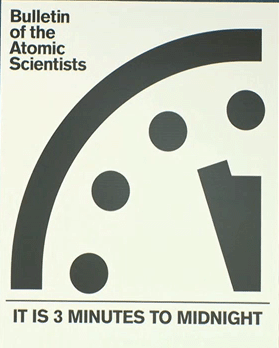
Watch the 2026 Doomsday Clock unveiling live here on January 27 at 10 a.m. EST
To see nuclear-related stories in greater depth and intensity – go to https://nuclearinformation.wordpress.com/

29 Jan. Thursday 7-8 p.m. Webinar – World’s Largest Nuclear Station in Port Hope, ON?


31st January – Challenging the War Machine – a DECLASSIFIED UK SUMMIT


Website of the Week
Now until to February 10, 2026 Radioactive waste storage in France: the debate is finally open! How to participate?
-
Archives
- January 2026 (277)
- December 2025 (358)
- November 2025 (359)
- October 2025 (376)
- September 2025 (258)
- August 2025 (319)
- July 2025 (230)
- June 2025 (348)
- May 2025 (261)
- April 2025 (305)
- March 2025 (319)
- February 2025 (234)
-
Categories
- 1
- 1 NUCLEAR ISSUES
- business and costs
- climate change
- culture and arts
- ENERGY
- environment
- health
- history
- indigenous issues
- Legal
- marketing of nuclear
- media
- opposition to nuclear
- PERSONAL STORIES
- politics
- politics international
- Religion and ethics
- safety
- secrets,lies and civil liberties
- spinbuster
- technology
- Uranium
- wastes
- weapons and war
- Women
- 2 WORLD
- ACTION
- AFRICA
- Atrocities
- AUSTRALIA
- Christina's notes
- Christina's themes
- culture and arts
- Events
- Fuk 2022
- Fuk 2023
- Fukushima 2017
- Fukushima 2018
- fukushima 2019
- Fukushima 2020
- Fukushima 2021
- general
- global warming
- Humour (God we need it)
- Nuclear
- RARE EARTHS
- Reference
- resources – print
- Resources -audiovicual
- Weekly Newsletter
- World
- World Nuclear
- YouTube
-
RSS
Entries RSS
Comments RSS
 nuclear-news