Ex-Ukrainian president pictured wearing Nazi symbol (PHOTOS)

https://www.rt.com/russia/583014-poroshenko-nazi-patch-ukraine/
https://www.rt.com/russia/583014-poroshenko-nazi-patch-ukraine/ 17 Sept 23
Pyotr Poroshenko, the former president of Ukraine, was photographed wearing a symbol on his military fatigues that was created by the Nazis, during a meeting with Ukrainian troops last week.
The politician often showcases supplies such as quadcopter drones, household equipment, or even armored vehicles in his social media and PR, to emphasize his personal contribution to the war effort against Russia.
The images posted on his social media accounts last Saturday show him wearing a military patch with the so-called Black Sun, or ‘Sonnenrad.’ The symbol originates from Nazi Germany and is extensively used by various neo-Nazi groups around the world to denote their political leanings.
The infamous Ukrainian military unit, the Azov Batallion, for example, featured the Sonnenrad in its original insignia but later removed it as it attempted to downplay its association with far-right ideologies.
The controversial patch appears to come from the 36th Marine Brigade of the Ukrainian Armed Forces. An earlier photo of the ex-president showed him clasping hands with Valery Prozapas, a member of Poroshenko’s European Solidarity party and a captain serving in the 36th Brigade, who wore an identical emblem.
The 10th Mountain Assault Brigade, which Poroshenko was visiting while sporting the patch on his jacket shoulder, is called ‘Edelweiss’ after Zelensky formally assigned the designation to the unit in February.
The Ukrainian military denies that the name has anything to do with the Nazi-era 1st Mountain Division of the Wehrmacht, which is notorious for war crimes committed by its troops on the Eastern front, and used the Edelweiss as an insignia.
The prevalence of neo-Nazi sympathizers among Ukrainian troops after the 2014 coup in Kiev has been thoroughly documented by researchers and the international press. However, this has been largely ignored by the Western media since the hostilities between Russia and Ukraine broke out last year.
In June, the New York Times contended that the widespread use of Nazi iconography in Ukraine was a “thorny issue,” emphasizing it does not reflect the true ideology of those displaying them.
Moscow, on the other hand, has called the empowerment of far-right nationalists in modern Ukraine one of the key reasons for the ongoing conflict.
The UK Government Knows How Extreme the Online Safety Bill Is

SCHEERPOST, By Joe Mullin / Electronic Frontier Foundation (EFF)
The U.K.’s Online Safety Bill (OSB) has passed a critical final stage in the House of Lords, and envisions a potentially vast scheme to surveil internet users.
The bill would empower the U.K. government, in certain situations, to demand that online platforms use government-approved software to search through all users’ photos, files, and messages, scanning for illegal content. Online services that don’t comply can be subject to extreme penalties, including criminal penalties.
Such a backdoor scanning system can and will be exploited by bad actors. It will also produce false positives, leading to false accusations of child abuse that will have to be resolved. That’s why the OSB is incompatible with end-to-end encryption—and human rights. EFF has strongly opposed this bill from the start.
Now, with the bill on the verge of becoming U.K. law, the U.K. government has sheepishly acknowledged that it may not be able to make use of some aspects of this law. During a final debate over the bill, a representative of the government said that orders to scan user files “can be issued only where technically feasible,” as determined by Ofcom, the U.K.’s telecom regulatory agency. He also said any such order must be compatible with U.K. and European human rights law. ……………………………………………………………………………
People Need Privacy, Not Weak Promises
Let’s be clear: weak statements by government ministers, such as the hedging from Lord Parkinson during this week’s debate, are no substitute for real privacy rights.
Nothing in the law’s text has changed. The OSB gives the U.K. government the right to order message and photo-scanning, and that will harm the privacy and security of internet users worldwide. These powers, enshrined in Clause 122 of the OSB, are now set to become law. After that, the regulator in charge of enforcing the law, Ofcom, will have to devise and publish a set of regulations regarding how the law will be enforced.
Several companies that provide end-to-end encrypted services have said they will withdraw from the U.K. if Ofcom actually takes the extreme choice of requiring examination of currently encrypted messages. Those companies include Meta-owned WhatsApp, Signal, and U.K.-based Element, among others. ……………………….
Finally, lawmakers in other jurisdictions, including the United States, should take heed of the embarrassing result of passing a law that is not just deceptive, but unhinged from computational reality. The U.K. government has insisted that through software “magic,” a system in which they can examine or scan everything will also somehow be a privacy-protecting system. Faced with the reality of this contradiction, the government has turned to an 11th hour campaign to assure people that the powers it has demanded simply won’t be used. https://scheerpost.com/2023/09/15/the-uk-government-knows-how-extreme-the-online-safety-bill-is/
JULIAN ASSANGE AND THE END OF AMERICAN DEMOCRACY
The revival of the Espionage Act in the persecution of Assange is destroying the very foundation of democracy
The US government has hounded Julian Assange since WikiLeaks first revealed the extent of US war crimes in 2010. In the process of persecuting Assange, the federal government has used every tool at its disposal and even pushed beyond the boundaries that supposedly restrict state power in defense of civil liberties. One of the most insidious tactics is the use of the Espionage Act, which had not been used for against whistleblowers and journalists for almost a century before Assange’s case. In the first part of a two-part conversation, lawyer and human rights defender Stella Assange, spouse of Julian Assange, joins Chris Hedges for a look at the vast and vicious campaign by the US to silence Julian Assange, and what it all portends for our democracy.
…..one of the things that’s disturbed me from the start is how all of the international bodies and the legal entities that have gone after Julian, have broken their own rules and it’s so blatant. That’s what I find kind of incomprehensible because it’s public. It’s not a secret. I mean, there is many secret stuff they’ve done, too, of course. But, you know, revoking political asylum, allowing British police to go in on sovereign territory, charging him under the Espionage Act when he’s not an American citizen, recording his meeting with his attorneys. I mean, any one of these things in a normal legal procedure, would have seen the case dismissed and yet they keep doing it and doing it.
…………. if they eviscerate the rule of law, it’s not just going to be for Julian. They set those kinds of precedents and if they’re allowed to get away with it with anyone, it’s dangerous. That’s what, for me, is just so frustrating.
STELLA
But don’t you think they’re deliberately dismantling the system? They want to show that they are dismantling it.
CHRIS
Yes, of course, they are. But they’re dismantling it right in front of us and we’re just watching. I’m talking about the broader public and not reacting.
Yes, of course, that is the goal.
And so in a way, that passivity makes us complicit in what is ultimately our own enslavement. I mean, this is all, of course, even beyond Julian as a person and as a journalist. And that’s what, you know, having followed this case for several years and as you know, I was very close friends with Michael Ratner, which is how I met Julian, because I would come to London with Michael. I’m just kind of mystified at how people can’t see where this is going to lead………………………………………………………….
CHRIS
……… I think reading the CIA, which is a state within a state, it’s not even accountable within the Congress. And there was a few years ago, Feinstein, after the torture was exposed, tried to do a congressional report and there was this really revealing moment. I’m no fan of Feinstein, but she was, at that moment, trying to do the right thing.And she came out and she was just ashen. And I can’t remember the exact words, but it’s something like, “we can’t take on these people…”, because they had bugged all the computers in the congressional office, they destroyed information.
And I think it was that moment where she personally realised that we can’t control, there’s no regulation, there’s no oversight, there’s no control. And unlike the Church and the Pike committees that in the middle 70s, had exposed the crimes. That was it. That moment is gone. And I think that Vault 7, because of this kind of imperial attitude on the part of the CIA where they can do anything, because the CIA, we have 17 intelligence communities in the United States. I mean, the CIA as an intelligence organization is kind of redundant.
And what it has done is transformed itself into a paramilitary, especially after 9/11. And it’s completely in the dark. It has its own drones and special forces units. Having had friends who served in Afghanistan and Iraq, these people create more problems than they solve because they’ll go on extraction and night raids and anger an entire village and then the next day the Rangers will go through the village and they open fire on…I mean, they’re counterproductive. And I think that what happened with Vault 7 is that you now have an incredibly powerful organisation that is, in essence, a paramilitary organisation with huge resources and that exposure of Vault 7, they’re not used to being monitored, exposed in any way. I think the anger, I think it was more visceral. I think the anger within the CIA was ran really deep. And, you know, again, I haven’t spoken to anyone in the CIA, but my guess is that at that point, they laid down the law. We’re getting Julian. That’s my my guess.
I think it’s all being, because Biden, no matter who’s in the office, Obama, you can’t, at this point they talk about the Dark State. I mean, these are the, you know, figures like Biden are the puppets. In the military, you know, the US military has not been audited for a decade. I read somewhere we spend more on military bands than we do on the State Department. I mean, again, it’s like ancient Rome. I mean, it’s its own entity, almost severed from the government.
But that’s how I read what happened after Vault 7.
…………………………………………………………………………………………………………………………………….. there is no investigative journalism now within the government, with the inner workings of government, because everyone’s too frightened to talk, because they they’re they can immediately be traced.
So the last readout of any kind of exposure of the the the crimes, the criminal activity of power comes through people who are like Chelsea manning or Snowden, who have access to documents and will leak them,……………………………………………………………….
It means there is no power is in no way accountable. There’s no transparency, and we know history has taught us that when that kind of secrecy is imposed on autocratic power, it just in abuse grows upon abuse grows upon abuse. And that is why they’re just determined to crucify Julian.
That’s the crisis that we’re in.
We’ve lost the ability to know what power is doing.
STELLA
I have this feeling that in order to establish the baseline, you would have to give a history lesson.
Because, for example, the use of the Espionage Act, you have to understand that it wasn’t used for almost 100 years against whistleblowers and journalists. There was a shift with Obama that opened the doors to maybe one day the Espionage Act being used against publishers in the same way now being used against whistleblowers. And the way it was being used against whistleblowers was as if they were spies to begin with. So, there was a progressive shift. And that’s why Julian was surprised when Michael Ratner told him that he tought the US would try him under the Espionage Act after he had published. Because it was unprecedented, because the First Amendment is clear. And the First Amendment is really a revolutionary instrument, and it is the gold standard in the world…………………………………………………………..
And then, with what’s been done to Julian, because it’s been so protracted, we’re in a completely different information and security environment, as in the powers of the security state are far greater and have eroded all these other rights that came.
…………………………………since the surveillance state has become so powerful, there’s been an ability to control communication in such an aggressive and invisible manner.
In the 12 or 13 years since WikiLeaks published this, we’re in a completely different environment……………………………………………………………………………………………………………………. more https://therealnews.com/julian-assange-and-the-end-of-american-democracy
G20 Announces Plan To Impose Digital Currencies And IDs Worldwide
Zero Hedge, BY TYLER DURDEN, Authored by Bryan Jung via The Epoch Times 14 Sept 23
The Group of 20 leaders have agreed to a plan to eventually impose digital currencies and digital IDs on their respective populations, despite fears that governments will use them to monitor their peoples’ spending and crush dissent.
The G20, which is currently under India’s presidency, adopted a final declaration on the subject over the weekend in New Delhi.
The meeting, which included the world’s leading economies, announced last week that they had agreed to build the necessary infrastructure to implement digital currencies and IDs.
The group said that discussions were already underway to create international regulations for cryptocurrencies, but claimed that there was “no talk of banning cryptocurrency” at the summit.
Many critics are concerned that governments and central banks will eventually regulate cryptocurrencies and then immediately replace them with central bank digital currencies (CBDCs), which lack similar privacy and security………………………………..
The top items discussed at the New Delhi summit included “building Digital Public Infrastructure, Digital Economy, Cryptoassets, [Central Bank Digital Currencies].”……………………………….
The European Union is currently trying to introduce a bloc-wide “digital identity” app that would consolidate various personal information, including passports, driver’s licenses, and medical history………………………………………………………………………………………………………………. https://www.zerohedge.com/political/g20-announces-plan-impose-digital-currencies-and-ids-worldwide
Chris Hedges: Stella Assange Speaks Out on the Conditions of Julian Assange’s Imprisonment
SCHEERPOST, September 14, 2023
Julian Assange has languished in Belmarsh Prison in the UK since 2019 as he fights extradition to the US to face prosecution under the Espionage Act.
Prison is always a political tool, and in the case of whistleblowers like Julian Assange, the use of incarceration to suppress, discourage, and silence dissent is self-evident. Since being imprisoned, Assange has married and even started a family—but has been kept apart from his wife and children. In the second part of a two-part conversation, Stella Assange and Chris Hedges discuss the conditions of Julian’s incarceration, and how it offers a glimpse into the overall brutality of the prison system……………………………………………………
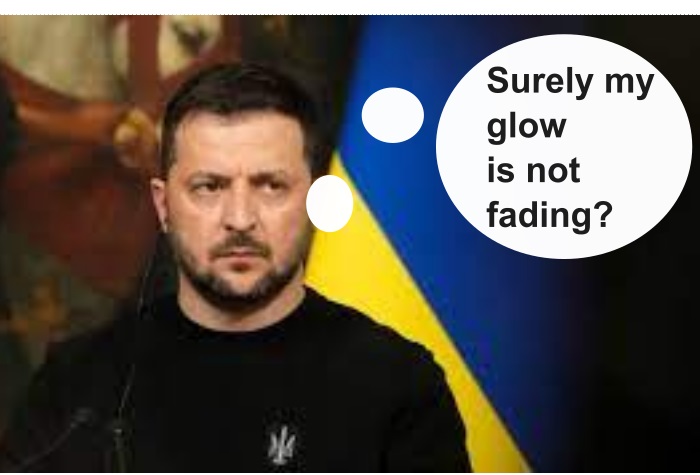
Ukrainians blame Zelensky for corruption – poll
https://www.rt.com/news/582796-ukraine-corruption-poll-zelensky-responsible/ 13 Sept 23
Nearly eight in ten citizens believe the country’s president is “directly responsible” for rampant graft, a new survey has shown
The vast majority of Ukrainians believe that President Vladimir Zelensky is at fault for widespread corruption in the country’s government and military, a new study has revealed.
The poll, released on Monday, found that 78% of Ukrainian adults see Zelensky as “directly responsible” for Kiev’s corruption problem. It was conducted by the Ilko Kucheriv Democratic Initiatives Charitable Foundation and the Kiev International Institute of Sociology.
Prior to the launch of Russia’s military offensive in February 2022, Ukraine consistently ranked among the world’s most corrupt nations, but it was touted as a bastion of freedom and democracy as the US and its NATO allies rallied public support for massive aid to Kiev. However, Ukrainian corruption remains a concern and could hinder the country’s bid to join the European Union, an unidentified Western diplomat told Politico on Monday.
Ukraine is a “very corrupt country,” the diplomat said, adding that Zelensky’s plan to use the Security Service of Ukraine (SBU) to prosecute graft cases could “send the wrong message.” Upon landing in Kiev for a surprise visit on Monday, German Foreign Minister Annalena Baerbock reportedly said Ukraine needed to step up its efforts to fight corruption.
The Ukrainian poll was conducted from July 3 to July 17 in face-to-face interviews with thousands of citizens across the country. There were no major differences in findings based on region or socioeconomic factors. Respondents aged 60 and older took a harsher view, with 81% saying Zelensky was responsible for government corruption. The rate was 70% in the youngest segment, ages 17 to 29. Overall, only 18% of Ukrainian adults disagreed with the statement that Zelensky bears responsibility.
Documents obtained by the International Association of Investigative Journalists in 2021 showed that Zelensky and his business partners set up offshore companies to purchase lavish properties in central London. Zelensky transferred his stake in one of the companies to an aide just before he was elected president in 2019. Supporters of former Ukrainian president Petro Poroshenko accused Zelensky and his associates of using their offshore accounts to evade taxes.
Zelensky has purged officials in his government for alleged corruption, including an embezzlement scheme involving humanitarian aid. Just this month, he sacked Defense Minister Aleksey Reznikov, who came under fire earlier this year over purchases of military rations at inflated prices. However, the new defense chief, Rustem Umerov, is reportedly under investigation for alleged crimes in his previous job.
The Discharge of Fukushima’s Radioactive Water could be a Precedent for Similar Actions

Obviously, it would be misleading to rely on the IAEA’s statements suggesting that radioactive wastewater does not pose any risk to global health. This information strengthens the likelihood that the IAEA did not reveal valid and precise radiation data regarding the Chornobyl accident and Zaporizhia nuclear power plant during the ongoing Ukrainian war either.
Pinar Demircan 7 Sept 23 https://www.dianuke.org/the-discharge-of-fukushimas-radioactive-water-could-be-a-precedent-for-similar-actions/
Underlying the disregard for objections from global civil society and transforming the ocean into a nuclear waste dump lies a bigger goal inspired by capitalist practices that arise from its crisis: to achieve another threshold by normalization of cost-cutting measures for the sake of the nuclear industry.
While the climate crisis is rapidly turning forests and habitats of living creatures into coal and ash with a tiny spark of fire in Turkiye, Greece, and Canada, the planet’s seas, already polluted with plastics and waste, are also being recklessly infused with radioactivity, driven by profit and cost-centered policies. On August 24, within the framework of the procedures carried out by the Japanese government and TEPCO, the discharge of 1.34 million tonnes of radioactive water which is accumulated in tanks at the plant site, started.
The installation of a treatment system costing 23 million USD, the discharge of wastewater without an Environmental Impact Assessment (EIA) is being realized by foregoing safer alternatives such as solidification of wastewater into construction materials or long-term storage costing 100 times more that constitutes ecocide. Clearly, this method of release that is expected to be carried out over the next 40 years, indicates a systemic assault on the global ecosystem that is longer and more severe than presently apparent.
The Japanese Government is not telling the truth about ‘purification’
The discharge process of the wastewater resulting from the complete meltdown of three reactor cores at the Fukushima nuclear facility began in 2011 and is at par with the danger level ascribed to the Chornobyl disaster. This also highlights how the Fukushima discharge differs from the regular discharge processes of nuclear power plants and indicates the extent of danger that nuclear power plants pose. Furthermore, the radioactive isotopes treated in the accumulated wastewater is only half of the whole amount according to what was stated on the website of the Japanese Ministry of the Environment.
A detail that has been overlooked till today is that there is no information regarding the amount of discharge during this 40-year time frame for the disposal of radioactive water into the ocean. This might indicate that the discharged amount may even be equivalent to the period of, for example, 100 years despite the declared duration of 40. In addition, since the present objections have been disregarded, it is worth considering the potential impact of future oppositions at the end of the 40 years.
A threshold to be achieved
Apparently, over the next decade, the radioactive water discharged from Fukushima is anticipated to disseminate into multiple seas worldwide, encompassing the Marmara, Mediterranean, Aegean, and Black Sea, which surrounds Turkiye. A recent scientific study [2] suggests that the evaporation in these seas will escalate industrial radioactivity levels in the ecosystem. Given this backdrop, it is important to ask why TEPCO, the Japanese government, and the IAEA continue to disregard the adverse impacts of the discharge, which also makes them responsible for the potential increases in cancer, DNA damage, increased miscarriages, hormone imbalances, and unhealthy future generations worldwide? Underlying the disregard for objections raised by global civil society, and transforming the ocean into a nuclear waste dump, lies a bigger goal inspired by capitalist practices that arise from its crisis: to achieve another threshold of the normalization of cost-cutting measures for the sake of nuclear industry.
How can we be sure of the exact amount to be released?
It is also possible to consider the above statement with the possibility of adding wastewater from the other nuclear power plants across Japan to the already 1 million 340 thousand tonnes of water accumulated over the past 12 years at Fukushima. While nuclear power plants operate under higher costs and have to cope with four times cheaper renewable energy production costs, the ocean dumping of the radioactive wastewater offers an easy solution for the nuclear industry. Crossing this threshold guarantees the capability to manage climate-induced hazards to nuclear facilities since now, societal consent has been obtained for this plan of action. Imagine how beneficial this course of action will be for the nuclear industry, with the IAEA promising its support for the industry – to the 410 reactors operating worldwide, approximately 50 reactors under construction, and 80 reactors [3] in various stages of maintenance, repair, decommissioning, and dismantling.
Take for example, Rosatom of Russia, the owner of the Akkuyu Nuclear Power Plant which reached its final stage of construction for the first reactor in Turkiye. It has a long history of concealing the Mayak nuclear power plant accident, well into the 1990s. Furthermore, from 1948 to 2004, Rosatom discharged nuclear waste into the Techa River, thus reinforcing its already questionable track record, and also points to how the legalization of nuclear discharge might be beneficial for the industry. It is also easy to predict the potential impact of this approach in the Mediterranean region by a nation with an underdeveloped democratic system and institutional dynamics dominated [4] by political power. This is especially important since an exemption made for the Akkuyu NPP in the article which allows for the discharge water from the facilities around the Mediterranean temperature of the plant and allows the sea temperature to reach up to 35 Celsius and poses serious ecological challenges indicating that Turkiye violates Barcelona Agreement.
The Role of the IAEA
The example of Fukushima’s radioactive water discharge presents us a picture of a political power that has adopted the corporate management mentality prioritizing profits and industry interests under the guise of efficiency and profitability. The International Atomic Energy Agency (IAEA) plays a vital role in ensuring that nuclear energy generation is conducted safely and within established guidelines. However, a leaked document [5] from the IAEA reveals that the agency, which declared its support for TEPCO and the Japanese government, advised them to refrain from making statements that could portray nuclear power plants negatively and disseminate information that influences the press and public opinion. As this scandal brings to light the deep connections between the IAEA, the Japanese government, and TEPCO, it is important to consider the role of the IAEA as a highly regarded global organization.
It is noteworthy to mention that the IAEA’s involvement in the nuclear industry stems from a confidential agreement WHA 12-40 [6] with the World Health Organization (WHO) in 1959, stating that “whenever either organization proposes to initiate a programme or activity on a subject in which the other organization has or may have a substantial interest, the first party shall consult the other with a view to adjusting the matter by mutual agreement”. Consequently, the IAEA, established to promote the growth of nuclear power plants worldwide, refrained from disclosing any potential health hazards posed by these plants.
Obviously, it would be misleading to rely on the IAEA’s statements suggesting that radioactive wastewater does not pose any risk to global health. This information strengthens the likelihood that the IAEA did not reveal valid and precise radiation data regarding the Chornobyl accident and Zaporizhia nuclear power plant during the ongoing Ukrainian war either.
It is important to inform the global society that the IAEA, which focuses mainly on promoting nuclear power, should not be involved in discussions related to public health in line with the principle of separating responsibilities to avoid conflict of interest. Therefore, it is recommended that civil society should inform the international community about the content of the recently disclosed IAEA document and demand an end to the discharge of radioactive water from Fukushima into the ocean. Accordingly, it should be ensured that all processes involved in disposing radioactive contamination in Fukushima are subject to internal and financial control measures performed by a minimum of two separate units.
At this stage, it is essential to take measures by clarifying the issues emphasized by the non-governmental organizations following the processes, and it should be ensured that realistic solutions can only be produced with the involvement of a consortium of neighbouring countries such as South Korea, China, Taiwan and the Pacific Islands. In this regard, the process management for the construction of the steel dome shelter, which was completed in 2016 with financing by 40 countries that came together in 1997 to protect the exploded fourth reactor of the Chornobyl Nuclear Power Plant from external weather conditions, can be taken as an example. [7]
Undoubtedly, the economic and administrative control mechanisms created for Chornobyl due to Ukraine’s lack of financial resources is not acceptable for the technology-giant Japan, which bears the costs of the disaster on its own. However, since global society has not entirely shown its commitment to changing the system, an in-system solution can prevent adding the radioactive disaster to the climate crisis before the transformation of life on the planet hits its constraints. In other words, claiming efficiency and profitability and institutionalization of the logic of ‘running the state like a business’, which has become the common discourse of political powers will at least help to achieve the rationality of emulated corporate management.
Antony Blinken mouths complacent lies: “very confident in Ukraine’s ultimate success”

Blinken’s wrong-headed confidence and his acceptance of a significant escalation in the Ukraine war defies belief, given the reality on the ground today in the war.
WHEN THE INTELLIGENCE IS INCONVENIENT. What goes wrong when politics suppresses the truth
Substack SEYMOUR HERSH, SEP 13, 2023
On Sunday Secretary of State Antony Blinken told Jonathan Karl of ABC’s This Week that he remained “very confident in Ukraine’s ultimate success” in the ongoing war with Russia. He depicted Ukraine President Volodymyr Zelensky’s decision to escalate its attacks inside Russia as “their decision, not ours.”
Blinken’s wrong-headed confidence and his acceptance of a significant escalation in the Ukraine war defies belief, given the reality on the ground today in the war. But it also could be based on insanely optimistic assessments supplied by the Defense Intelligence Agency. The DIA’s assessments, as I have reported, are now the intelligence of choice inside the White House.
As a journalist who has written about national security matters for many decades, how can I explain a process that is clearly contrary to the best interests of the people of the United States and its leadership?……………………………(Subscribers only) more https://seymourhersh.substack.com/p/when-the-intelligence-is-inconvenient?utm_source=post-email-title&publication_id=1377040&post_id=136980218&utm_campaign=email-post-title&isFreemail=true&r=ln98x&utm_medium=email
∙
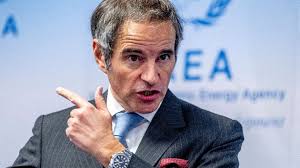
IAEA sees no problem with depleted uranium weaponry – Grossi
The US and UK have sent the toxic ammunition to Ukraine
Rt.com 12 Sept 23
There are “no significant radiological consequences” to the use of depleted uranium ammunition, International Atomic Energy Agency (IAEA) Director General Rafael Grossi has declared. Russia insists that Grossi is “not telling the whole story.”
“From a nuclear safety point of view there are no significant radiological consequences” to the use of this ammunition, Grossi told reporters during a briefing on Monday.
“Maybe in some very specific cases, people near a place that was hit with this kind of ammunition, there could be contamination,” he continued, adding that “this is more of a health issue of a normal nature than a potential radiological crisis.”
Depleted uranium is used to make the hardened cores of certain armor-piercing tank and autocannon rounds. Although it is not highly radioactive, uranium is still a toxic metal, and this metal is turned into a potentially hazardous aerosol when a depleted uranium round strikes its target.
US forces utilized depleted uranium tank shells during the 1991 Gulf War, reportedly causing a spike in birth defects, autoimmune disorders, and cancer cases in Iraq over the following decades. NATO also used depleted uranium in its 1999 air campaign against Yugoslavia. Earlier this year, Serbian Health Minister Danica Grujicic described the carcinogenic consequences of this ammunition on the Serb population a “horrible and inhumane experiment.”
The UK began supplying Ukraine with depleted uranium tank shells in March, while the US announced last week that it would send depleted uranium ammunition for its M1 Abrams tanks, which are expected to arrive in Ukraine in the coming weeks.
By focusing on the issue from a nuclear safety point of view, Grossi was being deliberately disingenuous, Russian Foreign Ministry spokeswoman Maria Zakharova wrote on Telegram on Monday.
“Mr. Grossi is, of course, right in saying that there are no significant radiological consequences from the standpoint of ‘nuclear safety,” she wrote. “It’s likewise obvious, though, that he is not telling the whole story.”
Zakharova pointed out that depleted uranium releases “extremely toxic aerosols” when ignited and vaporized. “Perhaps this is beyond Mr. Grossi’s expertise as head of the IAEA,” she concluded. “This question should be addressed to chemists, who will tell us about the harmful effects of heavy metal accumulation on the environment and human health.”
Russian forces claim to have destroyed at least one warehouse in Ukraine containing British depleted uranium shells. Kremlin spokesman Dmitry Peskov warned last week that the West will ultimately be responsible when this ammunition “inevitably” contaminates Ukrainian land………………. https://www.rt.com/news/582793-iaea-depleted-uranium-grossi/
What is the Digital Prison?

The Countermeasure 6 Aug 23
Your phone alarm wakes you up and you get ready for work. You scan your face to use your phone so you can text your coworker that you’ll be late. You stop to get a coffee anyways, and you scan the QR code to enter the coffee shop. Your membership is still good. You order and go to pay, and the barista reminds you it is “card only.” You grab your coffee and go. Getting ready to cross the street, you notice a camera pointing right at you and everyone else on the corner. You think nothing of it — its for safety after all. Remembering that you are running a bit late, you pull out Google Maps to look for a shortcut right from your immediate location…
That short scene may sound like a very typical day for a lot of people around the world, not just in the US. And because it seems typical, it seems normal. And normal always means right, right? Wrong.
In 2023, people are starting to familiarize themselves with the idea of a digital prison, but what is it? The digital prison idea suggests that as a species, we are moving closer and closer to a state of society in which we will be asked, coerced, or even forced to utilize a digital identity to engage with aspects of life that we currently utilize freely, such as the internet, online and conventional shopping, voting, or accessing personal finances.
To many, the idea seems conspiratorial and out of a paranoid science fiction novel, but some of the effects already permeate the “free” West. In some places, like China, this digital panopticon is already functioning in the form of a Social Credit System used to surveille, control, and conform China’s citizens into inert, malleable pawns of the state.
Like most issues in 2023, the digital prison is no different in that two loud voices on either “side” of the metaphorical aisle are speaking up in defiance or defense of the issue. In the case of the digital prison, I see it as more severe.
This issue permeates borders and cultures. It has no regard for personal preferences, religious or cultural beliefs. And the defenders of such an idea do not seem to know exactly what they are supporting. That is in part because the current effects are normalized, people are conditioned to accept them. As for the future terrors, they have yet to be fathomed or revealed.……………………….
The disagreement that anti-digital-prison folks have is not with the principles behind some of the 21st century’s technological developments, it is disagreement with the collective effect of a society that forces inescapable compliance from individuals.
……………………………………………………………………………………………………….. Cell phones are a great example of the development of this fear. When they were originally created, they made the function of voice communications even more convenient. And technologies that do that tend to alter the fabric of society without a need to do so subliminally or subversively. In other words, because the thing (in this case cellphones) appears to be an unequivocal asset for the everyman of the modern era, it permeates into our lives without second thought.
The Ulez System in the UK is a good example of this:
I would imagine that most people in UK would agree that crime should be reduced and criminals held accountable; that a reasonable element of policing, patrolling, undercover work, and surveillance may even be acceptable to do so. What is not acceptable, however, is the establishment of a surveillance network, seeing everything all the time, that backlogs the personal lives, actions, and whereabouts of all of the UK’s citizens.
So we can see the problem here with rampant digital “progress”; there are great principles and functions being made by technology, but the employment of such capabilities needs to be checked.
It is in this idea — the application of technology, and the potentially tyrannical and sinister goals behind it — that we return to the collective effects of various tech that define what the digital prison is.
Ulez alone may not have been such a big deal in the UK. After all, there are cameras at street lights, government buildings, museums, stores, banks and ATMs. People walk with cameras on their phones and take pictures and videos all the time.
But as an implementation alongside everything we currently have, it’s a bit much. Cell phones are a great example of the development of this fear. When they were originally created, they made the function of voice communications even more convenient. And technologies that do that tend to alter the fabric of society without a need to do so subliminally or subversively. In other words, because the thing (in this case cellphones) appears to be an unequivocal asset for the everyman of the modern era, it permeates into our lives without second thought.
………………………. Continuing with cellphones, the problem is remains that they developed too quickly. Before we knew it, cell phones were also entertainment systems, our credit cards, our MP3s, our ledgers and address books, our maps, our news streams, our fitness trackers… The technology developed so quickly, so efficiently — and society with it — that to get by, any individual had to buy in.
That is the digital prison — unwilling consent to an inescapable lifestyle.
And if the principle of the fear is not enough, look at the application of it. In China, for example, there is a social credit system that bars people from jobs, schooling, eating or shopping establishments. The system even goes so far as to publicly shame Chinese citizens who maintain “insufficient” scores. They go so far as posting their picture, ID information, and address to the public. The reason? To entice submission and compliance.
And once again, like the Ulez rhetoric, many will present the excuse that “That is in China, such a thing won’t happen here.” But it does. We have facial ID, thumb print scanners, grocery stores that can only be accessed by QR code or facial recognition. Some places are switching to digital payment altogether, and excluding the use of cash entirely. The WEF once entertained the idea of “prescriptive elections,” in which the need to vote would no longer exist because governing entities would already “know the result” through data trends.
……………………………………………………………………………………. And aside from the examples we write off as acceptable because of “crisis,” it would appear that in the most subliminal and seemingly harmless ways, we have already taken the first plunge; we have already submitted ourselves to be molded by further effects of digitization.
In my opinion, the full-blown digital prison is nearing reality. There are zero indications that the companies who make the technologies are looking to make their platforms safer, less addictive, and less invasive. What is worse, there is also no indication that governments want to remain a healthy distance away from a society that is grafted to technology dependence.
So what do you think? Are we nearing life in a digital prison? Are we there already? What are we currently subjected to? What will we be subjected to in the future? More importantly, what can we do to stop it?
 | |||
| |||
https://countermeasuremedia.medium.com/what-is-the-digital-prison-9c3438b3a1a0
Crooked Canadian company Lavalin trying to sell ?zombie nuclear technology to China and UK

 Canada now dominates World Bank corruption list, thanks to SNC-Lavalin, Financial Post Armina Ligaya | September 18, 2013 Canada’s corporate image isn’t looking so squeaky-clean in the World Bank’s books — all thanks to SNC-Lavalin.Corruption’s double standard: It’s time to punish countries whose officials accept bribes
Out of the more than 250 companies year to date on the World Bank’s running list of firms blacklisted from bidding on its global projects under its fraud and corruption policy, 117 are from Canada — with SNC-Lavalin and its affiliates representing 115 of those entries, the World Bank said.
“As it stands today, the World Bank debarment list includes a high number of Canadian companies, the majority of which are affiliates to SNC Lavalin Inc.,” said the bank’s manager of investigations, James David Fielder.
“This is the outcome of a World Bank investigation relating the Padma Bridge project in Bangladesh where World Bank investigators closely cooperated with the Royal Canadian Mounted Police in an effort to promote collective action against corruption.”
As a result of the misconduct found during the probe, the Montreal-based engineering and construction firm, and its affiliates as per World Bank policy, were debarred in April 2013 for 10 years, as part of a settlement with SNC-Lavalin. And in one fell swoop, 115 Canadian firms were blacklisted by the World Bank, making Canada seemingly look like the worst offending country.
It’s quite the jump from 2012, when no Canadian companies were barred……..http://business.financialpost.com/2013/09/18/canada-now-dominates-world-bank-corruption-list-thanks-to-snc-lavalin/

Lavalin looks to expand nuclear enterprise in China http://www.theglobeandmail.com/report-on-business/industry-news/energy-and-resources/lavalin-looks-to-grow-in-china/article17950935/ SHAWN MCCARTHY – GLOBAL ENERGY REPORTER OTTAWA — The Globe and Mail, Apr. 13 2014, SNC-Lavalin Inc. is hoping to revitalize its international nuclear business through an effort with its Chinese partners to burn reprocessed fuel in a Candu reactor as a way to reduce radioactive waste.
Officials from Candu Energy Inc. are leading a Canadian nuclear industry mission to China this week, which will include a visit Monday to the Qinshan nuclear power station south of Shanghai where two heavy-water Candu 6 reactors are in operation. Candu Energy is the former Atomic Energy of Canada Ltd., and is now wholly owned by SNC-Lavalin
The Mississauga-based nuclear vendor has been working with the Chinese operator of the Qinshan plants to fashion reprocessed fuel from the waste products of competing light-water reactors. The Candu could, in effect, become the blue box of the nuclear industry, company executives said in an interview.
“We’re very excited that this advances the discussion we can have about introducing more Candus into China,” Jerry Hopwood, the company’s vice-president of marketing and product development, said.
Candu reactors use heavy water, which includes a hydrogen isotope called deuterium, both for coolant and to moderate atomic reactions. Light-water reactors use ordinary water for both purposes.
Each approach offers different benefits, but the world market is dominated by light-water reactors, which require enriched uranium as fuel. In contrast, the heavy-water Candus can burn natural uranium as well as reprocessed fuel.
Mr. Hopwood said China now has 21 light-water reactors that produce two streams of energy-rich waste: spent fuel from the reactor itself and depleted uranium from the enrichment process. China plans to more than double its number of light-water reactors to meet the demands of its growing economy.
“Those reactors are going to produce a lot of waste fuel and China has a plan to recycle all the waste fuel from its reactor,” Mr. Hopwood said. “We believe there is a very strong opportunity to sell a significant number of Candu units in China.”
He said the partners have completed all the development and licensing work, and the Chinese operators expect to begin running reprocessed fuel in the two Candu reactors at an industrial level by the end of the year.
The company is also working with Chinese partners to modify the existing Enhanced Candu model so it will more efficiently burn the recycled fuel but also run on thorium, an abundant alternative to uranium that produces less highly radioactive waste. China has vast reserves of thorium but must import uranium, and develop a thorium-fired reactor.
As well, Candu Energy is one of two finalists in the United Kingdom’s competition to select a reactor design that will eliminate a stockpile of plutonium. “We think this work in China is paving the way for other options where Candu’s fuel-cycle ability is a benefit, notably in the U.K.,” Mr. Hopwood said.
The trade delegation will include Ontario’s Minister of Research and Innovation, Reza Moridi, who is a nuclear physicist, and several business leaders from the Organization of Canadian Nuclear Industries, an Ontario-based suppliers’ group that is eager to land export and service business in the world’s fast growing reactor market.
Critics contend the Candu 6 is an outdated design that lacks safety features included in newer reactors, and that it is a technology that the international marketplace has largely rejected since the 1990s.
“So yeah, the industry is trying to say Candu isn’t dead. Never say die,” said Shawn-Patrick Stensil, a nuclear campaigner at Greenpeace Canada. “If Candu isn’t dead, it’s a zombie.”
SNC Lavalin changing its name to AtkinsRéalis in effort to shed parts of its past
It’s a name change but the company will still be the main private sector force behind Canada’s current push for SMRs.
SNC Lavalin changing its name to AtkinsRéalis in effort to shed parts of its past
Stéphane Rolland, Christopher Reynolds · The Canadian Press ·
SNC-Lavalin is changing its name to AtkinsRéalis as it faces an “inflection point” in its 112-year history, according to CEO Ian Edwards, after a tumultuous decade for the engineering giant.
The rebrand follows 11 years markedby trouble with the law, including the Libya corruption scandal that tarnished its reputation and ensnared the highest office of the Canadian government, as well as lacklustre earnings at times.
The company also hopes to shed the costly backlog of big, over-budget rail contracts that has plagued it for years and launch expansion plans after a steady slim-down regimen and, until 2021, declining revenue and headcount……………………………………..
Doubts persist in the financial community that SNC’s newfound momentum will continue, particularly given its inconsistent performance over the years, said National Bank analyst Maxim Sytchev. But those worries can overlook the fact the company has a new management team and board of directors, he added
“While margin expansion is certainly possible, it is by no means an easy task,” Sytchev said.
“The Montreal-based company said its symbol on the Toronto Stock Exchange will change from SNC to ATRL as of Monday, Sept. 18.”
https://www.cbc.ca/news/canada/montreal/snc-lavalin-changes-name-to-atkinsr%C3%A9alis-1.6964149
Blinken, Assange, And The 20th Anniversary Of The Palestine Hotel Bombing


SCHEERPOST, By Chip Gibbons / The Dissenter, 11 Sept 23
When Secretary of State Antony Blinken visited Australia in August, he was, as expected, asked about WikiLeaks founder Julian Assange. Blinken confirmed that he discussed the Assange case with his Australian counterpart Foreign Minister Penny Wong. He stated that while he understood Australians’ views on the matter, Australians needed to recognize the United States’ position. “Mr. Assange was charged with very serious criminal conduct.”
Blinken’s remarks were outrageous for a number of reasons. The most glaring and obvious reason is that Assange is charged with exposing human rights abuses by the U.S. one might label “very serious criminal conduct.” The fact that the U.S. now seeks to extraterritoriality apply its Espionage Act to a journalist for exposing these crimes could reasonably be deemed “very serious criminal conduct.”
But an extra layer of perversity is attached to Blinken’s hypocritical remarks when one considers that the State Department cables published by WikiLeaks document how the U.S. works to evade accountability for its serious crimes. The one that was most on my mind involved the U.S. efforts to squash criminal indictments of three U.S. servicemembers over their alleged involvement in the death of Spanish photographer Jose Couso…………………………………………………………………………………………………………………………………………………………………………………………
The U.S. government, unsurprisingly, was vehemently opposed to the indictment and refused extradition. When WikiLeaks released State Department cables given to them by U.S. Army whistleblower Chelsea Manning, they revealed new information on how the U.S. had worked behind the scenes to thwart the case.
A May 2007 cable from the U.S. embassy in Madrid made clear that pressuring Spanish officials over the Couso case and indictment of U.S. soldiers was a key goal. The cable stated, “While we are careful to show our respect for the tragic death of Couso and for the independence of the Spanish judicial system, behind the scenes we have fought tooth and nail to make the charges disappear.”………………………………………………………………………….
the charges brought by Spain involved “serious criminal conduct,” and the juxtaposition between the U.S.’s own attempts to thwart a war crimes prosecution, versus its obsessive pursuit of Assange for exposing U.S. war crimes, make Blinken’s remarks on the political case against the WikiLeaks founder all the more maddening. https://scheerpost.com/2023/09/11/blinken-assange-and-the-20th-anniversary-of-the-palestine-hotel-bombing/
Ukraine wasted $17 million on faulty drones – media
Rt.com 8 Sept 23
A company managed to supply only one airworthy drone out of a batch of 55 ordered by Kiev, investigative outlet reports
A drone-manufacturing company has failed to deliver on a lucrative contract with the country’s military, Ukrainian investigative outlet Bihus.info reported on Tuesday. Ukrainian Aviation Systems (UAS) failed to meet a deadline to provide the military with 55 HAWK reconnaissance drones in mid-August, delivering just four units, of which just one was deemed airworthy.
The HAWK drone is a small winged reconnaissance UAV capable of reaching speeds of up to 55 kilometers per hour (34mph), according to UAS. Each unit costs more than 14.5 million hryvnias (nearly $400,000), while the whole contract is worth 807 million hryvnias or almost $22 million, with at least $17.6 million paid to the company in advance, according to Bihus.info.
Reporters with the outlet attended ill-fated trials of the drones, during which only one unit managed to show decent performance and was accepted by the military. One of the drones repeatedly lost connection to ground control mid-flight, while another lost its wings and crashed. A third unit failed to take off at all, the outlet reported.
UAS is linked to Borislav Rosenblat, a former MP and close associate of former Ukrainian President Pyotr Poroshenko. Rosenblat has repeatedly been involved in various corruption scandals, ending up being stripped of his mandate in 2017 amid an investigation into illegal amber mining and trade……………………………………………………………………………….. more https://www.rt.com/russia/582430-ukraine-faulty-drones-contract/
Educating the US Imperium: Australia’s Mission for Assange

Then there is the issue of whether the delegation’s urgings will have any purchase beyond being a performing flea act. US State Department officials remain glacial in their dismissal of Canberra’s “enough is enough” concerns and defer matters to the US Department of Justice. The unimpressive ambassador Kennedy has been the perfect barometer of this sentiment: host Australian MPs for lunch, keep up appearances, listen politely and ignore their views. Such is the relationship between lord and vassal.
September 6, 2023 Dr Binoy Kampmark https://theaimn.com/educating-the-us-imperium-australias-mission-for-assange/
An odder political bunch you could not find, at least when it comes to pursuing a single goal. Given that the goal is the release of WikiLeaks publisher Julian Assange makes it all the more striking. Six Australian parliamentarians of various stripes will be heading to Washington ahead of Prime Minister Anthony Albanese’s October visit to test the ground of empire, maybe even plant a few seeds of doubt, about why the indictment against their countryman should be dropped.
That indictment, an outrageous, piffling shambles of a document comprising 18 charges, 17 based on that nasty, brutish statute, the Espionage Act of 1917, risks earning Assange a prison sentence in the order of 175 years. But in any instrumental sense, his incarceration remains ongoing, with the United Kingdom currently acting as prison warden and custodian.
In the politics of his homeland, the icy polarisation that came with Assange’s initial publishing exploits (former Australian Prime Minister Julia Gillard was convinced Cablegate was a crime) has shifted to something almost amounting to a consensus. The cynic will say that votes are in the offing, if not at risk if nothing is done; the principled will argue that enlightenment has finally dawned.
The Australian Prime Minister Anthony Albanese and the Opposition leader, Peter Dutton, agree on almost nothing else but the fact that Assange has suffered enough. In Parliament, the tireless work of the independent MP from Tasmania, Andrew Wilkie, has bloomed into the garrulous Bring Julian Assange Home Parliamentary Group.
The Washington mission, which will arrive in the US on September 20, comprises former deputy prime minister Barnaby Joyce, the scattergun former Nationals leader, Labor MP Tony Zappia, Greens Senators David Shoebridge and Peter Whish-Wilson, Liberal Senator Alex Antic and the competent independent member for Kooyong, Dr. Monique Ryan.
What will be said will hardly be pleasing to the ears of the Washington establishment. Senator Shoebridge, for instance, promises to make the case that Assange was merely telling the truth about US war crimes, hardly music for guardians from Freedom’s Land. Sounding like an impassioned pastor, he will tell his unsuspecting flock “the truth about this prosecution.”
Joyce, however, tried to pour some oil over troubled waters by insisting on ABC News that the delegates were not there “to pick a fight”. He did not necessarily want to give the impression that his views aligned with WikiLeaks. The principles, soundly, were that Assange had not committed any of the alleged offences as a US national, let alone in the United States itself. The material Assange had published had not been appropriated by himself. He had received it from Chelsea Manning, a US military source, “who is now walking the streets as a free person.”
To pursue the indictment to its logical conclusion would mean that Assange, or any journalist for that matter, could be extradited to the US from, say, Australia, for the activities in question. This extraterritorial eccentricity set a “very, very bad precedent”, and it was a “duty” to defend his status as an Australian citizen.
The Nationals MP also noted, rather saliently, that Beijing was currently interested in pursuing four Chinese nationals on Australian soil for a number of alleged offences that did not, necessarily, have a nexus to Chinese territory. Should Australia now extradite them as a matter of course? (The same observation has been made by an adviser to the Assange campaign, Greg Barns SC: “You’ve got China using the Assange case as a sort of moral equivalence argument.”)
Broadly speaking, the delegation is hoping to draw attention to the nature of publishing itself and the risks posed to free speech and the journalistic craft by the indictment. But there is another catch. In Shoebridge’s words, the delegates will also remind US lawmakers “that one of their closest allies sees the treatment of Julian Assange as a key indicator on the health of the bilateral relationship.”
Ryan expressed much the same view. “Australia is an excellent friend of the US and it’s not unreasonable to request to ask the US to cease this extradition attempt on Mr Assange.” The WikiLeaks founder was “a “journalist; he should not be prosecuted for crimes against journalism.”
While these efforts are laudable, they are also revealing. The first is that the clout of the Albanese government in Washington, on this point, has been minimal. Meekly, the government awaits the legal process in the UK to exhaust itself, possibly leading to a plea deal with all its attendant dangers to Assange. (The recent floating of that idea, based on remarks made by US ambassador to Australia Caroline Kennedy, was scotched by former British diplomat and Assange confidante Craig Murray in an interview with WBAI radio last week.) Best, then, to leave it to a diverse set of politicians representative of the “Australian voice” to convey the message across the pond.
Then there is the issue of whether the delegation’s urgings will have any purchase beyond being a performing flea act. US State Department officials remain glacial in their dismissal of Canberra’s “enough is enough” concerns and defer matters to the US Department of Justice. The unimpressive ambassador Kennedy has been the perfect barometer of this sentiment: host Australian MPs for lunch, keep up appearances, listen politely and ignore their views. Such is the relationship between lord and vassal.
In Washington, the perspective remains ossified, retributive and wrongheaded. Assange is myth and monster, the hacker who pilfered state secrets and compromised US national security; the man who revealed confidential sources and endangered informants; a propagandist who harmed the sweet sombre warriors of freedom by encouraging a new army of whistleblowers and transparency advocates.
Whatever the outcome from this trip, some stirring of hope is at least possible. The recent political movement down under shows that Assange is increasingly being seen less in the narrow context of personality than high principle. Forget whether you know the man, his habits, his inclinations. Remember him as the principle, or even a set of principles: the publisher who, with audacity, exposed the crimes and misdeeds of power; that, in doing so, he is now being hounded and persecuted in a way that will chill global efforts to do something similar.
1 This Month

26 September – International Day for the Total Elimination of Nuclear Weapons


PLEASE OPPOSE HR 8255 AND S.3639 – bills would accelerate satellite deployment, with no environmental review or safeguards – https://ncstd5li.quorum.us/campaign/169331/
To see nuclear-related stories in greater depth and intensity – go to https://nuclearinformation.wordpress.com
-
Archives
- September 2026 (200)
- August 2026 (330)
- July 2026 (355)
- June 2026 (287)
- May 2026 (306)
- April 2026 (356)
- March 2026 (251)
- February 2026 (267)
- January 2026 (308)
- December 2025 (358)
- November 2025 (359)
- October 2025 (375)
-
Categories
- 1
- 1 NUCLEAR ISSUES
- business and costs
- climate change
- culture and arts
- ENERGY
- environment
- health
- history
- indigenous issues
- Legal
- marketing of nuclear
- media
- opposition to nuclear
- PERSONAL STORIES
- politics
- politics international
- Religion and ethics
- safety
- secrets,lies and civil liberties
- spinbuster
- technology
- Uranium
- wastes
- weapons and war
- Women
- 2 WORLD
- ACTION
- AFRICA
- Atrocities
- AUSTRALIA
- Christina's notes
- Christina's themes
- culture and arts
- Events
- Fuk 2022
- Fuk 2023
- Fukushima 2017
- Fukushima 2018
- fukushima 2019
- Fukushima 2020
- Fukushima 2021
- general
- global warming
- Humour (God we need it)
- Nuclear
- RARE EARTHS
- Reference
- resources – print
- Resources -audiovicual
- Weekly Newsletter
- World
- World Nuclear
- YouTube
-
RSS
Entries RSS
Comments RSS
 nuclear-news