Australia’s New AUKUS Protest Police, and the Quiet Redefinition of Dissent
28 January 2026 AIMN Editorial, By Denis Hay
AUKUS protest police: FOI documents reveal the AFP’s Orcus Command and how protest is being treated as a national security issue in Australia.
Introduction
Public discussion of AUKUS has focused on submarine delivery dates, strategic alignment, and cost blowouts. Far less attention has been given to how the Australian government is preparing for domestic opposition to the agreement.
Freedom of Information documents obtained by transparency advocate Rex Patrick and reported by Michael West Media reveal that the Australian Federal Police has quietly established a new unit, Orcus Command, dedicated to protecting AUKUS-related defence facilities. The documents show this unit is also planning for public order management, including protest and political dissent connected to Australia’s growing role in US and UK military operations.
This matters because protest is a cornerstone of democratic accountability. When dissent is framed primarily as a security risk, the balance between public order and civil liberties shifts in ways that deserve close public scrutiny.
What has received far less attention is how the government is preparing to manage Australians who oppose it.
Internal link: “Australia’s AUKUS agreement”.
Editor’s note:
This analysis is based on Freedom of Information documents obtained by transparency advocate Rex Patrick and reporting by Michael West Media. All claims in this article are drawn from released documents, budget papers, and publicly available statements. Care has been taken to distinguish between documented facts, lawful policing powers, and broader democratic implications.
What Is Orcus Command
Orcus Command is a specialised AFP unit created to provide protective security for the AUKUS nuclear-powered submarine program, particularly at strategically significant defence bases such as HMAS Stirling in Western Australia.
FOI documents show that:
- The unit was created with minimal public disclosure.
- It has a mandate extending beyond physical asset protection.
- It is embedded within the Department of Defence, not a civilian oversight body.
- Its planning includes public order and protest activity.
This institutional placement is significant. By situating Orcus Command within Defence rather than a civilian agency, protest management around AUKUS is treated as a national security issue rather than a matter of routine democratic policing.
Internal link: “Defence influence in Australia”.
Protest and Dissent as a Security Issue
Internal AFP documents explicitly reference the monitoring and response to political opposition and protest activity linked to AUKUS and the expanding US military presence in Australia.
This reflects a broader shift in Australian governance. Over recent years, most states have introduced or strengthened laws restricting protest, increasing police powers, and imposing harsher penalties for disruption.
Rather than being framed as a democratic expression to be facilitated and protected, protest is increasingly framed as a risk to continuity and order.
The Orcus Command documents indicate:
- Planning for escalation scenarios
- Proactive monitoring of protest groups
- Coordination with state police
- Anticipation of increased protest intensity
Internal link: “right to protest in Australia”
Why is Protest Being Framed as a National Security Issue Under AUKUS?
The documents state that Orcus Command has Commonwealth responsibility for protecting the nuclear submarine program under existing legislative powers.
This places protest activity in the same conceptual space as counterterrorism and critical infrastructure protection. While such powers are lawful, their application to political dissent raises difficult questions.
When a protest is absorbed into a national security framework:
- Thresholds for intervention are lowered.
- Decision-making becomes less transparent.
- Oversight mechanisms are weakened.
- Civil liberties are more easily subordinated to strategic objectives.
This does not mean that protest is automatically criminalised. It does mean that the lens through which protest is viewed has changed.
Internal link: “national security frameworks”.
One of the most sensitive revelations in the AFP briefing material is the inclusion of lethal force within Orcus Command’s armed protection planning.
Lethal force authorisations are standard in many armed federal policing and counter-terrorism contexts. Their inclusion alone is not unlawful or unusual. However, the context matters.
These provisions appear within documents that also discuss protest and public order management. This signals that scenarios involving political dissent are being contemplated within a framework that allows for the highest level of force available to federal police.
This does not suggest protesters will routinely face lethal force. It does show that dissent around AUKUS is being planned for within a security paradigm where extreme outcomes are legally contemplated.
That distinction is important, but it should not be dismissed.
Reassuring Allies, Managing Citizens
FOI emails reveal that Australian authorities are keen to show to the United States and the United Kingdom that protest activity will not disrupt or delay AUKUS operations.
This highlights a core tension: Australian policing resources are being used not only to keep domestic order, but also to reassure foreign military partners.
The documents emphasise:
- Proactive responses to identified protest risks.
- The importance of continuity for allied operations
- Minimising disruption to US and UK interests
Internal link: “Foreign policy dependence“.
Budget Allocations Signal Long-Term Expansion
Funding figures reinforce the seriousness of the operation.
- $73.8 million allocated to Orcus Command in late 2025.
- Funding rising to $125.2 million in 2026.
This near doubling suggests the government expects expanded responsibilities and sustained operations, rather than a short-term security task.
Budgets reflect priorities. In this case, substantial public funds are being committed to a policing unit designed to manage both infrastructure security and anticipated dissent.
Internal link: “public money priorities”.
Secrecy, FOI, and Democratic Oversight
AUKUS is one of the most secretive projects in Australia’s modern history. While some confidentiality around defence capabilities is legitimate, secrecy has expanded far beyond technical details.
The government has:
- Refused a comprehensive public inquiry.
- Limited parliamentary scrutiny
- Relied heavily on national security exemptions
- Restricted public access to key information
Without FOI requests and investigative journalism, the existence and scope of Orcus Command would remain unknown.
The Broader Democratic Context
The creation of Orcus Command does not occur in isolation. It sits alongside:
- Tightened protest laws across states
- Expanded police powers.
- Increasing surveillance of activists
- Reduced tolerance for disruption
Taken together, these trends suggest a gradual rebalancing of the state’s relationship with citizens, particularly where dissent intersects with powerful economic or strategic interests.
Why This Matters for Democracy……………………………………………………………………………………. https://theaimn.net/australias-new-aukus-protest-police-and-the-quiet-redefinition-of-dissent/
Leaked Nuclear Secrets: China Arrests Top Military Leader Close to Xi Jinping
Vladislav V., January 25, 2026, https://militarnyi.com/en/news/leaked-nuclear-secrets-china-arrests-top-military-leader-close-to-xi-jinping/
China’s top general has been accused of leaking information about the country’s nuclear program to the United States and of accepting bribes to facilitate official promotions, including that of an officer to the post of defense minister.
This was reported by The Wall Street Journal, citing attendees of a closed briefing on the case.
The briefing, attended by some of China’s senior military commanders, took place shortly before the Ministry of National Defense of the People’s Republic of China issued a statement announcing an investigation into General Zhang Youxia.
He had previously been considered one of Chinese leader Xi Jinping’s closest military allies.
The official statement provided minimal details, only noting that Zhang was under investigation for serious violations of party discipline and state law.
Sources familiar with the undisclosed briefing said Zhang is suspected of forming political cliques — a term in the Chinese system that refers to informal networks undermining the Communist Party’s unity.
He is also accused of abusing his authority in the Central Military Commission, the top body overseeing the PLA’s administration.
Investigators are focusing on the period when Zhang headed the influential department responsible for military research, development, and procurement.
According to sources, the general allegedly received large sums in exchange for official appointments and promotions within the military procurement system, which operates with multi-billion-dollar budgets.
Zhang Youxia’s Removal and Its Consequences
Zhang’s removal makes the purge of the PRC general staff one of the largest personnel reshuffles in the Chinese military since the dispersal of protests in Tiananmen Square in 1989.
Control over the armed forces is widely seen as critical to the power and political survival of Chinese leaders. Historically, internal party struggles have often been won by those with authority and influence over the military.
Zhang’s dismissal highlights Xi’s drive for absolute concentration of power.
As first vice chairman of the Central Military Commission, a role combining responsibilities similar to those of a US defense minister, chairman of the Joint Chiefs, and national security adviser, Zhang held exceptionally broad authority.
He oversaw strategy, promotions, and budgets, and reported directly to Xi. Analysts had considered him virtually untouchable due to his combat experience and personal ties to Xi.
Zhang had survived previous purges among the generals, retained significant loyalty within the military, and remained in his top post well past the normal retirement age.
Analysts say his removal reflects Xi’s urgent effort to “restore order” in the military leadership, despite Zhang’s planned retirement at the next party congress in 2027.
Xi’s unprecedented consolidation of military power also narrows the circle of decision-makers on Taiwan and other strategic issues, including control of China’s nuclear arsenal.
Analysts note that the older generation of PLA leaders has historically acted as a moderating influence in military planning.
The reshuffle comes as Xi seeks to rapidly modernize the military and achieve strategic objectives, including the declared ability to conduct operations against Taiwan by 2027.
Australia’s Lack Of Speech Protections Means We Should Be MORE Hostile To Speech Regulation
Caitlin Johnstone, Jan 25, 2026, https://www.caitlinjohnst.one/p/australias-lack-of-speech-protections?utm_source=post-email-title&publication_id=82124&post_id=185687870&utm_campaign=email-post-title&isFreemail=true&r=1ise1&triedRedirect=true&utm_medium=email
A normal, healthy person would look at Australia’s lack of free speech protections and say “Hmm, Australian leaders should be extremely resistant to new laws and policies which restrict speech then, because it would be very easy for those restrictions to become abusive.”
Australian leaders look at our lack of free speech protections and say “See? This means we get to take away your right to protest genocide!”
Nowhere is this more clearly exemplified than the repeated statements from New South Wales premier Chris Minns saying it’s fine to silence Australians because we don’t have free speech rights.
Over and over again Minns has defended his promotion of authoritarian speech crackdowns in his state by claiming it’s okay to stomp out dissident speech of Australians because Australians don’t have the same speech protections as Americans, saying “we don’t have the same free speech rules that they have in the United States and I make no apologies for that” and similar statements in recent weeks.
To be clear, Minns is being repulsively tyrannical when he says this, but factually speaking he isn’t wrong.
As Joe Lauria wrote for Consortium News following the passage of Australia’s frightening new “hate speech” bill:
“Unlike the United States, Australia has no Bill of Rights in its Constitution protecting freedom of speech, assembly and other rights. Much as Israel would want it, a law such as this adopted in Australia would still be difficult to pass in the U.S. on paper, despite the Israel Lobby’s hold over the U.S. Congress.”
If Australians had the same speech protections that they have in the United States, we could appeal tyrannical new laws on First Amendment grounds. Because we have no such protections, it is much harder to oppose authoritarian speech restrictions once they are in place.
As I often remind readers, Australia is the only so-called democracy in the world which has no national charter or bill of rights of any kind. A tremendous amount of faith has been placed in state and federal legislators to simply do the right thing, which has proved foolish and ineffective. Professor George Williams wrote for the Melbourne University Law Review in 2006:
“Australia is now the only democratic nation in the world without a national bill of rights. Some comprehensive form of legal protection for basic rights is otherwise seen as an essential check and balance in democratic governance around the world. Indeed, I can find no example of a democratic nation that has gained a new Constitution or legal system in recent decades that has not included some form of a bill of rights, nor am I aware of any such nation that has done away with a bill of rights once it has been put in place.”
It has been clearly and conclusively established that this system does not work. State and federal governments are working frenetically to shred the right of Australians to oppose the actions of the state of Israel, with their assault on our civil rights disguised as an effort to fight “antisemitism” in our country and help Jewish Australians feel more safe. The fact that this happens to advance the information interests of the western power alliance, we are told, is purely coincidental.
The evidence is in and the case is closed. The Australian system does not work. We need a national bill of rights, and we need free speech to be enshrined in our constitution.
In the meantime, we need to be aggressively opposed to laws and policies which assault our freedom of speech. We need to be more aggressive in our opposition than Americans would be, because we have fewer safeguards against tyrannical abuses.
It’s so disgusting how these freaks are telling us right to our faces “Yeah well you guys don’t have any rights, so I’m going to silence you and oppress you and I make no apologies about that.”
That kind of arrogant, abusive authoritarianism deserves nothing but ferocious defiance.
Nuclear lapses overshadow reactor restarts in post-Fukushima Japan.

Power provider admits to manipulating data to downplay effect of large
earthquake. This month, one of Japan’s biggest utilities admitted to
manipulating data to downplay the effect of a large earthquake on a nuclear
power plant under review for reopening.
The admission followed a security
failure at Japan’s nuclear energy watchdog, in which an employee lost a
work phone with contact details of staff involved in nuclear security
during a personal trip to China.
The compliance lapses at Chubu Electric
and the Nuclear Regulation Authority threaten confidence in Japan’s safety
regime as the country tries to reopen its nuclear plants 15 years after a
massive quake caused a tsunami that inundated reactors in Fukushima.
FT 22nd Jan 2026,
https://www.ft.com/content/0bb511ab-80dc-44c2-ab06-d0e587c8367e
The secret nuclear influencer in the heart of Moscow.
Dr Eva Stegen 21st Jan 2026
Nuclear energy does not appear in any of the 19 EU sanctions packages, thanks to a key individual. Former nuclear power executive Henri Proglio has maintained several consulting offices in Moscow, the heart of Putin’s power, for the past 10 years. The former head of the state-owned Électricité de France (EdF) still sits on the international advisory board of Putin’s nuclear power conglomerate Rosatom.
Déjà vu: A wave of outrage swept through Germany when the “family business owners” tested the boundaries by extending an invitation to the AfD. The business lobby group eventually backtracked. The German “corporate families” may have been inspired by French far-right extremists who have been casting their nets into corporate boardrooms for some time. The French trial balloon was launched two years ago, a few months before the elections, and provoked a media frenzy. Marine Le Pen, the presidential candidate of the National Rally (RN), orchestrated a meeting with an extremely polarizing manager: Henri Proglio. He was one of the country’s most powerful business leaders until he was deemed inferior at the nuclear power company Électricité de France (EdF).
Critics consider the self-proclaimed Putin supporter, who calls himself a “killer ,” to be “not as successful as he would have people believe .” They claim he has “developed a system of clans, gangs, and sinecures” that promoted nuclear technology exports to crisis regions. Under his leadership (2009-2014), he forged ties with Chinese rulers, the Libyan dictator Gaddafi , the Saudi Bin Laden Group, and other dubious business partners. His mentor, Nicolas Sarkozy, was imprisoned over the Libya affair. Another key figure in this corrupt clique, the secret protector of Proglio’s career, “Monsieur Alexandre,” also received a prison sentence. Proglio’s enforcer, a former gang leader from the Parisian suburbs , knows prison from the inside. The middleman rose from the underworld to the highest circles of politics and business: “I hold them all by the balls .”……………………………………………………………………………………………………………………………………………
Proglio and the National Rally (RN) are advocating for a “Frexit,” wanting to withdraw from the EU electricity market and give preferential treatment to French companies. These ideas of European division are welcomed by the Kremlin. ………………………………
the fact that “the fuels that power our nuclear power plants largely
come from Russia” amounts to nothing less than import dependency . And this is with a high-risk technology of civil-military relevance.
“Why is the nuclear industry spared?”
Investigate Europe and Tagesspiegel asked back in 2022. Nuclear power does not appear in a single one of the (now 19) EU sanctions packages. In their joint research, they show:
“ The close connection between the French and Russian nuclear industries is exemplified not least by Henri Proglio , the former CEO of the French state-owned electricity supplier EDF, who still sits on the international advisory board of Rosatom ,” the Russian nuclear conglomerate used by Vladimir Putin as a geopolitical instrument to expand his influence in Europe.
No nuclear sanctions – thanks to import dependency and a key personnel decision
In addition to his position at Rosatom, Proglio has maintained several consulting offices in Moscow for the past ten years, profiting handsomely from Putin’s war in Ukraine and orchestrating shady deals, including in the nuclear sector. This is particularly sensitive because he is privileged to the most closely guarded secrets of France, a civilian-military nuclear power. While he can keep secrets—he even concealed the lucrative activities of companies like ‘Henri Proglio Consulting’ and ‘HP Energy Advisory’ in Moscow from the parliamentary inquiry committee—it is highly questionable whether this is always in the best interests of France or Europe.
……………………….He believes the existing reactors should be allowed to operate until a medium-power reactor (1000 MW) is developed. He himself is responsible for the sale of the intellectual property rights for precisely this technology to China. That was the death knell for the French reactor manufacturer Areva.
ts engineers were stunned when they discovered a Chinese pirated copy of their plans, developed with Japanese colleagues for a 1000 MW reactor. Proglio was behind it:
“We will build Franco-Chinese reactors. And we will also build Franco-Russian reactors.” He himself was present at the clandestine signing of far-reaching contracts , which amounted to a ticket into the heart of France’s highly sensitive nuclear infrastructure. ………………………………………………………………………………………………………………………………………………………………………………………………………..
Rosatom’s geostrategy for global dependence
According to its own statements, “Rosatom is the only company worldwide that possesses all technologies of the nuclear fuel cycle .” The nuclear giant, with its 450 arms, employs around 420,000 people and aims to establish itself as the world market leader in the entire nuclear process chain, from uranium mining through conversion, enrichment, fuel element production, reactor construction, operation, maintenance and decommissioning, to waste management…………………………………………………………………………………….https://www-eva–stegen-de.translate.goog/blog/atom-Influencer-im-herzen-moskaus.html?_x_tr_sl=de&_x_tr_tl=en&_x_tr_hl=de&_x_tr_pto=wapp
They’re Trying To Sneak Israel’s President Into Australia Without Anti-Genocide Protests
And Other Notes
Caitlin Johnstone, Jan 23, 2026, t.one/p/theyre-trying-to-sneak-israels-president?utm_source=post-email-title&publication_id=82124&post_id=185482225&utm_campaign=email-post-title&isFreemail=true&r=ln98x&triedRedirect=true&utm_medium=email
Israeli president Isaac Herzog is expected to visit Australia at the invitation of the Australian government, with anonymous sources telling the Israeli press that he’s scheduled to arrive on February 7, but so far Canberra itself has been very opaque about the time and nature of the visit. We can surmise from this that they’re currently trying to come up with a strategy for how to sneak the president into the country without the spectacle of him getting confronted by throngs of anti-genocide protesters.
Again: they’re trying to sneak the president into the country for a visit to protect him from anti-genocide protesters. Really think about what that means, and what it says about Australia as a country.
When you are doing things like this, you’re on the wrong side of history.
As soon as the UK listed Palestine Action as a terrorist group it was made clear to the entire western world that there is no limit to how far our governments will go to stomp out speech that is critical of Israel. Literally no limit. Once you’re arresting old ladies in wheelchairs for holding a sign that says “I oppose genocide, I support Palestine Action,” you’re making it clear that there’s nothing you won’t do to bludgeon the populace into line regarding this one particular foreign state.
That was a real turning point for western society, in retrospect. Up until then it’d been horrific genocidal depravity in Gaza and some ugly shenanigans with TikTok and university campuses, but actually proclaiming that an activist group is a terrorist organization and arresting anyone who supports it was a wildly unprecedented escalation. From that point on it’s been clear to every decent person throughout the western world that we’re in the imperial crosshairs now.
They’re coming for us directly. Our rights are on the chopping block. There’s no limit to how dark and dystopian things can get from here.
I’m not trying to be antisemitic or anything but I personally think it should be legal to voice criticisms of the military activities of a foreign state.
❖
One of the many reasons I’m so hostile to authoritarian efforts to stomp out pro-Palestine speech in Australia is because there’s something deep inside me that would find it intolerable for us to be worse than the Brits.
There should be a mandatory six-month “cooling off period” between any mass shooting or act of terrorism and any legislation purportedly put out in response to it, because the emotional immediate aftermath is always when lawmakers try to roll out their most authoritarian agendas.
I’ve said it before and I will say it again: nobody actually believes the Bondi attack had anything to do with Palestinians or pro-Palestine protests. Anyone who claims they believe that is lying. They’re just pretending there’s a connection in order to stomp out pro-Palestine speech and activism in Australia.
International social media has rediscovered video footage of the Sydney Harbour Bridge protest last year, and it is very impressive to revisit. A massive line of hundreds of thousands of people holding umbrellas and Palestinian flags in opposition to their government’s complicity in the holocaust in Gaza.
It must have left a mark, because the Israel lobby has been on the warpath frantically trying to crush our right to protest ever since. People sometimes knock the effectiveness of peaceful demonstrations, but if they didn’t make a difference tyrants wouldn’t hate them so much.
The reason I’ve been talking about the Australian Israel lobby so much lately is because it has made itself my problem. Kwame Ture said “If a white man wants to lynch me, that’s his problem. If he’s got the power to lynch me, that’s my problem.” I find his logic sound.
The Israel lobby in Australia has shown it has the power to successfully pressure governments to advance laws and policies which threaten the speech of people like myself who speak critically of the state of Israel. That makes them my problem.
There are more important and urgent things going on in the world than the lobbying efforts of an apartheid state in a peripheral nation of the imperial core, to be sure. I’d rather be writing about those matters. But the Australian Israel lobby has made itself my problem, so I need to mention its abusive behaviors from time to time.
I know my name has appeared on lists. I know I’ve been the subject of private discussion among people I’d have preferred not to receive attention from. I know I share a country with people who would openly celebrate if I was imprisoned for the things I have said about Israel and Zionism. So I’ve got a vested interest in calling attention to the forces that are working to assault the civil rights of people like myself, and to my government’s inexcusable advancement of those agendas.
And all decent Australians have that same vested interest, to be clear. Every person of conscience who wishes to be able to speak out against their government’s facilitation of mass murder and abuse has a personal stake in this debate. Because we’ve each got a target on our voice box now. We all need to speak out while we still can.
Welcome to the Peace IPO: Gaza, Rebranded as a Prospectus
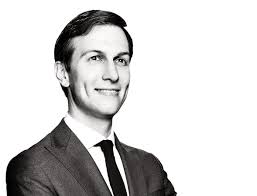
In a February 2024 bull-session at Harvard, Kushner gazed at Gaza and saw—not a besieged enclave packed with families and memory – but “very valuable” waterfront property, and he floated the idea of moving civilians out so Israel could “clean it up.” As you do.
21 January 2026 David Tyler, https://theaimn.net/welcome-to-the-peace-ipo-gaza-rebranded-as-a-prospectus/
Trump’s so‑called “Board of Peace” looks less like a new deal than Jared Kushner’s “Peace to Prosperity” 2019 plan re-branded. It’s as flash as a rat with a gold tooth in a new suit and a limited‑edition Speedmaster, but woefully vapid. It’s a real‑estate pitch pimped as an opportunity to the canny. Palestinians appear merely as background labour: extras, porters, shoeshine boys and waiters in a production where they’re expected to serve, not share.
While Israel’s Likud‑led far‑right coalition continues its military actions, attacks and land grabs that UN experts and human‑rights organisations describe as genocidal in effect.
The difference is not the logic. The difference is the volume. And a crass vulgarity meter off the scale. But nothing can distract from the monumental inhumanity and asinine stupidity of the whole project.
Not to mention calculated cruelty. In 2019, the sales pitch was polite. It spoke in the soothing language of workshops and investment frameworks; a $50 billion vision to “unlock” Palestinian potential, as if the West Bank and Gaza were a start-up stuck in beta because it hadn’t embraced enough deregulation. Palestinians boycotted it because the plan put money in the driver’s seat and rights in the boot.
In 2026, the pitch is blunt: join the Board, bring capital, buy a seat at the table, said to be a US$1 billion buy-in for “permanent” membership, while the souls whose land is now an upscale reno, get “technocratic committees,” “transition governance,” and the home comforts of Israeli management.
Peace, in other words, has gone subscription-tier.
How we got this Frankenstein
The Frankenstein story begins with another colour-coded Excel spreadsheet. As so many other, modern horrors do.
Kushner’s original “Peace to Prosperity” treated Palestine as an underperforming asset. The cure was foreign capital, investment corridors, industrial parks, tax-free zones, economic carrots without a match-stick of political liberation. The occupation, the siege, the “asymmetry” or inequality of power was left intact, politely ignored, like rust and dried blood, under a quick new paint-job.
Of course, the plan didn’t just sideline Palestinians’ political agency, the elephant in the room. It shut them out. Local and global fat cats would use Palestinians as a labour pool and a “stability problem,” while sovereignty, restitution and justice sat outside, like poor, uninvited relatives at a wedding.
Then came the moment where the whole philosophy slipped its tie and revealed the raw instinct underneath it.
In a February 2024 bull-session at Harvard, Kushner gazed at Gaza and saw—not a besieged enclave packed with families and memory – but “very valuable” waterfront property, and he floated the idea of moving civilians out so Israel could “clean it up.” As you do. That is not a diplomatic remark. It is a hard-nosed developer’s call. It is the real-estate gaze: people only get in the way, land is your opportunity.
Fast-forward to Trump’s “Board of Peace,” and you can see the same gaze. Formulated.
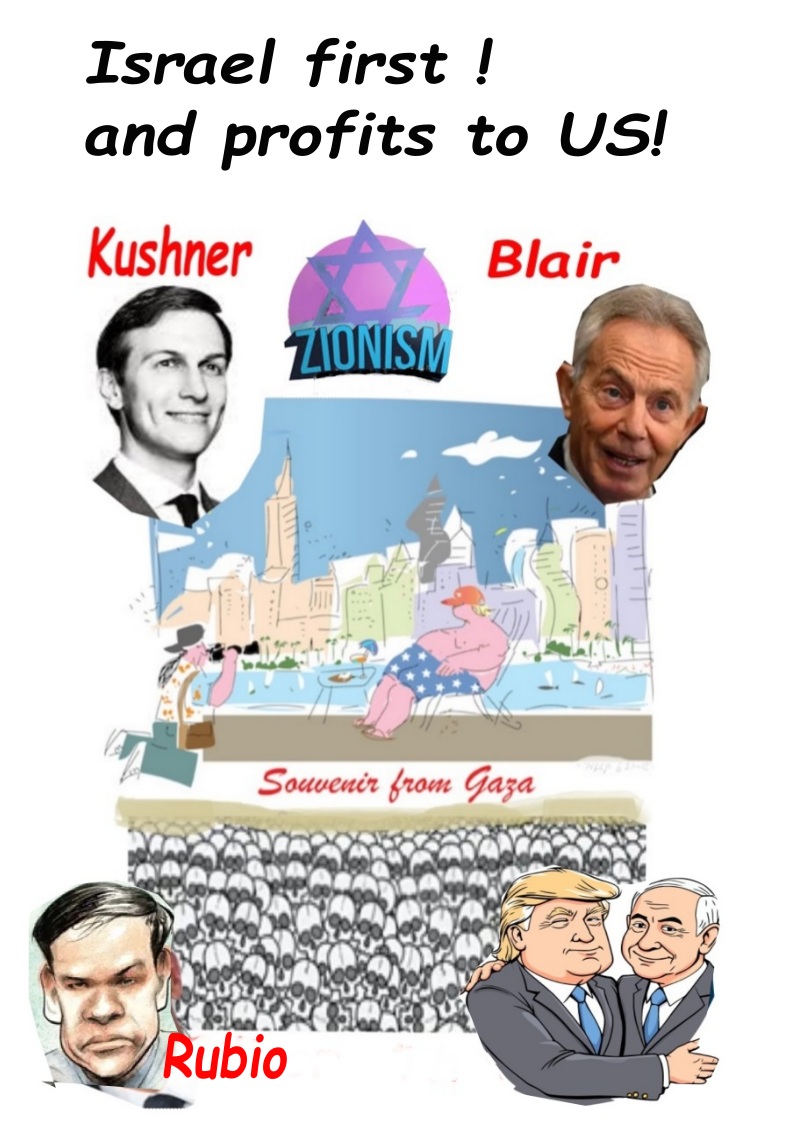
The language is a sales brochure parody. The White House frames the Board as part of a “Comprehensive Plan” and celebrates the creation of a Gaza administrative committee as a “vital step” in a multi-phase roadmap for “peace, stability, reconstruction, and prosperity.” Al Jazeera notes a three-tier structure that puts Trump and pro-Israel officials at the top while Palestinians get to take out the garbage. The landowners are relegated to municipal duties. ABC says invitation mail-outs are thick and fast. It worries that Trump is setting up as an alternative, $uperior, model to UN mechanisms.
Satire is writing itself by the time we get to the seat price. Bloomberg reports Trump wants nations to pay $1 billion for permanent membership, with renewable term options for non-paying participants.
This is not diplomacy. This is a club. It is peace by buy-in. A moral authority with an admission fee?
Why it could be proposed at all
Something this offensive to Gaza’s actual inhabitants only makes sense once Palestine is reclassified, from homeland to high-yield opportunity zone.
That reclassification didn’t happen overnight. It took decades of a broader architecture of policy and language to reduce Palestinian rights to “final status issues”; treat their political claims as a negotiating inconvenience, and normalise de facto control on the ground as an unchangeable reality.
Once you perform that trick; once you turn rights into “issues,” and a people into an “administrative challenge”, then the next step becomes conceivable: the coastline becomes an asset; the survivors become “human resources”; and peace becomes a portfolio strategy.
Trump’s political brand fits perfectly. He fuses branding with foreign policy. He doesn’t ask, “What is just?” He asks, “What sells?” He doesn’t ask, “What do people consent to?” He asks, “Who’s paying?”
CounterPunch repeatedly frames the Trump approach to “peace” as chaotic, self-interested statecraft where the prize is not justice but leverage, contracts, and strategic positioning; the kind of diplomacy that behaves like a market raid.
So the Board of Peace is not an aberration. It is the system, finally saying the quiet part out loud.
Satire interlude: Peace, now with equity options
There is, apparently, a new path to peace in Gaza: an Initial Public Offering.
The prospectus is glossy. The board is illustrious. Only one thing missing from the term sheet is the consent of the people who actually live there.
Trump, now moonlighting as Chair of Global Serenity LLC, has got up a committee that includes himself, Kushner, and Tony Blair: a trio whose track record is a museum of modern hubris. It’s less a diplomatic team than a support group for men who believe history is a distressed asset they were born to privatise.
The sales pitch is an elegantly simple Levantine Walz:
One. Label Gaza “valuable waterfront property”; a phrase typically intoned just before someone proposes a golf course over a mass grave.
Two. Announce that peace comes with tiers. A “permanent seat”? $1 billion, thank you. Peace, but make it premium.
Three. Invite governments and investors to bid for moral authority while Palestinians are quietly sidelined into the business plan as “local capacity.”
Kushner, once tasked with making peace by people who confused “son-in-law” with “diplomat,” returns as the visionary architect. The same man who dismissed political claims as obstacles and mused that Gazans could be moved out so someone could finally do something tasteful with the shoreline.
Having failed at “Peace to Prosperity,” he has now moved on to “Peace to Portfolio Diversification.”
What it really represents
Strip away the PR turd-polish and the Board of Peace represents three deeper trends:
Neoliberal occupation
Economic-first “solutions” that treat Palestinians as an economic population to be “developed” rather than a political people to be free. This was the Bahrain model: investment theatre without dismantling the structures that make normal economic life impossible.
Financialisation of justice
A $1 billion buy-in doesn’t just raise governance questions; it changes the moral architecture. It says legitimacy can be bought. It says peace is an asset class. It says the right to influence the future of Gaza belongs to whoever can wire the funds.
Erasure by technocracy
National claims, refugees, restitution, the right of return are all swept aside and replaced with “governance development,” “capacity building,” “administrative transition.” The jargon fog in which an occupied people are recoded as an admin problem consultants can solve.
The real genius is euphemism density. Layer upon layer. Occupation becomes “security architecture.” Siege becomes “border management.” External control becomes “oversight.” And the bombed-out landscape becomes “an opportunity corridor.”
What’s likely to happen next
Here the satire ends and the stakes bite. Legitimacy will be radioactive so long as Palestinians remain excluded from real sovereignty while the conditions of coercion persist. A structure unveiled about them, without them, is not peace, it’s administration.
Those positioned to profit will circle early. Reconstruction is always where politics, contracts, and influence meet. A pay-to-play architecture is an engraved invitation to opportunists and aligned states seeking leverage.
Civil society backlash will grow precisely because the moral inversion is so blatant: catastrophe monetised; rights treated as optional add-ons.
And the core problem, the one no amount of branding can fix, remains brutally simple:
If you build “peace” on the denial of self-determination, on the absence of accountability, and on the conversion of a people’s catastrophe into a capital project, you won’t get peace.
You’ll get a prospectus. You’ll get a boardroom. You’ll get a beachfront brochure printed on the ashes.
The Debt That Cannot Be Traded
The “Board of Peace” is a gamble that history can be treated as a distressed asset, and that a people’s identity can be diluted into a dividend. It assumes that if you make the brochure glossy enough, the ghosts of the past and the demands of the present will simply vanish into the “transition committees.”
But there is a flaw in the real-estate gaze: it mistakes silence for consent and rubble for a blank slate.
True peace is not a subscription service, and it certainly isn’t a premium tier accessible only to those with a billion dollars to burn. If we have learned anything from the century that birthed this Frankenstein, it is that human dignity is the one currency that cannot be devalued by an Excel spreadsheet. The “Board” may try to privatise the future, but they cannot buy the air, the memory, or the sheer, stubborn persistence of fifteen million people who refuse to be “extras” in their own story.
The old truth remains: you can build a boardroom on a shoreline, and you can print a prospectus on the ashes, but you cannot govern a people who haven’t been seen, only managed. In the end, the most “valuable property” in Gaza isn’t the waterfront; it is the unyielding agency of those who live there.
That is the debt that eventually comes due, and it is the only one that can’t be settled at a discount and the only one we keep turning away from at incalculable cost to our collective humanity.
This article was originally published on URBAN WRONSKI WRITES
60 years since the Palomares incident “The residents were constantly misinformed”.
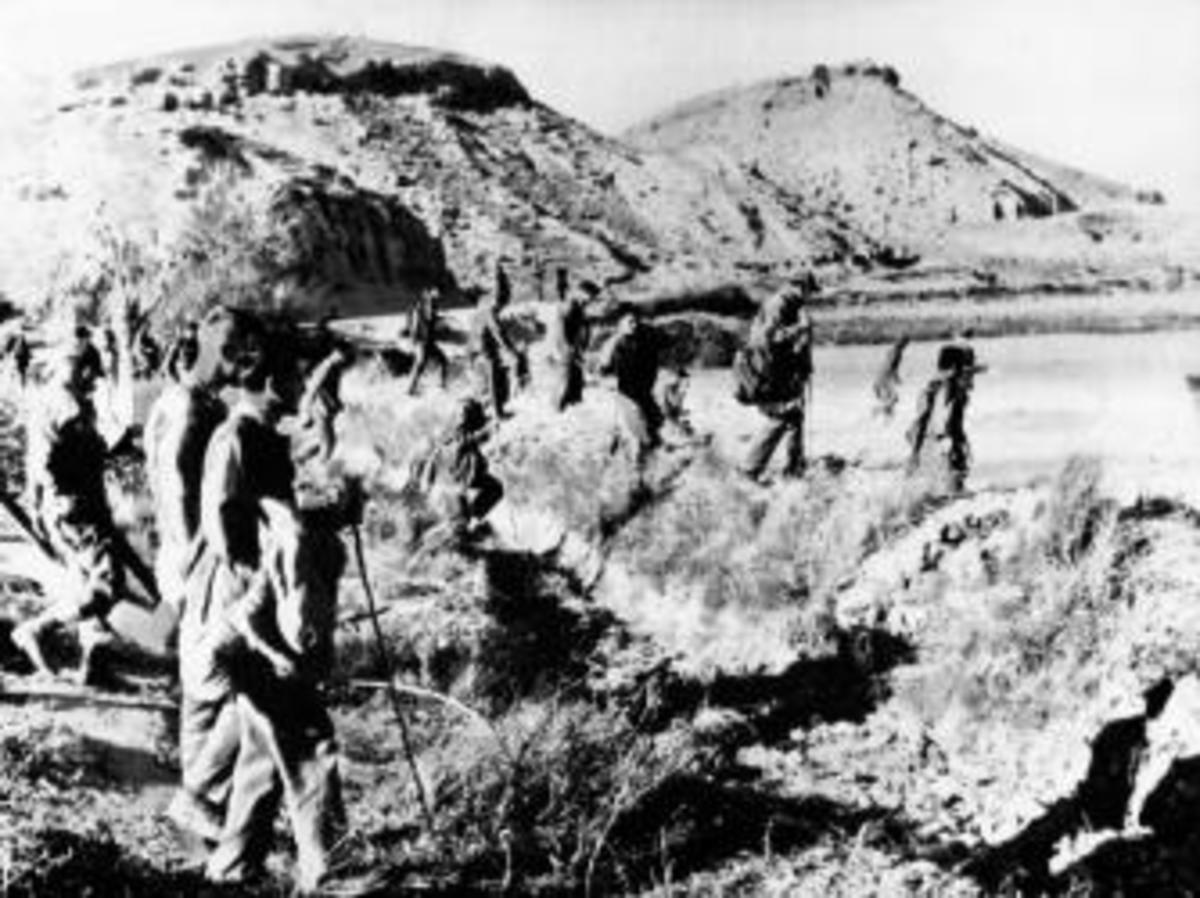
On the Palomares nuclear accident, symbolic decontamination actions, and the lasting damage to people and the environment. A conversation with José Herrera Plaza.Interview: Norbert Suchanek
Sixty years ago, on January 17, 1966, one of the most serious nuclear accidents of the Cold War occurred over southern Spain. A US Air Force tanker collided with a B-52 bomber carrying four hydrogen bombs. Both aircraft exploded; the debris and the dangerous cargo fell from the sky over the small coastal village of Palomares in Andalusia. The parachutes on two of the four bombs failed to deploy. They shattered on impact, contaminating the air and soil around Palomares with plutonium and uranium. The fourth bomb fell into the Mediterranean Sea and was not recovered for 80 days. Where were you in January 1966 when the hydrogen bombs fell from the sky?
I was just starting school in Almería at the time. That’s about 90 kilometers from Palomares. Like most people in Andalusia, I had no idea about the hydrogen bombs hanging over our heads.
When and why did you begin your research on the Palomares accident and make it your main topic?
On January 13, 1986, I attended a meeting of the residents of Palomares. It was three days before the 20th anniversary of the accident, and their claims for compensation for health damages were about to expire. I wanted to make a documentary about this little-known, almost unbelievable story, but at the time, the source material relevant for a documentary was classified. I waited 21 years, gathering all available documents, until I was finally able to complete the documentary “Operation Broken Arrow: The Palomares Nuclear Accident.”
What does “Operation Broken Arrow” stand for?
“Broken arrow” is a code word used by the US military. It refers to an incident involving nuclear weapons, such as an accidental or unexplained nuclear explosion, or the loss or theft of nuclear weapons.
How did the local Spanish authorities react in January 1966? Were they aware of the plutonium danger?
The local authorities reacted according to the standard protocol for an aircraft accident and were without information for several days regarding the involvement of nuclear weapons and consequently also regarding the widespread contamination.
How and when did the Madrid government react?
Spanish authorities learned of the crash almost immediately, thanks to warnings transmitted by a Spanish Navy helicopter via emergency channels. Also on the same day, they learned from the US ambassador that the aircraft was carrying four hydrogen bombs. However, both governments remained silent until the media informed the public three days later.
How was it possible that the media reported on it so quickly during the Franco dictatorship?
Two days after the accident, the Spanish-American journalist André del Amo, working for United Press, was in Palomares and confirmed the involvement of nuclear weapons as well as the ground measurements taken with Geiger counters. His report appeared in major media outlets worldwide the following day. The dictatorship reacted in its usual manner: it confiscated newspapers from kiosks and at the airports in Madrid and Barcelona as soon as international flights landed.
What were the direct consequences of the hydrogen bombs bursting? Was there a risk of a nuclear explosion?
The two Mk-28-FI bombs had 68 times the explosive power of the atomic bomb dropped on Hiroshima. Upon impact in Palomares, the bombs exploded because the conventional explosive charge detonated in the fuse. An area of 635 hectares was subsequently contaminated with fissile fuel: approximately ten kilograms of plutonium-239 and -241, as well as slightly more than ten kilograms of uranium-235 and depleted uranium-238. While the risk of an accidental nuclear detonation was very low, it did exist. These hydrogen bombs were among the most technologically advanced in the US arsenal at the time. Their safety systems were quite good—with the exception of the conventional explosive, which was sensitive to shocks. Due to this accident and a similar one two years later in Greenland, the US military replaced this explosive with a shock- and fire-resistant alternative.
Was the population warned about the plutonium contamination and the consumption of potentially contaminated food such as tomatoes?
The inhabitants of Palomares were continually and insidiously misinformed for fifty years, both under the Franco dictatorship and in democratic Spain. They learned about their precarious situation largely through banned shortwave radio stations such as the communist Radio España Independiente , as well as through the BBC and Radio Paris with their nightly Spanish-language programs. A prominent member of the Spanish nobility, the Duchess of Medina Sidonia, also contributed to informing the local population about their situation and their rights, for which she was imprisoned by the fascist dictatorship.
Are there any data or estimates on the number of people who became ill or died as a result of the radioactive contamination?
No, because a comprehensive epidemiological study was never permitted. Independent attempts failed miserably. At the same time, the governments in Madrid and Washington maintain the official narrative that there has never been a single case of cancer caused by plutonium. In reality, however, Palomares is an environmental disaster zone with significant health risks for its inhabitants. Yet Palomares is not an exception compared to similar incidents elsewhere in the world: an invisible minority, invisible consequences.
Did the nuclear incident have any impact on tourism in southern Spain, which was then becoming an important economic factor?
In 1966, tourists visited other parts of Spain, but not this region. The province of Almería was very poor at the time and virtually isolated due to its poor transport infrastructure. However, there were fears that the accident could negatively impact tourism in the rest of the country, as the international press—especially the British and Italian press in Europe—reported on it. In Australia, a newspaper owned by the young Rupert Murdoch claimed there had been a nuclear explosion, that thousands of people were fleeing, and that the entire Spanish Mediterranean coast was contaminated. This led to the Spanish Minister of Information and the American ambassador swimming in the sea at Palomares beach in front of the media.
The US military conducted a large-scale search and cleanup operation after the crash in Palomares. How did the local population react?
The main priority of the extensive military operation was the search for the missing bomb on land and underwater. The search on land lasted over 45 days, the search at sea 80 days. Second priority was the recovery of the flight recorder and the classified B-52 components, primarily the radio equipment used for the combat log. Thirdly, over 125 tons of wreckage from the bomber and the tanker aircraft were to be recovered and sunk off the coast in the Mediterranean Sea. Finally, a symbolic decontamination operation was carried out for the international community. After the disaster, some people likely suffered from a kind of post-traumatic stress. Subsequently, a collective paranoia gripped the city, exacerbated by the contradictions between the statements of the authorities of both countries. The population was suddenly catapulted into the nuclear age and had to grapple with a new concept: radioactivity.
Was the military able to remove all the plutonium from the region?
After lengthy and asymmetrical negotiations between the hegemonic power, the USA, and the Franco dictatorship, they agreed to remove the plutonium, which had been scattered to the winds, and return it to the USA. However, they transported only 650 cubic meters of contaminated soil and 350 cubic meters of contaminated crop residue to the USA. The agreement was not honored because the excavated soil, stored in metal drums, was not the most heavily contaminated. It is estimated that less than one percent of the plutonium, just under 100 grams, returned to the USA in the 4,810 metal drums, each holding 208 liters. The remaining contaminated fields were plowed to inject the plutonium 30 centimeters into the soil. Forty years later, two secretly constructed pits containing approximately 4,000 cubic meters of radioactive waste were discovered in the region.
What happened to the contaminated material from Palomares in the USA?
Two metal drums were sent to the Los Alamos National Laboratory for plant experiments. 4,808 metal drums were transported to Aiken, South Carolina, to the Savannah River Nuclear Complex of the U.S. Atomic Energy Commission and buried at a depth of six meters. This was accompanied by a comprehensive, worldwide propaganda campaign. The fact that 99 percent of the plutonium and uranium remained in the soil of Palomares was kept secret from the public, and especially from the residents and farmers who cultivated these radioactively contaminated areas. The U.S. Air Force and the Spanish government assured them that the land was completely decontaminated and that there was no danger. Meanwhile, the U.S. Atomic Energy Commission and the Junta de Energía Nuclear in Spain used the situation to conduct a secret experiment program on the local population. The aim was to investigate the uptake and storage of plutonium and uranium in the human body by a representative number of individuals from a population potentially exposed to inhaling plutonium oxide aerosol. This was the secret program codenamed “Indalo Project,” which was carried out without the informed consent of the local population.
What is the current situation in Palomares? Are there still contaminated areas and radioactive hazards in the region?
Despite assurances from Spain and the US that there was no longer any danger to farmers and their families, the plowing of the soil with plutonium in 1966 led to the stirring up and release of numerous aerosols containing radioactive elements. For forty years, the residents of Palomares were exposed to radioactive nuclides. It wasn’t until 2006 that the first radiation protection measures were implemented for the population, restricting access to and agricultural use of a 40-hectare area through fencing and marking. Now, sixty years later, we are still waiting for the central government in Madrid to carry out the decontamination. It has never prioritized the issue, even though it is documented that more than 210 residents exhibited symptoms of internal lung contamination. The actual number of those affected, however, remains unknown. After all, the political elites of the central government live over 520 kilometers away in Madrid.
Why did the B-52 bomber fly over southern Spain with nuclear weapons back then?
This occurred as part of Operation Chrome Dome, which began on January 18, 1961. From then on, four to six strategic bombers flew round-trip missions over Spain every day, year after year. During the Cuban Missile Crisis of 1962, 42 bombers were in the air daily. They came from the East Coast of the United States, crossed Spanish airspace, approached southern Italy, and returned to their bases over Spain. Each B-52 carried four thermonuclear bombs. In an attack scenario, they could reach and attack their targets within one to two hours, depending on whether the target was in the USSR or another Warsaw Pact state. For five years, more than 17,000 bombers flew over Spain and were refueled 26,000 times. No other country in Europe permitted such dangerous maneuvers in its airspace. Almost 35,000 hydrogen bombs flew over our heads. The collisions over Palomares and two years later over Thule in Greenland occurred because the law of probability came into play.
How will you commemorate the 60th anniversary of this never-ending Palomares disaster?
I am planning a photo exhibition and a panel discussion at the Villaespesa Library in Almería entitled “Palomares – 60 Years of Government Failure.” I also expect to present my new book at the end of January. It is titled “The Year of the Bombs: Stories from Palomares.” The book brings together the testimonies of 27 Spaniards and Americans who were involuntarily involved in the Palomares disaster. It is written in the style of a documentary narrative, similar to Svetlan Alexievich’s “Voices from Chernobyl,” a work to which it thus pays homage. It is about counteracting oblivion. The story of Palomares is not yet over. It continues to be written.
The Mirage of the Enemy: Deconstructing Contemporary Media Bias
Following the “12-Day War” strikes in June 2025, which targeted Iranian facilities at Natanz and Fordow, the narrative shifted from “containment” to “inevitable conflict.” By painting the Iranian leadership as “Mad Mullahs” who cannot be deterred, the West creates a self-fulfilling prophecy where diplomacy is framed as cowardice and bombardment as “safety.”
20 January 2026 David Tyler , Australian Independent Media
In the opening weeks of 2026, the Western media’s portrait of Iran has reached a fever pitch of distortion. We are told, with the practised urgency of a countdown, that we are witnessing the final days of a “mad” regime, a nuclear-armed chaos factory that must be dismantled for the safety of the world. Yet, if we pull back the curtain on this narrative, we find a much more complex and tragic story, one where Iran is not merely a rogue actor, but a civilisation trapped between the hammer of domestic repression, and the anvil of imperial design whilst being wickedly misreported by a mainstream media, at the service of a power elite.
To understand Iran today, we must first dismantle two colliding fictions that monopolise our screens: the myth of the “irrational” religious state and the “imminent” nuclear menace. Blend in blame the victim in the guise of Coalition Islamophobia such Tony Abbott’s jibe that Islam “has a massive problem”.
The Original Sin: A Democracy Interrupted
The “anti-Western” sentiment so often cited by CNN or the ABC as proof of Iranian fanaticism did not emerge from a theological vacuum. It was set up in 1953. When Prime Minister Mohammad Mossadegh, a secular nationalist, dared to nationalise Iran’s oil to benefit his own people, the CIA and MI6 responded with Operation Ajax. By toppling a democratically elected leader to reinstate the Shah, the West sent a clear message: Iranian sovereignty is secondary to the flow of crude.
Historical amnesia is the bedrock of modern disinformation. We are taught to see the 1979 Revolution as a sudden burst of “madness,” ignoring a quarter-century of torture by the Shah’s SAVAK secret police that preceded it. The West did not lose a “friend” in 1979; it lost a compliant oil warden, and it has never forgiven the Iranian people for the replacement.
The Nuclear Paradox: A Richly Hypocritical Charge
The most potent weapon in the media’s arsenal is the “Nuclear Menace.” For over two decades, we have been told Iran is “months away” from a bomb. It’s a claim that persists despite IAEA confirmations of compliance and US intelligence assessments that Tehran has not, in fact, decided to weaponise.
There is a profound irony in watching nuclear-armed powers; including Israel, with its uninspected arsenal of hundreds of warheads; lecture a nation under total siege about the “danger of annihilation.” This is the collision of the Whipping Boy and the Existential Threat: Iran must be small enough to be bullied by sanctions, yet large enough to justify the $100 billion arms deals the U.S. signs with its regional rivals.
Following the “12-Day War” strikes in June 2025, which targeted Iranian facilities at Natanz and Fordow, the narrative shifted from “containment” to “inevitable conflict.” By painting the Iranian leadership as “Mad Mullahs” who cannot be deterred, the West creates a self-fulfilling prophecy where diplomacy is framed as cowardice and bombardment as “safety.”
The Starlink Catastrophe: A Digital Trojan Horse
Nowhere is the gap between Western “solidarity” and tactical reality more glaring than in the recent Starlink disaster. Throughout late 2025, Western pundits celebrated a “digital liberation” as thousands of Starlink internet terminals were reportedly smuggled into Iran to bypass government blackouts. It was framed as a gift from the tech elite “billionaire-Bros” to the brave dissidents in the streets of Tehran.
Were the dissidents ranks swollen by foreign agents? Certainly. It was Israel who prevailed upon “Help is on its way” Trump not to proceed because so many “assets” had been lost. We will never know the true figures. But we do know that rebels were trapped. In reality, it was a digital Trojan Horse. By January 2026, it was clear that the “liberation” had been turned into a mass-surveillance dragnet. The Iranian Cyber Police (FATA) and the IRGC’s intelligence wing had not been outsmarted; they had been waiting.
The Trap: Because Starlink terminals require a clear line of sight to the sky, activists were forced to place them on rooftops and in open squares.
The Triangulation: Using signal-intercept technology and GPS-tracking beacons embedded in intercepted shipments, the Iranian police were able to map the exact coordinates of every active terminal.
The Fallout: In a series of ruthless raids across Tehran, Isfahan, and Mashhad, thousands of individuals, believing they were using “secure” Western tech, unwittingly broadcast their locations to the state.
This catastrophe reveals a dark truth: Western “help” often functions more as a tool for intelligence gathering than for any liberation. The thousands of young Iranians and “helpers” now in custody are the human cost of a “regime change” fantasy that prioritises high-tech optics over the safety of the people on the ground.
Sanctions as Slow-Motion War
We are told that sanctions target “the regime,” (never the government) but the reality is collective punishment. By severing Iran from the SWIFT banking system, the West has triggered 70% food inflation and chronic shortages of life-saving medicines. This is the Shock Doctrine in action: hollow out the middle class, starve the vulnerable, and wait for the “inevitable” uprising.
As the 2026 protests continue, fuelled by both genuine grievance and economic desperation, we must be wary of “selective outrage.” The same outlets that decry Iranian repression remain silent on Saudi beheadings or the UAE’s labour- camps. This hypocrisy suggests that the West is not interested in Iranian freedom, but in Iranian subservience.
Myths vs. Realities of 2026
| The Myth | The Ground Reality | The Strategic Goal |
| “Irrational Actors” | Iran’s strategy is a defensive response to 70 years of encirclement. | Justify pre-emptive strikes. |
| “Tech Liberation” | Tools like Starlink were compromised, leading to 2,400+ arrests. | Co-opt domestic dissent for foreign Intel. |
| “Targeted Sanctions” | 85 million people are suffering from medicine and food shortages. | Destabilise for regime change. |
This guide deconstructs the mechanisms of “perception management” used by mainstream Western media as we navigate the crises of 2026. It highlights the stark contrast between the breathless coverage of Iran’s internal strife and the calculated silence or obfuscation regarding the “old news” of a post-Assad Syria and the enduring genocide in Gaza.
1. Selective Credibility: The Death Toll Gap
One of the most potent tools of manipulation is the Hierarchy of Proof. In 2026, we see a radical divergence in how Western outlets verify human loss.
In Iran: Media outlets like CBS and the ABC frequently lead with headlines such as “Over 12,000 feared dead,” citing “anonymous sources” or single activists with a VPN. These figures are treated as objective truth to manufacture a sense of immediate, catastrophic urgency that demands foreign intervention.
In Gaza: Despite the “first live-streamed genocide” producing mountains of forensic video evidence, Western media continues to use the “Gaza Health Ministry” caveat to cast doubt on Palestinian death tolls. Even as the count surpassed 70,000 in late 2025, it was framed as “disputed” or “unverifiable,” a technique designed to stall public empathy and political action.
2. The Starlink Catastrophe: A Case Study in Techno-Orientalism
The recent tragedy involving Starlink terminals in Iran serves as a masterclass in how Western media markets “liberation” while obscuring tactical reality. In late 2025, a narrative was sold to the Western public: Silicon Valley would “break the mullahs’ internet” by smuggling thousands of terminals into the country.
The catastrophe unfolded in three distinct phases of media manipulation:………………………………………………………………………………………………………………………………………….. https://theaimn.net/the-mirage-of-the-enemy-deconstructing-contemporary-media-bias/
Iran & Israel Secretly Agreed Not To Attack Each Other Through Russian Backchannel
by Tyler Durden, Jan 15, 2026, https://www.zerohedge.com/geopolitical/iran-israel-secretly-agreed-not-attack-each-other-through-russian-backchannel-wapo
There may have been some back-channel dealmaking and a ‘mutual understanding’ reached between Iran and Israel far behind the scenes as protests unfolded on Iran’s streets, and as President Trump began to make threats about striking Tehran.
At a moment Trump seems to have climbed down (at least for now) from the threatened drive to intervene militarily, The Washington Post has issued a Wednesday report saying Israel and Iran have been in indirect diplomatic contact via Russia as a mediator.
“Days before protests erupted in Iran in late December, Israeli officials notified the Iranian leadership via Russia that they would not launch strikes against Iran if Israel were not attacked first,” WaPo writes. “Iran responded through the Russian channel that it would also refrain from a preemptive attack, diplomats and regional officials with knowledge of the exchange said.”
Could this be because of the Iranian missiles that rained down on Tel Aviv back in June? If so, it seems the Islamic Republic has finally established deterrence.
The timeline of what was communicated when remains unclear. But this backchannel had already been revealed in Middle East media reports, for example in the following prior reporting:
Israel and Iran have recently exchanged secret, indirect messages through Russia in the midst of heightened regional tensions, according to a new report by Amwaj.media today. The exchanges were described as an effort to prevent further military escalation rather than to establish any form of ceasefire or diplomatic framework.
According to the report, the messages were conveyed through Russian President Vladimir Putin after Israel sought to pass along a signal that it was not interested in escalating military conflict at this stage. Iranian officials acknowledged the message but emphasized that their reply carried no commitment, no coordination, and no obligation on Iran’s part. An Iranian political source quoted in the report said bluntly that “there is no commitment, no coordination, and no ceasefire agreement.” The source emphasized that the contact should not be interpreted as a step toward broader understandings between the two countries, which remain bitter adversaries with no direct diplomatic ties.
The exchanges were reportedly limited in scope and intent. No guarantees were offered, no timelines were discussed, and no monitoring or enforcement mechanisms were established. One source described the communication as “a mutual announcement to a mutual friend on no new strikes,” meaning that the goal was simply to manage tensions at a specific moment rather than to lock in any lasting arrangement.
A senior Iranian political source confirmed that indirect communication with Israel had indeed taken place, identifying Russia, and specifically Putin, as the intermediary. The source reiterated that there was “no ceasefire agreement” and that the messages amounted only to parallel notifications of intent, rather than a shared understanding or deal.
The report says the Iranian side of the exchanges was handled not by the foreign ministry but by Ali Larijani, secretary of Iran’s Supreme National Security Council.
It’s possible that this served as important background to Trump’s apparent decision to not strike Iran at this point. Israel is usually the country yelling loudest to hit Iran, but this time the Netanyahu government was somewhat muted.
By all accounts, Iran’s streets have pretty much gone quiet by now, after a crescendo of violence this week left hundreds dead, including many police and security personnel.
Revealed: The CIA-Backed Think Tanks Fueling The Iran Protests

Reading between the lines, the National Endowment for Democracy (NED) is attempting to build up a widespread network of media outlets, NGOs, activists, intellectuals, student leaders and politicians who will all sing from the same hymn sheet, that of “transitioning” from “authoritarianism” (i.e., the current system of government” to “democracy,” (i.e., a U.S.-picked government). In other words: regime change.
Mint Press News, January 15th, 2026. Alan Macleod
As waves of deadly demonstrations and counter-demonstrations hit Iran, MintPress examines the CIA-backed NGOs helping to stir the outrage and foment more violence.
One of these groups is Human Rights Activists In Iran, frequently referred to as HRA or HRAI in the media. The group, and its media arm, the Human Rights Activists News Agency (HRANA) have become the go-to group of experts for Western media, and are the source of many of the most inflammatory claims and shockingly high casualty figures reported in the press. In the past week alone, their assertions have provided much of the basis for stories in CNN, The Wall Street Journal, NPR, ABC News, Sky News, and The New York Post, among others. And in a passionate plea for leftists to support the protests, Owen Jones wrote in The Guardian Tuesday that HRAI are a “respected” group whose death toll proclamations are “probably significant underestimates.”
Yet what none of these reports mention is that Human Rights Activists In Iran is bankrolled by the Central Intelligence Agency, through its cutout organization, the National Endowment for Democracy (NED)
“Independent” NGOs, Brought to You By the CIA
Established in 2006, Human Rights Activists in Iran is based in Fairfax, Virginia, just a stone’s throw away from CIA headquarters in Langley. It describes itself as a “non-political” association of activists dedicated to advancing freedom and rights in Iran. On its website, it notes that, “because the organization seeks to remain independent, it doesn’t accept financial aid from neither political groups nor governments.” Yet, in the same paragraph, it notes that “HRAI has also been accepting donations from National Endowment for Democracy, a non-profit, non-governmental organization in the United States of America.” The level of NED investment into HRAI has been substantial, to say the least; journalist Michael Tracey found that, in 2024 alone, the NED had apportioned well over $900,000 towards the organization.
Another NGO widely cited in recent media reports on the protests is the Abdorrahman Boroumand Center for Human Rights in Iran (ABCHRI). The group has been quoted widely, including by The Washington Post, PBS, and ABC News. Like with the HRAI, these reports also fail to disclose the Abdorrahman Boroumand Center’s proximity to the U.S. national security state.
Although it does not mention it in its funding disclaimer, the center is supported by the NED. Last year, the NED described the center as a “partner” organization, and awarded its director, Roya Boroumand, their 2024 Goler T. Butcher medal for democracy promotion.
“Roya and her organization have worked rigorously and objectively to document human rights violations committed by the regime in Iran,” said Amira Maaty, senior director for NED’s Middle East and North Africa programs. “The work of the Abdorrahman Boroumand Center is an indispensable resource for victims to seek justice and hold perpetrators accountable under international law. NED is proud to support Roya and the center in their advocacy for human rights and tireless pursuit of a democratic future for Iran.”
In addition to this, sitting on the center’s board of directors is controversial academic, Francis Fukuyama, a former NED board member and an editor of its “Journal of Democracy” publication.
If anything, the Center for Human Rights in Iran (CHRI) has gone further than HRAI or the ABCHRI. Widely cited across Western media (e.g., The New York Times, The Guardian, USA Today), the CHRI has been the source of many of the goriest and most lurid stories coming out of Iran. A Monday article in The Washington Post, for example, leaned on the CHRI’s expertise to report that Iranian hospitals were being overwhelmed and had even run out of blood to treat the victims of government repression. “A massacre is unfolding. The world must act now to prevent further loss of life,” a CHRI spokesperson said. Given President Trump’s recent threats about U.S. military attacks on Iran, the implications of the statement were clear.
And yet, like with the other NGOs profiled, none of the corporate media outlets citing the Center for Human Rights in Iran noted its close connections to the U.S. national security state. The CHRI – an Iranian human rights group based in New York City and Washington, D.C. – was identified by the government of China as directly funded by the NED.
The claim is far from outlandish, given that CHRI board member, Mehrangiz Kar, is a former Reagan-Fascell Democracy Fellow at the NED. And in 2002 at a star-studded gala on Capitol Hill, First Lady Laura Bush and future president Joe Biden presented Kar with the NED’s annual Democracy Award.
A History of Regime Change Ops
The National Endowment for Democracy was created in 1983 by the Reagan administration, after a series of scandals had seriously damaged the image and reputation of the CIA. The Church Committee – a 1975 U.S. Senate investigation into CIA activities – found that the agency had masterminded the assassination of several foreign heads of state, was involved in a massive domestic surveillance campaign against progressive groups, had infiltrated and placed agents in hundreds of U.S. media outlets, and was carrying out shocking mind control experiments on unwilling American participants.
Technically a private entity, although receiving virtually all its funding from the federal government and being staffed by ex-spooks, the NED was created as a way to outsource many of the agency’s most controversial activities, especially overseas regime change operations. “It would be terrible for democratic groups around the world to be seen as subsidized by the CIA,” Carl Gershman, the NED’s longtime president, said in 1986. NED co-founder Allen Weinstein agreed: “A lot of what we do today was done covertly 25 years ago by the CIA,” he told The Washington Post.
Part of the CIA’s mission was to create a worldwide network of media outlets and NGOs that would parrot CIA talking points, passing it off as credible news. As former CIA taskforce leader John Stockwell admitted, “I had propagandists all over the world.” Stockwell went on to describe how he helped flood the world with fake news demonizing Cuba:
We pumped dozens of stories about Cuban atrocities, Cuban rapists [to the media]… We ran [faked] photographs that made almost every newspaper in the country… We didn’t know of one single atrocity committed by the Cubans. It was pure, raw, false propaganda to create an illusion of communists eating babies for breakfast.”
Mike Pompeo, former CIA director, alluded this being active CIA policy. At a 2019 talk at Texas A&M University, he said, “When I was a cadet, what’s the cadet motto at West Point? You will not lie, cheat, or steal or tolerate those who do. I was the CIA director. We lied, we cheated, we stole. We had entire training courses [on] it!”
One of the NED’s greatest successes came in 1996, when it successfully swung elections in Russia, spending vast amounts of money to ensure U.S. puppet ruler Boris Yeltsin would remain in power. Yeltsin, who came to power in a 1993 coup that dissolved parliament, was deeply unpopular, and it appeared that the Russian public were ready to vote for a return to Communism. The NED and other American agencies flooded Russia with money and propaganda, ensuring their man remained in power. The story was cataloged in a famous edition of Time magazine, whose title page was emblazoned with the words, “Yanks To The Rescue: the Secret Story of How American Advisors Helped Yeltsin Win.”
Six years later, the NED provided both the finances and the brains for a briefly successful coup d’état against Venezuelan president, Hugo Chavez. The NED spent hundreds of thousands of dollars flying coup leaders (such as Marina Corina Machado) back and forth to Washington, D.C. After the coup was overturned and the plot was exposed, NED funding to Machado and her allies actually increased, and the organization has continued to fund her and her political organizations.
The NED would have more luck in Ukraine, playing a key role in the successful 2014 Maidan Revolution that toppled President Viktor Yanukovych and replaced him with a pro-U.S. successor. The Maidan affair followed a tried-and-tested formula, with large numbers of people coming out to protest, and a hardcore of trained paramilitaries carrying out acts of violence aimed at destabilizing the government and provoking a military response.
Assistant Secretary of State for European and Eurasian Affairs (and future NED board member) Victoria Nuland flew to Kiev to signal the U.S. government’s full support of the movement to oust Yanukovych, even handing out cookies to protestors in the city’s main square. A leaked telephone call showed that the new Ukrainian prime minister, Arseniy Yatsenyuk, was directly chosen by Nuland. “Yats is the guy,” she can be heard telling U.S. Ambassador to Ukraine, Geoffrey Pyatt, citing his experience and friendliness with Washington as key factors. The 2014 Maidan Revolution and its aftermath would lead to Russia’s invasion of Ukraine eight years later.
Just across the border in Belarus, the NED planned similar actions to overthrow President Alexander Lukashenko. At the time of the attempt (2020-2021), the NED was pursuing 40 active projects inside the country.
On a Zoom call infiltrated and covertly recorded by activists, the NED’s senior Europe Program officer, Nina Ognianova, boasted that the groups leading the nationwide demonstrations against Lukashenko were trained by her organization. “We don’t think that this movement that is so impressive and so inspiring came out of nowhere — that it just happened overnight,” she said, noting that the NED had made a “significant contribution” to the protests.
On the same call, NED President Gershman noted that “we support many, many groups, and we have a very, very active program throughout the country, and many of the groups obviously have their partners in exile,” boasting that the Belarusian government was powerless to stop them. “We’re not like Freedom House or NDI [the National Democratic Institute] and the IRI [International Republican Institute]; we don’t have offices. So if we’re not there, they can’t kick us out,” he said, comparing the NED to other U.S. regime change organizations.
The attempted Color Revolution did not succeed, however, as demonstrators were met with large counter-demonstrations, and Lukashenko remains in power to this day. The NED’s actions were a key factor in Lukashenko’s decision to abandon his relationship with the West, and ally Belarus with Russia.
Just months after their failure in Belarus, the NED fomented another regime change attempt, this time in Cuba. The agency spent millions of dollars infiltrating and buying off pliant musical artists, especially in the hip hop community, in an attempt to turn local popular culture against its revolution. Led by Cuban rappers, the U.S. attempted to rally the people into the streets, flooding social media with calls from celebrities and politicians alike to topple the government. This did not translate into boots on the ground, however, and the fiasco was written off sarcastically as the U.S.’ “Bay of Tweets.”
So many of the most visible protest movements the world over have been quietly masterminded by the NED. This includes the 2019-2020 Hong Kong protests, wherein the agency funnelled millions to the movement’s leaders to keep people in the streets as long as possible. The NED continues to work with Uyghur and Tibetan separatist groups, in the hope of destabilizing China. Other known NED meddling projects include interfering with elections in France, Panama, Costa Rica, Nicaragua, and Poland.
It is precisely for these reasons, therefore, that accepting funding from the NED should be unthinkable for any serious NGO or human rights organization, as so many that do have been front groups for American power and clandestine regime change operations. It is also why the public should be extremely wary about any claims made by organizations on the payroll of a CIA cutout organization, especially those that attempt to hide the fact. Journalists, too, have a duty to scrutinize any statements made by these groups, and inform their readers and viewers about their inherent conflicts of interests.
Targeting Iran
Apart from funding the three U.S.-based human rights NGOs profiled here, the NED is spearheading a myriad of operations targeting the Islamic Republic. According to its 2025 grant listings, there are currently 18 active NED projects for Iran, although the agency does not divulge any of the groups they are working with.
It also refuses to divulge any hard details about these projects, beyond rather bland descriptions that include:
Empowering” a network of “frontline and exiled activists” inside Iran;
“Promoting independent journalism,” and “Establishing media platforms to influence the public;”
“Monitoring and promoting human rights;”
“Training student leaders inside Iran;”
“Advancing policy analysis, debate, and collective actions on democracy,” and;
“Foster[ing] collaboration between Iranian civil society and political activists on a democratic vision and raise awareness on civic rights within the legal community, the organization will facilitate debate on transition models from authoritarianism to democracy.”
Reading between the lines, the NED is attempting to build up a widespread network of media outlets, NGOs, activists, intellectuals, student leaders and politicians who will all sing from the same hymn sheet, that of “transitioning” from “authoritarianism” (i.e., the current system of government” to “democracy,” (i.e., a U.S.-picked government). In other words: regime change.
Iran, of course, has been in American crosshairs ever since the removal of the Shah Mohammad Reza Pahlavi during the Islamic Revolution of 1978-79. Pahlavi himself had been kept in place by the CIA, who engineered a coup against the democratically-elected government of Mohammad Mossadegh (1952-53). Mossadegh, a secular liberal reformer, had angered Washington by nationalizing the country’s oil industry, carrying out land reform, and refusing to crush the communist Tudeh Party.
The CIA (the NED’s parent organization), infiltrated Iranian media, paying them to run hysterical anti-Mossadegh content, carried out terror attacks inside Iran, bribed officials to turn against the president, cultivated ties with reactionary elements within the military, and paid protestors to flood the streets at anti-Mossadegh rallies.
The shah reigned for 26 bloody years between 1953 and 1979, until he was overthrown in the Islamic Revolution.
The U.S. supported Saddam Hussein’s Iraq, who almost immediately invaded Iran, leading to a bitter, eight-year long conflict that killed at least half a million people. Washington supplied Hussein with a wide range of weapons, including components for chemical weapons used on Iranians, as well as other weapons of mass destruction.
Since 1979, Iran has also been under restrictive American economic sanctions, measures that have severely hindered the country’s development. During his first term, Trump withdrew from the Iran Nuclear Deal and turned up the economic pressure. The result was a collapse in the value of the Iranian rial, mass unemployment, soaring rents and a doubling of the price of food. Ordinary people lost both their savings and their long-term security.
Throughout this, Trump has constantly threatened Iran with attack, finally following through in June, bombing a host of infrastructure projects inside the country.
A Legitimate Protest
The current demonstrations began on December 28 as a protest against rising prices. Yet they quickly ballooned into something much bigger, with thousands calling for an overthrow of the government, and even the reinstatement of the monarchy under the son of the shah, Crown Prince Reza Pahlavi.
They were quickly supported and signal boosted by the U.S. and Israeli national security states. “The Iranian regime is in trouble,” Pompeo announced. “Happy New Year to every Iranian in the streets. Also to every Mossad agent walking beside them…” he added. Israeli media are openly reporting that “foreign elements” (i.e., Israeli) are “arming the protesters in Iran with live weapons, and this is the reason for the hundreds of dead among the regime’s people.”
The Israeli intelligence services confirmed Pompeo’s not-so-cryptic assertion. “Go out together into the streets. The time has come,” the spying agency’s official social media accounts instructed Iranians: “We are with you. Not only from a distance and verbally. We are with you in the field.”
Trump echoed those words. “TAKE OVER YOUR INSTITUTIONS!!! Save the names of the killers and abusers. They will pay a big price,” he roared, adding that American “help is on the way.”
Any debate about what Trump meant by “American help” was ended on Monday, when he stated that “If Iran shots [sic] and violently kills peaceful protesters, which is their custom, the United States of America will come to their rescue… We are locked and loaded and ready to go.” He also attempted to place an all-out economic blockade, announcing that any country trading with Tehran would face an additional 25% tariff.
All of this, added to the increasing violence of the protests, makes it much harder for Iranians to express themselves politically. What started as a demonstration about the cost of living has spiralled into a huge, openly insurrectionist movement, backed and fomented by the U.S. and Israel. Iranians, of course, have every right to protest, but a wealth of factors have raised the very real possibility that much of the anti-government movement is an inorganic, U.S.-orchestrated attempt at regime change. While Iranians can argue about how they wish to express themselves and what sort of government they want, what is undebatable is that so many of the think tanks and NGOs called upon to provide supposed expert evidence and commentary about these protests are tools of the National Endowment for Democracy.
Alan MacLeod is Senior Staff Writer for MintPress News. He completed his PhD in 2017 and has since authored two acclaimed books: Bad News From Venezuela: Twenty Years of Fake News and Misreporting and Propaganda in the Information Age: Still Manufacturing Consent, as well as a number of academic articles. He has also contributed to FAIR.org, The Guardian, Salon, The Grayzone, Jacobin Magazine, and Common Dreams. Follow Alan on Twitter for more of his work and commentary:
The War On Free Speech In Australia Is Getting Cartoonishly Absurd.
Caitlin Johnstone, Jan 17, 2026, https://www.caitlinjohnst.one/p/the-war-on-free-speech-in-australia?utm_source=post-email-title&publication_id=82124&post_id=184831756&utm_campaign=email-post-title&isFreemail=true&r=1ise1&triedRedirect=true&utm_medium=email
A mentally disabled Australian woman is being prosecuted for antisemitic hate crimes after accidentally pocket-dialing a Jewish nutritionist, resulting in a blank voicemail which caused the nutritionist “immediate fear and nervousness” because she thought some of the background noises in the recording sounded a bit like gunshots.
We’re being told we need more of this. There’s “hate speech” legislation presently in the works to make this worse. Australia’s controversial Combatting Antisemitism, Hate and Extremism Bill appears to be explicitly crafted to dramatically increase the scale, frequency and consequences of the exact sort of dynamics we’re seeing in this case, and to eradicate opposition to Israel throughout the nation.
This is how overextended Australia’s freakout over “antisemitism” already is. You can literally just be sitting there not saying or doing anything and still find yourself getting arrested and prosecuted for an antisemitic hate crime. They have the authority to do this presently, under the laws that already exist. The argument for this bill is that our present horrifyingly tyrannical and abusive system is insufficiently authoritarian and tyrannical, and that prosecutors need more power to police speech far more forcefully.
Australians are being asked to trust a system that would take a woman with an intellectual disability to prosecution in a court of law over an accidental butt-dial to a person of Jewish faith with the authority to send people to prison for years over their political speech. And this is happening after we just spent years watching Australian authorities roll out authoritarian measures to stomp out criticism of Israel and quash protests against an active genocide.
This is madness, and it needs to be brought to a screeching halt. Immediately. This entire country has lost its damn mind.
The Bondi attack isn’t the reason, it’s the excuse. All these laws being rolled out to stomp out criticism of Israel in Australia were sought for years before the shooting occurred.
Immediately after the attack last month I tweeted, “Not a lot of info about the Bondi shooting yet but it’s safe to assume it will be used as an excuse to target pro-Palestine activists and further outlaw criticism of Israel in Australia, as has been happening to a greater and greater extent in this country for the last two years.”
They could have proved me wrong, but instead they’ve spent this entire time proving me one hundred percent correct. The frenzied efforts to crush anti-genocide protests and silence speech that is critical of Israel and Zionism in these subsequent weeks has plainly established this.
There is no connection between pro-Palestine demonstrations and the Bondi attack. None. It had nothing to do with Palestinians, and it had nothing to do with anti-genocide demonstrations. It’s a completely made-up claim that Israel’s supporters have been circulating in Australian consciousness through sheer repetition. They’re just pretending to believe it’s true in order to promote the information interests of a genocidal apartheid state.
Israel’s supporters need to use propaganda, deception, censorship and oppression to promote their agendas, because it’s all they have. They don’t have truth. They don’t have arguments. They don’t have morality. All they have is brute force. They are shoving support for Israel and its atrocities down our throats whether we like it or not, and if we refuse what we’re being force-fed they will punish us. That’s the only tool in their toolbox.
This needs to be ferociously opposed. The more Israel and its supporters work to assault our right to oppose their abuses, the more aggressively we need to oppose them. We are no longer fighting against war and genocide in the middle east, we are fighting against an assault on our own civil rights. It’s personal now. They’re coming for us directly.
The Nobel Peace Prize, Re-Gifted (Peace Through Strength™ Edition)
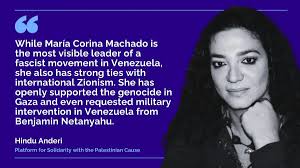
17 January 2026 Roswell, https://theaimn.net/the-nobel-peace-prize-re-gifted-peace-through-strength-edition/
Donald Trump stands beneath the presidential seal, gripping a gold medal the way a game-show winner clutches an oversized cheque. The cameras whir. The aides clap a little too loudly.
Beside him, María Corina Machado beams, her smile frozen somewhere between gratitude and hostage-negotiation optimism. She has just presented Trump with an 18-karat validation token for what she calls his “extraordinary leadership,” otherwise known as the special-forces operation that removed Nicolás Maduro with the urgency of a late pizza pickup.
The symbolism is exquisite. A prize historically associated with non-violent resistance, moral courage, and painstaking diplomacy is now being ceremonially re-gifted as a thank-you for a military abduction. Gandhi spins. Martin Luther King Jr. sighs. Alfred Nobel briefly considers haunting someone.
Trump’s Truth Social post hits like a victory lap: “María presented me with her Nobel Peace Prize for the work I have done. Such a wonderful gesture of mutual respect. Thank you María!” Meanwhile, the Norwegian Nobel Committee is out there speed-tweeting clarifications like panicked HR reps: “A medal can change owners, but the title of a Nobel Peace Prize laureate cannot. Please return to sender if found in wrong hands.”
It’s the political equivalent of winning Employee of the Month because your coworker felt bad you got passed over last year, then framing the certificate and hanging it in your office anyway. Machado’s inscription? “To President Donald J. Trump in Gratitude for Your Extraordinary Leadership in Promoting Peace through Strength.” Translation: “Thanks for the special forces cameo – here’s some shiny validation. Now maybe back me as interim prez?” (Spoiler: Trump reportedly already lost interest in her leadership bid months ago when she didn’t publicly demand the prize go to him instead. Classic.)
The irony is thicker than the gold plating: A prize meant to honour tireless non-violent struggle against tyranny gets symbolically transferred in gratitude for a military abduction op. Next thing you know, Trump’s melting it down for a limited-edition MAGA coin collection or auctioning it on Truth Social to fund the wall around Mar-a-Lago.
If this doesn’t win Satire of the Year, nothing will. The Nobel just became the ultimate regift – peace prize edition. Your move, universe. What part of this timeline do you want to break next?
Chubu Electric’s data fraud ‘undermines’ Japan’s nuclear energy policy
10 Jan 2026 https://www.japantimes.co.jp/news/2026/01/10/japan/chubu-electric-data-fraud/
Chubu Electric Power’s data fraud linked to earthquake risks at its Hamaoka nuclear power plant has splashed cold water on the Japanese government’s energy policy of maximizing nuclear power use.
Shinsuke Yamanaka, chief of the Nuclear Regulation Authority, has said that the NRA’s safety screening of the Nos. 3 and 4 reactors at the plant in Shizuoka Prefecture is expected to “go back to square one.”
A delay in the restart of Hamaoka reactors will deal a blow to Chubu Electric’s earnings and affect the government’s goal of raising the share of nuclear power in the country’s energy mix.
The new basic energy plan of the government, adopted in February 2025, marked a shift from its policy of reducing dependence on nuclear power as much as possible, which was introduced following the March 2011 triple meltdown at Tokyo Electric Power Company Holdings’ tsunami-stricken Fukushima No. 1 nuclear power plant.
The plan instead calls for fully utilizing nuclear energy to meet surging electricity demand in the country. It specifically seeks to raise the share of nuclear power in the energy mix to about 20% by fiscal 2040 from the current level of slightly less than 10%. For this to be achieved, the number of active nuclear power reactors should be increased from the current 14 to more than 30.
Late last year, the process to obtain local consent was completed for the restart of reactors at Tepco’s Kashiwazaki-Kariwa nuclear power station in Niigata Prefecture and Hokkaido Electric Power’s Tomari plant in Hokkaido.
On Jan. 20, the Kashiwazaki-Kariwa plant’s No. 6 reactor is expected to become the first Tepco reactor to be brought back online since the 2011 disaster.
Yamanaka said that the NRA does not plan to investigate nuclear power plants other than the Hamaoka power station for data fraud similar to the irregularities found at the Chubu Electric plant.
If public trust in safety is eroded, however, securing local consent for future reactor restarts would become increasingly difficult.
Chubu Electric’s data fraud case “will greatly undermine public trust in safety,” industry minister Ryosei Akazawa told a news conference Friday. “This should not have happened.” He vowed to “take strict measures” against Chubu Electric based on its upcoming report on preventive steps.
If the safety screening of the Hamaoka reactors restarts from scratch, the power supplier’s earnings will be affected significantly.
The company expects that its profitability will improve by about ¥250 billion a year if the Nos. 3 to 5 reactors at the Hamaoka plant are brought back online. The Nos. 1 and 2 reactors at the plant ended operations in January 2009 and are now being decommissioned.
At a news conference Monday, Chubu Electric President Kingo Hayashi said, “The company’s responsibility for the data fraud is serious.”
On whether he will step down from his post, Hayashi said only that he will consider the matter “comprehensively.”
Hayashi also serves as chairman of the Federation of Electric Power Companies of Japan.
Chubu Electric is also expected to struggle in its decarbonization efforts after the company decided last year to withdraw from a project to construct wind power plants at a total of three locations off the coasts of Akita and Chiba prefectures.
From Musk to TikTok: How AI Fakes Fueled a Disinformation Frenzy Around Maduro

By Joshua Scheer,January 5, 2026 https://scheerpost.com/2026/01/05/from-musk-to-tiktok-how-ai-fakes-fueled-a-disinformation-frenzy-around-maduro/
In the hours following the capture of Venezuelan President Nicolás Maduro, social media erupted with images and videos claiming to show Venezuelans “celebrating their liberation” by the United States. The posts went viral, amplified by high-profile accounts—including Elon Musk—but fact-checkers confirm that much of the content was entirely AI-generated, highlighting the deepening crisis of truth in the digital age. Elon has a tendency to amplify fake reports and misleading claims.
A video posted on X (formerly Twitter) by the account Wall Street Apes featured text claiming, “Venezuelans are crying on their knees thanking Trump and America for freeing them from Nicolás Maduro,” and racked up over 5 million views. But close analysis revealed glaring inconsistencies: elderly women appearing and disappearing, flags that change shape, and impossible crowd formations. The earliest version of the clip appeared on TikTok, where the account “curiosmindusa” has a history of AI-generated videos.
Similarly, images purporting to show Maduro in custody with DEA agents were widely circulated. One viral photo, shared by conservative activist Benny Johnson, shows the Venezuelan leader flanked by soldiers in fatigues marked “DEA.” Open source intelligence analysts traced the image to X user Ian Weber, who described himself as an “AI video art enthusiast” and later admitted, “This photo I created with AI went viral worldwide.” Analysis using Google’s Gemini AI model detected a hidden SynthID watermark, confirming the image was digitally generated.
Even more elaborate disinformation spread through fake celebration photos from Caracas and protests in New York. Flags had incorrect colors or star patterns, protest signs were illegible, and images were clearly manufactured by AI rather than capturing real-world events. Fact-checkers at PolitiFact rated the posts “Pants on Fire!”
Ben Norton tweeted this “This is a fake, AI-generated video. But it has more than 5 million views, 35K+ shares, and 118K likes. The US empire’s war propaganda is getting much more sophisticated. You can bet the US government will use AI to try to justify its many more imperialist wars of aggression.”
Another major problem arises when scenes from movies are circulated and presented as real news, blurring the line between fiction and reality.
The flood of misinformation comes amid a broader U.S. political context: Trump announced Maduro’s capture on Truth Social, stating the Venezuelan leader had been “captured and flown out of the country,” while U.S. Attorney General Pam Bondi announced indictments for narco-terrorism, cocaine importation, and possession of machine guns. Within hours, social media was saturated with AI-manipulated content, old footage misrepresented as recent, and misleading images that blurred the line between reality and fiction.
As WIRED and other outlets noted, even AI chatbots—including X’s Grok and ChatGPT—were unable to verify the events in real time, sometimes offering contradictory or false information.
The Maduro case shows a frightening new reality: in the era of AI-generated media, “seeing is no longer believing.” High-profile endorsements of fabricated content—whether by influencers, politicians, or tech executives—can spread disinformation faster than traditional fact-checking can respond. The result is a global information environment in which truth is increasingly unstable, and public perception can be manipulated with unprecedented speed.
In short: what is real anymore? In the digital age, the answer is more complicated—and more dangerous—than ever. The most important thing, whether the story is from yesterday or today, is to check sources and verify facts. If a story sounds unbelievable, it most likely is.
For more here on the latest Breaking Points episode exposes how fake and AI-generated videos are being used to manipulate public perception of Venezuela. Viral clips falsely depicting Venezuelans celebrating the “kidnapping” of President Nicolás Maduro—often recycled footage or entirely fabricated—have been amplified by influencers like Elon Musk and political commentators, spreading unchecked despite being debunked.
The hosts dissect how these videos manufacture consent for U.S.-backed intervention, contrasting the propaganda with reports from Venezuela showing fear, protests, and widespread concern. They highlight the stark divide between Venezuelans inside the country and the diaspora, noting how polling shows far higher support for foreign intervention among those living abroad.
The discussion also critiques the moral bankruptcy of those spreading misinformation, tracing a historical pattern of triumphalism and false narratives in U.S. foreign policy—from Iraq and Afghanistan to the Spanish-American War. Ultimately, the episode underscores the dangers of a media ecosystem where reality can be bent to fit political agendas and the urgent need for accountability in journalism and public discourse.
1 This Month

of the week – Shut Down Drone Warfare!


Tell the Ukrainian Government to Drop Prosecution of Peace Activist Yurii Sheliazhenko

Petition to revoke the licensing of the Near Surface Nuclear Disposal Facility (NSDF) at Chalk River. https://www.ourcommons.ca/petitions/en/Petition/Details?Petition=e-7247
To see nuclear-related stories in greater depth and intensity – go to https://nuclearinformation.wordpress.com
-
Archives
- March 2026 (237)
- February 2026 (268)
- January 2026 (308)
- December 2025 (358)
- November 2025 (359)
- October 2025 (376)
- September 2025 (257)
- August 2025 (319)
- July 2025 (230)
- June 2025 (348)
- May 2025 (261)
- April 2025 (305)
-
Categories
- 1
- 1 NUCLEAR ISSUES
- business and costs
- climate change
- culture and arts
- ENERGY
- environment
- health
- history
- indigenous issues
- Legal
- marketing of nuclear
- media
- opposition to nuclear
- PERSONAL STORIES
- politics
- politics international
- Religion and ethics
- safety
- secrets,lies and civil liberties
- spinbuster
- technology
- Uranium
- wastes
- weapons and war
- Women
- 2 WORLD
- ACTION
- AFRICA
- Atrocities
- AUSTRALIA
- Christina's notes
- Christina's themes
- culture and arts
- Events
- Fuk 2022
- Fuk 2023
- Fukushima 2017
- Fukushima 2018
- fukushima 2019
- Fukushima 2020
- Fukushima 2021
- general
- global warming
- Humour (God we need it)
- Nuclear
- RARE EARTHS
- Reference
- resources – print
- Resources -audiovicual
- Weekly Newsletter
- World
- World Nuclear
- YouTube
-
RSS
Entries RSS
Comments RSS
 nuclear-news