The Atlas Network talking about itself

The MPS and its Atlas Network have conscientiously worked to change university campuses from places of free inquiry and critical thinking. Those beachheads in universities are matched by opportunities to find and promote “conservative” students. The idea is to shape them and potentially promote their careers in politics, the law, media, policy, academia and business.
January 26, 2025, Lucy Hamilton , https://theaimn.net/the-atlas-network-talking-about-itself/
There is much to learn about the Atlas Network from one of Ron Manners’ Mannkal Economic Education Foundation newsletters. This Mannkal newsletter was issued in April 2015. The project continues unabated.
The Atlas Network is a global interconnection of over 500 faux “thinktanks” (or junktanks), dedicated to reinforcing and propagandising the “free market” message. The Mont Pelerin Society (MPS) is considered its steering committee. The Atlas Network was designed from 1981 to metastasise similar bodies to sell “business” ideas. It finds local enthusiasts and donors around the world to eliminate obstructions to profit for American corporations and local fellow-travellers. The MPS is secretive: its membership is only rarely leaked.Ron Manners, with mining money, founded Mannkal in 1997. He is currently a life member and on the board of the MPS. He was appointed to the Advisory Council for the Atlas Economic Research Foundation in 2010. In 2020, he was awarded Atlas’s Sir Antony Fisher Achievement award. The newsletter explains that the name Mannkal originated in the cable/telex address of the company he inherited.
The Mannkal newsletter illustrates the connection to the MPS which first met in 1947. It brought together Austrian School economists such as Friedrich von Hayek and Ludwig von Mises together with the Chicago School’s Milton Friedman. The MPS, through Hayek, began the process of creating plutocrat-serving law and economics institutes in universities around America.
It also took the model provided by bodies such as the Foundation for Economic Education (FEE), founded in 1946, to create the mirage that a chorus of genuine policy experts supported the political economy that the donors desired. Friedman did much of the public relations for the project before the junktanks became more organised.
In the 1950s, Brit Antony Fisher, inspired by The Road to Serfdom, visited Hayek for advice. One of the UK junktanks in the Network explains that Hayek “told him bluntly to forget politics. Politicians just follow prevailing opinions. If you want to change events, change ideas.” He instructed Fisher to found thinktanks to help shift the prevailing mood away from the consensus that government, labour and capital all had a say in how society should operate towards a world where capital could dictate all including directing the government for its own ends.
When the co-founder of the Atlas Network Heritage Foundation, Ed Feulner, visited Australia in 1985 to conduct a workshop, he contrasted Friedman’s role marketing supply side economics, privatisation and the flat tax with the need for bodies to “set the terms and agenda of public policy.” The intent was to propagandise or “market an idea.” There must be “permanent saturation campaigns with multi-pronged, longterm strategies.” Proctor and Gamble, he explained, sell Crest toothpaste by “keeping the product fresh in the consumers’ minds.” That was to be the junktanks’ role. (These are a combination of Dr Jeremy Walker’s summaries and Feulner’s own words. The essay is well worth your time to see the history and people of Atlas in Australia.)
That Adam Smith Institute essay continues to boast that the Atlas Network had grown at the time of writing to 450 bodies. Now, the essay boasts, “They are changing events all over the world – from land reform in Peru, through privatization in Britain, public debt control in Pakistan, to low-cost education in India. And spreading the ideas of liberty in even the most unlikely places, in the Muslim world from Morocco through Turkey to Yemen and Kazakhstan; in Africa from Mali and Ivory Coast to Ethiopia; in Europe and the Far East.”
The MPS and its Atlas Network have conscientiously worked to change university campuses from places of free inquiry and critical thinking. Those beachheads in universities are matched by opportunities to find and promote “conservative” students. The idea is to shape them and potentially promote their careers in politics, the law, media, policy, academia and business.
One of Mannkal’s primary roles is the selecting of libertarian students in Western Australia for scholarships to Atlas Network junktanks around the world. In this edition of the newsletter, two report back on attending an MPS conference. One celebrated attending “networking events with prominent intellectuals and businesspeople from around the world.” Another was dazzled by, “Having dinner alongside a mining magnate, the chairman of a prominent think-tank, a famous TV presenter and an ex-CIA agent”. He continued, “I was exposed to a network rich in knowledge and influence, including a plethora of world-class academics, Nobel laureates and senior political figures.” (Nafeez Ahmed’s Alt Reich shows the significance of the CIA – and their former Nazis – in the shaping of the Atlas Network.)
Melbourne’s Institute of Public Affairs (IPA), a 1943 creation, was absorbed into the Atlas Network in the era of the Liberal Party’s battle between the Wets and the Dries. It was reportedly “hijacked” by “radicals” after people senior in the body attended an MPS conference.

The newsletter report of a third scholarship holder illustrates the Cold War dread of communism that continues to motivate the MPS and its Atlas junktanks. Former Czech president Vaklav Klaus, then a member of the MPS for 25 years, spoke at a lunch. People who have suffered under communist and socialist governments are often rolled out to warn audiences of the continuing threat of authoritarianism. The offspring of refugees who have had awful experiences in such countries provide some of the enthusiastic recruits for Mannkal.
Neoliberalism was always a bunk economics that trumpeted itself as superior because it was driven by theory and rejected evidence. In fact it was an ideology – and a network of activists – that functioned to serve the rich donors. As the project became our new normal, it created ever more dramatic inequalities, resulting in the fury and pain that drives sadopopulism. Youthful interest in social democracies has been a more productive response. In 2024, the IPA was sharing American Atlas junktank Cold War 2.0 propaganda to address the risk that youth might turn away from the “freedom” they sell.
Those of us watching the Atlas Network’s Heritage Foundation plans come to fruition in the first week of Trump’s second term see where authoritarianism lurks right now. Heritage’s Mandate for Leadershiphas come a long way since its first iteration set out the Ronald Reagan economic revolution’s steps. Now it combines its ultra-libertarian positions with authoritarian social policy and autocratic governance.
In this newsletter, Mannkal boasts of 154 scholarships available. Many are to conferences. Fifteen are “midyear internships abroad.” Another 45 are “3-month internships abroad.” The students are sent to Atlas junktanks around the world with 12 partners in particular listed. They include the inspiration for Mannkal, the FEE in Atlanta mentioned above. The Institute of Economic Affairs in London is another. That’s the body that helped create Maggie Thatcher’s economics after she was inspired by The Road to Serfdom. She co-founded another Atlas junktank, the Centre for Policy Studies.
One of the interns celebrates Maggie Thatcher’s certainty of the importance of Atlas: “It started with Sir Keith and me, with the Centre for Policy Studies, and Lord Harris at the Institute of Economic Affairs. Yes, it started with ideas, with beliefs. That’s it. You must start with beliefs. Yes, always beliefs.” Thatcher and Reagan make repeat appearances as Atlas heroes in the newsletter.
Another intern went to the New Zealand Institute, where the Chief Economist is Eric Crampton, MPS director.
The intern who was sent to Atlas headquarters in Washington was delighted to attend events at several of the Atlas junktanks including the Cato Institute (where Rupert Murdoch was a board member in the 1990s) and the Leadership Institute (party to Project 2025 and, like Heritage, to the Christian Nationalist Council for National Policy). She was impressed by Tom Palmer: Atlas’s Executive Director for International Programs. His patronising speeches at the Friedman Conference over the years can be found online.
Another of the interns was deeply grateful to spend time in Melbourne at the IPA with John Roskam. Two went to the Menzies Research Centre (MRC). One was thrilled to sit in on “meetings with high-level politicians and policy-advisors.” Mathias Corman, then Finance Minister, spoke at an MRC event about “shrinking government” in New Zealand and Australia. The Atlas Network’s Project 2025 shows how brutal the cuts to government are ultimately intended to be.
The Executive Director of the Liberal Party-affiliated MRC Nick Cater has just spent the European summer with Viktor Orbán’s junktanks in Budapest.
Scholarship donors are listed in the newsletter as Manners, Gina Rinehart, Willy Packer and Toby Nichols.
One public figure who shows the path and now models the Atlas policy influence is David Seymour, Deputy Prime Minister of New Zealand/Aotearoa. He was recruited on his university campus by the Atlas Association of Consumers and Taxpayers (ACT). The ACT is the now the political party that he leads. Seymour was awarded an Atlas “MBA” after a fortnight’s training at Atlas headquarters. He went on to work in the Canadian Atlas Frontier Center before returning to Atlas work in NZ. He is far from the only political leader with deep Atlas Network ties.
Austrian School economics is largely dead these days, although Atlas partners continue to try to resuscitate them. One of the intern reports in the newsletter says the “highlight of my experience was learning about Austrian economics, a stream of economics that is not taught in Australian high schools or universities.” There is a cogent reason why she was freshly discovering the contribution from “economists such as Ludwig von Mises, Friedrich Hayek, Joseph Schumpeter and Frederic Bastiat – important economists whose ideas or names have never once been mentioned in my four years of studying economics.” Several interns mention this inculcation of Austrian School truthiness as part of their experience.
One of the most ebullient floggers of Austrian thought in America has been Rand Paul. The intern sent to Canada’s Fraser Institute was excited to report that he met the man.
The newsletter discusses its links to the then highlight of the Atlas Network calendar in Australasian region, the Friedman Conference. In 2024, the conference was reduced to a rabble-rousing event called the Triple Conference that gave a day to libertarianism, a day to Christian Nationalism and a day to conspiracy theory nonsense.
The Mannkal newsletter also links to the History of Economic Thought Society Australia (HETSA), which hosts a Young Scholars Initiative (YSI) conference. HETSA is, anecdotally, a host to MPS figures. In 2024, this event took place at the Alphacrucis University College in NSW. Alphacrucis is the official training college of the Pentecostal Assemblies of God network, Australian Christian Churches reshaped under Hillsong’s Brian Houston. Notre Dame University, also a Catholic force in reactionary politicking and culture wars, provided the YSI organiser.
A third conference series mentioned is the “Freedom to Choose” conference, hosted by Notre Dame University and “supported” by Mannkal. The 2024 conference focused as its theme on the “enduring relevance” of Hayek’s Road to Serfdom, the book that inspired so many of the big money donors in the early history of neoliberalism.
Ron Manners pontificates on Public Choice Theory in the newsletter. This is a core aspect of Atlas’s history.
One of the key details to be gleaned from the newsletter is that this project is lifelong and often intergenerational for the donors. One of the interns at the IEA considered herself lucky to meet Hayek’s daughter who allowed the interns to “gain insight into the workings of her father first-hand!” Antony Fisher’s daughter, Linda Whetstone, was president of the MPS, chair of the Atlas Network and on the board at the IEA. Rupert Murdoch’s father Keith co-founded the IPA with Charles Kemp. Rupert was an official board member at Cato, and an unofficial conduit of the IPA, Centre of Independent Studies and MRC, whose people are regularly found on his platforms. The Kemp sons, Rod and David, were key figures in the thinktanks and the Atlas Americanisation of Australian politics.
Charles Koch has been a prime force financially and strategically at Atlas for decades.
It is hard to know how much of the change from Keynesian balanced economy to neoliberal brutality is attributable to the MPS and the Atlas Network, compared to how much might be due to the general impact of the donors and ideologues. Industry lobbies and the direct power of the plutocrats intermix with the marketing of the Atlas Network and its soft power impact for American corporations around the world.
The plutocrats ventriloquised through Atlas operations, but do not seem to feel the same compulsion to separate their goals from their faces any longer. Whether it’s Elon Musk or Gina Rinehart, they seem to feel comfortable now dictating oligarch policy for themselves.
Regardless, it’s worth watching Atlas talking about itself: the freedom it declares it fights for was always anti-democratic.
North Korea beats sanctions to acquire key tool for nuclear weapons.
North Korea obtained a key tool used in the production of nuclear warheads
by shipping it through three separate countries in an elaborate ploy to
dodge international sanctions on the country’s weapons programme.
According to a US think tank, authorities in Mexico, South Africa and China
failed to spot false documentation for a vacuum furnace, which can be used
in creating uranium fuel for nuclear warheads.
The case demonstrates the
increasing difficulties of enforcing international sanctions against North
Korea. The report by the Institute for Science and International Security
cites unnamed government sources to describe an incident in 2022, when the
vacuum furnace was shipped from Spain with an accurate declaration of its
function.
Times 20th Jan 2025,
https://www.thetimes.com/world/asia/article/north-korea-sanctions-key-nuclear-tool-z6qwg79jj
‘I was exposed to evil in British nuclear tests’

Kirsteen O’Sullivan & Marcus White, 15 Jan 25, https://www.bbc.com/news/articles/cvgpp5ze28ro?fbclid=IwY2xjawH5E-JleHRuA2FlbQIxMQABHegxfVRLO66gQNKipt3Y5f9BWzRPbu0h6QWkys9CWH2yBTjZhE1YRCwhmA_aem_E7q8FCNDKoWD6DMMToVaoQ
A nuclear test veteran who witnessed the detonation of several British atomic bombs in the 1950s has said he was “exposed to evil”.
Robert James, 87, was an RAF firefighter stationed in Maralinga in Australia, where seven major UK tests took place.
Mr James, from Fordingbridge, Hampshire, said many service personnel had suffered fatal illnesses as a result and he was angry that the UK government had still not offered compensation.
The Ministry of Defence (MoD) said ministers were continuing to discuss issues with families.
Veterans’ campaign groups have said British service personnel were lined up and deliberately exposed to bomb tests to see what effect they would have.
Mr James said many of his comrades had died as a result of cancers and diseases associated with radiation exposure.
He said: “A lot of the guys suffered a lot. There’s lads dying every day… and after having long illness.
“We were exposed to evil, we were exposed to radiation. That’s pretty serious and I think that warrants compensation.
“Not only for people that are surviving like myself but the families that have suffered where their husbands or fathers died.”
In 2019, the Labour Party, then led by Jeremy Corbyn, pledged £50,000 for each surviving British nuclear test veteran.
Sir Keir Starmer met veterans in 2021, before becoming Prime Minister, but made no promises – and the 2019 offer was not in the 2024 manifesto.
However, the current Defence Secretary John Healey posted on his website in 2021: “UK remains the only nuclear power that refuses them recognition or compensation, unlike the US, France, Canada and Australia.”
Mr James said: “Don’t go back on your word, Mr Starmer… You promised us full compensation and recognition. Keep to your word.”
Destroyed Assange Files: Why Judge’s Rebuke Against Crown Prosecution Service Was So Significant.

“This is a significant victory in a long battle to get the truth out on the involvement of CPS in keeping Julian in arbitrary detention that later turned into political imprisonment, according to UN bodies and the Parliamentary Assembly of the Council of Europe.”
An unknown number of emails were apparently deleted after one of the U.K.’s lead prosecutor in the case, Paul Close, retired from the CPS. The deletions occurred despite the fact that the case against the award-winning journalist and publisher of the news and transparency website WikiLeaks was still active.
the dissenter, Mohamed Elmaazi, 14 Jan 2025,
A British judge issued an unusually critical rebuke against the Crown Prosecution Service of England and Wales.
A British judge issued an unusually critical rebuke against the Crown Prosecution Service of England and Wales (CPS) for its handling of freedom of information requests related to Sweden’s failed attempt to extradite WikiLeaks founder Julian Assange.
The decision by the United Kingdom’s information rights tribunal was made public on January 10. It followed an appeal by Italian investigative journalist Stefania Maurizi, who argued that the CPS failed in its duty to properly explain why a senior prosecutor’s emails were allegedly deleted or destroyed.
In writing the decision for the three-member tribunal, First-Tier Tribunal (FTT) Judge Penrose Foss pierced the veil of deference that is often shown to governmental bodies in England and Wales by the U.K.’s data protection regulator, the Information Commissioner’s Office (ICO). Foss was quite blunt in her criticism of the CPS’s handling of multiple Freedom of Information Act (FOIA) requests that Maurizi had submitted as early as 2015.
It is uncommon for the CPS to be a respondent in FOIA appeals. A review of FTT decisions regarding information rights cases since 2009 shows the CPS as a respondent in 16 out of 3,167 cases (0.5 percent). This includes two appeals filed by Maurizi.
The decision establishes a precedent that may make it easier for future FOIA requests to be successful in the long run, according to Estelle Dehon KC of London’s Cornerstone Barristers, who represented Maurizi.
When the information rights tribunal comes across instances of a public authority’s failure to comply with FOIA obligations it “has been known to be quite trenchant in its criticism,” Dehon, told The Dissenter. But it is “unusual in the run of cases that are specific to Stefania’s FOIA requests” for the tribunal to be as critical as it was last week, she added.
“What we can do now is say to the ICO, look at the quality of the search process [conducted by a public body when a FOIA request is made]. If the search process was poor, then that is an indication that the information is being, or might be, held despite the public authority’s claims to the contrary,” Dehon said.
Kristinn Hrafnsson, WikiLeaks’ editor-in-chief, told The Dissenter, “This is a significant victory in a long battle to get the truth out on the involvement of CPS in keeping Julian in arbitrary detention that later turned into political imprisonment, according to UN bodies and the Parliamentary Assembly of the Council of Europe.”
The tribunal ordered the CPS to confirm whether it holds information as to “when, how and why” it destroyed or deleted any “hard or electronic copies of emails” with the Swedish Prosecution Authority by February 21 at 4 p.m. If they have any such information they must provide it to Maurizi or otherwise explain why they are exempt from doing so.
‘Unfounded’ Assumptions Prevented Adequate Search For Records
“Overall, based on the evidence before us, our concern is that over a number of years the CPS has not properly addressed itself at least to recording, if not undertaking, adequate searches in relation to the CPS lawyer’s emails, with the result that, in 2023, when it has purported to answer [Maurizi’s] 2019 [FOIA] Request, it has not been able to give a clear and complete account,” the Tribunal stated in its decision.
The tribunal noted that the CPS’s approach “appears to have been informed by a combination of unfounded and incorrect assumptions or speculation, flawed corporate memory, and unreliable anecdotal instruction, much, but not all, of that resting inevitably in the natural succession of employees through the organisation over time.”
“The cumulative effect of those things, taken together with what we find to be (1) imprecisely worded questions and a failure to drill down into answers, and (2) the absence of any clear and complete audit trail of enquiries and responses at each stage, has very likely prevented adequate searches and has certainly prevented a full and satisfactory account of matters.”
An unknown number of emails were apparently deleted after one of the U.K.’s lead prosecutor in the case, Paul Close, retired from the CPS. The deletions occurred despite the fact that the case against the award-winning journalist and publisher of the news and transparency website WikiLeaks was still active.
…………………………………………………………………….. Taking Aim At the UK’s Data Protection Regulator
The tribunal was quite critical of the ICO for its willingness to accept that every reasonable step had been taken by the prosecution to search for the information Maurizi requested.
…………………………………………………………………. The tribunal found that claims made by the government were contradictory and lacking in evidence to support them and even found “no evidence as to what searches were undertaken” in relation to Maurizi’s earlier FOIA requests.
……………………………………….The tribunal’s decision represents the latest victory for Maurizi who has filed multiple FOIA requests and appeals over the U.K. and Swedish governments’ handling of Assange’s extradition case. Dehon summarized the decision succinctly, “The tribunal concluded the CPS likely still holds some information explaining what took place. Hopefully that will finally be disclosed.”
“So far we have learned that the CPS overstepped and dictated how the Swedish prosecutor’s office handled the case with the obvious intent to keep Julian in limbo and maintain for years his unlawful detention,” Hrafnsson said. “The world needs to know who dictated CPS staff to handle the case in this manner both inside the U.K. establishment at its initiative and with input from other governments. It is unacceptable that government files in the U.K. are disappeared in an effort to hide the truth from the public.”
Hrafnsson believes that the missing files, or “at least their fate,” will ultimately “shed light on the real story behind the political persecution of Julian Assange.”
………………………………………………………………………………………. more https://thedissenter.org/destroyed-assange-files-why-judges-rebuke-against-crown-prosecution-service-was-so-significant/
CBS’ 60 Minutes Exposes the Biden Administration’s Complicity in Gaza Genocide, Interviews the Whistleblowers
Here is the segment on YouTube:
Biden policy on Israel-Gaza sparks warnings, dissent, resignations | 60 Minutes
Juan Cole, 01/13/2025 Ann Arbor (Informed Comment) https://www.juancole.com/2025/01/administrations-complicity-whistleblowers.html
– The amazingly brave Cecilia Vega at CBS’ 60 Minutes did a groundbreaking segment on Sunday in which she interviewed US government officials involved with the Israeli war on Gaza, who resigned in protest either explicitly or implicitly. She also screened the sort of horrific footage of the aftermath of Israeli attacks in Gaza, with the gory parts left in. Here is the transcript.
American television news has almost completely ignored Israeli (and US) war crimes in Gaza, which have been taking place daily, but are not apparently deemed “news” at CNN, MSNBC, Fox, CBS, ABC, etc.
Here let me just excerpt some statements by the former US government officials:
Hala Rharrit was an American diplomat working on human rights: “What is happening in Gaza would not be able to happen without U.S. arms. That’s without a doubt.”
“I would show the complicity that was indisputable. Fragments of U.S. bombs next to massacres of– of ch– mostly children. And that’s the devastation. It’s been overwhelmingly children.” (Emphasis added.)
“I would show images of children that were starved to death. In one incident, I was basically berated, “Don’t put that image in there. We don’t wanna see it. We don’t wanna see that the children are starving to death.”
Hala Rharrit: The level of anger throughout the Arab world, and I– I’ll say beyond the Arab world– is palpable. Protests began erupting in the Arab world, which I was also documenting, with people burning American flags. This is very significant because we worked so hard after the war on terror to strengthen ties with the Arab world.
[Cecilia Vega: You believe that this has put a target on America’s back, you’ve said.]
Hala Rharrit: 100%.
Hala Rharrit: Yes. I don’t say them lightly. And I say it as someone that myself has survived two terrorist attacks. My first assignment was in the U.S. Embassy in Yemen. I survived a mortar attack. I say it as someone who has worked intensely on these issues and has intensely monitored the region for two decades.
After three months of the Gaza War in 2023, she was told her reports were no longer needed.
Josh Paul spent 11 years as a director in the State Department’s Bureau of Political – Military Affairs.
Josh Paul: Most of the bombs come from America. Most of the technology comes from America. And all of the fighter jets, all of Israel’s fixed-wing fleet– comes from America.
Josh Paul: There is a linkage between every single bomb that is dropped in Gaza and the U.S. because every single bomb that is dropped is dropped from an American-made plane.
Josh Paul: After October 7th, there was no space for debate or discussion. I was part of email chains where there were very clear directions saying, “Here are the latest requests from Israel. These need to be approved by 3:00 p.m.”
Josh Paul: “This came from the president, from the secretary and from those around them.”
Josh Paul: I would argue exactly the opposite. I think the moment of October 7th was a moment of incredible worldwide solidarity with Israel. And had Israel leveraged that moment to press for a real, just and lasting peace, I think we would be in a very different place now in which Israel would not be facing this increasing isolation around the world and in which its hostages would be free.
Andrew Miller was the deputy assistant secretary of state for Israeli-Palestinian affairs.
Andrew Miller: The Israelis were using those bombs in some instances to target one or two individuals in densely packed areas. And in enough instances, we saw that was in question, how Israel was using it. And those weapons were suspended.
Andrew Miller: There were conversations from the earliest days about U.S. desires and expectations for what Israel would do. But they weren’t defined as a red line.
Andrew Miller: I’m unaware of any red lines being imposed beyond the normal language about complying with international law, international humanitarian law, the law of armed conflict.
Andrew Miller: I believe the message that Prime Minister Netanyahu received is that he was the one in the driver’s seat, and he was controlling this, and U.S. support was going to be there, and he could take it for granted.
Andrew Miller: There is a danger– that if the U.S. was not providing support to Israel, Hezbollah, Hamas, Iran would see that as an opportunity to go after Israel. However, we could have said, we are taking this step because we believe this class of weapons– is being used inappropriately. But if you use this moment to accelerate your attacks against Israel, then we are going to immediately lift our prohibition.
Andrew Miller: Yes. I think it’s fair to say Israel does get the benefit of the doubt. There is a deference to Israeli accounts of what’s taken place.
Here is the segment on YouTube:
Biden policy on Israel-Gaza sparks warnings, dissent, resignations | 60 Minutes
How Fukushima’s radioactive fallout in Tokyo was concealed from the public

Because of the controversy surrounding Satoshi’s paper and the lack of research on the health impacts of these particles, it remains unclear to what extent Tokyo residents have been exposed to dangerous radiation levels as a result of the Fukushima accident.
Because CsMPs are so small, typically two microns or less in diameter, if humans breathe them, they could potentially reach the bottom of the lung, and be lodged into sacs known as alveoli, where the lung generally cannot expel them.
By unit of mass, CsMPs are much more radioactive than even spent reactor fuel
Japanese radiochemist Satoshi Utsunomiya found that air samples from March 15, 2011, in Tokyo contained a very high concentration of insoluble cesium microparticles. He immediately realized the implications of the findings for public safety, but his study was kept from publication for years.
Bulletin, By François Diaz-Maurin, January 13, 2025 [excellent illustrations]
On March 14 and 15, 2011—three days after the Great East Japan Earthquake and its resulting tsunami hit the Fukushima nuclear power plant—explosions at two of the plant’s reactor buildings released a huge amount of invisible radioactivity. These radioactive plumes were blown away by the wind, descending over the surrounding area and into the ocean. Eventually, the radiation emitted from the Fukushima plants spread over the entire Northern Hemisphere. It also spread to Japan’s capital, Tokyo.
Following the explosions, Japanese researchers rushed to collect and study radioactive materials from the soil and the air to find out what had happened inside the reactors, believed now to have melted down because their cooling systems failed. On March 13, the Tokyo Metropolitan Industrial Technology Research Institute, the agency responsible for measuring the air quality of particulate matter in the Tokyo area, started to collect air samples more frequently. This effort was part of the Tokyo metropolitan government’s emergency monitoring program for environmental radiation, which aimed to detect gamma-emitting nuclides in airborne dust. The filters revealed that at around 10 a.m. on March 15, 2011, a large plume of radioactivity reached Tokyo, some 240 kilometers (149 miles) south of Fukushima. All samples taken on March 14 and March 15 showed spikes in radioactivity.
The institute’s researchers published their first results in the journal of the Japan Radioisotope Association in June 2011 (Nagakawa et al. 2011); they estimated the total exposure dose to humans from radioactive substances, including iodine 131 and cesium 137 found in airborne dust, foodstuffs, and drinking water from the Setagaya ward in the old Tokyo City. Extrapolating from their measurements from March 13 to May 31, they calculated the corresponding annual cumulative dose of radiation in that part of Tokyo as being 425.1 microsieverts, which is less than half the annual dose limit to the public recommended by the International Commission on Radiological Protection. In a second conference publication in English (Nagakawa et al. 2012), the researchers extended their monitoring period to October and estimated that the total annual effective dose due to inhalation for adults in the Tokyo metropolitan area from the Fukushima radioactive plumes was far lower, at 25 microsieverts.
But two years after the accident, Japanese scientists discovered a new type of highly radioactive microparticle in the exclusion zone around the Fukushima plant. The microparticles, which had been ejected from the Fukushima reactors, contained extremely high concentrations of cesium 137—a radioactive element that can cause burns, acute radiation sickness, and even death. Satoshi Utsunomiya, an environmental radiochemist from Kyushu University in southwestern Japan, soon found that these particles were also present in air filter samples collected in Tokyo in the aftermath of the Fukushima accident.
The controversy surrounding his attempts to publish his findings nearly cost him his career and prevented his results from being widely known by the Japanese public ahead of the 2020 Summer Olympics in Tokyo.[1] Scientists still don’t know if these highly radioactive microparticles present significant danger to people, and Satoshi is one of the very few scientists who is focused on trying to find out. “We have the measurements now that tell that the particles did pass over population centers and were being deposited in places,” Gareth Law, a radiochemist from the University of Helsinki, told me. “We should answer the question.”
The discovery
In May 2012, Toshihiko Ohnuki, an accomplished environmental radiochemist then at the Japan Atomic Energy Agency (JAEA), visited Yoshiyasu Nagakawa at the Tokyo Metropolitan Industrial Technology Research Institute, also known as TIRI. Nagakawa was the first author of two TIRI studies on radiation exposure in Tokyo, and Ohnuki asked Nagakawa if he could obtain some air samples for further analysis. Ohnuki had already studied how radioactive cesium fallout from Fukushima reacted with components of contaminated soil. Now, he wanted to do the same with the airborne dust samples from Tokyo.
Nagakawa gave Ohnuki five small filters that had been collected from the Setagaya ward in old Tokyo City at different times on March 15, 2011—the day the radioactive plume reached Tokyo. Ohnuki received the samples without restriction on their use, and no written agreement was made.[2]
Back in his laboratory at JAEA, Ohnuki performed autoradiography of the five samples, revealing many radioactive spots on all of them. The bulk radioactivity on each sample was measured to be between 300 counts per minute for the filter that covered the midnight to 7 a.m. period and 10,500 counts per minute between 10 a.m. and 11 a.m. on March 15.[3] The radiation rate was so high that Ohnuki had to cut some of the filters into small pieces, less than one square centimeter, to keep from saturating the scanning electron microscope. Ohnuki stored the unexamined filters for future analysis.
Months later, in August 2013, four researchers from the Meteorological Research Institute in Japan reported for the first time about a new type of spherical radioactive cesium-bearing particle that had been ejected in the early days of the Fukushima accident (Adachi et al. 2013). The researchers had collected air samples on quartz fiber filters at their institute in Tsukuba, located 170 kilometers southwest of the Fukushima plant. Their findings, published in Scientific Reports, were about to revolutionize the way environmental radiochemists understood the radioactive fallout from Fukushima.
Back in the lab, the researchers placed the filters on an imaging plate and inserted them into a portable radiography scanner. The images revealed many black dots, which indicated the presence of radioactive materials on the filters, with a maximum radioactivity level measured on the sample at 9:10 a.m. on March 15, 2011, four days after the Fukushima accident began. The researchers placed this sample under a scanning electron microscope and then into an energy-dispersive X-ray spectrometer to directly observe the shape and composition of the radioactive materials on the filters. What they saw stunned them………………………………………………………………
Shocking results
The newly discovered entities were initially called spherical cesium-bearing particles, but Satoshi and his co-workers coined the term cesium-rich microparticles, or CsMPs, in 2017, which is now what researchers call them generally (Furuki et al. 2017). CsMPs had not been noted in earlier major reactor accidents.
Scientists knew the microparticles came from the Fukushima reactors because their isotopic ratio between cesium 134 and cesium 137 matched the average ratio for the three damaged reactors calculated by the Oak Ridge National Laboratory.[5] Because these particles emanated from the Fukushima reactors, Satoshi and the other scientists studying them thought that they may contain evidence about reactions that occurred during the accident. But the environmental radiochemist’s curiosity was also triggered by the unique features of these microparticles: Their size is very small, typically two to three microns, even smaller than one micron in some cases.[6] And the cesium concentration in each of the particles is very high relative to their size.
After Satoshi obtained four small pieces of the Tokyo air filters, he designed what he calls “a very simple procedure” to find out whether the filters contained cesium-rich microparticles. In April 2015, he took autoradiograph images of the four pieces, confirming what Ohnuki had already seen with a digital microscope at JAEA. Then Satoshi moved to characterize the structural and chemical properties of the particles using scanning electron microscopy (SEM) and atomic-resolution transmission electron microscopy (TEM). Although the procedure’s design was simple, executing these steps would prove to be extremely difficult.
In July 2015, as Satoshi was busy working on the Tokyo air filters in his lab at Kyushu University, Ohnuki received a note from Nagakawa, the TIRI researcher who had provided the samples, asking him to return them so they could be reanalyzed. In his e-mail, Nagakawa did not specify the motive for his request, which appeared innocuous: “Please return at least some of the materials we gave you for reanalysis … if the location is unknown, it can’t be helped.”
Ohnuki immediately sent Nagakawa two filters from March 15, including the filter from 10 a.m. to 11 a.m. that had the highest level of radioactivity and contained the largest number of radioactive spots. Ohnuki added that he had discarded the other three filters after he analyzed them in 2013.
Nagakawa also asked Ohnuki whether he was planning to publish papers based on the samples. Ohnuki explained that he stopped analyzing them after his inconclusive attempts in 2013, but did not mention he had given Satoshi part of the filters for study.[9]
Satoshi was now ready to publish his results in a scientific journal. These were important findings that the scientific community needed to know. But Satoshi also understood that they could create a public relations crisis in Japan because his findings contradicted previous statements that played down the implications for public health of Fukushima fallout in Tokyo.
The Goldschmidt Conference—the foremost such international meeting on geochemistry—that year was held in the Japanese city of Yokohama. Satoshi was invited to give a plenary talk and present his research on environmental contamination from the Fukushima disaster (Utsunomiya 2016). During the talk, he presented his new findings on the Tokyo air filters. His talk received a lot of attention and was even reported by several Japanese and international newspapers. After his presentation, the scientific chair of the conference, Hisayoshi Yurimoto, said: “Very interesting results. And also very shocking results.”[1
In April and June 2016, Satoshi conducted dissolution experiments and quickly confirmed that the CsMPs were insoluble in water. The experiments also showed that most of the cesium activity on these filters came from CsMPs. In fact, up to 90 percent of the cesium radioactivity came from these microparticles, not from soluble forms of cesium—meaning that most of the cesium radioactivity detected during the March 15 plume in Tokyo was from CsMPs.
Between 2016 and 2019, a Kafkaesque sequence of events circled about Ohnuki, the former JAEA researcher who gave Satoshi the Tokyo air filter samples, and Satoshi. During that sequence of events, Satoshi’s research paper was accepted for publication by a prestigious scientific journal after peer review—but the journal delayed publication of the paper for years, eventually deciding not to publish it based on mysterious accusations of misconduct that, it turned out, were unwarranted. As a result, Satoshi’s findings were not made widely known, saving the Japanese authorities a possible public relations crisis as the summer Olympics in Tokyo neared. Because of the controversy surrounding Satoshi’s paper and the lack of research on the health impacts of these particles, it remains unclear to what extent Tokyo residents have been exposed to dangerous radiation levels as a result of the Fukushima accident.
I worked to reconstruct the sequence of events related to Satoshi’s research paper to find out whether the controversy over its publication was the result of some unethical practice on his part; competition between research laboratories; or attempted suppression of scientific results. The account that follows is based on the review of dozens of e-mails, letters, reports, and transcripts of phone conversations the Bulletin has obtained, as well as on multiple interviews with people directly involved in the events.
In August 2016, the leader of Nagakawa’s research group at TIRI, Noboru Sakurai, sent an e-mail to Ohnuki urging him to return filter samples he had earlier obtained from TIRI to the Tokyo Institute of Technology, where Ohnuki was now employed. Ohnuki responded that the filters had already been sent, but Sakurai maintained they had not received them. Ohnuki had asked a staff member of the research group he used to work in at the Japan Atomic Energy Agency to send the samples he had left there, but the samples were not sent. Because the samples were studied in a controlled area, theymay have been disposed of together with other Fukushima-related samples that had been stored at JAEA.
In October, as Ohnuki dealt with insistent requests that he return the filter samples, Satoshi submitted two research manuscripts to the journal Scientific Reports, one on the first successful isotopic analysis of individual cesium-rich microparticles based on soil samples collected from the exclusion zone at Fukushima, and one on the first characterization of the CsMPs from the Tokyo air filter samples that he had presented during his talk in Yokohama. Both articles were accepted in early January 2017 after peer review.[11]
The Tokyo paper, titled “Caesium fallout in Tokyo on 15th March, 2011 is dominated by highly radioactive, caesium-rich microparticles,” was co-authored by three graduate students from Satoshi’s lab—Jumpei Imoto, Genki Furuki, and Asumi Ochiai, who conducted the experiments—and three Japanese collaborators: Shinya Yamasaki from the University of Tsukuba who contributed to the measurement of samples; Kenji Nanba of Fukushima University, who contributed to the collection of samples; and Toshihiko Ohnuki, who had obtained the samples. The paper included two international collaborators who were world experts in the study of radioactive materials, Bernd Grambow of the French National Center for Scientific Research at the University of Nantes in France and Rodney C. Ewing of Stanford University, who contributed to the research ideas and participated in the analysis of the data. Satoshi was the lead author of the study.
……………………………………………..On the day of the visit, Moriguchi sent an e-mail to Ohnuki, pressing him to inform TIRI about the planned publication. “This type of information makes government agencies very sensitive,” Moriguchi wrote. “If the results obtained from these valuable sample collections conducted at a research institute under the administration were to incur the displeasure of government agencies and it becomes difficult to obtain cooperation from research institutions, we are concerned that this could hinder future research using these types of samples.”
…………………………………………………..Almost immediately, Sakurai moved to block the publication, according to e-mails obtained by the Bulletin.
………………………………………………………………………………………In July 2017, TIRI increased the pressure by sending a formal complaint to the Tokyo Institute of Technology, where Ohnuki was now employed. In a letter that the researchers were not able to see until a year after it was sent, TIRI accused Ohnuki of “suspected acts violating internal regulations, researcher’s ethics and code of conduct” in providing Satoshi with samples from TIRI without the institute’s consent.
As the issue became more political and involved more institutions, Satoshi continued his research on CsMPs and presented two other papers about Fukushima at the next Goldschmidt Conference in Paris in August 2017. Later that month, under pressure from the Tokyo Metropolitan Institute of Industrial Technology, the Tokyo Institute of Technology opened a formal investigation of Ohnuki on suspicion of improper research activities with Satoshi. “It was like a court,” Satoshi said of being called before the compliance committee. Except that, unlike in a trial, he did not know the exact terms of what they were accused of. “The team at TIRI didn’t even allow Kyushu University to show me this letter,” Satoshi said. “So at that point, I didn’t understand what the problem was.”
………………………………………………………………………………………………………………………………………………. Cleared but still harassed
During the investigation, Satoshi almost gave up on publishing the paper based on examination of the filters in Tokyo. He told the committee members that he would probably withdraw the paper, then “in press,” from Scientific Reports. Both the committee members and TIRI were pleased. “But then I talked to Rod [Ewing], and we did something clever,” Satoshi explained. They would not withdraw the paper; instead, they would keep it “in press” until the investigation was over.
…………………………………………………………………………….Tokyo Tech initiated a pressure campaign against Ohnuki and Satoshi to get the samples back…………………………………..
Satoshi did not want to give the samples away. “These are the only evidence to prove our article,” he said.
………………………………………………………“I sent all the samples to Stanford,” Satoshi said. Satoshi sent the air filter samples through regular postal services “in a UPS package.”[15] On September 13, Kyushu University’s executive vice president, Koji Inoue, called Satoshi to his office and yelled at him, urging him to give back the samples. Satoshi told Inoue that it was too late; he had already sent the samples to Stanford “for further investigation.”
Now the samples were secured, but Satoshi still needed his paper to be published.
……………………………………………………………………….. Thompson’s article in Scientific American was published on March 11, 2019, mentioning the fact that the paper had been rejected (Thompson 2019).
In June 2019, Satoshi and his co-authors posted their paper on arXiv (Utsunomiya et al. 2019), thereby making the findings public—two-and-a-half years after its acceptance by Scientific Reports. Ohnuki’s name does not appear in the list of co-authors on the arXiv paper, and Satoshi did not acknowledge TIRI for providing the samples.
……………………………………………………………………………………. After the paper was made public, the researchers received some attention, but not the visibility commensurate with the implications that the study had for public health in Japan.[16] The three institutions—TIRI, Tokyo Tech, and Kyushu University—were all “very happy,” Satoshi said. “People may think that we lost, but for me, we actually protected science.“
New risks
In the early days after the Fukushima accident, radiochemists thought that the situation was very different from Chernobyl. The three reactor-core damage events at Fukushima were considered to be of low energy, meaning that no actual explosion of the reactors had occurred, as was the case for Chernobyl. This led radiochemists to assume that radioactive particles probably had not come out of the reactors or, at least, not in large volume. A lot of the early post-accident research, therefore, focused on the traditional environmental radiochemist approach of collecting soils and sediments, doing bulk analysis, and learning from that.
It was only after scientists discovered the existence of cesium-rich microparticles that researchers, including Satoshi, realized that particles had actually been ejected from the reactors.
…………………………………………………………………………Because they were unknown until recently, CsMPs pose new risks that are still underappreciated by the research community and public authorities.
Once formed, radioactive cesium 137 has a half-life of about 30 years, after which half of the nuclides will have decayed into stable barium 137, whereas the other half will remain radioactive. CsMPs tend to accumulate, forming hotspots that contain many of the particles.[17] Hotspots of the microparticles have been found inside and outside abandoned buildings in the Fukushima exclusion zone and in other places (Fueda et al. 2023; Ikenoue et al. 2021; Utsunomiya 2024a). “They’re actually there in great numbers in many places, and then that’s when the health questions start to come in,” Law said. Despite their great numbers and potential risks, hotspots of CsMPs have not been systematically mapped around Fukushima. “When we visited the exclusion zone, we could still see some hot spot occurrences on the roadside without any protection,” Satoshi said. “We shouldn’t be able to access freely that kind of hot spots.”
Because CsMPs are so small, typically two microns or less in diameter, if humans breathe them, they could potentially reach the bottom of the lung, and be lodged into sacs known as alveoli, where the lung generally cannot expel them.[18] Scientists don’t know what would happen then. For instance, a typical immune system response would consist of some kind of clearance mechanism that seeks out foreign bodies and tries to either envelop or dissolve them. But it is still unknown how exactly CsMPs would dissolve in lung fluids.
Most knowledge about breathing and radioactive particulates is based on the assumption that particles dissolve, and researchers have calculated the rates for their dissolution in the human body. But because CsMPs don’t dissolve easily, once inhaled, they will likely stay longer in the human body. Researchers believe that, because CsMPs are so slow to dissolve, they may stay much longer—certainly for several months, maybe longer—in the body, compared to hours or days for suspended cesium.[19]
By unit of mass, CsMPs are much more radioactive than even spent reactor fuel. Some researchers from the Japan Atomic Energy Agency have shown that cultured cells exposed to the radiation from suspended CsMPs display a stronger local impact compared to what is known from previous radiological simulation studies using soluble radionuclides (Matsuya et al. 2022). Scientists are only now seeing some emerging evidence that the point-source nature of the radioactivity from CsMPs could lead to damage to cell systems. This is qualitatively different from the conventional estimate of internal radiation dose at the organ level based on uniform exposure to soluble cesium.
Despite the new risks that CsMPs might pose, the study of their impacts has received little interest.
…………………………………………………………………………………………………….Satoshi continues to study CsMPs actively and regularly presents his results to the Goldschmidt Conference and publishes his results in scientific journals. He and his collaborators work relentlessly to understand better the fate of CsMPs in the environment and their impacts on human health. In 2024, Satoshi received the Geochemical Society’s Clair C. Patterson Award in recognition of his innovative contributions to the understanding of CsMPs.[21]……………… more https://thebulletin.org/premium/2025-01/how-fukushimas-radioactive-fallout-in-tokyo-was-concealed-from-the-public/?utm_source=SocialShare&utm_medium=Facebook&utm_campaign=Facebook&utm_term&fbclid=IwY2xjawHyUndleHRuA2FlbQIxMQABHb1H3gK2UVzfBC5I7-s75EVtx4t5Q9uUi2MspvTqpluEOqbarYJJnhIwUA_aem_ok6x3HQOxccGg2I-7KnZjA
Japanese yakuza leader pleads guilty to trafficking nuclear materials from Myanmar
US authorities charged Takeshi Ebisawa with conspiring to traffic nuclear materials from Myanmar for expected use by Iran in nuclear weapons, handling nuclear material sourced from Myanmar and seeking to sell it to fund an illicit arms deal, US authorities have said.
Yakuza leader Takeshi Ebisawa and a co-defendant had previously been charged in April 2022 with drug trafficking and firearms offences, and both were remanded.
He was then additionally charged in February 2024 with conspiring to sell weapons-grade nuclear material and lethal narcotics from Myanmar, and to purchase military weaponry on behalf of an armed insurgent group, prosecutors said.
The military weaponry to be part of the arms deal included surface-to-air missiles, the indictment alleged.
“As he admitted in federal court today, Takeshi Ebisawa brazenly trafficked nuclear material, including weapons-grade plutonium, out of Burma,” acting US attorney Edward Kim said on Wednesday, using another name for Myanmar.
“At the same time, he worked to send massive quantities of heroin and methamphetamine to the United States in exchange for heavy-duty weaponry such as surface-to-air missiles to be used on battlefields in Burma.”
Prosecutors alleged that Ebisawa, 60, “brazenly” moved material containing uranium and weapons-grade plutonium, alongside drugs, from Myanmar.
From 2020, Ebisawa boasted to an undercover officer he had access to large quantities of nuclear materials that he sought to sell, providing photographs of materials alongside Geiger counters registering radiation.
During a sting operation including undercover agents, Thai authorities assisted US investigators in seizing two powdery yellow substances that the defendant described as “yellowcake.”
“The (US) laboratory determined that the isotope composition of the plutonium found in the Nuclear Samples is weapons-grade, meaning that the plutonium, if produced in sufficient quantities, would be suitable for use in a nuclear weapon,” the Justice Department said in its statement at the time.
One of Ebisawa’s co-conspirators claimed they “had available more than 2,000 kilograms (4,400 pounds) of Thorium-232 and more than 100 kilograms of uranium in the compound U3O8 – referring to a compound of uranium commonly found in the uranium concentrate powder known as ’yellowcake’.”
The indictment claimed Ebisawa had suggested using the proceeds of the sale of nuclear material to fund weapons purchases on behalf of an unnamed ethnic insurgent group in Myanmar.
Ebisawa faces up to 20 years’ imprisonment for the trafficking of nuclear materials internationally.
Prosecutors describe Ebisawa as a “leader of the Yakuza organised crime syndicate, a highly organised, transnational Japanese criminal network that operates around the world (and whose) criminal activities have included large-scale narcotics and weapons trafficking.”
Sentencing will be determined by the judge in the case at a later date, prosecutors said.
The Atlas Network has eugenicist roots

January 8, 2025 Lucy Hamilton, https://theaimn.net/the-atlas-network-has-eugenicist-roots/
We don’t expect the free market’s ad men to understand their movement’s deep integration with eugenicist ideas. It is worth knowing that fact, however much they will deny the relevance of their origin stories.

Peter Kurti, of the Atlas Network’s Centre for Independent Studies, wrote an opinion piece for The Australian recently called “Citizenship based on rights can’t replace the glue of civil society.” There he posits “social cohesion” as more important than rights. He blames “multiculturalism” for the reluctance of Australians to volunteer. These are baseless tropes common to the Atlas Network, and also to Viktor Orbán’s junktank space where Kurti is a feature.
British investigative journalist Nafeez Ahmed has just published a book tracking the tight integration of the same American eugenics movement that fed the Nazi death camps into the “science” of free market economics. The integration of “former” Nazis and fellow travellers into the movement around libertarianism is made quite clear in his account. The same donors that fund the Atlas Network also funded the “science” of class and racial difference.
It is not surprising that a movement designed to serve the rich should emerge out of racist beliefs. The upper classes of the early 20th century tended to be eugenicist and many supported the Nazis. The 19th century Social Darwinist idea that success, in society or business, reflected genetic fitness never went away.
The Mont Pelerin Society (that later birthed the Atlas Network to act as the self-replicating advertising agency for its oligarch donors’ policy goals) was established in 1947 to fight the threat of communism. Property had to be protected from the masses. Keynesian government involvement in the market and society was just another form of theft for these economist-servants of the upper echelons.
At the same time, Ahmed explains, the proto-CIA was integrating former Nazi spies into the Western intelligence gathering circuit where they fostered anti-Soviet hysteria for their own purposes. William Casey was one of the key OSS figures in that era and later director of the CIA under Reagan.
Casey also worked with the creator of the Atlas Network Sir Antony Fisher, co-founding together Fisher’s first American junktank, the Manhattan Institute.(1)
Race, empire and capitalism have deeply intertwined roots. Part of the monumental global violence of the Cold War involved empires and capitalist forces rejecting the colonised people’s demand for freedom. One of the Atlas Network’s roles has been to deploy disgruntled local elites to foster a more convenient definition of “freedom” that protects the local (lighter skinned) aristocracy’s property, alongside the (foreign) corporations’ investments and profits.
The Cold War struggle against redistribution came to demarcate the “communist” enemy in any group that wanted equal rights. Old racisms were recast as factual detection of communist subversion. The Civil Rights movement was depicted by the propagandists entrenching privilege as a communist threat.
Many amongst the moneyed class in America belonged to the notorious John Birch Society through the 1950s into the 70s. Charles Koch, one of the key Atlas Network donors and strategists later in the century bought a lifetime membership. His father had been a founding member. Birch was an hysterical conspiracist organisation that fought communism but was also explicitly racist.
So the fact that key Atlas donors like the Mellon-Scaifes, Bradleys and Olins were also funding research to establish that “science” could shore up the Evolutionary Ladder is not surprising. They wanted the proof that Black people were genetically inferior.
It had the adjunct benefit of establishing that the White working class was inferior also.
Atlas junktanks and Rupert Murdoch, who was a junktank director at Atlas’s Cato Institute in the 90s, fostered the career and disseminated the writing of figures like Charles Murray who gave them the (discredited) science to fight “welfare.” There was no value in helping the poor, of any skin colour, if they were genetically trapped in their suffering.
Many of the same donors funded the transition of the race biology industry into the Islamophobia industry after 9/11. They needed a new enemy, now that Russia was White and Christian again. Creating a sense that there was an integral “clash of civilisations” with the Islamic “world” was as useful as the certainty that the Soviets were an existential threat and that Black people were genetically inferior.
Many of same figures and families continue to work now in this movement that gradually flipped Western society from a Keynesian understanding of political economy to a neoliberal one.
In the wake of the shooting of a CEO in New York, there have been many musings on the “ruthless arithmetic” of neoliberal capitalism, the implicit knowledge that some lives have no value for the shareholder.
The same old idea of the fungibility of the lower orders underpins the Atlas Network’s Institute of Public Affairs (IPA) hosting Jay Bhattacharya in Australia during the pandemic to promote his easily debunked research fighting public health measures. The massive death toll amongst (darker skinned) “essential workers” in the USA was a small price to pay for quarterly profit protection.
One of the reasons such tools argued that schools must remain open (despite the unwillingness to allow investment in the improvements that would make schools safer during a pandemic) is because the CEOs needed them as childminding.
Atlas Network junktanks fight any regulation that translates into making workplaces and products safer. Their workers, neighbours and customers can die if the shareholder is happy.
The demonisation of “welfare” by Atlas Network junktanks over the decades created the space for Alan Tudge’s threats towards the battlers in the rhetoric around Robodebt. It provides the context for the individual cases that Tudge had extracted and provided to “friendly” media to ruin the reputation of people complaining about the illegal program.
The rich are on tax strike, one of the Atlas Network’s key goals. Much of the common wealth that is collected is funnelled up to the investors in industries such as the weapons sector, or just gifted as Jobkeeper overpayments were. This limits the money available for social goods.
That means that Kurti’s emphasis on volunteering becomes even more important. If the oligarchs have ensured that there is very little money available for the community, we need volunteers to compensate. The neoliberal project also partly works to fan up “family values” because they need women to provide the care for the family unit that they have prevented society making available.
And the enemy must be depicted as the Other. Whether it is the Black rights activist who must be portrayed as “communist” or the multicultural society that Kurti singles out as undermining “social cohesion,” the enemy cannot be the oligarch whose propaganda has enabled making our lives more precarious. Viktor Orbán is the guiding light of those who want ethnostates, the only way they can imagine cohesion.
The alleged socialism of anyone who wants their rights protected continues in random allegations of “socialism” by Atlas Network operatives. They rant against the trope of “woke” which they claim is the product of “cultural marxism,” a fevered furphy that is both an allegation of socialism and an antisemitic slur.(2)
The roots of the racism and desired inequality that underpinned the creation of the Atlas Network continue in its talking points now. We need to help those around us see those ghostly echoes for the dangerous entrenchment of privilege that they are.
- Atlas’s Manhattan Institute now has Christopher Rufo as a Senior Fellow. This is the man who took the academic legal study of residual racist laws from past eras – Critical Race Theory – and turned it into a frenzied effort by the MAGA base to prevent the teaching of accurate history in schools. His work to return American education to a White mythologised version of the nation’s history has been very effective at mobilising – and distracting – the radicalised base. Rufo followed up that work with a second toxic campaign to erase the existence of LGBTQIA+ people from education. Rufo is one of the connections between the acknowledged Atlas junktanks and Viktor Orbán’s junktank sphere.
Jack Posobiec was a 2019 Fellow at Atlas’s Claremont Institute. Claremont was a more reputable right-wing junktank but has become radicalised. It has many personnel connections with an “extremist fraternal order” with Christofascist goals. It hosted senior personnel connected to the plot behind Donald Trump’s insurrection attempt in 2021. It appeared to be promoting a new civil war. Jack Posobiec has written a book that labels anyone not belonging to the radicalised Right a “socialist” threat and an Unhuman. The violence likely to follow that label has clear historical precedents.
EU officials will claim ignorance of Israel’s war crimes. A leaked document shows what they knew.
Arthur Neslen, The Intercept, Mon, 23 Dec 2024
The internal EU document may strip European foreign ministers of “plausible deniability” in Israeli war crimes in Gaza, experts said.
European Union foreign ministers rebuffed a call to end arms sales to Israel last month, despite mounting evidence of war crimes — and, potentially, genocide — presented to them in an internal assessment obtained by The Intercept.
The contents of the previously unknown 35-page assessment could sway future war crimes trials of EU politicians for complicity in Israel’s assault against Gaza, according to lawyers, experts, and political leaders.
The appraisal was written by the EU’s special representative for human rights Olof Skoog and sent to EU ministers ahead of acouncil meetingonNovember 18, as part of a proposal by the head of the EU’s foreign policy to suspend political dialogue with Israel. The proposal was rejected by the council of foreign ministers from EU member states.
Skoog’s analysis laid out evidence from United Nations sources of war crimes by Israel, Hamas, and Hezbollah since October 7, 2023, when around 1,200 people were killed during a Hamas-led attack that prompted Israel’s assault on the Gaza Strip. The U.N. estimates some 45,000 people have died in Gaza since, with more than half estimated to be women and children.
Though the assessment did not spare Hamas and Hezbollah, much of its strongest language was reserved for the Israel Defense Forces.
“War has rules,” the paper says. “
Given the high level of civilian casualties and human suffering, allegations focus mainly on how duty bearers, including the Israeli Defence Forces (IDF), have seemingly failed to distinguish between civilians and combatants and to take all feasible precautions to protect civilians and civilian objects against the effects of the attacks, in violation of the fundamental principles of IHL” — international humanitarian law……………………………………………………………………………………………………………………………
In the wake of the assessment, some EU politicians will be at risk of complicity if Israel is found to have committed war crimes, said Tayab Ali, a partner in the U.K. law firm Bindmans, which recently took the British government to court over its arms exports to Israel.
“Lawyers across Europe are watching this closely and likely to initiate domestic and international accountability mechanisms. Economic interests are not a defence to complicity in war crimes,” Ali told The Intercept. “It is astounding that, following the contents of this report, countries like France and Germany might even remotely consider raising issues of immunity to protect wanted war criminals like Netahyahu and Gallant” — referring to Israeli Prime Minister Benjamin Netanyahu and former Defense Minister Yoav Gallant.
Diana Buttu, a former legal adviser and negotiator for the Palestinian Authority suggested that the rejection of the EU’s own analysis by its member states was political.
“Legally, we know where the dominoes should be falling,” Buttu said. “It was a question of whether the politics would match with the law, and unfortunately, they did not.”…………………………………………………………………………………………….
Skoog’s assessment says international law allows Israel “the right and indeed the duty to protect its population,” but that this can only be exercised in response to an armed attack or imminent attack and must be proportional. Because it is an occupying power, the assessment says, Israel also had an obligation to ensure safety and the health of those living under occupation.
Agnès Bertrand-Sanz, an Oxfam humanitarian expert, said the assessment “reinforces the case that EU governments have been acting in complicity with Israel’s crimes in Gaza.”
“Even when their own services presented them with the facts, they refused to act,” she said. “Those that continued exporting arms to Israel in defiance of the report’s clear advice, are involved in a blatant case of criminal collusion.” m https://www.sott.net/article/496948-EU-officials-will-claim-ignorance-of-Israels-war-crimes-A-leaked-document-shows-what-they-knew
New Zealand is under siege by the Atlas Network
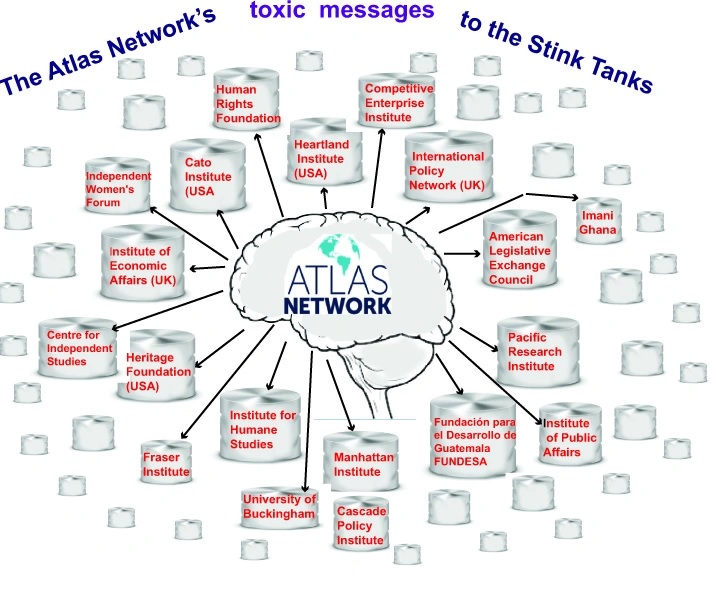
We have a handful of years to achieve a monumental shift from fossil fuel towards renewable energy: Atlas partners aim to ensure this does not take place.

March 3, 2024, by: Lucy Hamilton, https://theaimn.com/new-zealand-is-under-siege-by-the-atlas-network/—
Just as the Atlas Network-connected Advance body intervened in the Voice referendum in Australia and, in recent weeks, a by-election, similar organisations spawned from the American model are distorting New Zealand’s politics from within as well as from without.
One of the key researchers into the Atlas Network, Lee Fang, observed that it has “reshaped political power in country after country.” In America, every Republican president since Ronald Reagan has begun office with a Roadmap provided by the Heritage Foundation, primary Atlas Network partner. The “Mandate” for 2025 puts America on a hard path to fascism should a Republican win in November. Britain’s economy and standing have been savaged by Atlas partners’ impacts on the Tories. In New Zealand, the recently-elected rightwing coalition government is aping the new “Atlas president” of Argentina, aiming to privatise national assets, but is increasingly also imitating Atlas strategies recently seen in Australia, inflaming racial tensions and harming the wellbeing of Māori people.
Dr Jeremy Walker called Australia’s attention to the local Atlas partner organisations’ impact on the Voice to Parliament referendum and is now helping draw together the focus on the New Zealand partners’ very similar distortion of their national debate. There is a deep racism at the heart of this ultra-free market ideology that has licensed the international right to exploit resources and people around the globe untrammelled, largely in American corporate interest, but more broadly for any corporation or allied sector big enough to be a contender. (They do not, by contrast, fight for the renewable energy sector’s interests, as a competitor to their dominant fossil fuel donors; this shapes their climate crisis denial and delay, and colours their loathing of First People’s capacity to interfere with their profits by environment-driven protest. A sense of Western Civilisation as the apex of human existence and deep disdain for non-Western cultures also pervade the network.)
The Atlas model is to connect and foster talent in the neoliberal sphere. Young men (mostly) are funded or trained to replicate the talking points that Ultra High Net Worth Individuals (UHNWI) and lobbyists have built into a global network of over 500 bodies in 100 nations. The fact that neoliberal orthodoxies are more religious ideology that fact-based theories explains why their impact has been so utterly disastrous everywhere they have reshaped societies. The goal is to spawn replicating bodies with benign-sounding names that promote the UHNWI and corporate talking points – but with a veil hiding the self-interest that is obvious when those groups speak for themselves. Some of the bodies feign being thinktanks, which George Monbiot recently renamed junktanks to clarify their disingenuousness. Others are “astroturf” organisations that pretend to be grass roots bodies representing popular opinion. Another model is the beach-head in universities, an independent organisation within those institutions intended to dignify the neoliberal religion and the chosen strategies, including climate denial. All these produce material to fill civic debate and train more acolytes to enter politics, strategy companies and junktanks. Mainstream media elevates their standing by hosting their operatives as experts without explaining that the benign-sounding organisation to which they belong is a foreign-influence operation’s local outlet.
These groups damage local conditions to favour international corporations. They lobby for the removal of the “regulations” that are actually protections for the public – as workers, as consumers, as residents. They push for the privatisation of national treasures so that (often foreign) corporations can exploit the profits at the expense of the public. The greater the damage to the local democracy, the easier it is for them to act unimpeded. The stronger their infiltration of the media, the harder it is for the local electorate to understand the stakes. The politicians and strategists that emerge from the sphere (or are its allies) know that none of this wins votes, so they fill the space with culture war division to distract the voter from paying attention. Race and sexuality are their most obvious targets, as reactionary nostalgia for a mythical past of white picket fences pervades their ideology: a valorisation of “Christianity” and “family” and the “sacredness of marriage” (preached by adulterous politicians) is equally apparent in their propaganda.
The coalition that took power in NZ late in 2023, after a campaign centred on attacking the country’s founding Waitangi Treaty, has considerable Atlas infiltration. There is concern about Atlas fossil fuel and associated tobacco interests perverting policy in parliament, as well as senior ministerial aides who might be compromised. The government has promised to repeal Jacinda Ardern’s ban on offshore gas and fuel exploration, plans to sell water to private interests, not to mention planning to enable the selling off of “sensitive” NZ land and assets to foreign corporations, just as Argentinian Milei is intending.’
One of the government members, the Act Party, began its existence as an Atlas partner thinktank and continues that close connection. It was founded by former parliamentarian Denis Quigley with two members of the Mont Pelerin Society (MPS), the Atlas Network’s inner sanctum. One, Roger Douglas, was responsible for Rogernomics in NZ which has been described as a “right wing coup” that worked to “dismantle the welfare state.” The other, Alan Gibbs, who has been characterised as the godfather of the party, and a major funder, argued Act ought to campaign for government to privatise “all the schools, all the hospitals and all the roads.” This may not be surprising since he made much of his fortune out of the privatisation of NZ’s telecommunications.
The Act Party is currently led by David Seymour who functions as a co-deputy prime minister in the government. He has worked almost his entire adult life within Atlas partner bodies in Canada and boasts a (micro) MBA dispensed by the Network.
In Seymour’s 2021 Waitangi Day speech, he acknowledged his “old friends at the Atlas Network.” In light of that, his recent disdainful and absolute dismissal of the party’s connection to Atlas in an interview was telling: he clearly felt the association was damaging enough to lie outright.
Seymour is also deeply antagonistic to policies dedicated to repairing the disadvantage suffered by Māori people, disingenuously describing provisions that work cooperatively with Māori people as the “dismantling of democracy.” He appears antagonistic to Māori culture.
Another Atlas partner that has been key to distorting debate in NZ is the Taxpayer Union (TPU) which is emblematic of the production of metastasising bodies central to the Atlas strategy. Its co-founder and executive director is another graduate of the Atlas (micro) MBA program. Jordan Williams (currently “capo di tutti capi” of the Atlas global alliance of anti-tax junktanks) laughably depicts Atlas as a benign “club of like-minded think tanks.” He created, however, a body called the Campaign Company which helped radicalise the established farmer power base in NZ politics, planting sponsored material in the media. Williams claimed to grant the farmers “world-class campaign tools and digital strategies.” He also co-founded the Free Speech Union (FSU), which is unsurprisingly fighting regulation of the damaging impact of internet disinformation as well as fostering culture war battles.
A further spin-off of the bodies illustrates the increasing ugliness of the populist strategies. A former Act Party MP has founded the New Zealand Centre for Political Research which is fomenting civic division against Māori interests, including placing hate-mongering advertisements in the media.
The Act Party (alongside the populist New Zealand First party) is at the heart of the coalition government’s intention to destroy NZ’s admirable efforts to promote Māori interests for the betterment of the commonwealth, including the co-governance innovation. Efforts to undo disadvantage and programs that have promoted the distinctive NZ democratic experiment are set to be dismantled. A “massive unravelling” of Māori rights is at stake.
It is not only Māori people who will suffer. The NZ coalition government is also attempting a kind of “shock therapy” that did so much to tip first Chile and then other “developing” nations into brutal pain in pursuit of market “freedom.” The MPS was at the heart of Pinochet’s neoliberal brutality, resulting from Nixon’s injunction to make the Chilean economy scream.[1] New Zealand now faces cuts to a range of services, welfare and disability payments, even while the new PM, one of NZ’s wealthiest ever holders of the role, charged the taxpayer NZD 52,000 to live in his own property. It’s important to remember that this kind of entitlement is the sort that the neoliberals like, alongside subsidies to industry and corporations.
Lord Hannan (one of Boris Johnson’s elevations to the peerage, and a junktank creature) recently spoke in NZ, welcoming “all the coalition partners around this table” to hear his oration. There he celebrated the small percentage of GDP that NZ’s government spends on its people, cheering on the TPU’s power. He also disdained the “tribalism” that has dictated recognition of First Peoples’ suffering. There is grand (but unsurprising) irony in a graduate of three of Britain’s preeminent educational institutions dictating that humanity’s essential equality is all that can be considered when devising policy, particularly in settler-colonial nations.
Amusingly the weightier debunking of the Atlas connections has come from: Chris Trotter, formerly centre left, now a council member of Williams’ FSU; Eric Crampton, chief economist of the New Zealand Initiative, NZ’s leading Atlas partner and Sean Plunkett whose “anti-woke” vanity media platform, Platform, is plutocrat funded and regularly platforms the NZI talking heads.
While Atlas’s system largely functions to connect and train operatives, as well as acting as an extension of American foreign policy, this modest-seeming program must not be ignored. We have a handful of years to achieve a monumental shift from fossil fuel towards renewable energy: Atlas partners aim to ensure this does not take place.
And Atlas partners will push us at each other’s throats while we procrastinate.
[1] That MPS intervention resulted in massive unemployment, extraordinary inequality, and fire-sale prices of national assets to cronies. Much of Chile’s later success is as likely to be attributable to the trade requirements of (statist) China whose demand for copper has done so much to enrich Chile.
US-Funded Group Removes Report Warning of Famine in North Gaza After Complaint From US Ambassador
In a statement denouncing the report, the US ambassador to Israel acknowledged Israel’s ethnic cleansing campaign in northern Gazaby Dave DeCamp December 26, 2024
The Famine Early Warning Systems Network, a project funded by the US Agency for International Development (USAID), has removed a report from its website that warned it was “highly likely” famine is occurring in northern Gaza after a complaint by the US ambassador to Israel.
The report noted that Israel has imposed a “near-total blockade of humanitarian and commercial food supplies” on the North Gaza Governorate, which includes the cities of Beit Lahia, Beit Hanoun, and Jabalia. The report said 65,000 to 75,000 civilians remained in the area, “including civilians who have been unable to or prevented from evacuating.”
US Ambassador Jack Lew issued a statement slamming the report, saying there are far fewer civilians in those areas, an acknowledgment of the ethnic cleansing campaign that Israel has been conducting in northern Gaza since early October.
“The report issued today on Gaza by FEWS NET relies on data that is outdated and inaccurate,” Lew said. He claimed that there are somewhere between 7,000 and 15,000 civilians in the North Gaza Governorate.
“At a time when inaccurate information is causing confusion and accusations, it is irresponsible to issue a report like this,” the US ambassador said.
FEWS Net said it used UN numbers from mid-November and that it would update its report with the latest figures. But the group did not withdraw its assessment that famine was likely occurring in north Gaza.
Last month, the Integrated Food Security Phase Classification (IPC) said there was a strong likelihood famine was occurring in north Gaza.
Lew also claimed that the US has worked to ensure more humanitarian access in north Gaza, but the area has been under a total siege, and only 12 aid trucks have been able to make deliveries since October 6. Israel has forcibly displaced civilians from the area under the threat of death, either by shooting, bombing, or starvation, following an outline known as the “general’s plan.”
Black Money, Black Flags: How USAID Paved the Way for Syria’s Militant Takeover
By Alex Rubinstein / MintPress News,21 Dec 24
As the designated terrorist group Hayat Tahrir al-Sham (HTS) establishes its proto-government in Idlib, notoriously corrupt NGOs are stepping in to fill the gaps in public services, with some even defecting to work alongside the group.
The United States, which spent two decades and $5.4 trillion overthrowing governments hostile to al-Qaeda, now finds itself in a paradoxical position. Modern al-Qaeda has carved out its own quasi-state in Syria, yet remains on the U.S. list of Foreign Terrorist Organizations. To characterize this as a foreign policy misstep would be reductive; the U.S. has actively facilitated HTS’s conquest of parts of Syria while maintaining its official terrorist designation.
For the past five years, HTS, an al-Qaeda offshoot, has sought to rehabilitate its image. Its leader, Abu Mohammad al-Jolani—a former high-ranking member of both ISIS and al-Qaeda—has led a calculated charm offensive, attempting to rebrand the group from one focused on violence and minority persecution to a more palatable local governance entity.
Since establishing HTS and a proto-government called the Syrian Salvation Government, or SSG, the group’s leader, al-Jolani has expended a good deal of energy talking about topics intended to normalize the idea of a-Qaeda’s statehood; things like ‘institutions,’ and ‘structures.’ This, coupled with al-Jolani’s sudden embrace of Syria’s diverse tapestry of minority groups, has made up the main pillars of the terror group’s rebrand. Al-Jolani himself credits the establishment of quasi-state structures for the group’s sudden success in taking over Syria.
This shift in focus from the elimination of infidels to the establishment of good governance was given the spotlight in an article in the Telegraph entitled ‘How Syria’s ‘diversity-friendly’ jihadists plan on building a state.’ Published five days before President Assad fled the country, the article seemingly understood a total takeover by HTS to be a fait accompli…………………………………………………………………………………………………………………
Al-Jolani would take much of the remainder of the interview as an opportunity to deliver his stump speech on building inclusivity. And, of course, in the immediate aftermath of HTS’ takeover, gruesome videos of torture and executions aimed at Syria’s Alawite community flooded social media, dispelling the terrorist group’s progressive propaganda. And while it has only been a few years since HTS was carrying out suicide bombings, other groups that helped al-Jolani’s offensive have received next to zero coverage in Western media.
These groups include Ahrar al-Sham, which has been accused of war crimes, kidnappings, torture and potential use of chemical weapons by Amnesty International. Also involved in the offensive was Nour al-Din al-Zenki, a “moderate rebel” group supported by the United States until 2017, when footage emerged of its members gleefully beheading a teenager.
Yet, the horrifying history of these al-Qaeda offshoots has not given much pause to the White House. Just days after Assad’s egress, Joe Biden noted that the designated terrorist groups that had hijacked state power in Syria were “saying the right things.” Additionally, Biden promised more humanitarian and to “engage with all Syrian groups” with the goal of establishing a new government and constitution.
Make no mistake, some of the rebel groups that took down Assad have their own grim record of terrorism and humanit- — human right [sic] abuses. We’ve taken note of statements by the leaders of these rebel groups in recent days. And we’re — they’re saying the right things now, but as they take on greater responsibility, we will assess not just their words, but their actions.”
…………………………………………………………….. Implementing Partners – in Crime
Since the start of the war, USAID and the State Department’s Bureau of Humanitarian Assistance (BHA) have spent more than $18 billion on “humanitarian assistance” in Syria and more than $1.2 billion in fiscal year 2024 alone, oftentimes employing notoriously corrupt NGO partners to do the dirty work.
In a PBS interview with James Jeffrey, the United States Special Representative for Syria Engagement, Jeffrey admitted that “in 2018, my focus was — at the very center of everything I was doing was Idlib. And in Idlib, he [al-Jolani] was the strongest force.” Thus, USAID was confronted with a problem: how to deliver aid to a region ruled by a group they were legally prohibited from aiding.
………………………………………………………………….. While these instances of fraud, corruption, and supporting terrorist groups by USAID’s NGO partners are shocking, what is perhaps even more shocking is that these same NGOs continue to enjoy support from USAID despite the scandals. In fact, far from cutting these organizations off from future contracts, USAID continues to this day to actively encourage donations to Catholic Relief Services and the International Medical Corps………………………………………………………………………………………………………………………………………………….. more https://www.mintpressnews.com/black-money-black-flags-how-usaid-paved-the-way-for-syrias-jihadist-takeover/288876/
References to ‘inducing a North Korean attack’ found in ex-military official’s notes
2024-12-24 , By Lee Ji-hye, staff reporter, HANKYOREH,
A notebook found at the home of Roh Sang-won, the former Defense Intelligence Command, included jottings about shooting people to death and “concentration and handling” of those who were to be arrested.
A memo written by Roh Sang-won, the former head of the Defense Intelligence Command identified as the secret mastermind of the Dec. 3 insurrection attempt, contained the phrases “inducing a North Korean attack around the Northern Limit Line (NLL),” and “trash balloons.” With evidence pointing to attempts to stoke conflict with North Korea surfacing, police have stated that they are investigating President Yoon Suk-yeol, his former defense chief Kim Yong-hyun, and others on suspicions of treason.
Roh’s notebook also mentioned the “means of concentration and handling” of those who were to be arrested, even going so far as to suggest “execution by shooting.” Such drastic phrases suggest those plotting to punish so-called “anti-state forces” may not have been satisfied with simply detaining these figures.
The special unit investigating the martial law declaration under the Korean National Police Agency’s National Office of Investigation announced on Monday that Roh’s notebook contained the phrase “inducing a North Korean attack around the Northern Limit Line (NLL).”
When asked by Democratic Party lawmaker Youn Kun-young whether “trash balloons” also appeared in Roh’s notebook during a plenary session of the parliamentary Public Administration and Security Committee on the same day, Woo Jong-soo, the head of the National Office of Investigation, confirmed that the phrase was spotted in the notebook.
This is the first time that a plot to provoke North Korea has been confirmed in the investigation into the Dec. 3 insurrection attempt……………………………………………………………………………..more https://english.hani.co.kr/arti/english_edition/e_national/1174701.html
Pentagon Admits It’s Been Lying About the Number of Troops in Both Iraq and Syria
December 25, 2024, By Dave DeCamp / Antiwar.com, https://news.antiwar.com/2024/12/23/pentagon-admits-its-been-lying-about-the-number-of-troops-in-both-iraq-and-syria/
The Pentagon said on Monday that the US has more troops deployed in Iraq than it has been disclosing, an admission that comes after it revealed there are significantly more US troops in Syria than the US has said.
For years, the Pentagon has said there are 900 troops in Syria and 2,500 in Iraq. Last week, Pentagon spokesman Maj. Gen. Pat Ryder revealed the US was lying about the number of troops in Syria, saying the real number is 2,000.
In a statement meant to clarify the situation that was released on Monday, Ryder also said there were more than 2,500 US troops in Iraq but refused to say how many. “However, due to operations security and diplomatic considerations, we do not have any more specifics to provide,” Ryder said.
Ryder’s statement revealed that the number of US troops in Syria has been higher than publicly disclosed since 2020. “In addition to the approximately 900 baseline troops, there are also approximately 1,100 US military personnel in Syria that deploy for shorter durations as temporary enablers in support of force protection, transportation, maintenance, or other emerging operational requirements,” Ryder said.
“The numbers of these additional temporary forces have fluctuated over the past several years based on mission needs but in general have increased over time as the threat has increased to baseline forces,” he added.
Lying about the actual number of US troops in Syria goes back to at least the Trump administration. In 2020, James Jeffrey, the outgoing US envoy for Syria at the time, admitted his team was “always playing shell games to not make clear to our leadership how many troops we had there.” In 2019, after reversing an order to withdraw all troops from Syria, Trump agreed to keep 200 in the country. But Jeffrey said there was “a lot more” than that deployed.
In his statement on Monday, Ryder also said that “some additional temporary enablers” had been deployed alongside the 2,500 US troops in Iraq.
Sources told CNN that the US had been lying about the number of US troops in Syria because it didn’t want to anger neighboring countries, particularly Iraq, where the presence of US troops is strongly opposed by many political factions.
The sources said the US was worried if Iraqi officials found out the US had more troops in Syria than it was disclosing, officials would fear the same is happening in Iraq. Ryder’s statement that there are more than 2,500 US troops in Iraq will likely cause trouble for Iraqi Prime Minister Mohammed Shia al-Sudani, who has been under significant pressure to get the US to leave.
Earlier this year, after a series of US airstrikes on Iraq, al-Sudani called for US troops to leave, and his government entered negotiations with the US. The two sides reached a deal that was announced in September, but it will only formally end the mission of the US-led anti-ISIS coalition and says US troops will remain in the country under a “bilateral security partnership.”
No more research for genocide at MIT !

Every human on this planet, especially those of us at MIT, is morally obligated to use their voice, body, and labor to make an immediate material impact toward ending the ongoing genocide.
By MIT Coalition For Palestine, Mondoweiss, December 22, 2024,
https://popularresistance.org/no-more-research-for-genocide-at-mit/
Despite Censorship And Intimidation We Continue To Make This Demand.
An MIT lab is collaborating with the Israeli military to develop AI surveillance algorithms and the university censored a campus publication that tried to expose it. We refuse to be intimidated and continue to demand: No More Research for Genocide.
On November 7th, we published an op-ed titled “Daniela Rus, The People Demand: No More Research for Genocide” in the MIT Tech. Our piece detailed how Prof. Daniela Rus, director of MIT’s Computer Science and Artificial Intelligence Laboratory, uses Israeli Ministry of Defense money to develop algorithms with applications in “multirobot security defense and surveillance.” Rather than engage with these publicly verifiable facts, the Tech’s editorial board (under the guidance of Prof. Rus) retracted our op-ed.
MIT sent several of us “no contact” and “no harassment” orders for Prof. Rus, disciplining one student for simply writing our Op-Ed’s title on a public chalkboard! As if this naked intimidation wasn’t enough, the Tech indefinitely halted all Op-Eds after retracting our piece. This comes directly after the suspension and effective expulsion of MIT PhD student Prahlad Iyengar, in part due to an email he sent Professor Rus’ students “offering support” and a “safe space” to discuss her research.
We refuse to be intimidated by MIT. Professor Rus takes money from a genocidal army to do research with military applications (stated in her own papers here, here and here). Retractions and suspensions cannot change these simple facts. Here, we republish our article in full:
Daniela Rus, The People Demand: No More Research For Genocide
Today, MIT’s Computer Science and Artificial Intelligence Laboratory (CSAIL) conducts research funded by the Israeli Ministry of Defense (IMoD), with direct applications to the ongoing genocide in Gaza. We, the MIT Coalition for Palestine, whose tuition and labor support CSAIL, call on CSAIL Director Daniela Rus to lead by example and end her IMoD-sponsored research.
Rus currently leads the project “Coreset Compression Algorithms,” which has received $425,000 in direct sponsorship from the IMoD since 2021, according to MIT’s 2024 Brown Books. This project develops AI algorithms for applications like “city-scale observation systems” and “surveillance and vigilance”. Many of these lightweight algorithms are ideal for teaching small unmanned vehicles, including drones, to track and pursue targets with increased autonomy. Notably, navigating human environments is central: “a human may provide the global path… and the robots will adapt their configuration automatically”.
Many of us have friends and family surveilled and killed by the Israel Defense Forces (IDF) drones streamlined by Rus’s research. These quadrotor drones are used extensively to monitor, injure, and kill Palestinian civilians at close range. Last Wednesday, October 30, 2024, Palestinian poet Mosab Abu Toha shared videos showing Israeli bombs destroying his home, including footage of a quadrotor drone with a mounted machine gun just meters away. He described how Israel’s relentless indiscriminate bombardment in Gaza has wiped out entire families he knew. Stories like his have become the norm for families in Gaza.
As we write this piece, Jabalia has been under constant siege for a month. The Israeli military is targeting hospitals and burning patients alive. The government blocks access to life-saving humanitarian supplies, worsening Gaza’s already severe health crisis, all while threatening, targeting, and killing journalists attempting to report on these war crimes. At this time, it is our moral responsibility to do everything in our power to disrupt and dismantle all which enable the continuing of this genocide.
There has been a long-standing demand for Rus’s IMoD-sponsored projects to end.
The MIT Coalition for Palestine (C4P) is a group of MIT students, staff, faculty, community members, and campus organizations who refuse to devote their labor to companies complicit in Israeli apartheid, occupation, and the violation of Palestinian human rights. Daniela Rus was first contacted by the C4P on March 8th, 2024 by email where she was informed of how her IMoD-sponsored projects made her complicit in the ongoing genocide in Gaza.
Without response, we then emailed out to the graduate students in her lab informing them of these ties and of potential alternative funding arrangements. In April, we launched the Scientists Against Genocide Encampment, where we consistently highlighted her lab’s IMoD ties to the school and community.
Over a year of accelerating genocide has now since passed, seven months since we first contacted Rus, and she continues her research, violating MIT’s own rules for research sponsorship. On Tuesday October 22, 2024, the Coalition Against Apartheid, a member organization of C4P, delivered a second letter in-person to her CSAIL office, chanting and flyering in the process.
We are committed to engaging in continuing action because it works. For instance, The U.S. arm of Israeli defense contractor Elbit Systems recently ended its lease of office space in Cambridge after months of demonstrations by pro-Palestinian protestors. This win reinforces our resolve, and reminds us of a crucial lesson: the only way to make material disruptions for these inhumane systems is to continuously raise the cost for conducting research for genocide.
MIT’s police and disciplinary response against peaceful demonstrators was swift and unjust.
Within fifteen minutes, MIT escalated the situation with police force by violently arresting student protestors and detaining others for merely chanting and passing out flyers. At one point, there were four to six cops pinning down one person. Even those who were simply filming the arrests were detained, pushed around, and groped. There was no warning or attempt by faculty or administrators to engage with the students in order to understand their actions. Three days after the protest, eight students received interim sanction letters from the MIT Committee on Discipline (COD).
This interim letter did not indicate what charges students were being prosecuted for. Rather, they prohibited the students from entering common student spaces in CSAIL, where some of these students work. They also issued three no-contact orders to students: one for Rus, one for her collaborator on IMoD-funded projects Eytan Modiano, and one for Jack Costanza, a CSAIL employee who physically assaulted students in an attempt to unlawfully aid police in their arrests. None of the students were given the chance to review or respond to the charges. Once again, the COD demonstrates it operates primarily on the premise of treating political dissidents as “guilty until proven innocent.”
One week later, students received their alleged charges from the COD. All eight of them, whether they were chanting, putting a flyer up on a wall with painter’s tape, or simply video-taping the protest, received the same charges: assault, disorderly conduct, harassment, and threats/intimidation. COD Chair Tamar Schapiro later verbally admitted to one student in a meeting that she was aware none of the protestors assaulted anyone. Yet she still sent the letters accusing all eight of the students of assault. The COD systematically criminalizes the Coalition for Palestine as a community for protesting genocide. By indiscriminately instating a blanket no-contact order against all individuals who received a discipline letter, the COD draws a direct parallel between the acts of collective punishment MIT inflicts on pro-Palestinian advocates on its campus, and the collective punishment that Israel has long been inflicting on Palestinians themselves.
Discipline against pro-Palestinian students reinforces systemic racism at MIT.
Over the past year, MIT’s administration’s response to protests against genocide continues to be reflective of MIT’s longstanding racist and xenophobic systems. Students have attempted time and time again to address these issues, as described in this article by the Black Graduate Students Association. Despite the manufactured facade of an MIT community that is safe for students of minoritized backgrounds, racism at MIT has persisted over the last year at an institutional level.
At an institutional level, the MIT administration has been emboldened to continue to weaponize the police and inconsistent “academic” disciplinary proceedings in order to disproportionately target Black and Brown students. In the past year, 87% of the people MIT has disciplined, relating broadly to protest activity, have been people of color. Just consider MIT’s response to the letter delivery protest of Rus’ lab: people of color made up 8 out 13 student protestors present, yet 7 out of 8 people who received letters from the CoD were people of color. In addition to the disciplinary discrimination we face, many of us on campus feel incredibly unsafe, as the Institute of Discrimination Harassment and Reporting (IDHR) has failed to follow up on at least thirty reports of harassment against us. Simultaneously, IDHR selectively applies sanctions against us without evidence. To MIT, we are solely perceived as threats, never as victims. When Tamar Schapiro was asked to clarify the discipline, she told one female student that as a woman, she should understand that Daniela Rus felt unsafe by the demonstration, even though she was not even present in the lab at the time. What about the women in Gaza who fear being killed by the very technology Daniela Rus’s work contributes to? What about the women of color on campus who fear being unjustly brutalized by the frequent displays of disproportionate police violence? Tamar Schapiro, and MIT as a whole, fail to acknowledge the tangible fears of marginalized women, yet prioritize the theoretical fears of white women. This twisted, victim-blaming, racist logic matches the insinuation of Provost Barnhart in the previous Spring semester, wherein she justified the interim suspensions and eviction threats of 27 people by suggesting that MIT apply the same disciplinary measures previously reserved for when individuals are immediately at risk of sexual assault. As long as we have a broken reporting system, rapists and sexual offenders continue to freely walk on campus while students of color are treated as criminals for protesting a genocide.
To Daniela Rus and the world: no more labor for apartheid and genocide!
At the end of the day, MIT’s racism and racist discipline cannot counteract one fact: Daniela Rus is complicit in doing research for genocide. She has been complicit since 2012 when the sponsorship was first established through her then-postdoc, Dan Feldman, who currently works at University of Haifa in occupied Palestine. Professor Rus continues to deny her evident, present-day connections to the IMoD while flaunting her other morally dubious connections, such as her recent public statement of admiration, at her October book talk, for Marvin Minsky, alleged co-perpetrator of notorious pedophile Jeffrey Epstein.
As students of conscience, we cannot stand for this. The time to take action is now. We therefore call on Daniela Rus to immediately terminate all IMOD-funded projects and for MIT to provide transitional funding to all affected graduate students, in line with how MIT terminated financial ties with the Skoltech Institute in Russia the day after the Russian invasion of Ukraine.
Why are we here at MIT? What purpose is there to any of the science and research being done on this campus when we know that ultimately our work will be used for mass murder and exploitation? It is the current leadership at MIT that is ensuring that the great potential of this community is being abused to oppress individuals globally. Therefore, it will take all people of conscience at this institution to change the course we are currently on to force MIT to embody the values it claims to have. We cannot rest until MIT completely cuts ties and divests from all entities that support genocide and colonialism.
Every human on this planet, especially those of us at MIT, is morally obligated to use their voice, body, and labor to make an immediate material impact toward ending the ongoing genocide.
1 This Month


Shut down the radiation-damaged Heysham nuclear reactors now
To see nuclear-related stories in greater depth and intensity – go to https://nuclearinformation.wordpress.com

Say No to NASA’s Reckless Nuclear Reactor on the Moon
Say No to NASA’s Reckless Nuclear Reactor on the Moon
-
Archives
- October 2026 (256)
- September 2026 (339)
- August 2026 (330)
- July 2026 (355)
- June 2026 (287)
- May 2026 (306)
- April 2026 (356)
- March 2026 (251)
- February 2026 (267)
- January 2026 (308)
- December 2025 (358)
- November 2025 (359)
-
Categories
- 1
- 1 NUCLEAR ISSUES
- business and costs
- climate change
- culture and arts
- ENERGY
- environment
- health
- history
- indigenous issues
- Legal
- marketing of nuclear
- media
- opposition to nuclear
- PERSONAL STORIES
- politics
- politics international
- Religion and ethics
- safety
- secrets,lies and civil liberties
- spinbuster
- technology
- Uranium
- wastes
- weapons and war
- Women
- 2 WORLD
- ACTION
- AFRICA
- Atrocities
- AUSTRALIA
- Christina's notes
- Christina's themes
- culture and arts
- Events
- Fuk 2022
- Fuk 2023
- Fukushima 2017
- Fukushima 2018
- fukushima 2019
- Fukushima 2020
- Fukushima 2021
- general
- global warming
- Humour (God we need it)
- Nuclear
- RARE EARTHS
- Reference
- resources – print
- Resources -audiovicual
- Weekly Newsletter
- World
- World Nuclear
- YouTube
-
RSS
Entries RSS
Comments RSS

