India’s National Nuclear Safety Authority Bill aims to hide nuclear information
 The government also intends to amend the RTI law to exempt the proposed nuclear energy regulator – the National Nuclear Safety Authority – from the ambit of the transparency law….the bill seeks to amend the RTI law to prevent seeking of information on the grounds of “the larger public interest”..
 New laws to get around Right To Information act, Chetan Chauhan, Hindustan Times New Delhi, October 17, 2011 India’s transparency law – the Right To Information Act – will not change but the government wants to restrict its applicability to some areas of sports and nuclear safety through other laws.
Two new draft laws – the National Sports Development Bill and the National Nuclear Safety Authority Bill – have specific provisions prohibiting disclosure of information in addition to the exemption clauses already in the RTI law Continue reading
Money talks louder than the public good, in the issue of uranium mining
 Editorial: There’s green in that thar canyon The Daily Courier, 13 Oct 11, We smell something surrounding this week’s battle to open 1 million acres near the Grand Canyon for mining, and that something is political money.
Nuclear terrorism in London – the murder of Alexander Litvinenko

 Alexander Litvinenko murder was ‘London nuclear terror’, BBC News 13 Oct 11 The murder of Russian dissident Alexander Litvinenko was “an act of nuclear terrorism on the streets of London”, a coroner has heard.
Mr Litvinenko died in 2006 after he was apparently poisoned with the radioactive substance polonium-210. Ben Emmerson QC said 700 people had to be tested for radioactive poisoning.St Pancras coroner Dr Andrew Reid is holding a pre-inquest review where he will decide whether he or a top judge should hear the inquest into the death.
‘Grave suspicion’ Mr Emmerson, representing Mr Litvinenko’s family, said a number of locations were closed for several months as health agencies tried to contain the risk of contamination. He told the hearing at St Pancras coroner’s court in London that the case gave rise to the “grave suspicion” that Mr Litvinenko’s death was the result of state-directed execution by Russia.
British authorities had abandoned the search for truth in order to maintain trade relations with the Russian government, he added. The prime suspect for Mr Litvinenko’s death is ex-KGB officer Andrei Lugovoi who was represented in court. His legal team says he denies any involvement.The family of former Russian spy Mr Litvinenko has called for a senior High Court judge to be appointed to conduct the inquest. http://www.bbc.co.uk/news/uk-15293395
Shroud of secrecy over USA nuclear loan guarantee program
 Nuclear Secrecy – Plant Vogtle Federal Loan Guarantee History Clean Energy.org October 13th, 2011 Sara Barczak After more than a year and a half of stonewalling by the U.S. Department of Energy (DOE), the Southern Alliance for Clean Energy (SACE) continues to press ahead with our Freedom of Information Act (FOIA) litigation so that U.S. taxpayers can learn the full extent of the risks to which they are exposed in the massive commitment of$8.33 billion in conditional federal loan guarantees to Southern Company and their utility partners for two proposed new nuclear reactors at Plant Vogtle in Georgia. Continue reading
 France increases fines, cracks down on anti nuclear protestors
Post-Fukushima, France breaks silence on nuclear safety, The Hindu VAIJU  NARAVANE, 11 Oct 11 “…….France has always come down hard on any anti-nuclear protests and there has been very little debate on the decision taken in the 1950s or under the post-oil-crisis Messmer Plan of 1974, to wholeheartedly embrace nuclear energy. An appeals court in the northern city of Caen on September 27, upped the fines slapped on Greenpeace France for occupying the nuclear site at Flamanville (Normandy) where France’s first EPR reactor is under construction.
Greenpeace France will now have to pay €2,500 instead of the initial €1,500 and individual protesters will have to cough up fines of €200 each. The French electricity giant EDF, which is the constructor and future operator of the reactor, had called for damages and interest amounting to €155,000…. http://www.thehindu.com/opinion/op-ed/article2526288.ece
Israel prevents nuclear whistleblower Vanunu from emigrating

 Israel bars nuclear whistle-blower from emigrating: media, Google News, 7 Oct 11 JERUSALEM — Israel’s supreme court on Thursday barred nuclear whistle-blower Mordechai Vanunu from emigrating on the grounds he still poses a threat to state security, Israeli media reported. Vanunu, under orders to stay in Tel Aviv and not to speak to journalists, “has proved several times he can not be trusted and does not respect the letter of the law,” supreme court judges said in turning down his appeal.
The prosecution charged he posed “a real danger to the security of Israel,” while the judges stressed the 56-year-old former nuclear technician had contacts with unspecified “foreign elements.”
Vanunu served 18 years behind bars for disclosing the inner workings of Israel’s Dimona nuclear plant to Britain’s Sunday Times newspaper in 1986. He was released in 2004 but banned from travel or contact with foreigners without prior permission. He has since been sanctioned more than 20 times for breaking the rules.
Israel is widely believed to be the only nuclear-armed power in the Middle East, with between 100 and 300 warheads, but it has a policy of neither confirming nor denying that.
The Jewish state has refused to sign the nuclear Non-Proliferation Treaty or to allow international surveillance of its Dimona plant in the Negev desert of southern Israel. http://www.google.com/hostednews/afp/article/ALeqM5g9x-LXW9KK7ZK3qTE9Lev88ZJTHg?docId=CNG.c05571d1da8b533f5fbbc6407b4da20d.ae1
TEPCO hides nuclear information from politicians and public
 Tepco fights to keep nuclear emergency procedures secret, FT.com By Jonathan Soble in Tokyo, October 4, 2011 Six months after the meltdowns at Fukushima Daiichi nuclear station, the Japanese utility that owns the plant is fighting to keep its pre-disaster emergency-response procedures a secret from politicians and the public, arguing they contain valuable trade information. Tokyo Electric Power angered members parliamentary committee last month when it handed over manuals outlining steps that its nuclear plant operators are meant to follow in the case of accidents.
All but a few words of the texts were redacted with black ink.
The storm of controversy that followed – one newspaper columnist compared it to wartime censorship – seems not to have softened the company’s stance. This week it asked Japan’s nuclear safety regulator, which had ordered it to resubmit the manuals without redaction, to allow it to keep much of the material secret. So far only the regulator, the Nuclear and Industrial Safety Agency (Nisa), has seen the originals, which run to thousands of pages. It has not passed them on to the lawmakers who originally requested them.
Tepco has told Nisa that if the manuals are to be made public, 90 per cent of the content related to “severe accidents” such as that at Fukushima should be kept under black ink. “The manuals contain knowhow that we have built up over a long period of operation,” a company spokesman said on Tuesday…. http://www.ft.com/intl/cms/s/0/2dc211b0-ee78-11e0-a2ed-00144feab49a.html#axzz1a2EVqNGT
Japan’s nuclear conspiracies to manipulate public opinion
Japan nuke companies stacked public meetings, ABC Radio 774 North Asia correspondent Mark Willacy, October 03, 2011 An independent investigation in Japan has revealed a long history of nuclear power companies conspiring with governments to manipulate public opinion in favour of nuclear energy. Continue reading
Secret negotiations over Mongolia becoming repositary for nuclear waste
the idea has become a political lightning rod, with the opposition Green Party charging that a waste facility could become an environmental and safety nightmare….
 the draft agreement, which has not been released but reportedly included a passage referring to Mongolia as a future destination for spent fuel……
“Mongolia is not an awfully democratic state,”

 Senior U.S. Official Denies Talk of Foreign Nuclear Waste Site in Mongolia, NTI Global Security Newswire, Sept. 30, 2011, By Elaine M. Grossman WASHINGTON — A senior U.S. Energy Department official on Wednesday disputed reports that the Obama administration has sought Mongolian support for construction of a storage site for international spent nuclear fuel in the Central Asian nation (see GSN, March 30).
The assertion — made by a high-ranking official who asked not to be named in addressing a diplomatically sensitive issue — directly countered remarks offered last spring by a veteran State Department official who leads U.S. nuclear trade pact negotiations. Continue reading
Coverup of ionising radiation as cause of lung cancer
 Karagueuzian and his team replicated the calculations that tobacco company scientists described in these documents and found that the levels of radiation in cigarettes would account for up to 138 deaths for every 1,000 smokers over a period of 25 years.
Tobacco Companies Knew of Radiation in Cigarettes, Covered It Up, By CARRIE GANN, ABC News Medical Unit, Sept. 29, 2011 Tobacco companies knew that cigarettes contained a radioactive substance called polonium-210, but hid that knowledge from the public for over four decades, a new study of historical documents revealed. Continue reading
Nuclear plant crew supervisor falsified safety records
2nd man charged for fake records at TVA nuke plant, Bloomberg, By BILL POOVEY, CHATTANOOGA, TENN. 28 Sept 11, A second contractor employee at the Tennessee Valley Authority’s Watts Bar Nuclear Plant has been charged with falsifying electrical cable inspection records … Continue reading
Collusion still, between Japanese government and nuclear industry
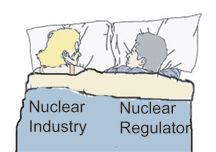 The collusive ties between government and industry were what undermined nuclear safety regulations. One would think that given the nuclear disaster, the practice of “amakudari” (literally “coming down from the heavens”), in which retiring bureaucrats acquire jobs in the industries that they formerly regulated, would have diminished, but that hasn’t been the case…..
Noda must make promoters of nuclear power take responsibility for disaster, Mainichi Daily News, By Takao Yamada, 26 Sept 11, “……..there’s something I want to ask Noda, and that is this: Haven’t you forgotten one very crucial issue? The big question that was on everyone’s minds just six months ago? That is, to clarify what responsibility the main promoters of nuclear power — also known as Japan’s “nuclear village” spanning industry, government and academia — have over the still ongoing disaster? Continue reading
Involvement of the West in sabotage and assassinations in Iran?
former officials said, the U.S. and its allies have secretly ramped up covert actions aimed at slowing Iran’s nuclear progress toward a bomb….
Ex-officials see signs US and allies have stepped up sabotage against Iran’s nuclear efforts Washington Post, 26 Sept 11WASHINGTON — Iran’s star-crossed nuclear and energy programs have suffered a rash of setbacks, mishaps and catastrophes in the past two years.
Assassins killed three scientists with links to Iran’s nuclear programs. The Stuxnet computer worm that famously infected computers worldwide zeroed in on a single target in Iran, devices that can make weapons-usable uranium. Dozens of unexplained explosions hit the country’s gas pipelines, and Iran’s first nuclear power plant suffered major equipment failures as technicians struggle to bring it online.
Has Iran just been unlucky? Probably not. Continue reading
USA’s Nuclear Regulatory Commission changed safety rules to benefit nuclear company
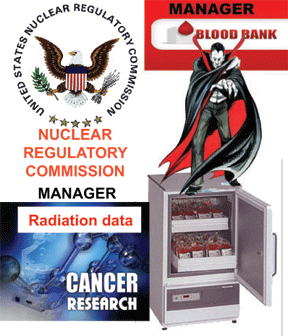 a decision by the NRC that “exempted” Indian Point from fire safety requirements that had been on the books for 30 years. ……And the “exemption” was granted in complete secrecy
NRC Cooks the Books at Indian Point, Policy Shop , 21 Sept 11, Richard Brodsky The Fukushima nuclear catastrophe opened the eyes and minds of most Americans to the dangers of Indian Point, and real mismanagement by the NRC. The NRC is supposed to ensure American nuclear reactors are not operated dangerously. There’s been widespread concern that the NRC isn’t doing what it’s supposed to do. Now we can prove it. Continue reading
Iran nuclear experts subjected to spying and assassinations
Iran nuclear chief says UK spies shadowed him, By Fredrik Dahl, VIENNA Sep 20, 2011 (Reuters) – Iran’s nuclear energy chief accused British spies on Monday of shadowing him around the world — even to the “back door” of his university office — to gather information ahead of a failed assassination attempt on him last year. Continue reading
1 This Month
26 September – International Day for the Total Elimination of Nuclear Weapons





PLEASE OPPOSE HR 8255 AND S.3639 – bills would accelerate satellite deployment, with no environmental review or safeguards – https://ncstd5li.quorum.us/campaign/169331/
To see nuclear-related stories in greater depth and intensity – go to https://nuclearinformation.wordpress.com
-
Archives
- September 2026 (323)
- August 2026 (330)
- July 2026 (355)
- June 2026 (287)
- May 2026 (306)
- April 2026 (356)
- March 2026 (251)
- February 2026 (267)
- January 2026 (308)
- December 2025 (358)
- November 2025 (359)
- October 2025 (375)
-
Categories
- 1
- 1 NUCLEAR ISSUES
- business and costs
- climate change
- culture and arts
- ENERGY
- environment
- health
- history
- indigenous issues
- Legal
- marketing of nuclear
- media
- opposition to nuclear
- PERSONAL STORIES
- politics
- politics international
- Religion and ethics
- safety
- secrets,lies and civil liberties
- spinbuster
- technology
- Uranium
- wastes
- weapons and war
- Women
- 2 WORLD
- ACTION
- AFRICA
- Atrocities
- AUSTRALIA
- Christina's notes
- Christina's themes
- culture and arts
- Events
- Fuk 2022
- Fuk 2023
- Fukushima 2017
- Fukushima 2018
- fukushima 2019
- Fukushima 2020
- Fukushima 2021
- general
- global warming
- Humour (God we need it)
- Nuclear
- RARE EARTHS
- Reference
- resources – print
- Resources -audiovicual
- Weekly Newsletter
- World
- World Nuclear
- YouTube
-
RSS
Entries RSS
Comments RSS

