Revealed: The Israeli Spies Writing America’s News

Mint Press News, October 16th, 2024, Alan Macleod
ne year after Oct. 7 attacks, Netanyahu is on a winning streak.” So reads the title of a recent Axios article describing the Israeli prime minister riding on an unbeatable wave of triumphs. These stunning military “successes,” its author Barak Ravid notes, include the bombing of Yemen, the assassinations of Hamas chief Ismail Haniyeh and Hezbollah leader Hassan Nasrallah, and the pager attack against Lebanon.
The same author recently went viral for an article that claimed that Israeli attacks against Hezbollah are “not intended to lead to war but are an attempt to reach ‘de-escalation through escalation.’” Users on social media mocked Ravid for this bizarre, Orwellian reasoning. But what almost everybody missed is that Barak Ravid is an Israeli spy – or at least he was until recently. Ravid is a former analyst with Israeli spying agency Unit 8200, and as recently as last year, was still a reservist with the Israeli Defense Forces group.
Unit 8200 is Israel’s largest and perhaps most controversial spying organization. It has been responsible for many high-profile espionage and terror operations, including the recent pager attack that injured thousands of Lebanese civilians. As this investigation will reveal, Ravid is far from the only Israeli ex-spook working at top U.S. media outlets, working hard to manufacture Western support for his country’s actions.
White House Insider
Ravid has quickly become one of the most influential individuals in the Capitol Hill press corps. In April, he won the prestigious White House Press Correspondents’ Award “for overall excellence in White House coverage”—one of the highest awards in American journalism. Judges were impressed by what they described as his “deep, almost intimate levels of sourcing in the U.S. and abroad” and picked out six articles as exemplary pieces of journalism.
Most of these stories consisted of simply printing anonymous White House or Israeli government sources, making them look good, and distancing President Biden from the horrors of the Israeli attack on Palestine. As such, there was functionally no difference between these and White House press releases. For example, one story the judges picked out was titled “Scoop: Biden tells Bibi 3-day fighting pause could help secure release of some hostages,” and presented the 46th President of the United States as a dedicated humanitarian hellbent on reducing suffering. Another described how “frustrated” Biden was becoming with Netanyahu and the Israeli government.
Protestors had called on reporters to snub the event in solidarity with their fallen counterparts in Gaza (which, at the time of writing, comes to at least 128 journalists). Not only was there no boycott of the event, but organizers gave their highest award to an Israeli intelligence official-turned-reporter who has earned a reputation as perhaps the most dutiful stenographer of power in Washington.
Ravid was personally presented with the award by President Biden, who embraced him like a brother. That a known (former) Israeli spy could hug Biden in such a manner speaks volumes about not only the intimate relationship between the United States and Israel but about the extent to which establishment media holds power to account………………………………………………………………………………………………………………………………………………………………………………………………………….
An Infamous Spy Agency
Founded in 1952, Unit 8200 is the Israeli military’s largest and most controversial division.
Responsible for covert operations, spying, surveillance and cyberwarfare, since October 7, 2023, the group has been at the forefront of the world’s attention. It is widely identified as the organization behind the infamous pager attack on Lebanon, which left at least nine dead and around 3,000 people injured. While many in Israel (and Ravid himself) hailed the operation as a success, it was condemned worldwide as an egregious act of terrorism, including by ex-CIA director Leon Panetta.
Unit 8200 has also constructed an artificial intelligence-powered kill list for Gaza, suggesting tens of thousands of individuals (including women and children) for assassination. This software was the primary targeting mechanism the IDF used in the early months of its attack on the densely populated strip.
Described as Israel’s Harvard, Unit 8200 is one of the most prestigious institutions in the country. The selection process is highly competitive; parents spend fortunes on science and math classes for their children, hoping they will be picked for service there, unlocking a lucrative career in Israel’s burgeoning hi-tech sector.
It also serves as the centerpiece of Israel’s futuristic repressive state apparatus. Using gigantic amounts of data compiled on Palestinians by tracking their every move through face recognition cameras monitoring their calls, messages, emails and personal data, Unit 8200 has created a dystopian dragnet that it uses to surveil, harass and suppress Palestinians.
Unit 8200 compiles dossiers on every Palestinian, including their medical history, sex lives and search histories, so that this information can be used for extortion or blackmail later. If, for example, an individual is cheating on their spouse, desperately needs a medical operation, or is secretly homosexual, this can be used as leverage to turn civilians into informants and spies for Israel. One former Unit 8200 operative said that as part of his training, he was assigned to memorize different Arabic words for “gay” so that he could listen out for them in conversations.
Unit 8200 operatives have gone on to create some of the world’s most downloaded apps and many of the most infamous spying programs, including Pegasus. Pegasus was used to surveil dozens of political leaders around the world, including France’s Emmanuel Macron, South Africa’s Cyril Ramaphosa, and Pakistan’s Imran Khan.
The Israeli government authorized the sale of Pegasus to the Central Intelligence Agency, as well as some of the most authoritarian governments on the planet. This included Saudi Arabia, who used the software to surveil Washington Post journalist Jamal Khashoggi before he was assassinated by Saudi agents in Türkiye.
A recent MintPress News investigation found that a large proportion of the worldwide VPN market is owned and operated by an Israeli company headed and co-founded by a Unit 8200 alumnus.
In 2014, 43 Unit 8200 reservists penned a joint statement declaring that they were no longer willing to serve in the unit on account of its unethical practices, which included making no distinction between ordinary Palestinian citizens and terrorists. The letter also noted that their intelligence was passed on to powerful local politicians, who used it as they saw fit.
This public statement left Ravid bristling with anger at his co-workers. In the wake of the scandal, Ravid went on Israeli Army radio to attack the whistleblowers. Ravid said that to oppose the occupation of Palestine was to oppose Israel itself, as the occupation is a fundamental “part” of Israel. “If the problem is really the occupation,” he said, “then your taxes are also a problem — they fund the soldier at the checkpoint, the education system… and 8200 is a great spin.”
Leaving aside Ravid’s comments, the question arises: is it really acceptable that members from a group designed to infiltrate, surveil and target foreign populations, that has produced many of the planet’s most dangerous and invasive spying technology, and is widely to be behind sophisticated international terror attacks, are writing Americans’ news about Israel and Palestine? What would the reaction be if senior figures in U.S. media were outed as intelligence officers for Hezbollah, Hamas, or Russia’s F.S.B.?
News About Israel, Brought to You by Israel
Ravid is far from the only influential journalist in America with deep ties to the Israeli state, however. Shachar Peled spent three years as an officer in Unit 8200, leading a team of analysts in surveillance, intelligence and cyberwarfare. She also served as a technology analyst for the Israeli intelligence service, Shin Bet. In 2017, she was hired as a producer and writer by CNN and spent three years putting together segments for Fareed Zakaria and Christiane Amanpour’s shows. Google later hired her to become their Senior Media Specialist.
Another Unit 8200 agent who went on to work for CNN is Tal Heinrich. Heinrich spent three years as a Unit 8200 agent. Between 2014 and 2017, she was the field and news desk producer for CNN’s notoriously pro-Israel Jerusalem Bureau, where she was one of the principal journalists shaping America’s understanding of Operation Protective Edge, Israel’s bombardment of Gaza that killed more than 2,000 people and left hundreds of thousands displaced. Heinrich later left CNN and is now the official spokesperson of Prime Minister Benjamin Netanyahu.
CNN’s penchant for hiring Israeli state figures continues to this day. Tamar Michaelis, for example, currently works for the network, producing much of its Israel/Palestine content. This is despite having previously served as an official IDF spokesperson in the Israeli Defense Forces.
The New York Times, meanwhile, hired Anat Schwartz, an ex-Israeli Air Force Intelligence officer with zero journalistic experience. Schwartz co-wrote the infamous and now discredited “Screams Without Words” expose, which claimed that Hamas fighters systematically sexually violated Israelis on October 7. Times staff themselves revolted over the lack of evidence and fact-checking in the piece.
Multiple New York Times employees, including star columnist David Brooks, have had children serving in the IDF; even as they report or offer opinions on the region, the Times never disclosed these glaring conflicts of interest to its readers. Nor has it disclosed that it purchased a Jerusalem house for its bureau chief that was stolen from the family of Palestinian intellectual Ghada Karmi in 1948.
MintPress News interviewed Karmi last year about her latest book and Israeli attempts to silence her. Former New York Times Magazine writer and current editor-in-chief of The Atlantic Jeffrey Goldberg (an American) dropped out of the University of Pennsylvania to volunteer as an IDF prison guard during the first Palestinian Intifada (uprising). In his memoirs, Goldberg revealed that, while serving in the IDF., he helped cover up the abuse of Palestinian prisoners.
Social media companies, too, are filled with former Unit 8200 agents. A 2022 MintPress study found no fewer than 99 former Unit 8200 operatives working for Google.
Facebook also employs dozens of ex-spooks from the controversial unit. This includes Emi Palmor, who sits on Meta’s oversight board. This 21-person panel ultimately decides the direction of Facebook, Instagram and Meta’s other offerings, adjudicating on what content to allow, promote, and what to suppress……………………………………
Top Down Pro-Israel Censorship
When it comes to the Israeli attack on its neighbors, corporate media has consistently displayed a pro-Israel bias. The New York Times, for example, regularly refrains from identifying the perpetrator of violence when that perpetrator is the Israeli military and described the 1948 genocide of around 750,000 Palestinians as a mere “migration.” A study of the paper’s coverage found that words like “slaughter,” “massacre,” and “horrific” appear 22 times more frequently when discussing Israeli deaths than Palestinian ones, despite the gigantic disparity in the number of people killed on both sides.
Meanwhile, in a story about how Israeli soldiers shot 335 bullets at a car containing a Palestinian child and then shot the rescue workers who came to save her, CNN printed the headline “Five-year-old Palestinian girl found dead after being trapped in car with dead relatives” – a title that could be interpreted that her death was a tragic accident.
This sort of reporting does not happen by accident. In fact, it comes straight from the top. A leaked New York Times memo from November revealed that company management explicitly instructed its reporters not to use words such as “genocide,” “slaughter,” and “ethnic cleansing” when discussing Israel’s actions. Times’ staff must refrain from using words like “refugee camp,” “occupied territory,” or even “Palestine” in their reporting, making it almost impossible to convey some of the most basic facts to their audience.
CNN staff are under similar pressure. Last October, new C.E.O. Mark Thompson sent out a memo to all staff instructing them to make sure that Hamas (and not Israel) is presented as responsible for the violence, that they must always use the moniker “Hamas-controlled” when discussing the Gaza Health Ministry and their civilian death figures, and barring them from any reporting of Hamas’ viewpoint, which its senior director of news standards and practices told staff was “not newsworthy” and amounted to “inflammatory rhetoric and propaganda.”
Both the Times and CNN have fired multiple journalists over their opposition to Israeli actions or support for Palestinian liberation. ………………………………………………………………………………
Hiring agents from Unit 8200 to produce American news should be as unthinkable as employing Hamas or Hezbollah fighters as reporters. Yet former Israeli spooks are entrusted with informing the American public about their country’s ongoing offensives against Palestine, Lebanon, Yemen, Iran and Syria. What does this say about the credibility and biases of our media?
Since Israel could not continue to prosecute this war without American aid, the battle for the American mind is as important as actions on the ground. And as the propaganda war wages, the lines between journalist and fighter blur. The fact that many of the top journalists supplying us with news about Israel/Palestine are literally former Israeli intelligence agents only underlines this. https://www.mintpressnews.com/revealed-israel-unit-8200-spies-american-media/288457/
Exposed: How Israeli spies control your VPN (Virtual Private Network)
the high tech industry is inextricably linked to the Israeli military apparatus
Mint Press News, September 11th, 2024, Alan Macleod
An estimated 1.6 billion people rely on VPNs to carry out the most sensitive tasks online, from watching illegal videos to engaging in sexual or political activities. But few people know that a considerable chunk of that market—including three of the six most popular VPNs—is quietly operated by an Israeli-owned company with close connections to that country’s national security state, including the elite Unit 8200 and Duvdevan Units of the Israeli Defense Forces (IDF).
Previous MintPress News investigations into Israel’s growing control over the tech industry have outlined how those units have been involved in many of Israel’s most outrageous hacking, surveillance and assassination programs, acting as spies and death squads. Unit 8200, for example, has been the source of much of the world’s most infamous spying software, including Cellebrite and Pegasus, the program used to snoop on tens of thousands of the world’s top politicians and journalists, including by Saudi Arabia, who used it to help track down and kill Washington Post columnist Jamal Khashoggi.
Given this context, justifiable fears arise that control over a vast VPN empire could add to Israel’s influence over the online information and security world, creating backdoors for Israeli intelligence to carry out a vast kompromat operation on users around the globe.
This investigation is part of a series highlighting and detailing the power of Israel’s growing tech industry to access and control people’s data.
A Company Like No Other
Kape Technologies is a major player in the online privacy world, one of the three giants that collectively control the market. It owns many of the world’s top VPNs, including ExpressVPN, CyberGhost, Private Internet Access, ZenMate, Intego Antivirus, and a host of tech websites that promote its products. Kape brands can be seen sponsoring a wide array of public figures, such as Tucker Carlson, Angry Video Game Nerd, Drew Gooden, Lex Fridman, Cody Ko, Uncle Roger, and Ben Shapiro.
“We are living in an era of tyranny,” Shapiro says in one video endorsing the company, adding:
“The Internet is at the frontier of a battle for control. When powerful interests want to push their agenda, they get big government and big tech to silence any voice that doesn’t fit the narrative. Americans are being forced to give up the very thing that makes Americans great: our freedom of speech. Well, I don’t like my voice being censored, I also don’t like being monitored by big Tech and big government, that’s why I use ExpressVPN [and] you should do the same.”
VPN stands for virtual private network and is a service that claims to protect your anonymity online. Instead of giving your information to an internet service provider, you provide it to the VPN company, who will scramble it, allowing users to get around government censorship and carry out activities online that they do not wish to be connected to themselves, such as purchasing banned products, partaking in certain activities, and communicating with others. Therefore, individuals trust VPNs to conceal their most sensitive activities.
Although it is headquartered in London and employs more than 1,000 people worldwide, Kape Technologies maintains a distinctly Israeli flavor. This begins with its owner, Teddy Sagi. Born in Tel Aviv, the tycoon, who previously spent time in prison for financial crimes,isestimatedto be worth $6.4 billion, making him among the top ten richest Israelis.
Sagi has a long history of working closely with the IDF and is rumored to be extremely close to Israeli intelligence. In 2019, he donated $3 million to fund hundreds of academic scholarships for discharged Israeli soldiers.
Sagi, at the Friends of the IDF Gala, said:
“It is a debt of honor for us and for me personally to express gratitude and appreciation that all of Israel’s citizens owe to you.”
………………………………Kape Technology’s connections to the Israeli security services do not end there. Indeed, the company is teeming with Israeli intelligence officials.………………………..
…………………………………………………………………………………………………………………………. Express VPN Executive, a Former Spy
When using a VPN service, users place a large amount of trust in the VPN company itself. They must trust that it is effectively encrypting users’ traffic, securing their data and the server network infrastructure, and not doing anything else with the vast amount of sensitive information they are given. As noted previously, individuals and organizations use VPNs to carry out all manner of highly compromising activities online.
Unfortunately, Daniel Gericke, ExpressVPN’s chief technology officer (CTO) from 2019-2023, was deeply involved in such questionable practices. A Reuters investigation series revealed that Gericke was a key member of a team of spies that hacked the devices of human rights activists, journalists and government officials, stealing their data and passing it on to the government of the United Arab Emirates. The UAE used this data to track down dissidents and torture them, according to the investigation.
ExpressVPN hired Gericke (a former manager for weapons firm Lockheed Martin) after the Reuters exposé and continued to back him, even after the U.S. Department of Justice fined him $335,000 for his role in the clandestine operation. “Our trust in Daniel remains strong,” the company said in a statement. Gericke left ExpressVPN last summer after nearly four years with the company.
A Unit Like No Other
With his background as a former spy, Gericke likely fits well with many of the other top Kape Technologies leaders. Ido Erlichman, Kape CEO between 2016 and 2023, is a veteran of the Duvdevan, an elite Israeli commando unit. Described by Middle East news outlet Electronic Intifada as Israel’s “death squad,” members are given special training to disguise themselves as Palestinians in order to infiltrate enemy groups and carry out extrajudicial killings. Both the selection process and the training are exceptionally rigorous, and Duvdevan commandos often spend months or even years undercover before being assigned a mission.
The life and work of Duvdevan agents were explored and promoted in the Netflix series Fauda.
Unit 8200, meanwhile, is no less prestigious.Described as Israel’s Harvard, parents spend fortunes on extra classes for their children, who know that selection into the unit will unlock a wealth of doors in Israel’s burgeoning hi-tech industry.
But Unit 8200 is also the centerpiece of the country’s repressive state apparatus. It has created a gigantic digital dragnet that is used to constantly monitor, surveil and harass the Palestinian population,whose calls, emails and every move are clocked by the group.
Unit 8200 uses this data to compile gigantic dossiers of information on Palestinians under their control, including their medical history, sex lives, and search histories, so that it could be used later for extortion. If a particular individual needs to travel across checkpoints for crucial medical treatment, permission can be suspended until they comply with Israeli requests for dirt on their peers. Information, such as if a person was cheating on their spouse or was homosexual, is also used as bait for blackmail. One former Unit 8200 soldier said that as part of his training, he was assigned to memorize different Arabic words for “gay” so that he could listen out for them in conversations.
In 2014, 43 Unit 8200 reservists went public,revealing that the unit makes no distinction between ordinary Palestinians and those engaged in violence and that Palestinians as a whole are considered enemies of the state. They also claimed that their intelligence was passed on to powerful local politicians, who used it as they saw fit.
More recently, Unit 8200’s new project, Lavender, uses artificial intelligence to select targets for the Israeli military’s bombing campaign in Gaza. A “conservative estimate” published by the medical journal The Lancet suggested that 186,000 people have died since October 7 due to Israeli bombing. Some two millionmore people have been displaced.
Unit 8200 agents have gone on to produce many of the world’s most downloaded apps, including the maps service Waze and the communications platform Viber.Perhaps the most consequential, however, is the spying software Pegasus.
Pegasus was used to spy on more than 50,000 prominent individuals around the world, including politicians such as President Emmanuel Macron of France, Prime Minister Imran Khan of Pakistan, and President Barham Salih of Iraq. Journalists, human rights defenders and members of royal families were also targeted for surveillance. The Unit 8200 veterans sold Pegasus to some of the world’s most authoritarian governments. Indian prime minister Narendra Modi, for example, used the software to dig up dirt on his political opponents, while other members of his government hacked the phone of a woman who accused the Chief Justice of India of raping her.
Known purchasers of the software include the U.S. Central Intelligence Agency, as well as the governments of the UAE, Panama, and Saudi Arabia, who used the software to surveil Washington Post journalist Jamal Khashoggi before he was assassinated by Saudi agents in Türkiye. All sales of Pegasus had to be approved by the Israeli government, who ostensibly had access to the data Pegasus’ foreign customers were accruing.
Unit 8200 veterans have even created spyware VPNs before. In 2013, Facebook purchased Onavo Protect and later heavily promoted its product to its billions of users. However, Those who downloaded it were unaware that, far from being a privacy app,Onavo was being used to surveil them to help Facebook understand the market and crush its competitors. After the scandal was made public, Facebook removed Onavo from the app store, and, as of 2019, the product is defunct.
The Spies Controlling Your Social Media
Facebook’s collaboration with Unit 8200 goes far deeper, however. This author’s 2022 MintPress News investigation found that a vast number of Unit 8200 veterans had gone on to work in senior positions at Meta, Facebook’s parent company.
Chief among these is Emi Palmor, a longtime IDF veteran and former Director General of the Israeli Ministry of Justice.Palmor is one of 21 individuals sitting on Meta’s Oversight Board, the panel that ultimately controls the political direction of Facebook, Instagram and Threads, deciding what content is appropriate and what is unacceptable and should be suppressed. As such, a Unit 8200 veteran is influencing what content billions of users see – and don’t see – online, including, presumably, on Israel’s assault on Gaza, an issue on which Facebook has consistently favored Israel and silenced Palestinian voices.
The same investigation found at least 99 former Unit 8200 agents working at Google. These included Google’s head of strategy and operations, Gavriel Goidel; its head of insights, data and management, Jonathan Cohen; and Google Waze’s head of global self-service, Ori Daniel.
Microsoft, meanwhile, hired at least 166 Unit 8200 veterans to fill its ranks, including many that went straight from the military into the company, suggesting that it is actively recruiting from the regiment.
These numbers are certainly a serious underestimate, as, under Israeli law, revealing one’s current or previous affiliation to Unit 8200 is an offense. Therefore, those found were the ones brazen enough to defy Israeli law.
Is Your Identity Safe?
Internet secrecy is a serious business. Over a billion individuals trust VPNs to hide their identities online. However, the background of Kape Technologies, from its beginnings as an adware company spamming users with advertisements to its key figures’ close connections to Israeli intelligence, raises serious concerns about its clients’ privacy.
At best, a worrying set of conflicts of interest arises when giving your data to a company with such an ethical background. But given that many of the key figures highlighted here have close connections to groups such as the Duvdevan and Unit 8200, both of which carry out wide-scale spying operations, and ExpressVPN’s former CTO reportedly working to spy on users and pass that information on to foreign governments, one cannot rule out the possibility that this is a gigantic sting operation to gather data on vast amounts of individuals,akin to what Unit 8200 is already known to do.
While ExpressVPN, CyberGhost, Private Internet Access, ZenMate and other Kape Technologies products may well be safe to use, activists and revolutionaries — particularly those who work on issues such as Palestine — should at least know the company’s history before reflexively trusting it. https://www.mintpressnews.com/exposed-how-israeli-spies-control-your-vpn/288259/
Blinken Approved Policy to Bomb Aid Trucks, Israeli Cabinet Members Suggest

Drop Site News Yaniv Cogan, Oct 06, 2024
From the very beginning of Israel’s assault on the Gaza Strip, U.S. Secretary of State Antony Blinken had his hands on the steering wheel. After October 7, Blinken was the first senior U.S. official to arrive in Israel, on October 11. “I’m going with a very simple and clear message… that the United States has Israel’s back,” Blinken reportedly said before boarding the plane.
He returned again days later. This time, Blinken was there to demand that Israel rethink its decision to bomb any humanitarian aid entering Gaza and impose a “total siege” on the Strip. In exchange, U.S. President Joe Biden offered to visit Israel himself. Reportedly, Israeli Prime Minister Benjamin Netanyahu explained to Blinken upon his arrival on October 16, 2023: “I have got people in the cabinet who don’t want an aspirin to get into Gaza because of what’s happened.”
From within the Kirya, the Israeli military’s main headquarters in Tel Aviv, Blinken participated in the frantic discussions of the Israeli War Cabinet—the decision-making forum guiding the genocidal campaign—that were occuring in parallel to conversations in the broader Security Cabinet.
According to Channel 12 reporter Yaron Avraham, on October 16 and 17, “the [Security] Cabinet deliberated for hours over the precise wording of the decision, with each draft being passed between the Cabinet room and Blinken’s room, a distance of a few meters away, inside the Kirya…. Eventually, around 3 a.m., they arrive at an agreed upon text that is read in the Cabinet room in English.”
Avraham’s account of the process was independently corroborated by a reporter for the competing Channel 13, who wrote: “The discussion with Blinken is conducted as follows: he is sitting in a room in the Kirya with his advisors and security team, while Security Cabinet holds the discussion; [Minister of Strategic Affairs Ron] Dermer goes back and forth and interfaces with him.”
Blinken, for his part, concluded the day with a triumphant speech taking responsibility for the restarting of humanitarian aid to Gaza:
To that end, today, and at our request, the United States and Israel have agreed to develop a plan that will enable humanitarian aid from donor nations and multilateral organizations to reach civilians in Gaza – and them alone – including the possibility of creating areas to help keep civilians our of harm’s way. It is critical that aid begin flowing into Gaza as soon as possible.
We share Israel’s concern that Hamas may seize or destroy aid entering Gaza or otherwise preventing it from reaching the people who need it. If Hamas in any way blocks humanitarian assistance from reaching civilians, including by seizing the aid itself, we’ll be the first to condemn it and we will work to prevent it from happening again.
The following day, after an additional round of Cabinet meetings, this time helmed by both Blinken and Biden, an outline of the decision was publicly announced by Prime Minster’s Netanyahu’s office: “We will not allow humanitarian assistance in the form of food and medicines from our territory to the Gaza Strip” and, in a separate Hebrew version, “In light of President Biden’s demand, Israel will not thwart humanitarian supplies from Egypt as long as it is only food, water and medicine for the civilian population located in the southern Gaza Strip or moving there, and as long as these supplies do not reach Hamas. Any supplies that reach Hamas will be thwarted.” The Hebrew word לסכל, “to thwart,” is frequently used by Israel to describe targeted killings and assassinations. The previous policy of “thwarting” all humanitarian supplies from entering Gaza was conveyed to Egypt as an explicit threat to “bomb” aid trucks.
The substance of the Blinken-approved policy was starkly conveyed by Security Cabinet member Bezalel Smotrich, who later told the Israeli media: “We in the cabinet were promised at the outset that there would be monitoring, and that aid trucks hijacked by Hamas and its organizations [sic] would be bombed from the air, and the aid would be halted.”
“Minimal Aid Should Be Allowed”
For Smotrich and other Israeli policymakers, the U.S.’s approval of the policy presented an opportunity to realize aspirations they had harbored long before October 7th. Already in 2018, as Palestinians in Gaza resisted the Israeli blockade—jokingly referred to by the Israeli government as “an appointment with a dietician”—through mass protests, Smotrich stated: “As far as I’m concerned, Gaza should be hermetically sealed. We shouldn’t provide them anything. Let them die of hunger, thirst, and malaria. I don’t care, they are not my citizens, I owe them nothing”.
The first part of the humanitarian aid policy approved by Blinken—the barring of entry of aid from within Israeli territory—was short-lived. By December 2023, aid had begun entering directly through Israel, and from the very first moment Israel’s monitoring mechanism, implemented shortly after the meetings on October 16 and 17, required all aid, regardless of origin, to go through checks within Israel before reaching Gaza, resulting in major delays. But the second policy—the “thwarting” of aid shipments within Gaza if they “reach Hamas”—also proved to be an effective tool in Israel’s arsenal when it came to starving the Gazan population.
The Hebrew word לסכל, “to thwart,” is frequently used by Israel to describe targeted killings and assassinations.
As 2023 came to an end, the UN Security Council voted on a resolution to facilitate the entry of aid into Gaza, which had been significantly watered down under U.S. pressure. UN Secretary General António Guterres explained: “Many people are measuring the effectiveness of the humanitarian operation in Gaza based on the number of trucks from the Egyptian Red Crescent, the UN, and our partners that are allowed to unload aid across the border. This is a mistake. The real problem is that the way Israel is conducting this offensive is creating massive obstacles to the distribution of humanitarian aid inside Gaza.”
Aid that had made it through into Gaza without rotting, despite delays caused by the military and by Israeli protesters egged on by the government to block aid trucks, had to then be distributed within Gaza using a handful of trucks Israel allowed to operate in The Strip, running on barely available fuel, driven under fire over destroyed roads filled with unexploded munitions, and delivered without real time communications due to blackouts imposed by the Israeli government. For over a million refugees confined to the south of The Strip, whatever food they had received had to then be stored in tents, using increasingly scarce containers. Meanwhile, the domestic food production capacity of Gaza has been decimated through the deliberate and gleeful destruction of agriculture by the IDF and bakeries.
Guterres’s remarks were quoted in the application made by the South African government to the International Court of Justice one week later, alongside comments from a senior official from UNRWA, which has coordinated most of the humanitarian efforts in Gaza, characterizing the resolution as “a greenlight for continued genocide.”
On January 26, a panel of 17 judges found “a real and imminent risk” to the rights of Palestinians under the Genocide Convention. On the very same day, the U.S. cut funding for UNRWA after a narrative aggressively promoted by Israel Knesset members that the agency—which employed tens of thousands in the Gaza Strip—was also employing an untold number of members of Hamas and that “terrorists” had been students in UNRWA-run schools. ………………………………………………………………………………………………………………………………………………………………………….
……………….. Netanyahu repeatedly emphasized in public speeches that the amount of aid Israel is allowing into Gaza is “minimal.” Former Brigadier General Effi Eitam, who reportedly became one of Netanyahu’s close confidants and advisors in the wake of October 7th, shed light on the meaning of the phrase: “Regarding the humanitarian aid, minimal aid should be allowed, and when I say minimal this means—not to shy away from a humanitarian crisis in Gaza. There are no innocents in Gaza.”
………………………………………………………………………………………………………………………………………… By February 9th, UNRWA’s director, Philippe Lazzarini, told the press that the Israeli military had assassinated eight Palestinian police officers who were providing escorts to humanitarian aid convoys………………………………………
On March 28, the International Court of Justice noted “unprecedented levels of food insecurity experienced by Palestinians in the Gaza Strip over recent weeks,” and ordered Israel to “take all necessary and effective measures to ensure, without delay… the unhindered provision… of urgently needed basic services and humanitarian assistance, including food, water, electricity, fuel, shelter, clothing, hygiene and sanitation requirements, as well as medical supplies and medical care.”
Less than 24 hours later, Israel reportedly targeted and killed several local policemen who were securing aid deliveries in two separate attacks, along with some of their family members and unrelated bystander. And on the next day, the Israeli military killed 12 people, among them officials representing tribal committees, who were coordinating aid distribution efforts.
Two days later, Israel’s favored aid provider, World Central Kitchen, fell victim to the same policy: over the course of several minutes an IDF drone pursued a 7-member WCK team driving along a designated route, and, in three different airstrikes several kilometers apart, targeted and killed every single one of them. The vehicles, marked with a WCK logo which the IDF claimed was not visible through the drone’s thermal camera, were driving along a preapproved route, escorting an aid convoy on a mission coordinated with the Israeli military.
World Central Kitchen subsequently decided to halt their aid operations in Gaza, though they later resumed it.
The Israeli military ended up putting the blame on Colonel Nochi Mendel, who ordered the strike, and has previously expressed support for halting aid provision to Gaza. Mendel’s punishment amounted to being let go from his military service, and going back to his prestigious day job as director of the Settlement Department at the Israeli Ministry of Defense.
But the right wing Makor Rishon newspaper concluded, on the basis of conversations with drone operators involved in the assassination of the aid workers, that Mendel was only implementing the official policy jointly set by Blinken and the Israeli cabinet back in October: “The mission order made it clear that the IDF is instructed to thwart an attempt by Hamas terrorists to take over the aid trucks that entered Gaza. The IDF received this instruction from the Security Cabinet at the beginning of the war, sometime around October 18, 2023, following heavy pressure from the United States.”
Concerns raised by the drone operators about hitting aid workers were dismissed by their commanders, who insisted on strict adherence to the order, “no matter what.”
U.S. Secretary of State Antony Blinken reacted to the killing of the WCK aid workers by stating: “Humanitarian workers are heroes. They show the best of what humanity has to offer. I extend my deepest condolences to those who lost their lives in the strike on WCK in Gaza. There must be a swift, thorough, and impartial investigation into this incident.”
But follow-ups by U.S. press in the next few months revealed the State Department was happy to have the investigation conducted by the president and CEO of one of Israel’s largest arms manufacturers. The ultimate culprit for the killings—the policy that Blinken had brokered—was not amended………………………………………………….
On August 29th, the Israeli military assassinated four Palestinian aid delivery workers who accompanied a convoy organized by the U.S.-based NGO Anera. Again, the Israeli government cited the operational policy of targeting armed forces who assume control of the aid as justification for the strike.
Devastating Effects
The results of the starvation policies in Gaza are no longer a matter of speculation…………………………………………………………………………………………………………………………………………………………….
As the U.S. was busy formulating the policies that brought about this outcome, it has simultaneously sought to help Israel construct a narrative that would help it carry on starving the population of Gaza unimpeded. “The images [seen] in America are brutal. There are enemies of Israel that are actively telling the story in a very negative way, and there are a lot of things that can be pointed to if that’s the view you’re taking,” U.S. ambassador to Israel, Jack Lew, told a crowd of Israeli academics in July. “Israel needs to tell the story that it is making sure that people are getting what they need for there not to be a famine.”
The State Department, meanwhile, continuously offered lip service to the suffering of Palestinians. When asked about the U.S.’s responsibility for the spread of starvation in Gaza, State Department spokesperson Matthew Miller responded: “It is the United States that has secured all of the major agreements to get more humanitarian assistance into Gaza going back to the very early days, the first week after October 7th, when the Secretary traveled to the region and the President traveled to Israel, and together convinced Israel to open Rafah crossing to allow humanitarian assistance in.”
In fact, Blinken and Biden’s visit resulted in the formulation of the Israeli policy of starvation as it stands today. “The United States, including Blinken and others, have legitimized this tactic,” said Asi. “Starvation as a weapon of war is okay as long as we agree with your aims.” That U.S.-approved policy was then implemented using U.S.-manufactured weapons, with the backing of U.S.-imposed sanctions, under the veil of a U.S.-constructed narrative. https://www.dropsitenews.com/p/blinken-approved-policy-bomb-aid-trucks
Fulsome bribery to communities – from Canada’s Nuclear Waste Management Organization (NWMO)

Frank Greening, 7 Oct 24
Canada’s Nuclear Waste Management Organization (NWMO) is using offers of money – and I’m talking about a lot of money in the millions of dollars range – to “persuade” local individuals or groups to vote in favor of constructing a DGR on their land. For example, consider the announcement by the township of Ignace after it agreed to allow NWMO to construct a used fuel DGR on its land:
There are of course many benefits to hosting the DGR in the area and these benefits will exceed the $170 Million monitory value of this agreement plus the cost of the Centre of Expertise, and thousands of dollars in housing, infrastructure, and capacity building studies to build the Township over the course of many years.
As we all know, NWMO is fond of saying that it will only proceed with the construction of a DGR at a particular location if there is a “willing host”. Now the dictionary definition of “willing” implies a readiness and eagerness to accede to or anticipate the wishes of another person or group. However, I’m sure if you asked the people of Ignace if they were ready and eager to host a DGR in their town, without any compensation or inducement, the answer would be a resounding NO! However, throw $170 million into the pot and everything changes! So, it’s obvious that the notion of “willingness” really means “a willingness to be bribed”.
Now some might argue that my use of the word bribe is too strong – dare I say offensive – but consider the dictionary definition of bribe: To give someone money or something else of value, to persuade that person to do something you want. In this case “you” means the NWMO, and what NWMO “wants” is a township’s approval of a DGR. I would argue, however, that the true meaning of willingness is acceptance without inducement!
I believe that NWMO know full well that, as the saying goes, “money talks”, and NWMO appears to have plenty of money to talk unwilling hosts into becoming willing hosts. In this regard, consider the opinion of a certain James Kimberly as expressed in his letter to the Fort Francis Times, dated December 6th, 2023:
The NWMOs proposed budget for 2023 is $162 million dollars. Projections to 2026 increase their budget to $299.8 million dollars increasing on average $40 million dollars per year. Their budget is broken into eight categories; engineering, site assessment, safety, regulatory decisions, engagement, transportation, communications, staffing and administration. All of the money the NWMO spends in their budget is derived from the public – people who pay the electricity bills. The interesting thing about their budget projection is the amount of money dedicated to the different activities.
Second to staffing and administration the next major expenditure is what they call “engagement”. There are no specific details on what “engagement” entails but I think one could safely state it is getting the public on side for their proposed dump. The engagement portion of their budget in 2023 is $47.8 million rising to $81.9 million by 2026. Other parts of their budget such as engineering, site assessment and safety come in at much lower costs literally a fraction of the staffing and engagement dollars.
According to NWMO’s projections over the next five years they will spend $359.3 million dollars of public money in trying to convince people their plan will work and that is just a part of their bottomless pit of money…..
So, I’m sure we can continue to present endless technical arguments against NWMOs plans to build a DGR, and I believe we are doing the right thing because we have the moral high-ground, but how can such arguments compete with NWMO’s bottomless pit of money?
and ……. it looks like Ignace is being short-changed!
Check out the South Bruce Hosting Agreement:
South Bruce stands to receive a stunning $418 million if it signs NWMO’s Hosting Agreement, (tabled in May of this year), and due to be voted on October 28th.
I would say, to quote a famous Mafia line, NWMO is making an offer South Bruce residents can’t refuse…
Finally Free, Assange Receives a Measure of Justice From the Council of Europe

In the U.S., “the concept of state secrets is used to shield executive officials from criminal prosecution for crimes such as kidnapping and torture, or to prevent victims from claiming damages,” the resolution notes. But “the responsibility of State agents for war crimes or serious human rights violations, such as assassinations, enforced disappearances, torture or abductions, does not constitute a secret that must be protected.”
In his first public statement since his release, Assange said, “I’m free today … because I pled guilty to journalism.”
By Marjorie Cohn , Truthout, October 4, 2024
he Parliamentary Assembly of the Council of Europe (PACE), Europe’s foremost human rights body, overwhelmingly adopted a resolution on October 2 formally declaring WikiLeaks founder Julian Assange a political prisoner. The Council of Europe, which represents 64 nations, expressed deep concern at the harsh treatment suffered by Assange, which has had a “chilling effect” on journalists and whistleblowers around the world.
In the resolution, PACE notes that many of the leaked files WikiLeaks published “provide credible evidence of war crimes, human rights abuses, and government misconduct.” The revelations also “confirmed the existence of secret prisons, kidnappings and illegal transfers of prisoners by the United States on European soil.”
According to the terms of a plea deal with the U.S. Department of Justice, Assange pled guilty on June 25 to one count of conspiracy to obtain documents, writings and notes connected with the national defense under the U.S. Espionage Act. Without the deal, he was facing 175 years in prison for 18 charges in an indictment filed by the Trump administration and pursued by the Biden administration, stemming from WikiLeaks’ publication of evidence of war crimes committed by the U.S. in Iraq, Afghanistan and Guantánamo Bay. After his plea, Assange was released from custody with credit for the five years he had spent in London’s maximum-security Belmarsh Prison.
The day before PACE passed its resolution, Assange delivered a powerful testimony to the Council of Europe’s Committee on Legal Affairs and Human Rights. This was his first public statement since his release from custody four months ago, after 14 years in confinement – nine in the Ecuadorian Embassy in London and five in Belmarsh. “Freedom of expression and all that flows from it is at a dark crossroads,” Assange told the parliamentarians.
A “Chilling Effect and a Climate of Self-Censorship”
The resolution says that “the disproportionately harsh charges” the U.S. filed against Assange under the Espionage Act, “which expose him to a risk of de facto life imprisonment,” together with his conviction “for — what was essentially — the gathering and publication of information,” justify classifying him as a political prisoner, under the definition set forth in a PACE resolution from 2012 defining the term. Assange’s five-year incarceration in Belmarsh Prison was “disproportionate to the alleged offence.”
Noting that Assange is “the first publisher to be prosecuted under [the Espionage Act] for leaking classified information obtained from a whistleblower,” the resolution expresses concern about the “chilling effect and a climate of self-censorship for all journalists, editors and others who raise the alarm on issues that are essential to the functioning of democratic societies.” The resolution also notes that “information gathering is an essential preparatory step in journalism” which is protected by the right to freedom of expression guaranteed by the European Court of Human Rights.
The resolution cites the conclusion of Nils Melzer, UN Special Rapporteur on torture and other cruel, inhuman or degrading treatment or punishment, that Assange had been exposed to “increasingly severe forms of cruel, inhuman or degrading treatment or punishment, the cumulative effects of which can only be described as psychological torture.”
Condemning “transnational repression,” PACE was “alarmed by reports that the CIA was discreetly monitoring Mr. Assange in the Ecuadorian embassy in London and that it was allegedly planning to poison or even assassinate him on British soil.” The CIA has raised the “state secrets” privilege in a civil lawsuit filed by two attorneys and two journalists over that illegal surveillance.
In the U.S., “the concept of state secrets is used to shield executive officials from criminal prosecution for crimes such as kidnapping and torture, or to prevent victims from claiming damages,” the resolution notes. But “the responsibility of State agents for war crimes or serious human rights violations, such as assassinations, enforced disappearances, torture or abductions, does not constitute a secret that must be protected.”
Moreover, the resolution expresses deep concern that, according to publicly available evidence, no one has been held to account for the war crimes and human rights violations committed by U.S. state agents and decries the “culture of impunity.”
The resolution says there is no evidence anyone has been harmed by WikiLeaks’ publications and “regrets that despite Mr Assange’s disclosure of thousands of confirmed — previously unreported — deaths by U.S. and coalition forces in Iraq and Afghanistan, he has been the one accused of endangering lives.”
Assange’s Testimony
The testimony Assange provided to the committee was poignant. “I eventually chose freedom over realizable justice … Justice for me is now precluded,” Assange testified. “I am not free today because the system worked. I am free today after years of incarceration because I pled guilty to journalism.” He added, “I pled guilty to seeking information from a source. I pled guilty to obtaining information from a source. And I pled guilty to informing the public what that information was.” His source was whistleblower Chelsea Manning, who provided the documents and reports to WikiLeaks. “Journalism is not a crime,” Assange said. “It is a pillar of a free and informed society.”………………………………………………………………………………
PACE Urges US to Investigate War Crimes
The resolution calls on the U.S., the U.K., the member and observer States of the Council of Europe, and media outlets to take actions to address its concerns.
It calls on the U.S., an observer State, to reform the Espionage Act of 1917 to exclude from its operation journalists, editors and whistleblowers who disclose classified information with the aim of informing the public of serious crimes, such as torture or murder. In order to obtain a conviction for violation of the Act, the government should be required to prove a malicious intent to harm national security. It also calls on the U.S. to investigate the allegations of war crimes and other human rights violations exposed by Assange and Wikileaks.
PACE called on the U.K. to review its extradition laws to exclude extradition for political offenses, as well as conduct an independent review of the conditions of Assange’s treatment while at Belmarsh, to see if it constituted torture, or inhuman or degrading treatment.
In addition, the resolution urges the States of the Council of Europe to further improve their protections for whistleblowers, and to adopt strict guidelines to prevent governments from classifying documents as defense secrets when not warranted.
Finally, the resolution urges media outlets to establish rigorous protocols for handling and verifying classified information, to ensure responsible reporting and avoid any risk to national security and the safety of informants and sources.
Although PACE doesn’t have the authority to make laws, it can urge the States of the Council of Europe to take action. Since Assange never had the opportunity to litigate the denial of his right to freedom of expression, the resolution of the Council of Europe is particularly significant as he seeks a pardon from U.S. President Joe Biden. https://truthout.org/articles/finally-free-assange-receives-a-measure-of-justice-from-the-council-of-europe/
Refurbished Three Mile Island Payment Structure Is Not Quite What It Seems

In May Constellation applied for a $1.6 billion federal loan guarantee — which coincidentally is precisely the amount of money it plans to invest to restart the shuttered reactor. According to the Washington Post, the taxpayer-backed loan could give Microsoft and Constellation Energy a major boost in their unprecedented bid to steer all the power from a US nuclear plant to a single company.
A loan guarantee would allow Constellation to shift much of the risk of reopening Three Mile Island to taxpayers.
Clean Technica, 4 Oct 24, Steve Hanley
Two weeks ago, the news was filled with reports that Reactor 1 at the Three Mile Island nuclear generating station, which was shut down in 2019, will be refurbished and put back into service for another 20 years or more. Its sole customer will be Microsoft, which needs a lot of electricity to operate its data centers. Reactor 2 is the one that melted down in 1979. It is in the process of being dismantled.
The Three Mile Island facility is currently owned by Constellation Energy, the largest operator of nuclear power plants in America. It told the New York Times it plans to spend $1.6 billion to refurbish Reactor 1 and restart it by 2028, pending regulatory approval. “The symbolism is enormous,” said Joseph Dominguez, chief executive of Constellation. “This was the site of the industry’s greatest failure, and now it can be a place of rebirth.”
Economic Benefits Of Three Mile Island
Local residents and politicians welcome the return of Three Mile Island, which will employ about 600 people when it restarts. “This will transform the local economy and presents a rare opportunity to power our economy with reliable clean energy that we can count on,” said Tom Mehaffie, a Republican state representative whose district includes the plant. “This is a rare and valuable opportunity to invest in clean, carbon-free and affordable power — on the heels of the hottest year in Earth’s history.” A recent poll found that 57% of Pennsylvania residents supported reopening Three Mile Island “as long as it does not include new taxes or increased electricity rates.”
Dominguez was especially proud to announce that Constellation would pay to refurbish the Three Mile Island facility entirely out of its own pocket, and Microsoft would be on the hook for buying electricity from the plant for 20 years. “We’re not asking for a penny from the state or from utility customers,” he said.
There is a lot to unpack here. The demand for electricity is exploding, thanks to cryptomining and AI. Data centers are sucking up vast amounts of electricity, much of it from renewables. That means there is precious little electricity left over to cool our homes and business, power our electric cars, or meet the needs of industries trying to decarbonize their activities. Supplying the crypto and AI sectors with renewable energy threatens to slow or reverse the transition to clean energy for the rest of society. At some point, we may need to ask ourselves just how much crypto and AI we really need.
A $1.6 Billion Federal Loan Guarantee
What Joseph Dominguez failed to mention when he proclaimed that Constellation was not asking for a penny from the state or from utility customers to restart Three Mile Island was that in May it applied for a $1.6 billion federal loan guarantee — which coincidentally is precisely the amount of money it plans to invest to restart the shuttered reactor. According to the Washington Post, the taxpayer-backed loan could give Microsoft and Constellation Energy a major boost in their unprecedented bid to steer all the power from a US nuclear plant to a single company. Microsoft is one of many large tech companies scouring the nation for zero emissions power for its data centers and one of the leaders in the field of artificial intelligence.
The plan to restart the shuttered reactor on Three Mile Island has already generated controversy as energy experts debate the merits of providing separate federal subsidies for the project in the form of tax credits. Constellation’s pursuit of the $1.6 billion federal loan guarantee, which has not been previously disclosed, is likely to intensify that debate. The loan guarantee request has cleared an initial review. It has now reached the stage where the specific terms of a deal would ordinarily start to be negotiated, according to the Washington Post. A loan guarantee would allow Constellation to shift much of the risk of reopening Three Mile Island to taxpayers. The federal government, in this case, would pledge to cover up to $1.6 billion if there is a default. The guarantees are typically used by developers to lower the cost of project financing, as lenders are willing to offer more favorable terms when there is federal backing.
Borrowing Costs For Three Mile Island
In this case, the loan guarantee could save Constellation up to $122 million in borrowing costs for restarting Three Mile Island, John Parsons, an energy economist at the Massachusetts Institute of Technology, told the Post. It would come on top of the federal tax credits on the sale of the power — passed in the Inflation Reduction Act of 2022 — which could be worth nearly $200 million annually for Constellation and Microsoft. Over 20 years, that comes to a tidy sum — $4 billion to be exact. Technology companies already benefit from similar tax credits when they purchase energy from a solar or wind farm, but nuclear power plants generate electricity at a higher cost, making the scale of the subsidy larger. Microsoft and Constellation have not released any details about how much the electricity from Three Mile Island will cost.
The Energy Department declined to comment on the application, but Constellation told the Post it has not decided whether to accept the loan guarantee if one is offered, but claimed that any financial risk for taxpayers would be negligible. “Rest assured that to the extent we may seek a loan, Constellation will guarantee full repayment,” said a statement from the company. “Any notion that taxpayers are taking on risk here is fanciful given that any loan will be backstopped by Constellation’s entire $80-billion-plus value.” If that is so, then why the need for the federal loan guarantee in the first place?
The biggest risk to taxpayers would be if the project were to fail after a significant amount of money is spent trying to get Three Mile Island operational. Such setbacks are common when new nuclear plants are being built. The last new nuclear reactors to go online near Augusta, Georgia, were seven years late and $17 billion over budget. Constellation says it is confident Three Mile Island won’t face such setbacks because the company is restarting an existing unit rather than building a new one from the ground up. Some may view that as wishful thinking, or as my old Irish grandmother liked to say, “There’s many a slip twixt the cup and the lip.”
…………………… Another Kink In The Program
To hear Microsoft and Constellation tell it, every electron generated by the rejuvenated Three Mile Island plant would be used to power Microsoft data centers. That’s not quite how it will work out in practice, however. The electricity from the restarted nuclear reactor will not be connected directly to Microsoft’s data centers. Instead it will flow into the broader power grid that serves 13 states and D.C. As the purchaser of the clean energy, Microsoft can use it to erase — on paper — the emissions from burning gas or coal to produce electricity that does flow into its data centers. Microsoft is among several large tech firms using such accounting methods to brand their data centers climate friendly. CleanTechnica readers are savvy enough to recognize there is great potential for all of this euphoria over Three Mile island to become little more than another corporate greenwashing scheme, one paid for in large part by federal taxpayers.
Some critics question if Constellation is presenting an overly optimistic assessment of how quickly and cheaply a nuclear plant can be restarted. The company said last month that $1.6 billion would cover the full cost of reopening Three Mile Island by 2028. “We have one Big Tech company trying to do something that is not aligned with how the markets should be working, and they want to do it on the backs of ratepayers and taxpayers,” said Evan Caron, co-founder of Montauk Climate, which invests in clean energy technologies.
If there are any cost overruns or delays, Microsoft would probably have the option of abandoning the deal and Constellation would need to find another buyer willing to pay a premium for Three Mile Island power, he said. “This has real risk. I think the likelihood of that plant coming back online by 2028 is low to zero,” Caron said………………….
The Takeaway
There is nothing overtly wrong with the plan to restart Three Mile Island, but when the details are examined, there certainly are some reasons to be skeptical. First, when the company bragged it was putting its own money unto the project, it should have been upfront about the federal loan guarantee. Second, when Microsoft bragged it was increasing the supply of renewable energy to its data centers, it should have been upfront about how the process will actually work. In point of fact, none of the electricity from Three Mile Island may ever be used to power a Microsoft data center. There are carbon offsets and accounting shenanigans at work here, which open the door to chicanery or what some might call “creative accounting.” more https://cleantechnica.com/2024/10/04/refurbished-three-mile-island-payment-structure-is-not-quite-what-it-seems/?fbclid=IwY2xjawFvCNVleHRuA2FlbQIxMQABHcU7hX-pedORjEJ_lcT_tU0Hsy_C2HBPk6pbnMqSpjCnc7SnZtgJeCxCcQ_aem__L52Lun4mpFIcwhpVmUUpw
Unrealisable Justice: Julian Assange in Strasbourg
October 2, 2024, by: Dr Binoy Kampmark, https://theaimn.com/unrealisable-justice-julian-assange-in-strasbourg/
It was good to hear that voice again. A voice of provoking interest that pitter patters, feline across a parquet, followed by the usual devastating conclusion. Julian Assange’s last public address was made in the Ecuadorian Embassy in London. There, he was a guest vulnerable to the capricious wishes of changing governments. At Belmarsh Prison in London, he was rendered silent, his views conveyed through visitors, legal emissaries and his family.
The hearing in Strasbourg on October 1, organised by the Committee on Legal Affairs and Human Rights of the Parliamentary Assembly of the Council of Europe (PACE), arose from concerns raised in a report by Iceland’s Thórhildur Sunna Ævarsdóttir, in which she expressed the view that Assange’s case was “a classic example of ‘shooting the messenger’.” She found it “appalling that Mr Assange’s prosecution was portrayed as if it was supposed to bring justice to some unnamed victims the existence of whom has never been proven, whereas perpetrators of torture or arbitrary detention enjoy absolute impunity.”
His prosecution, Ævarsdóttir went onto explain, had been designed to obscure and deflect the revelations found in WikiLeaks’ disclosures, among them abundant evidence of war crimes committed by US and coalition forces in Iraq and Afghanistan, instances of torture and arbitrary detention in the infamous Guantánamo Bay camp facility, illegal rendition programs implicating member states of the Council of Europe and unlawful mass surveillance, among others.
A draft resolution was accordingly formulated, expressing, among other things, alarm at Assange’s treatment and disproportionate punishment “for engaging in activities that journalists perform on a daily basis” which made him, effectively, a political prisoner; the importance of holding state security and intelligence services accountable; the need to “urgently reform the 1917 Espionage Act” to include conditional maliciousness to cause harm to the security of the US or aid a foreign power and exclude its application to publishers, journalists and whistleblowers.
Assange’s full testimony began with reflection and foreboding: the stripping away of his self in incarceration, the search, as yet, for words to convey that experience, and the fate of various prisoners who died through hanging, murder and medical neglect. While filled with gratitude by the efforts made by PACE and the Legal Affairs and Human Rights Committee, not to mention innumerable parliamentarians, presidents, prime ministers, even the Pope, none of their interventions “should have been necessary.” But they proved invaluable, as “the legal protections that did exist, many existed only on paper or were not effective in any remotely reasonable time frame.”
The legal system facing Assange was described as encouraging an “unrealisable justice”. Choosing freedom instead of purgatorial process, he could not seek it, the plea deal with the US government effectively barring his filing of a case at the European Court of Human Rights or a freedom of information request. “I am not free today because the system worked,” he insisted. “I am free today because after years of incarceration because I plead guilty to journalism. I plead guilty to seeking information from a source. I plead guilty to informing the public what that information was. I did not plead guilty to anything else.”
When founded, WikiLeaks was intended to enlighten people about the workings of the world. “Having a map of where we are lets us understand where we might go.” Power can be held to account by those informed, justice sought where there is none. The organisation did not just expose assassinations, torture, rendition and mass surveillance, but “the policies, the agreements and the structures behind them.”
Since leaving Belmarsh prison, Assange rued the abstracting of truth. It seemed “less discernible”. Much ground had been “lost” in the interim; truth had been battered, “undermined, attacked, weakened and diminished. I see more impunity, more secrecy, more retaliation for telling the truth and more self–censorship
Much of the critique offered by Assange focused on the source of power behind any legal actions. Laws, in themselves, “are just pieces of paper and they can be reinterpreted for political expedience.” The ruling class dictates them and reinterprets or changes them depending on circumstances.
In his case, the security state “was powerful enough to push for a reinterpretation of the US constitution,” thereby denuding the expansive, “black and white” effect of the First Amendment. Mike Pompeo, when director of the Central Intelligence Agency, simply lent on Attorney General William Barr, himself a former CIA officer, to seek the publisher’s extradition and re-arrest of Chelsea Manning. Along the way, Pompeo directed the agency to draw up plans of abduction and assassination while targeting Assange’s European colleagues and his family.
The US Department of Justice, Assange could only reflect, cared little for moderating tonic of legalities – that was something to be postponed to a later date. “In the meantime, the deterrent effect that it seeks, the retributive actions that it seeks, have had their effect.” A “dangerous new global legal position” had been established as a result: “Only US citizens have free speech rights. Europeans and other nationalities do not have free speech rights.”
PACE had, before it, an opportunity to set norms, that “the freedom to speak and the freedom to publish the truth are not privileges enjoyed by a few but rights guaranteed to all”. “The criminalisation of newsgathering activities is a threat to investigative journalism everywhere. I was formally convicted, by a foreign power, for asking for, receiving, and publishing truthful information about that power while I was in Europe.”
A spectator, reader or listener might leave such an address deflated. But it is fitting that a man subjected to the labyrinthine, life-draining nature of several legal systems should be the one to exhort to a commitment: that all do their part to keep the light bright, “that the pursuit of truth will live on, and the voices of the many are not silenced by the interests of the few.”
Questions still remain on the suspicious death of nuclear worker Karen Silkwood


Karen Gay Silkwood (February 19, 1946 – November 13, 1974) was an American chemical technician and labor union activist known for raising concerns about corporate practices related to health and safety of workers in a nuclear facility. Following her mysterious death, which received extensive coverage, her estate filed a lawsuit against chemical company Kerr-McGee, which was eventually settled for $1.38 million. Silkwood was portrayed by Meryl Streep in Mike Nichols‘ 1983 Academy Award-nominated film Silkwood.
She worked at the Kerr-McGee Cimarron Fuel Fabrication Site plant near Crescent, Oklahoma, United States. Silkwood’s job was making plutonium pellets for nuclear reactor fuel rods. This plant experienced theft of plutonium by workers during this era. She joined the union and became an activist on behalf of issues of health and safety at the plant as a member of the union’s negotiating team, the first woman to have that position at Kerr-McGee. In the summer of 1974, she testified to the Atomic Energy Commission about her concerns.
For three days in November, she was found to have plutonium contamination on her person and in her home. That month, while driving to meet with David Burnham, a New York Times journalist, and Steve Wodka, an official of her union’s national office, she died in a car crash under unclear circumstances.
Her family sued Kerr-McGee on behalf of her estate. In what was the longest trial up until then in Oklahoma history, the jury found Kerr-McGee liable for the plutonium contamination of Silkwood, and awarded substantial damages. These were reduced on appeal, but the case reached the United States Supreme Court in 1979, which upheld the damages verdict. Before another trial took place, Kerr-McGee settled with the estate out of court for US $1.38 million, while not admitting liability. https://en.wikipedia.org/wiki/Karen_Silkwood
Questions Still Remain In Suspicious Death Of Karen Silkwood
Karen Silkwood and Kerr-McGee: A Reinvestigation
Silkwood was an outspoken advocate of both maintaining union representation and taking precautions to protect the workers from plutonium contamination caused by the company’s poor handling practices.
Van De Steeg’s analysis is definitive proof that Silkwood never spiked her samples. Kerr-McGee argued that she did it to embarrass the company……… Van De Steeg testified that after Bill Silkwood filed his lawsuit, his lab notebook containing his notes on Silkwood’s samples was removed from his lab and was never seen again.
[The film] Silkwood poorly portrays the real Silkwood…………………. she cared about the lives of her friends and co-workers at the plant and channeled that care about others into activism.
the real Karen Silkwood “died defending her trade union and coworkers against a powerful employer—one whose lax practices threatened not only its employees, but also the community and possibly the entire nation.
By Steven H. Wodka, September 25, 2024, https://www.wodkalaw.com/karen-silkwood-and-kerr-mcgee?fbclid=IwY2xjawFi1zBleHRuA2FlbQIxMAABHbdJGAfN8QXm-MRvButaJeYwt7KZrRu3b1OHQNkIkSlxxJ8rmbk2rRMLvQ_aem_Laom06PdDllnHMWJxw7Wsg
In 1974, Karen Silkwood and her union, the Oil, Chemical and Atomic Workers, were engaged in a confrontation with her employer, the Kerr-McGee Corporation, and its regulator, the Atomic Energy Commission. On November 5th, Silkwood became contaminated with plutonium and died in a car crash a few days later. Fifty years later, even after repeated investigations, the basic questions on how these events occurred have gone unanswered.
On November 7, 1974, the Atomic Energy Commission (AEC) took responsibility for determining “the cause and extent of the contamination.” But by December 16, 1974, the AEC had given up and stated that its “investigation did not reveal exactly how the contamination occurred.”
After Silkwood’s death on November 13, 1974, the US Department of Justice (DOJ) ordered the Federal Bureau of Investigation (FBI) to commence an investigation of her car crash. On February 21, 1975, the DOJ further ordered the FBI, after a request from the newly formed Nuclear Regulatory Commission (the NRC, a successor to the AEC), to expand its investigation to include the circumstances of Silkwood’s contamination with plutonium. The unauthorized possession and use of plutonium is prohibited by the Atomic Energy Act of 1954.
Silkwood’s union, the OCAW, had high hopes for a thorough investigation. The FBI was known for its massive response to the 1964 murders of three civil rights workers in Philadelphia, Mississippi. Within six months, even though it was operating in hostile territory, the FBI had their suspects, which included the county sheriff and his deputy. We expected no less for Silkwood.
However, neither the DOJ nor the FBI effectively supervised the FBI agent placed in charge of the Silkwood investigation, Lawrence J. Olson, Sr. There was no dispute that plutonium from Kerr-McGee’s nuclear fuel manufacturing plant at Crescent, Oklahoma had escaped and contaminated Silkwood’s apartment. Yet Olson failed to treat anyone associated with the plant with suspicion, except for Silkwood.
Olson joined forces with Kerr-McGee’s internal security to defend the corporation and destroy Silkwood’s credibility. In the course of his investigation, Olson uncovered critical evidence that indicated that someone other than Silkwood had placed plutonium in her urine and fecal sample kits. Olson also obtained information that it was likely that an anti-union worker had spiked her kits. But Olson never pursued any investigation into a potential perpetrator.
Read more: Karen Silkwood and Kerr-McGee: A ReinvestigationUltimately, the DOJ conceded that the FBI’s investigation “did not determine” how the plutonium was taken out of the plant. The FBI’s failure allowed for rampant speculation. On March 9, 1976, The Washington Star reported, without any supporting facts, that Silkwood “managed to carry a small quantity of plutonium oxide out of the plant without being detected.”
The failures of the AEC and the FBI led to Congressional investigations. In the Senate, the Government Operations Committee led by Sen. Lee Metcalf (D-MT), started to look into the matter, but Kerr-McGee intervened and Metcalf backed off. In the House, Rep. John Dingell (D-MI) led a two day hearing by his Subcommittee on Energy and the Environment. But Jacque Srouji, who claimed to have a “special relationship” with the FBI, successfully sidetracked the Subcommittee’s investigation before it could make any meaningful progress.
In November 1976, Silkwood’s father, Bill Silkwood, as administrator of his daughter’s estate and on behalf of her children, filed a civil action against Kerr-McGee in Federal court in Oklahoma City. This action presented Bill Silkwood with the opportunity to use the court’s discovery process to pick up the leads that Olson had dropped.
Instead, Silkwood’s attorney, Danny Sheehan, used the discovery process to pursue nonsensical conspiracy theories concerning the Oklahoma City police, wiretapping, physical surveillance, and anti-nuclear dissidents. Sheehan took eight depositions of members of the Oklahoma City Police Department that went nowhere. As a result, most of the available time and money, as well as the patience of the court, was wasted by Sheehan, who never pursued the evidence before him on Silkwood’s contamination.
At the trial of the lawsuit, from March 7 to May 18, 1979, Silkwood’s personal injury claim was saved by brilliant lawyering conducted by another attorney, Gerry Spence. The circumstances of Silkwood’s contamination pervaded the trial. Kerr-McGee contended that Silkwood contaminated herself while spiking her urine and fecal samples in order to embarrass the company. Bill Silkwood, the plaintiff, didn’t offer any proof on how the samples were spiked. Rather, the plaintiff followed a tort rule of strict liability that applied to ultra-hazardous activity, such as the handling of plutonium. Under strict liability, if such dangerous activity gets out of control and hurts someone, the owner or operator of the dangerous activity is liable, regardless of how much care was taken.
But before reaching that issue, the jury had to determine whether “Karen Silkwood intentionally, that is knowingly and consciously, carried from work to her apartment the plutonium that caused her contamination.”
The jury answered that question in the negative and went on to award Silkwood $10,505,000 in damages, a sum that included $10 million for punitive damages that was ultimately affirmed by the US Supreme Court. But the last word on that award was issued by the US Court of Appeals for the Tenth Circuit, which ordered a new trial and took away $10.5 million of the award. The Tenth Circuit held that Silkwood’s contamination arose in the course of her employment. Accordingly, the exclusivity of workers’ compensation barred any tort recovery against Kerr-McGee for personal injuries suffered by Karen Silkwood. As a result, the case settled for $1.38 million.
The question of how Silkwood got contaminated was never answered during the trial.
My Reinvestigation
Since 1974, I have attempted to follow every twist and turn of this case. At the time, I was a staff representative for the Oil, Chemical, and Atomic Workers International Union (OCAW) at its legislative office in Washington, DC. In 1981, I left the union, went to law school, and then practiced law for 37 years representing workers who had developed cancer as a result of exposure to toxic chemicals.
I retired in 2023. I finally had unlimited time to explore the obscure edges of this case and double and triple check the claims that others had made. I still had my notes and files from 1974. I also had multiple responses from Freedom of Information Act requests that I had made to the AEC and the FBI. I also obtained the entire discovery record and trial transcript of Silkwood v. Kerr-McGee that had been held in the National Archives repository in Kansas City.
In 1974, Kerr-McGee was known by the OCAW as a brutal and ruthless employer. From May through November 1973, the OCAW members who worked at Kerr-McGee’s uranium mine in Grants, New Mexico went on strike for more than six months in order to obtain a new contract. At Grants, Kerr-McGee followed the same tactic that it had successfully used in the prior year against Silkwood’s local at the Crescent plant.
Instead of negotiating with its union for a new contract, Kerr-McGee would impose a new contract on the union. If the union didn’t like the terms of the contract that Kerr-McGee sought to impose, the local could go on strike. In fact, Kerr-McGee took a nine week strike at Crescent from late 1972 to early 1973, but Kerr-McGee got its way. Silkwood and her co-workers went back to work in February 1973 under a contract that was worse than the one they had before the strike. This defeat for the union set the stage for a vote on whether to decertify the OCAW as the bargaining agent for the workers in October 1974.
Kerr-McGee was also vindictive. The Grants local believed that Kerr-McGee’s uncompromising stance was directly connected with the union’s successful efforts in 1971 to get the State of New Mexico to reduce the allowable radiation exposure in the mines, which was a proven cause of lung cancer in the miners. At Crescent, the exposures were far worse than in the mines because plutonium was much more radioactive than the radon gas found in the uranium mines. Thus, if Silkwood’s local union managed to win the decertification election in October 1974, it would still need all the leverage imaginable in order to obtain a decent new contract in November 1974 without going on a lengthy strike.
I had known Silkwood during this tumultuous period of her life. We first met on September 27, 1974, when she came to Washington, DC to meet in person with the AEC with her fellow local union leaders Jack Tice and Gerald Brewer. We saw each other again on October 10, 1974, when the OCAW arranged for an educational session for the members of her local union on the health effects of exposure to plutonium. The last time I saw her was on November 8 and 9, 1974, in Oklahoma City, when she was being interviewed by the AEC after her plutonium contamination and I was arranging for her medical care.
In March 2023, I set to work to see if I could answer the still unanswered questions about what had happened to Karen Silkwood in 1974. Here is what I found.
The Events Leading up to November 9th
When we met in Washington, DC on September 27, 1974, Silkwood and Brewer, who worked in the plant’s laboratory where quality checks were run, described a multi-faceted effort by Kerr-McGee to speed up production by shipping plutonium fuel rods which should have been rejected. According to Silkwood and Brewer, the results of quality control checks were being manipulated. Anthony Mazzocchi, the OCAW’s legislative director, and I had never encountered such an effort by any manufacturer. Our first instinct was that if the OCAW was going to make an accusation against Kerr-McGee on its manipulation of such quality control checks, such a charge needed to be documented, or no one would believe our claim.
Even though Brewer had brought his personal notes that identified specific welding samples, rods and pellet lots that had passed quality control checks when they should have been failed, it was Silkwood who volunteered to assemble the documentation upon her return to Oklahoma. Brewer didn’t have any company documents that contained any incriminating data or statements. This is what Silkwood offered to find.
Within ten days of her arriving back in Oklahoma, Silkwood called me on October 7th and described the information that she had amassed to date. On October 10th we met at an educational session sponsored by the local union to inform the members about the hazards of plutonium. She told me that she was still collecting records. The contract negotiations were set to begin on November 6th. The contract expiration date was December 1, 1974. On October 30th, we made arrangements for her to meet with reporter David Burnham of The New York Times on November 13th in Dallas.
It is well documented that Silkwood was found to be contaminated at work with plutonium on Tuesday, November 5, 1974, and again at work the next day. However, there were no leaks or exposures at work that could have accounted for the contamination on either day. After being decontaminated on November 6th, she was instructed to report directly to the Health Physics (HP) office upon her arrival at work the next day, and not go into any work areas where there was any potential for exposure. Health physics is the science and practice of radiation protection.
On Thursday, November 7, 1974, Silkwood did as she was instructed and came directly to the HP office after parking her car and walking in the door. She was very hot (heavily contaminated with plutonium) and the urine and fecal samples that she was carrying with her were very hot as well. It was evident to the HPs that the source of her contamination was off-site. Her car was first checked but it was clean of any contamination.
Silkwood and the HPs then went to her apartment and discovered that it was contaminated. Kerr-McGee started the process of decontaminating it and discarding her possessions. The AEC was notified.
Karen called me and asked me to come down from Washington. She was quite upset and told me that she had no idea whether she was going to live another day. She called her mother and told her that she thought that she was dying from radiation. Her boyfriend, Drew Stephens, reported that Silkwood arrived at his home that night “crying and shaking.”
As for the meeting with Burnham, I assumed that all bets were off. First, if Silkwood lived, I thought that she would be bedridden or at least far too ill to travel or engage in meetings. I also assumed that whatever Kerr-McGee documents that she had collected were now back in Kerr-McGee’s hands. As of November 7th, Kerr-McGee had complete control over her apartment and everything in it. She couldn’t store such documents at the plant. They must have been in her home. She could have easily called off the meeting and no one would have questioned her decision.
I arrived in Oklahoma City the next day, November 8th. Silkwood’s short life was dissected in back to back interviews of her by the AEC investigators, by the AEC’s medical consultant, and by Kerr-McGee’s medical consultant, Charles Sternhagen, MD. She cried often. Her skin was so raw from the decontamination treatments that she told us that her tears were burning the skin on her face.
Plans were made for Silkwood to be examined by Sternhagen the next day, November 9th, at Oklahoma City’s Baptist Hospital. Additional arrangements were made for Silkwood, her roommate Sherri Ellis, and Drew Stephens to fly to New Mexico on November 10th for two days of testing at the AEC facility in Los Alamos.
On November 8th, I was surprised when Silkwood made it clear that she still had her documentation against Kerr-McGee and that she still wanted to go forward with the planned meeting with Burnham on November 13th. To accommodate her upcoming trip to New Mexico, we moved the site of the meeting to Oklahoma City. Burnham agreed.
Throughout this time period, beginning on the evening of November 5th, and lasting for the next five days, Silkwood was required to collect all of her urine and fecal voidings into sample jars that were part of a kit prepared by the HPs. The kit was placed on a shelf in a hallway approximately 30 steps from the HP office, a location that all employees passed on entry to and exit from the plutonium plant. It was labeled with her name and badge number. It consisted of four one-liter plastic bottles in a cardboard carrying box. Silkwood was instructed to pick it up on her way out of the plant.
The urine and fecal samples that Silkwood brought with her to the plant on the morning of November 7th were heavily contaminated with plutonium that was not the result of Silkwood’s exposure to, inhalation of, or excretion of this highly radioactive substance. Rather, the plutonium had been intentionally placed into the sample containers. They had been “spiked.” Moreover, on November 7th, the spiked plutonium had evidently gotten out of the sample container and contaminated Silkwood’s apartment.
Plutonium is a special nuclear material under the Atomic Energy Act of 1954. It is an intense emitter of alpha radiation and can be made into a nuclear weapon. As described at the trial by Dr. John Gofman, sixteen billionths of a gram of plutonium will release two thousand alpha particles per minute. The half-life of plutonium-239, one of the isotopes that Silkwood was handling, is 24,300 years. Plutonium is poorly excreted from the body. It can be readily taken into the lung and absorbed during inhalation. According to Gofman, when these plutonium particles get into the lung, they are “hitting right through the cells of the lung with two and a half million times the energy that you would get from a carbon burning.”
The Atomic Energy Commission had the responsibility for making certain that plutonium could not leave Kerr-McGee’s nuclear fuel fabrication plant in any unauthorized manner. It was evident that the AEC safeguards had failed. Yet, the AEC never attempted to determine the identity of the perpetrator, nor did it ever penalize Kerr-McGee for its failure to protect this weapons-grade material.
On December 16, 1974, the AEC investigators signed off on their report of Silkwood’s contamination. They admitted that their “investigation did not reveal exactly how the contamination occurred.” The agency’s report did indicate that the spiking of Silkwood’s samples had begun earlier than first believed and also continued after November 7th.
At some point between October 15 and 22, 1974, and again on October 31, 1974, Silkwood used urine sample kits that had been spiked. In addition, the fecal sample kit that Silkwood used on Saturday, November 9, 1974, at the Baptist Hospital when she was undergoing an examination by Dr. Sternhagen, contained an extraordinary amount of insoluble plutonium. The fact that the spiking of the samples began in October and continued through November 9th is significant.
On October 16, 1974, Silkwood and her union achieved an upset victory. On that day, the National Labor Relations Board (NLRB) conducted the decertification election. In September 1974, more than 80 hourly workers had signed a petition to the NLRB to have the OCAW decertified as their collective bargaining agent. On October 16th, the union only had 30 dues paying members. But the union won the “decert” by a vote of 80 votes for the union and 61 votes for no union.
Silkwood was an outspoken advocate of both maintaining union representation and taking precautions to protect the workers from plutonium contamination caused by the company’s poor handling practices. In the laboratory section where Silkwood worked, 19 out of the 21 hourly workers opposed the union. Even after the decert vote, the lab workers circulated a petition that was submitted to the company and the union on November 6th. The petition demanded that the lab workers be excised from the union’s jurisdiction and be placed on salaried status. But the petition was too little and too late. Under the NLRB rules, the decert election was the only opportunity for the workers to vote the union out.
In this plant handling radioactive materials, there was another way to silence a union activist. If a worker’s urine or fecal samples indicated potential contamination, the worker is deemed “hot” and is restricted from working in areas where there is potential exposure. At Kerr-McGee, a sample result greater than 10 disintegrations per minute is cause to “[i]mpose work restrictions that prevents [the] individual from entering any radiation area.”
Kerr-McGee’s normal handling of such samples allowed for a delay between the collection of the sample and receipt of the results. Normal, routine samples, where no contamination was expected, were analyzed for Kerr-McGee by an outside testing company. The collection, mailing, and routine analytical process typically consumed a month or more between the collection date and the date when the results were received. Thus, on November 5th, the results of the samples provided by Silkwood in mid and late October were not known. Negotiations between the OCAW and Kerr-McGee on a new contract were set to begin on November 6th.
When Silkwood was found to be contaminated while working in the lab on the evening of Tuesday, November 5th, the investigators could not find any source for the exposure. The deposition and trial testimony of Kerr-McGee’s HPs convinced me that they had properly tested both the gloves and the glovebox at which Silkwood was found contaminated and could not find any leaks.
On November 5th, Silkwood had arrived at the plant at 1:20 PM. She was carrying with her a routine urine sample that she had voided earlier that day at home. She handed in the sample at the HP office before proceeding to her work area. Because it was routine, this sample was not checked when it arrived at the plant. Weeks later this sample was reported as hot, containing 27,000 disintegrations per minute per 100 milliliters of urine. The AEC designated this sample as “spiked,” the same label that was applied to the two prior urine samples that were provided in October.
During the AEC’s interrogation in my presence on November 8th, Silkwood stated that she checked herself twice on November 5th, at 3:15 PM and again at 5:30 PM, and did not find any contamination. Only after working in a glovebox and testing herself at 6:30 PM did Silkwood discover the contamination.
During this late afternoon period, after the day shift workers had left, very few people remained in the lab. It would have taken only seconds for another lab worker to walk by the glovebox and, by using a syringe (which were plentiful in the lab), eject a tiny dab of plutonium into the recesses of the glove, where Silkwood would soon place her hands and forearms. Kerr-McGee estimated that the entire amount of plutonium involved in all of Silkwood’s contamination from October through November 1974 was “about the amount of a No. 8 shot, which is smaller than the head of a pin.”
The identity of the workers present in the lab during the late afternoon of November 5th could have been easily determined by Olson. Yet he never subjected any of them to an interview as to their animus to Silkwood and the union, or as to their activities on November 5th
The Sample at Baptist Hospital
Olson also failed to investigate the spiked fecal sample that Silkwood provided at the Baptist Hospital on Saturday, November 9th. This sample provides the most compelling evidence that Silkwood could not have been spiking her samples.
By November 9th, Silkwood’s life was in tatters. She had been exposed to plutonium and inhaled it. She didn’t know how much was in her. She didn’t know whether she would soon become ill from the effects of acute radiation exposure. Even though she had been decontaminated at the plant for the third time on the morning of November 7th, and checked again on November 8th by the AEC investigators with Geiger counters, Silkwood felt that she was radioactive and that she was exhaling plutonium particles. She was placing all of her tissues from blowing her nose into a plastic bag.
The process of being decontaminated was horrifying. Wayne Norwood, Kerr-McGee’s Health and Safety Manager, was present in the HP office on November 6th and described at trial what Silkwood underwent in order to remove the “fixed” contamination from her skin:
Her and Mr. Fine went into the first aid room area there at the wash basin and proceeded to decontaminate the fixed area. They used a de-con solution of clorox and water, which is 25 percent clorox with a little Tide thrown in for sudsing to remove it. That removed part of the contamination.
There was still some left that was even more stubborn. So, we applied potassium permanganate to that, and normally applied several applications and wait for each application to dry. So, it takes some time to wait between applications, and then we used sodium bisulfite to remove the potassium permanganate, which removed the fixed contamination.
Not mentioned by Norwood is that the mixture of Tide and Clorox was applied to Silkwood’s skin with a vegetable brush.
She had no place to live. Kerr-McGee’s HPs dressed in moon suits and breathing through respirators were in her apartment, going through all of her possessions, testing them for plutonium contamination, and if they were contaminated, tossing them into 55 gallon drums for disposal as radioactive trash. She was under intense scrutiny from Kerr-McGee and the AEC. Even the local news media was camped outside her motel room at the Holiday Inn. Yet, Kerr-McGee argued at the trial that throughout this time period she continued with her “scheme” to spike her samples.
At around 6:00 PM on November 9th, Silkwood met with Dr. Sternhagen at the emergency department of the Baptist Hospital in Oklahoma City. She had complained of constipation and Sternhagen had advised her to take a laxative. It had the desired effect. Silkwood assumed that the hospital would have a kit for the collection. But none was available.
She had been driven to the hospital by Drew Stephens. Since she knew that she was on a total collection, they had brought a sample kit with them in the trunk of his car. Drew went out to his car in the parking lot, retrieved the sample kit, brought it into the hospital, and handed it to Silkwood. Silkwood used the kit in the examining room at the emergency department.
Gerald Sinke was Kerr-McGee’s Coordinator for Radiation Health and Safety. He told Olson that he had responsibility for auditing the health physics program at the plant and writing health physics procedures. He had accompanied Sternhagen to the hospital. Sinke took possession of the kit from Silkwood. Sinke locked the kit in the trunk of his car. But before he left the hospital, he checked Room 8 of the emergency department for contamination with a survey meter. He found none.
On November 10th, Sinke took the fecal samples to the plant and examined them through the exterior of the containers using a wound counter which measures gamma radiation. He told Olson that he was “surprised that they were highly contaminated.” He even returned to the emergency department at the Baptist Hospital to check again with survey meter to make sure that it wasn’t contaminated. These surveys were again negative. But no effort was made by Sinke or by anyone else with Kerr-McGee to track down Silkwood or Stephens, determine the origin of this fecal kit, and confiscate the remaining kits that they had.
On Monday, November 11th, Sinke drove Silkwood’s sample directly to Kerr-McGee’s Technical Center at 3301 NW 150th Street in Oklahoma City. There, the sample was analyzed by Garet Van De Steeg, a PhD radiochemist who had been heading up Kerr-McGee’s radiochemistry program since 1972. Van De Steeg’s function, in the event of a release of plutonium, was “to analyze the urine and fecal samples from the employees on a rush basis to provide the company with as rapid information as possible regarding any potential contamination of the individual.”
Van De Steeg was interviewed by Olson on April 2, 1975. Olson recorded the interview on a FBI form FD-302, which is used by FBI agents to memorialize their interviews and report their results. The contents of a FD-302 are meant to be used for potential court testimony and are supposed to be truthful. Olson dictated the FD-302 the following day, April 3, 1975.
Van De Steeg told Olson that there was “an extremely high amount of radioactive material” in the fecal sample. Olson wrote, “[t]here was a total of twenty micrograms in the sample he saw.” Van De Steeg concluded, with respect to the fecal samples provided by Silkwood earlier on November 7th and then on November 9th at the Baptist Hospital, that “it does not appear to him that the plutonium seen in these two samples was ingested.”
Van De Steeg’s analysis is definitive proof that Silkwood never spiked her samples. Kerr-McGee argued that she did it to embarrass the company, but after November 7th Kerr-McGee was already embarrassed and under intense investigation by the AEC. Kerr-McGee had violated its license with the government. If Silkwood had thought that she could spike her samples without hurting herself, the events of November 7th demonstrated that she had miscalculated. By November 7th, Silkwood knew that her life, as well as the lives of her friends and lovers, were now in danger from the plutonium contamination spread throughout her apartment.
Van De Steeg made his observations on Monday, November 11th. Silkwood had already left for New Mexico the previous day, but was scheduled to return on Tuesday, November 12th. Based on Van De Steeg’s findings, Kerr-McGee should have moved immediately to confiscate and analyze any unused sample kits in Silkwood’s possession. Such action was never taken.
But Kerr-McGee did confiscate Van De Steeg’s handwritten record of his observations. In his deposition, Van De Steeg testified that after Bill Silkwood filed his lawsuit, his lab notebook containing his notes on Silkwood’s samples was removed from his lab and was never seen again.
Norwood, Kerr-McGee’s Health and Safety Manager, also drew similar conclusions about Silkwood’s November 9th fecal sample. On March 26, 1975, Olson recorded an interview with Norwood in a FD-302. Norwood told Olson that the evidence suggested that “one of the containers furnished by STEPHENS to SILKWOOD was contaminated prior to her voiding therein.” Norwood further advised Olson “that the containers utilized by SILKWOOD had been furnished to her by DREW STEPHENS who got the containers from his car.”
On June 5, 1975, Olson interviewed Drew Stephens for the third time. By this time, Olson knew that Silkwood had not used a bathroom at the hospital, but rather she had provided the fecal sample in an examining room of the emergency department. It would have been highly unlikely that Silkwood could have spiked a sample there, assuming that she was engaging in such conduct, as a hospital staff member could have walked into the room at any time. The sample container that Stephens took out of his car must have been already spiked.
There is no record of Olson asking Stephens about the origin of this kit. The interview is totally silent on the subject. Rather, Stephens repeated his earlier statement to Olson, that he “still does not feel that KAREN would have knowingly contaminated herself nor does he feel that KAREN would have spiked her urine and fecal samples.”
Another Lab Employee Likely Caused Silkwood’s Contamination
I submit that another employee of Kerr-McGee, with access to plutonium at the plant, must have intentionally contaminated Silkwood’s urine and fecal sample kits beginning in October 1974. Such criminal conduct violated the Atomic Energy Act of 1954. There has never been an arrest.
One month after interviewing Van De Steeg, Olson interviewed Gerald Brewer, Silkwood’s closest confidant at the plant and the only other lab worker who supported the union. Brewer was one of the three members of the local union leadership committee, along with Silkwood and Jack Tice, who met with Mazzocchi and I, in Washington, DC on September 27, 1974.
While both Silkwood and Brewer had witnessed the quality control procedures in the lab being compromised, Brewer brought notes to the meeting that identified specific welding samples, rods and pellet lots that had passed quality control checks when they should have been failed. Brewer also described the improper practice of another lab analyst who used a felt-tipped pen to touch up photographic negatives taken of weld samples. Both Kerr-McGee and the US Energy Research and Development Administration ultimately confirmed Brewer’s allegation that this lab analyst had improperly touched up the negatives. In real life, Brewer was far removed from the country bumpkin as he was portrayed in Mike Nichols’ and Nora Ephron’s movie, Silkwood.
On May 5, 1975, Olson interviewed Brewer. As recorded by Olson in a FD-302, Brewer stated that “it would be very possible that some unknown employee who disliked SILKWOOD and her union activities, may have acted on his own without the knowledge of the company and in so doing, spiked SILKWOOD’s urine samples and contaminated SILKWOOD’s apartment.” On June 18, 1975, Olson sent this FD-302 to FBI headquarters in Washington where it was reviewed. There is no record that the Bureau directed Olson to follow up on Brewer’s suggestion, nor is there any indication that Olson attempted to determine which employees disliked Silkwood and her union activity.
In 1975, Olson was a FBI Special Agent, assigned to the Oklahoma City Field Office, having served as a Special Agent of the FBI since September 1961. The contamination investigation was deemed a “Special” by the FBI. Due to this designation, Olson was required to prepare daily and weekly summaries of his investigative efforts which were forwarded to FBI Headquarters. According to Olson, the results of his investigation were set forth on internal FBI reports which were reviewed by his supervisor, George C. Robb. These reports were then forwarded to Andrew J. Duffin, supervisor of Atomic Energy Desk, Intelligence Division, at FBI Headquarters in Washington, DC. Olson has further asserted that his reports “were forwarded by the FBI to the Internal Security Section, Criminal Division, Department of Justice for review to determine whether there had been violations of the federal laws.”
On April 26, 1976, Jacque Srouji testified before Congressman John Dingell’s Subcommittee on Energy and Environment of the House Committee on Small Business. Srouji enraged Dingell and his staff with her testimony implying that she, as a journalist from Tennessee, due to a “special relationship” that she had with the FBI and specifically with Olson, was able to obtain access to Olson’s entire file. That file, of course, was being sought by Dingell’s committee and the FBI had denied them access to it. Srouji’s testimony was highly successful in derailing Dingell’s investigation into Silkwood’s contamination. Two years later, Srouji was equally successful in diverting Sheehan and causing him to spend scarce time and funds on depositions, hearings and motions that went nowhere.
Srouji did focus Dingell’s attention onto Olson. The FBI resisted providing Olson for public testimony. Ultimately, Attorney General Edward Levi intervened and arranged for Olson to be interviewed privately by the Subcommittee counsel, but on the record and under oath. The interview occurred on May 7, 1976, but the transcript was not published by the Subcommittee until 1977.
Olson testified that he had “thoroughly studied and understood how one would obtain the kits.” According to Olson, the workers obtained the urine and fecal sample kits on a “random” basis from a storage area on the “clean” side of the men’s and women’s locker rooms. Thus, Olson testified, the “likelihood of people being able to predict a particular kit to Silkwood was very remote” and that Silkwood’s name would only be “applied to the kit after–by the employee after donation.”
Olson lied to the Subcommittee while under oath. Olson never interviewed Kerr-McGee’s HPs who reported that they had issued specific urine and fecal sampling kits to Silkwood. Even the AEC report did not support Olson’s testimony. In its December 16, 1974 report on Silkwood’s contamination, the AEC stated that on November 5th:
[a] urine kit and a fecal kit were prepared for her use by a health physics technician and she was requested to begin a total collection program which was to last for the next five days. Between 9 and 10 p.m. these kits, which bore a label with her name and badge number, were placed on a shelf situated for this purpose in the hallway leading to the air lock through which all personnel must pass.
The Subcommittee counsel had this AEC report as well. Their failure to stop Olson at this point and use the AEC report to cross-examine him is inexplicable.
At trial, under direct examination by Bill Paul, counsel for Kerr-McGee, Norwood further confirmed that Olson’s testimony was erroneous:
Q. Now, who writes in the name, the badge number, the location, and so on?
A. The health physics technician.
Q. And on November 5th that was Mr. Fine who did that, who testified here earlier, isn’t that so?
A. That is correct.
Q. Okay. Then the kit is issued to the employee?
A. Yes, sir.
After 1974, Kerr-McGee moved the shelf with the marked sample kits to an area within the view of the plant guards.
Ten days after Olson’s testimony, on May 17, 1976, the FBI Intelligence Division issued the following report in order to close out their investigation into Silkwood’s contamination:
Intensive investigation into the contamination incidents resulted in no evidence being found that would definitely prove that Silkwood was contaminated accidentally, purposefully by her own hand or purposefully by someone else without her knowledge. Indications are however that she purposefully contaminated herself in an attempt to discredit KMC [Kerr-McGee Corporation]. These indications are a result of the fact that Silkwood was uncooperative in the submission of body samples for analysis and the fact that many of her samples indicated that they had been “salted” and were not the result of normal bodily functions. A thorough review of this case fails to locate any possible loop holes.
That was it. No explanation was provided for how “the fact that many of her samples indicated that they had been ‘salted’” supports the Bureau’s conclusion that she did it. By the time that the FBI got involved, it was already established that the samples had been spiked. Rather, the Nuclear Regulatory Commission had asked the FBI to determine the who, how, and why of the spiking.
On January 12, 1977, the majority and minority counsels to Dingell’s Subcommittee issued a joint statement “that the FBI did not conduct an encompassing investigation, and this has resulted in continuing problems.” Remarkably, the Subcommittee counsels acknowledged that the “Silkwood investigation of this Subcommittee ends not with a bang, but a whimper.”
The Missing Documents
I am convinced that Silkwood had some form of documentation on quality control when she left the Hub Café in Crescent about 7:00 PM on the night of November 13th. Co-worker Jean Jung was the last person to see Silkwood alive and talk to her. For several months, Silkwood had confided in Jung that she was gathering information on the poor safety conditions and the falsification of the quality control checks.
Jung stated in a subsequent affidavit that she noticed Silkwood carrying a “brown manila folder filled with papers, about an inch thick.” Silkwood also had a “reddish-brown spiral notebook about 8 by 10 in size.” Jung noticed that some of the papers in the folder “were quite heavy — almost like cardboard — and smaller than typewriter paper.” According to Jung, they “looked to me like they might be photographs.” Jung further described some of the papers as “yellow, apparently from a yellow tablet.”
Silkwood then told Jung that there was one thing she was glad about, that she had all of the proof concerning the health and safety conditions in the plant, and concerning falsification of records. As she said this, she clenched her hand more firmly on the folder and the notebook she was holding. She told me she was on her way to meet Steven Wodka and a New York Times reporter at the Holiday Inn Northwest to give them this material.
None of the material described by Jung ever got to me. Silkwood left the Hub Café shortly after 7:00 PM. By 7:30 PM she was dead.
Seven miles south of Crescent, Silkwood, in her 52 horsepower, 1600 pound, 1973 Honda Civic, went off the left hand side of the two-lane highway, traveled approximately 255 feet on the grass adjacent to the road’s shoulder, flew through the air over a culvert carrying a small stream, and then hit a concrete wingwall head on. The Oklahoma Highway Patrol (OHP) estimated that her car was traveling about 40 to 45 miles per hour at the moment of impact. The collision crumpled the front-end of her car. The impact pushed the firewall, dashboard, and steering wheel of the car into the driver’s compartment. The windshield flew out. The car landed on its driver’s side into the red mud of the stream. The steering wheel pinned Silkwood to the ceiling of the car. She died instantly.
The first three people who arrived at the scene of the accident were John Trindle, James Mullins, and Dalton Ervin. Trindle was interviewed on January 29, 1975 by Kerr-McGee’s security department. When Trindle saw the wreck, he drove to a gas station and called the Oklahoma Highway Patrol. He returned to the wreck site. According to Kerr-McGee’s report of this interview,
TRINDLE stated while he was in the creek near the wrecked car assisting, he noticed some scattered papers and the victim’s purse on the ground in front of the wreck. He said he did not bother thesearticles and they were gathered up by the patrolman and placed in the wrecked car.
Mullins and Ervin confirmed Trindle’s observation to Kerr-McGee’s investigators.
Rick Fagan was the officer for the Oklahoma Highway Patrol who responded to Trindle’s call. On November 19, 1974, Fagan told Jim Reading, the head of Kerr-McGee’s security, that his original inspection of the interior of the vehicle revealed a red notebook and two bundles of paper, 8-½ x 11, in the vehicle. His second inspection of the vehicle was with the AEC inspectors in Crescent, Oklahoma, where the vehicle had been stored after the accident. At this time, these papers and notebook was checked for contamination and proved to be negative. During this inspection, he noted the contents referred to the Kerr-McGee operations and labor negotiations at the Cimmaron facility.
Eight days later, on November 27, 1974, Fagan was interviewed by Olson. According to Olson’s FD-302, Fagan said that he observed on the “rear seat there were two stacks of paper approximately one-half inch thick each which contained papers relative to Kerr-McGee – Union Bargaining Session.” Fagan also said that he saw “a thin spiral notebook, red in color, approximately nine inches by eleven inches in size.”
More than four years later on February 20, 1979, Fagan was deposed by Sheehan. Fagan testified that when he arrived at the crash site at 8:15 PM on November 13th, he didn’t recall seeing any documents scattered around the crash nor did he recall ever picking up documents around the car and putting them back in the car. Fagan did recall that he saw a “red notebook” in the car.
It is difficult to reconcile the recollections of Jung, Trindle, Mullins, and Ervin with Fagan. Fagan claims that two stacks of paper remained resting on the rear seat of the car when he arrived at the crash site. Such an observation would defy the law of physics. Fagan had estimated that Silkwood’s Honda was traveling at 40 to 45 miles per hour when it hit a concrete wall head on. Anything unrestrained that was sitting on the rear seat would have continued moving forward at 40 to 45 miles per hour until it hit something else. Even the windshield of the car flew out. In addition, according to Fagan and confirmed by other eyewitnesses, the car came to rest on its left hand, driver’s side, in the mud created by the stream flowing through the culvert. It would have been difficult for papers resting on the back seat to have remained in two stacks.
During the afternoon of November 14th, the day after the accident, Bill Silkwood authorized the garage, to which the Honda had been towed, to release all of Silkwood’s possessions in the car to Stephens and me. In these materials, there was no “reddish-brown spiral notebook about 8 by 10 in size” as described by Jung, nor “a thin spiral notebook, red in color, approximately nine inches by eleven inches in size” as described by Fagan. None of the documents concerned quality control. Rather, they were all connected with the company-union bargaining sessions for a new contract. In addition, all of the documents released to us were clean. None of them were dirtied by any mud from the crash site.
In his deposition, Fagan testified that earlier that day, at about 1:00 AM on November 14th, he met a Crescent police officer and three men who said that they were with the AEC at Sebring’s garage in Crescent where the car had been towed. The AEC also confirmed that it sent two representatives to Sebring’s garage that night, but that the third person was with Kerr-McGee, not the AEC. Olson ultimately determined that this third person was Kerr-McGee’s Gerald Sinke. All three surveyed Silkwood’s automobile for contamination, but none was found.
According to Fagan, it took about 15 to 20 minutes for them to check the car for “radiation.” Fagan testified that “they handled the documents in her car” and checked them with Geiger counters. Such checking for plutonium contamination, if done properly, would have required every piece of paper to be individually surveyed. To the extent that there were Kerr-McGee quality control documents in the wreck, as well as the red or reddish-brown notebook that was seen by both Jung and Fagan, Sinke had the opportunity to remove them during the wee hours of the morning of November 14th.
Silkwood poorly portrays the real Silkwood
Dr. Karl Z. Morgan, the renowned “father” of the science of health physics, has characterized Silkwood as one of the worst cases of plutonium contamination. At the trial, he testified that the Kerr-McGee plant “was one of the worst operations” that he had ever studied because of the “wanton disregard for the health and safety of the employees” and “a burning desire and motivation to put production first.” Morgan found that Silkwood “had a terrific insight and realized that plutonium was extremely hazardous material, and it was very much to her credit that she did all she could to bring this to the attention of the authorities, not only for her own protection but for her fellow-employees.”
There is much speculation as to what drove Karen Silkwood to speak up at the plant and talk back to the Kerr-McGee management. In the movie, Silkwood, she was wrongly portrayed by Meryl Streep as a careless, chain-smoking, and apolitical woman, who was living in squalor and who was consumed by a lonely fight against the world. At age 28, Silkwood was already the mother of three children. At bottom, she cared about the lives of her friends and co-workers at the plant and channeled that care about others into activism. In a phone conversation with me on October 7, 1974, these instincts were apparent. She told me that
in the laboratory we’ve got 18 and 19 year old boys, you know, 20 and 21. I mean and they didn’t have the schooling so they don’t understand what radiation is. They don’t understand, Steve, they don’t understand.
Her union, however, did understand what she was trying to do, but we should have done more. We should not have allowed her to leave the Hub Café alone that night for the drive to Oklahoma City. We should have met her there.
Suzanne Gordon wrote in Ms. Magazine that the real Karen Silkwood “died defending her trade union and coworkers against a powerful employer—one whose lax practices threatened not only its employees, but also the community and possibly the entire nation.” It was a privilege to have known her.
Blinken Lied To Congress About Israeli War Crimes Because He Knows He’ll Get Away With It
Caitlin Johnstone, Sep 25, 2024, https://www.caitlinjohnst.one/p/blinken-lied-to-congress-about-israeli?utm_source=post-email-title&publication_id=82124&post_id=149377307&utm_campaign=email-post-title&isFreemail=true&r=1ise1&triedRedirect=true&utm_medium=email
As Israel butchers hundreds of civilians in its latest attacks on Lebanon, leaked documents have surfaced revealing that US Secretary of State Antony Blinken knowingly lied to congress about Israel’s siege warfare against civilians in Gaza.
ProPublica’s Brett Murphy, who has been covering aspects of this story for months, has a new article out titled “Israel Deliberately Blocked Humanitarian Aid to Gaza, Two Government Bodies Concluded. Antony Blinken Rejected Them.” In it we learn that both USAID and the State Department’s Bureau of Population, Refugees and Migration produced two separate reports this past spring concluding that Israel was deliberately blocking much-needed humanitarian aid from Palestinian civilians in Gaza, which under US law should have led to the suspension of US weapons supplies. Blinken dismissed these findings, as did the rest of the headless cohort known as the Biden administration.
Days after receiving these reports, Blinken delivered a statement to congress that he knew to be false, saying, “We do not currently assess that the Israeli government is prohibiting or otherwise restricting the transport or delivery of U.S. humanitarian assistance.”
This was a lie. Blinken’s own people were telling him Israel was obstructing aid, but he lied to congress about it in order to ensure that Israel would keep receiving the weapons it needs to keep killing Palestinian and Lebanese civilians.
This is what happens when you don’t prosecute your war criminals. Blinken lied to congress that Israel wasn’t assessed to have been blocking aid when both USAID and the State Department’s refugees bureau had indeed assessed that the Israeli government is doing precisely that, because he knew he’d never be jailed for lying in facilitation of horrific war crimes.
Blinken has watched George W Bush’s entire cabinet not only walk free but continue to have high-profile careers in government, punditry, think tanks and the military-industrial complex, when they all should have been caged for two decades now. He watched CIA officials like Michael Hayden lie to congress about the agency’s torture program without ever facing any consequences. He watched Director of National Intelligence James Clapper lie to congress about the NSA’s surveillance program without ever facing any consequences. He knew he could lie to congress about some of the worst atrocities his nation has ever participated in because he knew there would never be any consequences for this.
None of the world’s worst people are in prison, but if you ever did anything to try to bring them to justice yourself you’d spend the rest of your life behind bars, or be executed. The law doesn’t exist to protect ordinary people from the worst of our society, it exists to protect the worst of our society from ordinary people.
It’s worth noting here that while powerful men in Washington break the law and lie in facilitation of mass atrocities, the US is executing Black men without evidence of their guilt. The state of Missouri just executed a man named Marcellus Williams despite objections from prosecutors, jurors, and the victim’s own family due to a lack of solid evidence that he actually committed the murder he was convicted of. Days earlier, Khalil Divine Black Sun Allah was executed in North Carolina despite the key witness in his case recanting his testimony against him.
Both men were Black, and both men were Muslim. As men with white skin lie with impunity to help butcher brown-skinned civilians in the middle east, I personally find this noteworthy.
This has been going on a long time. In 1902, the renowned attorney Clarence Darrow said the following in a speech to inmates at the Cook County Jail in Chicago:
“Those men who own the earth make the laws to protect what they have. They fix up a sort of fence or pen around what they have, and they fix the law so the fellow on the outside cannot get in. The laws are really organized for the protection of the men who rule the world. They were never organized or enforced to do justice. We have no system for doing justice, not the slightest in the world.”
It’s just as true in 2024 as it was in 1902.
Assange to Testify at Council of Europe
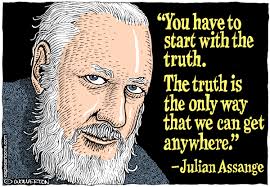
The freed publisher will appear in person in Strasbourg on Oct. 1 to address the Council of Europe, WikiLeaks said today.
September 24, 2024, By Joe Lauria, Consortium News
WikiLeaks publisher Julian Assange, who was released from prison in June, will address the Council of Europe in Strasbourg, France on Oct. 1 after he was granted Status as a Political Prisoner by a rapporteur of the Parliamentary Assembly of the Council of Europe (PACE), WikiLeaks said today.
It will be the first time Assange will speak in public since his hearing in U.S. federal court on the North Mariana islands in June, at which he was granted his release after a plea deal.
Assange will give evidence before the Committee on Legal Affairs and Human Rights of the Parliamentary Assembly of the Council of Europe (PACE), which will meet from 8.30am to 10am at the Palace of Europe, WikiLeaks said.
It follows the PACE inquiry report into Assange’s case, written by Rapporteur Thórhildur Sunna Ævarsdóttir.
“The report focuses on the implications of his detention and its broader effects on human rights, in particular freedom of journalism,” WikiLeaks said in a press release published on X. “The report confirms that Assange qualifies as a political prisoner and calls on the UK [to] conduct an independent review into whether he was exposed to inhuman or degrading treatment.”
Ævarsdóttir called Assange’s case a “high profile example of transnational repression.” Her report “discusses how governments employ both legal and extralegal measures to suppress dissent across borders, which poses significant threats to press freedom and human rights,” said WikiLeaks.
Still Recovering
Assange is “still in recovery following his release from prison,” it said. He will travel to France because of “the exceptional nature of the invitation and to embrace the support received from PACE and its delegates over the past years”………………………………………………………. more https://consortiumnews.com/2024/09/24/assange-to-testify-at-council-of-europe/
‘Obvious Conflict of Interest’: Report Reveals 50+ US Lawmakers Hold Military Stocks


“It’s abjectly terrifying that the personal benefit of any member of Congress is factored into decisions about how to wield and fund the largest military in the world,” said one critic.
Brett Wilkins 12 Sept 24, https://www.commondreams.org/news/members-of-congress-who-own-defense-stock
At least 50 U.S. lawmakers or members of their households are financially invested in companies that make military weapons and equipment—even as these firms “receive hundreds of billions of dollars annually from congressionally-crafted Pentagon appropriations legislation,” a report published Thursday revealed.
Sludge‘s David Moore analyzed 2023 financial disclosures and stock trades disclosed in other reports and found that “the total value of the federal lawmakers’ defense contractors stock holdings could be as much as $10.9 million.”
Melanie D’Arrigo, @DarrigoMelanie
Over 50 members of Congress, who vote to approve the military budget and approve the sale of weapons, own up to $10.9M in military contractor stocks. Military contractors have also donated $29M this year to election campaigns. That isn’t national defense. That’s corruption.
According to the report:
The spouse of Sen. Susan Collins (R-Maine), the ranking member of the Defense Appropriations subcommittee, holds between $15,000 and $50,000 worth of shares in each of Boeing and RTX, as well as holdings in two other defense manufacturers. Sen. Jerry Moran (R-Kansas), another Defense Appropriations subcommittee member, holds up to $50,000 in the stock of Boeing, which received nearly $33 billion in defense contracts last year. On the Democratic side of the aisle, Sen. John Hickenlooper (Colo.) holds up to a quarter of a million dollars’ worth of stock in RTX…
The most widely held defense contractor stock among senators and representatives is Honeywell, an American company that makes sensors and guiding devices that are being used by the Israeli military in its airstrikes in Gaza. The second most commonly held defense stock by Congress is RTX, formerly known as Raytheon, the company that makes missiles for Israel’s Iron Dome, among other weapons systems.
All 13 senators whose households disclosed military stock holdings voted for the most recent National Defense Authorization Act, which, as Common Dreams reported, allocated a record $886.3 billion for the U.S. military while many lawmakers’ constituents struggled to meet their basic needs.
“It is an obvious conflict of interest when a member of Congress owns significant stock investments in a company and then votes to award the same company lucrative federal contracts,” Craig Holman, government affairs lobbyist at the consumer advocacy group Public Citizen, told Sludge.
“Whether or not the official action is taken for actual self-enrichment purposes is beside the point. There is at least an appearance of self-enrichment and that appearance is just as damaging to the integrity of Congress,” Holman added. “This type of conflict of interest is already banned for executive branch officials and so should be for Congress as well. The ETHICS Act would justly avoid that conflict of interest by prohibiting members of Congress and their spouses from owning stock investments altogether.”Holman was referring to the Ending Trading and Holdings In Congressional Stocks (ETHICS) Act, introduced earlier this year by Sens. Jeff Merkley (D-Ore.), Jon Ossoff (D-Ga.), Gary Peters (D-Mich.), and Josh Hawley (R-Mo.).
In the House of Representatives—where the 2024 NDAA passed 310-118, with the approval of over two dozen members who own shares in military companies—House Foreign Affairs Committee Chair Michael McCaul’s (R-Texas) household owns up to $2.6 million in General Electric, Oshkosh Corporation, and Woodward shares. Rep. Dave Joyce (R-Ohio), who sits on the Defense Appropriations subcommittee, owns as much as $100,000 worth of Boeing and General Electric stock.
Other House lawmakers with potential conflicts of interest include Rep. Gerry Connolly (D-Va.), a member of the Foreign Affairs Committee, who owns Leidos shares worth as much as $248,000; Rep. Debbie Dingell (D-Mich.), who owns up to $100,000 worth of RTX stock; and Rep. Patrick Fallon (R-Texas), a member of the Armed Services Committee who holds Boeing stock worth between $100,000 and $250,000.
“Every American should take a long, hard look at these holdings to conceptualize the scope of Congress’ entanglement with defense contractors,” Public Citizen People Over Pentagon advocate Savannah Wooten told Sludge. “It’s abjectly terrifying that the personal benefit of any member of Congress is factored into decisions about how to wield and fund the largest military in the world.”
“Requiring elected officials to divest from the military-industrial complex before stepping into public service would create a safer and more secure world from the outset,” she added.
FBI Sued For Withholding Files On Assange And WikiLeaks

Kevin Gosztola, Sep 12, 2024, https://thedissenter.org/fbi-sued-for-withholding-files-on-assange-and-wikileaks/
“With the legal persecution of Julian Assange finally over, the FBI must come clean to the American people,” Chip Gibbons, policy director for Defending Rights & Dissent.
The civil liberties organization Defending Rights and Dissent sued the FBI and United States Justice Department for withholding records on WikiLeaks and its founder Julian Assange.
“For nearly a decade and a half, we’ve been trying to get at the truth about the U.S. government’s war on WikiLeaks,” declared Chip Gibbons, the policy director for Defending Rights and Dissent.
Gibbons added, “With the legal persecution of Julian Assange finally over, the FBI must come clean to the American people.”
On June 25, 2024, U.S. government attorneys submitted a plea agreement [PDF] in the U.S. District Court for the Northern Mariana Islands after Assange agreed to plead guilty to one conspiracy charge under the U.S. Espionage Act.
Assange was released on bail from London’s Belmarsh prison, where he had been jailed for over five years while fighting a U.S. extradition request. He flew on a charter flight to the Northern Mariana Islands, a U.S. territory where a plea hearing was held.
The plea agreement marked the end of a U.S. campaign to target and suppress Assange and WikiLeaks that spanned 14 years and first intensified after WikiLeaks published documents from U.S. Army whistleblower Chelsea Manning that exposed crimes committed in U.S. wars in Iraq and Afghanistan as well as U.S. complicity in human rights abuses in dozens of countries around the world.
“As soon as we began publishing newsworthy stories about US war crimes in 2010, we know the US government responded to what was one of most consequential journalistic revelations of the 21st century by spying on and trying to criminalize First Amendment-protected journalism,” stated WikiLeaks editor-in-chief Kristinn Hrafnsson.
Hrafnsson continued, “While WikiLeaks has fought for transparency, the U.S. government has cloaked its war on journalism in secrecy. That’s why Defending Rights & Dissent’s lawsuit is so important, as it will help unmask the FBI’s efforts to criminalize journalism.”
On June 27, Defending Rights and Dissent requested [PDF] “all records created, maintained, or in the custody of the FBI that mention or reference: WikiLeaks; Julian Assange.”
The FBI separated the request into two requests—one for files mentioning “WikiLeaks,” one for files mentioning Julian Assange. And by August 19, the organization was informed by the FBI that it would take around five and a half years (2,010 days) to “complete action.”
Previously, on June 22, 2021, Defending Rights and Dissent submitted a nearly identical request. It took the FBI two years to respond and notify the organization that the documents could not be provided because there was a “law enforcement” proceeding that was pending against Assange.
The FBI became involved in pursuing an investigation against Assange and WikiLeaks in December 2010.
In 2011, FBI agents and prosecutors flew to Iceland to investigate what they claimed was a cyber attack against Iceland’s government systems. But as Iceland Interior Minister Ögmundur Jónasson told the Associated Press in 2013, it became clear that the FBI agents and prosecutors came to Iceland to “frame” Assange and WikiLeaks.
The FBI was interested in interviewing Sigurdur Thordarson, a serial liar and sociopath who embezzled funds from the WikiLeaks store and sexually preyed on underage boys. As I recount in my book “Guilty of Journalism: The Political Case Against Julian Assange,” Thordarson subsequently became an FBI informant or cooperating witness.
“When I learned about it, I demanded that Icelandic police cease all cooperation and made it clear that people interviewed or interrogated in Iceland should be interrogated by Icelandic police,” Jónasson added.
A little more than a year before the U.S. government’s prosecution against Assange collapsed, the FBI approached three journalists who had worked with Assange but had a falling-out with him. Each refused to help U.S. prosecutors further their attack on journalism.
“The decision to respond to reporting on U.S. war crimes with foreign counterintelligence investigations, criminal prosecutions, and dirty tricks continues to cast a dark shadow over our First Amendment right to press freedom,” Gibbons said.
Gibbons concluded, “We will work tirelessly to see that all files documenting how the FBI criminalized and investigated journalism are made available to the public.”
Federal Conflict Rules Would Have Barred New Brunswick, Ontario Cabinet Ministers from New Corporate Posts, Expert Says

The ENERGY MIX, Mitchell Beer September 12, 2024
Two former provincial cabinet ministers would have been barred by conflict of interest legislation from the senior positions they’ve taken with engineering services and nuclear energy giant AtkinsRéalis if they’d been in federal politics, an expert in government and corporate ethics has concluded.
Former New Brunswick natural resources minister Mike Holland and Ontario energy minister Todd Smith both left their positions over the summer and signed on with Montreal-based AtkinsRéalis within a couple of weeks of quitting politics. Holland resigned from cabinet in late June and was appointed as Atkins’ director of business development for North America in early July. Smith quit in mid-August and was hired as vice-president, marketing and business development for Atkins subsidiary Candu Energy two weeks later……………………………………………………
Holland’s and Smith’s career moves are permitted by New Brunswick’s and Ontario’s conflict of interest rules, respectively. Both provinces set 12-month bans on activities like direct lobbying after a former official leaves office, but do not bar other employment with a company that does business with the official’s former government.
……………………………………………… Democracy Watch co-founder Duff Conacher said neither official would have been allowed to make the move if they’d been serving in the federal cabinet. And Smith would have been barred by Ontario rules if he had been working as minister’s staff, rather than as minister.
A Preceding Transaction
“At the federal level you wouldn’t be allowed to do what they did,” Conacher told The Energy Mix.
“There’s a preceding transaction, a negotiation they provided advice on. They were both quoted in AtkinsRéalis’ news release.”
That was a reference to an April 13, 2022 release in which Candu Energy and Saint John, New Brunswick-based Moltex Energy announced a “strategic partnership to advance the development and deployment of next-generation Small Modular Reactor (SMR) nuclear technology in Canada,” including a “first of a kind” installation in New Brunswick. In that release, Holland and Smith both showed up as early boosters for the partnership.
“New Brunswick welcomes investment in clean energy, especially as it builds on the province’s established core of expertise in nuclear technology,” Holland said. “This agreement contributes not only to the growth of long-term, high-quality jobs in New Brunswick’s energy sector; it also recognizes the leadership role of both Moltex and the province in advancing the next generation of nuclear technology.”
“I’m thrilled to welcome this new partnership between Moltex and SNC-Lavalin that builds our provincial energy industry, one renowned for its talented work force and strong nuclear supply chain,” Smith added. “This partnership enhances our clean energy advantage and reputation as a global hub for SMR expertise, making Ontario an even more attractive place to do business and create jobs.”
The release cited Candu Energy as a subsidiary of SNC-Lavalin, the politically connected but often deeply troubled global firm that eventually rebranded as AtkinsRéalis in September, 2023. But not before it set up Candu Energy by acquiring key commercial nuclear contracts, intellectual property, and personnel from federally-owned Atomic Energy of Canada Ltd. in 2011.
‘You’re Never Allowed’
Neither Holland nor Smith would have been allowed to join AtkinsRéalis if they were bound by the federal Conflict of Interest Act, Conacher told The Mix.
“You’re never allowed to act on behalf of any person or organization connected with something you were involved with in government. It’s not 12 months. It’s never. You’re never allowed,” Conacher said.
“And then secondly, you’re not allowed to give advice to anyone using confidential information,” he added. That amounts to a blanket restriction because “they learn things every day that are not disclosed,” which means all the advice a former cabinet official gives is based on confidential information.
“How do you unknow what you know and then give advice pretending you don’t know what you know? It’s impossible.”
That concern doesn’t apply in New Brunswick or Ontario, and Conacher said New Brunswick’s conflict of interest rules are the weaker of the two. In mid-August, Holland was listed in the federal lobbying registry as an AtkinsRéalis senior officer whose lobbying activities represented more than 20% of his duties.
Other Ways to Be Useful
But direct lobbying isn’t the only way, or even the most useful way, a former cabinet minister can help out a new corporate employer.
If a provincial ban applies only to lobbying, “you just don’t make the representation,” Conacher explained. “You give strategic advice to the company’s lobbyists on who they should be talking to, who’s the real decision-maker in cabinet, and what you should be saying to make something go through smoothly or get some extra benefit, like a subsidy or a [deadline] extension without any penalty. And that’s why they’re hired—because they have that inside knowledge.”………………………… https://www.theenergymix.com/exclusive-federal-conflict-rules-would-have-barred-new-brunswick-ontario-cabinet-ministers-from-new-corporate-posts-expert-says-old/
Rich countries silencing climate protest while preaching about rights elsewhere, says study

Report says governments in global north increasingly using draconian measures while criticising similar tactics in global south
Matthew Taylor, Tue 10 Sep 2024 https://www.theguardian.com/environment/article/2024/sep/10/climate-rights-report-draconian-measures-protest
Wealthy, democratic countries in the global north are using harsh, vague and punitive measures to crack down on climate protests at the same time as criticising similar draconian tactics by authorities in the global south, according to a report.
A Climate Rights International report exposes the increasingly heavy-handed treatment of climate activists in Australia, Germany, France, the Netherlands, Sweden, the UK and the US.
It found the crackdown in these countries – including lengthy prison sentences, preventive detention and harassment – was a violation of governments’ legal responsibility to protect basic rights to freedom of expression, assembly, and association.
It also highlights how these same governments frequently criticise regimes in developing countries for not respecting the right to protest peacefully.
“Governments too often take such a strong and principled view about the right to peaceful protest in other countries – but when they don’t like certain kinds of protests at home they pass laws and deploy the police to stop them,” said Brad Adams, director at Climate Rights International.
Across Europe, the US and the UK, authorities have responded to non-violent climate protests with mass arrests and draconian new laws that have resulted in long prison sentences. In some instances those who have taken part have been labelled as hooligans, saboteurs or ecoterrorists by politicians and the media.
Senior human rights advocates and environmental campaigners have raised concerns about the crackdown and called on governments to protect the right to non-violent protest.
“These defenders are basically trying to save the planet, and in doing so save humanity,” Mary Lawlor, the UN special rapporteur on human rights defenders, told the Guardian last year. “These are people we should be protecting, but are seen by governments and corporations as a threat to be neutralised. In the end it’s about power and economics.”
The escalating climate crisis has resulted in record-breaking temperatures around the world in 2024, driving food shortages, mass movements of people and economic hardship – as well as deadly fires and floods.
But the report found that rather than taking urgent measures to rapidly reduce the use of fossil fuels and halt ecological collapse, many relatively wealthy countries have instead focused on those trying to stop those raising the alarm by taking part in protests and civil disobedience.
“You don’t have to agree with the tactics of climate activists to understand the importance of defending their rights to protest and to free speech,” said Adams. “Instead of jailing climate protesters and undermining civil liberties, governments should heed their call to take urgent action to address the climate crisis.”
The report’s authors highlighted several examples of developed countries lauding the importance of the right to protest on the international stage at the same time as undertaking harsh and punitive crackdowns at home.
Welcoming a UN report in July this year, the UK government said: “These rights [to peaceful assembly and protest] are essential to the functioning of society, providing a platform for citizens to advocate for positive change. Nonetheless, civic space is increasingly contested as authoritarian governments and actors, who feel vulnerable to scrutiny and accountability, seek to silence dissent.”
Tuesday’s report also found:
- Record prison sentences for non violent protest in several countries including the UK, Germany and the US.
- Preemptive arrests and detention for those suspected of planning peaceful protests.
- Draconian new laws passed to make the vast majority of peaceful protest illegal.
- Measures to stop juries hearing about people’s motivation for taking part in protests during court cases, which critics say fundamentally undermines the right to a fair trial.
Climate Rights International called on democratic governments around the world to halt the authoritarian crackdown and protect people’s rights to protest.
“Governments should see climate protesters and activists as allies in the fight against climate change, not criminals,” said Adams. “The crackdown on peaceful protests is not only a violation of their basic rights, it can also be used by repressive governments as a green light to go after climate, environmental, and human rights defenders in their countries.”
1 This Month

of the week – Shut Down Drone Warfare!


Tell the Ukrainian Government to Drop Prosecution of Peace Activist Yurii Sheliazhenko

Petition to revoke the licensing of the Near Surface Nuclear Disposal Facility (NSDF) at Chalk River. https://www.ourcommons.ca/petitions/en/Petition/Details?Petition=e-7247
To see nuclear-related stories in greater depth and intensity – go to https://nuclearinformation.wordpress.com
-
Archives
- March 2026 (244)
- February 2026 (268)
- January 2026 (308)
- December 2025 (358)
- November 2025 (359)
- October 2025 (376)
- September 2025 (257)
- August 2025 (319)
- July 2025 (230)
- June 2025 (348)
- May 2025 (261)
- April 2025 (305)
-
Categories
- 1
- 1 NUCLEAR ISSUES
- business and costs
- climate change
- culture and arts
- ENERGY
- environment
- health
- history
- indigenous issues
- Legal
- marketing of nuclear
- media
- opposition to nuclear
- PERSONAL STORIES
- politics
- politics international
- Religion and ethics
- safety
- secrets,lies and civil liberties
- spinbuster
- technology
- Uranium
- wastes
- weapons and war
- Women
- 2 WORLD
- ACTION
- AFRICA
- Atrocities
- AUSTRALIA
- Christina's notes
- Christina's themes
- culture and arts
- Events
- Fuk 2022
- Fuk 2023
- Fukushima 2017
- Fukushima 2018
- fukushima 2019
- Fukushima 2020
- Fukushima 2021
- general
- global warming
- Humour (God we need it)
- Nuclear
- RARE EARTHS
- Reference
- resources – print
- Resources -audiovicual
- Weekly Newsletter
- World
- World Nuclear
- YouTube
-
RSS
Entries RSS
Comments RSS
 nuclear-news