New Zealand is under siege by the Atlas Network
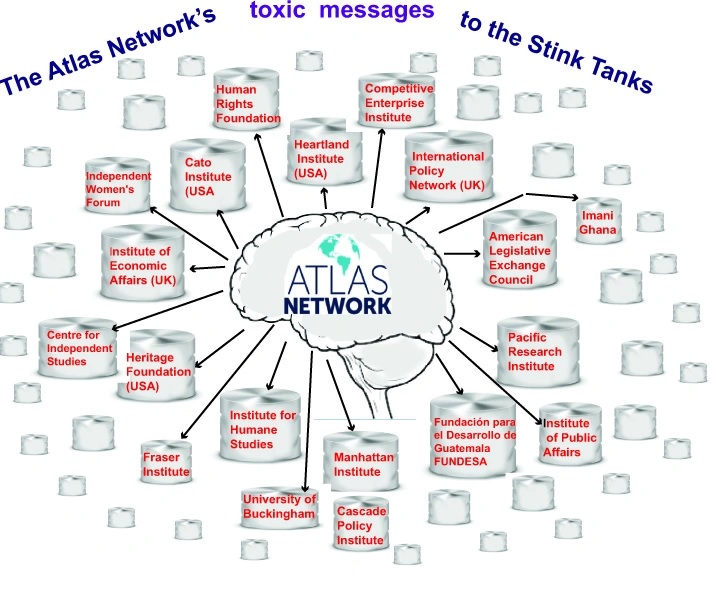
We have a handful of years to achieve a monumental shift from fossil fuel towards renewable energy: Atlas partners aim to ensure this does not take place.

March 3, 2024, by: Lucy Hamilton, https://theaimn.com/new-zealand-is-under-siege-by-the-atlas-network/—
Just as the Atlas Network-connected Advance body intervened in the Voice referendum in Australia and, in recent weeks, a by-election, similar organisations spawned from the American model are distorting New Zealand’s politics from within as well as from without.
One of the key researchers into the Atlas Network, Lee Fang, observed that it has “reshaped political power in country after country.” In America, every Republican president since Ronald Reagan has begun office with a Roadmap provided by the Heritage Foundation, primary Atlas Network partner. The “Mandate” for 2025 puts America on a hard path to fascism should a Republican win in November. Britain’s economy and standing have been savaged by Atlas partners’ impacts on the Tories. In New Zealand, the recently-elected rightwing coalition government is aping the new “Atlas president” of Argentina, aiming to privatise national assets, but is increasingly also imitating Atlas strategies recently seen in Australia, inflaming racial tensions and harming the wellbeing of Māori people.
Dr Jeremy Walker called Australia’s attention to the local Atlas partner organisations’ impact on the Voice to Parliament referendum and is now helping draw together the focus on the New Zealand partners’ very similar distortion of their national debate. There is a deep racism at the heart of this ultra-free market ideology that has licensed the international right to exploit resources and people around the globe untrammelled, largely in American corporate interest, but more broadly for any corporation or allied sector big enough to be a contender. (They do not, by contrast, fight for the renewable energy sector’s interests, as a competitor to their dominant fossil fuel donors; this shapes their climate crisis denial and delay, and colours their loathing of First People’s capacity to interfere with their profits by environment-driven protest. A sense of Western Civilisation as the apex of human existence and deep disdain for non-Western cultures also pervade the network.)
The Atlas model is to connect and foster talent in the neoliberal sphere. Young men (mostly) are funded or trained to replicate the talking points that Ultra High Net Worth Individuals (UHNWI) and lobbyists have built into a global network of over 500 bodies in 100 nations. The fact that neoliberal orthodoxies are more religious ideology that fact-based theories explains why their impact has been so utterly disastrous everywhere they have reshaped societies. The goal is to spawn replicating bodies with benign-sounding names that promote the UHNWI and corporate talking points – but with a veil hiding the self-interest that is obvious when those groups speak for themselves. Some of the bodies feign being thinktanks, which George Monbiot recently renamed junktanks to clarify their disingenuousness. Others are “astroturf” organisations that pretend to be grass roots bodies representing popular opinion. Another model is the beach-head in universities, an independent organisation within those institutions intended to dignify the neoliberal religion and the chosen strategies, including climate denial. All these produce material to fill civic debate and train more acolytes to enter politics, strategy companies and junktanks. Mainstream media elevates their standing by hosting their operatives as experts without explaining that the benign-sounding organisation to which they belong is a foreign-influence operation’s local outlet.
These groups damage local conditions to favour international corporations. They lobby for the removal of the “regulations” that are actually protections for the public – as workers, as consumers, as residents. They push for the privatisation of national treasures so that (often foreign) corporations can exploit the profits at the expense of the public. The greater the damage to the local democracy, the easier it is for them to act unimpeded. The stronger their infiltration of the media, the harder it is for the local electorate to understand the stakes. The politicians and strategists that emerge from the sphere (or are its allies) know that none of this wins votes, so they fill the space with culture war division to distract the voter from paying attention. Race and sexuality are their most obvious targets, as reactionary nostalgia for a mythical past of white picket fences pervades their ideology: a valorisation of “Christianity” and “family” and the “sacredness of marriage” (preached by adulterous politicians) is equally apparent in their propaganda.
The coalition that took power in NZ late in 2023, after a campaign centred on attacking the country’s founding Waitangi Treaty, has considerable Atlas infiltration. There is concern about Atlas fossil fuel and associated tobacco interests perverting policy in parliament, as well as senior ministerial aides who might be compromised. The government has promised to repeal Jacinda Ardern’s ban on offshore gas and fuel exploration, plans to sell water to private interests, not to mention planning to enable the selling off of “sensitive” NZ land and assets to foreign corporations, just as Argentinian Milei is intending.’
One of the government members, the Act Party, began its existence as an Atlas partner thinktank and continues that close connection. It was founded by former parliamentarian Denis Quigley with two members of the Mont Pelerin Society (MPS), the Atlas Network’s inner sanctum. One, Roger Douglas, was responsible for Rogernomics in NZ which has been described as a “right wing coup” that worked to “dismantle the welfare state.” The other, Alan Gibbs, who has been characterised as the godfather of the party, and a major funder, argued Act ought to campaign for government to privatise “all the schools, all the hospitals and all the roads.” This may not be surprising since he made much of his fortune out of the privatisation of NZ’s telecommunications.
The Act Party is currently led by David Seymour who functions as a co-deputy prime minister in the government. He has worked almost his entire adult life within Atlas partner bodies in Canada and boasts a (micro) MBA dispensed by the Network.
In Seymour’s 2021 Waitangi Day speech, he acknowledged his “old friends at the Atlas Network.” In light of that, his recent disdainful and absolute dismissal of the party’s connection to Atlas in an interview was telling: he clearly felt the association was damaging enough to lie outright.
Seymour is also deeply antagonistic to policies dedicated to repairing the disadvantage suffered by Māori people, disingenuously describing provisions that work cooperatively with Māori people as the “dismantling of democracy.” He appears antagonistic to Māori culture.
Another Atlas partner that has been key to distorting debate in NZ is the Taxpayer Union (TPU) which is emblematic of the production of metastasising bodies central to the Atlas strategy. Its co-founder and executive director is another graduate of the Atlas (micro) MBA program. Jordan Williams (currently “capo di tutti capi” of the Atlas global alliance of anti-tax junktanks) laughably depicts Atlas as a benign “club of like-minded think tanks.” He created, however, a body called the Campaign Company which helped radicalise the established farmer power base in NZ politics, planting sponsored material in the media. Williams claimed to grant the farmers “world-class campaign tools and digital strategies.” He also co-founded the Free Speech Union (FSU), which is unsurprisingly fighting regulation of the damaging impact of internet disinformation as well as fostering culture war battles.
A further spin-off of the bodies illustrates the increasing ugliness of the populist strategies. A former Act Party MP has founded the New Zealand Centre for Political Research which is fomenting civic division against Māori interests, including placing hate-mongering advertisements in the media.
The Act Party (alongside the populist New Zealand First party) is at the heart of the coalition government’s intention to destroy NZ’s admirable efforts to promote Māori interests for the betterment of the commonwealth, including the co-governance innovation. Efforts to undo disadvantage and programs that have promoted the distinctive NZ democratic experiment are set to be dismantled. A “massive unravelling” of Māori rights is at stake.
It is not only Māori people who will suffer. The NZ coalition government is also attempting a kind of “shock therapy” that did so much to tip first Chile and then other “developing” nations into brutal pain in pursuit of market “freedom.” The MPS was at the heart of Pinochet’s neoliberal brutality, resulting from Nixon’s injunction to make the Chilean economy scream.[1] New Zealand now faces cuts to a range of services, welfare and disability payments, even while the new PM, one of NZ’s wealthiest ever holders of the role, charged the taxpayer NZD 52,000 to live in his own property. It’s important to remember that this kind of entitlement is the sort that the neoliberals like, alongside subsidies to industry and corporations.
Lord Hannan (one of Boris Johnson’s elevations to the peerage, and a junktank creature) recently spoke in NZ, welcoming “all the coalition partners around this table” to hear his oration. There he celebrated the small percentage of GDP that NZ’s government spends on its people, cheering on the TPU’s power. He also disdained the “tribalism” that has dictated recognition of First Peoples’ suffering. There is grand (but unsurprising) irony in a graduate of three of Britain’s preeminent educational institutions dictating that humanity’s essential equality is all that can be considered when devising policy, particularly in settler-colonial nations.
Amusingly the weightier debunking of the Atlas connections has come from: Chris Trotter, formerly centre left, now a council member of Williams’ FSU; Eric Crampton, chief economist of the New Zealand Initiative, NZ’s leading Atlas partner and Sean Plunkett whose “anti-woke” vanity media platform, Platform, is plutocrat funded and regularly platforms the NZI talking heads.
While Atlas’s system largely functions to connect and train operatives, as well as acting as an extension of American foreign policy, this modest-seeming program must not be ignored. We have a handful of years to achieve a monumental shift from fossil fuel towards renewable energy: Atlas partners aim to ensure this does not take place.
And Atlas partners will push us at each other’s throats while we procrastinate.
[1] That MPS intervention resulted in massive unemployment, extraordinary inequality, and fire-sale prices of national assets to cronies. Much of Chile’s later success is as likely to be attributable to the trade requirements of (statist) China whose demand for copper has done so much to enrich Chile.
US-Funded Group Removes Report Warning of Famine in North Gaza After Complaint From US Ambassador
In a statement denouncing the report, the US ambassador to Israel acknowledged Israel’s ethnic cleansing campaign in northern Gazaby Dave DeCamp December 26, 2024
The Famine Early Warning Systems Network, a project funded by the US Agency for International Development (USAID), has removed a report from its website that warned it was “highly likely” famine is occurring in northern Gaza after a complaint by the US ambassador to Israel.
The report noted that Israel has imposed a “near-total blockade of humanitarian and commercial food supplies” on the North Gaza Governorate, which includes the cities of Beit Lahia, Beit Hanoun, and Jabalia. The report said 65,000 to 75,000 civilians remained in the area, “including civilians who have been unable to or prevented from evacuating.”
US Ambassador Jack Lew issued a statement slamming the report, saying there are far fewer civilians in those areas, an acknowledgment of the ethnic cleansing campaign that Israel has been conducting in northern Gaza since early October.
“The report issued today on Gaza by FEWS NET relies on data that is outdated and inaccurate,” Lew said. He claimed that there are somewhere between 7,000 and 15,000 civilians in the North Gaza Governorate.
“At a time when inaccurate information is causing confusion and accusations, it is irresponsible to issue a report like this,” the US ambassador said.
FEWS Net said it used UN numbers from mid-November and that it would update its report with the latest figures. But the group did not withdraw its assessment that famine was likely occurring in north Gaza.
Last month, the Integrated Food Security Phase Classification (IPC) said there was a strong likelihood famine was occurring in north Gaza.
Lew also claimed that the US has worked to ensure more humanitarian access in north Gaza, but the area has been under a total siege, and only 12 aid trucks have been able to make deliveries since October 6. Israel has forcibly displaced civilians from the area under the threat of death, either by shooting, bombing, or starvation, following an outline known as the “general’s plan.”
Black Money, Black Flags: How USAID Paved the Way for Syria’s Militant Takeover
By Alex Rubinstein / MintPress News,21 Dec 24
As the designated terrorist group Hayat Tahrir al-Sham (HTS) establishes its proto-government in Idlib, notoriously corrupt NGOs are stepping in to fill the gaps in public services, with some even defecting to work alongside the group.
The United States, which spent two decades and $5.4 trillion overthrowing governments hostile to al-Qaeda, now finds itself in a paradoxical position. Modern al-Qaeda has carved out its own quasi-state in Syria, yet remains on the U.S. list of Foreign Terrorist Organizations. To characterize this as a foreign policy misstep would be reductive; the U.S. has actively facilitated HTS’s conquest of parts of Syria while maintaining its official terrorist designation.
For the past five years, HTS, an al-Qaeda offshoot, has sought to rehabilitate its image. Its leader, Abu Mohammad al-Jolani—a former high-ranking member of both ISIS and al-Qaeda—has led a calculated charm offensive, attempting to rebrand the group from one focused on violence and minority persecution to a more palatable local governance entity.
Since establishing HTS and a proto-government called the Syrian Salvation Government, or SSG, the group’s leader, al-Jolani has expended a good deal of energy talking about topics intended to normalize the idea of a-Qaeda’s statehood; things like ‘institutions,’ and ‘structures.’ This, coupled with al-Jolani’s sudden embrace of Syria’s diverse tapestry of minority groups, has made up the main pillars of the terror group’s rebrand. Al-Jolani himself credits the establishment of quasi-state structures for the group’s sudden success in taking over Syria.
This shift in focus from the elimination of infidels to the establishment of good governance was given the spotlight in an article in the Telegraph entitled ‘How Syria’s ‘diversity-friendly’ jihadists plan on building a state.’ Published five days before President Assad fled the country, the article seemingly understood a total takeover by HTS to be a fait accompli…………………………………………………………………………………………………………………
Al-Jolani would take much of the remainder of the interview as an opportunity to deliver his stump speech on building inclusivity. And, of course, in the immediate aftermath of HTS’ takeover, gruesome videos of torture and executions aimed at Syria’s Alawite community flooded social media, dispelling the terrorist group’s progressive propaganda. And while it has only been a few years since HTS was carrying out suicide bombings, other groups that helped al-Jolani’s offensive have received next to zero coverage in Western media.
These groups include Ahrar al-Sham, which has been accused of war crimes, kidnappings, torture and potential use of chemical weapons by Amnesty International. Also involved in the offensive was Nour al-Din al-Zenki, a “moderate rebel” group supported by the United States until 2017, when footage emerged of its members gleefully beheading a teenager.
Yet, the horrifying history of these al-Qaeda offshoots has not given much pause to the White House. Just days after Assad’s egress, Joe Biden noted that the designated terrorist groups that had hijacked state power in Syria were “saying the right things.” Additionally, Biden promised more humanitarian and to “engage with all Syrian groups” with the goal of establishing a new government and constitution.
Make no mistake, some of the rebel groups that took down Assad have their own grim record of terrorism and humanit- — human right [sic] abuses. We’ve taken note of statements by the leaders of these rebel groups in recent days. And we’re — they’re saying the right things now, but as they take on greater responsibility, we will assess not just their words, but their actions.”
…………………………………………………………….. Implementing Partners – in Crime
Since the start of the war, USAID and the State Department’s Bureau of Humanitarian Assistance (BHA) have spent more than $18 billion on “humanitarian assistance” in Syria and more than $1.2 billion in fiscal year 2024 alone, oftentimes employing notoriously corrupt NGO partners to do the dirty work.
In a PBS interview with James Jeffrey, the United States Special Representative for Syria Engagement, Jeffrey admitted that “in 2018, my focus was — at the very center of everything I was doing was Idlib. And in Idlib, he [al-Jolani] was the strongest force.” Thus, USAID was confronted with a problem: how to deliver aid to a region ruled by a group they were legally prohibited from aiding.
………………………………………………………………….. While these instances of fraud, corruption, and supporting terrorist groups by USAID’s NGO partners are shocking, what is perhaps even more shocking is that these same NGOs continue to enjoy support from USAID despite the scandals. In fact, far from cutting these organizations off from future contracts, USAID continues to this day to actively encourage donations to Catholic Relief Services and the International Medical Corps………………………………………………………………………………………………………………………………………………….. more https://www.mintpressnews.com/black-money-black-flags-how-usaid-paved-the-way-for-syrias-jihadist-takeover/288876/
References to ‘inducing a North Korean attack’ found in ex-military official’s notes
2024-12-24 , By Lee Ji-hye, staff reporter, HANKYOREH,
A notebook found at the home of Roh Sang-won, the former Defense Intelligence Command, included jottings about shooting people to death and “concentration and handling” of those who were to be arrested.
A memo written by Roh Sang-won, the former head of the Defense Intelligence Command identified as the secret mastermind of the Dec. 3 insurrection attempt, contained the phrases “inducing a North Korean attack around the Northern Limit Line (NLL),” and “trash balloons.” With evidence pointing to attempts to stoke conflict with North Korea surfacing, police have stated that they are investigating President Yoon Suk-yeol, his former defense chief Kim Yong-hyun, and others on suspicions of treason.
Roh’s notebook also mentioned the “means of concentration and handling” of those who were to be arrested, even going so far as to suggest “execution by shooting.” Such drastic phrases suggest those plotting to punish so-called “anti-state forces” may not have been satisfied with simply detaining these figures.
The special unit investigating the martial law declaration under the Korean National Police Agency’s National Office of Investigation announced on Monday that Roh’s notebook contained the phrase “inducing a North Korean attack around the Northern Limit Line (NLL).”
When asked by Democratic Party lawmaker Youn Kun-young whether “trash balloons” also appeared in Roh’s notebook during a plenary session of the parliamentary Public Administration and Security Committee on the same day, Woo Jong-soo, the head of the National Office of Investigation, confirmed that the phrase was spotted in the notebook.
This is the first time that a plot to provoke North Korea has been confirmed in the investigation into the Dec. 3 insurrection attempt……………………………………………………………………………..more https://english.hani.co.kr/arti/english_edition/e_national/1174701.html
Pentagon Admits It’s Been Lying About the Number of Troops in Both Iraq and Syria
December 25, 2024, By Dave DeCamp / Antiwar.com, https://news.antiwar.com/2024/12/23/pentagon-admits-its-been-lying-about-the-number-of-troops-in-both-iraq-and-syria/
The Pentagon said on Monday that the US has more troops deployed in Iraq than it has been disclosing, an admission that comes after it revealed there are significantly more US troops in Syria than the US has said.
For years, the Pentagon has said there are 900 troops in Syria and 2,500 in Iraq. Last week, Pentagon spokesman Maj. Gen. Pat Ryder revealed the US was lying about the number of troops in Syria, saying the real number is 2,000.
In a statement meant to clarify the situation that was released on Monday, Ryder also said there were more than 2,500 US troops in Iraq but refused to say how many. “However, due to operations security and diplomatic considerations, we do not have any more specifics to provide,” Ryder said.
Ryder’s statement revealed that the number of US troops in Syria has been higher than publicly disclosed since 2020. “In addition to the approximately 900 baseline troops, there are also approximately 1,100 US military personnel in Syria that deploy for shorter durations as temporary enablers in support of force protection, transportation, maintenance, or other emerging operational requirements,” Ryder said.
“The numbers of these additional temporary forces have fluctuated over the past several years based on mission needs but in general have increased over time as the threat has increased to baseline forces,” he added.
Lying about the actual number of US troops in Syria goes back to at least the Trump administration. In 2020, James Jeffrey, the outgoing US envoy for Syria at the time, admitted his team was “always playing shell games to not make clear to our leadership how many troops we had there.” In 2019, after reversing an order to withdraw all troops from Syria, Trump agreed to keep 200 in the country. But Jeffrey said there was “a lot more” than that deployed.
In his statement on Monday, Ryder also said that “some additional temporary enablers” had been deployed alongside the 2,500 US troops in Iraq.
Sources told CNN that the US had been lying about the number of US troops in Syria because it didn’t want to anger neighboring countries, particularly Iraq, where the presence of US troops is strongly opposed by many political factions.
The sources said the US was worried if Iraqi officials found out the US had more troops in Syria than it was disclosing, officials would fear the same is happening in Iraq. Ryder’s statement that there are more than 2,500 US troops in Iraq will likely cause trouble for Iraqi Prime Minister Mohammed Shia al-Sudani, who has been under significant pressure to get the US to leave.
Earlier this year, after a series of US airstrikes on Iraq, al-Sudani called for US troops to leave, and his government entered negotiations with the US. The two sides reached a deal that was announced in September, but it will only formally end the mission of the US-led anti-ISIS coalition and says US troops will remain in the country under a “bilateral security partnership.”
No more research for genocide at MIT !

Every human on this planet, especially those of us at MIT, is morally obligated to use their voice, body, and labor to make an immediate material impact toward ending the ongoing genocide.
By MIT Coalition For Palestine, Mondoweiss, December 22, 2024,
https://popularresistance.org/no-more-research-for-genocide-at-mit/
Despite Censorship And Intimidation We Continue To Make This Demand.
An MIT lab is collaborating with the Israeli military to develop AI surveillance algorithms and the university censored a campus publication that tried to expose it. We refuse to be intimidated and continue to demand: No More Research for Genocide.
On November 7th, we published an op-ed titled “Daniela Rus, The People Demand: No More Research for Genocide” in the MIT Tech. Our piece detailed how Prof. Daniela Rus, director of MIT’s Computer Science and Artificial Intelligence Laboratory, uses Israeli Ministry of Defense money to develop algorithms with applications in “multirobot security defense and surveillance.” Rather than engage with these publicly verifiable facts, the Tech’s editorial board (under the guidance of Prof. Rus) retracted our op-ed.
MIT sent several of us “no contact” and “no harassment” orders for Prof. Rus, disciplining one student for simply writing our Op-Ed’s title on a public chalkboard! As if this naked intimidation wasn’t enough, the Tech indefinitely halted all Op-Eds after retracting our piece. This comes directly after the suspension and effective expulsion of MIT PhD student Prahlad Iyengar, in part due to an email he sent Professor Rus’ students “offering support” and a “safe space” to discuss her research.
We refuse to be intimidated by MIT. Professor Rus takes money from a genocidal army to do research with military applications (stated in her own papers here, here and here). Retractions and suspensions cannot change these simple facts. Here, we republish our article in full:
Daniela Rus, The People Demand: No More Research For Genocide
Today, MIT’s Computer Science and Artificial Intelligence Laboratory (CSAIL) conducts research funded by the Israeli Ministry of Defense (IMoD), with direct applications to the ongoing genocide in Gaza. We, the MIT Coalition for Palestine, whose tuition and labor support CSAIL, call on CSAIL Director Daniela Rus to lead by example and end her IMoD-sponsored research.
Rus currently leads the project “Coreset Compression Algorithms,” which has received $425,000 in direct sponsorship from the IMoD since 2021, according to MIT’s 2024 Brown Books. This project develops AI algorithms for applications like “city-scale observation systems” and “surveillance and vigilance”. Many of these lightweight algorithms are ideal for teaching small unmanned vehicles, including drones, to track and pursue targets with increased autonomy. Notably, navigating human environments is central: “a human may provide the global path… and the robots will adapt their configuration automatically”.
Many of us have friends and family surveilled and killed by the Israel Defense Forces (IDF) drones streamlined by Rus’s research. These quadrotor drones are used extensively to monitor, injure, and kill Palestinian civilians at close range. Last Wednesday, October 30, 2024, Palestinian poet Mosab Abu Toha shared videos showing Israeli bombs destroying his home, including footage of a quadrotor drone with a mounted machine gun just meters away. He described how Israel’s relentless indiscriminate bombardment in Gaza has wiped out entire families he knew. Stories like his have become the norm for families in Gaza.
As we write this piece, Jabalia has been under constant siege for a month. The Israeli military is targeting hospitals and burning patients alive. The government blocks access to life-saving humanitarian supplies, worsening Gaza’s already severe health crisis, all while threatening, targeting, and killing journalists attempting to report on these war crimes. At this time, it is our moral responsibility to do everything in our power to disrupt and dismantle all which enable the continuing of this genocide.
There has been a long-standing demand for Rus’s IMoD-sponsored projects to end.
The MIT Coalition for Palestine (C4P) is a group of MIT students, staff, faculty, community members, and campus organizations who refuse to devote their labor to companies complicit in Israeli apartheid, occupation, and the violation of Palestinian human rights. Daniela Rus was first contacted by the C4P on March 8th, 2024 by email where she was informed of how her IMoD-sponsored projects made her complicit in the ongoing genocide in Gaza.
Without response, we then emailed out to the graduate students in her lab informing them of these ties and of potential alternative funding arrangements. In April, we launched the Scientists Against Genocide Encampment, where we consistently highlighted her lab’s IMoD ties to the school and community.
Over a year of accelerating genocide has now since passed, seven months since we first contacted Rus, and she continues her research, violating MIT’s own rules for research sponsorship. On Tuesday October 22, 2024, the Coalition Against Apartheid, a member organization of C4P, delivered a second letter in-person to her CSAIL office, chanting and flyering in the process.
We are committed to engaging in continuing action because it works. For instance, The U.S. arm of Israeli defense contractor Elbit Systems recently ended its lease of office space in Cambridge after months of demonstrations by pro-Palestinian protestors. This win reinforces our resolve, and reminds us of a crucial lesson: the only way to make material disruptions for these inhumane systems is to continuously raise the cost for conducting research for genocide.
MIT’s police and disciplinary response against peaceful demonstrators was swift and unjust.
Within fifteen minutes, MIT escalated the situation with police force by violently arresting student protestors and detaining others for merely chanting and passing out flyers. At one point, there were four to six cops pinning down one person. Even those who were simply filming the arrests were detained, pushed around, and groped. There was no warning or attempt by faculty or administrators to engage with the students in order to understand their actions. Three days after the protest, eight students received interim sanction letters from the MIT Committee on Discipline (COD).
This interim letter did not indicate what charges students were being prosecuted for. Rather, they prohibited the students from entering common student spaces in CSAIL, where some of these students work. They also issued three no-contact orders to students: one for Rus, one for her collaborator on IMoD-funded projects Eytan Modiano, and one for Jack Costanza, a CSAIL employee who physically assaulted students in an attempt to unlawfully aid police in their arrests. None of the students were given the chance to review or respond to the charges. Once again, the COD demonstrates it operates primarily on the premise of treating political dissidents as “guilty until proven innocent.”
One week later, students received their alleged charges from the COD. All eight of them, whether they were chanting, putting a flyer up on a wall with painter’s tape, or simply video-taping the protest, received the same charges: assault, disorderly conduct, harassment, and threats/intimidation. COD Chair Tamar Schapiro later verbally admitted to one student in a meeting that she was aware none of the protestors assaulted anyone. Yet she still sent the letters accusing all eight of the students of assault. The COD systematically criminalizes the Coalition for Palestine as a community for protesting genocide. By indiscriminately instating a blanket no-contact order against all individuals who received a discipline letter, the COD draws a direct parallel between the acts of collective punishment MIT inflicts on pro-Palestinian advocates on its campus, and the collective punishment that Israel has long been inflicting on Palestinians themselves.
Discipline against pro-Palestinian students reinforces systemic racism at MIT.
Over the past year, MIT’s administration’s response to protests against genocide continues to be reflective of MIT’s longstanding racist and xenophobic systems. Students have attempted time and time again to address these issues, as described in this article by the Black Graduate Students Association. Despite the manufactured facade of an MIT community that is safe for students of minoritized backgrounds, racism at MIT has persisted over the last year at an institutional level.
At an institutional level, the MIT administration has been emboldened to continue to weaponize the police and inconsistent “academic” disciplinary proceedings in order to disproportionately target Black and Brown students. In the past year, 87% of the people MIT has disciplined, relating broadly to protest activity, have been people of color. Just consider MIT’s response to the letter delivery protest of Rus’ lab: people of color made up 8 out 13 student protestors present, yet 7 out of 8 people who received letters from the CoD were people of color. In addition to the disciplinary discrimination we face, many of us on campus feel incredibly unsafe, as the Institute of Discrimination Harassment and Reporting (IDHR) has failed to follow up on at least thirty reports of harassment against us. Simultaneously, IDHR selectively applies sanctions against us without evidence. To MIT, we are solely perceived as threats, never as victims. When Tamar Schapiro was asked to clarify the discipline, she told one female student that as a woman, she should understand that Daniela Rus felt unsafe by the demonstration, even though she was not even present in the lab at the time. What about the women in Gaza who fear being killed by the very technology Daniela Rus’s work contributes to? What about the women of color on campus who fear being unjustly brutalized by the frequent displays of disproportionate police violence? Tamar Schapiro, and MIT as a whole, fail to acknowledge the tangible fears of marginalized women, yet prioritize the theoretical fears of white women. This twisted, victim-blaming, racist logic matches the insinuation of Provost Barnhart in the previous Spring semester, wherein she justified the interim suspensions and eviction threats of 27 people by suggesting that MIT apply the same disciplinary measures previously reserved for when individuals are immediately at risk of sexual assault. As long as we have a broken reporting system, rapists and sexual offenders continue to freely walk on campus while students of color are treated as criminals for protesting a genocide.
To Daniela Rus and the world: no more labor for apartheid and genocide!
At the end of the day, MIT’s racism and racist discipline cannot counteract one fact: Daniela Rus is complicit in doing research for genocide. She has been complicit since 2012 when the sponsorship was first established through her then-postdoc, Dan Feldman, who currently works at University of Haifa in occupied Palestine. Professor Rus continues to deny her evident, present-day connections to the IMoD while flaunting her other morally dubious connections, such as her recent public statement of admiration, at her October book talk, for Marvin Minsky, alleged co-perpetrator of notorious pedophile Jeffrey Epstein.
As students of conscience, we cannot stand for this. The time to take action is now. We therefore call on Daniela Rus to immediately terminate all IMOD-funded projects and for MIT to provide transitional funding to all affected graduate students, in line with how MIT terminated financial ties with the Skoltech Institute in Russia the day after the Russian invasion of Ukraine.
Why are we here at MIT? What purpose is there to any of the science and research being done on this campus when we know that ultimately our work will be used for mass murder and exploitation? It is the current leadership at MIT that is ensuring that the great potential of this community is being abused to oppress individuals globally. Therefore, it will take all people of conscience at this institution to change the course we are currently on to force MIT to embody the values it claims to have. We cannot rest until MIT completely cuts ties and divests from all entities that support genocide and colonialism.
Every human on this planet, especially those of us at MIT, is morally obligated to use their voice, body, and labor to make an immediate material impact toward ending the ongoing genocide.
Israel’s Crime of Extermination, Acts of Genocide in Gaza
Authorities’ Widespread Deprivation of Water Threatens Survival
Human Rights Watch 19 Dec 24
Israeli authorities have deliberately inflicted conditions of life calculated to bring about the destruction of part of the population in Gaza by intentionally depriving Palestinian civilians there of adequate access to water, most likely resulting in thousands of deaths.
In doing so, Israeli authorities are responsible for the crime against humanity of extermination and for acts of genocide. The pattern of conduct, coupled with statements suggesting that some Israeli officials wished to destroy Palestinians in Gaza, may amount to the crime of genocide.
- Governments and international organizations should take all measures to prevent genocide in Gaza, including discontinuing military assistance, reviewing bilateral agreements and diplomatic relations, and supporting the International Criminal Court and other accountability efforts.
(Jerusalem) – Israeli authorities have intentionally deprived Palestinian civilians in Gaza of adequate access to water since October 2023, most likely resulting in thousands of deaths and thus committing the crime against humanity of extermination and acts of genocide, Human Rights Watch said in a report released today.
In the 179-page report, “Extermination and Acts of Genocide: Israel Deliberately Depriving Palestinians in Gaza of Water,” Human Rights Watch found that Israeli authorities have intentionally deprived Palestinians in Gaza of access to safe water for drinking and sanitation needed for basic human survival. Israeli authorities and forces cut off and later restricted piped water to Gaza; rendered most of Gaza’s water and sanitation infrastructure useless by cutting electricity and restricting fuel; deliberately destroyed and damaged water and sanitation infrastructure and water repair materials; and blocked the entry of critical water supplies.
“Water is essential for human life, yet for over a year the Israeli government has deliberately denied Palestinians in Gaza the bare minimum they need to survive,” said Tirana Hassan, executive director at Human Rights Watch. “This isn’t just negligence; it is a calculated policy of deprivation that has led to the deaths of thousands from dehydration and disease that is nothing short of the crime against humanity of extermination, and an act of genocide.”
Human Rights Watch interviewed 66 Palestinians from Gaza, 4 employees of Gaza’s Coastal Municipalities Water Utility (CMWU), 31 healthcare professionals, and 15 people working with United Nations agencies and international aid organizations in Gaza. Human Rights Watch also analyzed satellite imagery, photographs, and videos captured between the beginning of the hostilities in October 2023 and September 2024, as well as data collected and estimates produced by doctors, epidemiologists, humanitarian aid organizations, and water and sanitation experts.
Human Rights Watch concluded that Israeli authorities have intentionally created conditions of life calculated to bring about the physical destruction of Palestinians in Gaza in whole or in part. This policy, inflicted as part of a mass killing of Palestinian civilians in Gaza, means Israeli authorities have committed the crime against humanity of extermination, which is ongoing. This policy also amounts to one of the five “acts of genocide” under the Genocide Convention of 1948. Genocidal intent may also be inferred from this policy, coupled with statements suggesting some Israeli officials wished to destroy Palestinians in Gaza, and therefore the policy may amount to the crime of genocide.
Immediately after the attacks in southern Israel by Hamas-led Palestinian armed groups in Gaza on October 7, 2023, which Human Rights Watch has found amounted to war crimes and crimes against humanity, Israeli authorities cut all electricity and fuel to the Gaza Strip. On October 9, then-Defense Minister Yoav Gallant announced a “complete siege” of Gaza, stating: “There will be no electricity, no food, no water, no fuel, everything is closed.”
That same day, and for weeks thereafter, Israeli authorities cut off all water and blocked fuel, food, and humanitarian aid from entering the strip. Israeli authorities continue to restrict the entry of water, fuel, food, and aid into Gaza and to cut Gaza’s electricity, which is required to operate life-sustaining infrastructure. This continued even after the International Court of Justice (ICJ) issued provisional measures in January, March, and May 2024 ordering Israeli authorities to protect Palestinians in Gaza from genocide and, in so doing, provide humanitarian aid, specifying in March that this includes water, food, electricity, and fuel. ……………………………………………………………………………………………………………………….. more https://www.hrw.org/news/2024/12/19/israels-crime-extermination-acts-genocide-gaza
“I don’t care if its tainted money”: Council leader’s telling admission in Nuclear Waste Services cash grab debate

Nuclear Free Local Authorities, 16th Dec 2024
In a busy week for GDF developments, East Lindsey District Councillors were last Wednesday (11th December) engaged in a fractious debate over proposals to accept £3 million in money from the Environment Agency to carry out coastal defence works. The controversy arose because the money originated from the coffers of Nuclear Waste Services.
It is of course in the interests of NWS to invest in coastal defences because they would not want to see any Geological Disposal Facility sited in Mablethorpe or Theddlethorpe inundated in the future by flooding. The surface site would be operable for up to 175 years, receiving regular shipments of high-level radioactive waste shipments. Flood waters could render the facility inoperable far in advance of this end date.
Local members, Cllrs Travis Hesketh and Robert Watson called the proposal “pure blackmail”. Councillor Watson issued a caution that accepting the money will mean the district council “surrenders its independence” to NWS. Councillor Jill Makinson-Saunders echoed this sentiment, which was shared by many opposition members in the chamber, saying “If we are taking money from the nuclear people, we cannot fly the flag for independence”. In response to his critics, Council Leader Craig Leyland said “I don’t care if its tainted money”.
Despite the strength of opposition, the Conservative Minority Administration, with the support of some opposition members, were able to secure sufficient votes to approve the proposal.
The decision must again cast doubt on the supposed impartiality of the district council over the GDF proposal. There is within the report put before Council an admission that this is infact the case; under a section titled ‘Reputation’ it says:
‘There is risk of perception of predetermination for GDF facility due to the source of funding being NWS. This will be mitigated by providing clear information in public domain at all stages of work on full transparency basis’.
In addition, as the proposal will require East Lindsey District Council to find another source of finance to carry out the work were it to disengage from the GDF process, the Council is in effect curtailed from exercising its Right to Withdraw and it will certainly not be inclined to call for a Test of Public Support within twelve months, as agreed by Council at a previous meeting and as just again asked for by local MP Victoria Atkins.
The decision comes hot on the heels of a decision made by the Executive at Lincolnshire County Council to seek a Hosting Agreement with the NWS and government promising millions if a GDF comes to Lincolnshire.
Some Thoughts On The Mystery Drones
Caitlin Johnstone, Dec 14, 2024
Okay I need to jot down some thoughts on the “mystery drone” thing because it’s way too interesting a story to ignore.
For those who aren’t aware, since mid-November people have been sighting large drones all over the east coast of the United States, and what makes this so interesting is that the US government is claiming they don’t know anything about them. Don’t know who owns them, where they’re taking off from or where they’re landing.
They’re either lying or telling the truth about this, and either way it’s a major story. Either the US government is keeping secrets from the public about huge numbers of drones that have spent weeks flying over populated areas, or they somehow legitimately don’t know what’s going on with these sightings. Contemplating either of these possibilities should widen your eyes a bit.
And to be clear there really does appear to be something up there. Many of the sightings that are being reported are just the result of a fun news story causing people to look up from their smartphones into the night sky for the first time in years and see things they’re not familiar with like planes and stars — but there are also large, hovering aircraft of uncertain origin.
The clearest footage I’ve seen of these mystery drones so far was presented by NewsNation’s Rich McHugh, who actually turned and pointed to one of the craft in the air behind him while reporting out of central New Jersey. It must have been fairly low down because they got a great shot of the thing; it had fixed wings and blinking lights like a plane, but was reportedly only eight to ten feet wide.
McHugh said he and his crew saw some 40 or 50 of the aircraft in the hour they were on location. He interviewed officers from the Ocean County Sheriff’s Department, who told him the drones evade detection because they don’t give off heat like normal drones, and that one vanished when they tried to pursue it with a police drone. A sheriff named Michael Mastronardy told McHugh that one of his officers reported seeing fifty of these drones flying in off the ocean all at once, after which the US Coast Guard reported seeing a number of the same craft over the water.
Michael Tracey, one of the very few western journalists I have any respect for, went drone hunting and reported seeing “one mystery drone with all red lights, hovering quite low, and another with green and red lights, higher altitude, flying in a straight line.”
“It was hovering. If that’s a plane, I’m a horse’s ass!” Tracey tweeted.
So as far as I can tell this is a real thing and not mass hysteria resulting from large numbers of people suddenly looking up and misinterpreting the lights they’re seeing.
But what is it?
As of this writing we’re not getting any answers from the US government. The White House, FBI and DHS are all saying that they don’t assess that the mystery drones have a foreign nexus or pose a threat to national security, but that they also have no idea what they are. All three departments have released statements saying that “many of the reported sightings are actually manned aircraft, operating lawfully,” which sounds intentionally obfuscatory because obviously there are going to be many reports from people misidentifying normal aircraft thrown into the mix, and this is completely irrelevant to all the reported sightings which don’t fit that description…………………………………………………………… more https://www.caitlinjohnst.one/p/some-thoughts-on-the-mystery-drones?utm_source=post-email-title&publication_id=82124&post_id=153115935&utm_campaign=email-post-title&isFreemail=true&r=1ise1&triedRedirect=true&utm_medium=email
The Antisemitism Awareness Act Is the Death Knell for Free Speech
Mike Whitney • November 21, 2024, The Unz Review
Freedom of speech is the principal pillar of a free government; when this support is taken away, the constitution of a free society is dissolved, and tyranny is erected on its ruins….Ben Franklin.
The Antisemitism Awareness Act is a wrecking ball designed to pulverize the First Amendment. While the alleged intention of the bill is to make Jewish students feel safer on campus, the real purpose is to put an end to the anti-genocide demonstrations that have broken out across the country and to prevent the criticism of Israel. The proposed bill invokes a dodgy legal mechanism to derail the protests and to silence Israel’s critics. By using a broad and ambiguous definition of antisemitism, the bill compels university administrators to crackdown on free speech invoking sketchy claims of discrimination. Political analyst Paul Craig Roberts summed it up like this: “if universities …don’t suppress student protests against Israel’s massacre of civilians in Gaza and Lebanon they will lose their accreditation and federal financial support.” In short, universities are being encouraged to quash the free expression of political ideas to preserve their federal funding. This helps to illustrate how Zionist lobbyists are now engaged in a full-throated assault on constitutionally protected civil liberties, namely free speech.
The bill—which already passed the House with a sizable majority—shows how the charge of antisemitism can be used as a coercive political tool to silence Israel’s critics. That is why civil liberties organizations—like the ACLU, PEN America, the Alliance Defending Freedom and even Jewish groups like Bend the Arc and T’ruah—strongly oppose the bill based on free speech grounds. Even so, this attack on constitutionally protected rights has a good chance of passing the senate due to the arm twisting of powerful interest groups that have their tentacles wrapped tightly around both houses of congress. Here’s a brief summary from political analyst Guy Christensen:
The House just passed the Antisemitism Awareness Act which will shut down college protests against Israel and silence all future criticism of the state of Israel. The law literally redefines antisemitism as criticizing the state of Israel and makes it a violation of Title 6 to do so. The purpose of this is to allow politicians to pull federal funding from colleges who don’t stop these college protests and let their students continue to criticize Israel.
We must speak out against the Antisemitism Awareness Act. This is insanity. These people are full-on Zionists trying to silence free speech here in America, trying to silence criticism of the oppression of the Palestinians, criticism of the state of Israel that murdered 14,000 children.
Like I said, the guy who wrote the bill, Mike Lawler, is funded by AIPAC $180,000 (he said to NBC News when talking about this bill.) When you hear “River to the sea, Palestine will be free” that is calling for the eradication of the Jews in the state of Israel. (They are) Literally trying to make it illegal to criticize Israel.
If you don’t know how Title 6 works, all federally funded programs and institutions must follow it or they won’t receive any more federal funding. This includes US colleges and K through 12 schools who are very strict about following Title 6 because they need that funding. They can’t go without it. So, if we let this become law, it would force US colleges to shut down all these protests immediately.
This contends for the most outrageous bill for Israel the government has ever tried to pass. I will not vote or say a kind word about any politician who voted in favor of this bill…. (your representative ) care more about Israel than they care about your free speech. What they are doing is incredibly dangerous. Zionists are scared because American public opinion is changing. Students across the country are protesting against Israel. You know they’re scared because this is one of the boldest things they’ve ever tried to do…..AIPAC and the pro-Israel lobby is behind all of this. Ban AIPAC Stop the Antisemitism Awareness Act. We have to protect our free speech and our right to protest against evil. YourFavoriteGuy@guychristensen_
Not surprisingly, President Donald Trump—whose campaign was given $100 million by a strident Zionist donor—confirmed that he will aggressively implement the blatantly unconstitutional law by cancelling the funding of any college that tolerates the anti-genocide protests. He further stated that he will prosecute the universities for, what he calls, “violations of the civil rights law.” In other words, it is not the tens of thousands of Palestinian civilians that have been killed by Israel who are the victims, but the Jewish university students who feel “unsafe.” (Note—Trump refers to the protestors views as “antisemitic propaganda”)…………………………………………………………………………………………………………………………………………………more https://www.unz.com/mwhitney/the-antisemitism-awareness-act-is-the-death-knell-for-free-speech/
The secret audit that crucifies most French nuclear start-ups.

Classified as a top secret, the results of the audit conducted in the spring by the High Commissioner for Atomic Energy and submitted to the Élysée Palace reveal that many subsidized nuclear start-ups will not keep their promises.
By Géraldine Woessner Le Point 22nd Nov 2024
This is what could be called a vast smokescreen operation. On November 19, the start-up Naarea, founded in 2020 to develop fourth-generation modular reactors, with molten salts and fast neutrons, published a triumphant press release on its LinkedIn account: “It is a great honor to have been able to discuss with the High Commissioner for Atomic Energy the conclusions of his report,” the company trumpeted, proudly announcing to potential investors that the audit conducted by the experts had “not identified any unavoidable blocking point” concerning the deployment of its program……… (Subscribers only) https://www.lepoint.fr/economie/exclusif-l-audit-secret-qui-crucifie-la-plupart-des-start-up-francaises-du-nucleaire-22-11-2024-2575980_28.php
UK Government urged to end secrecy over ‘worrying’ drone sightings near nuclear-linked air bases
THE government was urged today to end its “wall of secrecy” over drone sightings at three air bases in East Anglia amid escalating tensions with Russia.
The US Air Force has confirmed “unmanned aerial devices” were spotted over RAF Lakenheath, which is set to house US nuclear weapons, RAF Mildenhall in Suffolk and RAF Feltwell in Norfolk between November 20 and 22.
Unconfirmed reports claim F-15E Strike Eagles were scrambled to chase the drones, which affected the flight operations at the bases.
The USAF, which has fighter jets on standby at the bases, declined to comment on those claims but said it retains “the right to protect” installations.
On Thursday, Russian leader Vladimir Putin said military facilities in Britain and the US could become valid targets for the Kremlin’s forces as a direct response to Ukraine’s firing of US and British missiles at targets on Russian territory.
Campaign for Nuclear Disarmament (CND) general secretary Sophie Bolt said that it appeared the drones were a co-ordinated launch within Britain.
She said: “The fact they happened in three bases means it was co-ordinated. Other than that we just don’t have any more information.
“People will be understandably very worried, therefore there needs to be responsibility around what information is shared.
“There’s a complete lack of transparency within the British government, who still completely refuse to acknowledge they have given permission for Storm Shadow missiles to be used by Ukraine.
“It’s invariably the case in terms of the military and specially around military bases and around defence generally to have a wall of secrecy.
“This is completely unacceptable because people have a right to know what’s going on
“They have definitely been launched in the local area … and I think we just have to be very careful about what’s going on, because there’s a particularly escalatory climate.
“More broadly, armed drones need to be banned.
“The US, the UK and Israel are well known for using these terrible weapons.”
UK Defence secretary to seek ‘missing’ nuclear test records
Dominic Casciani, BBC, 16 Nov 24
Defence Secretary John Healey has launched an investigation into whether there are long lost or hidden documents that reveal military chiefs secretly monitored the health of men who witnessed nuclear bomb tests in the 1950s.
John Healey told MPs that while “nothing is being withheld”, officials would carry out a “detailed dig” amid concerns from the surviving veterans.
The pledge comes after the BBC screened a special documentary on Wednesday into allegations that there has been a decades-long cover-up of how the nuclear testing programme harmed personnel.
Alan Owen, one of the leaders of the men’s campaign said the decision was a “brilliant” step forward after years of battles for answers.
Survivors in their 80s say many of them and their children have suffered cancers, genetic defects and other illnesses that must be linked to radioactive fall-out.
Similar claims have been made by indigenous communities in Australia where many of the tests were conducted.
For decades, successive governments have denied there was a secret monitoring programme – but the veterans say recently declassified files support their memories of medical staff taking blood and urine samples.
Speaking to Parliament’s Defence Committee, Mr Healey said the investigation would not be straight-forward and records may have been lost…………………………………………………………………………………… https://www.bbc.co.uk/news/articles/cg7g4z0jxneo
Germany and US Are in a Race to the Bottom on Suppressing Pro-Palestine Speech

Both countries are adding to the transnational toolkit used to crack down on activists speaking out against genocide.
H.R. 9495 is just one new development in a transnational string of crackdowns on the activists and groups that dare to speak out against Israel’s genocide in Gaza. And while Democrats quibble over terminology, we don’t need to look to fascist regimes to see how quickly civil rights can be eroded. Even under democratic systems, pro-Palestine activists are suppressed and branded as terrorist-supporters. Germany, in particular, offers a playbook — and a mirror.
the German parliament overwhelmingly voted to pass a resolution that would ban public funding for any group that “spreads anti-Semitism, calls into question Israel’s right to exist or calls for a boycott of Israel.”
By Schuyler Mitchell , Truthout, November 18, 2024
Last week, 52 Democrats voted to embolden a fascist.
Let’s back up. For the past year, leading members of the Democratic Party have increasingly called attention to Donald Trump’s authoritarian ambitions.
He tried to overturn an election. He’s threatened to prosecute his political rivals. He’s sowed distrust in the democratic process, deemed the press an “enemy of the people” and pledged to use the National Guard to squash protests and conduct mass deportations of millions of people.
“We cannot allow Donald Trump and the rise of fascism and authoritarianism to take root in America,” Rep. Greg Landsman (D-Ohio) said in a July statement. “To allow Trump to become president and control all three branches of government puts our democracy and freedoms at great risk.”
Democrats are right to name the imminent draconian threat of a second Trump presidency. But such rhetoric stands at odds with their business-as-usual approach to transferring power. For a glaringly obvious example of Democratic doublethink, look no further than the 52 votes from party members, including Landsman, on H.R. 9495: the “Stop Terror-Financing and Tax Penalties on American Hostages Act.”
The fast-tracked House bill died on November 12 after it failed to secure support from the necessary 2/3 majority. Widely condemned by human rights groups, the resolution would allow the Treasury secretary — a presidentially appointed position — to strip any nonprofit organization it deems to be “terrorist supporting” of its tax-exempt status. Free speech and civil rights advocates noted how easily the law could enable an authoritarian ruler to weaponize accusations of “terrorism” to unilaterally silence dissent, particularly against groups that support Palestinian liberation. As of this writing, Israel has killed more than 43,000 Palestinians in Gaza since October 7, 2023, a number the United Nations says is likely an undercount.
H.R. 9495 is just one new development in a transnational string of crackdowns on the activists and groups that dare to speak out against Israel’s genocide in Gaza. And while Democrats quibble over terminology, we don’t need to look to fascist regimes to see how quickly civil rights can be eroded. Even under democratic systems, pro-Palestine activists are suppressed and branded as terrorist-supporters. Germany, in particular, offers a playbook — and a mirror.
Just days before the House voted down H.R. 9495, a parallel legislative measure moved through the German government. On November 7, the parliament overwhelmingly voted to pass a resolution that would ban public funding for any group that “spreads anti-Semitism, calls into question Israel’s right to exist or calls for a boycott of Israel.” The resolution was opposed by more than 103 civil society organizations, including Amnesty International and Oxfam, who wrote in an open letter that “branding legitimate criticism of Israel’s human right record as anti-Semitic also undermines the fight against genuine anti-Semitism.”
While Germany’s resolution is more direct, it shares the same goal as the House Republicans’ bill: shut down organizations that critique Israel. It’s important to note that, while the German constitution includes protections for freedom of expression, it has broad carve-outs for language that is considered a danger to the state, and several laws on the books ban hate speech.
This is, of course, understandable given Germany’s abhorrent past. But amid the genocide in Gaza, Germany has thrown about accusations of Nazism and antisemitism to assuage itself of its own national guilt and shield Israel from anything remotely approaching accountability.
Such a practice, Daniel Denvir wrote in Jacobin earlier this year, “involves demonizing and suppressing expressions of Palestinian identity and anti-Zionism in the guise of Holocaust remembrance.” In Berlin, for instance, officials authorized schools to ban Palestinian flags and keffiyehs, and police have responded with repeated brutality towards Palestine solidarity protests, which have been heavily limited by the state. “Meanwhile, far-right politics are ascendant, with the Alternative for Germany party, or AfD, making terrifying gains in the polls fueled by an anti-migrant politics that’s increasingly echoed across the political spectrum,” Denvir continued.
German politicians do not shy away from making explicit that their opposition to antisemitism is often a cover for racist, anti-immigrant policies. “It is very clear to us that Islamist agitators who are mentally living in the Stone Age have no place in our country,” Germany’s Interior Minister Nancy Faeser, a member of the governing center-left Social Democratic Party, told reporters.
In fact, another draft German law would deport anyone promoting “terrorist crimes.” The resolution includes “liking” a single post on social media as an example of something that could constitute support for terrorism……………………………………. more https://truthout.org/articles/germany-and-us-are-in-a-race-to-the-bottom-on-suppressing-pro-palestine-speech/?utm_source=feedotter&utm_medium=email&utm_campaign=FO-11-18-2024&utm_content=httpstruthoutorgarticlesgermanyandusareinaracetothebottomonsuppressingpropalestinespeech&utm_source=Truthout&utm_campaign=07ed4ae08b-EMAIL_CAMPAIGN_2024_11_18_10_03&utm_medium=email&utm_term=0_bbb541a1db-07ed4ae08b-650192793
The media’s role in lying about Amsterdam violence just keeps getting darker
Jonathon Cook, 13 November 2024, https://www.jonathan-cook.net/blog/2024-11-13/media-lying-amsterdam-violence/
News outlets didn’t make a mistake. They knowingly aired disinformation and peddled fake news. Admitting that requires a troubling recalibration of perspective if we’re ever to make sense of the world.
The media’s role in peddling disinformation over last week’s violence in Amsterdam just keeps getting darker.
Owen Jones has interviewed a Dutch woman who shot the footage used by major outlets – from Sky News and the BBC to the Guardian and New York Times – to suggest that locals in Amsterdam carried out “antisemitic attacks” on Maccabi Tel Aviv fans.
In fact, as she has noted on social media, her footage shows the exact reverse: Israeli fans attacking local Dutch residents.
As I noted in my article yesterday, despite her efforts to get these outlets to correct their mistake and issue apologies, none has done so, apart from a German news programme, Taggeschau.
Jones’ interview offers insights as to why.
We know that an early report from the scene by Sky News’ reporter was one of the only ones to correctly describe the video as showing Israeli hooliganism, not antisemitism.
But Sky quickly took down that report, saying it wasn’t “balanced”. The channel then heavily re-edited the segment and issued a new version that presented the footage – quite wrongly – as evidence of Dutch locals attacking Israeli fans.
That was crucial to shoring up the false “antisemitism” and “pogrom” narratives spread by western politicians and the establishment media.
Here’s where it gets even more disturbing. The Dutch photographer interviewed by Jones says she was interviewed by Sky News about her footage before the second, re-edited report was aired.
In other words, not only was Sky’s reporter correct in her first account of the events in Amsterdam, but Sky’s news editors back in London knew exactly what the footage showed too – because the Dutch woman who filmed it had told them.
And yet Sky’s news team still edited a truthful news report to make it untruthful.
The only conclusion one can draw is that they did so to mislead their audience. They didn’t make a mistake. They didn’t act out of ignorance. They knowingly aired disinformation. They intentionally peddled fake news.
That’s something very hard for most of us to accept. It requires a troubling recalibration, a shift of perspective, if we are to understand the world we live in. But doing that is the only way to make sense of some of the most significant events that have unfolded over the past two decades.
Remember the lies we were sold by the western establishment media about “weapons of mass destruction” in Iraq to justify a US-UK invasion and get western troops into a key oil-rich Middle Eastern state in gross violation of international law?
Remember the years of evidence-free claims from the entire British establishment media about the most prominent anti-racist politician of his generation, Jeremy Corbyn, who suddenly was outed as an unhinged antisemite the moment he became leader of the Labour party? Corbyn also just happened to be the first democratic socialist to head the party in 40 years.
Remember the entire western media establishment telling us that Russia’s invasion of Ukraine was completely “unprovoked” – memory-holing years of warnings from leading western foreign policy advisers and analysts that the West was playing with fire: that Nato’s relentless military advance towards Russia’s borders; its meddling to overthrow in 2014 a Ukrainian government sympathetic to Moscow; and Washington’s tearing up of nuclear arms treaties with Russia leaving the latter exposed to Nato’s expansion to its borders would inevitably trigger a backlash – and Ukraine would be its epicentre?
Remember the entire western media insisting that Israel’s slaughter and maiming of many tens of thousands of children in Gaza, the systematic bombing of the enclave’s hospitals, and the mass starvation of the 2.3 million people there was not textbook genocide? Rather, it was “self-defence”. It was a legitimate war against Hamas.
None of those things should have sounded like they made any sense at the time.
And if they did, we should have noticed that the media’s presentation of the “facts” just happened to coincide precisely with Washington’s interests to prop up its most important client state in the oil-rich Middle East and isolate its one potential military rival, Russia, as part of a strategic policy of “global full-spectrum dominance” – or, expressed another way, its project to be the world’s sole imperial power, to run the planet like some untouchable godfather.
The problem wasn’t, as you feared, you. You weren’t going mad. Your suspicions were justified. You were being lied to. The media was gaslighting you.
The challenge is to find a way to liberate other minds still desperately clinging to a comforting illusion: that the establishment media can be trusted, that it is free, honest and moral.
1 This Month

of the week – Shut Down Drone Warfare!


Tell the Ukrainian Government to Drop Prosecution of Peace Activist Yurii Sheliazhenko

Petition to revoke the licensing of the Near Surface Nuclear Disposal Facility (NSDF) at Chalk River. https://www.ourcommons.ca/petitions/en/Petition/Details?Petition=e-7247
To see nuclear-related stories in greater depth and intensity – go to https://nuclearinformation.wordpress.com
-
Archives
- March 2026 (244)
- February 2026 (268)
- January 2026 (308)
- December 2025 (358)
- November 2025 (359)
- October 2025 (376)
- September 2025 (257)
- August 2025 (319)
- July 2025 (230)
- June 2025 (348)
- May 2025 (261)
- April 2025 (305)
-
Categories
- 1
- 1 NUCLEAR ISSUES
- business and costs
- climate change
- culture and arts
- ENERGY
- environment
- health
- history
- indigenous issues
- Legal
- marketing of nuclear
- media
- opposition to nuclear
- PERSONAL STORIES
- politics
- politics international
- Religion and ethics
- safety
- secrets,lies and civil liberties
- spinbuster
- technology
- Uranium
- wastes
- weapons and war
- Women
- 2 WORLD
- ACTION
- AFRICA
- Atrocities
- AUSTRALIA
- Christina's notes
- Christina's themes
- culture and arts
- Events
- Fuk 2022
- Fuk 2023
- Fukushima 2017
- Fukushima 2018
- fukushima 2019
- Fukushima 2020
- Fukushima 2021
- general
- global warming
- Humour (God we need it)
- Nuclear
- RARE EARTHS
- Reference
- resources – print
- Resources -audiovicual
- Weekly Newsletter
- World
- World Nuclear
- YouTube
-
RSS
Entries RSS
Comments RSS
 nuclear-news