Russia’s Rosatom behind the funding for Finland’s Fennovoima nuclear project
That’s not the end of nuclear problems in Finland. The country is suffering through a protracted mess with Areva, the French nuclear company, over the building the Olkiluoto 3 nuclear plant. The project is years late and billions over budget with no end to the problems in sight.
With lessons like those from Rosatom and Areva’s Finnish nuclear projects, it is no wonder that in Finland the public majority is against nuclear.
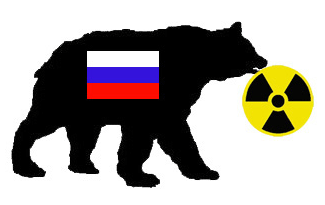
 Count on the nuclear industry to have strange things happen http://www.greenpeace.org/international/en/news/Blogs/nuclear-reaction/Rosatom-Finnish-nuclear-project/blog/53456/?__surl__=Igtmc&__ots__=1436367733419&__step__=1
It has been said often on the Nuclear Reaction blog but bears repeating: the nuclear industry really can’t be trusted. A good case in point is the bizarre antics in Finland right now. On June 30th, Fennovoima, a Finnish utility, submitted an application to the government to build a nuclear plant. One of the utility’s partners is Rosatom, the Russian state nuclear corporation.
To apply for a license, the government requires the project to be 60% owned by companies from the European Union or the European Trade Association. The 60% criterion was put in place by the Finnish government in order to control Russian influence over the country’s energy policy. And that means that Rosatom can’t be the biggest player in this game.
But, a strange thing happened on the filing deadline of June 30. Out of the blue, a new financing partner was found so that the project could meet the 60% rule and could go ahead. At least, that’s the claim.
Greenpeace Nordic decided to take a closer look at this strangely fortuitous development for Rosatom’s Finnish nuclear project. We uncovered what appears to be quite a different story, from a serendipitous turn of events in the form of a new nuclear investment partner.
Instead of a viable European company with a track record that would suggest it is a credible business partner, Greenpeace found a Croatian company, Migrit Solarna Energija, that operates out of an apartment block in Zagreb. It has no employees, capital stock of only 26,000 Euros, and absolutely no income in 2012-2013. And yet, this company is supposedly going to be able to contribute 150 million Euros to the project?
More importantly, Greenpeace found what appear to be strong ties between this tiny company holed up in an apartment complex, and Russia’s nuclear giant, Rosatom. Continue reading
Japanese public not well informed on the grim realities of Fukushima

 View from Inside Fukushima Prefecture: Vastly Different from Govt. Pronouncements, UK Progressive, by Robert Hunziker, 8 July 15 Because of Japan’s unconscionable open-ended new secrecy law, it is very likely journalism in the nation has turned tail, scared of its own shadow. Nevertheless, glimmers of what has happened, of what is happening, do surface when brave people come forward.
On May 22nd 2015 Hiromichi Ugaya, a photojournalist who is well-informed, insightful, and engaging, was interviewed about what he witnessed in the aftermath of one of the world’s most horrendous disasters……..
Naïveté of Public Continue reading
USA government hid radiation test results in Pacific
Japan Scientists: High radiation levels near West Coast after Fukushima disaster — Almost 30 Bq/m3 of cesium offshore — Secret documents reveal US gov’t previously ordered radiation test results in Pacific be hidden to avoid contamination fears http://enenews.com/japan-scientists-high-radiation-levels-west-coast-after-fukushima-disaster-almost-30-bqm3-cesium-offshore-secret-documents-reveal-govt-ordered-radiation-test-results-pacific-be-hidden-avoid-cont
Michio Aoyama (Fukushima University) et al. (pdf), European Geosciences Union General Assembly, Apr 2015 (emphasis added): The oceanic distribution of Cs-137 and Cs-134 released from [Fukushima Daiichi] were investigated… During the period from end of March to early of April 2011, extremely high activities of Cs-137 and Cs-134 in seawater were concentrated along the coast… The high activities area spread to the region of 165_E with a latitudinal center of 40_N in the western North Pacific Ocean. Atmospheric deposition is also cause to high activities in the region between 180º and 130º W in the North Pacific Ocean. The total inventory of FNPP1-released Cs-134 in the North Pacific Ocean is estimated to be 15.2 +/- 1.8 PBq… Leak of stagnant water induced by heavy rainfall would also cause the increase of the total…
Meteorological Research Institute (further detailed inAoyama et al.): 137Cs and 134Cs activities in the North Pacific Ocean after Fukushima Nuclear power plants accident — MRI (Meteorological Research Institute) measured the concentration of radiocesium (134Cs、137Cs) in the seawater sampled in April – May 2011.
- May 13 (42.72ºN, 151.12ºW): 27.3 Bq/m3 of 134Cs + 137Cs (13.5 + 13.8)
- May 14 (40.97ºN, 141.46ºW): 19.3 Bq/m3 of 134Cs + 137Cs (8.1 + 11.2)
Advisory Committee on Human Radiation Experiments(special committee created by Executive Order of the President of the United States), 1994: The [Department of Defense] engaged in fallout data gathering. In the fall of 1954, the Armed Forces Special Weapons Project established a “Fall-out Study Group“… A December 16, 1954, memorandum from the chief of the Armed Forces Special Weapons Project stated… “The actual data obtained are SECRET and the sample collection should be discreetly handled.”… Another contemporary instance of selective disclosure of fallout-related research… is discussed in a February 1955 letter… Willard Libby, acting AEC chairman [reporting] on a proposed marine radiobiological survey in the Pacific… “The classification ‘Secret’ Defense Information has been assigned to the surveyin order to avoid… unwarranted recrudescence [i.e. recurrence] of fears in Japan of radioactive contamination of fish… The fact of an oceanographic survey in the Pacific, however, is regarded as unclassified so long as purpose, content, and results are not revealed.”
Note the rather obvious gap in the center of the Woods Hole Oceanographic Institution’s map showing test results for the Fukushima radioactive plume from 2011-15. According to the WHOI website, they are attempting to “reveal the ongoing spread of radiation across the Pacific.” Perhaps samples from a location that’s in the projected path of the radiation spreading across the Pacific would help.
Continuing cover-up of the seriousness of the Fukushima and Chernobyl nuclear catastrophes
Fukushima Not Even Close To Being Under Control Oil Price, By ZeroHedge , 28 June 2015 Fukushima’s still radiating, self-perpetuating, immeasurable, and limitless, like a horrible incorrigible Doctor Who monster encounter in deep space.
Fukushima will likely go down in history as the biggest cover-up of the 21st Century. Governments and corporations are not leveling with citizens about the risks and dangers; similarly, truth itself, as an ethical standard, is at risk of going to shambles as the glue that holds together the trust and belief in society’s institutions. Ultimately, this is an example of how societies fail.
Tens of thousands of Fukushima residents remain in temporary housing more than four years after the horrific disaster of March 2011. Some areas on the outskirts of Fukushima have officially reopened to former residents, but many of those former residents are reluctant to return home because of widespread distrust of government claims that it is okay and safe.
Part of this reluctance has to do with radiation’s symptoms. It is insidious because it cannot be detected by human senses. People are not biologically equipped to feel its power, or see, or hear, touch or smell it (Caldicott). Not only that, it slowly accumulates over time in a dastardly fashion that serves to hide its effects until it is too late.
Chernobyl’s Destruction Mirrors Fukushima’s Future As an example of how media fails to deal with disaster blowback, here are some Chernobyl facts that have not received enough widespread news coverage: Over one million (1,000,000) people have already died from Chernobyl’s fallout.
Additionally, the Rechitsa Orphanage in Belarus has been caring for a very large population of deathly sick and deformed children. Children are 10 to 20 times more sensitive to radiation than adults.
Zhuravichi Children’s Home is another institution, among many, for the Chernobyl-stricken: “The home is hidden deep in the countryside and, even today, the majority of people in Belarus are not aware of the existence of such institutions” (Source: Chernobyl Children’s Project-UK).
One million (1,000,000) is a lot of dead people. But, how many more will die? Approximately seven million (7,000,000) people in the Chernobyl vicinity were hit with one of the most potent exposures to radiation in the history of the Atomic Age.
The exclusion zone around Chernobyl is known as “Death Valley.” It has been increased from 30 to 70 square kilometres. No humans will ever be able to live in the zone again. It is a permanent “dead zone.”
Additionally, over 25,000 died and 70,000 disabled because of exposure to extremely dangerous levels of radiation in order to help contain Chernobyl. Twenty percent of those deaths were suicides, as the slow agonizing “death march of radiation exposure” was too much to endure……http://oilprice.com/Latest-Energy-News/World-News/Fukushima-Not-Even-Close-To-Being-Under-Control.html
New WikiLeaks Documents Reveal NSA Spied On Top French Companies
by Jeffrey Phillips | Jun 30, 2015 “……in addition to eavesdropping French Economy Ministers François Baroin and Pierre Moscovici between 2004 and 2012, the NSA gathered as much data as possible on big French companies. In particular, the agency wanted to know more about the companies that signed expensive export contracts for industrial goods, such as nuclear power plants, planes, high speed trains, etc……..
Near nuclear power stations, breast cancer rates are 5 times higher
 Breast Cancer Rates Skyrocket Near Nuclear Power Plants http://naturalsociety.com/breast-cancer-rates-skyrocket-near-nuclear-power-plants/ by Robert Harrington
June 26, 2015 Rates as much as 5x higher A scientific research paper in Great Britain asserted that breast cancer rates increased to 5x the normal rate for women who lived near one of three nuclear power plants that they studied. The two others nuclear power plants doubled the incidence for those women living downwind from the reactors.
For decades the American public has been assured that there is very little chance that nuclear radiation escapes from the normal operation of a nuclear power plant. Yes, there may be catastrophic mishaps like Three Mile Island, or Chernobyl, or Fukushima, but absent those once-in-a-decade nuclear disasters, the people living near these plants have nothing to worry about … until now.
“Women living downwind from nuclear power plants are at five times greater risk of developing breast cancer, experts have warned.” [1]
The entire nuclear power industry was launched on the premise that they could be constructed so as to safely contain any and all radiation. Because so many nuclear reactors are relatively close to populated areas, this assumption was key to the promotion of nuclear power generation. If radionuclides could easily escape, then the whole business model and engineering paradigm would be fatally flawed.
“Other forms of cancer showing elevated levels included prostate, leukemia, mesothelioma and pancreas.” [1]
Scientific studies, such as this one conducted by Dr. Chris Busby, are rarely undertaken because the Nuclear Energy Industry would rather not know the true statistics. Were the facts surrounding nuclear discharges to become known to the general public there would be a groundswell of opposition to nuclear power plant sitings anywhere near densely populated areas.
Given that the worst cancer statistics concern carbon dioxide, gas-cooled graphite block reactors, in all likelihood they would be permanently shut down until a durable resolution could be implemented. It is this type of reactor that generates releases into the air which are higher than most other types of nuclear reactors.
Like the U.K., the U.S. nuclear power industry has also seen a great number of reported releases throughout the country over the past few decades. As these nuclear reactors age, they become the victim of a phenomenon known as technospheric breakdown[2]. Since many of them were constructed in the 1970s, those that have not been decommissioned have been operating for a long stretch of time. The average age of commercial reactors in the USA is 34 years.
In view of the extraordinary stresses which exist in the reactor environment, the 40-year license that is granted by the NRC seems far too long. There are several points of inherent weakness within the structural engineering of nuclear reactors, as well as within the controlled atomic fission process that were designed in what could now be described as the nuclear Stone Age. And, yet, the same fatally flawed nuclear energy paradigm is still being promoted worldwide today.
When more studies are conducted, which indicate a spike in cancer rates in locations which have a nuclear power plant nearby, governments across the planet will be forced to respond appropriately. After all, the presence of ionizing radiation will always manifest as various forms of cancer the longer a residential or business area is exposed to it.
Hence, governments will eventually be compelled to remedy the many compromised nuclear power stations which are frequently making these contaminating releases. Not to do so will inevitably translate to an explosion in healthcare costs.
ConclusionJust as the Fukushima nuclear disaster has shown the complete folly of building nuclear power plants on one of the most seismically active (as well as tsunami-prone) group of islands in the world, there are now other well documented serious issues which ought to disqualify plants from being built. It would seem that those reactors with considerably higher rates of nuclear releases would qualify them as menaces to the community. Simply put, they shouldn’t even be there.
Additional Sources:
[1] Daily Mail
Pentagon’s new “laws of war” legalise killing of inconvenient journalists
 Pentagon Legalizes Killing Journalists As ‘Law Of War’ http://www.mintpressnews.com/pentagon-legalizes-killing-journalists-as-law-of-war/206990/?utm_content=buffer5e853&utm_medium=social&utm_source=facebook.com&utm_campaign=buffer
Jackson Marciana for Counter Current News | June 25, 2015 The Pentagon just changed the rules of war to include legitimizing the killing of any journalists they deem “belligerent.”
The new “laws of war” were released as part of a book of instructions on legitimate warfare practices approved by the United States military.This “rule book” of sorts details what the US government deems the acceptable ways of killing those they claim are the “enemy”… including journalists whose reporting they do not approve.
The manual explains that the Pentagon considers such journalists “unprivileged belligerents,” even though they are not “enemy combatants.”
This distinction is important for the Pentagon, since the battles against Muqtada as-Sadr’s “Jaysh al-Mahdi” militia was a fight the US picked over a newsletter America did not approve of. When the military tried to stop the presses, Sadr’s army took up arms against the US forces.
We don’t hear a lot about that in the media or government these days, because those battles didn’t exactly end in the US’s favor. Now, the American 1,176-page “Department of Defense Law of War Manual” says that it is perfectly legitimate to shoot, explode, bomb, stab, or cut journalists they deem “belligerent.”
Professor of Journalism at Georgetown Chris Chambers told RT News that he doesn’t know what this means, since “the Geneva Convention, other tenets of international law, and even United States law – federal courts have spoken on this – doesn’t have this thing on ‘unprivileged belligerents’.”
RT notes that Pentagon “did not specify the exact circumstances under which a journalist might be declared an unprivileged belligerent,” but Chambers explains that “their legal department is going over it, as is the National Press Club and the Society of Professional Journalists.” This article was originally published by Counter Current News.
Radioactive Polonium from Fukushima has contaminated Southeast USA
 NASA Experts: Southeast US hit by “anomalously high” levels of polonium from Fukushima — Never seen before, except during volcanic events — Fallout also detected in Mississippi river — Polonium releases kept secret in past nuclear disasters; Death estimates would skyrocket if included http://enenews.com/nasa-experts-anomalously-high-levels-polonium-found-southeastern-after-fukushima-explosions-never-recorded-before-except-during-volcanic-events-fallout-detected-mississippi-river-polonium-rel?utm_source=feedburner&utm_medium=email&utm_campaign=Feed%3A+ENENews+%28Energy+News%29
Journal of Environmental Radioactivity, W. Yang and L. Guo, NASA Stennis Space Center and Univ. of Southern Mississippi Dept. of Marine Science, 2012 (emphasis added): Depositional fluxes and residence time of atmospheric radioiodine (131I) from the Fukushima accident
- The Fukushima Dai-ichi nuclear power plant explosions… emitted vast quantities of radioactive materials into the environment… radioiodine (131I)… 134Cs and 137Cs are of special concern to people because they could trigger dangerous health effects
- However, data on time series depositional fluxes are still lacking, preventing… prediction of the scope of dispersion especially in North America
- Following the Fukushima accident, a high level of 131I was first detected on March 23 in a dry deposition sample at [NASA’s space center]
- After this initial fallout, the 131I depositional flux increased up to ten- to twenty-foldduring the following two weeks, varying from 218 mBq/m^2/day to 463 Bq/m^2/day
- Concurrent high rainfall and high 131I fluxes were observed at the SSC site… from 97 to 337 mBq/L with an average of 217 mBq/L
- In addition to precipitation samples, 131I was also detectable in surface waters from the Pearl River in Mississippi, with an activity of 6.7 mBq/L
- Interestingly, the 210Po/210Pb ratios of the fallout samples during the peak 131I fallout period were anomalously high… Before and after the Fukushima accident, the environmental 210Po/210Pb ratio in precipitation samples varied from 0.02 to 0.09 with anaverage of 0.06 at the SSC in southern Mississippi… However, the 210Po/210Pb ratioduring the Fukushima fallout was up to 1.5 on March 23…
- To date, excess 210Po in the atmosphere was only reported for high temperature activities such as volcanic eruptions or degassing… Therefore, the anomalously high 210Po/210Pb ratios observed in the southern US were mostly derived from theFukushima Dai-ichi nuclear plant explosions which could have resulted in the fractionation of environmental 210Po and 210Pb and thus the preferential release of volatile 210Po into the atmosphere. Indeed, the anomalous 210Po/210Pb ratios were accompanied by the peak fallout of 131I… indicating that the Fukushima nuclear plant explosions mainly contributed to the anomaly in the 210Po/210Pb ratio…
- it seemed that regions reachable by 131I transport within two weeks from Fukushima would receive much more fallout…
New Scientist, Mar 1983: 25 years since the nuclear accident at Windscale… Attention has centred [on] radioactive iodine… the National Radiological Protection Board (NRPB) said the iodine-131 may have killed 13… However, the damage to health may have been much more severe… Indeed, it could represent the worst environmental disaster that Western Europe has known this century… re-examination of the data… reveals that one crucial isotope released in the fire has been ignored… there was one isotope released in the accident that is highly mobile [with] a high take-up by the human body… this was only revealed this week by the NRPB after New Scientist’s inquiries… It is polonium… polonium could give… a total dose to the UK of 5 million man-rems… the death figures may have to be revised significantly upwards… The figures suggest that some 1200 excess cases of leukaemia may have been caused in Britain by the Windscale accident. Since leukaemia deaths account for some 15 per cent of cancers attributable to nuclear accidents, the total toll of cancer deaths suggested is 8000… Clearly further investigations into the whole of the Windscale accident must be urgently pursued. The British are in effect now the nuclear laboratory of the world.
Woods Hole’s Ken Buesseler and others have cited polonium-210 levels in seafood tested for Fukushima radionuclides, for example: “Doses from eating fish are very low off US, and in fact 500 times greater from a natural radionuclide, polonium-210, but no one worries about 210Po.”
USA government anticipates rise in thyroid cancer, due to Fukushima radiation

 Government Emails Reveal Fukushima Radiation Could Cause Thyroid Cancer to Skyrocket in Americans By J. D. Heyes Global Research, June 19, 2015 Censored and heavily redacted emails [PDF] from U.S. government scientists and officials reveal that there were major concerns among American policymakers shortly after the devastating Fukushima nuclear power plant disaster in March 2011 that there would be widespread radiological contamination and spikes in thyroid cancer rates. Continue reading
Investigation into Cyberspying of Iran Nuclear Talks
Swiss, Austrian Officials Probe Iran Nuclear Talks Cyberspying VOA News, Reuters June 11, 2015 GENEVA/VIENNA — Swiss authorities have searched a house in Geneva and seized computer material in connection with a possible cyberattack on nuclear negotiations between Iran and major powers in the city, Switzerland’s attorney-general said on Thursday.
A computer virus was used to hack into locations including three luxury hotels that have hosted negotiations between Iran and six world powers, the Russian computer security company Kaspersky Lab said on Wednesday.
“On 12 May 2015, a house search took place in Geneva and IT hardware as well as software was seized. The aim of the aforementioned house search was to seize respective information as well as the malware; it was of particular interest to investigate whether the malware infected the respective IT systems,” the Swiss attorney-general’s office in Berne said in a statement.
Criminal proceedings have been opened against unknown persons “on suspicion of political espionage”, it added without elaborating. A spokesman declined to give any further information on the investigation.
Meanwhile, Austrian authorities are investigating reported cyberattacks on venues linked to international talks on Iran’s nuclear program, the government said on Thursday……..
srael, Iran’s arch-enemy and a strong critic of the big powers’ diplomacy with Tehran, on Thursday dismissed as baseless reports that it may have had a connection to the computer virus.
Both Kaspersky and U.S. security company Symantec said the virus shared some programming with previously discovered espionage software called Duqu, which security experts believe to have been developed by Israelis.
Israel, widely believed to be the Middle East’s only nuclear power, has denounced the negotiations with Iran, saying it doubts any agreement arising from the talks will sufficiently restrain the Islamic Republic’s atomic program. http://www.voanews.com/content/austria-investigating-possible-cyberattack-on-iran-nuclear-talks/2816943.html
India bans entrance of Greenpeace member
India barred activist from entry: Greenpeace , Arab News 9 June 15 NEW DELHI: Greenpeace said Monday an Australian staff member had been barred from entering India despite holding a valid visa, in what it said was the latest crackdown against the group.
Aaron Gray-Block was on his way to meetings in India when immigration officials stopped him at Bangalore airport on Saturday night and put him on a flight to Kuala Lumpur without explanation, the campaign group said.
His passport was seized and only returned to him once he had landed in the Malaysian capital, the environmental group said in a statement.
“Our colleague has a valid business visa, and yet he was prevented from entering India with no reason given,” Divya Raghunandan, program director of Greenpeace India, said.
“We are forced to wonder if all international staff of Greenpeace will now be prevented from entering the country?“
Local media reports cited unnamed home ministry sources saying Gray-Block was denied entry because his name figured in an official ‘black list’.
But the activist said he had “not received any communication” from the government of being placed on such a list, demanding “an explanation to this.”
“I arrived at Bangalore Airport with a valid business visa issued by the Indian embassy in Australia… Any suggestion of wrongdoing is a farce and a smear,” Gray-Block said in a statement late Monday.
“There is no reason for me to be included in any blacklist,” he added……
A court last month ordered authorities to unfreeze some of Greenpeace’s accounts, handing the group a lifeline after it faced closure of its local operations.
Greenpeace has accused the government of waging a “malicious campaign” against it. Authorities prevented one of its campaigners in January from leaving Delhi after she was placed on a suspicious persons list. According to Indian media, a secret report by the main intelligence agency recently warned that delays to key development projects being sought by Greenpeace and other activist groups could knock up to three percentage points off India’s annual growth rate.
Greenpeace has been at loggerheads with the government over claims of environmental damage caused by India’s heavy reliance on coal and the impact of deforestation and nuclear projects. http://www.arabnews.com/news/758971
USA Senate passes Act Restricting NSA Surveillance Powers
 Senate Passes USA Freedom Act, Restricting NSA Surveillance Powers http://www.truthdig.com/eartotheground/item/senate_passes_usa_freedom_act_restricting_nsa_surveillance_powers_20150602 by Roisin Davis Jun 2, 2015 In a move seen to vindicate whistleblower Edward Snowden, the Senate on Tuesday passed the USA Freedom Act, which will end the bulk collection of Americans’ phone records.
As the Guardian explains, this is the most significant surveillance reform for decades, “a direct result” of Snowden’s revelations to the paper two years ago. “The passage of the USA Freedom Act,” the Guardian states, “paves the way for telecom companies to assume responsibility of the controversial phone records collection program, while also bringing to a close a short lapse in the broad NSA and FBI domestic spying authorities. Those powers expired with key provisions of the Patriot Act at 12.01 am on Monday amid a showdown between defense hawks and civil liberties advocates.”
Needing only a simple majority to pass, the final tally of the vote showed that 67 senators were in favor of the measure and 32 against.
The vote comes only two days after key parts of the Patriot Act expired, and BBC News compares the two:
What is changing? The expiry of the Patriot Act brings to an end bulk collection of Americans’ phone metadata – who called who, when and for how long, but not the content of calls – by the US. Under its successor, records must be held by telecommunications companies and investigators need a court order to access specific information. Technology companies will be given greater leeway to reveal data requests. The measures are intended to balance concerns on privacy with providing the authorities the tools they need to prevent attacks.
What stays the same? Key parts of the Patriot Act are retained in the Freedom Act. They include the provision allowing the monitoring of “lone wolf” suspects – potential attackers not linked to foreign terror groups, despite the US authorities admitting the powers have never been used. The Freedom Act also maintains a provision allowing investigators to monitor travel and business records of individuals, something law officers says is more effective than bulk collection.
Censored emails show US govt concern about Fukushima radiation on West Coast of USA
Censored US gov’t emails reveal proposed plan to test West Coast residents for Fukushima fallout — “Many cases of cancer may end up being attributed to exposures” — Doses could exceed EPA’s emergency levels — UC Berkeley Nuclear Dept.: “Prompt action should be taken” http://enenews.com/govt-emails-reveal-proposed-plan-test-west-coast-residents-fukushima-radiation-many-cases-cancer-being-attributed-exposures-doses-could-exceed-epas-emergency-levels?utm_source=feedburner&utm_medium=email&utm_campaign=Feed%3A+ENENews+%28Energy+News%29
FOIA Document — Excerpts from email by Per Peterson, Chair of Dept. of Nuclear Engineering at Univ.of California Berkeley & scientific adviser to Energy Secretary Steven Chu , Mar 23, 2011 at 1:35p (emphasis added):
- [Sent to John Holdren, senior adviser to Pres. Obama on science & technology, Secretary of Energy Steven Chu, DOE/NRC officials, and others who were redacted]
- I would like to raise another issue which now merits expeditious, near term action. There is a short time window… during which it will remain possible to… measure any I-131 that members of the public may have ingested…
- Collecting this data… would be very valuable…
- UCB faculty [is in] general agreement that prompt action should be taken…
- Many cases of thyroid cancer, and other health problems, may end up being attributed to exposures from the Fukushima accident… on the U.S. west coast…
Washington was contaminated with radiation in 1949 secret Air Force experiment
The Secret 1949 Radiation Experiment That Contaminated Washington, Gizmodo, 3 June 15 Sarah Zhang The physicists who invented the nuclear bomb worked out of Los Alamos in New Mexico, but the people who did the dirty work of making the bombs were in Hanford, Washington. Throughout the Cold War, Hanford churned out plutonium for our nuclear arsenal. It was also, conveniently, a place to experiment with radiation.
Today, Hanford is the most contaminated radioactive site in America—the site of a massive (and troubled) cleanup effort. Radioactive material is still accidentally leaking into the ground. Though Hanford’s plants routinely released small doses of radioactive material into the air, most of this damage came from an event in 1949 called Green Run.
Green Run was a secret Air Force experiment that released Hanford’s largest single dose of radioactive iodine-131. On the night of December 2, 1949, at the behest of the military, scientists at Hanford let 7,000 to 12,000 curies of iodine-131 into the air, where it rode the wind as far as 200 miles. For a sense of scale, the Three Mile Island nuclear power plant accident released an estimated 15 to 24 curies of iodine-131 and the Chernobyl accident 35 million to 49 million curies.
The Green Run stayed secret until the 1980s, when it was revealed by Freedom of Information Act requests from local newspapers. The military details are still classified. More than half a century later, suspicion and controversy continue to lurk around Green Run, especially among the residents who lived downwind of Hanford.
There’s still much that we don’t know about the Green Run, but here is what we do.
Hanford, Factory and Farm …….Hanford was always more than a production facility; it was also a research complex. Up to 1,000 animals were housed on a farm near reactor F for experiments on the effects of radiation. The animals included fish, dogs, pigs, sheep, and even alligators. Sheep, especially, were given feed with iodine-131, the same radioactive material that the reactors were discharging into the air…….http://gizmodo.com/the-secret-1949-radiation-experiment-that-contaminated-1707748721
Secrecy, and no costing known, in South Africa’s plans for nuclear power
Key details of SA’s nuclear procurement plan kept under wraps, BD Live, BY CAROL PATON, 02 JUNE 2015 KEY DETAILS OF SA’S NUCLEAR PROCUREMENT PROGRAMME REMAINED SECRET IN A PRESENTATION BY TOP DEPARTMENT OF ENERGY OFFICIALS, AS WELL ENERGY MINISTER TINA JOEMAT-PETTERSSON TO PARLIAMENT’S PORTFOLIO COMMITTEE ON ENERGY.

However, officials said the procurement would be completed by the end of the financial year when “a strategic partner or partners” would be chosen.
While the officials gave a lengthy motivation on the need for nuclear power and SA’s preparedness for the new nuclear energy build, details about the cost, the financing and the procurement process were not provided. Inter-governmental agreements that SA has signed with various countries on nuclear co-operation, as well as a damning report by the Integrated Nuclear Infrastructure Review on SA’s readiness also remained under wraps.
Ms Joemat-Pettersson is backed by President Jacob Zuma in her quest to build 9.6GW of nuclear generation capacity. However, there are several detractors of the plan, including the former National Planning Commission, opposition political parties and a wide array of civil society and human rights lobby groups……
DA MP Gordon MacKay said that with regard to the financing the government had got the cart before the horse.”It is strange that we are wanting to buy something that we don’t know the cost of and we don’t know how we will pay for,” he said.
Mr MacKay also criticised the secrecy of the report compiled in the Integrated Nuclear Infrastructure Review process.While reports for other countries are available on the website of the International Atomic Energy Agency, the report compiled on SA remains “classified” despite being completed two years ago.
Mr MacKay said it was believed that the report showed SA to be unprepared for the nuclear procurement in 14 of 19 benchmark areas.http://www.bdlive.co.za/business/energy/2015/06/02/key-details-of-sas-nuclear-procurement-plan-kept-under-wraps
1 This Month
26 September – International Day for the Total Elimination of Nuclear Weapons





PLEASE OPPOSE HR 8255 AND S.3639 – bills would accelerate satellite deployment, with no environmental review or safeguards – https://ncstd5li.quorum.us/campaign/169331/
To see nuclear-related stories in greater depth and intensity – go to https://nuclearinformation.wordpress.com
-
Archives
- September 2026 (281)
- August 2026 (330)
- July 2026 (355)
- June 2026 (287)
- May 2026 (306)
- April 2026 (356)
- March 2026 (251)
- February 2026 (267)
- January 2026 (308)
- December 2025 (358)
- November 2025 (359)
- October 2025 (375)
-
Categories
- 1
- 1 NUCLEAR ISSUES
- business and costs
- climate change
- culture and arts
- ENERGY
- environment
- health
- history
- indigenous issues
- Legal
- marketing of nuclear
- media
- opposition to nuclear
- PERSONAL STORIES
- politics
- politics international
- Religion and ethics
- safety
- secrets,lies and civil liberties
- spinbuster
- technology
- Uranium
- wastes
- weapons and war
- Women
- 2 WORLD
- ACTION
- AFRICA
- Atrocities
- AUSTRALIA
- Christina's notes
- Christina's themes
- culture and arts
- Events
- Fuk 2022
- Fuk 2023
- Fukushima 2017
- Fukushima 2018
- fukushima 2019
- Fukushima 2020
- Fukushima 2021
- general
- global warming
- Humour (God we need it)
- Nuclear
- RARE EARTHS
- Reference
- resources – print
- Resources -audiovicual
- Weekly Newsletter
- World
- World Nuclear
- YouTube
-
RSS
Entries RSS
Comments RSS

