Political deception aimed at sabotaging the nuclear agreement with Iran – phony news
 Media Trumpet Another Phony “Secret Nuclear Deal” Story , 08 September 2016 By Gareth Porter, Truthout | News Analysis Two major media outlets — Reuters and The Washington Post — pushed another Iran “secret side deal” story last week, ignoring obvious facts that revealed it as clever political deception aimed at sabotaging the nuclear agreement with Iran.
Stories in both of those outlets suggested that a leading think tank had revealed a secret deal that allowed Iran to exceed various qualitative and quantitative limits placed on it under the nuclear agreement reached last year — the main current theme of political opponents of the agreement. The stories were based on claims in a report co-authored by David Albright, the head of the Institute for Science and International Security, who has long been treated by corporate media as the leading “independent” expert on Iran’s nuclear program.
In fact, as Truthout revealed in 2014, Albright had abandoned any independence he had maintained on Iran as early as 2008 and had aligned his position on nuclear negotiations with Iran with those of the Bush administration and Israel…….
Albright’s attack on the Obama administration and the Joint Commission was only the latest installment in the current campaign by pro-Israeli media and political opponents of the JCPOA to claim existence of “secret side deals” between the Obama administration and Iran. Just six weeks ago, the Associated Press correspondent in Vienna, George Jahn, published a story that falsely portrayed Iran’s report to the International Atomic Energy Agency [IAEA] on its plan for implementation of the agreement as such a “secret side deal.” The agreement reached between Iran and the IAEA on the issue of alleged past Iranian nuclear work, which included arrangements for taking environmental samples at Iran’s Parchin military facility, was also treated by JCPOA opponents as a “secret side deal.” http://www.truth-out.org/news/item/37527-media-trumpet-another-phony-secret-nuclear-deal-story
Outcry over secret trucking of weapons grade nuclear waste to South Carolina
 Weapons-grade nuclear waste shipments to U.S. prompt outcry Trucks expected to carry
  casks containing highly enriched uranium and radioactive isotopes CBC News Sep 05, 2016 A highly secretive plan to ship weapons-grade nuclear waste from a federal lab northwest of Ottawa to the United States is drawing ire in some of the southern Ontario and American communities along the potential route.
Radioactive waste from the former Atomic Energy of Canada Ltd. laboratory in Chalk River, Ont., a major but dwindling world supplier of medical isotopes that is now run by a private consortium, is set to be transported in liquid form to a site in Savannah River, S.C., for processing and disposal. The route could take it through Ontario’s fruit-rich Niagara Region, or possibly even through the border crossing at Sault Ste. Marie, Ont., into Michigan, according to a lawsuit trying to stop the shipments. Thelawsuit was filed in a U.S. federal court last month by a coalition of American environmental and nuclear watchdog groups. …….
Kept secret from emergency personnel
The plan is for about 150 shipments by truck to South Carolina, a minimum distance of nearly 1,700 kilometres from Chalk River, which is 180 km northwest of Ottawa. Each shipment would carry four 58-litre steel containers placed inside a larger steel and lead tube, carrying liquid radioactive waste including isotopes of cesium, iodine, strontium and plutonium, according to the U.S. lawsuit.
The waste would also contain a modest but dangerous quantity of highly enriched uranium, which can be used to make a nuclear bomb, the lawsuit states.
The waste is a byproduct of making molybdenum-99, a medical isotope used in diagnostic tests of organs and other body parts.
The Niagara area’s regional government passed a motion last year opposing the shipments…….
One problem raised by opponents is that, for security reasons, the route through Canada and the timetable for shipments are being kept under tight secrecy — so secret that local emergency responders haven’t been kept in the loop.
“There would be no notice given, but of course it would be our first responders, my friends, my neighbours, working in our volunteer force and in our emergency services, that would be exposed… in case there was an accident,” Hodgson said, adding that even his local fire chief only found out through the media.
The Canadian Nuclear Safety Commission, the federal nuclear safety regulator, approved the steel tube design last year for transporting the nuclear waste, but full environmental assessments have not been conducted in either Canada or the U.S., opponents complain. …… http://www.cbc.ca/news/health/nuclear-waste-chalk-river-uranium-transport-carolina-1.3748658
Hypocrisy of big USA companies on climate change
 U.S. companies tout climate policies, fund climate skeptics. Reuters, 6 Sept 16, By Richard Valdmanis and Grant Smith | BOSTON/NEW YORK
U.S. companies that have expressed the most fervent public support for President Barack Obama’s environmental agenda are also funding its biggest enemies – the scores of U.S. lawmakers who are climate change skeptics and oppose regulation to combat it, according to a Reuters review of public records.
Ahead of the Nov. 8 presidential and congressional elections, the donations from companies including PepsiCo, Dupont, and Google reveal a disconnect between how these companies present themselves to the public on environmental issues, and how they manage their political contributions to support business-friendly policy.
But inconsistency between a company’s environmental positions and its political giving may point up a need for better oversight, according to Jon Lukomnik, head of the Investor Responsibility Research Center Institute.
“There really needs to be a process that looks at these issues … at C-suite and board levels on a periodic basis,” Lukomnik said.
The Reuters review covered donations made during the 2016 election cycle by the political action committees (PACs) of 30 of the biggest publicly traded U.S. companies that signed Obama’s “American Business Act on Climate Change Pledge” in 2015, a public promise to enact climate-friendly corporate policies and support strong climate change oversight like the global climate accord signed in Paris.
The review found that 25 of the 30 companies are funding the campaigns of lawmakers featured on a “climate deniers” list that was put together by Organizing For Action, a non-profit created by former Obama campaign aides to advocate his agenda.
The list includes more than 130 members of Congress, nearly all Republicans, and is a who’s who of the biggest opponents of Obama’s plan to combat climate change. Some of those on the list dispute the label “denier” and describe themselves as climate change “skeptics”.
The list includes Republican Congressman Kevin Cramer of North Dakota, an energy advisor to presidential candidate Donald Trump who once argued the Earth was cooling not warming, and Republican U.S. Senator Jim Inhofe of Oklahoma, who last year held up a snowball on the Senate floor as evidence global warming does not exist.
Other signatories to the American Business Act on Climate Change Pledge that gave more than a third of their top political contributions to lawmakers on the list include Google, AT&T, GE, Verizon, and Mondelez, according to the review.
Those levels of donations given to climate skeptics are relatively high given that the list covers about a quarter of U.S. Congress members……… http://www.reuters.com/article/us-usa-election-climate-donations-idUSKCN11C0ED
South Africa’s Energy Minister Tina Joemat-Pettersson maintains the secrecy on nuclear power procurement plans

 Tina Joemat-Pettersson refuses to provide papers on nuclear plans, BD Live, BY LINDA ENSOR, 06 SEPTEMBER 2016, ENERGY Minister Tina Joemat-Pettersson has refused to supply the DA with a range of documents related to the government’s nuclear power procurement plans, saying they are privileged, sensitive state documents the release of which “could compromise the new build process”.
Another ground for her refusal is that the requested documents are also subject to the sub judice rule as there is litigation in the High Court in Cape Town in a case brought in October last year by Earthlife Africa and the Southern African Faith Communities’ Environment Institute against the minister and President Jacob Zuma.
The two organisations which are attempting to stop what they say is a flawed and illegal, nontransparent nuclear procurement process, have requested the same information from the government.
The minister’s refusal was contained in a written reply to a parliamentary question by DA energy spokesman Gordon Mackay, who asked for copies of the proposal for the roll-out of new nuclear power plants as signed off by her; the Integrated Nuclear Infrastructure Review by the International Atomic Energy Agency; the terms of reference for the National Nuclear Energy executive co-ordinating committee, its communication and stakeholder engagement strategy and its phased decision-making approach to implementing government’s nuclear programme; and the designation of Eskom as the owner and operator of nuclear power plants in SA……..http://www.bdlive.co.za/business/energy/2016/09/06/tina-joemat-pettersson-refuses-to-provide-papers-on-nuclear-plans
Iran arrests member of Nuclear Deal Negotiation Team on suspicion of spying
 Iran Arrests Member Of Nuclear Deal Negotiation Team http://www.huffingtonpost.com/entry/iran-nuclear-deal-arrest_us_57c2e81ce4b04193420f8788 Spokesman Gholamhossein Mohseni Ejei said a member of the team was arrested on suspicion of spying.
The suspect was released on bail after a few days in jail but is still under investigation, Gholamhossein Mohseni Ejei said at a weekly news conference, calling the unidentified individual a “spy who had infiltrated the nuclear team,” state media reported.
The deal that President Hassan Rouhani struck last year has given Iran relief from most international sanctions in return for curbing its nuclear program, but it is opposed by hardliners who see it as a capitulation to the United States.
Ejei was responding to a question about an Iranian lawmaker’s assertion last week that a member of the negotiation team who had dual nationality had been arrested on espionage charges.
Tehran’s prosecutor general on Aug. 16 announced the arrest of a dual national he said was linked to British intelligence, but made no mention of the person being in the nuclear negotiations team. On Sunday, Ejei did not explicitly confirm that the arrested person had a second nationality.
Britain said on Aug. 16 that it was trying to find out more about the arrest of a joint-national.
Canada’s nuclear scientists want freedom to express their safety concerns

 Nuclear scientists push for freedom to express views without fear of reprisals http://www.theglobeandmail.com/news/politics/nuclear-scientists-push-for-freedom-to-express-views-without-fear-of-reprisals/article31219139/ GLORIA GALLOWAYOTTAWA — The Globe and Mail, Aug. 01, 2016 Scientists working for the Canadian Nuclear Safety Commission have asked their union to negotiate a policy on scientific integrity that would allow them to express their views about nuclear-safety issues without fear of reprisals from management.
The unionized professional employees at the nuclear regulator and two nuclear research facilities – Chalk River in Ontario and Whiteshell in Manitoba – have been negotiating a new contract for the past three years, a process that was significantly delayed as a result of last year’s federal election.
The labour talks have continued as the two reactors are gradually being decommissioned.
The Professional Institute of the Public Service of Canada (PIPSC), the union that represents them, says the aim is to secure scientific integrity in the workplace. Allowing more freedom for government scientists to speak to the public and the media has been a central theme of the PIPSC’s negotiations with many government departments.
“When our members fight for scientific integrity to be in the collective agreement, they’re not just fighting for their own right as regulatory scientists, they’re also fighting for the rights of every Canadian to live in safety,” Debi Daviau, president of PIPSC.
“The situation with specialists at the nuclear regulator is a clear case of that,” she said. “After a decade of disregard for the advice of public service professionals, we want to see real change reflected in our collective agreements.”
The effort to free the CNSC’s scientific staff to voice concerns comes as the regulator investigates allegations contained in an anonymous letter, purportedly written by employees at the nuclear regulator, that says information was withheld from commissioners while they were making critical decisions about the licensing of this country’s nuclear plants.
The letter, which was sent several weeks ago to CNSC president Michael Binder, points to five separate cases in which the commission’s staff sat on relevant material about risk or non-compliance that might have called the safety of a plant into question.
Environmental groups have complained for many years that the CNSC acts more as a booster for nuclear energy than as a watchdog for public safety. In response to the union’s demands, the CNSC created a working group, composed largely of managers, to develop ways to resolve scientific or regulatory disagreements, to establish the rules for publishing research and to discuss the scope of a potential policy on scientific integrity.
A document, obtained under Access to Information by the environmental group Greenpeace, says one of the aims of that working group is to “provide mechanisms for staff to express dissenting views without fear of reprisal in a respectful environment.”
That document says the CNSC would benefit from having a science policy and recommends the creation of a science adviser position to ensure compliance with that policy.
The CNSC said in an e-mail that its staff have always had scientific freedom to publish their research, that healthy debate is encouraged, that a formal process for resolving differences of professional opinion already exists and that whistle blowers can raise concerns anonymously.
But the union says CNSC scientists are extremely fearful of the repercussions they might face for speaking out. Although management is open to creating its own internal policy around scientific integrity, the union says it wants to the policy written into the collective agreement to ensure that its members are protected.
Wikileaks reveals The Saudi Cables
 The Saudi Cables. Cables and other documents from the Kingdom of Saudi Arabia Ministry of Foreign Affairs https://wikileaks.org/saudi-cables/buying-silence
A total of 122619 published so far
Buying Silence: How the Saudi Foreign Ministry controls Arab media
On Monday, Saudi Arabia celebrated the beheading of its 100th prisoner this year. The story was nowhere to be seen on Arab media despite the story’s circulation on wire services. Even international media was relatively mute about this milestone compared to what it might have been if it had concerned a different country. How does a story like this go unnoticed?
Today’s release of the WikiLeaks “Saudi Cables” from the Saudi Ministry of Foreign Affairs show how it’s done.
The oil-rich Kingdom of Saudi Arabia and its ruling family take a systematic approach to maintaining the country’s positive image on the international stage. Most world governments engage in PR campaigns to fend off criticism and build relations in influential places. Saudi Arabia controls its image by monitoring media and buying loyalties from Australia to Canada and everywhere in between.
Documents reveal the extensive efforts to monitor and co-opt Arab media, making sure to correct any deviations in regional coverage of Saudi Arabia and Saudi-related matters. Saudi Arabia’s strategy for co-opting Arab media takes two forms, corresponding to the “carrot and stick” approach, referred to in the documents as “neutralisation” and “containment”. The approach is customised depending on the market and the media in question.
“Contain” and “Neutralise”
The initial reaction to any negative coverage in the regional media is to “neutralise” it. The term is used frequently in the cables and it pertains to individual journalists and media institutions whose silence and co-operation has been bought. “Neutralised” journalists and media institutions are not expected to praise and defend the Kingdom, only to refrain from publishing news that reflects negatively on the Kingdom, or any criticism of its policies. The “containment” approach is used when a more active propaganda effort is required. Journalists and media institutions relied upon for “containment” are expected not only to sing the Kingdom’s praises, but to lead attacks on any party that dares to air criticisms of the powerful Gulf state.
One of the ways “neutralisation” and “containment” are ensured is by purchasing hundreds or thousands of subscriptions in targeted publications. These publications are then expected to return the favour by becoming an “asset” in the Kingdom’s propaganda strategy. A document listing the subscriptions that needed renewal by 1 January 2010 details a series of contributory sums meant for two dozen publications in Damascus, Abu Dhabi, Beirut, Kuwait, Amman and Nouakchott. The sums range from $500 to 9,750 Kuwaiti Dinars ($33,000). The Kingdom effectively buys reverse “shares” in the media outlets, where the cash “dividends” flow the opposite way, from the shareholder to the media outlet. In return Saudi Arabia gets political “dividends” – an obliging press.
An example of these co-optive practices in action can be seen in an exchange between the Saudi Foreign Ministry and its Embassy in Cairo. On 24 November 2011 Egypt’s Arabic-language broadcast station ONTV hosted the Saudi opposition figure Saad al-Faqih, which prompted the Foreign Ministry to task the embassy with inquiring into the channel. The Ministry asked the embassy to find out how “to co-opt it or else we must consider it standing in the line opposed to the Kingdom’s policies“.
The document reports that the billionaire owner of the station, Naguib Sawiris, did not want to be “opposed to the Kingdom’s policies” and that he scolded the channel director, asking him “never to host al-Faqih again”. He also asked the Ambassador if he’d like to be “a guest on the show”.
The Saudi Cables are rife with similar examples, some detailing the figures and the methods of payment. These range from small but vital sums of around $2000/year to developing country media outlets – a figure the Guinean News Agency “urgently needs” as “it would solve many problems that the agency is facing” – to millions of dollars, as in the case of Lebanese right-wing television station MTV.
Confrontation
The “neutralisation” and “containment” approaches are not the only techniques the Saudi Ministry is willing to employ. In cases where “containment” fails to produce the desired effect, the Kingdom moves on to confrontation. In one example, the Foreign Minister was following a Royal Decree dated 20 January 2010 to remove Iran’s new Arabic-language news network, Al-Alam, from the main Riyadh-based regional communications satellite operator, Arabsat. After the plan failed, Saud Al Faisal sought to “weaken its broadcast signal“.
The documents show concerns within the Saudi administration over the social upheavals of 2011, which became known in the international media as the “Arab Spring”. The cables note with concern that after the fall of Mubarak, coverage of the upheavals in Egyptian media was “being driven by public opinion instead of driving public opinion”. The Ministry resolved “to give financial support to influential media institutions in Tunisia“, the birthplace of the “Arab Spring”.
The cables reveal that the government employs a different approach for its own domestic media. There, a wave of the Royal hand is all that is required to adjust the output of state-controlled media. A complaint from former Lebanese Prime Minister and Saudi citizen Saad Hariri concerning articles critical of him in the Saudi-owned Al-Hayat and Asharq Al-Awsat newspapers prompted a directive to “stop these type of articles” from the Foreign Ministry.
This is a general overview of the Saudi Foreign Ministry’s strategy in dealing with the media. WikiLeaks’ Saudi Cables contain numerous other examples that form an indictment of both the Kingdom and the state of the media globally.
Chinese nuclear company Pushed U.S. Experts for Nuclear Secrets – says FBI
 FBI Files Say China Firm Pushed U.S. Experts for Nuclear Secrets , Bloomberg, David Voreacos davidvoreacos David McLaughlin damclaughAugust 25, 2016
-
China General Nuclear Power charged with conspiracy by U.S.
-
CGN is partner in delayed British Hinkley plant under review
-
A state-owned Chinese power company under indictment in the U.S. pressed American nuclear consultants for years to hand over secret technologies and documents they weren’t supposed to disclose — and in some cases it got them, several of the consultants have told the FBI.
Summaries of the consultants’ interviews with agents from the Federal Bureau of Investigation were filed this month in a federal court where the company, China General Nuclear Power Corp., has been charged with conspiring to steal nuclear technology.
The FBI documents surfaced shortly after the same company became a focus of concerns across the Atlantic: The U.K. last month delayed approval of the country’s biggest nuclear power station in a generation as questions swirled about whether China General Nuclear’s investment in the plant poses a security risk.
The filings provide a window into the tactics of CGN, China’s biggest nuclear power operator. One of the consultants said CGN employees asked for off-limits operational manuals to nuclear equipment and software, according to the interview summaries. Another said he was asked to provide proprietary temperature settings for material used to contain nuclear fuel. After he refused, he wasn’t offered more consulting jobs, he told the FBI…….. -
China Warning
While the U.S. court case doesn’t address the U.K. plant, the FBI interviews could add to concerns expressed by British officials like Nick Timothy, a close adviser to the new prime minister, Theresa May. Timothy warned last year that China’s involvement in nuclear projects there might allow it to “shut down Britain’s energy production at will.”
The prime minister hasn’t said why she put the brakes on the 18 billion pound ($24 billion) Hinkley Point plant in southwest England, a project one-third owned by CGN and led by Electricite de France SA. In addition to the security concerns, the project has faced criticism over its price tag and the above-market electricity rates that U.K. taxpayers would have to pay. Electricite de France declined to comment……….
-
U.S. Indictments
In the U.S., CGN was indicted along with Szuhsiung “Allen” Ho, an American nuclear engineer born in Taiwan who recruited the U.S. consultants for CGN. Ho and the company are accused in a federal court in Knoxville, Tennessee, of conspiring to help Beijing obtain restricted U.S. nuclear technology over two decades. Ho, 66, is also accused of acting as an unregistered agent of the Chinese government. He faces life in a U.S. prison in what prosecutors call an “extremely significant national security case.”
- Ho has pleaded not guilty. His lawyers say that he was merely helping China’s civil nuclear power industry and that he had no intent to break the law or steal U.S. secrets.
The case is unfolding as U.S. officials say they see Beijing’s hand in cyber-espionage, indicting five Chinese military officials in absentia in 2014 for allegedly stealing trade secrets from U.S. companies — including Westinghouse Electric Co., a unit of Japan’s Toshiba Corp. that designs nuclear power plants. Westinghouse, which didn’t respond to requests for comment, is the former employer of Ho and many of the experts he brought to China to consult for CGN……..http://www.bloomberg.com/news/articles/2016-08-25/fbi-files-say-china-firm-pushed-u-s-experts-for-nuclear-secrets
While Louisiana drowns, sociopaths sabotage action on climate change
 The Path of the Sociopath They did it while Louisiana drowned. http://washingtonmonthly.com/2016/08/20/the-path-of-the-sociopath/#.V7jF_CUlnoY.twitter by D.R. Tucker August 20, 2016
They didn’t give a damn about how many people had lost their lives, or how many people will lose their lives if we don’t transition as quickly as possible away from fossil fuels. They couldn’t care less about the health impacts of carbon pollution, and the fact that it is inherently unfair to deprive innocent people of a stable climate and clean air. Their arrogance has reached new heights–in fact, the level of their arrogance is as high as the sea levels will be in a few decades.
As DeSmogBlog’s Sharon Kelly reports:
A long-awaited campaign to rebrand fossil fuels called Fueling U.S. Forward made its public debut at the Red State Gathering 2016 [in Denver, Colorado last] Saturday, where the organization’s President and CEO Charles Drevna gave attendees the inside scoop on the effort, and confirmed that the campaign is backed financially by Koch Industries.
Back in February, Peter Stone first reported in the Huffington Post that a $10 million-a-year effort was proposed by a Koch Industries board member, James Mahoney, and Mr. Drevna, aiming “to boost petroleum-based transportation fuels and attack government subsidies for electric vehicles.” In early August, the Fueling U.S. Forward website launched, and on Saturday, the first public comments were made about the campaign by Mr. Drevna, and they revealed a lot about how the Koch-backed initiative is working to re-frame fossil fuels…
The top line takeaway from Mr. Drevna’s comments is that the Koch-funded Fueling U.S. Forward is an effort to rebrand fossil fuels, focusing on the “positive” sides of oil, gas and coal.
The new initiative comes at a time when the impacts of climate change are becoming more difficult to ignore. 2016 is already on track to be the hottest year ever recorded, a mid-year climate analysis from NASA reported, and unusual storms, like the torrential rainfall that struck the Gulf Coast over the past few days causing historic flooding, have become more frequent.
Charles and David Koch built this, this monument to malevolence. We always knew they were ruthless…but to do this while Louisiana drowned as a clear result of fossil-fueled climate change is beyond heartless. This is Trumpian in its treachery.
Spare me the nonsense that the Koch family doesn’t like Trump. Yes, Charles and David may scorn Trump in public, but if the bigoted billionaire manages to turn things around and win the White House, both men will be wholly satisfied with Trump’s dirty-energy agenda. (In addition, let’s not forget that another Koch Brother, William “Death to Cape Wind” Koch, has officially boarded the Trump train.)
When Bill McKibben calls for a “war” on climate change, he’s calling for a war on Koch ideology. It’s a war that progressives, moderates and whatever remains of the rational right must be prepared to fight and win. This is an enemy that must be conquered before it conquers us.
The sociopathy of the Kochs shocks the conscience. Looking at a world on fire, they call for the use of more fossil fuels to further increase their profits as they further inflame the planet. If Joseph Welch were alive today, he wouldn’t ask the Kochs if they had any sense of decency; he’d tell them he already knew they had none.
I’ve yet to read Daniel Schulman’s 2014 Koch biography Sons of Wichita, though I imagine that Schulman was thoroughly disgusted by their disregard for their fellow human beings. (Considering their latest actions, I have to say Schulman’s title is incomplete, since obviously Wichita is not the only thing these fossil-fuel fiends are sons of.)
I give Wisconsin talk radio star Charlie Sykes credit for admitting, at long last, that the right-wing media noise machine has created a “monster” comprised of millions of Americans who are resistant to facts and logic. Of course, Janeane Garofalo basically said the same thing seven years ago, and received nothing but scorn from the right for saying so:
Fox News loves to foment this anti-intellectualism because that is their bread and butter. If you have a cerebral electorate, Fox News goes down the toilet, you know, very, very fast…They‘re been doing this for years. That‘s why Roger Ailes and Rupert Murdoch started this venture; it is to disinform and to coarsen and dumb-down a certain segment of the electorate.
Thanks to right-wing radio, Fox and the wingnut blogosphere, we have far too many Americans who scorn science and reject reason…far too many Americans who think the lies of Charles, David and William Koch are the truth…far too many Americans who will suffer as a result of the actions of the fossil fuel industry and its media allies.
They did it while Louisiana drowned.
While Louisiana drowned.
Damn them.
Critical documents missing – secrecy in South Africa’s nuclear negotiations
Joemat-Pettersson to be quizzed on missing nuclear documents, Engineering News, Creamer Media,
19TH AUGUST 2016 Energy Minister Tina Joemat-Petterssonwill be asked in Parliament next week to account for missing documents in a court case regarding the nuclear energy programme.
That is according to Democratic Alliance (DA) MP and shadow energy minister Gordon Mackay on Thursday, who sits on the energy portfolio committee in Parliament. He was responding to a claim on Thursday that government failed to disclose about ten documents in justifying its decision to enter into an intergovernmental agreement withRussia.
The claim was made by Southern African Faith Communities’ Environment Institute (Safcei) and Earthlife AfricaJohannesburg (ELA), who are challenging government in court to prove this nuclear agreement was not in fact a done deal.
Government wants to build about eight nuclear reactors to add 9.6GW of baseload energy in its drive to boost industrialisation in South Africa. However, many economists and pro-renewable energy advocates believe it is too expensive and unnecessary for South Africa, with some suggesting it would result in rating agencies downgrading the country to junk status.
“Parliamentary committees recommence next week and the DA will be asking the minister to account for the missing documents,” Mackay told Fin24.
“The DA remains deeply perturbed by the state’s lack of compliance in this case,” he said.
ELA’s Dominque Doyle said government continues to promise a fair and accountable process of nuclearprocurement, but its deeds do not live up to its promises.
“We need answers,” said Doyle. “Parliament should hold government accountable in a transparent manner.”
“Getting information out of government has been like pulling teeth,” said Safcei spokesperson Liz McDaid. “The case has been drawn out since October 2015, with government reluctant to provide the information necessary for a fair hearing.”
No nuclear deal, says minister
However, on Wednesday Joemat-Pettersson emphasised that there is no “nuclear deal”…….
Safcei and ELA said it was picked up that documents were missing while their legal team was reviewing a 700-page responding affidavit from government.
“Detailed analysis reveals the government has failed to disclose at least ten documents to which it refers when justifying its decisions to enter into a nuclear deal withRussia,” it claimed on Thursday.
On August 4, they sent the department a letter requesting the missing documents, “as they are clearly relevant to the case … and we are still awaiting a response”.
The missing documents include:
1. The proposal to cabinet that the minister signed off for the roll-out of the new nuclear power plants;
2. The Integrated Nuclear Infrastructure Review by the International Atomic Energy Agency;
3. The terms of reference for the National Nuclear EnergyExecutive Coordinating Committee;
4. The communication and stakeholder engagement strategy;
5. The phased decision making approach for implementing the nuclear programme ;
6. The designation of Eskom as the owner and operator ofnuclear power plants in South Africa;
7. The 2004 Bilateral International Agreement with the Russian Federation;
8. The May 2013 agreement between Russia and South Africasigned during the Brics summit meeting in Durban;
9. The invitation to attend vendor parade workshops sent to the Republic of Korea, the United States of America, the Russian Federation, the French Republic, the People’s Republic of China, Canada and the Kingdom of Japan; and
10. The list of topics each vendor country was requested to address relating to the invitation referred to in the previous point. http://www.engineeringnews.co.za/article/joemat-pettersson-to-be-quizzed-on-missing-nuclear-documents-2016-08-19
Canadian nuclear boss ridicules whistledblower
Canadian nuclear boss jokes about whistleblowers and muzzles environmentalist, By Mike De Souza, National Observer August 18th 2016 Shawn-Patrick Stensil shook his head in disbelief as he walked out of a Canadian Nuclear Safety Commission public meeting on Thursday.
The commission also declined to review Stensil’s 26-page analysis of the safety issues raised in the anonymous letter.
“I’ve never been shut down before like that by the commission,” said Stensil in an interview withNational Observer after his brief appearance at the meeting.
Stensil is a senior energy strategist at Greenpeace Canada, who has researched nuclear safety policy issues for more than a decade and testifies frequently before federal panels about the issue.
The commission is an independent federal regulator that is responsible for overseeing the Canadian nuclear industry. In other words, it is there to ensure that Canada’s nuclear reactors don’t meltdown and cause a full-scale catastrophe.
“I’ve been intervening before the commission for 15 years,” Stensil said. “They didn’t want to see any outside opposing views. They didn’t want to ask why it happened in the first place and it also shows that the Harper government is still alive and well at the Canadian Nuclear Safety Commission. Outside views aren’t welcome. Dissenting views aren’t welcome. And that’s a legacy of Harper that the Trudeau government needs to clean up.”
The letter, released by Stensil, a nuclear campaigner from Greenpeace Canada, to media outlets in July, was addressed to Binder, who was appointed by the government of former prime minister Stephen Harper. Stensil had received a copy of the letter, along with other senior officials at the commission in May. It suggested that commission employees were not doing their job properly, withholding critical information from commissioners, prior to decisions on nuclear safety.
The letter also alleged that some nuclear plants were violating safety rules and had licenses that were approved following inadequate reviews by staff, who then withheld information from commissioners prior to decisions. The author or authors said that the commission, as a result, failed to identify safety risks at nuclear plants and impose conditions to reduce the likelihood of serious accidents.
Stensil has compared these types of failings to the errors which led to the Fukushima nuclear disaster in Japan that was triggered by an earthquake and tsunami in 2011, causing serious damage in its wake.
“It’s very clear from this letter that people (the authors) have inside information about what’s going on at the CNSC,” Stensil said. “I’ve seen some of these issues raised in debates internally that I’ve gotten through access to information (requests). There’s a credibility issue here. And when you start dismissing a dissenter as not having expertise, it really shows why they probably did this in an anonymous fashion.”
But when Stensil began addressing the whistleblowers’ concerns, Binder told him that the commission had discussed the anonymous letter the night before and proceeded to cut off the environmentalist’s microphone.
Whistleblowers targeted by jokes, ridicule
At that previous meeting, the commission heard testimony from several staff, led by Peter Elder, an engineer and strategic advisor at the commission who presented a report that dismissed the concerns raised by the whistleblowers and defended the commission’s oversight and integrity.
Binder and the commission’s senior staff went a bit further, suggesting that the letter’s author or authors were incompetent……After several staff members further ridiculed the letter and commended their boss, Binder, for raising good points, another executive, Ramzi Jammal, the executive vice president and chief regulatory operations officer intervened to echo their comments…….
Stensil described the whole exercise as having appeared to be staged to embarrass and shame the author or authors of the letter and discourage others from coming forward with safety concerns.
Scientists’ union rebukes nuclear boss, vows to defend public interest Binder’s behaviour prompted a rebuke from the union that represents the commission’s scientists and which has been trying to ensure that its collective agreements with government include protections for scientific integrity to prevent muzzling.
“Our members who are involved in protecting the safety of Canadians do not take their duties or concerns lightly,” said Steve Hindle, vice-president of the Professional Institute of the Public Service of Canada. “It is unfortunate that Mr. Binder has chosen to make light of such an important issue. But his reaction will not prevent our members from defending the public interest.”……. http://www.nationalobserver.com/2016/08/18/news/canadian-nuclear-boss-jokes-about-whistleblowers-and-muzzles-environmentalist
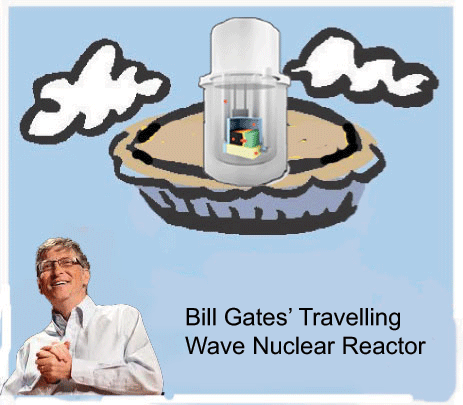
Secretive manouvres involve tax-payer funds for Bill Gates’ small nuclear reactors
months have elapsed since the Microsoft Corp. co-founder and 27 other billionaires rolled out their Breakthrough Energy Coalition (BEC) — a promise to invest billions of dollars with a very long payback horizon on groundbreaking new carbon-neutral technologies. And the group has barely been heard from since.
Jonah Goldman, a spokesman for the coalition, said much of the work is happening behind the scenes.
Gates brought his message to Capitol Hill, where he met twice with Sen. Lamar Alexander (R-Tenn.) in the past year to press the Energy and Water Appropriations Subcommittee chairman for federal support for research and development.
The two men discussed small modular nuclear reactors and carbon capture and storage technology at the meetings, an Alexander aide said.
Nineteen countries joined the United States in backing Mission Innovation in Paris, and the European Union signed on in June. Since then, the Obama administration has followed up with a fiscal 2017 funding request of $7.7 billion for clean energy R&D across the federal government, with $5.9 billion of that going to DOE programs
What’s happening with Bill Gates’ multibillion-dollar energy fund? EENews, Jean Chemnick, E&E reporter, ClimateWire: Monday, August 15, 2016 Bill Gates believes the key to addressing climate change is an “energy miracle,” and in November, he set about trying to conjure one.
Flanked by President Obama and more than a dozen other world leaders in Paris for the first day of a landmark climate summit, Gates claimed a role for the private sector in delivering new solutions.
“We must … add the skills and resources of leading investors with experience in driving innovation from the lab to the marketplace,” Gates said that morning. “The private sector knows how to build companies, evaluate the potential for  success, and take the risks that lead to taking innovative ideas and bringing them to the world.”
But months have elapsed since the Microsoft Corp. co-founder and 27 other billionaires rolled out their Breakthrough Energy Coalition (BEC) — a promise to invest billions of dollars with a very long payback horizon on groundbreaking new carbon-neutral technologies. And the group has barely been heard from since.
Jonah Goldman, a spokesman for the coalition, said much of the work is happening behind the scenes. The fund, he said, will make announcements about the kinds of investments that will be made when it is up and running, likely toward the end of this year.
“But the focus is definitely more on doing the work we’ve committed to than making public pronouncements,” he said.
A few things are clear. Some of the group’s contributions will flow through a fund that will concentrate on certain kinds of investments. The group is currently hiring scientists and investment professionals who will direct those decisions. Goldman declined to say how many people are working to stand up the fund or how many employees it will eventually have.
Other things remain a mystery, including the coalition’s eventual capitalization target. Gates promised to invest an additional $1 billion of his own dollars when he launched BEC, and predicted the other members would contribute a collective “couple” billion more toward the venture. But it is unclear how much of that $3 billion — if it is $3 billion — will flow through the fund, versus members investing it independently. Goldman said the total size of the fund and targets for investment will be based on this year’s fundraising.
He said the goal would be to raise a level of capital that the fund could deploy effectively, with the understanding that some of the group’s members will continue to invest in projects outside the fund.
“We feel tremendously confident that we will get significant participation in the ultimate funding vehicle, but each of the potential investors will have to make that decision based on the terms presented, and we’re not quite there yet,” he said…..
Gates brought his message to Capitol Hill, where he met twice with Sen. Lamar Alexander (R-Tenn.) in the past year to press the Energy and Water Appropriations Subcommittee chairman for federal support for research and development.
The two men discussed small modular nuclear reactors and carbon capture and storage technology at the meetings, an Alexander aide said.
Then, in the three months before Paris, Gates bore down. He joined Energy and State department officials and White House personnel on calls with foreign governments to urge them to sign on to Mission Innovation, a commitment by countries to double their individual R&D budgets by 2020. Energy Secretary Ernest Moniz spearheaded the initiative, which was unveiled in Paris alongside BEC (EnergyWire, Dec. 17, 2015).
On those calls, former officials say Gates offered the private investors fund as a kind of carrot, promising to help carry technologies produced in national laboratories across the “valley of death” — where ideas often perish for lack of investment — toward greater development that leads to commercialization.
But first governments had to put up the money…….
DOE vague on BEC relationship
Nineteen countries joined the United States in backing Mission Innovation in Paris, and the European Union signed on in June. Since then, the Obama administration has followed up with a fiscal 2017 funding request of $7.7 billion for clean energy R&D across the federal government, with $5.9 billion of that going to DOE programs…….
DOE was less forthcoming about its work with BEC post-Paris. A department spokesman said in response to an inquiry only that the agency “is in communication with thousands of researchers, entrepreneurs, inventors, small businesses and large corporations.”
While the spokesman asserted that the investors’ group and Mission Innovation are “separate” and “complementary,” the private-sector group has popped up in DOE communications with interested members of civil society. It figured, for example, in a slideshow presentation that Office of International Science and Technology Collaboration Director Robert Marlay prepared for the U.S. Energy Information Administration earlier this year.
The presentation states that the fund would provide “seed, angel and series A” investments. Seed capital is offered in exchange for a stake in a company, while angel investments help startup companies. “Series A” investments are typically the first round of venture capital investments that are made in a new company….
Some of the Gates group’s radio silence appears to be strategic.
Bodnar said Gates and his partners opted not to put forward a concrete pledge of dollars in Paris because it wasn’t a venue where the contribution would appear in its best light. Even a funding target that would be enough to fulfill the group’s goal of readying promising technologies for the market would pale in comparison to the hundreds of billions or even trillions of dollars that are routinely discussed in the multilateral climate process…..
what the 28 billionaires managed to do was to signal there will now be “truly patient, flexible” capital available for promising technologies that make it through the basic research phase. Patient capital is seen to be key, because the high risk and very long time horizons for payback have generally made these technologies unattractive to conventional investors.
Bodnar said Gates and his colleagues were confident that the money they put up would be sufficient to ensure the gap is bridged between federally funded basic research and ready-to-deploy commercial technologies……http://www.eenews.net/stories/1060041571
USA had secret plans to place nuclear weapons in Iceland
 US Debated Deploying Nuclear Weapons in Iceland, Iceland Review, 16 Aug 16 BY VALA HAFSTAD
The documents are discussed on the website of the National Security Archive, but until now, they have been classified. On the website, it is noted that this is not the first time clues have been discovered about such plans.
Historian Valur Ingimundarson had previously argued that a weapon storage facility built in Keflavík in the 1950s was intended for nuclear weapons. Furthermore, during the 1980s, historian William Arkin reported that a presidential directive from President Richard Nixon’s period in office treated Iceland as one of several conditional deployment locations for nuclear weapons in the event of war……..http://icelandreview.com/news/2016/08/16/us-debated-deploying-nuclear-weapons-iceland
Chinese executives charged with spying on USA nuclear technology, particularly Small Nuclear Reactor plans
US government accuses Hinkley point partner of nuclear espionage, SC Magazine, Max Metzger, Reporter, 12 Aug 16 Major partners in the controversial nuclear power plant at Hinkley Point have been accused in American courts of attempting to steal US nuclear technology. Fears over Chinese involvement in a new nuclear power plant at Hinkley Point have been reinforced as a major partner in the plant’s development has been accused by the US government of nuclear espionage.
Szuhsiung Ho, an advisor to the state-owned China General Nuclear Power (CGN) company, which would have a 33 percent stake in the new plant at Hinkley, has been charged with “conspiracy to unlawfully engage and participate in the production and development of special nuclear material outside the United States”.
Essentially, the US Department of Justice has accused Szuhsiung Ho, otherwise known as Allen Ho, of trying to steal US nuclear technology.
Ho, under orders from CGN, is supposed to have tried to get US nuclear experts to help develop nuclear material in China. According to a statement released by the DoJ, for nearly 20 years, between 1997 and 2016, Ho “identified, recruited and executed contracts with US-based experts from the civil nuclear industry who provided technical assistance related to the development and production of special nuclear material”.
Of particular interest to Ho and his co-conspirators was assistance with CGN’s programmes on small modular reactors, advanced fuel assembly and fixed in-core detectors.
If one is to act as an agent of a foreign power within the United States, their status must be declared to the US attorney general. Not only did Ho not do this but explicitly told those he was trying to recruit that he was acting on behalf of the Chinese state. The DoJ records him as telling his potential recruits that he was working surreptitiously to help China “to design their Nuclear Instrumentation System independently and manufacture them independently”.
None of the accusations have yet been proven but the charges could carry a sentence of life and a US$250,000 (£192,000) fine.
The case is being pursued by a number of US law enforcement agencies including the Department of Energy – National Nuclear Security Administration and the US Federal Bureau of Investigation (FBI). Executive assistant director of the FBI’s national security branch Michael Steinbach said in a statement, “The arrest and indictment in this case send an important message to the US nuclear community that foreign entities want the information you possess”.
“The federal government has regulations in place to oversee civil nuclear cooperation, and if those authorities are circumvented, this can result in significant damage to our national security. The US will use all of its law enforcement tools to stop those who try to steal US nuclear technology and expertise.”…….http://www.scmagazineuk.com/us-government-accuses-hinkley-point-partner-of-nuclear-espionage/article/515702/
China General Nuclear Power Group (CGN) is accused of stealing US nuclear secrets
Chinese investor in Hinkley Point faces nuclear espionage charges http://www.rsc.org/chemistryworld/2016/08/chinese-investor-hinkley-point-nuclear-espionage , 12 August 2016Matthew Gunther
The charges only add to a growing sense of uncertainty around the Hinkley Point project. Earlier this month, the UK government announced it will reassess the investment plan and only make a final decision on whether the plant should be built this autumn.
Although the main investor, EDF Energy, has played down fears the project will be scrapped, China has warned the UK it must reach a decision quickly. Writing in the Financial Times, the Chinese ambassador to the UK, Liu Xiaoming, said: ‘Right now, the China–UK relationship is at a crucial historical juncture.’
Ho, who is a US citizen with dual residency in China, is set to appear in court next week.
1 This Month



26 September – International Day for the Total Elimination of Nuclear Weapons


PLEASE OPPOSE HR 8255 AND S.3639 – bills would accelerate satellite deployment, with no environmental review or safeguards – https://ncstd5li.quorum.us/campaign/169331/
To see nuclear-related stories in greater depth and intensity – go to https://nuclearinformation.wordpress.com
-
Archives
- September 2026 (278)
- August 2026 (330)
- July 2026 (355)
- June 2026 (287)
- May 2026 (306)
- April 2026 (356)
- March 2026 (251)
- February 2026 (267)
- January 2026 (308)
- December 2025 (358)
- November 2025 (359)
- October 2025 (375)
-
Categories
- 1
- 1 NUCLEAR ISSUES
- business and costs
- climate change
- culture and arts
- ENERGY
- environment
- health
- history
- indigenous issues
- Legal
- marketing of nuclear
- media
- opposition to nuclear
- PERSONAL STORIES
- politics
- politics international
- Religion and ethics
- safety
- secrets,lies and civil liberties
- spinbuster
- technology
- Uranium
- wastes
- weapons and war
- Women
- 2 WORLD
- ACTION
- AFRICA
- Atrocities
- AUSTRALIA
- Christina's notes
- Christina's themes
- culture and arts
- Events
- Fuk 2022
- Fuk 2023
- Fukushima 2017
- Fukushima 2018
- fukushima 2019
- Fukushima 2020
- Fukushima 2021
- general
- global warming
- Humour (God we need it)
- Nuclear
- RARE EARTHS
- Reference
- resources – print
- Resources -audiovicual
- Weekly Newsletter
- World
- World Nuclear
- YouTube
-
RSS
Entries RSS
Comments RSS

