Serious questions about South Africa’s nuclear power tender process

 Energy department to co-operate with Treasury on nuclear deal, BUSINESS NEWS / 18 September 2016, Pretoria – The energy department will fully co-operate with National Treasury regarding the nuclear new build programme, Energy Minister Tina Joemat-Pettersson insisted on Saturday……………….
The awarding of the contract to Reddy’s company was highly irregular considering that both Joemat-Pettersson and Deputy President Cyril Ramaphosa had been at pains to assure South Africans that no deal had been concluded.
“If there is in fact no nuclear deal yet, why the need to procure a R171-million system to manage it?” Mackay asked.
Alarmingly, the contract with Reddy was awarded on the back of an as yet unidentified tender in the Free State and not publically advertised on the department’s website, as was standard practice. That notwithstanding, the deal with Reddy was personally signed off by the department’s director general.
“This raises serious questions surrounding the tender process that was followed, not least of which is what knowledge the minister had of the deal with Reddy.”
The DA would submit parliamentary questions to Joemat-Pettersson to ascertain, among other things, the reasons for the deviation from the department’s standard procurement process and the basis on which Reddy’s company, an entity with no experience in the nuclear field, was awarded the contract.
Also, whether the minister had any involvement in, or knowledge of the contract and why a contract for the management of the new build programme had been awarded if, by the minster’s account, no deal had been concluded.
“The move is premature at best and once again suggests that protestations by government are a smokescreen to hide the fact that the nuclear new build is a done deal. Moreover, the development ads to the growing body of evidence suggesting that the primary motivation being Zuma’s pursuit of the ill-advised and unaffordable nuclear deal is to enrich his cronies and fund his patronage network.
“The DA has long maintained that the nuclear deal has potential for corruption the likes of which South Africa has never seen. One thing is increasingly clear – the only really beneficiary of the nuclear deal will be Zuma Inc at the expense of an already highly indebted and fragile South African economy,” Mackay said.
African News Agency (ANA) http://www.iol.co.za/business/news/energy-department-to-co-operate-with-treasury-on-nuclear-deal-2069549
South African govt says no nuclear deals made, but now there is one!
Zuma pals clinch first nuclear deal, Mail and Guardian, Jessica Bezuidenhout 16 Sep 2016 Shantan Reddy, the son of President Jacob Zuma’s friend Vivian Reddy, has clinched what appears to be a landmark deal for the country’s controversial multibillion-rand nuclear programme.
Details of the R171-million contract for “the procurement of the nuclear build programme management system” emerged after an innocuous-looking entry appeared on the department of energy’s website.
Listed under the category “awarded bids”, it is scant on detail, simply naming the winning bidder of BAC-10/2016 as Central Lake Trading 149, a company trading as Empire Technology.
The little-known company’s sole director is Shantan Reddy, the son of flamboyant power and property mogul Vivian Reddy, a longtime friend of the president.
Although there is no suggestion of wrongdoing on the part of Reddy or his company, the awarding of this contract has set off alarm bells with industry experts and politicians because the government continues to maintain that it has not entered into any nuclear deal.
The contract awarded to Reddy’s company, if indeed linked to the “nuclear build”, as stated by the energy department, suggests that work may have already begun behind the scenes.
“Considering that the minister of energy is on record stating no deal has been signed and the deputy president [has said] that South Africa will not commence on nuclear if it can’t afford it, the issuance of a contract is highly irregular,” said Gordon Mackay, the Democratic Alliance’s spokesperson on energy.
The Mail & Guardian briefly spoke to Shantan Reddy about the energy department deal. He asked for questions to be sent on SMS but did not respond by deadline….. (subscribers only) http://mg.co.za/article/2016-09-16-00-zuma-pals-clinch-first-nuclear-deal
Australia’s secret shame – the Maralinga nuclear bomb tests
This March, documents obtained exclusively by news.com.au revealed that hundreds of children and grandchildren of veterans exposed to radiation were born with shocking illnesses including tumours, Down syndrome, cleft palates, cerebral palsy, autism, missing bones and heart disease.
Other veterans posted to the Maralinga nuclear test site blamed the British Nuclear Test for an unusually high number of stillbirths and miscarriages among the group.
“The rest of the Aboriginal people in this country need to know the story as well,” “This one’s been kept very quiet.”
Nuclear will be on show at the National Aboriginal Cultural Institute in Adelaide, South Australia from 17 September to 12 November.
 The secret destruction of Australia’s Hiroshima, http://www.news.com.au/lifestyle/real-life/news-life/the-secret-destruction-of-australias-hiroshima/news-story/9eabf722dbe2f87e03a297c2a348a8e1 news.com.au, SEPTEMBER 17, 2016 WHEN nuclear explosions tore through Australia’s vast, arid centre, some people living there didn’t even know it was coming.
It devastated the country for miles around, annihilating every bird, tree and animal in its path.
Even today, the effects of our very own Hiroshima are still felt by the families it ripped apart, and those suffering horrific health problems as a result.
The British military detonated seven nuclear bombs in remote Maralinga, around 800km north-west of Adelaide, plus two at Emu Fields and three off the coast near Karratha, Western Australia.
They also staged hundreds of minor trials investigating the impact of non-nuclear explosions on atomic weapons, involving tanks, gun, mannequins in uniforms and even tethered goats. In many ways, these smaller tests were equally dangerous, spraying plutonium in all directions.
Yet most Australians know very little about the blasts that shattered communities, and the dramatic story now buried under layers of dust.
Archie Barton was just a child when the nuclear testing took place between 1956 and 1963, stretching across a huge now uninhabitable 120km of land where he and thousands of others lived.
“He was taken away from his mother,” his stepson Steve Harrison tells news.com.au. “He was part of the Stolen Generations. He grew up in homes around Australia, and led a very rough life.
“Before my mum, he was a full-blown alcoholic. He wanted to go back to his birthplace.
“He came into my life at a very young age. I was 14. I knew him as a strong, proud Aboriginal black man. He ended up getting an OBE.”
‘CHEAP AND NASTY SOLUTION’
Mr Barton’s family was not the only one scattered by the bombs. Many walked for days or even weeks to find new homes, deliberately going barefoot so their relatives could follow behind. British soldiers repeatedly turned them back south when they tried to head north.
Unsurprisingly, many never found each other.
“They were dispersed pretty much to the four points of the compass,” said Paul Brown, creative director of new showcase Nuclear, featuring Mr Harrison’s artwork. “It represented a massive dislocation from the watering holes and places that were important to Aboriginal people.
“If Aboriginal people weren’t caught up in the blast, it was by sheer luck, not design.
“People were very close at the time of the blast, they even had to take people into the decontamination area to scrub them down.”
Decades later, 57-year-old Mr Harrison’s village still isn’t a safe place for humans to live, despite numerous attempts to decontaminate the area, in 1967, 1985 and the late 1990s.
Ian Anderson’s 1993 New Scientist article “Britain’s dirty deeds at Maralinga” exposed negotiations between the UK and Australia to dispose of toxic plutonium that had been lightly covered with soil instead of being buried in concrete bunkers.
And as recently as 2007, nuclear engineer Alan Parkinson claimed the latest $100 million clean-up was a “cheap and nasty solution”.
IT RUINED QUITE A LOT OF LIVES’
The Anandu people fled to Oak Valley, Yalata, Renmark and almost anywhere between Kalgoorlie in WA and Adelaide.
Torn from family members and their homes, indigenous communities saw the consequences travel down the generations. Alcoholism is one of the biggest problems, along with drugs, crime, homelessness and lack of acceptance from new towns where these displaced people live on the fringes.
The Royal Commission found evidence of terrible disabilities caused by likely radiation impacts on both veterans and Aboriginal communities.
This March, documents obtained exclusively by news.com.au revealed that hundreds of children and grandchildren of veterans exposed to radiation were born with shocking illnesses including tumours, Down syndrome, cleft palates, cerebral palsy, autism, missing bones and heart disease.
Other veterans posted to the Maralinga nuclear test site blamed the British Nuclear Test for an unusually high number of stillbirths and miscarriages among the group.
A 2008 Department of Veterans’ Affairs study reported that the doses to Australians were small, with a spokesman tellingnews.com.au that studies into the descendants of Hiroshima and Nagasaki nuclear bombs survivors showed they “do not have an increased frequency of chromosome abnormalities or major birth defects.”
Yet a 1999 study for the British Nuclear Test Veterans Association found that 30 per cent of involved veterans had died from cancer, mainly in their 50s.
Troops flew through mushroom clouds from explosions without protection and marched to ground zero immediately after bomb detonation. Airborne drifts of radioactive material resulted in “radioactive rain” being dropped on Brisbane and Queensland country areas.
“When they created this problem, they didn’t picture it at the end,” says Mr Harrison. “People are fighting for their existence.
“We can go back, but cannot go back and live there. It’s ruined quite a lot of lives.
“I see people who’ve been taken away coming back trying to reconnect with family. Most now live in Yalata on the Nullabor Plains.
“It was so sad, so hard. You need to grow up with family from a young age. Now they’re telling people they’ve got to leave communities in the Northern Territory, they’re closing down a lot of these communities.”
THIS ONE’S BEEN KEPT QUIET’
The Maralinga bombs were set off in a way that officially satisfied safe firing requirements. The detonations were even celebrated as a “great success” in The Advertiser.
But Mr Brown says there is evidence the military was “deliberately misleading the public about the likely impact.”
Britain’s Parliament last year issued a statement of recognition and set up a benevolent fund for veterans who took part in the nuclear tests.
Mr Brown hopes his exhibition, 60 years on from the blasts, will show that these are not simply stories about victims. “Often people have gone on the front foot,” he said. “In Japan, the Hibakusha are world leaders in the peace movement. They’ve taken it upon themselves to campaign for disarmament and world peace.”
Mr Harrison, who has visited Hiroshima and Nagasaki survivors in Japan and presented them with a sculpture, says his main concern is making sure Australians know what happened in their own country.
“The rest of the Aboriginal people in this country need to know the story as well,” he added.
“This one’s been kept very quiet.”
Nuclear will be on show at the National Aboriginal Cultural Institute in Adelaide, South Australia from 17 September to 12 November.
Secret nuclear management contract given to donor to South Africa’s President Zuma
‘Predatory elite’ eye nuclear deal http://mg.co.za/article/2016-09-16-00-editorial-predatory-elite-eye-nuclear-deal The looming nuclear deal that seems to be President Jacob Zuma’s biggest pet project (and will be South Africa’s biggest financial and construction deal ever, if it happens) has been questioned by many commentators, including MPs and civil society groups. The deal, which already has links with Russia’s notoriously oligarchic government, worries anyone who can see in it the largest opportunity yet for the looting of state resources by the group currently devoting all their means to that end.
The nation was told, in the National Assembly, that all the necessary checks would be put in place and that the legal and other hurdles would be diligently cleared before the deal went ahead. The intimation was that any serious obstacles to the deal would come to light and could possibly scupper it entirely – a prospect many would welcome.
But the nation was also told, by a different minister in the other House of Parliament, that it was full steam ahead on the project – with the intimation that no objections would be allowed to stand in its way.
The first utterance came from Deputy President Cyril Ramaphosa, who seems to have been given the job of placating the objectors and the intelligentsia, or anyone concerned about the ongoing plans of what unionist Zwelinzima Vavi long ago called “the predatory elite”.
The second utterance came from Zuma’s extremely loyal energy minster, Tina Joemat-Pettersson, so it was to be expected that she would show every sign of wanting to do his bidding as soon as possible.
It has emerged that a contract worth R171-million for a “programme management system” to help get the nuclear deal off the ground has been awarded, in practical secrecy, to a company called Empire Technology. This is wholly owned by Shantan Reddy, the son of controversial businessperson Vivian Reddy, who has given Zuma considerable financial support over the years, including a contribution to the building of the president’s family complex in Nkandla.
That so little is known about the company, and that the deal appears to have gone through so quickly, is cause for concern.
Is the nuclear deal going ahead or not? Will South Africa be taking adequate precautions to ensure that it doesn’t overly indebt the nation? Was the evidence collated and presented to Zuma’s Cabinet? There are no clear answers to any of these questions.
Without a rational and sensible evaluation of the logic of the deal, and an accounting of the costs and benefits to South Africa if it goes ahead, it can’t be seen as much more than another way for the predatory elite to milk money from the state.
Britain’s Tories stand to gain financially from Hinkley nuclear decision: what a conflict of interest!!
When you have EDF granted access to the heart of government, former ministers now acting as lobbyists for the nuclear industry, and top-level Conservatives with their fingers in Hinkley’s financial pies, what’s best for the UK goes out of the window.

Hinkley: where Tories’ private bank balances are going nuclear, The Canary SEPTEMBER 15TH, 2016“……….a quietly released report by Greenpeace shows that the deal was probably always
 going to go ahead.
EDF: in bed with the UK governmentAnalysis done by Greenpeace found that ten advisers and civil servants who worked at the former Department for Energy and Climate Change (DECC) in the last five years had links to EDF. One was recently employed by the DECC and was also a manager at the Office for Nuclear Regulation, the regulator for the nuclear industry. This was before they became a licensing officer for EDF.
An EDF Strategy Manager had a 13-month secondment to the DECC commercial team while working for auditors KPMG. As Greenpeace notes, the DECC commercial team “played a crucial role in deciding to press ahead with the Hinkley project”. It was this team which had oversight on who invested in Hinkley Point C. Additionally, a communications officer for EDF was previously the Senior Ministerial Visits Manager at DECC until early 2016. And a policy adviser and analyst for the now-defunct department had previously done the same job at EDF.
This is on top of the fact that former Liberal Democrat Energy Secretary, Ed Davey, now works as a lobbyist for MHP Communications – where EDF just happens to be a client. As Martin Williams describes in his book Parliament Ltd: A journey to the dark heart of British politics:
When he lost his seat in 2015, he [Davey] went off to join MHP Communications. He had connections with the firm already: MHP acted as lobbyists for EDF Energy, who Davey “had dealings with as a minister”… When MHP’s Chief Executive announced Davey’s appointment he was able to speak candidly about the benefits of employing a former energy minister. “Ed’s unique insight into the energy sector will be particularly valuable to the companies that we work with in that sector. His knowledge of the top-level workings of Britain’s political system will also prove immensely useful to a range of our clients and to MHP itself”. http://www.thecanary.co/2016/09/15/hinkley-tories-private-bank-balances-going-nuclear/
It was Davey who was responsible for the initial agreement between the government and EDF. But the links to EDF Energy and the Tory government run deeper than the Greenpeace analysis. And go right to the top of the Conservative Party.
Tories: in bed with EDF
Sir Richard Lambert heads EDF’s Stakeholder Advisory Panel. It gives EDF “strategic advice and direction”. Knighted under David Cameron, he’s a non-executive director of the Foreign and Commonwealth Office, acting as lead advisor to the Foreign Secretary. He was in this role under Philip Hammond, who appears to have been crucial in getting the Hinkley deal pushed through. Lambert said of the Hinkley deal:
Tory peer Lord Patten of Barnes is the former governor of Hong Kong and a former Conservative Party Chairman. But currently, he too sits on EDF Energy’s Stakeholder Advisory Panel. On 9 September, Patten co-authored an open letter to the Financial Times (FT), calling on May to “press ahead with Hinkley Point”.
Also on the EDF panel is Sir Simon Robertson. Another Tory peer, who is a party donor to the tune of £765,000, he was knighted in 2010, just after the Tories came to office. Robertson was also Deputy Chairman of HSBC until April 2016. In 2014, HSBC arranged the financial backing for EDF to carry out the project at Hinkley. Robertson also signed the letter in the FT. He is also a long-standing member of the Tory “Leader’s Group“. This “club” costs £50,000 a year to be a member of and gives access to the likes of May and Hammond at exclusive private dinners.
Hinkley: benefitting everyone, except the public
And in another twist of ‘fate’, it would seem the Prime Minister may well benefit from Hinkley Point C going ahead. May’s husband, Philip, works for investment company Capital Group. It, in turn, has a nearly 10% stake in French company Schneider Electric, which has been awarded a contract at Hinkley.
It would seem that the Tories’ push for the Hinkley project is not driven so much by “energy security”, but more by vested interests.
When you have EDF granted access to the heart of government, former ministers now acting as lobbyists for the nuclear industry, and top-level Conservatives with their fingers in Hinkley’s financial pies, what’s best for the UK goes out of the window. Meanwhile, the cost to every household is around £25 per year extra on the energy bill.
Business Secretary Greg Clark said the deal strikes the “right balance between foreign investment and national interest”. But the only “interests” being served, judging by who’s involved, are those of Tory bank balances.
Get Involved!
– Sign the petition against Hinkley Point C.
– Write to your MP to oppose the development.
– Find out when a protest is taking place.
The ex-Westinghouse employee accused of helping a foreign power with nuclear secrets
 Nuclear secrets: The ex-Westinghouse employee accused of helping a foreign power Power Source By Anya Litvak / Pittsburgh Post-Gazette September 15, 2016 Following the arrest of Allen Ho this spring, FBI agents appeared on the doorsteps of nuclear scientists across the United States.
In Murrysville, they met with Charles Beard, a retired Westinghouse Electric Co. software engineer who first connected with Mr. Ho in the 1980s when both men worked for that company. In 2011, Mr. Ho had approached Mr. Beard to consult for his Delaware-based firm Energy Technology International, according to documents in the case.
Mr. Beard had just retired and wasn’t sure it was worth it. He quoted an hourly rate so high it was intended to repel the advances, Mr. Beard told the FBI. But Mr. Ho agreed to the money, and so did Mr. Beard.
And thus he became part of a group of consultants — retired nuclear specialists, many from Cranberry-based Westinghouse — that Mr. Ho assembled on behalf of the China General Nuclear Power Corp. (CGN), one of several state-owned nuclear firms in one of the world’s largest commercial nuclear markets.
The consulting team was to “provide technology transfer in design, manufacturing, related training and technical support,” Mr. Ho wrote in an e-mail later obtained by the FBI. “They said budget is no issue.”
Since mid-April, Mr. Ho, 66, has been in jail in Tennessee awaiting a trial in which he faces a potential life sentence for violating a 60-year statute that has never before been tested in court. He spends 23 hours in a cell, in solitary confinement, according to his attorney.
In its case, the government has said that Mr. Ho’s consulting services amount to nuclear espionage and that he was acting as a foreign agent when he recruited nuclear scientists to educate China’s nuclear engineers on aspects of commercial reactors.
Mr. Ho, and one of his former consultants Ching Ning Guey whose plea deal last year helped the government build a case, are the first people to be charged under a statute of the Atomic Energy Act of 1954 that says people who help make special nuclear material outside of the U.S. have to ask the Secretary of Energy for permission.
They are the only two people that have been charged in this case.
The “special nuclear material” in question is plutonium — a byproduct of the nuclear reaction that takes place inside commercial power plants. By helping a Chinese company with its operations, Mr. Ho was involved in making plutonium, the government said.
Last month, despite a slew of character letters from friends, some of which pledged their homes as collateral, Mr. Ho was denied bail.
Even if he were stripped of his U.S. and Chinese passports, and outfitted with a tracking anklet that confined him to his home, Chinese operatives might shepherd him out of the country, prosecutors warned. They cited his expensive house in Delaware, an apartment in China and a child he fathered there nine years ago………
Mr. Ho had, in fact, applied for the special authorization required by the Atomic Energy Act.
In 2013, he sent two letters to the U.S. Department of Energy describing his activities in China. One said he and his consultants were engaged in IT support work, such as converting code from one language to another and updating it with more recent fission and heat transfer models.
In less than two months, the energy agency replied to Mr. Ho that these activities don’t need special permission……..
Special permission
The government’s argument on the dangers of Mr. Ho’s actions follow two paths. On the one hand, the FBI has alleged Mr. Ho was selling commercial secrets, violating intellectual property protections and helping Chinese companies get ahead by bypassing the expense and time of research and development.
On the other hand, the government and the FBI agents that conducted the interviews with Mr. Ho’s consultants have sprinkled in questions about possible security concerns, given that the plutonium produced at commercial nuclear power plants can be used for military purposes.“Our idea of how China works, is that at the end of the day, whatever’s good for commercial is also good for military,” the federal agent told Mr. Ho after his arrest.
That dynamic is the focus of the Atomic Energy Act, a law passed in 1954 that guides how the U.S. balances the promotion of nuclear trade in the electric sector with the goal of keeping nuclear proliferation at bay.
There are 50 countries for which a special authorization is not required. For all others — including China — activities ranging from document transfers and e-mails to the “transfer of knowledge and expertise” in the area of nuclear reactors call for special permission from the Secretary of Energy.
George Rudy, who consulted for Mr. Ho, told an FBI agent on April 15 that Mr. Ho didn’t seem to understand the logic behind the authorization rules. “He felt that the requirements were the NSA and DOE trying to impede his progress,” Mr. Rudy told the FBI.
A 2014 Government Accountability Office report looking at how the Department of Energy handles the special authorization statute found that U.S. nuclear firms and the Nuclear Energy Institute commonly felt the requirements and the long approval times put U.S. firms and the interest of commercial nuclear development at a disadvantage to suppliers in other countries.
It’s OK for Westinghouse………
China’s nuclear ambitions are second to none. It is gobbling up Western nuclear technology and expertise, and developing its own in service of an aggressive plan to build dozens of reactors in the next decade.
“This whole thing doesn’t make any sense, because Westinghouse sold AP1000 reactors to China along with all of their proprietary information,” Mr. Rombough said this month. “If doing nuclear reactors in China is so off limits, why did they allow Westinghouse to do that?”
David Seel, another retired Westinghouse engineer, told FBI agents in April that his concerns “were mitigated by the assumption (Westinghouse’s) presence in China and AP1000-related business dealings illustrated consulting such as his was not prohibited.”………
While he declined to speak about Mr. Ho’s case in detail, Mr. Zeidenburg said it “falls into a long and depressing line of cases where the Department of Justice has arrested a Chinese-American first and asked questions later.”
In court filings, he has argued that the government — unable to find an espionage statute that sticks — has tried to “shoehorn” Mr. Ho’s legitimate commercial work into a statute that has never been tested in court.
Mr. Ho’s trial is scheduled to begin in January.
Anya Litvak: alitvak@post-gazette.com or 412-263-1455.http://powersource.post-gazette.com/powersource/companies/2016/09/15/Nuclear-secrets-The-ex-Westinghouse-employee-accused-of-helping-a-foreign-power/stories/201609140193
Protect Freedom of The Press! Drop Arrest Warrant for Amy Goodman
 http://www.thepetitionsite.com/268/169/575/protect-freedom-of-the-press-drop-arrest-warrant-for-amy-goodman/ By: Kelsey Bourgeois Target: North Dakota police
She was doing her job of reporting what was happening, which was security guards pepper spraying protectors and forcing attack dogs to bite protectors that didn’t pose a threat. Obviously, this is intimidation of the freedom of the press.
The pipeline threatens water supplies, sacred Native American sites, and the environment broadly and the amazing Native Americans and allies standing up against it deserve fair coverage from the press. The authorities want this pipeline so badly that they are willing to cover up reporting on misconduct at the construction site.
“This is an unacceptable violation of freedom of the press,” said Amy Goodman in a statement. “I was doing my job by covering pipeline guards unleashing dogs and pepper spray on Native American protesters.” Amy Goodman is an award-winning journalist.
This warrant sets a horrifying precedent. It restricts the freedom of the press, a constitutional right that our society requires to thrive. We demand this warrant be dropped immediately. The reporting Amy Goodman and Democracy Now did that day is crucial and we cannot allow them to silence it.
The sugar industry joins the throng corrupting science
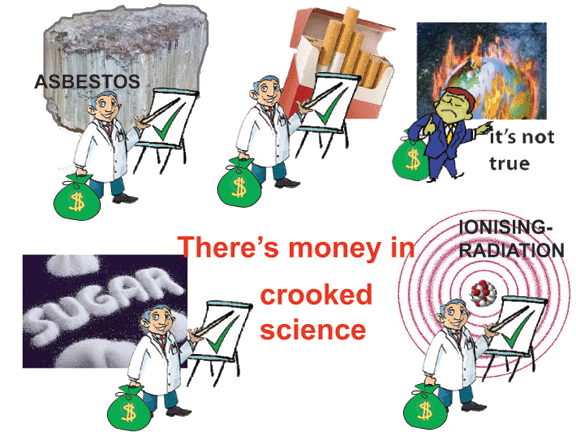
How the Sugar Lobby Skewed Health Research Archival documents reveal how the sugar industry secretly funded heart disease research by Harvard professors, Time, Alexandra Sifferlin @acsifferlin Sept. 12, 2016 The sugar industry has a long history of skewing nutrition science, a new report suggests. By combing through archival documents from the 1950s and 1960s, researchers from the University of California, San Francisco (UCSF), report that the sugar industry sponsored research that turned attention away from the sweetener’s link to heart disease and toward fat and cholesterol as the bigger culprits.
The documents the researchers reviewed in their report, published Monday in JAMA Internal Medicine, included correspondence between the Sugar Research Foundation (SRF) and nutrition professors at the Harvard School of Public Health. The letters discussed the SRF’s effort to respond to growing research linking sugar to coronary heart disease.
In 1954, SRF then-president Henry Hass gave a speech to the American Society of Sugar Beet Technologists that highlighted opportunities for the sugar industry to expand by encouraging people to adopt a low-fat diet. He said:
“Leading nutritionists are pointing out the chemical connection between [Americans’] high-fat diet and the formation of cholesterol which partly plugs our arteries and capillaries, restricts the flow of blood, and causes high blood pressure and heart trouble… if you put [the middle-aged man] on a low-fat diet, it takes just five days for the blood cholesterol to get down to where it should be… If the carbohydrate industries were to recapture this 20 percent of the calories in the US diet (the difference between the 40 percent which fat has and the 20 percent which it ought to have) and if sugar maintained its present share of the carbohydrate market, this change would mean an increase in the per capita consumption of sugar more than a third with a tremendous improvement in general health.”
What appears to have happened next were efforts by the SRF to increase skepticism over sugar’s link to heart troubles. In 1967, an SRF-funded report led by Harvard nutrition professors was published in the New England Journal of Medicine. The report reviewed the available evidence that linked various nutrients to heart disease and argued that epidemiological and animal studies that linked sugar with heart disease were limited, and suggested the available science wasn’t up to snuff. The review also highlighted studies that linked saturated fat to heart problems, without the same critiques. The review was published in the journal without disclosing the sugar industry’s funding or role in making the study happen in the first place. (Later, in 1984, the NEJM began requiring disclosure of conflicts of interest.)……….
It’s not the first time researchers have found links between sugar industry connections and nutrition science. The same team of UCSF researchers behind the new study previously used sugar industry documents to reveal how advocacy groups influenced federal cavity prevention recommendations.
“What struck me was that I thought the evidence the researchers summarized in the review was stronger and more consistent for a sugar effect [on coronary heart disease] than for a fat effect,” says study author Stanton Glantz of UCSF. “No matter how good the evidence was linking sugar to heart disease, there was something wrong with it. But for fat, the evidence was fine. They set up a false dichotomy.”
In an editorial published alongside new study, Marion Nestle, a professor in the Department of Nutrition and Food Studies at NYU, writes that the Harvard professors who conducted the review knew what the funders wanted and provided those findings. “Whether they did this deliberately, unconsciously, or because they genuinely believed saturated fat to be the greater threat is unknown,” Nestle writes. “But science is not supposed to work this way. The documents make this review seem more about public relations than science.”………http://time.com/4485710/sugar-industry-heart-disease-research/
Canadian political parties forced to reimburse illegal SNC-Lavalin donations
Liberals, Conservatives reimburse illegal SNC-Lavalin donations, ROBERT FIFE AND DANIEL LEBLANC OTTAWA — The Globe and Mail, Sep. 08, 2016 The federal Liberal and Conservative parties were forced to reimburse the government after the commissioner of elections found they had received $117,803 in illegal donations from SNC-Lavalin’s political slush fund.
The unlawful contributions span from March, 2004, to May, 2011, and showcase how dirty money that funded Quebec political parties also found a home in the federal arena.
The Liberal Party received the bulk of the illegal donations from the Quebec engineering giant, amounting to $109,615, while the Conservatives got $8,187. As part of its reimbursement, the Liberal Party covered $12,529 in donations that SNC-Lavalin gave in 2006 to the leadership campaigns of Michael Ignatieff, Bob Rae, Stéphane Dion and Gerard Kennedy.
The Commissioner of Canada Elections, Yves Côté, announced Thursday morning that the company had signed a compliance agreement with the federal agency and committed to put in place a series of steps to ensure it does not make illegal donations in the future.
SNC-Lavalin has already admitted it made more than $1-million in illegal donations to Quebec political parties during the 2000s. Like other engineering firms in the province, managers and family members made personal donations to parties, which were then reimbursed with salary bonuses.
A commission of inquiry found that officials inside the Quebec Liberal Party and the Parti Québécois were aware of SNC-Lavalin’s political slush fund, although there is no evidence the federal political parties knew the donations were illegal.
The Liberal Party said it was informed of the illegal donations by the Commissioner of Canada Elections last month, and immediately reimbursed the Chief Electoral Officer……….
An elections commissioner investigation found that senior SNC-Lavalin executives illegally donated $83,534 to the Liberal Party of Canada; $13,552 to various Liberal riding associations; $12,529 to contestants involved in the 2006 Liberal leadership race; $3,137 to the Conservative Party; and $5,050 to Conservative riding associations………
Facing the threat of getting barred from future federal contracts, SNC-Lavalin signed an “administrative agreement” last year with the Public Services and Procurement Department under the government’s new integrity regime. The agreement allows companies that have federal charges pending against them to continue to contract with or supply the government. As part of the deal, SNC agreed to strict conditions and third-party oversight of its business practices. http://www.theglobeandmail.com/news/politics/snc-lavalin-violated-elections-act-with-contributions-to-liberals-tories/article31762290/?cmpid=rss1&click=sf_globe
A reminder that the World Health Organisation is subservient to International Atomic Energy Agency
Dissolving the WHO-IAEA agreement is a necessary first step to restoring the WHO’s independence to research the true health impacts of ionising radiation and publish its findings.
it is time the WHO regained the freedom to impart independent, objective advice on the health risks of radiation.
 Toxic link: the WHO and the IAEA, https://www.theguardian.com/commentisfree/2009/may/28/who-nuclear-power-chernobyl Oliver Tickell, A 50-year-old agreement with the IAEA has effectively gagged the WHO from telling the truth about the health risks of radiation. F
Fifty years ago, on 28 May 1959, the World Health Organisation‘s assembly voted into force an obscure but important agreement with theInternational Atomic Energy Agency – the United Nations “Atoms for Peace” organisation, founded just two years before in 1957. The effect of this agreement has been to give the IAEA an effective veto on any actions by the WHO that relate in any way to nuclear power – and so prevent the WHO from playing its proper role in investigating and warning of the dangers of nuclear radiation on human health.
The WHO’s objective is to promote “the attainment by all peoples of the highest possible level of health”, while the IAEA’s mission is to “accelerate and enlarge the contribution of atomic energy to peace, health and prosperity throughout the world”. Although best known for its work to restrict nuclear proliferation, the IAEA’s main role has been to promote the interests of the nuclear power industry worldwide, and it has used the agreement to suppress the growing body of scientific information on the real health risks of nuclear radiation.
Under the agreement, whenever either organisation wants to do anything in which the other may have an interest, it “shall consult the other with a view to adjusting the matter by mutual agreement”. The two agencies must “keep each other fully informed concerning all projected activities and all programs of work which may be of interest to both parties”. And in the realm of statistics – a key area in the epidemiology of nuclear risk – the two undertake “to consult with each other on the most efficient use of information, resources, and technical personnel in the field of statistics and in regard to all statistical projects dealing with matters of common interest”.
The language appears to be evenhanded, but the effect has been one-sided. For example, investigations into the health impacts of the Chernobyl nuclear accident in Ukraine on 26 April 1986 have been effectively taken over by IAEA and dissenting information has been suppressed. The health effects of the accident were the subject of two major conferences, in Geneva in 1995, and in Kiev in 2001. But the full proceedings of those conferences remain unpublished – despiteclaims to the contrary by a senior WHO spokesman reported in Le Monde Diplomatique.
Meanwhile, the 2005 report of the IAEA-dominated Chernobyl Forum, which estimates a total death toll from the accident of only several thousand, is widely regarded as a whitewash as it ignores a host of peer-reviewed epidemiological studies indicating far higher mortality and widespread genomic damage. Many of these studies were presented at the Geneva and Kiev conferences but they, and the ensuing learned discussions, have yet to see the light of day thanks to the non-publication of the proceedings.
The British radiation biologist Keith Baverstock is another casualty of the agreement, and of the mindset it has created in the WHO. He served as a radiation scientist and regional adviser at the WHO’s European Office from 1991 to 2003, when he was sacked after expressing concern to his senior managers that new epidemiological evidence from nuclear test veterans and from soldiers exposed to depleted uranium indicated that current risk models for nuclear radiation were understating the real hazards.
Now a professor at the University of Kuopio, Finland, Baverstock finally published his paper in the peer-reviewed journal Medicine, Conflict and Survival in April 2005. He concluded by calling for “reform from within the profession” and stressing “the political imperative for freely independent scientific institutions” – a clear reference to the non-independence of his former employer, the WHO, which had so long ignored his concerns.
Since the 21st anniversary of the Chernobyl disaster in April 2007, a daily “Hippocratic vigil” has taken place at the WHO’s offices in Geneva, organised byIndependent WHO to persuade the WHO to abandon its the WHO-IAEA Agreement. The protest has continued through the WHO’s 62nd World Health Assembly, which ended yesterday, and will endure through the executive board meeting that begins today. The group has struggled to win support from WHO’s member states. But the scientific case against the agreement is building up, most recently when the European Committee on Radiation Risk (ECRR) called for its abandonment at its conference earlier this month in Lesvos, Greece.
At the conference, research was presented indicating that as many as a million children across Europe and Asia may have died in the womb as a result of radiation from Chernobyl, as well as hundreds of thousands of others exposed to radiation fallout, backing up earlier findings published by the ECRR in Chernobyl 20 Years On: Health Effects of the Chernobyl Accident. Delegates heard that the standard risk models for radiation risk published by the International Committee on Radiological Protection (ICRP), and accepted by WHO, underestimate the health impacts of low levels of internal radiation by between 100 and 1,000 times – consistent with the ECRR’s own 2003 model of radiological risk (The Health Effects of Ionising Radiation Exposure at Low Doses and Low Dose Rates for Radiation Protection Purposes: Regulators’ Edition). According to Chris Busby, the ECRR’s scientific secretary and visiting professor at the University of Ulster’s school of biomedical sciences:
“The subordination of the WHO to IAEA is a key part of the systematic falsification of nuclear risk which has been under way ever since Hiroshima, the agreement creates an unacceptable conflict of interest in which the UN organisation concerned with promoting our health has been made subservient to those whose main interest is the expansion of nuclear power. Dissolving the WHO-IAEA agreement is a necessary first step to restoring the WHO’s independence to research the true health impacts of ionising radiation and publish its findings.”
Some birthdays deserve celebration – but not this one. After five decades, it is time the WHO regained the freedom to impart independent, objective advice on the health risks of radiation.
Nuclear company SNC-Lavalin’s sorry history of corruption
 Liberals, Conservatives reimburse illegal SNC-Lavalin donations, ROBERT FIFE AND DANIEL LEBLANC OTTAWA — The
 Globe and Mail, Sep. 08, 2016 The federal Liberal and Conservative parties were forced to reimburse the government after the commissioner of elections found they had received $117,803 in illegal donations from SNC-Lavalin’s political slush fund.
The unlawful contributions span from March, 2004, to May, 2011, and showcase how dirty money that funded Quebec political parties also found a home in the federal arena.
The Liberal Party received the bulk of the illegal donations from the Quebec engineering giant, amounting to $109,615, while the Conservatives got $8,187. As part of its reimbursement, the Liberal Party covered $12,529 in donations that SNC-Lavalin gave in 2006 to the leadership campaigns of Michael Ignatieff, Bob Rae, Stéphane Dion and Gerard Kennedy.
The Commissioner of Canada Elections, Yves Côté, announced Thursday morning that the company had signed a compliance agreement with the federal agency and committed to put in place a series of steps to ensure it does not make illegal donations in the future.
SNC-Lavalin has already admitted it made more than $1-million in illegal donations to Quebec political parties during the 2000s. Like other engineering firms in the province, managers and family members made personal donations to parties, which were then reimbursed with salary bonuses.
A commission of inquiry found that officials inside the Quebec Liberal Party and the Parti Québécois were aware of SNC-Lavalin’s political slush fund, although there is no evidence the federal political parties knew the donations were illegal…….
An elections commissioner investigation found that senior SNC-Lavalin executives illegally donated $83,534 to the Liberal Party of Canada; $13,552 to various Liberal riding associations; $12,529 to contestants involved in the 2006 Liberal leadership race; $3,137 to the Conservative Party; and $5,050 to Conservative riding associations.
In the compliance agreement, SNC-Lavalin “acknowledges that, in offering to reimburse its employees for federal political contributions, and in reimbursing such contributions, it was in fact making those contributions itself.”……..
SNC-Lavalin, or former officials of the company, have in the past been accused of bribery in Algeria, Bangladesh and Libya, as well as in connection with major projects in Canada.
In March, 2012, then-CEO Pierre Duhaime, who oversaw the illegal donations and was involved in other scandals, abruptly resigned after an independent review found he had signed off on $56-million in payments to undisclosed agents to win contracts.
Later that year, Mr. Duhaime and former SNC-Lavalin vice-president Riadh Ben Aissa were charged with fraud for $22.5-million in alleged bribes paid to win SNC-Lavalin the contract to build Montreal’s super hospital. Mr. Ben Aissa served 2 1/2 years in jail in Switzerland for involvement in corruption and money laundering tied to SNC-Lavalin projects in Libya. http://www.theglobeandmail.com//news/politics/snc-lavalin-violated-elections-act-with-contributions-to-liberals-tories/article31762290/?cmpid=rss1&click=sf_globe
To secure 2020 Olympics Japan’s PM Abe lied about Fukushima nuclear plant being ‘under control’
 Abe’s Fukushima ‘under control’ pledge to secure Olympics was a lie – former PM
http://www.channelnewsasia.com/news/asiapacific/abe-s-fukushima-under-control-pledge-to-secure-olympics-was-a/3108276.html07 Sep 2016 TOKYO: Japanese Prime Minister Shinzo Abe’s promise that the crippled Fukushima nuclear plant was “under control” in his successful pitch three years ago for Tokyo to host the 2020 Olympic Games “was a lie”, former premier Junichiro Koizumi said on Wednesday.
Koizumi, one of Japan’s most popular premiers during his 2001-2006 term, became an outspoken critic of nuclear energy after a March 2011 earthquake and tsunami triggered meltdowns at Tokyo Electric Power Co’s (Tepco) Fukushima Daiichi plant, the worst nuclear disaster since Chernobyl in 1986.
Abe gave the assurances about safety at the Fukushima plant in his September 2013 speech to the International Olympic Committee to allay concerns about awarding the Games to Tokyo. The comment met with considerable criticism at the time.
“Mr. Abe’s ‘under control’ remark, that was a lie,” Koizumi, now 74 and his unruly mane of hair turned white, told a news conference where he repeated his opposition to nuclear power.
“It is not under control,” Koizumi added, citing as an example Tepco’s widely questioned efforts to build the world’s biggest “ice wall” to keep groundwater from flowing into the basements of the damaged reactors and getting contaminated.
“They keep saying they can do it, but they can’t,” Koizumi said. Experts say handling the nearly million tonnes of radioactive water stored in tanks on the Fukushima site is one of the biggest challenges.
Koizumi also said he was “ashamed” that he had believed experts who assured him that nuclear power was cheap, clean and safe and that resource-poor Japan had to rely on nuclear energy.
After the Fukushima crisis, Koizumi said, “I studied the process, reality and history of the introduction of nuclear power and became ashamed of myself for believing such lies.”
All Japan’s nuclear plants – which had supplied about 30 percent of its electricity – were closed after the Fukushima disaster and utilities have struggled to get running again in the face of a sceptical public. Only three are operating now.
Abe’s government has set a target for nuclear power to supply a fifth of energy generation by 2030.
The meltdowns in three Fukushima reactors spewed radiation over a wide area of the countryside, contaminating water, food and air. More than 160,000 people were evacuated from nearby towns.
(Reporting by Linda Sieg and Megumi Lim; Editing by Nick Macfie)
Attempts to sabotage Iran nuclear deal – who stands to gain in this?
 Despite the benefits that several countries would receive if the deal fell through, its success would serve the interests of the international community in a greater capacity by improving Iranian relations with the world.
The international community should invest heavily on the proper implementation of the JCPOA as it is the most comprehensive agreement ever reached in the history of nuclear nonproliferation. While Iran has fully complied with its JCPOA commitments, the U.S. must take steps to fill current gaps in implementing its commitments. This could open the door to using the experience of JCPOA to resolving other regional crises through diplomacy.
Ultimately, the cost of the potential downfall of the deal far outweighs the individual gains of a single nation.
Who Benefits Most From a Sabotaged Iran Nuclear Deal, http://www.huffingtonpost.com/seyed-hossein-mousavian/sabotaged-iran-nuclear-deal_b_11897718.html Hesam Rahmani, PhD student at UC Irvine, 8 Sept 16, On July 14, 2016, one year after the historic Joint Comprehensive Plan of Action nuclear deal was struck in Vienna between Iran and the P5+1 nations, respective administrations in Iran and the U.S. released statements asserting their commitment towards ensuring the deal’s success. But despite these commitments, the future of the JCPOA is at risk.
In the U.S., the Republican-controlled Congress largely opposes President Barack Obama’s signature foreign policy achievement and frames his diplomatic efforts for conflict resolution with Iran as a display of weakness. Meanwhile, JCPOA critics in Tehran continue to pessimistically cite the deal as another corroborative chapter of the U.S.’s treacherous and hostile history with the Islamic Republic.
Moreover, Iran’s Supreme Leader Ayatollah Ali Khamenei recently described the JCPOA as an “experience” demonstrating “the futility of negotiations with the Americans.” He and many other Iranian officials believe the U.S. has failed to live up to its JCPOA commitments. While Iran has enjoyed meaningful benefits since the deal’s implementation, such as drastically increasing its oil exports, gainingaccess to $30 billion of its frozen assets abroad and inking investment agreementstotaling $60 billion, the sanctions have nonetheless left a chilling effect in preventing business normalizations between Iran and western countries — particularly in the banking sector — something Iranian officials, among others, continue to point out.
Radical voices on both sides that have sought to undermine the deal will win, and escalation will once again become the name of the game between Iran and the U.S.
Foreign firms understandably fear legal repercussions either from accidentally violating convoluted sanctions laws yet to be abrogated or from having any business agreement sabotaged in case of future sanctions. Additionally, despite President Obama’s promise to veto any congressional attempt to sabotage the deal, hawkish lobby groups have continued efforts to prevent foreign business deals with Iran.
With pressure to break the deal mounting in Washington and pessimism growing in Tehran, it begs the question: who benefits most from a sabotaged deal?
ISRAEL
Israel’s firebrand Prime Minister Benjamin Netanyahu infamously condemned the JCPOA as a “mistake of historic proportions.” Such rhetoric has not abated among Netanyahu allies, with former Israeli National Security Council head Yaakov Amidror recently accusing the U.S. of “forfeiting a historic opportunity to dismantle Iran’s nuclear capability.” In Washington, hardline pro-Israel groups like theFoundation for Defense of Democracies have been leading the lobbying campaign to undo the nuclear deal. It is apparent that the far-right Israeli government views U.S.-Iran détente and an Iran that has returned to the international fold as a threat that can only be alleviated by undermining the nuclear deal. It is important to bear in mind that a failed JCPOA may lead to Iran revamping its nuclear program to pre-deal capabilities — a move that depending on the circumstances could result in renewed pressure against Iran by the West, which plays into the Israeli leadership’s interests.
SAUDI ARABIA
Tensions between Iran and Saudi Arabia have increased dramatically over the past half-decade, with the two sides coming to a head over their opposing policies inSyria, Yemen and Bahrain. Their relations have become further strained by the 2015 Hajj stampede, which left a disproportionate number of Iranians dead and an overall death count the Saudi government has been accused of attempting to cover up, as well as the January 2016 execution of prominent Saudi civil rights activist and Shia cleric Sheikh Nimr al-Nimr and the subsequent storming of the Saudi embassy in Tehran. Recent Saudi support to Iranian terrorist groups like the The People’s Mujahedeen of Iran, or MEK, has also been deeply provocative and lowered the chance for any rapprochement between the two countries in the near future.
The stakes have risen so high that an unlikely Israeli-Saudi alliance based on a mutual antipathy towards Iran is beginning to form. Some have described the Iran-Saudi rivalry as a new age “Middle East Cold War.” Needless to say, a failed JCPOA has the potential to ostracize Iran and strengthen Saudi Arabia’s regional position.
THE EASTERN BLOC
During the period Iran was under nuclear-related sanctions, its trade with Western countries was all but eliminated. Its economic ties with the East, in particular China, however, dramatically increased. The EU used to be Iran’s largest trading partnerless than a decade ago, but after sanctions China quickly assumed this position and bilateral trade between the two countries now stands at an estimated $60 billion. While Iran turned more to China during the sanctions period, largely because it had little other choice, it is in the post-JCPOA era seeking to diversify its trading partners and hoping to increase its economic ties with Europe. In the event of a JCPOA failure, this trend will reverse and Iran will move to further cement its economic relationship with China at the expense of Western countries.
In the post-JCPOA era, Russia and India have also moved towards developing closer ties with Iran. Russia for its part has moved farther away from the possibility of supporting anti-Iran sanctions again and has pursued developing a strategic relationship with Tehran, as indicated by its sale to Iran of the sophisticated S-300 missile defense system, use of an Iranian air base for strikes in Syria andannouncement that it will construct two new nuclear power plants in Iran.
For India, the expanded relationship comes in the form of oil, as it looks to reestablish itself as a top importer of Iranian oil and has pledged to spend $500 million to develop the Chabahar port in southeastern Iran. In the event of a JCPOA failure, it is unlikely these countries will abandon their more entrenched political and economic bonds with Iran.
Despite the benefits that several countries would receive if the deal fell through, its success would serve the interests of the international community in a greater capacity by improving Iranian relations with the world. President Obama declared in a statement following the announcement of the JCPOA in July 2015 that the deal, “offers an opportunity to move in a new direction. We should seize it.” This promise for a better future for not only Iran and the U.S. but the entire world as well still exists, but now more than ever it is critical to maintain the gains of the JCPOA and ensure its self-interested opponents do not achieve their aims.
The international community should invest heavily on the proper implementation of the JCPOA as it is the most comprehensive agreement ever reached in the history of nuclear nonproliferation. While Iran has fully complied with its JCPOA commitments, the U.S. must take steps to fill current gaps in implementing its commitments. This could open the door to using the experience of JCPOA to resolving other regional crises through diplomacy.
Ultimately, the cost of the potential downfall of the deal far outweighs the individual gains of a single nation.
Beyond the personal interests of the states mentioned above, a JCPOA failure will serve to diminish the pragmatic minds in Tehran and Washington that negotiated it and bolster the voices of the more polarized camps on both sides that prefer a hostile U.S.-Iran relationship. The hardline opponents of the JCPOA in the U.S. Congress, Israel and Saudi Arabia will gain legitimacy and boost their respective standings. In Iran, mistrust of the U.S. will be reaffirmed in the once-hopeful masses and opportunities for further dialogue will disappear. Overall, the radical voices onboth sides that have sought to undermine the deal will win, and escalation will once again become the name of the game between Iran and the U.S.. The path to peace will diverge back onto the path to war. Ultimately, the cost of the potential downfall of the deal far outweighs the individual gains of a single nation.
Ambassador Seyed Hossein Mousavian is a professional specialist at Princeton’s Woodrow Wilson School and a former spokesman for Iran’s nuclear negotiators. His latest book, “Iran and the United States: An Insider’s view on the Failed Past and the Road to Peace,” was published by Bloomsbury Publishers in May 2014. Hesam Rahmani is a PhD student in political science at UC Irvine, California.
The Ugly Australian Uranium Companies in Africa

 Africa Down Under: Tales Of Australian Woe On The ‘Dark Continent’, New Matilda, By Dave Sweeney on September 7, 2016 A mining conference underway in Perth states its aim is to help boost the fortunes of one of the poorest regions on earth. But boost the fortunes for whom, asks Dave Sweeney from ACF.
Stories of corruption, dirty dealing and corner cutting are not uncommon in the world of mining and resource extraction, especially in the developing or majority world. It is a tough trade where the high-visibility clothing is often in stark contrast to the lack of transparency surrounding payments and practises.
But as a major industry gathering takes place this week in Perth it is time for a genuine look at whether Australian resource companies are supporting the growth of fledgling democracies or literally undermining them.
No doubt the tall tales will flow along with the cocktails at the Africa Down Under mining conference, an annual event that sees Australian politicians join their African counterparts alongside a melange of miners, merchants and media.
According to the organisers “the ancient land mass of Africa is without question the world’s greatest treasure trove. A new era of joint ventures with juniors and grub-staking is taking place. The action across the continent is taking place hard and fast there could not be a better time to explore the options and hear the stories from the people who are unlocking the wealth of the formerly ‘Dark Continent’.”
While the agenda for conference participants seems clear, the benefits for communities in Africa are less so.
Recent years have seen a marked increase in Australian mining operations and ambitions in Africa with a major increase in the number of Australian mining companies and resource service companies active in sub-Saharan Africa (SSA). Over a 150 publicly listed companies are operating in more than 30 African nations.
There have been new allegations of Australian companies involved in irregular and illegal practices off-shore, including confirmation that the Australian Federal Police are actively investigating trouble prone Sundance Resources over bribery allegations linked to its Mbalam-Nabeba iron ore project in Congo.
But Sundance is not the only Australian miner generating headlines and heartache. Paladin Energy’scontaminating uranium operations, controversy over Anvil and state repression in Congo, MRC’s exit from its Xolobeni titanium project on South Africa’s Wild Coast following the murder of anti-mining advocateBazooka Rhadebe earlier this year.
The list goes ever on and the details – some of which are documented in a powerful report by the International Consortium of Independent Journalists – are deeply disturbing.
As this decade began, the Human Rights Law Resource Centre expressed the situation clearly stating: “Many Australian companies, particularly mining companies, can have a severe impact on human rights throughout the world, including the right to food, water, health and a clean environment. Despite this, successive governments lack a clear framework of human rights obligations for Australian corporations operating overseas. This is particularly problematic in countries with lax or limited regulations.”……..
Expanding the extractives industry in regions with major governance, capacity and transparency challenges is a concern for communities and civil society groups in both Australia and Africa. The absence of a robust regulatory regime in many African countries can see situations where Australian companies are engaged in activities that would not be acceptable practise at home………
Tracey Davies, a lawyer with the South African-based Centre for Environmental Rights told Fairfax medialast year that there is a widespread and “very strong perception that when Australian mining companies come here they take every advantage of regulatory and compliance monitoring weaknesses, and of the huge disparity in power between themselves and affected communities, and aim to get away with things they wouldn’t even think of trying in Australia”……https://newmatilda.com/2016/09/07/africa-down-under-tales-of-australia-woe-on-the-dark-continent/
$25,000 funnelled into Cabinet Minister’s riding, by nuclear company SNC Lavalin
 Cabinet minister’s riding may have received $25K from SNC-Lavalin execs CTVNews.ca Staff CTV News, , November 28, 2014
SNC-Lavalin executives involved in an illegal political slush fund for Quebec provincial parties may have conducted the same practice at the federal level, CTV News has learned.
Elections Canada records reveal that 10 top SNC-Lavalin managers and their wives wrote personal cheques in 2009 to two federal Conservative riding associations that showed little chance of winning.
A total of $25,000 was funnelled to the ridings of Laurier-Sainte-Marie and Portneuf-Jacques-Cartier……..
A top SNC-Lavalin executive has previously admitted to Quebec’s corruption inquiry, the Charbonneau Commission, that the company illegally donated more than $1 million to Quebec provincial parties.
Managers made personal donations and were reimbursed with salary bonuses……http://www.ctvnews.ca/politics/cabinet-minister-s-riding-may-have-received-25k-from-snc-lavalin-execs-1.2125096
1 This Month



26 September – International Day for the Total Elimination of Nuclear Weapons


PLEASE OPPOSE HR 8255 AND S.3639 – bills would accelerate satellite deployment, with no environmental review or safeguards – https://ncstd5li.quorum.us/campaign/169331/
To see nuclear-related stories in greater depth and intensity – go to https://nuclearinformation.wordpress.com
-
Archives
- September 2026 (269)
- August 2026 (330)
- July 2026 (355)
- June 2026 (287)
- May 2026 (306)
- April 2026 (356)
- March 2026 (251)
- February 2026 (267)
- January 2026 (308)
- December 2025 (358)
- November 2025 (359)
- October 2025 (375)
-
Categories
- 1
- 1 NUCLEAR ISSUES
- business and costs
- climate change
- culture and arts
- ENERGY
- environment
- health
- history
- indigenous issues
- Legal
- marketing of nuclear
- media
- opposition to nuclear
- PERSONAL STORIES
- politics
- politics international
- Religion and ethics
- safety
- secrets,lies and civil liberties
- spinbuster
- technology
- Uranium
- wastes
- weapons and war
- Women
- 2 WORLD
- ACTION
- AFRICA
- Atrocities
- AUSTRALIA
- Christina's notes
- Christina's themes
- culture and arts
- Events
- Fuk 2022
- Fuk 2023
- Fukushima 2017
- Fukushima 2018
- fukushima 2019
- Fukushima 2020
- Fukushima 2021
- general
- global warming
- Humour (God we need it)
- Nuclear
- RARE EARTHS
- Reference
- resources – print
- Resources -audiovicual
- Weekly Newsletter
- World
- World Nuclear
- YouTube
-
RSS
Entries RSS
Comments RSS

