Japanese companies exploit refugees for Fukushima radioactive clean-up work
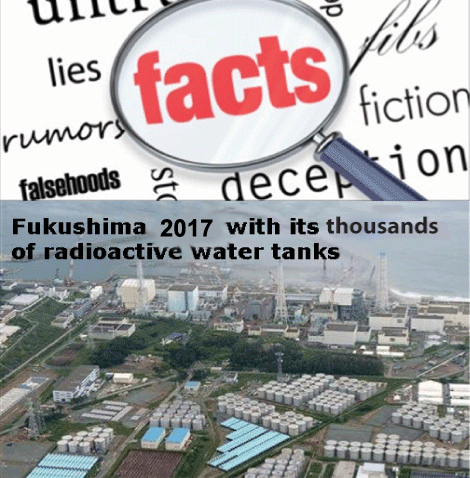 Spotlight: Fury sparked in Japan as companies found duping foreign refugees into decontamination work in Fukushima 2017-03-17 TOKYO, March 17 (Xinhua)— “Such scams are a shame to Japan,” said a reporter from Tokyo Metropolitan Television Broadcasting Corp., referring to a recently-exposed scandal involving labor dispatch agencies duping foreign refugees into doing decontamination work in Fukushima.Various local media have exposed recently that some Japanese companies have swindled foreign refugees into doing decontamination work in Fukushima with empty promises that such work might help extend their visas to stay in Japan.
Fifty-year-old Hosein Moni and 42-year-old Hosein Deroaru from Bangladesh were both caught in such a scam, according to a recent report by the Chunichi Shimbun, one of the largest newspapers in Japan.
The two came to Japan in 2013 seeking to be recognized as political refugees. In Japan, foreigners are given temporary permission to stay for up to six months at one application before they are recognized as refugees and given status as residents.
According to government data, the number of refugees actually afforded recognition as refugees in Japan is disproportionately low among developed nations, while the numbers of those applying for refugee status has been rapidly increasing in recent years in Japan.
The government received some 5,000 such applications in 2014, but only 11 were granted refugee status, according to the data.
Moni and Deroaru were told by a so-called labor dispatch agency in Nagoya that they could do decontamination work in exchange for an extension of their visa.
The two, knowing little Japanese and trying to seize every opportunity they could, accepted the job and worked in Fukushima for three months in 2015.
But when they finished their work and went to the local immigration bureau to extend their stay, they were told by officers there that they knew nothing about such a policy.
They later found out that the construction company that had hired them had changed its company name, and its Fukushima branch had closed.
Half of the 20 workers that they had worked with in Fukushima were foreigners, many of whom had been applying for refugee status in Japan, the pair later recalled. Their work mainly involved clearing away contaminated soil with spades, and while they were at work might well have been affected by high levels of radiation. “The radiation detectors we brought with us kept sounding alarms, which was rather scary,” they were quoted as saying.
The incident, after been exposed by local media, also caused a splash on social network sites. Many Japanese netizens felt indignant that such scams were happening in their homeland…….
Most of the foreign workers could hardly speak Japanese. As anti-radiation brochures provided by the plant’s operator, Tokyo Electric Power Company Holdings Inc. (TEPCO), were only available in Japanese or English, many of the workers could not understand it, Ishikawa was quoted as saying.
The foreign workers, to some extent, saved the contractors and TEPCO by pushing forward the decommissioning work of the nuclear plant, remarked the report…..http://news.xinhuanet.com/english/2017-03/17/c_136137295.htm
Defector’s ‘Astounding’ Theories About A Potential North Korean Nuclear Apocalypse Discredited
http://dailycaller.com/2017/03/16/defectors-astounding-theories-about-a-potential-north-korean-nuclear-apocalypse-discredited/ RYAN PICKRELL A high-ranking North Korean defector believes the North intends to test a nuclear bomb over a dozen times larger than anything it has previously tested, but that theory is a bit off.
fossil fuel corporations have captured academic research

Does this corporate capture of academia apply to nuclear research, also?

 The fossil fuel industry’s invisible colonization of academia https://www.theguardian.com/environment/climate-consensus-97-per-cent/2017/mar/13/the-fossil-fuel-industrys-invisible-colonization-of-academia
Corporate capture of academic research by the fossil fuel industry is an elephant in the room and a threat to tackling climate change, Guardian, Benjamin Franta and Geoffrey Supran, 13 Mar 17, On February 16, the Harvard Kennedy School’s Belfer Center hosted a film screening of the “Rational Middle Energy Series.” The university promoted the event as “Finding Energy’s Rational Middle” and described the film’s motivation as “a need and desire for a balanced discussion about today’s energy issues.”
Who can argue with balance and rationality? And with Harvard’s stamp of approval, surely the information presented to students and the public would be credible and reliable. Right?
Wrong.
The event’s sponsor was Shell Oil Company. The producer of the film series was Shell. The film’s director is Vice President of a family-owned oil and gas company, and has taken approximately $300,000 from Shell. The host, Harvard Kennedy School, has received at least $3.75 million from Shell. And the event’s panel included a Shell Executive Vice President.
The film “The Great Transition” says natural gas is “clean” (in terms of carbon emissions, it is not) and that low-carbon, renewable energy is a “very long time off” (which is a political judgment, not a fact). Amy Myers Jaffe, identified in the film as the Executive Director of Energy and Sustainability at the University of California, Davis, says, “We need to be realistic that we’re gonna use fossil fuels now, because in the end, we are.” We are not told that she is a member of the US National Petroleum Council.
The film also features Richard Newell, who is identified as a Former Administrator at the US Energy Information Administration. “You can get 50% reductions in your emissions relative to coal through natural gas,” he says, ignoring the methane leaks that undermine such claims. The film neglects to mention that the Energy Initiative Newell founded and directed at Duke University was given $4 million by an Executive Vice President of a natural gas company.
Michelle Michot Foss, who offers skepticism about battery production for renewables, is identified as the Chief Energy Economist at the Center for Energy Economics at the University of Texas at Austin. What’s not said is that the Energy Institute she founded at UT Austin is funded by Chevron, ExxonMobil, and other fossil fuel interests including the Koch Foundation, or that she’s a partner in a natural gas company.
You may notice a pattern. The very experts we assume to be objective, and the very centers of research we assume to be independent, are connected with the very industry the public believes they are objectively studying. Moreover, these connections are often kept hidden.
To say that these experts and research centers have conflicts of interest is an understatement: many of them exist as they do only because of the fossil fuel industry. They are industry projects with the appearance of neutrality and credibility given by academia.
After years conducting energy-related research at Harvard and MIT, we have come to discover firsthand that this pattern is systemic. Funding from Shell, Chevron, BP, and other oil and gas companies dominates Harvard’s energy and climate policy research, and Harvard research directors consult for the industry. These are the experts tasked with formulating policies for countering climate change, policies that threaten the profits – indeed the existence – of the fossil fuel industry.
Down the street at MIT, the Institute’s Energy Initiative is almost entirely fundedby fossil fuel companies, including Shell, ExxonMobil, and Chevron. MIT has taken $185 million from oil billionaire and climate denial financier David Koch, who is a Life Member of the university’s board.
The trend continues at Stanford, where one of us now works. The university’s Global Climate and Energy Project is funded by ExxonMobil and Schlumberger. The Project’s founding and current directors are both petroleum engineers. Its current director also co-directs Stanford’s Precourt Institute for Energy, which is named after (and was co-founded by) the CEO of a natural gas company (now owned by Shell). Across the bay, UC Berkeley’s Energy Biosciences Institute is the product of a $500 million deal with BP – one that gives the company power over which research projects get funded and which don’t.
Fossil fuel interests – oil, gas, and coal companies, fossil-fueled utilities, and fossil fuel investors – have colonized nearly every nook and cranny of energy and climate policy research in American universities, and much of energy science too. And they have done so quietly, without the general public’s knowledge.
For comparison, imagine if public health research were funded predominantly by the tobacco industry. It doesn’t take a neurosurgeon to understand the folly of making policy or science research financially dependent on the very industry it may regulate or negatively affect. Harvard’s school of public health no longer takes funding from the tobacco industry for that very reason. Yet such conflicts of interest are not only rife in energy and climate research, they are the norm.
This norm is no accident: it is the product of a public relations strategy to neutralize science and target those whom ExxonMobil dubbed “Informed Influentials,” and it comes straight out of Big Tobacco’s playbook. The myriad benefits of this strategy to the fossil fuel industry (and its effects on academic research) range from benign to insidious to unconscionable, but the big picture is simple: academia has a problem.
As scientists and policy experts rush to find solutions to the greatest challenge humanity has ever faced, our institutions are embroiled in a nationwide conflict of interest with the industry that has the most to lose. Our message to universities is: stop ignoring it.
We are not saying that universities must cut all ties with all fossil fuel companies. Energy research is so awash with fossil fuel funding that such a proposal would imply major changes. What we are saying is that denial – “I don’t see a conflict,” MIT’s Chairman told the Boston Globe – is no longer acceptable.
Two parallel approaches can help. First, mandatory standards should be established in climate policy and energy research for disclosing financial and professional ties with fossil fuel interests, akin to those required in medical research. And second, conflicts of interest should be reduced by prioritizing less conflicted funding and personnel.
One way or another, the colonization of academia by the fossil fuel industry must be confronted. Because when our nation’s “independent” research to stop climate change is in fact dependent on an industry whose interests oppose that goal, neither the public nor the future is well served.
Dr. Benjamin Franta is a PhD student in the Department of History at Stanford University, an Associate at the Harvard School of Engineering and Applied Sciences, and a former Research Fellow at the Harvard Kennedy School of Government’s Belfer Center for Science and International Affairs. He has a PhD in Applied Physics from Harvard University.
USA nuclear weapons vulnerable to hacking
 Why Our Nuclear Weapons Can Be Hacked https://www.nytimes.com/2017/03/14/opinion/why-our-nuclear-weapons-can-be-hacked.html?_r=0 MARCH 14, 2017 It is tempting for the United States to exploit its superiority in cyberwarfareto hobble the nuclear forces of North Korea or other opponents. As a new form of missile defense, cyberwarfare seems to offer the possibility of preventing nuclear strikes without the firing of a single nuclear warhead.
Did Israel hire assassins to murder Iranian nuclear scientists?
Iran accuses Israel of hiring assassins to take out nuclear scientists http://www.ynetnews.com/articles/0,7340,L-4933589,00.html
Iranian rep. at International Atomic Energy Agency describes Israel as a threat to entire Middle East, claims it targeted Iranian experts and criticizes Israel for not joining Treaty on the Non-Proliferation of Nuclear Weapons.
WikiLeaks posts huge CIA hacking trove
 WikiLeaks posts huge CIA hacking trove | 08 March 2017 | The CIA has suffered what appears to be a massive security breach with WikiLeaks dumping thousands of confidential documents detailing the spy agency’s global hacking abilities. The CIA documents published by WikiLeaks show how the CIA has managed to read popular encrypted apps, signal and telegram by breaking into phones to intercept messages before the encryption is applied. WikiLeaks, headed by Australian Julian Assange, claimed that its leaked data includes hundreds of millions of line of code that includes the CIA’s “entire hacking capability.”
Lockheed Martin – USA’s top salesman for war?
Lockheed Martin Used Pentagon Dollars to Lobby Congress for Nuclear Weapons Funding One of the uses of the billions of dollars from these contracts is to recycle them back into lobbying the government to push for additional conventional and nuclear weapons spending, as reported by William Hartung and Stephen Miles. Of course, in addition, these funds are used to support a general environment of fear and insecurity, through contributions supporting hawkish think tanks.
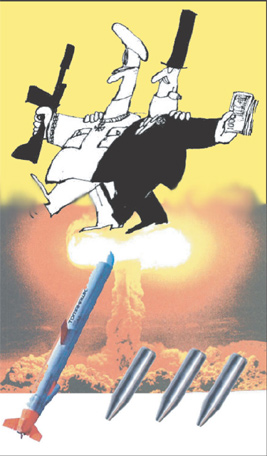 Trump Is Bankrupting Our Nation to Enrich the War Profiteers, March 06, 2017 By Jonathan King and Richard Krushnic, Truthout | News Analysis
“……..Corporations that contract with the Department of Defense (DOD) for nuclear weapons complex work do not report revenues and profits from this work separately from their other military work, although they do break up government work from civilian work, and sometimes break up military work from other government work. Hence, it is not possible to determine profits made from nuclear weapons complex work from the annual reports and Securities and Exchange Commission (SEC) filings of large military corporations. However, it is possible to estimate, and to demonstrate how a significant amount of military R&D and production not recorded as nuclear weapons work is in fact partially nuclear weapons work. The nuclear weapons work financed by the US Department of Energy (DOE) is (not surprisingly) carried out in a semi-secret insiders club that insulates it from public knowledge and oversight. The first contracts for the upgrading of the nuclear weapons triads have already been awarded — one to Northrop Grumman — for a new generation of long-range bomber. But the public remains in the dark as to how many tens of billions of their tax dollars will be spent on the project.
From 2012-2014, according to Lockheed Martin’s 2014 annual report, the company realized an average of $46 billion a year in revenue, with an average of $3.2 billion in profits — 7 percent of revenue, and a 76 percent return on $4.2 billion of investor equity. The annual report informs us that 59 percent of 2014 revenue came from the Pentagon. We know from other sources that $1.4 billion a year is coming from the DOE for operation of the Sandia nuclear weapons lab, and we are estimating that an additional $600 million a year is coming for DOE nuclear weapons complex work. Information in the annual report indicates that around $6.1 billion came from foreign military sales. This adds up to around $35 billion of military revenue, or 75.3 percent of total 2014 revenue. The single biggest revenue earner in recent years is the F-35 jet fighter, bringing in $8.2 billion, 17 percent of total corporation revenue, in 2014. (William Hartung’s recent report describes additional aspects of Lockheed Martin’s military business, and his book Prophets of War: Lockheed Martin and the Making of the Military Industrial Complex provides extensive background).
The only references to Lockheed Martin’s nuclear weapons complex work in its 2014 annual report is a sentence noting provision of infrastructure and site support to the DOE’s Hanford complex, and a phrase noting continuing work on the Trident missile. The words “nuclear weapons” never appear in the report.
Lockheed Martin’s Nuclear Weapons Operations
In spite of the lack of mention in the annual report, Lockheed Martin is a partner with Bechtel ATK, SOC LLC and subcontractor Booz Allen Hamilton in Consolidated Nuclear Security LLC (CNS), in running the DOE Pantex Plant and the Y-12 Complex. Pantex does nuclear weapons life extension, dismantlement, development, testing and fabrication of high explosive nuclear warhead components. Y-12 stores and processes uranium, and fabricates uranium weapons components.
Lockheed Martin produced the Trident strategic nuclear missile for the 14 US Ohio-class nuclear submarines and for the four British Vanguard-class submarines. The 24 Tridents on each Ohio-class submarine each carry either eight or 12 warheads, all of them 20 to 50 times more powerful than the bombs dropped on Hiroshima and Nagasaki. Each warhead is capable of killing most of the people in any one of the world’s largest cities — either immediately or later, from radiation, burns, other injuries, starvation and disease. Lockheed MArtin is not producing new Trident missiles now, but it maintains and modifies them. Previously, Lockheed Martin and its subcontractors received $65 million for each of the 651 Trident missiles, in addition to the $35 billion in earlier development costs.
The other primary strategic nuclear weapon delivery vehicle is Boeing’s land-based Minuteman III strategic missile, also with many warheads per missile. About 450 of them are in silos in Colorado and northern plains states. Lockheed Martin produced and continues to produce key systems for the Minuteman III, and plays a large role in maintaining them. It was awarded a $452 million contract for this work in 2014.
Lockheed’s Sandia Subsidiary
Regarding the Pentagon’s nuclear weapons upgrades planned for the next decade; particularly important is the role of Sandia National Laboratories (SNL). Outside of Albuquerque, New Mexico, this DOE lab’s 10,600 employees make 95 percent of the roughly 6,500 non-nuclear components of all seven US nuclear warhead types. Components arm, fuse, fire, generate neutrons to start nuclear reactions, prevent unauthorized firing, preserve the aging nuclear weapons stockpile and mate the weapons to the missiles, planes and ships that deliver them to targets. Sandia Corporation LLC, wholly owned by Lockheed Martin, operates Sandia. The DOE is spending at least $1.4 billion a year on Sandia nuclear weapons work. The secret Lockheed Martin nuclear warhead assembly plant uncovered in Sunnyvale in 2010 is an extension of Lockheed Martin’s Sandia operations. Again, none of this received any mention or revenue numbers in Lockheed Martin’s 2014 annual report.
Lockheed Martin Used Pentagon Dollars to Lobby Congress for Nuclear Weapons Funding
One of the uses of the billions of dollars from these contracts is to recycle them back into lobbying the government to push for additional conventional and nuclear weapons spending, as reported by William Hartung and Stephen Miles. Of course, in addition, these funds are used to support a general environment of fear and insecurity, through contributions supporting hawkish think tanks. Technically, the federal government does not allow military contracting firms to use awarded funds to lobby Congress. Lobbying funds must come from other parts of the companies’ businesses. In reality, this is a non-functional restriction, since profits from various business segments are fungible; that is, once they are profits, they are intermingled, so in reality, the firms can use the profits from military contracts to lobby Congress. But Lockheed Martin went ahead and spent military contract funds from 2008-2012 as part of the contract expenditures. It didn’t even bother to book the lobbying expenditures as expenditures of profits. In 2015, the US Department of Justice required Lockheed Martin’s Sandia subsidiary to repay $4.9 million of a Sandia contract award to the Pentagon that the firm had spent under the contract for lobbying of Congressman the DOE secretary and the secretary’s family and friends………http://www.truth-out.org/news/item/39712-trump-is-bankrupting-our-nation-to-enrich-the-war-profiteers
Attacks on climate scientists will continue
Climate scientists face harassment, threats and fears of ‘McCarthyist attacks’
Researchers will have to deal with attacks from a range of powerful foes in the coming years – and for many, it has already started “…….The Texas Tech University professor Katharine Hayhoe, who has gathered a healthy following for her Facebook posts that mix climate science with evangelism, has opened her inbox to missives including “Nazi Bitch Whore Climatebecile” and a request that she “stop using Jesus to justify your wacko ideas about global warming”.
Threats and badgering of climate scientists peaked after the theft and release of the “Climategate” emails – a 2009 scandal that was painfully thin on scandal. But the organized effort to pry open cracks in the overwhelming edifice of proof that humans are slowly baking the planet never went away. Scientists are now concerned that the election of Donald Trump has revitalized those who believe climate researchers are cosseted fraudsters.
Mann said climate scientists “fear an era of McCarthyist attacks on our work and our integrity”. The odd unfulfilled threat may be perturbing but a more morale-sapping fear is that the White House and Congress will dig up and parade seemingly unflattering emails, sideline or scrap research and attempt to hush the scientific community…..https://www.theguardian.com/environment/2017/feb/22/climate-change-science-attacks-threats-trump
Pressure on Hanford doctor to disregard worker safety

 Former Hanford doctor ‘under duress’ to disregard worker safety In 30 years of medical practice, Dr. Loren Lewis of Spokane said he’s never seen tactics like those used at Hanford.
Instead of putting worker safety as priority number one at the former nuclear weapons complex, the occupational medicine expert said he felt “forced and under duress to…manipulate a medical policy” he wasn’t comfortable with.
From 2004 to 2006, Lewis was the top medical professional at the site, the Site Occupational Medical Director (SOMD). As per federal regulation, he was legally and ethically responsible for overseeing medical policy and programs for the 11,000 workers at the site. As SOMD, he was an employee of a federal government contractor, AdvanceMed Hanford.
Lewis said his supervisors at AdvanceMed Hanford and officials they reported to at the U.S. Department of Energy pressured him to abandon his adherence to the federal regulations and loosen medical policy as it related to keeping workers safe from a highly toxic metal at the site called beryllium.
“That was really a violation of their own regulations. They should have been aware that (the regulation) gives strict authority to the SOMD (to direct medical policy),” said Lewis. “To me, it is unthinkable that a medical professional would be forced to do things that are politically or have some other motivation besides the health of the person. That’s what we are trained to do and what the Hippocratic oath is about – the health of the person.”
In the mid-2000s, the subject of keeping workers safe from beryllium was a hot topic. The metal was used at Hanford in non-sparking tools and processes used to produce plutonium. It is one of the most hazardous metals on the planet, and some workers become allergic to it or contract a life-threatening disease called Chronic Beryllium Disease. The condition is an incurable lung disease that can cause a person’s health to decline over several years. It can affect not only a person’s lungs, but can also damage a person’s heart, nervous system, and mental health, as well as liver and kidney function.
After a worker would be diagnosed with an allergic reaction to beryllium, a condition called beryllium sensitivity, experts say best practice is to keep them away from beryllium to the greatest extent possible.
“It takes a seemingly trivial amount of beryllium to cause this disease,” said Dr. Lee Newman of the University of Colorado Denver. “So if you’re not being as strict as possible in controlling the exposures, it’s, unfortunately, easy for someone to be overexposed.”
Newman is considered the world’s leading expert on beryllium.
“There is no known safe level for someone who is sensitized,” said Newman.
But Lewis said his supervisors and a top U.S. Department of Energy official were pressuring him to come up with a safe level of beryllium and to put that measurement in Hanford medical policy for those who had become sensitized.
Hundreds of internal emails obtained by KING 5 show the bitter dispute over this issue between Lewis and his superiors.
“We received specific guidance from (U.S. Department of Energy administrator) Doug Shoop to reword the policy,” wrote Lewis’ boss on Oct. 8, 2006. “He (Shoop) specifically requested that the wording in the medical restriction document contain a reference to the maximum exposure limit…(but) you began questioning this direction…Such behavior is inexcusable.”
Lewis pushed back in dozens of emails.
“I cannot stress enough that it is very inappropriate for…DOE to exert duress and compulsion on the way that we practice medicine, on medical decision making,” wrote Lewis on Oct. 4, 2006.
“I cannot provide a ‘safe level’ of exposure because there is no medical support of such,” wrote Lewis. “(I’m being) forced and under duress to manipulate a medical policy (by people who do not have) a license to practice medicine in the State of Washington. (Going along) would put Hanford workers at increased risk.”
Shoop said he could barely remember Lewis and that he “didn’t believe” he had put pressure on the SOMD.
“My interest was the health of the worker and keeping them safe and not letting them go back into a situation where they could be harmed further,” said Lewis.
Lewis said making deadlines and getting the work done seemed to eclipse worker safety at the site.
“It was in the best interest of the employer and their profitability and getting people to do the work regardless of what the health consequences were,” said Lewis.
Lewis refused to cave under pressure. Nineteen days after he put his foot down once and for all, he was fired. “My supervisor gave me a note and said the Department of Energy had lost confidence in my leadership and fired me on the spot,” said Lewis.
Lewis said on behalf of the sick and forgotten at Hanford, the fight, the stress, the loss of a job was all worth it.
“It was very difficult to stand up against that,” Lewis said. “There was a lot of force…I was proud of myself that I was willing to stand my ground and stick up for my principals and the ethics I felt were important, and if I did it again, I would do the same thing.”
Lewis now works for the U.S. Department of Labor, helping sick nuclear workers.
During that time in the mid-2000s, he tried to get the word out about what was going on. He filed complaints with the Department of Energy in Washington D.C. Teams came out and investigated, but nothing ever came of it.
That’s why he’s speaking out now, to bring attention to what he thinks is most likely still going on at Hanford.
“The workers are not safe and protected by the system,” said Newman.
Britain’s Espionage Act change wanted: it could then be used to prosecute foreign journalists

 UK COULD PROSECUTE US JOURNALISTS WITH NEW ESPIONAGE ACT http://govtslaves.info/uk-could-prosecute-us-journalists-with-new-espionage-act/ [2/3/17] KIT DANIELS– The UK Law Commission wants to overhaul the country’s Espionage Act to prosecute foreigners who “leak confidential information” which “damages” national security and the UK’s economy.
“Foreigners who leak information overseas that damages British national security could also be prosecuted in the UK for the first time,” the Telegraph reported. “This would include a non-British citizen seconded to a government department and in that role have access to information that relates to security and intelligence.”
“Currently, they can only be prosecuted if the leak is by a British national or happens on UK soil.”
And anyone who leaks “sensitive information” that “affects the economic well-being of the UK” would also be at risk for prosecution, an Orwellian premise given its broad scope.
If the UK adopts the Law Commission’s recommendations, prosecuted foreigners could face up to 14 years in jail – and the UK has extradition agreements with at least 105 countries, including the US.
In addition to foreign journalists, US whistleblowers such as Edward Snowden could also be targeted due to the global interconnection of spy organizations; his NSA leaks in particular also implicated British intelligence.
The UK’s Ministry of Defence already issues “D-Notices” to gag news stories from appearing in British media which the government claims is “harmful to national security implications,” including bombshell reports such as the Snowden leaks that exposed government criminality.
But now it appears the UK wants to go one step further and ensure that damning information is never released to the public to keep the population ignorant and under control.
Russia finally admits to a nuclear reactor failure that it covered up for 2 months
Russia fixes a reactor it initially refused to say was broken Russian nuclear officials say they’ve fixed a generator glitch that more than two months ago shut down its prized, first of a kind AES-2006 reactor under a cloud of embarrassment and initial secrecy. Bellona, January 31, 2017 by Charles Digges, Russian nuclear officials say they’ve fixed a generator glitch that more than two months ago shut down its prized, first of a kind AES-2006 reactor under a cloud of embarrassment and initial secrecy.
The November 10 generator failure at the reactor, which began operating last year at the Novovoronezh Nuclear Power Plant south of Moscow, was kept under wraps by nuclear utility Rosenergoatom.
Official Russian news agencies reported the hiccup six days later, and referenced a statement from Rosenergoatom published the same day. Since then, however, the utility appears to have backdated its initial November 16 Russian language Web post on the incident to November 10.
When the company finally did publish information on the cause of the unexpected shutdown at the flagship reactor, also known as a VVER-1200, which Rosatom is building for a number of foreign customers, it cited a short circuit as the cause.
The apparently re-dated release emphasized that the shutdown was not unusual, and that it had no effect on the radiation safety of the plant. But the utility’s late reporting of the incident gave rise reports in local publications that the plant had suffered an emergency.
On November 15, Bloknot Voronezh, a Web site published in Voronezh Russia, ran a report citing an anonymous witness who reported hearing an explosion near the nuclear plant’s turbine hall, and who spoke of a burned out generator. The witness also reported burned out electrical equipment and a telltale loud noise.
Russia’s state nuclear corporation Rosatom has staked much of its reputation on the successful operation of the AES-2006, which had long been under development. Its launch at the Novovoronezh plant was initially scheduled for 2012, but there was a four-year delay in its construction…….
both the AES-2006 reactor, which is Novovoronezh’s unit 6, and the next reactor from the line at unit No 7 are already seriously behind schedule. The original launch date for unit No 7 passed in 2016.
Previous to that it had been expected to come online in 2014 and 2015 as well, so in total, it’s not on time at all, but rather running five years behind.
But don’t tell that to Belarus, which is currently building an AES-2006 reactor, or Finland, Turkey, and Hungary, who all have orders in for one.
And Rosenergoatom’s initial impulse to not report the shutdown of Novovoronezh’s unit No 6 appeared to be an effort to keep things hushed up. Not until rumors of something far worse bubbled up in the local press did the utility attempt to correct the record by admitting a minor malfunction.
Even then, it apparently rewrote the date when the malfunction occurred on its press release to make it look like it had spoken up earlier. By turns, any of Rosatom’s customers should likely be prepared to receive backdated bills for late reactors when they finally get to building them.
Andrei Ozharovsky contributed to this report from Moscow. http://bellona.org/news/nuclear-issues/2017-01-russia-fixes-a-reactor-it-initially-refused-to-say-was-broken
Fake charity (nuclear lobby) The Weinberg Foundation is whining about Britain leaving Euratom
 Leaving Euratom: the government should reconsider, Weinberg Next Nuclear 27 Jan 17 “…….A complex set of negotiations will now have to take place as most nuclear co-operation with the UK relies on safeguards provided through Euratom. It may not be possible to agree and ratify new agreements before Britain leaves the EU in 2019. According to Vince Zabielski, a senior lawyer at law firm Pillsbury Winthrop Shaw Pittman, “current new build projects will be placed on hold while those standalone treaties are negotiated” meaning possible delays at Hinkley as well as Bradwell, Moorside and Wylfa.
The decision however is not just bad for the UK, but for nuclear as a whole. With the UK one of the last big supporters of the technology, weakening its strength in the field will give power to anti-nuclear camps across the continent.
Weinberg Next Nuclear is very concerned that the departure from Euratom could severely damage the UK’s nuclear industry, with impacts on energy security, industrial competitiveness and decarbonisation objectives. We find no reason why such drastic action needs to be taken. Article 50 deals with the two Treaties of Lisbon: the Treaty on the European Union and the Treaty on the Functioning of the European Union. However the Euratom treaty is separate, not mentioned in either of the above treaties thus there is no reason for including Euratom in any part of Article 50 debate. As Jonathan Leech, a senior lawyer and nuclear expert at Prospect Law said, “there doesn’t seem to have been any real explanation as to why, because we are going towards the unknown at great speed. Legally we don’t have to [leave Euratom because the UK is leaving the EU],”.
Weinberg Next Nuclear thus urges the government to reconsider and avoid the highly damaging consequences this unnecessary withdrawal could have on the UK’s nuclear future. http://www.the-weinberg-foundation.org/2017/01/27/leaving-euratom-the-government-should-reconsider/
Conflict between Big Nuclear Reactor makers and Small Nuclear Reactor makers now coming out into the open?
Nuclear Options The Economist, print version, 28 Jan 17 “………Not one of the two technologies that were supposed to revolutionise the supply of nuclear energy—the European Pressurised Reactor, or EPR, and the AP1000 from America’s Westinghouse—has yet been installed, despite being conceived early this century. In Finland, France and China, all the EPRs under construction are years behind schedule. The main hope for salvaging their reputation—and the nuclear business of EDF, the French utility that owns the technology—is the Hinkley Point C project in Britain, which by now looks a lot like a Hail Mary pass.
Meanwhile, delays with the Westinghouse AP1000 have caused mayhem at Toshiba, its owner. The Japanese firm may announce write-downs in February of up to $6bn on its American nuclear business. As nuclear assets are probably unsellable, it is flogging parts of its core, microchip business instead……..

“Clearly the momentum seems to be shifting away from traditional suppliers,” says William Magwood, director-general of the OECD’s Nuclear Energy Agency……
The WNA also notes in a report this month a “revival” of interest in SMRs, partly because of rock-bottom sentiment toward large plants. Utilities are finding it tough to pay for big projects (Barakah, for instance costs a whopping $20bn), especially in deregulated power markets where prices have slumped because of an abundance of natural gas and renewable energy. Big investments can sink a firm’s credit rating and jack up its cost of capital.
It is less onerous to pay for an SMR, which means that even though they produce less energy, they can be cost-competitive with larger plants once they are being mass produced, says the WNA….
Trump Wants “Alternative Facts” on Climate Change. We Saved the Real Ones.
 Daily Kos ·”……Today, the new White House team is taking a deeply troubling step to hide the truth by shuttering the EPA’s climate change website and, by extension, deleting volumes of important scientific information. And it is part of a very troubling pattern: President Trump once famously proclaimed that climate change was an idea “created by and for the Chinese.” And, in an all-out assault on science and reality, he has nominated Scott Pruitt – a man so extreme that we broke 35 years of silence on cabinet nominees to oppose his nomination – to head the Environmental Protection Agency.
Another British nuclear mishap kept secret – the Scottish cold war nuclear submarine collision

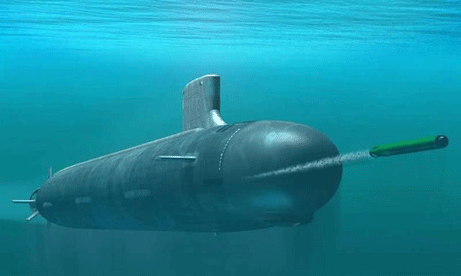 Scottish cold war nuclear submarine collision kept secret for 43 years
Documents published by CIA reveal crash between US and Soviet subs a few miles off coast of Scotland in 1974, Guardian, Matthew Weaver, 26 Jan 17, Two nuclear submarines from rival sides in the cold war collided a few miles off the coast of Scotland in an incident that was covered up for 43 years.
The potentially catastrophic crash occurred in November 1974 when the SSBN James Madison, armed with 16 Poseidon nuclear missiles, was heading out of the US naval base at Holy Loch, 30 miles north-west of Glasgow.
Soon after leaving the port it hit an unidentified Soviet submarine that had been sent to tail it, according to a cable to then US secretary of state Henry Kissinger, marked “secret eyes only” [pdf].
The cable, sent by national security adviser Brent Scowcroft, said: “Have just received word from the Pentagon that one of our Poseidon submarines has just collided with a Soviet submarine.
“The SSBN James Madison was departing Holy Loch to take up station when it collided with a Soviet submarine waiting outside the port to take up trail.
“Both submarines surfaced and the Soviet boat subsequently submerged again. There is no report yet of the extent of damage. Will keep you posted.”
The cable was published by the CIA on 17 January as part of a mass release of more than 12m pages of previously classified reports in 930,000 documents.
The cable corroborates an until-now unconfirmed report on the incident in the Washington Post on 1 January 1975 by the investigative journalist Jack Anderson. He reported that the collision left a 9ft scratch on the side of the James Madison and that the two submarines came within inches of sinking one another.
Another document marked “top secret” [pdf]released in the same batch expressed alarm that the news of the collision had leaked.
It said: “On 3 January, the NID [National Intelligence Daily] ran an item on the collision just off Holy Loch of US Polaris submarine and a Soviet attack submarine. Unfortunately, Jack Anderson had run the same news in the Washington Post a day or two earlier.
“This pre-emption on Anderson’s part forced the surfacing (no pun intended) of a piece of information in a current intelligence 2 months after the event occurred. …..
Kate Hudson, general secretary of the Campaign for Nuclear Disarmament, said the secret cable exposed the “enormous risks” of nuclear weapons.
“The history of nuclear weapons is a history of near misses, accidents, potential catastrophes and cover-ups. This latest example joins 25 other near misses that could have led to nuclear war.”
CND is calling for an inquiry into Trident, the successor to the Poseidon programme, after it emerged that a malfunctioning missile with the potential to carry a nuclear warhead was forced to self-destruct in mid-air off the US coast last June.
Hudson added: “These enormous risks have to be acknowledged particularly when we also now face the increasing likelihood of cyber-attack on nuclear weapons systems. With advancing technological developments added to the already dangerous mix there can be no confidence that nuclear weapons are a credible part of British security in the 21st century……… https://www.theguardian.com/us-news/2017/jan/25/nuclear-submarine-collision-cold-war-cia-scotland
1 This Month



26 September – International Day for the Total Elimination of Nuclear Weapons


PLEASE OPPOSE HR 8255 AND S.3639 – bills would accelerate satellite deployment, with no environmental review or safeguards – https://ncstd5li.quorum.us/campaign/169331/
To see nuclear-related stories in greater depth and intensity – go to https://nuclearinformation.wordpress.com
-
Archives
- September 2026 (269)
- August 2026 (330)
- July 2026 (355)
- June 2026 (287)
- May 2026 (306)
- April 2026 (356)
- March 2026 (251)
- February 2026 (267)
- January 2026 (308)
- December 2025 (358)
- November 2025 (359)
- October 2025 (375)
-
Categories
- 1
- 1 NUCLEAR ISSUES
- business and costs
- climate change
- culture and arts
- ENERGY
- environment
- health
- history
- indigenous issues
- Legal
- marketing of nuclear
- media
- opposition to nuclear
- PERSONAL STORIES
- politics
- politics international
- Religion and ethics
- safety
- secrets,lies and civil liberties
- spinbuster
- technology
- Uranium
- wastes
- weapons and war
- Women
- 2 WORLD
- ACTION
- AFRICA
- Atrocities
- AUSTRALIA
- Christina's notes
- Christina's themes
- culture and arts
- Events
- Fuk 2022
- Fuk 2023
- Fukushima 2017
- Fukushima 2018
- fukushima 2019
- Fukushima 2020
- Fukushima 2021
- general
- global warming
- Humour (God we need it)
- Nuclear
- RARE EARTHS
- Reference
- resources – print
- Resources -audiovicual
- Weekly Newsletter
- World
- World Nuclear
- YouTube
-
RSS
Entries RSS
Comments RSS

