The deadly business of grassroots climate activismNew Internationalist, 20 Nov 16A recent report found that 2015 was the deadliest year on record for environmental activists, raising concerns for those who continue to fight on the frontline, writes Liam Turner. It’s 2015, and Honduran campaigner Berta Cáceres has just won the Goldman Environmental Prize for grassroots environmentalism in South and Central America. The crowd claps as she walks up to the podium in her silver-sequined dress, a slight smile on her face. Then the room goes quiet, and Berta adopts a much more serious tone.
She speaks of her people, the Lenca, and their constant battle to protect their land. She speaks of how the world must break free from the grasp of ‘rapacious capitalism, racism and patriarchy’ that will ultimately lead to its self-destruction. She speaks of how her people’s sacrifice is not just for them, but for the world and everyone in it. She ends by dedicating the award to the martyrs who have given their lives in the struggle to defend our natural resources.
Less than a year later, armed men would break into her house in the middle of the night and murder her in cold blood, making her the latest to die for her cause. She was 44.
The Truth Behind the Paris Climate Deal
Climate activism has always been risky. Not only are there hazards that come from protesting at large, industrial sites, there is also the danger that comes from conflict with people whose interests lie with extractivist transnational companies. Ultimately, those who make a stand put themselves in harm’s way one way or another.
In fact, there’s evidence to suggest that climate activism is now more dangerous than ever. In June, a report by Global Witness revealed that 2015 was the deadliest year for environmental activists. It had recorded a total of 186 killings across 16 different countries, an increase of 59 per cent from the previous year. Global Witness also believes this number should actually be much higher, as a lack of reliable data meant that they weren’t able to record all fatal incidents.
An increasing threat
In a postscript to the Global Witness report – entitled ‘On Dangerous Ground’ – campaign leader Billy Kyte said: ‘As demand for products like minerals, timber and palm oil continues, governments, companies and criminal gangs are seizing land in defiance of the people who live on it. Communities that take a stand are increasingly finding themselves in the firing line of companies’ private security, state forces and a thriving market for contract killers.’
Report: 12 members of nuclear negotiating team arrested by Iran for espionage, Jerusalem Post, 18 Nov 16At least a dozen senior officials who were part of the negotiating team that conducted talks with the west regarding the Islamic Republic’s nuclear program were arrested by Iranian authorities on espionage charges, Channel 2 citing an Iranian member of parliament reported Friday.
Iranian MP Husein Al Haj said earlier this week that some of those arrested had dual citizenship but he did not disclose their identities or nationalities.
Government controlled media in Iran did not comment or acknowledge the arrests but Arab media outlets have been covering the story quite extensively.
Iranian authorities earlier in the year had carried out a similar arrest against another member of the negotiating unit, claiming the suspect was a “spy who had infiltrated the nuclear team.”
Termination clause in nuclear deal with Japan not binding
on India, insists govt, First Post, 13 Nov 16 New Delhi: The just-signed historic civil nuclear deal with Japan has a “termination” clause which the government here insists is not binding on India but merely records the “views” of the Japanese side considering its “special sensitivities”.
The government insisted that India has made “no additional commitments” over the similar agreements signed with the US and other countries.
In the Nuclear Cooperation Agreement, signed in the presence of Prime Minister Narendra Modi and his Japanese counterpart Shinzo Abe in Tokyo on Friday, there is a note on ‘Views and Understanding’ wherein the Japanese side has cited India’s September 2008 declaration of unilateral moratorium on atomic tests and said if this commitment is violated, the deal will terminate.
Indian government holds that this is merely recording of the views of the two sides.
“The termination clause is there in other NCAs (nuclear cooperation agreements) we have signed, including with the US (Article 14). However the circumstances triggering a possible termination are never sharply defined. Consideration also has to be given to mitigating factors,” a source here said.
“That note is simply a record by the negotiators of respective views on certain issues. It is not the NCA which is what is binding,” the source said.
The sources added that given Japan’s special sensitivities as the only nation to have suffered a nuclear attack, “it was felt that their views should be recorded in a separate Note. The Note is a record by the negotiators of respective views on certain issues.
“The termination clause is there in other NCAs (nuclear cooperation agreements) we have signed, including with the US (Article 14). However the circumstances triggering a possible termination are never sharply defined. Consideration also has to be given to mitigating factors,” a source here said.
“That note is simply a record by the negotiators of respective views on certain issues. It is not the NCA which is what is binding,” the source said.
The sources added that given Japan’s special sensitivities as the only nation to have suffered a nuclear attack, “it was felt that their views should be recorded in a separate Note. The Note is a record by the negotiators of respective views on certain issues………
Nuclear deals could be ‘captured’ http://www.timeslive.co.za/thetimes/2016/11/07/Nuclear-deals-could-be-captured JAN-JAN JOUBERT | 07 November, 2016 Environmentalists have warned that proposed nuclear building programmes could be “captured” if Eskom continues to be the procurement agency for the project, which is expected to cost more than R1-trillion. Environmental action group Greenpeace said former public protector Thuli Madonsela’s report on state capture released last week confirmed that vested interests and corruption in the energy sector were central to the energy choices made in South Africa.
“It is no coincidence that Brian Molefe is a key figure in the State of Capture report, and that he and the Eskom board have been running an anti-renewable energy campaign, focused instead on pushing for expensive and unnecessary nuclear energy,” said Greenpeace spokesman Helen Dena.
“This undermines the prioritisation of renewable energy, which would enhance South Africa’s energy future, strengthen the economy and deliver affordable, safe, clean electricity,” said Dena.
DA MP Gordon Mackay said: : “In light of the government’s own policy documents, preference for nuclear is irrational in law.”
BY SIKONATHI MANTSHANTSHA, NOVEMBER 03 2016,By the time you read this, Statistics SA will have published yet another electricity production report that exposes the propaganda coming out of Eskom for the lie it really is. The last electricity production report, released in the first week in October, shows Eskom has been generating ever-shrinking amounts of power for the past decade. For the eight months to August, it produced a total 152,432 gigawatt hours (gWh) of electricity. For the whole of last year Eskom generated 230,122gWh of power, a far cry from the 241,170gWh it churned out in 2007, the year the screws really came off. The next-best generation performance came only in 2010, with 240,528gWh of electricity produced. It has been on a downward production spiral since then.
This year’s production figures also include the more than 2,000MW that is produced by private, renewable-power operators.
Yet for the past year the utility has been feeding the nation the lie that it has improved its generation performance, pointing at the absence of load shedding as proof. Only when confronted with the evidence do Eskom’s executives reluctantly admit that the much lower demand “has contributed” to the lack of load shedding.
Stats SA collects its information from the utility itself. So who is Eskom fooling with its public-relations spin?
Now that they have been repeating the “superb performance” narrative, Eskom’s managers are beginning to believe it and are becoming more ambitious and brazen. Generation chief Matshela Koko has been generating a storm of hot air about why Eskom must handle the procurement of the next fleet of nuclear power stations. And now that energy minister Tina Joemat-Pettersson has effectively handed the responsibility to Eskom, the utility says it will use its balance sheet to fund the nuclear power stations, which it would operate when the first one comes into operation by 2026……..
While I believe that SA does need to build more nuclear power stations in order to restore energy security, I do not think Eskom can be trusted with such a huge, risky and expensive exercise at this stage. And I believe we only need to build a maximum 3,000MW of new nuclear capacity during the next 20 years, not the 9,600MW government has been pushing for.
As a start, it is fanciful and misleading at best to say a nuclear power station can be commissioned by 2026. Certainly not by Eskom. The worst possibility is that Eskom executives are deliberately misleading SA into believing they can efficiently manage such a process.
Over budget and years late
Since August 2007, Eskom has been bumbling and unnecessarily costing SA billions trying to build the Medupi and Kusile power stations. Both are way over budget and at least five years late.
It is not only lack of skills causing these delays and cost overruns. Corruption inside Eskom and at government level has played the biggest role. And corruption has since got worse, not better.
The biggest lie in Eskom’s bid to control the nuclear procurement is that it has a balance sheet capable of handling such a commitment. Koko conveniently forgets that in 2009 Eskom abandoned its nuclear build programme, and handed the responsibility to government.
The reason was stated clearly: Eskom alone could not afford the commitment, said then chief generation officer Brian Dames in 2009. The utility has since leant on government for financial guarantees and bailouts to support its current capital investment programme. The taxpayer is exposed to more than R170bn in Eskom guarantees alone. Eskom did not have the money then. It does not have it now.
Eskom boss Brian Molefe bursts into tears over #StateCaptureReport. Has he been hung out to dry? Biz News, 2 Nov 16 Eskom boss Brian Molefe is not coping well with the stream of allegations that point to his role as a central figure in the capture of state entities by the Gupta family. He broke down in tears at a conference on Eskom’s latest financial reports when talk turned to the #StateCaptureReport compiled by former Public Protector Thuli Madonsela, which was released to the public this week. Molefe has been referred to as a friend of the Gupta family and is a key link in allegations that Eskom may have fraudulently given money to a Gupta-linked company to enable it to buy a coal mine. Molefe has also vigorously promoted the benefits of a nuclear build programme, which many believe will bankrupt the country while its beneficiaries reap the benefits of tapping into state contracts. Molefe’s prominent appearance in the #StateCaptureReport has evidently caught him by surprise. With an illustrious career in powerful roles, including as chief executive officer of the state’s Public Investment Corporation, and influential friends, perhaps he thought he was beyond reach? At the very least, it seems that Molefe’s friends forgot to let him know that he featured in the document, while alerting others – including co-operative governance minister Des van Rooyen and mines’ minister Mosebenzi Zwane, who made noises about going to court to stop the release of the #StateCaptureReport. It’s starting to look a bit like a case of ‘every man for himself’ as the web of deceit around the Gupta and Zuma families unravels. – Jackie Cameron
By Gareth van Zyl Johannesburg – Eskom CEO Brian Molefe has lashed out at former public protector Thuli Madonsela’s use of cellphone records to suggest he had numerous meetings with the controversial Gupta family.
Nuclear CSI: Noninvasive procedure could identify criminal nuclear activity, http://phys.org/news/2016-11-nuclear-csi-noninvasive-procedure-criminal.htmlNovember 1, 2016 by Molly PetersonDetermining if an individual has handled nuclear materials, such as uranium or plutonium, is a challenge national defense agencies currently face. The standard protocol to detect uranium exposure is through a urine sample; however, urine is able to only identify those who have been exposed recently. Now, scientists at the University of Missouri have developed procedures that will better identify individuals exposed to uranium within one year. Scientists and homeland security experts believe this noninvasive procedure could identify individuals who may be smuggling nuclear materials for criminal purposes.
“We are working to develop a tool that law enforcement agencies in nuclear proliferation or smuggling investigations can use to identify individuals who have handled special nuclear material,” said John Brockman, associate professor of research in the MU Research Reactor Center. “The goal of our research was to determine if hair, fingernail clippings and toenail clippings could be used to better detect uranium exposure.”
Brockman collected hair, fingernail and toenail clippings from workers in nuclear research facilities from around the country. Testing procedures developed by Brockman and his team were able to identify exposure to both natural and manmade sources of uranium.
According to the World Nuclear Association, naturally occurring uranium is a mixture of three isotopes, including uranium-238 (U-238), U-235 and traces of U-234. U-238 accounts for over 99 percent of the isotopes found in nature; U-235 is the isotope necessary to create nuclear weapons or power a nuclear reactor. U-235 is considered a fissile isotope, meaning the atom has the ability to split, yielding a large amount of energy. Uranium that has been used as fuel in a nuclear power plant also contains the manmade isotope, U-236.
“Our technique was not only able to determine uranium exposure, but also the specific isotopes the individual has handled within the last year,” Brockman said. “We were able to identify exposure to enriched uranium, which is used to make both nuclear fuel and weapons, and U-236 which is suggestive of nuclear fuel reprocessing.”
With this discovery, law enforcement official could use specialized equipment and identify individuals who have been exposed to special nuclear material within 48 hours. Brockman is looking to expand his analysis with the national human radiobiological tissue repository (NHRTR) to further provide insight on how hair and nail samples could be used to monitor exposure to special nuclear material.
The MU Research Reactor has been a crucial component to research at the university for more than 40 years. Operating 6.5 days a week, 52 weeks a year, scientists from across the campus use the 10-megawatt facility to not only provide crucial radioisotopes for clinical settings globally, but also to carbon date artifacts, improve medical diagnostic tools and prevent illness.
A CITY of almost 82,000 people are living on a nuclear time bomb in one of the most toxic places on earth. By SIOBHAN MCFADYEN, Oct 31, 2016 And the residents of the Russian walled city of Ozyorsk in Chelyabinsk Oblast code named City 40 are living in fear of their lives with their every move being watched by Kremlin spies.
Brave locals are living in an experiment zone, on a toxic lake where almost of all of Vladimir Putin’s nuclear arsenal is stockpiled.
And for the first time they have opened up about their experiences residing in the birthplace of the Soviet nuclear weapons programme. The city is officially closed to the outside world and for those who live there every day is a battle.
Around 15,000 people are employed by the Mayak plant, a plutonium handling facility which rose to prominence during the Cold War. The plant itself covers an area of approximately 50 miles and reprocesses spent fuel from the country’s nuclear submarines.
A new documentary called City 40 now available on Netflix shows for the first time the challenges being faced by the people who live there – many of whom are suffering from cancer. The narrator says: “Growing up as a kid I was aware of a strange place a closed place, a top secret place
“This is where almost all the reserve of Russia’s nuclear materials is stockpiled. “To get in there you would need a full-scale army operation. “Unauthorised access there cannot even be imagined.” The city itself is constantly under surveillance with very little information leaking out to the mainstream.
A narrator adds: “It’s cozy and a beautiful town but a closed one. “There are spies all over sneaking around gathering information. “My mother used to warn me ‘darling, never say where you are from. “‘Or a Black Maria will take us away and you’ll never see your parents again’.
“Once there was a spill of powder, the radioactive kind of powder. “An underground container of liquid radioactive waste exploded.”
According to reports around 10,000 people have disappeared off the census list in just eight years.
The last census was taken in 2010, it is unknown whether the people have died however many residents are extremely sick. A city dweller adds: “The local people will tell you that this lake is nicknamed the ‘lake of death’ because it has been so heavily contaminated with plutonium.
“Mostly people were dying of carcinogenic diseases. “Once can say this city was built on dead and ruined human bodies.”If someone refused to work they’d be taken to a prison camp and executed because they were introduced to state secrets.
“They created their own ideology. “We’re the saviours of the world, creators of the nuclear shield.” While the undercover film team have managed to gain access to the locals it is unknown whether they will go unpunished for revealing themselves to camera.
Tensions between the USA and Russia have peaked over recent weeks and it is believed the facility will no doubt be in full production mode. A narrator adds that most of the locals wouldn’t dream of leaving – not because they want to but because they can’t.
They added: “We are used to it and this is how we want to live. “It may be for the better, it may be for the worse, but for now just leave us alone please.”My mother told me ‘let state secrets stay secrets.”
The UK government accepts that, in setting a cap, the residual risk, of the very worst-case scenarios where actual cost might exceed the cap, is being borne by the government.”
Separate documents confirm that the cap also applies should the cost of decommissioning the reactor at the end of its life balloon.
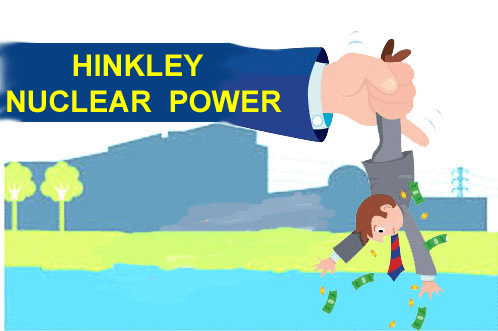
Secret government papers show taxpayers will pick up costs of Hinkley nuclear waste storagehttps://www.theguardian.com/uk-news/2016/oct/30/hinkley-point-nuclear-waste-storage-costs Documents show steps Whitehall took to reassure French energy firm EDF and Chinese investors,Guardian, Jamie Doward, 30 Oct 16, Taxpayers will pick up the bill should the cost of storing radioactive waste produced by Britain’s newest nuclear power station soar, according to confidential documents which the government has battled to keep secret for more than a year.
The papers confirm the steps the government took to reassure French energy firm EDF and Chinese investors behind the £24bn Hinkley Point C plant that the amount they would have to pay for the storage would be capped.
The Department for Business, Energy & Industrial Strategy – in its previous incarnation as the Department for Energy and Climate Change – resisted repeated requests under the Freedom of Information Act for the release of the documents which were submitted to the European commission.
“The government has attempted to keep the costs to the taxpayer of Hinkley under wraps from the start,” said Dr Doug Parr, Greenpeace chief scientist. “It’s hardly surprising as it doesn’t look good for the government’s claim that they are trying to keep costs down for hardworking families.”
But, earlier this month, on the very last day before government officials had to submit their defence against an appeal for disclosure of the information, the department released a “Nuclear Waste Transfer Pricing Methodology Notification Paper”. Marked “commercial in confidence”, it states that “unlimited exposure to risks relating to the costs of disposing of their waste in a GDF [geological disposal facility], could not be accepted by the operator as they would prevent the operator from securing the finance necessary to undertake the project”.
Instead the document explains that there will be a “cap on the liability of the operator of the nuclear power station which would apply in a worst-case scenario”. It adds: “The UK government accepts that, in setting a cap, the residual risk, of the very worst-case scenarios where actual cost might exceed the cap, is being borne by the government.”
Separate documents confirm that the cap also applies should the cost of decommissioning the reactor at the end of its life balloon. The level of the cap is unclear. But Dr David Lowry, a senior research fellow at the Institute for Resource and Security Studies in Cambridge, Massachusetts, who made the FoI request, said it was clear that the risk of footing the bill for a significant cost overrun had been transferred from Hinkley’s operator to the taxpayer.
“This shows that the government cares more about the economic future of a foreign power generator than British taxpayers,” Lowry said.
In return for the cap, the document reveals that Hinkley’s operator will pay the government a risk fee which “is expected to be relatively low, reflecting the high level of confidence that the cap will not be breached”.
But Lowry pointed out that the nuclear industry had form when it came to sizable cost over-runs. He warned that an accident that could force the closure of the reactor, either because of problems with it or at another plant, as happened in Japan, would leave the taxpayer having to pay billions of pounds for the clear-up years after it ceased generating revenues.
A government spokesman said: “All operators of new nuclear power stations in the UK are legally obliged to meet the full costs of decommissioning and their full share of waste management and disposal costs. They will also pay the UK government to dispose of the waste produced at the end of a plant’s life.”
On Thursday (October 27) a US military spokesperson confirmed the exercise had been carried out in a rare public announcement.
They said: “Troops of South Korean Air Force’s combat control team, an infiltration commando unit, and the US Air Force’s 353rd Special Operations Group staged a joint exercise at Gunsan Air Base recently.”
Part of the operation saw military transport aircraft practising flying low – something that has been done since the 1990s to test infiltrating North Korea.
These aircraft are apparently used to transport special forces who are on a mission to destroy Kim Jong-un’s missiles and nuclear weapons.
According to a South Korean news network, the 353rd Special Operations Group, which is based at the Kadena Air Base in Okinawa, Japan, completes missions to send commandos into the closed country.
The military spokesperson added: “The latest Teak Knife exercise focused on infiltrating an inland area in the North to destroy key facilities.
“It’s different from a decapitation strike operation targeting the North Korean leadership.”
There have been calls in the US to launch pre-emptive strikes in North Korea following numerous incidents of despot leader Kim Jong-un testing his countries nuclear power.
US nuclear secrets trial cools co-operation with China Arrest of an energy consultant spurs concern over racial profiling, Ft.com by: Lucy Hornby in Beijing and David J Lynch in Washington
Allen Ho was still reeling from his arrest during a conference in Atlanta, Georgia, when armed Federal Bureau of Investigation agents began interrogating the nuclear energy consultant about his work in China, without any lawyer present.
That business involved hiring retired US nuclear engineers and consultants to advise China General Nuclear Power Corp, the state-owned company that plans to invest in an £18bn reactor in the UK.
Mr Ho, born in Taiwan and a US citizen since 1983, was charged with violating a statute designed to prevent American scientists from helping other countries develop an atomic bomb. The case comes during an era of unprecedented nuclear co-operation between the west and China, but also a time of growing trade friction and accusations of cyber crime and espionage.
After his arrest in April, Mr Ho’s imprisonment for six monthsin a maximum security cell in Tennessee has chilled Chinese technical co-operation with the international nuclear industry and raised accusations of racial profiling in the US.
Along with Mr Ho, CGN was also indicted on charges of producing “special nuclear material” outside the US without the required approval from the US Department of Energy.
The company said in an emailed statement that it “has long been adhering to the principle of lawfulness and compliance in all our business operation and international exchanges and will carry on following such a principle”.
Wary of being indicted if they step foot on US soil, CGN executives have since skipped meetings run by the American Society of Mechanical Engineers (Asme), which sets international standards for everything from school heating boilers to nuclear reactors
This is an issue because engineering decisions made in China affect the world’s reactor fleet. China is the furthest ahead in constructing the European Pressurized Reactor destined for Hinkley Point in the UK as well as the AP1000, an American-designed reactor under construction in China and the US. And under bilateral accords CGN and other Chinese groups will supply components for US and UK reactors.
“China is the only country that can provide the information at present” for the AP1000, said Zhang Qiang, Asme’s chief representative in China. Other forms of international co-operation continue.
Mr Ho does not deny helping CGN improve operations at its nuclear plants but his defence insists that is a far cry from making material for nuclear weapons. Frank Wu, chairman of the Committee of 100, an advocacy group, said the indictment had inflamed fears of “racial profiling” in the Chinese-American scientific community.
The engineers Mr Ho employed told the FBI that they shared only publicly available information with Chinese nuclear companies, according to court documents. Some helped inexperienced Chinese engineers decipher technical manuals at Daya Bay, the French-designed reactor that supplies electricity to Hong Kong.
Others advised on developing a nuclear fuel process so that CGN could avoid paying hefty royalties to the French. They have not been publicly charged.
The case against Mr Ho will rest on testimony from a Taiwanese-American consultant he employed who secretly pleaded guilty 18 months ago to selling subscription-only research reports on nuclear power to China………
Two prosecutions of US citizens of Chinese birth have already unravelled. The Department of Justice in March dropped all charges against Sherry Chen, a hydrologist accused of illegally sharing information about US dams with Chinese contacts. Months earlier, prosecutors abandoned an espionage case against Xi Xiaoxing, acting head of Temple University’s physics department.
“There’s nothing about this case that’s normal,” said Peter Zeidenberg of Arent Fox, Mr Ho’s lawyer who also represented Mr Xi. “There’s an undercurrent running through all these cases and it’s because of these individuals’ association with China.”
Deia Schlosberg and Lindsey Grayzel face felony charges that first amendment advocates say are part of a growing number of attacks on freedom of the press, Guardian, Sam Levin , 23 Oct 16, Two documentary film-makers are facing decades in prison for recording US oil pipeline protests, with serious felony charges that first amendment advocates say are part of a growing number of attacks on freedom of the press.
But authorities in other parts of North Dakota and in Washington state have continued to target other film-makers over their recent reporting on similar demonstrations, raising concerns that the lesser-known journalists are not getting the same kind of public support and national attention.
Schlosberg, a New York-based film-maker, is facing three felony conspiracy charges for filming protesters on 11 October at a TransCanada Keystone Pipeline site in Pembina County in North Dakota, with prosecutors alleging that she was “recruited to record the criminal activity”.
The 36-year-old – who produced a documentary called How to Let Go of the World and Love All the Things Climate Can’t Change – could face 45 years in prison. US whistleblower Edward Snowden recently tweeted his support of Schlosberg, writing: “This reporter is being prosecuted for covering the North Dakota oil protests. For reference, I face a mere 30 years.”
Grayzel, an independent film-maker from Portland, Oregon, was also arrested and jailed on 11 October while filming at a separate pipeline protest in Skagit County, Washington. She and her cinematographer, Carl Davis, had their footage and equipment seized and were kept behind bars for a day.
The two were filming activist Ken Ward attempting to shut down the Trans Mountain pipeline, and they now face 30 years in prison for a felony burglary charge, a felony “criminal sabotage” charge and a misdemeanor trespass offense. There were a series of pipeline protests across the US on 11 October.
“Everyone needs to be afraid when our first amendment rights are in jeopardy,” Grayzel, 41, told the Guardian on Thursday before her criminal arraignment. “This is not just about me. This is not just about Carl. This is not about Amy Goodman … This is about the public’s right to know what is going on in this country.”
Free-speech advocates said that both cases are unusual and troubling given that prosecutors have admitted that the defendants were acting as film-makers and are still pursuing aggressive felony cases.
While it’s not uncommon for journalists to face arrest and misdemeanor charges for trespassing or disorderly conduct while reporting at controversial protests, conspiracy, burglary and sabotage offenses are rare for members of the media.
“It’s outrageous. It’s an assault on the first amendment,” said Neil Fox, one of Grayzel’s attorneys. “It’s shocking, but it is the kind of climate that we’re living in right now.”
Fox cast blame on the Republican presidential candidate, Donald Trump, who has made vicious attacks on the media a cornerstone of his campaign. “This is certainly the result of the toxic language that Trump brings to the election.”
Although Ward, a climate activist, had gained access to a fenced enclosure owned by the Trans Mountain Pipeline, the Skagit County sheriff’s report noted that Grayzel and her cinematographer were “just outside the enclosure … taking photographs and video”. The report said they confiscated the film-makers’ phone and “assorted camera equipment”, actions that have raised further concerns about press intimidation and free speech violations.
Washington prosecutors are relying on laws that were passed in the early 20th century to target labor rights’ protesters, Fox added. “There’s been a revival in the state of Washington of the use of these statutes against labor activists and against environmental activists.”
In Goodman’s case, a judge forced prosecutors to drop a serious “riot” charge, which was centered on Goodman’s viral coverage of the intense Native American-led protests. But prosecutors and sheriff’s officials said they may continue to pursue other charges against the critically acclaimed journalist.
In Schlosberg’s charges, North Dakota prosecutors have alleged that she was part of a conspiracy, claiming she traveled with protesters “with the objective of diverting the flow of oil”.
“I was surprised at the conspiracy charges. I never thought that would ever happen,” her attorney Robert Woods told the Guardian. “All she was doing was her job of being a journalist and covering the story.”
The fervent Trump supporter has told his viewers that the both US president, Barack Obama, and the Democrat nominee, Hilary Clinton, were “literal demons” who smelt of sulphur. I kid you not.
In Australia, we have a senator who similarly sees climate change as a thing made up by the UN. Our top-rating radio host, Alan Jones (no relation), has said climate science is “witchcraft”.
There’s now a whole media ecosystem that climate science denialism can exist inside, where there’s little scrutiny of the views of deniers. US-based sites like the Drudge Report, Infowars, Breitbart and Daily Caller are part of that ecosystem.
For a while, maybe the Trumpocene and the Anthropocene can coexist.
But even though they exist on separate plains, can we really afford to dismiss the impact of either of them?
Websites pushing climate science denial are growing their audience in an era where populist rhetoric and the rejection of expertise is gaining traction For years now geologists have been politely but forcefully arguing over the existence or otherwise of a new epoch – one that might have started decades ago.
Some of the world’s most respected geologists and scientists reckon humans have had such a profound impact on the Earth that we’ve now moved out of the Holocene and into the Anthropocene.
Dropping nuclear bombs and burning billions of tonnes of fossil fuels will do that to a planet, as will clearing swaths of forests to make way for food production and supermarket car parks and the like.
That’s all in the real world though, and sometimes you might get the horrible, chilling idea that when it comes to the production of our thoughts and ideas, that’s not the place a lot of us live anymore.
So I’d like to also propose the idea of an impending new epoch – the Trumpocene – that in the spirit of the era itself is based solely on a few thoughts held loosely together with hyperlinks and a general feeling of malaise.
In the Trumpocene, the epoch-defining impacts of climate change are nothing more than a conspiracy. Even if these impacts are real, then they’re probably good for us.
The era is named, of course, for the phenomenon that is Donald Trump, the Republican pick for US president whose candidacy has been defined by a loose grasp of facts, jingoistic posturing, populist rhetoric, his amazing hair and his treatment of women.
So what are the things that might define the Trumpocene?
Is it the point at which large numbers of people started to reject the views of large groups of actual experts – people with university qualifications and things – in exchange for the views of anyone who agrees with them? (Brexit, anyone?)Continue reading →
At a special late-night tender committee meeting, Eskom executives agreed to hand a Gupta company R587-million – money that was used, two days later, to help pay the R2.15-billion purchase price for Optimum Coal. By Susan Comrie for AMABHUNGANE.
Six hours after the banks refused to give the Guptas a R600-million loan for their controversial Optimum Coal deal, Eskom came to their rescue.
amaBhungane can reveal that at a special late-night tender committee meeting, Eskom executives agreed to hand a Gupta company R587-million – money that was then used, two days later, to help pay the R2.15-billion purchase price for Optimum Coal.
The deal, which documents show was clinched via a 21:00 teleconference call, involved extending Tegeta Exploration and Resources’ coal supply contract with Arnot power station by R587-million.
The fact that Eskom also agreed to pay the money up front reinforces the impression of preferential treatment.
Details of these hurried meetings – all held on April 11 this year – are contained in a report by the business rescue practitioners for Optimum Coal and in minutes of Eskom’s 21:00 meeting that were leaked to Carte Blanche in June.
The report by the business rescue practitioners, Piers Marsden and Peter van den Steen, was made to the Directorate of Priority Crime Investigation (Hawks) in terms of section 34 of the Prevention and Combating of Corrupt Activities Act.
amaBhungane understands that the section 34 report, submitted on July 1 this year, also forms part of former Public Protector Thuli Madonsela’s state capture report.
The business rescue practitioners refused to confirm or deny the existence of the report, but amaBhungane has seen a copy, which sets out in detail what happened on April 11:
On that morning, Nazeem Howa, the chief executive of Gupta-owned Oakbay Investments, called the business rescue practitioners and asked for a meeting.
At 10:00, Howa sat with the practitioners at Tegeta’s office in Sandton and delivered the bad news – Tegeta was R600-million short of the purchase price for Optimum Coal.
At Howa’s request, the practitioners called an urgent meeting with Optimum’s three bank creditors – First Rand Bank, Investec and Nedbank – and a representative of Optimum’s then-owner, Glencore. At the meeting, held at about 13:30 at First Rand’s Sandton offices, the practitioners asked whether the consortium of banks would offer Tegeta a R600-million bridging loan.
At 15:00, Marsden phoned Howa to tell him the banks had refused the request.
Leaked Eskom minutes, broadcast on Carte Blanche in June, show that about six hours after Howa was informed that the banks would not stump up the funding, Eskom held a “special tender committee meeting” where it decided to hand Tegeta a R587-million prepayment for coal.
Two days later, Tegeta delivered the full purchase price of R2.15-billion for Optimum Coal.
Tegeta’s purchase of Optimum from Glencore has been muddied by allegations of political interference and favouritism, particularly directed at mines minister Mosebenzi Zwane and Eskom.
Tegeta is partly owned by the Gupta family through Oakbay Investments, but smaller stakes are owned by President Jacob Zuma’s son Duduzane Zuma, Gupta-linked businessman Salim Essa and an opaque offshore company registered in the United Arab Emirates.
Eskom has repeatedly denied showing Tegeta favourable treatment.
Tegeta, through Oakbay Investments, declined to comment on this detailed timeline, saying it was “subject to an apparent ongoing investigation and the provisions of the Public Protector Act”.
Eskom and Oakbay deny that the approach for the R587-million prepayment was made after Tegeta failed to secure financing from the banks, saying that Eskom had been in discussions with Tegeta for some time.
“Following negotiations (of which we have proof and necessary documentation) we agreed that a prepayment be made against onerous provisions,” Oakbay said. “We cannot comment on how Eskom dealt with the transaction on their side save to mention that a formal agreement was reached, signed pursuant whereto an invoice was issued and paid.”……..
In written statements, Eskom and Oakbay Investments denied that the mine was entitled to receive any part of the prepayment.
The rights of activists and journalists are under threat wherever communities challenge Big Oil – in North Dakota and beyond. For far too long, the world had been ignoring the North Dakota anti-pipelines protests. Then the Democracy Now! host Amy Goodman captured private security forces (employed by a fossil fuel company)sicking dogs on Native Americans during a peaceful demonstration against the Dakota Access Pipeline, which encroaches on their sacred lands and waters. For that, she nearly went to jail.
The video made Goodman a target of North Dakota authorities, who brought charges of trespassing and rioting against her and the native leaders on the ground during the dog attack. Yes, a journalist was threatened with punishment for reporting on the horrific attack on indigenous people.
Authorities said Goodman didn’t deserve press protections because her opinions made her an “activist” instead of a journalist. Are we to punish every journalist who calls out state violence as he or she sees it? How could you not have an opinion in the face of such brutality? Should Walter Cronkite have gone to prison for his words about Vietnam?
Clearly not. Organizations defending freedom of the press decried the charges against Goodman. Activists like ourselves rallied behind her cause online because we understand the importance of a free press to social change. And on Monday, a North Dakota judge dropped the charges due to lack of probable cause.
It’s a win for freedom of the press, but intimidation by the fossil fuel industry and its government allies is far from over. Native leaders at the Standing Rock camps know this all too well, as they continue to face arrests by North Dakota police and pressure by Energy Transfer Partners, the company behind the pipeline.
There’s no question that Goodman’s fearless reporting helped make this act of brutality a turning point in the fight to stop the Dakota Access Pipeline. Soon after her broadcast, the Obama administration stepped in and paused the project until there could be “further consultation” of indigenous peoples. Suddenly, TV news and the mainstream media took up the story in a serious way for the first time. Thousands of more people headed out to the camp.
The trampling of our rights as activists, or as journalists, isn’t just a problem in North Dakota. It’s also a fight that’s playing out around the world wherever communities stand up to the fossil fuel industry and other corporate interests destroying our communities and climate.
We see it in the murder of activists like Berta Cáceres in Honduras. We see it in the Philippines, where anti-mining activists are being murdered by paramilitary groups. According to a report by Global Witness, 185 environmental activists in 16 countries were killed last year and the number is just going up.
Despite this violence, the movement to challenge the fossil fuel industry has continued to grow more powerful, and we’re not backing down. As the work to stop the Dakota Access Pipeline continues, I’m honored to stand in solidarity with the incredible Native American leaders at Standing Rock who are putting their bodies on the line to shut this destructive project down. The photos and videos of their brave actions have become lightning rods, channeling tremendous new energy into this movement. This is a historic fight unfolding in real time.
The images of resistance at Standing Rock are a call to action. We cannot let the rights of indigenous peoples be sidelined by the fossil fuel industry, and we can’t afford another pipeline if we want to maintain a livable planet.
We also must fiercely defend the rights of activists and journalists alike to tell stories like these, stories that often unfold in sacrifice zones far from the “halls of power”, and to tell them fairly and honestly. This won’t be the last fight against a pipeline and Amy Goodman won’t be the last journalist brought to court for reporting about the fossil fuel industry. The struggle continues, together.













 nuclear-news