The McCarthyist Attack on Gaza Protests Threatens Free Thought for All

ARI PAUL, 19 April 24, https://fair.org/home/the-mccarthyist-attack-on-gaza-protests-threatens-free-thought-for-all/
With the encouragement of the state, universities from coast to coast are taking draconian steps to silence debate about US-backed violence in the Middle East.
The Columbia University community looked on in shock as cops in riot gear arrested at least 100 pro-Palestine protesters who had set up an encampment in the center of campus (New York Post, 4/18/24). The university’s president, Nemat Shafik, had just the day before testified before a Republican-dominated congressional committee ostensibly concerned with campus “antisemitism”—a label that has come to be misapplied to any criticism of Israel, though the critics so smeared are often themselves Jewish.
A sense of delight has filled the city’s opinion pages. The New York Post editorial board (4/18/24) hailed both the clampdown on protests and Congress’s push to ensure that such drastic action against free speech was taken: “We’re glad to see Shafik stand up…. Congress deserves some credit for putting educrats’ feet to the fire on this issue.” The paper added, “Academia has been handling anti-Israel demonstrations with kid gloves.” In other words, universities have been allowing too many people to think and speak critically about an important issue of the day.
In “At Columbia, the Grown-Ups in the Room Take a Stand,” New York Times columnist Pamela Paul (4/18/24) hailed the eviction, saying of the encampment that for the “passer-by, the fury and self-righteous sentiment on display was chilling,” and that for supporters of Israel, “it must be unimaginably painful.” In other words, conservative pundits have decided that campus safe spaces where speech is banned to protect the feelings of listeners are good, depending on the issue. Would Paul (no relation!) favor bans on pro-Taiwan or pro-Armenia demonstrations because they could offend Chinese and Turkish students?
And for Michael Oren, a prominent Israeli politico, Columbia students hadn’t suffered enough. He said of Columbia in a Wall Street Journal op-ed (4/19/24):
Missing was an admission of the university’s failure to enforce the measures it had enacted to protect its Jewish community. [Shafik] didn’t address how, under the banner of free speech, Columbia became inhospitable to Jews. She didn’t acknowledge how incendiary demonstrations such as the encampment were the product of the university’s inaction.
Shafik had assured her congressional interrogators that Columbia had already suspended 15 students for speaking out for Palestinian human rights, suspended two student groups—Jewish Voice for Peace and Students for Justice in Palestine (Jewish Telegraphic Agency, 11/10/23)—and had even terminated an instructor (New York Times, 4/17/24).
The hearing was bizarre, to say the least; a Georgia Republican asked the president if she wanted her campus to be “cursed by God” (New York Times, 4/18/24). (“Definitely not,” was her response.)
The former World Bank economist had clearly been shaken after seeing how congressional McCarthyism ousted two other female Ivy League presidents (FAIR.org, 12/12/23; Al Jazeera, 1/2/24).
‘Protected from having to hear’
“What happened at those hearings yesterday should be of grave concern to everybody, regardless of their feelings on Palestine, regardless of their politics,” Barnard College women’s studies professor Rebecca Jordan-Young told Democracy Now! (4/18/24). “What happened yesterday was a demonstration of the growing and intensifying attack on liberal education writ large.”
Her colleague, historian Nara Milanich, said in the same interview
This is not about antisemitism so much as attacking areas of inquiry and teaching, whether it’s about voting rights or vaccine safety or climate change — right?—arenas of inquiry that are uncomfortable or inconvenient or controversial for certain groups. And so, this is essentially what we’re seeing, antisemitism being weaponized in a broad attack on the university.
Jewish faculty at Columbia spoke out against the callous misuse of antisemitism to silence students, but those in power aren’t listening (Columbia Spectator, 4/10/24).
Shafik justified authorizing the mass arrests, which many said hadn’t been seen on campus since the anti-Vietnam War protests of 1968. “The individuals who established the encampment violated a long list of rules and policies,” she said (BBC, 4/18/24). “Through direct conversations and in writing, the university provided multiple notices of these violations.”
One policy suggested by the university’s “antisemitism task force,” according to a university trustee who also testified (New York Times, 4/18/24): “If you are going to chant, it should only be in a certain place, so that people who don’t want to hear it are protected from having to hear it.”
Cross-country rollback
Meanwhile, the University of Southern California canceled the planned graduation speech by valedictorian Asna Tabassum—a Muslim woman who had spoken out for Palestine (Reuters, 4/18/24). The university cited unnamed “security risks”; The Hill (4/16/24) noted that “she had links to pro-Palestinian sites on her social media.” Andrew T. Guzman, the provost and senior vice president for academic affairs, said in a statement that cancelation was “consistent with the fundamental legal obligation—including the expectations of federal regulators—that universities act to protect students and keep our campus community safe” (USC Annenberg Media, 4/15/24).
This is happening as academic freedom is being rolled back across the country. Republicans in Indiana recently passed a law to allow a politically appointed board to deny or even revoke university professors’ tenure if the board feels their classes lack “intellectual diversity”—at the same time that it threatens them if they seem “likely” to “subject students to political or ideological views and opinions” deemed unrelated to their courses (Inside Higher Ed, 2/21/24).
Benjamin Balthaser, associate professor of English at Indiana University South Bend, told FAIR in regard to the congressional hearing:
There is no other definition of bigotry or racism that equates criticism of a state, even withering, hostile criticism, with an entire ethnic or religious group, especially a state engaging in ongoing, documented war crimes and crimes against humanity. Added to this absurdity is the fact that many of the accused are not only Jewish, but have strong ties to their Jewish communities. To make such an equation assumes a collective or group homogeneity which is itself a form of essentialism, even racism itself: People are not reducible to the crimes of their state, let alone a state thousands of miles away to which most Jews are not citizens.
Of course, witch hunts against leftists in US society are often motivated by antisemitism. Balthaser again:
The far right has long deployed antisemitism as a weapon of censorship and repression, associating Jewishness with Communism and subversion during the First and Second Red Scares. Not only did earlier forms of McCarthyism overwhelmingly target Jews (Jews were two-thirds of the “defendants” called before HUAC in 1952, despite being less than 2% of the US population), it did so while cynically pretending to protect Jews from Communism. Something very similar is occurring now: Mobilizing a racist trope of Jewish adherence to Israel, far-right politicians are using accusations of antisemitism to both silence criticism of Israel and, in doing so, promote their antisemitic ideas of Jewishness in the world.
Silencing for ‘free speech’
These universities are not simply clamping down on free speech because the administrators dislike this particular speech, or out of fear that pro-Palestine demonstrations or vocal faculty members could scare donors from writing big checks. This is a result of state actors—congressional Republicans, in particular—who are using their committee power and sycophants in the media to demand more firings, more suspensions, more censorship.
I have written for years (FAIR.org, 10/23/20, 11/17/21, 3/25/22), as have many others, that Republican complaints about “cancel culture” on campus suppressing free speech are exaggerated. One of the biggest hypocrisies is that so-called free-speech conservatives claim that campus activists are silencing conservatives, but have little to say about blatant censorship and political firings when it comes to Palestine.
This isn’t a mere moral inconsistency. This is the anti-woke agenda at work: When criticism of the right is deemed to be the major threat to free speech, it’s a short step to enlisting the state to “protect” free speech by silencing the critics—in this case, dissenters against US support for Israeli militarism.
But this isn’t just about Palestine; crackdowns against pro-Palestine protests are part of a broader war against discourse and thought. The right has already paved the way for assaults on educational freedom with bans aimed at Critical Race Theory adopted in 29 states.
If the state can now stifle and punish speech against the murder of civilians in Gaza, what’s next? With another congressional committee investigating so-called infiltration by China’s Communist Party, will Chinese political scholars be targeted next (Reuters, 2/28/24)? With state laws against environmental protests proliferating (Sierra, 9/17/23), will there be a new McCarthyism against climate scientists? (Author Will Potter raised the alarm about a “green scare” more than a decade ago—People’s World, 9/26/11; CounterSpin, 2/1/13.)
Universities and the press are supposed to be places where we can freely discuss the issues of the day, even if that means having to hear opinions that might be hard for some to digest. Without those arenas for free thought, our First Amendment rights mean very little. If anyone who claims to be a free speech absolutist isn’t citing a government-led war against free speech and assembly on campuses as their No. 1 concern in the United States right now, they’re a fraud.
Flicker of Hope: Biden’s Throwaway Lines on Assange
April 12, 2024 by: Dr Binoy Kampmark, https://theaimn.com/flicker-of-hope-bidens-throwaway-lines-on-assange/
Walking stiffly, largely distracted, and struggling to focus on the bare essentials, US President Joe Biden was keeping company with his Japanese counterpart, Prime Minister Fumio Kishida, when asked the question. It concerned what he was doing regarding Australia’s request that the WikiLeaks founder Julian Assange be returned to Australia.
Assange, who has spent five tormenting years in Belmarsh Prison in London, is battling extradition to the US on 18 charges, 17 tenuously and dangerously based on the US Espionage Act of 1917.
The words that followed from the near mummified defender of the Free World were short, yet bright enough for the publisher’s supporters. “We’re considering it.” No details were supplied.
To these barest of crumbs came this reaction from from Australian Prime Minister Anthony Albanese on ABC’s News Breakfast: “We have raised on behalf of Mr Assange, Australia’s national interest, that enough is enough, that this needs to be brought to a conclusion, and we’ve raised it at each level of government in every possible way.” When pressed on whether this was merely an afterthought from the president, Albanese responded with the usual acknowledgments: the case was complex, and responsibility lay with the US Department of Justice.
One of Assange’s lawyers, the relentless Jennifer Robinson, told Sky News Australia of her encouragement at Biden’s “response, this is what we have been asking for over five years. Since 2010 we’ve been saying this is a dangerous precedent that’s being set. So, we certainly hope it was a serious remark and the US will act on it.” Assange’s brother, Gabriel Shipton, also told Sky News that the statement was significant while WikiLeaks editor-in-chief, Kristinn Hrafnsson thought the utterance “extraordinary”, cautiously hoping “to see in the coming days” whether “clarification of what this means” would be offered by “those in power” and the press corps.
The campaign to free Assange has burgeoned with admirable ferocity. The transformation of the WikiLeaks founder from eccentric, renegade cyber thief deserving punishment to prosecuted and persecuted scribbler and political prisoner has been astonishing.
The boggling legal process has also been shown up as woefully inadequate and scandalous, a form of long-term torture via judicial torment and deprivation. The current ludicrous pitstop entails waiting for a UK Court of Appeal decision as to whether Assange will be granted leave for a full reconsideration of his case, including the merits of the extradition order itself.
The March 26 Court of Appeal decision refused to entertain the glaringly obvious features of the case: that Assange is being prosecuted for his political views, that due process is bound to be denied in a country whose authorities have contemplated his abduction and murder, and that he risks being sentenced for conduct he is not charged with “based on evidence he will not see and which may have been unlawfully obtained.” The refusal to entertain such material as the Yahoo News article from September 2021 outlining the views of intelligence officials on kidnapping and assassination options again cast the entire affair in a poor light.
Even if Assange is granted a full hearing, it is not clear whether the court will go so far as to accept the arguments. The judges have already nobbled the case by offering US prosecutors the chance to offer undertakings, none of which would or could be binding on the DOJ or any US judge hearing the case. Extradition, in other words, is likely to be approved if Assange is “permitted to rely on the First Amendment”, “is not prejudiced at trial (including sentence) by reason of his nationality” and that he “is afforded the same First Amendment protection as a United States citizen, and that the death penalty not be imposed.” These conditions, on the face of it, look absurd in their naïve presumption.
Whether Biden’s latest casual spray lends any credibility to a change of heart remains to be seen. In December 2010, when Vice President in the Obama administration, Biden described Assange as a “high-tech terrorist” for disclosing State Department cables. He failed to identify any parallels with previous cases of disclosures such as the Pentagon papers.
Craig Murray, former British diplomat and Assange confidant, adds a note of cautious sobriety to the recent offering from the president: “I’m not going to get too hopeful immediately on a few words out of the mouth of Biden, because there has been no previous indication, nothing from the Justice Department so far to indicate any easing up.”
For all that, it may well be that the current administration, facing a relentless publicity campaign from human rights organisations, newspapers, legal and medical professionals, not to mention pressure from both his own party in Congress and Republicans, is finally yielding. Caution, however, is the order of the day, and nothing should be read or considered in earnest till signatures are inked and dried. We are quite a way off from that.
The Empire Slowly Suffocates Assange Like It Slowly Suffocates All Its Enemies
CAITLIN JOHNSTONE, MAR 27, 2024, https://www.caitlinjohnst.one/p/the-empire-slowly-suffocates-assange?utm_source=post-email-title&publication_id=82124&post_id=142993532&utm_campaign=email-post-title&isFreemail=true&r=1ise1&triedRedirect=true&utm_medium=email
The British High Court has ruled that WikiLeaks founder Julian Assange may potentially get a final appeal against extradition to the United States, but only within a very limited scope and only if specific conditions are met.
The court ruled that Assange may appeal only on the grounds that his freedom of speech might be restricted in the US, and that there is a possibility he could receive the death penalty. If the US provides “assurances” that neither of these things will happen, then the trial moves to another phase where Assange’s legal team may debate the merits of those assurances. If the US does not provide those assurances, then the limited appeal will move forward.
Absurdly, the court determined that Assange’s lawyers may not argue against extradition on matters as self-evidently critical as the fact that the CIA plotted to assassinate him, or on the basis that he is being politically persecuted for the crime of inconvenient journalism.
The mass media are calling this a “reprieve”, even “wonderful news”, but as Jonathan Cook explains in his latest article “Assange’s ‘reprieve’ is another lie, hiding the real goal of keeping him endlessly locked up,” that’s all a bunch of crap.
“The word ‘reprieve’ is there — just as the judges’ headline ruling that some of the grounds of his appeal have been ‘granted’ — to conceal the fact that he is prisoner to an endless legal charade every bit as much as he is a prisoner in a Belmarsh cell,” writes Cook. “In fact, today’s ruling is yet further evidence that Assange is being denied due process and his most basic legal rights — as he has been for a decade or more.”
Cook writes the following:
“The case has always been about buying time. To disappear Assange from public view. To vilify him. To smash the revolutionary publishing platform he founded to help whistleblowers expose state crimes. To send a message to other journalists that the US can reach them wherever they live should they try to hold Washington to account for its criminality.
“And worst of all, to provide a final solution for the nuisance Assange had become for the global superpower by trapping him in an endless process of incarceration and trial that, if it is allowed to drag on long enough, will most likely kill him.”
This kind of slow motion strangulation is how the empire operates all the time these days, across all spheres. Helping Israel starve Gaza while slowly pretending to work toward solutions. Drawing out a proxy war in Ukraine for as long as possible to bleed Russia. Slowly killing Assange in prison without trial under the pretense of judicial proceedings.
The US-centralized empire hunts not like a tiger, killing its prey with one fatal bite to the jugular, but more like a python: slowly suffocating the life out of its prey until it perishes. It favors the long, drawn-out, confusing strangulation of inconvenient populations and individuals, carried out under the cover of bureaucracy and propaganda spin. In today’s world it prefers sanctions, blockades and long proxy conflicts over the big Hulk-smash ground invasions we saw it carry out in places like Iraq and Vietnam.
These slow suffocations can take more time, but what they lack in efficiency they make up for in the quality of perception management. It’s bad PR to just openly invade countries and murder people, which is why the leaders of the western empire have been able to wag their fingers at Putin despite their being quantifiably far more murderous than Russia. People start snapping out of the propaganda matrix you spent so much time building for them and begin organizing against the political status quo your power is premised on.
So they opt for slow strangulation strategies where they can confuse the public about what’s happening and who’s responsible, outsourcing the blame to other parties while posing as the good guy who’s trying to bring peace and stability. It takes time, but the empire has time to burn. That’s what happens when you’re the most powerful empire in the history of civilization; you have the luxury of biding your time while orchestrating large-scale, long-term operations to advance your power agendas.
Meanwhile Gaza starves, Ukraine bleeds, and Assange languishes in prison, each needing this to end with more urgency every day.
Visa & Mastercard: The Real Threat To The Digital ID Control System
March 11, 2024 By Corey Lynn and The Sharp Edge
The question isn’t whether Visa and Mastercard are at the forefront of the Digital ID control system, the question is whether Visa, Mastercard and central banks will be able to pull it off without the implementation of central bank digital currencies (CBDCs). A “Digital ID” may sound convenient and harmless, but the intention behind it is far reaching – compiling and connecting data and biometrics while removing every form of privacy in order to control how one spends their money, achieves access to services, and ultimately takes control over all assets. This will have an impact on all areas of life, including education, healthcare, food, agriculture, transportation, real estate, and technology, which of course will all be controlled through the Digital ID connected to banks, and a person’s social credit score. This isn’t an imaginary scheme. These intentions are well documented by the Bank for International Settlements (BIS), central banks, the World Bank, financial institutions, credit card companies, and government.
In simple terms, the Bank For International Settlements’ (BIS) blueprint proposes that all private property in the real world, such as money, houses, cars, etc., would be “tokenized” into digital assets within an “everything in one place” global unified ledger. Of course, smart contracts on a “programmable” platform with rules on how each asset can and cannot be used are the key ingredient.
By using fear of cyber attacks on any single institution, big Gov and financial institutions want everyone to believe that consolidating all data and assets of a person’s life into tokens under a Digital ID will somehow protect them from attacks by having everything in one location.
Though many are under the impression that the battle is against the ushering in of CBDCs, it would seem that all of the appropriate financial rails and interoperability are already in place, or darn close to it, to expand on the mountain of identity verification processes already dialed in, to initiate the all-in-one Digital Identity and lock those dominoes into place.
This digital world they intend to manifest is being fashioned to look like a convenient and necessary way everyone must live, and as they build these “rails” of prison cells, consumers are sinking further into debt and relying more and more on credit cards. The Federal Reserve Bank of New York issued a report noting that credit card balances in Q4 of 2023 increased by $50 billion to a record high of $1.13 trillion, while also reporting a rise in delinquencies. The report states that credit card delinquencies increased over 50% in 2023. Total household debt also rose by $212 billion reaching $17.5 trillion in the fourth quarter of 2023, according to the report.
Visa and Mastercard are at the forefront of this takeover and if they succeed, the monitoring, tracking, and control will be immeasurable and there will be no going back. Consumers need to think twice before using credit cards and use cash as often as possible, while state legislators need to get on board with implementing creative legislation with independent systems that not only provide protection for the citizens of their state, but build strong financial freedom with the ability to operate utilizing cash, precious metals, and unique structures as pointed out in this article.
“I get why China would be interested. Why would the American people be for that?” – Neel Kashkari, President of the Minneapolis Federal Reserve, ‘The Threat of Financial Transaction Control,’ the Solari Report, February 24, 2024.
Why the US is trying to imprison Assange: Report from inside the Court
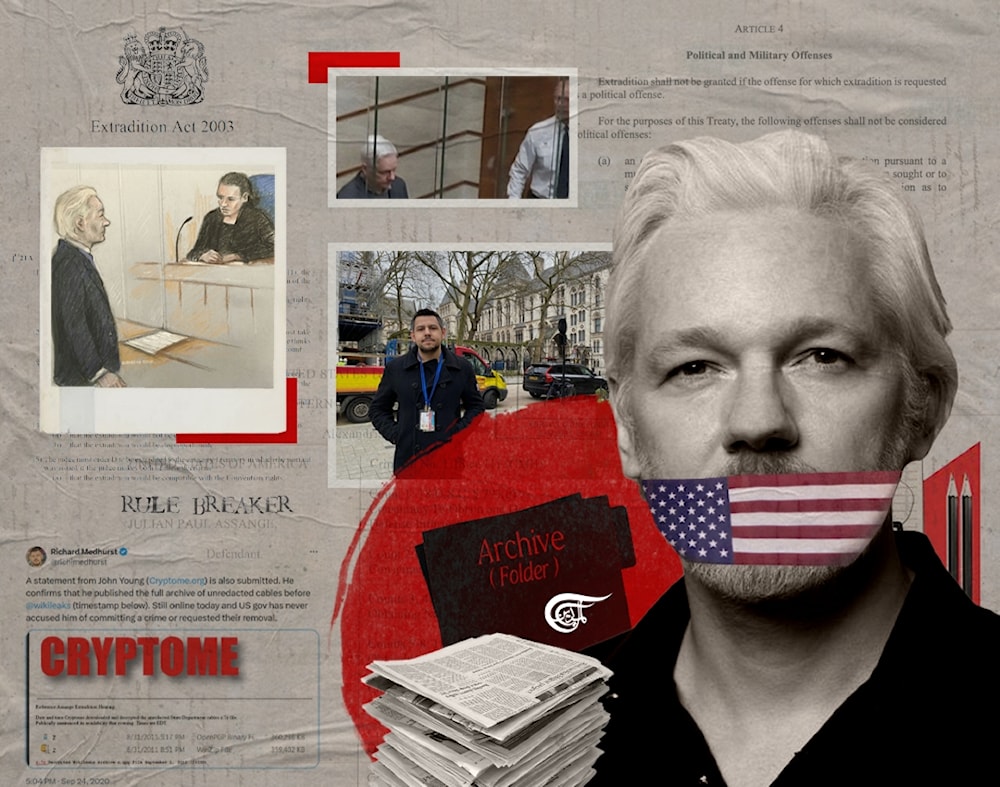
But even if what the United States is saying were true, these documents were not published first by Assange. John Young, the owner of a website called cryptome.org testified to the court that he was the one who published the documents first, and the United States never prosecuted him or asked him to take them down.
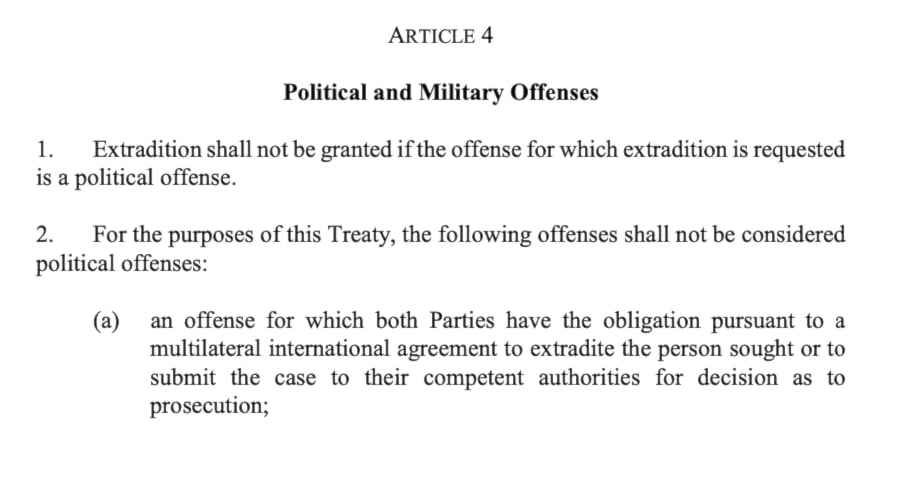
Extraditions for political offenses are forbidden under Article 4 of the US-UK Extradition Treaty 2003
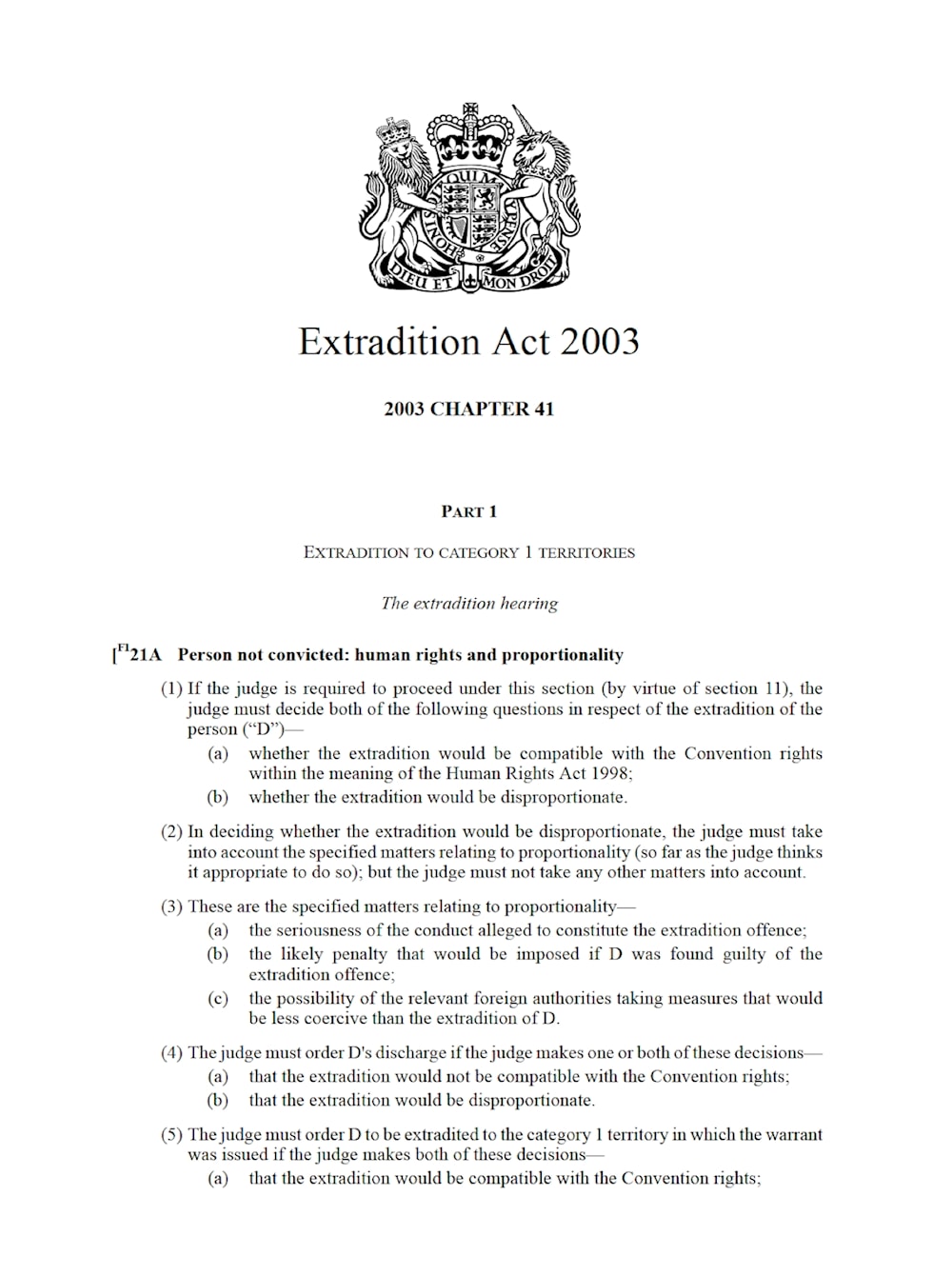
The Extradition Act, which is the implementation of the US-UK treaty inside British law, is missing this section. This is likely due to the fact it was passed at the height of the “War on Terror” in 2003, giving the Americans carte blanche to snatch people, drag them to the US and throw them in dungeons
Richard Medhurst Al Mayadeen English, 7 Mar 2024, https://english.almayadeen.net/articles/analysis/why-the-us-is-trying-to-imprison-assange–report-from-inside
Richard Medhurst is a British journalist who has covered Julian Assange’s extradition case from inside the court since 2020. In this article, he explains what took place in the latest hearings, why the United States is trying to extradite the WikiLeaks founder, and why everyone should care.
Julian Assange is an Australian journalist in the United Kingdom, and the founder of WikiLeaks. He published documents that were given to him by a US soldier called Chelsea Manning, which showed US war crimes in Iraq, Afghanistan, and much more.
The United States want to extradite Assange from the UK to America, and put him on trial for publishing these classified documents. They are threatening him with 175 years in prison.
The reason this case is so serious is because it essentially makes journalism illegal.
The United States claims Assange asked Manning for classified documents and that this is a crime. It’s not.
The US alleges that Assange having classified documents in his possession and publishing them is a crime. It’s not.
Asking for classified documents; protecting sources, these are things journalists do every single day around the world.
But because these files were so embarrassing to the United States and exposed the brutality of their war crimes, they are threatening Assange with almost two centuries in prison; and to do it, they are accusing him of being a “spy” and a “hacker”, charging him with 17 counts under the “Espionage Act”, and with one count of “Conspiracy to Commit Computer Intrusion”.
The goal of this indictment is to make an example out of Assange, and make other journalists afraid to publish things that the public has a right to know.
If extradited, Assange would be placed in the worst prison conditions imaginable, “Special Administrative Measures” (or SAMs): A strict regime of solitary confinement, no contact with other prisoners allowed, and barely any contact with your family. SAMs are internationally recognized as torture. Julian would be sent to the worst prison in America, ADX Florence, a super-maximum security facility in Colorado.
On January 4, 2021, British judge Vanessa Baraitser blocked Assange’s extradition because US prison conditions would be so oppressive in his current state as to drive him to suicide.
Nevertheless, despite blocking the extradition on health grounds, she agreed with all the political and trumped-up charges.
I have attended all of Assange’s court hearings and saw the smears against him debunked by dozens of expert witnesses. But the judge still chose to side with the United States. She chose to essentially criminalize journalism, even drawing dangerous equivalences between the US Espionage Act and Britain’s Official Secrets Act (OSA).
After this, the United States went to the English High Court to appeal her ruling and won by providing empty promises that they would supposedly treat Assange well– even though the United States has a history of violating extradition assurances. I exposed this when I published classified documents from David Mendoza’s extradition from Spain to the US, a case previously cited in court by Julian’s lawyers.
After the US succeeded in overturning the lower court’s ruling in Dec 2021, there was only one thing left: A signature from the Home Secretary, who allowed the extradition to go ahead.
The above is everything that took place between 2020 and 2024, which brings us to the latest hearings at the Royal Courts of Justice in February 2024.
Point 1: To appeal the ruling of the lower court from Jan 4, 2021.
Assange’s lawyers argued that the judge was correct to block Assange’s extradition on health grounds, but she was wrong to agree with all the political charges (equating him with a “hacker” and a “spy”).
They’re saying very plainly: This case is undemocratic, it criminalizes journalism, and doesn’t take into account the fact that the documents Assange published expose enormous US war crimes that the public had the right to know about.
(See for example the “Collateral Murder” video published by Julian Assange’s WikiLeaks: Footage from a US gunship crew laughing as they slaughter Iraqi civilians, among them children and reporters).
Another claim made by the United States is that Assange “harmed informants” by publishing unredacted cables. Ironically, this was proven false by the United States’ own military when they court-martialed Chelsea Manning (the soldier that gave the files to Assange). The US military couldn’t find a single example of anyone having been harmed by the disclosures.
The assertion by the United States that Julian Assange simply published all these documents without censoring or redacting names simply isn’t true: I listened to many journalists tell the court how they spent countless hours meticulously redacting names with Assange.
Assange’s lawyers are also arguing that the judge in the lower court failed to undertake a balancing act. She blindly accepted the United States’ premise that the lives of informants– who weren’t even harmed– are more important than the people killed and tortured by the United States. This is tantamount to saying: The United States should be allowed to continue committing these war crimes in secret; that it’s somehow okay for them to butcher people in Iraq and Afghanistan, and the public have no right to know.
But even if what the United States is saying were true, these documents were not published first by Assange. John Young, the owner of a website called cryptome.org testified to the court that he was the one who published the documents first, and the United States never prosecuted him or asked him to take them down.
This demonstrates that the whole case against Assange is selective, political, and has nothing to do with the law.
Assange’s lawyers are also arguing that the judge in the lower court failed to undertake a balancing act. She blindly accepted the United States’ premise that the lives of informants– who weren’t even harmed– are more important than the people killed and tortured by the United States. This is tantamount to saying: The United States should be allowed to continue committing these war crimes in secret; that it’s somehow okay for them to butcher people in Iraq and Afghanistan, and the public have no right to know.
But even if what the United States is saying were true, these documents were not published first by Assange. John Young, the owner of a website called cryptome.org testified to the court that he was the one who published the documents first, and the United States never prosecuted him or asked him to take them down.
This demonstrates that the whole case against Assange is selective, political, and has nothing to do with the law.
The Espionage Act that Assange is being charged under was created during World War I, in 1917. It has always been used as a political tool against dissidents such as Eugene Debs, or whistleblowers like Daniel Ellsberg and Edward Snowden, who exposed the true extent of the US war in Vietnam, and NSA mass surveillance.
If you’re charged under the Espionage Act, you’re also forbidden from arguing a public interest defense. This means that even if you expose colossal government crimes, you still go to prison.
Point 2: The Home Secretary was wrong to allow the extradition
This constitutes the second part of Assange’s appeal: It is illegal in Britain to extradite someone to another country, knowing they could face the death penalty.
If the Home Secretary, who has the final say on extraditions, is aware of such a risk, they are compelled to bar the extradition.
It is inconceivable that Priti Patel was unaware of who Julian Assange is, and the likelihood he would be killed in the United States. Once in US jurisdiction, the US could pile on additional charges, or simply execute him, as espionage is a capital offense.
Even without a specific death sentence, at 52 years old, even a 30-year bid is akin to a death sentence.
The hollow assurances given by the United States do not preclude the death penalty. And on top of that, the Home Secretary didn’t even bother asking for assurances that would.
So how could the Home Secretary agree to send Assange to a foreign country that so clearly wants to see him dead?
Mike Pompeo, who back then was head of the CIA, and then-president Donald Trump, launched this legal case against Julian Assange. In the past, Donald Trump had called for Assange to be given the death penalty, while Mike Pompeo proclaimed Assange “has no First Amendment rights”. After WikiLeaks published a trove of CIA documents, dubbed the Vault 7 files, Mike Pompeo declared war on WikiLeaks by publicly labeling it a “non-state hostile intelligence service”
All these political denunciations of WikiLeaks and Assange were then followed up with threats against him and his family. As we heard in court in 2020 from protected witnesses, the CIA had drawn up plans to potentially kidnap or assassinate Julian.
The United States is accusing Julian Assange of “espionage”. Normally, this is where the case should be thrown out, because espionage is considered a textbook political offense. And it is forbidden to extradite someone for a political offense under the US-UK Extradition Treaty, Art 4.
Customary extradition treaties have always forbidden extradition for political offenses such as “espionage” and “treason”. And this line of defense has been used before in court to successfully block extraditions.
- Extraditions for political offenses are forbidden under Article 4 of the US-UK Extradition Treaty 2003
Here is where the problem arises:
The Extradition Act, which is the implementation of the US-UK treaty inside British law, is missing this section. This is likely due to the fact it was passed at the height of the “War on Terror” in 2003, giving the Americans carte blanche to snatch people, drag them to the US and throw them in dungeons.
At the time of its passage, many criticized the Extradition Treaty as being extremely one-sided in favor of the United States.
No matter how you look at Assange’s case, it is unfair and illegal.
The United States wants to prosecute Julian Assange under US law, but at the same time deny him any protections under US law, such as free speech. If Assange has no First Amendment rights as a foreign national, then how can he be punished as a foreign national – who is not even in the US? This is such a flagrant double standard, and selective application of the law.
The European Convention on Human Rights (ECHR) is incorporated into British law through the Human Rights Act. Upon examination, it is clear that Julian’s rights are being flagrantly violated
Article 5 protects one from arbitrary detention.
Because this is a political case, it would be a violation of the Extradition Treaty to send Julian to America. Therefore, he has no reason to be in prison right now, and is therefore being arbitrarily detained in violation of his Article 5 rights.
Article 6 guarantees the right to a fair trial.
We know the United States spied on Assange’s conversations with his lawyers when he was inside the Ecuadorian embassy; stole his electronic devices; and collected medical and legal records.
In 2020, I sat in court with Fidel Narvaez, the former Consul to the Ecuadorian embassy in London. We listened to the submissions of two protected witnesses who confirmed they had spied on Assange because the security company they worked for, UC Global, had been contracted by the CIA to do so. They also discussed plans to potentially kidnap and poison Julian Assange and harvest DNA from his baby.
To spy on someone’s privileged conversations with their lawyers, and to use tainted evidence in court is scandalous beyond words, and violates the fundamentals of due process in any jurisdiction. Any judge would have thrown this case out from day one.
We also know Assange will not get a fair trial in America because the jury will be selected from a pool of people who work for the CIA, NSA, or have friends and family working in the intelligence community. These are the very same people whose crimes Julian Assange exposed.
The court in Virginia that issued the charges and would hold this trial is used specifically for this reason; because the jury is biased and the government knows it can’t lose. It is already 100% guaranteed that he will get convicted and go to prison.
Additionally, the United States could use secret evidence against Julian Assange, that he wouldn’t even be allowed to view due to it being “classified”.
Article 7 protects one from being punished retroactively. The case against Julian Assange is unprecedented: No publisher in America has ever been prosecuted, let alone convicted for publishing classified documents.
This case criminalizes journalism, and therefore violates Article 10, which guarantees freedom of expression.
Assange’s lawyers went over the ECHR repeatedly because it is incorporated into British law, meaning the court is obliged to follow it. Not only that, but this was their way of hinting to the judges: If you don’t give us permission to appeal, we will go to the European Court of Human Rights (ECtHR) in Strasbourg, and that court will look upon your decision unfavorably.
(The United Kingdom is a founding and current member of the European Council, which is separate from the European Union).
Assange’s lawyer, Mark Summers, argued very clearly: The Strasbourg court will see that a) these US war crimes were real; b) they were happening on the ground at the time, and; c) by publishing these documents Assange altered the United States’ behavior: The helicopter massacres like in the “Collateral Murder” video stopped, and the Iraq war came to an end.
Assange’s team put together a very compelling defense during this week’s hearing.
Continue readingUK steps up war on whistleblower journalism with new National Security Act
KIT KLARENBERG, ·FEBRUARY 9, 2024, The GrayZone
Under a repressive new act, British nationals could face prison for undermining London’s national security line. Intended to destroy WikiLeaks and others exposing war crimes, the law is a direct threat to critical national security journalism.
It was the afternoon of May 17 2023 and I had just arrived at London’s Luton Airport. I was on my way to the city of my birth to visit my family. Before landing, the pilot instructed all passengers to have their passports ready for inspection immediately upon disembarking the plane. Just then, I noticed a six-strong squad of stone-faced plainclothes British counter-terror officers waited on the tarmac, intensely studying the identification documents of all travelers.
As soon as the cops identified me, I was ordered to accompany them into the airport terminal without explanation. There, I was introduced to two officials whose names I could not learn, who subsequently referred to each other using nondescript callsigns. I was invited to be digitally strip searched, and subjected to an interrogation in which I had no right to silence, no right to refuse to answer questions, and no right to withhold pin numbers for my digital devices or sim cards. If I asserted any rights to privacy, I faced arrest and up to 48 hours in police custody.
I chose to comply. And so it was that over the next five hours, I sat with a couple of anonymous counter-terror cops in an airless, windowless, excruciatingly hot back room. They fingerprinted me, took invasive DNA swabs, and probed every conceivable aspect of my private and professional life, friend and family connections, and educational background. They wanted to know why I write, say and think the things I do, the specifics of how I’m paid for my investigative journalism, and to which bank account.
I had been detained under Britain’s 2019 Counter-Terrorism and Border Security Act, which the UN has branded draconian and repressive. Under its Schedule 3 powers, anyone entering British territory suspected of “hostile activity” on behalf of a foreign power can be detained, interrogated for six hours, and have the contents of their digital devices seized and stored. “Hostile acts” are defined as any behavior deemed threatening to Britain’s “national security” or its “economic well-being.”
More disturbingly, Schedule 3 is suspicionless. Under its terms, “it is immaterial whether a person is aware that activity in which they are or have been engaged is hostile activity, or whether a state for or on behalf of which, or in the interests of which, a hostile act is carried out has instigated, sanctioned, or is otherwise aware of, the carrying out of the act.” It must be quite an elaborate conspiracy when conspirators do not even know they’re conspiring.
It turns out the British state wrongly believed The Grayzone had a relationship with Russia’s notorious FSB security service. They based their assumption not on any evidence, but on our knack for producing factual investigative journalism based on documents passed to this outlet anonymously, via burner email accounts. Such activity is common practice for Western media outlets, rights groups, and much venerated “open source” investigative outfits like the US-government sponsored Bellingcat. If I and the rest of The Grayzone made any mistake, it was in publishing material the US-UK national security state does not want in the public domain.
Now, the British government is taking its war on investigative journalism to a new level through its little-known National Security Act. Under this law, authorities in London have granted themselves the power to surveil, harass, and ultimately imprison any British citizens they wish on similarly suspicionless grounds. Dissidents of every stripe must now worry that everything they do or say could land them in jail for lengthy terms, simply for failing to toe London’s rigid national security line.
Among the top lobbyists for these authoritarian measures is Paul Mason, the celebrity journalist who posed as a leader of the British left until The Grayzone unmasked him as a security state collaborator hellbent on destroying the antiwar movement from within.
Inspired by the US Espionage Act, designed to criminalize whistleblowing
In December 2023, after processing for 18 months through parliamentary procedures, the British National Security Act came into force. Under the aegis of protecting Britain from the threat of espionage and sabotage by hostile actors at home and abroad, the law introduces a number of completely new criminal offenses with severe penalties — and wide-ranging consequences for freedom of speech. Indeed, the law’s terms are so broad, individuals will almost inevitably break the law without wanting to, intending to, or even knowing they have.
Because no one has been prosecuted under the Act to date, its full ramifications remain unclear. However, London’s security and intelligence apparatus now enjoy far-reaching powers to police what can be said about the British government’s activities abroad.
Given the frightening implications of the Act, UK journalists, press rights groups, and civil liberties organizations should be up in arms. Yet serious criticism of the law was largely absent from mainstream publications throughout various phases of debate in parliament.
Scrutiny of the anti-free press Act has been left almost entirely to independent journalists like Mohamed Elmaazi. Writing for Consortium News in July 2022, Elmaazi noted that it “shares many elements” with Washington’s “draconian 1917 Espionage Act,” which is currently being used to prosecute WikiLeaks founder Julian Assange…………………………………………
Act specifically intended to criminalize WikiLeaks threatens whistleblowers
During the 2022 House of Commons debate, knighted Conservative MP Sir Robert Buckland led the charge against WikiLeaks. Buckland, who was responsible in his former role as Secretary of State for Justice for “upholding the rule of law and protecting judicial independence,” argued that the National Security Act was a vital tool to prosecute “those such as Julian Assange who dump data in a way that has no regard for the safety of operatives and other affected people.” He later remarked, “none of us [in Parliament] wants to see Julian Assange and his type carry sway here.”
The UK Supreme Court expressed a very different view when, in 2018, it held in a unanimous decision that cables published by WikiLeaks are admissible as evidence in court proceedings…………………………………………………………………………
Should authorities in London merely suspect someone might in some way benefit from possessing “information” provided to them by an unknown “foreign” power, that they may have stumbled across on the internet or been provided one way or another without their express request or consent, they could be branded as a criminal and locked away.
British journalists more compliant to authoritarian measures than ever
The British state’s campaign to muzzle dissenting voices draws on London’s operation of a little-known but devastatingly effective censorship mechanism known as the Defense and Security Media Advisory (DSMA) Committee.
Comprised of representatives of the security and intelligence services, military veterans, high-ranking government officials, press association chiefs, editors and journalists, the committee determines behind closed doors which national security related-issues can be covered by the press, and in what fashion.
On occasion, the Committee issues what are known as “D-notices.” Theoretically, these are voluntary requests for news outlets to not broadcast particular pieces of information, or to omit details deemed harmful to national security. While recipients are not legally obliged to comply, they are fully aware that a refusal could mean prosecution under the Official Secrets Act 1989, especially if the information in question results from an “unauthorised disclosure.” Alternatively, an offending journalist might simply be blacklisted, losing access to on and off-the-record briefings and privileged information from officials, which would then threaten their employment. As a result, examples of outlets ignoring “D-notices” are few and far between…………………………………………………………………………………….
Paul Mason suggests The Grayzone be prosecuted for exposing him
In June 2022, The Grayzone exposed British reporter Paul Mason for his collusion with a senior British Foreign Office intelligence officer in a clandestine campaign to brand the British antiwar left as a vehicle for the Russian and Chinese governments. The publication of the material, which was sent to this outlet via anonymous burner accounts, was clearly in the public interest………………………………… more https://thegrayzone.com/2024/02/09/uk-national-security-act-wikileaks/—
Assange’s Very Life Is at Stake
Julian Assange will soon find out whether he will be granted a final appeal in the U.K. in his fight against extradition, or will soon face the cruel vengeance of the U.S.
By Mary Kostakidis, 4 Feb 24, https://consortiumnews.com/2024/02/04/mary-kostakidis-assanges-very-life-at-stake/
In Julian Assange’s extradition case, Magistrate Judge Venessa Baraitser determined he would not survive imprisonment in a U.S. Supermax facility – that he is very likely to commit suicide.
One of the final witnesses in the 4 week extradition trial in 2020 was an American lawyer whose client Abu Hamza was held in ADX Colorado where Julian is likely to be sent. Abu Hamza has no hands. He was extradited from the U.K. following assurances by the U.S. that the prison system was able to deal with the special requirements of such a prisoner.
His lawyer testified that despite assurances he would not be placed in total isolation, that is indeed where he was kept, under Special Administrative Measures, and the U.S. had also failed to delivered on other undertakings to protect his human rights – he did not have a toilet in his cell he could operate – he was stripped of all dignity, contrary to guarantees.
In the case of David Mendoza Herrera, the Spanish government successfully pursued the return of their citizen who was extradited to the U.S. following assurances the U.S. reneged on – a process that took many years while the prisoner attempted first to seek redress in the U.S. but ultimately only succeeded after suing the Spanish government for failing to protect his rights. It was forced to act after the Spanish Supreme Court virtually threatened to suspend the Spain-U.S. Extradition Treaty.
The assurances provided by the U.S. in their 2021 High Court Appeal of the District Court’s decision in Assange’s case were not tested in Court. They were automatically accepted, a judge expressing complete confidence in the reliability of a guarantee from the United States Government, and differentiating between the guarantee of a State and that provided by a Diplomat.
(Whilst a Diplomat’s assurance may involve a different signature at the bottom of the page, surely it appears there only after the boss’s approval, but evidently this makes a difference).
Significantly however, the assurances were also conditional — they could be revoked at any time, so not worth the paper they were written on, no matter who signed them.
Since that decision was handed down though, the U.K. Supreme Court has delivered a landmark ruling in a case where the U.K. government had accepted assurances provided by a foreign government (Rwanda). It determined that such assurances cannot be automatically accepted – that there is a requirement for ‘meaningful, independent, evidence- based judicial review focusing on the protection of human rights on the ground in that country’.
In Julian’s case, it is the human rights of national security prisoners in the U.S., their treatment and the conditions in which they are kept.
The U.N. considers solitary confinement beyond 2 weeks as torture – special rapporteurs have been arguing this for decades. In condemning the treatment of Chelsea Manning in a U.S. prison, then Special Rapporteur on Torture Juan Mendez said:
“Prolonged solitary confinement raises special concerns, because the risk of grave and irreparable harm to the detained person increases with the length of isolation and the uncertainty regarding its duration… I have defined prolonged solitary confinement as any period in excess of 15 days. This definition reflects the fact that most of the scientific literature shows that, after 15 days, certain changes in brain functions occur and the harmful psychological effects of isolation can become irreversible.” [Emphasis added.]
Abu Hamza has been in solitary confinement for nine years. His lawyer testified walking was too painful for him because his toe nails were so long, and his pleas for them to be cut were ignored.
Significant Recent Changes in Assange’s Health
The automatic acceptance and reliability of the assurances were not the only problem at that time.
A serious problem that arose during that hearing was its failure to note or take into account the change in Julian’s medical condition. It is a critical failure because the decision delivered was based on assurances the U.S. prison system could mitigate against his known risk factors – the risk he would commit suicide. But he had developed another serious physical risk factor.
After the four-week Extradition hearing in the lower court where Assange appeared boxed in a glass booth at the back of the court where he was prevented from communicating with his lawyers, he was permitted to appear via videolink from Belmarsh at subsequent substantive hearings.
At the start of the U.S. Appeal there was a brief pre-hearing chat between Assange’s lawyer and the judge to the effect that the defendant has elected not to appear due to an increase in medication.
It was extraordinary and inconceivable he would choose not to observe the hearing via videolink. Indeed I was later informed by his wife Stella he had wanted to appear but had not been permitted to by the prison.
Both his absence and the explanation flagged a problem.
Assange had not missed a single hearing. He had shown great determination in his struggle to engage with the drama unfolding in court despite enormous challenges such as not being able to attract his lawyers’ attention (after being denied the tools and time to prepare for his own defence), and in spite of medication and a dramatic deterioration in his health as was so throughly documented by former U.N. Rapporteur on Torture Nils Melzer in his book The Trial of Julian Assange: A Story of Persecution.
Why was he so heavily medicated so as not to be able to sit in the video-link room at Belmarsh? What had necessitated this increase in medication? This question was directly pertinent to the decision the court had to make, but I heard no question from the judge about it and the hearing proceeded.
Then, remarkably, some time into the hearing, Julian appeared.
We journalists observing via a link could see him in a window on our screens. He would have been able to see and hear the judge, and those in the courtroom would be able to see him on a monitor as we could.
He looked mighty unwell, not only drugged. He had to use his arm to prop up his head but one side of his face was noticeably drooping and one eye was shut.
During these hearings we were given very occasional, brief glimpses of the defendant – time enough to note he is still observing his own legal proceeding, be it in a depersoned way. I asked the video link host on the chat facility to show us more of the defendant – we needed a better and more frequent look at him as he looked unwell.
Journalists are warned when we join the video-link that using the chat facility for anything other than communicating about technical issues and only with the host (hearings were frequently hamstrung by audio problems) could result in access being withdrawn. But many of the other 30 or so journalists on the link were sending Me Too messages on the Chat. Remarkably and to my relief the host obliged & we were shown Julian more often and for longer than in any previous hearings.
So after the bizarre news Julian was not going to attend his own hearing, the second thing I could not understand is that given his condition when he did appear, there were no questions or adjournment. Those deciding his fate were not perturbed by his state, or had failed to notice what was immediately evident to us.
Julian persisted in his attempt to focus, but he was clearly severely hampered. He eventually gave up, stood up & moved away from the monitor camera. It was as if he could no longer abide the humiliation of being scrutinised by people unknown, witnesses to a feeble, failed attempt to command his body and mind, a mind that has been razor sharp and never before let him down.
The public learnt some nine weeks later, and days after the judgement came down clearing the way for Julian’s extradition, that he in fact had had a TIA – a Transient Ischemic Attack or minor stroke – often a precursor to a major, catastrophic one when prompt access to an MRI machine would be vital if his life was to be saved.
I don’t know whether it is known, exactly when Julian had the stroke. The monitoring of prisoners is not exactly tailored to pick up and quickly respond to such silent stealthy symptoms. Did the stroke occur before the hearing? Was that why he was so heavily medicated? Or did it occur at the time of the hearing?
One thing is clear – he has had a stroke, so his condition has changed, and the assurances accepted took no account of this, though the Court’s decision was handed down long after he had the stroke and a fewsdays before it was finally made public.
One of the two Justices presiding over the U.S. Appeal, Ian Duncan Burnett, was the Chief Justice of the High Court at the time. His decision in the case of U.K. citizen Lauri Love set a precedent where extradition to the U.S. was denied on the basis of a medical condition.
This engendered a little hope that he may not reverse the District Court’s decision in Julian’s case. But as Law Professor Nils Melzer remarked, you don’t need the Chief Justice on a case where he has already set a precedent that can be followed. However you do need him if his precedent is to be overturned.
Throughout the hearing, the Love decision loomed large in our minds and Love was present in Court, but we realised this potential pathway was a dead end when it was finally raised by Julian’s lawyers.
The Chief Justice responded swiftly, dismissively and categorically: ‘Oh but that was an entirely different case. He had eczema.’ (Verbatim to my memory)
So the difference between being extradited or not, was eczema, and there would be no joy for Julian in this court despite the marked deterioration in his physical and psychological health.
Julian sought leave to appeal the decision of the High Court, in the Supreme Court, but that Supreme Court’s determination was that there were no arguable points of law to form a basis for an Appeal.
The Upcoming Hearing
Over two days on Feb. 20-21, a panel of two High Court judges will rule on whether Julian can appeal both the Secretary of State’s decision to extradite him and Judge Baraitser’s decision on the basis of all the grounds he argued which she knocked back, such as the political nature of the prosecution and the impossibility of a fair trial for him in the U.S..
The reliability and adequacy of the U.S. assurances that he will not be held in a super max prison, nor under S.A.M.s, that his suicide can be prevented, that he would be returned to Australia to serve out a sentence at some point, have not been tested in court, and now the medical condition for which they were furnished has changed. And in the meantime there has been a landmark ruling by the [U.K.] Supreme Court in another case, regarding the necessity for judicial review of foreign govt assurances.
A letter very early this year to the U.K. home secretary from a cross party group of our Parliamentarians is an important and timely one, requesting he “undertake an urgent, thorough and independent assessment of the risks to Mr. Assange’s health and welfare in the event he is extradited to the United States.”
Assange has made an application to attend this month’s hearing in person so he can communicate with his legal team.
The judges may make an immediate decision at the conclusion of the two-day hearing or reserve their judgement.
If Assange wins this case, a date will be set for a full Appeal hearing.
If he is denied the right to appeal there are no further appeal avenues at the domestic level.
He can then apply to the European Court of Human Rights, which has the power to order a stay on his extradition – a Rule 39 Instruction, which is only given in “exceptional circumstances”. It may however be a race to lodge the Appeal before he is bundled off on a plane to the U.S.
If Julian Assange is extradited and the U.S. is successful in prosecuting him he will not receive a fair trial there and unlikely to receive the constitutional protection afforded to its own citizens, the U.S. will have redefined in law, investigative journalism as ‘espionage’.
It will demonstrate that U.S. domestic laws, but not protections, apply internationally to non-U.S. citizens.
It will have cost Assange his freedom & likely his life – an example to anyone who attempts to discredit the state sanctioned narrative. A narrative that has been shattered by independent and citizen journalists in Gaza – explosively, daily, globally, and irrevocably.
This is the text of a speech delivered by Mary Kostakidis to a conference on Julian Assange held in Sydney, Australia on Jan. 29.
Journalist Mary Kostakidis presented SBS World News for two decades as Australia’s first national primetime news anchorwoman. Previous articles include “Watching the Eyes” for Declassified Australia. She covers Julian Assanges’s extradition court proceedings live on Twitter.
A Radically Different World Since Assange’s Indictment
Biden would have hell to pay from the DNC and the C.I.A. if he dropped the case.
Still, he’s probably not so foolish to want a shackled journalist showing up on U.S. shores to stand trial in the midst of his re-election campaign.
Leniency towards Assange would win back some respect the United States has lost, which would mean it couldn’t suffer another blow and had finally woken to the new world it inhabits. Crushing him would be yet another step towards its demise.
The Assange case is a centerpiece of an emerging, global challenge to U.S. dominance that did not exist in 2010 when the U.S. began its legal pursuit of the publisher, says Joe Lauria.
By Joe Lauria, Consortium News, 29 Jan 24
The world has changed dramatically since the United States began its legal pursuit of WikiLeaks publisher Julian Assange, bringing new risks to the U.S. if it persists in pursuing him to the end.
The geo-strategic situation and the state of the media are today nearly unrecognizable from 2010, when the U.S. empaneled a grand jury to indict Assange. Conditions have changed significantly since even 2019, when he was dragged from the embassy and the indictment was unveiled.
The United States is in the midst of suffering its third major, strategic defeat since the process against Assange began, bringing potentially significant consequences for the U.S., the world and possibly Assange.
In just the past three years, the United States has experienced humiliating defeats in Afghanistan, Ukraine, and now Gaza.
Afghanistan hurt Americans’ sensitivities about their precious “prestige,” which American elites care so much about. The rest of the world takes it into its geo-strategic calculations.
The U.S. instigation of war in Ukraine, intended to weaken Russia and bring down its government, has instead turned into a debacle for the United States and Europe of world historical proportions.
A new commercial, financial and diplomatic system has emerged in opposition to the U.S.-dominated West. This had been slowly developing but was accelerated by Washington’s provocation in Ukraine. It is a way more serious problem for the United States than the mere loss of “prestige.”
Add to this the worldwide disapproval and condemnation the U.S. is facing for its blatant complicity in Israel’s ongoing genocide in Gaza during a war the U.S. and Israel are not winning. The result is U.S. legitimacy has significantly weakened around the world. And at home.
Is this the moment to bring a journalist to the United States in chains to stand trial for publishing truthful material that exposed earlier crimes by the United States?
The risks of doing so at this moment — a very different moment from 2010 — are serious for the U.S, at home and abroad. Domestically the Bill of Rights is at risk. Internationally the bully is losing credibility.
This is seen in the forthrightness of some world leaders, particularly in Latin America, who in the spirit of this new, non-U.S. world, have confronted the United States on its treatment of Assange and have demanded his release.
The established media, which by definition runs cover for the U.S. to commit crimes and abuses wherever its interests are challenged, is suffering its own precipitous loss of legitimacy. The spectacular growth of both social and independent media’s influence since 2010 has helped create a worldwide movement in defense of Assange and the basic principle of a free press.
The question is how aware is the Biden administration of this new world and how will it react?
At a certain point U.S. hubris and intransigence would seem to be headed for collapse. But until then, Washington will no doubt double down in denial and in vengeance. It’s not giving up in Ukraine nor in Gaza — the neocon grip on power in Washington over the realists remains. Will the extremists remain ascendant on Assange too?
In December 2010, Vice President Joe Biden told the television news show Meet the Press that the Obama administration could only indict Assange if they caught him red-handed stealing government secrets and not receiving them passively as a journalist. The Obama administration concluded he was acting as a journalist, even if they refused to call him one, and didn’t indict him.
So what changed for Biden? Why does he persist in this prosecution begun by his mortal enemy Donald Trump and Trump’s C.I.A. director, Mike Pompeo?
The indictment until today still only deals with events in 2010. Nothing has changed legally. But everything changed politically for President Biden, the head of the Democratic Party, with the 2016 DNC leaks, and the C.I.A. Vault 7 releases the following year.
Biden would have hell to pay from the DNC and the C.I.A. if he dropped the case.
Still, he’s probably not so foolish to want a shackled journalist showing up on U.S. shores to stand trial in the midst of his re-election campaign. The High Court here in London has been good at dragging things out and could easily do so until after November.
The Assange case is a centerpiece of this global challenge to U.S. dominance that did not exist in 2010.
To the extent that U.S. leaders are aware of what is happening to U.S. standing in the world, their propensity is to lash out with the only argument they have left – lethal force. In Assange’s case it is legal force, with lethal consequences.
Leniency towards Assange would win back some respect the United States has lost, which would mean it couldn’t suffer another blow and had finally woken to the new world it inhabits. Crushing him would be yet another step towards its demise.
The U.S. does not really need him. It has enough blood on its hands.
This is the text of an address Joe Lauria made by video on Monday to a conference in Sydney, Australia.
Joe Lauria is editor-in-chief of Consortium News and a former U.N. correspondent for The Wall Street Journal, Boston Globe, and other newspapers, including The Montreal Gazette, the London Daily Mail and The Star of Johannesburg. He was an investigative reporter for the Sunday Times of London, a financial reporter for Bloomberg News and began his professional work as a 19-year old stringer for The New York Times. He is the author of two books, A Political Odyssey, with Sen. Mike Gravel, foreword by Daniel Ellsberg; and How I Lost By Hillary Clinton, foreword by Julian Assange. He can be reached at joelauria@consortiumnews.com and followed on Twitter @unjoe
In Assange’s Darkest Hour, Committee To Protect Journalists Yet Again Excludes Him From Jailed Journalist Index
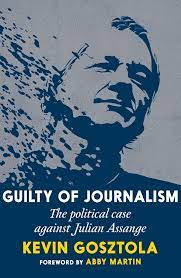
for another year, CPJ excluded the imprisoned former WikiLeaks editor-in-chief from their database of jailed journalists.
Assange is a member of the International Federation of Journalists, which is the world’s largest federation of journalists.
if Assange was brought to trial that it would “effectively criminalize journalists everywhere.”
Assange is and will always be a detained journalist so long as the Justice Department pushes onward with this political case. It is too bad CPJ staff cannot get past their professional hangups and include him in their annual index. It would strengthen their opposition to the prosecution in a way that would give their advocacy even more clarity.
Kevin Gosztola, 20 Jan 24, https://thedissenter.org/assange-darkest-hour-cpj-yet-again-excludes-jailed-journalist-index/
The Committee to Protect Journalists (CPJ) released its census report for 2023. Three hundred and twenty detained or imprisoned journalists were counted by the press freedom organization, as of December 1, 2023.
As indicated, that number is not far from the record high of 360 jailed journalists that was set in 2022.
The 2023 census takes on greater significance given the Israeli government’s war on Gaza and the military attacks and crackdown on Palestinian journalists. Seventeen journalists were jailed by Israel, the “highest number of arrests” since CPJ began tracking arrests in 1992. It is the first time that Israel has “ranked among the top six offenders.”
But at this moment, WikiLeaks founder Julian Assange and his legal team are preparing for a major hearing on February 20 before the High Court of the Justice in the United Kingdom. They view the hearing as a final opportunity to save him from extradition to the United States, where he was charged with violating the Espionage Act in 2019.
Assange needs press freedom organizations, especially those with U.S. headquarters, to strengthen their stand against the charges from the Justice Department. However, for another year, CPJ excluded the imprisoned former WikiLeaks editor-in-chief from their database of jailed journalists.
I emailed CPJ a request for comment and asked why Assange remains excluded from the organization’s annual jailed journalist census, especially given CPJ’s methodology. The response that a CPJ communications person sent me was disappointing.
“After extensive research and consideration, CPJ chose not to list Assange as a journalist, in part because his role has just as often been as a source and because WikiLeaks does not generally perform as a news outlet with an editorial process,” CPJ answered.
The statement was copied-and-pasted from a 2019 post that then-CPJ executive editor Robert Mahoney authored, where he defended the exclusion of Assange.
I pointed out to CPJ that this “extensive research and consideration” was completed in 2019, and I did so because perhaps it is time for CPJ to reassess their determination. To that, CPJ replied, “Yes, there have been many articles about our position on Assange. While you’re free to disagree, our position has been clear, transparent, and consistent for years.”
Indeed, CPJ’s position has been clear. The organization has been consistent in their exclusion of Assange from the press freedom organization’s annual census.
It is debatable whether the organization has been transparent. To my knowledge, the “extensive research and consideration” that they did to decide that Assange is not a journalist has never been shared with the public.
Also, it remains puzzling how a press freedom organization led primarily by journalists with experience in newsgathering can insist that Assange is a source. He has never held a security clearance or a position in the U.S. government that would give him access to classified documents.
The source of the documents at issue in the Espionage Act prosecution against Assange was a U.S. Army intelligence analyst known as Chelsea Manning. She had access to the classified military and government documents, submitted over 700,000 files to WikiLeaks, and Assange published them in 2010 and 2011.
My request for comment mentioned CPJ’s own methodology for labeling someone a journalist, however, CPJ ignored this part of my question.
According to CPJ, a journalist is someone who covers the news or comments on public affairs through any media—including in print, in photographs, on radio, on television, and online.”
Between 2010 and 2017, Assange appeared numerous times on news networks, such as CNN and Al Jazeera English, to comment on WikiLeaks publications as well as public affairs, like National Security Agency (NSA) whistleblower Edward Snowden, NSA surveillance, and internet freedom. He frequently appeared on the independent news program “Democracy Now!” to discuss Google, corruption within U.S. security agencies, and even the Catalonia independence movement in Spain.
Assange is a member of the International Federation of Journalists, which is the world’s largest federation of journalists. Twenty affiliates of the European Federation of Journalists (EFJ), including France, Germany, Italy, Spain, and the United Kingdom, granted Assange honorary membership.
Since 2010, Assange has also been a member of the Media, Entertainment, and Arts Alliance, a trade union in Australia.
CPJ partnered with various civil liberties, human rights, and press freedom organizations in December 2022 to send a letter to Attorney General Merrick Garland demanding that the Justice Department drop all charges against Assange.
On World Press Freedom Day in 2023, CPJ CEO Jodie Ginsberg spoke at an event hosted by the United Nations Educational, Scientific, and Cultural Organization (UNESCO) at the UN headquarters in New York.
Ginsberg called out lawfare targeting journalists and clearly stated, “One thing that the United States could concretely do is drop the charges against Julian Assange.” She noted if Assange was brought to trial that it would “effectively criminalize journalists everywhere.”
So, why the refusal to label Assange a journalist?
I asked CPJ if they have come under pressure from officials within the U.S. government and that is why they will not acknowledge Assange is a jailed journalist. After all, if the Chinese or Russian governments detained someone like Assange, that person would almost certainly be included in CPJ’s index.
The press freedom organization disregarded this portion of my request for comment.
Continue readingThe Last Flurry: The US Congress and Australian Parliamentarians seek Assange’s Release

January 19, 2024 : Dr Binoy Kampmark, https://theaimn.com/the-last-flurry-the-us-congress-and-australian-parliamentarians-seek-assanges-release/
On February 20, Julian Assange, the daredevil publisher of WikiLeaks, will be going into battle, yet again, with the British justice system – or what counts for it. The UK High Court will hear arguments from his team that his extradition to the United States from Britain to face 18 charges under the Espionage Act of 1917 would violate various precepts of justice. The proceedings hope to reverse the curt, impoverished decision by the remarkably misnamed Justice Jonathan Swift of the same court on June 6, 2023.
At this point, the number of claims the defence team can make are potentially many. Economy, however, has been called for: the two judges hearing the case have asked for a substantially shortened argument, showing, yet again, that the quality of British mercy tends to be sourly short. The grounds Assange can resort to are troublingly vast: CIA-sponsored surveillance, his contemplated assassination, his contemplated abduction, violation of attorney-client privilege, his poor health, the violation of free-speech, a naked, politicised attempt by an imperium to capture one of its greatest and most trenchant critics, and bad faith by the US government.
Campaigners for the cause have been frenzied. But as the solution to Assange’s plight is likely to be political, the burden falls on politicians to stomp and drum from within their various chambers to convince their executive counterparts. In the US Congress, House Resolution 934, introduced on December 13 by Rep. Paul A. Gosar, an Arizona Republican, expresses “the sense of the House of Representatives that regular journalistic activities are protected under the First Amendment, and that the United States ought to drop all charges against and attempts to extradite Julian Assange.”
The resolution sees a dramatic shift from the punishing, haute view taken by such figures as the late Democratic Senator Dianne Feinstein, who was one of the first political figures to suggest that Assange be crucified on the unsteady timber of the Espionage Act for disclosing US cables and classified information in 2010. The resolution acknowledges, for instance, that the disclosures by WikiLeaks “promoted public transparency through the exposure of the hiring of child prostitutes by Defense Department contractors, friendly fire incidents, human rights abuses, civilian killings, and United States use of psychological warfare.” The list could be sordidly longer but let’s not quibble.
Impressively, drafters of the resolution finally acknowledge that charging Assange under the Computer Fraud and Abuse Act (CFAA) for alleged conspiracy to help US Army intelligence analyst Chelsea (then Bradley) Manning access Defense Department computers was a fabled nonsense. For one, it was “impossible” – Manning “already had access to the mentioned computer.” Furthermore, “there was no proof Mr Assange had any contact with said intelligence analyst.”
Ire is also directed at the espionage counts, with the resolution noting that “no other publisher has ever been prosecuted under the Espionage Act prior to these 17 charges.” A successful prosecution of the publisher “would set a precedent allowing the United States to prosecute and imprison journalists for First Amendment protected activities, including the obtainment and publication of information, something that occurs on a regular basis.”
Acknowledgment is duly made of the importance of press freedoms to promote transparency and protect the Republic, the support for Assange, “sincere and steadfast”, no less, shown by “numerous human rights, press freedom, and privacy rights advocates and organizations”, and the desire by “at least 70 Senators and Members of Parliament from Australia, a critical United States ally and Mr Assange’s native country” for his return.
Members of Australia’s parliament, adding to the efforts last September to convince members of Congress that the prosecution be dropped, have also written to the UK Home Secretary, James Cleverly, requesting that he “undertake an urgent, thorough and independent assessment of the risks to Mr Assange’s health and welfare in the event that he is extradited to the United States.”
The members of the Bring Julian Assange Home Parliamentary Group draw Cleverly’s attention to the recent UK Supreme Court case of AAA v Secretary of State for the Home Department which found “that courts in the United Kingdom cannot just rely on third party assurances by foreign governments but rather are required to make independent assessments of the risk of persecution to individuals before any order is made removing them from the UK.
It follows that the approach taken by Lord Justices Burnett and Holroyde in USA v Assange [2021] EWHC 3133 was, to put it politely, a touch too confident in accepting assurances given by the US government regarding Assange’s treatment, were he to be extradited. “These assurances were not tested, nor was there any evidence of independent assessment as to the basis on which they could be given and relied upon.”
The conveners of the group point to Assange’s detention in Belmarsh prison since April 2019, his “significant health issues, exacerbated to a dangerous degree by his prolonged incarceration, that are of very real concern to us as his elected representatives.” They also point out the rather unusual consensus between the current Australian Prime Minister, Anthony Albanese, and his opposition number, Peter Dutton, that the “case has gone on for too long.” Continued legal proceedings, both in the UK, and then in the US were extradition to take place “would add yet more years to Mr Assange’s detention and further imperil his health.”
In terms of posterity’s calling, there are surely fewer better things at this point for a US president nearing mental oblivion to do, or a Tory government peering at electoral termination to facilitate, than the release of Assange. At the very least, it would show a grudging acknowledgment that the fourth estate, watchful of government’s egregious abuses, is no corpse, but a vital, thriving necessity.
Cancelling the Journalist: The Australian ABC’s Coverage of the Israel-Gaza War
- January 18, 2024, by: Dr Binoy Kampmark, https://theaimn.com/cancelling-the-journalist-the-abcs-coverage-of-the-israel-gaza-war/#
What a cowardly act it was. A national broadcaster, dedicated to what should be fearless reporting, cowed by the intemperate bellyaching of a lobby concerned about coverage of the Israel-Gaza war. The investigation by The Age newspaper was revealing in showing that the dismissal of broadcaster Antoinette Lattouf last December 20 was the nasty fruit of a campaign waged against the corporation’s management. This included its chair, Ita Buttrose, and managing director David Anderson.
The official reason for that dismissal was disturbingly ordinary. Lattouf had not, for instance, decided to become a flag-swathed bomb thrower for the Palestinian cause. She had engaged in no hostage taking campaign, nor intimidated any Israeli figure. The sacking had purportedly been made over sharing a post by Human Rights Watch about Israel that mentioned “using starvation of civilians as a weapon of war in Gaza”, calling it “a war crime”. It also noted the express intention by Israeli officials to pursue this strategy. Actions are also documented: the deliberate blocking of the delivery of food, water and fuel “while wilfully obstructing the entry of aid.” The sharing by Lattouf took place following a direction not to post on “matters of controversy”.
Human Rights Watch might be accused of many things: the dolled up corporate face of human rights activism; the activist transformed into fundraising agent and boardroom gaming strategist. But to share material from the organisation on alleged abuses is hardly a daredevil act of dangerous hair-raising radicalism.
Prior to the revelations in The Age, much had been made of Lattouf’s fill-in role as a radio presenter, a stint that was to last for five shows. The Australian, true to form, had its own issue with Lattouf’s statements made on various online platforms. In December, the paper found it strange that she was appointed “despite her very public anti-Israel stance” (paywalled). She was also accused of denying the lurid interpretations put upon footage from protests outside Sydney Opera House, some of which called for gassing Jews. And she dared accused the Israeli forces of committing rape.
It was also considered odd that she discuss such matters as food and water shortages in Gaza and “an advertising campaign showing corpses reminiscent of being wrapped in Muslim burial cloths.” That “left ‘a lot of people really upset’.” If war is hell, then Lattouf was evidently not allowed to go into quite so much detail about it – at least when concerning the fate of Palestinians at the hands of the Israeli war machine.
What also transpires is that the ABC managers were not merely targeting Lattouf on their own, sadistic initiative. Pressure of some measure had been exercised from outside the organisation. According to The Age, WhatsApp messages had been sent to the ABC as part of a coordinated campaign by a group called Lawyers for Israel.
The day Lattouf was sacked, Sydney property lawyer Nicky Stein buzzingly began proceedings by telling members of the group to contact the federal minister for communication asking “how Antoinette is hosting the morning ABC Sydney show.” Employing Lattouff apparently breached Clause 4 of the ABC code of practice on impartiality.
Stein cockily went on to insist that, “It’s important ABC hears from not just individuals in the community but specifically from lawyers so they feel there is an actual legal threat.” She goes on to read that a “proper” rather than “generic” response was expected “by COB [close of business] today or I would look to engage senior counsel.”
-ADVERTISEMENT-
Did such windy threats have any basis? No, according to Stein. “I know there is probably no actionable offence against the ABC but I didn’t say I would be taking one – just investigating one. I have said that they should be terminating her employment immediately.” Utterly charming, and sufficiently so to attract attention from the ABC chairperson herself, who asked for further venting of concerns.
Indeed, another member of the haranguing clique, Robert Goot, also deputy president of the Executive Council of Australian Jewry, could boast of information he had received that Lattouf would be “gone from morning radio from Friday” because of her anti-Israeli stance.
There has been something of a journalistic exodus from the ABC of late. Nour Haydar, an Australian journalist also of Lebanese descent, resigned expressing her concerns about the coverage of the Israel-Gaza conflict at the broadcaster. There had been, for instance, the creation of a “Gaza advisory panel” at the behest of ABC News director Justin Stevens, ostensibly to improve the coverage of the conflict. “Accuracy and impartiality are core to the service we offer audiences,” Stevens explained to staff. “We must stay independent and not ‘take sides’.”
This pointless assertion can only ever be a threat because it acts as an injunction on staff and a judgment against sources that do not favour the accepted line, however credible they might be. What proves acceptable, a condition that seems to have paralysed the ABC, is to never say that Israel massacres, commits war crimes, and brings about conditions approximating to genocide. Little wonder that coverage on South Africa’s genocide case against Israel in the International Court of Justice does not get top billing on in the ABC news headlines.
Palestinians and Palestinian militias, on the other hand, can always be written about as brute savages, rapists and baby slayers. Throw in fanaticism and Islam, and you have the complete package ready for transmission. Coverage in the mainstays of most Western liberal democracies of the Israeli-Palestinian conflict, as the late Robert Fisk pointed out with pungency, repeatedly asserts these divisions.
After her signation Haydar told the Sydney Morning Herald that, “Commitment to diversity in the media cannot be skin deep. Culturally diverse staff should be respected and supported even when they challenge the status quo.” But Haydar’s argument about cultural diversity should not obscure the broader problem facing the ABC: policing the way opinions and material on war and any other divisive topic is shared. The issue goes less to cultural diversity than permitted intellectual breadth, which is distinctly narrowing at the national broadcaster.
Lattouf, for her part, is pursuing remedies through the Fair Work Commission, and seeking funding through a GoFundMe page, steered by Lauren Dubois. “We stand with Antoinette and support the rights of workers to be able to share news that expresses an opinion or reinforces a fact, without fear of retribution.”
Kenneth Roth, former head of Human Rights Watch, expressed his displeasure at the treatment of Lattouf for sharing HRW material, suggesting the ABC had erred. ABC’s senior management, through a statement from managing director David Anderson, preferred the route of craven denial, rejecting “any claim that it has been influenced by any external pressure, whether it be an advocacy group or lobby group, a political party, or commercial entity.” They would, wouldn’t they?
Criticize Israel? You’re fired.

The Intercept, 11 Dec 23
A climate of fear is gripping U.S. newsrooms as a growing list of journalists have been fired, suspended, or otherwise sidelined after refusing to abide by the pro-Israel bias across the U.S. news media.
The New York Times, Associated Press, BBC, and Los Angeles Times are just a handful of the more prominent news outlets where journalists say they were sidelined after criticizing Israel or expressing sympathy for Palestinians.
Meanwhile, the death toll in the Gaza Strip now exceeds 18,000, and more than 80 percent of Palestinians there have been displaced by the war.
Since October 7, there have been numerous incidents reported in which journalists were fired, demoted, suspended, or otherwise silenced after voicing criticism of Israel, including:
- The German media giant Axel Springer fired Kasem Raad, a 20-year-old apprentice at the company, after he questioned the company’s Israel policy through internal channels.
- Thirty-eight Los Angeles Times journalists have been barred from covering Gaza for a minimum of three months after signing an open letter criticizing media coverage of the war and Israel’s targeting of journalists.
- The BBC took six Arab journalists off the air after they allegedly showed “anti-Israel bias” by liking and publishing pro-Palestinian posts on social media.
- Mona Chalabi, the data journalist and illustrator who won the Pulitzer Prize for the New York Times earlier this year, said she’s been unable to get commissioned for additional work from the paper since the war started.
- Artforum editor-in-chief David Velasco was fired after wealthy art collectors objected to an open letter by artists expressing solidarity with Palestinians was posted on the magazine’s website.
- The Harvard Law Review killed an article on the Gaza war and Nakba after it was commissioned, edited, fact-checked, and prepared for publication.
- Two weeks ago, MSNBC canceled the Sunday night show hosted by Mehdi Hasan, one of the only cable news hosts willing to openly challenge Israel and a valued former Intercept colleague.
While the reasons for some of these moves against journalists have been disputed, there’s been an undeniable chilling effect across the U.S. media landscape as a result of incidents like these.
In the words of Pulitzer Prize-nominated journalist Abdallah Fayyad, a “culture of fear in many newsrooms” is leading many journalists “to take the easier route and continue the mainstream media’s pro-Israel slant.”
The US Condemned Stalin’s Prosecution of Journalists. Now It Uses His Playbook.
The prosecution of Julian Assange in 2023 mirrors the prosecution of journalist Bill Oatis during the Cold War.
By Charles Glass / Truthout 10 Dec 23
Two of my colleagues — Evan Gershkovich in Moscow and Julian Assange in London — languish in prisons for doing their job: keeping you informed. Russia and the U.S., knowingly or not, are following Joseph Stalin’s press playbook. A case in point: the Stalinist persecution of U.S. journalist William (Bill) Nathan Oatis in Cold War Czechoslovakia, which mirrors the contemporary prosecutions of my colleagues.
To Bill Oatis, as to Assange and Gershkovich, journalism was less a job than a vocation. He worked on school newspapers from the age of 12 and dropped out of college in 1933 to take a job at his hometown newspaper, the Marion, Indiana, Leader-Tribune. From there, he moved to the Associated Press (AP) bureau in the state capital, Indianapolis. (His managing editor, Drysdale Brannon, recalled, “He was a factual reporter and probably the most conscientious man who ever worked on the staff.”) Diverted from journalism to the Army for three years during World War II, he returned to the AP, first to its New York news desk, then to London and in 1950 to Prague, Czechoslovakia, as bureau chief…………………………………………………………………………………………………………………………..
The issue that unites Oatis, Gershkovich and Assange is not only the prosecution of journalists for doing their jobs. It is censorship of everything the state believes we have no right to know. Censorship by state and church has done more to deprive humanity of knowledge and to stunt creativity than any other method of control. Knowing that prison awaits you if you expose state crimes in the U.S. or propaganda lies in Moscow has an inhibiting effect. Many journalists will not, indeed do not, take the risk…………………………..
Historian Erin Maglaque has written how centuries of Catholic censorship in early modern Europe spawned self-censorship, lamenting “the art and literature that was never made, the religious and scientific ideas that remained unwritten — unthought, even — because of the existence of the Index [of Prohibited Books], the congregation [of the Faith], and the Inquisition tribunal.” Stalin’s secret police, and their contemporary incarnation in the Russian Federal Security Service and the U.S. national security state, stand in the Inquisitorial tradition of deciding what you and I may (and may not) read and therefore know. It is for that Gershkovich and Assange suffer the anguish of isolation in their dungeons. https://scheerpost.com/2023/12/10/the-us-condemned-stalins-prosecution-of-journalists-now-it-uses-his-playbook/
Digital Rights Groups Urge Meta to Stop Silencing Palestine
SCHEERPOST, By Jillian C. York / Electronic Frontier Foundation (EFF), December 8, 2023
In the wake of the October 7 attack on Israel and the ensuing backlash on Palestine, Meta has engaged in unjustified content and account takedowns on its social media platforms. This has suppressed the voices of journalists, human rights defenders, and many others concerned or directly affected by the war.
This is not the first instance of biased moderation of content related to Palestine and the broader MENA region. EFF has documented numerous instances over the past decade in which platforms have seemingly turned their backs on critical voices in the region. In 2021, when Israel was forcibly evicting Palestinian families from their homes in Jerusalem, international digital and human rights groups including EFF partnered in a campaign to hold Meta to account. These demands were backed by prominent signatories, and later echoed by Meta’s Oversight Board.
The campaign—along with other advocacy efforts—led to Meta agreeing to an independent review of its content moderation activities in Israel and Palestine, published in October 2022 by BSR. The BSR audit was a welcome development in response to our original demands; however, we are yet to see its recommendations fully implemented in Meta’s policies and practices.
The rest of our demands went unmet. Therefore, in the context of the current crackdown on pro-Palestinian voices, EFF and 17 other digital and human rights organizations are issuing an updated set of demands to ensure that Meta considers the impact of its policies and content moderation practices on Palestinians, and takes serious action to ensure that its content interventions are fair, balanced, and consistent with the Santa Clara Principles on Transparency and Accountability in Content Moderation.
Why it matters
The campaign is crucial for many reasons ranging from respect for free speech and equality to prevention of violence.
Free public discourse plays an important role in global conflicts in that it has the ability to affect the decision making of those occupying decisive positions. Dissemination of information and public opinion can reflect the majority opinion and can build the necessary pressure on individuals in positions of power to make democratic and humane decisions. Borderless platforms like Meta, therefore, have colossal power to shape narratives across the globe. In order to reflect a true picture of the majority public opinion, it is essential that these platforms allow for a level playing field for all sides of a conflict.
These leviathan platforms have the power and responsibility to refuse to succumb to unjustifiable government demands intended to skew the discourse in favor of the latter’s geopolitical and economic interests. There is already a significant imbalance between the government of Israel and the Palestinian people, particularly in their economic and geopolitical influence. Adding to that, suppression of information coming out of or about the weaker party has the potential to aid and abet further suffering.
……………………….. According to some estimates over 90% of pro-Palestinian content has been deleted following Israel’s requests since October 7………………………………………… more https://scheerpost.com/2023/12/08/digital-rights-groups-urge-meta-to-stop-silencing-palestine/
UN Launches Gates-Funded Global Digital ID Program as Experts Warn of ‘Totalitarian Nightmare’
“the reality is that these tools have the potential for furthering exclusion of political activists, whistleblowers, and other individuals who hold controversial opinions,”
With support from the Bill & Melinda Gates Foundation, the United Nations this month launched its “50-in-5” campaign to promote and accelerate the development of a global digital public infrastructure. One critic called the campaign “a totalitarian nightmare” designed to “onboard” small countries with “digital ID, digital wallets, digital lawmaking, digital voting and more.”
By Michael Nevradakis, Ph.D. The Defender, 6 Dec 23
With support from the Bill & Melinda Gates Foundation, the United Nations (U.N.) this month launched an “ambitious-country-led campaign” to promote and accelerate the development of a global digital public infrastructure (DPI).
The United Nations Development Programme (UNDP) said its “50-in-5” campaign will spur the construction of “an underlying network of components” that includes “digital payments, ID, and data exchange system,” which will serve as “a critical accelerator of the Sustainable Development Goals (SDGs).”
“The goal of the campaign is for 50 countries to have designed, implemented, and scaled at least one DPI component in a safe, inclusive, and interoperable manner in five years,” the UNDP stated.
Critics of the campaign include Tim Hinchliffe, editor of The Sociable, who told The Defender he believes DPI “is a mechanism for surveillance and control that combines digital ID, central bank digital currencies [CBDC], vaccine passports and carbon footprint tracking data, paving the way for 15-minute smart cities, future lockdowns and systems of social credit.”
The UNDP is leading the “50-in-5” campaign along with the Center for Digital Public Infrastructure, Co-Develop, the Digital Public Goods Alliance. Supporters include GovStack, the Inter-American Development Bank and UNICEF, in addition to the Gates Foundation.
In September 2022, the Gates Foundation allocated $200 million “to expand global Digital Public Infrastructure,” as part of a broader plan to fund $1.27 billion in “health and development commitments” toward the goal of achieving the SDGs by 2030…………………..
California-based privacy attorney Greg Glaser described the “50-in-5” campaign as “a totalitarian nightmare” and a “dystopian” initiative targeting small countries “to onboard them with digital ID, digital wallets, digital lawmaking, digital voting and more.”…………………
Another California-based privacy attorney, Richard Jaffe, expressed similar sentiments, telling The Defender the “50-in-5” initiative “point[s] to the much bigger issue of the globalization, centralization and digitalization of the world’s personal data.”
“My short-term concern is bad actors, and that would be individuals and small groups, as well as state mal-actors, who will now have a big fat new target or tool to threaten the normal operation of less technologically sophisticated countries,” he said.
Jaffe said Gates’ involvement “scares the hell out of him.” Derrick Broze, editor-in-chief of The Conscious Resistance Network, told The Defender that it is “another sign that this renewed push for digital ID infrastructure will not benefit the average person.”
“Projects like these only benefit governments who want to track their populations, and corporations who want to study our daily habits and movements to sell us products,” Broze said.
Initiatives to promote DPI globally also enjoy the support of the G20. According to The Economist, at September’s G20 Summit in New Delhi — held under the slogan “One Earth, One Family, One Future” — India garnered support from the Gates Foundation, UNDP and the World Bank for a plan to develop a global repository of DPI technologies……………………………………………………………………………………………………………..
According to Hinchliffe, Togo’s DPI system had seemingly benign origins, launching as a universal basic income scheme for the country’s citizens, “but shortly after that, they expanded the system to implement vaccine passports…………………….
Speaking at the G20 Summit in September, European Commission President Ursula von der Leyen said, “The trick is to build public digital infrastructure that is interoperable, open to all and trusted,” citing the EU’s COVID-19 digital certificate as an example.
Four of the “First-Mover” countries are African. Shabnam Palesa Mohamed, executive director of Children’s Health Defense (CHD) Africa Chapter, told The Defender the “50-in-5” campaign will be used as a geo-political tool. “Africa is always a prime target because it is comparatively untapped digitally,” she said.
Along similar lines, Hinchliffe said, “The world doesn’t need ‘50-in-5.’ The people never asked for it. It came from the top down. What the people want is for their governments to do their actual jobs — to serve the people.”
A 2022 World Economic Forum (WEF) report, “Advancing Digital Agency: The Power of Data Intermediaries,” said vaccine passports “serve as a form of digital identity.”
In 2020, WEF founder Klaus Schwab said, “What the Fourth Industrial Revolution will lead to is a fusion of our physical, our digital and our biological identities.”
Digital ID intended to be ‘securely accessed’ by government, private stakeholders
According to The Economist, India is heavily promoting its digital ID technologies, first deployed domestically, for global implementation in “poor countries.” These technologies have garnered support and funding from Bill Gates and the Gates Foundation.
For instance, Lawson said Togo was issuing biometric digital ID “for all our citizens using MOSIP” — Modular Open Source Identity Platform — a system developed at India’s International Institute of Information Technology in Bangalore.
MOSIP, backed by the Gates Foundation, the World Bank and eBay founder Pierre Omidyar, is modeled after Aadhaar, India’s national digital ID platform — the largest in the world — which has been beset by controversy.
Launched in 2009, Aadhaar enrolled over 99% of all Indian adults, linking them with many public and private services. But according to The Economist, Aadhaar “suffers security breaches,” and though it “was supposed to be optional, it is hard to function without it.”
Glaser said Aadhaar “has been a nightmare for Indians. It is constantly hacked, including, for example the largest personal information hack in world history earlier this month, with personal information sold on the dark web.”
“Aadhaar is openly mocked in India,” Glaser said. “The only reason it is still used by the citizenry is because people have no practical choice. To participate meaningfully in Indian society, you need the digital ID,” he added.
Nevertheless, Gates has praised Aadhaar — describing it on his blog as “a valuable platform for delivering social welfare programs and other government services.” In October 2021, the Gates Foundation issued a $350,690 grant for the rollout of India’s Ayushman Bharat Digital Mission, a digital health ID system linked with Aadhaar.
A Business 20 (B20) communique issued following this year’s G20 summit called on “G20 nations to develop guidelines for unique single digital identification … that can be securely accessed (based on consent) by different government and private stakeholders for identity verification and information access within three years.”
In April, Nandan Nilekani, former chair of the Unique Identification Authority of India, told an International Monetary Fund panel on DPI that digital ID, digital bank accounts and smartphones are the “tools of the new world.” He added that if this is achieved, “Then, anything can be done. Everything else is built on that.”
“The lesson of course for the rest of the world is to never let digital ID take root in your society,” Glaser said. “Once a nation’s consumer class adopts digital ID with global partners, as in India, it is basically checkmate for that nation.”………………………………………………………………..
“inclusivity” is one of the key narratives employed to promote DPI. The “50-in-5” campaign states, “Countries building safe and inclusive DPI … can foster strong economies and equitable societies” and that DPI “promotes innovation, bolsters local entrepreneurship, and ensures access to services and opportunities for underserved groups, including women and youth.”
Experts who spoke with The Defender warned DPI has the potential to be exclusionary.
“While the United Nations, the Gates Foundation and Rockefeller Foundation promote DPI as necessary for an ‘equitable’ world, the reality is that these tools have the potential for furthering exclusion of political activists, whistleblowers, and other individuals who hold controversial opinions,” Broze said.
Similarly, CHD Africa’s Mohamed claimed, “People, groups and organizations that pose a threat to the establishment will be targeted for digital surveillance and socio-economic isolation” via DPI. “This … is an easier way to control critical thinkers.”
Hinchliffe said DPI will “accelerate technocratic control through digital ID, CBDC and massive data sharing, paving the way for an interoperable system of social credit.”
Similarly, Glaser said, “With DPI, the U.N.’s plan is to issue everyone a social credit score in line with U.N. SDGs (Agenda 2030) … Your digital ID will become the new you. And from the perspective of governments and corporations, your digital ID will be more real than your flesh … required in various measures to travel, work, buy/sell, and vote.”
“When they say inclusive, they really mean exclusive, because the system is set up to exclude people who don’t go along with unelected globalist policies,” Hinchliffe said. “What they really want is for everybody to be under their digital control.”
Notably, a June 2023 WEF report titled “Reimagining Digital ID” concedes that “Digital ID may weaken democracy and civil society” and that the “greatest risks arising from digital ID are exclusion, marginalization and oppression.”
Making ID — digital or otherwise — mandatory may exacerbate “fundamental social, political and economic challenges as conditional access of any kind always creates the possibility of discrimination and exclusion,” the report adds.
Experts who spoke with The Defender said people must be given the choice to opt out.
“If the U.N. and its member states push the digital ID agenda, they must ensure that their respective populations have a simple way to opt out without being punished or denied services,” Bronze said. “Otherwise, the digital ID creep will eventually become mandatory to exist in society and we will see the end of privacy, and, in the long-term, liberty,” Broze said.
Jaffe said that while he does not oppose digital payment systems, he “would be vehemently opposed to the elimination of non-digital payment, like fiat paper currency,” calling this an issue of “freedom and privacy.”
Similarly, Hinchliffe said, “There should be non-digital alternatives available at all times and this should be a right of every citizen. Systems can fail. Databases can be breached. Governments can become tyrannical. Corporations can become greedy.”
The endgame is sovereignty by transhumanists’
Many of the initiatives that are backing “50-in-5” are themselves interlinked — in addition to their connections to entities such as the Gates Foundation.
For instance, the Omidyar Network, one of the supporters of “50-in-5,” has provided funding to MOSIP — as has the Gates Foundation………………………………………………………………….
Glaser said that Gates attained wealth by “monopolizing his operating system into every home and business worldwide” and “is doing the same now at the U.N. level with vaccines and DPI applications.”
“DPI platforms essentially outsource sovereignty to international governing bodies that do the bidding of financial entities like Vanguard, BlackRock and State Street,” he said.
“Companies with that much information on citizens hold enormous power to sabotage infrastructure [with] very few ethics to stop them,” Mohamed said.
“The endgame is sovereignty by transhumanists,” Glaser added. “The reason digital ID is an existential threat to society is because it separates people from their local governments, who have always worked cooperatively to prevent tyranny.”
“DPI is being sold to authorities on the grounds that it will include them in the worldwide economy, when in reality it will commodify their people and remove the ability of local authorities to ever govern meaningfully again,” he said.
Hinchliffe also connected DPI to policies that purport to combat climate change………………………………………..
“If we can legislate and litigate to retain the right to traditional identification, then this categorically protects all of our rights,” Glaser added. “As long as the consumer classes of large nations like the United States resist digital ID, there is hope.”
“These schemes do little to nothing for the prosperity of the majority of Africans, but rather, they further the interests of a small economic and political class,” Mohamed said. “With growing economic disparity and anger, the attempt to waste more African resources on digital ID may lead to widespread revolt.”
“Generally, once Africans know what Bill Gates is about, they refuse to get involved in or support his activities,” she added. https://childrenshealthdefense.org/defender/gates-funded-global-digital-id-program-totalitarianism/
1 This Month
5 March -Online – Reversing nuclearization:
From nuclear weapons in Belarus and NATO host countries to a European-Nuclear-Weapon Free Zone
11am-12:30pm Eastern Time USA / 5pm-6:30pm CET

of the week – Advocating for a
nuclear free beach – https://www.samuellawrencefoundation.org/
The Samuel Lawrence Foundation advocates for a Nuclear Waste Free Beach at San Onofre, join us and take action!
10 March A LIVE WEBINAR THE REAL EFFECTS OF NUCLEAR POWER
What the Industry Isn’t Telling Us
1:00 PM Mountain, 2 pm Central, 3 pm Eastern. Live on the Keepers of the Water Facebook page


18 March Webinar @ 1 PM EST: An Assessment of SMR Projects: The Case of Canada
register for the zoom:
https://us02web.zoom.us/webinar/register/WN_o8BIIOUvQ2ONJR1nta65DQ#/registration

of the week – STOP SMALL MODULAR REACTORS IN CANADA
To see nuclear-related stories in greater depth and intensity – go to https://nuclearinformation.wordpress.com
-
Archives
- March 2026 (38)
- February 2026 (268)
- January 2026 (308)
- December 2025 (358)
- November 2025 (359)
- October 2025 (376)
- September 2025 (258)
- August 2025 (319)
- July 2025 (230)
- June 2025 (348)
- May 2025 (261)
- April 2025 (305)
-
Categories
- 1
- 1 NUCLEAR ISSUES
- business and costs
- climate change
- culture and arts
- ENERGY
- environment
- health
- history
- indigenous issues
- Legal
- marketing of nuclear
- media
- opposition to nuclear
- PERSONAL STORIES
- politics
- politics international
- Religion and ethics
- safety
- secrets,lies and civil liberties
- spinbuster
- technology
- Uranium
- wastes
- weapons and war
- Women
- 2 WORLD
- ACTION
- AFRICA
- Atrocities
- AUSTRALIA
- Christina's notes
- Christina's themes
- culture and arts
- Events
- Fuk 2022
- Fuk 2023
- Fukushima 2017
- Fukushima 2018
- fukushima 2019
- Fukushima 2020
- Fukushima 2021
- general
- global warming
- Humour (God we need it)
- Nuclear
- RARE EARTHS
- Reference
- resources – print
- Resources -audiovicual
- Weekly Newsletter
- World
- World Nuclear
- YouTube
-
RSS
Entries RSS
Comments RSS
 nuclear-news