Democracy eroding in India
ID please, keep it ready for all reserved rail trips after Dec 1 Hindu Business Line, MAMUNI DAS NEW DELHI, NOV 1: From December1, you require an original identity proof to travel in any reserved services of the Indian Railways. Those without identity proof will be treated as travelling without ticket and attract a penalty equivalent to the ticket fare….
http://www.thehindubusinessline.com/industry-and-economy/logistics/id-please-keep-it-ready-for-all-reserved-rail-trips-after-dec-1/article4054531.ece?homepage=true
India: more arrests of peaceful protestors in Tamil nadu
We have information that 25 members of Tamizhaga Vazurimai Iyyakam from Salem (including the district secretary), 2 members of Dalit Viduthalai Katchi from Avinashi, and 1 member each from MDMK and Nam Tamilar Iyyakam from Tirupur are presently under preventive detention. The Police have maintained that they are only being detained and will not be arrested but the status remains unclear at the time of sending out this report.
Another 42 members of Pengal Munnani have been detained by the police at Kulithalai Railway Station and taken to Kulithalai police station. The police have said that they will get the signatures of the people and let them leave after 11 pm.
Tepco will make all 100,000 employees work at Fukushima annually
 Report: 100,000 Tepco employees being sent to Fukushima in 2013 http://enenews.com/100000-tepco-employees-expected-to-go-to-fukushima-in-2013-all-of-companys-workers-to-be-sent
Report: 100,000 Tepco employees being sent to Fukushima in 2013
October 27th, 2012
Oct. 27 ,2012 report in Nikkei with summary translation by Fukushima Diary:
In the mid-term administration plan, Tepco decided to send all of their employees to Fukushima for decontamination from 2013.
They are sent to Fukushima for 2~3 times a year, about 100,000 people in total will go to Fukushima annually.
This is not volunteer, this is obligation.
Google translation of an excerpt from the Nikkei report:
USA doesn’t like Imran Khan’s anti drone opinions
This Former Cricket Star Turned US Drone Critic Was Pulled From His Plane On The Way To The States http://www.businessinsider.com/this-former-cricket-star-turned-us-drone-critic-imran-khan-got-hauled-off-a-plane-for-questioning-on-his-way-to-the-states-2012-10 AP | Oct. 28, 2012, Imran Khan, the cricketer turned politician, claimed he was taken off an international flight by US immigration officials and questioned about his views on drones and jihad before being allowed into the country, it emerged on Saturday
Mr Khan has emerged as a leading critic of US policy in Pakistan and Afghanistan, and his party is poised to make a breakthrough in elections due next year. Continue reading
India stops Australian film maker entering Kudankulam anti nuclear protest area
 Australian filmmaker prevented from entering Kudankulam 25 Oct
  12http://www.dnaindia.com/india/report_australian-filmmaker-prevented-from-entering-kudankulam_1756187 , Oct 25, 2012, Three persons from Australia were today prevented from entering Idinthakarai, the epicentre of protests by People’s Movement Against Nuclear Energy leading the stir against Kudankulam Nuclear Power Plant in Tirunelveli district, police said.
Filmmaker David Bradbury along with his wife and son arrived in India on tourist visas and were about to enter Idinthankarai from Kanyakumari district this morning when police stopped them near Radhapuram police station, they said.
“After interrogations, the three were made to go back, since prohibitory orders were in place,” an officer said.
The PMANE has been leading protests against the plant for over a year citing safety concerns.
Commissioning of the first unit of the Indo-Russian project was originally scheduled for December last year, but has been delayed due to the protest.
South Korea – civil liberties disappearing, in the interests of nuclear industry

 South Korea can’t deny the risks of nuclear power forever http://www.greenpeace.org/international/en/news/Blogs/nuclear-reaction/nuclear-south-korea-risks/blog/42486/
by Jan Beranek – October 8, 2012 I am at a detention centre at South Korea’s airport, quickly writing these few words as best I can on a mobile phone. Together with my colleague, Dr. Rianne Teule, I have been denied entry to South Korea.
We have done nothing wrong. That is, unless you agree with the government in Seoul that exposing the risks of nuclear power and calling for better protection of people from radiation is wrong. Continue reading
East Kazakhstan’s horror nuclear legacy from Soviet times till now

 Josef Stalin’s nuclear legacy remains in East Kazakhstan Scotsman.com, 9 October 2012 Stalin used the area as a nuclear test site and the local population have been paying a terrible price ever since. The plight of these people in East Kazakhstan has touched the heart of Scottish MEP Struan Stevenson, who has campaigned to bring their situation to wider
recognition for 13 years. Now, in an exclusive article for
The Scotsman, he argues Stalin’s actions could have devastating consequences in the future, too Continue reading
Josef Stalin’s nuclear legacy remains in East Kazakhstan Scotsman.com, 9 October 2012 Stalin used the area as a nuclear test site and the local population have been paying a terrible price ever since. The plight of these people in East Kazakhstan has touched the heart of Scottish MEP Struan Stevenson, who has campaigned to bring their situation to wider
recognition for 13 years. Now, in an exclusive article for
The Scotsman, he argues Stalin’s actions could have devastating consequences in the future, too Continue reading
Death of democracy in India: anti nuclear heroes – “Enemies of the State”
 A non-governmental fact finding team that visited area found that police
  personnel had seriously injured many protestors, inflicted physical and verbal sexual abuse on several women, and at least two children had been stripped and tortured
serious criminal charges have been slapped against more than 150,000, mostly unnamed villagers…. at least 10,000 people are charged with sedition and waging war against the state..
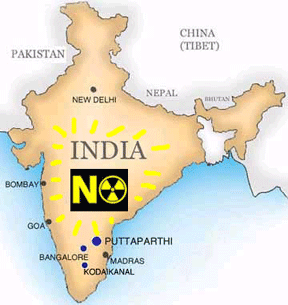 India Clamps Down on Villagers’ Anti-Nuclear Protests, Earth Island Journal, BY NITYANANDJAYARAMAN – OCTOBER 4, 2012 In their eagerness to power the country’s growing economy, ndian authorities are treating opponents of nuclear energy as enemies of the state
If the chief minister of Tamil Nadu has her way, democracy would be dispensed with in the southern Indian state. On two separate occasions this year, chief minister J. Jayalalithaa let loose battalions of armed police on thousands of fisherfolk and farmers to crush their months-long non-violent protest against the unfinished nuclear power plants in Koodankulam and Idinthakrai, two coastal villages in the state.
In March, when she sent out security personnel to quell the protests, police squads blocked roads leading to villages and stopped essential supplies like milk and drinking water from reaching the area. (Read our earlier report on the conflict here.) Continue reading
India: opponents of nuclear power treated as ‘pathological’
The way the Indian government has dealt with the opponents of the Koodankulam nuclear reactors being built in Tamil Nadu violates all three red lines.
The Department of Atomic Energy and its subsidiary Nuclear Power Corporation of India Ltd. see the opposition as a pathology to be cured by psychiatrists from the National Institute of Mental Health and Neurosciences.
Don’t impose K’kulam reactorshttp://www.thedailystar.net/newDesign/news-details.php?nid=252289, 3 Oct 12, Praful Bidwai Even zealous supporters of nuclear power should logically concede three things to their opponents. First, after Fukushima, it’s natural for people everywhere to be deeply sceptical of the claimed safety of nuclear power, and for governments to phase out atomic programmes, as is happening in Germany, Switzerland, Italy, and now Japan.
Second, nuclear power, like all projects, should only be promoted with the consent of local people, and with scrupulous regard for civil liberties. And third, safety must be paramount in reactor construction and operation, with strict compliance with rules laid down by an
independent safety authority. Continue reading
Indian government’s nuclear attack on democracy
Nuking democracy at Kudankulam Financial Chronicle, By Praful Bidwai Oct 03 2012 Is nuclear power going to be promoted in India only at gunpoint, and in brazen violation not just of people’s fundamental rights, but also of the norms and rules to be set by an independent safety regulator?
Going by what the government, department of atomic energy, Nuclear Power Corporation (NPCIL), and Atomic Energy Regulatory Board (AERB) are doing at Kudankulam in Tamil Nadu, the answer is an emphatic yes.
To start with, the AERB is not an independent agency. As shown by the Comptroller and Auditor-General’s recent report, it’s slavishly subservient to the government and DAE-NPCIL. Nor has it evolved transparent safety norms. Its integrity is in grave doubt. It does not disclose information that’s vitally important to public safety. Critical documents on safety codes/ guidelines have disappeared from
its website, for example,…
… the state and central police have unleashed repression against Kudankulam’s grassroots protesters. Although there hasn’t been a single violent incident, the police have lodged first information reports against several thousand people, charging many with sedition and waging war against the State, on this scale, probably for the first time since independence. On September 10, they attacked peaceful unobtrusive protesters with batons and
tear-gas. They literally drove many agitators into the sea, molested women, looted homes and killed a fisherman.
A fact-finding team led by Justice BG Kolse-Patil describes this as a “reign of terror”, with
“totally unjustified” physical abuse, vindictive detention of 56 people including juveniles, and sexual harassment. Such police behaviour “has no place in a country that calls itself democratic”.
This comes on top of systematic demonisation of the protesters as “foreign-inspired”, repeated harassment of their sympathisers, and deportation of three Japanese activists, who wanted to express solidarity with them. Such repression is becoming routine in India and undermining democracy. That’s the additional price nuclear power will extract from us.
http://wrd.mydigitalfc.com/op-ed/nuking-democracy-kudankulam-443
Poor children sprayed with radioactive particles, by US military
US military secretly sprayed radioactive particles on St. Louis poorest children, Examiner, OCTOBER 3, 2012, BY: DEBORAH DUPRE A St. Louis, Missouri college professor has revealed through Freedom of Information Act documents that the United States military’s long history of secret non-consensual human experimentation includes spraying radioactiveparticles on the city’s poorest neighborhoods, comprised of mainly children, in the 1950s and ‘60s, and that later government investigations neglected to speak with victims of this human rights abuse.
As the debate increases globally about what many people today call United States military-based secret “chemtrailing,” Lisa Martino-Taylor, a sociologist at St. Louis Community College in the Midwest, has revealed findings from her investigation of publically available archives and documents from Freedom of Information Act requests about non-consensual human experimentation involving a chemical spraying program that blanketed parts of her hometown and other cities fifty to sixty years ago.
“It was pretty shocking. The level of duplicity and secrecy,” the researcher told St. Louis’ KSDK.
“Clearly they went to great lengths to deceive people,” Martino-Taylor said….. http://www.examiner.com/article/us-military-secretly-sprayed-radioactive-particles-on-st-louis-poorest-children?CID=examiner_alerts_article
India interrogates, deports visitors who have anti nuclear opinions
The three activists were going to visit India for only a few days. They had hoped to avail of the tourist visa on arrival to visit the “temples of modern India”. They came in solidarity, good will and peace. Neither they nor their friends in India had imagined that being “anti-nuclear” would be seen as a threat by the Indian government.
Are you going to Kudankulam? http://www.dnaindia.com/analysis/column_are-you-going-to-kudankulam_1745780 29 Sept 12, Bela Bhatia | Agency: DNA , September 27, 2012 On Tuesday this week, three Japanese visitors who are part of the anti-nuclear movement in Japan were refused entry to India and deported on arrival at Chennai. Reading the account sent by them from Kuala Lumpur makes for not-exactly-pleasant reading.
“When we got off the plane and approached the immigration counter, one personnel came to us smiling… [and took] us to the immigration office. [There were more than five personnel there.] … one asked me [Yoko Unoda] whether I am a member of No Nukes Asia Forum Japan. ‘You signed the international petition on Kudankulam, didn’t you?’ … another person asked, ‘Mr Watarida … he is involved in the anti-nuclear movement in Kaminoseki, right?’
‘Are you going to Kudankulam? Who invited you all? … Who will pick you up at Tuticorin airport? [they had a copy of the itinerary of the domestic flight] Tell me their names. Tell me their telephone numbers. Continue reading
Democratic freedoms trampled: the sorry story of India’s Kudankulam nuclear power project
Despite mass opposition, India pushes ahead with operationalizing nuclear plant WSWS, By Arun Kumar and Kranti Kumara 27 September 2012 Despite mass protests by villagers, the Indian government in partnership with the Tamil Nadu state government is pushing ahead with the loading of nuclear fuel at the recently built 2000 MW Kudankulam Nuclear Power Plant (KNPP) located on the Tamil Nadu coast.
This massive power plant is a joint venture between India and Russia and has cost 172 billion Rupees (about $3.2 billion) to build. The plant currently houses two nuclear pressurized water reactors (PWR) reactors, each capable of driving a 1000 MW electric generator. But there are plans to construct four additional reactors at the site…..
Despite the deep misgivings of the population, the Indian elite, without any democratic debate, is rushing feverishly ahead, claiming that nuclear plants are essential to satisfying growing domestic electricity needs.
This particular plant is causing great concern among villagers and fishermen living in its vicinity, because it is situated right next to the ocean just like the Japanese Fukushima plant. Built at the southern tip of the state, KNPP is highly vulnerable to undersea earthquakes and tsunami that are an ever-present danger in the Indian Ocean region. That such concerns are far from hypothetical was demonstrated when the plant installations got inundated from ocean waves unleashed by the massive undersea earthquake that occurred in the Indian Ocean in 2004….
Last April witnessed a particularly brutal response by joint forces deployed by the Indian and the state governments. The police cut off water, food and power-supply to protesting villagers and imposed a curfew in the villages where the agitation has been centered. Nearly 200 people were arrested including women and children. Subsequently protests abated somewhat as the People’s Movement against Nuclear Energy (PMANE), which has led the agitation, called it off in the hope that the Tamil Nadu and Indian judiciaries would intervene on its behalf.
However, by late August the Madras High Court gave the green light to the Indian government to proceed with the steps it needs to take to make the plant operational. An appeal was then filed by an anti-nuclear activist with the Indian Supreme Court asking the court to halt further progress on operationalizing the plant, since 11 of the 17 critical safety measures recommended by the government’s own Atomic Energy Regulatory Board (AERB) had not been implemented.
Around this time, widespread protests resumed and the police responded with still greater violence. On Sept. 10 a protesting fisherman, 48 year-old Antony John, was shot dead. A young girl was also trampled to death when police resorted to charges to break up the protests. To observe and terrify those conducting a water protest, the Coast Guard flew low-flying aircrafts. One of the protesting fisherman named Sathyam panicked when a surveillance aircraft flew low, then slipped hitting his head against a boulder and subsequently died. Sathyam’s funeral became a rallying point for opposition to the nuclear power plant attracting large number of villagers from neighbouring areas.
Earlier this month, India’s Supreme Court refused to even hear the petition against operationalizing KNPP. In so doing, the court ignored publicly available evidence of shoddy workmanship, the dangers inherent from using an untested reactor design, and the fact that over 1 million people live within a 30 Km. radius of the plant, which violates even the AERB’s feeble safety regulations.
Following this, the Indian government proceeded post-haste to begin loading enriched-uranium fuel rods into one of the reactors. The government has said that it expects the fuel loading to be complete by Sept. 28 and the plant fully operational soon afterwards.
This move provoked the villagers into intensifying their agitation.
On Saturday, Sept. 22, over 500 fishing boats laid siege for several hours to the Tuticorin port about 100 Km north of KNPP. This port is used for unloading nuclear fuel rods from ships for transportation to the reactor at the plant. Simultaneously other protestors including villagers led by PMANE undertook “Jal Satyagraha” (Water Agitation), by standing in waist-deep water in the ocean near the plant and forming a human chain.
Solidarity protests also sprung up across the state. But the police repression has continued unabated with arrest warrants being issued for activist-leaders, many of whom including PAME leader Udayakumar have now gone into hiding. Under the pretext of looking for protest leaders, the police in bands of 10 have gone on a rampage, breaking down doors and ransacking the houses of villagers living in the Kudankulam area. This is clearly an attempt by the government to terrorize the populace into submission.
Kudankulam has been practically sealed off by armed policemen who are allowing only the transport of essential goods into the area. Public transport has also been barred from entering some of the areas surrounding the plant.
To the consternation of the authorities, the protests have now snowballed with growing numbers of people, including students, advocates and villagers, joining protests across the state and even in the Bangalore, the capital of the neighbouring state of Karnataka. … http://www.wsws.org/articles/2012/sep2012/indi-s27.shtml
Indian villagers have sound reasons to distrust their government
 Despite mass opposition, India pushes ahead with operationalizing nuclear plant WSWS, By Arun Kumar and Kranti Kumara 27 September 2012“…….It is not just the safety of the plant that the villagers are angry about. While the Indian government has spent huge amounts to build ultra-modern facilities for the nuclear plant’s employees, including a fully-equipped hospital, villagers are barred from using them. Most of the villagers and fishermen live in squalor and poverty lacking even basic facilities such as running water.
Moreover the villagers put no faith in the ability of the Indian elite to manage a nuclear accident given the government’s display of a mixture of incompetence and callousness during and after the 1984 Union Carbide disaster in Bhopal. The uncontrolled release of toxic gas at Bhopal, which caused over half a million casualties including over 20,000 deaths, was the worst industrial disaster in world history. Even after the passage of 38 years, the government has left the plant site and its surroundings severely contaminated with toxic substances. No one has been held criminally responsible and the Indian government has essentially connived to this mass crime by agreeing to accept a measly $470 million in compensation from Union Carbide.
Despite this horrible precedent, the Indian government has agreed that the Russian firm that has supplied and built KNPP’s reactor will have zero liability in the event of an accident
In a desperate attempt to justify the state suppression of the protests, Prime Minister Manmohan Singh has brazenly declared that the anti-nuclear protestors are acting at the behest of United States-based Non-Governmental Organisations (NGOs) that want to derail India’s “progress”.
The Indian establishment is justifying its single-minded pursuit of nuclear power plants by claiming that it will help reduce the chronic electricity shortage that afflicts the country. Such arguments are duplicitous as there are far more cost-efficient ways to produce electricity than from nuclear power plants.
But motives other than providing cheap electricity are propelling the Indian elite to expand the country’s nuclear power industry—first and foremost its drive to increase its arsenal of nuclear weapons. With the signing of the India-US Nuclear Accord in 2008, the Indian elite can now utilize domestic uranium reserves for weapons production while obtaining and gaining expertise in the latest state-of-the-art nuclear technology. http://www.wsws.org/articles/2012/sep2012/indi-s27.shtml
USA classes Assange with al-Qaeda and Taliban: Australian govt toes the USA line
 ‘Enemy’ tag poses fresh test of citizens’ rights, The Age editorial September 28, 2012 The law must be the same for Assange as for everyone else. THE designation of WikiLeaks and its co-founder, Julian Assange, as enemies of the US adds to the gravity of the consequences for releasing classified embassy cables two years ago.
The development, revealed in newly released US Air Force documents, puts Assange in the same category as al-Qaeda terrorists and the Taliban. Personnel who contact him risk being charged with crimes that may carry the death penalty.
Senior US politicians have called Assange a terrorist and demanded he be charged with espionage, hunted down or assassinated.
The Age has refuted Australian government claims of ignorance of US plans to pursue Assange. When coupled with public denunciations – Prime Minister Julia Gillard declared Assange to be a criminal – this government inspires little confidence that it would be any more diligent than the Howard government was in standing up for its citizens’ rights.
A member of the military charged with a military offence can expect to be tried in a military court. US Army private Bradley Manning faces a court martial charged with aiding the enemy by transmitting information that became available to the enemy via WikiLeaks. However, as a result of being deemed ”enemy combatants” – an expedient but legally dubious categorisation – Australians David Hicks and Mamdouh Habib endured long detentions without charge at Guantanamo Bay until a special military tribunal was set up to try detainees.
That points to the risks for anyone declared an ”enemy” of the US military. Assange, though, is not a combatant; as WikiLeaks editor-in-chief, he sees himself as a journalist. The Age published excerpts from the cables by arrangement with WikiLeaks, as did The New York Times in the US and The Guardian in the UK. This information exposed the truth
about the conduct of governments involved in wars in Afghanistan and Iraq.
Publication was based on the conviction that citizens have a right to know about glaring differences between what governments say in public and what they say and do in private. We had no compunction about making public the secret business of governments and their militaries when the public had been deceived about grave decisions of state,
which went to the justifications for and progress of two wars. At the time, The Age cited an obvious historical precedent. Four decades ago, the Pentagon papers, also illegally copied and provided to The New York Times, showed the Johnson administration had deceived Congress and the public about the Vietnam War.
It is hard to mount a credible argument that exposing deceptive conduct and collusion by elected governments is against the public interest. If governments are embarrassed, lose credibility and are politically damaged, they deserve to be……. http://www.theage.com.au/opinion/editorial/enemy-tag-poses-fresh-test-of-citizens-rights-20120927-26o6e.html#ixzz27o1kr02U
1 This Month


10 March A LIVE WEBINAR THE REAL EFFECTS OF NUCLEAR POWER
What the Industry Isn’t Telling Us
1:00 PM Mountain, 2 pm Central, 3 pm Eastern. Live on the Keepers of the Water Facebook page


18 March Webinar @ 1 PM EST: An Assessment of SMR Projects: The Case of Canada
register for the zoom:
https://us02web.zoom.us/webinar/register/WN_o8BIIOUvQ2ONJR1nta65DQ#/registration


of the week – STOP SMALL MODULAR REACTORS IN CANADA
To see nuclear-related stories in greater depth and intensity – go to https://nuclearinformation.wordpress.com
-
Archives
- March 2026 (76)
- February 2026 (268)
- January 2026 (308)
- December 2025 (358)
- November 2025 (359)
- October 2025 (376)
- September 2025 (258)
- August 2025 (319)
- July 2025 (230)
- June 2025 (348)
- May 2025 (261)
- April 2025 (305)
-
Categories
- 1
- 1 NUCLEAR ISSUES
- business and costs
- climate change
- culture and arts
- ENERGY
- environment
- health
- history
- indigenous issues
- Legal
- marketing of nuclear
- media
- opposition to nuclear
- PERSONAL STORIES
- politics
- politics international
- Religion and ethics
- safety
- secrets,lies and civil liberties
- spinbuster
- technology
- Uranium
- wastes
- weapons and war
- Women
- 2 WORLD
- ACTION
- AFRICA
- Atrocities
- AUSTRALIA
- Christina's notes
- Christina's themes
- culture and arts
- Events
- Fuk 2022
- Fuk 2023
- Fukushima 2017
- Fukushima 2018
- fukushima 2019
- Fukushima 2020
- Fukushima 2021
- general
- global warming
- Humour (God we need it)
- Nuclear
- RARE EARTHS
- Reference
- resources – print
- Resources -audiovicual
- Weekly Newsletter
- World
- World Nuclear
- YouTube
-
RSS
Entries RSS
Comments RSS
 nuclear-news