E.P.A. Cancels Talk on Climate Change by Agency Scientists https://www.nytimes.com/2017/10/22/climate/epa-scientists.html By LISA FRIEDMANWASHINGTON— The Environmental Protection Agency has canceled the speaking appearance of three agency scientists who were scheduled to discuss climate change at a conference on Monday in Rhode Island, according to the agency and several people involved.
Trump finds the First Amendment ‘frankly disgusting’ https://www.deathandtaxesmag.com/348184/trump-finds-the-first-amendment-frankly-disgusting/In News by Jordan Freiman/October 11, 2017 Donald Trump on Wednesday continued his ongoing feud with NBC over a report that Secretary of State Rex Tillerson called the president a “fucking moron” during a meeting at the Pentagon back in July. That comment was reportedly in response to Trump demanding that the U.S. increase its nuclear stockpile 10-fold, an absurd request considering we have plenty of nukes to wipe out every single person on the planet many times over.
Trump, as he did with the initial “fucking moron” report (which has been corroborated by multiple sources), called the nuke story “Fake News.” Defense Secretary James Mattis chimed in to call the latest report “absolutely false” as well, but Trump took things a step further during a press conference on Wednesday.
“That was just fake news by NBC, which gives a lot of fake news lately,” Trump told reporters, claiming he just wanted to make sure the U.S.’s nuclear arsenal was in good shape. For what it’s worth, Trump previously boastedabout how the nuclear arsenal has in fact been “modernized,” despite it not being possible to complete such an undertaking in just six months.
“It’s frankly disgusting the way the press is able to write whatever they want to write,” the president of the United States said, “and people should look into it.”
Well, people have looked into it. Turns out we’ve got this whole First Amendment thing which includes freedom of the press.There are obviously limits on that freedom, and those are typically hashed out in court. Under normal circumstances, the president is supposed to uphold the constitution. It’s in the oath of office, after all. Instead, Trump continues to threaten to pull NBC’s broadcasting license.
He tweeted that the broadcaster “made up a story that I wanted a ‘tenfold’ increase in our US nuclear arsenal. Pure fiction, made up to demean. NBC = CNN!”
The health ramifications of the tests are unknown. Lisa Martino-Taylor, an associate professor of sociology at St. Louis Community College who wrote “Behind the Fog: How the U.S. Cold War Radiological Weapons Program Exposed Innocent Americans,” acknowledged that tracing diseases like cancer to specific causes is difficult.
But three congressmen who represent areas where testing occurred — Democrats William Lacy Clay of Missouri, Brad Sherman of California and Jim Cooper of Tennessee — said they were outraged by the revelations.
Martino-Taylor used Freedom of Information Act requests to obtain previously unreleased documents, including army records. She also reviewed already public records and published articles. In an interview, she said she found that a small group of researchers, aided by leading academic institutions, worked to develop radiological weapons and later “combination weapons” using radioactive materials along with chemical or biological weapons.
Her book, published in August, was a follow-up to her 2012 dissertation that found the government conducted secret testing of zinc cadmium sulfide in a poor area of St. Louis in the 1950s and 1960s. The book focuses on the mid-1940s to the mid-1960s.
An army spokeswoman declined comment, but Martino-Taylor’s 2012 report on testing in St. Louis was troubling enough to spur an army investigation. The investigation found no evidence that the St. Louis testing posed a health threat.
Martino-Taylor said the offensive radiological weapons program was a top priority for the government. Unknowing people at places across the U.S. as well as parts of England and Canada were subjected to potentially deadly material through open-air spraying, ingestion and injection, Martino-Taylor said.
“They targeted the most vulnerable in society in most cases,” Martino-Taylor said. “They targeted children. They targeted pregnant women in Nashville. People who were ill in hospitals. They targeted wards of the state. And they targeted minority populations.”
The tests in Nashville in the late 1940s involved giving 820 poor and pregnant white women a mixture during their first pre-natal visit that included radioactive iron, Martino-Taylor said. The women were chosen without their knowledge. Blood tests were performed to determine how much radioactive iron had been absorbed by the mother, and the babies’ blood was tested at birth. Similar tests were performed in Chicago and San Francisco, Martino-Taylor said.
Cooper’s office plans to seek more information from the Army Legislative Liaison, said spokesman Chris Carroll.
“We are asking for details on the Pentagon’s role, along with any cooperation by research institutions and other organizations,” Carroll said. “These revelations are shocking, disturbing and painful.”
In California, investigators created a radiation field inside a building at North Hollywood High School during a weekend in the fall of 1961, Martino-Taylor said. Similar testing was performed at the University of California, Los Angeles and at a Los Angeles Police Department building.
Sherman said he wants a survey of people who graduated from the school around the time of the testing to see if there was a higher incidence of illness, including cancer. He also said he will seek more information from the Department of Energy.
“What an incredibly stupid, reckless thing to do,” said Sherman, whose district includes North Hollywood High School.
Among those who recall the testing is Mary Helen Brindell, 73. She was playing baseball in a St. Louis street in the mid-1950s when a squadron of green planes flew so low overhead that she could see the face of the lead pilot. Suddenly, the children were covered in a fine powdery substance that stuck to skin moistened by summer sweat.
Brindell has suffered from breast, thyroid, skin and uterine cancers. Her sister died of a rare form of esophageal cancer.
“I just want an explanation from the government,” Brindell said. “Why would you do that to people?”
Clay said he was angered that Americans were used as “guinea pigs” for research.
“I join with my colleagues to demand the whole truth about this testing and I will reach out to my Missouri Delegation friends on the House Armed Services Committee for their help as well,” Clay said in a statement.
St. Louis leaders were told at the time that the government was testing a smoke screen that could shield the city from aerial observation in case of Soviet attack. Evidence now shows radioactive material, not just zinc cadmium sulfide, was part of that spraying, Martino-Taylor said.
Doris Spates, 62, was born in 1955 on the 11th floor of the Pruitt-Igoe low-income high-rise where the army sprayed material from the roof. Her father died suddenly three months after her birth. Four of her 11 siblings died from cancer at relatively young ages. She survived cervical cancer and suffers from skin and breathing problems.
“It makes me angry,” Spates said. “It is wrong to do something like that to people who don’t have any knowledge of it.”
According to Martino-Taylor, other testing in Chicago; Berkeley, California; Rochester, New York; and Oak Ridge, Tennessee, involved injecting people with plutonium-239.
She said her book shines a light on the team of mostly young scientists tasked with developing radiological weapons. They worked in a closed world with virtually no input from anyone “who could say, ‘This isn’t right,’ or put some sort of moral compass on it,” she said.
She hopes her book prompts more people to investigate.
“We haven’t gotten any answers so far,” Martino-Taylor said. “I think there’s a lot more to find out.”
Israel ‘reviewing’ nuclear spy Vanunu’s travel restrictions, Foreign Ministry to determine appropriate restrictions for Dimona secret-spiller who wants to join his wife in Norway, Times of Israel, By AFP, October 1, 2017 The Foreign Ministry said on Sunday it’s reviewing the travel ban imposed on Israeli nuclear secret-spiller Mordechai Vanunu after Norway granted him permission to immigrate so he can be united with his wife.
“Israel will continue to review updates of the situation in order to determine appropriate restrictions in accordance with security dangers posed by Vanunu,” a statement said.
Vanunu’s wife, Kristin Joachimsen, told Norway’s TV2 channel Friday the couple requested family reunification after they wed in May 2015. Norway’s Directorate of Immigration confirmed permission had been granted.
Vanunu served 18 years in prison for leaking details and pictures of an alleged Israeli nuclear weapons program to a British newspaper. He sought asylum in Norway after his 2004 release……..
Israel is the Middle East’s sole if undeclared nuclear power, refusing to confirm or deny that it has such weapons.
Many people have bought the argument that nuclear energy is carbon-free, even though it isn’t, and they have accepted the promise from the nuclear industry that there will be no more nuclear catastrophes because all the “lessons have been learned” and nothing of the kind will ever, ever happen again. They say that after every nuclear mistake big or small. The public also accepts without too much inquiry that nuclear reactors could exist in this world alongside a hypothetical abolition of nuclear weapons. Enough people seem persuaded of these arguments, so a passive acceptance of nuclear energy is the norm in most countries that still depend on it.
The issue that ought to be the real deal-breaker is none of the above-mentioned objections, even though they are each, individually, sufficient to make any nation reject nuclear energy. The most serious problem with nuclear energy is that no one, since the time when nuclear power plants were first switched on, has found a way to dispose of irradiated uranium and plutonium, commonly known as “nuclear waste.”
The public has been told that it can be safely buried as soon as nuclear reactor operators find a suitable geological disposal site and a “willing host community” to take it. So far both of these conditions have not been met. Willing host communities are extremely hard to produce, and reluctant host communities have exposed the fact that no proposed disposal site can be guaranteed to be safely sealed off from the ecosystem for the thousands of years into the future.
Over the last five years I have followed the opposition that has arisen to France’s plan to bury its nuclear waste in an enormous facility in northeastern France near the town of Bure. The articles I translated previously can be found at the links at the end of this article. The translation that follows this introduction describes what is happening to opponents in September 2017 as their movement has grown and their lawsuits and legal challenges have been rejected. The state has finally decided to crack down. When a group of people decide to stand up and protect future generations, this is the thanks they get.
Events in France illustrate the serious flaws in our civilization’s approach to energy policy. Any solution that imposes destruction on a local people cannot be called the product of a democratic process. One can say that this is a majority decision, or the nation requires this sacrifice, but any such abuse of a minority is incompatible with democracy because anyone, and thus everyone, becomes susceptible to such tyranny in different times and circumstances.
Some nations are aware of this dilemma so they are content to delay indefinitely the quest for a final resting place for irradiated fuel rods. They hope to someday find the appropriate host community, but it doesn’t matter if they never succeed. As long as they talk of having this intent and pretend a solution is possible, they can continue operating their reactors. France, on the other hand, seems to have been foolish enough to take the idea of building a permanent disposal site seriously. They proceeded to build it over the objections of citizens and in spite of evidence that it would jeopardize future generations.
On Wednesday September 20, police raided several locations in Bure (Meuse region) and surrounding areas inhabited by opponents of the nuclear waste disposal project. For many of them, this operation seems to be “the main focus of police pressure that has become widespread and permanent.” Gatherings of support are being organized throughout France.
La maison de résistance in Bure, the place where opponents of CIGEO meet and organize, was raided for the first time on September 20 at about 06:15.
Bought in 2005 by French and Germn antinuclear activists from belonging to Bure Zone Libre (BZL), this old farm today welcomes activists of many kinds on a regular and permanent basis. “Raiding la maison de resistance is very symbolic. They are getting serious now,” remarks Joel, a resident of Mandres and opponent of the nuclear waste repository. Over almost ten hours, officers went through everything in the building, and seized numerous objects. Joel explained, “They didn’t have enough boxes to seal everything up properly, so they had to have more brought to them. They came with a moving truck, ready to empty the house.”
It was about 6:20 in the morning when officers started their raids at the maison de resistance, in Bure, the grounds of the station at Lumeville, and a residence in Commercy. They also went to an apartment in Mandres-en-Barrois, near Verdun. These places are occupied by people opposed to the burial of nuclear waste in Bure. Managed by ANDRA (l’Agence Nationale pour la gestion des Déchets RAdioactifs), this project was baptized as CIGEO (Centre Industriel de stockage GEologique)
The forces of public order justified their entry into the maison de resistance with a warrant from a commission of inquiry formed to investigate an attack on the hotel-restaurant of the ANDRA laboratory last June.
According to the website MVC.Camp maintained by the activists on the site, “There were forty officers, and they made their entry violently. Equipped with a crowbar, they broke the door and, it seems, some car windows.”
At the train station, about fifteen officers were present, accompanied by a prosecutor and drug-sniffing dogs. They came in with a warrant from the commission allowing a search for drugs. In Commercy, they also arrived about 6:00 and seized a computer, a hard drive and a portable phone. During this time, roadblocks were put up at Ribeaucourt and at Mandres.
“The people here are exhausted and afraid”
According to the prosecutor in Bar-le-Duc, Olivier Glady, interviewed by AFP (Agence France Presse), officers seized helmets, gas masks and fireworks, 140 grams of “packaged” cannabis resin, ten cannabis plants, as well as data and phones. They were pursuing three different investigations:
The one ordered by the commission of inquiry mentioned above.
Another investigation was launched after confrontations that occurred at a protest on August 15, according to Mr. Glady.
Some raids were related to “infractions of drug laws,” he added.
For the organization Sortir du Nuléaire, “this raid comes after many months of permanent police harassment in the villages around Bure, with constant patrols by police cars and helicopters, and roadblocks where both protesters and farmers have to show identification.”
In a press release, the group denounced “these unacceptable methods and the escalation in this strategy of tension. It is shameful that the State chooses targeting of opponents rather than abandoning this dangerous project that imposes a danger on future generations.” The group is calling for protests throughout the country (see list below.)
A resident of Mandres, an opponent of the CIGEO project, told Reporterre, “It’s the first time we’ve seen an operation of this scale in Bure.” For him, it’s the main focus of a police pressure that is now diffuse and permanent. “Officers patrol daily in the streets and villages, filming and harassing, controlling everything in a pervasive manner. They are raising the tension in order to discourage people, making people afraid, and pushing them to the margins, but all they’re doing is motivating people to mobilize more.”
Michel Labat, another resident of Mandres told Reporterre he was revolted. “It’s incredible. So many police everywhere. Today there is no more opposition. As soon as we do something, they call in the police. Then they insult and harass us regularly. They have no respect. People here are exhausted and afraid.”
For Jean-Francois Bodenreider, a physiotherapist, a resident of Bonnet, and president of the group Habitants Vigilants de Gondrecourt said, “These raids are a way of destabilizing the struggle, a way of focusing on other things. While we are pointing out the dangers of CIGEO, they are conducting disciplinary operations, portraying opponents as druggies and criminals. This makes people stop talking about the real problems. They don’t know what to say or do to defend le nucléaire, so they talk about something else.
“They are pushing us to our limits to make us do something irreparable”
On September 17, this physiotherapist who established himself in Gondrecourt twenty-five years ago, experienced another of many provocations by police. He was in his yard when a black 4×4 stopped in front of his house. Mr. Bodenreider said, “I approached and the passenger in the front took out his phone to take some photos. He told me he was looking for houses to buy in the area. I asked him to leave because our house is not for sale, then his tone changed. Suddenly, one of the passengers shouted, ‘Go! He has a hammer!’” Mr. Bodenreider’s son, Leonard, a medical student, was in the garage gathering supplies for a camping trip. “Out of fear for his father, and in anger” he threw a rubber hammer toward the vehicle. Then the family was shocked to see the passengers in the 4×4 identify themselves as police officers. They handcuffed Leonard and took him away. The spouses of father and son went to the police station in Gondrecourt and waited patiently until they were finally listened to as witnesses. Mr. Bodenreider recounted, “The officers were talking about attempted manslaughter charges, but some local officers who knew us were there and they defused the situation, and they finally got our son released that evening.”
Leonard will have to appear in court on charges of destruction of property because the hammer slightly struck the vehicle.
“After the incident, I told myself that if I reacted like that it was because I was irritated,” said the physiotherapist. I don’t live under daily pressure, not like the residents of Mandres who are patrolled eight times a day. But this pressure exerted by police patrols affects all of us.” He describes himself as “moderate” in the struggle, but he is sure of one thing: “They are pushing us so that we’ll do something irreparable.”
“Once you are identified as an opponent, you are presumed to be guilty”
Joel, an opponent of the CIGEO project, recently relived the experience of his house arrest during the COP21 summit: “At 6 AM, ten officers came to the door of the friend I was staying with in Commercy. They went through everything for the next hour. One of them had a Taser gun. They left with papers, my computer, and my phone. As a bonus question, the forces of public order asked before leaving, “Do you have anything else to declare regarding Bure?”
As in the other locations that were raided, one of which was Joel’s apartment in Mandres, officers indicated that they were investigating the attack on the hotel-restaurant of the ANDRA laboratory. One catch: Joel was on vacation in Greece at the time. He adds indignantly, “Once you are identified as an opponent, in my case since the COP21, you’re a target and presumed guilty.”
For Joel, this is all proof that the operations this Wednesday were not aimed solely at finding who is responsible for the acts committed this summer. He observes, “They are creating permanent tension in order to break people.”
List of protest events being organized by Sortir du Nucleaire this Wednesday:
Paris à 18h, appel à rassemblement au marché aux fleurs, métro Cité, à 18h. En solidarité également avec les camarades en procès de la voiture brûlée.
devant la Préfecture de Bar-le-Duc à 17h30
Nantes, rdv 18h à Commerce dans le cadre du Front social.
Grenoble, 17h30, au pied de la tour Perret, parc Paul Mistral, par le comité local de soutien contre les GPII.
Nancy place Stanislas à 18h.
Angers, 18h, devant la Préfecture d’Angers.
Épinal, 18h, devant la Préfecture.
Colmar, 18h, devant la Préfecture, Champ-de-Mars.
Dijon, 18h, devant la Préfecture. Événement ici.
Rassemblement en cours d’organisation en Alsace, on vous tient au courant dès que possible.
Rassemblement en cours d’organisation à Reims, idem.
Une conférence de presse commune du mouvement de résistance se tiendra jeudi 21 septembre à 11h à la Maison de résistance à la poubelle nucléaire, à Bure.
More articles about Bure, CIGEO and French nuclear history:
Superphénix (some history of the French anti-nuclear movement) Very valuable information for the anglophone world. We are constantly being told of how popular and successful is the nuclear industry in France. This is a timely counter to the pro nuclear English language propaganda
Free speech for me but not for thee” seems to be a core principle of the Trump administration.
The president defended a group of white supremacists, neo-Nazis, Ku Klux Klan members, and the “very fine people” who march with them earlier this month, partly on the grounds that they had secured a permit and thus had a First Amendment right to assemble. But when it comes to scientists publishing their findings on issues that Republicans and the fossil fuel interests that pay their campaign bills find inconvenient, this administration suddenly takes a very dim view of free expression. The latest example comes via a scientist at Northeastern University, who received an intriguing email from a federal bureaucrat Thursday afternoon:[on original]
As another scientist who shared Bowen’s post on Twitter put it, this is a textbook case of censorship. Political operatives in the administration are attempting to police the work of nonpartisan academics to remove any references to “climate change” or “global warming.” Because if you never say the words, the things they describe will never appear. Like Beetlejuice.
These aren’t exactly uncharted waters for the Trump administration. Earlier this month, it emerged that staffers at the U.S. Department of Agriculture were instructed to censor the terms “climate change,” “reduce greenhouse gasses,” “sequester carbon,” and “climate change adaptation” in their work. In March, Politicoreported the Department of Energy’s international climate office had instructed staff not to use “climate change,” “emissions reduction,” or “Paris Agreement” in “memos, briefings, or other written communication.”
And of course, the contemptible Scott Pruitt—the man tasked with destroying the Environmental Protection Agency from the inside—has enacted a policy of secrecy at that agency that wouldn’t be out of place at the CIA. The problem is so bad that scientists from 13 federal agencies preemptively leaked a terrifying report on the realities of man-made climate change, explicitly stating that they were concerned it would be censored by the administration.
This all fits the mold for Republicans in general. After all, Vice President Dick Cheney and his operatives did plenty of meddling in climate research during the Bush administration. And the administration of Governor Rick Scott in Florida—a state in which the biggest city is already flooding at high tide—has long banned the use of certain terms, including “climate change.” Because again, if you don’t say the words, the problem doesn’t exist. It’s like playing hide and seek with a toddler. Just put your palms over your eyes and stand there while the water rises around your ankles.
As the name suggests, the NIEHS’ site links to research summariesdetailing how the environment affects personal health. Since it began tracking changes to the site in April, the EDGI report found that the NIEHS has deleted dozens of references to climate change or edited them to simply say “climate.”
Obviously, “climate” is not the same as human-driven climate change. But eliding that difference casts climate change as something abstract or distant. It’s not. It’s real, it’s tangible and its effects have an enormous impact on people’s health. Unfortunately, the NIEHS is failing in its mission to inform people of this. Among the removals is a fact sheet, “Climate Change and Human Health” that lists the immediate health impacts of climate change. Though still hosted on the site, the links have been removed and its no longer listed on the NIEHS’ Brochures and Fact Sheet page.
The fact sheet regionalizes weather effects like extreme heat, flooding and poor air quality and connects them to climate change, summarizing how climate change has an outsized impact on specific vulnerable populations—the elderly, pregnant women, low income and indigenous groups. These groups are both the most vulnerable to the effects of climate and are the clear targets of campaigns meant to mislead on the dangers of climate change.
The latests revisions in the NIEHS only compound with similar deletions on the Department of Energy and Environmental Protection Agency websites. They’re falling in line with the Trump administration’s stance on climate change: deflection (senior officials admitting they “haven’t asked” if the President believes in climate change,) and casting the consensus as a “both sides” debate. Further, it works against the newer, soft rebranding of climate denial employed by EPA head Scott Pruitt—this pernicious idea that the science of climate change is unsettled and no cause for alarm.
But if climate change doesn’t pose a threat, then why are they so afraid of it?
Anti-Bure website 18th Aug 2017, In Bure on the 15 August 2017, around 800 people set off on a demo (numbers
like this had never been seen before for a non-declared demo in Bure). The
prefecture deliberately chose a strategy of aggression and asphyxiation
that led to a number of injured people.
The police deployed were twice the number deployed for the demo of the 18 February 2017, 15 riot cop vans and
a water cannon were counted. The route of the demo headed towards Saudron
and not the “laboratory”, chosen to avoid the fortified red zone and
all the blue team.
The objective was to arrive in a big field between the
village of Saudron the “Espace Technologique” (an Andra Building) to
highlight a very important Neolithic site discovered by archaeologists and
ignored by Andra http://en.vmc.camp/2017/08/18/bure-prefecture-chose-strategy-agression-led-number-injured-people-lets-keep-supporting-struggle/
Police in northeast France used water cannons and fired tear gas and stun grenades Tuesday against demonstrators protesting plans to store nuclear waste at an underground site.
The issue has been raging for years as the waste is the dangerous long-term by-product of France’s extensive nuclear energy program.
Around 300 protesters took part in the demonstration in Bure, a commune in the Meuse department, against plans to store highly radioactive waste 500 meters underground.
Protest organizers said 36 people were injured, with six gravely hurt in the clashes, while the local prefecture said at least three demonstrators had been injured, according to calls to emergency services.
The protest was one in a series to try to block the waste site. France’s Environment Minister Nicolas Hulot has said he needs more information before he gave his position on the project.
Earlier this month, the Nuclear Safety Authority said it had “reservations” about the project, known as Cigeo, citing uncertainty about the potential danger from highly inflammable material in the case of rising temperatures.
In July, the National Agency for the Management of Radioactive Waste said construction of the storage site would start in 2022 at the earliest.
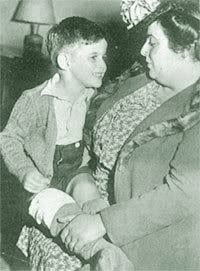
Paul Langley,https://www.facebook.com/paul.langley.9822/posts/10213752429593121CAL-2, 14 Aug 17, 5 yr-old Simon Shaw and his mum. Simon was flown from Australia to the US on the pretext of medical treatment for his bone cancer. Instead, he was secretly injected with plutonium to see what would happen. His urine was measured, and he was flown back to Australia.
Though his bodily fluids remained radioactive, Australian medical staff were not informed. No benefit was imparted to Simon by this alleged “medical treatment” and he died of his disease after suffering a trip across the world and back at the behest of the USA despite his painful condition. The USA merely wanted a plutonium test subject. They called him CAL-2. And did their deed under the cover of phony medicine.
“Congress of the United States, House of Representatives, Washington, DC 20515-2107, Edward J. Markey, 7th District, Massachusetts Committees, [word deleted] and Commerce, Chairman Subcommittee on Telecommunications and Finance, Natural Resources, Commission on Security and Cooperation in Europe] MEMORANDUM To: Congressman Edward J. Markey From: Staff Subject: The Plutonium Papers Date: 4/20/94
Staff Memo on Plutonium Papers
The medical file for Cal-2 also contains correspondence seeking follow-up from Argonne National Laboratory in the 1980s. Cal-2 was an Australian boy, not quite five years old, who was flown to the U.S. in 1946 for treatment of bone cancer. During his hospitalization in San Francisco, he was chosen as a subject for plutonium injection. He returned to Australia, where he died less than one year later.
Document 700474 is a letter from Dr. Stebbings to an official at the Institute of Public Health in Sydney, Australia, in an attempt to reach the family of Cal-2. This letter reports that the child was “injected with a long-lived alpha-emitting radionuclide.” Document 700471 is a letter from Dr. Stebbings to New South Wales, Australia (names and town deleted), inquiring about recollections of the boy’s hospitalization in 1946. The letter notes that, “those events have become rather important in some official circles here,” but provides few details to the family.
A hand-written note on the letter reports no response through October 8, 1987. Considering the history on the lack of informed consent with these experiments, it is surprising that the letters to Australia failed to mention the word “plutonium.”
The Australian news media has since identified Cal-2 as Simeon Shaw, the son of a wool buyer in New South Wales, and information on the injection created an international incident. The information in the medical file does indicate that at a time when Secretary Herrington told you that no follow-up would be conducted on living subjects, the Department of Energy was desperately interested in conducting follow-up on a deceased Australian patient.
In an effort to determine the full extent of follow-up by the Department after 1986, your staff has requested, through the Department’s office of congressional affairs, the opportunity to speak with Dr. Stebbings, Dr. Robertson, and any other officials who may have been involved in the follow-up. So far, that request has been unsuccessful. It remains an open question as to what was the full extent of follow-up performed in the 1980s, and whether the efforts then would facilitate any further follow-up on subjects now. It seems appropriate for the Interagency Working Group to address these questions as its efforts continue.”
NO MORE DUAL USE ABUSE OF AUSTRALIANS MR PRESIDENT. STOP FUNDING SYKES AND FLINDERS UNIVERSITY IN THE DOE QUEST FOR CHEAP CLEANUP OF URANIUM CONTAMINATED SITES.
Mr. President, you are wrong if you think you can do the same again re hormesis funding in Australia as the USA did with CAL-2. We have not forgotten and do not trust you or your paid agents in Australian universities such as Flinders.
A PUBLIC sector department has told employees to cease using the term ‘climate change’ and opt for other more benign words instead. Benedict Brook@BenedictBrook, news.com.au , 8 Aug 17 GOVERNMENT employees in the US have been given a dictionary of accepted words to use — and “climate change” isn’t one of them.
In a directive reminiscent of George Orwell’s dystopian novel Nineteen Eighty-Four, where people were only allowed to communicate in an ever diminishing language called “newspeak”, employees of the US Department of Agriculture (USDA) have been told to ditch the word “climate change”.
They should use “weather extreme” instead.
The clampdown comes as President Donald Trump further distances the US from global moves to limit global warming. Last week, the US formally announced its withdrawal from the Paris Agreement on climate change.
In a series of emails received by the Guardian, the director of the USDA’s soil health department, Bianca Moebius-Clune, listed terms that should be avoided and the alternatives to be used instead.
As well as giving climate change the flick, staff were told to avoid the term “climate change adaptation” and instead opt for “resilience to weather extremes”.
When talking about the cause of climate change, sorry “weather extremes”, saying people should “reduce greenhouse gases” is a big no-no. Rather, staff should talk in favour of “build soil organic matter, increase nutrient use efficiency”.
The email was dated 16 February but has only just come to light.
However, far from being a politically motivated reaction against the science of climate change, the instructions to staff may instead be a way for the Government department to continue its work without ruffling feathers in a White House averse to discussing global warming.
In the missive, Ms Moebius-Clune said that, “we won’t change the modelling, just how we talk about it — there are a lot of benefits to putting carbon back in the soil, climate mitigation is just one of them”.
The Guardian report added that public relations staff from the USDA had advised departments should “tamp down on discretionary messaging right now”.
The USDA denied it was limited discussion of climate change.
In a statement, the department said, “this guidance, similar to procedures issued by previous administrations, was misinterpreted by some to cover data and scientific publications.
Under guidance from the agency’s director of soil health, Bianca Moebius-Clune, a list of phrases to be avoided includes “climate change” and “climate change adaptation”, to be replaced by “weather extremes” and “resilience to weather extremes”.
Also blacklisted is the scary locution “reduce greenhouse gases” – and here, the agency’s linguists have done an even better job of camouflage: the new and approved term is “increase nutrient use efficiency”.
The effectiveness of this approach – based on the well-known principle that what you can’t say won’t hurt you – has previously been tested at the state level, making use of the “policy laboratories” provided by America’s federalist system.
In 2012, for instance, the North Carolina general assembly voted to prevent communities from planning for sea level rise. Early analysis suggests this legislation has been ineffective: Hurricane Matthew, in 2016, for instance drove storm surge from the Atlantic ocean to historic levels along the Cape Fear river. Total damage from the storm was estimated at $4.8bn.
It is true that the next year “unprecedented” coral bleaching blamed on rising temperatures destroyed vast swaths of the state’s reefs: from Key Biscayne to Fort Lauderdale, a survey found that “about two-thirds were dead or reduced to less than half of their live tissue”. Still, it’s possible that they simply need to increase their nutrient use efficiency.
At the federal level, the new policy has yet to show clear-cut success either. As the say-no-evil policy has rolled out in the early months of the Trump presidency, it coincided with the onset of a truly dramatic “flash drought” across much of the nation’s wheat belt.
As the Farm Journal website pointed out earlier last week: “Crops in the Dakotas and Montana are baking on an anvil of severe drought and extreme heat, as bone-dry conditions force growers and ranchers to make difficult decisions regarding cattle, corn and wheat.”
In typically negative journalistic fashion, the Farm Journal reported that “abandoned acres, fields with zero emergence, stunted crops, anemic yields, wheat rolled into hay, and early herd culls comprise a tapestry of disaster for many producers”.
Which is why it’s good news for the new strategy that the USDA has filled its vacant position of chief scientist with someone who knows the power of words.
In fact, Sam Clovis, the new chief scientist, is not actually a scientist of the kind that does science, or has degrees in science, but instead formerly served in the demanding task of rightwing radio host (where he pointed out that followers of former president Obama were “Maoists”). He has actually used the words “climate change” in the past, but only to dismiss it as “junk science”.
Under his guidance the new policy should soon yield results, which is timely since recent research (carried out, it must be said, by scientist scientists at MIT) showed that “climate change could deplete some US water basins and dramatically reduce crop yields in some areas by 2050”. But probably not if we don’t talk about it. Bill McKibben is the founder of the climate campaign 350.org.
Japan’s Anticonspiracy Law Draws Mixed Responses http://jen.jiji.com/jc/eng?g=eco&k=2017071100602, Tokyo, July 11 (Jiji Press)–Japan’s controversial anticonspiracy legislation, which took effect on Tuesday, has been welcomed by some as being necessary as part of the nation’s efforts to prevent terrorism, while others are concerned that it could lead law-enforcement authorities to launch investigations prematurely before conditions are met and help create a surveillance society.
The revised organized crime punishment law now newly enables authorities to criminalize people planning and preparing to commit acts of terrorism and other serious offenses.
Noting that Japan can ratify the U.N. Convention against Transnational Organized Crime following the enforcement of the law, a senior police official expressed hopes that the country will be able to “cooperate more smoothly with other signatories in criminal investigations and handovers of suspects,” leading to progress in probes into organized crimes.
The official brushed aside concerns over possible abuse of the law by investigative authorities. Any compulsory investigations require search warrants from courts, meaning that such probes are subject to judicial scrutiny, the official noted.
Still, the official said that the application of the law to specific cases will have to be considered carefully, citing parliamentary debates on the legislation during which opposition parties strongly opposed the legislation.
Anticonspiracy Law Comes into Force in Japan
Tokyo, July 11 (Jiji Press)–The anticonspiracy law took effect in Japan on Tuesday, allowing authorities to criminalize planning and preparations to commit serious crimes, including terrorist attacks.
The government now plans to ratify promptly the U.N. Convention against Transnational Organized Crime so that the country can share investigative information about organized crimes with other nations.
Under the law, a group of two or more people can be punished for plotting a crime at the planning stage, or before committing it, if any member starts an act of preparation for the crime.
The Diet, Japan’s parliament, enacted the law last month, with support from the ruling coalition of the Liberal Democratic Party and Komeito, as well as Nippon Ishin no Kai, an opposition party.
During Diet debates on the controversial law, opposition parties expressed concerns that investigative authorities may use the law arbitrarily.
From January 1, 2018, there will be an obligation on almost all employers to implement reporting/whistleblowing schemes.
France has historically been very reluctant to support workplace whistleblowing, especially anonymously. Whistleblowing schemes were effectively only authorized in 2005 to permit US companies to comply with their SOX obligations. Those regulations were very restrictive, limited to employees and only in relation to certain legal breaches.
However, since December 2016, we now have a law relating to “transparency, the fight against corruption and modernization of business life,” also known as “Sapin 2.” This has introduced a number of changes, including the obligation to implement whistleblowing schemes and anti-corruption compliance programs.
Definition of Whistleblower
Sapin 2 Law defines a whistleblower (in French “lanceur d’alerte”) as:
Any individual (i.e., not limited to employees)
Acting in good faith
Reporting or revealing a crime, a serious and manifest breach to an international treaty, a serious breach of a law or regulation, or a serious threat or harm to the public interest
Of which he or she has personal knowledge……….
Principles Governing Reporting Schemes
Reporting schemes must protect the identity of the whistleblower, the identity of any person incriminated and the information collected. The disclosure of any of these details carries up to two years’ imprisonment and a €30,000 fine (€150,000 for corporations)……….
Breach of Secrecy by the Whistleblower
A whistleblower will not be liable for breaching a secrecy obligation by law provided that:
The disclosure is necessary and proportionate for the protection of the interests at stake, and
The reporting procedures provided by law are complied with
However, Sapin 2 does not allow a whistleblower to disclose information covered by doctor/patient or client/lawyer professional secrecy or national security.
No Retaliation
Whistleblowers are protected from retaliation in the hiring process, in terms of access to an internship or professional courses or in salary or otherwise. However, where the report is made in bad faith, the employee can: