Swedish drones shine light on potential threat to nuclear plants, say Nuclear Free Local Authorities (NFLA)

Recent reports of mysterious drones overflying several nuclear power plants in Sweden have illustrated just one of the possible future threats faced by Britain’s reactors that must be addressed, say the UK and Ireland Nuclear Free Local Authorities (NFLA).
In his letter to the Nuclear Decommissioning Authority, NFLA Steering Committee Chair, Councillor David Blackburn, has identified ‘a void (of information) on the preparations in place to deter physical attacks upon nuclear facilities or the theft of nuclear materials from site’, and he has called the absence of such information in the agency’s latest Draft Business Plan for 2022-25 ‘not reassuring’.
In December 2021, the Non-Proliferation Policy Education Centre published a paper outlining the risks posed by military and terrorist strikes on nuclear facilities in the Middle East. Although the dynamic in the UK is not the same, the NFLA wants the NDA to draw from it the relevant lessons about the vulnerability of nuclear plants to strikes by missiles and drones, sophisticated technologies now increasingly available to terrorist groups as well as nation states.
On 18 January, BBC News reported sightings of drones in preceding days over the Forsmark, Ringhals, and Oskarshamn nuclear power plants. The Swedish Police appealed to the public to come forward with information, and the Swedish Security Service, Sapo, launched an investigation into the perpetrators who were suspected of ‘grave unauthorised dealing with secret information’.[i]
These recent developments have prompted the NFLA to call for the NDA to include in its final Business Plan ‘some record of any activity or exercises, or future plans, to address these threats (subject to restrictions on the disclosure of sensitive information on grounds of security)’.
Speaking for the NFLA Steering Committee Chair, Cllr David Blackburn, said:
‘Although the NFLA welcomes the NDA’s stated commitment to participate in exercises to counter cyber attacks, it is worrying that the current draft Business Plan is silent on the preparations that the NDA and its partners has in place to counter any potential physical terrorist attack on a facility, which might be by land, air or sea, or upon nuclear waste in transit, or to prevent the theft of nuclear materials from sites. It is our hope that we can see further detail in the final version.’
Cracks found in Civaux nuclear reactors, both 1 and 2
On 21 October 2021, following ultrasonic checks scheduled during the
second ten-yearly outage of Civaux NPP reactor 1 (1450 MWe reactor), EDF
informed ASN that it had detected indications on welds on the elbows of the
safety injection system piping[2] of the reactor’s main primary system
(see image below).
As Civaux NPP reactor 2 was the only 1450 MWe reactor
not yet to have undergone these types of checks, EDF shut it down in
November 2021 so that they could be carried out ahead of the date initially
scheduled for its second ten-yearly outage.
The checks confirmed the
presence of indications similar to those of reactor 1. On 15 December 2021,
EDF informed ASN that the metallurgical analyses conducted on the parts of
the pipes removed from Civaux NPP reactor 1 had revealed the presence of
cracking resulting from an unexpected stress corrosion phenomenon on the
inner face of the piping, close to the weld bead.
ASN 31st Jan 2022
MOST of Iran’s nuclear facilities are vulnerable to devastating drone attacks
Iran Fukushima warning: Iran’s nuclear plants could be WIPED OUT https://www.express.co.uk/news/world/1558057/Iran-news-nuclear-threat-war-latest
MOST of Iran’s nuclear facilities are vulnerable to devastating drone attacks, a report has found.
By MARCO GIANNANGELI – DIPLOMATIC EDITOR11:00, Sun, Jan 30, 2022 But using unmanned vehicles (UMVs) laden with explosives could lead to a critical Fukushima-style reactor meltdown.
The revelation comes as diplomatic efforts to rein in Iran’s nuclear ambitions continue to flounder, with former Italian foreign minister Giulio Terzi last night warning: “The Iran nuclear deal is already on life-support and it is very possible that it might falter altogether due to Iran’s shameless violations.”
Detailed analysis of its 22 nuclear facilities by Dr Bahram Ghiassee, of the Henry Jackson Society think-tank, found that all except the Fordow fuel enrichment plant, near Qom – built into a mountain – are vulnerable to drone strikes which could incapacitate them.
And burying the Fordow facility under 60 metres of rock does not protect it from attacks on air shafts and other external supply systems.
While many facilities would result in little overall impact if attacked, there are glaring exceptions, the report found. These include the conversion plant at the Esfahan nuclear technology centre – a critical part of the nuclear fuel cycle – and the Bushehr nuclear power plant on the Persian Gulf.
The same applies to the Natanz enrichment facility now being rebuilt into a mountain after an explosion – believed to have been caused by Israel – destroyed the previous overland structure.
Though nuclear power plants are built to withstand light aerial attacks, Bushehr’s ancillary facilities “are highly vulnerable to aerial attacks, including drone strikes”, said the report, including by “commercially available as ‘Surface UMVs’ and ‘Submersible UMVs’, with an operating range of some 120 kilometres. “
However, Dr Ghiassee, a nuclear consultant, added: “A synchronised attack on the cooling water facilities, external electricity supply and electricity distribution systems could lead to the overheating of the reactor core and the spent fuel ponds.
“Under such circumstances, as in the Fukushima nuclear accident, the reactor core could melt down.”
Attacks against Iranian nuclear facilities are not a new phenomenon.
The Bushehr power plant was attacked by Saddam Hussein during the Iran-Iraq war in 1980, though this caused minor damage.
More recently, Iran has been the recipient of incapacitating explosions, cyber strikes and UMV attacks.
Though not confirmed by Tel Aviv, these are believed to have been carried out by Israel after it openly pledged never to allow Iran – which has threatened to blow Israel off the face of the world – to possess nuclear weapons.
We have a duty to be brave and responsible for the fate of our children and grandchildren. We have used force against our enemies in the past, and we are convinced that in extreme situations, there is a need to act using military means,” said Israeli Deputy Defence Minister Alon Schuster recently.
Actions have included the assassination of Iranian nuclear scientists, the explosion at Natanz in 2020 – said to have been caused by the provision of faulty materials following Mossad’s infiltration of the supply chain- and the cyber strike in 2010 using the Stuxnet virus, which reportedly infected more than 200,000 commuters and destroyed a fifth of Iran’s nuclear centrifuges.
Explanation of near-miss at San Onofre Nuclear Generating Station (SONGS).

NEAR-MISS AT NUCLEAR SITE AT SAN ONOFRE EXPLAINED https://www.surfer.com/environmental-news/nuclear-san-onofre-near-miss-explained/
SONGS ALMOST SUFFERED A SERIOUS ACCIDENT IN AUGUST, NEW DETAILS EMERGE, NOVEMBER 9, 2018 BY JUSTIN HOUSMAN Back in August, workers at the San Onofre Nuclear Generating Station (SONGS), were lowering a 50-ton spent nuclear fuel canister into a holding tank at the controversial nuclear storage site, not far from Old Man’s. While the workers thought they’d lowered it all the way, the massive canister containing deadly amounts of nuclear waste, was resting–barely–on a metal ring at the top of the tank, never intended to support the weight of the canister.
Nuclear incidents and meltdowns – far more than we realised

Incidents AND MELTDOWNS AND THERE ARE FAR MORE THAN WE REALISED
FUKUSHIMA
CHERNOBYL SELLAFIELD THE INLAND SANTA SUSANA FIRES SANTA SUSANNA MELTDOWNS. INCIDENTS ANS WILDFIRES AT LOS ALAMOS
WILD FIRES AT HANFORD
THE GREEN RUN
THE NUCLEAR MELTDOWN IN 1969 IN SWITZERLAND
The recent chinese reactor nuclear incident.
INCIDENTS 1957 to 2011
with multiple fatalitIies

September 29, 1957 Mayak, Kyshtym, Soviet Union The Kyshtym disaster was a radiation contamination accident (after a chemical explosion that occurred within a storage tank) at Mayak, a Nuclear fuel reprocessing plant in the Soviet Union.
October 10, 1957 Sellafield, Cumberland, United Kingdom Windscale fire was a fire at the British atomic bomb project (in a plutonium-production-reactor) damaged the core and released an estimated 740 terabecquerels of iodine-131 into the environment. A rudimentary smoke filter constructed over the main outlet chimney successfully prevented a far worse radiation leak.

March – July 1959 , Santa Susana Field Lab , Western San Fernando Valley, USA. At least four of the ten nuclear reactors suffered accidents incl Partial meltdown, 1964, 1969 further accidents
January 3, 1961 Idaho Falls, Idaho, United States Explosion at SL-1 prototype at the National Reactor Testing Station. All 3 operators were killed when a control rod was removed too far.
October 5, 1966 Frenchtown Charter Township, Michigan, United States Meltdown of some fuel elements in the Fermi 1 Reactor at the Enrico Fermi Nuclear Generating Station. Little radiation leakage into the environment
January 21, 1969 Lucens reactor, Vaud, Switzerland On January 21, 1969, it suffered a loss-of-coolant accident, leading to meltdown of one fuel element and radioactive contamination of the cavern, which before was sealed.
December 7, 1975 Greifswald, East Germany Electrical error in Greifswald Nuclear Power Plant causes fire in the main trough that destroys control lines and five main coolant pumps
January 5, 1976 Jaslovské Bohunice, Czechoslovakia Malfunction during fuel replacement. Fuel rod ejected from reactor into the reactor hall by coolant
March 28, 1979 Three Mile Island, Pennsylvania, United States Loss of coolant and partial core meltdown due to operator errors and technical flaws. There is a small release of radioactive gases.
September 15, 1984 Athens, Alabama, United States Safety violations, operator error and design problems force a six-year outage at Browns Ferry Unit 2
March 9, 1985 Athens, Alabama, United States Instrumentation systems malfunction during startup, which led to suspension of operations at all three Browns Ferry
April 11, 1986 Plymouth, Massachusetts, United States Recurring equipment problems force emergency shutdown of Boston Edison’s Pilgrim Nuclear Power
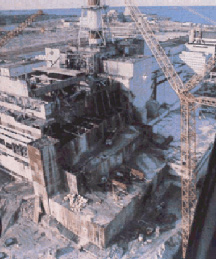
April 26, 1986 Chernobyl, Chernobyl Raion (Now Ivankiv Raion), Kiev Oblast, Ukraininan SSR, Soviet Union A flawed reactor design and inadequate safety procedures led to a power surge that damaged the fuel rods of reactor no. 4 of the Chernobyl power plant. This caused an explosion and meltdown, necessitating the evacuation of 300,000 people and dispersing radioactive material across Europe (see Effects of the Chernobyl disaster).
Around 5% (5200 PBq) of the core was released into the atmosphere and downwind.
May 4, 1986 Hamm-Uentrop, West Germany Experimental THTR-300 reactor releases small amounts of fission products (0.1 GBq Co-60, Cs-137, Pa-233) to surrounding area 0 267
December 9, 1986 Surry, Virginia, United States Feedwater pipe break at Surry Nuclear Power Plant kills 4 workers 4
March 31, 1987 Delta, Pennsylvania, United States Peach Bottom units 2 and 3 shutdown due to cooling malfunctions and unexplained equipment problems 0 400
December 19, 1987 Lycoming, New York, United States Malfunctions force Niagara Mohawk Power Corporation to shut down Nine Mile Point Unit 1 0 150
March 17, 1989 Lusby, Maryland, United States Inspections at Calvert Cliff Units 1 and 2 reveal cracks at pressurized heater sleeves
October 19, 1989 Vandellòs, Spain A fire damaged the cooling system in unit 1 of the Vandellòs nuclear power plant, getting the core close to meltdown. The cooling system was restored before the meltdown but the unit had to be shut down due to the elevated cost of the repair
March 1992 Sosnovyi Bor, Leningrad Oblast, Russia An accident at the Sosnovy Bor nuclear plant leaked radioactive iodine into the air through a ruptured fuel channel.
February 20, 1996 Waterford, Connecticut, United States Leaking valve forces shutdown Millstone Nuclear Power Plant Units 1 and 2, multiple equipment failures found 0 254
September 2, 1996 Crystal River, Florida, United States Balance-of-plant equipment malfunction forces shutdown and extensive repairs at Crystal River
September 30, 1999 Ibaraki Prefecture, Japan Tokaimura nuclear accident killed two workers, and exposed one more to radiation levels above permissible limits.
February 16, 2002 Oak Harbor, Ohio, United States Severe corrosion of reactor vessel head forces 24-month outage of Davis-Besse reactor
April 10, 2003 Paks, Hungary Collapse of fuel rods at Paks Nuclear Power Plant unit 2 during its corrosion cleaning led to leakage of radioactive gases. It remained inactive for 18 months.
August 9, 2004 Fukui Prefecture, Japan Steam explosion at Mihama Nuclear Power Plant kills 4 workers and injures 7
July 25, 2006 Forsmark, Sweden An electrical fault at Forsmark Nuclear Power Plant caused multiple failures in safety systems that had the reactor to cool down
March 11, 2011 3 meltdowns Fukushima, Japan A tsunami flooded and damaged the plant’s 3 active reactors, drowning two workers. Loss of backup electrical power led to overheating, meltdowns, and evacuations.] One man died suddenly while carrying equipment during the clean-up. The plant’s reactors Nr. 4, 5 and 6 were inactive at the time.
September 12, 2011 Marcoule, France One person was killed and four injured, one seriously, in a blast at the Marcoule Nuclear Site. The explosion took place in a furnace used to melt metallic waste.
And this is the tip of the iceberg
Anniversary Of The Night Nuclear Bombs Fell Near Goldsboro
Anniversary Of The Night Nuclear Bombs Fell Near Goldsboro https://www.goldsborodailynews.com/2022/01/24/anniversary-of-the-night-nuclear-bombs-fell-near-goldsboro/January 24, 2022 Ken Conners
It’s the 61st anniversary of the big bang that, fortunately, never happened.
Around midnight on January 24th, 1961, a B-52G aircraft based at Seymour Johnson Air Force Base experienced a fuel leak and broke up in midair over Wayne County.
Five crewmen were able to successfully eject or bail out of the aircraft, but three did not survive the crash.
Two Mark 39 nuclear bombs being carried on the bomber plummeted to the earth, landing with the wreckage in the farmlands of Faro, about 12 miles north of Goldsboro.
Declassified information eventually showed one of the bombs came very close to detonating with 3 of 4 arming mechanisms being tripped in the crash. One of the bombs was recovered while portions of the second sank into a muddy field never to be seen again.
Germany formally opposes inclusion of nuclear energy in EU’s ”sustainable” taxonomy

Germany cries foul over nuclear energy in EU’s green rule book, Daily Sabah, BY REUTERS, BERLIN JAN 23, 2022 German Chancellor Olaf Scholz’s three-party coalition government has raised objections to a European Union draft plan to label nuclear power plants as a sustainable energy source in a formal letter to Brussels, ministers said on Saturday.
The EU taxonomy aims to set a gold standard for green investments, helping climate-friendly projects to pull in private capital and stamping out “greenwashing,” where investors and companies overstate their eco-credentials.
“As the federal government, we have once again clearly expressed our rejection of the inclusion of nuclear energy. It is risky and expensive,” Vice Chancellor and Economy Minister Robert Habeck said in a joint statement with Environment Minister Steffi Lemke, both senior members of the Greens party.
In its letter to Brussels, published by the Economy Ministry on its webpage, the German government also pointed to the lack of any safety requirements regarding nuclear power plants.
“Serious accidents with large, cross-border and long-term hazards to humans and the environment cannot be excluded,” Berlin said in its letter, adding that the question of where to store radioactive waste in the long term was still unanswered.
Habeck and Lemke said that Berlin should reject the plan in their opinion if the European Commission disregarded Germany’s objections and left the draft plan unchanged.
However, German government sources told Reuters earlier this month that coalition parties wanted to avoid escalating the EU dispute and agreed in coalition talks behind closed doors to abstain in any upcoming vote.
Long delayed
The EU rules have been long delayed, with countries split over whether nuclear energy and natural gas deserve a green badge. Austria has already said it would take legal action if the European Commission proceeds with its draft plan to label both as sustainable investments………………………..
The commission hopes to adopt a final draft by the end of the month. https://www.dailysabah.com/business/energy/germany-cries-foul-over-nuclear-energy-in-eus-green-rule-book
Officials at San Onofre conspicuously silent on the risks of tsunami waves to nuclear waste storage.
The tsunami advisory that woke up the West Coast Jan. 15 should serve as a wake-up call on flooding dangers at the nuclear waste storage facility in San Onofre. The facility is 100 feet from the beach.
During high tides, waves crash into an aging bulkhead that separates the sea from the storage
vault — a kind of crypt that holds 73 thin-walled, metal canisters jam-packed with 3.6 million pounds of deadly, radioactive waste.
According to Southern California Edison, the sprawling, concrete vault will flood from a storm at high tide. If the ocean were to swamp the so-called Independent Spent Fuel Storage Installation, we could have an unsurpassed disaster on our hands, an uncontrolled criticality, one that has never occurred in the U.S. commercial power industry.
The undersea volcanic eruption this month near Tonga sent waves across the Pacific. Officials in
Hawaii reported tsunami wave heights of nearly 3 feet. At San Diego Harbor, officials measured more than a half-foot of sea level rise. Meanwhile, officials from shuttered San Onofre Nuclear Generating Station remained conspicuously silent.
Times of San Diego 20th Jan 2022
The production, servicing and berthing of nuclear-powered submarines in or near population centres present unacceptable health risks.

Following revelations in freedom of information requests to Declassified UK records show 97,430 stable iodine tablets were pre-issued to people in Plymouth, Portland and Barrow-in-Furness from 2016-21 to protect them from radiation.
Kate Hudson, general secretary of the Campaign for Nuclear Disarmament (CND), said: “The production, servicing and berthing of nuclear-powered submarines in or near population centres present unacceptable health risks.
“Safeguarding our communities cannot be achieved through limited distribution of pills,” she said, adding that the vessels, some of which carry nuclear warheads, “need to be disarmed and decommissioned.” As Tim Deere-Jones has pointed out “I’m amazed at the way Governments and Regulators allow the “nuclear authorities” to mainstream on publicly highlighting the dangers of one or two radionuclides such as Iodine and Caesium and discuss them endlessly while avoiding the additional issues of the other 50/60 + nuclides that would be released by a meltdown or a LOCA or any other significant event.”
Radiation Free Lakeland 22nd Jan 2022
Design flaws in Flamanville EPR nuclear reactor vessel, and attempts to solve this
The EPR reactor vessel is not designed like the previous vessels, and the
water does not follow the flow movements observed on conventional reactors.
EDF engineers therefore had a piece of metal (deflector) installed in each
tank bottom to redirect the water correctly. But that would be
insufficient.
What solutions? The most logical solution would therefore be
to change this deflector “with the key to a work of development as
complex as ruinous, notes the weekly. And no one is sure, given the limited
space available in an EPR tank, that this repair is technically
possible”.
The other solution envisaged would therefore be to “reinforce
the fuel assemblies, reinforce the protective grids so that the blades
resist the flows”, mentioned Julien Collet.
EDF will present its plan to us
in February, so we can see if their proposals can solve the problem.
Another possibility mentioned at the end of the article: “To limit the
pressures of the water, it would be a question of running the EPR at only
60% of its power, Flamanville would then go from a capacity of 1,650
megawatts less than 1,000 and would end up, for a record bill of 13 billion
euros, less efficient than the reactors built 50 years ago.”
La Presse de la Manche 20th Jan 2022
Row over plans to reform groups at nuclear sites.
Rob Edwards The Ferret, January 23, 2022,
New guidelines which campaigners say could benefit communities around nuclear sites have been boycotted by a UK Government nuclear agency.
Internal documents seen by The Ferret reveal that the Nuclear Decommissioning Authority (NDA) has rejected proposed reforms because they had caused “a great deal of bad feeling”
Guidelines aimed at making local meetings about safety at nuclear sites across the UK more transparent, accountable and representative were put forward in a nuclear industry report.
There are 29 licensed nuclear sites around the UK, six of them in Scotland. They include nuclear power stations operating and being decommissioned, nuclear submarine bases, waste and processing plants.
All of the sites have stakeholder or local liaison groups aimed at keeping local communities informed about events, including shutdowns, safety incidents and radiation leaks. But they differ greatly in how they are run…………………………..
In 2017 the 50-strong group of nuclear-free local authorities in the UK published a report questioning whether the stakeholder and local liaison groups were “fit for purpose”. It concluded that there was an “urgent need” to reform them.
This prompted the nuclear industry’s Safety Directors’ Forum, which brings together senior managers from all the civil and military nuclear sites, to commission a report. It was researched and written by the industry’s industry’s Young Nuclear Professionals’ Forum.
The resulting “Good Practice Guide” was circulated in November 2021. “Nuclear sites often have a reputation of being opaque, secretive and unwilling to engage with the public,” it said.
“This negative reputation is actively damaging, from open opposition to the site’s existence to a general lack of understanding. Active engagement is key to undoing this, the nuclear industry must be open and honest.”
The report argued that local liaison groups at several unidentified nuclear sites had “no accountability”. This included “no terms of reference being in place, no clear action management process, inadequate minute taking and infrequent meetings.”
It pointed out that while some meetings were open to the public, others were not. Some groups only invited “selected stakeholders” and “diversity and inclusion is not always encouraged”.
Some of the groups didn’t have websites. “Meetings are not always accessible and, in some cases, not comprehensible due to the extensive use of acronyms, particularly for those who do not work in the nuclear industry,” the report added.
The report recommended that the groups should all have websites, clear and published constitutions and a “diverse range of stakeholders”. There should be a co-chair independent of the industry and members of the public should be allowed to ask questions.
correspondence released under freedom of information law has disclosed how the report has upset the NDA and some of the existing groups………………………………… https://theferret.scot/nuclear-sites-reforms-row/
Does the Flamanville EPR nuclear reactor have a design fault?

Nuclear: is the Flamanville EPR vessel poorly designed? In its edition of
Wednesday January 19, 2022, Le Canard Enchaîné details the problem on the
Taishan EPR and links it to the Cotentin site. “EDF is struggling to sleep
off its nuclear”. This is the title at the top of page 3 of the Chained
Duck of this Wednesday, January 19, 2022.
Is this a new article following the announcement, a week ago, of a delay and an additional cost of 300
million euros for the construction of the future Flamanville EPR reactor?
No, there is no question of re-welding operations taking longer than
expected.
“The energy company must face a formidable puzzle encountered on
the reactor vessel, where nuclear fission takes place”, immediately
announces the journalist Hervé Liffran. The concern was flushed out
following an incident on the other side of the world, in China. The Taishan
nuclear power plant, with the world’s first operating EPR reactor, was shut
down on July 30, 2021, after damaged fuel rods caused a buildup of
radioactive noble gases in the reactor’s primary circuit .
La Presse de la Manche 20th Jan 2022
Stranded in Vladivostok: KIMO International and NFLA express concern at mysterious plight of Russian nuclear-powered freighter

Richard Outram, KIMO International, 19th January 2022,
KIMO International and the UK/Ireland Nuclear Free Local Authorities, two organisations campaigning for pollution-free oceans have expressed their concerns at the possible danger posed to the marine environment by a Russian nuclear-powered freighter stranded in the Russian Far East.
The Sevmorput (or Northern Sea Route) is the sole survivor of Russia’s original fleet of four nuclear powered cargo ships which traversed the Arctic trade routes. Sevmorput has now been operational for over thirty years, and though refitted within the last decade, is showing her age with recent voyages plagued by mechanical breakdowns. Her latest transit of the Northern Sea Route which links North Western Russia to Eastern Siberia ended badly.
The Sevmorput was ordered in 1978 and was completed more than a decade later. With a maximum seasonal displacement of 62,000 tons and 260 metres in length, the ship is powered by a single 135 MWt reactor at a maximum speed of 21 knots. With an ice-breaking capacity, the ship can pass through 1 metre thick ice at a speed of 2 knots.
Operated by the Murmansk Shipping Company for her first twenty years of service, the Sevmorput was transferred to ATOMFLOT, the mercantile marine subsidiary of ROSATOM, Russia’s State Atomic Energy Corporation, in 2008.
In early November 2021 the Sevmorput set sail from western Russia to Vladivostok, via the Arctic with a cargo of reactor parts, intended for transshipment to another vessel for onward transport to the Rooppur nuclear project in Bangladesh. The Rooppur plant is being built under contract by ROSATOM. During the passage, sea ice conditions worsened, but the Sevmorput, with nuclear propulsion and its ice-breaking capability, was able to battle through to Vladivostok.
Other shipping was less fortunate with a significant number of vessels becoming frozen fast in the Arctic, necessitating rescue by ROSATOM’s fleet of nuclear-powered ice breakers. Amongst them were ships carrying supplies to the copper and gold mines and processing plants at Pevek in the remote Chukotka region of Eastern Siberia and undefined spare parts and equipment for the Russian floating nuclear power plant, the Akademik Alexander Lomonosov which supplies Pevek with its heat and power; these cargoes remained undelivered.
In a response to the set-back, ROSATOM assigned the Sevmorput to hasten back to Murmansk, collect the supplies for Pevek and deliver them by early January. The ship was unable to carry out the assignment and it fell instead to ROSATOM’s newest icebreaker Arktica, escorting three cargo ships, to carry out this task.
For unexplained reasons, the Sevmorput has remained moored and immobile for almost two months, first at Nakohodka around 85 kms away from Vladivostok and then from early January anchored in an offshore ‘dry cargo holding area’ about 10kms away from the port. Here she is being attended to by another mysterious Russian vessel, identified only as ‘SPK-44150’, which has moored alongside the freighter.
ROSATOM has not explained why the Sevmorput was unable to sail to Pevek and has made no statement as to why the Sevmorput has been immobile for so long or about her current condition.
Commenting, Councillor Jerry Ahlström, President of KIMO International, said:
“Any leaks of radioactive material at sea will enter the marine environment where containment and remediation are near impossible. The lack of transparent emergency planning in the event of a marine accident involving nuclear materials and the question of liability and compensation in the event of a nuclear accident at sea raises huge concerns for KIMO’s coastal authority members.
“The consistent lack of decision-making input, of consultation and of information and transparency on shipping routes means they are left facing a real and present risk of harm that disempowers the very communities who health and livelihoods depend upon the sea.”
Commenting, Councillor David Blackburn, Chair of the NFLA Steering Committee, said:
“The NFLA is concerned that the immobility and isolation of this nuclear-powered vessel away from prying eyes for so long might indicate that there has been some kind of nuclear accident on board or that the vessel has suffered some equipment failure that seriously compromises nuclear safety on the ship.
“Our fear is of course that such a scenario might lead to an escape of radioactive materials into the atmosphere or into our oceans, where currents might carry it to distant shores compromising the health of the Pacific environment or its inhabitants. It would be helpful if ROSATOM made a statement about the condition of this vessel and the mysterious activities of the SPK-44150’. For more information please contact: Richard Outram, Secretary, NFLA email Richard.outram@manchester.gov.uk / mobile 07583 097793
The websites for both organisations can be found at:
KIMO International
Nuclear Free Local Authorities
Drones sighted over Sweden’s nuclear power stations
Days of sightings of drones over key Swedish sites including nuclear plants have prompted the country’s security service to take the lead in an investigation. Three nuclear sites have been targeted and sightings have been reported over airports and the royal palace. Authorities have not speculated on who is behind the mysterious drones. Police and the coastguard are searching the sea and islands around Stockholm, local media reports say.
The latest sightings on Monday evening involved a drone above the Forsmark nuclear plant, but security agency Sapo said it was also investigating earlier drone flights near the Ringhals and Oskarshamn power
plants. Police appealed to the public to come forward with information. Sapo said the drones were suspected of “grave unauthorised dealing with secret information”.
BBC 18th Jan 2022
https://www.bbc.co.uk/news/world-europe-60035446
10 out of 56 French nuclear reactors are currently shut down
“They are very anxious”: EDF in the face of nuclear reactor
breakdowns. Ten reactors out of 56 are shut down, i.e. 20% of French
nuclear production capacity. “In winter, the availability of the nuclear
fleet has never been so low”, observes RTE, the manager of the high voltage
network.
The black series continues for EDF. Thursday, January 13, the
group announced that a fourth nuclear reactor, Penly 1, in Seine-Maritime,
was affected by a corrosion problem on its safety injection system – a
device of capital importance in the event of a accident. His shutdown has
been extended until the end of May. Reporterre takes stock of the
situation.
Reporterre 15th Jan 2022
https://reporterre.net/Ils-sont-tres-angoisses-EDF-face-aux-pannes-de-reacteurs-nucleaires
https://nuclearinformation.wordpress.com/
1 This Month



26 September – International Day for the Total Elimination of Nuclear Weapons


PLEASE OPPOSE HR 8255 AND S.3639 – bills would accelerate satellite deployment, with no environmental review or safeguards – https://ncstd5li.quorum.us/campaign/169331/
To see nuclear-related stories in greater depth and intensity – go to https://nuclearinformation.wordpress.com
-
Archives
- September 2026 (233)
- August 2026 (330)
- July 2026 (355)
- June 2026 (287)
- May 2026 (306)
- April 2026 (356)
- March 2026 (251)
- February 2026 (267)
- January 2026 (308)
- December 2025 (358)
- November 2025 (359)
- October 2025 (375)
-
Categories
- 1
- 1 NUCLEAR ISSUES
- business and costs
- climate change
- culture and arts
- ENERGY
- environment
- health
- history
- indigenous issues
- Legal
- marketing of nuclear
- media
- opposition to nuclear
- PERSONAL STORIES
- politics
- politics international
- Religion and ethics
- safety
- secrets,lies and civil liberties
- spinbuster
- technology
- Uranium
- wastes
- weapons and war
- Women
- 2 WORLD
- ACTION
- AFRICA
- Atrocities
- AUSTRALIA
- Christina's notes
- Christina's themes
- culture and arts
- Events
- Fuk 2022
- Fuk 2023
- Fukushima 2017
- Fukushima 2018
- fukushima 2019
- Fukushima 2020
- Fukushima 2021
- general
- global warming
- Humour (God we need it)
- Nuclear
- RARE EARTHS
- Reference
- resources – print
- Resources -audiovicual
- Weekly Newsletter
- World
- World Nuclear
- YouTube
-
RSS
Entries RSS
Comments RSS
 nuclear-news