Danger déjà vu

by beyondnuclearinternational, https://beyondnuclearinternational.org/2025/10/01/danger-deja-vu/
With offsite power cut, peril returns to the Zaporizhzhia nuclear power plant in war-torn Ukraine, writes Linda Pentz Gunter
We have been here before, nine times. External power provided by the grid has been lost, backup diesel generators have been called into duty, and Ukraine and the rest of the world has held its collective breath, hoping we are not about to witness another major nuclear disaster.
This is once again the situation at the six-reactor Zaporizhzhia nuclear power plant (ZNPP) in southeast Ukraine, where for the tenth time external power has been lost. By September 30, that blackout had lasted seven days, the longest such stretch since the plant was first occupied by Russian forces on March 4, 2022, ten days after Russia invaded Ukraine and provoked a war that shows no sign of ending anytime soon.
Alarm is especially high at the Zaporizhzhia site given its size — the largest nuclear power plant in Europe — and enormous radioactive waste inventory of more than 2,000 metric tons. The plant has been embroiled in some of the worst of the fighting and has already suffered previous damage.
Meanwhile, Ukraine’s other nine reactors at three other sites are by no means immune to the dangers of being caught up in an indefinite war zone. In late September, a drone detonated just 875 yards from the perimeter of the South Ukraine three-reactor nuclear power plant. Monitors from the International Atomic Energy Agency (IAEA) said they observed at least 22 drones close to the facility.
“Once again, drones are flying far too close to nuclear power plants, putting nuclear safety at risk,” wrote the IAEA’s director general, Rafael Grossi in a September 25 statement after the drone incident. “Fortunately, last night’s incident did not result in any damage to the South Ukraine Nuclear Power Plant itself. Next time we may not be so lucky.” The IAEA nevertheless continues ardently to promote the use and expansion of nuclear power around the world.
Currently, all six reactors at Zaporizhzhia are in cold shutdown, which means less cooling is needed, but they are by no means out of danger. However, it is unclear how many members of the trained Ukrainian plant staff remain to operate the facility. According to an alarming new investigative report, Seizing Power, prepared by Truth Hounds and supported by Greenpeace Ukraine, numerous personnel have been abducted from the plant, interned and even tortured.
Cold shutdown means that fissioning in the reactors has stopped and the temperature of the reactor cores is below 200 F with the coolant system at atmospheric pressure. But this does not mean that further cooling is no longer required.
The fuel inside the reactors remains hot and requires a steady flow of cooling water which is why power is still needed on the site. Failure to achieve this would mean the fuel rods would heat up the water in the core, causing it to boil away, exposing the rods. This could then lead to fires, which in turn could cause hydrogen explosions of the kind we saw at the Fukushima Daiichi nuclear plant in March 2011. A meltdown is also still possible, although the time it would take to reach such a critical juncture is longer when the reactors are not operating.
The fuel pools, where much of the irradiated fuel is stored, also require continued cooling, although less so than the reactors, and risk the same outcome if cooling stops— a boiling away of the water exposing the rods and leading to a potential fuel pool fire.
The offsite power was being provided by the one still functioning power line into the site. Without it, workers have had to deploy backup diesel generators. There are reportedly 18 of these on site, with seven currently in use. But they cannot provide power indefinitely.
Accessing cooling water has also become more of a challenge. The Kakhovka Dam was destroyed in June 2023 leading to the depletion of the Kakhovka Reservoir, the vital water source for the Zaporizhzhia plant. Indeed, according Seizing Power, “the license to operate the ZNPP was premised on the availability of the Kakhovka Reservoir to supply water to the ZNPP and, in the event of an emergency, to function as a vital heat sink.” Instead, operators have been drilling for groundwater wells on-site in order to keep cooling water flowing into the reactors and the pools.
Of the 2,000 tons of radioactive waste stored on the Zaporizhzhia site, 855 tons are in the fuel pools and the rest in waste fuel casks. There are 200 different radioactive isotopes that could be released in the event of a disaster, an eventuality that could lead to both serious and fatal health consequences for those exposed, as well as longterm contamination of the environment and natural resources.
Such a release would also have a devastating impact on Ukraine’s economy, given the country’s role as a major agricultural exporter. Known as the “breadbasket of Europe,” Ukraine’s agricultural products account for close to 60 percent of all exports, predominantly grains.
And yet, despite the on-going war, “Ukraine’s agricultural exports reached $24.5 billion in 2024, accounting for 59% of the country’s total exports,” according to January 2025 figures from the Ukrainian Agriculture Ministry.
It is a loss Ukraine cannot afford but we have of course seen this very outcome once before, after the April 26, 1986 Chornobyl explosion and meltdown in Ukraine that left lands in much of the former Soviet Union and parts of Europe permanently radioactively contaminated.
Operating a nuclear power plant safely, even in shutdown mode, can be jeopardized by multiple external factors, but how the workforce functions is also key. Both the Three Mile Island and Chornobyl nuclear disasters were the result of human error. When people are working under duress and especially extreme fear, mistakes become more likely.
That makes the revelations in Seizing Power all the more shocking. Researchers compiled their evidence through firsthand accounts from the residents of Enerhodar, the city where the plant is located and which was also captured on March 4, 2022. After resistance to the occupation failed, the report said, “Repression and violence quickly became systematic, targeting territorial defense volunteers, pro-Ukrainian activists, and ZNPP staff who refused to collaborate, among others.”
At least seven detention centers were established, said the report, where at least 226 Enerhodar residents and ZNPP employees were held captive, “subjected to physical and psychological torture to extract information, force confessions, punish dissent, intimidate, and coerce collaboration. Russian forces deprived detainees of food, water, and medical care, contrary to the provisions of international law. Torture, including beatings, electrocution, sexual violence, mock executions, and threats to family members of detainees, became routine.”
Why would either side gamble with such a lethal liability as the safety of a nuclear power plant, given the potentially drastic outcome whose resulting deadly radioactive plume would know no borders? Russia has accused Ukraine of damaging the power lines near the plant. The Ukrainians have in turn suggested the Russians are using the disabling of the plant as a threat to drive them into submission and cede territory in the east. The Russians have already signaled that they intend to use the plant to supply electricity to Russia once it is safe to restart the reactors.
That the war in Ukraine (and others elsewhere) must end, is stating the obvious. Human suffering around the world is already too great and entirely avoidable. Wars involving nuclear power plants ramp up the risks monumentally. But those dangers are also ever present, given nuclear power is inherently dangerous both on good days and bad.
As we watch ever greater militarization occurring here in the United States, with war declared by the White House on our own cities and “the enemy within”; with the abrupt and unlawful detentions and deportations of workers; and with the reckless determination to keep not only our aging nuclear fleet in operation but also to revive already closed and dangerously decrepit reactors; we, too, are one wrong move away from experiencing a nuclear disaster.
Russian nuclear submarine: Fears as K-159 nuke vessel, that sank over 20 years ago, rusty and resting on seabed with highly radioactive fuel

By Isabella Boneham, Reporter, https://www.nationalworld.com/news/world/russian-nuclear-submarine-fears-as-k-159-nuke-vessel-that-sank-years-ago-resting-on-seabed-5337748
The decommissioned Soviet nuclear submarine K-159 is still at the bottom of the Barents Sea after sinking more than 20 years ago.
In August 2003, the K-159 sank in a storm while being towed for scrapping. The submarine, which had been decommissioned since 1989, was in poor condition and was not defueled.
The submarine lies at a depth of about 246 meters in Russian territorial waters, near the entrance to the Kola Bay. Russia was soon to announce that the sub should be lifted, although it would be challenging due to the outer hull’s rusty conditions.
But nothing happened and Europe-Russia ties turned gradually colder. Researchers have since then monitored the wreck, fearing leakages of radioactivity from the two old nuclear reactors onboard could contaminate the important fishing grounds in the Barents Sea.
The K-159 still contains about 800 kg of spent nuclear fuel in its two reactors, posing a long-term environmental risk. The rusty hull is in a state of advanced corrosion, increasing the chance of future radioactive leaks.
A joint Norwegian-Russian expedition examined the site in 2014 and concluded that no leakage has so far occurred from the reactors to the surrounding marine environment. According to the Barents Observer, Lithuania-based nuclear expert Dmitry Gorchakov with the Bellona Environmental Transparency Center is worried.
He said: “There is a possibility of leaks, of course. Especially since K-159 was not prepared for flooding”. He underlined that so far, to his knowledge, “no leaks have been found.”
Dmitry Gorchakov says it one day eventually will be necessary to bring up the K-159. However, plans have been put on hold due to the Russia-Ukraine war.
He said: “In the current conditions of isolation, it is unlikely Russia will be able to conduct such an operation alone. There is no necessary equipment, and there may not be money for this in the budget. I think in the coming years they will depict preparations for the lift, but nothing more”.
Thomas Nilsen, editor of The Barents Observer online newspaper, previously described the submarines as a “Chernobyl in slow motion on the seabed”. In a BBC report, Ingar Amundsen, head of international nuclear safety at the Norwegian Radiation and Nuclear Safety Authority, agreed that it is a question of when, not if, the sunken submarines will contaminate the waters if left as they are.
IAEA Races to Restore Power at Besieged Zaporizhzhya Nuclear Plant
Oil Price, By RFE/RL staff – Oct 01, 2025,
- Europe’s largest nuclear plant has been disconnected from the grid for over a week and is running on emergency diesel generators, one of which has already failed.
- Ukrainian President Zelenskyy warned of a “threat to everyone” as shelling prevents the repair of damaged power lines.
- IAEA head Rafael Grossi is mediating between Ukraine and Russia to restore offsite power, stressing that prolonged reliance on generators is unsustainable.
…………………………………………………………………………………………………………….https://oilprice.com/Alternative-Energy/Nuclear-Power/IAEA-Races-to-Restore-Power-at-Besieged-Zaporizhzhya-Nuclear-Plant.html
Suffolk County Council has no evacuation plan in case of a RAF Lakenheath nukes incident
Suffolk County Council has no evacuation plans in case of an incident
involving the US nuclear weapons which are widely believed to be held at
RAF Lakenheath, a Canary investigation can reveal. RAF Lakenheath nuclear
weapons: council has no evacuation plans in place. The base, which is owned
by the UK’s Royal Air Force (RAF), but operated and managed by the United
States Air Force (USAF), was widely reported to have received a delivery of
US nuclear weapons in July 2025. The UK and US governments have a policy of
neither confirming, nor denying, the alleged locations of deployed nuclear
weapons.
The Canary 30th Sept 2025, https://www.thecanary.co/uk/analysis/2025/09/30/raf-lakenheath-nuclear-weapons-2/
Russian nuclear submarine surfaces near UK territory in ‘explosive hazard’
A Russian nuclear-powered submarine has been forced to surface in the Strait of Gibraltar after suffering a serious leak in its fuel system, with the vessel becoming an explosive hazard
William Morgan Reporter, Mirror, UK, 30 Sep 2025
International naval forces have been put on high alert following a ‘serious accident’ involving a Russian nuclear submarine, which was compelled to surface near UK waters over the weekend.
Further details have come to light about the incident in the Strait of Gibraltar, where the 74-metre missile-laden Novorossiysk became an “explosive hazard” after suffering a significant leak in its fuel system. Russian Telegram channels painted a grim picture of the situation on board as the stealth sub’s hull filled with diesel.
Despite the critical nature of the diesel-electric powered ship’s fuel delivery system, military bloggers alleged that no one on board had the training to rectify the problem and that there were no spare parts available. With the potentially nuclear-armed sub at risk of exploding in one of the world’s busiest shipping lanes, concerns were raised that the crew might start discharging diesel into the Mediterranean.
While the Russian Navy has yet to confirm the incident, open source ship-tracking software and eyewitnesses on the ground have observed a concerted effort from various military powers to keep tabs on the struggling submarine, which has moved west towards the Atlantic in the days since it was forced to surface………………………………………………………………………………. https://www.mirror.co.uk/news/world-news/russian-nuclear-submarine-surfaces-near-35986816
IAEA issues fresh warning over drones near nuclear plants

26 September 2025, https://www.world-nuclear-news.org/articles/iaea-report-drones-downed-close-to-south-ukraine-nuclear-power-plant
The International Atomic Energy Agency has said drones flew within a few hundred metres of the South Ukraine Nuclear Power Plant, underlining the continued risks to nuclear safety from the on-going war. Meanwhile Zaporizhzhia Nuclear Power Plant continues to have to rely on emergency diesel generators after a loss of off-site power.
International Atomic Energy Agency (IAEA) experts stationed at the three-unit South Ukraine nuclear power plant were told that 22 unmanned aerial vehicles were observed on Wednesday night and Thursday morning within its monitoring zone, “some coming as close as half a kilometre from the site”, the agency said.
“From their accommodation near the plant, IAEA team members heard gunfire and explosions around 01:00 am local time and today (Thursday) they visited the location where one of the drones had come down, observing a crater measuring four square metres at the surface and with a depth of around one metre,” the agency’s statement said.
“Once again drones are flying far too close to nuclear power plants, putting nuclear safety at risk. Fortunately, last night’s incident did not result in any damage to the South Ukraine Nuclear Power Plant itself. Next time we may not be so lucky. I continue to urge both sides to show maximum military restraint around all important nuclear facilities,” IAEA Director General Rafael Mariano Grossi said.
“For more than three and a half years, the IAEA has been doing everything in its power to help prevent a nuclear accident during this devastating war. We will only be able to say that our mission was successful if the war ends without a serious nuclear accident. Our indispensable work is far from finished.”
Meanwhile Zaporizhzhia Nuclear Power Plant has been without external power for more than 48 hours and has been relying on its fleet of emergency diesel generators. The IAEA said “the plant said it has the necessary spare parts and personnel to repair the line once the military situation permits. Ukraine has informed the Agency that it is also prepared to repair damages to a backup power line, when the military situation permits”.
Following the loss of off-site power all 18 available emergency generators started operating, with the number reduced to those required to provide power to the site – seven – helping to preserve the diesel fuel. The IAEA has been told previously that 20 days’ worth of fuel was stored at the site.
Zaporizhzhia Nuclear Power Plant has been under Russian military control since early March 2022 and is on the frontline of Russian and Ukrainian forces.
Flamanville fiasco: EDF blamed by the Nuclear Safety Authority

The French Nuclear Safety and Radiation Protection Authority (ASNR) has severely
criticised the crisis management at the EPR in Flamanville (Manche), which
has been shut down since 19 June due to a valve problem.
On 20 August, the inspectors subjected EDF teams to an unannounced exercise of “deployment of a local crisis means” (MLC), i.e. the replacement of one element of the
electrical panel with another to resupply batteries in the event of a total
loss of power supplies. As a result, the operator was unable to carry out
this operation, which was essential to avoid an accident.
In its follow-up
letter, the ASNR points to a “range of interventions that are not precise
enough”, agents “forced to question themselves on numerous occasions” and a
training follow-up deemed “perfectible”. Even more serious, some crisis
equipment requested by the inspectors could not be presented. “The
organisation of the Flamanville EPR in terms of crisis management and means
appears insufficient”, concludes the nuclear watchdog, an extremely rare
assessment in its usually measured vocabulary.
” I don’t remember such an
observation,” Guy Vastel, of the Association for the Control of
Radioactivity in the West (Acro), told Ouest-France. Yannick Rousselet,
from Greenpeace, believes that “nothing is right” in this report. EDF, for
its part, announced an “action plan” and assured that the findings “do not
call into question the availability of crisis resources or the site’s
ability to manage an emergency”.
Reporterre 10th Sept 2025,
https://reporterre.net/Fiasco-de-Flamanville-EDF-blamee-par-l-Autorite-de-surete-nucleaire
Safety fears as external power to Zaporizhzhia nuclear plant still out after three days
Guardian, 27 Sept 25 https://www.theguardian.com/world/2025/sep/27/safety-fears-as-external-power-to-zaporizhzhia-nuclear-plant-still-out-after-three-days
Ukrainian officials among those concerned Russia is manufacturing crisis to keep hold of frontline plant
External power to the Russian-occupied Zaporizhzhia nuclear plant has been cut for more than three days, a record outage that has prompted safety concerns over the six-reactor site on the frontline of the Ukraine war.
Emergency generators are being used to power cooling and safety systems after the final power line into the plant was cut on the Russian side at 4.56pm on Tuesday and there is no immediate sign that the line will be reconnected.
Rafael Grossi, the director general of the International Atomic Energy Agency (IAEA), described the situation as “deeply concerning” on Wednesday and met Vladimir Putin on Thursday but the situation has continued.
Western experts and Ukrainian officials fear the Kremlin is manufacturing a crisis to consolidate its grip over the plant, which is Europe’s largest, and that Russia is taking high-risk steps to turn on at least one reactor despite the wartime conditions.
“Russia is using the nuclear power station as a bargaining chip,” said one Ukrainian government official, while a specialist at Greenpeace said the Russian occupation had entered “a new critical and potentially catastrophic phase”.
Stress tests by European regulators after the 2011 Japanese reactor disaster at Fukushima indicated that a nuclear plant should be able to operate without external power for 72 hours. Going beyond that time limit is untried, Ukrainian sources said.
Russia seized the Zaporizhzhia nuclear plant in March 2022 and its reactors, once capable of powering 4m homes, were put into cold shutdown for safety.
Ukraine regards the nuclear plant as its own but the plant has cropped up in negotiations between Donald Trump and Putin. Trump has tried to suggest the US should to take control, while the Kremlin has said it wants to restart all the reactors and connect them to the Russian grid – a task considered feasible only during peacetime.
External power has been lost at Zaporizhzhia nine times before. On each occasion the damage was done in Ukrainian-held territory by Russian forces striking energy infrastructure across the Dnipro. The final 750-kilovolt electricity line had run across the river, with Ukraine willing to supply energy to maintain safety.
On Tuesday the line was damaged on the Russian side, about a mile from the plant. The plant’s Russian operators said repair efforts were “complicated by ongoing shelling by the Ukrainian armed forces”, though Ukraine says it never fires at or around the plant, arguing it would be unacceptably risky.
The IAEA said it had been told by the Russian operators that there was enough diesel to power the generators for 20 days without fuel resupply. But Grossi said loss of external power “increases the likelihood of a nuclear accident”.
Seven out of 18 available generators are powering cooling on site but if they were to fail, Ukrainian sources said, there would be a risk that the nuclear fuel in the six reactors would heat uncontrollably over a period of weeks, leading to a meltdown.
An accelerated version of this scenario happened at Fukushima because the reactors had just been operating. A 9.0-magnitude earthquake struck Japan and the hot reactors on the site were automatically shut down in response. Emergency generators continued to pump cooling water around the reactor but these were knocked out by a tsunami that followed minutes later. Three nuclear cores at the plant melted down within three days, though the fuel remained contained. Nobody was killed [?] but more than 100,000 were evacuated.
UK Minister cites national security and public safety in dismissing 148-home scheme near nuclear weapons facility
The planning minister has dismissed
plans for 148 countryside homes citing “national security” and public
safety concerns due to the presence of a nearby nuclear warheads facility,
despite the local authority having a housing land supply of less than two
years.
Planning Resource 24th Sept 2025, https://www.planningresource.co.uk/article/1933536/minister-cites-national-security-public-safety-dismissing-148-home-scheme-near-nuclear-weapons-facility
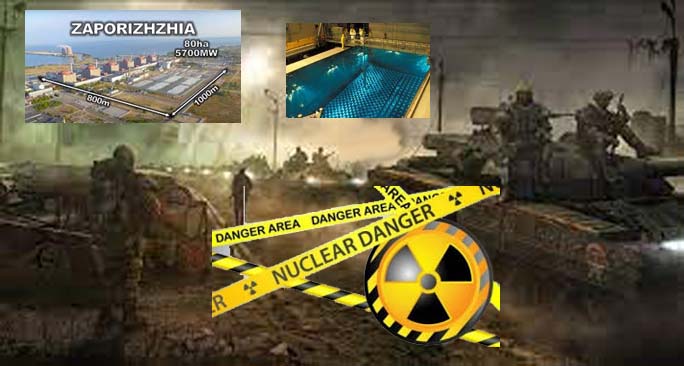
Zaporizhzhia nuclear plant loses all off-site power, risking safety
Xinhua 2025-09-24, https://global.chinadaily.com.cn/a/202509/24/WS68d35d8ba3108622abca294f.html
VIENNA – The Zaporizhzhia Nuclear Power Plant lost all off-site power on Tuesday, showcasing persistent risks to nuclear safety, according to a UN nuclear watchdog.
The power loss was the 10th time during the conflict between Russia and Ukraine, the International Atomic Energy Agency said Tuesday on social platform X, adding that its team is investigating the cause of the incident.
The agency’s Director General Rafael Grossi said later that day that emergency diesel generators had started operating to supply the plant with power, citing its team at Zaporizhzhia.
Zaporizhzhia’s six reactors have been in cold shutdown since 2024 but still require cooling water for their reactor cores and spent fuel pools. Before the conflict, it had 10 off-site power lines available.
Three formal ‘special measures’ notices remain in place amid ongoing safety issues at Dounreay

By Iain Grant, 22 September 2025
Dounreay remains under ‘enhanced’ oversight from
its regulators over ongoing safety issues which have been flagged up at the
plant. While some have been resolved, three formal notices remain in force
including the need to improve the storage of drums containing radioactive
sodium and to better control the risk posed by ‘dangerous substances and
explosive atmospheres. ‘
The Office for Nuclear Regulation announced in June
last year that Dounreay was in “enhanced regulatory attention for
safety.” It had a raft of concerns covering ageing, deteriorating plant,
radioactive leaks and the storage of chemical and radioactive materials.
NRS Dounreay managing director Dave Wilson claims good progress has been
made since. Speaking at Wednesday’s meeting of Dounreay Stakeholder Group,
he said: “We’re pushing ahead with our plan to return to a routine
regulatory position.” He said it had taken advantage of the good weather to
‘rattle through’ the list of buildings in need of urgent attention. This
included work to fix leaks in the roof of the turbine hall of the prototype
fast reactor which have been blamed for corroding sodium drums stored
there. An extra £3 million was allocated in 2024/25 to address the
concerns about the state of the buildings and modernise elderly electrical
plant. The £12 million budget has increased to £19 million in the current
financial year.
John O’Groat Journal 22nd Sept 2025, https://www.johnogroat-journal.co.uk/news/three-formal-special-measures-notices-remain-in-place-amid-392690/
Quake less alarming than tsunami threat to China’s coastal nuclear power plants

REACTORS: A tremor yesterday posed minimal danger to Kinmen, but a greater risk would come from tsunamis striking Chinese coastal nuclear plants, an expert said
Taipei Times, By Wu Liang-yi and Jake Chung / Staff reporter, with staff writer, 21 Sept 25, https://www.taipeitimes.com/News/taiwan/archives/2025/09/21/2003844164
Taiwan’s nuclear engineers and the Central Weather Administration (CWA) yesterday said that an earthquake near Kinmen County was less concerning than the potential risk posed by earthquake-triggered tsunamis striking nuclear power plants along China’s coast.
A magnitude 5.0 quake on the Richter scale, the strongest recorded in the Kinmen region in 32 years, struck at 6:56am yesterday.
The CWA said its epicenter was in the Taiwan Strait, about 93.9km east of Kinmen County Hall, at a depth of 17.2km.
Nuclear engineer Ho Li-wei (賀立維) said that while nuclear power plants are designed to withstand strong earthquakes, their cooling systems are more vulnerable.
Ho cited the 2011 Fukushima Dai-ichi disaster, where the plant’s cooling system was damaged by a tsunami triggered by the Tohoku earthquake, ultimately leading to hydrogen explosions that destabilized the facility.
If the same happened to Chinese coastal nuclear power plants, irradiated water could seep into underground aquifers or be carried into the sea, posing a devastating threat to Taiwan’s fisheries, he said.
Kinmen and Lienchiang counties would face particular risk due to their proximity to China, he said.
On the issue of spent fuel pools, Ho said that used fuel rods are stored in pools to dissipate heat and radiation, often requiring years of cooling before they can be transferred to dry storage.
The number of spent fuel rods in pools far exceeds those in active reactors, making them a significant security risk, he said.
CWA Seismological Center Director Wu Chien-fu (吳健富) said that the Kinmen earthquake was not on a fault line and carried little risk of causing a major quake.
Tsunami-generating earthquakes must reach at least magnitude 7 on the Richter scale and occur at depths of less than 30km, Wu said, adding that the likelihood of such conditions arising in the Taiwan Strait is not high.
While the Strait’s shallow waters make it theoretically vulnerable to tsunamis, Wu said that even waves generated by distant quakes would be greatly diminished by the time they reached the area.
Additional reporting by CNA
Case for Military Proportionality: Disabling Nuclear Plants.
If a reactor’s spent fuel pond storage system was hit, the likely radiological releases could force millions of people to evacuate……………… In an attack against a spent fuel storage facility, US Nuclear Regulatory Commission staff conservatively estimate the radiological release could be 100 times greater than that of the Fukushima accident.20
Today, nuclear plants can be disabled in many ways without risking harmful releases of radiation. The Russians, in the Russia-Ukraine War, have demonstrated several disabling techniques
Russia’s attacks afford a clear example of disabling critical civilian objects (reactors) to its military advantage without releasing hazardous radiation
By: Henry Sokolski, Nonproliferation Policy Education Center, September 16, 2025
For nearly a decade, protecting civilians and civil objects from disproportionate military assaults has been a top priority of the Pentagon. Two Department of Defense secretaries from the first Donald Trump administration championed quantifying and reducing harm to civilians and civil objects. Under the Joe Biden administration, the Pentagon further focused on protecting civilians and civil objects, and, in 2023, Congress created a Civilian Protection Center of Excellence within the Department of Defense. This center, consisting of a staff of 30 people with an annual budget of $7 million, helped military commands execute their missions while minimizing collateral damage.1
In early 2025, however, the Pentagon cut the funding and eliminated almost all the staff in the Civilian Harm Mitigation and Response office and the Center and asked Congress to eliminate the legal requirement for its continued operation. Rattled, some wondered if the Department of War was rescinding its previous guidance on limiting civilian harm. The answer to the question was unclear.2
Trump administration officials stated the Civilian Protection Center of Excellence jeopardized war fighters’ abilities to do their jobs. But those officials did not discuss a deeper set of developments: Hamas’s October 7 attack against Israeli citizens; Israel’s crushing response, which killed thousands of noncombatants; and Russia’s attacks against Ukrainian civilians and civil infrastructure. Each development challenged many experts’ previous beliefs about what proportionality should prohibit.
Both Vladimir Putin and Benjamin Netanyahu insist their military operations are proportionate. These claims, in turn, rely on an American view of proportionality Abraham Lincoln’s top military and legal adviser, Francis Lieber, promulgated in the 1860s. The Lieber Code (General Orders No. 100) championed avoiding attacks on civilians and civilian objects. But the code also allowed, if a compelling military objective emerged whose achievement incidentally entailed harming civilian people and objects, that attacks were permissible. Commanders on the front lines should decide what actions are militarily justified or not, according to the code.3
Some have argued Lieber’s view renders proportionality hopelessly subjective. If commanders were free to determine what actions are justified, proportionality would seem to be little more than a standard of behavior the weak may demand of the strong, but the strong can effectively ignore. Victorious nations rarely litigate against their own officials or officers for disproportionate military actions (that is, for ignoring or violating the requirements of proportionality).4
Therefore, enforcing proportionality against defeated foreign nations might be attractive, but demanding one’s own military enforce proportionality is less realistic or practical. At best, realists argue, limiting harm to civil persons and objects is advisory; institutionalizing or promoting proportionality by creating Pentagon centers goes too far.
This line of thinking is intuitive and appealing. But it ignores a critical point: Sparing civilians and civilian objects unnecessary harm is often essential to achieving military victory.
Carl von Clausewitz, known for championing the necessity of violence in battle, was just as emphatic that wars could only be won by reaching political solutions the enemy’s military and leadership—and the enemy’s population—could accept. Needlessly killing civilians and destroying infrastructure critical to their welfare only complicates reaching lasting political solutions. For Clausewitz, the need to inflict violence in war had to be measured against the war’s ultimate objective, which is always political. Violence against civilians is self-defeating if it undermines the achievement of the war’s ultimate political objective.5
Thus, Winston Churchill and Dwight D. Eisenhower resisted calls in 1944 for the indiscriminate bombing of French cities and infrastructure during World War II because though such bombings would weaken German defenses, they would also dramatically undermine French political support of the Allied powers and the Allies’ resistance to the Nazis. Indiscriminate bombing would also complicate the reconstruction of the French economy after the Allies won the war.6
For similar reasons, President Harry S. Truman rejected the advice of his commander in the field, General Douglas MacArthur, who wanted to use nuclear weapons on North Korea and China. Truman feared attacking these states with nuclear weapons would escalate the conflict, cause unnecessary destruction, and turn international public opinion against the United States. Truman understood maintaining international support was essential to containing China and deterring Russia’s use of nuclear weapons after the end of the Korean War.7
One of Adolf Hitler’s best generals—Erwin Rommel—also refrained from using excessive force against civilians to protect his communications and supply lines from local disruption. Rommel understood that, in some cases, good military discipline and order required restraint, as did pacific relations with the local population (for example, in Northern Africa). Rommel’s attention to these points helped secure supply lines and reduced local resistance to his forces’ operations.8
Nazi troops terrorized enemy populations, but General Walther Wever, who served as the Luftwaffe’s chief of staff in the mid-1930s, argued such actions. Responsible for formulating Germany’s military air doctrine, Wever rejected the idea of bombing cities to break the will of the people. Wever believed such attacks were, at best, distractions from the Luftwaffe’s main mission: destroying the enemy’s armed forces. Wever also believed terror bombing was militarily self-defeating because it increased, rather than reduced, local resistance, jeopardizing the achievement of the Luftwaffe’s prime military missions.9
Besides these arguments, there are additional reasons for not hitting certain civilian facilities. Attacking chemical plants and nuclear facilities can poison the theater of operations with dangerous contaminants and hamper military operations (for example, if a dam is attacked, flooding the terrain). Such attacks can also prompt major evacuations which, in turn, retard military movements.
However, another advantage of avoiding conducting military assaults on civilian objects relates to military cohesion. As I noted in a previous Parameters article, Protocol I of the Geneva Conventions specifically discourages nations from attacking civilian objects, especially if doing so would risk releasing “hazardous forces” that could inflict “severe harm” on innocent civilians. Although the United States has signed the protocol, 174 nations took the additional step of ratifying it. The United States chose not to do so. As such, the United States is at odds with most of its NATO Allies.10
Thus, in 2022, foreign and military ministers in the European Union, the United Kingdom, and Germany declared Russian strikes against Ukrainian infrastructure and the Zaporizhzhya nuclear power plant were prosecutable war crimes. The United States took no position. In a war game conducted in 2022, close US Allies that have ratified Protocol I were at odds with Washington regarding how to respond to Russian attacks on Allied reactors. The United States’ Allies wanted to respond strongly to what they saw as a war crime, whereas the United States did not. In the game, the other NATO members were concerned NATO would be drawn into a larger conflict if Poland and Ukraine jointly attacked Russia. These concerns held up war operations and resulted in the United States using Article 5 of the North Atlantic Treaty to keep Poland from participating in a Ukrainian strike against Russia.11
Finally, temporarily disabling civilian infrastructure (for example, water, gas, and oil pumps; energy pipelines; telecommunications lines; and electrical-supply systems) can afford clear military advantages over physically obliterating civilian infrastructure, even if no hazardous forces are released. The temporary disablement of civilian infrastructure deprives one’s enemy of the ability to use infrastructure facilities, facilitates their subsequent use by one’s own forces in war, and allows for their speedy repatriation once the war is over.12
All of these points recommend fostering effective military applications of proportionality against civilian objects. The question is how.
………………………………………………………………………………………………………………………………………….If a reactor’s spent fuel pond storage system was hit, the likely radiological releases could force millions of people to evacuate, as confirmed by US Nuclear Regulatory Commission, government-sponsored, and private studies. The areas rendered uninhabitable could also be quite large: from 30,000 to 100,000 square kilometers (the latter area is larger than the entire state of New Jersey). In an attack against a spent fuel storage facility, US Nuclear Regulatory Commission staff conservatively estimate the radiological release could be 100 times greater than that of the Fukushima accident.20
The case of an attack against a spent fuel storage facility is extreme. A less dramatic scenario is the radiological release attendant to a loss of coolant induced by a military assault. Still, a wholesale, indiscriminate attack against Iran’s Bushehr power reactor could release significant radiation and force the evacuation of hundreds of thousands to millions of nearby civilians.21
Wholesale, indiscriminate attacks are precisely the kind of assault diplomats and lawyers aimed to prevent when they crafted Protocol I to the Geneva Conventions a half century ago. This international framework has several provisions that focus on the most likely type of military assault against nuclear power plants at the time: wholesale aerial attacks, which were almost certain to trigger massive releases of radioactivity. Today, things are different. With precision targeting and tailored munitions, nuclear power plants can be disabled in many ways without releasing radiation.22
Oddly, this transition to precision is still not fully reflected in the Pentagon’s legal guidance on targeting nuclear plants. …………………………………………………………………………………
Today, median miss distances for precision weapons are measured in meters or in smaller units. As a result, nuclear plants can be disabled in many ways without risking harmful releases of radiation. The Russians, in the Russia-Ukraine War, have demonstrated several disabling techniques……………
Through repeated strikes on these nonnuclear components, Russia has succeeded in shutting down Europe’s largest nuclear power plant—the Zaporizhzhya nuclear power plant. In addition, Putin can now collapse Ukraine’s entire electrical-supply system at a time of his choosing. Meanwhile, Russia says it could restart the Zaporizhzhya nuclear power plant to supply electricity to territories occupied by Russia in a matter of months.
More could be said about Russia’s studied targeting of Ukraine’s nuclear power plants and electrical-power systems. But Russia’s attacks afford a clear example of disabling critical civilian objects (reactors) to its military advantage without releasing hazardous radiation.26
Of course, other nuclear examples should be considered. Some states use portions of their civilian nuclear programs to make nuclear-weapons materials—for example, China, India, and North Korea. Disabling the facilities used to make nuclear-weapons materials would be a worthy military objective. Physically, obliterating those facilities and risking the widespread dispersal of harmful radiation, however, could be militarily counterproductive.median miss distances for precision weapons are measured in meters or in smaller units. As a result, nuclear plants can be disabled in many ways without risking harmful releases of radiation. The Russians, in the Russia-Ukraine War, have demonstrated several disabling techniques. These techniques exploited the nuclear-safety requirement for irradiated reactor fuel to be cooled continuously to prevent it from overheating, failing, and releasing dangerous, radioactive by-products.24
Rather than prompting such failures, analysis suggests Russia has been careful to target the electrical power–supply systems needed to keep the nuclear plants’ cooling and safety systems running. Russia’s aim is twofold: first, to force the plants’ operators to shut them down for safety reasons, and second, to increase the credibility of making follow-on strikes that might risk a significant release of radiation.25
The power-system components Russia has targeted include on- and off-site electrical transformers; high-voltage lines running in and out of the plants; cooling water supply systems; a major dam critical to supplying water to the Zaporizhzhya nuclear power plant; and major, off-site electrical power–generating plants needed to stabilize the electrical-supply grid supporting the nuclear plant’s safe operation…………………………
Recommendations
What steps can the US military take to update its plans and operations for targeting and protecting civil infrastructure?
First, the Pentagon should publicly share much more information about its thinking than it has to date, which would allow for greater civilian oversight, sharpen military planning, and increase the clarity of current policy and legal guidance.
Second, the Pentagon should work with private industry and other government departments focused on civil-infrastructure protection—the US Department of Homeland Security and the US Nuclear Regulatory Commission—to produce convincing public narratives about why and how civil objects should be protected and to improve existing protection schemes. Planning to protect this infrastructure has long been underway, but under the protection of the Federal Energy Regulatory Commission’s Critical Energy / Electric Infrastructure Information, which keeps these plans from the public. What’s needed is a sensible tear sheet for public consumption.27
Third, the Department of War should offer Congress routine public reports about matters related to protecting civil infrastructure. The US government must prepare the public for a future in which the United States’ electrical-supply systems, energy pipelines, biological research facilities, potentially dangerous petrochemical plants, telecommunications systems, and civil nuclear facilities may come under attack. Setting the public’s expectations about what can and should be done, actively and passively, to defend these systems should not wait until an attack occurs.
Finally, training is critical. The Department of War’s military education training institutions should offer dedicated, unclassified courses that provide technical and historical instruction on the targeting and defense of civil objects. The instruction should be fortified by unclassified government simulations for civilians and military officials, which play out alternative targeting plans against civil objects that could release hazardous forces.
How will the US government accomplish these objectives? The first step is to make mastering these matters a requirement for military promotion. This step could be done quietly, without top-down scolding, legal hectoring, or creating centers. The best US military operators and planners already know civil objects and nuclear facilities are becoming increasingly significant military targets. The Pentagon should reward and support efforts to clarify what should be done to disable and protect civil objects and nuclear facilities.
Acknowledgments: I would like to thank Caitlyn Collett for providing essential assistance in the production and editing of this special commentary.
To read the full piece, click here.
Iran, allies submit draft IAEA resolution to ban attacks on nuclear sites
Sep 16, 2025, https://www.iranintl.com/en/202509162278
Iran and five other countries have submitted a draft resolution to the International Atomic Energy Agency’s annual general conference calling for a ban on any attack or threat of attack against nuclear sites under UN safeguards, Iran’s foreign ministry said on Tuesday.
Foreign ministry spokesperson Esmaeil Baghaei said on X that the text, backed by China, Russia, Venezuela, Nicaragua and Belarus, was intended “to defend the integrity of the NPT” and reaffirmed the inalienable right to develop nuclear energy for peaceful purposes.
“All states must refrain from attacking or threatening to attack peaceful nuclear facilities in other countries,” Baghaei wrote. “These principles must be upheld; it is high time that the international community acted firmly to prevent the normalization of lawlessness.”
Draft resolution
The draft resolution condemns “the deliberate and unlawful attacks carried out in June 2025 against nuclear sites and facilities of the Islamic Republic of Iran,” calling them clear violations of the UN Charter and the IAEA Statute.
It says nuclear sites under IAEA safeguards “shall not be subject to any kind of attack or threat of attack,” adding that such actions pose serious risks to international peace and security, human health, the environment, and the credibility of the non-proliferation regime.
The document also recalls UN Security Council Resolution 487 of 1981, which condemned Israel’s bombing of Iraq’s Osirak reactor, and reaffirms previous IAEA decisions prohibiting attacks on safeguarded facilities.
It further stressed that all questions regarding nuclear programs should be resolved “exclusively through dialogue and diplomacy, as the only viable path.”
Israel launched a surprise military campaign on June 13 targeting Iranian nuclear and military sites, including senior commanders and nuclear officials in a conflict that lasted 12 days. On June 22, the United States joined the campaign, striking nuclear facilities in Fordow, Natanz and Isfahan. Washington brokered a ceasefire on June 24.
Iran’s nuclear chief Mohammad Eslami told the conference on Monday that Tehran’s atomic program “cannot be eliminated through military action,” accusing Israel and the United States of launching illegal strikes on Iranian sites in June.
“Despite our formal request, the agency did not condemn the attacks by the United States and Israel on the nuclear centers of the Islamic Republic,” Eslami said, calling the IAEA’s silence “a stain on the Agency’s history.”
Eslami said Tehran would use the conference to highlight what he called unlawful measures against its nuclear industry and to push for adoption of the draft.
The debate comes as Iran’s recent cooperation deal with IAEA chief Rafael Grossi awaits implementation and European powers press ahead with the UN “snapback” mechanism that could reinstate sanctions on Tehran by late September.
Chernobyl shelter repairs: ‘Difficult choices’ lie ahead
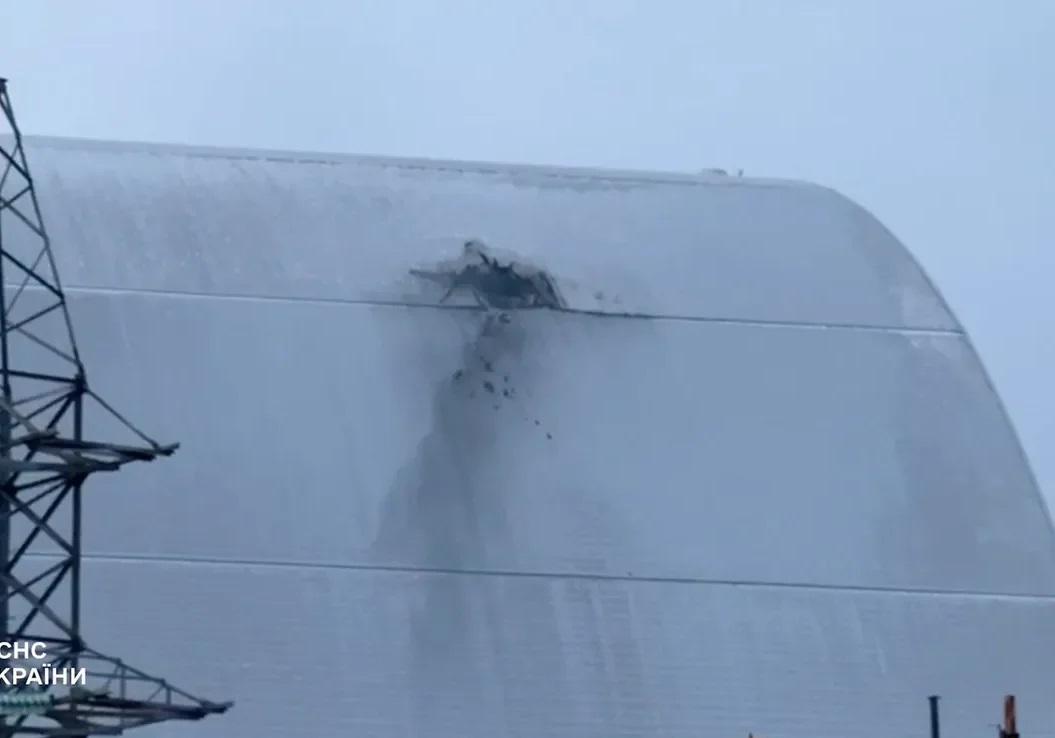
The arch-shaped New Safe Confinement structure built over the remains of
Chernobyl’s destroyed unit 4 suffered such extensive damage in a drone
strike in February that it may not be possible to restore it to its full
original design purposes and life-span of 100 years, a side event at the
International Atomic Energy Agency General Conference heard.
World Nuclear News 18th Sept 2025, https://www.world-nuclear-news.org/articles/chernobyls-giant-shelter-may-never-return-to-original-state
1 This Month

of the week – Shut Down Drone Warfare!


Tell the Ukrainian Government to Drop Prosecution of Peace Activist Yurii Sheliazhenko

Petition to revoke the licensing of the Near Surface Nuclear Disposal Facility (NSDF) at Chalk River. https://www.ourcommons.ca/petitions/en/Petition/Details?Petition=e-7247
To see nuclear-related stories in greater depth and intensity – go to https://nuclearinformation.wordpress.com
-
Archives
- April 2026 (44)
- March 2026 (251)
- February 2026 (268)
- January 2026 (308)
- December 2025 (358)
- November 2025 (359)
- October 2025 (376)
- September 2025 (257)
- August 2025 (319)
- July 2025 (230)
- June 2025 (348)
- May 2025 (261)
-
Categories
- 1
- 1 NUCLEAR ISSUES
- business and costs
- climate change
- culture and arts
- ENERGY
- environment
- health
- history
- indigenous issues
- Legal
- marketing of nuclear
- media
- opposition to nuclear
- PERSONAL STORIES
- politics
- politics international
- Religion and ethics
- safety
- secrets,lies and civil liberties
- spinbuster
- technology
- Uranium
- wastes
- weapons and war
- Women
- 2 WORLD
- ACTION
- AFRICA
- Atrocities
- AUSTRALIA
- Christina's notes
- Christina's themes
- culture and arts
- Events
- Fuk 2022
- Fuk 2023
- Fukushima 2017
- Fukushima 2018
- fukushima 2019
- Fukushima 2020
- Fukushima 2021
- general
- global warming
- Humour (God we need it)
- Nuclear
- RARE EARTHS
- Reference
- resources – print
- Resources -audiovicual
- Weekly Newsletter
- World
- World Nuclear
- YouTube
-
RSS
Entries RSS
Comments RSS
 nuclear-news