Book Review: A Timely History of Nuclear Catastrophes

In “Atoms and Ashes,” Serhii Plokhy offers a harrowing account of the world’s six major accidents and their aftershocks.
Top: Three Mile Island photographed in 1999, 20 years after the Unit 2 reactor failed.
RUSSIA’S INVASION OF Ukraine not only reminded the world of all the usual horrors of modern warfare, but also stirred the long-slumbering spectre of nuclear catastrophe, both in the form of nuclear war à la “Dr. Strangelove” and of civilian disaster à la Chernobyl. When Russian forces occupied the Chernobyl nuclear plant and held its workers hostage, some worried about a new nuclear disaster in the making if the plant was damaged or if decommissioning operations were severely disrupted. Other nuclear plants in Ukraine, including the Zaporizhzhia nuclear power station — the largest nuclear power plant in Europe, with six reactors — were threatened by invading forces. The dangers were severe enough that the International Atomic Energy Agency sent safety staff and continues to monitor the unfolding situation to ensure that things don’t get out of control.
At the moment, Ukraine’s nuclear plants seem to be safe, but fear and anxiety persist. As Serhii Plokhy details in “Atoms and Ashes: A Global History of Nuclear Disasters,” the memories of past catastrophes continue to haunt the idea of nuclear power, including any plans or hopes for a nuclear power renaissance in a world of worsening climate change.
Each of the book’s six chapters focuses on an individual nuclear accident, some famous, others more obscure, including relevant background information and historical context. ……………………………… https://undark.org/2022/05/27/book-review-a-timely-history-of-nuclear-catastrophes/
France is offering 6 new nuclear reactors to India, even though India’s nukes are not within the IAEA safety regulatory framework.
AMAZINGLY, despite the fact that at a time when India’s eight nuclear
reactors already remain out of the IAEA safety regulatory framework,
Electrrice de France (EDF) has offered India to get six evolutionary
pressurised water nuclear reactors (EPRs) from France. While looking into
the evolution of the Indian nuclear program, one gets a clear picture that
since Pokhran-1-11 1974 , 1998, New Delhi has been unduly favoured by the
foreign powers to enhance its soft power and hard power nuclear assets.
Pakistan Observer 26th May 2022
Foreign powers’ role behind India’s nuclear programme? | By Syed Qamar Afzal Rizvi
For the first time in history, nuclear sites have been caught up in the middle of warfare

With Russia’s invasion of Ukraine, nuclear facilities have been caught
up in the midst of conventional warfare for the first time in history. That
nightmare scenario is one that few of the industry’s players had
anticipated. In Chernobyl and Zaporizhzhia, Russian forces represent a
lingering threat to the most basic rules of nuclear security.
On the way to
Chernobyl along the Dnipro River, a two-hour drive from Kyiv, the imprint
left by Russia’s occupation remains, two months after an ordeal that
lasted from the February 24 invasion until March 31. Most bridges have been
destroyed and our driver warns us to stay on the pavement as landmines lurk
beyond. After the invasion, the exclusion zone around Chernobyl – a
30-kilometre radius around the notorious nuclear plant near Ukraine’s
border with Belarus – made global headlines once again.
For some 35 days,
Chernobyl personnel had to abide the Russian soldiers who seemed oblivious
to the dangers inherent in a nuclear site. Those in the civil nuclear
industry believe it is vital to deliberate on the issue of nuclear security
in wartime. Terrorist attack scenarios had been considered in the past. But
in light of the Russian invasion, the matter of adopting international
rules is now on the table. Over the past three months, Ukrainian
authorities have been calling – so far without success – for the
International Atomic Energy Agency (IAEA) to commit its members to
respecting a five-kilometre perimeter around nuclear facilities inside of
which no military forces can be permitted to penetrate.
France24 26th May 2022
Security issues at UK’s civil nuclear facilities have reached highest level in 14 years
The number of formal reports documenting security issues at the UK’s
civil nuclear facilities has hit its highest level in at least 12 years
amid a decline in inspections, the Guardian can reveal. Experts said the
news raised concerns about the regulator’s capacity to cope with a
planned expansion in the sector. A total of 456 incident notification forms
documenting security issues at UK nuclear facilities were submitted to the
Office for Nuclear Regulation (ONR) over 2021, according to information
obtained by the Guardian and the investigative journalism organisation
Point Source. This is 30% higher than the 320 reports filed during the
whole of 2020 and more than double the 213 reports that were filed in 2018.
Guardian 26th May 2022
A 5.5 Magnitude Earthquake Shakes Area Near the Fukushima Disaster Site

NatureWorld News, By Rain Jordan May 25, 2022 Scientists believe a significant earthquake was reported off the coast of Japan, near Fukushima, the location of a nuclear disaster precipitated by a quake a decade ago.
The 5.5-magnitude quake struck off the coast of Fukushima Prefecture in northeastern Japan on Sunday, but no damage or casualties were reported. A tsunami warning was not issued.
The epicenter of the quake, according to the USGS, was 82 miles southeast of Shizunai, Japan, at a depth of 19 miles. The Japanese Meteorological Agency raised the magnitude to 6.0.
After the earthquake, the JMA warned locals about the danger of landslides.
Because Japan is located in the seismically active “Pacific Rim of Fire” area, earthquakes occur often.
A 7.3-magnitude earthquake hit off the shore of Fukushima in March, killing one person and wounding scores of others.
The 2011 earthquake caused a tsunami, which resulted in an accident at the Fukushima Daiichi Nuclear Power Plant………………….. https://www.natureworldnews.com/articles/51000/20220525/a-5-5-magnitude-earthquake-shakes-area-near-the-fukushima-disaster-site.htm
South Carolina Woefully Underprepared for Nuclear Disaster
FITSNEWS, ByDylan Nolan, 23 May 22, Oconee Nuclear Station emergency sets off alarm bells,
South Carolina state government can’t get a nuclear reactor up and running, as was made clear by the spectacular failure of government-run utility Santee Cooper — which five years ago officially pulled the plug on the proposed V.C. Summer nuclear generating station expansion (a.k.a. NukeGate). The botched construction of this project cost Palmetto State ratepayers and taxpayers more than $10 billion.
What is less known, but potentially more ominous, is the fact that sources close to the S.C. Department of Health and Environmental Control (SCDHEC) Radiation Nuclear Safety unit say the state is woefully underprepared to respond to potential nuclear disasters.
Staffing this specialized unit has allegedly become an increasingly serious issue for SCDHEC in recent years. The unit dwindled from seven to three full-time employees as frustration with ineffective management led to employees finding work elsewhere.
The remaining full-time employees are stretched thin. The map below [on original] illustrates South Carolina’s nuclear facilities, as well as those in neighboring states that have the potential to harm South Carolinians in the event of a disaster.
The SCDHEC unit is responsible for more than just those facilities though, it also handles transportation incidents involving radiological materials
This seems like a herculean task for three individuals — one that could have ended poorly in early February when two of the (at that time) four employees of the unit were out of town at a training event when an incident involving a potential release of radiological material at the Oconee Nuclear Station threw the remaining two employees into high gear.
As the first light of dawn penetrated the darkness of the lakeside sky, it cast a dull glow over the three reactors — built in 1974 on the Keowee River at the foot of the Blue Ridge Escarpment. This still morning would soon be broken, however.
At 3:57 a.m. EST February 5, the west penetration room adjacent to one of the three reactors filled with smoke and prevented personnel from entering. At this time, officials at the plant filled out their initial nuclear power plant emergency notification form (ENF).
Nuclear facilities experiencing emergencies issue warnings indicating the severity of an accident. In this instance, employees at the Oconee station chose the second of four alert levels. According to the emergency response guide posted on plant operator Duke Energy’s website, this indicates “there is no impact to the public.” The plant’s resident Nuclear Regulatory Commission (NRC) inspector concurred with that assessment.
Had they chosen the next level of alert — a site area emergency warning — plant operators would have indicated they believed the event to be a “major operational/ security event that could affect plant safety” and would have likely warned the public of the event’s occurrence.
The Oconee County Fire Department responded by sending five trucks on-site with more staged off site.
SCDHEC’s response was solely conducted remotely. A source close to this unit characterized this response as “strictly for show” — adding that managers frequently refuse to allow the responders to go to the scene of the emergency.
SCDHEC’s director of media relations Ron Aiken told FITSNews that “because both the facility and the Nuclear Regulatory Commission confirmed no off-site release occurred, no emergency field-monitoring by SCDHEC was required.”
One SCDHEC insider frustrated with the response contended that “this unit is set up to be the state’s assurance that nothing is/was being released.”
“We should not have sat by and waited for the plant to tell us that there was no leak,” the insider said. “If there was a leak, it would have been too late to perform any protective actions.”
While plant operators did not issue a warning that would notify residents surrounding the plant, they sent employees to their Charlotte, N.C.-based emergency operations facility — which allows engineers to have off-site control of the plant in the event it had to be evacuated.
SCDHEC didn’t conduct independent soil and vegetation testing until three days after the incident. According their internal after-action report (below) “taking the soil, water and vegetation samples three days after the incident and with rain being present diminished the possibility of detecting anything.” A source familiar with the report added that “we don’t have any option but to take them (nuclear plant operators) at their word.”
……………….a federal response would take hours to arrive given both the complexity of responding to a nuclear disaster and the fact that federal officials are primarily located out of state. A failure to properly handle a situation in the hours before the feds arrive could turn an emergency into a tragedy
………. Individuals familiar with the operations of the unit have voiced concerns that none of the stakeholders truly care about the efficacy of the unit. The state’s nuclear power plant operators care a great deal about the state continuing to provide the Federal Emergency Management Agency (FEMA) with “reasonable assurance” that the state can adequately respond to nuclear disasters since their ability to operate plants is dependent on federal approval of state safety measures…………………………… https://www.fitsnews.com/2022/05/23/south-carolina-woefully-underprepared-for-nuclear-disaster-sources-say/. State and local officials must therefore be ready to stand in the gap during those crucial first hours.
Magnitude 6.0 quake shakes Japan’s east and northeast
https://www.japantimes.co.jp/news/2022/05/22/national/earthquake-ibaraki-fukushima/An earthquake with a preliminary magnitude of 6.0 struck Fukushima and other prefectures in Japan’s east and northeast on Sunday, but there was no threat of a tsunami, the Meteorological Agency said.
There were no immediate reports of injuries or serious property damage following the quake, which occurred around 12:24 p.m.
The quake’s magnitude was later revised upward from the initial estimate of 5.8, the agency said.
The quake registered lower 5 on the Japanese seismic intensity scale to 7 in the city of Iwaki in Fukushima, according to the agency. Its focus was at a depth of about 30 kilometers in the Pacific off Ibaraki Prefecture.
The quake registered 4 in some other parts of Fukushima and 3 in the neighboring prefectures of Miyagi, Yamagata, Ibaraki, Niigata and Tochigi.
No abnormalities were found at the Tokai No. 2 nuclear power plant on the coast of Ibaraki or at the Fukushima No. 1 and No. 2 nuclear power plants, their operators said.
There were also no major transport disruptions. JR East said it briefly suspended services on a section of the Tohoku Shinkansen line between Fukushima and Miyagi prefectures.
3 unplanned shutdowns of French nuclear reactors due to corrosion concerns, in the Framatome-designed piping
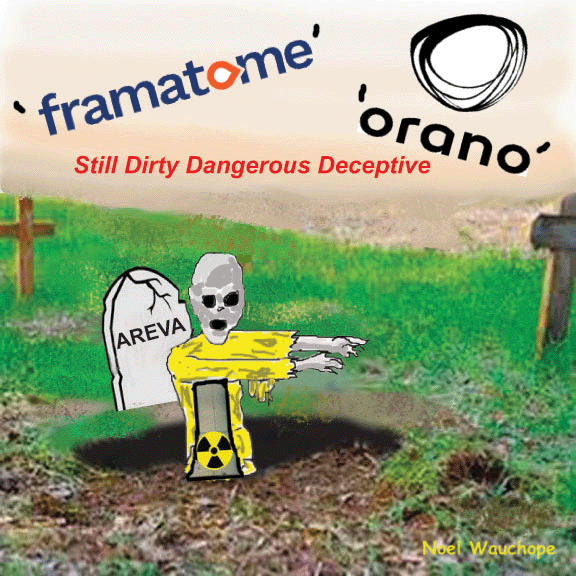
EDF revealed on Thursday that it will shut down the 1.3 GW Paluel 2, Penly
2 St Alban 2 and Cattenom 1 reactors next year, when no shutdowns were
planned so far, to check whether their auxiliary pipes to the primary
circuit are affected by corrosion. The dates of these shutdowns, which will
occur in the second quarter of 2023, must be published imminently on Remit,
said the deputy director of EDF’s nuclear production department Régis
Clément at a press conference in Paris.
The French group intends to check the rest of these 56 reactors by the end of 2023, or even the beginning of 2024, during the planned shutdowns which will be extended and the ten-year
visits, seven of which are scheduled for the rest of this year, he added.
Earlier on Thursday, EDF on Thursday revised the dates for thirteen
scheduled outages at nuclear power plants in 2022-23 due to
corrosion-related checks and repairs. Mr. Clément also asserted that the
“preponderant” cause of cracks due to corrosion on the auxiliary piping
to the primary circuit of certain reactors in the nuclear fleet was the
design of these circuits, developed by the EDF subsidiary Framatome. “Today
what we have as a clear conviction is that the design [of the auxiliary
circuits] appears to us as a preponderant cause”, he said.
Montel 19th May 2022
https://www.montelnews.com/news/1322042/corrosion-edf-rvle-les-4-units-quelle-arrtera-en-2023
Seismic Concerns at Los Angeles Nuclear Laboratory and Expanded Plutonium Pit Production
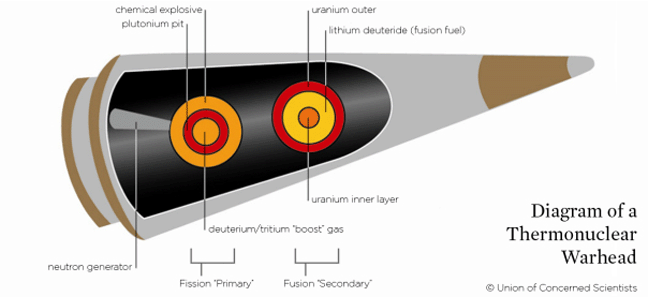
Seismic Concerns at LANL and Expanded Plutonium Pit Production http://nuclearactive.org/, May 19th, 2022, Ongoing Plutonium operations at Los Alamos National Laboratory’s Technical Area 55 are centered in the middle of the 36-square mile national nuclear weapons facility. LANL is the only U.S. facility with the capabilities to fabricate plutonium triggers, or the fissile pits, for nuclear weapons. However, Technical Area 55, or TA-55, is located within the complex Pajarito Fault Zone between two young, north – south running faults called the Guaje Mountain and Rendija Canyon faults. Visual evidence of faulting can be found in the canyons to the north of TA-55. http://nuclearactive.org/gilkeson/ see Seismic Documents.
The U.S. Department of Energy owns LANL. It has plans for expansion of all things plutonium-pit production at the Plutonium Facility and at least five new support buildings at TA-55. CCNS anticipates that DOE will continue its efforts to conceal and ignore the reality of the growing seismic threats of the young faults.
We witnessed similar efforts in the mid-2000s when DOE began to design a new super Walmart-sized Nuclear Facility within TA-55 next door to the Plutonium Facility. DOE was so bold as to dig into the volcanic tuff with heavy equipment to prepare a pad for future construction. http://www.nuclearactive.org/news/030510.html In the end, public opposition and escalating costs forced the cancellation of its plans. http://nuclearactive.org/livestreamed-nuclear-safety-board-hearing-on-february-21st-in-albuquerque/
Fabricating plutonium pits for nuclear weapons involves many steps – some using aqueous processes that result in water contaminated with radiation and hazardous materials. That water is treated across the street from the Plutonium Facility at the Radioactive Liquid Waste Treatment Facility and for decades was discharged through an industrial outfall into Effluent Canyon. Since November 2011, though, the treated water has been evaporated into the air at a mechanical evaporator.
In April, the Environmental Protection Agency renewed the five-year industrial permit for LANL to discharge through Outfall 051 into Effluent Canyon. https://www.epa.gov/nm/los-alamos-national-laboratory-lanl-industrial-wastewater-permit-final-npdes-permit-no-nm0028355
We note that on May 11th, CCNS, Honor Our Pueblo Existence, and the Albuquerque Veterans for Peace, Chapter No. 63, appealed the EPA decision to permit the outfall and five others to the Environmental Appeals Board. https://yosemite.epa.gov/oa/EAB_Web_Docket.nsf/f22b4b245fab46c6852570e6004df1bd/ba987f24df0c356085258837004f3dcd
Then on May 5th, the New Mexico Environment Department approved for the first time a ground water discharge permit for not only for the Radioactive Liquid Waste Treatment Facility, the outfall and Mechanical Evaporator, but for two large solar evaporative tanks, and a new low-level radioactive liquid waste treatment facility. In addition, DOE plans to build a liquid waste treatment facility for the transuranic plutonium liquid waste. https://www.env.nm.gov/public-notices/, go to Los Alamos County, and scroll down to DP-1132 where the draft permit is posted, but not the final permit.
These facilities are all in support of DOE’s plans for expanded plutonium pit production at LANL.
UK Public Accounts Committee warns on need to double-check on safety of aging nuclear reactors
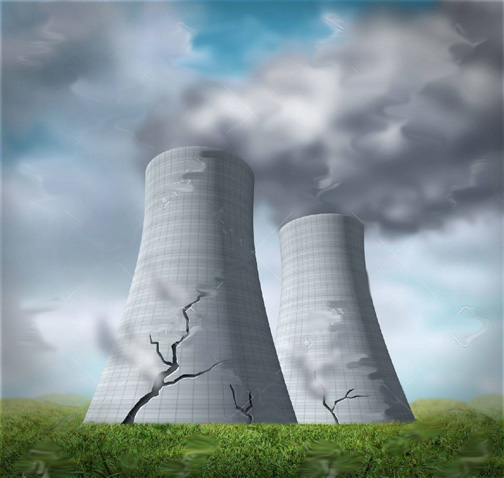
Ageing nuclear reactors must be ‘double-checked’ for safety before
being kept going to ease energy crisis. Closure of seven nuclear reactors
by 2028 will ‘significantly reduce’ UK energy generation, the Public
Accounts Committee warns, and taxpayers face billions of pounds in extra
costs.
iNews 20th May 2022
France’s woes with nuclear power plants means more energy uncertainty for Europe
The utility cut its forecast as it realised that “stress corrosion” issues affecting some of its reactors will require more checks and repairs. Irish Examiner, THU, 19 MAY, 2022. LARS PAULSSON, JESPER STARN AND FRANCOIS DE BEAUPUY
The woes facing the nuclear power stations at France’s EDF — Europe’s largest electricity producer — will increase the pressure on war-hit European energy markets after the summer.
EDF, which is the backbone of Europe’s integrated power system, cut its nuclear output target for a third time this year, the latest sign that Europe’s power crisis is worsening.
Western Europe has for decades relied on exports of power from EDF’s nuclear stations. The cuts are another blow to European energy security just as the region is weaning itself off Russian supplies of everything from natural gas to coal and oil because of the war in Ukraine.
Less output from EDF is sending prices higher just as soaring inflation is pushing up costs for everything from petrol to food. It could get even worse in winter as France, traditionally an exporter of electricity, may be forced to import more from its neighbours.
French prices are the most expensive in Europe, with contracts for the period almost double levels in Germany. The utility cut its forecast as it realised that “stress corrosion” issues affecting some of its reactors will require more checks and repairs. The outlook for the following year remains unchanged for now, the firm said.
| “We fine-tuned the repairs to be made,” Regis Clement, deputy head of the company’s nuclear division, said during a media conference. “We’ve got to cut more pipes” to carry out further checks “and more repairs to handle”, he said.The big test will come when temperatures start to fall toward the end of the year. It won’t take many days of cold weather to jeopardise French power supplies, according to Emeric de Vigan, chief executive officer at French energy analysis firm Cor-e.“With such poor nuclear availability, if we reach 2 degrees Celsius below normal in the winter for a few days we could be in trouble, it would be really tight,” Mr de Vigan said. Paying customers and factories to lower consumption are steps that likely will need to be taken, he said. ………………. https://www.irishexaminer.com/business/economy/arid-40876541.html |
Chernobyl nuclear fears as forest near Exclusion Zone in FLAMES – emergency triggered

CHERNOBYL nuclear fears have surged after a forest near the Exclusion Zone erupted in flames as emergency services battled to extinguish the huge blaze.
By PAUL WITHERS, May 18, 2022 The State Emergency Service of Ukraine reported that litter in the forest near the Chernobyl Exclusion Zone had caught fire. More than a dozen firefighters and four units of equipment were involved in battling to put out the massive fire. At 2.10am local time, the fire had been localised to an area of 45 hectares.
Video footage shared on Twitter shows the forest next to the Exclusion Zone engulfed in flames that are several metres high.
Rescue workers wearing protective face masks are also seen leading a local resident to safety.
The State Emergency Service of Ukraine shared footage of the fire on its Telegram channel.
The service also wrote alongside this: “May 17 near the village. “In the forest of Vyshhorod district, forest litter caught fire.
“During the fire, our firefighters rescued a local resident.
“At 02:10 on May 18, the fire was localized on an area of 45 hectares.
“As of 09:00 there is decay of dry grass and stumps.
“Sixteen rescuers and four units were involved in the firefighting techniques.
The Chernobyl Exclusion Zone is an officially designated 1,000 square mile area in Ukraine around the site of the Chernobyl nuclear reactor disaster.
It covers an area where radioactive contamination is highest and public access and habitation are restricted.
The Exclusion Zone aims to restrict access to hazardous areas, reduce the spread of radiological contamination, and conduct radiological and ecological monitoring activities.
It remains one of the most radioactively contaminated areas in the world, attracting widespread interest over the high levels of radiation exposure in the environment.
The Exclusion Zone had been established by the Soviet Armed Forces soon after the nuclear power plant disaster in 1986. This initially existed as an area with a radius of 30 miles from the structure, designated for evacuation and placed under military control.
Over the years, its borders have been widened to cover a much larger area of Ukraine.
Sellafield Update 2022
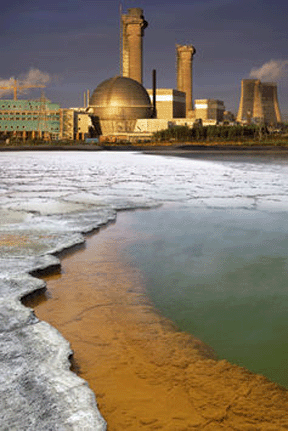
nuClear News, May 2922, Executive Summary
Reprocessing
Spent fuel from the UK’s first-generation Magnox reactors is still being reprocessed. It was
scheduled to end in 2012 to help the UK meet its international obligations to end the radioactive
pollution of the north-east Atlantic. It’s now scheduled to end later this year.
Storage
At the end of 2021, the First Generation Magnox Storage Pond (FGMSP), one of Sellafield’s most
hazardous facilities, and the Pile Fuel Storage Pond (PFSP) still contained 75% of the legacy
spent fuel which has to be removed and placed in interim storage. This degraded fuel won’t be
in interim storage until 2025. It will then have to be conditioned, and eventually transferred to
the proposed Geological Disposal Facility by 2125.
Spent fuel
The Thermal Oxide Reprocessing Plant (THORP) has closed, and almost 5,000 tonnes of unreprocessed spent fuel from the UK’s second-generation Advanced Gas-cooled Reactors (AGRs)
will be stored in ponds at Sellafield until at least 2075. In addition, an estimated 141 tonnes of
exotic fuel will remain in storage once the Magnox reprocessing plant closes, and isn’t expected
to be in a modern interim storage facility until 2028. Sellafield is also contracted to receive and
store spent submarine fuel from the MoD.
Plutonium
The government has yet to decide about possible re-use or disposal of the 140 tonnes of
plutonium stored at Sellafield. Its preferred option is to re-use it in Mixed Oxide Fuel (MOX) for
nuclear reactors, but some plutonium will be unsuitable for this and will need to be immobilised
and treated as a waste for disposal. Some of the older plutonium packages and facilities are
amongst the highest hazards on the Sellafield site. All plutonium needs to be gradually transferred to a new store, and two more stores are likely to be required – one is expected to be
ready in 2033 and the second in 2040.
High Level Waste
High Level Waste (HLW) Liquors, left over after reprocessing, need to be constantly cooled
otherwise they would start to boil causing radioactivity to escape and contaminate the
surrounding environment. Conversion of these liquors into a solid form and emplacement in
storage is not expected to be complete until 2030. The solid waste will remain in storage until
‘disposal’ by 2104. All HLW belonging to overseas customers should be returned by 2025.
Levels of risk
In 2013 Sellafield was described as posing an “intolerable risk”. Then in 2018 it was reported
that “work to reduce risk and high hazard at Sellafield has taken an encouraging turn for the
better”. Since then, the site has not been much in the news, but there is still a lot of work to do,
as many of the risks remain. And the timescales for carrying out this work are simply
staggering. According to the UK Radioactive Waste Inventory decommissioning won’t be
complete until around 2090 and then all buildings won’t be demolished until 2120 – almost a
century from now. (1)
France’s nuclear corrosion problem will need a ”large scale” plan, and ”several years” to fix.
The head of French nuclear regulator ASN said on Tuesday (17 May) that
fixing corrosion problems at some of state-controlled utility EDF’s
nuclear reactors would require a “large scale” plan and “several
years” as he warned of a risk more reactors could be halted.
Euractiv 18th May 2022 https://www.euractiv.com/section/electricity/news/fixing-edfs-reactors-corrosion-mystery-to-take-several-years-french-regulator-warns/
France’s Nuclear Safety authority struggles with the problems realated to corrosion in 12 reactors
Nuclear: faced with the problem of corrosion, a “large-scale” control
program. The president of the Nuclear Safety Authority, Bernard Doroszczuk,
gives a “general positive assessment” of the safety of the park, but
underlines “points of vigilance”.
The traditional exercise aimed to take
stock of the state of nuclear safety in 2021. In the end, it was the events
that occurred during the very last weeks of the year, but also during the
first months of 2022, that was at the heart of Bernard Doroszczuk’s speech
to the members of the Parliamentary Office for the Evaluation of Scientific
and Technological Choices on Tuesday 17 May.
The President of the Nuclear
Safety Authority (ASN) returned to the consequences of the “stress
corrosion” phenomenon observed on parts of the pipes which allow water to
be injected into the main primary circuit in order to cool the core. of the
reactor in the event of an accident.
Since mid-December, EDF has shut down
or extended the shutdown of twelve units in order to carry out in-depth
assessments or repairs related to this problem. If the origin of this
corrosion is not completely determined, Mr. Doroszczuk indicated that it
could be due to the “design” of the reactors: the oldest and most
widespread in the fleet are based on an original technology American, while
the most recent were designed according to a model adapted by EDF. However,
the piping that goes from the primary circuit to the first valve is longer
and more complex on the second, and this route could generate greater
thermomechanical stresses.
Le Monde 17th May 2022
1 This Month



26 September – International Day for the Total Elimination of Nuclear Weapons


PLEASE OPPOSE HR 8255 AND S.3639 – bills would accelerate satellite deployment, with no environmental review or safeguards – https://ncstd5li.quorum.us/campaign/169331/
To see nuclear-related stories in greater depth and intensity – go to https://nuclearinformation.wordpress.com
-
Archives
- September 2026 (219)
- August 2026 (330)
- July 2026 (355)
- June 2026 (287)
- May 2026 (306)
- April 2026 (356)
- March 2026 (251)
- February 2026 (267)
- January 2026 (308)
- December 2025 (358)
- November 2025 (359)
- October 2025 (375)
-
Categories
- 1
- 1 NUCLEAR ISSUES
- business and costs
- climate change
- culture and arts
- ENERGY
- environment
- health
- history
- indigenous issues
- Legal
- marketing of nuclear
- media
- opposition to nuclear
- PERSONAL STORIES
- politics
- politics international
- Religion and ethics
- safety
- secrets,lies and civil liberties
- spinbuster
- technology
- Uranium
- wastes
- weapons and war
- Women
- 2 WORLD
- ACTION
- AFRICA
- Atrocities
- AUSTRALIA
- Christina's notes
- Christina's themes
- culture and arts
- Events
- Fuk 2022
- Fuk 2023
- Fukushima 2017
- Fukushima 2018
- fukushima 2019
- Fukushima 2020
- Fukushima 2021
- general
- global warming
- Humour (God we need it)
- Nuclear
- RARE EARTHS
- Reference
- resources – print
- Resources -audiovicual
- Weekly Newsletter
- World
- World Nuclear
- YouTube
-
RSS
Entries RSS
Comments RSS
 nuclear-news