nuclear-news

The News That Matters about the Nuclear Industry Fukushima Chernobyl Mayak Three Mile Island Atomic Testing Radiation Isotope

Blasts near Zaporizhzhia nuclear plant

The UN nuclear watchdog reported Thursday (26 January) that there were
powerful explosions close to the Zaporizhzhia nuclear plant in Ukraine.
This prompted renewed calls for a zone of security around the facility.
Russian officials dismissed comments made by Rafael Grossi (head of the
International Atomic Energy Agency, IAEA), claiming that they suggested
Moscow couldn’t uphold nuclear safety.

EU Reporter 31st Jan 2023

February 1, 2023 Posted by | incidents, Ukraine | Leave a comment

Australian Radiation Protection and Nuclear Safety Agency (ARPANSA) sends specialist team to Western Australia in search for missing radioactive capsule

Nuclear safety agency joins radioactive capsule hunt

By Michael Ramsey, January 31 2023 https://www.canberratimes.com.au/story/8067912/nuclear-safety-agency-joins-radioactive-capsule-hunt/

Federal authorities are set to join the massive search for a dangerous radioactive capsule missing in Western Australia.

The 8mm by 6mm item fell out of a density gauge while being trucked from a Rio Tinto mine in the Pilbara to Perth.

Emergency services are searching a 1400km route amid warnings the Caesium-137 in the capsule could cause radiation burns or sickness if handled and potentially dangerous levels of radiation with prolonged exposure.

The Australian Radiation Protection and Nuclear Safety Agency (ARPANSA) on Tuesday said it had sent a deployment team with specialised car-mounted and portable detection equipment to join the search.

Led by WA’s Department of Fire and Emergency Services, the hunt is expected to take five days with vehicles travelling at 50km/h.

Radiation services specialists and detection and imaging equipment are also being sent to WA by the Australian Nuclear Science and Technology Organisation.

Rio Tinto has apologised and ordered an investigation into what went wrong during the haul, which was carried out by a contractor.

Emergency Services Minister Stephen Dawson flagged the WA government was likely to also probe the incident.

“How these are transported does need to be looked at,” he told ABC radio.

“It does puzzle me how such a thing can fall off the back of a truck.”

Rio said a bolt that secured the capsule within the gauge appeared to have sheared off, creating a hole just big enough for the item to escape.

The truck arrived in the Perth suburb of Malaga on January 16 but it wasn’t until nine days later that a technician realised the capsule was missing.

The capsule is smaller than a 10 cent coin but the amount of radiation it emits is equivalent to receiving 10 X-rays in an hour.

Drivers have been warned it could have become lodged in their car’s tyres.

January 31, 2023 Posted by | AUSTRALIA, incidents | Leave a comment

Takahama nuclear reactor in Fukui halted after alert goes off

 https://www.japantimes.co.jp/news/2023/01/30/national/takahama-nuclear-plant-halt/ 30 Jan 23, FUKUI – A reactor at Kansai Electric Power Co.’s Takahama nuclear power station in Fukui Prefecture was automatically halted Monday after an alert went off warning of a rapid decrease in the number of neutrons within the unit, the complex’s regulator and operator said.

The No. 4 reactor was halted at 3:21 p.m., the Osaka-based utility said, adding that there has been no indication of the incident causing environmental contamination. The reactor’s cooling function is normal, according to the Nuclear Regulation Authority.

The No. 4 reactor restarted in November after being shut down for routine inspections.

The seaside plant has four reactors and faces the Sea of Japan.

January 31, 2023 Posted by | Japan, safety | Leave a comment

Clear and present danger- Ukraine’s reactors remain at risk

Grossi and others insist that the nuclear plants themselves are not the problem. “It’s very simple, the problem in Ukraine and in Russia is they are at war. The problem is not nuclear energy,” he told the BBC in an interview.

Except that it IS the nuclear plants that are the problem. After all, if Ukraine was powered by renewables and not nuclear plants, this wouldn’t even be an issue.

Bombardments in Ukraine keep reactors in the crosshairs

Ukraine’s reactors remain at risk as one-year anniversary of war looms

Clear and present danger, Beyond Nuclear, By Linda Pentz Gunter 29 Jan 23

A year ago, even before Russia invaded Ukraine, we ran our first article about the very real dangers of commercial nuclear power plants being caught up in a war.

A year later, we can thank only luck that what we predicted could happen, hasn’t.  And the pinnacle — or, more accurately, nadir — of that “could” would be a catastrophic attack resulting in a major radioactive release.

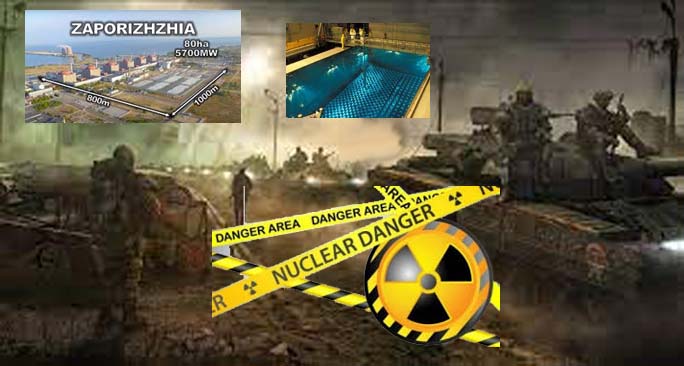
Since the war began, the 15 Ukraine reactors situated at four sites, along with the defunct Chornobyl nuclear plant, have been at the center of media attention, once again bringing to light the inherent and extreme dangers of nuclear power plants at any time, let alone during an armed conflict. And, on a few occasions, all of those sites have also been in the crosshairs of actual fighting, most notably the six-reactor Zaporizhzhia nuclear power plant, the largest both in Ukraine and all of Europe.

Despite pleadings by the International Atomic Energy Agency and its director, Rafael Grossi, not to engage in combat close to the nuclear plants, no effective deterrent or peaceful protective measure has been found or implemented, even as the IAEA continues to urge the creation of safe zones around the nuclear sites.

Grossi and others insist that the nuclear plants themselves are not the problem. “It’s very simple, the problem in Ukraine and in Russia is they are at war. The problem is not nuclear energy,” he told the BBC in an interview.

Except that it IS the nuclear plants that are the problem. After all, if Ukraine was powered by renewables and not nuclear plants, this wouldn’t even be an issue. As an Austrian government briefing paper, collected under “Fairy tales by the nuclear lobby,” said: “A ‘successful’ attack on a nuclear power plant in densely populated Europe would have radiological and economic consequences far beyond those experienced after Chernobyl or Fukushima. So far, no terrorist attacks on wind turbines or solar panels have been reported.”

An attack or other precipitating events caused by the war in Ukraine, could still result in such a disaster. Sadly, with the war raging on, nothing has really changed since the February 24, 2022 invasion.

Since it’s the most dangerous, being the largest, and also the closest to the worst of the fighting, let’s take Zaporizhzhia as our test case. 

There are approximately 200 different radioactive isotopes contained in any given nuclear reactor and its waste inventories. Zaporizhzhia houses at least 2,204 tons of highly radioactive waste within the reactors and the irradiated fuel pools, according to a March 2022 Greenpeace analysis, looking at 2017 figures, the latest data available. At least 855 tons of those wastes are in the pools. The quantities are so high because the reactors have been in operation for several decades. The first unit came on line in 1985, the sixth in 1996.

Among those 200 isotopes are iodine-131, which attacks the thyroid, cesium-134 that accumulates in muscle and strontium-90 which acts like calcium in the body and is easily incorporated into bone. Since all reactors also make plutonium-239 — with a half-life of 24,000 years — as part of the fission process, it, too, could be propelled into the environment. As an alpha-emitting particle, it is most dangerous when inhaled, attacking lungs, kidneys and other organs.

As we have written frequently at Beyond Nuclear since our first article appeared and the Russian war on Ukraine followed, there are a number of scenarios that could precipitate such a catastrophe. It could involve a full or partial reactor meltdown, an irradiated fuel pool fire or hydrogen explosion, or a breach of the radioactive waste storage casks.

The specific scenarios for this are described with essential detail and great clarity in the special section on “Nuclear Power and War” in the 2022 edition of the World Nuclear Industry Status Report.

Unlike all other types of power plants, the safety of a nuclear power plant depends on continuously functioning cooling systems,” the WNISR authors write in the chapter introduction. “The physical reason for this is the radioactive decay of the fission products and transuranic elements produced by neutron capture on uranium. During this decay, considerable amounts of heat are generated, so-called decay heat. If it is not continuously removed by cooling, this leads to strong heat buildup, which can cause melting, fires, or other events that can cause major releases of radioactive materials. During operation and directly after a reactor shutdown, cooling requirements are particularly high.”

This also means that even when the reactors are shut down, as at least four have been at Zaporizhzhia, they are not out of danger. And the fuel pools present the greatest threat, as the radioactive waste inventory they contain is more radioactive than the fresh fuel before it is loaded into the reactor.

But it need not take a full blown attack to cause at least some of these disastrous outcomes. It could be as simple as a loss of power, or human error. ……………………………………………………………………………………………………………..

As we ponder this in the context of the perils of war, we must also remember that war just makes this outcome [a Chornobyl type disaster] more likely. A major nuclear disaster is still possible — and even probable — on a daily basis at any nuclear power plant anywhere and at any time. Loss of power and human error remain key causes, along with violent weather events — occurrences that will continue to become more frequent and more severe as the climate crisis worsens. Sabotage and terrorism are an ever-present possibility as well.

This means that striving for the unrealistic goal, as the IAEA does, of ensuring nuclear reactors are not caught up in a war zone, doesn’t make us all that much safer. Only the complete elimination of nuclear power as an energy source will achieve that. 

Linda Pentz Gunter is the international specialist at Beyond Nuclear and writes for and curates Beyond Nuclear International.  https://beyondnuclearinternational.org/2023/01/29/clear-and-present-danger/

January 29, 2023 Posted by | safety, Ukraine | Leave a comment

Cracking Under Pressure: Inside the Race to Fix France’s Nuclear Plants

Macron’s government wants to help EDF build six new large reactors and begin preparatory studies on another eight units by 2050.

But building 14 new reactors is “absolutely not within EDF’s reach with its current balance sheet,” said Celine Cherubin, a senior credit officer at Moody’s Investors Service………..

The plan to fix seven safety cooling systems in 2023 is “not the end of the story,”… “It’s possible that we have to carry long and complex works. I think that 2023, ’24 and ’25 will continue to entail issues related to the stress corrosion.”

Yahoo News, Francois De Beaupuy, Sat, January 28, With assistance from Samuel Dodge and Patricia Suzara.

(Bloomberg) — Behind layers of security and a thick concrete wall, a team of welders work in shifts to fix the crippled Penly nuclear plant in northern France. Sweating under protective gear, they’re replacing cracked pipes in the emergency cooling system which protects against a reactor meltdown.

Each weld takes at least three days to complete, with workers often on their knees or backs to reach for the correct angle. Even in radiation suits, health regulations limit work in that environment to a maximum 40 hours a year.

The complicated procedures, replicated across sites this winter, have hampered the ability of Electricite de France SA to get its reactors back online after lengthy shutdowns.

Deadlines have slipped. The two Penly reactors were scheduled to be back online this month and next. Instead, EDF has been forced to delay the restarts to May and June.

“These are complex situations, in a noisy and radioactive environment,” Laurent Marquis, a manager at Altrad Group-Endel which is coordinating the repairs for EDF at Penly, said last month, before the restarts were pushed back. “Workers can sometimes only hold their position for just a few minutes before they need to be replaced.”

The power station, below a cliff on France’s northern coast, normally provides electricity for about 3.6 million households. Its two reactors have been, in effect, grounded by faulty plumbing — the same cracked pipes first discovered by EDF at another plant in late 2021. That reactor, at Civaux in central France, only came back online on Wednesday after extensive repairs.

The discoveries plunged the operator into a crisis with repercussions for all of Europe. EDF called it an “annus horribilis,” and from early May to late October, about half of its 56 reactors sat idle due to the repair and maintenance backlog.

It flipped France from Europe’s biggest electricity exporter into a net importer last year, just as the continent needed it more than ever. After gas imports from Russia dried up, energy prices soared, governments spent billions helping consumers with their bills and Europe was threatened with shortages and blackouts.

So far, Europe has avoided the worst-case scenario, thanks to efforts to conserve energy and a relatively mild winter that reduced heating demand

But the crisis is far from over, and EDF needs to find a way to avoid a repeat next winter. That challenge — finding problems, fixing them, doing checks — is already a mammoth task, and it’s being compounded by financial issues and staff shortages………………………………………………………….

By May, the utility had concluded that 16 of its reactors had pipes more prone to stress corrosion. Significantly, they were actually the group’s newest reactors, where the French nuclear plant builder Framatome — a unit of EDF — had modified the original Westinghouse Electric Co. design used for the 40 older units………………………………….

EDF has a history of missed maintenance deadlines, which an external audit published in June blamed on inadequate management of data, staff shortfalls and inexperienced teams in charge of turnarounds.


The company is still trying to figure out the speed at which cracks progress through pipes once they appear, meaning it faces tighter, more frequent monitoring of its reactors. Future setbacks can’t be ruled out.

The plan to fix seven safety cooling systems in 2023 is “not the end of the story,” Cedric Lewandowski, EDF’s senior executive vice-president for nuclear and thermal production, said at a parliamentary hearing this month. “It’s possible that we have to carry long and complex works. I think that 2023, ’24 and ’25 will continue to entail issues related to the stress corrosion.”

If that caps nuclear output, that means less power for France, and less to export to Europe.

Compounding the pipe issues is the broader maintenance work needed on what’s an aging fleet. Most of EDF’s reactors were built from the late 70s to the mid-90s, and now require longer down time. The utility wants to coincide the corrosion repairs with the other halts to maintain production, Lewandowski said.

On top of that, the utility is still repairing 122 faulty welds at a new flagship reactor in Flamanville in Normandy, which it wants to commission in the first half of 2024. The project is already over a decade behind schedule, and about €10 billion over budget.

All of which raises significant questions for EDF and the French government……………..

Macron’s government wants to help EDF build six new large reactors and begin preparatory studies on another eight units by 2050.

But building 14 new reactors is “absolutely not within EDF’s reach with its current balance sheet,” said Celine Cherubin, a senior credit officer at Moody’s Investors Service………………………..

The bigger question is whether EDF and the government can now reverse the sense of decline in France’s nuclear industry.

January 29, 2023 Posted by | France, safety | Leave a comment

The dirty secret of US nuclear energy

JOHN GREEN recommends an exposé of dangerous malpractice at the oldest and largest nuclear site in the US

Atomic Days: The Untold Story of the Most Toxic Place in America
By Joshua Frank

A DESCRIPTION of Hanford in Washington state — the place where the US stores much of its plutonium waste — sounds like something out of a dystopian novel by Kurt Vonnegut.

The town of Richland, a stone’s throw from Hanford’s boundary fence and where many of the workers’ families live, is an odd place. No rich mineral deposits, no surrounding agricultural landscape, no ski slopes or well-heeled tourists.

Richland was established by the atom bomb project and celebrates that history. The local pub is called Atomic Ale Brewpub. It showcases beers like Plutonium Porter, half-life Hefeweizen and Atom Bustin’ IPA.

The local school coat of arms boasts an exploding mushroom cloud. There is “a fervent mystifying patriotism” running deep in Richland, says Frank. The town also boasts more PhDs than any similar sized town in the state but voted overwhelmingly for Trump in recent elections.

Hanford’s B reactor has been designated a National Historic Landmark and was the first full scale plutonium production plant in the world. Those acting as guides do not appear to reflect on its legacy or suggest, perhaps, a moment of silence for the victims of nuclear bombs; for them it is a reason to rejoice at the ingenuity and superiority of the US war machine

Atomic Days reads at times like a political thriller, involving government lying and cover-ups, corruption, private-sector rapaciousness, spying on union “troublemakers” or anyone concerned about health and safety, and even the attempted murder of a whistleblower. There is no transparency and little accountability.

Many Hanford workers and their families have suffered serious illness as a result of radioactive contamination, from hyperthyroidism to miscarriages, disabilities and cancers, and numbers of unexplained deaths.

All this has been largely ignored by the national media, despite the fact that Hanford poses not only a danger to local people but to the whole country.

While focusing on Hanford, Frank encompasses the nuclear story on a global scale, from the US army injecting unsuspecting human guinea-pigs with plutonium in the 1940s, to the bombing of Hiroshima and Nagasaki, Chernobyl, Fukushima and the air crash over Spain involving nuclear weapons, to the legacy of nuclear bomb testing.

During the Cold War, the project expanded to include nine nuclear reactors and five large plutonium processing complexes, the last of which was decommissioned in 1987.

Once home to the US largest plutonium production site, the Hanford Nuclear complex is laced with 56 million gallons of radioactive waste. There have been numerous releases of radioactive isotopes into the ground water and into the atmosphere, but it has all been shrouded in secrecy. Today, the EPA has designated Hanford the most toxic place in America; it is also the most expensive environmental clean-up job the world has ever seen, with a soaring price tag of £553 billion.

At present, Hanford’s radioactive waste is stored in 177 waste tanks, 149 of them with just a single wall. The facility sits over a huge aquifer, above which 53 million gallons of radioactive and chemically hazardous waste are stored in leaky underground tanks.

These tanks are well past their life expectancy and full of boiling radioactive gunk. They are leaking, infecting groundwater supplies and threatening the nearby Columbia River. It also sits on around 750,000 cubic metres of buried solid waste, spent nuclear fuel and leftover plutonium.

The threat of an explosive accident at Hanford is all too real and could be more catastrophic than Chernobyl. There have already been numerous accidents, mostly unregistered and unknown to the public. It is one of the most radioactive wastelands on Earth.

It used to be home to several indigenous groups who once fished in the fish-rich Columbia River and hunted the deer and other animals in the surrounding woods. They were resettled from their ancestral lands once the US government determined to use the land to build the biggest plutonium production plant and waste dump in the country.

Frank’s chilling account should certainly disabuse the illusions of anyone out there who still views nuclear energy as a means of producing clean energy and saving the planet.

Joshua Frank is co-editor of the radical magazine, Counterpunch.

January 29, 2023 Posted by | culture and arts, media, safety, USA, wastes | 1 Comment

Missing radioactive capsule: Western Australia officials admit it was weeks before anyone realised it was lost

Fire and Emergency Services official says capsule left Rio Tinto mine site on 10 January but was not found missing for 15 days

Guardian, Mostafa Rachwani, 28 Jan 23

Western Australian authorities are scrambling to find a missing radioactive capsule that is a fraction of the size of a 10c coin, conceding it was not found missing until more than two weeks after it left a Rio Tinto mine site.

The 8mm by 6mm capsule is a 19-gigabecquerel caesium 137 ceramic source, commonly used in radiation gauges, and was supposed to be contained in a secure device which had been “damaged” on a truck which travelled from the mine site north of Newman in the Pilbara to a depot in Perth.

Authorities are now searching along the 1,400km stretch of the Great Northern Highway for the capsule, which they warn can cause skin burns, radiation sickness and cancer.

At a news conference on Saturday, Darryl Ray, the acting superintendent for Western Australia’s Department of Fire and Emergency Services, said authorities were largely searching for the capsule at “strategic sites”.

He said an incident management team including the Department of Health and police had been formed.

“We have continued the search on strategic sites along the route that the vehicle had taken, concentrating on sites close to high-population areas within the metropolitan suburbs,” he said. “The search involves the use of radiation survey meters to detect the radiation levels which will help us locate the small device.

“What we are not doing is trying to find a tiny little device by eyesight. We are using the radiation detectors to locate the gamma rays, using the meters, that will help us then locate the small device.

“We have secured the GPS data from the trucking company to determine the exact route and stops that the vehicle has taken on its journey.

“We will continue to use specialist equipment to help us search the remaining known locations … in particular, the Great Northern Highway between Perth and Newman.”

The WA chief health officer, Andrew Robertson, said there were screws missing from the protective gauge holding the capsule when it was discovered missing.

“These gauges are designed to be robust and to be used in industrial settings where they may be exposed to weather and vibration, so it is unusual for a gauge to come apart like this one has,” Robertson said.

“We are conducting an investigation on all of the circumstances from when it was originally transported from the mine site, the whole of the transport route, and then its handling on arrival in Perth.”

Robertson urged anyone who found the capsule not to handle it.

“People could end up developing redness of the skin and eventually burns of the skin from the beta radiation,” he said. “If it were kept long enough and they were exposed long enough, they could also have some acute effects, including impacts on their immune system and the gastrointestinal system.”

Robertson said the capsule was “most dangerous if it is handled or if it is close to the body”.

“If you are further than five metres away from the source, certainly if you are more than 20 metres away from the source, it will pose no danger to you,” he said. “If it is closer than that, and we strongly discourage people from picking it up, certainly don’t put it in your pocket or put it in your car, don’t put it on your sideboard, it will continue to radiate.

“While you may not have immediate health effects, they can occur relatively rapidly over a short period of time if it is close to the body………………

Robertson said officials did not know the date the capsule fell off the truck.

Ray said the capsule was placed on to the pallet on 10 January at the mine site, transited and arrived at the radiation service company in Malaga on 16 January.

“It was not until the 25th, late morning, when they opened it up to reveal that the device had fallen apart, was damaged in transit, and that the actual capsule was discovered missing, which is when authorities were first notified.” ………… more https://www.theguardian.com/australia-news/2023/jan/28/missing-radioactive-capsule-wa-officials-admit-it-was-weeks-before-anyone-realised-it-was-lost

January 29, 2023 Posted by | AUSTRALIA, incidents | Leave a comment

UK’s ‘Protect and Survive’ nuclear attack advice deemed ‘futile’ in face of modern threats

The 32-page booklet Protect and Survive about what to do in the event of a nuclear attack was offered to the public in 1980. But it was widely criticised and mocked at the time, and has since been deemed nothing but a “charade”.

Express UK By RHIANNON DU CANN, Jan 29, 2023 “…………………………….. what should people do if the worst were to happen? Is there any official advice? Here, Express.co.uk looks at the UK’s last official piece of nuclear advice: a booklet titled Protect and Survive.

The booklet told the public “how to make your home and family as safe as possible under nuclear attack”. In the event of a crisis, the 32-page booklet would be distributed with announcements made on the TV, the radio, and in the press. The pamphlets and a series of public information films were only intended to be made known to the public in the event of a crisis. Some 2,000 copies of the pamphlets were sent to senior officials in the emergency services and local authorities.

The apocalyptical pamphlet — which described how no part of the UK would be considered safe in the event of a nuclear bomb or missile attack — advised the public to create a “fall-out room” and “inner refuge” to protect from radiation

The public was ordered to stay in the room furthest from the outside walls and roof for 14 days without leaving “at all”, essentially barricading themselves in to protect against the penetration of radiation. If possible, Britons were advised to build a “lean-to” inside using dense materials, again to resist radiation. If you lived in a flat of more than five floors, then you must head to the basement or ground floor.

Windows were to be painted with white emulsion to reflect the heat and advice was given on how to bury and label those who had died.

The public would be told to put together a survival kit which consisted of three and a half gallons of drinking water and some for washing; tinned or well-wrapped food to last for a fortnight; a portable radio (described as “only link to the outside world”); warm clothing; letter writing paraphernalia; tin and bottle openers

; crockery; bedding and toilet “articles”.

The booklet also included a checklist that asked questions such as “do you know the warning sounds?”; “have you got buckets of water ready on each floor?” and “have you sent the children to the fall-out room?”

The senior curator of the 2017 People Power: Fighting for Peace exhibit at the Imperial War Museum told The Times that year that the pamphlet was “chilling”.

Matt Brosnan said: “The matter-of-fact instructions are written so as to be easy to follow, yet never broach the underlying question that all readers would be likely to ask: in a nuclear strike, would most of this be futile?”……………………………………….more https://www.express.co.uk/news/uk/1727069/uk-protect-and-survive-booklet-nuclear-attack-advice-spt

January 29, 2023 Posted by | safety, UK | Leave a comment

Kramatorsk radiological accident

 https://en.wikipedia.org/wiki/Kramatorsk_radiological_accident#:~:text=The%20Kramatorsk%20radiological%20accident%20was,rate%20of%201800%20R%2Fyear.

The Kramatorsk radiological accident was a radiation accident that happened in Kramatorsk, in the Ukrainian SSR from 1980 to 1989. A small capsule containing highly radioactive caesium-137 was found inside the concrete wall of an apartment building, with a surface gamma radiation exposure dose rate of 1800 R/year.[1] The capsule was detected only after residents requested that the level of radiation in the apartment be measured by a health physicist.[1]

The capsule was originally part of a radiation level gauge and was lost in the Karansky quarry in the late 1970s. The search for the capsule was unsuccessful and ended after a week. The gravel from the quarry was used in construction.[2] The caesium capsule ended up in the concrete panel of apartment 85 of building 7 on Mariyi Pryimachenk Street (at the time under the Soviet name Gvardeytsiv Kantemirovtsiv), between apartments 85 and 52.[1]

Over nine years, two families lived in apartment 85.[1] A child’s bed was located directly next to the wall containing the capsule.[1] The apartment was fully settled in 1980. A year later, an 18-year-old woman who lived there suddenly died. In 1982, her 16-year-old brother followed, and then their mother. Even after that the flat did not attract much public attention, despite the fact that the residents all died from leukemia. Doctors were unable to determine root-cause of illness and explained the diagnosis by poor heredity. A new family moved into the apartment, and their son died from leukemia as well. His father managed to start a detailed investigation, during which the vial was found in the wall in 1989.

By the time the capsule was discovered, four residents of the building had died from it and 17 more had received varying doses of radiation.[2] Part of the wall was removed and sent to the Institute for Nuclear Research, where the caesium capsule was removed, identified by serial number and disposed of.[1]

January 29, 2023 Posted by | incidents, Ukraine | Leave a comment

Urgent public health warning issued over lost radioactive capsule in Western Australia

“It emits both beta rays and gamma rays so if you have it close to you, you could either end up with skin damage including skin burns,” .

“And if you have it long enough near you, it could cause acute radiation sickness.

DFES have issued a warning for people to stay at least five metres away from it if they see something that resembles the capsule.

 https://www.abc.net.au/news/2023-01-27/radioactive-capsule-lost-in-wa-emergency-public-health-warning/101901472 By Cason Ho 28 Jan 23

A missing radioactive capsule lost somewhere between Perth and a Pilbara mine site over an area of 1,400 kilometres has sparked an urgent health warning.

Key points:

  • A capsule containing a radioactive substance has been lost
  • The capsule is 6mm in diameter and 8mm wide
  • People are being urged not to get close to the capsule

In an emergency press conference on Friday afternoon, WA’s chief health officer urged people to stay away from the capsule if they see it because of its radioactive properties.

The capsule is tiny – 6mm diameter by 8mm high.

The radioactive gauges are commonly used in mining. It went missing from a truck sometime after January 10.

WA radioactive substance risk alert

The radioactive capsule could be anywhere along the more than 1,400 km journey between Malaga, in Perth and Newman in WA’s remote north

Any motorists who have travelled along the Great Northern Highway between Newman and Perth since January 10 should check their tyres, in case the capsule has become lodged in them.

Chief Health Officer Andy Robertson said the capsule was lost while it was being transported, somewhere between a mine site north of Newman and Malaga, north east of Perth. 

It is believed the capsule fell through the gap left by a bolt hole, after the bolt was dislodged when a container collapsed as a result of vibrations during the trip.

Authorities are searching Great Northern Highway in a desperate effort to find the capsule, which is smaller than a 10-cent piece.

DFES said the capsule “cannot be weaponised” but are still urging caution due to potentially serious health consequences.

Radiation equivalent to 10 X-rays an hour

Mr Robertson said it does emit a “reasonable” amount of radiation.

He says the radiation emitted is equivalent to receiving 10 X-rays in one hour, if you were within one metre of it, or the amount of natural radiation a body is exposed to over a year.

The half-life of the substance is 30 years. 

“It emits both beta rays and gamma rays so if you have it close to you, you could either end up with skin damage including skin burns,” he said.

“And if you have it long enough near you, it could cause acute radiation sickness.

“Now that will take a period of time but obviously we are recommending people not be close to it or hang on to it.”

Mr Robertson advised anyone who finds the capsule not to go near it, and to rather call DFES on 133 337.

The Department of Fire and Emergency Services is leading search efforts, coordinating a team involving the Department of Health, WA Police, and other subject matter experts.

DFES Country North chief superintendent David Gill said there would be “challenges” in locating such a small object.

“The start and finish of the transportation from the mine site north of Newman, and the transport depot in Perth, are among some of the locations that are searched, and being searched yesterday, but the capsule remains unfound,” he said.

“There are challenges here. It is 1,400 kilometres between the mine site … to the north of Newman, and Perth.”

DFES have issued a warning for people to stay at least five metres away from it if they see something that resembles the capsule.

People are urged to avoid coming into contact with it, and immediately contact DFES.

January 29, 2023 Posted by | AUSTRALIA, incidents | Leave a comment

Military offensives increase nuclear accident odds in Ukraine, warns atomic safety chief

Earlier this month, Petro Kotin, president of Ukraine’s state-run Energoatom nuclear operator, said a U.N. security buffer was not “realistic” and instead called for Ukraine’s forces to take the facility back by force.

But Grossi warned that any attack “puts the installation at great risk.

Rafael Mariano Grossi wants ‘every’ EU country to push for a security buffer around the occupied Zaporizhzhia plant.

POLITICO, BY VICTOR JACK, JANUARY 25, 2023 

The risk of an accident at Ukraine’s Russia-occupied Zaporizhzhia nuclear power plant will “undoubtedly” increase as both Kyiv and Moscow prepare for military offensives in the coming months, warned the chief of the U.N.’s nuclear watchdog.

“There is a lot of talk about bigger, larger maneuvers and action in the early spring or late winter,” Rafael Mariano Grossi, the International Atomic Energy Agency (IAEA) director general, told POLITICO, “which makes me think that any increase in bombing and shelling will undoubtedly increase the possibility of a nuclear accident.”

Russia is likely to launch a fresh push to take Ukrainian territory this spring, a top NATO official said last week, while Ukraine also says it is readying a major counter-offensive……………………………………….

Earlier this month, Petro Kotin, president of Ukraine’s state-run Energoatom nuclear operator, said a U.N. security buffer was not “realistic” and instead called for Ukraine’s forces to take the facility back by force.

But Grossi warned that any attack “puts the installation at great risk.”

He’s pressing for EU foreign ministers to get involved and use their “own channels of communication” with Ukraine and Russia to “pass the message … that avoiding a nuclear accident is a must” and a security zone is needed.

Grossi also addressed the increasingly frequent calls from Russian propagandists and some politicians that Moscow should respond to its battlefield setbacks by unleashing its nuclear weapons.

“I don’t see how a conventional war — no matter how dramatic it is — between a non-nuclear weapon state and a nuclear weapon state could … justify the use of nuclear weapons,” he said. https://www.politico.eu/article/ukraine-war-military-nuclear-accident-atomic-safety-chief-rafael-mariano-grossi/

January 27, 2023 Posted by | safety, Ukraine, weapons and war | Leave a comment

Former DEA Nuclear Security Official Says Wyoming Reactor Not Safe

the sodium reactor planned for Kemmerer has a high degree of potential for explosive accidents and proliferation of nuclear weapons material.

Sodium reacts with water and air, which Tallen said poses a huge risk for accidents.

Cowboy State Daily, By Kevin Killough, State Energy Reporter
Kevin@CowboyStateDaily.com  January 25, 2023January 25, 2023 

When TerraPower and PacifiCorp announced in November 2021 that they had selected Kemmerer as the location of its Natrium reactor demonstration project, many welcomed the opportunity as a path to a diverse energy economy for Wyoming.  

In the next few months, TerraPower plans to break ground on a sodium testing project for the larger demonstration project. If the reactor design is proven, it would provide lots of carbon-free energy and provide a viable replacement for retiring coal plants in the state, TerraPower said. 

Wapiti resident Bill Tallen had a 20-year career with the Department of Energy that was focused on the threat posed by terrorists who sought ways to create improvised nuclear devices.

Tallen argues that the sodium reactor planned for Kemmerer has a high degree of potential for explosive accidents and proliferation of nuclear weapons material. Henry Sokoloski, executive director of the Nonproliferation Policy Education Center (NPEC), which is based in Washington D.C., has a lot of the same concerns.  

Jeff Navin, director of external affairs with TerraPower, says these concerns have been considered and addressed as much as reasonably possible in the project’s design and development.  

Not Opposed To Nuclear 

Tallen said he’s not ideologically opposed to nuclear power. He said he rubbed elbows with that crowd years ago, but it’s not where he stands today.  

“The distrust of nuclear power is one of the major ideological tenets of left-wing, anti-establishment politics,” Tallen said. “I had to say to them, I can’t agree with you on many of your basic assumptions. I’m just saying that this particular [Natrium] technology pursued the way it is right now – I don’t think it’s a good idea.”  

Reaction Risk  

The Natrium reactor being built in Kemmerer uses sodium instead of water as a heat sink for the reactor core. That heat will then be transferred to water, which will produce steam to turn turbines.  

Sodium reacts with water and air, which Tallen said poses a huge risk for accidents.  

“There’s never been a sodium reactor that has actually met its promises. They’ve all had leaks and fires and explosions and toxic releases,” Tallen said. “Granted, in America we haven’t had big problems, but the past is not always prologue. The risk is still there.”  ……………………

Plutonium And Proliferation 

Sokolski with NPEC said these reactors produce plutonium during the fission process.  

“The plutonium produced in these machines isn’t just weapons usable. It isn’t even weapons grade. It’s super weapons grade,” Sokolski said.  

The Natrium reactors run on high-assay low-enriched uranium, known commonly as HALEU. It’s currently produced only in Russia, and due to the invasion of Ukraine, supplies of the material are scarce. This has led to a delay in the Kemmerer project.   

Tallen said that as these reactors grow and more HALEU is produced, it’s just inviting a nation like Iran to find sources of the material, which can be enriched to weapons-grade with the right facilities.  

“These are parties that do in fact have, or can construct, enrichment capabilities and will not be concerned by U.S. export restrictions,” Tallen said.  ………………………..  https://cowboystatedaily.com/2023/01/25/former-dea-nuclear-security-official-says-wyoming-reactor-not-safe/

January 25, 2023 Posted by | safety, Small Modular Nuclear Reactors, USA | Leave a comment

Nuclear power in Ukraine: what would happen if Zaporizhzhia was hit?

The most likely risk scenario is a breach of spent fuel held in canisters or cooling ponds outside of the reactor core containment structure. This spent fuel is still highly radioactive and vulnerable to missiles, shells and rocket strikes which could spread radiation directly or start fires spreading radiation. An impact by an aircraft is also a significant risk due to the highly inflammable aircraft fuel onboard.

Scientists for Global Responsibility, Dr Philip Webber, 22 Jan 23
 

The Zaporizhzhia region in south eastern Ukraine houses the largest nuclear power station in Europe – the Zaporizhzhia NPP – one of the ten largest such plants in the world. It is currently in an intensely fought war zone. Dr Philip Webber, SGR, explains some of the risks of radiation releases that this poses, both nationally and internationally.

Article from Responsible Science journal, no.5; advance online publication: 15 December 2022
 

About the Zaporizhzhia site

The Zaporizhzhia nuclear plant [1] is part of a huge industrial complex some 8km square. It houses six large (1 gigawatt or GW) VVER-1000 Russian designed and built nuclear power reactors, [2] three thermal (coal- and gas-powered) power stations, and the purpose-built city of Enerhodar, which was built in 1970 to house 11,000 power plant workers and a total population of around 53,000. [3]  Before the war, the nuclear plant supplied about 20% of Ukraine’s electricity – widely used for heating in large apartment blocks. The reactors’ containment structures [4] house the nuclear core and used or ‘spent’ nuclear fuel in cooling pools. After five years, this spent fuel is transferred to dry storage casks nearby, which are air-cooled. In addition, huge external cooling ponds – which are continuously sprayed with water – store many older used nuclear fuel rods. The three thermal plants were shut down in May 2022 having run out of fuel due to the Russian invasion.

The Zaporizhzhia power site is much larger than the biggest UK nuclear sites such as Sellafield or Hinkley Point – either of these would fit within just the area of the cooling ponds at Zaporizhzhia. The entire complex is situated on a flat promontory on the south-east bank of the Dnipro River which is 5km wide at that point. [5]  The site is 50km south west of the city of Zaporizhzhia, also on the south bank of the Dnipro. Kherson is about 150km to the south west – but on the other bank of the river.
 

Under occupation

The reactor site has been occupied by Russian military forces since March 2022 – with Ukrainian forces in control of the opposite river bank. The original Ukrainian Energoatom plant operators are being forced to keep working there under conditions of extreme stress. These stresses include excessively long shifts, extreme concerns about family safety, and even the arrest of the plant chief. Various parts of the site have been hit by artillery shells and warheads from rocket-launched missiles over several months. Photographs show cratering and rocket tubes embedded in the ground. Both sides accuse the other of deliberately targeting and hitting the plant site. As a result of major safety concerns, the International Atomic Energy Agency (IAEA) has placed monitoring teams at the site and nearby, but sourcing reliable information remains extremely difficult. [6]

The local electricity grid is very extensive and extremely vulnerable. Before the war, several high voltage (HV) power lines extended east from the nuclear and thermal plants to what is now Russian-occupied Ukraine via extensive electricity sub-stations, whilst one large HV line connected directly across the Dnipro to the opposite bank – under the control of Ukraine – via Marhanets just 15km away. Artillery shells can easily be fired over 40km whilst rocket launchers can reach even further, so the entire area is within range of both Russian and Ukrainian forces. Perhaps unsurprisingly, the IAEA continue to report that connections to the electricity grid keep being destroyed by artillery shelling which are then intermittently repaired. Repairs are very difficult owing to a severe shortage of supplies such as power transformers, insulators, cabling and HV circuit breakers. So far, neither the containment buildings for the reactors, nor the spent fuel assemblies in canisters, nor the large cooling ponds appear to have been seriously breached, but there is no guarantee this will continue to be the case.

The plants remain in a highly contested conflict area. The IAEA and UN have called for the plants to be placed in a demilitarised safety zone. No such zone has yet been set up. It is perhaps worth saying that any such demilitarised zone would have to include the city of Enerhodar because of its intimate connection and proximity to the nuclear power plants and power lines that traverse the entire area. Creating such an exclusion zone at the centre of a high intensity war zone is extremely difficult and has been rarely achieved in other conflicts.
 

Emergency shutdown

It is extremely difficult to secure a reliable picture of what is actually going on at the Zaporizhzhia power generation site……………………………

What if the cooling fails?

Any nuclear reactor, for safe operation, needs to be connected to an electricity supply to provide a reliable source of emergency core cooling power. Without such active cooling from pumped water, the reactor core will eventually overheat to dangerous levels. Outside the reactor cores, radioactive decay in spent fuel continues, releasing heat inside the reactor containment structure, the dry storage casks, and the external ponds. Any failures of, or threats to, electricity supplies create serious emergency situations. Because of this danger, each reactor has emergency diesel-fired electricity generators with around 10 days of fuel. [8]  Ultimately, without active cooling powered by the grid, and once back-up diesel generators run out of fuel, core temperatures would rise uncontrollably. This would lead first to hydrogen gas release, then explosions, and ultimately, runaway core meltdowns breaching the core containment.

This is what happened at the Fukushima nuclear plant in Japan in 2011 [9] – when the cores in three reactors could not be cooled, large volumes of hydrogen gas were released into the containment structures, which then exploded, releasing highly radioactive materials into the environment – mainly as gases and vapours. After a few days, the reactor cores reached the melting points of the nuclear fuels and these highly radioactive molten materials burned down through the lower regions of the reactor vessels. This situation also has similarities with the 1986 Chernobyl disaster – the site of which is now part of Ukraine (and was occupied briefly by Russian troops early during the invasion).

In a reactor core of 1GW size, as those at Zaporizhzhia, if the cooling system breaks down, hydrogen explosions would occur after 8 to 12 hours. After about two days, the reactor core would become hot enough to burn through the base of the reactor vessel. [10]

Cooling for the reactor cores and spent fuel storage relies on several factors: a reliable supply of water; a reliable supply of power for the cooling pumps; working pumps; and staff to conduct any repairs and maintain the cooling systems. Without a reliable connection to the electricity grid, the only source of power for the pumps are, as mentioned, the back-up generators. With all of these factors now under threat, the risk of a reactor containment breach due to cooling failure is high. [11]

Other risks result from the ongoing conflict. Whilst an artillery shell or conventional cruise missile strike is unlikely to breach the reactor core containment directly, the threat is much greater to the integrity of over 3,000 spent fuel assemblies stored locally in concrete containers. Artillery, or a cruise missile could easily breach any of these containers releasing highly radioactive materials. This in turn could make part of the site – for example, cooling circuitry or fuel supplies – too dangerous to manage, which would lead to an even more serious core failure.

The possible effects of a nuclear disaster

There are a wide range of possible disaster scenarios.

Firstly, considering a meltdown of one or more reactor cores, the most comparable reactor accident so far has been the Fukushima plant radiation releases following the Great East Japan Earthquake and its subsequent tsunami in 2011. This led to an initial obligatory exclusion zone of 20km radius around the plant with 30km radius stay-at-home and no-fly zones and finally a larger zone extending 40km to the north west. Within a year, some people were permitted to return home within the 20km zone, whilst others with higher radiation levels were restricted for five years after the disaster, and a 30-year clean up period was envisaged. The Fukushima experience however does not give one high confidence that future nuclear disasters may be better managed……………………….

A further difficulty arising from the conflict is that emergency responses such as evacuation of population, distribution of iodine tablets or provision of emergency medical treatment would be very difficult to coordinate, especially as no one authority would be able to take charge of the situation………….

The most likely risk scenario is a breach of spent fuel held in canisters or cooling ponds outside of the reactor core containment structure. This spent fuel is still highly radioactive and vulnerable to missiles, shells and rocket strikes which could spread radiation directly or start fires spreading radiation. An impact by an aircraft is also a significant risk due to the highly inflammable aircraft fuel onboard.

What if a nuclear weapon were used?

The worst possible scenario is nuclear strike on a reactor.  A direct strike by even the smallest nuclear warhead, for example, a 10 kilotonne (kT) ‘tactical’ nuclear warhead – smaller than that dropped on Hiroshima in World War II – would breach the core containment and spread the highly radioactive materials inside. A strike missing the core containment would spread the large amounts of spent fuel stored nearby. A 10kT nuclear blast and fireball would create a 1km radius zone of major destruction, a crater 25m deep and carry radioactive materials into a cloud of 8km altitude and 3km across depositing them underneath and downwind as fallout.

The reactor waste products contain long-lasting radioactive isotopes such as caesium and strontium which are readily absorbed into the body or into crops contaminating farmland. This would create a major radiation problem tens to hundreds of times worse and much longer-lasting than the nuclear weapon alone. [13]

At Zaporizhzhia, the large amounts of spent fuel storage make this risk even worse. Fallout would create a lethal radiation risk across the entire plant site and city of Enerhodar. …………………… a completely unmanageable evacuation requirement in peacetime let alone in the middle of an intense war. Depending on the dose rates, some areas may need to be avoided for years to decades………………………………….

Impacts in a war zone

Both the risk of a nuclear disaster and the consequences of it are multiplied in a war zone. In Ukraine, the population are already suffering intense pressure, strain and casualties due to direct impacts such as widespread Russian bombardment with artillery and missiles…………………………….

The only conclusion that can be drawn is that the existence of nuclear plants in any war zone creates a whole new range of risks and dangers ………………….. The other three Ukraine reactor sites are also at high risk due to damage to the electricity grid and have already been subject to emergency shutdown due to such damage…………..more https://www.sgr.org.uk/resources/nuclear-power-ukraine-what-would-happen-if-zaporizhzhia-was-hit


January 24, 2023 Posted by | Reference, safety, Ukraine | 2 Comments

Ukraine says situation deteriorating at Zaporizhzhia nuclear plant.

Ukraine says situation deteriorating at Zaporizhzhia nuclear plant.
Ukraine’s energy minister said on Friday the situation at the Russian-held
Zaporizhzhia nuclear power station was deteriorating because of the
psychological state of its Ukrainian staff and the condition of equipment.
The Ukrainian staff have remained at the plant in southeastern Ukraine
since Russian forces captured it last March, soon after Moscow’s invasion.

Reuters 20th Jan 2023

https://www.reuters.com/business/energy/ukraine-says-situation-deteriorating-zaporizhzhia-nuclear-plant-2023-01-20/

January 24, 2023 Posted by | safety, Ukraine | Leave a comment

French nuclear safety needs review ahead of reactor lifespan extensions, newbuilds.

 https://www.reuters.com/business/energy/french-nuclear-safety-needs-review-ahead-reactor-lifespan-extensions-newbuilds-2023-01-23/ PARIS, Jan 23 (Reuters) – France’s nuclear safety needs a global and systemic review as President Emmanuel Macron’s government prepares to extend the lifespan of the existing fleet while planning to build new reactors, nuclear agency ASN said on Monday.

Bernard Doroszczuk, head of the French nuclear safety watchdog, also told a news conference that utility EDF (EDF.PA) must explain by end-2024 how it plans to extend the life of its nuclear plants up to or beyond 60 years, in order to formulate a first position on the issue within a further two years.

Doroszczuk said a nuclear safety review needs to anticipate the effects of ageing on nuclear installations as well as new challenges posed by climate change.

The government plans to present new energy and climate legislation this summer that will serve as the legislative framework for plans announced by Macron in February 2022 to start construction of at least six new EPR 2 nuclear reactors and to extend the lifespan of as many reactors as possible.

“We need to identify for which components there may be a limit to their operating lifespan,” Doroszczuk said, adding that some components, such as the reactor vessel and the reactor building, cannot be replaced while other components are hard to replace.

“This is not something that can be worked out on the back of an envelope, we cannot decide in a few months whether it is feasible to go beyond 60 years,” he said.

As well as better anticipating the long-term consequences of climate change on the current and future fleet, ASN also wants the new climate and energy law to tackle the issue of treatment and recycling of spent nuclar fuel.

During last year’s heatwave, the watchdog had to grant waivers in order to let certain reactors continue to operate – which had not happened since 2003.

The agency added that EDF unit Framatome had asked it to delay the replacement of the vessel cover of the EPR reactor under construction in Flamanville so it coincided with the first fuel reloading rather than replacing it at the end of 2024 as currently planned.

ASN said that the safety of French nuclear installations overall in 2022 was satisfactory, despite corrosion problems detected on some reactors.

January 24, 2023 Posted by | France, safety | Leave a comment