Maintenance impacted at Zaporizhzhia, says IAEA

24 April 2023 https://www.world-nuclear-news.org/Articles/Maintenance-impacted-at-Zaporizhzhia,-says-IAEA
The current situation at the Zaporizhzhia nuclear power plant is having a significant impact on the plant’s maintenance capability, the International Atomic Energy Agency (IAEA) said.
Plant management informed the IAEA experts present at plant that the scope of maintenance performed during outages on all units in 2022 was reduced compared with the planned scope, due to reduced maintenance staff, absence of external contractors who perform a significant part of the work, and a lack of spare parts needed for the maintenance, including critical components.
The Zaporizhzhia plant currently has only about one-quarter of its regular maintenance staff available, the IAEA said. It noted new staff are being hired but it will take some time until they are fully trained. The plant said a substantial list of required spare parts has recently been submitted to Russian state nuclear corporation Rosatom.
“As a result of the significant reduction of staff, the ZNPP currently does not have a systematic maintenance and in-service inspection schedule,” the IAEA said. “Before restarting any of the reactor units, the site is considering obtaining advice from an engineering organisation within Rosatom that will assess the status of the plant and provide recommendations for all structures, systems and components important to safety regarding their maintenance or any necessary replacement before operation. The site considers that this maintenance/replacement work may be undertaken using the services of a centralised Rosenergoatom company that is capable of performing these types of maintenance tasks.”
“This shows again the continuing detrimental impact that the current situation on the site is having on the seven indispensable pillars for ensuring nuclear safety and security, in this case pillars two and five on safety and security systems and equipment and logistical supply chain,” IAEA Director General Rafael Mariano Grossi said.
The IAEA noted that the Zaporizhzhia plant continues to rely on the only remaining functioning 750kV power line for the external electricity it needs for reactors cooling and other essential nuclear safety and security functions. Meanwhile, a back-up 330kV power line that was damaged on 1 March on the other side of the Dnipro River from the Russian-controlled plant remains unrepaired, with Ukraine having said military action is preventing its experts from safely accessing the location situated in territory it controls to repair the line.
Russia reported last month that Rosatom was working to remove damaged equipment from the open switchyard, with the aim of restoring three 330kV lines to the grid system in currently Russian-controlled territory. The IAEA team will access the site to assess the situation.
Four of the six reactors have been in cold shutdown, with two (units 5 and 6) in hot shutdown – which allows them to provide heat to the plant and the nearby town of Energodar where many of the workers live. However, the IAEA said that, with the weather warming, unit 6 has now been transferred to cold shutdown.
Campaigners’ concerns about safety of Sizewell as Russian ‘spy’ ship seen nearby
Campaigners have expressed concerns about the risks posed to Suffolk’s
Sizewell nuclear plants after a Russian ‘spy’ ship stopped at sites off the
coast. The Admiral Vladimirsky ship is believed to have stopped at wind
farms off the East Anglian coast to map undersea power cables as part of
plans to sabotage the UK’s key energy infrastructure.
Alison Downes, from campaign group Stop Sizewell C, said she wanted to know what measures UK regulators were proposing to protect UK power plants, including Sizewell B,
from attack.
East Anglian Daily Times 22nd April 2023
https://www.eadt.co.uk/news/23473262.concerns-sizewell-safety-russian-spy-ship-seen/
Nuclear life extension plans tested by obsolete components
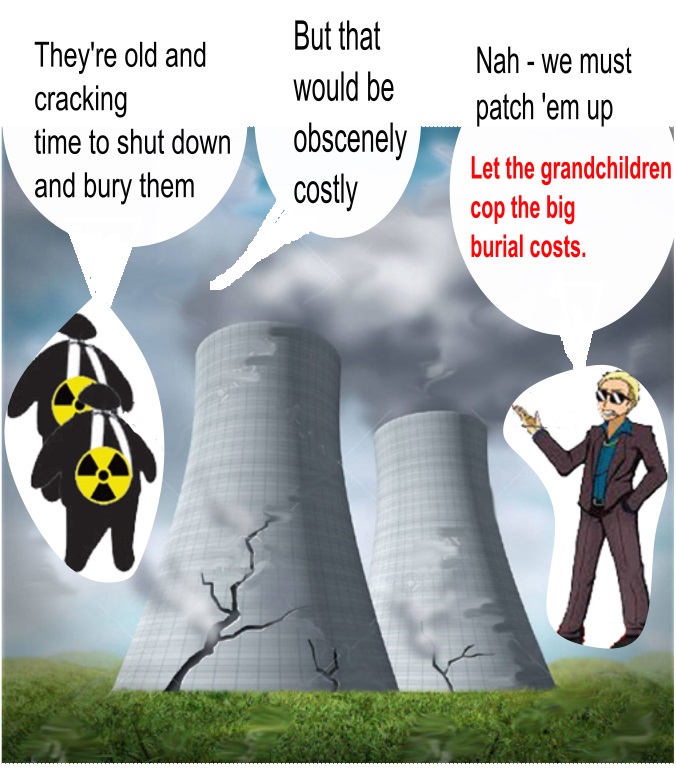
Reuters, By Paul Day, April 5 – Nuclear operators must be able to swap out old parts for new to keep a reactor running, but when like-for-like is unavailable, original equipment manufacturers (OEMs) are faced with the challenge of finding an alternative while avoiding making any major changes.
There’s a rule of thumb that if a plant has to do a design change, it’ll cost anywhere from $300,000-$500,000 just in engineering, licensing changes, drawing changes, and that doesn’t include the cost of the required equipment … so we try, wherever possible, to keep our clients from doing a design change,” says Vice President of Westinghouse Parts Business in its Operating Plant Services unit Craig Irish………………………….
Life extensions
Many of the world’s nuclear power plants were built several decades ago and applications for long-term operations (LTOs) beyond initial lifespans are becoming increasingly common.
…………………………………………………………..In the United States………….the average age of the fleet is 41 years including three reactors that started operation 52 years ago, according to the Department of Energy (DOE)
Nine U.S. reactors have active applications with the Nuclear Regulatory Commission (NRC) to extend their lives and 10 reactors have publicly announced plans to extend their licenses to 80 years.
“Under current license basis 92% of operating reactors would shut down by 2050 and 74 percent would shut down by 2050 with anticipated license renewals. However, if 54 reactors extended operation to 80 years, only 20% of operating reactors would shut down by 2050,” the DOE said in its 2022 report on nuclear energy supply chains.
Obsolescence challenge
The challenge, say OEMs, is keeping a supply chain running and up to date for complex, always-on machines that were built with Reagan-era (or earlier) technology.
………………with construction times for some plants approaching ten years, many of the parts can be obsolete before the plant has even started generating power, according to Westinghouse’s Irish.
……………………………………………Internationally, part of the challenge is many of the parts produced for the nuclear industry face varying specifications depending on the regulator they are working under, restricting an already tight market to national boundaries.
Such differences will become even more pronounced with the introduction of a new generation of reactors expected to begin commercial operations within the next decade, with more than 70 SMR designs under development in 18 countries.
…………………………………………………………………………… “The biggest problem is a lot of these discrete components, resistors, diodes, transistors, capacitors, etc are either substantially changed from the 70s and 80s when we built these instruments or they’re not available or they got bought and sold by another company,” he says. https://www.reuters.com/business/energy/nuclear-life-extension-plans-tested-by-obsolete-components-2023-04-05/
Hungary to Prolong Nuclear Plant’s Lifetime as Expansion Stalls
By Marton Kasnyik, April 21, 2023 https://www.bloomberg.com/news/articles/2023-04-21/hungary-to-prolong-nuclear-plant-s-lifetime-as-expansion-stalls?leadSource=uverify%20wall
Hungary aims to extend the lifetime of its sole nuclear power plant by 20 years to bridge major delays to its Russian-managed expansion, according to a senior official.
Extending the operation of the Paks plant in southern Hungary will maintain the source of about 40% of the country’s electricity consumption. The government is currently assessing safety issues after previous 20-year extensions to the four existing reactors in the last decade.
“Our plan is to get a further 20 years of life-extension,” Energy Minister Csaba Lantos said at a conference on Friday.
Prime Minister Viktor Orban’s administration handed a €10 billion ($11 billion) contract to Russia’s Rosatom Corp. in 2014 to expand the Paks plant. The project has been marred by delays, including due to initial European Union opposition to the investment and the quality of Rosatom’s plans, which Hungary’s own regulator has said fell short of stringent requirements.
Last week, Hungary and Russia said they agreed to an amendment of their original contract following media reports of a potentially reduced role for Rosatom amid EU sanctions against Russia for its invasion of Ukraine.
The changes are “technical” in nature and don’t affect the project’s cost, Cabinet Minister Gergely Gulyas told reporters on Thursday, without elaborating.
Shining a light on St Louis’ radioactive waste landfill scandal

ST. LOUIS PREPS FOR “CATASTROPHIC” NUCLEAR EVENT http://armydotmil.com/st-louis-preps-for-catastrophic-nuclear-event/
To offer your help, email: westllakemoms@gmail.com http://armydotmil.com/epa-does-nothing-as-nuclear-waste-calamity-inches-closer/
UN’s nuclear chief warns ‘we are living on borrowed time’ after two landmine explosions near Europe’s largest atomic power station in Ukraine

- UN has often expressed fears over the safety of Ukraine’s Zaporizhzhia plant
- Two landmine explosions took place outside plant’s perimeter this month
- Russian forces took control of the six-reactor plant in Ukraine in March last year
Daily Mail, By ARTHUR PARASHAR, 14 April 2023
A UN nuclear chief has warned ‘we are living on borrowed time’ after two landmine explosions near Europe’s largest atomic power station in Ukraine.
Rafael Grossi, director general of the International Atomic Energy Agency (IAEA), has repeatedly expressed fears over the safety of Ukraine’s Zaporizhzhia plant.
……….. We are living on borrowed time when it comes to nuclear safety and security at the Zaporizhzhia nuclear power plant,’ Mr Grossi said yesterday.
‘Unless we take action to protect the plant, our luck will sooner or later run out, with potentially severe consequences for human health and the environment,’ he added.
Two landmines exploded outside the plant’s perimeter fence – the first on April 8, and another four days later on Wednesday, according to the statement.
It was not immediately clear what caused the blasts, it said.
Grossi met senior Russian officials in Kaliningrad last week and prior to this with Zelensky in Zaporizhzhia to discuss a safety plan.
He also warned yesterday that the plant continued to depend on a single still-functioning power line, posing ‘a major risk to nuclear safety and security’.
A back-up power line damaged on March 1 has still not been repaired, the IAEA said.
It added that the staffing situation at the plant remained ‘complex and challenging’, in part because of staff shortages.
Last month, Grossi warned that a nuclear disaster was very possible due to the ‘perilous’ situation at the plant.
‘The plant’s lack of access to the grid and necessary repair work on its last emergency power line could cause a complete loss of power, making it reliant on diesel generators for the seventh time since Russia captured it,’ Grossi said at the time.
I once again call for a commitment from all sides to secure nuclear safety and security protection at the plant,’ he added.
Emergency diesel generators had been activated to power the plant’s safety systems, according to Ukrainian nuclear energy agency Energoatom, which has warned of the risk of an accident.
Without the electricity produced by these generators, the overheating of the reactor fuel could cause a nuclear accident, as in Japan’s Fukushima in 2011……………………………………..more https://www.dailymail.co.uk/news/article-11972139/UNs-nuclear-chief-warns-living-borrowed-time-two-explosions-near-Zaporizhzhia.html
Disturbing Clues at Fukushima Nuclear Plant May Be an Omen for Another Disaster
880 tons of melted nuclear fuel remains inside the three failed reactors—that’s about 10 times the fuel removed during the Three Mile Island clean up after the 1979 meltdown
It’s been 12 years since the catastrophe at Fukushima Daiichi, and decommissioning the site continues to be a major headache. Popular Mechans BY DARREN ORF, APR 10, 2023
- On March 11, 2011, Japan’s Fukushima prefecture experienced a devastating earthquake and tsunami, which killed upwards of 20,000 people.
- One of the lasting legacies of the earthquake is the extensive damage to the Fukushima Daiichi Nuclear Power Plant that experienced meltdowns in three of its six nuclear reactors.
- Twelve years later, the clean up and decommission of the plant continues, and new evidence suggests that at least one reactor could be vulnerable to future earthquakes
…………………………………………………………………………………………….. Because of the immense radiation inside these reactors, engineers still don’t know the exact extent of the meltdowns. But for years, robotic rovers have investigated these highly irradiated zones to get a better understanding of each reactor’s status and—crucially—ability to withstand another earthquake.
Earlier this week, the Associated Press reported that one of these robotic sojourns, conducted by an underwater remotely operated vehicle named ROV-A2, uncovered something troubling: exposed steel bars in the main support structure of Unit 1, along with missing pieces of its external concrete wall.
Located right under the nuclear core of Unit 1, this support structure wasn’t in jeopardy of failing on its own, but experts worried about its ability to withstand another earthquake if one were to strike. Because decommissioning and cleaning up Fukushima Daiichi will likely take decades to fully complete, the plant experiencing more earthquakes is likely. Just last year, the region was hit by another earthquake—thankfully the tremor was some 63 times less powerful than the devastating disaster in 2011.
Tokyo Electric Power Company Holdings (TEPCO), which operates Fukushima Daiichi, says that it will analyze the video taken by the underwater drone, along with other data, in the coming months to figure out ways to improve the unit’s earthquake resistance. This a priority, as 880 tons of melted nuclear fuel remains inside the three failed reactors—that’s about 10 times the fuel removed during the Three Mile Island clean up after the 1979 meltdown, according to the Associated Press……………………
[this article then goes on to say how safe nuclear power now is! ] https://www.popularmechanics.com/science/energy/a43525886/fukushima-nuclear-plant-images-raise-safety-concerns/
The Other Atomic Concern in Taiwan—Nuclear Reactors
NEWSWEEK, GARRETT EHINGER , CHINA ANALYST, DEFENSE PRIORITIES, 4/7/23
The Ukrainian nuclear reactor at Zaporizhzhia came dangerously close to a meltdown when Russian forces damaged power circuits, affecting cooling systems. This has sparked concern over Taiwan’s nuclear plants amid heightening tensions between China and the U.S. Considering China’s preparations to invade Taiwan, the United States should seek to establish a convention with China that explicitly forbids the intentional assault of nuclear establishments to both protect Taiwan against nuclear devastation, and also to open up much needed dialogue with China that may help relax tensions.
In a wartime scenario, nuclear reactors are something of a house of cards. It’s rather easy for stray ordinance to hit an unintended target, as demonstrated by stray missiles from the Ukraine conflict that landed in Poland, killing two civilians. Taiwanese reactors are not only near major population centers, but they also overlap with many optimal landing sites for Chinese invasion forces, heightening the risks of being damaged by close proximity to battlefronts.
Nick Roth, senior director of the Nuclear Threat Initiative’s Nuclear Materials Security Program, said that the risks of things going wrong either from direct or indirect attacks is “quite high.”
To manage rates of fission reactors rely on control rods to absorb radiation. If the control rods are damaged, there is nothing to limit reaction rates, and a small nuclear explosion can erupt. Cooling systems maintain temperature and pressure in nuclear reactors, and are extremely vulnerable in a warzone. If the power circuits to Taiwan’s Kuosheng reactor cooling systems get damaged, a meltdown could occur where temperatures and pressures reach explosive levels.
Even if these explosions themselves don’t have immediate anti-personnel effects, seasonal winds can still blow their radiation clouds onto large cities, sickening or killing thousands, and costing billions in damages.
Wenchung Liu, deputy minister of the Atomic Energy Committee in Taiwan, said in a September news conference last year that because of these risks of serious collateral damage, a deliberate attack by China on Taiwan’s nuclear power plants was “unlikely.” He claimed that military operations leading to damage and disruption of critical infrastructure were more realistic concerns
But Ian Easton, senior director at the 2049 Research Institute, disagreed. He pointed out that in the People’s Liberation Army (PLA) course manuals the Chinese Communist Party (CCP) stated, “Taiwan’s nuclear power plants represent high-value military targets…[and advise] PLA combat commanders to … [use] helicopter gunships armed with anti-tank missiles” to attack facilities. The manuals also instruct soldiers to “wash off” nuclear radiation and not let it “slow you down as you finish conquering the island,” clearly indicating the CCPs lack of care about radiation damage to their troops.
……………………………………………………………… Ultimately, China and America desperately need détente. On top of absolving risks to Taiwanese nuclear reactors, a collaborative treaty between America and China prohibiting attacks on nuclear facilities could be the olive branch both countries seek. Thankfully, as former U.S. State Department foreign policy expert Bennett Ramberg pointed out, “a perfectly serviceable template already exists” for such a treaty. “In 1988, India and Pakistan, two of the world’s most ferocious adversaries, cobbled together [an adequately detailed] accord” prohibiting attacks on nuclear establishments. He said “this model should be adopted as a universal norm.”
Regardless of the fate of Taiwan’s nuclear energy programs, the risks posed to existing facilities amid heightening cross-strait tensions demands international coordination—coordination that might make room for talks between America and China and a cooling of relations. https://www.newsweek.com/other-atomic-concern-taiwannuclear-reactors-opinion-1792583
Fukushima Now Part 1: Railroading the Contaminated Water Release is Unacceptable!
BY CITIZENS’ NUCLEAR INFORMATION CENTER · APRIL 5, 2023, By Ban Hideyuki (CNIC Co-Director)
The Ministry of Economy, Trade and Industry (METI) and Tokyo Electric Power Holdings (TEPH) had decided on a policy of oceanic release of the contaminated water, which continues to build up at Fukushima Daiichi NPS, from an early stage and have been steadily proceeding with preparatory construction work for the release. This work has been proceeding despite written commitments to the National Federation of Fisheries Cooperative Associations and Fukushima Prefecture Federation of Fisheries Cooperative Associations in August 2015 that “(contaminated water) would not be released into the ocean without their agreement.”
This is the plan for how the release work will proceed. …………………………………………………………………..
This resulted in construction costs of 43 billion yen for the first four years and a release period of 30 years or more, a significant increase from the initial estimate of 3.4 billion yen and 88 months. However, the cost is based on an assessment of 800,000 tons, which differs from the current volume, but nevertheless the assessment that the oceanic release method is “cheap and fast” has been destroyed. Fishermen’s groups passed a special resolution at their general meeting in FY2022 to oppose oceanic releases, and their opposition remains unchanged.
………………………………………………………………….. Securing storage space for high integrity containers is a challenge
Wastewater collected during the ALPS treatment and its pre-treatment stage is stored in polyethylene high integrity containers (HICs). As of December 2022, there were 4,192 containers in storage. To prepare for an increase in wastewater, TEPH plans to expand the storage space by 192 units by June 2025 and a further 192 units by about the middle of 2026………………………………………………
As of June 2021, the Nuclear Regulation Authority had pointed out that there were 31 HICs with absorbed doses that had reached the limit of five mega-grays. That means the limit has been reached sooner than TEPCO had predicted, because, unlike TEPH, TEPCO evaluated absorbed doses from the sludge accumulated at the bottom of the waste effluent HIC. ………………………. Given that contaminated water will continue to be generated in the future, it is likely that securing storage space will become even more difficult. https://cnic.jp/english/?p=6562
Foundation in Fukushima nuclear plant reactor likely badly damaged
The internal wall of a cylindrical foundation supporting the reactor
pressure vessel of the No. 1 unit of the crippled Fukushima Daiichi nuclear
power plant may be badly damaged across its entire circumference, its
operator said Tuesday. Some of the damage was revealed in videos taken
during a survey of the No. 1 unit’s containment vessel by operator Tokyo
Electric Power Company Holdings Inc., which said it would further analyze
the footage and assess the seismic resistance of the pedestal. The survey,
conducted from March 28 through March 31 using an underwater robot, found
the concrete wall missing in over half of the pedestal measuring 5 meters
in internal diameter, leaving the reinforcing bar exposed.
Mainichi 4th April 2023
https://mainichi.jp/english/articles/20230404/p2g/00m/0bu/040000c
Americans now fear cyberattack more than nuclear attack
The Hill, BY DANIEL DE VISÉ – 04/07/23
Americans now see cyberattack as the greatest threat facing the country, two recent polls show, suggesting that cyber fears have outflanked concern over climate change, immigration, terrorism or nuclear weapons.
The national obsession with computer-on-computer attack, documented in a 2023 Gallup poll and a 2022 Pew Research survey, comes at a time when cyberattack seems to be everywhere and nowhere.
………………………………………………. In the Gallup poll, published last month, 84 percent of respondents rated cyberterrorism as a critical threat, ranking it above 10 other fears, including international terrorism, global warming, the conflict between Russia and Ukraine and Iran’s nuclear program. ……………………………………………………………………………………………………………………………………………
And, of course, the world faces many perils beyond cyberattack. One is nuclear war. Nuclear fears surged in the weeks after the Russian invasion of Ukraine in February 2022.
More than a year later, the nuclear threat seems greater than ever. The Doomsday Clock, a symbol of humanity’s proximity to extinction, stands at 90 seconds to midnight, signifying a moment of unprecedented danger.
Peter Kuznick, a history professor and director of the Nuclear Studies Institute at American University, believes “the danger of nuclear war is probably greater” now than at the invasion’s start.
But the nuclear threat, Kuznick said, is “something that people don’t want to think about.”
Japan’s nuclear regulators find errors in Japan Atomic Power’s safety documents for the Tsuruga plant.
Nuclear regulators said Wednesday they will again halt a safety assessment
of an offline central Japan reactor after its operator repeatedly submitted
documents containing errors, further prolonging a process toward resumption
that has already taken years. Japan Atomic Power has been seeking approval
to reboot the No. 2 unit at the Tsuruga plant in Fukui Prefecture under
stricter regulations imposed following the 2011 Fukushima nuclear power
plant disaster, but its application has been fraught with mistakes and data
tampering.
Japan Times 5th April 2023
https://www.japantimes.co.jp/news/2023/04/05/national/tsuruga-reactor-safety-assessment-halt/
Mainichi 5th April 2023
https://mainichi.jp/english/articles/20230405/p2g/00m/0na/027000c
Navy’s nuclear-powered super submarine ‘Trident’ fixed with super glue
The damage was done at HMNB Devonport in Plymouth during a dry dock renovation and refuel. This work, reportedly started in 2015 and is four year behind the schedule and approximately £300 million over budget
Abhishek Awasthi January 31, 2023 https://www.firstpost.com/world/uks-own-chernobyl-averted-navys-nuclear-powered-super-submarine-trident-fixed-with-super-glue-12075672.html?fbclid=IwAR0u3HB9pkg4GbjW37GnF6XxNoRo97No0AskR6qi5bPaS0umNQ7852Hpre8
London: In a bizarre incident, employees aboard the UK’s most advanced frontline submarine Trident risked the lives of millions of people by allegedly using superglue to fix broken bolts of a nuclear reactor chamber prompting navy chiefs to order an investigation.
The crucial cooling pipes’ shoddy repairs were revealed after one of the bolt fell off during a routine check of the 16,000-ton HMS Vanguard.
Reports reveal that the bolts had broken due to careless overtightening, but civilian staff of the defence contractor Babcock glued the heads back on rather than alerting the damage to the authorities so that the fractured shafts could be repaired correctly.
The staff reportedly informed authorities about a process of work difficulty, or procedural fault, but avoided talking about the bolts and glue.
The staff reportedly informed authorities about a process of work difficulty, or procedural fault, but avoided talking about the bolts and glue.
The incident came to light after a UK newspaper publisged a detailed report on the grave blunder prompting Defence
Secretary Ben Wallace to call for a meeting and set accountability of the officials once and for all.
According to a Navy source, he was enraged that Babcock, one of the largest defence contractors in the UK, kept the Navy in the dark.
It’s a disgrace, they remarked. Nuclear technology forbids cutting corners. “The rules are the rules. Standards in the nuclear industry are never waived,” he said.
The damage was done at HMNB Devonport in Plymouth during a dry dock renovation and refuel. This work, reportedly started in 2015 and is four year behind the schedule and approximately £300 million over budget.
The sailors of the three remaining Trident 2 nuclear missile subs, HMS Vengeance, HMS Victorious, and HMS Vigilance, have had to endure protracted patrols due to persistent delays.
From 2028, the Dreadnought class will take their place and carry the UK’s nuclear deterrent.
The experts said that the seven bolts that were fixed using Superglue were reportedly preventing a Chernobyl type meltdown by holding the insulated coolant pipes.
They were discovered this month, ahead of the engineers’ scheduled first firing of the reactor at maximum power.
Investigators are still combing through data to determine when it occurred and who was to blame. As part of nuclear safety protocols, employees usually work in pairs.
After the incident, the Ministry of Defence in the UK issued a statement saying: “A fault from work done when HMS Vanguard was in dry dock was detected as part of a planned examination.”
It was reported and rectified right away, ministry said while adding that the Secretary of State also engaged with Babcock’s CEO in order to secure reassurance for future works.
Navy sources however claimed there were “no nuclear safety issues and that the reactor would not have exploded if the damage hadn’t been discovered.
“This is a big trust issue for Babcock and the Royal Navy to tackle,” former sub skipper Cdr. Ryan Ramsay stated, adding that It makes one wonder what else has been done poorly.
“The time strain imposed by falling considerably behind schedule may have induced this behaviour,” he said.
Babcock has multi-billion dollar contracts to overhaul at Devonport and maintain the Astute and Vanguard sub fleets
for the Royal Navy at HMNB Clyde in Scotland.
Any quality-related issue is extremely disappointing, however our own thorough inspection procedures found the problem, said Ramsay, adding that There was no safety or operational impact from the work.
Meanwhile, Rolls Royce which manufactures and maintains the reactors asserted that it was indeed a dereliction of duty on Babcock’s part.
New images from inside Fukushima reactor spark safety worry
Images captured by a robotic probe inside one of the three melted reactors
at Japan’s wrecked Fukushima nuclear power plant showed exposed steel bars
in the main supporting structure and parts of its thick external concrete
wall missing, triggering concerns about its earthquake resistance in case
of another major disaster.
The plant’s operator, Tokyo Electric Power
Company Holdings, has been sending robotic probes inside the Unit 1 primary
containment chamber since last year. The new findings released Tuesday were
from the latest probe conducted at the end of March. An underwater remotely
operated vehicle named ROV-A2 was sent inside the Unit 1 pedestal, a
supporting structure right under the core.
It came back with images seen
for the first time since an earthquake and tsunami crippled the plant 12
years ago. The area inside the pedestal is where traces of the melted fuel
can most likely be found. An approximately five-minute video – part of
39-hour-long images captured by the robot – showed that the 120-centimeter
(3.9-foot) -thick concrete exterior of the pedestal was significantly
damaged near its bottom, exposing the steel reinforcement inside. TEPCO
spokesperson Keisuke Matsuo told reporters Tuesday that the steel
reinforcement is largely intact but the company plans to further analyze
data and images over the next couple of months to find out if and how the
reactor’s earthquake resistance can be improved.
The images of the exposed
steel reinforcement have triggered concerns about the reactor’s safety.
Daily Mail 4th April 2023
France’s nuclear company planning to extend the life of its creaky old reactors.
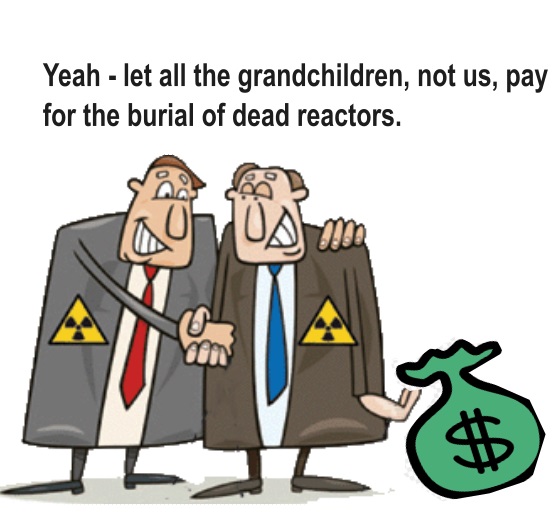
Electricite de France SA is reviving studies to boost the longer-term
output of some nuclear reactors as part of a plan to extend the life of its
atomic fleet to at least 60 years.
Europe’s energy crisis and rising power
prices have put such considerations back “on the company’s agenda for
2023,” according to Sylvie Richard, who’s in charge of the
state-controlled utility’s €33 billion ($35.6 billion) spending on
reactor maintenance and retrofit for the period from 2022 through 2028. The
upgrades could boost the output of some EDF reactors by 4% to 5%. If that
proves financially viable and gets approved by the nuclear safety
authority, some of the work would take place beyond 2028, Richard told
reporters at the Saint-Laurent nuclear power station in central France
Thursday.
The French nuclear giant has been tasked by President Emmanuel
Macron to extend the lifetime of its 56 reactors and to build at least six
new ones to help the country reduce its reliance on fossil fuels. However,
EDF has been grappling for more than a year with extended reactor repairs
and outages that have worsened Europe’s energy crunch, while triggering a
record loss at the company.
Bloomberg 3rd April 2023
https://www.bnnbloomberg.ca/edf-mulls-reactor-upgrades-to-boost-longer-term-nuclear-output-1.1903718
1 This Month
Chernobyl: The Lost Tapes – A good documentary on Chernobyl on SBS available On Demand for the next 3 weeks– https://www.sbs.com.au/ondemand/tv-program/chernobyl-the-lost-tapes/2352741955560

of the week–London Campaign for Nuclear Disarmament

Tell the Ukrainian Government to Drop Prosecution of Peace Activist Yurii Sheliazhenko
To see nuclear-related stories in greater depth and intensity – go to https://nuclearinformation.wordpress.com
-
Archives
- April 2026 (139)
- March 2026 (251)
- February 2026 (268)
- January 2026 (308)
- December 2025 (358)
- November 2025 (359)
- October 2025 (376)
- September 2025 (257)
- August 2025 (319)
- July 2025 (230)
- June 2025 (348)
- May 2025 (261)
-
Categories
- 1
- 1 NUCLEAR ISSUES
- business and costs
- climate change
- culture and arts
- ENERGY
- environment
- health
- history
- indigenous issues
- Legal
- marketing of nuclear
- media
- opposition to nuclear
- PERSONAL STORIES
- politics
- politics international
- Religion and ethics
- safety
- secrets,lies and civil liberties
- spinbuster
- technology
- Uranium
- wastes
- weapons and war
- Women
- 2 WORLD
- ACTION
- AFRICA
- Atrocities
- AUSTRALIA
- Christina's notes
- Christina's themes
- culture and arts
- Events
- Fuk 2022
- Fuk 2023
- Fukushima 2017
- Fukushima 2018
- fukushima 2019
- Fukushima 2020
- Fukushima 2021
- general
- global warming
- Humour (God we need it)
- Nuclear
- RARE EARTHS
- Reference
- resources – print
- Resources -audiovicual
- Weekly Newsletter
- World
- World Nuclear
- YouTube
-
RSS
Entries RSS
Comments RSS
 nuclear-news