USA Nuclear Regulatory Commission ready to remove “barriers” so as to speed up licensing of new untested nuclear reactors.
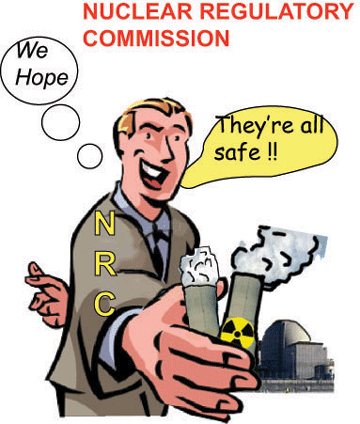
U.S. regulators are ready to review and license the next generation of
nuclear reactors while staying committed to safety, the Nuclear Regulatory
Commission (NRC) says. The NRC is under pressure to show it can move fast
on a new generation of nuclear technology, including small modular reactors
(SMRs) and other previously untested designs, as many in the industry call
for deep reforms at the regulator.
The regulator must be willing to remove
operational and organizational barriers that are in the way of rapid and
efficient licensing and understand that time is of the essence to reduce
emissions and solve energy security issues, critics say.
Reuters 1st Sept 2023
https://www.reuters.com/business/energy/us-regulator-ready-next-generation-nuclear-nrc-2023-09-01/
Over 100 security incidents at UK’s Ministry of Defence (MoD) nuclear weapons body
An arm of the Ministry of Defence (MoD) which oversees the UK’s nuclear
weapons programme has refused to release details of over 100 security
incidents it logged over the last five years, prompting accusations of a
“cover up”.
According to new figures – released to The Ferret after a
freedom of information (FoI) request – the Defence Nuclear Organisation
(DNO) has recorded 113 ‘security concerns’ since 2017-18. The DNO said
these incidents may have ranged from minor breaches of security policies to
the outright loss of information.
But despite claiming that many of the
reported incidents would not have “significant ramifications”, the
organisation refused to provide descriptions of any. It cited national
security concerns and fears about damaging the UK’s reputation
internationally.
The Ferret 30th Aug 2023 https://theferret.scot/over-100-incidents-body-oversees-nuclear-weapons/
Atomic Blackmail: Ukraine war realises predictions of nuclear power plant threat, says Leicester civil safety expert.

Governments need to be aware of the risk of their country’s nuclear
power plants being weaponised as they turn to nuclear to tackle the ongoing
energy crisis, a University of Leicester civil safety expert has argued. In
his new book Atomic Blackmail?
The weaponisation of nuclear facilities
during the Russia-Ukraine War, Dr Simon Bennett lays out how the ongoing
conflict is confirming long-running concerns about the security of nuclear
power plants and their potential to be weaponised to gain political
traction over an opponent. The events of the Russia-Ukraine War have
demonstrated the capacity that nuclear power plants have to amplify
protagonists’ hitting power, Dr Bennett argues. This is believed to be
the first time in the history of nuclear electricity that nuclear power
plants have been occupied by an invading force.
Leicester University 29th Aug 2023
https://le.ac.uk/news/2023/august/nuclear-power-plant-ukraine
French nuclear watchdog ASN issues first lifespan extension to 40-year-old reactor
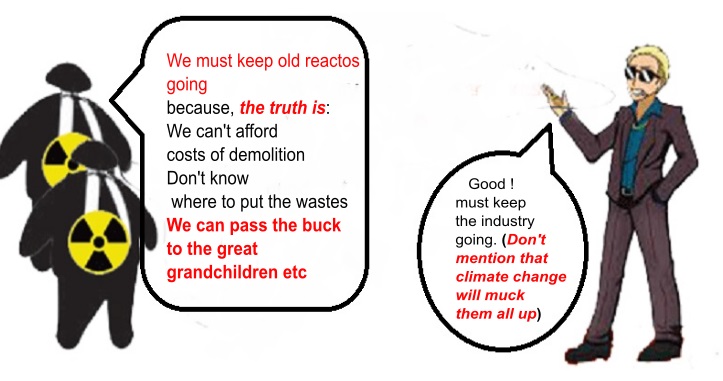
French nuclear watchdog ASN issued a decision allowing for the continued
operation of state-owned utility EDF’s Tricastin 1 nuclear reactor in
southern France, the first lifetime extension granted to a French reactor
after 40 years of operation.
In a decision published on Aug. 10 and seen by
Reuters on Tuesday, ASN granted the reactor an extension until its next
review, so for another ten years. Some 32 of France’s fleet of 56 reactors
are up for their fourth ten-yearly inspection this decade, leaving French
energy production reliant on securing a swathe of reactor extensions for
another ten years.
Reuters 22nd Aug 2023
Russia And Ukraine Trade Blame Over Outages At Zaporizhzhya Nuclear Plant
The fate of the massive nuclear power plant in the crosshairs of Europe’s
largest war in decades has made for worrisome headlines since Russia
launched its large-scale invasion of Ukraine nearly 18 months ago.
As fighting intensifies not far from the plant, fears of a disaster have not
abated. On August 10, the main power line delivering electricity to the
Zaporizhzhya nuclear power plant was disconnected twice, forcing it to rely
on its last remaining off-site power line. The main line was reconnected by
evening. In the meantime, though, Ukraine’s energy minister raised the
prospect of a meltdown.
Oil Price 15th Aug 2023
Nuclear Power Plants as Targets of War — A New Worry?

Energy Intelligence, Aug 14, 2023, Author Stephanie Cooke,
When writer-director Christopher Nolan told his teenage son about his plans for the movie Oppenheimer, his son told him, “That’s just not something anybody worries about anymore,” Nolan told the New York Times. With so much else to worry about, it’s no surprise that nuclear weapons no longer register as a threat to a generation that never felt the fear or moral weight of them. Climate change is the new focal point and for good reason. But if Nolan’s son is correct, when it comes to mitigating the dangers of nuclear power, especially for countries in and around war zones, politicians are off the hook. That’s a big mistake and one that could prove costly down the road.
Despite the shocking risks that Russian forces have created by their occupation and shelling of nuclear power reactors in Ukraine, the push to keep selling nuclear reactors, even in war zones, continues.
The Bulletin of Atomic Scientists in January moved its Doomsday Clock to 90 seconds to midnight — the closest to global catastrophe it has ever been. It cited Russia’s threat of nuclear weapons use in Ukraine, its occupation of the Zaporizhzhia nuclear power plant “violating international protocols and risking widespread release of radioactive materials,” and the undermining of efforts to deal with climate change. But the global resurgence of interest in new nuclear, most notably among several of Ukraine’s neighbors, but also among countries in Asia and Africa, sets us all up for even more trouble.
Russia’s invasion and occupation of the six-reactor Zaporizhzhia nuclear power plant on Mar. 4, 2022 was not the first time an operating nuclear plant had come under military attack; nor is it something unforeseen.
Since 1980 the Middle East has seen some 13 attacks on reactors (in Iran, Iraq, Syria and Israel), according to a July presentation by Henry Sokolski to the Los Alamos National Laboratory. Luckily, these attacks by aerial bombing or missile strikes either failed or avoided massive radiation releases because the reactors were mainly small research reactors that weren’t operating. Only one, Iraq’s Tuwaitha research reactor, was actually operating when the US struck it in 1991. And, unlike Ukraine’s situation, none of the reactors attacked in the Middle East were large-scale commercial power plants or situated in heavily populated areas as is Zaporizhzhia.In all of these attacks, the aim of the perpetrator, whether the US, Israel, Iran or Iraq, was to destroy a facility seen as integral to a clandestine nuclear weapons program.
Russia’s ground invasion and occupation of Zaporizhzhia, in contrast, demonstrates why commercial plants might become targets in future wars. Russia has used the plant to shield Russian troops and military personnel and equipment, gain control over Ukraine’s energy system, and provide a lever against European intervention through the threat of radiation contamination, according to a paper by the Royal United Services Institute for Defense and Security Studies.
Wider Threats
The idea of using nuclear plants as pawns in war is hardly unique to Russia, however. In Asia, North Korea has over the past decade suggested that nuclear power plants in both South Korea and Japan could be fair game for strikes; similar suggestions or alleged threats have been reported out of both Taiwan and China against each other.
A US war manual actually permits attacks on nuclear plants if they serve military objectives, including their use to deny power to enemy forces or to pre-empt enemy forces from hampering the movement or advance of US or allied forces. And it rejects any military-civilian distinction, stating that “under customary international law, no legal presumption of civilian status exists for persons or objects.”
But attacking nuclear plants, and ignoring the distinction between civil and military targets, or people, totally ignores the 1949 Geneva Convention and protocols to that convention added in 1977. These protocols, signed and ratified by 174 countries, tightened rules regarding military conflicts and discouraged military actions against nuclear power plants. The fundamental idea was to distinguish between combatants and non-combatants — including both people and facilities — and to prevent any attacks that would cause widespread harm to civilians. The US, alongside Iran and Pakistan, signed but did not ratify the protocols, and a further 20 countries, including India and Israel did neither. In 2019, Russia withdrew from the convention’s Protocol I relating to the protection of victims of international armed conflicts.
It’s important to understand that while some features of existing plants might mitigate a combat type attack, nuclear power plants are not designed to withstand a deliberate state-sponsored military attack. Nuclear safety and security rules are crafted to address conceivable accidents or terrorist threats but don’t address how to prevent or respond to full-on military attacks. Steps can be taken to harden vulnerable areas of nuclear plants, such as spent fuel pools, and active air defense and anti-drone systems can be deployed, among other things, but these substantially increase costs.
…………………………………………………………………………………………………………………………………………….. Eyes Closed
As governments and industry continue their headlong advance into the climate change breach with the promise of “clean, safe and secure” nuclear energy they conveniently do close their eyes to this issue. Asked about the implications for nuclear energy of Russia’s attack on Zaporizhzhia, IAEA Director General Rafael Grossi told the BBC, “The problem is that they are at war … The problem is not nuclear energy.” But that is precisely the problem — nuclear energy sites are attractive targets in war.
The US push for new nuclear business throughout central and eastern Europe, alongside competitors and sometime-collaborators in Canada, France and South Korea, completely ignores the inherent risks, given that these countries are already awash in nuclear energy. “Six of the 10 most nuclear-dependent countries are former Eastern bloc states. They all rely on nuclear power for more than 30% of their electricity, creating a vulnerability,” points out Sharon Squassoni, a former State Department official at George Washington University. The rationale is that nuclear will provide these countries a way around dependence on fossil fuels imports from Russia and other suppliers. But by opting for more nuclear these countries are swapping one type of energy insecurity for a far more dangerous version.
Stephanie Cooke is the former editor of Nuclear Intelligence Weekly and author of In Mortal Hands: A Cautionary History of the Nuclear Age. The views expressed in this article are those of the author.
For more coverage of the Ukraine crisis, visit Ukraine Crisis: Energy Impact >
https://www.energyintel.com/00000189-bbea-dbd9-a9df-fffe811a0000
Power-Line Cut Raises Alarm Over Russian-Held Nuclear Plant In Ukraine, But Expert Says Little Has Changed

Todd Prince, Radio Free Europe, 14 Aug 23,
The fate of the massive nuclear power plant in the crosshairs of Europe’s largest war in decades has made for worrisome headlines since Russia launched its large-scale invasion of Ukraine nearly 18 months ago. As fighting intensifies not far from the plant, fears of a disaster have not abated.
On August 10, the main power line delivering electricity to the Zaporizhzhya nuclear power plant was disconnected twice, forcing it to rely on its last remaining off-site power line.
The main line was reconnected by evening. In the meantime, though, Ukraine’s energy minister raised the prospect of a meltdown.
Is Russia’s invasion of Ukraine about to cause a nuclear catastrophe?
Steven Nesbit, a nuclear power industry veteran who was president of the American Nuclear Society in 2021-22, told RFE/RL that the Zaporizhzhya plant has been in a precarious position since the start of Russia’s full-scale invasion. But the failure of the off-site power line did not make his assessment of the situation any more dire than it had been.
“I don’t see anything really new right now that should have people extremely concerned relative to the already undesirable situation,” he said, adding that the plant’s offsite power sources have been interrupted before due to the war.
“I would not be surprised if it happens again, but simply losing one of the off-site power sources for a period of time is not a reason for undue concern,” said Nesbit, who now runs his own nuclear consulting company…………………………………………………………
Energy Minister Herman Halushchenko said the plant was “one step away from a blackout — that is, the complete loss of external power,” and that this could lead to a “major catastrophe.”
Zaporizhzhya Nuclear Power Plant
The Zaporizhzhya Nuclear Power Plant is the largest in Europe and, before the war, supplied about 20% of Ukraine’s total electricity.
The plant would resort to diesel generators if all external power was lost, but if the generators were damaged by a Russian attack, he said, “the cooling of the plant would stop and the irreversible process of heating and melting of nuclear fuel” would begin.
“I think that’s a little alarmist,” Nesbit said in a phone interview on August 11.
The same day, Enerhoatom said on Telegram that the main power line had been reconnected the previous evening after being knocked out by Russian fire.
The diesel generators are well protected and have enough fuel to provide power to keep the cooling system going for an extended period of time while external sources are being restored, Nesbit said.
“The six units can share power among them. It’s a flexible and safe system,” he said.
The Zaporizhzhya plant has lost all external power at least twice in the past year.
…………………………………..The plant and the surrounding area are controlled by Russia, but it is being run by its Ukrainian engineers. In September 2022, Ukraine shut the station down to minimize risk of a catastrophe.
Five of the six reactors are in what is known as cold shutdown mode while one unit is being maintained at an elevated temperature — hot shutdown mode — to provide auxiliary steam and heating, the American Nuclear Society, which is monitoring information about the plant, said in July.
As a result, the level of heat production has been low and on-site equipment can provide enough of the water needed for cooling, the society, an international organization of engineers and scientists, said in a statement.
It called the threat of a large-scale release of radioactive material “speculative” but said that assessment does “not constitute an ‘all clear’ for safety risks at the plant site.”
Nesbit said it is of crucial importance that the reactors at the Zaporizhzhya plant have not been generating power for months, allowing the heating level associated with the reactor fuel to fall. The shutdown cuts by many orders of magnitude the amount of radioactivity that could potentially be released in the event of a major incident involving the reactors.
Still, tension is high.
The plant is located in the Zaporizhzhya region in southeastern Ukraine, where fighting is intense amid a counteroffensive that Kyiv launched in early June, seeking to push Russian forces back from territory they have taken and eventually expel them from the country altogether.
Zaporizhzhya is one of four regions of Ukraine that Moscow claimed last year had become part of Russia but does not hold in their entirety. The plant stands on the south bank of a wide stretch of the Dnieper River that was largely drained by the breach of the Kakhovka dam downstream, while Ukraine controls the north bank.
Ukraine and Russia have accused each other of planning to sabotage the plant, warning of the possibility of a nuclear disaster that could threaten millions of people and poison the environment………………………………………………. more https://www.rferl.org/a/power-cut-ukraine-nuclear-plant-expert-opinion/32547684.html
2 minor earthquakes strike near North Korea’s nuclear test site
Sunday’s tremors latest in series of earthquakes to hit Kilju region in recent months
By Anadolu staff 13.08.2023 https://www.aa.com.tr/en/asia-pacific/2-minor-earthquakes-strike-near-north-koreas-nuclear-test-site/2966671
ANKARA
Two minor earthquakes struck on Sunday near North Korea’s nuclear test site, the latest in a series of natural earthquakes to hit the region in recent months, South Korea’s state weather agency said.
There were no reports of any damage.
The first earthquake of 2.7 magnitude struck about 40 kilometers (24.8 miles) north-northwest of Kilju, North Hamgyong Province, at 3:13 a.m. (local time), while the second of 2.3 magnitude struck 42 km (26 m) north-northwest of Kilju at 7:55 a.m, Seoul-based Yonhap News reported.
Kilju is home to the Punggye-ri nuclear test site, where North Korea conducted all six of its nuclear tests.
Eight natural earthquakes were reported to have struck the area in 2022 alone.
Ukraine: Zaporizhzhya nuclear plant initiates reactor shutdown following water leak, reports IAEA
UN News, 10 August 2023
The Zaporizhzhya Nuclear Power Plant in Ukraine has begun transitioning one of its reactor units from a hot shutdown to a cold shutdown after a water leak was detected in one of its steam generators, the International Atomic Energy Agency (IAEA) said on Thursday.
The purpose of placing reactor unit 4 in cold shutdown is to investigate the exact cause of the leak and carry out necessary maintenance to repair the affected steam generator, according to a statement by Rafael Mariano Grossi, IAEA Director General.
There was no radiological release to the environment, the statement noted, adding that over the next three days, the nuclear power plant will move unit 6 to hot shutdown to continue steam production.
Unit 6 had been in cold shutdown since 21 April to facilitate safety system inspections and maintenance.
“The IAEA team on the site will closely monitor the operations for the transition between the shutdown states of Units 4 and 6,” said Mr. Grossi.
Power challenges
The IAEA has been monitoring the situation at Europe’s largest nuclear power plant since the early days of the conflict. The ZNPP is controlled by Russian forces but operated by its Ukrainian staff.
Mr. Grossi reported that there were power disruptions on Thursday after the 750kV power line disconnected twice during the day.
The ZNPP had to rely on 330 kV backup line, to supply the electricity required, for example, to perform safety functions such as pumping cooling water for the plant; and there was no total loss of off-site power to the site and emergency diesel generators were not needed.
According to IAEA, the nuclear power plant has been experiencing major off-site power problems since the conflict began in February 2022, exacerbating the nuclear safety and security risks facing the site currently located on the frontline.
“The repeated power line cuts underline the continuing precarious nuclear safety and security situation at the plant,” Mr. Grossi said.
Availability of cooling water remains relatively stable, with measures to mitigate water loss from the cooling pond by pumping in water from the ZNPP inlet channel.
IAEA experts’ site inspections
IAEA experts at the nuclear power plant have also conducted multiple walkdowns in different parts of the site, including visits to spent fuel storage and reactor control rooms, the agency said.
In one of the visits, on Tuesday, to the main control room, emergency control room and other safety-related rooms, the team did not observe any mines or usual objects in the main control; but in the turbine hall of unit 2, they noted the presence of a number of military trucks parked in an area reserved for vehicle maintenance…………………………….. https://news.un.org/en/story/2023/08/1139662
Ukrainian Minister Warns Zaporizhzhya Nuclear Plant ‘One Step Away’ From Blackout
Ukrainian Energy Minister Herman Halushchenko has appealed to the
International Atomic Energy Agency (IAEA) about the loss of the main power
line supplying electricity to the Zaporizhzhya nuclear power plant in
southern
Ukraine. Halushchenko said on Ukrainian television on August 10
that the nuclear plant is currently being supplied with power from a backup
line. “This is the only external power line left. And such a situation is
one step away from the blackout of the Zaporizhzhya nuclear power plant —
that is, the final loss of external power supply,”
Halushchenko said. In
the event of a blackout, diesel generators would be connected to meet the
needs of the station, but they may be damaged by Russian shelling, which
would stop the cooling of the station and set off a nuclear meltdown,
Halushchenko said. Ukraine’s nuclear authority, Enerhoatom, warned earlier
on August 10 that the Russian-occupied nuclear plant is on the verge of a
blackout because power was cut from the main high-voltage line.
Radio Free Europe 10th Aug 2023
https://www.rferl.org/a/ukraine-zaporizhzhya-nuclear-plant-risk-blackout/32541960.html
Dounreay inspectors raise further red flag about sodium storage
John O’Groat Journal, By Iain Grant, 5 Aug 23
The Office for Nuclear Regulation (ONR) has issued an enforcement letter to Magnox Ltd after recording a breach of its nuclear site licence.
Sodium was used to cool the prototype fast reactor (PFR) whose closure in 1994 sounded the death knell for the experimental power plant.
Since its removal from the redundant plant, some of the highly volatile liquid metal has been stored in drums.
ONR’s latest concern follows an inspection at the end of April.
The agency has concluded that the storage arrangements do not comply with good practice. Its latest report states: “The dutyholder has failed to safely protect the drums against degradation via air and moisture ingress; large stocks of the inventory are not available for inspection due to the way in which it has been stored; and a number of the storage vessels of the material are not identified on the site maintenance system.
ONR found that Magnox – a wholly owned subsidiary of the Nuclear Decommissioning Authority – had breached the Control of Substances Hazardous to Health Regulations 2002 and its nuclear site licence.
It followed up its enforcement letter with a ‘holding-to-account’ meeting on site in June with Magnox directors.
According to ONS, this was arranged to ‘further secure a commitment to return to compliance.”
In June, the Scottish Environment Protection Agency (Sepa) had fired off a warning letter about a minute leak of radioactive tritium from a sodium drum stored at the PFR in November last year…………………………………………….. https://www.johnogroat-journal.co.uk/news/dounreay-inspectors-raise-further-red-flag-about-sodium-stor-322156/
Russia’s Kola nuclear power plant turns 50. That is not necessarily something to celebrate
The first VVER-440/230 reactor at Kola Nuclear Power Plant was connected to the electricity grid on June 29, 1973. Western sanctions do not trouble the safety as most spare parts are made in Russia, says environmental watchdog Bellona.
Barents Observer, By Thomas Nilsen June 23
The Kola plant became the world’s first to produce nuclear-generated electricity north of the Arctic Circle. Construction of the first reactor started in 1969 and four years later it was connected to the grid. A total of four reactors are today in operation at the power plant.
The two first are of the VVER-440/230 type, the Soviet Union’s first generation civilian water-cooled reactors. The last two are the second generation of the VVER-440/213 type.
Later, the USSR designed the larger VVER-1000 reactors that today are in operation at several nuclear power plants, including the Zaporizhzhia in the war zone in Ukraine.
A few years after the breakup of the Soviet Union, the International Atomic Energy Agency (IAEA) initiated a full safety evaluation of the old VVER-400/230 reactors, at that time in operation in Russia, Bulgaria and Czechoslovakia. A plant with similar reactors Greifswald in the former East Germany was already shut down for safety concerns.
Safety help
The IAEA report published in 1992 identified some 100 safety issues and pointed out a ranking of needed improvements. In the 90s, safety problems at Kola nuclear power plants caused headlines not only in Russia, but also in neighboring Scandinavian countries.
Norway granted the power plant both cash for improving the safety, but also practical equipment like external generators to ensure cooling in case of loss of power to the inbuilt cooling system. Foreign Minister of Norway at the time, Bjørn Tore Godal, however, ensured the Parliament in Oslo in 1995 that all Norwegian technical assistance to Kola nuclear power plant should not «contribute to prolong the lifetime of the reactors, only to improve the safety.»
Wartime
For wartime Russia, most of the internationally focused safety work at Kola nuclear power plant has come to an end.
“There are no more foreign donors helping Russia on nuclear safety in the northwest,” says Dmitry Gorchakov, a nuclear advisor with the Bellona Environmental Transparency Center in Vilnius. His group had to leave Russia for Lithuania after the full-scale war started. This spring, authorities in Moscow declared Bellona undesirable, meaning no one inside Russia can any longer work for, or stay in contact with, the environmentalists.
For Dmitry Gorchakov and his colleagues, that limits their access to reliable information.
“During the war, many official resources, government resources, are closed, they don’t share all information like they did before. We have to find new sources, new tools,” he says.
“Liars”
How Western sanctions are impacting radiation safety works on the Kola Peninsula is difficult to assess, according to Bellona.
“We don’t talk with officials. They are lying. About how they manage with sanctions, how they will work in different countries,” Gorchakov says. He, however, thinks the state nuclear corporation Rosatom easily can maneuver operations based on a domestic supply chain.
“Not much depends on foreign spare parts, uranium products. They make most inside the country,” Dmitry Gorchakov tells. Before starting to work for Bellona, Gorchakov worked for years for the nuclear industry inside Russia, often in tight contact with state officials.
He believes many of the safety programs initiated during decades of international cooperation now are put on hold.
“Some safety programs will be slowed down, while others will be canceled. They will maybe put it on pause,” he says.
“I think some Russian officials hope the war will stop sooner or later. But now they spend a lot of money on the war, so environmental problems are not a priority.”
“This could be dangerous, but we need to analyze it more,” Gorchakov says.
Operation until 2033
Meanwhile, reactor No. 1 at Kola NPP, originally built for a 30-years lifetime, celebrates its 50th anniversary.
Authorities granted one license prolongation after the other. In 2018, Rostechnadzor, the federal supervisory body for environmental, industrial and nuclear services, issued the license for the operation of Kola nuclear power plant’s unit No. 1 until July 6, 2033, the Barents Observer reported. The following year, unit No. 2 was granted an additional 15-years operation licence. …………………………………
The backup emergency external power system at the plant aimed to keep cooling water running in case of power fallouts, is supposed to come from two diesel generators, both delivered by Norway in the 90ties. Today, Norway has ended all practical cooperation on nuclear safety with Russia, including possible deliveries of spare parts to the Kola NPP’s emergency generators. ………. https://thebarentsobserver.com/en/nuclear-safety/2023/06/today-first-kola-npp-reactor-turns-50
UN nuclear watchdog finds no explosives at Zaporizhzhia plant
Experts given access to two units at Russian-held site month after Ukraine claimed there were devices on roofs
The UN nuclear watchdog says it has found no explosives in areas of the Russian-held Zaporizhzhia nuclear power plant in southern Ukraine to which it had requested access a month earlier.
On 4 July, Russia and Ukraine accused each other of planning to stage an attack on Europe’s biggest nuclear power plant, with the latter claiming “operational data” showed “explosive devices” had been placed on the roofs of two units.
The following day the International Atomic Energy Agency, which has repeatedly warned of nearby military clashes potentially causing a nuclear disaster, said access to the roofs of the two units and parts of the turbine halls was essential.
A small IAEA team based at the plant sought to verify the accusations by inspecting areas of the site to which it had already been granted access. It issued updates in the ensuing weeks to say it had found no signs of explosives in those areas, except mines outside the perimeter that appeared to pose no danger to the plant’s safety.
On Friday, it said in a statement: “[IAEA] experts have observed no mines or explosives on the rooftops of unit three and unit four reactor buildings and the turbine halls … after having been given access yesterday afternoon.
“Following repeated requests, the team had unimpeded access to the rooftops of the two reactor units and could also clearly view the rooftops of the turbine halls. The team will continue its requests to visit the roofs of the other four units.”
Non-compliant fire program halts decommissioning of Whiteshell Nuclear Laboratories
Canadian Nuclear Safety Commission, 4 Aug 23
A 40-minute “Event Initial Report” during the Canadian Nuclear Safety Commission (CNSC) June 28th meeting discussed an internal review by Canadian Nuclear Laboratories (CNL) which found that fire protection staff, systems and equipment at Whiteshell Laboratories were deficient, and had been deficient for years. This issue came to light when a new fire protection employee was hired and raised the alarm.
This has forced a shut-down of decommissioning activities. CNL President Joe McBrearty said that staff and resources have been transferred from the Chalk River Laboratories to Whiteshell to address the deficiencies.
Whiteshell Laboratories has been undergoing accelerated decommissioning since 2015 when CNL was sold to Canadian National Energy Alliance, a multinational consortium currently composed of three companies, (SNC-Lavalin and Texas-based Fluor and Jacobs), under a contract to reduce the Government of Canada’s nuclear liabilities quickly and cheaply.
In December 2019 the CNSC had issued a decision that “CNL is qualified to carry on the activity that the proposed licence will authorize and that it will make adequate provision for the protection of the environment, the health and safety of persons.” At that time, CNSC renewed the Nuclear Research and Test Establishment Licence for Whiteshell (NRTEL-W5-8.00/2024) for the period January 1, 2020 until December 31, 2024. …………………….
CNL President McBrearty noted that the Whiteshell hot cells have been reactivated to enable waste retrieval. Whiteshell decommissioning waste is being shipped to the Chalk River Laboratories for disposal in the proposed NSDF nuclear waste dump. https://cnsc.isilive.ca/2023-06-28/2023-06-28-3M.mp4
Will this experimental nuclear reactor escape federal scrutiny?
Unlike in most other reactors, where the coolant is water, in these reactors the coolant is sodium based, which has challenging chemical features. Other challenges include activated corrosion products in the sodium due to its chemical reactivity and the consequences of leakage during the operation of some reactors.
By Susan O’Donnell & Kerrie Blaise July 26th 2023 As https://www.nationalobserver.com/2023/07/26/opinion/new-brunswick-experimental-nuclear-reactor-federal-assessment?
On June 30, NB Power registered an environmental impact assessment with the province of New Brunswick and filed a licence application with the Canadian Nuclear Safety Commission (CNSC) to prepare a site on the Bay of Fundy for the ARC-100, an experimental small modular reactor (SMR) still in early design.
Making information public about the project, which includes not just a nuclear reactor new aquatic infrastructure in the Bay of Fundy and new radioactive storage, will be difficult if not impossible without a federal impact assessment. So, too, will testing the veracity of claims made about the project’s safety, risk and impacts. But so far, a federal impact assessment has been denied.
Relying only on the provincial assessment or the CNSC’s review to inform understandings of adverse effects and impacts is a major step backwards. The provincial process has limited opportunities for public input. The CNSC’s licensing process is narrowly defined by the stage of activity being licensed (i.e., site selection, construction, operations and eventual decommissioning).
The federal impact assessment process, conversely, reviews all activities within the lifespan of the project, from development through to decommissioning, including project impacts that are direct or incidental to the project, prior to any decision being made about its development.
The proposed reactor is cooled by liquid sodium metal. No such reactor has ever been successfully commercialized because of many technical problems. Sodium is highly combustible, and experiments with this type of reactor have seen fires and the distribution of radioactive particles on shorelines, even decades after experiments were shut down. The sodium from these reactors bonds to used fuel, and no known commercial method exists to treat sodium-bonded used reactor fuel.
Despite the obvious questions about direct impacts and legacy risks the reactor poses, changes to federal impact assessment law in 2019 mean the project will likely escape a transparent, evidence-based review. After successful lobbying by the nuclear industry and the CNSC in the leadup to passing the Impact Assessment Act, most nuclear projects, from new reactor proposals to the decommissioning of existing ones, were dropped from the list of projects automatically requiring an upfront impact assessment.
There remains one last chance for this highly controversial project to undergo a federal impact assessment. On March 31, three months before the licence application was filed, the Sierra Club Canada joined three community groups with a direct interest in the project — the Coalition for Responsible Energy Development in New Brunswick and We the Nuclear Free North and Protect our Waterways in Ontario — to write to federal Environment Minister Steven Guilbeault, urging him to require the project undergo a federal impact assessment. When a project may cause adverse environmental effects or public concern warrants an impact assessment, the minister has the jurisdiction to order one. Both are true in this instance.
This is the second of such requests for an impact assessment to the minister. Guilbeault rejected the first request in December 2022. However, the new request cites significant changes to the proposed ARC-100 project previously unknown to the public, based on information unearthed through access-to-information requests.
The Ontario groups that joined the Sierra Club in its request have many questions about the radioactive waste from the ARC-100, which is slated to be deposited in a proposed repository in one of their communities. They say no information about the waste from the ARC-100 has been provided to residents living near the two proposed sites for a deep geological repository or along the transportation routes. The groups want information about the volume, nature, characteristics and potential additional hazards associated with the wastes that the ARC-100 could generate.
Indigenous nations have expressed support for an impact assessment because they also have concerns that can only be addressed through a federal review. The group representing the Peskotomuhkati Nation at Skutik, whose traditional territory includes the proposed site in New Brunswick, wrote to Guilbeault in April, raising questions about the ARC-100’s profound and lasting impacts to the Bay of Fundy, the marine life the bay supports and coastal communities.
First Nations in Ontario and Quebec are also concerned that nuclear technology operating in one province could have impacts on First Nations in other provinces, triggering the need for an assessment of likely economic, social, cultural and environmental impacts in accordance with the United Nations Declaration on the Rights of Indigenous Peoples.
First Nations in Ontario and Quebec are also concerned that nuclear technology operating in one province could have impacts on First Nations in other provinces, triggering the need for an assessment of likely economic, social, cultural and environmental impacts in accordance with the United Nations Declaration on the Rights of Indigenous Peoples.
1 This Month
Chernobyl: The Lost Tapes – A good documentary on Chernobyl on SBS available On Demand for the next 3 weeks– https://www.sbs.com.au/ondemand/tv-program/chernobyl-the-lost-tapes/2352741955560

of the week–London Campaign for Nuclear Disarmament

Tell the Ukrainian Government to Drop Prosecution of Peace Activist Yurii Sheliazhenko
To see nuclear-related stories in greater depth and intensity – go to https://nuclearinformation.wordpress.com
-
Archives
- April 2026 (126)
- March 2026 (251)
- February 2026 (268)
- January 2026 (308)
- December 2025 (358)
- November 2025 (359)
- October 2025 (376)
- September 2025 (257)
- August 2025 (319)
- July 2025 (230)
- June 2025 (348)
- May 2025 (261)
-
Categories
- 1
- 1 NUCLEAR ISSUES
- business and costs
- climate change
- culture and arts
- ENERGY
- environment
- health
- history
- indigenous issues
- Legal
- marketing of nuclear
- media
- opposition to nuclear
- PERSONAL STORIES
- politics
- politics international
- Religion and ethics
- safety
- secrets,lies and civil liberties
- spinbuster
- technology
- Uranium
- wastes
- weapons and war
- Women
- 2 WORLD
- ACTION
- AFRICA
- Atrocities
- AUSTRALIA
- Christina's notes
- Christina's themes
- culture and arts
- Events
- Fuk 2022
- Fuk 2023
- Fukushima 2017
- Fukushima 2018
- fukushima 2019
- Fukushima 2020
- Fukushima 2021
- general
- global warming
- Humour (God we need it)
- Nuclear
- RARE EARTHS
- Reference
- resources – print
- Resources -audiovicual
- Weekly Newsletter
- World
- World Nuclear
- YouTube
-
RSS
Entries RSS
Comments RSS
 nuclear-news