Slovenian nuclear plant to stay closed until leak fixed.
Reuters, Tue, October 10, 2023
SARAJEVO, – Expert teams at Slovenia’s only nuclear power plant Krsko (NEK), jointly owned by Slovenia and Croatia, have narrowed down the location of the leak which led to the plant’s shut down last week, the NEK said on Monday.
The leak occurred on the connection system of the primary circuit, NEK said on its web page, adding it will analyse the cause and draw up a plan to fix it.
“All this will require more time, probably several weeks; however, it is currently too early to assess the forecast for the power plant’s return to operation,” the company said.
Since Friday, the plant had been first placed under safe state of so-called hot-standby and then under so-called cold shutdown, which allowed the teams to determine the precise location of the leak that had been found in the primary system within the containment building, the company said…………………
NEK was built in cooperation with U.S. company Westinghouse Electric Corporation and started operating in 1982. In 2016 Slovenia and Croatia agreed to prolong its lifespan by 20 years until 2043. (Reporting by Daria Sito-Sucic; Editing by Louise Heavens) https://finance.yahoo.com/news/slovenian-nuclear-plant-stay-closed-130321224.html #nuclear #antinuclear #NuclearFree #NoNukes
Loud Explosion Heard In Pakistan’s Dera Ghazi Khan City With Nuclear Facility; Officials Say ‘Sonic Boom’
The loud thud in the vicinity of Dera Ghazi Khan town in southern Punjab caused panic and soon it started trending on social media.
BQ Prime 6 Oct 23
Pakistan authorities on Friday said that the sound of a loud explosion in Punjab province could be due to a sonic boom as there was no information of a bombing incident or an act of sabotage. The loud thud in the vicinity of Dera Ghazi Khan town in southern Punjab caused panic and soon it started trending on social media. Videos circulating on X showed people vacating the area even as rescue teams and police personnel were moving around.
Pakistan’s nuclear research site is in the neighbourhood…………………….
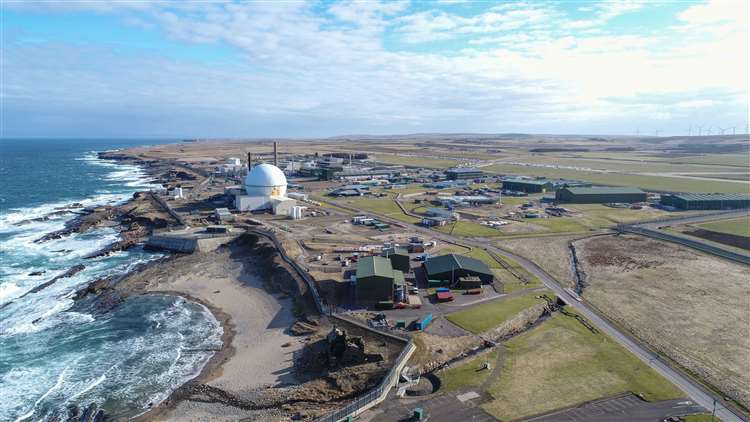
Residents closest to Dounreay and Vulcan to be excluded from the nuclear emergency planning zone.
By Iain Grant, 06 October 2023 https://www.johnogroat-journal.co.uk/news/nearby-homes-to-be-outside-of-dounreay-emergency-zone-for-fi-328741/ #nuclear #antinuclear #nuclear-free #NoNukes
Residents closest to Dounreay and Vulcan are for the first time to be excluded from the emergency planning zone around the redundant nuclear sites.
It is being shrunk to reflect the perceived reduction in risk to the public presented by the adjoining plants.
The zone would be the focus of the response to what is considered a worst-case scenario involving a radiation release.
Up until the plug was pulled on Dounreay’s fast reactor programme in the mid-1990s, its zone extended to five kilometres. The equivalent at Vulcan was two kilometres.
Dounreay’s limit was subsequently cut to 1.5km and reduced further in 2020 when a new linked zone taking in both sites was set at 700 metres.
Repeated malfunctions reveal safety issues in Fukushima discharge

CGTN 6 Oct 23 #nuclear #antinuclear #nuclear-free #NoNukes
Japan started the second discharge of nuclear-contaminated wastewater from the crippled Fukushima Daiichi Nuclear Power Plant into the Pacific Ocean on Thursday, despite strong opposition from local fishermen as well as neighboring and Pacific island countries.
The plant’s operator, Tokyo Electric Power Company (TEPCO), said it plans to carry out the release over 17 days to discharge 7,800 tons of the radioactive wastewater, about the same amount as the first discharge which ended on September 11.
Currently, more than 1.3 million tons of nuclear-contaminated wastewater has been accumulated in storage tanks at Fukushima.
The company’s key facility for nuclear-contaminated water treatment, the Advanced Liquid Processing System (ALPS), is a multi-filter system that can remove radioactive materials through a series of chemical reactions. The international community has had doubts about the safety, effectiveness and sustainability of the system, due to its treatment capacity and incidents of malfunction.
When the amount of nuclear-contaminated water is too large, the chances to replace the filters are limited and the performance of the ALPS is significantly degraded, said Ryota Koyama, a professor at Fukushima University in Japan.
“If nuclear-contaminated water is discharged, I think there must be a problem. If the Japanese government or the TEPCO really wants to discharge the contaminated water into the sea, they need to explain in more detail,” Koyama told China Media Group (CMG) in an interview……………………………..
The ALPS has failed to remove isotopes adequately, with the adsorbents used to remove radioactive isotopes being replaced less often than they were supposed to be. As a result, 70 percent of the water in the storage tanks still contains non-tritium radionuclides at a concentration that exceeds the regulatory standards applicable for discharge into the environment.
Since its trial operation in 2013, the ALPS has frequently experienced malfunctions. Just before the first discharge in August, TEPCO found leaks in a hose used to transfer nuclear-contaminated water, according to Japanese broadcaster NHK………………..
In June, the government of Republic of Korea said that there have been eight confirmed cases of malfunction with the ALPS between 2013 and 2022, which concerned corrosion of facilities and issues with filters, after its experts conducted an on-site inspection, said the country’s public broadcaster KBS.
According to previous reports, TEPCO found that there were at least 10 breakages on the ALPS’ filters used to absorb nuclides in August 2021. In the process of replacing the broken filters, the company discovered that 24 filters were damaged. A month later, TEPCO announced that five more filters in the ALPS were found to have been damaged, and radioactive contamination had been detected near some of the filters.
Hikaru Amano, senior researcher of the Nuclear Science Research Institute, Japan Atomic Energy Agency, told CMG that another problem with the ALPS is that there is little room to store used filters.
Amid concerns of Japan’s discharge of nuclear-contaminated wastewater, the Republic of Korea (ROK) plans to raise the number of testing spots to nearly 250 next year, increasing from the 75 coastal locations where emergency radiation tests were conducted about a month ahead of Japan’s first release in August, Seoul-based Yonhap News reported…………… https://news.cgtn.com/news/2023-10-06/Repeated-malfunctions-reveal-safety-issues-in-Fukushima-discharge-1nFOJHDPdgQ/index.html
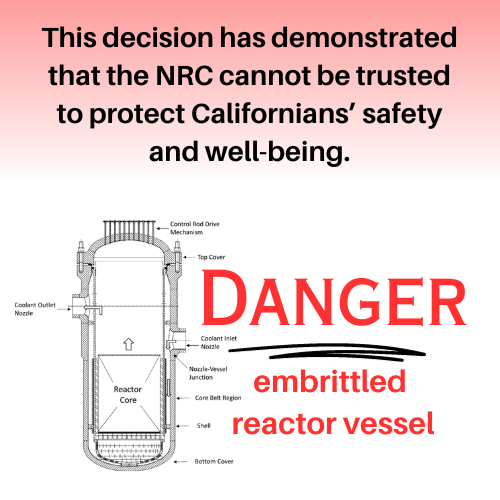
NRC Commissioners Fail to Take Action on Critical Safety Issue at Diablo Canyon
San Luis Obispo, CA, October 4, 2023 https://mothersforpeace.org/nrc-commissioners-fail-to-take-action-on-critical-safety-issue-at-diablo-canyon/?fbclid=IwAR1A_L1NhvPiZW4tMjfCTfu-4Ov7duSTtEOyamayx97DjaRb4fGQ7UGVjZI #nuclear #antinuclear #nuclear-free #NoNukes
— San Luis Obispo Mothers for Peace (MFP) and Friends of the Earth (FoE) today deplored a decision of the Commissioners of the Nuclear Regulatory Commission (NRC) for demonstrating a complete lack of concern for the safety and security of the people living near the Diablo Canyon Nuclear Power Plant.
Disregarding expert evidence presented by MFP and FoE that the Diablo Canyon Unit 1 pressure vessel is at risk of dangerous embrittlement due to decades of neglect by Pacific Gas and Electric Co. (PG&E) and lax oversight by the NRC technical staff, the Commissioners refused to grant the groups’ hearing request or to order the immediate shutdown of the reactor for comprehensive testing of the reactor vessel’s condition.
Instead, the Commissioners bucked the groups’ shutdown request back to the agency’s technical staff to consider whether to take enforcement action against PG&E.
“We are appalled that the Commissioners are entrusting this important safety review to the same agency staff who for fifteen years has given PG&E repeated extensions of deadlines for essential tests and inspections,” said Diane Curran, attorney for MFP. Curran noted that the groups had intentionally petitioned the Commissioners, as the highest officers of the NRC, to exercise their legal responsibility for oversight of the technical staff.
Nevertheless, the groups vowed to persevere. Hallie Templeton, Legal Director for FoE, said, “We plan to continue our rigorous watchdogging of PG&E and the NRC.” She added, “The Commissioners’ decision has raised a red flag to all of us. Anyone, including California politicians, who thinks the safety of Diablo Canyon can be entrusted to the federal government unquestioningly has just received a big wakeup call.”
Linda Seeley, spokesperson for MFP, renewed the group’s call to the State of California to “go back to the original plan to close Diablo Canyon when it reaches its 40-year operating license limit in 2024 (Unit 1) and 2025 (Unit 2). Enough is enough.”
Slovenian nuclear plant shut due to leak in containment building

SARAJEVO, Oct 6 (Reuters) #nuclear #antinuclear #nuclear-free #NoNukes – Slovenia’s only nuclear power plant Krsko (NEK), jointly owned by Slovenia and Croatia, was shut down early on Friday due to a leak in its containment building, the company said on its website.
“The nuclear power plant Krsko was shut down today, at 05:30 (0330 GMT), and has been placed under safe state of so-called hot-standby,” the company said.
Expert teams have begun work to locate the site of the leak, the company said, adding it would be able to estimate the time for repairs and a restart of the plant after the source of the leak had been found…………………. https://www.reuters.com/world/europe/slovenian-nuclear-plant-shut-due-leak-containment-building-2023-10-06/
Tragic Nuclear Submarine Accident in China Sparks Global Concern

The incident raises serious concerns about the safety of submarine missions and the readiness of governments to seek international assistance in times of such crises. It also raises questions about the effectiveness of defense systems and their potential to backfire
By Ravichandran Devendran, 5 Oct 23, https://bnn.network/breaking-news/accidents/tragic-submarine-accident-in-china-sparks-global-concern/ #nuclear #anti-nuclear #nuclear-free #NoNukes
Details of the Submarine Disaster
55 Chinese sailors are feared dead in a tragic incident involving a nuclear submarine in the Yellow Sea. According to a confidential UK report, the submarine became entangled in a trap set up for Western sub-surface vessels, leading to a catastrophic system failure and the poisoning of the crew. Despite the severity of the situation, the Chinese government has officially denied the incident’s occurrence, and it appears that international assistance for the stranded submarine was declined.
The fatal accident occurred on August 21st, during a mission in the Yellow Sea. The submarine collided with a chain and anchor obstacle, resulting in system failures that took six hours to repair and bring the vessel to the surface. As a result of these system failures, the onboard oxygen system malfunctioned catastrophically, leading to the poisoning of the crew and the subsequent loss of life.
The Echoes of Past Submarine Catastrophes
This incident brings to mind the Kursk catastrophe, where over 100 Russian sailors died in an explosion aboard their nuclear submarine in August 2000. Initially, the Kremlin denied reports of the incident and declined assistance from Britain and Norway until it was too late to save those trapped inside the vessel. The Kursk disaster remains the biggest in submarine history with 118 lives lost.
Similarly, the Chinese government has refuted speculations about the incident as completely false, and Taiwan has also denied internet reports. The UK report on the incident is highly classified and based on defense intelligence. Despite official denials, it is believed that the incident did occur and that China declined international support.
Implications of the Submarine Disaster
The incident raises serious concerns about the safety of submarine missions and the readiness of governments to seek international assistance in times of such crises. It also raises questions about the effectiveness of defense systems and their potential to backfire, as in this case where the Chinese submarine was ensnared by its own trap intended for foreign vessels. The incident also highlights the importance of transparency in reporting such catastrophic events, as the refusal to acknowledge the incident only fuels speculation and mistrust.
The Human Cost of the Tragedy
Among the deceased are the captain of the Chinese PLA Navy Submarine 093-417 and 21 other officers. The loss of such a large number of naval personnel in a single incident is a devastating blow to the Chinese Navy and a stark reminder of the dangers that submarine crews face. As investigations continue, the world waits for definitive confirmation of the incident and its implications for international submarine operations.
Minnesota State records highlight lack of coordination in nuclear leak response
Ben Henry KSTP, October 4, 2023 #nuclear #anti-nuclear #nuclear-free #NoNukes
Internal communication within state agencies highlights what appears to be a lack of coordination in responding to a radioactive leak at a nuclear power plant.
5 EYEWITNESS NEWS obtained hundreds of records in a public data request surrounding communication about Xcel Energy’s Monticello nuclear power plant leak from late last year.
According to Xcel, it detected the leak on Nov. 22, 2022. The 400,000-gallon spill was contaminated with tritium, which, according to the power company, is a compound that emits low levels of radiation.
From the start, Xcel says the leak posed no health or safety risk.
While the leak was detected in November, it wasn’t until mid-March this year that the public was informed. Now, after analyzing state data, we’re getting a better idea of how the months of communication, before informing the public, within state agencies went.
In an email between two Minnesota Pollution Control Agency (MPCA) officials on Feb. 22 — three months after the leak was detected — one official wrote in part, “there’s a lot to say about this situation. It’s not helped by the fact that no state or federal agency has really stepped up to the plate and taken complete charge of the situation.”
That email goes on to say that in a meeting with Xcel, the MPCA official “told them we were concerned about Tritium getting into the Miss. River and that everything should be done to prevent that from happening,” eventually adding, “Xcel has not informed local Emergency Response authorities or legislators (something I told them to do).”
Then on March 2 — two weeks before Xcel publicly announced the leak — the same MPCA official informed colleagues that they would be the lead agency but that they’re still working out how other state agencies will respond – writing, “A “kickoff” meeting for involved staff is being scheduled. To be clear, there’s no new information prompting this action but rather a growing need for better coordination.”…………………… https://kstp.com/kstp-news/top-news/state-records-highlight-lack-of-coordination-in-nuclear-leak-response/
A Chinese nuclear-powered submarine has sunk with the loss of 55 sailors
#nuclear #anti-nuclear #nuclear-free #NoNukes The nuclear submarine sank after it was caught in a trap intended for American and British vessels, leaked intelligence reports disclose. China has six Type 093 attack
submarines, which have a displacement of 6,096 tonnes and are armed with
553mm torpedoes. The nuclear-powered submarines, designed to be quieter
than previous models, entered service in the past 15 years.
Times 4th Sept 2023
Typhoon Koinu Could Slam Straight Into Nuclear Power Plant

Newsweek, BY ANNA SKINNER ON 10/4/23 #nuclear #anti-nuclear #nuclear-free #NoNukes
Category 4 typhoon is headed straight toward a nuclear power plant in southern Taiwan.
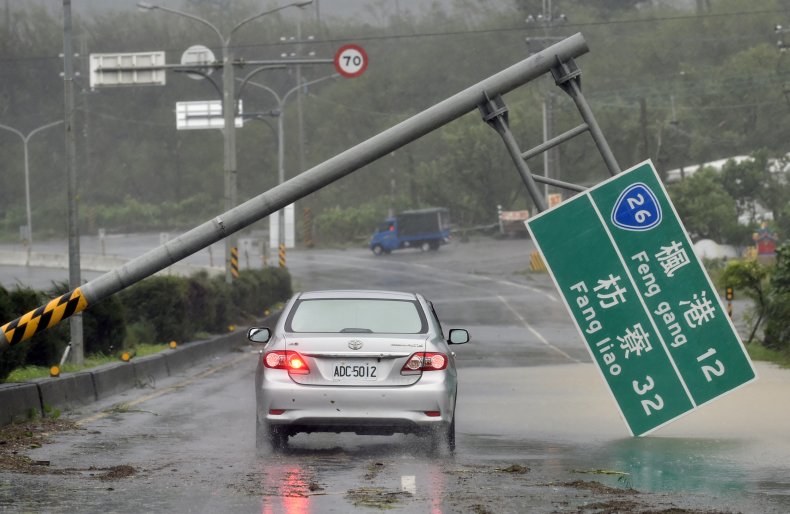
Typhoon Koinu slammed into Taiwan’s southeastern islands on Wednesday and the massive storm is anticipated to hit southern Taiwan in the next few hours, which would be Thursday morning local time. The storm’s strength prompted meteorologists and storm chasers to voice concern ahead of its landfall, as wind gusts of 212 miles per hour were documented by Lanyu Weather Station as the storm lashed Orchid Island on Wednesday. The storm has sustained winds of 130 miles per hour, which makes it equivalent to a Category 4 hurricane.
If the wind gust recording is accurate, it would be one of the top five strongest wind gusts ever recorded on Earth, a concerning fact as the storm is barreling toward the Maanshan Nuclear Power Plant in southern Taiwan. AccuWeather meteorologist Bill Deger told Newsweek he expects the storm may weaken to a Category 2 or Category 3 by the time it makes landfall.
However, the storm is expected to pass directly over Taiwan’s last active nuclear power plant.
“It’ll come very close to where the eye of this typhoon is expected to move,” Deger told Newsweek
In 2021, Taiwan Power Company submitted an application to shutter the two-unit power plant. The plant’s 40-year operating licenses are set to expire, but the nuclear units won’t close until 2024 and 2025.
Despite the storm’s direct path toward the plant, there are no announcements on the power company’s website about efforts being made to protect the plant from the incoming storm’s harsh winds.
With a storm of Koinu’s strength, Deger said power outages, structural damage and flooding can be expected. Up to 12 inches of rain is expected to fall as well, causing a flood risk.
Storm chasers and weather experts have issued warnings in advance of the storm’s impact, with one storm chaser seemingly very concerned about the storm’s path…………………………………………..
Natural disasters have posed a high risk to power plants in the past. The Fukushima Daiichi nuclear plant in Japan was damaged by a tsunami after a 9.0-magnitude earthquake struck the area in 2011.
01:40
Tropical Storm vs Cyclone vs Hurricane vs Typhoon: What’s The Difference?
Share
Share on FacebookShare on TwitterShare on LinkedInShare on RedditShare on FlipboardShare via EmailComments
WORLDTYPHOONSTORMTAIWANNUCLEAR ENERGY
ACategory 4 typhoon is headed straight toward a nuclear power plant in southern Taiwan.
Typhoon Koinu slammed into Taiwan’s southeastern islands on Wednesday and the massive storm is anticipated to hit southern Taiwan in the next few hours, which would be Thursday morning local time. The storm’s strength prompted meteorologists and storm chasers to voice concern ahead of its landfall, as wind gusts of 212 miles per hour were documented by Lanyu Weather Station as the storm lashed Orchid Island on Wednesday. The storm has sustained winds of 130 miles per hour, which makes it equivalent to a Category 4 hurricane.
If the wind gust recording is accurate, it would be one of the top five strongest wind gusts ever recorded on Earth, a concerning fact as the storm is barreling toward the Maanshan Nuclear Power Plant in southern Taiwan. AccuWeather meteorologist Bill Deger told Newsweek he expects the storm may weaken to a Category 2 or Category 3 by the time it makes landfall.
SUBSCRIBE NOW FROM JUST $1 PER MONTH >
However, the storm is expected to pass directly over Taiwan’s last active nuclear power plant.
“It’ll come very close to where the eye of this typhoon is expected to move,” Deger told Newsweek.
READ MORE
- Taiwan scrambles to secure sunken cargo ship before Typhoon Doksuri hits
- Typhoon Mawar path, track update as “direct hit” expected for Guam
- NASA image shows powerful cyclone that injured 700 people
In 2021, Taiwan Power Company submitted an application to shutter the two-unit power plant. The plant’s 40-year operating licenses are set to expire, but the nuclear units won’t close until 2024 and 2025.
SIGN UP FOR NEWSWEEK’S DAILY HEADLINES >
Despite the storm’s direct path toward the plant, there are no announcements on the power company’s website about efforts being made to protect the plant from the incoming storm’s harsh winds.
With a storm of Koinu’s strength, Deger said power outages, structural damage and flooding can be expected. Up to 12 inches of rain is expected to fall as well, causing a flood risk.
Storm chasers and weather experts have issued warnings in advance of the storm’s impact, with one storm chaser seemingly very concerned about the storm’s path.
“12:10 am. Could be one of my final posts,” storm chaser Josh Morgerman posted on X, formerly Twitter with a screenshot of the storm’s intimidating radar image. “Star = my location in Jialeshui #Taiwan. Just outside #Typhoon #KOINU‘s potent eyewall. Wind starting to rip. 987 mb & falling fast. I’ll post as long as I can.”
Others commented on the storm’s strength.
“Wow. Lanyu Weather Station on Orchid Island, Taiwan, at an elevation of 324 m, recorded a wind gust of 342 km/h (212 mph) at 9:53 pm local time as the eyewall of Typhoon Koinu moved over the area. This is provisionally the highest gust ever recorded in Asia,” one user posted on X, formerly Twitter.
ADVERTISING
Natural disasters have posed a high risk to power plants in the past. The Fukushima Daiichi nuclear plant in Japan was damaged by a tsunami after a 9.0-magnitude earthquake struck the area in 2011.
A typhoon is classified as a severe tropical cyclone occurring in the Northwest Pacific. A hurricane is the term for the same type of storm in the Northeast Pacific and Northern Atlantic. Outside of these regions, the storms are called tropical cyclones. https://www.newsweek.com/typhoon-koinu-could-slam-straight-nuclear-power-plant-1832169
Accident on nuclear submarine would leave Australia ‘unavoidably’ responsible, says US report.

9 news By Richard Wood • Senior Journalist Oct 4, 2023 #nuclear #anti-nuclear #nuclear-free #NoNukes
Australia would “unavoidably” become responsible for stopping an accident once it sails American-made nuclear powered submarines under the AUKUS deal, a report warns.
The warning comes in a study prepared for US legislators that looks at the potential impacts of the Royal Australian Navy acquiring the submarines.
Australia will spend up to $368 billion by 2055 to build a new fleet of eight nuclear-propelled submarines in Adelaide to enter service in the 2040s under the costliest defence project in the nation’s history.
But any accident on one of the vessels would have potentially huge ramifications, the Congressional Research Service report said.
Any mishap might “call into question for third-party observers the safety of all US Navy nuclear-powered ships”.
It would likely impact support by the American public for operating US Navy nuclear-powered submarines.
Foreign ports might also be put off from hosting the vessels, thus affecting the US Navy’s deterrent ability against potential adversaries such as China and Russia………………..
The federal government confirmed earlier this year that Australia will take delivery of three US Virginia-class nuclear-powered submarines by the early 2030s.
The report comes after a group of Republicans in the US Senate in July expressed their fears that selling nuclear-powered submarines to Australia through the AUKUS arrangement would leave their own navy short.
They demanded more funding for the US military before they said they would support the sale.
But Australian Defence Minister Richard Marles said he was confident the US Congress would pass the AUKUS deal.

Fresh concerns over Zaporizhzhia nuclear power plant: Emerging Europe this week
Emerging Europe 29th Sept 2023 #nuclear #antinuclear #nuclear-free #NoNukes
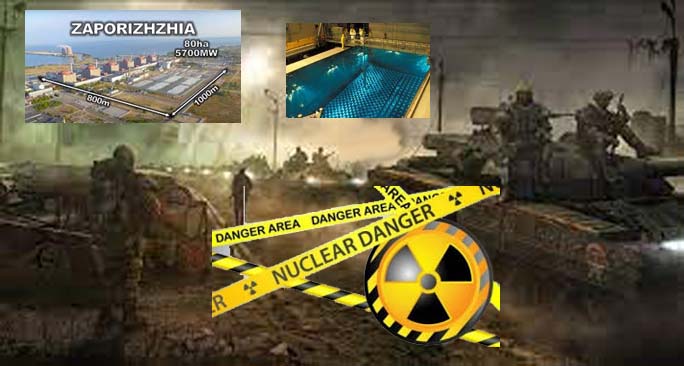
International regulators are incapable of properly monitoring safety at the Russian-occupied Zaporizhzhia nuclear power station, according to a critical dossier compiled by Greenpeace that is being sent to western governments on Thursday.
The environmental campaign group concludes the International Atomic Energy Agency has too few inspectors at Europe’s biggest nuclear plant—four—and that there are too many restrictions placed on their access.
It argues that the IAEA is “unable to meet its mandate requirements” but it is not prepared to admit as much in public, and as a result what it describes as Russian violations of safety principles are not being called out.
Shaun Burnie and Jan Vande Putte, nuclear specialists at Greenpeace, conclude: “The IAEA risks normalising what remains a dangerous nuclear crisis, unprecedented in the history of nuclear power, while exaggerating its actual influence on events on the ground.”
The vast Zaporizhzhia nuclear power plant, with six reactors on site, was captured by Russia in early March 2022 and has been on the frontline of the war ever since. It is sited on the Dnipro River in central Ukraine and Ukrainian forces occupy the riverbank opposite, leaving the plant in the sights of both sides’ militaries. https://emerging-europe.com/news/fresh-concerns-over-zaporizhzhia-nuclear-power-plant-emerging-europe-this-week/
‘Unprecedented nuclear crisis’ at Russian-controlled power plant with 148 attacks
An alarming dossier compiled by Greenpeace is being sent to
Western governments warning international regulators are currently
incapable of properly monitoring safety at the Zaporizhzhia plant in
Ukraine.
Mirror 28th Sept 2023
https://www.mirror.co.uk/news/world-news/unprecedented-nuclear-crisis-russian-controlled-31050468
Bring radiation regulations up to international standards, say Nuclear Free Local Authorities
https://www.nuclearpolicy.info/news/bring-radiation-regulations-up-to-international-standards-say-nflas/ Ian Grant 26 Sept 23
Inadequate emergency planning zones, inconsistent iodine distribution, and a lack of public engagement and accountability are some of the criticisms the UK/Ireland Nuclear Free Local Authorities levelled in response to a consultation being conducted by the Department of Energy Security and Net Zero about the regulations governing emergency planning for nuclear accidents.
The Department has just conducted a periodic review of the 2019 REPPIR – Radiation (Emergency Preparedness and Public Information) Regulations – in conjunction with its partners in the Ministry of Defence and Health and Safety Executive.
The NFLAs have found that the regulations governing emergency preparedness are ‘wholly inadequate and fail completely to take account of the total area which would be likely contaminated by radiation in the event of a nuclear accident’.
The NFLAs have called on the government to amend the regulations so they meet the standards set out in guidance issued by the International Atomic Energy Agency to countries with nuclear power plants. This would mean that Detailed Emergency Planning Zones would be set at a radius of at least five KMs from the plant, an Outline Planning Zone set at least thirty KMs, and iodine tablets proactively issued as a precautionary measure to all residents in these zones.
The current regulations require a Detailed Emergency Planning Zone to be set, but these are currently below 5 KMs in radius, the setting of an Outline Planning Zone is not even mandatory, and the pre-distribution of iodine tablets for residents to self-administer in the event of an accident can be inconsistent, and not proactive.
The NFLAs are also critical that emergency planning is underfunded, inadequate, inconsistent, and often opaque; with a general failure to engage members of the public and wider stakeholders in its development.
Councillor Lawrence O’Neill, Chair of the NFLA Steering Committee, said: “The Windscale Fire and Chernobyl both showed that vast areas can be contaminated by a radioactive plume. Should an accident occur, any resultant radiation will not halt at the modest line recommended for emergency planning purposes to the local authority by the nuclear operator.
“We want to see larger DEPZs and Outline Planning Zones to reflect the true reality, including a recognition that accidents can contaminate large areas and large cities rendering them uninhabitable; the extensive pre-distribution of iodine tablets as a sensible precautionary measure; and an emergency planning regime that is better resourced rather than being a Cinderella service, that is accountable not opaque, and that embraces input from a wider range of stakeholders, including the public.
“To the NFLAs, the current regime appears to be collective hubris on the part of government ministers and industry insiders, each hoping that an accident will not happen and that if it does the worst can easily be contained within a 3 km DEPZ”.
UN nuclear agency slams Iran for barring inspectors from monitoring program
The UN nuclear watchdog has criticised Iran for effectively barring several of its most experienced inspectors from monitoring the country’s program.
International Atomic Energy Agency (IAEA) chief Rafael Grossi on Saturday condemned Iran’s “disproportionate and unprecedented” move to bar multiple inspectors assigned to the country, hindering its oversight of Tehran’s atomic activities.
Iran’s move is a response to a call led by the United States, Britain, France and Germany at the IAEA’s Board of Governors this week for Tehran to cooperate immediately with the agency on issues including explaining uranium traces found at undeclared sites.
Grossi made clear, however, that he believed Iran had overreacted.
“I strongly condemn this disproportionate and unprecedented unilateral measure which affects the normal planning and conduct of agency verification activities in Iran and openly contradicts the cooperation that should exist between the agency and Iran,” he said in a statement.
The strongly worded statement came amid longstanding tensions between Iran and the agency, which is tasked with monitoring a nuclear program that Western nations have long suspected is aimed at eventually developing a nuclear weapon. Iran insists the program is peaceful.
Iran’s move, known as “de-designation” of inspectors, is allowed; member states can generally veto inspectors assigned to visit their nuclear facilities under the nuclear Non-Proliferation Treaty (NPT) and each country’s safeguards agreement with the agency governing inspections.
But the IAEA said Tehran’s decision went beyond normal practice. It said Iran had told it that it would bar “several” inspectors, without giving a number.
“These inspectors are among the most experienced agency experts with unique knowledge in enrichment technology,” the agency said. “With today’s decision, Iran has effectively removed about one third of the core group of the agency’s most experienced inspectors designated for Iran.”
Iran’s foreign ministry linked the move to what it said was an attempt by the US and three European countries to misuse the body “for their own political purposes”. He appeared to be referring to Britain, France and Germany, which said on Thursday they would maintain sanctions on Iran related to its nuclear and ballistic missile programs.
“Of course, Iran will continue its positive cooperation within the framework of the agreements that have been made, and emphasise the necessity of the agency’s neutrality,” he added.
A Vienna-based diplomat said Iran had de-designated all the French and German members of the IAEA inspection team. There were already no US or British members.
The Vienna-based IAEA reported earlier this month that Iran had slowed the pace at which it is enriching uranium to nearly weapons-grade levels. That was seen as a sign that Tehran was trying to ease tensions after years of strain between it and the US.
Iran and the US are negotiating a prisoner swap and the release of billions of dollars in Iranian assets frozen in South Korea.
Then-President Donald Trump unilaterally pulled the US out of the accord in 2018, restoring crippling sanctions. Iran began breaking the terms a year later. Formal talks in Vienna to try to restart the deal collapsed in August 2022.
1 This Month
Chernobyl: The Lost Tapes – A good documentary on Chernobyl on SBS available On Demand for the next 3 weeks– https://www.sbs.com.au/ondemand/tv-program/chernobyl-the-lost-tapes/2352741955560

of the week–London Campaign for Nuclear Disarmament

Tell the Ukrainian Government to Drop Prosecution of Peace Activist Yurii Sheliazhenko
To see nuclear-related stories in greater depth and intensity – go to https://nuclearinformation.wordpress.com
-
Archives
- April 2026 (126)
- March 2026 (251)
- February 2026 (268)
- January 2026 (308)
- December 2025 (358)
- November 2025 (359)
- October 2025 (376)
- September 2025 (257)
- August 2025 (319)
- July 2025 (230)
- June 2025 (348)
- May 2025 (261)
-
Categories
- 1
- 1 NUCLEAR ISSUES
- business and costs
- climate change
- culture and arts
- ENERGY
- environment
- health
- history
- indigenous issues
- Legal
- marketing of nuclear
- media
- opposition to nuclear
- PERSONAL STORIES
- politics
- politics international
- Religion and ethics
- safety
- secrets,lies and civil liberties
- spinbuster
- technology
- Uranium
- wastes
- weapons and war
- Women
- 2 WORLD
- ACTION
- AFRICA
- Atrocities
- AUSTRALIA
- Christina's notes
- Christina's themes
- culture and arts
- Events
- Fuk 2022
- Fuk 2023
- Fukushima 2017
- Fukushima 2018
- fukushima 2019
- Fukushima 2020
- Fukushima 2021
- general
- global warming
- Humour (God we need it)
- Nuclear
- RARE EARTHS
- Reference
- resources – print
- Resources -audiovicual
- Weekly Newsletter
- World
- World Nuclear
- YouTube
-
RSS
Entries RSS
Comments RSS
 nuclear-news