Nuclear plant problems have happened across the planet, and aging facilities across USA still pose a major threat
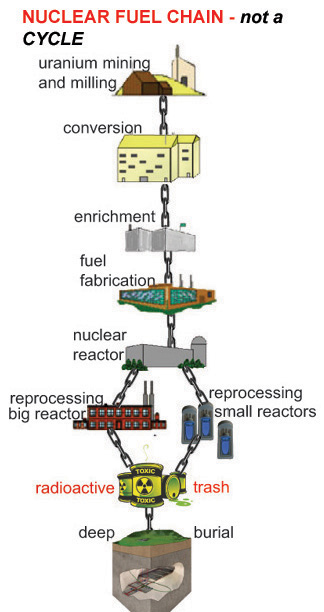
Before we allow very expensive investment in a new generation of nuclear reactors, it is well-advised to consider the long-term impact on the environment from all phases in the nuclear fuel cycle.
Jay Davis, https://www.sdstandardnow.com/home/nuclear-plant-problems-have-happened-across-the-planet-and-aging-facilities-across-usa-still-pose-a-major-threat 30 Oct 23
Remember the catastrophic nuclear meltdown in March 2011 at Fukushima, Japan, after an earthquake and tsunami?
Along with similar disasters at nuclear power plants at Chernobyl, Ukraine, and Three Mile Island near Harrisburg, Pennsylvania, the destruction of reactors at Fukushima continues to threaten the environment. For more than 12 years, the Tokyo Electric Power Company (TEPCO) has continuously poured cold water onto melted uranium and plutonium to keep those elements from overheating. That water, and the groundwater that runs through the reactor’s ruined foundation, poses an ongoing threat to surrounding communities and to fisheries.
In August, TEPCO began dumping millions of gallons of this radioactive wastewater into the Pacific Ocean. When that began, Robert Richmond, a marine biologist at the University of Hawaii, told the BBC that he is “very concerned that Japan would not only be unable to detect what’s getting into the water, sediment and organisms, but if it does, there is no recourse to remove it.”
In other words, the ongoing contamination of the Pacific will be irreversible.
Perhaps the wastewater from Fukushima is of little immediate concern to Americans unless they live in Hawaii or possibly Alaska. Hopefully, the radioactive tritium will be diluted long before any currents reach our West Coast. Meanwhile, the decommissioned Pilgrim Nuclear Power Station in Plymouth, Mass., was blocked from dumping radioactive waste into Cape Cod Bay by state environmental protection regulators in July. The Pilgrim reactor is the same General Electric design as Fukushima, and has been an ongoing environmental threat to Boston and much of densely populated New England for decades.
Much closer to home is the aging nuclear reactor (seen above in a public domain U.S. Government photo posted in wikimedia commons) which is operated by Xcel along the Mississippi River near Monticello, Minn. Xcel, an electric utility which was formerly known as Northern States Power, serves the Sioux Falls area as well as much of Minnesota.
This reactor, which is also the identical General Electric design, has been in operation since 1971, so it is overdue for decommissioning. Its corroded pipes are buried underground, and have never been inspected. However, Xcel detected radioactive tritium in November 2022 in monitoring wells, a leak into surrounding groundwater that was 250 times the legal concentration for safe drinking water.
Unfortunately, Xcel neglected to inform the sometimes toothless Nuclear Regulatory Commission (NRC) of this leak until March of this year. There is no suggestion that the reactor will be shut down soon, but it poses an ongoing threat to the Mississippi, which provides drinking water to millions of Americans.
Nuclear energy is still promoted as a climate-friendly alternative to fossil fuels. Before we allow very expensive investment in a new generation of nuclear reactors, it is well-advised to consider the long-term impact on the environment from all phases in the nuclear fuel cycle.
Here in South Dakota, old uranium mining sites near Edgemont and near Buffalo are still contaminated. America has yet to find a safe and appropriate place or method for the disposal of high-level nuclear waste that has been generated by our power plants.
Proposed sites in the Nevada desert and in the Permian Basin of west Texas have met with local opposition, for good reason. In the meantime, we hope and pray that nuclear power plants in Massachusetts, Minnesota and elsewhere will not experience meltdowns like Fukushima and Chernobyl. #nuclear #antinuclear #nuclearfree #NoNukes
3-day evacuation drill at Niigata nuclear plant called ‘useless’
THE ASAHI SHIMBUN, October 30, 2023
Residents said their safety concerns have still not been addressed following a three-day government-led drill simulating a serious accident at the Kashiwazaki-Kariwa nuclear power plant in Niigata Prefecture.
They said the drill, which concluded on Oct. 29, showed that there are no measures in place to ensure a smooth evacuation in heavy snow or to prevent traffic congestion caused by radiation checks.
Around 1,400 residents joined the drill, which assumed a magnitude-7.6 earthquake off the prefecture caused a loss of cooling functions at reactors of the plant, which is operated by Tokyo Electric Power Co.
This was the first government-run drill at the seven-reactor Kashiwazaki-Kariwa nuclear plant since the 2011 disaster at TEPCO’s Fukushima No. 1 nuclear power plant caused by the Great East Japan Earthquake and tsunami.
At the end of last year, main evacuation routes, including in Kashiwazaki, where the plant is located, were closed for up to 52 hours due to heavy snowfall…………………………………………………………….. more https://www.asahi.com/ajw/articles/15042691— #nuclear #antinuclear #nuclearfree #NoNukes
Switzerland continues its nuclear safety awareness with iodine pills distributed to the population
Bloomberg, By Paula Doenecke and Kevin Whitelaw, October 28, 2023
ZURICH — Switzerland is in the middle of a ritual it performs once a decade: distributing a fresh round of iodine pills to protect its people should something go wrong with one of its nuclear power plants.
Residents who live within 50 kilometers of one of the nation’s three nuclear power plants will find an orange package with a dozen tablets in their mailbox by next April. The delivery replaces the lilac box of thyroid cancer prevention medication that the government handed out 10 years ago.
The campaign may seem like a Cold War relic to some — newly arrived expatriates are often startled to be handed a voucher for their pills when they first register at the town hall. But the idea is that sirens would sound in the event of a nuclear accident so that people could take a dose before any fallout reaches them.
The pills containing the compound potassium iodide are distributed free of charge, including in the financial and industrial centers of Zurich and Basel. People living within the 50-kilometer radius, but on the German side of the border, are left to fend for themselves.
The logistical effort costs 34 million Swiss francs (€35.9 million) — a third of which is financed by the nuclear power plant operators. Beyond protecting the health of the Swiss people, the strategy is part of the country’s long-standing identity of neutrality, dubbed Reduit Switzerland, or Swiss Fortress. That pride of self-defense still manifests today in a multitude of well-maintained tank stoppers and bunkers spread throughout the Swiss Alps.
While Germany and France are battling these days over the role of nuclear power in Europe’s energy transition, Switzerland is proceeding on its path of risk mitigation — keeping its remaining three atomic plants running as long as they are functioning, as decided by a public vote in 2017. It retired a fourth in Muehlenberg in 2019…….. more https://www.bloomberg.com/news/newsletters/2023-10-28/switzerland-s-once-a-decade-nuclear-ritual #nuclear #antinuclear #nuclearfree #NoNukes
Israeli prime minister Benjamin Netanyahu and his wife Sara have decamped to a luxury mansion with a deep nuclear bunker
Daily Mail, By MELANIE SWAN, 29 October 2023
- Israeli PM Benjamin Netanyahu and his wife Sara are hiding in a luxury mansion
- It is owned by US billionaire Simon Falic, and comes with high security
Israeli prime minister Benjamin Netanyahu and his wife Sara have decamped to the luxury mansion with a deep nuclear bunker, amid growing public anger towards the country’s leaders.
The gated mansion in a Jerusalem mansion, owned by US billionaire Simon Falic, comes with high-level security.
He said the staff are being moved there, including their personal chef, with the preparations suggesting future meetings with world leaders will also be relocated there.
The decision to move into a residence with a deep nuclear bunker is not a common one in Israel, even among the super-rich.
But with the looming threat from Iran, a handful of the PM’s inner circle have built them……………………………………….
Prior to the Hamas atrocities, hundreds of thousands of Israelis had been protesting against the premier and his right-wing coalition over plans to reform the judicial system, allegations of cronyism and allowing Jewish settlers to expand into more areas that were supposed to be occupied by Palestinians. https://www.dailymail.co.uk/news/article-12684385/Israeli-prime-minister-Benjamin-Netanyahu-wife-Sara-decamped-luxury-mansion-deep-nuclear-bunker.html #nuclear #antinuclear #NoNukes
War Against Renewables Takes Terrifying Turn in Newsom’s Nuke-Powered California

Embrittlement transforms a metallic reactor pressure vessel (RPV) as heat, pressure and radiation rob it of resilience. An embrittled reactor pressure vessel can shatter when coolant water is poured in during an emergency, causing massive steam, hydrogen and fission explosions.
HARVEY WASSERMAN, TRUTHOUT
PG&E now says it won’t test its reactor in Diablo Canyon for deadly embrittlement this year as planned.
The nuclear industry’s war against renewable energy has taken center stage in California under Democratic Gov. Gavin Newsom, with a terrifying new development now threatening the state and nation with increased risk of intense radioactive fallout.
This week on October 24 — despite earlier assurances — Pacific Gas and Electric (PG&E) revealed that it will not test its 38-year-old atomic reactor in California’s Diablo Canyon for embrittlement during the current refueling outage, but instead plans to wait until the next outage in 2025 before conducting the crucial safety tests.
Embrittlement transforms a metallic reactor pressure vessel (RPV) as heat, pressure and radiation rob it of resilience. An embrittled reactor pressure vessel can shatter when coolant water is poured in during an emergency, causing massive steam, hydrogen and fission explosions.
The reactor in Diablo Canyon showed dangerous embrittlement during the last inspections of it, which took place between 2003 and 2005, and it has not been tested since. PG&E now wants the 38-year-old atomic reactor, which is known as Unit One, to operate years longer without examining this core safety feature, arguing that it is not able to remove a component needed for testing until 2025.
This terrifying decision epitomizes the all-out war occurring between nuclear power and renewable energy in California.
On the grid, against rooftop solar panels, in batteries in basements, at the marketplace and regulatory agencies, in the banks and the legislatures – the zero-sum confrontation between green power and the “Peaceful Atom” stands to define the human future.
It begins on the wires.
Since 1985, the two big light-water reactors at the state’s last remaining nuclear power plant, Diablo Canyon, have regularly poured more than a thousand megawatts each of “baseload energy” into the grid.
But the value of that energy has been upended by a spectacular influx of renewable green power. With nearly 1.8 million rooftop installations, California now gets far more juice from solar panels — more than a quarter of the state’s electricity — than from Diablo.
Since 1985, the two big light-water reactors at the state’s last remaining nuclear power plant, Diablo Canyon, have regularly poured more than a thousand megawatts each of “baseload energy” into the grid.
But the value of that energy has been upended by a spectacular influx of renewable green power. With nearly 1.8 million rooftop installations, California now gets far more juice from solar panels — more than a quarter of the state’s electricity — than from Diablo………………………….
Overall, batteries have now become such a dependable, fast-growing piece of the energy supply that a Vermont utility is proposing to install them in their customers’ basements rather than extending new power lines. In a state whose single atomic reactor has recently shut, the battery-based system will be cheaper and more reliable than depending on power wired in from distant generators.
Likewise, Diablo’s inflexible feed has become an unsustainable dinosaur. Atomic reactors are neither cheap nor easy to manipulate. They function primarily in a straight-line paradigm (except when refueling or being repaired) with the same high-priced power flowing into the grid in a steady stream.
By contrast, decentralized renewables like solar and wind are quick to ramp up or down. With batteries now in millions of basements, inflexible baseboard power becomes a burden, clogging up the grid when cheaper, quicker-to-deploy renewables could flow to meet peak demands while scaling back at times of lower usage. In essence, Diablo’s power has become the electric equivalent of a debilitating blood clot.
Ironically, earlier this year a forced slowdown hit Finland’s new Olkiluoto reactor. Opened in May, after long delays and huge cost overruns, Olkiluoto had to slow down production within weeks to clear the grid for a massive influx of far cheaper wind and hydro power.
Partly due to this extremely expensive market disconnect, Pacific Gas and Electric in 2016 agreed to phase out the two Diablo reactors in 2024 and 2025, when their Nuclear Regulatory Commission (NRC) operating licenses would expire as they reached 39 and 40 years old respectively. Facing a wide range of additional repairs and regulatory mandates, PG&E joined with then-Gov. Jerry Brown to chart orderly shutdowns in sync with the transition toward a renewable-based grid.
After months of tense high-level negotiations, the agreement was also signed by then-Lieutenant Gov. Gavin Newsom, the state legislature and key regulatory agencies, local governments, major labor unions, environmental groups, and others. The landmark agreement included union-endorsed compensation and retraining for the plant’s labor force, environmental concessions, tax subsidies for local governments, and more. As a whole, it created a crucial template for phasing out old atomic reactors amidst the global tsunami of new renewables………………………………………
But in 2022, Newsom suddenly trashed the shutdown deal he’d signed six years before. Warning of potential shortfalls during very narrow theoretical windows of potential peak demand, he strong-armed the legislature and the Public Utilities Commission (CPUC) into a bailout plan with more than $1.4 billion in state funds for PG&E to keep Diablo running, along with another $1.1 billion from the federal government.
The move has shocked and infuriated the state’s anti-nuclear and renewable energy movement. Its extremely complicated ramifications are now being challenged throughout the regulatory and court systems.
The Mothers for Peace has taken the NRC to federal court, arguing that PG&E’s relicensing plans fall short of the agency’s own long-standing requirements.
In league with Friends of the Earth, Mothers for Peace has also filed a petition with the NRC to warn that the elderly Unit One of the Diablo plant is deeply — possibly fatally — embrittled.
Embrittlement occurs as a reactor pressure vessel is subjected to extreme heat, pressure and radiation over decades of operation. In response, the RPV’s metals lose their resiliency. In an emergency situation, with a rapid influx of cold water, the RPV could shatter, leading to steam, hydrogen and radiation explosions involving massive releases of apocalyptic fallout.
Among much more, NRC tests conducted in 2003-2005 showed that Unit One was already dangerously embrittled. Unique amalgams used in its formative welds have since been abandoned for safety reasons.
Embrittlement tests are required by NRC regulations to be done every 10 years. Failure to check for embrittlement at Massachusetts’s Yankee Rowe reactor in 1992 resulted in an NRC-ordered permanent shutdown.
But allegedly no such tests have been comprehensively conducted at Diablo One for 20 years. The reactor is currently offline for a refueling expected to last about 50 days. A wide range of experts is calling for detailed inspections of the plant’s internals to be conducted immediately. Thus far there’s been no response from the NRC, but, as explained above, PG&E now says it won’t inspect Unit One for embrittlement at least until 2025, with results not likely to come until 18 months later. Yet the utility expects to operate the plant until then without having inspected this crucial safety feature.
While gliding toward a permanent shutdown since 2016, PG&E also let slide a series of routine maintenance requirements that have alarmed technical observers. Expert observers worry that if the plant’s allowed back online without a thorough public inspection, California’s downwind safety could be deeply compromised. Seeing as Diablo is located on the central California coast, fallout from an explosion there could carry all the way across the continental United States.
he deepening doubts surrounding Diablo Canyon — especially in the wake of the 2016 decision to shut it — have aroused serous grassroots anger against Newsom.
But it doesn’t stop with just nuclear power……………………………………….
n 2021, Newsom’s handpicked CPUC launched a devastating anti-solar attack. ……………………………
……………as atomic energy falls deeper into an economic pit, the push to sustain it with massive subsidies could only be coming from the nuclear weapons industry, whose infrastructure, fuel supply and core of trained personnel may be essential to the continued supply of atomic bombs.
………………………….. Whatever the case, these coming months of California’s energy war — tested safe versus dangerously embrittled, green versus nuclear, flexible versus baseload, old reactors versus new panels, wind turbines and batteries — will go a long way toward defining the nature of our nation’s future power supply. https://truthout.org/articles/war-against-renewables-takes-terrifying-turn-in-newsoms-nuke-powered-california/?utm_source=Truthout&utm_campaign=19c5e52962-EMAIL_CAMPAIGN_3_20_2023_13_41_COPY_05&utm_medium=email&utm_term=0_bbb541a1db-19c5e52962-649984717&mc_cid=19c5e52962&mc_eid=082a9d17c9 #nuclear #antinuclear #NoNukes
IAEA warning after explosions heard near Khmelnitsky nuclear power stations

International Atomic Energy Agency Director General Rafael Mariano Grossi warns that nearby explosions which shattered windows at Ukraine’s Khmelnitsky nuclear power plant “show just how close it was – and underlines the extremely precarious nuclear safety situation … which will continue as long as this tragic war goes on”.
WNN 27 Oct 23
The International Atomic Energy Agency (IAEA) experts stationed at the plant in western Ukraine said air raid sirens sounded at 01:26 local time on Wednesday followed by two loud explosions which they were later told were two drones being shot down 5 kilometres and 20 kilometres from the site.
Although the site was not hit or have its operations affected, the IAEA reported that “shockwaves damaged the windows of several buildings at the site, including the passageway to the reactor buildings, an integrated auxiliary building, a special equipment building, the training centre, as well as other facilities, the plant said. The seismic monitoring stations installed in the vicinity of Khmelnitsky nuclear power plant also recorded the seismic impacts of the blasts”………
Grossi said: “Next time, we may not be so fortunate. Hitting a nuclear power plant must be avoided at all costs.”
Khmelnitsky’s first reactor was connected to the grid in 1987, but work on three other reactors was halted in 1990. Work on the second reactor restarted and it was connected to the grid in 2004 but units 3 and 4 remain uncompleted.
The primary focus of safety concerns for the IAEA since the outbreak of the war has been on the Zaporizhzhia nuclear power plant which has been under Russian military control since early March 2022. It is located on the frontline between the forces, and although it has not been reported to have been hit by shelling in recent months, military activity nearby has continued. In its update on the situation at the weekend, the IAEA said its experts at the site “have continued to hear explosions almost every day and they have also heard occasional machine gun fire”. https://www.world-nuclear-news.org/Articles/IAEA-warning-after-explosions-heard-near-Khmelnits #nuclear #antinuclear #NoNukes #radiation
Nuclear regulator raps EDF over cyber compliance
The Office for Nuclear Regulation says EDF has come up short on needed measures to improve cyber security standards at several critical UK nuclear facilities
France-headquartered energy giant EDF has been singled out by the UK’s
Office for Nuclear Regulation (ONR) and placed under significantly enhanced
regulatory attention for cyber security – the highest possible level of
scrutiny – after the critical national infrastructure (CNI) operator failed
to comply with previously made commitments to enhance its cyber security
posture.
Computer Weekly 19th Oct 2023
https://www.computerweekly.com/news/366556335/Nuclear-regulator-raps-EDF-over-cyber-compliance #nuclear #antinuclear #nuclearfree #NoNukes
Risk of total shutdown of Eskom’s Koeberg nuclear power station continues to increase
The risk of both nuclear reactors at Eskom’s Koeberg nuclear power station in Cape Town being shut down simultaneously for life extension continues to increase…………………………………… (Subscribers only) https://www.dailymaverick.co.za/article/2023-10-20-koeberg-nuclear-power-station-rising-risk-of-total-shutdown/ #nuclear #antinuclear #nuclearfree #NoNukes
Crackdown on nuclear firm after cyber security ‘shortfalls’

“Cyber attacks threaten the security of nuclear facilities by compromising command and control systems and damaging safety, security and emergency responses.”
“Rapidly spreading computer viruses and worms can infect instrument systems and corrupt files.
The Ferret Rob Edwards, October 18, 2023
A multinational nuclear power company has been hit by an official crackdown because of cyber security failures that critics warned were a “very real and present danger”.
Oversight of EDF Energy by the UK Government’s safety watchdog, the Office for Nuclear Regulation, has been “significantly enhanced” to combat “shortfalls” in defences against digital attacks. This means more inspections and increased scrutiny of EDF’s cyber security.
EDF is a French government company that runs one nuclear power station in Scotland, at Torness in East Lothian, and four in England. It is also building a new nuclear station at Hinkley Point in Somerset.
Campaigners described EDF’s failure to properly protect its nuclear operations from “potentially dangerous cyber attacks” as “incomprehensible”. Nuclear plants were “vulnerable” to computer viruses that could threaten safety, they said……….
No details of EDF’s cyber security failings have been released for fear of helping would-be hackers. Cyber attacks are on the increase, with many organisations – such as the Scottish Environment Protection Agency – severely impacted.
The Times reported in 2017 that insecure passwords used by EDF nuclear managers had been found in two lists of stolen credentials traded on Russian hacking sites. According to The Telegraph in 2019, UK government intelligence experts had been called in after a cyber attack on an unnamed nuclear power company, suspected to be EDF.
The Ferret revealed in March 2023 that the police force tasked with guarding UK nuclear plants reported 37 security breaches in 2021-22, the highest for eight years. In August we reported that the Ministry of Defence’s nuclear managers had recorded 113 “security concerns” since 2017-18………………………………………………..
Nuclear plants ‘vulnerable’ to cyber attack
Dr Paul Dorfman, a nuclear critic and visiting fellow at the science policy research unit in the University of Sussex, highlighted concerns expressed by the UN’s International Atomic Energy Agency (IAEA) about the growing threats posed by cyber attacks.
Nuclear power plants are “vulnerable,” Dorfman said. “Cyber attacks threaten the security of nuclear facilities by compromising command and control systems and damaging safety, security and emergency responses.”
He added: “Rapidly spreading computer viruses and worms can infect instrument systems and corrupt files. EDF’s persisting failure to prepare for the very real and present danger of cyber attack on nuclear facilities is, quite simply, incomprehensible.”
Pete Roche, a consultant and anti-nuclear campaigner based in Edinburgh, pointed out that the Torness nuclear station was due to keep operating until 2028 despite cracks spreading in its graphite core.
“We need an operating company which can give meticulous attention to detail,” he said. “These revelations about cyber security seem to indicate that EDF is not capable of doing that.” …………………………………………………………………more https://theferret.scot/cyber-security-nuclear-security-crackdown/ #nuclear #antinuclear #nuclearfree #NoNukes
IAEA: Zaporizhzhia nuclear plant to move second reactor into hot shutdown
Y! News, Abbey Fenbert, Sat, October 14, 2023
The Russian-occupied Zaporizhzhia Nuclear Power Plant (ZNPP) intends to transition a second reactor into hot shutdown, the International Atomic Energy Agency (IAEA) reported on Oct. 13.
IAEA Director General Rafael Mariano Grossi said authorities at the plant informed the agency they were beginning to move reactor 5 from cold to hot shutdown in order to provide warm water and heating for Enerhodar ahead of the winter season.
Previously, only one unit, reactor 4, was in hot shutdown mode. The IAEA has said that for safety purposes, all units at the nuclear plant should be kept in cold shutdown.
The agency has strongly recommended that the ZNPP find an external source of steam generation. The IAEA experts were told that the plant is looking into purchasing an external steam generator, but that “installation of this equipment is not expected until the first part of 2024, possibly not until after the end of the heating season.”
Occupying authorities at the plant did not tell IAEA inspectors how long unit 5 would remain in hot shutdown. They also said there were no plans to transfer addition units from cold to hot shutdown…………………….. https://news.yahoo.com/iaea-zaporizhzhia-nuclear-plant-move-010453561.html #nuclear #antinuclear #NuclearFree #NoNukes #NuclearPlants
SOS – The San Onofre Syndrome: Nuclear Power’s Legacy.
A crucial warning
that nuclear power plants’ intensely radioactive waste is putting
communities at grave risk. SOS is an urgent call to action. Will we rally
to implement this lifeline in time?
Filmed over 12 years, this film
dramatically chronicles how Southern California residents came together to
force the shutdown of an aging nuclear power plant only to be confronted by
an alarming reality: tons of nuclear waste left near a popular beach, only
100 feet from the rising sea, that — with radioactivity lasting millions
of years—menaces present and future generations. Film screening on 16th
Oct.
Entertainment Oxygen (accessed) 15th Oct 2023
https://app.entertainmentoxygen.com/feed/e42963ea-7477-4952-a073-31b60e4e280d #nuclear #antinuclear #NuclearFree #NoNukes #NuclearPlants
Question from Jamaica: are we being the world’s guinea pig for SMR nuclear power?
Oct 15, 2023 Dennis A Minott, PhD, is a physicist and energy specialist. https://www.jamaicaobserver.com/columns/are-we-being-the-worlds-guinea-pig-for-smr-nuclear-power/
Hard Question #1:
If a small modular nuclear reactor (SMR) in the Caribbean goes wrong, who can physically, or by financial means, stop it before it causes widespread harm in our relatively small archipelagic crescent of geographical space?
This question is hard because it forces us to confront the reality of nuclear incidents and accidents, which can be catastrophic and irreversible. Even if we or the owner can summarily replace the top managers of an SMR plant with more “experienced experts”, it may not be enough or in time to avert a disaster. SMRs are a new and unproven technology, and there is no guarantee that they will be safe or that the new hires know anything appropriate to do since the technology would be absolutely novel to them.
How do you fix something like a getaway hazardous process that you do not quite understand when, even at your quickest and brightest, you have no time to learn because “things” are so immediate?
In the event of a nuclear accident the consequences could be devastating for the Caribbean. The islands are densely populated and rely heavily on tourism, which would be severely disrupted by even a hint of a nuclear disaster. The region is also certainly vulnerable to earthquakes, hurricanes, and other natural disasters, which could make it difficult to contain a nuclear accident. Jamaican and all Caribbean people deserve a serious and honest assessment of the risks and benefits of SMRs. They need to know that if something goes wrong, there may be no way to stop it.
Hard Question #2: How can we ensure that SMRs are safely designed, built, and operated in the Caribbean?
Hard Question #3: What are the long-term risks of nuclear waste disposal in the region?
Hard Question #4: What are the economic and social costs of nuclear accidents?
Hard Question #5: Are there better proven and practically risk-free green alternatives to SMRs for meeting the Caribbean’s energy needs?
Hard Question #6: Can any Caribbean terrorist gang/insurgents or group of enemy combatants gain the capacity to hold citizens or any governing authority to ransom by occupying or targeting an SMR from 200 Ukraine-like kilometres?
These are just six of the hard questions that need to be answered before any decision is made about whether to deploy SMRs in the Caribbean.
As I recall, Jamaica is still within the Caribbean where even a little 5.0-magnitude shaker near Hope Bay vibrated The Turks & Caicos, Cuba, Florida, and Hispaniola. Within exactly three minutes of 7:31 pm that Thursday, one of my friends in America was calling to know if I was OK.
I hate to break it this way: My friend understands geophysics. My daughter is a Yale teaching fellow geophysics specialist, and my late wife was an ODPEM senior director who understood these matters very well as she taught the stuff at university level for many years, up to months before she died of cancer. As a physicist who communicates with my tribe I would be dishonest if I pretended ignorance of the true reason for my friend’s call. Here it is:
The Enriquillo-Plantain Garden fault zone is a major fault system that extends through Haiti and the Dominican Republic into Jamaica. It is a strike-slip fault where the motion is primarily horizontal, with the Caribbean plate moving eastward relative to the Gonâve microplate. This fault has been associated with significant earthquakes in the past, including the devastating 2010 Haiti earthquake which laid claim to 0.25 million human lives in minutes.
Both Jamaica and Haiti are located in seismically active regions, and understanding the fault lines and tectonic activity in these areas is crucial for assessing and mitigating seismic risks to even the best-designed SMR touted by our wealthiest citizens who know money movements but, respectfully, not the deadly movements of neighbourhood tectonic plates. My learned friend in America does, and called me immediately.
Flow’s cables remained unbroken — one more time. #nuclear #antinuclear #NuclearFree #NoNukes #NuclearPlants
South Carolina nuclear plant gets warning over another cracked emergency fuel pipe
JENKINSVILLE, S.C. (AP) 10 Oct 23— Federal officials have issued a warning about a substantial safety violation at a South Carolina nuclear plant after cracks were discovered again in a backup emergency fuel line.
Small cracks have been found a half-dozen times in the past 20 years in pipes that carry fuel to emergency generators that provide cooling water for a reactor if electricity fails at the V.C. Summer plant near Columbia, according to the U.S. Nuclear Regulatory Commission.
The agency issued what it calls a preliminary “yellow” warning to plant owner Dominion Energy last week.
It is the second most serious category and only seven similar warnings have been issued across the country since 2009, nuclear power expert David Lochbaum told The State newspaper after reviewing records from federal regulators.
A crack first appeared on a diesel fuel pipe in 2003, and similar pipes have had other cracks since then.
During a 24-hour test of the system in November, a small diesel fuel leak grew larger, according to NRC records.
The agency issued the preliminary yellow warning because of the repeated problems………………….
Dominion has recently requested to renew the license for the nuclear plant for an additional 40 years.
Longtime nuclear safety advocate Tom Clements told the newspaper the pipe problems should mean a lot more scrutiny by regulators.
“This incident serves as a wake-up call to fully analyze all such systems prior to a license-renewal determination,’’ Clements said in an email. https://apnews.com/article/nuclear-plant-south-carolina-dominion-energy-b71d1e3b598b84623259205997602aaf #nuclear #antinuclear #NuclearFree #NoNukes #NuclearPlants
Zelensky pledged not to directly attack nuclear plant in Zaporizhzhia, says IAEA chief
“a number of fragile points apart from the reactors themselves”, including “the spent fuel area which is not fortified” as well as other storage areas holding fresh nuclear fuel.
Rafael Grossi says president personally assured him Ukraine ‘will not directly bomb or shell’ plant in counteroffensive
Dan Sabbagh, Guardian, 11 Oct 23
Rafael Grossi, the head of the International Atomic Energy Agency, says Volodymyr Zelenskiy has promised him that Ukraine will not attack Europe’s biggest nuclear plant as part of its counteroffensive against Russia.
In an interview with the Guardian, the nuclear watchdog chief said he was most concerned about the Zaporizhzhia nuclear plant becoming engulfed in fighting between the two sides, but insisted he had obtained a commitment from the Ukrainian president.
“President Zelenskiy has personally assured me that they will not directly bomb or shell it,” Grossi said, although he added that Zelenskiy had told him “all other options are on the table” in terms of taking it back.
That means Ukraine would comply with the first of the five new nuclear safety principles – “do not attack a nuclear power plant” – initially outlined by Grossi at the UN security council at the end of May to avert “a catastrophic accident”.
The Zaporizhzhia nuclear power station was captured by Russia in March 2022, the first time any reactor has been captured in war, prompting fears of a fresh incident in the same country where an explosion at Chornobyl spread radioactivity across Europe in 1986.
Grossi said the danger was that “anything can happen at any time” given the prevailing military situation. “I’m often asked, is [the power station] safe now? No. It’s in the middle of a war zone with a counteroffensive,” he said.
He said he believed there “were two main problems”, the most significant of which was “a direct attack, hit” on one of the less secure areas of the plant, while the secondary concern was the maintenance of water cooling, necessary even as the six reactors are in shutdown……….
Grossi said he was particularly concerned by “a number of fragile points apart from the reactors themselves”, including “the spent fuel area which is not fortified” as well as other storage areas holding fresh nuclear fuel.
“The fresh fuel halls, let me remind you, were hit in August 2022,” he added, describing the aftermath of an attack that left holes visible to satellite imagery on the roof of the power station’s key facility.
A few days later, Grossi crossed the frontlines to pay one of three personal visits since the start of the war to the nuclear plant, where he said he saw the damage caused by the attack where “a few metres down, you have the racks containing the fresh fuel”.
Though the damage was likely to have come after a Ukrainian attack, Grossi said he would not say who was responsible. “I don’t have a forensic capacity [to determine who was responsible],” he said. “The Russians would certainly say that [the Ukrainians did it].”
IAEA monitors are permanently based at the nuclear power plant, although last week Greenpeace said their number – at four – was too small and they were unable to provide effective assurances about safety because they had to give a week’s notice of their inspection requests…………..
Russia’s Rosatom nuclear agency has taken over the management of the plant, but has had to rely on a fraction of the prewar Ukrainian staff to keep it operational. Staffing levels plunged from 12,000 before the war to, Grossi said, about 2,000 today, although he added it was “growing again” with more native Russians coming onsite.
Concerns about maintaining water cooling increased sharply after the Nova Kakhovka dam downstream was blown in June, draining the Dnipro reservoir around the plant and leaving its reserve cooling water pond exposed…………………….
Grossi said he regretted how the plant had been used in military brinkmanship between the two sides. “We were not expecting a war with these kind of characteristics,” he said………… https://www.theguardian.com/world/2023/oct/10/zelenskiy-promises-not-to-attack-zaporizhzhia-nuclear-plant-says-iaea-chief #nuclear #antinuclear #NuclearFree #NoNukes #NuclearPlants
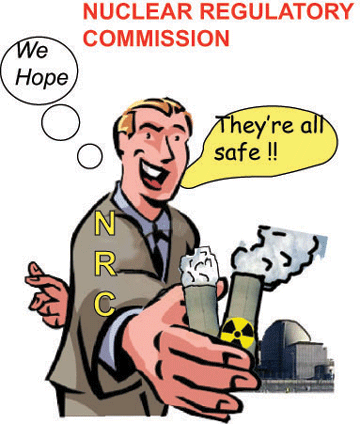
Regulators reject request to shutter nuclear reactor
The Journal Record, By: Associated Press//October 9, 2023
LOS ANGELES (AP) – Federal regulators have rejected a request from two environmental groups to immediately shut down one of two reactors at California’s last nuclear power plant.
Friends of the Earth and Mothers for Peace said in a petition filed last month with the Nuclear Regulatory Commission that long-postponed tests needed to be conducted on critical machinery at the Diablo Canyon Nuclear Power Plant, located midway between Los Angeles and San Francisco. They argued the equipment could fail and cause a catastrophe.
In an order dated Tuesday, the NRC took no action on the request to immediately shut down the Unit 1 reactor and instead asked agency staff to review it.
……………. According to the groups, the last inspections on the vessel took place between 2003 and 2005. The utility postponed further testing in favor of using results from similar reactors to justify continued operations, they said.
The commission found there was no justification for a hearing.
The groups said in a statement that the decision showed “a complete lack of concern for the safety and security of the people living near” the plant, which started operating in the mid-1980s……………..
The petition marked the latest development in a long fight over the operation and safety of the seaside plant, which sits on a bluff above the Pacific Ocean. In August, a state judge rejected a lawsuit filed by Friends of the Earth that sought to block PG&E from seeking to extend the operating life of the plant.
PG&E agreed in 2016 to shutter the plant by 2025, but at the direction of the state changed course and now intends to seek a longer operating run for the twin reactors. Democratic Gov. Gavin Newsom, who once was a leading voice to close the plant, said last year that Diablo Canyon’s power is needed beyond 2025 to ward off possible blackouts as California transitions to solar and other renewable energy sources. https://journalrecord.com/2023/10/09/regulators-reject-request-to-shutter-nuclear-reactor/
1 This Month
Chernobyl: The Lost Tapes – A good documentary on Chernobyl on SBS available On Demand for the next 3 weeks– https://www.sbs.com.au/ondemand/tv-program/chernobyl-the-lost-tapes/2352741955560

of the week–London Campaign for Nuclear Disarmament

Tell the Ukrainian Government to Drop Prosecution of Peace Activist Yurii Sheliazhenko
To see nuclear-related stories in greater depth and intensity – go to https://nuclearinformation.wordpress.com
-
Archives
- April 2026 (126)
- March 2026 (251)
- February 2026 (268)
- January 2026 (308)
- December 2025 (358)
- November 2025 (359)
- October 2025 (376)
- September 2025 (257)
- August 2025 (319)
- July 2025 (230)
- June 2025 (348)
- May 2025 (261)
-
Categories
- 1
- 1 NUCLEAR ISSUES
- business and costs
- climate change
- culture and arts
- ENERGY
- environment
- health
- history
- indigenous issues
- Legal
- marketing of nuclear
- media
- opposition to nuclear
- PERSONAL STORIES
- politics
- politics international
- Religion and ethics
- safety
- secrets,lies and civil liberties
- spinbuster
- technology
- Uranium
- wastes
- weapons and war
- Women
- 2 WORLD
- ACTION
- AFRICA
- Atrocities
- AUSTRALIA
- Christina's notes
- Christina's themes
- culture and arts
- Events
- Fuk 2022
- Fuk 2023
- Fukushima 2017
- Fukushima 2018
- fukushima 2019
- Fukushima 2020
- Fukushima 2021
- general
- global warming
- Humour (God we need it)
- Nuclear
- RARE EARTHS
- Reference
- resources – print
- Resources -audiovicual
- Weekly Newsletter
- World
- World Nuclear
- YouTube
-
RSS
Entries RSS
Comments RSS
 nuclear-news
.jpg)