Nuclear Regulatory Commission wants anti terrorism plans for reactors
 NRC seeks nuke anti-terror plans |Security Info Watch Nuclear plant operators required to submit plans by June 10, Brattleboro Reformer (Vermont) 05-18-2011 WASHINGTON (AP) — The Nuclear Regulatory Commission is demanding that operators of the 104 U.S. nuclear reactors submit detailed information about plans to respond to a possible terrorist attack.
NRC Chairman Gregory Jaczko said Wednesday that operators must submit by June 10 details about plans, equipment and personnel in place to respond to a terrorist attack. The agency has required nuclear power plants to prove their ability to respond to terrorism since the Sept. 11, 2001, attacks on New York and Washington…….NRC seeks nuke anti-terror plans |
Nuclear Regulatory Commission Complacent About Safety of US Nuclear Reactors
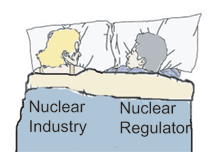 Eric Leeds, director of the NRC’s Office of Nuclear Reactor Regulation, said, “Our inspectors found all reactors would be kept safe ..”
Florida nuclear reactors pass inspection in wake of Japan disaster By Susan Salisbury, Palm Beach Post , May 16, 2011,The U.S. Nuclear Regulatory Commission has completed inspections of the nation’s 104 nuclear reactors, including those in Florida, to examine the plants’ abilities to deal with power losses or other issues following extreme events, such as floods, fires or terrorist attacks. Continue reading
Poor safety record of Browns Ferry Nuclear Plant
How safe is the Browns Ferry Nuclear Plant? , Richard W. Jobe, 17 May 11, A Nuke hazard?Reading Brian Lawson’s excellent article in The Times on May 11, I asked: Could Brown’s Ferry Nuclear Plant have a meltdown like Fukushima in Japan? Judge for yourself with these facts: Continue reading
With nuclear safety concerns, why extend Vermont Yankee’s license?
the too frequent appearance that the NRC is in bed with the industry it regulates, there’s no reason to assume that every plant should get added years. This is where concerns about Vermont Yankee’s record of operation, radioactive leaks included, kick in, and where the NRC needs to do a much better job of explaining why Vermont Yankee should keep running past 2012
The 40-year license for nuclear power plants – New Hampshire, SentinelSource.com: Editorial, 15 May 11, “……….When the Atomic Energy Act of 1954 was being debated, the drafters felt it necessary to put an expiration date on licenses, after which renewals could be considered. However, at the time no one had any experience with nuclear power plants, so the drafters essentially lifted the 40-year provision from federal licenses then in use for hydroelectric power plants. The decision wasn’t based on science and safety; it was based mainly on investment considerations, such as how long it would take for a huge investment to make financial sense.
But, as the unfolding Fukushima disaster tells us, nuclear plants are about more than investments. To bring that point home, the NRC reports that it is finding that many nuclear power plants in this country are vulnerable to big natural disasters; the finding was based on a review ordered up after the Japanese crisis began. Continue reading
Yes, Fukushima nuclear plant DID have a full nuclear meltdown
 It’s Official: Fukushima Hit With Full-Blown Nuclear Meltdown Gizmodo Australia, By Sam Biddle on May 13, 2011 The flow of bad news (and radiation) out of Fukushima’s reactors has diminished to a trickle over the past several weeks, as rescue work has proceeded. Not today. TEPCO’s admitted for the first time that Fukushima experienced a full meltdown.
The possibility of a meltdown has been floating in the air since the earthquake and subsequent explosions first rocked the roof off of Fukushima, spreading radiation, confusion and displacement across the local populace (and beyond). Since then, TEPCO workers and the Japanese government have desperately struggled to keep the nuclear fuel rods inside the reactors cool – if they don’t, the scorching material will melt into a pool of radioactive lava. That’s the scenario everyone’s been aiming to avoid – and that’s the scenario we now know had actually occurred all along. Underneath all that dumped seawater has been lying a blob of melted fuel. And it could be melting its way out.
This admittance goes against every assurance TEPCO has handed the world in the midst of Japan’s nuclear crisis – that the situation was bad, but that with emergency work, the plant would be mostly stable, and could be safely shutdown within the year. The worry now, beyond the fact that the damage to the reactor is far worse than imagined, is that a hole in the facility will lead incredibly contaminated water leak out like a faucet. A scalding, radioactive faucet.
So now what? “We will have to revise our plans,” Junichi Matsumoto, a TEPCO rep, told The Guardian. To say the least. [The Guardian and Kyodo News]
It’s Official: Fukushima Hit With Full-Blown Nuclear Meltdown | Gizmodo Australia
Safety problems, spent fuel worries, at US nuclear plants
Inspectors Found Preparedness Issues at U.S. Nuclear Plants, NYTimes.com, By MATTHEW L. WALD May 12, 2011 ROCKVILLE, Md. — Despite repeated assurances that American nuclear reactors are better equipped to deal with natural disasters than their counterparts in Japan, regulators said Thursday that recent inspections found serious problems with some emergency equipment that would have made it unusable in an accident.
In addition, the staff of the Nuclear Regulatory Commission acknowledged that the agency’s current regulations and disaster plans did not give enough consideration to two factors that had greatly contributed to the continuing Fukushima Daiichi crisis in Japan: simultaneous problems at more than one reactor at the same site and a natural disaster that disrupts roads, electricity and other infrastructure surrounding a plant…….
The Fukushima accident has cast new attention on spent fuel pools; the reason the United States government recommended that Americans stay 50 miles from the plant was damage to the spent fuel pool of Fukushima’s Unit 4, a reactor that had been shut down at the time of the March 11 earthquake and tsunami…….Inspectors Found Preparedness Issues at U.S. Nuclear Plants – NYTimes.com
Dangers of fire and other threats to US nuclear reactors
On other fronts, the NRC has acquired a reputation for being lenient and too close to industry. For instance, despite compelling evidence after September 11, 2001, that reactors could be vulnerable to terrorist attacks, the NRC still allowed many security gaps. And the NRC has allowed reactors to continue operating despite known design problems and deteriorating equipment that could lead to a loss of coolant and fuel damage. At some two dozen of the nation’s reactors, spent fuel sits in unsecured, above-ground storage pools — a radiological threat underscored by recent events at the Fukushima Daiichi nuclear plant. The potentially lethal waste in those pools far exceeds the stored rods in Japan….
A more likely nuclear nightmare HUFFINGTON POST, By Susan Q. Stranahan, 11 May 11“……..Fires regularly occur at the 104 U.S. nuclear plants, nearly 10 times a year on average. Continue reading
European Commission chief says nuclear safety must include terrorism risks
EU nuclear safety test must cover ‘man-made’ events: Barroso, Google News, (AFP) – 12 May, 11, BRUSSELS — Tests on the ability of Europe’s nuclear power plants to withstand disasters should include man-made events, the head of the European Commission said Wednesday.European nuclear regulators and EU energy chief Guenther Oettinger meet Thursday to draw up the parameters for a safety sweep of Europe’s 143 nuclear reactors in the wake of the Fukushima atomic crisis in Japan…..
Oettinger is pushing for simulated responses to terror attacks and plane crashes to be undertaken as part of the exercise, while regulators from Europe’s 14 nuclear nations want to limit them to natural disasters.
AFP: EU nuclear safety test must cover ‘man-made’ events: Barroso
More dangers for UK’s nuclear submarine “Astute”
Jinxed nuclear submarine’s malfunction could have killed its entire crew Herald Scotland | By Rob Edwards 8 May 2011 The Royal Navy’s latest £1.2 billion nuclear submarine, HMS Astute, has been towed back to base after a malfunction which could have killed the entire crew, the Sunday Herald can reveal. Continue reading
Radiation leak on Russian nuclear powered ice-breaker ship
“Even a small radiation leak inside the reactor structure is a serious event,” said independent military analyst Pavel Felgenhauer.
“If the leak is small, they might be able to repair it. But it is hard to do because the reactor is hot,” Felgenhauer noted.
Nuclear leak on Russian icebreaker in Arctic sparks rescue mission THE AUSTRALIAN, May 06, 2011 RUSSIA have launched an urgent rescue mission after one of its atomic-powered icebreakers developed a nuclear leak in the frozen seas of the Arctic and was forced to abandon its mission. Continue reading
Japan’s most dangerous nuclear power plant
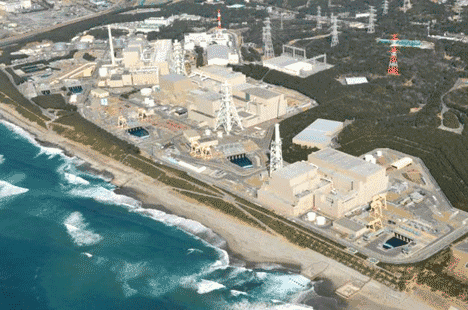 Hamaoka, Japan’s Most Infamous Nuclear Plant? WSJ May 6, 2011, The Hamaoka nuclear power plant may not be as well known around the world as Fukushima Daichi, crippled by the March 11 disasters. But the complex that Prime Minister Naoto Kan ordered closed down Friday is extremely well known in Japan. In fact, it’s infamous.
The plant, operated by Chubu Electric Power Co., is sited on Japan’s east coast, about 200 kilometers southwest of Tokyo, by Omaezaki city in Shizuoka prefecture. Omaezaki is known for its fishing and its green tea. And also for being sited pretty much, some say, on the fault line in the area that would be hit by the next, historically overdue “Tokai earthquake” – a long-feared “Big One” that could wreak havoc in the Kanto region that includes the capital…..Hamaoka, Japan’s Most Infamous Nuclear Plant? – Japan Real Time – WSJ
Entergy Nuclear Company – Nonchalant About Safety
It’s frightening that Entergy has such a cavalier attitude toward the safety of their nuclear power plants. Especially, given the fact that Indian Point and Pilgrim rank as the top two reactors with the highest risk of an earthquake causing core damage. What would it mean to have a Chernobyl or Fukushima scale accident at Indian Point?
 VIDEO Will Entergy learn anything from the Fukushima nuclear disaster in Japan? Greenpeace USA by Jarred Cobb – May 6, 2011 Entergy, the company trying to continue running dangerous old nuclear plants like Vermont Yankee, Indian Point in New York, and Pilgrim in Massachsusetts, is holding their annual shareholder meeting today. We sent them a letter highlighting the risks of these old plants, and questioning if the company has learned anything from the nuclear disaster in Japan. Continue reading
New plutonium nuclear fuel plant, costly, delayed, and unsafe, too?
More than a decade later, the mixed oxide fuel [2] (MOX) plant is running into mounting troubles [3], including long delays, soaring costs and the lack of utilities committed to use the new fuel in their reactors
But there’s another aspect of the story that has received little attention…

 Safety Reviewers Raise Questions about Construction of New Nuclear Fuel Plant, ProPublica By Donna Deedy, w ith Michael Grabell, May 5, 2011, . In the late 1990s, U.S. policymakers approved a plan to turn plutonium from nuclear weapons into fuel for commercial reactors. The first-of-its kind plant [1], now being built in South Carolina, was intended to reduce the Cold War stockpile and the threat of nuclear material theft while supplying the country’s energy needs. Continue reading
Russian nuclear powered ice-breaker has radiation leak
Radioactivity leak reported on Russian icebreaker, Moscow – Monsters and Critics May 5, 2011, Moscow – A small amount of radiation escaped from a Russian nuclear-powered icebreaker, officials said Thursday. …Radioactivity leak reported on Russian icebreaker – Monsters and Critics
Afghanistan anxious about security of Pakistan’e nuclear weapons
Afghanistan questions safety of nuclear neighbour, Scotsman.com, : 05 May 2011, By Hamid Shalizi Pakistan’s spy agency should have known Osama bin Laden was hiding not far from the country’s capital, Afghanistan’s defence ministry has said, the first direct comment from Kabul about its neighbour’s apparent inability to track the al-Qaeda leader.
Defence ministry spokesman Zaher Azimy said the case raised questions about Pakistan’s ability to adequately protect its nuclear weapons….. http://www.scotsman.com/news/Afghanistan-questions-safety-of-nuclear.6762700.jp
1 This Month





PLEASE OPPOSE HR 8255 AND S.3639 – bills would accelerate satellite deployment, with no environmental review or safeguards – https://ncstd5li.quorum.us/campaign/169331/
To see nuclear-related stories in greater depth and intensity – go to https://nuclearinformation.wordpress.com
-
Archives
- October 2026 (19)
- September 2026 (339)
- August 2026 (330)
- July 2026 (355)
- June 2026 (287)
- May 2026 (306)
- April 2026 (356)
- March 2026 (251)
- February 2026 (267)
- January 2026 (308)
- December 2025 (358)
- November 2025 (359)
-
Categories
- 1
- 1 NUCLEAR ISSUES
- business and costs
- climate change
- culture and arts
- ENERGY
- environment
- health
- history
- indigenous issues
- Legal
- marketing of nuclear
- media
- opposition to nuclear
- PERSONAL STORIES
- politics
- politics international
- Religion and ethics
- safety
- secrets,lies and civil liberties
- spinbuster
- technology
- Uranium
- wastes
- weapons and war
- Women
- 2 WORLD
- ACTION
- AFRICA
- Atrocities
- AUSTRALIA
- Christina's notes
- Christina's themes
- culture and arts
- Events
- Fuk 2022
- Fuk 2023
- Fukushima 2017
- Fukushima 2018
- fukushima 2019
- Fukushima 2020
- Fukushima 2021
- general
- global warming
- Humour (God we need it)
- Nuclear
- RARE EARTHS
- Reference
- resources – print
- Resources -audiovicual
- Weekly Newsletter
- World
- World Nuclear
- YouTube
-
RSS
Entries RSS
Comments RSS

