Latest on Fukushima, and USA nuclear waste worries
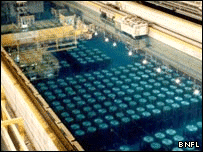 Additional concerns in the U.S. this week include the safety of spent fuel pools and reactor venting systems. A new report by the Institute for Policy Studies charges that we are at greater risk than Japan of an accident occurring in fuel pools due to overcrowding beyond design capacity. It has also surfaced that engineers warned the NRC of design flaws in venting systems 5 years ago, with little action taken.

 Japan Nuclear Disaster Update 2 June Clean Energy.org. France’s Institute for Radiological Protection and Nuclear Safety recommends that an additional 70,000 people be evacuated from areas outside the already established 20 km zone, which includes 10,000 children. These figures are based on radiation data collected by U.S. and Japanese radiation monitors. Continue reading
IAEA ‘s focus is on commercial benefit of rare earth plant, not on safety
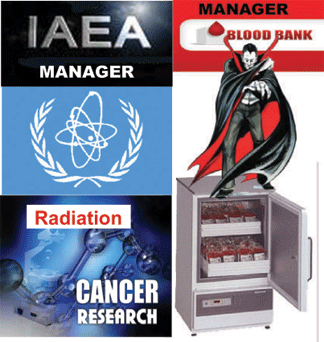 ‘There’s no safe radiation level’, FreeMalaysia Today Tashny Sukumaran, June 2, 2011 The IAEA standards are not based on what is safe but how great the benefit, said CAP after a meeting with the panel. PUTRAJAYA: International Atomic Energy Agency (IAEA) today admitted there is no such thing as “safe” levels of radiation.
However , it told the Consumer Association of Penang that some radiation levels could be justified.
The nine-member IAEA panel is here to gauge the safety of the Lynas rare earth refinery in Kuantan. Continue reading
Full severity of Fukushima nuclear disaster now slowly being revealed
 Yukiya Amano, director general of the International Atomic Energy Agency said Thursday. “The situation continues to be very serious.”.
Fukushima plant probably began spewing radiation within hours of earthquake: data National Post, Peter Goodspeed 21 May 11, Data released for the first time this week show three of the damaged Fukushima Daiichi nuclear reactors probably began spewing radiation within a few hours of Japan’s devastating earthquake and at least one may have gone into a full meltdown within about 15 hours of the tsunami striking the plant and shutting off its cooling systems. Continue reading
Fears of terrorist nuclear jihad, following Taliban raid on Pakistan naval base
Signalling the launch of nuclear jihad!, The Pioneer , May 30, 2011 Kanchan Gupta After the Taliban’s daring raid on PNS Mehran, a heavily guarded naval base in Karachi, the world, and not only the US, has reason to worry, if not be alarmed. This is not just another incident of radical Islamists demonstrating their ability to strike terror with the help of brainwashed young men desperate to die in the hope of frolicking with 72 nubile nymphets in the other world; it signals enhanced capability on part of Pakistan’s terrorists to attack high security targets. Continue reading
Fears of Al Qaida attack on Pakistan’s nuclear facilitues
Attack on naval base raises fresh nuclear fears, gulfnews, 27 May 11A serious breach of the security perimeter could lead to calls for a unilateral American move to secure the atomic weapon, Islamabad: A raid by militants on a Pakistani naval base this week has raised fresh anxiety about Pakistan’s ability to protect its nuclear sites. Although Western governments and analysts agree there is little chance militants could succeed in stealing nuclear material in an assault like the one in Karachi, attacks by Al Qaida or the Taliban against a nuclear facility remain a possibility…..gulfnews : Attack on naval base raises fresh nuclear fears
Nuclear plant near Joplin vulenerable to tornadoes
‘Tornado Alley’ reactor not fully twister-proof, Google News, (AP) 27 May 11, WASHINGTON (AP) — The closest nuclear power plant to tornado-ravaged Joplin, Mo., was singled out weeks before the storm for being vulnerable to twisters.Inspections triggered by Japan’s nuclear crisis found that some emergency equipment and storage sites at the Wolf Creek nuclear plant in southeastern Kansas might not survive a tornado.
Specifically, plant operators and federal inspectors said Wolf Creek did not secure equipment and vehicles needed to fight fires, retrieve fuel for emergency generators and resupply water to keep nuclear fuel cool as it’s being moved.
Despite these findings, the Nuclear Regulatory Commission concluded that the plant met requirements put in place after the Sept. 11 attacks that are designed to keep the nuclear fuel cool and containment structures intact during an emergency….. The Associated Press: ‘Tornado Alley’ reactor not fully twister-proof
“Allowable” radiation levels for children in Japan and the anger of parents
“Do you really care about our children’s health?” one parent shouted. “Why have you acted so late?” said another. Among other concerns: isn’t radiation still raining down on Fukushima? Shouldn’t the entire school building be decontaminated? The entire city? Can we trust you?
Angry Parents in Japan Confront Government Over Radiation Levels, NYTimes.com,By HIROKO TABUCHI, May 25, 2011 FUKUSHIMA CITY, Japan — The accusations flew on Wednesday at the local school board meeting, packed with parents worried and angry about radiation levels in this city at the heart of Japan’s nuclear crisis. Continue reading
UK and France manage to water down European nuclear safety tests
 The UK, with the backing of France and the Czech Republic, managed to have terror attacks excluded from a series of new nuclear safety tests
Europe divided over nuclear power after Fukushima disaster, The Guardian, 25 may 11, UK and France lobby to have safety checks watered down, while Switzerland moves to phase out its nuclear power plants Europe‘s nuclear power faultlines in the wake of the Fukushima disaster were exposed on Wednesday as Switzerland moved to phase out its nuclear power plants and the extent of British and French lobbying to water down nuclear safety checks was revealed. Continue reading
Wikileaks reveal global concerns about Pakistan’s nukes
 VIDEO WikiLeaks: US raised concerns about safety of Pakistan’s nuclear
  assets, NDTV May 26, 2011 New Delhi: Defence Minister AK Antony voiced India’s apprehension on Wednesday about the safety of Pakistan’s nuclear arsenal and said it was a matter of global concern. “Naturally, it is a concern not only for us but for everybody,” Antony said in response to reporters’ questions on whether the security of Pakistan’s nuclear arsenal was under threat in the wake of terror strikes such as the one at the Mehran naval air base in Karachi on Sunday night. (Watch – India’s new worry: Are Pak’s N-weapons safe?)
US cables, accessed exclusively by NDTV through WikiLeaks, show that this concern is indeed a global one and has been voiced by several countries since the present government took over in 2008. Several cables between US embassies and Washington during in a year-long period between mid 2008 and mid 2009, reveal that the US had raised concerns about the security of Pakistan’s nuclear arsenal with Pakistan and China and had sought to reassure a worried Russia……
WikiLeaks: US raised concerns about safety of Pakistan’s nuclear assets
Pakistan and the nuclear terrorism risk
Pakistan is the nuclear Somalia...- By: Sumantra Maitra 05/23/11 The Examiner Pakistani Talibans last night attacked a heavily secured Air Force base in Karachi, Pakistan at approximately 2 AM. Around 15-20 heavily armed terrorists, with rocket propelled granades, shoulder fired missile launchers, and assault rifles, attacked the Air Force base PNS Mehran, which also houses the Pakistani Navy air group, right at the heart of the commercial capital of Pakistan raises question on the failing state.
The Pakistani Taliban spokesperson Ihsan Ullah claimed the attack to be a “revenge for the death of Osama Bin Laden and against the entire infidel foprces of the World.” Hw also warned saying that this attack proves that they are capable of attacking any place in the World, at anytime. …….The PNS Mehran base is within miles of the largest air force base of Pakistan, which is probably also a suspected place of storage of nuclear materials. The attack points out to the increasing radicalisation of the armed forces of Pakistan, as such an attack could not be planned and executed without some inside help from someone inside the Pakistani Navy.
Also it raises the unanswered question about the safety of the nuclear materials in the custody of Pakistan. If the Terrorists can get hold of any IRBM and nuclear materials, a few Indian and Israeli cities, and a few thousand NATO soldiers in Afghanistan might go up in smoke…. Read more at the Washington Examiner: http://washingtonexaminer.com/blogs/opinion-zone/2011/05/pakistan-nuclear-somalia#ixzz1NHl9k74X
Hamaoka nuclear plant – seawater in reactor core, radiation in farmland
Seawater enters reactor core at nuclear plant, Oman Observer, Sat, 21 May 2011 TOKYO — Some five tons of seawater is estimated to have entered a reactor core at the Hamaoka nuclear power station in central Japan, the operator said on Thursday. That followed the discovery of an estimated 400 tons of seawater that has inundated the main steam condenser at reactor 5 of the Hamaoka nuclear plant in Shizuoka prefecture, south-west of Tokyo.
Chubu Electric Power Co, which runs the plant, found the 400 tons of seawater while shutting down the reactor as requested by the government. Chubu Electric officials said their assessment of the purity of water inside the pressure vessel showed some 5 tons of seawater came from the condenser. The utility will not decommission the reactor. Instead, it will dilute and desalinate the seawater to prevent any corrosion inside the reactor as salt causes corrosion…….
The plant is run by Tokyo Electric Power Co (TEPCO). On Saturday, after Chubu Electric started to put the Hamaoka plant in a stable state known as cold shutdown, it discovered seawater in the reactor core, Jiji said. Meanwhile, local officials in the prefecture of Miyagi said on Thursday they had found high levels of radioactive substances in a sample of pasture grass.
Local government officials detected 1,530 becquerels of radioactive caesium per kilogram in a sample collected a week ago from a farm run by the town of Marumori, some 60 kilometres north of the Fukushima plant. — DPA… Seawater enters reactor core at nuclear plant | Oman Observer
US nuclear reactors same design as Fukushima’s- are they safe?
US reactors of the same design have generally been found to have less, not more, emergency battery power to cool reactors during power outages. Most such reactors also have much larger loads of spent fuel in their cooling pools than did their counterparts at Fukushima.
Nuclear power safety: Latest on Japan crisis fuels new concern in US Nuclear Regulatory Commission still insists that US nuclear plants with same design as Japan’s stricken Fukushima Daiichi facility are safe. But watchdog groups cite failed venting system, which led to hydrogen explosions. CSMonitor.com, By Mark Clayton, Staff writer / May 20, 2011 Continue reading
“New Generation” nuclear raectors have safety problems, says NRC
U.S. Nuclear Agency Has ‘Technical Issues’ With Toshiba Reactor, WSJ.com, MAY 21, 2011By CASSANDRA SWEET The top U.S. nuclear regulator on Friday threw a roadblock in the way of a new type of nuclear reactor that some U.S. operators are using for their next-generation nuclear plants, saying officials have discovered “technical issues.” Continue reading
US Nuclear Regulatory Commission – lax oversight of nuclear power safety
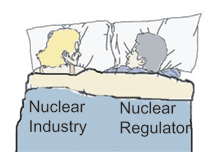 the NRC’s Generic Issues Program….“does not clearly assign ownership for each issue to a particular NRC office and is not transparent to NRC senior management or the Commission.” Also, the safety issues were not always “well-tracked.”…..
Watchdog: Nuclear Regulators’ Action on Safety Issues Is Too Slow, Not Well-Tracked By NICK SCHWELLENBACH, POGO 19 May 11, As the Fukushima Dai-ichi nuclear power plant disaster in Japan continues to unfold, POGO, like many others, is concerned about the effectiveness of the U.S. Nuclear Regulatory Commission’s (NRC) oversight of nuclear power here. The NRC’s internal watchdog, the NRC Office of Inspector General (OIG), has questioned the aggressiveness of the NRC’s oversight as well. Continue reading
USA Nuclear Regulatory Commission’s safety claims are not convincing
the initial round of (inadequate) Nuclear Regulatory Commission safety assessments found enormous levels of risk at U.S. plants — particularly the backup systems that caused the problems in Japan. While the NRC’s summary blandly assured that “all the reactors would be kept safe, even in the event their regular safety systems were affected by these events,” the detailed reports by the inspection teams made it clear that these bromides were anything but reassuring.
Why They Don’t — and Can’t — Get It Right HUFFINGTON POST< Carl Pope, 05/17/11 Well, now we know that not one but three of Japan’s Fukushima reactors suffered core meltdowns within hours of the earthquake and tsunami that cut off their diesel-generated backup power. Continue reading
1 This Month





PLEASE OPPOSE HR 8255 AND S.3639 – bills would accelerate satellite deployment, with no environmental review or safeguards – https://ncstd5li.quorum.us/campaign/169331/
To see nuclear-related stories in greater depth and intensity – go to https://nuclearinformation.wordpress.com
-
Archives
- October 2026 (19)
- September 2026 (339)
- August 2026 (330)
- July 2026 (355)
- June 2026 (287)
- May 2026 (306)
- April 2026 (356)
- March 2026 (251)
- February 2026 (267)
- January 2026 (308)
- December 2025 (358)
- November 2025 (359)
-
Categories
- 1
- 1 NUCLEAR ISSUES
- business and costs
- climate change
- culture and arts
- ENERGY
- environment
- health
- history
- indigenous issues
- Legal
- marketing of nuclear
- media
- opposition to nuclear
- PERSONAL STORIES
- politics
- politics international
- Religion and ethics
- safety
- secrets,lies and civil liberties
- spinbuster
- technology
- Uranium
- wastes
- weapons and war
- Women
- 2 WORLD
- ACTION
- AFRICA
- Atrocities
- AUSTRALIA
- Christina's notes
- Christina's themes
- culture and arts
- Events
- Fuk 2022
- Fuk 2023
- Fukushima 2017
- Fukushima 2018
- fukushima 2019
- Fukushima 2020
- Fukushima 2021
- general
- global warming
- Humour (God we need it)
- Nuclear
- RARE EARTHS
- Reference
- resources – print
- Resources -audiovicual
- Weekly Newsletter
- World
- World Nuclear
- YouTube
-
RSS
Entries RSS
Comments RSS

