Vermont Yankee nuclear plant – radioactive leaks over several years
 Vt nuke had past radioactive releases – BostonHerald.com, 4 Aug 11, “……..an Associated Press review of Nuclear Regulatory Commission records finds that Vermont Yankee reported releasing strontium-90 into the environment several times since Entergy bought the reactor in 2002. Annual reports to the NRC show strontium-90 releases from Vermont Yankee in 2002, 2003, 2004 and 2005….”Vt nuke had past radioactive releases – BostonHerald.com
Arrest of man building nuclear reactor in kitchen
Man Building Nuclear Reactor in Kitchen Arrested – William Pentland Forbes,4 Aug 11, A Swedish man was arrested after asking authorities if his efforts to split an atom in his kitchen had been legal.For several months, Richard Handl has spent hours and hours and hours on the mother of all home hobbies – setting up a nuclear reaction in his kitchen. Handl’s hobby was hardly a secret. He published highly-detailed updates about his atomic ambitions on a personal blog, including a small meltdown Handl had created on his kitchen stove.Long after launching the project, it dawned on Handl that maybe his experiments were not legal. To find out, he asked Sweden’s Radiation Authority for advice. They sent the police who arrested Handl after discovering the radioactive elements radium, americium and uranium in his apartment in southern Sweden, according to The Daily Telegraph…Man Building Nuclear Reactor in Kitchen Arrested – William Pentland – Clean Beta – Forbes
Fears of al-Qa’ida finding refuge in a nuclearized Iran
al-Qa’ida may logically seek to achieve an untouchable strategic sanctuary within a nuclearized Iran.
Might al-Zawahiri’s al-Qa’ida come to view future nuclear power Iran as THE perfect sanctuary?, TIME, by Thomas P. M. Barnett , August 1, 2011 As al-Qa’ida leaders the world over signal their intent to stay the course — challenging assumptions that the integrity of their network has been perhaps irreversibly jeopardized by the death of bin Laden — national security managers must remain focused on denying its core leaders a safe base of operations.
Meanwhile, due to growing ties between al-Qa’ida’s regional network and defense officials in Iran, the strategic dimension of the West’s counter-terrorism efforts is likely to grow significantly in the years ahead. Continue reading
China’s rail disaster – a prelude to nuclear disaster?
The breadth of Chinese ambitions to indigenize foreign technologies and scale them for mass deployment has simply outpaced its ability to plan, operate and staff these complex undertakings in a safe and sustainable manner. This is true in the case of high-speed rail, and it threatens to become the overarching storyline for the country’s nuclear energy program.
Wenzhou Train Crash Highlights Risks of China’s Nuclear Program Epoch Times, July 29, 2011 by ML COULD A TECHNOLOGY mishap akin to Saturday’s deadly train crash near Wenzhou, China happen at one of China’s 40 operating or planned nuclear power reactors?….. Experts are attributing China’s high-speed rail woes to its policies of adapting foreign technologies without the means to adequately operate and maintain them.
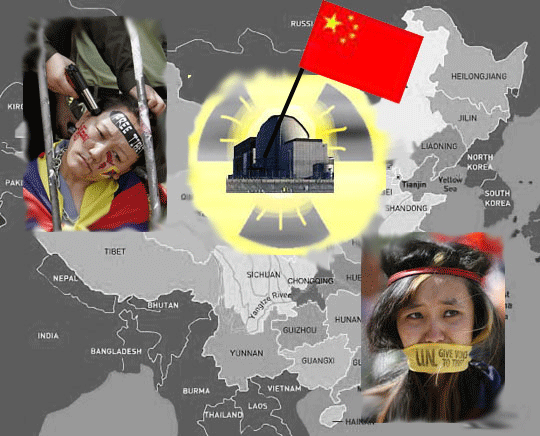
The risky strategy isn’t just being used by China’s Ministry of Railways, it’s also the foundation of the country’s nuclear power program. Continue reading
New York monitoring for potential ‘dirty bombs’
NYPD Testing “Dirty Bomb” Monitoring Network, NTI: Global Security Newswire -July 29, 2011 The New York Police Department is preparing to bring online an innovative monitoring network for detecting the presence of radiological materials that could be part of a “dirty bomb,” the Associated Press reported on Friday (see GSN, April 12).
The system links the 2,000 compact radiation sensors used daily by officers to a command post in lower Manhattan, which would receive an alert if any one of the detectors picked up a trace of a potential radiological weapon. The technology is being tested and federal officials want to see if it could be put into place in other parts of the United States……NTI: Global Security Newswire – NYPD Testing “Dirty Bomb” Monitoring Network
Dissension in the Nuclear Regulatory Commission over regulatory changes
Always a most dangerous nuclear plant – Fukushima
 SPECIAL REPORT-Fukushima long ranked Japan’s most hazardous nuclear plant One of 5 worst nuclear plants in world for exposure to radiation
* Tepco prioritised cost-savings over radiation standard
* Tepco says old plants like Fukushima have high radiation
* Foreign workers used to avoid exposing staff to high radiation
* Improvements made at Fukushima before disaster hit
By Chisa Fujioka and Kevin Krolicki, TOKYO, July 26 (Reuters) – Japan’s Fukushima Daiichi nuclear plant ranked as one of the most dangerous in the world for radiation exposure years before it was destroyed by the meltdowns and explosions that followed the March 11 earthquake. For five years to 2008, the Fukushima plant was rated the most hazardous nuclear facility in Japan for worker exposure to radiation and one of the five worst nuclear plants in the world on that basis. The next rankings, compiled as a three-year average, are due this year. Reuters uncovered these rankings, privately tracked by Fukushima’s operator Tokyo Electric Power, in a review of documents and presentations made at nuclear safety conferences over the past seven years…..
As Japan debates its future energy policy after the worst nuclear accident since Chernobyl, a Reuters review of the long-troubled record at Fukushima shows how hard it has been to keep the country’s oldest reactors running in the best of times. It also shows how Japan’s nuclear establishment sold nuclear power to the public as a relatively cheap energy source in part by putting cost-containment ahead of radiation safety over the past several decades. …..http://www.reuters.com/article/2011/07/26/idUSL3E7IE3Z920110726—
Tanzania: poor protection from ionising radiation
| Atomic energy body’s radiation fears |
| 27 July 2011 23:00 |
|
By Zephania Ubwani, The Citizen Bureau Chief, Arusha. The Tanzania Atomic Energy Commission (TAEC) has raised a red flag over lack of effective protection infrastructure in areas such as industries, mines and other work places where radiation technology is used.
The commission says lack of effective radiation protection infrastructure poses occupational risks to workers through exposure to ionising radiation.The commission’s acting director general, Mr Firmin Banzi, says although Tanzania had seen increased use of nuclear technology such as atomic energy, many facilities that were operating throughout the country lacked effective radiation control. This, according to him, exposed workers and members of the public to harm resulting from the use of ionising radiation sources such as industrial radiography and irradiators as well as other nuclear gauges…..http://thecitizen.co.tz/news/-/13215-atomic-energy-bodys-radiation-fears |
Three months later, flood problems keep nuclear reactor closed
The nuclear plant has been shut down for nearly three months. According to the NRC it won’t be allowed back on-line until it passes several rigorous safety inspections.
OPPD: Duration of 2011 Flood “Unprecedented in Nuclear Industry”, Missouri News Horizon, by Joe Jordan, 27 July 1 1, Officials with the Nuclear Regulatory Commission(NRC) and the Omaha Public Power District (OPPD) met in Omaha today, as the NRC continues to examine OPPD’s flood safety plans at the Fort Calhoun Station.
In the midst of record flooding on the Missouri River, the NRC’s Kriss Kennedy says, “It’s not clear what we’re going to see when the waters recede.” Kennedy added, “There’s a potential long-term impact on the equipment.” Continue reading
Assassination of Iranian nuclear scientist
Doubts on the credibility of Japan’s nuclear regulator
The errors will adversely affect the operations of all nuclear power stations across the country, casting a damper on the planned stress tests from the outset..
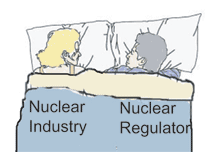 ..Goshi Hosono, state minister for the nuclear crisis, is aiming to separate NISA from its parent body, the Economy, Trade and Industry Ministry, which is promoting nuclear power generation in Japan. However, structural changes alone are insufficient. Whether NISA can function as a nuclear safety regulator will be severely tested.
Errors in nuclear plant data highlight checking system insufficiencies, Mainichi Daily News, By Takuji Nakanishi, Mainichi Shimbun, 23 July 2011 The discovery of errors in data incorporated in a report on the No. 3 reactor at the Genkai Nuclear Power Plant in Saga Prefecture illustrates problems with its operator’s checking system and the government regulator’s ability to examine safety data. Continue reading
18 Metre walls to protect Hamaoka nuclear plant from tsunamis
Nukes in Space – a Recipe for Disaster
an accident in which plutonium is released by a space device as tiny particles falling to Earth maximizes its lethality. A millionth of a gram of plutonium can be a fatal dose. The pathway of greatest concern is the breathing in plutonium particle..
As the NASA Environmental Impact Statement puts it: “Particles smaller than about 5 microns would be transported to and remain in the trachea, bronchi, or deep lung regions.” The plutonium particles “would continuously irradiate lung tissue.”
“A small fraction would be transported over time directly to the blood or to lymph nodes and then to the blood,” it continues. Once plutonium “has entered the blood via ingestion or inhalation, it would circulate and be deposited primarily in the liver and skeletal system.” Also, says the document, some of the plutonium would migrate to the testes or ovaries.
 What Could Truly End the Space Program: A Nuclear Disaster Overhead , OpED News, By Karl Grossman 21 July 11, Between November 25 and December 15 NASA plans to launch for use on Mars a rover fueled with 10.6 pounds of plutonium, more plutonium than ever used on a rover. Continue reading
Watts Bar nuclear plants – a history of safety flaws
Guity’s reports showed that hundreds of cables had been installed incorrectly at Watts Bar. They demonstrate that the TVA cared very little about regulations…
Safety Concerns Cloud US Nuclear Renaissance, Spiegel Online, By Ullrich Fichtner, 21 July 11, Translated from the German by Christopher Sultan “…….. A nuclear engineer who was born in Iran in 1942, Guity is a disappointed American today. “Time bombs,” he says, sounding very bitter. “We are sitting on a bunch of ticking time bombs.”……. Continue reading
Nuclear Regulatory Commission rubber-stamps another nuclear plant re-licence
Hope Creek nuclear plant’s license extended to 2046, Newsworks, By Monika Zaleska, July 20, 2011 The Hope Creek nuclear plant in South Jersey’s Salem County can now operate until 2046. The Nuclear Regulatory Commission renewed the 1,060-megawatt plant’s license Wednesday.
A watchdog group, Unplug Salem, which is campaigning to close Hope Creek and the two nearby Salem plants, is not happy about the decision.
Norm Cohen, a group coordinator, claims the 25-year-old plant is out of date and unsafe. He says the state should move toward wind and solar energy instead of renewing nuclear licenses.
The Hope Creek reactor is the same model as the plant that melted down in Japan following the catastrophic tsunami and earthquake in the spring…….http://www.newsworks.org/index.php/local/item/23437
1 This Month





PLEASE OPPOSE HR 8255 AND S.3639 – bills would accelerate satellite deployment, with no environmental review or safeguards – https://ncstd5li.quorum.us/campaign/169331/
To see nuclear-related stories in greater depth and intensity – go to https://nuclearinformation.wordpress.com
-
Archives
- October 2026 (19)
- September 2026 (339)
- August 2026 (330)
- July 2026 (355)
- June 2026 (287)
- May 2026 (306)
- April 2026 (356)
- March 2026 (251)
- February 2026 (267)
- January 2026 (308)
- December 2025 (358)
- November 2025 (359)
-
Categories
- 1
- 1 NUCLEAR ISSUES
- business and costs
- climate change
- culture and arts
- ENERGY
- environment
- health
- history
- indigenous issues
- Legal
- marketing of nuclear
- media
- opposition to nuclear
- PERSONAL STORIES
- politics
- politics international
- Religion and ethics
- safety
- secrets,lies and civil liberties
- spinbuster
- technology
- Uranium
- wastes
- weapons and war
- Women
- 2 WORLD
- ACTION
- AFRICA
- Atrocities
- AUSTRALIA
- Christina's notes
- Christina's themes
- culture and arts
- Events
- Fuk 2022
- Fuk 2023
- Fukushima 2017
- Fukushima 2018
- fukushima 2019
- Fukushima 2020
- Fukushima 2021
- general
- global warming
- Humour (God we need it)
- Nuclear
- RARE EARTHS
- Reference
- resources – print
- Resources -audiovicual
- Weekly Newsletter
- World
- World Nuclear
- YouTube
-
RSS
Entries RSS
Comments RSS

