New study on earthquake risks near USA nuclear plants
 Quakes and U.S. Reactors: An Analytic Tool, NYT. By MATTHEW L. WALD With the release of a computer model of all known geologic faults east of Denver, nearly all of the nuclear power plants in the United States are about to embark on a broad re-evaluation of their vulnerability to earthquakes. The new mapping is the first major update of the fault situation for plants since 1989.
The map has been in preparation since 2008, well before the earthquake and tsunami that caused three meltdowns at Fukushima Daiichi in Japan last March or the quake near Mineral, Va., last summer that shook a twin-reactor plant beyond the degree expected. Still, those events have lent urgency to the effort to assess the American plants’ ability to withstand quakes.
The new study does not calculate the risk of damage from an earthquake or even specify how much ground motion is likely at the reactor sites. That work is left to the plants’ owners, supervised by the Nuclear Regulatory Commission.
The industry began to realize after the Fukushima disaster that engineers do not have a strong understanding of which structures and systems at the plants are most vulnerable…..
Not everyone is pleased with the route that the commission is taking when it comes to future construction. David Lochbaum, a reactor expert with the Union of Concerned Scientists, said that the agency had already approved sites for new reactors and designs for new reactors based on computer analyses of earthquake hazards.
If considerable study is needed on the quake vulnerability of existing reactors, he argues, the uncertainty surrounding the soundness of future plants must be even greater. “How can we know more about the reactors that haven’t been built than the ones that have been built?’’ he said. http://green.blogs.nytimes.com/2012/01/31/quakes-and-u-s-reactors-an-analytic-tool/
New costly earthquake security could close some US nuclear plants
 New Quake Risks Seen for Nuclear Plants WSJ, By REBECCA SMITH, JANUARY 31, 2012, Nuclear reactors in the central and eastern U.S. face previously unrecognized threats from big earthquakes, the Nuclear Regulatory Commission said Tuesday. Experts said upgrading the plants to withstand more substantial earth movements would be costly and could
force some to close. Continue reading
Illinois nuclear reactor shut down
Reactor shuts down, releases steam at Illinois nuclear plant after losing outside power Washington Post, Associated Press, January 30 BYRON, Ill. — A nuclear reactor at a northern Illinois plant shut down Monday after losing power, and steam was being vented to reduce pressure, according to officials from Exelon Nuclear and federal regulators.
Unit 2 at Byron Generating Station shut down around 10:18 a.m., after losing power from an off-site source, Exelon officials said. Diesel generators began supplying power to the plant equipment and operators began releasing steam from the non-nuclear side of the plant to help
cool the reactor, officials said.
Even though the turbine is not turning to produce electricity, “you still need to cool the equipment.” said U.S. Nuclear Regulatory Commission spokeswoman Viktoria Mitlyng. Releasing steam helps “take away some of that energy still being produced by nuclear reaction but that doesn’t have anywhere to go now.”
The steam contains low levels of radioactive tritium, but the levels are safe for workers and the public, federal and plant officials said….. http://www.washingtonpost.com/business/industries/reactor-shuts-down-releases-steam-at-illinois-nuclear-plant-after-losing-outside-power/2012/01/30/gIQALf13cQ_story.html
Problems in assessing radiation in Fukushima school lunches
Radiation testing on school lunches differs, The Yomiuri Shimbun, 30 Jan 12, FUKUSHIMA-–Municipalities are carrying out tests for radioactive substances on ingredients used in school lunches, but parents are worried whether their children are adequately protected as the testsare conducted in various ways. Continue reading
Worry over nuclear transport through Caribbean Sea
Hazardous waste through the Caribbean Sea a concern The Barbados Advocate, 1/23/2012 There is concern over the transportation of hazardous nuclear waste and other hazardous material through the Caribbean Sea which are potential threats to lives, health, the environment and our economies.
This comes from Ambassador Raymond Wolfe, speaking on behalf of the Caribbean Community (CARICOM) to the General Assembly’s Social, Humanitarian and Cultural Committee….
He said that the focus on shipping and maritime commerce must also include improved measures, regulations and standards governing maritime safety, the training of seafarers and the safety of navigation at sea, including the safety of shipping vessels… while CARICOM acknowledges the rights of Member States to use nuclear energy for peaceful purposes, there still remains a concern,” he stressed…….. http://www.barbadosadvocate.com/newsitem.asp?more=local&NewsID=22326
Japan’s nuclear plant stress tests – “flimsy” and unreliable
“I don’t view their evaluation as something that is trustworthy or carries any weight,” “The last time the IAEA inspectors came to Japan, they simply inspected sites and documents and left saying everything was fine. They submitted a flimsy report, and I fear the same will be the case this time.”
 Experts cast doubt on Japan nuclear plant tests, Justin McCurry in Tokyo, guardian.co.uk, 27 January 2012 Japanese government ordered tests on all reactors after Fukushima meltdown, but advisers say they do not prove a plant is safe Advisers to Japan‘s nuclear safety agency have said power plant stress tests do not prove that a nuclear plant is safe, as the country faces the prospect of a summer without a single nuclear reactor in operation. Continue reading
China remains inscrutable on nuclear safety
China denies nuclear accident Telegraph, 27 Jan 12, China has moved swiftly to deny it has become the latest nation to experience a nuclear accident, after claims that it was forced to shut down its newest nuclear reactor last year. By David Eimer in Beijing 27 Jan 2012 A report from Japan’s Atomic Energy Agency said the China Experimental Fast Reactor (CEFR) stopped generating electricity in October following an accident. With Japan already reeling from the meltdown at the Fukushima nuclear plant in March last year, the incident sparked alarm there and in South Korea over the prospect of radiation leaking from the CEFR.
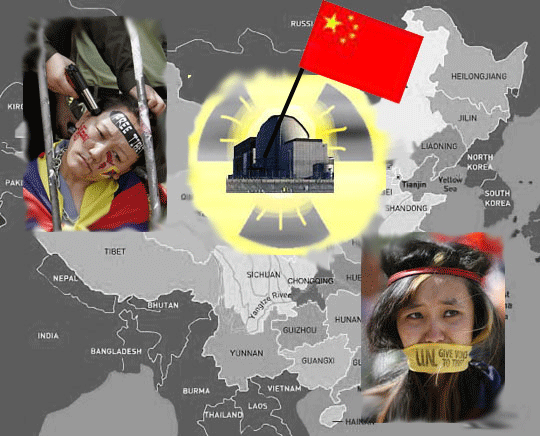
Those fears were intensified by Beijing’s failure to report the accident or release details of what happened, according to a Tokyo newspaper which cited the Japanese Atomic Energy Agency’s investigation. Continue reading
Nuclear personnel asleep at Oak Ridge National Laboratory?
Vulnerable U.S. Nuclear Weapons Site Faces Allegations of Snoozing Security Guard Potential Pattern of Fatigue Among Wackenhut Nuclear Personnel
Project on Government Oversight (POGO) 25 Jan 12, By MIA STEINLE
The security contractor for the Energy Department’s Oak Ridge National Laboratory in Tennessee is investigating reports that one of its security guards was sleeping and had also been using an unauthorized cell phone while they were supposed to be guarding a sensitive nuclear facility with bomb-grade material.
Photos of the alleged incident were sent to Wackenhut Security Inc.’s (WSI) Oak Ridge unit, the Energy Department, and the Knoxville News Sentinel, which broke the story Tuesday.
The photos were allegedly taken inside Building 3019, which raises “the additional issue of who took photographs inside a high-security nuclear installation,” according to the News Sentinel. Building 3019 stores about a half-ton of uranium-233, which POGO Senior Investigator Peter Stockton said today in a statement is roughly the amount needed for 250 improvised nuclear detonations.
“Perhaps the most egregious part of all this is that the Energy Department is allowing Wackenhut to investigate the latest security lapse itself,” Stockton said. “This is too important to leave up to Wackenhut.” WSI is commonly known as Wackenhut. In 2002, the Florida company was acquired by a Danish corporation and is now officially known in the U.S. as G4S Secure Solutions.
Wackenhut has a history of sleeping security guards. “It was Wackenhut that in 2007 initially denied that its guards at the Peach Bottom nuclear power plant in Pennsylvania were sleeping on the job—that is until the company was confronted with a video of the guards that was leaked to the media,” Stockton said. In the wake of that scandal, Wackenhut lost its contract with Exelon to manage security at ten nuclear power plants, according to a Washington Post article.
POGO called Oak Ridge National Laboratory a “high risk” as early as 2006 for its inadequate security, and also found that Wackenhut security guards at the nearby Y-12 National Security Complex were overworked to the point of severe fatigue. http://pogoblog.typepad.com/pogo/2012/01/vulnerable-us-nuclear-weapons-site-faces-allegations-of-snoozing-security-guard.html
French nuclear company warns on safety of Scottish nuclear reactor
New safety fears for Ayrshire nuclear power station, Herald Scotland, 22 Jan 12 By Rob Edwards, The company that runs the nuclear reactors at Hunterston in North Ayrshire is warning that their safety could be jeopardised by plans to build a huge coal-fired power station next door. EDF Energy says that the construction and operation of the controversial new plant could block the evacuation routes of staff and deprive its site of electricity and vital cooling water in an emergency.
It is also worried that discharges from the coal plant could compromise reactor cooling systems.
The French nuclear company has lodged a formal objection to an application by Ayrshire Power to build a £3 billion coal station at Hunterston. Following rejection of the application, which attracted more than 20,000 objections, by North Ayrshire Council in November,
the Scottish Government has now confirmed that it will go to a public inquiry later this year…… http://www.heraldscotland.com/news/environment/new-safety-fears-for-ayrshire-nuclear-power-station.1327201596
Radioactive water leak reported from Fukushima’s No 2 nuclear reactor
Fresh Radioactive Water Leakage Reported at Fukushima Nuke Plant, MOSCOW, January 22 (RIA Novosti) About two liters of radioactive water leaked from the turbine building of the second reactor at the crippled Fukushima Daiichi nuclear plant, Kyodo news agency reported on Sunday.
TEPCO, which operates the nuclear plant, issued a statement on Saturday saying the leak was from a pipe there that transfers highly radioactive water in the basement of the No. 2 reactor’s turbine building to the plant’s waste disposal facility……http://en.ria.ru/world/20120122/170887389.html
Kuwait would be first victim of Iranian nuclear disaster
Kuwait, GCC not ready to face nuclear crisis’ – Government playing politics, Kuwait Times, By Ben Garcia, 23 Jan 12 KUWAIT: Neither Kuwait nor the Gulf Cooperation Council [GCC] countries are prepared for any incident of nuclear disaster in the Middle East, says environment activist Dr Khaled Al-Hajery. Speaking with the Kuwait Times, Al-Hajery, Greenline chairman, said his group had advised and urged the Kuwaiti authorities and other GCC countries many years ago to act and be ready for any nuclear disaster but still
no one seems to listen. “The nuclear problem has started way back from the beginning of the Bushehr nuclear operation in September 2011.
Since then, there had been nuclear waste coming out from the nuclear facility but do we really care? We are dealing and have been talking about nuclear issue since the operation of the Bushehr Plant, but the government didn’t do anything,” he said. Yesterday reports from
several Arabic dailies mentioned the GCC’s ‘rapid deployment team’ to face repercussions of a possible accident at Iran’s Bushehr nuclear plant which is located just across the Gulf water, or around 236 km from Ras Al Zour in Kuwait.
Aleqtisadia Arabic language daily said, quoting Tariq Al-Obaid, secretary general of the Geneva-based Euro-Arab Environment Organization (EAEO), GCC countries could be the
first victims of any nuclear radiation from the Iranian plant….. Continue reading
Violence, gunshots, and radioactive material stolen from Egyptian nuclear facility site

 Radioactive material stolen from Egyptian
  power station: report Reuters Jan 19, 2012 CAIRO – Radioactive material has been stolen from a nuclear power station on Egypt’s Mediterranean coast that was the scene of violent protests last week, the state-run al-Ahram newspaper reported on Thursday.
A safe containing radioactive material at the Dabaa nuclear power plant, which is still under construction, was seized while another also containing radioactive material was broken open and part of its contents taken, the newspaper said.
In Vienna, an official of the U.N. nuclear agency described the items missing as “low-level radioactive sources” which had been taken from a laboratory at the construction site. He could not give any details on the nature of the stolen items…
.. More than a dozen people were wounded last week when military police tried to disperse hundreds of Egyptian protesters demanding the relocation of the Dabaa plant.
Plant staff have refused to go to the site because of the deterioration in the security situation there, al-Ahram said. About 500 Egyptians rallied in front of the plant last week to demand that the project be terminated, with some saying they had lost their land on the site.
Soldiers and the demonstrators threw stones at each other and exchanged gunfire after the protesters demolished a wall surrounding the site, a security source and witnesses said…
http://news.nationalpost.com/2012/01/19/radioactive-material-stolen-from-egyptian-power-station-report/
Violence as protestors oppose Egypt’s new nuclear power plant
Protests at nuclear power station construction site escalate, Egypt Independent, Al-Masry Al-Youm Staff, 19/01/2012 Protesters at the nuclear power station site in Dabaa, located in the Matrouh Governorate on the North Coast, said on Thursday they would continue their sit-in and asserted that the government would not be able to force them out.
Egypt’s first nuclear power station is planned to be built in Dabaa, but the residents stormed the site last week, destroying many buildings and staging a sit-in.
They have already built 50 houses on the site, changed its name to New Dabaa and decided to move the cattle market there.
They also said they would give 1,000 square meters for free to young people who cannot afford a place to live. Dabaa residents say the government did not compensate them for the land it allocated to the project.
The protesters rejected Prime Minister Kamal al-Ganzouri’s assurances that the government will go ahead with plans to build the plant on this site…. The plant’s construction site was looted and vandalized earlier this
week, resulting in LE500 million in losses.
There have been conflicting reports regarding the Nuclear Stations Authority committee that went to inspect the site on Thursday in order to assess the damages. It was rumored that committee members refused to enter the site upon hearing that safes containing radioactive elements were missing…… http://www.almasryalyoum.com/en/node/609946
Radioactive gravel in school building in Japan
Radioactive gravel finds way to school, Japan Times, 20 Jan 12, Hunt is on for other shipments from quarry in evacuation zone Kyodo FUKUSHIMA — Radiation-contaminated gravel shipped from a quarry in the evacuation zone around the Fukushima No. 1 nuclear plant found its way to an elementary school building as well as roads and pathways around
houses, sources said Wednesday. The gravel went into concrete that was used to make an elementary school in Nihonmatsu, Fukushima Prefecture, more resistant to earthquakes. The area where the gravel was used had a radiation reading of 0.1 to 0.2 microsieverts per hour.
“We are surprised at the news as we had never expected it. We’d like to make efforts to ensure children’s health by checking the radiation level on a regular basis,” the school’s principal said. Continue reading
Independent inquiry: did earthquake first damage Fukushima’s nuclear reactors?
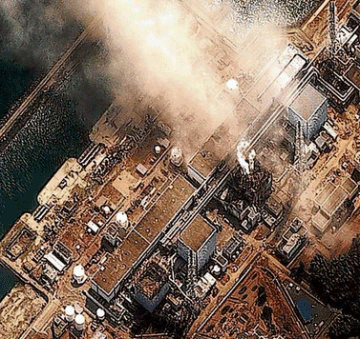 The panel includes legal, nuclear and medical experts. Seismologist Katsuhiko Ishibashi has long warned of tsunami risks in the earthquake-prone country where all 54 nuclear reactors are built on the coastline. Engineer Mitsuhiko Tanaka designed nuclear reactors at Babcock-Hitachi K.K. and has suggested the March quake damaged the Fukushima reactors before the tsunami.
New probe to cut deeper in Japan nuclear crisis17 JAN 2012 3 News New Zealand, By Mari Yamaguchi

http://www.3news.co.nz/New-probe-to-cut-deeper-in-Japan-nuclear-crisis/tabid/417/articleID/239500/Default.aspx A newly formed investigative panel on Japan’s nuclear disaster will use its subpoena powers wisely and cut deeper into the accident than the government’s probe, according to the leader of the independent commission.
The panel appointed by parliament last month has gained attention here because its 10 members include outspoken critics of Japan’s nuclear policy who long ago questioned the seismic risks to the country’s 54 nuclear reactors.
It is expected to examine the extent to which the 9.0-magnitude earthquake contributed to the crisis at the Fukushima Dai-ichi power plant, as well as the ensuing tsunami and radiation alert system. Continue reading
1 This Month





PLEASE OPPOSE HR 8255 AND S.3639 – bills would accelerate satellite deployment, with no environmental review or safeguards – https://ncstd5li.quorum.us/campaign/169331/
To see nuclear-related stories in greater depth and intensity – go to https://nuclearinformation.wordpress.com
-
Archives
- September 2026 (339)
- August 2026 (330)
- July 2026 (355)
- June 2026 (287)
- May 2026 (306)
- April 2026 (356)
- March 2026 (251)
- February 2026 (267)
- January 2026 (308)
- December 2025 (358)
- November 2025 (359)
- October 2025 (375)
-
Categories
- 1
- 1 NUCLEAR ISSUES
- business and costs
- climate change
- culture and arts
- ENERGY
- environment
- health
- history
- indigenous issues
- Legal
- marketing of nuclear
- media
- opposition to nuclear
- PERSONAL STORIES
- politics
- politics international
- Religion and ethics
- safety
- secrets,lies and civil liberties
- spinbuster
- technology
- Uranium
- wastes
- weapons and war
- Women
- 2 WORLD
- ACTION
- AFRICA
- Atrocities
- AUSTRALIA
- Christina's notes
- Christina's themes
- culture and arts
- Events
- Fuk 2022
- Fuk 2023
- Fukushima 2017
- Fukushima 2018
- fukushima 2019
- Fukushima 2020
- Fukushima 2021
- general
- global warming
- Humour (God we need it)
- Nuclear
- RARE EARTHS
- Reference
- resources – print
- Resources -audiovicual
- Weekly Newsletter
- World
- World Nuclear
- YouTube
-
RSS
Entries RSS
Comments RSS

