UK’s nuclear facilities ‘at high risk of atomic blackmail’ from Putin

the British sites can be seen in the same way as those in Ukraine in being susceptible to sabotage and infiltration.
The full-scale invasion of Ukraine has brought with it high-level warnings that the UK is headed for a direct military confrontation with Russia.
Josh Layton https://metro.co.uk/2024/08/19/uks-nuclear-facilities-at-high-risk-atomic-blackmail-putin-21449130/
The UK’s nuclear facilities are at high risk from hostile states who are tipping the world into war, according to an expert in risk management.
Dr Simon Bennett warned that World War Three is only a matter of years away, with Russia already pursuing a strategy of ‘atomic blackmail’.
Dr Bennett revived author Bennett Ramberg’s Cold War-era theory of how nuclear power facilities can be weaponised for political ends in calling on the UK government to ramp up defence spending.
He also believes the potential exists for a cornered Vladimir Putin to escalate from psyops to a deliberate use of the Zaporizhzhia nuclear power plant as a dirty bomb, which would have devastating consequences for Ukraine and neighbouring countries.
The risk management expert, of the University of Leicester, warned that the UK government has ‘lost sight’ of its primary duty to protect its citizens amid a slide to global conflict.
‘The full-scale invasion of Ukraine by Russia is the first large-scale conflict where there are potentially numerous nuclear power plants at risk,’ he said.
‘Not only at Zaporizhzhia, which is Europe’s largest power plant, but in Russia, where the current incursion could see the Ukrainians reach the Kursk nuclear power station if they drive hard to the east.
In the 80s, Bennett Ramberg came up with the hypothesis of atomic blackmail, which is based on the premise that as the number of nuclear power stations grows, so does the potential for an aggressor to use them to gain leverage over the owners
‘The potential for a facility like Zaporizhzhia to be used very crudely against an opponent is clear to see.
‘If the plant, which has six reactors, was rigged with powerful demolition mines, and they were detonated, the radiation would be off the scale.
‘It’s possible the Russians have already placed explosives there.’
Dr Bennett, director of the university’s Civil Safety and Security Unit, told Metro.co.uk that Putin — who is under pressure after Ukraine’s invasion of Russia’s Kursk region — is capable of the unthinkable.
He a drew a comparison with one of the darkest days of history.
‘Using Zaporizhzhia for atomic blackmail gives Putin leverage over not just Ukraine but the entire world,’ Dr Bennett said.
One of the latest safety incidents at Zaporizhzhia came last week when smoke was filmed rising from one of the cooling towers at the Russian-held facility in eastern Ukraine.
Experts doubted there was any risk of an explosion, with Ukraine saying that the fire was started deliberately by setting light to tyres.
However the use of the plant in this way, which follows continued reports of incidents involving drones and shelling, fits with Ramberg’s theory — and has implications for the UK’s own security, according to Dr Bennett.
On Saturday, the safety situation at Zaporizhzhia was ‘deteriorating’ after a nearby drone strike, the International Atomic Energy Agency said.
The party behind the explosion, just outside the site’s protected area, has not been identified. Under Rishi Sunak, the British government announced the biggest expansion in nuclear power for 70 years, and the new prime minister is also committed to building new facilities.
Through Ramberg’s thesis, the British sites can be seen in the same way as those in Ukraine in being susceptible to sabotage and infiltration.
‘If we think more laterally, the number of power stations in the UK is growing, and through the optics of Ramberg’s theory, we are offering our enemies more targets and potentially more leverage over us in a conflict,’ Dr Bennett said.
The Russian FSB security agency and GRU military intelligence are very good at hybrid warfare, so what they could be doing at the moment is recruiting and running individuals as “sleepers” within the British state and potentially within the nuclear industry, ready to be activated at any moment. Three civil servants have recently been charged under the National Security Act and my understanding is that they are alleged to have been spying for China.’
The full-scale invasion of Ukraine has brought with it high-level warnings that the UK is headed for a direct military confrontation with Russia.
British sites, including a shipyard housing nuclear submarines in Barrow-in-Furness, were last week reported by the Financial Times to be on the Kremlin’s list of targets.
Tobias Ellwood, former chair of the Commons Select Committee, responded by saying: ‘We must wake up — storm clouds are gathering.’
Dr Bennett said: ‘The British state needs to take these nuclear threats far more seriously not just within the optics of the Ukraine-Russia war but because, in my opinion, there will be a world war in the next five to 10 years. It will start in the Asia-Pacific, where China will invade Taiwan and, because of the Aukus pact, we will be directly involved in defending Taiwan.
‘Russia will be involved because of its ties with China, leading to a multi-hemisphere conflict.’

Dr Bennett, whose book ‘Atomic Blackmail?’ examines the weaponisation of nuclear facilities in the Russia-Ukraine war, has raised the issues in letters and emails to various governments, including that of Rishi Sunak, but to date has not received any acknowledgement.
‘In my opinion, the government obsession with net zero and climate change agreements distracts from a far greater threat to safety, namely atomic blackmail,’ he said.
‘The primary purpose of the state is national security and in my view we have lost sight of that purpose. The Labour government is carrying out a defence review when what we really need is to raise the 2% of GDP we spend on defence to a minimum 4% of GDP.’
The prospect of an apocalyptic conflict in a matter of years has gained traction during the Ukraine-Russia war and China’s continued pressure on Taiwan, which it views as its own territory.
The author intends to continue trying to raise the alarm.
What Happens if Ukraine Seizes the Kursk Nuclear Power Plant?

Moscow Times, By Dmitry Gorchakov, Aug. 16, 2024
From the very beginning of Ukraine’s offensive into Russia’s Kursk region on Aug. 6, there has been much discussion about the possible objectives of this operation. Simply glancing at the map begs the question of whether one objective of the Ukrainian incursion might be the seizure of the Kursk nuclear plant, located just 60 kilometers from the border.
It is a scenario the Russian side is taking seriously. Already Rosatom, Russia’s state nuclear corporation, had begun withdrawing staff from the plant and Russian troops are hastily digging trenches around it.
The mere possibility of a nuclear plant being seized during a war is a nightmare scenario for any nuclear and radiation safety specialist. But after the almost two-and-a-half-year-long Russian occupation of the Zaporizhzhia nuclear plant and the seizures (again, by Russia) of the Chernobyl exclusion zone and the research reactor in Sevastopol during the occupation of Crimea in 2014, such scenarios have become more possible. The longer Russia’s aggression against Ukraine continues, the more common the threat of an accident will become.
While we do not know how events will unfold, our analysis at Bellona and recommendations from the IAEA make clear that should nuclear plants be enveloped by war, every effort should be made to avoid a direct assault on them with heavy weapons. The defending side should not deploy troops at nuclear plants, which would turn them into military targets. Should a nuclear plant be surrounded, it is better to surrender it through negotiations rather than have the facility be attacked or used as a staging ground for attacks.
Having considered these principles, there are a few hypothetical plans that Ukraine could have for the Kursk nuclear plant as its incursion into Russia continues. These scenarios have repeatedly surfaced in the media, and it makes sense to address them in detail.
One theory is that Ukraine may connect the Kursk nuclear plant to its own energy system. I think this is the least likely objective. Should the plant be seized, the safest course of action for its operators would be to put all of its reactors into cold shutdown mode, which stops electricity generation……………………………………………………………..
Some have also speculated that Ukraine is trying to deprive Russia of a vital energy source — hopefully by shutting it down safely rather than a nuclear accident. But the numbers do not support this.
One would like to believe that if such a plan exists, it does not involve the loss of the facility due to a nuclear accident, but rather involves its shutdown through standard procedures…………………………………………….
The most rational objective for seizing the Kursk nuclear plant would be to use it in exchange for the Zaporizhzhia nuclear plant in any upcoming negotiations.
When we consider that Ukraine’s army is not only advancing in the Kursk region, but is also fortifying its position by bringing in reserves and other defenses, it appears that Kyiv intends to hold its gains — possibly until the end of the war and the start of negotiations. The presence of a nuclear power plant within the captured territory would significantly increase its leverage and would confirm the strategic nature of this operation.
Nevertheless, as a representative of an environmental organization, I sincerely hope that we do not see any attack or attempt to seize the Kursk nuclear plant. There is simply no safe way to do it. Any attempt to do so carries risks of a nuclear or radiation accident, to say nothing of damaging the political support Ukraine enjoys from its Western allies. ………………….
if ending this war on terms acceptable to Ukraine involves fighting around nuclear plants on both sides of the front, such a process must proceed with minimal risk of a nuclear disaster. https://www.themoscowtimes.com/2024/08/16/what-happens-if-ukraine-seizes-the-kursk-nuclear-power-plant-a86045
IAEA warns of heightened security dangers facing Ukraine’s Zaporizhzhia Nuclear Power Plant

ABC News, Sun 18 Aug
In short:
A drone strike on the perimeter of Ukraine’s Russian-controlled Zaporizhzhia Nuclear Power Plant has sparked fresh concerns for nuclear safety.
The International Atomic Energy Agency has warned of security dangers escalating and urged both countries to steer clear of attacks on energy facilities.
What’s next?
Zaporizhzhia’s power plant, the largest in Europe, is now reliant on just one power line, which if cut off, could set off cumulative explosions.
The International Atomic Energy Agency (IAEA) has called on Kyiv and Moscow to exercise “maximum restraint” amid fears of a deteriorating safety situation around the Zaporizhzhia Nuclear Power Plant in south-eastern Ukraine.
The facility came under Russian military and operational control in 2022, and has since been a target of repeated shelling with each side blaming the other.
Director-general of the IAEA, Rafael Mariano Grossi, on Saturday said a drone strike carrying an explosive payload had hit a perimeter access road, causing damage just outside of the plant’s protected area.
“Yet again we see an escalation of the nuclear safety and security dangers facing the Zaporizhzhia Nuclear Power Plant power plant,” he said.
“I remain extremely concerned and reiterate my call for maximum restraint from all sides and for strict observance of the five concrete principles established for the protection of the plant.”
Russia has accused Ukraine of detonating the explosive, according to reports from the TASS news agency.
The IAEA said the impact site was close to the essential cooling water sprinkler ponds and about 100 metres from the Dniprovska power line, the only remaining 750 kilovolt line providing a power supply to the plant.
There were no casualties or impact on equipment, however, there was damage between two main gates of the plant.
The attack comes as Ukraine continues an incursion into Russia, claiming to have taken control of 82 settlements over an area of 1,150 square kilometres in the Kursk region since August 6.
Moscow wants to discuss the drone strike with the IAEA, Russia’s RIA news agency reported, citing Roman Ustinov, the acting Russian representative in Vienna.
Why it matters
The Zaporizhzhia site is the largest nuclear power plant in Europe, holding six reactors containing Uranium 235.
All six reactors are now in cold shutdown and the plant is no longer producing electricity, as Ukraine and Russia repeatedly level allegations of sabotage against each other.
But despite the plant being dormant, electrical pumps moving water through the reactor core must still keep working to cool the nuclear fuel.
If the region’s final remaining power line is damaged, this cooling system will stop working, and result in a fuel meltdown which could begin a fire or explosion and induce a major nuclear disaster………………….. more https://www.abc.net.au/news/2024-08-18/ukraine-zaporizhzhia-nuclear-power-plant-hit-by-drone-srike/104238964
Safety at Ukraine nuclear power plant deteriorating after blast, watchdog warns
The International Atomic Energy Agency said the blast was close to Zaporizhzhia nuclear power plant’s cooling water sprinkler ponds and its only remaining power line
By Brendan McFadden, iNews 17th Aug 2024
Safety at Ukraine’s Zaporizhzhia nuclear power plant is deteriorating following a drone strike that hit an access road on its perimeter, according to an atomic energy watchdog,
Russia has been in control of the Zaporizhzhia site, the largest nuclear power plant in Europe, since soon after it launched a full-scale invasion of Ukraine in February 2022.
The International Atomic Energy Agency (IAEA) said the impact site was close to the essential cooling water sprinkler ponds and about 100 m from the Dniprovska power line, the only remaining 750 kilovolt line providing a power supply to the plant.
It comes after Russia earlier claimed a Ukrainian drone dropped an explosive charge on a road used by staff.
The plant is dormant as Moscow and Kyiv have repeatedly accused each other of trying to sabotage its operations and of endangering safety around it.
The IAEA director general Rafael Mariano Grossi, said “Yet again we see an escalation of the nuclear safety and security dangers facing the power plant.
“I remain extremely concerned and reiterate my call for maximum restraint from all sides and for strict observance of the five concrete principles established for the protection of the plant.”
An IAEA team visited the area on Saturday and reported that the damage seemed to have been caused by a drone equipped with an explosive payload.
The report said there were no casualties and no impact on any nuclear power plant equipment. However, the road between the two main gates of the plant was impacted.
Moscow wants to discuss the attack on the Zaporizhzhia plant with the IAEA, Russia’s RIA news agency reported, citing Roman Ustinov, the acting Russian representative in Vienna.
The attack comes as Ukraine continues an incursion into the Kursk region of Russia.
Kyiv claims to have taken control of 82 settlements over an area of 1,150 square kilometres (444 square miles) in the region since 6 August when its advance began.
Today Ukrainian President Volodymyr Zelensky said his troops are “strengthening” positions in the captured territory in Russia and expanding further.
Russian troops also hit the Ukrainian city of Sumy with an Iskander-K cruise missile, causing extensive damage to buildings.
It was claimed Germany, Ukraine’s second biggest donor, has frozen its military aid to Kyiv because it cannot afford to any longer supply equipment due to a national budget crisis.
Meanwhile, Ukraine denied claims by Russia that it is planning to attack a nuclear plant in Kursk and use ‘dirty bombs’ to attack Russian territory,
Moscow’s defence ministry made the claim and warned there would be a harsh response to any attack on the Kursk power plant, which remains under its control, according to Russian news agency Interfax.
The ministry gave no evidence for its claim, but said the surrounding area could be contaminated by an attack on the plant………………….. https://inews.co.uk/news/world/safety-at-ukraine-nuclear-power-plant-deteriorating-after-blast-watchdog-warns-3232978
IAEA says safety at Ukraine’s Zaporizhzhia nuclear plant deteriorates

By Reuters, August 18, 2024 https://www.reuters.com/world/europe/iaea-says-safety-ukraines-zaporizhzhia-nuclear-plant-deteriorates-2024-08-17/
Aug 17 (Reuters) – Safety at Ukraine’s Zaporizhzhia nuclear power plant is deteriorating following a drone strike that hit the road around the perimeter on Saturday, according to International Atomic Energy Agency (IAEA) director general Rafael Grossi.
The Russian management of the plant said a Ukrainian drone dropped an explosive charge on a road outside, endangering its staff who use the highway, the TASS state news agency reported.
Japan: Radioactive water leaks reported at crippled Fukushima power plant
Economic Times 14 Aug 24
About 25 tons of radioactive water have leaked within the crippled Fukushima Daiichi Nuclear Power Plant, the plant’s operator has reported, a week after the latest round of ocean discharge started.
Tokyo: About 25 tons of radioactive water have leaked within the crippled Fukushima Daiichi Nuclear Power Plant, the plant’s operator has reported, a week after the latest round of ocean discharge started.
The nuclear-contaminated water, which leaked from a surge tank connected to the Unit 2 reactor building, was meant to be contained in a tank receiving overflow from the spent nuclear fuel pool, reports Xinhua news agency, quoting Tokyo Electric Power Company (TEPCO).
Accumulating on the first basement level of the reactor building, the leaked water led to a rise in the level of contaminated water already present in the area, TEPCO introduced on Tuesday, confirming that the contaminated water had not escaped outside the reactor building.
The leak was first identified last Friday when a decrease in the water level of the surge tank was detected, according to TEPCO, which, upon further investigation, discovered water flowing into a drain in a room on the third floor of the reactor building…………………………. https://energy.economictimes.indiatimes.com/amp/news/japan-radioactive-water-leaks-reported-at-crippled-fukushima-power-plant/112522815?fbclid=IwY2xjawErZw1leHRuA2FlbQIxMQABHSWwmPKOPQUA1lBz87XbNFrQ3wk0wpyhN7qtxdfQuEx-DbXmtfHad_QMGg_aem_4DBCWO0jAgCiBqQbTvKONA
Latest leak accident in Fukushima ‘once again exposes management chaos of TEPCO’
By Liu Xin Aug 14, 2024 https://www.globaltimes.cn/page/202408/1318029.shtml
The recent report of 25 tons of radioactive water leaking from Tokyo Electric Power Company (TEPCO)’s troubled Fukushima Daiichi Nuclear Power Plant once again exposes TEPCO’s internal management chaos. It also highlights the unreliability and risks associated with Japan’s moves to dump nuclear-contaminated wastewater into the sea, analysts said.
Approximately 25 tons of water containing radioactive materials leaked into the spent fuel cooling pool of Reactor Unit 2 in the Fukushima plant. TEPCO has stopped water injection into the pool and is investigating the cause of the leak. To ascertain the precise location of the leak and its underlying cause, TEPCO plans to deploy robotic equipment for an inspection scheduled for this week, Japanese media NHK reported on Tuesday.
Although TEPCO claims that there has been no discharge into the outside environment, the report raises concerns about Japan’s current practice of dumping nuclear-contaminated wastewater into the sea given TEPCO’s notorious history of cover-ups related to the Fukushima disaster, analysts said.
This incident exposes TEPCO’s internal management chaos and disorganization. Lü Chao, a research fellow at the Liaoning Academy of Social Sciences said that both TEPCO and the Japanese government bear major responsibility for handling the Fukushima nuclear-contaminated wastewater and should be transparent about any incident that has occurred in Fukushima.
Despite using the International Atomic Energy Agency (IAEA)’s report as a shield, Japan continues to dump nuclear-contaminated wastewater into the ocean, disregarding objections from neighboring countries and calls for international oversight. If this attitude continues, it could lead to further catastrophic incidents, causing severe and irreversible damage to the ocean and the environment, Lü told the Global Times on Wednesday.
As of press time on Wednesday, IAEA has not responded to Global Times’ inquiries on the incident.
This is not the first time this has happened in the Fukushima plant. In February, approximately 5.5 tons of wastewater, which may contain 22 billion becquerels of radioactive materials such as cesium and strontium have leaked from equipment at the nuclear power plant. Also, in October, 2023, five workers were accidentally splashed with liquid containing radioactive materials while cleaning at the Fukushima No. 1 nuclear power plant, according to Japanese media.
On August 7, despite persistent opposition at home and abroad, Japan started its eighth round of dumping of nuclear-contaminated wastewater into the Pacific Ocean. In response, the spokesperson for the Chinese Embassy in Japan said in a statement that Japan is irresponsibly shifting potential pollution risks onto the entire world. It is continuously discharging nuclear-contaminated wastewater into the ocean without addressing international concerns about the safety of the discharge, the long-term reliability of the purification equipment and the effectiveness of monitoring arrangements.
The spokesperson urged Japan to fully cooperate in establishing a comprehensive, independent and effective long-term international monitoring arrangement involving relevant stakeholders, including neighboring countries.
Fire sparks Georgia nuclear plant alert, but officials say no safety threat as reactors unaffected
Georgia’s largest nuclear plant declared an emergency alert Tuesday
after an electrical transformer caught fire. The fire, described as small
by Georgia Power Co. spokesperson John Kraft, broke out about noon and
could have threatened the electrical supply to the heating and cooling
system for the control room of one of the complex’s two older nuclear
reactors, Vogtle Unit 2.
AP News 13th Aug 2024
Fukushima nuclear plant detects 25 tonnes of radioactive water leak
A significant leak of 25 tonnes of radioactive water has been detected within the spent nuclear fuel cooling pool of Reactor Unit 2 at the Tokyo Electric Power Company’s (TEPCO) Fukushima Daiichi Nuclear Power Plant in Okuma, Fukushima Prefecture, Japan, China Media Group (CMG) reported on Tuesday.
The utility company has assured the public that the nuclear-contaminated water has not breached the plant’s containment and that the cooling system for the nuclear fuel remains operational.
To ascertain the precise location of the leak and its underlying cause, TEPCO plans to deploy robotic equipment for an inspection scheduled for this week.
Previously, TEPCO announced on August 9 that equipment related to the spent fuel pool of Reactor Unit 2 had malfunctioned. As a precautionary measure, the cooling system for the spent fuel pool was subsequently halted while investigations into the cause of the malfunction commenced.
IAEA Director General Statement on Developments in the Russian Federation, (with Kursk Nuclear Power Plant under threat)

“the imperative to ensure the physical integrity of a nuclear power plant. This is valid irrespective of where an NPP is situated.”
Vienna, Austria
The IAEA has been monitoring the situation on the reported military activities taking place in the vicinity of the Kursk Nuclear Power Plant (NPP).
This NPP has six units of two different reactor types: RBMK-1000 and VVER-510. Two of the RBMK-1000 are in shutdown and two are fully operational. The two VVER-510 units are under construction.
In view of the reportedly significant military activity, I wish to remind all parties of the seven indispensable pillars for ensuring nuclear safety and security during an armed conflict. Additionally, I emphasize the five concrete principles to help to ensure nuclear safety and security which have been established for the Zaporizhzhya NPP in the context of the current conflict between the Russian Federation and Ukraine, and which are equally applicable in this situation. These include, among others, the imperative to ensure the physical integrity of a nuclear power plant. This is valid irrespective of where an NPP is situated.
At this juncture, I would like to appeal to all sides to exercise maximum restraint in order to avoid a nuclear accident with the potential for serious radiological consequences. I am personally in contact with the relevant authorities of both countries and will continue to be seized of the matter. I will continue to update the international community as appropriate.
Ukraine and Russia trade accusations over fire at occupied Zaporizhzhia nuclear plant
By Reuters, August 12, 2024
- Summary
- Cause of fire unclear
- Both sides trade blame
- Main fire since extinguished
- IAEA head says attacks endanger nuclear safety, must stop
Aug 11 (Reuters) – Moscow and Kyiv accused each other of starting a fire on the grounds of Europe’s largest and now Russian-occupied Zaporizhzhia nuclear power plant in Ukraine on Sunday, with both sides reporting no sign of elevated radiation.
The U.N.’s International Atomic Energy Agency (IAEA) nuclear watchdog, which has a presence at the vast six-reactor facility, said its experts had seen strong, dark smoke coming from the northern area of the plant in southern Ukraine following multiple explosions.
“These reckless attacks endanger nuclear safety at the plant and increase the risk of a nuclear accident. They must stop now,” IAEA chief Rafael Grossi warned in a separate statement, without attributing blame for the attack.
The fire comes less than a week after Ukraine’s forces launched their largest incursion into Russian territory since the war-start in 2022, a surprise move that has brought conflict into a new phase, after weeks of Moscow’s battlefield gains.
Russian state news agencies, TASS and RIA, cited the country’s nuclear energy company Rosatom as saying the main fire was extinguished shortly before midnight on Sunday.
RIA, citing Rosatom, said a drone attack started the fire at the cooling tower, without providing evidence.
Ukraine’s nuclear power company Energoatom said in a statement on the Telegram messaging app that one of the cooling towers and other equipment were damaged………………………….Ukraine’s Energoatom said Russia’s “negligence” or arson could have sparked the fire.
Russia’s officials in turn, including Foreign Ministry spokeswoman, Maria Zakharova, accused Kyiv of deliberately trying to destroy the plant and sow “nuclear terror………………………
https://www.reuters.com/world/europe/ukraine-russia-trade-accusations-over-fire-occupied-nuclear-plant-2024-08-11/
Nuclear disaster warning for two countries as Putin orders urgent mass evacuation

Ukrainian forces have made a surprise incursion into Russian territory sparking fears fighting could develop around the Kursk Nuclear Power Plant.
By Richard Ashmore, Senior News Reporter Aug 10, 2024 https://www.express.co.uk/news/world/1934579/nuclear-disaster-warning-ukraine-russia
The head of the international atomic monitoring body has issued a stark warning to Russia and Ukraine to avoid fighting getting close to huge nuclear power plant.
Rafael Grossi, the chief of the International Atomic Energy Agency (IAEA), urged both militaries to “exercise maximum restraint” if combat erupts near the Kursk Nuclear Power Plant.
In a bold move Ukraine has stunned President Putin and the Kremlin with a military incursion on Tuesday into the Russian provinces of Kursk, and most recently the neighbouring Belgorod region.
A humiliated Vladimir Putin has now been forced to issue a massive evacuation order for more than 76,000 civilians from the Kursk region. The measures, which also apply to the neighbouring Belgorod and Bryansk provinces that border Ukraine, allow the government to relocate residents, control phone communications and requisition vehicles.
The Russian Defence Ministry said today (Saturday) that fighting was continuing in the Kursk and that the army has conducted airstrikes against Ukrainian forces.
In an urgent statement issued last night, IAEA boss Rafael Grossi said: “The IAEA has been monitoring the situation on the reported military activities taking place in the vicinity of the Kursk Nuclear Power Plant.
“In view of the reportedly significant military activity, I wish to remind all parties of the seven indispensable pillars for ensuring nuclear safety and security during an armed conflict.”
Mr Grossi urged Russia and Ukraine to respect principles adhered to so far in the conflict which have been used to protect the Zaporizhzhya Nuclear Power Plant in Ukraine.
He added: “These include, among others, the imperative to ensure the physical integrity of a nuclear power plant. This is valid irrespective of where an NPP is situated.
“At this juncture, I would like to appeal to all sides to exercise maximum restraint in order to avoid a nuclear accident with the potential for serious radiological consequences.”
The nuclear lobby wants new large nuclear reactors to be classed as “Small”
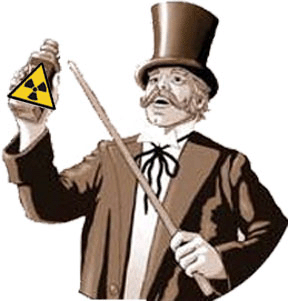
By magic, QUITE LARGE nuclear reactors are now SMALL.
And geewhiz – these new nuclear reactors no longer need much safety regulation

10 Aug 24, The Canadian Nuclear Association (CNA, the nuclear lobby) has written to all federal Members of Parliament in preparation for the 2025 budget. Their requests are in two sections: “investment tax credits” and “regulatory improvements.”
The investment tax credits allow companies to reduce their taxes owed if they spend money on nuclear development.
The CNA has numerous requirements , especially regarding SMRs
Small Modular Reactors (SMRs) – the numerous requirements include:
*Adjusting the definition to include projects up to 1400 megawatts thermal, or roughly 470 megawatts electrical.
*The CNA wants nuclear regulations to be reduced, particularly for Impact Assessments.
Streamline the Impact Assessment (IA) process:
Narrow the scope to factors of federal interest and indigenous rights and Remove the requirements for a Detailed Project Description
******************************************
From the International Atomic Energy Agency. Small modular reactors (SMRs) are advanced nuclear reactors that have a power capacity of up to 300 MW(e) per unit, which is about one-third of the generating capacity of traditional nuclear power reactors. https://www.iaea.org/newscenter/news/what-are-small-modular-reactors-smrs
From the International Atomic Energy Agency (For Small Modular Reactors) The main concepts underpinning the current safety approach — such as, for example, defence-in-depth, which assures prevention and mitigation of accidents at several engineering and procedural levels — are relevant for SMRs . A comprehensive safety assessment of all plant states — normal operation, anticipated operational occurrences and accident conditions — is required. https://www.iaea.org/newscenter/news/technology-neutral-safety-and-licensing-of-smrs
UK’s most dangerous nuclear site pleads guilty after endangering national security

More than 11,000 people work at the nuclear site in Cumbria, Sellafield, which holds the world’s largest store of plutonium and was called UK’s ‘most dangerous’
By WILLIAM MORGAN, Fri, Aug 9, 2024 https://www.express.co.uk/news/uk/1933985/UK-dangerous-nuclear-site-guilty-endangering-national-security
Europe’s largest nuclear site and the world’s largest plutonium storage facility has admitted putting Britain’s national security at risk, after a series of cybersecurity failings at the vast former nuclear power plant in Cumbria, Sellafield.
The company running the site, Sellafield Ltd, has apologised after pleading guilty to charges relating to information technology security from 2019 to 2023. Westminster Magistrates Court heard that, during this period, three quarters of the nuclear site’s servers were vulnerable to attack.
A Guardian investigation into nuclear industry practices also found that contractors could get unsupervised access to Sellafield computers and could plug external drives into the Sellafield systems. The company’s own report into the issue found that any “reasonably skilled hacker or malicious insider” could take advantage of these weaknesses.
The court heard from the nuclear watchdog that information which could pose a threat to national secrity lay vulnerable for years, with many of the critical security checks that Sellafield Ltd said they were completing, were simply not being done. The site has an otherwise poor reputation, often called “the most dangerous” site in the UK, employing 11,000 people to process nuclear waste and decommission equipment.
Tests of the vulnerable IT systems found that someone could access Sellafield’s servers and install phishing softward “without raising any alarms”. Raising further fears of information vulnerabiliy in key UK infrastructure to threats from hostile actors.
During their prosecution for failing to secure their systems, it emerged that 13 files marked “official/sensitive” had mistakenly been sent to outside contractors, alongside 4000 other files. Somehow, this did not trigger any elerts in their computer system, which was blamed in part for using “obsolete” software – including Windows 7 and Windows 2008.
At a court hearing on Thursday, a statement was read out from Sellafield Ltd’s CEO, Euan Hutton, who was present but did not speak.
The statement read: “I again apologise on behalf of the company for matters which led to these proceedings … I genuinely believe that the issues which led to this prosecution are in the past.”
The company is not due to be sentenced until September. The Office for Nuclear Regulation said after the August 8 hearing: “Sellafield Ltd had previously pleaded guilty to those offences in June, and while a hearing did take place today, Chief Magistrate Senior District Judge Paul Goldspring did not pass sentence.
“We expect Sellafield Ltd to be sentenced in September, when further details will be provided on our website and social media channels.”
Will Ukraine’s attack on Russian territory lead to the seizure of the Kursk Nuclear Plant?
Bellona, BY Dmitry Gorchakov, 9 Aug 24
As the Ukrainian army’s cross-border incursion into Russia’s Kursk Region rages into its fourth day, the objectives of the surprise attack have been grist for media speculation. Some have suggested the Ukrainians might target the Kursk Nuclear Power Plant as payback for Russia’s long-running seizure of Ukraine’s Zaporizhzhia nuclear plant.
It’s difficult to say how likely such a scenario is, but should it come to pass, it makes sense to briefly analyze the problems, risks, and dilemmas that would come of such an attack.
The specifics of the Kursk NPP
The Kursk Nuclear Power Plant is the closest Russian nuclear power plant to the Ukrainian border—just 60 km away. The idea that it could be at risk of attacks during a full-scale war became evident in the early months of Russia’s full-scale invasion of Ukraine. The Russia seizure of the Zaporizhzhia plant and territory of Chernobyl, followed by vigorous Ukrainian counterattacks, made clear that this would be a full-scale and potentially prolonged war with consequences for Russian territories.
As the war has dragged on, we have seen the Kursk NPP and its satellite city, Kurchatov, fall under attack by Ukrainian drones. No other Russian nuclear plants, which are much farther from the border and the front line, have been subjected to such attacks.
Currently, only two units are operating at the Kursk NPP, Units 3 and 4, each with a capacity of 1,000 MW. The first two units were shut down in 2021 and early 2024, respectively, after 45 years of operation. Fuel has been unloaded from Unit 1. All of the Kursk NPP’s units are RBMK-1000 reactors, similar to those used at Chernobyl. It’s worth noting that RBMK reactors — unlike the VVER-1000 reactors installed at the Zaporizhzhia NPP — are less protected against external threats. Much of our risk analysis for the Zaporizhzhia NPP during its seizure, presented in our 2023 report “The Radiation Risks of Seizing the Zaporizhzhia Nuclear Power Plant,” was based on a comparison of the characteristics of these reactor types.
Let’s examine some of the technical points and key vulnerabilities of the RBMK design. First, the lack of concrete containment structures (domes) over the reactor compartments makes RBMK reactors more vulnerable to damage from accidental or deliberate attacks by missiles, bombs, and artillery. Small arms or even light drones pose less danger.
Second, RBMK’s are single-circuit, boiling water reactors. This means that the same water and steam that pass through the reactor core go directly to the turbine, without intermediate circuits and heat exchangers. Therefore, depressurization and damage to the machine hall could lead to a radiation release………………………………
The seizure of nuclear facilities during war
Any armed seizure of a nuclear facility is unacceptable and extremely dangerous. Formally, this can be considered nuclear terrorism according to the International Convention for the Suppression of Acts of Nuclear Terrorism. Unfortunately, the reality of recent years in Europe has shown that many of the formulas embedded in international agreements, as well as many international organizations in general, are incapable of addressing, much less preventing, the modern challenges we are facing………………………………………………. https://bellona.org/news/nuclear-issues/2024-08-will-ukraine-attacks-on-russian-territory-lead-to-the-seizure-of-the-kursk-nuclear-plant
1 This Month

of the week – Shut Down Drone Warfare!


Tell the Ukrainian Government to Drop Prosecution of Peace Activist Yurii Sheliazhenko

Petition to revoke the licensing of the Near Surface Nuclear Disposal Facility (NSDF) at Chalk River. https://www.ourcommons.ca/petitions/en/Petition/Details?Petition=e-7247
To see nuclear-related stories in greater depth and intensity – go to https://nuclearinformation.wordpress.com
-
Archives
- April 2026 (79)
- March 2026 (251)
- February 2026 (268)
- January 2026 (308)
- December 2025 (358)
- November 2025 (359)
- October 2025 (376)
- September 2025 (257)
- August 2025 (319)
- July 2025 (230)
- June 2025 (348)
- May 2025 (261)
-
Categories
- 1
- 1 NUCLEAR ISSUES
- business and costs
- climate change
- culture and arts
- ENERGY
- environment
- health
- history
- indigenous issues
- Legal
- marketing of nuclear
- media
- opposition to nuclear
- PERSONAL STORIES
- politics
- politics international
- Religion and ethics
- safety
- secrets,lies and civil liberties
- spinbuster
- technology
- Uranium
- wastes
- weapons and war
- Women
- 2 WORLD
- ACTION
- AFRICA
- Atrocities
- AUSTRALIA
- Christina's notes
- Christina's themes
- culture and arts
- Events
- Fuk 2022
- Fuk 2023
- Fukushima 2017
- Fukushima 2018
- fukushima 2019
- Fukushima 2020
- Fukushima 2021
- general
- global warming
- Humour (God we need it)
- Nuclear
- RARE EARTHS
- Reference
- resources – print
- Resources -audiovicual
- Weekly Newsletter
- World
- World Nuclear
- YouTube
-
RSS
Entries RSS
Comments RSS
 nuclear-news