As usual, in matters nuclear, the Anglophone news is awash with articles extolling the future virtues of Small Nuclear Reactors. Especially in the UK, where Trumpian antics don’t dominate the news the whole time, nuclear news gets a lot of coverage. As I’ve mentioned before, the UK corporate press is ecstatic about SMRs. SMR critics, (of which there are plenty), usually focus their ire on the subject of costs. Other objections centre on health, climate needs, the environment, and the connection between civil and military nuclear technology.
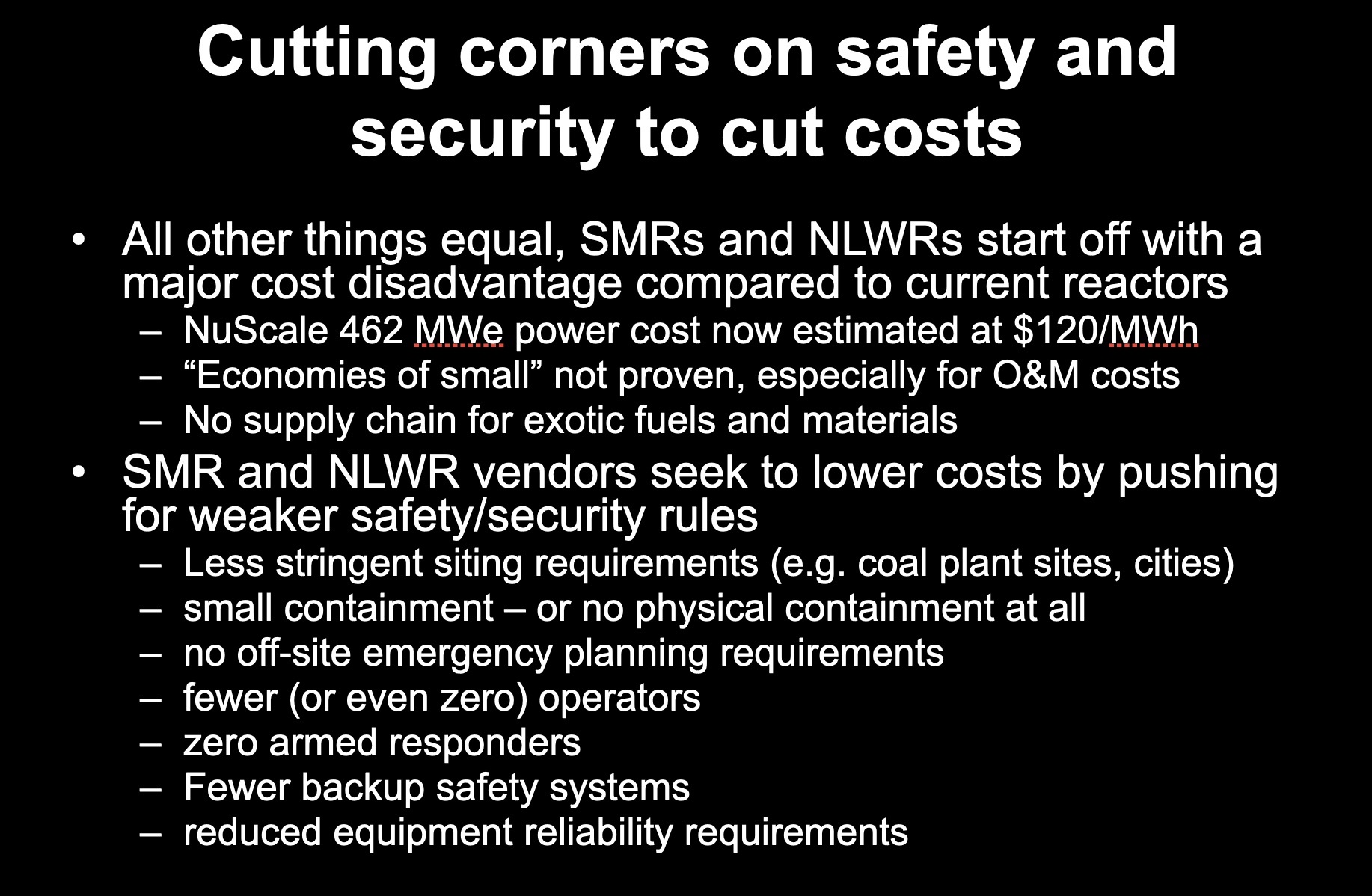
The nuclear lobby has very successfully touted safety as the big plus for the new (though still non-existent) Small Nuclear Reactors (SMRs) . Everyone seemed to buy this idea, because, after all, SMRs can’t melt down in the same dramatic way that big ones can. So, there’s been relatively little fuss made by the anti-nuclear movement on the grounds of safety, regarding SMRs.
Imagine my surprise when I opened up my eyes today – to see a corporate media news outlet, New Civil Engineer, usually pro-nuclear, coming out with a damning criticism of SMRs on the grounds of safety. It’s not as if New Civil Engineer actually condemned SMRs. Oh no! – they did indeed point out that the Department for Energy Security & Net Zero ((DESNZ) is confident that SMR developments are subject to “robust controls“. And the Office of Nuclear Security (ONR) “ensures that the highest levels of safety, security and safeguards are met”
“Despite EN-7 being 64 pages, just two lines are dedicated to specifically addressing the security of SMRs.“
The new regulations for SMRs would allow for many new nuclear sites near communities.
For large nuclear power sites, security is funded by the developers themselves. For SMRs, the security needs would be provided by the Civil Nuclear Constabulary (CNC) and also by local police. But these bodies are not under the direction of the ONR or the DESNZ. The writer quotes a policing expert, John McNeill :
“Not even [the government] can direct them.
Policing of airports and football grounds, even schools and educational campuses, shows how hard this will be to fund fairly.”
The expansion of AI and data centres add another complexity to the question of the amount of security needed, and of who pays for it. The proliferation of nuclear sites, closer to populated areas also means the increase in transport of radioactive materials – again bringing the risks of accidents, theft, and terrorism. And again, bringing the need for more security measures.
There’s some community concern in the UK about the safety of prolonging the life of aging nuclear reactors, and of the safety of coastal reactors and the marine environment. There’s also concern about the safety of the SMRs themselves, as the governments relax regulations.
The highly enriched uranium needed for most SMRs poses another risk – as it is useful for nuclear weapons, and therefore attractive to terrorists, and to countries seeking to get nuclear weapons.
So there has been some awareness of safety and security problems amongst critics, especially in the environmental movement. However, this is the first time that I’ve seen the corporate media speak up about this. As the author quotes questions raised in the House of Lords, it looks as though this issue is at last coming to the fore.
I guess that I should not be surprised that the issue of security of Small Nuclear Reactors is at last going to be taken seriously by The Establishment. After all, the examination of the huge and complicated difficulties raised in trying to organise security of SMRs eventually boils down to costs again – “Finally, who pays the piper?”
The Department of Energy has paused the firings of hundreds of employees who work for a key agency maintaining the U.S. nuclear weapons stockpile, multiple sources tell ABC News.
Managers with the National Nuclear Security Administration (NNSA) are frantically calling employees back and telling them that — as of right now — they’re not fired, despite some receiving termination emails and phone calls on Thursday. Their badges are getting turned back on and access to federal systems is being restored, at least temporarily.
Hundreds of probationary employees were terminated Thursday night in the mass Trump administration layoffs. The move prompted concerns of a national security risk because the agency is responsible for maintaining U.S. nuclear weapons, transporting them, and nuclear counterterrorism, among other missions.
NNSA held an all-staff meeting Friday morning, announcing the DOE had agreed to pause the layoffs, due to the agency’s national security mission.
NNSA staff tell ABC News they are in a holding pattern. They’re still bracing for firings, but possibly not as widespread.
Despite hitting the nuclear plant, the small fire was quickly contained and officials said there was no apparent radiation leak. The Chernobyl nuclear power station was hit overnight in an apparent drone strike, International Atomic Energy Agency (IAEA) has said. Ukrainian president, Volodymyr Zelensky, said a Russian drone strike with a “high explosive warhead” hit the outer shelter of the nuclear plant. The IAEA said that a UAV hit the shelter protecting the site at approximately 1.50am local time.
Footage from lastnight, showing a Russian Drone striking the Containment Structure around Reactor No. 4 at the Chernobyl Nuclear Power Plant (ChNPP) in Northern Ukraine, as well as the extent of the Damage from inside the Containment Structure.
Security concerns have been raised following the publication of the draft National Policy Statement for nuclear energy which would change where small modular reactors (SMRs) could be situated.
Limited details about security in EN-7 raises policing questions
Despite EN-7 being 64 pages, just two lines are dedicated to specifically addressing the security of SMRs.
The proposed proliferation of SMRs in the UK presents a novel nuclear security risk because of there potentially being many more smaller nuclear-licensed sites which are closer to people and property than gigawatt-scale reactors which tend to be in remote coastal locations.
In a section titled “Security of Site”, EN-7 says “Ensuring that the proposed nuclear infrastructure will be secure is vital. The Security Considerations section of EN-1 addresses security considerations in detail.
“The applicant should engage with the Office for Nuclear Regulation (ONR) as part of early engagement on securing a Nuclear Site Licence to understand what steps will be required to comply with relevant site security requirements.”
Policing SMRs would require a significant uplift in funding and workforce at the Civil Nuclear Constabulary (CNC) which is run by the Civil Nuclear Police Authority (CNPA). The CNPA is an executive non-departmental public body, sponsored by the Department for Energy Security and Net Zero (DESNZ).
Local police forces, overseen by the Home Office, could also be required to increase their capacity to respond to CBRN (chemical, biological, radiological and nuclear) incidents.
It is currently unclear how any resource uplift would be funded, and which bodies would provide that funding. As things stand, gigawatt-scale nuclear power sites’ security is funded by the developers themselves.
The business model for SMRs is not yet settled, with different developers proposing different management mechanisms.
Existing policing model does not accommodate complex demands of SMRs
Former police investigations and review commissioner Scotland and co-author of the Centre for Emerging Technology and Security analysis on SMR policing John McNeill said: “The ONR can specify security standards for SMRs, but they cannot require policing bodies to comply with their requirements.
“ONR can specify, approve, or reject, security arrangements, and vary these in response to changes in the threat assessments. But they cannot require any Police and Crime Commissioner (PCC) or Chief Constable (CC) to assign resources to meet their defined standards. Not even [the government] can direct them.
“Policing of airports and football grounds, even schools and educational campuses, shows how hard this will be to fund fairly…………………………………………………………….
“The existing policing model does not readily accommodate the complex demands of responding to the protection of the critical national infrastructure, nor a spread of SMRs.
It’s an outdated model that is not fit for this purpose. Since 2012 the 43 local (directly elected) policing bodies have set the priorities and assigned the budgets, for their police areas.
“We have already highlighted the complexities of policing a proliferation of SMRs in new areas of the country. Policing will need to extend their capability and capacity to respond. And meet the associated costs. It will not be enough to promise a reduction in their electricity bills sometime in the future!
“In short, the deafening silence from the Home Office and policing bodies is not reassuring to apprehensive communities who may have an SMR (or more) in their back yard.
“Finally, who pays the piper? Contractors will baulk at paying for local security. Site security may be less problematic.”
Sheffield Hallam University hosts the Centre of Excellence in Terrorism, Resilience, Intelligence and Organised Crime Research (Centric).
Centric professor in governance and national security Fraser Sampson co-authored the policing reform analysis with McNeill.
Sampson said: “The introduction of SMRs (and now associated data centres) is being presented as wholly different from whatever has gone before. That means the policing and security arrangements will need to be wholly different as they are the solution to the wrong problem.
“The engineering, environmental and economic noises are deafening but so is the silence on the extraordinary challenges that this will bring for community-level policing and resilience.
Policing and security are a network of systems. Turbocharging one part of a system will only pay off if the rest of the system can keep up – otherwise, the fast bit has to wait for the rest. No one wants to be responsible for the weakest link in the security chain.
“Workforce vetting has proved challenging enough for policing; an exponential increase in both volume and speed of reliable vetting must have a significant resource impact but add in risks from supply chain integrity, cyber-attacks and insider threats.”
Sampson said that the International Atomic Energy Agency (IAEA) “states more than half of radioactive [materials] thefts/losses since 1993 occurred during authorised transit.
“Where is the reassurance coming from that proliferation will improve these figures? We’re not dealing with Swampy anymore.”
Concerns about security of SMRs raised in parliament
In a debate about SMRs in the House of Lords, backbench Labour peer Lord Harris of Haringey asked about the potential increased demand on nuclear policing. The debate took place on 22 January 2025, before the publication of EN-7.
Outside of parliament, Harris is chair of the National Preparedness Commission (NPC), which works “to promote policies and actions to help the UK be significantly better prepared to avoid, mitigate, respond to, and recover from major shocks, threats and challenges”.
In the Lords debate, Harris asked: “What consideration has been given to who will protect and police modular nuclear reactors?
“Will it be the Civil Nuclear Constabulary, which would mean covering far more sites than it currently does, or will it be the other police forces?
Nuclear bunkers aren’t a foolproof way to stay safe during a nuclear attack. Here’s why.
No other human-made catastrophes can wreak more destruction than a nuclear bomb. Luckily, bomb shelters and bunkers can protect us, right?
The truth is that these structures’ ability to shield people from the potent heat and blast of a nuclear bomb varies.
“It all depends on where the bunker is and the quality of the bomb,” Norman Kleiman, an associate professor of environmental health sciences and director of the Radiation Safety Officer Training course at Columbia University’s Mailman School of Public Health, told Live Science
According to Kleiman, bomb shelters came about during the Cold War as the U.S. and the Soviet Union hinted at mutually assured destruction by nuclear weapons. Both countries’ governments designed programs to construct shelters in large public buildings, as well as to encourage individuals to build bunkers inside or outside their homes, Kleinman said.
It’s possible that some people marketing these shelters were looking to make a buck amid a crisis. “I’d argue that most of them were being marketed by snake oil salesmen and hucksters,” said Peter Caracappa, executive director of the radiation safety program at Columbia University.
A bomb shelter doesn’t necessarily guarantee safety in the event of a nuclear blast. Its effectiveness comes down to the quality of both the bomb and the shelter.
Modern nuclear weapons are quite different from those of the mid-20th century. Nuclear weapons are much more powerful now, largely because they detonate using a different reaction than they did during World War II and the Cold War. Nuclear bombs in the 1950s had cores made of the radioactive element plutonium or the isotope uranium-235, in which the atoms would split apart in a process called fission, causing a huge explosion. These bombs were a type of nuclear weapon known as atomic bombs, or fission bombs.
“The size of these devices was much smaller, orders of magnitude smaller than current nuclear weapons,” Kleiman said. But now we use bombs that rely on hydrogen fusion to create that boom. These bombs utilize the atomic explosion described merely to trigger a larger, thermonuclear explosion. This explosion can have a blast radius of up to 100 miles (160 kilometers). (For comparison, the bombs used on Hiroshima and Nagasaki had blast radii of about 1 mile, or 1.6 km.) Between these two nuclear weapons, hydrogen fusion-powered thermonuclear bombs are far more powerful than fission-powered atomic bombs.
“If you are 600 miles [1,000 km] away from a thermonuclear device, maybe a shelter would help you,” Kleiman said. “But if you’re anywhere within that blast radius, the blast, the heat, the explosion — those are going to take you out.”
And then there’s the question of radiation, which is the emission of waves and particles in the wake of the blast. Kleiman said it’s possible to build a bunker to protect you from radiation. The walls must be lined with 3 to 5 feet (0.9 to 1.5 meters) of concrete and steel, as well as lead. This lead is embedded in the shelter’s walls and doorways, so an intact bunker poses little risk of exposure to its occupants.
Moreover, the entrance “has to be kind of zigzaggy,” Kleiman said. Radiation travels in straight lines, so a zigzagging entrance would fend it off.
Capacarra broke down a shelter’s protection ability into three components: It must be effective as a structure to withstand an explosion and weather radiation (which, in part, depends on where it is relative to the explosion), how much material is between you and the radiation the explosion emits, and how well it can keep out fallout material, or the material that’s generated and released in a nuclear explosion.
Lethal radiation persists for days after the explosion, so if you were to survive the initial blast, you would have to stay in the bunker to avoid radioactive fallout. So your shelter would need to not only be equipped with supplies for the time you’d need to stay put — about a week, according to Kleiman — but also ventilate without letting in any radiation. This estimated timeline depends on how far the shelter is from the blast.
However, “that doesn’t mean that it’s safe, it just means that the radiation levels are low enough that you’re not going to die of acute radiation poisoning,” Kleiman continued. He added that cancer is one huge long-term risk of radiation exposure, but that and other consequences may not emerge for decades.
So, while a bunker only a few miles from an explosion wouldn’t be very helpful, a good shelter dozens of miles from a blast could protect inhabitants from radiation for days. “It’s really a question of shielding,” Kleiman said — “shielding from heat, shielding from the blast and shielding from radiation.”
You may have never heard of the National Nuclear Security Administration, but its work is crucial to your safety—and to that of every other human being on the planet. If Elon Musk’s Department of Government Efficiency (DOGE) hasn’t yet come across the NNSA, it surely will before too long. What happens after that could be alarming.
As recently as yesterday morning, Musk made clear that DOGE will go line by line through the government’s books looking for fat targets for budget-cutting, including those that are classified—especially those that are classified. DOGE employees are bound to notice NNSA, a 1,800-person organization that sits inside the Department of Energy and burns through $20 billion every year, much of it on classified work. But as they set out to discover exactly how the money is spent, they should proceed with care. Musk’s incursions into other agencies have reportedly risked exposing sensitive information to unqualified personnel, and obstructing people’s access to lifesaving medicine. According to several nuclear-security experts and a former senior department official, taking this same approach at the NNSA could make nuclear material at home and abroad less safe.
KYIV, Ukraine (AP) – Moscow´s renewed attacks on Ukraine´s electricity infrastructure this winter have heightened scrutiny over the Ukrainian Energy Ministry’s failure to protect the country´s most critical energy facilities near nuclear power sites.
Despite more than a year of warnings that the sites were vulnerable to potential Russian attacks, the Energy Ministry failed to act swiftly, current and former Ukrainian officials in Kyiv told The Associated Press.
Two years of punishing Russian strikes on its power grid have left Ukraine reliant on nuclear power for more than half of its electricity generation. Especially vulnerable are the unprotected nuclear switchyards located outside the perimeters of its three functioning nuclear plants, which are crucial to transmitting power from the reactors to the rest of the country.
“The switchyards that handle electrical routing from nuclear power plants are a vital component of Ukraine´s nuclear energy infrastructure – powering homes, schools, hospitals and other critical civilian infrastructure,” said Marcy R. Fowler, head of the office for research and analysis at Open Nuclear Network, a program of the U.S.-based NGO PAX sapiens that focuses on reducing nuclear risk.
“Given Ukraine´s heavy reliance on nuclear energy, military attacks on these switchyards would be devastating, severely impacting civilian life and undermining the resilience of the energy grid,” she said.
Even more worrying, nuclear switchyards also have a second critical function: delivering electricity to nuclear plants from the offsite grid that is essential to cooling their reactors and spent fuel. A disruption could potentially spell disaster, the U.N. nuclear agency has repeatedly warned since the Russian attacks began in August.
And while Ukraine’s nuclear plants have backup emergency power systems, these “are designed to provide temporary support,” Fowler said. “Without functioning switchyards, the backup systems alone would not be sufficient to sustain operations or prevent safety risks during an extended outage.”
Lawmakers cited failure to protect these sites in a resolution last month calling for the removal of Energy Minister Herman Haluschenko. The list of grievances, which also censured Haluschenko for alleged systematic corruption and inadequate oversight of the energy sector, must still be voted on by parliament.
Haluschenko maintained at a news conference Tuesday the allegations were “a manipulation” and that fortifications for the electrical grid were “done.” But he would not answer direct questions about whether Ukraine’s nuclear switchyards in particular were protected.
Russian attacks in November and December came dangerously close to the country´s nuclear power plants, causing five out of its nine operating reactors to reduce power generation. The attacks did not strike the nuclear switchyards about a kilometer (half-mile) away from reactor sites but came alarmingly close.
The task of building protections for energy transmission substations, both nuclear and non-nuclear, fell to state and private companies, with the Energy Ministry supervising.
Three layers of fortifications were ordered: sandbags followed by cement barricades capable of withstanding drone attacks and – the most costly and least complete – iron-and-steel-fortified structures.
Following a government decree in July 2023, many state energy companies began immediately contracting to build first- and second-layer fortifications for their most critical power facilities. In the spring of 2024, the government repeated the urgent call to get the work done.
But nuclear switchyards, under the responsibility of Ukraine’s state nuclear company Energoatom, did not issue contracts to build second-layer concrete fortifications until this fall. By then, state energy company Ukrenergo, which manages the high-voltage substations that transmit power from the nuclear reactors to the grid, had already completed 90% of its 43 sites.
The bidding process for two nuclear plants – in Khmelnytskyi and Mykolaiv – only started in early October, according to documents seen by the AP. The tender for the Rivne Nuclear Power Plant was even later, at the end of November.
Construction is not expected to be completed until 2026, the contract documents said.
Ministers are preparing to relax planning rules to make it easier to build mini nuclear power plants in more parts of the country in order to hit [?] green energy targets and boost the industry.
They are also examining whether it is possible to streamline the process for approving the safety of new nuclear power plants as a way to reduce construction delays. At present rules state that only the government may designate sites for potential nuclear power stations, of which there are eight, severely limiting where they can be built. T
his is seen as a serious barrier to developing small modular reactors (SMRs) that could be placed in various locations across the country, providing power for remote areas or power-hungry developments such as data centres for artificial intelligence.
Under plans to update the planning regime with a new national policy statement on nuclear power, companies would be free to develop SMRs in most areas of the country outside built-up areas and would also benefit from fast-tracked planning approval, as the power plants would be designated nationally significant infrastructure.
Rachel Reeves, the chancellor, is expected to use the government’s spending review to announce funding for one of two small modular reactors designs. GE Hitachi Nuclear Energy and Rolls-Royce are among companies competing for the funding in a process being run by Great British Nuclear. Reeves is also expected to make a final funding decision on Sizewell C.
International Atomic Energy Agency (IAEA) chief Rafael Grossi said late on Monday that he was on his way to visit Kyiv and inspect a key substation that is critical for the safety of Ukraine’s nuclear power. “On my 11th visit to Ukraine since the war began,” Grossi wrote on X. “I’m heading to Kyivska substation, critical for the safety of Ukraine’s nuclear power, to assess damage and help prevent a nuclear accident.” Last week, the IAEA said in a statement that Grossi would visit Kyiv for “high-level” meetings to ensure nuclear safety in the war that Russia started in February 2022.
Yet, in recent months highly placed government officials have expressed their concerns over the possibility that drones flying near or over conventional and nuclear electric generating facilities could cause damage to the facilities, leading to power blackouts or worse.
drones operated with malicious intent present two distinct threats to critical infrastructure sites such as power-generating facilities.
drones can be equipped with weapons or explosives to devastating effect.
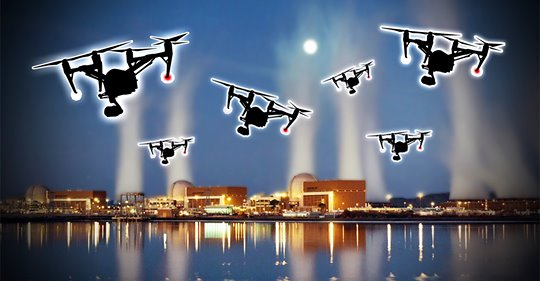
Are nuclear power plants, other electric facilities at risk from drones?
By DRONELIFE Features Editor Jim Magill
This is the third in a series of articles, examining the problems posed to critical infrastructure sites and other significant potential targets of drone incursions by hostile actors. Part one described current federal laws pertaining to the use of counter-drone technology. Part two looked at the threats from UAVs faced by jails and prisons.
This article will explore whether drones operated with malicious intent present a danger to nuclear power plants and other facets of the U.S. electric grid.
Counter-drone series – Part 3
Earlier this month the Nuclear Regulatory Commission put out a statement in an effort to reassure the public that nuclear power plants are safe from potential attacks from the sky in the form of drones flown by bad actors.
“While nuclear power plant security forces do not have the authority to interdict or shoot down aircraft, including drones, flying over their facilities, commercial nuclear power plants are inherently secure and robust, hardened structures,” the statement reads.
They are built to withstand hurricanes, tornadoes and earthquakes. Nuclear plants maintain high levels of security measures, which ensure they can defend against threats,” up to and including threats to the plant’s basic structure.
The statement notes that last year, the NRC updated its regulations to require its nuclear power plant licensees, which are largely private companies, to report sightings of drones over their facilities. These reports are sent to the NRC, the FAA, the FBI and local law enforcemen
Yet, in recent months highly placed government officials have expressed their concerns over the possibility that drones flying near or over conventional and nuclear electric generating facilities could cause damage to the facilities, leading to power blackouts or worse. In early January, Louisiana Gov. Jeff Landry brought the question up to then President-elect Donald Trump at a dinner meeting of Republican governors at Trump’s Mar-a-Lago resort in Palm Beach. Landry reported that suspicious drone activity had been spotted over or near Entergy’s River Bend nuclear power plant in West Feliciana Parish.
Scott Parker, chief of unmanned aircraft systems at the U.S. Department of Homeland Security’s Cybersecurity and Infrastructure Security Agency (CISA), said drones operated with malicious intent present two distinct threats to critical infrastructure sites such as power-generating facilities.
A drone “can be used to either compromise the site’s secret protocols, or it can also be used to capture information that that organization may want to protect, like intellectual property,” Parker said. “There’s also the added capability of cyber-attack tools.” Drones can easily be equipped with a number of capabilities that could identify and exploit wireless communications to gain access into sensitive systems or networks.
Earlier this month the Nuclear Regulatory Commission put out a statement in an effort to reassure the public that nuclear power plants are safe from potential attacks from the sky in the form of drones flown by bad actors.
“While nuclear power plant security forces do not have the authority to interdict or shoot down aircraft, including drones, flying over their facilities, commercial nuclear power plants are inherently secure and robust, hardened structures,” the statement reads.
“They are built to withstand hurricanes, tornadoes and earthquakes. Nuclear plants maintain high levels of security measures, which ensure they can defend against threats,” up to and including threats to the plant’s basic structure.
The statement notes that last year, the NRC updated its regulations to require its nuclear power plant licensees, which are largely private companies, to report sightings of drones over their facilities. These reports are sent to the NRC, the FAA, the FBI and local law enforcement.
“Additionally, in late 2019, the nuclear industry began coordinating with the Department of Energy (DOE) and the FAA to restrict drone overflights over certain nuclear power plants,” the statement says.
Yet, in recent months highly placed government officials have expressed their concerns over the possibility that drones flying near or over conventional and nuclear electric generating facilities could cause damage to the facilities, leading to power blackouts or worse. In early January, Louisiana Gov. Jeff Landry brought the question up to then President-elect Donald Trump at a dinner meeting of Republican governors at Trump’s Mar-a-Lago resort in Palm Beach. Landry reported that suspicious drone activity had been spotted over or near Entergy’s River Bend nuclear power plant in West Feliciana Parish.
Scott Parker, chief of unmanned aircraft systems at the U.S. Department of Homeland Security’s Cybersecurity and Infrastructure Security Agency (CISA), said drones operated with malicious intent present two distinct threats to critical infrastructure sites such as power-generating facilities.
A drone “can be used to either compromise the site’s secret protocols, or it can also be used to capture information that that organization may want to protect, like intellectual property,” Parker said. “There’s also the added capability of cyber-attack tools.” Drones can easily be equipped with a number of capabilities that could identify and exploit wireless communications to gain access into sensitive systems or networks.
In addition, as demonstrated in overseas conflicts in recent months, drones can be equipped with weapons or explosives to devastating effect. “It could also be used to some degree in order to attack critical infrastructure, especially when you think about a close-in blast capability of a drone targeting a specific asset,” Parker said……………
Are Drones a Threat to Nuclear Power Plants? Examining Risks to the U.S. Electric Grid
Are nuclear power plants, other electric facilities at risk from drones?
By DRONELIFE Features Editor Jim Magill
This is the third in a series of articles, examining the problems posed to critical infrastructure sites and other significant potential targets of drone incursions by hostile actors. Part one described current federal laws pertaining to the use of counter-drone technology. Part two looked at the threats from UAVs faced by jails and prisons.
This article will explore whether drones operated with malicious intent present a danger to nuclear power plants and other facets of the U.S. electric grid.
Counter-drone series – Part 3
Earlier this month the Nuclear Regulatory Commission put out a statement in an effort to reassure the public that nuclear power plants are safe from potential attacks from the sky in the form of drones flown by bad actors.
“While nuclear power plant security forces do not have the authority to interdict or shoot down aircraft, including drones, flying over their facilities, commercial nuclear power plants are inherently secure and robust, hardened structures,” the statement reads.
“They are built to withstand hurricanes, tornadoes and earthquakes. Nuclear plants maintain high levels of security measures, which ensure they can defend against threats,” up to and including threats to the plant’s basic structure.
The statement notes that last year, the NRC updated its regulations to require its nuclear power plant licensees, which are largely private companies, to report sightings of drones over their facilities. These reports are sent to the NRC, the FAA, the FBI and local law enforcement.
“Additionally, in late 2019, the nuclear industry began coordinating with the Department of Energy (DOE) and the FAA to restrict drone overflights over certain nuclear power plants,” the statement says.
Yet, in recent months highly placed government officials have expressed their concerns over the possibility that drones flying near or over conventional and nuclear electric generating facilities could cause damage to the facilities, leading to power blackouts or worse. In early January, Louisiana Gov. Jeff Landry brought the question up to then President-elect Donald Trump at a dinner meeting of Republican governors at Trump’s Mar-a-Lago resort in Palm Beach. Landry reported that suspicious drone activity had been spotted over or near Entergy’s River Bend nuclear power plant in West Feliciana Parish.
Scott Parker, chief of unmanned aircraft systems at the U.S. Department of Homeland Security’s Cybersecurity and Infrastructure Security Agency (CISA), said drones operated with malicious intent present two distinct threats to critical infrastructure sites such as power-generating facilities.
A drone “can be used to either compromise the site’s secret protocols, or it can also be used to capture information that that organization may want to protect, like intellectual property,” Parker said. “There’s also the added capability of cyber-attack tools.” Drones can easily be equipped with a number of capabilities that could identify and exploit wireless communications to gain access into sensitive systems or networks.
In addition, as demonstrated in overseas conflicts in recent months, drones can be equipped with weapons or explosives to devastating effect. “It could also be used to some degree in order to attack critical infrastructure, especially when you think about a close-in blast capability of a drone targeting a specific asset,” Parker said.
The Nuclear Energy Institute (NEI), the trade association for nuclear power industry, downplays the potential hazards associated with UAV flights over its facilities. ……………………………
The United States is estimated to have spent more than $400 billion on the kinds of antimissile goals that the president now says will provide “for the common defense.”
Star Wars is back, with an executive order from President Trump that the White House said “directs the building of the Iron Dome missile defense shield for America.”
The order, issued on Monday night, didn’t quite do that. It was more a vaguely worded set of instructions to accelerate current programs or explore new approaches to defending the continental United States than a blueprint for arming the heavens with thousands of antimissile weapons, sensors and tracking devices.
But two blocks away, on the same evening, the Office of Management and Budget issued a 56-page spreadsheet that detailed the suspension of funding for thousands of programs. They included most of the major U.S. efforts to reduce the amount of nuclear fuel that terrorists might seize, to guard against biological weapon attacks and to manage initiatives around the globe to curb the spread of nuclear arms.
The two announcements seemed to encapsulate the administration’s conflicting instincts in its opening weeks. Mr. Trump wants to build big and take the Space Force he created to new heights, even at the risk of new arms races. That effort has been underway since Ronald Reagan’s day, with only mixed results.
But in its drive to shut down programs it believes could be creations of the so-called deep state, the administration wants to cut off funding for many programs that seek to reduce the chances of an attack on the United States — an attack that could very well come in forms other than a missile launched from North Korea, China or Russia.
A judge paused Mr. Trump’s spending freeze on Tuesday, but the president’s intentions are clear.
Though Mr. Trump calls his plan the Iron Dome, it has little if any resemblance to the Israeli system of the same name that has succeeded in destroying small missiles that move at a snail’s pace compared with the blinding speeds of intercontinental warheads………………………………………………………..
Missile defense has long been a favorite topic for Mr. Trump, who has envisioned the project as the next step for the Space Force, which he created in his first term.
But it could also trigger a new arms race, some experts fear. And unaddressed in Mr. Trump’s new initiative is the threat of nuclear terrorism and blackmail with an atomic bomb, which might be smuggled into the United States on a truck or a boat. Many experts see the terrorism threat as far bigger than an enemy firing a single missile or a swarm.
In 2001, after Sept. 11 attacks, the federal government scrambled to get wide-ranging advice on how outwit terrorists and better protect Americans from the threats of germ, computer, chemical and nuclear attacks.
“The combination of simultaneously deploying a missile defense system of questionable effectiveness against any real threat” while “suspending operative programs against nuclear or bioterrorists, sophisticated cyberattackers or others” is a “terrible trade-off,” said Ernest Moniz, the energy secretary under President Barack Obama who now heads the Nuclear Threat Initiative.
“The Iron Dome reference conjures up the success of the Israeli missile defense, but that’s misleading given the relatively short-range missiles that Israel defends against and the small territory it needs to defend,” said Mr. Moniz, a former professor at the Massachusetts Institute of Technology with long experience in nuclear weapons ………………
Critics of the executive order say it is more a list than a program, and includes systems that have never panned out. In an interview, Theodore A. Postol, an emeritus professor of science and national security at M.I.T., called Mr. Trump’s missile plan “a compendium of flawed weapons systems that have been shown to be unworkable.”…………………………………………
The nuclear watchdog has issued an improvement notice after two railway wagons carrying nuclear waste crashed.
It happened on the Sellafield site, in Cumbria, which manages more radioactive waste in one place than any other nuclear facility in the world.
The Office for Nuclear Regulation (ONR) said although no-one was injured and there were no radiation risks during the incident, which happened in November, it could have had “serious consequences”.
A Sellafield spokesman said: “An internal investigation was initiated to understand the root cause and to prevent this from happening again in future.”
The ONR said one of the wagons on the site’s railway had not been properly secured and it rolled about 200ft (60m), hitting a stationary wagon.
They added the wagons were left with minor damage and the nuclear containers were unaffected “due to their robust construction”, however health and safety improvements were needed to prevent future incidents.
Ian Bramwell, ONR’s head of regulation for Sellafield, said: “This will include improving how Sellafield plan, organise, monitor and review the measures in place to protect personnel directly and indirectly involved in rail activities on the site.”
The ONR will reinspect the site in the coming months and Sellafield has until 13 June to comply with the notice.
A Sellafield spokesman said it was working with the ONR to review its processes.
Recent events on the Ukraine-Russia war front have drawn widespread attention to a terrifying new reality: According to a dispatch from C.J. Chivers published by The New York Times Magazine in December, remote drone operators can now overcome virtually any defensive barrier or evasive maneuver, fundamentally altering the nature of warfare between the two countries and raising new concerns about nuclear reactor safety in the region.
From safe bunkers that are sometimes as far as miles away, Ukrainian operators have begun sending small unmanned devices that cost as little as US $400 to destroy tanks and heavy artillery pieces worth millions. While militaries have traditionally relied on larger, “purpose-built” drones in the past, fighters in Ukraine have recently turned to small, relatively inexpensive hobbyist drones used around the world for everything from firefighting to aerial photography. Many of the drone operators are young and not extensively trained. But their work has allowed the vastly outnumbered Ukrainian fighters to overcome highly complex, sophisticated defensive barriers, and inflict brutal, lethal, and enormously expensive damage with shocking ease.
This new turn in weaponized drone use bears startling implications in relation to nuclear reactor safety. There are eight atomic power plants in the Russo-Ukrainian war zone—six at the Zaporizhzhia site in Ukraine, and two at Kursk in Russia—whose security is continually threatened by the ongoing conflict and by a lack of skilled, reliable operators in the area. If severely damaged, deprived of cooling water, or cut off from back-up power supplies, any one of these plants could melt or explode. Such an event could blanket large swaths of the planet and many of Europe and Asia’s largest cities with deadly radiation, inflicting tremendous human suffering as well as permanent ecological devastation. The damage could exceed that of the 1986 explosion at Chernobyl Unit Four, which contained significantly less core radiation than at Zaporizhzhia and Kursk, both of which have operated far longer.
Reactor containment domes are often constructed with thick, reinforced concrete. But they are far from invulnerable. The routes to major catastrophe—from loss of coolant and back-up power to operator error and structural defects—are too numerous to delineate or discount. A combination of these risks plagues each of the more than 400 nuclear power plants licensed worldwide, including the more than ninety in the United States.
Another recent Times report warns that weaponized drones have become part of a “hybrid” global conflict operating in an amorphous “Gray Zone.” The ability of these drones to wreak lethal and exorbitantly expensive havoc is virtually unlimited. With easily deployed drones like those now ravaging Eastern Europe, hostile nations, rogue armies, small terror groups, or even a lone psychopath could handily turn any number of commercial reactors into lethal engines of a radioactive apocalypse.
Atomic technology has been in civilian use since the 1957 opening of Pennsylvania’s Shippingport reactor. The U.S. Congress at the time promised the public that the “Peaceful Atom” would have comprehensive liability insurance within fifteen years. But nearly seven decades later, no commercial U.S. atomic power plant has blanket private accident insurance against a major catastrophe. Homeowners policies nationwide specifically exempt a nuclear disaster: When push comes to shove, homeowners will pay for their own irradiation.
All atomic power plants cause environmental damage on both the local and global level. They emit radioactive Carbon-14, expand global CO2 levels in the mining and fuel fabrication process, burn at 540-plus degrees Fahrenheit that heats the atmosphere and nearby bodies of water, bathe their neighborhoods in “low level” radiation, and create unmanageable wastes. What’s more, they cost far more than renewables by factors of 2 to 400 percent, while producing inflexible “baseload” power that clogs the grid.
Atomic power plants have always been vulnerable to explosion due to natural disasters such as the one at Fukushima in 2011, systemic mismanagement such as that at Chernobyl, or military and terror attacks. The advent of drone warfare in addition to all of this has raised the threat level to a terrifying new height. But in spite of this, Congress approved a forty-year extension of the original federal insurance exemption in 2024. This means that by the 2060s, the industry may have operated an entire century without ever obtaining the basic private insurance necessary to protect the public from a major radiation release.
A new level of terror is now being inflicted in the Ukraine-Russian war zone by drones once considered to be harmless, frivolous techno-gadgets. The nuclear industry’s insistence that we have nothing to fear from military or terror attacks on its uninsured fleet has lost any residual credibility. Given the horrific new reality of drone warfare, generating hyper-expensive radioactive power and waste from hot, dirty, decrepit reactors is less defensible than ever.
The director general of the International Atomic Energy Agency (IAEA) has said he is growing increasingly concerned that the organisation’s efforts to prevent a major nuclear incident in war-torn Ukraine in under increasing threat.
It comes as Rafael Mariano Grossi (above) revealed the agency’s team based at Ukraine’s Zaporizhzhya Nuclear Power Plant (ZNPP) has heard frequent explosions from outside the site over the past week.
He added The team reported hearing multiple instances of such military activity in recent days, at varying distances from the ZNPP. There was no damage reported to the plant itself. Although the sound of nearby military action has been a common occurrence ever since the IAEA established a continued presence at the ZNPP in September 2022, it has happened virtually daily in recent weeks.
“For almost three years now, we have been doing everything we can to help prevent a nuclear accident at the Zaporizhzhya Nuclear Power Plant and elsewhere in Ukraine,” Grossi explained. “An accident has not occurred, but the situation is not improving. It is still precarious. I remain seriously concerned about nuclear safety and security in Ukraine, including at the Zaporizhzhya site. Our work is far from over.”
He continued as part of the ongoing work to monitor developments relevant for nuclear safety and security, the IAEA team has continued to conduct walkdowns across the site – including but not limited to the main and emergency control rooms of four reactor units and one turbine hall – and observed and discussed various safety-related maintenance activities with the plant.
The IAEA team was also informed that the ZNPP is procuring three new mobile diesel generators, similar to those received late last year. They are in addition to the site’s 20 fixed emergency diesel generators that are designed to provide on-site power if there is a total loss of off-site power.
Separately, the ZNPP said that four diesel steam generators were put into operation for ten days to provide the steam needed to process liquid radioactive waste. These generators were commissioned a year ago.
Elsewhere in Ukraine, the IAEA said air raid alarms were heard on several occasions at Ukraine’s three operating nuclear power plants (NPPs) – Khmelnytskyy, Rivne and South Ukraine – as well as at the Chornobyl site. At the Khmelnytskyy NPP, the IAEA team members have taken shelter at their residence three times in recent days due to such alerts.
At the Khmelnytskyy and South Ukraine NPPs and the Chornobyl site, the IAEA teams were informed of instances of drones being detected at distances ranging from 2 to 30 km from the sites.
Despite such military activities, Ukraine’s nine operating nuclear power reactors have been operating at full capacity this week, safely generating much-needed electricity during the cold winter months.
Separately, the Agency continued with deliveries under its comprehensive programme of nuclear safety and security assistance to Ukraine. Last week, the Chornobyl site received equipment to enhance its nuclear security system. The delivery, the 104th organised by the IAEA since the start of the armed conflict, was supported with funds from the United Kingdom.
Russia and Ukraine continue to swap daily barrages, with the prospects of ceasefire talks appearing slim.
Aljazeera, 29 Jan 2025
A nuclear power plant was among targets during a massive Ukrainian drone attack, Russian officials have said.
Moscow said on Wednesday that the country’s energy infrastructure had come under attack by at least 100 drones overnight. Ukraine also reported strikes. The continuing barrages were accompanied by barbs from the two countries’ presidents, suggesting little prospect of peace talks.
The Russian Ministry of Defence said on Telegram that 104 drones were involved in raids across western Russia, many targeting power and oil facilities.
Local officials claimed that air defence systems had destroyed one drone that had attempted to strike the nuclear power plant in the western region of Smolensk.
“According to preliminary information, one of the drones was shot down during an attempt to attack a nuclear power facility,” Governor Vasily Anokhin said on the Telegram messaging app. “There were no casualties or damage.”
The Smolensk Nuclear Power Plant, the largest power generating plant in Russia’s northwest, was working normally on Wednesday morning, RIA state news agency reported, citing the plant’s press service.
Russia’s air defences reportedly destroyed drones over nine regions, including 11 over Smolensk, which sits on the border with Belarus. Nearly half were hit over Kursk, where Ukrainian troops have occupied several villages for months following an incursion.
Ukraine and Russia have been swapping drone and missile strikes on an almost daily basis, with energy infrastructure a particular target amid winter.




 nuclear-news