Japan’s new nuclear safety agency dumps the previous hastily made “stress tests”

 New nuclear watchdog to dump reactor stress tests http://www.japantimes.co.jp/text/nn20120925c1.html Kyodo Japan’s new nuclear watchdog plans to disregard the stress tests used by its predecessor for the reactor reactivation process because it
plans to create fresh criteria for the task, Nuclear Regulation Authority chief Shunichi Tanaka said Monday.
“We will not use ‘stress tests’ as our judgment criteria,” Tanaka said in an interview,
referring to the two-stage safety examination that the government slapped together to push through reactor restarts in the wake of the Fukushima disaster in March last year, fearing summer power outages.
Utilities seeking to restart reactors have already submitted the results of their first-phase stress tests to the NRA’s predecessor, the Nuclear and Industrial Safety Agency. NISA was to check the results.
Of the nation’s 50 viable commercial reactors, results on 30 have been submitted. In July, Kansai Electric Power Co.’s two reactors at the Oi power plant in Fukui Prefecture became the first to be reactivated since the crisis.
But Tanaka’s remarks mean the utilities will have to go back to square one to restart their reactors.
Tanaka emphasized that he has “no intention” to decide on whether the stress test results so far submitted are proper.
The NRA, launched earlier this month as part of efforts to improve regulation in light of the Fukushima crisis, plans to formulate new safety standards within 10 months.
Radiation medicine scandal in France
French trial opens on cancer radiation scandal, France 24, 25 SEPTEMBER 2012 Radiophysicist Joshua Anah along with two doctors, is accused of involuntary homicide, not helping people in danger and destroying evidence arising from radiation overdoses given to nearly 450 cancer patients in a French hospital.
AFP – Two doctors and a radio physicist were due to go on trial Monday on manslaughter charges arising from radiation overdoses given to nearly 450 cancer patients in a French hospital. At least seven people died as a result of overdoses administered to patients at the Jean Monnet hospital in Epinal in northeastern France between 2001 and 2006.
At least 24 people treated between May 2004 and August 2005 received 20 percent more radiation than they should have due to a calibration error.
Another dysfunction led to 424 people being overdosed by between eight and 10 percent in the period spanning 2001 and 2006. Many of the victims were being treated for prostrate cancer.
Scores of victims are due to testify from Monday until October 31, some of them by video-link because they are too ill to attend court. The two doctors, Jean-Francois Sztermer, 64, Michel Aubertel, 62, and radio physicist Joshua Anah, 54, are accused of involuntary homicide, not helping people in danger and destroying evidence.
Three health executives are also in the dock on charges of not helping people in danger…..http://www.france24.com/en/20120925-french-trial-opens-cancer-radiation-scandal
Uranium smuggling n former Soviet Union
Loose Nuke Smugglers Caught With Uranium
http://abcnews.go.com/blogs/headlines/2012/09/loose-nuke-smugglers-caught-in-former-soviet-region/ MOSCOW — Seven individuals were reportedly arrested for allegedly trafficking uranium and weapons in a breakaway region of Moldova.
The unnamed group had been detained last week in the separatist enclave of Transnistria, according to Moldova’s interior ministry, Reuters reported.
The group had allegedly been involved in shipments of hand grenades, Kalashnikov assault rifles, rocket propelled grenade launchers, and even containers of uranium-235, which could be used to produce a nuclear bomb. The ministry provided no further details about the uranium shipment or its origin, according to Reuters.
The United States has been very concerned about loose nuclear material being trafficked through parts of the former Soviet Union.
This is not the first reported case of uranium-235 smuggling in Transnistria. In June, 2011 Moldovan police reportedly arrested six members of a criminal group for trying to peddle one kilogram of uranium-235 for about $38 million. That nuclear material had allegedly
been sourced in Russia. Three of those individuals were convicted last May.
Tsunami danger to 23 nuclear power plants
 23 Nuclear Plants in Tsunami Risk Zones, Study Finds http://www.livescience.com/23392-nuclear-plants-tsunami.html LiveScience Staff : 21 September 2012 “… A recent study led by European researchers found Fukushima is not alone, as 22 other plants around the world may be similarly susceptible to destructive tsunami waves, with most of them in east and southeast regions of Asia.
The 23 facilities on the list (including Fukushima) house a total of 74 nuclear reactors. Thirteen of the plants are active, while the others are either nearing completion or being expanded to house more reactors. The researchers say East and Southeast Asia are at the greatest risk of a nuclear crisis triggered by a tsunami because of the rise of atomic power stations in the region, especially in China, which houses 27 of the world’s 64 nuclear reactors currently under construction.
“The most important fact is that 19 (two of which are in Taiwan) out of the 27 reactors are being built in areas identified as dangerous,” state the authors of the study. Meanwhile, in Japan, seven plants — one of which is currently under construction — are located in zones at risk of a tsunami, and South Korea is now expanding two plants in risk zones, the researchers said.
The study, which appears in a recent issue of the journal Natural Hazards, urges energy officials in these countries to consider how they would deal with the potentially far-reaching consequences of a catastrophe.
“The location of nuclear installations does not only have implications for their host countries but also for the areas which could be affected by radioactive leaks,” study researcher Joaquín Rodríguez-Vidal, of the University of Huelva, told SINC, a Spanish news agency.
China still has poor record on nuclear safety, uranium environmental damage
Should China be involved in the UK’s nuclear energy infrastructure? Guardian UK, Paul Dorfman, 21 Sept 12“….In Tibet, the Chinese nuclear industry is engaged in a determined effort to secure uranium deposits located in Amdo, where leaching and open pit extraction are reported to have resulted in significant environmental contamination. Regulation of safety oversight mechanisms is relatively weak in the Chinese nuclear industry, and according to a recent Nuclear Materials Security Index report, China ranks 29th among the group of 32 nuclear nations in terms of nuclear security and materials transparency. Although it’s to be hoped that greater corporate social responsibility and sensitivity to vulnerable industrial communities is evolving in both Russia and China, it’s still troubling to reflect on their respective human rights situations, documented by Amnesty International……http://www.guardian.co.uk/environment/blog/2012/sep/21/nuclearpower-energy?newsfeed=true
Concern over Idaho wildfire at uranium contaminated site
One area of concern is a defunct uranium mine and milling operation 5 miles west of North Fork, where the U.S. Environmental Protection Agency conducted a cleanup several years ago of polluted soil, hazardous wastes and piles of raw uranium and thorium ore.
No decontamination of buildings at that site was ever performed, and at least one of those buildings burned in the fire, according to officials from the state Department of Environmental Quality
Idaho wildfire roars through former uranium mine site Laura Zuckerman
Reuters, September 21, 2012 SALMON, Idaho Continue reading
Daunting tasks for Japan’s new Nuclear Regulation Authority
 Nuclear regulatory body faces
  mountain of urgent tasks http://www.yomiuri.co.jp/dy/national/T120920003922.htm Koichi Yasuda / Yomiuri Shimbun 21 Sept 12, Five members of the new nuclear regulatory commission, headed by Shunichi Tanaka, showed strong determination to ensure the safety of the nation’s nuclear facilities and restore public confidence, based on lessons learned from the crisis at the Fukushima No. 1 nuclear
power plant.
However, the Nuclear Regulation Authority faces a growing number of urgent tasks, including establishing new regulations for nuclear power generation.
The commission must first determine how to evaluate stress tests that have served as a tentative yardstick for restarting reactors in the aftermath of last year’s disaster.
It must also decide what requirements need to be met to allow nuclear reactors to operate more than 40 years–which would be an exception to the government’s new energy strategy announced earlier this month.
It remains to be seen how the commission will conduct research on active faults under nuclear power plants nationwide.
Lastly, it also needs to introduce mandatory countermeasures for severe accidents, including reactor meltdowns, as well as expand disaster preparedness zones around nuclear plants. The fact that the commission was launched with members who were not approved by the Diet has added to these concerns.
Former Nuclear Safety Commission Chairman Shojiro Matsuura, 76, said establishing the above rules is “essentially a job that would take years for specialists to accomplish.
“I’m worried whether [the commission] will be able to tackle the problems without support of both the ruling and opposition parties,” he said.
Considering the head of the new commission will be given greater command authority during emergencies, Matsuura’s concern is reasonable.
The new commission, which has been granted a high level of independence, must pursue safety improvements at nuclear power plants from scientific and technological viewpoints, and keep a distance from political and economic concerns. The public will closely watch its
every action.
Inadequate safety plans for Kudankulam nuclear reactors
India’s Judiciary creates scam over Kudankulam The Canadian, 17 SEPTEMBER 2012“……In the name of nation and national interests they protect the rich and multinationals and want the common people also support that. Recent disclosures from a special official safety review on all Russian reactor designs reveal their several generic flaws, including inadequate emergency cooling, poor evacuation procedures, and non-factoring of earthquake hazards. The Kudankulam reactors lack an independent freshwater source, critical to cooling them in emergencies. They are probably the world’s only nuclear reactors dependent on unreliable seawater desalination, which can fail and has no backup. The Atomic Energy Regulatory Board (AERB) approved the fuel-loading despite all this and without the mandatory emergency evacuation drill in a 16-km radius. AERB approval is NPCIL’s clinching justification for fuel-loading. The AERB “has no rule-making powers.” It never fulfilled the mandate to prepare an overall nuclear and radiation safety policy.
It has failed to develop as many as 27 of the 168 Standards, Codes and Guides it itself termed essential. It has no role in radiological surveillance and monitoring workers’ health. It doesn’t directly oversee on-site emergency drills. The AERB doesn’t even possess a full inventory of nuclear materials and radiation sources. It has no framework for decommissioning nuclear plants……. http://www.agoracosmopolitan.com/news/intrnational/2012/09/17/4465.html
Explosion at oldest French nuclear plant http://www.beyondnuclear.org/france-whats-new/2012/9/11/explosion-at-oldest-french-nuclear-plant.html The oldest operating French nuclear power plant, at Fessenheim near the German border, suffered a chemical explosion on September 5 that sent 8 workers to the hospital, two of them with steam burns.
This was just the latest set-back for the French nuclear sector which is struggling to maintain a presence overseas but saw its Evolutionary Power Reactor (EPR) all but canceled at the Calvert Cliffs, MD site on August 30. Fessenheim sits on the banks of a river and on an active fault line and has been the object of consistent and large opposition
to its continued operation . At first alarm, it was believed a fire had broken out as 50 firefighters were dispatched to the site, operated by EDF. Later, it was described as a
chemical explosion that released “non-radioactive” steam.
The newly-elected French president, François Hollande, said he would shut the Fessenheim plant during his five-year term which most observers believe means at the end of it, in 2017. Furthermore, his energy minister, Dauphine Batho, has been quoted recently describing nuclear energy as “necessary” and the “energy of the future” causing a flurry
of critical and often derisory articles and commentaries in the French media.
Another Belgian nuclear reactor with cracks?
Second Belgian reactor has indications of cracks “…..(Reuters) 13 Sept 12, – A second nuclear reactor in Belgium has indications of cracks in its core tank, the nuclear regulator said on Thursday, putting further strain on the country’s energy supply as it heads into
winter. Continue reading
82 year old nun appreciated for showing up nuclear unsafety
 A Nun Is Appreciated, but Not for What She Intended http://green.blogs.nytimes.com/2012/09/12/a-nun-is-appreciated-but-not-for-what-she-intended/ By MATTHEW L. WALD An 82-year-old pacifist nun facing felony charges for breaking into a Tennessee nuclear weapons plant was publicly thanked on Wednesday by conservative members of a House committee for exposing security flaws. Representative Joe Barton, a Texas Republican had invited Sister Megan Gillespie Rice of Las Vegas to stand up and be recognized at the hearing, held by the House Energy and Commerce Committee’s subcommittee on oversight and investigations. Continue reading
Palisades managers admit problems at nuclear plant, tell regulators how they’re improving Michigan Live By Fritz Klug , September 12, 2012, “…..While the NRC was looking into issues at Palisades, Entergy contracted with an independent firm to survey the plant’s workforce in January. From responses by about 600 employees, the survey found three key takeaways:
There had been a significant loss of confidence in the site’s leadership team, and leadership did not challenge each other to make the right decisions.
Leadership did not value or prioritize processes to improve plant performance or develop “a learning organization.”
Accountability was viewed as punitive.
Management said these problems were widespread across different departments at the plant…. n May, Gregory Jaczko, the NRC chairman at the time, toured Palisades and said Entergy needed to improve on basics of nuclear safety.….. On Thursday, anti-nuclear activist Kevin Kamps will give a talk in Kalamazoo about what he contends are worsening conditions at the plant…. http://www.mlive.com/news/kalamazoo/index.ssf/2012/09/palisades_nuclear_power_plant_6.html
The world’s most dangerous nuclear reactor – Monju, Japan
Problem plagued nuclear reactor called world’s most dangerous via ABC News, The Atomic Age, May 2012 http://lucian.uchicago.edu/blogs/atomicage/2012/09/10/problem-plagued-nuclear-reactor-called-worlds-most-dangerous-via-abc-news/
Japan’s Monju nuclear reactor was supposed to be a model of power generation in the future, but it’s had many problems and in two decades it’s only generated one hour’s worth of electricity.
EMMA ALBERICI, PRESENTER: It’s supposed to be the future of nuclear power generation, a reactor that produces its own fuel in a self-sustaining cycle. Known as Monju, the reactor on the country’s west coast is held up as the saviour of a nation without energy resources. But Monju has been plagued with problems and many call it the most dangerous reactor in the world. In part two of his series on Japan’s so-called nuclear alley, North Asia correspondent Mark Willacy was given an exclusive look inside Monju.
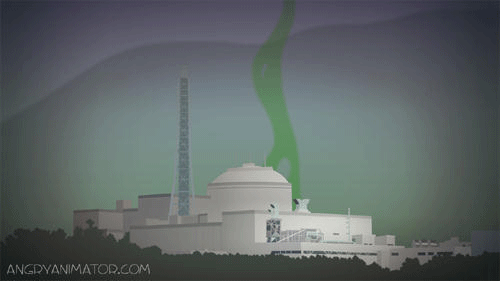
MARK WILLACY, REPORTER: People frolic in its shadow, a reactor its critics call the most dangerous in Japan. The name Monju comes from one of Buddha’s chief attendants, a purveyor of enlightenment depicted resting on the back of a lion, a beast whose phenomenal powers are controlled only by Monju’s wisdom.
But opponents of this prototype reactor fear its operators do not have the wisdom to harness its enormous energy.
KEIJI KOBAYASHI, FAST-BREEDER REACTOR EXPERT (voiceover translation): If a meltdown happens, it will get out of control very quickly. If the reactor core was to melt, the explosive energy would produce a blast like a nuclear bomb.
FUKIKO IKEJIMA, ‘STOP MONJU’ GROUP (voiceover translation): If a big accident were to happen, the impact would not stop in Japan, but spread around the world. It is our most dangerous reactor.
MARK WILLACY: And this is one of the reasons many Japanese fear Monju, because it uses sodium to cool a reactor, the substance that can ignite upon contact with oxygen. In 1995, a sodium leak at Monju caused a serious fire, one that resulted in the plant being out of operation for 15 years.
Lateline was given an exclusive tour of Monju, including an interview with the plant’s director-general, Satoru Kondo.
Continue reading at Problem plagued nuclear reactor called world’s most dangerous
Nuclear industry says it will take 40 years to decommission Fukushima nuclear reactors
It will take 40 years, the nuclear industry says, to decommission the reactors. (Not the 6 months the industry claimed would be required to bring the “slightly damaged” reactors back online.)
Slow progress containing problems at Fukushima, new ones arise http://nuclearhistory.wordpress.com/2012/09/11/slow-progress-containing-problems-at-fukushima-new-ones-arise/ September 11, 2012 The Asahi Shimbun Japan By TAKASHI SUGIMOTO/ Staff Writer The operator is having difficulty pumping water into destroyed reactors at the Fukushima No. 1 plant, tanks are rapidly filling with radioactive water, and hundreds of potentially volatile uranium fuel assemblies remain in a precarious storage pool that some warn could collapse in another strong earthquake. Continue reading
INS (InternationalNuclear Services ) second class safety for MOX transport
INS (InternationalNuclear Services — a subsidiary of the NDA) appears hell-bent on
shipping this MOX fuel to Germany on a third-hand ship with second class safety and kept afloat on first class INS PR alone
 International Nuclear Services Putting Business Before Safety http://lifeboat.com/blog/2012/09/international-nuclear-services-putting-business-before-safety by Tom Kerwick Whilst I was checking up on C.O.R.E. (Cumbrians Opposed to a Radioactive Environment) this weekend, I read of latest plans to ship plutonium MOX fuel assemblies from Sellafield to the small German port of Nordenham near Bremerhaven on the NDA’s (Nuclear Decommissioning Authority) ageing ship Atlantic Osprey. Continue reading
1 This Month




PLEASE OPPOSE HR 8255 AND S.3639 – bills would accelerate satellite deployment, with no environmental review or safeguards – https://ncstd5li.quorum.us/campaign/169331/
To see nuclear-related stories in greater depth and intensity – go to https://nuclearinformation.wordpress.com
-
Archives
- September 2026 (339)
- August 2026 (330)
- July 2026 (355)
- June 2026 (287)
- May 2026 (306)
- April 2026 (356)
- March 2026 (251)
- February 2026 (267)
- January 2026 (308)
- December 2025 (358)
- November 2025 (359)
- October 2025 (375)
-
Categories
- 1
- 1 NUCLEAR ISSUES
- business and costs
- climate change
- culture and arts
- ENERGY
- environment
- health
- history
- indigenous issues
- Legal
- marketing of nuclear
- media
- opposition to nuclear
- PERSONAL STORIES
- politics
- politics international
- Religion and ethics
- safety
- secrets,lies and civil liberties
- spinbuster
- technology
- Uranium
- wastes
- weapons and war
- Women
- 2 WORLD
- ACTION
- AFRICA
- Atrocities
- AUSTRALIA
- Christina's notes
- Christina's themes
- culture and arts
- Events
- Fuk 2022
- Fuk 2023
- Fukushima 2017
- Fukushima 2018
- fukushima 2019
- Fukushima 2020
- Fukushima 2021
- general
- global warming
- Humour (God we need it)
- Nuclear
- RARE EARTHS
- Reference
- resources – print
- Resources -audiovicual
- Weekly Newsletter
- World
- World Nuclear
- YouTube
-
RSS
Entries RSS
Comments RSS

