A horrible combination – fracking and nuclear reactor

 Fracking and nuclear side by side in Pennsylvania: A match made in hell? RT.com 25 October, 2012, Plans are afoot to drill a well that will use fracking technology only a mile from a nuclear power plant in Pennsylvania. The parties involved say they are unconcerned, despite evidence showing fracking increases incidence of earthquake….. http://rt.com/usa/news/fracking-nuclear-earthquake-safety-243/
Outside Fukushima’s evacuation zone, but kindergarten still not safe
NHK: Kindergarten outside evacuation zone closed because of Fukushima radiation threat — “No one can deny the reality” (VIDEO) http://enenews.com/nhk-fukushima-kindergarten-evacuation-zone-closed-because-radiation-threat-one-deny-reality-contamination-away-video October 24th, 2012 at
 Watch the NHK report here http://www.youtube.com/watch?feature=player_detailpage&v=6scs7iE02Vg#t=145s
Source: NHK NewsWatch 9
Published by: Missingsky101
Date Aired: February 2012
Date Published: Oct 23, 2012
[The head of a kindergarten in Minamisoma city, Fukushima Prefecture] decided to close the kindergarten indefinitely […] a history of 60 years […]
[He] says, “No one can deny the reality that the community is exposed to radiation” […]
The director was forthright about lingering concerns of radiation that never went away no matter how hard the school tried to decontaminate the premises […]
Wider evacuation area plans needed, says Japan’s nuclear regulator
the wide area of forecasted contamination means local governments will face a greater burden in compiling effective disaster management plans.
Shunichi Tanaka, chairman of the Nuclear Regulation Authority, has called such plans a minimum requirement before nuclear plants can be cleared for a restart.
If local governments cannot compile effective disaster management plans, it means the security of local residents is not assured. In such circumstances, not only would it be difficult to resume operations at such plants, but the very existence of those plants could be called into question.
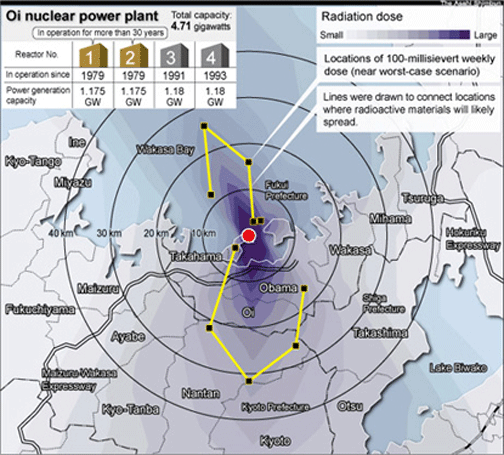
Forecast predicts wider evacuations needed if nuclear disaster repeated Nuclear watchdog may broaden definition of active fault lines October 24, 2012 THE ASAHI SHIMBUN A forecast of the radiation released in another nuclear accident shows that at four plants, a 30-kilometer evacuation zone would be insufficient for public safety, and that more distant residents would need to flee their homes too. Continue reading
30-km nuke safety zone may not be enough http://www.japantimes.co.jp/text/nn20121024a3.html Kyodo Radiation doses beyond 30 km from four nuclear plants, including those in Niigata and Fukui prefectures, could reach 100 millisieverts in the first seven days amid a severe meltdown crisis like the one that started in March 2011 at the Fukushima No. 1 complex, according to estimates by the Nuclear Regulation Authority.The NRA is crafting new guidelines on nuclear disaster mitigation measures based on the Fukushima disaster and has proposed a radius of 30 km from a nuclear plant as a rough standard for areas where special preparations against fallout exposure should be made.
The latest simulation results, however, could lead local governments to require preparations in areas beyond the 30-km zone.
The four nuclear power stations are Tokyo Electric Power Co.’s Kashiwazaki-Kariwa plant in Niigata Prefecture and Fukushima No. 2 plant in Fukushima Prefecture, Kansai Electric Power Co.’s Oi plant in Fukui Prefecture, and Chubu Electric Power Co.’s Hamaoka plant in Shizuoka Prefecture.
The NRA assumed two scenarios — one in which the amount of radioactive substances released is as high as in the Fukushima disaster and the other in which all reactors at each plant suffer meltdowns — to identify areas in which exposure could reach 100 millisieverts in the first seven days. The simulation did not take into account the geography around the plants.
For Kashiwazaki-Kariwa, areas located within a 40-km radius of the plant would register 100 millisieverts.
Identifying nuclear reactors that are in dangerous locations
 In China 19 of the 27 reactors are being built in areas identified as dangerous.
Scientists pinpoint nuclear plants in high-risk zones http://www.powerengineeringint.com/articles/2012/10/scientists-pinpoint-nuclear-plants-in-high-risk-zones.html 19/10/2012 By Diarmaid Williams Scientists in the Catholic University of Leuven, Belgium have produced a pioneering study, which shows nuclear power plants that are located in zones affected by tsunamis. Continue reading
How Many Potential Fukushimas in US?
Nuclear Perceptions Fight Reality OpEd News, By William Boardman, 22 Oct 12, FUKUSHIMA FREAKOUT OBSCURES REAL ACCIDENT THAT GOES ON AND ON “……How Many Potential Fukushimas in US? After discussing the Fort Calhoun nuclear plant surrounded by flood waters in 2011, with five
full-to-capacity dams upstream, Gunderson commented: “Yet the NRC was basically telling everybody, don’t worry be happy. You know, the probability of a dam failing is pretty low, but so is the probability of a 60 foot high tsunami hitting Fukushima. We know that low-probability events happen. And the NRC and Tokyo Electric both basically don’t want to admit that these events can happen. And we’ve got 34 different Fukushimas in the United States — one third of the nuclear fleet is in danger of an upstream dam failing.”
Currently four U.S. nuclear power plants have been shut down for extended periods of one to four years, while ratepayers continue to pay the operating costs of plants that aren’t operating. The two shut down reactors at San Onofre in California are costing ratepayers $50 million a month just to maintain the opportunity to re-start the reactors on short notice.
Worldwide, about 60 of the world’s 434 so-called safe, clean, reliable, inexpensive nuclear power plants are shut down, some forever.
“It just shows that the people we’re counting on to protect us, the regulators and the people that own these power plants, can’t be trusted,” Gunderson concluded. http://www.opednews.com/articles/Nuclear-Perceptions-Fight-by-William-Boardman-121022-931.html
Warning to Taiwan on its special danger from nuclear power
Taiwan has one of the highest densities of nuclear power plants in the world
the population density in northern Taiwan is so high that it would be very difficult to evacuate people if a nuclear accident were to occur at the Fourth Nuclear Power Plant in Gongliao District (貢寮), New Taipei City (新北市).
“The evacuation efficiency in northern Taiwan is virtually zero,”
Scientist warns of dangers of Taiwan nuclear mishap Taipei Times 21 Oct 12, By Lee I-chia A Japanese nuclear scientist and researcher says that if a nuclear accident occurred at one of northern Taiwan’s nuclear power plants, about 30,000 people would die within a short period of time and up to 7 million people could develop cancer from exposure to the nuclear radiation. Continue reading
Flood danger to USA nuclear plants hidden by Nuclear Regulatory Commission
Leaked Report Suggests Long-Known Flood Threat To Nuclear Plants, Safety Advocates Say HUFFINGTON POST 10/19/2012 An un-redacted version of a recently released Nuclear Regulatory Commission report highlights the threat that flooding poses to nuclear power plants located near large dams — and suggests that the NRC has misled the public for years about the severity of the threat, according to engineers and nuclear safety advocates. Continue reading
80 year licenses for USA’s old nuclear reactors?

 AUDIO “You won’t believe this”: US nuclear regulator meets to discuss 80-year licenses for old reactors -Expert ) http://enenews.com/you-wont-believe-this-us-nuclear-regulator-meets-to-discuss-80-year-licenses-for-old-reactors-not-just-rolling-the-dice-youre-practically-committing-suicide-expert-video
October 18th, 2012 Title: Interview with David Freeman
Source: IF YOU LOVE THIS PLANET with Dr. Helen Caldicott
Date: Oct. 12, 2012
h/t MsMilkytheclown
David Freeman, a senior advisor with Friends of the Earth’s nuclear campaign […] was appointed chairman of the Tennessee Valley Authority by President Jimmy Carter in 1977, where he stopped the construction of eight large nuclear power plants and pioneered a massive energy conservation program. Subsequently, Freeman served for two decades as general manager of several large public power agencies including the Los Angeles Department of Water and Power, the New York Power Authority and the Sacramento Municipal Utility District. He is a renowned expert on clean energy, efficiency and the risks of nuclear power.
David Freeman, former chairman of the Tennessee Valley Authority: And now guess what? The Nuclear Regulatory Commission last Thursday, guess what they met on? You won’t believe this… The subject of the meeting was 80-year licenses for old nuclear power plants […] If you have a plant operating for 80 years [next to an earthquake fault] you’re not just rolling the dice, you’re practically committing suicide […] everyone living within a 50 mile radius is a guinea pig.
Russia pulls out of nuclear Threat Reduction program
 After 20 Years of US Aid, Russia Goes Solo on Controlling Loose Nukes Voice of America October 18th, 2012 The day that Russia’s government decided last week to end its participation in the Nunn-Lugar Cooperative Threat Reduction program, a huge, mushroom-shaped cloud rose high in the air over Orenburg.
In this case, the dust was kicked up by massive, accidental blasts of conventional weapons, largely stores of Soviet-era artillery shells.
To avoid the real thing, a nuclear explosion, American taxpayers have paid $7 billion over the last 20 years to cut the threat of loose nukes scattered around the former Soviet Union. Continue reading
Nuclear power UNsafety in India
 India questions its own nuclear industry, SMH, October 15, 2012 ”…….India’s comptroller and auditor-general, Vinod Rai, has found the body that oversees nuclear safety in India, the Atomic Energy Regulatory Board, is ineffective, mired in bureaucracy and negligent in monitoring safety.
Sixty per cent of regulatory inspection reports for operating nuclear power plants in India were either delayed – up to 153 days late – or not undertaken at all. For power plants under construction, the number of regulatory inspections delayed or not done was 66 per cent.
Smaller radiation facilities operate throughout the country with no licences and no oversight at all. In many cases there are no rules for nuclear operators to follow. Despite an order from the government in 1983, the board has still not developed an overarching nuclear and radiation safety policy for India.
And even when laws do exist and are broken, the existing legislation gives the board almost no punitive power. In some cases, the fines for nuclear safety transgressions are as low as 500 rupees – less than $10.
India has had nuclear scares already. In 2010, a gamma irradiation machine containing Cobalt-60 was sold off by Delhi University for scrap. Pulled apart, it unleashed a massive dose of radiation, killing one person and putting another six in hospital.
The Indian government has legislation before parliament to replace the board with a new body, the proposed Nuclear Safety Regulatory Authority.
But Prabir Purkayastha from the Delhi Science Forum said: ”It is a very weak piece of legislation, that makes the regulator subservient to a group of ministers. It is a weakening of the current regulation.” http://www.smh.com.au/opinion/political-news/india-questions-its-own-nuclear-industry-20121014-27l0a.html#ixzz29Zt1gRpm
Most of Europe’s nuclear reactors are just not safe
 Most EU Nuclear Power Plants ‘Unsafe’ IPS, By Julio Godoy BERLIN, Oct 16 2012 – The so-called ‘stress tests’ on nuclear power plants in the European Union (EU) have confirmed environmental and energy activists’ worst fears: most European nuclear facilities do not meet minimum security standards. Continue reading
China’s nuclear power program slows down, as safety problems recognised
China Nuclear Report Acknowledges Safety Concerns, WSJ, By BRIAN SPEGELE And WAYNE MA 16 Oct 12, BEIJING — A report by China’s Ministry of Environmental Protection
acknowledged safety concerns in China’s fleet of nuclear reactors, including potential complications from the sheer variety of reactors in operation…. Continue reading
70 activists show up poor security at Sweden’s nuclear power plants
Greenpeace Sweden exposes lax security at nuclear plants Greenpeace, by Brian Blomme – October 9, 2012 They poured onto the sites of two nuclear reactor plants in Sweden this morning with minimal problems: more than 70 Greenpeace activists, from five countries, conducted peaceful stress tests of the sites.
The goal: to show how weak security arrangements are at the two plants. Continue reading
The UNsafety of South Korea’s nuclear power plants
 Nuclear safety concerns growing Korea Times. Experts stress system overhaul necessary to avoid disaster By Park Si-soo, 8 Oct 12, With nuclear reactors shutting down repeatedly month after month, there is growing concern over whether the nation’s atomic power plant management system has a structural problem that could lead to disaster. Continue reading
1 This Month




PLEASE OPPOSE HR 8255 AND S.3639 – bills would accelerate satellite deployment, with no environmental review or safeguards – https://ncstd5li.quorum.us/campaign/169331/
To see nuclear-related stories in greater depth and intensity – go to https://nuclearinformation.wordpress.com
-
Archives
- September 2026 (330)
- August 2026 (330)
- July 2026 (355)
- June 2026 (287)
- May 2026 (306)
- April 2026 (356)
- March 2026 (251)
- February 2026 (267)
- January 2026 (308)
- December 2025 (358)
- November 2025 (359)
- October 2025 (375)
-
Categories
- 1
- 1 NUCLEAR ISSUES
- business and costs
- climate change
- culture and arts
- ENERGY
- environment
- health
- history
- indigenous issues
- Legal
- marketing of nuclear
- media
- opposition to nuclear
- PERSONAL STORIES
- politics
- politics international
- Religion and ethics
- safety
- secrets,lies and civil liberties
- spinbuster
- technology
- Uranium
- wastes
- weapons and war
- Women
- 2 WORLD
- ACTION
- AFRICA
- Atrocities
- AUSTRALIA
- Christina's notes
- Christina's themes
- culture and arts
- Events
- Fuk 2022
- Fuk 2023
- Fukushima 2017
- Fukushima 2018
- fukushima 2019
- Fukushima 2020
- Fukushima 2021
- general
- global warming
- Humour (God we need it)
- Nuclear
- RARE EARTHS
- Reference
- resources – print
- Resources -audiovicual
- Weekly Newsletter
- World
- World Nuclear
- YouTube
-
RSS
Entries RSS
Comments RSS

