World ignores Fukushima radiation at our peril
 Fukushima is currently releasing up to 93 billion becquerels of radioactive cesium into the ocean each day. How much radiation is that? A quick calculation shows that Chernobyl released around ten thousand times more radioactive cesium each day during the reactor fire. But the Chernobyl fire only lasted 10 days … and the Fukushima release has been ongoing for more than 2 years so far.
Indeed, Fukushima has already spewed much more radioactive cesium and iodine 131 than Chernobyl. The amount of radioactive cesium released by Fukushima was some 20-30 times higher than initially admitted.
Fukushima also pumped out huge amounts of radioactive iodine 129 – which has a half-life of 15.7 million years.
Fukushima has also dumped up to 900 trillion becquerels of radioactive strontium-90 – which is a powerful internal emitter which mimics calcium and collects in our bones – into the ocean..
Radiation Is Not On People’s Radar, Dr. Mark Sircus, Activist Post, 9 April 13, In publishing Atomic Suicide Drs. Walter and Lao Russell united with Dr. Albert Schweitzer’s 1957 appeal to the world to end nuclear tests, and in fact any and all use of radioactive elements. In this prophetic book, the Russells explain clearly that with radioactive elements unleashed into our atmosphere, the human race is heading for catastrophe. Giving detailed scientific evidence, they warn that ‘to fail to consider the nature of radioactive elements and their consequences would be a folly for which humanity would have to pay a terrible price.’ Continue reading
NRC report on San Onofre Nuclear Generating Station not good enough
Sen. Boxer Blasts Report on San Onofre Nuclear Generating Station SAN DIEGO (CNS) 11 April 13, – Sen. Barbara Boxer, D-Calif., Wednesday blasted a preliminary finding by Nuclear Regulatory Commission staff that restarting a unit at the idled San Onofre Nuclear Generating Station would not present significant safety hazards.
Officials with Southern California Edison, the plant’s majority owner and operator, have asked for permission to operate the plant’s Unit 2 reactor at 70 percent beginning June 1. The utility wants to run the unit at partial power for five months, then shut it down for an inspection of steam pressure tubes.
Boxer and Rep. Edward Markey, D-Mass, sent a letter to the NRC this week demanding that a comprehensive investigation of the plant be completed before any units be permitted to operate. They also said full public hearings should be held before a decision is made. “The NRC staff proposal, which could pave the way for the restart of the San Onofre nuclear power plant before the investigation of the crippled plant are completed, is dangerous and premature,” Boxer said in response to the commission staff’s preliminary finding. “It makes absolutely no sense to even consider taking any steps to reopen San Onofre until these investigations look at every aspect of reopening the plant, given the failure of the tubes that carry radioactive water.
“In addition, the damaged plant is located in an area at risk of earthquake and tsunami,” she said. “With 8 million people living within 50 miles of this plant, the staff proposal is beyond irresponsible.” …… The NRC has promised to hold a public meeting in Southern California before any final decisions are made on a restart plan. The agency and SCE have repeatedly said they won’t restart the plant until they are sure it is safe. http://www.sandiego6.com/news/local/Sen-Boxer-Blasts-Report-on-San-Onofre-Nuclear-Generating-Station-202441161.html
Earthquake? no worries – Iran will build more nuclear reactors there
 Iran says it will build more nuclear plants in area hit by earthquake : http://www.foxnews.com/world/2013/04/10/iran-to-build-more-nuclear-plants-in-area-hit-by-earthquake/#ixzz2QBoycUDm April 10, 2013
FoxNews A day after an earthquake rattled the area containing Iran’s only nuclear power plant, the country announced that it plans to build more plants in the same place.
Tuesday’s magnitude 6.1 earthquake struck 55 miles southeast of Bushehr, killing at least 37 and injuring more than 900, Iranian officials said.
The Russian power company that helped build the nuclear plant says its operations were unaffected. But the head of Iran’s Atomic Energy Organization told state TV hours after the earthquake that more reactors would be built near Bushehr, Reuters reports.
Iran has repeatedly ignored safety concerns about housing a nuclear facility in the area, which is highly seismic.
Last week, a report by U.S. think tanks the Carnegie Endowment and the Federation of American Scientists said the Bushehr reactor sits at the intersection of three tectonic plates, Reuters reports.
In 2003, an earthquake in Bam, which is about 600 miles east of Bushehr, killed more than 25,000 people.
Iran’s nuclear plant – close to recent earthquake
Strong earthquake near Iran nuclear plant kills dozens Radio Australia 10 April 2013, More than 30 people are dead after a magnitude 6.3 earthquake which hit near Iran’s only nuclear power plant. A powerful earthquake has struck close to Iran’s only nuclear power station, killing at least 37 people and injuring 850 as it destroyed homes and devastated two small villages.
The magnitude 6.3 quake totally destroyed one village, a Red Crescent official told the Iranian Students’ News Agency (ISNA), but the nearby Bushehr nuclear plant was undamaged, according to Iranian officials and the Russian company that built it.
Many houses in rural parts of the province are made of mud bricks, which have been known to crumble easily in quake-prone Iran.
The death toll is expected to climb, as the stricken area is home to some 12,000 inhabitants.
Across the Gulf, offices in Qatar and Bahrain were evacuated after the quake. Its epicentre was 89 km south-east of the port of Bushehr, according to the US Geological Survey.
The early afternoon shock was also felt in financial hub Dubai, Kuwait and the United Arab Emirates
The Russian company that built the nuclear power station, 18km south of Bushehr, said the plant was unaffected….. http://www.radioaustralia.net.au/international/2013-04-10/strong-earthquake-near-iran-nuclear-plant-kills-dozens/1113782
Government Accountability Office find USA nuclear evacuation plans inadequate
Feds sound alarm on nuclear evacuations, NJ.com 11 April 13, By The Associated Press Regulators and congressional investigators clashed today over a new report warning that in the event of an accident at a nuclear plant, panicking residents from outside the official evacuation zone might jam the roads and prevent others from escaping.
The report by the Government Accountability Office, which acts as the investigative arm of Congress, challenges a three-decade-old fundamental of emergency planning around American nuclear power plants: that preparations for evacuation should focus on people who live within 10 miles of the site.
The GAO found that people living beyond the official 10-mile evacuation zone might be so frightened by the prospect of spreading radiation that they would flee of their own accord, clog roads, and delay the escape of others. The investigators said regulators have never properly studied how many people beyond 10 miles would make their own decisions to take flight, prompting what is called a “shadow evacuation.”
As a result, the GAO report says, “evacuation time estimates may not accurately consider the impact of shadow evacuations.”……
The investigation was requested by four U.S. senators: Democrats Barbara Boxer of California, Robert P. Casey Jr. of Pennsylvania and Sheldon Whitehouse of Rhode Island, and independent Bernard Sanders of Vermont. They asked for the report in 2011 in response to an Associated Press investigative series reporting weaknesses in community planning for nuclear accidents, including the likelihood of surprisingly large shadow evacuations…… http://www.nj.com/news/index.ssf/2013/04/feds_sound_alarm_on_nuclear_ev.html
Japan’s oversight of Fukushima radiation too lax: public concern about food
Japan nuclear safety plans too lax for crowded, quake-prone nation, say nuclear experts The Star, By: Mari Yamaguchi The Associated Press, Apr 08 2013 TOKYO—Experts who investigated Japan’s nuclear crisis said Monday that government oversight of the crippled plant’s operator is still too lax, as public concern has grown over recent safety problems.
A power failure last month caused by a rat that short-circuited a switchboard left the Fukushima Dai-ichi nuclear plant’s fuel storage pools without cooling water for more than a day. Last Friday another cooling failure occurred, and hours later the operator reported a large leak of radioactive water from underground tanks.
The plant’s operator, Tokyo Electric Power Co., revealed Saturday that up to 120 tons of highly contaminated water escaped from a temporary underground tank and a smaller amount from another tank. TEPCO said it believes the water has not flowed into the ocean.
Regulators asked TEPCO on Monday to determine the cause and contain the problem quickly.
But the investigators told parliament on Monday that the recently formed Nuclear Regulation Authority is merely rubber-stamping TEPCO’s work at the plant, Continue reading
Failure of Fukushima cooling system due to rat risk
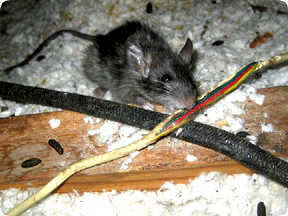 “We were installing wire nets to keep the rats out. But the end of one of the wires may have momentarily come into contact with a live terminal,” said Masayuki Ono, general manager at Tepco’s Nuclear Power and Plant Siting Division. “The next moment, there were sirens.”
Rat Chase Again Bedevils Fukushima Nuclear Plant http://www.nytimes.com/2013/04/06/world/asia/rat-chase-again-bedevils-fukushima-nuclear-plant.html?_r=0 By HIROKO TABUCHI April 5, 2013 TOKYO — Workers at the stricken Fukushima nuclear power plant who were installing wire nets Friday to keep rats away from a vital cooling system instead tripped up that system, causing it to fail for the second time in weeks. The spent-fuel pool at the site’s No. 3 reactor went without fresh cooling water for almost three hours on Friday afternoon, said the plant’s operator, the Tokyo Electric Power Company, or Tepco. Continue reading
The very real risk of Hanford nuclear waste tanks exploding
The nuclear safety board warned about the risk of explosion to Wyden, who wanted comment on the safety and operation of Hanford’s tanks, technical issues that have been raised about the design of a plant to treat the waste in those tanks, and Hanford’s overall safety culture.
Hanford Nuclear Waste Tanks Could Explode, Agency Warns http://www.huffingtonpost.com/2013/04/02/hanford-nuclear-waste-could-explode_n_3001134.html?utm_hp_ref=green includes video By SHANNON DININNY 04/02/13 YAKIMA, Wash. — Underground tanks that hold a stew of toxic, radioactive waste at the nation’s most contaminated nuclear site pose a possible risk of explosion, a nuclear safety board said in advance of confirmation hearings for the next leader of the Energy Department.
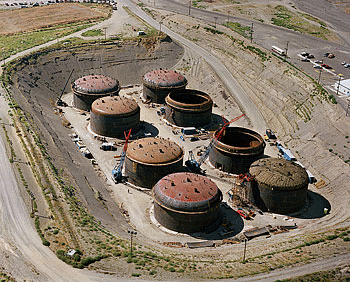
State and federal officials have long known that hydrogen gas could build up inside the tanks at the Hanford Nuclear Reservation, leading to an explosion that would release radioactive material. The Defense Nuclear Facilities Safety Board recommended additional monitoring and ventilation of the tanks last fall, and federal officials were working to develop a plan to implement the recommendation.
The board expressed those concerns again Monday to U.S. Sen. Ron Wyden, D-Ore., who is chairman of the Senate Energy and Natural Resources Committee and had sought the board’s perspective about cleanup at Hanford. Continue reading
Nuclear Regulatory Commission not facing up to flood risks
 Nuclear Power Flood Risk: NRC Insiders Say Agency Continues To Look The Other Way HUFFINGON POST Tom Zeller Jr. 03/29/2013 According to findings made public earlier this month, the Nuclear Regulatory Commission recently uncovered potentially significant flooding vulnerabilities at two Tennessee nuclear power plants and, after a thorough investigation, the agency aggressively sanctioned the errant operator for several safety violations — although the facilities were permitted to continue operating.
An internal document quietly released this week by the agency, however, suggests that some NRC employees with extensive knowledge of the threat believe the agency is violating its own regulatory mission by allowing at least one reactor to stay online, given the potential for flooding that would likely hobble core cooling equipment and possibly trigger a meltdown.
The odds of this happening, of course, are small. But the NRC is reviewing a variety of risks at United States nuclear power plants in the aftermath of the 2011 meltdown at the Fukushima-Daiichi facility in Japan, which succumbed to a rare but devastating earthquake and subsequent tsunami. Among the risks being considered by the agency is the potential at several U.S. plants on inland waterways to suffer damage if upstream dams are breached or otherwise fail.
Concerns that the NRC was not acting swiftly or decisively enough on the upstream dam risk were raised late last year by two other engineers inside the agency. Steps are being taken to shore up flood defenses at several plants, but no facility has been shuttered by regulators as a result of the heightened scrutiny.
In a memo dated March 19 and posted to the NRC website on Monday, Carl F. Lyon and Patrick D. Milano, both members of the NRC’s Office of Nuclear Reactor Regulation, argue that a rare but consequential rainfall is all that would be needed to disable cooling systems for a reactor at the Watts Bar nuclear station — referred to as “WBN Unit 1” — near Spring City, Tenn.
“Only the probable maximum precipitation event, without a concurrent earthquake or tsunami or any other accident,” the two employees wrote, “is needed at WBN Unit 1 to produce a loss of all decay heat removal systems.”…… http://www.huffingtonpost.com/2013/03/29/nuclear-power-flood-risk_n_2979098.html
How wildlife can, and does, damage nuclear reactors
 Wildlife vs U.S. nuclear plants: Flies short-out transformer — Pelican starts emergency generator — Snake causes fire — Bird shuts down reactor… more http://enenews.com/wildlife-incidents-at-u-s-nuclear-plants-flies-short-out-power-transformer-pelican-starts-emergency-generator-snake-causes-fire-fish-block-water-intake-more
March 27th, 2013
Title: Fission Stories #133: Mayflies, and Squirrels, and Rats
 Source: All Things Nuclear (Union of Concerned Scientists)
Author: Dave Lochbaum, director, Nuclear Safety Project
Date: March 26, 2013
[…] one wonders about the havoc that an individual saboteur or a team of bad guys might be able to cause by malicious intent. Could well-trained and heavily armed attackers cause more devastation than a furry little squirrel or a pesky rat? […]
Selected incidents at U.S. nuclear plants:
Pelican started an emergency diesel generator
Bird caused […] shut down […] after it landed in the switchyard containing electrical cables connecting the plant to its offsite electrical power grid
Snake slithering onto an overhead power cable […] caused a short that caught the wooden pole holding the cable on fire
“A large number of small forage fish” blocked the screens at the intake structure
Squirrel caused an electrical short in the main power transformer.
Bunch of jellyfish blocked the screens at the intake station
Mayflies caused a power transformer to short out
Full report here
See also: Tepco: Animal caused extended power outage at Fukushima Daiichi — Nearly a foot long (PHOTO)
Fears in Ukraine that ageing nuclear reactors will be kept going
 Nuclear Safety Plan Has Ukrainians Worried By Pavol Stracansky KIEV, Mar 27 2013 (IPS) – A 300 million euro loan to improve nuclear safety in the Ukraine has been attacked by environmental groups who say it will instead be used to keep ageing reactors working well beyond their planned lifespans – increasing the risks of a nuclear accident – while doing nothing to address serious issues with the country’s energy intensity.
The European Bank for Reconstruction and Development (EBRD), which approved the loan earlier this month, has said that the money will be used to upgrade safety at nuclear plants to international standards.
But environmentalists say it will instead be used by state energy company Energoatom to keep open or restart ageing reactors and that the EBRD should be helping the Ukraine move away from nuclear power and support renewable energy projects.
Iryna Holovko of the pan-European Bankwatch NGO, which together with other environmental groups has opposed the loan, told IPS: “Energoatom and the Ukrainian government is imposing another 20 years of additional nuclear risk – because of the increased risks associated with ageing of reactors – on the people of Ukraine without developing or offering an alternative option.”….
Environmental groups in the Ukraine point to an accident at the Rivne nuclear power plant’s Reactor 1. Its original lifespan had expired at the end of 2010 but it was given an extension for 20 years. One month later there was an accident, although no radiation leaked…… http://www.ipsnews.net/2013/03/nuclear-safety-plan-has-ukrainians-worried/
31 USA nuclear power plants must upgrade ventilation systems
 Nuclear Regulatory Commission Orders Power Plant Vent Upgrades, But Falls Short Of Requiring Filters HUFFINGTON POST, By MATTHEW DALY 03/19/13 WASHINGTON — U.S. nuclear power plants must upgrade ventilation systems at 31 reactors with designs similar to those that melted down two years ago in Japan, under a Nuclear Regulatory Commission order that stops short of requiring filtered vents, as some safety advocates and NRC’s staff had urged.
The filters are required in Japan and much of Europe, but U.S. utilities say they are unnecessary and expensive. Continue reading
New York Symposium will hear the story of radiation contaminated US Navy men
 The Story of Two Contaminated Navy Navigators,Fukushima and the Health Effects of Low Dose Radiation MARCH 06, 2013http://www.counterpunch.org/2013/03/06/fukushima-and-the-health-effects-of-low-dose-radiation/ by JOHN LaFORGE March 11 and 12, the Helen Caldicott Foundation is convening a symposium at the New York Academy of Medicine in New York City, “The Medical and Ecological Consequences of the Fukushima Nuclear Accident.”
Media attention may be brought to the gathering because of two US Navy navigators who will speak about their radioactive contamination while aboard the air craft carrier USS Reagan. They weren’t exposed by working around the carriers’ two Westinghouse propulsion reactors.
Navigators Maruice Enis, from Rochester, Minnesota, and Jamie Plym, from St. Agustine, Florida, were contaminated when Tokyo Electric Power Company reactors released unprecedented amounts of radiation to the air and the sea following the Great East Japan Earthquake and tsunami beginning March 11, 2011. Four of Tepco’s six Fukushima-Daiichi reactors were wrecked. Continue reading
“Radiation leaking” from Kudankulam nuclear power plant
Kudankulam plant ‘leaking radiation’ since Feb 27, Deccan Herald,
Colombo, Mar 2, 2013 Days after India dismissed as “baseless” reports
about radiation leaks at the yet to be commissioned Kudankulam Nuclear
Power Plant in Tamil Nadu, a Sri Lankan interest group on Saturday
alleged that the atomic power station has been leaking radiation since
February 27.
The People’s Movement Against Kudankulam Nuclear Power Plant, in a
statement, urged officials here to bare the truth.They held the
government of Sri Lanka responsible for turning a blind eye to
radiation threats from Kudankulam…..
http://www.deccanherald.com/content/316125/kudankulam-plant-leaking-radiation-feb.html
Danger to Sri Lanka from Kudankulam Nuclear Power Plant
Lanka seeks protection from Indian radiation http://www.emirates247.com/news/sri-lanka/lanka-seeks-protection-from-indian-radiation-2013-02-23-1.496099, February 23, 2013 Even before being commissioned, Kudankulam Nuclear Power Plant had developed leaks and leading environmentalists have urged the Indian government to protect Sri Lanka from the nuclear power plant, ‘The Island’ reported. Continue reading
1 This Month




PLEASE OPPOSE HR 8255 AND S.3639 – bills would accelerate satellite deployment, with no environmental review or safeguards – https://ncstd5li.quorum.us/campaign/169331/
To see nuclear-related stories in greater depth and intensity – go to https://nuclearinformation.wordpress.com
-
Archives
- September 2026 (330)
- August 2026 (330)
- July 2026 (355)
- June 2026 (287)
- May 2026 (306)
- April 2026 (356)
- March 2026 (251)
- February 2026 (267)
- January 2026 (308)
- December 2025 (358)
- November 2025 (359)
- October 2025 (375)
-
Categories
- 1
- 1 NUCLEAR ISSUES
- business and costs
- climate change
- culture and arts
- ENERGY
- environment
- health
- history
- indigenous issues
- Legal
- marketing of nuclear
- media
- opposition to nuclear
- PERSONAL STORIES
- politics
- politics international
- Religion and ethics
- safety
- secrets,lies and civil liberties
- spinbuster
- technology
- Uranium
- wastes
- weapons and war
- Women
- 2 WORLD
- ACTION
- AFRICA
- Atrocities
- AUSTRALIA
- Christina's notes
- Christina's themes
- culture and arts
- Events
- Fuk 2022
- Fuk 2023
- Fukushima 2017
- Fukushima 2018
- fukushima 2019
- Fukushima 2020
- Fukushima 2021
- general
- global warming
- Humour (God we need it)
- Nuclear
- RARE EARTHS
- Reference
- resources – print
- Resources -audiovicual
- Weekly Newsletter
- World
- World Nuclear
- YouTube
-
RSS
Entries RSS
Comments RSS

