‘Near miss’ at Chalk River nuclear reactor
Atomic Energy of Canada playing down ‘near-miss’ at Ontario nuclear reactorBy Steve Mertl | Daily Brew – Atomic Energy of Canada Ltd. (AECL) is playing down the danger caused by a so-called “near-miss” at its nuclear reactor in Chalk River, Ont., but says it’s still being taken seriously.
An operator mistakenly shut off a pumping system that supplies coolant to the reactor’s core, officials of the Crown corporation told the Canadian Nuclear Safety Commission on Wednesday…….
Unless there’s a release of radiation, the public rarely hears about accidents at nuclear facilities, so AECL’s session before the commission provided a rare glimpse into what can happen.
The Chalk River site, about a two-hour drive northwest of Ottawa, is Canada’s foremost nuclear research facility. It’s also the oldest, first established during the Second World War as part of the atomic bomb program. After the war it transitioned into research on the peaceful uses of nuclear energy and production of isotopes used in medicine.
The facility was the scene of two nuclear accidents in the 1950s, the first in 1952, severely damaging a reactor and creating 4,500 tons of radioactive water that was dumped in ditches near the Ottawa River. A 1958 incident involving the NRU reactor contaminated the reactor building and surrounding area.
The NRU reactor, which went online in 1957, was temporarily shut down in 2007 to deal with safety issues, raising concern about a worldwide shortage of medical isotopes during the year-long closure. It also suffered a radioactive water leak in 2008. The reactor was shut down again in 2009 for more than a year after the water leak recurred.
The latest incident seems trivial by comparison but could have had serious consequences……
According to a 2011 article in the Guardian newspaper, there have been 33 serious incidents and accidents at nuclear power plants since the first Chalk River meltdown in 1952. That one was rated a Level 5 incident on an ascending scale of 1 to 7…..
A 2011 post on the website of the environmental Bellona Foundation warned of an alarming number of emergency shutdowns, or scrams, and unscheduled repairs at Russian nuclear power stations…..http://ca.news.yahoo.com/blogs/dailybrew/atomic-energy-canada-playing-down-near-miss-ontario-185900047.html
Scientists’ doubts on the safety of Kudankulam Nuclear Power Plant
Top scientists express safety concerns over Kudankulam nuclear plant NDTV, by Pallava Bagla, Edited by Mala Das | May 14, 2013 New Delhi: Sixty of the country’s leading scientists have written to chief ministers of Tamil Nadu and Kerala, expressing safety concerns over the controversial Kudankulam Nuclear Power Plant which received the Supreme Court’s nod earlier this month. The scientists, most of who aren’t specialists in nuclear energy, have sought a safety review of the plant by an “independent panel” of experts.
But the scientists, in their three-page petition, have expressed doubts “particularly with reference to possible sub-standard components” that were supplied to the plant. Recently, four faulty valves were detected in the first reactor unit of the plant; they were later replaced. Some Russian officials had also been arrested recently over alleged corruption in sourcing sub-standard materials from some Russian nuclear plants.
Time to tighten regulation of the uranium market
The Global Market in Natural Uranium—From Proliferation Risk to Non-Proliferation Opportunity U
ranium remains a critical component of civil-military nuclear programs. Today, Ian Anthony and Lina Grip reveal that the global market for natural uranium remains relatively unchecked, as does the activities of new exporters from the developing world.
ISN, By Ian Anthony and Lina Grip for SIPRI, 13 May 13,
The effort to cap the number of nuclear armed states in the world has largely focused on limiting the spread of the industrial items and processes needed for the stages of the fuel cycle that can turn uranium or plutonium into forms that could be used to make a nuclear weapon: enrichment or reprocessing.
The most important suppliers of nuclear technology have recently agreed guidelines to restrict access to the most sensitive industrial items, in the framework of the Nuclear Suppliers Group (NSG). Nevertheless, the number of countries proficient in these industrial processes has increased over time, and it is now questionable whether a strategy based on close monitoring of technology ‘choke points’ is by itself a reliable barrier to nuclear proliferation.
Time to tighten regulation of the uranium market?……Restricting access to natural uranium could be an important aspect of the global efforts to obstruct the spread of nuclear weapons. The time is ripe to start thinking seriously about the design of such control measures and how responsibility can be shared across the non-proliferation regime.http://www.isn.ethz.ch/isn/Digital-Library/Articles/Detail/?lng=en&id=163968
Japan’s Nuclear Regulation Authority wants Monju reprocessing plant to stay shut
NRA wants Monju to remain shut downhttp://www.japantimes.co.jp/news/2013/05/14/national/nra-wants-monju-to-remain-shut-down/#.UZQmBqJwpLt Lapses seen in JAEA checks of key reactor components KYODO, STAFF REPORT MAY 14, 2013 The Japan Atomic Energy Agency committed grave safety errors in managing the troubled Monju prototype fast-breeder reactor in Fukui Prefecture, and top officials at the Nuclear Regulation Authority said Monday they plan to make sure it stays closed.
The closure order to the government-linked JAEA will effectively dash any hope of trying to restart the reactor by year’s end, dealing another setback to Japan’s long-stalled plan to set up a nuclear fuel recycling system.
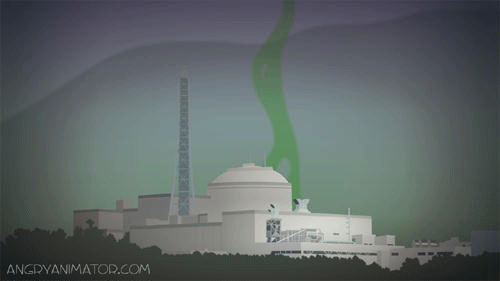
In September, the now-defunct Nuclear and Industrial Safety Agency carried out surprise inspections and determined that JAEA failed to regularly check key components of the experimental 280,000-kw reactor, as required by internal rules. Continue reading
Palisades Nuclear Power Plant chronology of incidents over last 6 years
 A timeline of incidents at Palisades Nuclear Power Plant since 2007, Michigan Live COVERT TOWNSHIP, MI , 12 May 13– The leak that shut down Palisades Nuclear Power Plant May 5 is one of a series of incidents that have bedeviled the nuclear reactor in recent years.
 Nuclear Regulatory Commissioner Kristine Svinicki will tour Palisades Nuclear Power Plant on Monday, May 13, at the invitation of U.S. Rep. Fred Upton, who will accompany her……. http://www.mlive.com/news/kalamazoo/index.ssf/2013/05/palisades_nuclear_power_plant_14.html
Hanford Nuclear reservation getting ever more dangerous
Hanford Nuclear Cleanup May Be Too Dangerous, Future Of Storage Plant Uncertain http://www.huffingtonpost.com/2013/05/09/hanford-nuclear-cleanup-too-dangerous_n_3246263.html?utm_hp_ref=green | By Valerie Brown 05/09/2013 , Scientific American: (click here for original article)
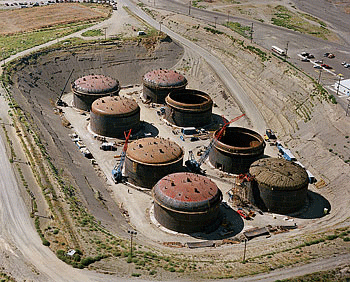
The most toxic and voluminous nuclear waste in the U.S.—208 million liters —sits in decaying underground tanks at the Hanford Site (a nuclear reservation) in southeastern Washington State. It accumulated there from the middle of World War II, when the Manhattan Project invented the first nuclear weapon, to 1987, when the last reactor shut down. The federal government’s current attempt at a permanent solution for safely storing that waste for centuries—the Waste Treatment and Immobilization Plant here—has hit a major snag in the form of potential chain reactions, hydrogen explosions and leaks from metal corrosion. And the revelation last February that six more of the storage tanks are currently leaking has further ramped up the pressure for resolution. Continue reading
Criminals continue to sustain Japan’s nuclear industry
the dirty secret that yakuza-linked workers and companies have long sustained Japan’s nuclear industry —  along with yakuza members themselves, ex-convicts, wanted criminals, and drug addicts working there — is now public knowledge.
most of their members are sociopathic felons who would commit theft, assault or murder to make a little money. And if you consider the black-market value of a little plutonium, you may feel a tad uneasy knowing such people have long had access to it — and can still get their hands on nuclear materials.
Of course, why take action when you can spend more time debating about taking action?
it seems more and more likely that criminals have been running the plants for a very long time — they just don’t all have tattoos
 Yakuza links put nation at added nuclear risk JAPAN TIMES, BY JAKE ADELSTEIN, 5 MAY 13 On April 15, two alleged terrorists in Boston killed three people, injured more than 170 others and terrified a nation — for about $100 it cost them to modify pressure cookers into bombs. We should be glad they didn’t come to Japan, where they may have been able to explode a ready-made nuclear dirty bomb, kill untold thousands, render huge swaths of the country uninhabitable — and get paid by Tokyo Electric Power Co. (Tepco) in the process.
I wish I were kidding. Japan has more than 50 gigantic nuclear “pressure cookers” ripe for exploitation by terrorists. And they wouldn’t even have to lay siege to the facilities. Instead, they could just walk into a nuclear plant and leave with enough weapons-grade plutonium for a small atomic device — which later could be detonated wherever they chose. How?
In Japan, getting access to a nuclear power plant is very simple: fill out a job application. Continue reading
Many occasions of lost radioactive materials in UK
UK watchdog admits losing nuclear materials dozens of times Raw Story, By Terry Macalister, The Guardian, May 5, 2013 Radioactive materials have gone missing from businesses, hospitals and even schools more than 30 times over the last decade, a freedom of information request to the UK’s health and safety authorities has revealed. Continue reading
Share price before safety at Indian Point nuclear reactor
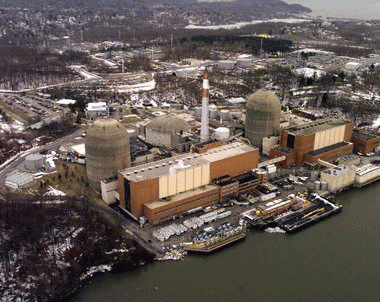 Entergy says no to NY plan for nuclear waste storage http://www.cnycentral.com/news/story.aspx?id=893794#.UYhtw6JwpLs by Laura Hand 05.05.2013 Stockholders give overwhelming no vote
Comptroller Thomas DiNapoli, speaking as trustee of the state’s pension fund, which has about $49million worth of Entergy stock, suggested cutting back on spent fuel pools, and instead storing the waste in dry-casks. DiNapoli says putting spent, cooled nuclear fuel in steel containers surrounded by inert gas is safer.
Entergy’s board said the proposal would limit company flexibility, and shareholders apparently agree. A preliminary count shows only 5% approve the change.
Band-aid patch not good enough for Palisades Nuclear Power Plant
Palisades nuclear plant needs permanent fix, says director of Union of Concerned Scientists’ nuclear safety project, Michigan Live, By Yvonne Zipp | yzipp@mlive.com
In an “issue brief” released Friday, Lochbaum called for a permanent repair to the leaking safety injection refueling water tank that caused a shutdown at the Covert Township facility May 5.
“The NRC must take steps to ensure that a federal regulation developed to protect public health and safety is consistently being met rather than consistently being violated. ‘Patch and restart” may be great for generating revenue, but it is very bad for public safety,” Lochbaum wrote. “The community does not deserve another Palisades patch. It deserves an effective repair.”http://www.mlive.com/news/kalamazoo/index.ssf/2013/05/palisades_nuclear_plant_needs.html
Radiation spilling into Lake Michigan from Palisades nuclear power plant
Nuclear plant spills radiation into Lake Michigan Grist, By John Upton, 9 May 13
Last summer, a leaky tank led to the shutdown of the Palisades nuclear power plant in Michigan. So plant owner Entergy patched up the leak, fired back up the reactor, and hoped for the best.
Unfortunately, the best did not materialize.
The tank began leaking again. But no worries, thought the Einsteins at Entergy, it was only leaking a gallon a day. That was OK, they figured, because the NRC had allowed it to leak up to 38 gallons a day. As of Friday, they were still doing that whole “hoping for the best” thing.
But on Saturday the leaky drip turned into a gush, and all the hoping in the world couldn’t hold back the tide of spilling radioactive water. Nearly 80 gallons of water containing small amounts of radioactive tritium and possibly trace amounts of cobalt and cesium spewed into Lake Michigan, the Nuclear Regulatory Commission told the AP.
Early Sunday morning, the tank was ruled inoperable and the nuclear power plant began powering down. This is reportedly the ninth time that the facility has been shut down since 2011……..
What should be of concern to regulators and the public, Jackson said, is whether any nuclear power plant has enough of a culture of safety in place. That’s especially important because of the intense pressures in the electrical power industry to keep costs low.
Palisades nuclear plant leaks radioactive water to the shores of Lake Michigan
 Local News: Radioactive leak from U.S. nuclear plant “got to the shore” — People on beaches a mile away — Officials downplaying seriousness of incident? (VIDEO) http://enenews.com/local-news-radioctive-leak-from-u-s-nuclear-plant-got-to-the-shore-most-likely-not-a-health-concern-officials-downplaying-seriousness-of-incident
Follow-up to: Nuclear plant spills radioactive water into Lake Michigan (AUDIO)
WSBT: Search for radioactive leak at Palisades nuclear plant[…] WSBT visited a park not far from the plant to hear from people on the beaches. […] Palisades sits about a mile down the beach […] “That’s not good, so I mean I get mad about ribbons and balloons, so radiation is obviously not thrilling either,” Larmee added. […] Groups opposing nuclear power plants, however, say regulators and the plant’s operator are downplaying the seriousness of the incident. “This plant is an accident waiting to happen, and it really needs to be permanently shut down before the worst happens there,” said Kevin Kamps of “Beyond Nuclear.” […]
WHTC: Nuclear Regulatory Commission officials said that 79 gallons of the tainted water had escaped, but by the time it got to the shore, it was highly diluted and posed no threat.
Businessweek: Saturday’s radiation leak “most likely … is not a public health concern,” [Alan Jackson, a radiation health physicist at Henry Ford Health System in Detroit] said. “What’s more a concern is why do these things keep happening?” “I would fixate on, ‘OK, you have this problem. Why aren’t you fixing it?’” he said.
Watch the broadcast here
Pentagon takes 17 officers off the nuclear missile job – safety issues
Pentagon removes 17 officers from duty to launch its most powerful nuclear missiles http://rt.com/usa/air-force-nuclear-missiles-010/ May 08, 2013 In an unprecedented action, the Air Force has removed 17 of its officers from a base at which they had the authority to control and launch nuclear missiles at the president’s command, thereby leaving the mission significantly understaffed. Continue reading
Still the danger of radioactive scrap metal in Delhi
 Delhi still not radiation ready Darpan Singh, Hindustan Times New Delhi, May 08, 2013 Three years after a man was killed in India’s first case of radiation exposure at the Mayapuri scrap market in West Delhi, there is still a big question mark on the preparedness to prevent such disasters.
The National Green Tribunal (NGT) will on Wednesday hear a petition, which has claimed the mechanism to detect radiation is withering away. There is no screening of scrap before it finds its way to the market. The National Disaster Management Authority is still in the process of procuring devices, to be given to the police, to detect radiation.
Safety hazards of India’s Kudankulam nuclear plant
Behind the scenes at Kudankulam… THE HINDU, VASUDEVAN MUKUNTH, 7 May 13 “…. the people of Kudankulam and its surrounding fishing villages protest against the plant and call for its shutdown. Why? Despite accidents being unpredictable by definition, they do occur because the enterprise is immensely complex for anyone to keep track of all its components at the same time.
While the Department of Atomic Energy (DAE) could be addressing this issue well, etc., the complexity increases the opportunities for accidents to occur rather than directly precipitating them. Despite a decent track record for maintenance, the one for compensation in India is dismal, and so the people’s fears are bound to persist.
In order to explain how a nuclear power plant works, I’ve divided it up into short chapters, each explaining the role of an important component. … Continue reading
1 This Month




PLEASE OPPOSE HR 8255 AND S.3639 – bills would accelerate satellite deployment, with no environmental review or safeguards – https://ncstd5li.quorum.us/campaign/169331/
To see nuclear-related stories in greater depth and intensity – go to https://nuclearinformation.wordpress.com
-
Archives
- September 2026 (330)
- August 2026 (330)
- July 2026 (355)
- June 2026 (287)
- May 2026 (306)
- April 2026 (356)
- March 2026 (251)
- February 2026 (267)
- January 2026 (308)
- December 2025 (358)
- November 2025 (359)
- October 2025 (375)
-
Categories
- 1
- 1 NUCLEAR ISSUES
- business and costs
- climate change
- culture and arts
- ENERGY
- environment
- health
- history
- indigenous issues
- Legal
- marketing of nuclear
- media
- opposition to nuclear
- PERSONAL STORIES
- politics
- politics international
- Religion and ethics
- safety
- secrets,lies and civil liberties
- spinbuster
- technology
- Uranium
- wastes
- weapons and war
- Women
- 2 WORLD
- ACTION
- AFRICA
- Atrocities
- AUSTRALIA
- Christina's notes
- Christina's themes
- culture and arts
- Events
- Fuk 2022
- Fuk 2023
- Fukushima 2017
- Fukushima 2018
- fukushima 2019
- Fukushima 2020
- Fukushima 2021
- general
- global warming
- Humour (God we need it)
- Nuclear
- RARE EARTHS
- Reference
- resources – print
- Resources -audiovicual
- Weekly Newsletter
- World
- World Nuclear
- YouTube
-
RSS
Entries RSS
Comments RSS

